≈ Comments Off on THE BEADY EYE SAYS: COP26 IS YET TO GRASP THE NETTLE BY THE NECK.
( Four-minute read)
To grasp the nettle Cop26 has to realize that there can be no compromises with the Climate.
This is not a negotiation with each other. There is another unspoken negotiation going on too – called compromises which are fundamentally unambitious when it comes to Climate Change.
Reducing carbon emissions, improving the food supply and demand imbalance, and reducing water shortages: are the three biggest challenges that the world is currently facing.
At the current temperature rate, we have just 12 years to make a difference.
Public government finances are not enough to fund efforts to keep a global temperature rise below two degrees.
By 2030, by 2070, and by, by do not grasp that it is now we need to ensure your money is tied up ethically, sustainably, and responsibly so it will go a long way to alleviate the increasing effects of climate change, and the subsequent challenges it brings.
To meet growing demand, we need more food, resources, water, and energy and this increase in the use of resources presents global challenges that can not be met by public finances.
So the onus is on the financial sector to make strides for climate change, but most of the fund offerings within the sustainability or environmental space are mainly equity-only strategies.
This poses a significant challenge only in cost but in investment.
It is now that we need to invest in a green economic world that is brimming with prosperity – something that is only expected to rise in the future as the world moves towards a necessarily sustainable society.
Growth is the key reason for general investor interest in sustainability and environmental themes.
One only has to look at sovereign wealth funds investing more and more in the green economy.
Most end-markets in the sustainability space are expected to grow annually at double-digit rates over the next three to five years compared to low single-digit in most developed economies.
So why not now invest sustainably by issuing Green bonds with remuneration in order to provide a clear incentive to drive this change.
They will not just provide financial rewards, but environmental ones, too.
COP26 MIGHT BE THE MOST COMPLEX NEGOTIATION EVER ATTEMPTED.
Why?
Because humans are helplessly reciprocal creatures and without realizing it we mirror each other in what we say and how we say it.
Negotiations are rarely about the issue we’re talking about.
Try compromising with this lot.
The temperature rise has not been, and will not be, uniform or smooth across the country or over time.
Increased heavy precipitation events will continue.
Heat waves (periods of abnormally hot weather lasting days to weeks) everywhere are projected to become more intense.
Hurricane-associated storm intensity and rainfall rates are projected to increase as the climate continues to warm.
Sea level rise will continue past 2100 because the oceans take a very long time to respond to warmer conditions at the Earth’s surface.
The Arctic Ocean is expected to become essentially ice-free in summer before mid-century.
Global climate is projected to continue to change over this century and beyond.
The effects of human-caused global warming are happening now, are irreversible on the timescale of people alive today, and will worsen in the decades to come.
So we must figure out new ways of working together to create a sustainable world.
All human comments are appreciated. All like clicks and abuse chucked in the bin.
≈ Comments Off on THE BEADY EYE SAYS WATCH THIS SPACE. THE UK IS GOING TO BALK ON ITS TRADE DEAL WITH THE EU USING NORTHERN IRELAND AS THE ESCAPE GOAT.
( Fifteen-minute read)
The 1998 Belfast Agreement was supposed to bring peace to the province. In reality, it institutionalized sectarianism by setting up a consociational regime, which, like Lebanon, rewards the hardest communal politicians.
UK-EU trade deal came into force on 1 January 2021.
The deal prevented any tariffs and quotas from being introduced – which would have made it more expensive to trade, but as the UK no longer has to follow EU rules on product standards, new checks were introduced.
However, this deal called the Northern Ireland protocol doesn’t completely eliminate the possibility of tariffs in the future.
If either the UK or the EU shifts their rules too far, the other side could introduce tariffs.
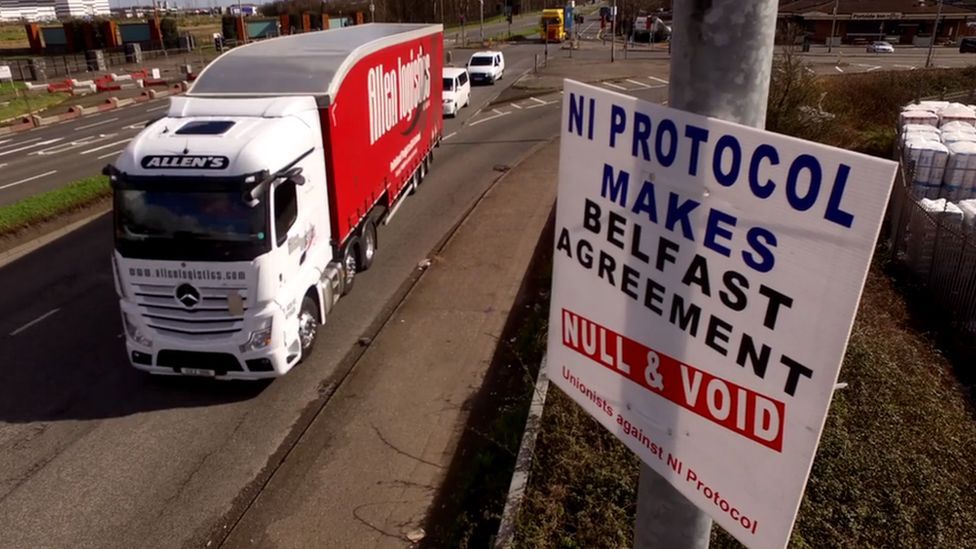
The Northern Ireland protocol keeps Northern Ireland in the EU single market for goods and means EU customs rules are enforced at its ports – but it is strongly opposed among unionists, who see it as separating Northern Ireland from the UK.
At the moment the protocol is part of the Brexit deal and so far the fundamentals of the agreement remain unquestioned.
Why?
Because Boris Johnson will not want a row over Northern Ireland with the EU to overshadow the Cop26 climate change summit in Glasgow.
——–
The DUP is a strange organization for those not familiar with the intricacies of Irish politics.
It began in the outer fringes of fundamentalist evangelicalism when Ian Paisley, the party’s founder, claimed that the leaders of the main Protestant churches were failing to stand up to “Romanism” and “papism”.
This allowed the DUP to become the dominant force in unionism, replacing the Ulster Unionist Party, which had ruled over the six counties since the state’s foundation.
40 percent of the DUP’s councilors and a third of its elected representatives in the Legislative Assembly are members of the Free Presbyterian church—a denomination that makes up only 0.6 percent of the total population.
They are Christian fundamentalists who still play a big role in the party, and their religious views coincide neatly with their right-wing political positions.
At the core of its politics is a veneration of the queen as a defender of the Protestant faith and the imperial past.
This loyalty is to a “form of national-imperial Britishness whose origins remain strongly associated with a bygone age”
Fortunately, modern Britain is a multicultural society—despite efforts to promote nostalgia for empire—where most of the population has little relationship to the Protestant churches. Nonetheless, this never stops the DUP from yearning for a restoration of old imperial glory.
On this basis, it aligned itself with the hardest Brexiteers in the Tory Party during the 2016 European Union referendum campaign and propped up Theresa May’s government after the 2017 general election in Britain.
The DUP backed Brexit for two reasons.
Firstly, it thought that a clean break with the EU would put an end to any drift towards a 32 county Ireland because the two parts of the country would be governed by different economic arrangements.
Secondly, it supported the Tory fantasy that a fully sovereign Britain would be better able to restore both its “greatness” and its imperial tradition.
———–
In the case of the DUP, this weakness lies in the very nature of its claim to British identity.
The queen is more widely seen as a soap opera matriarch than as the “defender of the faith”. The “Britishness” that plays such a central role in loyalist ideology barely exists in reality.
In the real world, Northern Ireland is one of the most contentious and defining conflicts of the twenty century and one whose impact is still felt today with its roots stretching back to the Anglo-Norman settlement of Ireland in 1167 the history of which shows no matter how dressed up shows that the island of Ireland was once a United Island before the partition of its six northern provinces.
Since then the process of ‘Ulsterization’ occurred, with decades of violence in Northern Ireland have been followed by the possibility of unity through political ends.
Irish unionism itself undergoing a profound transformation through, conflict and removal of religious domination in the South.
Brexit and the continuing difficulties in agreeing on the future EU-UK relationship has however fundamentally changed political opinion in Northern Ireland, where Irish unity is now a means by which Northern Ireland can avoid the post-Brexit chaos and re-enter the European Union.
The possibility of unity referenda in a five-to-10-year timeframe is now very real.
If this were to happen big questions would have to be answered first.
How would a united Ireland integrate public services such as health, welfare, education, policing, or infrastructural development?
So political and cultural positions are likely to be more important in the
coming months. “How can you unite this island when in Northern Ireland the
DUP ensures that the population of NI remains divided and segregated?
Comprehensive support in the Republic for a united Ireland will only be achieved if there is an emerging consensus in Northern Ireland, with almost 1 million Unionists agreeing to enter into dialogue.
Nor can that path cannot come through the politics of Sinn Fein.
A return to the Troubles in the North, rather than any UK demand for the European Court of Justice to lose oversight of the implementation of EU law in Northern Ireland is a tough ask for Brussels.
It is an unacceptable price for Irish unity.
As with most problems in the world today we can talk, write, post till the cows come home.
Brexit now tragically risks driving a horse and coach what was agreed in the Good Friday agreement
To use a cliche we have to learn from the past.
The youth of NI, the post ceasefire generation have probably little idea of where it all came from, why it came, and why in the end there has to be an agreed solution.
So in the context of a unified Ireland.
If northern Ireland’s economy improves with adjustment to the current protocol so that it simply reflects average Irish economic performance within the EU no Uk 10 bn subventions will be needed, and a united Ireland of some kind will have to agree by Unionists and nationalists.
All human comments are appreciated. All like clicks and abuse chucked in the bin.
( Twelve-minute read)
Since the 1980s, privatization has been the ideological talisman of the bourgeoisie.
Entainerment since the days man first smiled can be anything that removes the human mind from survival to killing each other or to watching competitors to doing so.
The Roman amphitheater was the center of public entertainment in Rome, and all over the Roman Empire. People would go to the amphitheater to see men fighting wild beasts or each other. These men were called gladiators. It was a cruel sport because someone was usually killed
Sport is an important social phenomenon in all levels of modern society, providing a large impact on key areas of social life: it affects national relations, business life, social status, fashion forms, ethical values, people’s lifestyle.
If you accept this the purchase of Newcastle United football club by a sovereignty fund is a tradigital for sport.
Effectively Sovernity wealth funds are state-run institutions, that either rescue crippled finance systems or launder excess funds.
————-
In the past, sovereign wealth funds were mainly ‘passive’ investors, quietly buying shares in big corporations and property without getting involved in management.
The sale of the Premier League football team Newcastle UNITED to Saudi Arabia’s Public Investment Fund the wealth of Saudi Arabia’s Public Investment Fund, a vehicle that controls assets worth $500 billion was met by joy in the streets and criticism from human rights groups and others.
It raises new questions about the economics and morality of allowing a nation-state, and particularly one accused of serious human rights abuses, into the elite club of Premier League owners.
The league said in a statement on Thursday that it could allow the deal to happen because it had received “legally binding assurances” that the Saudi state would not be in control of one of its member clubs.
This suggested that the Premier League owners are now apparently satisfied that the P.I.F. — chaired by Mohammed bin Salman, the crown prince of Saudi Arabia — is entirely separate from the Saudi state, where Salman is deputy prime minister, minister of defense.
“Under Mohammed bin Salman, the human rights situation in Saudi Arabia remains dire — with government critics, women’s rights campaigners, Shia activists, and human defenders still being harassed and jailed, often after blatantly unfair trials.”
The Premier League currently has 12 billionaire club owners including The Glazer Family, Roman Abramovich, and Stan Kroenke. Combined they are worth an astonishing $90.8 billion, according to Forbes
The most-watched sports league in the world, and if I am not mistaking with 20 teams in the league, with the top ten owned by non-residents of the Uk.
The league operates as a corporation and is owned by the 20 member clubs.
With the highest revenue of any association football league in the world that generates around £3.1billion per year in domestic and international television rights, broadcasting in 212 territories to 643 million homes and a potential TV audience of 4.7 billion people each club is a shareholder.
There is no team or individual salary cap in the Premier League.
List of Sportswash. Russia, China, US, Middle East.
Newcastle United has become one of the richest clubs in the Premier League and another shameless mouthpiece for the rich.
——————–
What is a Sovereign Wealth Fund (SWF)?
A Sovereign Wealth Fund (SWF) is a state-owned investment fund or entity that is commonly established from:
Balance of payments surpluses
Official foreign currency operations
The proceeds of privatizations
Governmental transfer payments
Fiscal surpluses
And/or receipts resulting from resource exports.
Classifications of Sovereign Wealth Fund
Stabilization Funds
Savings or Future Generations Funds
Pension Reserve Funds
Reserve Investment Funds
Strategic Development Sovereign Wealth Funds (SDSWF)
Common Sovereign Wealth Fund Objectives:
Protect & stabilize the budget and economy from excess volatility in revenues/exports
Diversify from non-renewable commodity exports
Earn greater returns than on foreign exchange reserves
Assist monetary authorities to dissipate unwanted liquidity
Increase savings for future generations
Fund social and economical development
Sustainable long term capital growth for target countries
Political strategy
Generally speaking, as other countries grow their currency reserves they will seek to diversify reserve portfolios and generate greater returns.
Between the years 2003 to 2013, sovereign wealth fund assets have skyrocketed by rising commodity prices greatly attributable to oil & gas. From the start of 2008 until the end of 2012, sovereign wealth fund assets grew by 59.1%.
BUT THINGS HAVE CHANGED.
Since the onset of the credit crunch, sections of finance capital have come to see the sovereign wealth funds as “indispensable investors of last resort.
Many of the leaders of capitalism fear that the sovereign funds may increasingly switch from purely financial aims to political or strategic goals, or from being passive investors to active involvement in company policymaking.
So the question is:
Should Newcastle (NO LONGER A FOOTBALL CLUB) be allowed to compete in the Premier League?
Why?
Because SWF buys or invests for profit not sport.
All human comments are appreciated. All like clicks and abuse chucked in the bin.
≈ Comments Off on THE BEADY EYE SAY’S: IF WE CONTINUE IN THE SAME DIRECTION AS WE ARE NOW, THE CONSEQUENCES WILL BE UNPREDICATABLE/ DISASTOROUS AND CONFLICT RIDDEN.
We all know that we must shift the direction of the way we live life on Earth.
Sadly, this does not seem to be the case and hence, social conflict and civil unrest seem inevitable.
We all know that what is needed is a coordinated global response and bipartisan domestic response not just to the current pandemic but also to tackle climate change.
As Schwab writes: “The new technology age if shaped responsively and responsibly, could catalyze a new cultural renaissance that will enable us to feel part of something much larger than ourselves – a truly global civilization.
Yes, we are in a fourth industrial-technological revolution with regulators guilty of sleeping by allowing AI to develop financial weapons of mass destruction turning the world into a digitalized market for the sake of short-term profit.
Today, 43% of the world’s population is connected to the internet, mostly in developed countries.
Each time you run a Google search, scan your passport, make an online purchase, or tweet, you are leaving a data trail behind that can be analyzed and monetized. Computers are already making decisions based on this information.
In less than 10 years computer processors are expected to reach the processing power of the human brain. Socialism for the Rich and Capitalism for the Poor.
Think of apps that track how much you eat, sleep, and exercise, and being able to ask a doctor a question by simply tapping it into your smartphone.
In the future, will it ever be possible to be offline anymore?
So are the technologies that surround us tools that we can identify, grasp and consciously use to improve our lives? Or are they more than that: powerful objects and enablers that influence our perception of the world, change our behavior, and affect what it means to be human?
It is therefore worthwhile taking some time to consider exactly what kind of shifts we are experiencing and how we might, collectively and individually, ensure that it creates benefits for the many, rather than the few.
———————————
At the heart of discussions around emerging technologies, there is a critical and central question: what do we want these technologies to deliver for us?
The fourth Industrial revolution is widely taken to be the shift from our reliance on animals, human effort, and biomass as primary sources of energy to the use of fossil fuels and the mechanical power this enabled.
It however can also be described as the advent of “cyber-physical systems” involving entirely new capabilities for people and machines.
It represents entirely new ways in which technology becomes embedded within societies and even our human bodies -. examples include genome editing, new forms of machine intelligence, breakthrough materials, and approaches to governance that rely on cryptographic methods such as the blockchain. It’s just not very evenly distributed.
More people in the world have access to a mobile phone than basic sanitation.
The complexity of these technologies and their emergent nature makes many aspects of the Fourth Industrial Revolution feel unfamiliar and, to many, threatening.
Indeed, it is certain that the governments know this, but instead of helping the poor they are making it harder for them to survive and it is certain that sooner or later when the bubble burst, there will be few survivors.
Added to this is the humungous amounts of money governments are borrowed to keep the government running in the absence of real economic growth.
Since the financial crash and before interest rates were kept at near-zero levels for most of the decade in the run-up to the crisis with the West governments encouraging speculation and risk-taking.
_________________________
Currently, there are three big areas of concern: Inequality, Security, and Identity.
Inequality.
62 individuals controlled more assets than the poorer 3.6 billion people combined, half the world’s population.
Unequal societies tend to be more violent, have higher numbers of people in prison, experience greater levels of mental illness, and have lower life expectancies and lower levels of trust.
An important potential driver of increased inequality is our reliance on digital markets – increase unemployment.
Security.
The combination of the digital world with emerging technologies is creating new “battlespaces”, expanding access to lethal technologies and making it harder to govern and negotiate among states to ensure peace.
The technologies of the Fourth Industrial Revolution also offer expanded capabilities for waging war which is increasingly accessible to both state and non-state actors, such as drones, autonomous weapons, nanomaterials, biological and biochemical weapons, wearable devices, and distributed energy sources
It’s not a question of if non-state actors will use some form of neuroscientific techniques or technologies, but when, and which ones they’ll use.
Identity, voice, and community.
Already, digital media is increasingly becoming the primary driver of our individual and collective framing of society and community, connecting people to individuals and groups in new ways, fostering friendships, and creating new interest groups. Furthermore, such connections transcend many traditional boundaries of interaction.
Unfortunately, expanded connectivity does not necessarily lead to expanded or more diverse worldviews.
Emerging technologies, particularly in the biological realm, are also raising new questions about what it means to be human.
The Fourth Industrial Revolution is the first where the tools of technology can become literally embedded within us and even purposefully change who we are at the level of our genetic makeup.
The very reason why people are residents in taking the covid jab.
Martin Nowak, a professor of mathematics and biology at Harvard University, stated that cooperation is “the only thing that will redeem mankind”.
If we have the courage to take collective responsibility for the changes underway and the ability to work together to raise awareness and shape new narratives, we can embark on restructuring our economic, social, and political systems to take full advantage of emerging technologies.
This can only be achieved through the ideology of. Live and let live.
In 1969 a man stood on the moon.
The U.S. Has Only Been At Peace For 21 Years Total Since Its Birth.
This means that for 222 out of 239 years – or 93% of the time – America has been at war. The only time the U.S. went five years without war (1935-40) was during the isolationist period of the Great Depression.
It’s no wonder that the world is Fucked up.
One only has to look at the current withdrawal from Afghanistan to see the benefits of War.
This has important implications for how policymakers ought to treat future wars that are inevitable as the world struggles to feed its present direction of economic growth at whatever cost.
All human comments are appreciated. All like clicks and abuse chucked in the bin.
(Six-minute read) Before life becomes electrical pulses with the arrival of quantum computers that will analyze big data in real-time the world needs to ensure that all data collection and its uses are totally transparent.
Since we constantly leave data in our wake, even casual technology users have no problem finding two points through which to draw a line.
We all know Big Data is well on its way to transforming the art of marketing into science and currently, the world that we live in becoming more and more ruled by data.
One of the more recent frightening things is seeing Amazon algorithms that could figure out if a woman were pregnant or if a man were gay.
If this sort of information is collected and used in future algorithms, the idea that programs, apps, or services could infer psychological data based on tests that have no psychological rigor is not just dangerous but against what is left of human rights.
That’s the sort of stuff where I feel like we need to be very conscious and cautious. The data we’re collecting and what data we’re sharing are vital because it is really on the proliferation of devices and social media in ways that go far beyond what appears to be on its face. To rule all aspects of life.
Online data is more than just a collection of ones and zeros, every piece of data a company records can be cross-referenced against other databases.
This is not hypothetical or scientist fiction use of data but rather a cultural change in the way we work, play, and communicate with each other.
The data revolution has only just started and the changes are substantial.
Take the Chinese Government’s recent introduction of a social credit system that relies on thousands of data inputs, including frivolous spending, or even playing too many video games.
Or The South Korean app that tracked the locations of all new visitors to the country, while registration was necessary for facilities such as gyms, restaurants, and malls, and people who broke quarantine were asked to wear a location-tracking bracelet.
You might think that these examples are in countries that do not operate as open democratic countries but ask yourself where are all the track and trace data due to covid going to end up.
Where are we today when it comes to data collection?
What are the biggest threats to our personal rights and freedoms in the age of technology?
There’s little doubt that data holds huge value in the fight against COVID-19 and the return to some resemblance of normality for citizens. That doesn’t, however, give collectors of public data the permission to use it as they please.
Contact tracing solutions are one of the primary ways in which public data has been collected over the course of the pandemic.
However COVID-19-related data should commit to only using the data for purposes that contribute to fighting the pandemic. This citizen data should be deleted as soon as it loses its relevance. This is not happing. Rather its collection is intensifying with the introduction of the Covid passport.
Contact-tracing apps have been portrayed as anonymized, deletable, and non-violating of existing privacy laws. However, the jury is still out on that.
For example, data on who contracted the virus in certain neighborhoods and which locations acted as epicenters might contribute to prejudices forming about those areas.
There’s no question that the public data accessible through contact tracing is of extreme value to government bodies that seek to increase surveillance on their citizens.
In addition to contact tracing apps, significant amounts of medical data are also being gathered, stored, and shared by hospitals and system providers with mandatory testing and temperature monitoring to ensure workplace safety.
All of these data collection practice calls into question how this data is being stored and used.When it comes to employer access to data, there are already issues forming here.
If employers have access to employees’ or potential employees’ health data, they could use it against them and allow citizens’ health history to impact their employment opportunities.
We are well on the way to what I call – The unregulated invasivity spectrum.
As this totally unregulated technology continues to evolve our personal and professional lives will be affected significantly.
There are some serious debates about the acceptable use of data.
For example, when is it OK to collect data or metadata (which traces the patterns of the information gathered) about the citizens of a country?
Organizations managing citizen data must be made under the law to open their processes for third-party review to ensure compliance with regulatory requirements.
What is acceptable?
With the Internet of Things growing at a staggering rate and artificial intelligence experiencing a renaissance, it’s little wonder that Big Data is taking center stage.
When combined with artificial intelligence, Big Data has proven itself a powerful tool in the fight against cybercrime, and collaboration and data-sharing have the potential to make networks far more difficult to compromise.
How do you challenge an algorithm and what’s the process for fixing the error?
The Information Age is still not in full effect, however, our world is increasingly reliant on computer technology which is evolving along the way.
Instead of having to rely on surveys and manually tracking how people move throughout an area, cities can instead rely on sensor-derived data, providing far greater resolution and a pool of data to draw from orders of magnitude larger than ever before available.
Government officials can better develop programs to encourage more efficient consumption through taxes and financial incentives, and Big Data is invaluable for informing these programs.
By relying on machine learning and other artificial intelligence tools, powerful computer systems using sophisticated algorithms can seek out signals that would be lost in the noise using more traditional statistical tools.
The ever-increasing flow of new data has made it nearly impossible for doctors and even large medical organizations to make sense of what the best and latest information is saying.
Computer-based help systems are coming, and Big Data has the potential to make them even better than human-run systems only if they are totally transparent if not our vote is worthless, and democracy as we know it is going to be dead in the water before we become Green. This is frightening.
We must define acceptable use of data and find ways to safeguard our personal information. In doing so, we must be careful that we don’t cut off the innovation and the opportunity for data to improve lives for those who need it most.
Regardless of how advanced technology gets, the need for human insights cannot be removed from the equation.
The online landscape is turning from a playground into a battlefield as to how to handle the complexity of Information with Technology becoming the be-all and end-all.
To put it simply at the end of the whole process humans are needed to make choices about data point combinations.
What we need to understand is what Alfred Adler said,
” What man needs most is to feel secure in his self-esteem. Man is not just a blind glob of idling protoplasm, but a creature with a name who lives in a world of symbols and dreams and not merely matter. His sense of self-worth is constituted symbolically, his cherished narcissism feeds on symbols, on an abstract idea of his own worth, an idea composed of sounds, words, and images, in the air, in the mind, on paper. And this means that man’s natural yearning for organismic activity, the pleasure of incorporation and expansion, can be feed limitlessly in the domain of symbols and so into immortality.”
The fact is that this is what society is and always has been, a symbolic action system, a structure of statuses and roles, customs, and rules for behavior.
We are just becoming conscious of what we are doing to the planet that we live on.
There is no douth with Climate change, future pandemics, mass migration, and energy that we are going to need big data to put things right as the population of the planet increases the demands that we place on it.
But if we peel away the massive disguise that blocks repression over human techniques for earning glory we arrive at the most pressing question of all the main problems of human life. Self-esteem.
If Big Data strips away self-esteem by removing decision-making and motivation we will become worthless products of consumption.
Remember the big tech mantra ” If the product is free then you are the product “
All human comments are appreciated. All like clicks and abuse chucked in the bin.
Answering this question is not as straightforward as it might appear.
We can ask, what am I? What is this place? And how am I related to it?
We have a record of history, moral behavior, economics, political and social institutions.
Is it to be human is to be one of us?
This begs the question of the class of creatures to which “us” refers.
In deciding that all and only Homo sapiens are humans, one is expressing a preference about where the boundary separating humans from non-humans should be drawn, rather than discovering where such a boundary lays.
We’re probably unique in our ability to investigate the future, imagine outcomes, and display images in our minds.
In fact, one could know everything there is to know biologically about a human, but still not know what is unique to humanity now, what will be unique about humanity in the future, and what is important about humanity.
Why?
Because the steady growth of computing power and sheer reality-describing data will eventually give scientists an unprecedented understanding of biological systems, including the human body, and the ability to hack it in ways that may ultimately defy death.
All of this will lead to a point at which our tools are so proficient at making themselves that more-human-intelligences emerge, and this change is now so accelerated that we can barely make sense of it.
Cells might be persuaded to develop new collective goals and assume shapes totally unlike those that normally develop from an embryo.
A new type of creature—one “defined by what it does rather than to what it belongs to developmentally and evolutionarily.
————- What will the future mean for us, for our relationships with other people, for our hopes and strivings?
When we look at how ordinary people have used the term “human” and its equivalents across cultures and throughout the span of history, we discover that often (maybe even typically) members of other species are explicitly excluded from the category of the human.
For example, Nazis considered Jews to be non-human creatures.
Generally, in wars, soldiers give nicknames to the enemy to dehumanize them.
And another example is provided by the seemingly interminable debate about the moral permissibility of abortion, which almost always turns on the question of whether the embryo is a human being.
But if we think of the human as an indexical expression – a term that gets its content from the context in which it is uttered – a very different picture emerges.
When we describe others as human, we are saying that they are members of our own kind or, more precisely, members of our own natural kind. ie natural kinds are to contrast them with artificial kinds.
If ‘human’ means ‘my own natural kind,’ then referring to a being as human boils down to the assertion that the other is a member of the natural kind that the speaker believes herself to be.
However, when it comes down to it, human beings have nothing special but our highly evolved brains that do something that other species can’t:
We remember, but so do elephants.
So our inquisitive, reflective, pondering minds are forced to wrestle with some big questions in one way or another.
We have cultures and ways of transmitting information, and I guess we may come to realize that it is just us in the future.
Rest assured humans will need humans to be human and the planet we presently call Earth will remain the only place that this is achievable.
You may be certain that AI will want to use satellites to look inside other cultures and will eventually create a human geography information system that uses satellite imagery as the baseline and overlays the satellite maps with datasets and other detailed information covering history, culture, education, economy, religion, weather, and political landscapes.
————-
Who gave EARTH its name? No one knows.
Earth is the only one in our solar system that does not come from Greco-Roman mythology. All of the other planets were named after Greek and Roman gods and goddesses.
Also, there is no particular Homo sapiens individual that researchers recognize as the specimen that gave Homo sapiens its name.
Self-awareness is in its infancy with Artificial intelligence, and the identity and authenticity of an individual in this melted world ahead will be daunting as we don’t yet understand who we are.
Undoubtedly, in the case of humans, we are more creative than any other animals currently alive or pre-human descendants with the same genes, but the problem with evaluating creativity in extinct species is that you can’t talk to them.
———–
We don’t know everything about our own species—but we keep learning more as we are rendering a new world with new opportunities and perspectives that will either go in two directions.
Either we harness technology to human values or technology is turning us into products for exploration.
Presently to live a human life which in essence is determined by an accident of birth is becoming more and more expensive so that ordinary people simply cannot afford to be born.
Moreover, we can scarcely go a day without using inventions and innovations that were once the stuff of science fiction. Cell phones, flat-screen TVs, airbags and antilock brakes, CT scans, digital video players, portable computers, and, of course, the World Wide Web were completely unavailable a few decades ago.
But of course, in a future world where accidents of birth and the fortunes of good genes are even more critical determinants of success than they are now, inequalities that persist will be especially galling.
Because social and positional inequalities already distort existing measures of income and wealth, many seemingly clean-cut economic debates are more intractable than one would imagine. And of course, social anxieties over the unavoidable differences will become even more troubling, the less we can constructively address these issues.
Even if biology could somehow be conquered to the point that genetic good fortune could be parceled out equally to all, the minor differences that remained would loom ever larger.
Whether you view such an eventuality as desirable or irrelevant, more of our intellectual effort should be devoted to this future scenario. Not simply because we are heading there, but in many ways, because parts of that world are already here.
Even today, we routinely exaggerate the extent of material inequality and make foolish comparisons between different time periods and between countries at different levels of development. This does not mean that inequality has disappeared, or that it is unimportant
And as COVID-19 pulls the rugout from under economic growth, money will have so much power that it with AI will control society.
As the need for money grows, so does the greed of it.
Ever since money was introduced as a value to exchange goods, every action that we take exacts a cost and produces consequences and none will be bigger than climate change.
In the economy of the future where knowledge is the most valuable commodity, a person or a country will have to offer more than just money.
Money should never be the master of anyone it is a tool to be used to accomplish the things you want in life.
Even if money does not buy happiness, raising as many people as possible to a middling level of prosperity (an important first step to endure day-to-day economic agony of inequality we are still creating a recipe, not just for disaster but exiting this world.
People are waking up to a story that was already there.
This Recipe for the human stew we are in.
Viruses have been on the planet for millions of years, much longer than Homo sapiens. After a year COVID has infected more than 115 million people and caused over 2.5 million deaths, with over half a million in the US alone.
The world population of 8 billion is doubling every 61 years with 55 percent of us living in urban areas or cities, which is set to rise to 68 percent over the coming decades. Currently, Cities house more than half of the world’s population and are expected to see another 2.5 billion new residents by 2050.
Cities consume over two-thirds of the world’s energy and account for more than 70% of global CO2 emissions.China’s co2 emission exceeded those of all developing countries. 14 gigatons, 25% of global emissions.
Producing enough food to feed the world includes raising large numbers of animals in close quarters, and they represent breeding grounds for viruses and infectious agents that can jump to humans. The spillover from animals to humans is closely linked to environmental change such as Climate change.
60% of all Mammals are livestock. Unsustainable.
80 % of all birds are Poultry. Unsustainable.
83% of wild animals are exterminated along with 50% of plants.
Because of selective breeding, future generations of selectively bred plants and animals will all share very similar genes which will reduce variation perfect for future Pandemics.
Mix all of this with Profit for Profit sake and we got a recipe for the future that will rise quicker than you can say I am all right Jack.
And I’m not saying we should go back and live like nomads. But when you put it all together — population pressure, urbanization, agricultural practices, deforestation, high mobility . . . and then climate change is going to make all these things worse.
Whatever the next event will be — and we know there’ll be another event — it’s already out there. A wake-up call is an understatement.
The Dominant role that humanity now plays on Earth – is unsustainable and we must have pandemic memory, even if we want to forget the past year.
What if anything can be done to reverse centuries of mismanagement?
The future of automation is only possible with the Internet of Things (IoT), the hub of collected data where devices interconnect. To get the most from automation, it’s essential to look beyond convenience toward efficiency.
416.2 terawatt-hours of electricity are used by data centers equaling 1% of world energy.
There is now a great urgency for the world to convert to green energy but solar panels and wind farm electrical cars are not the solutions unless they all operate on Hydrofusion. Yet commercial electricity generation from fusion still remains a goal rather than a reality and it’s a solid bet that it will not arrive on the grid before the 2030s and it will be expensive.
We are left with our whole system of living that requires radical structural change away from profit to beneficial sustainability.
This change requires giving the means to Humans to live their lives with dignity while protecting what is left of our planet.
There are other, more ethical ways to provide social services.
At the moment we have sales taxes, gasoline taxes, poll taxes, food taxes (yes, they tax what you need to survive), sin taxes (cigarettes, alcohol, gambling), “fat taxes” (taxes on unhealthy foods), housing taxes, Social Security taxes, payroll taxes, and income taxes…taxes galore! All harm the poor more than they do the rich. And of course, we have the income tax, which is a progressive tax, a tax that affects the rich more than the poor.
What if we had a cutoff point where at a certain income you pay no taxes, and those below that income get money back from the government. A Universal income.
This alone would be revolutionary for the poor and working-class! Coupled with the removal of all regressive taxes, it would be even better.
Instead of using hundreds of billions to fund programs like Social Security and free medical care, food banks, those who would require those programs would probably just be able to afford most of what they need anyway!
The demands for all goods would skyrocket as people now have free money to put into the market.
On top of this, all education including University should be made free.
If we want humans to protect, the ecosystem we have to make it more profitable to protect than destroy. Pay them to protect it.
To do this see previous posts – A 00.05% World Aid commission.
All human comments are appreciated. All like clicks and abuse chucked in the bin.
I don’t think people realize how little time we have left.
We are in a state of planetary emergency in more ways than one but climate change is the one we should all be addressing if we want to live our lives.
It is obvious why.
It is not an abstract threat already causing wars, mass migration, the extinction of species, plants, scarcity of fresh water, quality air, you name it and it will be affected by a raft of new diseases.
A groundswell of demand for green energy can push a behavior, product, or technology from the fringe and into the mainstream but at what cost to the health of the earth.
While the term “tipping point” is applied quite loosely regarding the political and societal change, it is clear that a number of them will need to be crossed – and quickly – to avoid toppling those in the Earth system.
These social tipping interventions comprise removing fossil-fuel subsidies and incentivizing decentralized energy generation, building carbon-neutral cities, divesting from assets linked to fossil fuels, revealing the moral implications of fossil fuels, strengthening climate education and engagement, and disclosing greenhouse gas emissions information.
Earth’s climate will not respond to forcing in a smooth and gradual way.
It will respond in sharp jumps which involve large-scale reorganization of Earth’s system.
Along with the climate, I think we also need to be looking at tipping points in human, social and technological systems.
There are, for example, many different views on how the term should be defined and used.
Here is my definition. A transition to a new state at a rate determined by the climate system itself and faster than the cause.
And then there’s another definition that actually says there needs to be a positive feedback mechanism associated with the element. So that means there is something that’s self-reinforcing and then that could lead to irreversible changes as well.
Both definitions point to a system that would not revert to its original state even if the forcing lessens or reverses. In other words, it stays in its changed state for some considerable time, or possibly even permanently. It is subsequently difficult, if not impossible, for the system to revert to its previous state.
A glance at the news media on any given week will likely highlight all sorts of climate change impacts. We are on the precipice of climate system tipping points beyond which there is no redemption.
Ecological systems are deeply intertwined.
The interactions among the elements of our global climate system mean a substantial change in one will affect others.
Powered by heat energy from the sun, the atmosphere, oceans, ice sheets, living organisms like forests, and the soils all affect, to a greater or lesser extent, the movement of that heat around the Earth’s surface.
Tipping points we thought might happen well into the future are already underway.
Global climate change has already had observable effects on the environment.
For example, the slow collapse of the West Antarctic ice sheet is in progress.
Arctic warming and melting of Greenland’s ice sheet are driving freshwater into the North Atlantic, which is contributed to a recent 15 percent slowdown of the Atlantic Meridional Overturning Circulation (AMOC) in the Atlantic Ocean.
Extensive thawing of permafrost is already happing with the potential to realize billions of tons of methane gas.
There is more heat-absorbing open water and 40 percent less reflective ice so we’ll reach 1.5 C in one or two decades.
Even if countries act on their Paris climate agreement pledges to reduce emissions, warming will still rise more than 3 degrees C (5.4 degrees F).
It’s important to know that global temperatures aren’t driven by human emissions of carbon alone.
The risk of those cascading into an irreversible global tipping point with tremendous impacts on human civilization warrants a declaration of a planetary climate emergency.
To err on the side of danger is not a responsible option. It is significantly cheaper to prevent additional global warming than it is to face its impacts.
We need to change our approach to the climate problem because our efforts to reach global targets have been “utterly inadequate”
No amount of economic cost-benefit analysis is going to help us now that we face an existential threat to civilization. The reality is that the cumulative impact of these changes will cause fundamental parts of the Earth system to change dramatically and irreversibly.
While climate records are being routinely broken, tipping points are not part of any economic analysis of climate policies it is widely assumed to mean that we are now committed to suffering these tipping events.
The time for talking is over and no matter what we do there has to be a radical change to our behavior.
Climate change will not be stoped by technology unless we distribute both the cost and benefits by allocating 0.05% of profit for profit’s sake in order to distribute wealth by way of nonrepayable grants to all activities that will mitigate its effects. ( See previous posts )
Only a fraction of articles and papers in economics journals discuss climate change.
≈ Comments Off on THE BEADY EYE. ASKS YOU TO HELP.
(One minute read)
Every day of our lives we are bombarded with appeals for money for help – from saving the environment to saving people, children, and donkeys.
The purpose of this new Flipboard Magazine ” #SILENT WITNESS TO SCREAMS OF HELP” is to afford a platform for projects that do not get much attention.
The second reason is to enable you the individual to act without donating money directly.
So if you are like me here is a giving that you or your children could do tomorrow.
I recently watched a documentary about a school for deaf children.
This school is in Kabul Afaganstian run by a few individuals on fresh air.
The words here are silent, but the classrooms are full of life. And for these children just coming here during a war has not been easy.
In Afghanistan, one of the poorest countries in the world, people with disabilities are stigmatized. 10,000 children in Afghanistan have no communication with the world. They are left to lead lives of solitude, without the opportunity for education, or often, work. These children have committed no crime, they have nothing to be ashamed of — they are deaf.
If (deaf children) don’t go to this school, they literally have no way of learning how to communicate with anyone else.
The operational needs of the school are big.
There is a lack of teaching material and books and no money to buy them.
You could lend a helping hand.
They need children’s books. Old laptops, Paint bruises & paint, coloring pencils, or any other items.
All that is necessary is to put a box together and post it to them.
The School for Deaf Children. Kabul Afaganstian.
To send a box from the UK/ Europe – 15cm X15cm weighing 5 kilos would roughly cost £60. which is quite expensive.
Here is the solution.
For instance, there is a total of 8.82 million pupils in 25000 schools in England.
As a school project to send a box, the cost would be minable plus the benefits of educating surrounding such a project would totally outweigh any costs.
≈ Comments Off on THE BEADY ASK’S. WHERE NOW IN DEMOCRACY DOES REAL POWER EXIST?
( Four minute read)
It is well known that the word ‘democracy’ originates from Ancient Greece and means ‘power of the people.
In its literal sense, democracy as an idea encompassing economic, political, the vote and not a flag however if democratic governments do not assume more power in technology governance as authoritarian governments grow more powerful, the digital world—which is a part of our everyday lives—will not be democratic.
Because capitalism, on the one hand, and genuine democracy, on the other, are completely incompatible with one another social democracy does not exist anywhere in the world.
The reason for this is that under capitalism, wealth is concentrated in the hands of a very small minority of the population.
A recent study by the World Institute for Development Economics Research at the United Nations University reports that the richest 1 percent of adults owned 40 percent of global assets in the year 2000, and that the richest 10 percent of adults accounted for 85 percent of the world’s assets. In contrast to this, the bottom half of the world adult population owned barely 1 percent of global wealth.
This is the basic reason why the working class majority feel powerless and not really ‘free.
Why?
Because they do not own any significant amount of the means for producing and distributing wealth, which people need in order to live. It means that the vast majority of us are forced by circumstances, to become economic slaves to the rich minority that are now with technology domineering the free market in all its forms.
—————-
So Democracy is not a society where everyone can have an equal say in the issues that concern them.
Capitalism’s leaders having little or no interest in public involvement in politics, outside of election time. This meant that the capitalists had no economic interest in maintaining those, who worked for them. After all, these workers could always be replaced by others in the queue, looking for work.
This was the thinking of the employers in the earlier period of capitalism and, still is today in the less developed parts of the planet. Such is the sophistication of modern wage slavery.
The key element has been private ownership of resources, by a small minority, right from slave owning societies through to feudalism and then, to capitalism.
Even now, many people realise that there is something seriously wrong with the present system (wars, poverty, pollution, inequality, covid-19 etc.).
However, it is the awareness of an alternative to this which is missing.
It is quite obvious now that we are rapidly become indifferent to democracy because of social media populisms, artificial machine learning, all reducing our world organisations and governing parliaments into talking shop.
With AI knowledge becoming the driving power that is going to shape the future any new systems will require free education, and a universal basic wage in order to share wealth we need in order to live.
It is time to imagine what real democracy would look like and to create institutions and mechanisms that could be the building blocks of genuinely democratic societies.
What is lacking is a more radical agenda, an international grassroots-based network promoting and struggling for participatory democracy as an alternative and ultimately a replacement to the existing system.
Through such a network, social movements, activists and ordinary citizens across the world could exchange ideas and experiences, learn from each other, and develop common campaigns and struggles.
Citizens acting collectively to express their demands and the political system has begun to adjust according.
In short, all protests reflect precisely the way democracy should work:
—————–
One could ask how has capitalism got such a grip on Democracy.
The prime reason is the planet’s resources. They do not belong to the people as a whole. Instead, they are in the hands of a small, privileged, rich minority. As a result capitalism’s ideology and indoctrination dominate the thinking of the vast majority of participants.
Up to now those who administer capitalism want the electorate to vote for the main parties but power within Democratic society is now shifting with Technology companies taking many aspects of tech governance from democratically elected leaders.
Increasingly, companies are taking over state roles or develop products that affect fundamental rights.
Systematically scoop up private data, often without consent.
Since technologies evolve faster than laws, discrepancies between private agency and public oversight are growing and this disparity between the public and private sectors is spiralling out of control.
There’s an information gap, a talent gap, and a compute gap. Together, these add up to a power and accountability gap. An entire layer of control of our daily lives thus exists without democratic legitimacy and with little oversight.
Why?
Because decisions that companies make about digital systems may not adhere to essential democratic principles such as freedom of choice, fair competition, nondiscrimination, justice, and accountability. Unintended consequences of technological processes, wrong decisions, or business-driven designs could create serious risks for public safety and national security. And power that is not subject to systematic checks and balances is at odds with the founding principles of most democracies.
With Artificial Intelligence the outcome of elections are not going to make any real difference to their way of doing business or our way of life.
Employment is accurately described as being exploitation since the value of what the workers produce in the form of goods and services is much greater than the value of the wages/salaries which they receive. The surplus value is pocketed by the capitalist class and is a very important source of the wealth of the ruling class.
Without a system of clear legitimacy for those who govern—without checks, balances, and mechanisms for independent oversight—it’s impossible to hold technology companies accountable.
Only by building a global coalition for technology governance can democratic governments once again put democracy first.
Right now, though, there are no international criteria that define when a cyberattack counts as an act of war.
All human comments appreciated. All like clicks and abuse chucked in the bin.
( Seven minute read)
There have been trillions and trillions of words spoken, written , and not heard about climate change.
I don’t know about you but I am tired of hearing that there is going to be another summit on climate change.
There have been proposed changes in absolute emissions that for all intensive purposes are a joke.
We all know that the capitalist world has little interest in reversing or addressing climate change as any action to do so is also politically tarnished by national self interested.
The whole business of a climate crises is much larger conversation than reducing CO2 emissions on HP of country by country.
The whole problem must be reframed. Words matter.
Climate change is not the problem. It is not the threat to Earth.
Take note: I didn’t say it was a threat to Earth. Because it’s not. It is only a threat to the things that live here — and that’s how we need to frame it
Climate change prevention must become the effort to “Save The Humans.”The idea of saving humans isn’t tough to grasp.
We also all know that Climate change is in fact the result of an world economic system that has been built for a few to extract every precious value out of this planet for the sake of profit – from natural resources to the fruits of human labour.
It is this system that has created climate change and if not changed it not pandemics that will create massive global migration and wars.
—————
To survive the fourth industrial technical revolution which is the next phase of our human existence we will need to restructure our social and economical systems and repair the earth.
Environmentalists should appeal to people’s enlightened self interests because we don’t think we need saving.
This is where we start.
So as I have said words matter.
For example there is little point in John Kerry going to China to talk about climate while accusing Chinees of genocide.
Because the Chinees will say so what you the USA exterminate the Indians.
When in fact they should be talking about the world climate as a reality and our cities and communities are not prepared only to make profit off people who will have to migrate.
We must all have the courage to admit we’ve taken too much.
To open our eyes to the fact that the entire world is paying a price for the privilege and the comfort of just a few people on the planet.
It’s time for us to make society – wide changes to a system that incentivise consumption to the point of global imbalance. Our social, political and economic systems of extraction must be transformed into a systems that regenerate the earth and advance human liberty globally.
It is arrogance to think that technology will save us and it is ego to think that we can continue this unjust and extractive approach to living on the planet and survive.
We must establish a new social attitude with technology by passing laws that make it and its use transparent and tax all profit seeking algorithms before all income disappears into the cloud.
—————–
Earth you might like to think belongs to all of us, but the assertion that climate activists are ” Saving the Planet,” or even “saving life on Earth ” is scientifically baseless.
The majority of humans will only see a small amount of Earth in their lifetime, and only a fortunate few will ever look through the window of a spacecraft at Earth’s true vastness
As much as we may think otherwise, we are profoundly, astronomically insignificant.
Earth is a big concept to grasp but it not difficult to grasp that most of the CO2 emissions come from CHINA, USA, INDIA, RUSSIA, AND JAPAN.
It’s difficult for humans to find the motivation to save something that they don’t truly comprehend but the threat of climate change is looming. It is a threat to all species.
When world leaders sit round the table to try and tackle what has become possibly the greatest moral crisis of my generation they are powerless to make any solution’s work without financial support – no country wants to carry the can or implement tax rises – levies etc. Instead they introduced carbon credits that turned CO2 emission into a product to trade on the stock market.
The underlying theory OF CARBON CREDITS is simple.
If one party can’t stop emitting CO2, it can ask another to emit less so that, even as the first carries on producing CO2, the total amount of carbon in the atmosphere is reduced.
But climate change is not just an environmental problem, it is a human rights issue. We are already calling people refugees when they are displaced by climate disaster even when they don’t cross international borders.
Despite this, the idea of ensuring justice between those generations responsible for the effects of climate change and those who will have to pay the heaviest price for it is not mentioned.
So we must stop borrowing from the future and act now
—————-
Climate change or whatever it is called next year is something we all better get used to adapting to.
Instead of taking action on this problem what are we doing?
We are fighting wars all over the world, planning the next Olympic games, carbon-trading, bailing-out the bankers, worshiping consumerism, developing more weapons, flying, planning the next election.
In other words: business as usual.
There is no doubt whatever that the world is warming up – the evidence is there for all to see – a BIG problem that is not going away, which has no respect for empty promises, targets and resolutions.
It is, with the greatest respect, totally useless to produce such stupid arguments as “the rich western countries have had their turn at exploiting the world’s resources and now it is our turn”.
Let us remember that global warming is not the only serious problem. In the long term depletion of minerals of food, oil, freshwater and other essentials is equally critical. The fact is that you cannot blame the past.
Unfortunately Politicians have hijacked “Global Warming” which is now a massive revenue generator for Governments.
Greed rules our modern world so it must be the solution.
There is no reason with the technology we have not to place a world aid commission of 0.05% on all activities that are
Profit for profit sake.
This would spread the cost fairly across the world, create a preputial fund out of which nonrepayable grants could be given to all projects to reverse climate change. ( See previous posts)
All human comments appreciated. All like clicks and abuse chucked in the bin.


 So the question is:
Should Newcastle (NO LONGER A FOOTBALL CLUB) be allowed to compete in the Premier League?
Why?
Because SWF buys or invests for profit not sport.
All human comments are appreciated. All like clicks and abuse chucked in the bin.
So the question is:
Should Newcastle (NO LONGER A FOOTBALL CLUB) be allowed to compete in the Premier League?
Why?
Because SWF buys or invests for profit not sport.
All human comments are appreciated. All like clicks and abuse chucked in the bin.