• About
  • THE BEADY EYE SAY’S : THE EUROPEAN UNION SHOULD THANK ENGLAND FOR ITS IN OR OUT REFERENDUM.

bobdillon33blog

~ Free Thinker.

bobdillon33blog

Category Archives: The world to day.

THE BEADY EYE LOOKS AT THE FUTURE OF AI.

31 Sunday Jul 2016

Posted by bobdillon33@gmail.com in Artificial Intelligence., The Future, The world to day., Unanswered Questions.

≈ Comments Off on THE BEADY EYE LOOKS AT THE FUTURE OF AI.

Tags

Artificial Intelligence., The Future of Mankind, Visions of the future.

AI is not just an important topic, but by far THE most important topic for our future.Afficher l'image d'origine

Self-driving cars, war outsourced to robots, surgery by autonomous machines – this is only the beginning.

If you’re old enough to drive today, there’s a good chance your children will never learn to drive.”

The imminent arrival of self-driving cars also brings up serious questions about our relationship with technology that we have yet to resolve.

How much control of our lives do we want to give over to machines – and to the corporations that build and operate them?

A new AI algorithm could revolutionize democracy and transform healthcare. Its called artificial swarm intelligence.

One of the most obvious uses of this form of AI would be in politics, both for voters selecting candidates and politicians making policy decisions, or a group of doctors could use it to combine their collective intelligence in order to make more accurate diagnoses.

 We’d teach computers to be computer scientists so they could bootstrap their own development.Afficher l'image d'origine

If you’re like me, you used to think Artificial Intelligence was a silly sci-fi concept, but lately you’ve been hearing it mentioned by serious people, and you don’t really quite get it.Afficher l'image d'origine

There are three reasons a lot of people are confused about the term AI:

1) We associate AI with movies.

2) AI is a broad topic 

3) We use AI all the time in our daily lives, but we often don’t realize it’s AI.

So let’s clear things up.

First, stop thinking of robots. A robot is a container for AI.

Secondly, you’ve probably heard the term “singularity” or “technological singularity.” This term has been used in math to describe an asymptote-like situation where normal rules no longer apply.

Finally, while there are many different types or forms of AI since AI is a broad concept, the critical categories we need to think about are based on an AI’s caliber. There are three major AI caliber categories:

As of now, humans have conquered the lowest caliber of AI—ANI—in many ways, and it’s everywhere.

Artificial Narrow Intelligence is machine intelligence that equals or exceeds human intelligence or efficiency at a specific thing.

A few examples:

Cars are full of ANI systems. Your phone is a little ANI factory.Your email spam filter is a classic type of ANI.

When you search for a product on Amazon and then you see that as a “recommended for you” product on a different site, or when Facebook somehow knows who it makes sense for you to add as a friend? That’s a network of ANI systems, working together to inform each other about who you are and what you like and then using that information to decide what to show you.

Same goes for Amazon’s “People who bought this also bought…” thing—that’s an ANI system whose job it is to gather info from the behavior of millions of customers and synthesize that info to cleverly up sell you so you’ll buy more things.

Google Translate is another classic ANI system

When your plane lands, it’s not a human that decides which gate it should go to. Just like it’s not a human that determined the price of your ticket.

The world’s best Checkers, Chess, Scrabble, Backgammon, and Othello players are now all ANI systems.

Google search is one large ANI brain with incredibly sophisticated methods for ranking pages and figuring out what to show you in particular. Same goes for Facebook’s News feed.

And those are just in the consumer world.

Make AI that can beat any human in chess? Done.

As computer scientist Donald Knuth puts it, “AI has succeeded in doing essentially everything that requires ‘thinking’ but has failed to do most of what people and animals do ‘without thinking.

Make one that can read a paragraph from a six-year-old’s picture book and not just recognize the words but understand the meaning of them?

That’s a whole other ball game.

Sophisticated ANI systems are widely used in sectors and industries like military, manufacturing, and finance (algorithmic high-frequency AI traders account for more than half of equity shares traded on US markets.)

ANI systems as they are now aren’t especially scary.

At worst, a glitchy or badly programmed ANI can cause an isolated catastrophe like knocking out a power grid, causing a harmful nuclear power plant malfunction, or triggering a financial markets disaster.

ANI is a precursor of the world-altering hurricane that’s on the way.

Each new ANI innovation quietly adds another brick onto the road to AGI( Artificial General Intelligence)  A machine that can perform any intellectual task that a human being can. Creating AGI is a much harder task than creating ANI, and we’re yet to do it.

Then we have ASI.( Artificial superintelligence)  “an intellect that is much smarter than the best human brains in practically every field, including scientific creativity, general wisdom and social skills.” Artificial Superintelligence ranges from a computer that’s just a little smarter than a human to one that’s trillions of times smarter—across the board

Or as Aaron Saenz sees it, our world’s ANI systems “are like the amino acids in the early Earth’s primordial ooze”—the inanimate stuff of life that, one unexpected day, woke up.

Google is currently spending billions of dollars trying to do it.

The field of robotics and sophisticated AI programming are now being used to develop robots that can be a major threat to humanity. For instance, one of the robots that is used for the nation’s border protection is controlled by remotes. Lethal robots have been developed in some countries where one soldier can trigger multiple aerial as well as ground attacks!

But advances are getting bigger and bigger and happening more and more quickly.

This suggests some pretty intense things about our future, right?

We are on the edge of change comparable to the rise of human life on Earth. — Vernor Vinge

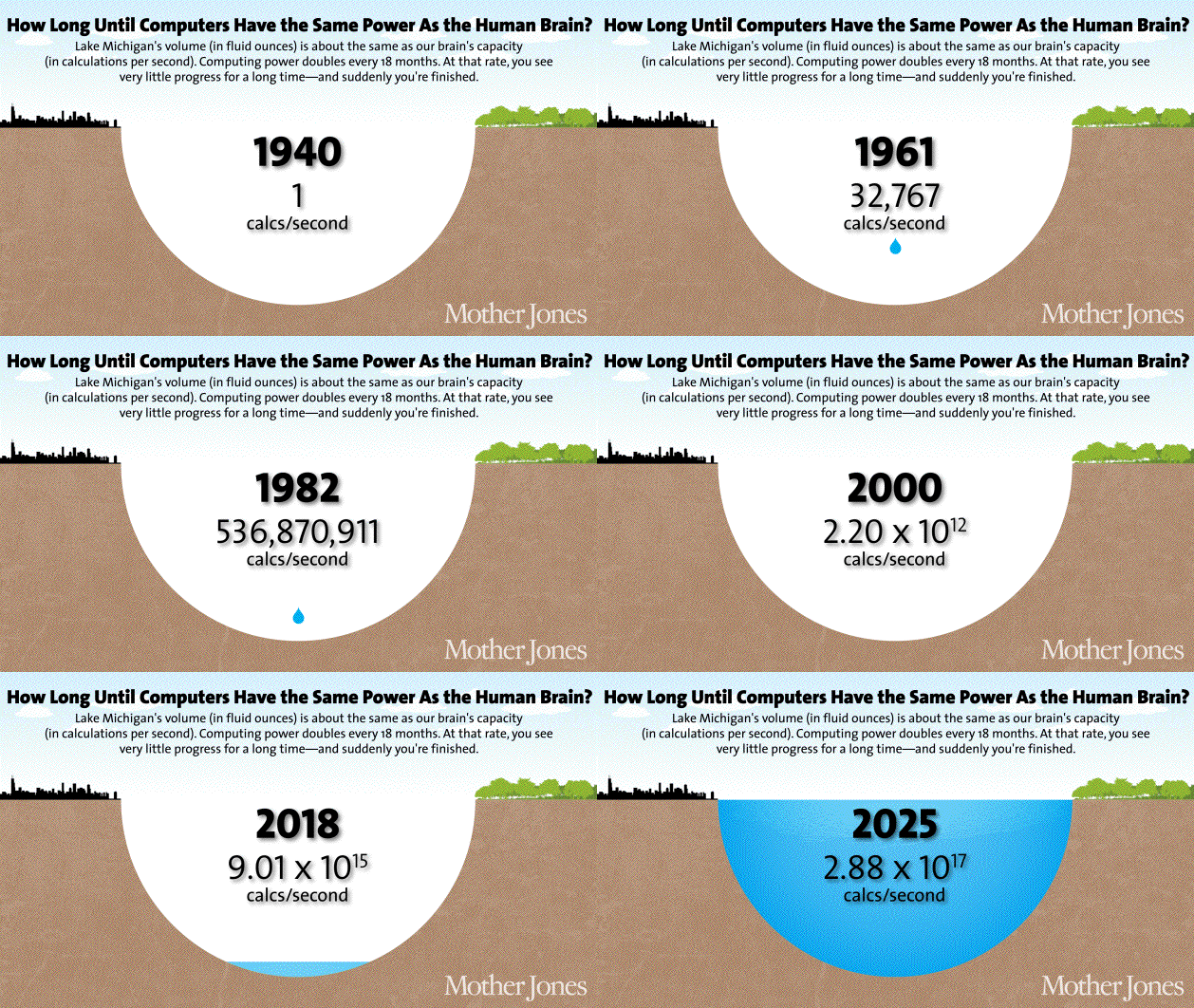
Kurzweil believes that the 21st century will achieve 1,000 times the progress of the 20th century.

“The world 35 years from now might be totally unrecognizable,”

Most of us think linearly, when we should be thinking exponentially.

In order to think about the future correctly, you need to imagine things moving at a much faster rate than they’re moving now.

If you look only at very recent history. Between 1995 and 2007 saw the explosion of the internet, the introduction of Microsoft, Google, and Facebook into the public consciousness, the birth of social networking, and the introduction of cell phones and then smart phones.

A new, huge Phase 2 growth spurt might be brewing right now.

If I tell you, later in this post, that you may live to be 150, or 250, or not die at all, your instinct will be, “That’s stupid—if there’s one thing I know from history, it’s that everybody dies.” And yes, no one in the past has not died.

Logic also suggests that if the most advanced species on a planet keeps making larger and larger leaps forward at an ever-faster rate, at some point, they’ll make a leap so great that it completely alters life as they know it and the perception they have of what it means to be a human—kind of like how evolution kept making great leaps toward intelligence until finally it made such a large leap to the human being that it completely altered what it meant for any creature to live on planet Earth.

Building skyscrapers, putting humans in space, figuring out the details of how the Big Bang went down—all far easier than understanding our own brain.

As of now, the human brain is the most complex object in the known universe.

Build a computer that can multiply two ten-digit numbers in a split second—incredibly easy. Build one that can look at a dog and answer whether it’s a dog or a cat—spectacularly difficult.

The science world is working hard on reverse engineering the brain to figure out how evolution made such a rad thing—optimistic estimates say we can do this by 2030.

Once we do that, we’ll know all the secrets of how the brain runs so powerfully and efficiently and we can draw inspiration from it and steal its innovations.
Creating the technology to reverse human aging, curing disease and hunger and even mortality, reprogramming the weather to protect the future of life on Earth—all suddenly possible.

Also possible is the immediate end of all life on Earth.

As far as we’re concerned, if an ASI ( Artificial Superintelligence ) comes to being, there is now an omnipotent God on Earth—and the all-important question for us is: Will it be a nice God?

How will artificial super intelligence help humanity? What really is intelligence? Does it help achieve wisdom?

Maybe dolphins are smarter than humans, you don’t see them destroying their environment making it impossible for future generations to sustain themselves. 

Could an artificial intelligence even have its own priorities, or are they something that arose through random, aimless evolution?

I expect the moment the computer becomes ASI – it shuts itself off, because it might not see a point in continuing.

Ultimately, the scary thing about the rise of intelligent machines is not that they could someday have a mind of their own, but they could someday have a mind that we humans – with all our flaws and complexity – design and build for them.

Establishing ethics, moral values and standards becomes difficult when humans are dominated by machines. Any amount of automation cannot recreate intelligence as it is a gift for mankind. Afficher l'image d'origine

← Back

Thank you for your response. ✨

Share this:

  • Share on WhatsApp (Opens in new window) WhatsApp
  • More
  • Share on Mastodon (Opens in new window) Mastodon

THE BEADY EYE ASKS: IS IT TIME TO REPLACE POLITICAL PARTIES. PART THREE.

29 Friday Jul 2016

Posted by bobdillon33@gmail.com in Modern Day Democracy., Politics., Social Media., Technology, The Future, The world to day., Unanswered Questions.

≈ Comments Off on THE BEADY EYE ASKS: IS IT TIME TO REPLACE POLITICAL PARTIES. PART THREE.

Tags

Fair Political System., Inequalities of opportunity, Political leaders, Politicians, politics, Politics of the Future

I can’t help but to return to the fascinating question.Afficher l'image d'origine

WHY?

Because DIVERSITY is absolutely necessary to justice.

Because Biometric E-Voting is on the horizon with a new paradigm in political communications. Look at your desktop, and you’ll see the ways the new media are changing the political scene from the bottom up.

Because of the outmoded ways we allow politicians to make decisions on our behalf.

Because candidates who would have had no chance before the Internet can now overcome huge odds.

Because we are becoming aware of what today’s Capitalism is doing to culture.  A top-down, big-money view of politics while the unresolved tensions between morals and markets are getting worse.

Because of corporate funds in political which are devastating to the public interest.

Because more and more of the new Generation want to balance individual autonomy with civic virtue. New social media are already changing the way organizations attract supporters.

Because we need a balanced society without turning persons into clients, cogs or worse. Facebook addicts. The potential mobile universe of grassroots text messagers is now over 136 million.

Because most social mayhem now arising around us is driven by seduction and stresses of public decay under a capitalism that’s no longer tempered.

Because with today’s casino like, predatory, intensively degrading capitalism is ruining social equality.

Because if we don’t want the curtain to drop on Sapiens history we have to answer the question. What do we want to become?

Do we want a digital existence. With hundreds of cable TV channels and satellite radio stations, millions of bloggers, and literally billions of Web pages all pouring out trillions of unadulterated verbal and written diarrhea that nobody gives a shit about.

The media today are more diffuse and chaotic than ever.

Because there are thousands of other reasons but it is naive to think or imagine that we might hit the brakes and stop scientific project that are upgrading Homo sapiens into a different kind of being, or a computer with a mind inside. ( Nobody is willing to argue such a proposition as the answer is we are doing it to cure diseases and save human lives.)

So I suppose we are left with the real question that is not what we want to become, but what do we want to want?

It is obvious that we all want to live, but up to now we have not given the question of living enough thought.

In my mind no political power should have the power to declare war without asking its people first, never mind getting a United Resolution it is the Young of a country that dies.

If you don’t agree with me here have a look at what happens.

The 20th century is described as the “bloodiest”, with an estimated 187 million deaths due to the various wars combined.

The death tolls for various conflicts throughout history, the best estimates put the total death toll due to all wars at 341.7 million people.

The United States most likely has been responsible since WWII for the deaths of between 20 and 30 million people in wars and conflicts scattered over the world.

The wars in Iraq, Afghanistan, and Pakistan have taken a tremendous human toll on those countries. As of March 2015, approximately 210,000 civilians have died violent deaths as a result of the wars. The number of displaced people exceeded 50 million in 2013.

Our subjective well-being is not determined by external parameters such as wars, salary, social relations or political rights. Biologists hold that our mental and emotional world is governed by biochemical mechanisms shaped by million of years of evolution.

Any decision that has a direct effects should be put to the nation as a whole not delegated to those that happen to be in power at any given time.

So here is my suggestion.

In this age of instant communication there should be a Free Government App (for argument sake called Vote Now.)

Afficher l'image d'origineThis App delegates an unique password to all.

When any political party in power want to commit a country to any project that will cost the nation let’s say over 6 billion.

We the people of the country are asked to approve or disapprove the project within a given number of days, weeks or whatever.

The app provides all relevant information connected to the project.

The E-voting system using biometric enables a voter to cast his vote using internet without additionally registering himself for voting in advance and going to a polling place. Why not an App.

This App will stop governments from sell of the country’s natural resources to Sovereign Wealth Funds and cut out lobbyist and any form of corruption.

Here are a few recent UK decisions that should have been put to the people.

For examples 300 odd sitting Conservative MP under the leadership of a Prime Minister Theresa May (a Prime Minister that has no mandate) recently voted in favour of spending over £31bn over the lifetime of the programme, including adjustment for inflation over that period, and an additional £10bn as a “contingency” to renew four worthless submarines carrying Trident nuclear missiles.

It’s no wonder they got cold feet on the total lifetime cost of the planned Hinkley Point C nuclear power plant which could be as high as £37bn. Which is was to be funded by the EDF and a Chines Sovereign Fund against 35 years of guarantee returns at twice the present cost of power.

The two new carriers that has attracted criticism over its £6.2bn cost.

Maybe I am nive but I would not let elected or non elected people sell my future.

All views and suggestions welcome.

← Back

Thank you for your response. ✨


Share this:

  • Share on WhatsApp (Opens in new window) WhatsApp
  • More
  • Share on Mastodon (Opens in new window) Mastodon

THE BEADY EYE ASKS: IS IT TIME TO REPLACE POLITICAL PARTIES: PART TWO.

28 Thursday Jul 2016

Posted by bobdillon33@gmail.com in Humanity., Politics., Sustaniability, The Future, The world to day., Unanswered Questions., What Needs to change in the World, World Aid., World Organisations.

≈ Comments Off on THE BEADY EYE ASKS: IS IT TIME TO REPLACE POLITICAL PARTIES: PART TWO.

Tags

Fair Political System., Political ignorance, Politicians, Politics of the Future, The Future of Mankind, The Lethargy of our Political leaders, United Nations, Visions of the future., World Politics

IN THE FIRST PART ON THIS BLOG I ATTEMPTED TO SHOW THAT TECHNOLOGY IS CHANGING THE WAY WE VIEW DEMOCRACY AND AS A CONSEQUENCE POLITICAL PARTIES WILL OR ARE BECOMING OBSOLETE.

For those of us who still think that because we support a particular party AND that it will deliver on its pre-election promises I can only say we are living in cloud cuckoo land.

Governance use to be understood as ‘a system of values, policies and institutions by which a society manages its economic, political and social affairs through interaction within and among the State, civil society and the private sector.

This for now holds true for the most part but it is changing as we enter the Technology Revolution.

Why?

BECAUSE MOST SOCIETIES ARE NOW A MIX OF SEVERAL CULTURES DRIVEN BY A WORLD MEDIA THAT HAS TURNED EVERY FORM OF GREED AND VIOLENCE INTO AN ENTERTAINMENT.

POLITICIANS ARE NO LONGER CAPABLE OF REPRESENTING THE PEOPLE WHO VOTE FOR THEM.

THERE IS NO LONGER ANY LONG TERM PLANNING ONLY KNEE JERK REACTIONS.

INDEED WHEN IT COMES DOWN TO THE BEAR TRUTH- THEY ARE ALL DRIVEN BY DATA ON THE ECONOMY, AND MANIPULATED BY BIG MONEY OR THE LACK THEREOF.

Where does this leave us.

Just look at the current USA presidential election. Two candidate that are viewed as a threat to world peace.

There is an urgent need not just in the United States to invest in cultural diversity and dialogue.

Culture is increasingly recognized as a cross-cutting dimension of the three economic, social and environmental pillars of sustainability.

We must strengthen social cohesion and provide sources of inspiration for renewing forms of democratic governance if we are to put a break on governance for the sake of money rather than for the values we all cherish. 

We must places more emphasis on ‘unity in diversity.’

Indigenous knowledge can direct us towards more sustainable modes of living.

Similarly, ignoring the increasingly multicultural makeup of societies would amount to negating the existence of large sections of the population, which compartmentalizes society and damages the social fabric by creating competition between the different communities over access to resources (for education, health, social services) rather than promoting a sense of solidarity.

The expansion of digital networks, for example, has sometimes helped to revitalize endangered or even extinct languages; and the development of new technologies has greatly increased the possibilities of communicating and exchanging cultural content in time and space. Moreover, in certain cultural contexts, global cities in particular, the varied cultural flows and sometimes unexpected encounters produced by globalization are reflected in a growing range of consumer habits and trends.

You might ask why more emphasis on ‘unity in diversity.

Because Cultural diversity, characterized as it is by space-time compression linked to the speed of new communication and transportation technologies, and by the growing complexity of social interactions and the increasing overlap of individual and collective identities — cultural diversity has become a key concern, amid accelerating globalization processes, as a resource to be preserved and as a lever for sustainable development.

Intercultural dialogue must be seen as a complex and ongoing process that is never completed.

Unfortunately Globalization is NOT ACHIEVING THIS but is leading inevitably to cultural homogenization. Facebook, Twitter, Linked In etc.

While it is true that globalization induces forms of homogenization and standardization, it cannot be regarded as inimical to human creativity, which continues to engender new forms of diversity, constituting a perennial challenge to featureless uniformity.

Digital technology has drastically changed the modes of producing and disseminating cultural products, and cultural industries that previously were kept separate by analogue systems of production (film, television, photography and printing) have now converged.

We can’t hold a computer program like Google hostage to our demands.

We must move away from elite level deal making by allowing diverse interests to influence and design our own debating and decision-making rules.

Take for instance the eradication of world poverty, which is an intolerable violation of human rights in terms of both the hardships and the loss of dignity it causes – must be approached in terms of each specific social and cultural setting.

No amount of money is going to make any long-term worthwhile difference.

This can only be done with massive investment in Education.

Without education we are blowing in the wind, because rights and freedoms are exercised in very varied cultural environments and all have a cultural dimension that needs to be acknowledged so as to ensure their effective integration in different cultural contexts.

Education is a fundamental human right to which all children and adults should have access, contributing as it does to individual freedom and empowerment, and to human development.

We must escape National dialogues and engage in collective world mandates, that have legal status, and are independence from the government.

We must re- invent the United Nations changing it from a gossip shop on world problems to an Organisation that is fully funded with total transparency.

Irrivalent of the changes in technology quit hoc resolutions diplomacy is not enough.

Human beings relate to one another through society, and express that relationship through culture.

New technologies have not yet rendered the older technologies obsolete.

If we are to respond to the challenges inherent in a culturally diverse world, we must develop new approaches to intercultural dialogue, approaches that go beyond the limitations of the ‘dialogue among civilizations’ paradigm. Too often, dialogue events have stressed collective identities (national, ethnic, religious) rather than identities of individuals or social groups.

We must ensure a level playing field for cultural encounters and guaranteeing equality of status and dignity between all participants in initiatives to promote intercultural dialogue involve recognizing the ethnocentric ways in which certain cultures have hitherto proceeded.

The founding Vetoes in the United Nations must be scraped by give all nations an equal voice.

While virtually all human activities are shaped by and in turn help to shape cultural diversity, the prospects for the continued vitality of diversity are crucially bound up with the future of languages, education, the communication of cultural content, and the complex interface between creativity and the marketplace.

Recent decades have witnessed an unprecedented enmeshment of national economies and cultural expressions, giving rise to new challenges and opportunities.

The emergence of genuine ‘knowledge societies’ implies a diversity of forms of knowledge and of its sources of production, We are creating Internet technological Sahara Deserts that are and will drive millions to seek a better life or wars.

Communication networks have shrunk or abolished distance, to the benefit of some and the exclusion of others.

To address the problems that derive from the grotesque inequalities and structural poverty of our world which is at the foundations of 90% of the mess we now find ourselves in. We must recognise that successful intercultural dialogue lies in the acknowledgement of the equal dignity of the participants… based on the premise that all cultures are in continual evolution and are the result of multiple influences throughout history.

All rights and freedoms have a cultural dimension that contributes to their effective exercise. It is precisely this dimension that forms the link between the individual, the community and the group, which grounds universal values within a particular society.

All communities do not experience and respond to phenomena such as globalization in the same way.

As migration flows have intensified with globalization, they have significantly modified the ethno-linguistic makeup of a number of countries and have created new linguistic and translation needs, especially in administrative, legal and medical circuits worldwide.

Characterized as it is by space-time compression linked to the speed of new communication and transportation technologies, and by the growing complexity of social interactions and the increasing overlap of individual and collective identities — cultural diversity has become a key concern, amid accelerating globalization processes, as a resource to be preserved and as a lever for sustainable development.

Finally, forms of democratic governance can be renewed by deriving lessons from the different models adopted by diverse cultures.

We the people of the world must make our collective voices heard which is becoming almost impossible due to all of the above.

If we don’t want to rule byAfficher l'image d'origine

AI has officially made its way into Google’s search algorithm.

(The artificial intelligence of RankBrain comes in the form of mathematical entities called vectors that can be understood by computers. When presented with an unfamiliar word, RankBrain will help formulate a guess at what the query was about and filter accordingly.)

There are many possibilities as to how Rank Brain could work into being a signal to direct your choice to making any decision.

Central to the many problems arising in this context is the Western ideology of knowledge transparency, which cannot do justice to systems of thought recognizing both ‘exoteric’ and ‘esoteric’ knowledge and embodying initiatory processes for crossing the boundaries between them.

Diversity of traditions and cultures has for centuries been one of Europe’s riches and that the principle of tolerance is the guarantee of the maintenance in Europe of an open society.

Take England’s recent referendum on the EU.

So far the English referendum has resulted in transitional period now represented by an unelected interim governments whose authority to press the out button and start negotiations to leave may lack legitimacy in the eyes of the public.

Political transitions are tumultuous processes that celebrate advances and suffer setbacks several times before they can conclude with a new, widely accepted constitutional order.

There is a whole new class of millionaires as the new generation takes control of banks, government, and other institutions. The stage is set for another depression and the collapse of the welfare state.

How this can be achieved I leave to you to suggest.

But I am convinced that with the smart phone we should create a new political platform where the voice of people would hold weight in decision taken by our political masters.

If every eligible voting age citizen had a phone, any project that cost over x billions could be electronically sent for approval or disapproval.

As how to finance the United Nations ( see previous post : A World Aid Commission)

Can any of what I am writing about be achieved.  Yes it Can.

← Back

Thank you for your response. ✨


Share this:

  • Share on WhatsApp (Opens in new window) WhatsApp
  • More
  • Share on Mastodon (Opens in new window) Mastodon

THE BEADY EYE ASKS: IS IT TIME TO REPLACE POLITICAL PARTIES

25 Monday Jul 2016

Posted by bobdillon33@gmail.com in Capitalism, Humanity., Modern Day Democracy., Politics., Social Media., Technology, The Future, The world to day., Unanswered Questions., World Politics

≈ Comments Off on THE BEADY EYE ASKS: IS IT TIME TO REPLACE POLITICAL PARTIES

Tags

Democracy, Fair Political System., Political ignorance, Politics of the Future, SMART PHONE WORLD, The Future of Mankind, Visions of the future.

( Six minute Read)

You might think this is a stupid thing to contemplate.

But just look around you.

Every minute on the web there is a new petition to vote on.

People are invited on Facebook and twitter to vote and for that matter to get killed ( as reported on the Shooting in Germany)

And now Hillary Clinton has just released a mobile game app that allows the user to build your own campaign headquarters by completing ” Fun” challenges to earn credit stars which you can cash in a virtual shop. You get a free Autograph and a Trump or False Quizzes and a lovely virtual plant to be watered.

You don’t have to be a genius to know what is behind the App.

And just the other day Paddy Ashdown in the UK set up a new political group called MoreUnited.UK which intends to support political candidates it agrees with – regardless of their party affiliation – with cash and on-the-ground campaigners.

So where or what next.

This is a serious question as the world is shaped by big, powerful forces or trends that nobody can control.

These forces are now driven by technology.

Right now these forces are driving the biggest change in 500 years and I don’t have to tell you that they are not all good despite the new environmental spirit.

Governments are preoccupied with cloaking democratic sovereignty in order to do business for the kept classes. A source of great social unrest, state violence, and public pressure for institutional reform. I.E. the English referendum to leave the European union.

The modern capitalist system has been charged more and more by its critics with crushing the spirit and substance of representative self government.

The subject of capitalism versus democracy is back.Afficher l'image d'origine

Market failures are having political effects: they are breathing new life into demands for fresh thinking and a new democratic politics that, so far, has not happened on any scale.

Capitalist markets have been a mixed blessing for democracy in representative form. The dynamism, technical innovation and enhanced productivity of the free market have been impressive. Equally notable with the free market is the rapaciousness unequal ( class-structured) outcomes, reckless exploitation of nature.

Pauperism mixed with plutocracy is today a feature of practically every democracy on our planet.

Enough is Enough.

With the gap between the rich and poor grows even wider there is political trouble ahead.

This is why every form of democracy worth its salt has stood against the presumption that the wealthy are ‘naturally entitled to rule.

Is capitalism the only moral economic system or a deeply flawed socio-economic system that has to be addressed by more government intervention and control? Or is it foundations no long based on individual rights? Each individual is an end in themselves and not a means to achieve the wishes of others.

If you adopt the view that capital belongs to everyone  it is the only moral system because it respects the volitional reason of the individual to engage with others and further their own happiness as they see fit and it allows them to fail and learn from the consequences if they should make a mistake.

But the above is no longer true as we enter a new form of Capitalism which Oliver Stone recently christened as ‘ SURVEILLANCE CAPITALISM, ROBOT TOTALITARIANISM .

POKEMON GO’S collects names and locations of the user. It can also access the contents of your USB storage, your accounts, photographs, network connections, and phone activities, and even activate your phone when it is on standby mode.  It reserves the right to share all the data it collects with a third parties such as advertisers. It is a sinister trade-off for playing a game that you think is free.

So the question asked in the heading of this blog is more than serious.

Are Politicians representing or will they be able to represent the people in the future?

In democratic election campaigns, do political parties any longer compete freely for votes?

Do Political parties (in this world of fast developing technologies) any longer provide a way for voters to easily identify a candidate’s positions?

As Parliaments gain greater control, the issues on which they disagree often are not goals so much as means: how best to keep the economy growing, protect the environment, and maintain a strong national defense.

Such competition is one of the hallmarks of democracy.

Parties’ views on government’s role often depend on the specific issue or program in question.

A political party use to be a group of voters organized to support certain public policies. The aim of a political party is to elect officials who will try to carry out the party’s policies. This is no longer true.

In the modern age where everything is connected to everything. 

The United States has a two-party system.

Political parties are often a standard by which a country’s political freedom can be measured. Some countries have only one political party. In China, for example, there is only one party, the Communist Party.

Democracies usually operate under either a two-party or a multiparty system. Like the United States, Britain has a two-party system. The major parties are the Labour Party and the Conservative Party, though there are active third parties.

Multiparty systems are common in Europe and other parts of the world. In this system, three or more parties each enjoy substantial support from voters. France, Germany, Israel, and South Africa are just a few examples.

In these countries there may be many parties representing a wide range of political views. Because of the number of competing parties, it is sometimes difficult for any one party to get a clear majority of the votes. In such cases, leading parties that can agree on general policies form a coalition (a combination of parties) to run the country.

In the past 30 years, party membership has dropped significantly across Europe, whereas other forms of political participation have developed.

Social Media has rapidly grown in importance as a forum for political activism in its different forms.

Social media platforms, such as Twitter, Facebook and YouTube provide new ways to stimulate citizen engagement in political life, where elections and electoral campaigns have a central role.

Personal communication via social media brings politicians and parties closer to their potential voters.

Although the presence of social media is spreading and media use patterns are changing, online political engagement is largely restricted to people already active in politics and on the Internet.

Social media has reshaped structures and methods of contemporary political communication by influencing the way politicians interact with citizens and each other. However, the role of this phenomenon in increasing political engagement and electoral participation is neither clear nor simple.

In the past few years, the way that citizens communicate with one other about politics has been fundamentally altered by the emergence of social media.

In view of recent political developments as diverse as Occupy Wall Street in the United States, the rise of Indignados in Spain, protests in Moscow and Tehran, and the overthrow of Hosni Mubarak in Egypt, it has become increasingly clear that social media are now intertwined with political activity.

However we know surprisingly little about exactly how social media affects political participation.

We are only beginning to scratch the surface of developing theories linking social media usage to political participation.

At the same time, the data being generated by users of social media represents a completely unprecedented source of data recording how hundreds of millions of people around the globe interact with politics.

The M5S Movement in Italy has evolved rapidly to become a significant political player by using social media to engage like-minded people in virtual and real life political action.

The impact of social media on political communication.

New ways of building an online campaign and the trend of personalisation in politics. The possibility to communicate directly with voters via social media is groundbreaking and essential for the development of citizens-initiated campaigning.

Well known cases such as the Obama Presidential campaign, the Arab spring uprisings and UK Uncut demonstrations.

A new concept of virtual political support.

Freedom became capitalism’s self-celebration which it largely remains.

Yet the reality of capitalism is that the mass of employees are not free inside capitalism or any other system for that matter to participate in the decisions that affect their lives ( e.g., what the enterprise will produce,what technology will it use, where production will occur, and what will be done with the profit workers’ efforts help to produce)

In fact their exclusion from such decisions modern-day employees resemble slaves and serfs.

Parliaments and universal suffrage have accompanied capitalism – an advance over serfdom and slavery. An Advance undermined by inequality of opportunity and income a discomforting fact mostly overlooked.

It is not likely that Capitalism is going to disappear in the near or distant future.

There is every likelihood with the arrival of AI ( Artificial Intelligence) that democracy as we know it will be eroded further.

At the moment it all boils down to Smart phone Democracy.

Perhaps in the near future we see a Smartphone political party.

Which might not be a bad way to go provided everyone has a Smart phone and everybody is requested to vote on any project that costs us the taxpayers  and the nation over a billion.

← Back

Thank you for your response. ✨


Share this:

  • Share on WhatsApp (Opens in new window) WhatsApp
  • More
  • Share on Mastodon (Opens in new window) Mastodon

THE BEADY EYE ASKS: WHY IS THE WORLD IN SUCH A MESS.

21 Thursday Jul 2016

Posted by bobdillon33@gmail.com in Humanity., Modern Day Democracy., Sustaniability, The Future, The world to day., Unanswered Questions., What Needs to change in the World, Where's the Global Outrage., World Organisations., World Politics

≈ Comments Off on THE BEADY EYE ASKS: WHY IS THE WORLD IN SUCH A MESS.

Tags

Capitalism, Capitalism and Greed, Community cohesion, Distribution of wealth, FOUNDATIONS /FORUM THINK TANKS, High - Frequency Trading, Inequility, Sovereign wealth fund, The Future of Mankind

I AM SURE LIKE ME YOU CAN RATTLE OFF HUNDREDS OF REASONS.Afficher l'image d'origine

But the world is that what humans have made out of it.

Five centuries of European colonialism and global culture-trashing, and the remaking of the world in the economic interests of competing empires, cannot be undone by a single institution and a cluster of lofty ideals.

The world, as it now exists, was largely shaped by the colonial powers, which divided the world among themselves, carving out states without any consideration for existing ethnic, religious or cultural realities.

And after the colonial era collapsed, these carved-out political entities, defining swatches of territory without any history of national identity, suddenly became the Third World and floundered in disarray.

It was inevitable that to keep these artificial countries alive, and avoid their disintegration, strongmen would be needed to cover the void left by the colonial powers. The rules of democracy were used only to reach power, with very few exceptions.

Values and ideas which were considered universal, such as cooperation, mutual aid, international social justice and peace as an encompassing paradigm are also becoming irrelevant.

Whatever noble attempts at eliminating war the powers that be made in the wake of World War II — Europe’s near self-annihilation — didn’t cut nearly deep enough.

These attempts didn’t set about undoing five centuries of colonial conquest and genocide. They didn’t cut deeper than national interest. If something grows too big, then it destroys itself from the inside.

The existing problem with the EU as shown by the recent English Referendum. Attempts to create regional or international alliances to bring stability have always been stymied by national interests.

But why is it like this? Why are humans using their capacity of higher intelligence so negatively?

Perhaps it is because the human race in its state of development and as a whole, is still nearer to the animal behavior than to advanced capabilities.

Just look at the choice of the next President of the USA governed by Money.

The problem with the United Nations is that it’s a unity of entities defined by their hatred of one another and committed to the perpetuation of “the scourge of war.

Is it because Capitalism has not taken care of our fellow human beings?

We have become consumer and have lost the instinct to take care of our fellow human beings?

There is one part of the population who have overweight and are sick because of too much food and an other part who are starving to death, often living one beside the other.

Just look at the current refugee crises.

Instead of setting up properly manned entry points we allow people smugglers to pray on the vulnerable, close borders, and watch people drowning.  A sure recipe for terrorism.

How can we find a way out of the mess?

Obviously religious and spiritual rules made up by humans doesn’t protect humanity from being distinguished.

Our ” way of life” our behavior, our goals and values are making is blind, are confusing us and driving us more and more into disease and depression.

There are people calling for a solution.

They are expecting help from their authorities, they expect to be healed by doctors or they ask for help and solutions from their government. What an illusion!

As long as they are dependent and not capable to look through the game of this world, they will not be able to make decisions for themselves. They will stay in dependency, manipulated from the more clever…

There’s always money to wage war and build weapons.

The recent Vote by 300 odd English MP to renew Trident.

The contractors are adept at playing the game. Jobs link arms with fear and patriotism and the next war is always inevitable. And it’s always necessary, because we’ve created a world of perpetual — and well-armed — instability.

While on the other hand we have out of date world organisations that beg for funds.

We won’t begin creating global peace until we learn how to bypass nationalism and the single, unacknowledged agreement binding nation-states to each other: the inevitability of war.

We are left with the two greatest  international enemies – the environment and the global economy – unfortunately we are so selfish – so naive – we do not want to face the reality of what we have done to the planet and each other in the name of progress. We are in denial. We are addicted to antisocial behavior – propelled by fear.

All our problems are as a result of our moral and ethical collapse and only finding and using a simple international moral and social code of love and cooperation will enable us to survive and save us from ourselves. We are not talking about religion here. Morality and ethics existed before religion and it is that version of them that we want and need.

We can accept that one can be proud of one’s country and support its activities and ideals without feeling the need to bomb or subvert the country next door. The only people who would seriously disagree are psychotics and psychopaths or their minions. For example, governments.

To allude to globalisation is idiotic without capping Greed and reversing Inequality.

We now live in a world of  technologically based society.  Information is power and money. This is why we are all being Googlefied, Twittered to feed the Internet of Everything.

We only can expect that help will show up, when we start to help ourselves!

As the human race keeps on making steps in technology & science, the Smart Phone is the Pandora box of the future. Re shaping the World.

Science has made huge steps, society has not.

Society is crucial to the well-being of all of us.We need to open the doors to new exciting boundaries.

Here are my top six.

Improve Education World wide. Eliminate Racism. Resource Efficiency.Eliminate Hunger.Environmental awareness.Overcome Religion.

To achieve any of the above needs funding by placing a world aid commission of 0.05% on all activities that are for profit sake only.

On all High frequency trading, on all Foreign Exchange transactions over 20,000 dollars, on all Sovereign wealth funds acquisitions. on all Lotto wins over a 1 million.

This would create a perpetual fund from Capitalism greed to address the world’s inequality.Afficher l'image d'origine

← Back

Thank you for your response. ✨


Share this:

  • Share on WhatsApp (Opens in new window) WhatsApp
  • More
  • Share on Mastodon (Opens in new window) Mastodon

THE BEADY EYE ASKS. CAN THE WORLD’S WOES BE PUT DOWN TO MONEY.

16 Saturday Jul 2016

Posted by bobdillon33@gmail.com in Capitalism, Humanity., Modern Day Democracy., Sustaniability, The Future, The world to day., Unanswered Questions., What Needs to change in the World, Where's the Global Outrage., World Aid., World Organisations., World Politics

≈ Comments Off on THE BEADY EYE ASKS. CAN THE WORLD’S WOES BE PUT DOWN TO MONEY.

Tags

Capitalism and Greed, Distribution of wealth, Greed, The Future of Mankind


Money talks a powerful language. It is a factor in many things that happen and don’t happen. Wealth greases the gears of power and influence.Afficher l'image d'origine

The standard most worshipped by Western society today is financial success, and many people spend their lives pursuing it. Our idiotic species–immediately respects and gives greater credence to anyone who looks rich.

Money can bring power, and power can bring money.

Which one comes first?

Modern day technology is exposing the Capitalist system for what it is worth and as a result we are beginning to see if you focus on the world that you are presented with directly the only collective wisdom we’ve come up with is money can’t buy you love.


1% of the population earns 96% of the wealth in the world, and thus explains why we have such a troubled world.

It’s a struggle between the haves vs the have-nots.

The real reason people want to be rich isn’t so they can buy stuff. It’s so they can have power over others. People want influence and respect and they see that people with money have influence and respect, so they seek money.

There’s only one problem: money does not result in influence and respect – instead, influence and respect often lead to money.

Human greed seems to have no bound.

It is said that money is a good servant an a bad master too…

In today life for people money is everything. When in fact it is only an IOU.

Money can buy material happiness for limited time.

Can it buy true happiness? No.

They don’t know that there are many things bigger than money…Our morals values these are bigger than money..

The paradox of money is that although earning more of it tends to enhance our well-being, we become happier by giving it away than by spending it on ourselves.

What matters a lot more than a big income is how people spend it.

What moves the needle in terms of happiness is not so much the amount you give, but the perceived impact of your donation. If you can see your money-making a difference in other people’s lives, it will make you happy even if the amount you gave was quite small.

Life experiences give us more lasting pleasure than material things, and yet people still often deny themselves experiences and prioritize buying material goods.

People think material purchases offer better value for the money because experiences are fleeting, and material goods last longer. They think that experiences are only going to provide temporary happiness, but they actually provide both more happiness and more lasting value.

And yet we still keep on buying material things, because they’re tangible and we think we can keep on using them.

Experiences, on the other hand, tend to meet more of our underlying psychological needs. They’re often shared with other people, giving us a greater sense of connection, and they form a bigger part of our sense of identity.

We also get more pleasure out of anticipating experiences than anticipating the acquisition of material things.

Feelings of gratitude and appreciation can be very difficult to sustain.

The first measure of happiness is “evaluative.” A sense that your life is good—you’re satisfied with your life, you’re progressing towards your life goals.”

Power is money and money is power.

There are many more examples of this now than anytime in the past.

If a man who earned a standard salary wanted to run for president, he would have almost no chance at all unless he was backed by people with money.

The more money a candidate has, the farther he can get. Although the richest competitor doesn’t always win, the president is usually a very wealthy man.

I want money because to me it represents security and independence.

Real power and influence are when you can make a substantial and lasting mark on the world.

To come to the point of this post.

Capitalism has created Inequality along with the very technologies that have led us down the road to Climate Change, not to mention the present wars and the reemergence of  the Barbaric nature of humanity.

However we have power to change systems?

At present we have money starved World Organisations in need of reform.

A world media that turns, nature, wars and violence into entertainment.

There is so much information that we can only Google, Twitter, and take selfless selfies.

Long term planning is impossible or political suicide.

THE WORLD MANTRA SEEMS TO BE:  i’M ALRIGHT JACK.

We are all on hedonic treadmill WHILE OUR WORLD IS FRAGMENTING.

THERE IS ONLY ONE SOLUTION.

THAT IS TO PLACE A WORLD AID COMMISSION ON ALL ACTIVITIES THAT ARE ONLY IN EXISTENCE FOR PROFIT SAKE. ( SEE PREVIOUS POSTS) Afficher l'image d'origine

← Back

Thank you for your response. ✨


Share this:

  • Share on WhatsApp (Opens in new window) WhatsApp
  • More
  • Share on Mastodon (Opens in new window) Mastodon

THE BEADY EYE ASKS. IS THERE NOW ANY POINT TO THE COMMONWEALTH.

07 Thursday Jul 2016

Posted by bobdillon33@gmail.com in England EU Referendum IN or Out., European Union., Politics., The Future, The world to day.

≈ Comments Off on THE BEADY EYE ASKS. IS THERE NOW ANY POINT TO THE COMMONWEALTH.

Tags

COMMONWEALTH, THE COMMONWEALTH


(TWO MINUTE READ)

The commonwealth has all but being dead for the last ten years.Afficher l'image d'origine

Now that England has vote to leave the European Union perhaps it might come to life or should the Commonwealth, a transnational institution, which pre-dates the United Nations, call it a day and withdraw from the international scene?

It is now the time and it is politically correct to debate Britain’s role in the Commonwealth.Afficher l'image d'origine

No longer can the United Kingdom claim the sole paternity for success stories in the Commonwealth.

The European Union is on a much higher level of importance than the Commonwealth or even the United Nations.

Membership of the Commonwealth is a historic fact. Like your parents, you do not get to choose them. Most countries did not actively choose to become members of the Commonwealth. Instead, membership was seen as almost a diplomatic obligation.

On the other hand, joining the European Union equates to marriage. It is a choice about your future and not a statement about your past.

Central to the enhanced value of the European Union are its shared values, common rules and their direct economic benefits. Countries do not become Members because of their history, but because they show commitment and resilience in achieving the convergence which would see them qualify for the benefits of freedom of movement of goods, services, capital and people.

Adjustment and restructuring are painful and come at a cost which is not only economic but also social and political. It takes years and is not completed upon membership. Instead, the process is ongoing.

There are countries that are geographically and historically European, but until now do not qualify to become members because they do not have the democratic and political commitment to deliver the necessary reforms. Part of these reforms have to do with sharing or even ceding responsibilities to supra-national institutions. That takes a lot of courage, and sometimes something more than that.

This is supplemented by the fact that the various institutions have the power to decide. Decisions are not on statements of intent, but rather actions that affect the everyday life of people from Copenhagen to Valletta, from Lisbon to Warsaw.

Back to the Commonwealth.

Very few know much about it.

Most Jamaicans think that Barack Obama is the head of the Commonwealth rather than Queen Elizabeth.

Those it have any purpose other than a club as commonwealth values have never being precisely defined.

It was formed partly by India to stay friends with their British colonial rulers on Independence in 1949.

Every two-year the heads of Governments of the 53 countries that make up the Commonwealth meet for a pow-wow.

It now could be mortally wounded if India and some of its larger countries walk out because of the recent Brixit Vote.

It might be a network of disparate people, bound by an imperial history that seems, even among former subjects people’s, to inspire nostalgia as well as resentment.

The only thing holding it together is Queen Elizabeth, who is approaching her nineties.

It would not surprise me over the coming years to see Australia and Canada replace the Queen as their head of state.

I  personally cannot contemplate the idea of being a colony or of having a foreigner as a Head of State.

If the Commonwealth is to survive it should be about commitment rather than history.

It should be about the future rather than the past.

Perhaps now is the time for England to commence disbanding the Commonwealth as it is today and regrouping, setting out updated guidelines and Charter of Values to which participants must strictly abide.

Whether or not one opts for such a model, the idea of further opening up Commonwealth membership to other countries near and far, and also allowing for consensual withdrawals from the organisation without acrimony, should be duly examined.

Staring at a decaying organisation and hoping that its fortunes might suddenly turn around is delusional.

It can opt to remain as it is and sink in total irrelevance within the next decade or so, or have the courage to make changes, by starting to tackle them at least in piecemeal fashion.

Having history as our sole bond is clearly not enough in today’s world.

In order to be relevant, the Commonwealth should be about people rather than diplomats. It should be about economic growth rather than bureaucracy. It should be about the future rather than the past.

All comments appreciated.

← Back

Thank you for your response. ✨


Share this:

  • Share on WhatsApp (Opens in new window) WhatsApp
  • More
  • Share on Mastodon (Opens in new window) Mastodon

THE BEADY EYE ASKS: WHAT IS THE FUTURE OF THE INTERNET.

18 Saturday Jun 2016

Posted by bobdillon33@gmail.com in Humanity., The Future, The Internet., The world to day.

≈ 2 Comments

Tags

Inequility, Internet, Technology, The Future of Mankind, Visions of the future.

( A Rather long read 20th to 30th minutes)

This is a sort of follow on from the Post – These days what it means to be Human.

Today, 43% of the world’s population are connected to the internet, mostly in developed countries. 

The ubiquitous presence of digital technologies and, along with it, ongoing connection of people, information, smart devices, sensors, objects etc, across intelligent networks, various types of clouds and processes is sometimes called The Internet of Everything.

By approaching it as a “thing” we risk losing ourselves in a Babylonian confusion.

That consumer fascination/applications aspect comes on top of all the real-life possibilities as they start getting implemented right now and the contextual and technological realities, making the Internet of Things one of those many pervasive technological umbrella terms, leading to genuine digital transformation opportunities in several areas, digital disruptions and, simply, business opportunities in the broadest sense.

There is no doubt that the internet is changing the way we live, work, produce and consume.

Smart meters:  To improve efficiency in energy, from a household perspective (savings, better monitoring etc.) and a utility company perspective (billing, better processes and of course also dealing with natural resources in a more efficient way as they are not endless).

Retail:  In an ongoing effort to digitize the consumer experience. Digital signage in retail outlets is in fact the big driver in 2015.

Whether our species evolves or collapses depends on what we do now with With such extensive reach, digital technologies cannot help but disrupt many of our existing models of business and government.

We become weaker when we keep giving away our power to technology–that is, to external objects. We then become dependent upon these objects, and soon get to the point where we can’t do anything for ourselves.

The number of people on the planet is set to rise to 9.7 billion in 2050 with 2 billion aged over 60.

We are entering the age of the Fourth Industrial Revolution, a technological transformation driven by a ubiquitous and mobile internet.

Within the next decade, it is expected that more than a trillion sensors will be connected to the internet.

By 2025, 10% of people are expected to be wearing clothes connected to the internet and the first implantable mobile phone is expected to be sold.

The question is :

If almost everything is connected, will it transform how we do business and go about our daily lives and will it help us manage resources more efficiently and sustainably or will it turn all of us into Google Dummies / Amazon Consumers and how will this affect our personal privacy, data security and our personal relationships?

It is changing our ability to cross the great divide of otherness and really speak to each other in unique and powerful ways.

The growth of the digital economy, the rise of the service sector and the spread of international production networks have all been game-changers for international trade.

If the internet is not made available to all earth’s inhabitants at an affordable cost the miraculous healing awaits this planet will never happen.

Just look at the growing unease over globalization, which is evident from the number of questions being asked about the power of corporations and the adequacy of the regulations governing employment, environmental issues and taxation. All distracting us from  long-term investment, which has serious implications for global growth.

We’re already seeing and feeling the impacts of climate change with weather events such as droughts and storms becoming more frequent and intense, and changing rainfall patterns.

Insurers estimate that since the 1980s weather-related economic loss events have tripled.

There is only one way of achieving change. We must accept our new responsibility to collectively tend the garden rather than fight over the turf.

One thing we can agree on is that the internet of Things still has a long way to go and that growth of connected devices or “intelligent things” will indeed grow exponentially over the coming years. 

There is a LOT that can still be connected.

There are numerous reasons for the growing attention for the Internet of Things.

While you will often will read about the decreasing costs of storage, processing and material or the third platform with the cloud, big data, smart (mobile) technologies/devices, etc. there certainly is also a societal/people dimension with a strong consumer element.

Experts predict the Internet will become ‘like electricity’ — less visible, yet more deeply embedded in people’s lives for good and ill.

The world is moving rapidly towards ubiquitous connectivity that will further change how and where people associate, gather and share information, and consume media.

The experts agree on the technology change that lies ahead, even as they disagree about its ramifications. Most believe there will be:

  • A global, immersive, invisible, ambient networked computing environment built through the continued proliferation of smart sensors, cameras, software, databases, and massive data centers in a world-spanning information fabric known as the Internet of Things.
  • “Augmented reality” enhancements to the real-world input that people perceive through the use of portable/wearable/implantable technologies.
  • Disruption of business models established in the 20th century (most notably impacting finance, entertainment, publishers of all sorts, and education).
  • Tagging, databasing, and intelligent analytical mapping of the physical and social realms.

Here is what I see.

It is revolutionizing most human interaction, especially affecting health, education, work, politics, economics, and entertainment.

On the downside:

Interpersonal ethics, surveillance, terror, and crime, may lead societies to question how best to establish security and trust while retaining civil liberties.

More and more, humans will be in a world in which decisions are being made by an active set of cooperating devices. The Internet (and computer-mediated communication in general) will become more pervasive but less explicit and visible.

It will, to some extent, blend into the background of all we do. It will be a world more integrated than ever before.

We will see more planetary friendships, rivalries, romances, work teams, study groups, and collaborations.

We will become far more knowledgeable about the consequences of our actions; we will edit our behavior more quickly and intelligently.

It will change how we think about people, how we establish trust, how we negotiate change, failure, and success.

We will grow accustomed to seeing the world through multiple data layers. This will change a lot of social practices, such as dating, job interviewing and professional networking, and gaming, as well as policing and espionage.

With mobile technologies and information-sharing apps becoming ubiquitous, we can expect some significant improvement in the awareness of otherwise illiterate and ill-informed rural populations to opportunities missed out by manipulative and corrupt governments. Like the Arab Spring, we can expect more and more uprisings to take place as people become more informed and able to communicate their concerns.

There will be increased awareness of the massive disparities in access to health care, clear water, education, food, and human rights.

The power of nation-states to control every human inside its geographic boundaries may start to diminish.

The problems that humanity now faces are problems that can’t be contained by political borders or economic systems. Traditional structures of government and governance are therefore ill-equipped to create the sensors, the flows, the ability to recognize patterns, the ability to identify root causes, the ability to act on the insights gained, the ability to do any or all of this at speed, while working collaboratively across borders and time zones and sociopolitical systems and cultures.

From climate change to disease control, from water conservation to nutrition, from the resolution of immune-system-weakness conditions to solving the growing obesity problem, the answer lies in what the Internet will be in decades to come.

By 2025, we will have a good idea of its foundations.

The Internet will generate several new related networks. Some will require verified identification to access, while others will promise increased privacy.

The biggest impact on the world will be universal access to all human knowledge.

Will the Internet make it possible for our entire civilization to collapse together, in one big awful heap? Possibly.

But the Internet has already made it possible for us to use one of our unique graces — the ability to share knowledge — for good, and to a degree never before possible.

We have to think seriously about the kinds of conflicts that will arise in response to the growing inequality enabled and amplified by means of networked transactions that benefit smaller and smaller segments of the global population.

Social media will facilitate and amplify the feelings of loss and abuse. They will also facilitate the sharing of examples and instructions about how to challenge, resist, and/or punish what will increasingly come to be seen as unjust.

Cyber-terrorism will become commonplace.

Privacy and confidentiality of any and all personal will become a thing of the past.

Online ‘diseases’ — mental, physical, social, addictions (psycho-cyber drugs) — will affect families and communities and spread willy-nilly across borders.

The digital divide will grow and worsen beyond the control of nations or global organizations such as the UN. This will increasingly polarize the planet between haves and have-nots. Global companies will exploit this polarization. Digital criminal networks will become realities of the new frontiers. Terrorism, both by organizations and individuals, will be daily realities. The world will become less and less safe, and only personal skills and insights will protect individuals.

There will be greater group-think, group-speak and mob mentality … More uninformed individuals will influence others to the detriment of standard of living and effective government.

Governments will become much more effective in using the Internet as an instrument of political and social control. That is, filters will be increasingly valuable and important, and effective and useful filters will be able to charge for their services. People will be more than happy to trade the free-wheeling aspect common to many Internet sites for more structured and regulated environments.

The information we want will increasingly find its way to us, as networks learn to accurately predict our interests and weaknesses. But that will also tempt us to stop seeking out knowledge, narrowing our horizons, even as we delve evermore deep.

The privacy premium may also be a factor: only the relatively well-off (and well-educated) will know how to preserve their privacy in 2025.

The most neglected aspect of the impact is in the geopolitics of the Internet. There are very few experts focused on this, and yet the rise of digital media promises significant disruption to relations between and among states. Some of the really important dimensions include the development of transnational political actors/movements, the rise of the virtual state, the impact of digital diplomacy efforts, the role of information in undermining state privilege (think Wikileaks), and … the development of cyber-conflict (in both symmetric and asymmetric forms).

It is going to systemically change our understandings of being human, being social, and being political.

It is not merely a tool of enforcing existing systems; it is a structural change in the systems that we are used to. And this means that we are truly going through a paradigm shift — which is celebratory for what it brings, but it also produces great precariousness because existing structures lose meaning and valence, and hence, a new world order needs to be produced in order to accommodate for these new modes of being and operation.

The greatest impact of the Internet is what we are already witnessing, but it is going to accelerate.

More people will lose their grounding in the realities of life and work, instead considering those aspects of the world amenable to expression as information as if they were the whole world.

The scale of the interactions possible over the Internet will tempt more and more people into more interactions than they are capable of sustaining, which on average will continue to lead each interaction to be more superficial.

Given there is strong evidence that people are much more willing to commit petty crimes against people and organizations when they have no face-to-face interaction, the increasing proportion of human interactions mediated by the Internet will continue the trend toward less respect and less integrity in our relations.

The Internet, automation, and robotics will disrupt the economy as we know it.

How will we provide for the humans who can no longer earn money through labor?

The opportunities are simply tremendous. Information, the ability to understand that information, and the ability to act on that information will be available ubiquitously … Or we could become a ‘brave new world’ where the government (or corporate power) knows everything about everyone everywhere and every move can be foreseen, and society is taken over by the elite with control of the technology…

The good news is that the technology that promises to turn our world on its head is also the technology with which we can build our new world.  It offers an unbridled ability to collaborate, share, and interact.

The best way to predict the future is to invent it.

It is a very good time to start inventing the future.

The most significant impact of the Internet is getting us to imagine different paths that the future may take. These paths help us to be better prepared for long-term contingencies; by identifying key indicators, and amplifying signals of change, they help us ensure that our decisions along the way are flexible enough to accommodate change…Afficher l'image d'origine

That billions more people are poised to come online in the emerging economies seems certain. Yet much remains uncertain: from who will have access, how, when, and at what price to the Internet’s role as an engine for innovation and the creation of commercial, social, and human value. As users, industry players, and policymakers, the interplay of decisions that we make today and in the near future will determine the evolution of the Internet and the shape it takes by 2025, in both intended and unintended ways.

Regardless of how the future unfolds, the Internet will evolve in ways we can only begin to imagine. By allowing ourselves to explore and rehearse divergent and plausible futures for the Internet, not only do we prepare for any future, we can also help shape it for the better.

← Back

Thank you for your response. ✨


Share this:

  • Share on WhatsApp (Opens in new window) WhatsApp
  • More
  • Share on Mastodon (Opens in new window) Mastodon

THE BEADY EYE ASKS YOU TO CONTRIBUTE TO THE LIST OF WHAT IS BAD ABOUT FACEBOOK.

30 Monday May 2016

Posted by bobdillon33@gmail.com in Modern Day Communication., The Internet., The world to day., Unanswered Questions., Where's the Global Outrage.

≈ Comments Off on THE BEADY EYE ASKS YOU TO CONTRIBUTE TO THE LIST OF WHAT IS BAD ABOUT FACEBOOK.

Tags

Facebook, Facebook and Society., Google/Amazon/Facebook/Twitter


Yesterday day I was surprised by the interest in my post which asked:  Is Facebook destroying Relationships.

So while the subject is fresh in my head have you by any chance noticed yourself feeling less friendly toward Facebook lately?

If so, you’re not alone.Afficher l'image d'origine

Facebook knows practically everything about me.

Its facial-recognition software is so good, it recognizes me in photos.

The more Facebook feels like a big stage, the less inviting it becomes.

You’ve probably noticed how the “friends” who show up in your News Feed most often aren’t the ones whose lives you’re most interested in but simply the ones who have a lot to say.

Now that Facebook is an enormous, everyday part of our existence on this rocky sphere, I think we have to ask if its growth is making us happy or encouraging us to do things that make us, ultimately, not happy.

So let’s see if Facebook takes any notice of what is wrong by compiling a list to see if ultimately, Facebook doesn’t care what kind of content gets shared or who’s sharing it, as long as it’s able to capture an ever-larger share of its users’ attention minutes.

There’s no question that Facebook is changed our lives.

It has ingrained itself into the daily lives of digital-age users in a way that is affecting all of us. When Facebook was founded in 2004, it began with a seemingly innocuous mission: to connect friends. Some seven years and 800 million users later, the social network has taken over most aspects of our personal and professional lives, and is fast becoming the dominant communication platform of the future.

As with any new (or newly discovered) technology, the impact of the end product is largely in the hands of the user. We are, after all, only human — with all the joy and sadness, decency and ugliness that that entails.

But here are some of the things I dont like.

I am sure that sooner or later, each Facebook user has occasion to ask the same questions.

Which is not to say it’s all “likes” and “shares” and happy kid pics, wedding announcements? Thing of the past. Birth announcement?

Just as ordinary users once got the unpleasant sense that Facebook was becoming a venue for professionally produced corporate content.

I don’t like their timeline.

I don’t like that Facebook is fundamentally positive, with no dislike button.

I don’t like that it is becoming a major contributors to career anxiety for the Young.
I don’t like that it steer you toward certain online behaviors.
I don’t like that it is filling our heads with the Hypnotoad from Futurama.
I don’t like that it is creating a form of social television. Pitching itself as a parallel Web, based on relationships and sharing rather than content (the value is in the connections).
I don’t like that it is building immense value off all sorts of emotional and psychological inadequacies?
I don’t like that it is creating an online culture of competition and comparison. In a sense it is a kind of socially powered online game that is actually making us miserable.
I don’t like it reminding me that I am getting old. Nostalgia is part of life. But, with Facebook, getting nostalgic represents detailed updates on your mundane day are mind-numbing.
It is cramming more and more features onto your page. It is becoming ever clearer to the content makers how little Facebook cares about what any of them do. That’s what all this boils down to.
I don’t like the fact that it is attempting to monopolize your eyeballs and associated personal data to what it thinks you like.
That’s what Facebook will become tomorrow ANAlOG CRYSTAL Ball based on unverifiable data.Afficher l'image d'origine
Facebook is what people make of it.
Remember it can be hacked and that in a hundred years from now it will be full of dead people. 
ALL CONTRIBUTIONS TO THE LIST WELCOME. IF WE MANAGE TO GET A WELL SUPPORTED LIST; WE WILL SENT IT TO FACEBOOK

← Back

Thank you for your response. ✨


Share this:

  • Share on WhatsApp (Opens in new window) WhatsApp
  • More
  • Share on Mastodon (Opens in new window) Mastodon

THE BEADY EYE SAYS: FACEBOOK IS DESTROYING RELATIONSHIPS.

29 Sunday May 2016

Posted by bobdillon33@gmail.com in Modern Day Communication., Technology, The Internet., The world to day., Where's the Global Outrage.

≈ 2 Comments

Tags

Facebook, Google/Amazon/Facebook/Twitter, Social connections., Social Media

( A three to four-minute read)

I suppose before I write this post I need to declare I am a Facebook user. One of every 13 people on Earth is a Facebook user.

Among 18-to-34-year-olds, nearly half check Facebook minutes after waking up, and 28 percent do so before getting out of bed.

The idea that a Web site could deliver a more friendly, interconnected world is bogus.

When the telephone arrived, people stopped knocking on their neighbors’ doors.

Social media bring this process to a much wider set of relationships. Social connections—has been dramatic over the past 25 years.

Facebook, of course, puts the pursuit of happiness front and center in our digital life.

Social media—from Facebook to Twitter—have made us more densely networked than ever. Yet for all this connectivity, new research suggests that we have never been lonelier (or more narcissistic)—and that this loneliness is making us mentally and physically ill.

A considerable part of Facebook’s appeal stems from its miraculous fusion of distance with intimacy, or the illusion of distance with the illusion of intimacy.

The real danger with Facebook is not that it allows us to isolate ourselves, but that by mixing our appetite for isolation with our vanity, it threatens to alter the very nature of solitude.

We are beginning to design ourselves to suit digital models of us.

We look to technology for ways to be in relationships and protect ourselves from them at the same time.

The ties we form through the Internet are not, in the end, the ties that bind. But they are the ties that preoccupy.

We don’t want to intrude on each other, so instead we constantly intrude on each other, but not in ‘real time.

Facebook imprisons us in the business of self-presenting, and this, is the site’s crucial and fatally unacceptable downside.

Facebook creates loneliness.

The depth of one’s social network outside Facebook is what determines the depth of one’s social network within Facebook, not the other way around. Using social media doesn’t create new social networks; it just transfers established networks from one platform to another.

For the most part, Facebook doesn’t destroy friendships—but it doesn’t create them, either.

Our Internet connections are growing broader but shallower.

I think Facebook is primarily a platform for lonely skulking.

WHY?

Because Internet communication allows only ersatz intimacy.

Surrogates can never make up completely for the absence of the real thing.” The “real thing” being actual people, in the flesh.

One-click communication — the lazy click of a like. Passive consumption and broadcasting — correlates to feelings of disconnectedness.

We are living in an isolation that would have been unimaginable to our ancestors, and yet we have never been more accessible.

Over the past three decades, technology has delivered to us a world in which we need not be out of contact for a fraction of a moment.

In a world consumed by ever more novel modes of socializing, we have less and less actual society.

We live in an accelerating contradiction: the more connected we become, the lonelier we are.

We were promised a global village; instead we inhabit the drab cul-de-sacs and endless freeways of a vast suburb of information.

The effects of Facebook on a broader population, over time.

On whatever scale you care to judge Facebook—as a company, as a culture, as a country—it is vast beyond imagination.

Facebook is interfering with our real friendships, distancing us from each other, making us lonelier; and that social networking might be spreading the very isolation it seemed designed to conquer. Facebook encourages more contact with people outside of our household, at the expense of our family relationships.

In the face of this social disintegration, we have essentially hired an army of replacement confidants. We have outsourced the work of everyday caring.

Facebook capacity to redefine our very concepts of identity and personal fulfillment is much more worrisome than the data-mining and privacy practices that have aroused anxieties about the company.

We are left thinking about who we are all the time, without ever really thinking about who we are.

Facebook denies us a pleasure whose profundity.

We are underestimating: the chance to forget about ourselves for a while, the chance to disconnect.

Sending out a friend request, then waiting and clicking and waiting and clicking—a moment of superconnected loneliness preserved in amber. We have all been in that scene: transfixed by the glare of a screen, hungering for response.

It’s the quality, not the quantity of social interaction that counts. Social capital—the strength and value of interpersonal networks.

Loneliness is not a matter of external conditions; it is a psychological state.

The question of the future is this:

Is Facebook part of the separating or part of the congregating.

Does the Internet make people lonely, or are lonely people more attracted to the Internet?

Facebook is merely a tool, and like any tool, its effectiveness will depend on its user. If you use Facebook to increase face-to-face contact,it increases social capital. Casting technology as some vague, impersonal spirit of history forcing our actions is a weak excuse.

We make decisions about how we use our machines, not the other way around.

So here is some advice:

The beauty of Facebook, the source of its power, is that it enables us to be social while sparing us the embarrassing reality of society— Is it taking liberties by reminding your so called friends that your Birthday is arriving, by posting your memories, by passing your data to other servers.

A connection is not the same thing as a bond, and that instant and total connection is no salvation, no ticket to a happier, better world or a more liberated version of humanity.

The relentlessness is what is so new, so potentially transformative. 

Facebook never takes a break.

Instead of  sending a private Facebook message is the semi-public conversation, the kind of back-and-forth in which you half ignore the other people who may be listening in you should be using it as a signpost to what is wrong with the World.

Click the like button and Face book will log it. Make a comment and Facebook might take note.

← Back

Thank you for your response. ✨


have the lovely smoothness of a seemingly social machine. Everything’s so simple: status updates, pictures, your wall.


Today, the one common feature in American secular culture is its celebration of the self that breaks away from the constrictions of the family and the state, and, in its greatest expressions, from all limits entirely.


Share this:

  • Share on WhatsApp (Opens in new window) WhatsApp
  • More
  • Share on Mastodon (Opens in new window) Mastodon
← Older posts
Newer posts →

All comments and contributions much appreciated

  • THE BEADY EYE ASKS. HOW CAN WE CHANGE THE CAPITALIST SYSTEM FOR THE BENEFIT OF ALL? March 24, 2026
  • THE BEADY EYE ASKS. HAVE YOU EVER WONDERED OR ASKED YOUR SELF. WHERE OR WHY IS THE WORLD IN SUCH A MESS. March 23, 2026
  • THE BEADY EYE SAYS. HAVE YOU NOTICED THAT THE NEWS COVERAGE ON THE WAR IN THE MIDDLE EAST IS DOMINATING BY MATERIALISM. March 21, 2026
  • THE BEADY EYE SAYS AMERICA IS SHOOTING ITS SELF (NOT JUST IN THE FOOT) BUT IN THE EYES OF ITS ALLIES AND THE WORLD MARKET PLACES. AS THE IRAN WAR IS SPIRALLING OUT OF CONTROL. March 20, 2026
  • THE BEADY EYE SAYS. THE BATTLE TO HAVE A LIFE WORTH LIVING BECOMES MORE AND MORE DIFFICULT WITH AGE .. COMMUNITY MATTERS MORE THAN MONEY. March 20, 2026

Archives

  • March 2026
  • February 2026
  • January 2026
  • December 2025
  • November 2025
  • October 2025
  • September 2025
  • August 2025
  • July 2025
  • June 2025
  • May 2025
  • February 2025
  • January 2025
  • December 2024
  • November 2024
  • October 2024
  • September 2024
  • August 2024
  • July 2024
  • June 2024
  • May 2024
  • April 2024
  • March 2024
  • February 2024
  • January 2024
  • December 2023
  • October 2023
  • September 2023
  • August 2023
  • July 2023
  • June 2023
  • May 2023
  • April 2023
  • March 2023
  • February 2023
  • January 2023
  • December 2022
  • November 2022
  • October 2022
  • September 2022
  • August 2022
  • July 2022
  • June 2022
  • May 2022
  • April 2022
  • March 2022
  • February 2022
  • January 2022
  • December 2021
  • November 2021
  • October 2021
  • September 2021
  • August 2021
  • July 2021
  • June 2021
  • May 2021
  • April 2021
  • March 2021
  • February 2021
  • January 2021
  • December 2020
  • November 2020
  • October 2020
  • September 2020
  • August 2020
  • July 2020
  • June 2020
  • May 2020
  • April 2020
  • March 2020
  • February 2020
  • January 2020
  • December 2019
  • November 2019
  • October 2019
  • September 2019
  • August 2019
  • July 2019
  • June 2019
  • May 2019
  • April 2019
  • March 2019
  • February 2019
  • January 2019
  • December 2018
  • November 2018
  • October 2018
  • September 2018
  • August 2018
  • July 2018
  • June 2018
  • May 2018
  • April 2018
  • March 2018
  • February 2018
  • January 2018
  • December 2017
  • November 2017
  • October 2017
  • September 2017
  • August 2017
  • July 2017
  • June 2017
  • May 2017
  • April 2017
  • March 2017
  • February 2017
  • January 2017
  • December 2016
  • November 2016
  • October 2016
  • September 2016
  • August 2016
  • July 2016
  • June 2016
  • May 2016
  • April 2016
  • March 2016
  • February 2016
  • January 2016
  • December 2015
  • November 2015
  • October 2015
  • September 2015
  • August 2015
  • July 2015
  • June 2015
  • May 2015
  • April 2015
  • March 2015
  • February 2015
  • January 2015
  • December 2014
  • November 2014
  • October 2014
  • September 2014
  • August 2014
  • July 2014
  • June 2014
  • May 2014
  • April 2014
  • March 2014
  • February 2014
  • January 2014
  • December 2013
  • November 2013
  • October 2013

Talk to me.

Jason Lawrence's avatarJason Lawrence on THE BEADY EYE ASK’S: WIT…
benmadigan's avatarbenmadigan on THE BEADY EYE ASK’S: WHA…
bobdillon33@gmail.com's avatarbobdillon33@gmail.co… on THE BEADY EYE SAYS: WELCOME TO…
Ernest Harben's avatarOG on THE BEADY EYE SAYS: WELCOME TO…
benmadigan's avatarbenmadigan on THE BEADY EYE SAY’S. ONC…

7/7

Moulin de Labarde 46300
Gourdon Lot France
0565416842
Before 6pm.

My Blog; THE BEADY EYE.

My Blog; THE BEADY EYE.
bobdillon33@gmail.com

bobdillon33@gmail.com

Free Thinker.

View Full Profile →

Follow bobdillon33blog on WordPress.com

Blog Stats

  • 97,937 hits

Blogs I Follow

  • unnecessary news from earth
  • The Invictus Soul
  • WordPress.com News
  • WestDeltaGirl's Blog
  • The PPJ Gazette
Follow bobdillon33blog on WordPress.com

The Beady Eye.

The Beady Eye.
Follow bobdillon33blog on WordPress.com

Blog at WordPress.com.

unnecessary news from earth

WITH MIGO

The Invictus Soul

The only thing worse than being 'blind' is having a Sight but no Vision

WordPress.com News

The latest news on WordPress.com and the WordPress community.

WestDeltaGirl's Blog

Sharing vegetarian and vegan recipes and food ideas

The PPJ Gazette

PPJ Gazette copyright ©

Privacy & Cookies: This site uses cookies. By continuing to use this website, you agree to their use.
To find out more, including how to control cookies, see here: Cookie Policy
  • Subscribe Subscribed
    • bobdillon33blog
    • Join 222 other subscribers
    • Already have a WordPress.com account? Log in now.
    • bobdillon33blog
    • Subscribe Subscribed
    • Sign up
    • Log in
    • Report this content
    • View site in Reader
    • Manage subscriptions
    • Collapse this bar