• About
  • THE BEADY EYE SAY’S : THE EUROPEAN UNION SHOULD THANK ENGLAND FOR ITS IN OR OUT REFERENDUM.

bobdillon33blog

~ Free Thinker.

bobdillon33blog

Category Archives: Innovation.

THE BEADY EYE: THERE IS ONE THING WE TAKE FOR GRANTED: AND THAT IS TIME.

21 Thursday Dec 2017

Posted by bobdillon33@gmail.com in Algorithms., Artificial Intelligence., Big Data., Evolution., Google it., Google Knowledge., Humanity., Innovation., Life., Sustaniability, Technology, The cloud., The common good., The essence of our humanity., The Future, The Internet., The Obvious., The world to day., Unanswered Questions., Where's the Global Outrage.

≈ Comments Off on THE BEADY EYE: THERE IS ONE THING WE TAKE FOR GRANTED: AND THAT IS TIME.


( A ten minute Christmas Read)Résultat de recherche d'images pour "pictures of robot santy"

When I decided to post this blog about what one might envisage to see in the future it turned out that it is much more difficult than one thinks to imagine what the world will be like in twenty years time.

Time will tell, but what time is it. Do you know? I don’t know what moment in time is it right now. Was there a yesterday 13.7 billion years ago? We don’t know.

If there was something that caused the big bang there has to have being something before it. Was it time? If so has time always being around, going at the same speed, or its it.

Most of us feel that time moved very slowly when we were children and is gradually speeding up as we grow older. We use to become conscious of this speeding up around our late twenties, not anymore. 

The assumption behind time is that we continually experience our lives as a whole, and perceive each day, week, month or year becoming more insignificant in relation to the whole.

This is true as we enter what I call Quasior time.

These days the speed of time seems to be largely determined by how much information our minds absorb and process – the more information there is, the slower time goes. This is because in states of absorption our attention narrows to one small focus and we block out information from our surroundings.

So is time as simple as we think it is.

I suppose it doesn’t matter how quickly you chase after or run towards time or light, either; that speed you view it traveling at will always be the same.

Anyway, when it comes to technology our time now has a tendency to dream optimistic futures. At this point it is tempting to roll out the usual clichés – food pills, flying cars and bases on the moon – but the reality will probably be less exciting.

For instance we could be eating insects in 2037. Falling in love with an artificial intelligence (AI) operating robot that has Scarlett Johansson’s voice. To bond is human.

Our DNA could be taken at birth and all defects remedied, altered or catered for.

or

Quantum computers and other varieties of information handling will be totally integrated in all of our possessions as well as ourselves.

Far fetched it may well be.

The world in 2037 will probably be much like it is today, but smarter and more automatic. However humans are driven by the same basic needs as we were 150 years ago, food, sleep, sex, the feeling of being appreciated and loved.

Will this change in the next twenty or 150 years?    No.


So what can we reasonably expect?

In general the inventions for the last twenty years have been a human strive for freedom and communication which now appears to be flawed.

We are indeed becoming more independent and less constrained by the old social norms and this will have an impact on the relationships we form.

There will not be the three letters at the end of your signature that predicts your future. Replaced by robots; doctors outclassed by algorithms that can plug into vast medical databases; and travel agents wiped out by trip-planning, flight-booking web services.

Chatbots technology has and is drastically changed the world we live in and the shift has changed business, which means it will impact employees and society as a whole just the same..

Ten years ago, social networks like Facebook didn’t exist. Ten years before that, the Internet was still something that no one quite understood.

With technology continuing to evolve on a weekly basis seniority will no longer guarantee you a job and office politics will slowly be thrown out the window. No jobs for life.

We live in the information age; in the last five years there has been more data created since the beginning of mankind.

Many of the degrees students are acquiring these days will have little relevance to the next in 20 years. Technologically, the 20-year jump from 2017 to 2037 will be huge. Elements of our world will change beyond recognition, creating new professions we can’t yet envisage.

The web has made the concept of informal education to become a phenomenon that everyone needs to be aware of.

Telehealth platforms will make in-home patient monitoring the norm. Genome mapping will lead to personalize medicines and 3D-printing printed replacement organs will be for sale on E Bay/Amazon.

The cloud, tablets and interactive PDFs will become mainstream.

Combine all of this into quantum computer technology with AI and we are well on the way into uncharted territory of exponential power growth, of self-replicating AI.

A ‘economic, social and environmental apocalypse.’

Technology underpins everything we’ve looked at so far – food, health, relationships and work.

The best decision’ is based on the best available information, and the best information is not the opinions of vested interests.

If we don’t get leadership right, all the bright shiny objects in the future will dangle beyond our reach.

With technology advances, answers are quickly becoming a commodity.

In the future the world will be in your pocket yet still you will ask
‘Who am I?’

We will not be able to fool the mind in the way that no matter how real the experience will feel, you will always know that it haven’t happen for real.

On the other hand.

Today you can Google – just about anything – just imagine how efficient “search” will be in 20 years.

Internal systems will capture corporate learning like never before, allowing you to tap deep into the set of corporate experiences.

Of much greater value will be the ability to ask the right questions.

Homes and offices will collect and process data.

Advertising will know who you are, who you were, and who you will be.

Buildings will have artificial intelligence ‘personalities’ and will be able to ‘talk’ to people with video tiles, color-changing materials and even electronic fibers in mats and other soft furnishings.

We may even have the ability to transcend our human bodies and live entirely in the cloud, but that’s not to say we will want to do so on any large-scale.

The decentralization movement is already becoming the major human rights issue of this decade and will do more to free mankind than all but a handful of humanity can contemplate yet.

It’s not quite the time  for your brain-wave analyser to say ” Happy Christmas to your robot.” Résultat de recherche d'images pour "pictures of sophia the robot dress for christmas"

Twenty years from now there will be many changes in medicine, technology and in environment, hopefully a better state for the poor people in the world, challenges in the climate change, or maybe some combination of economic, social and environmental apocalypse will cause the collapse of existing infrastructure and telecommunications will be back to pencil and paper or something even more primitive.

Whatever happens next, it will be a great time to be alive.

If anything is impervious to technology its life.

Just how insane things have gotten we might be in for a large dose of entropies.

Happy CHRISTMAS ONE IN ALL.

All human comments appreciated, all like clicks chucked in the bin.

← Back

Thank you for your response. ✨


http://www.dailymail.co.uk/sciencetech/article-3282480/Back-Future-2045-30-years-ll-talking-buildings-self-driving-planes-return-using-pens-paper.html#v-4100556278001

Share this:

  • Share on WhatsApp (Opens in new window) WhatsApp
  • More
  • Share on Pocket (Opens in new window) Pocket
  • Share on Mastodon (Opens in new window) Mastodon

THE BEADY EYE SAY’S: WE ARE NOW LOOKING AT A NEW REVOLUTION CALLED THE CLOUD.

21 Tuesday Nov 2017

Posted by bobdillon33@gmail.com in Artificial Intelligence., Capitalism, Google, Google it., Google Knowledge., HUMAN INTELLIGENCE, Humanity., Innovation., Our Common Values., Post - truth politics., Technology, The cloud., The Future, The Internet., The Obvious., The world to day., Unanswered Questions., Wealth., What Needs to change in the World, Where's the Global Outrage., WiFi communication.

≈ Comments Off on THE BEADY EYE SAY’S: WE ARE NOW LOOKING AT A NEW REVOLUTION CALLED THE CLOUD.

Tags

Artificial Intelligence., Capitalism and Greed, Globalization, The cloud., Visions of the future.

( A fifteen minute read.)

We all know that most if not all of our planets

PROBLEMS are caused by our actions, and can only be

resolved by us changing these actions.

The scientific innovations and new technologies thus

generated seem limitless, as they unfold everywhere

and on all kinds of fronts. It is the wild west where

rules are made up as we go and hope for the best.

There is no central body GOVERNING the use of the

cloud.

In a constantly evolving world transformed by cloud, social and mobile technologies, we’ve become accustomed to the idea of storing our personal data in the cloud, whether it’s via Dropbox, the iCloud or even Facebook.

as confusing as it may be we are never far from a new

era of revolt.

But this really only tells half the story. So far cloud computing has, for the most part, been used to speed up and reduce the costs of existing processes.

However we’re moving into what is becoming known as the mobile/cloud era. Cloud computing is set to impact not only on the way we do business, but how we live or lives.

Our thinking is being shaped by several key areas:

Applications we’re seeing at the moment really are the tip of the iceberg and, as the technology matures further, who knows how we may be using the cloud in even a year from now.

Smart cities are growing ever closer to becoming the norm as organisations begin to realize that the cloud can do so much more than simply speed up or reduce the cost.

Eight years from now we are likely to see low-power processors crunching many workloads in the cloud, housed in highly automated data centres and supporting massively federated, scalable software architecture.

So far we know that the following things are likely to happen:

There will be larger clouds. Some of these clouds will link to others. Many services that businesses consume will sit on top of clouds. Software will be much, much larger.

As with any technology, a lot of the true problems could come in implementation. Who will be the police? Who will be the judge? Who will be the jury for penalties?

We don’t have a clue what the procedures, policies and infrastructure really are.

It is said that changing the world is a noble, innate, haunting idea that, when flirting with it, ends up becoming as beautiful as it is dangerous.

Experts estimate cloud apps will account for a whopping 90 percent of worldwide mobile data traffic by 2019.

Cloud computing brings with it a whole new set of applications that will sit on multiple tiers of cloud infrastructure.

All the cloud promises is that you will have to turn over your security interests to a third-party in the clouds, and secondly that you are going to turn over your ability to do ANY real work to some third-party software provider in the cloud and become totally dependent on an internet connection to even work on the most simple of application based tasks.

Cloud data centers will “become much like a breathing and living organism with different states.

They will be differentiated by their infrastructure capabilities into a whole new set of classes.

So where are we.

How are we going to operate them efficiently?

Will they have standards and full technical disclosure?

The answer to both questions is that it is highly unlikely will we see either.

What we will see is a pitched battle fight for dominance with us reduced to an “inside-out” perspective. 

For instance, “The more the president [of the United States] scandalizes the world with Tweets, rather than embracing the future together with minimal barriers, we see the Western world retreating and starting to look inwards.

Technology has brought meaning to the lives of many technicians, but it is also destroying what it left of any world community spirit, with the smart phone embodying this state of affairs.

Technological advances in the fields of robotics, artificial intelligence or augmented reality are upset the global economy. The ability to acquire new knowledge will be worth more than the knowledge already learned, with people becoming brand-proof, it will become very difficult to exist the devil’s boots that don’t creak.

Behold the Cloud.

Every revolution up to now has had a common thread with the resulting conflicts largely boiling down to pervasive economic inequality.Résultat de recherche d'images pour "pictures of the cloud computer"

The Cloud revolution however is wireless dogma, not a guide for action, accepting connections and doling out information anywhere, anytime if you have the money to pay.  

The Internet revolution of tomorrow with the cloud as it’s center of power, will be the content revolution ,that does not bode well for the state of the world to-day and that could be inviting the collapse of society as we know it.

We are heading for a unilateral and silent war, which I think its going to be horrendous.

The difficulty will not come from governments that will be held hostage to a communication that it does not control but from profit seeking AI that feeds off the cloud.

A whopping 90% of businesses already use at least one cloud computing service.

The main players, Amazon, Google Drive, Apple Cloud, Microsoft, with revenue estimated to be in trillions by 2020,  know this.

It’s now totally the way of the future.

The cloud it is not just a metaphor for the internet it is more than a motor, it is a fuel that is constantly renewed, tirelessly feeding self learning algorithms.

The crisis of technological capitalism opens the prospect of new revolutionary waves everywhere.

Résultat de recherche d'images pour "pictures of revolution"

Many economists extol the fact that “It’s very good for the economy” but this is not true.  The world in which Beethoven grew up was in turmoil. It was a world of wars, revolutions and counter-revolutions – just like ours today.

This is not a war in the traditional sense of the term: it is and will be more and more a confrontation between belligerent technological armies; it is a war waged by the “civilized world”, firmly entrenched in its positions, against hundreds of millions of deprived civilians.

The divide between rich and poor started with the domesticate plant and animals, which lead to farming – based societies resulting in land ownership. It became easy to acquire wealth and to pass it down from generation to generation, till we arrived to-day with half of the world’s wealth owned by 1%.

We have never being able to decrease inequality peacefully and we never will be able to do so in the future with self learning profit seeking algorithms.

However we are now looking at a new revolution that will be governed by time in the cloud.

Why?

Because Revolutions are voluble, and the cloud is highly suited to exploiting  that volubility.

Because capitalism is and always will be set up for consumerism profit, to acquire wealth for the few not the many.

The frenetic pace of change has caused enormous social disruption as entire industries and employment have migrated to lower cost centers in Asia and other developing regions.

Throughout the course of human history, wealth, or the lack thereof, has driven social unrest.

Résultat de recherche d'images pour "pictures of revolution"

And so while the incredible benefits of globalisation have lifted many from poverty, profit seeking AI are going to create alienation and isolation in those areas that have lost out.

All new inventions and technologies have one thing in common: 

They derive their strength from digital and information technologies. All innovations are made possible and are enhanced by digital power. That power is in the Cloud.

Similarly, without computing power, no artificial intelligence and, without it, no sophisticated robots.

To live this transition means first to become aware of current and future changes, and to consider their impact at all levels of society as a whole.

However, the reasons to rise up are not lacking: economic precariousness, multiplication of political scandals, crisis of legitimacy of democratic institutions are all ringing warning bells.

Globalisation didn’t create multinational corporations but those that can take advantage of the changes have and will enriched themselves beyond imagination. While swathes of society will find themselves left behind, forced to compete for jobs at ever lower wages.

The free flow of money and the demolition of trade barriers fostered their growth and delivered them the political power to challenge the fundamental ideals of democracy.

The planet can deal with human demands on it at only 30 percent of what we take from-dump on it now (anyone who thinks that we can double our demands on the planet and people every 12-20 years in perpetuity or that technology will save us should be excluded from serious discussions, I think).

The world has limited resources and cannot go on consuming and squeezing people into every available space. That sense of powerlessness now threatens to overwhelm the positives of globalisation and free trade; such as cheaper consumer goods and higher global living standards.

Forcing nations into a tax rate race to the bottom.

And then there’s Donald Trump, who takes venality to an entirely new level. For all the good it has done, however, it has come at a significant cost, particularly in the developed world. Today, this translates into a crisis of political authority: we are not only frustrated by the incapacity of politicians to solve our problems, but we also question their legitimacy to act on our behalf since we discover, in certain situations, more capacities to act and find solutions than they do.

Tomorrow, this may result in an awareness that citizens can, in some cases, do without policies to make politics.

Résultat de recherche d'images pour "pictures of revolution"

There are two major threats to us all. Climate Change and The Cloud.

If we do not wake up and demand change we will all indeed be living with zero intelligence.

All human comments appreciated. All like clicks chucked in the bin.

← Back

Thank you for your response. ✨


Share this:

  • Share on WhatsApp (Opens in new window) WhatsApp
  • More
  • Share on Pocket (Opens in new window) Pocket
  • Share on Mastodon (Opens in new window) Mastodon

THE BEADY EYE SAYS; ARTIFICIAL INTELLIGENC AND ITS ALGORITHMS SHOULD BE REGULATED

15 Sunday Oct 2017

Posted by bobdillon33@gmail.com in Algorithms., Artificial Intelligence., Freedom, HUMAN INTELLIGENCE, Humanity., Innovation., Our Common Values., Technology, The Obvious., The world to day., Unanswered Questions., What Needs to change in the World, Where's the Global Outrage., WiFi communication.

≈ Comments Off on THE BEADY EYE SAYS; ARTIFICIAL INTELLIGENC AND ITS ALGORITHMS SHOULD BE REGULATED

Tags

Algorithms trade., Algorithms., Artificial Intelligence., Big Data, The Future of Mankind


( THREE MINUTE READ) Image associée

Can it be regulated?

I have addressed this subject in several previous posts.

You would think that we should learn from previous regulations, like those on the food, pharmaceutical, automobile etc all typically applied after something bad had happened, not in anticipation.

WHEN IT COMES TO TECHNOLOGIES THAT HAVE THE CAPABILITY TO LEARN FROM THEIR OWN ACTIVITIES, with the –  possible of impacting on the full spectrum of benefits and risks to humanity ― from the possible development of a more utopic society to the potential extinction of human civilization.

IT IS IMPERATIVE THAT WE HAVE SOME FORM OF CONTROL.

Without unnecessary constraints on AI researchers and developers, fundamental research fields or technologies should not be regulated.

Aspirational principles alone are not enough, if they are not put into practice, and a question remains: is government regulation and oversight necessary to guarantee that AI scientists and companies follow these principles and others like them?

Even today, we’re seeing signs of narrow AI exacerbating problems of discrimination and job loss, and if we don’t take proper precautions, we can expect problems to worsen, affecting more people as AI grows smarter and more complex.

The recently founded Partnership on AI  founding document states that:

“Where AI tools are used to supplement or replace human decision-making, we must be sure that they are safe, trustworthy and aligned with the ethics and preferences of people who are influenced by their actions.”

Because these problems threaten society as a whole, they can’t be left to a small group of researchers to address. At the very least, government officials need to learn about and understand how AI could impact us all.

YOU WOULD WONDER WHY, the topic rarely comes up in political discussion.

Let’s ask ourselves: how can we ensure that AI remains beneficial for all, and who needs to be involved in that effort?

THE PROBLEM IS TO DAY THAT WE DON’T KNOW WHAT TO REGULATE, OR AT WHAT LEVEL WOULD WE DO THIS?

This question to me is pointless.

We will never get enough international support lay the foundations for constructive regulation.

CONTROL SHOULD BE IMPLEMENTED LIKE AN LEGALLY REQUIRED  MOT.

EVERY ALGORITHM THAT IS INVASIVE OR PROFIT PRODUCING SHOULD BE REQUIRED BY INTERNATIONAL LAW TO LOGE A COPY ITS SOFTWARE PROGRAM OR PROGRAM’S IN A AI BANK.

WHERE IT IS HELD JUST IN CASE OF MALFUNCTION.

THIS NEEDS TO START- soon to have any chance of keeping up with innovation in the field.Résultat de recherche d'images pour "pictures of computer algorithms"

WHY?

Because:  Algorithms will dominate the coming centuries.

Because:  Ascribing human qualities to non-human entities is a minefield.

Because: Algorithms are becoming the single most important concept in our world.

Because: Algorithms are connected to our emotions.

Because: Algorithms are not just particular calculation, but a method followed when making the calculation.

Because: What we call sensations and emotions are all algorithms.

Because: Electronic Algorithms will out perform biochemical Algorithms.

Because: Humans can no longer cope with the immense flows of data.

Because: Algorithms will completely transform the very nature of life transforming the world beyond recognition.

Because: Free –market capitalism and controlled communism are competing data-processing systems.

Because:  The Stock Exchange, the economy of the world  is already run by high frequency algorithms for profit only.

Because: Algorithms structures will run hospitals. then your faith will be in the hands of the system. What is true of hospitals will be true of armies, wars, prisons, schools, and corporations.

Because: We will need to decide which is a computer and which is the human.

Because: It follows that external algorithms will know you better than yourself. 

I am sure you can add to the list.

Algorithms are decoupling us for shared values, with life becoming just data processing.

If this is the sort of world you want to live in stay silent and your wish will come true.

If you can think it, there’s most likely an algorithm for it.

While computer scientists may not be specifically finding better ways to manage your love life, you’d be surprised at how math can play a role as matchmaker. Let’s keep in mind that, during a search, you reach a point when you’ve gathered enough data and a continued search can be seen as both redundant as well as confirming what you know.

Well, how about when finding a parking space?

All human comments appreciated, all like clicks chucked in the bin of data.

← Back

Thank you for your response. ✨


Share this:

  • Share on WhatsApp (Opens in new window) WhatsApp
  • More
  • Share on Pocket (Opens in new window) Pocket
  • Share on Mastodon (Opens in new window) Mastodon

THE BEADY EYE SAYS. THE INDIVIDUAL IS BECOMING A TINY CHIP INSIDE A GIANT SYSTEM THAT NOBODY REALLY UNDERSTANDS.

22 Tuesday Aug 2017

Posted by bobdillon33@gmail.com in Artificial Intelligence., Big Data., Evolution, Humanity., Innovation., Life., Post - truth politics., Social Media, Technology, The Future, The Internet., The Obvious., The world to day., Unanswered Questions., Where's the Global Outrage.

≈ Comments Off on THE BEADY EYE SAYS. THE INDIVIDUAL IS BECOMING A TINY CHIP INSIDE A GIANT SYSTEM THAT NOBODY REALLY UNDERSTANDS.

Tags

Algorithms trade., Artificial Intelligence., Social Media, The Future of Mankind


(Two minute read)

Science is converging on an all-encompassing dogma, which says that organism are algorithms a, and life is data processing. Intelligence is decoupling from consciousness. Non-conscious but highly intelligent algorithms may soon know us better than we know ourselves.Image associée

Every day we absorb countless data bits.

This relentless flow of data gives rise to new inventions, disruptions that nobody plans, controls or fully comprehends.

For instance no one knows where global politics is heading, or how the global economy functions or what the climate is doing.

For all intensive purpose we don’t give a fuck providing we don’t pick up a virus, and even then our wireless brains want to remain in the flow of data.

Algorithms are constantly watching us, monitoring our thoughts,and feelings to such an extent that the meaning of life is disappearing into the invisible hand of Dataisim called Google, Face Book. Twitter and their disciples.

Experiences are valueless if not shared with an Algorithm on a smart phone.

No wonder we are all busy converting our experiences into data.

Your Dog or Cat or Fridge, might soon have a Facebook or Twitter account.

By equating the human experience with data patterns it is undermining the main source of authority, meaning of life, and this shift will not be just a philosophical revolution, it will be a practical revolution.

After a few hundred years of data flow your feelings which were once your best algorithms will have being replaced by a filtered personal platform or platforms all attached to the Cloud for an annual fee.Image associée

Its good-by democracy, elections. Have you had your DNA sequenced, are you wearing a biometric device that is connected to your smart phone.

The personal cloud god algorithm will tell you who to marry, what career to follow, what to put in your fridge.

All of this begs the question are we humans developing a seed algorithm that when it combines with machine learning will develop its own path, going where no human has gone before or can follow.

We have no idea whether it will develop consciousness and subjective experience.

Before we are reduced to non- conscious algorithms would it not be prudent to establish a New World organisation that vets all technology against our core values as humans. ( See previous posts)

What prevents us from collaborating in a global effort to solve climate change, or any other problem is probable the same reason why we are being exploited by Social media. Humans are deeply divided by nationalism and sectarian beliefs.. However with knowledge comes responsibility. So this failure is a global moral failure, as well as a failure of political will.

The world is changing faster than ever before with us relinquishing authority to crowd wisdom/data in the form of social media that is being mining by capitalist organisations which is governed by algorithms.Résultat de recherche d'images pour "pictures of humanity"

While inequality on all fronts grows and our world organisations become irrelevant we are flowed with irrelevant information.

The answer is bleakly simple: We cannot get these issues on our political radar screens without a huge prolong popular uprising.  It looks like humanity will soon be a ripple within the cosmic data flow. Résultat de recherche d'images pour "pictures of humanity"

All comments appreciated, all like clicks chucked in the bin.

← Back

Thank you for your response. ✨


Share this:

  • Share on WhatsApp (Opens in new window) WhatsApp
  • More
  • Share on Pocket (Opens in new window) Pocket
  • Share on Mastodon (Opens in new window) Mastodon

THE BEADY EYE ASKS: WHO WANTS TO LIVE IN A WORLD RUN BY GOOGLE .

11 Friday Aug 2017

Posted by bobdillon33@gmail.com in Artificial Intelligence., Big Data., Capitalism, Google, Humanity., Innovation., Technology, Wealth., What Needs to change in the World, World Organisations.

≈ Comments Off on THE BEADY EYE ASKS: WHO WANTS TO LIVE IN A WORLD RUN BY GOOGLE .

Tags

Artificial Intelligence., Big Data, Capitalism and Greed, Distribution of wealth, Elon Musk: take note., Inequility, Technology, The Future of Mankind, Visions of the future.


( A Twenty minute read)

We might not yet be living in a world  that is run by Google but the way we are accepting artificial intelligence algorithms we will soon if not already be living in a world run by a Google Algorithm brain.

Algorithm, complex mathematical formulas, are playing a growing role in all walks of life: from health, to shopping, and jobs

The complex mathematical formulas of Algorithms are playing a growing role in all walks of life: deciding who gets a job, how police resources are deployed, who gets insurance at what cost, or who is on a ‘no fly’ list.

There decisions are often based on data collected about people, sometimes without their knowledge inferring all sorts of things about you from your digital crumbs.

They are being used – experimentally – to write news articles from raw data, while Donald Trump’s presidential campaign was helped by behavioral marketers who used an algorithm to locate the highest concentrations of ‘persuadable voters.

Completely lacking any form of transparency they are both untraceable, and subject to no form of accountability. They can infer your sexual orientation, your personality traits, your political leanings, with predictive power, with high levels of accuracy.

We’re already halfway towards a world where algorithms run nearly everything.

As their power intensifies, wealth will concentrate towards them.

They will ensure the 1%-99% divide gets larger.

If you’re not part of the class attached to algorithms, then you will struggle.

They will further stratify society, creating a world of haves and have-not’s.

So why are we ‘blindly trusting’ formulas to determine a fair outcome.

The main reason is because most people don’t yet know or understand what they are doing or could be doing.

Algorithms are not inherently fair, because the person who builds the model defines success. This is the reason why there is no popular outrage about Wall Street being run by algorithms.

For techno-evangelists, Google is a marvel of Web brilliance … For Wall Street, it may be the IPO (An IPO is short for an initial public offering. Like the name says, it’s when a company initially offers shares of stocks to the public. It’s also called “going public.” An IPO is the first time the owners of the company give up part of their ownership to stockholders.) that changes everything (again) …

The vast majority of trades these days are performed by algorithms. The idea that the world’s financial markets – and, hence, the well-being of our pensions, shareholdings, savings etc – are now largely determined by algorithmic vagaries is unsettling enough for some.

But in my opinion we should not automatically see algorithms as a malign influence on our lives, we should debate their ubiquity and their wide range of uses.

The online gallery reveal the interior of eight of Google's secretive server farms around the globe, from Finland to Iowa

wonderful attention to detail.

Why?

Because we now spend so much of our time online that we are creating huge data-mining opportunities.

Because there is the possibility of using big-data predictions about people to judge and punish them even before they’ve acted. Doing this negates ideas of fairness, justice and free will. This presents an entirely new menace: penalties based on propensities.

Because we risk falling victim to a dictatorship of data, whereby we fetishise the information, the output of our analyses, and end up misusing it.

Because by far the most complicated algorithms are to be found in science, where they are used to design new drugs or model the climate.

We all urgently need to consider the implications of allowing commercial interests and governments to use algorithms to analyse our habits:

How are they being used to access and interpret “our” data? And by whom?

Big data is a useful tool of rational decision-making. Wielded unwisely, it can become an instrument of the powerful, who may turn it into a source of repression.

But there is a bigger question about the oversights involving AI.

The questions being raised about algorithms at the moment are not about algorithms per se, but about the way society is structured with regard to data use and data privacy. It’s also about how models are being used to predict the future.

There is currently an awkward marriage between data and algorithms. As technology evolves, there will be mistakes, but it is important to remember they are just a tool. We shouldn’t blame our tools. At the moment there is consensus, that in the next twenty years we will be looking at seeing AI as smart as humans.

Difficulties come when they are used in the social sciences not to mention again financial trading.

Targeted Algorithms can now calculate whether a woman is pregnant and, if so, when she is due to give birth: Teenage daughters can be identified pregnant by retailers long before her own father knows.

From dating websites and City trading floors, through to online retailing and internet searches (Google’s search algorithm is now a more closely guarded commercial secret than the recipe for Coca-Cola), algorithms are increasingly determining our collective futures. “Bank approvals, store cards, job matches and more all run on similar principles.

“The algorithm is the god from the machine powering them all, for good or ill.”

They are now so integrated into our lives we barely notice them.

Pharmacists are already seeing some of their prescribing tasks replaced by algorithms. Data analysis as a factor in deciding whether to release somebody from prison or to keep him incarcerated.”

On the one hand, they are good because they free up our time and do mundane processes on our behalf.

However as their ubiquity spreads, so too does the debate around whether we should allow ourselves to become so reliant on them – and who, if anyone, is policing their use.

Here’s the scary bit:

We will be at the mercy of algorithms. How will they work when they are combined together. The result will be a system that will never be completely understood, that they could fail in unpredictable ways.

We are currently creating AI without fully understanding intelligence or cognition first.

Google released a developer’s kit last spring that lets anyone integrate Google’s search engine into their own application. The download is simple, and the license is free for the taking. The developer’s kit is a classic Trojan-horse strategy, putting Google’s engine in places that the company might not have imagined. Basically, those developers can do whatever they want.

Google doesn’t market itself in the traditional sense. Instead, it observes, and it listens. Their Algorithms will run everything from shopping to gods only knows what in the future. Googlers will be living amid semantic, visual, and technical esoterica.

Google now processes over 40,000 search queries every second on average, which translates to over 3.5 billion searches per day and 1.2 trillion searches per year worldwide A single Google query uses 1,000 computers in 0.2 seconds to retrieve an answer.

In February 2016, Google briefly overtook Apple to become the most valuable company in the world – worth more than $500bn (£350bn).

In 2015 alone, Google had revenues of $75bn (£53bn). That’s about £1,675 a second. Yet its core service – search – costs nothing to use. Simply, everyday in 2016 Google earned a over $58 million (£45m).

Google at the moment controls around 70% of all online searches.How much does Google make a day?

It could and should be viewed as a monopoly, but most of us don’t give a toss as it is already impossible to stop using it.

We are all already essentially sentenced to a digital death out side any laws or regulations.

Innovation at Google is as democratic as the search technology itself. One reason Google puts its innovations on public display is to identify failures quickly. Another reason is to find winners.

We will all have a Google Assistant connected to the Cloud.

The question is: Will they be accountable to us or Google.

Will it make our lives better or improve its quality?

Not so as technologies have little to do with human thought or indeed intelligence.

GOOGLE RATTLES THE TECH WORLD WITH A NEW AI CHIP FOR ALL.

Google says it will not sell the chip directly to others. Instead, through its new cloud service, set to arrive sometime before the end of the year, any business or developer can build and operate software via the internet that taps into hundreds and perhaps thousands of these processors, all packed into Google data centers more recently, it has worked to sell time on this hardware via the cloud—massive computing power anyone can use to build and operate websites, apps, and other software online.

Unlike the original TPU, it can be used to train neural networks, not just run them once they’re trained. Also setting the new chip apart: it’s available through a dedicated cloud service.

Several companies, including chip giant Intel and a long list of startups, are now developing dedicated AI chips that could provide alternatives to the Google TPU.

Why?  Because, this is the good side of capitalism which is in the process of disappearing into the cloud.

Most of Google’s revenue still comes from advertising, however IN A MOVE that could shift the course of multiple technology markets, Google will soon launch a cloud computing service that provides exclusive access to a new kind of artificial-intelligence chip designed by its own engineers.

The company sees cloud computing as another major source of revenue that will carry a large part of its future: deep neural networks—machine learning systems behind the rapid evolution of everything from image and speech recognition to automated translation to robotics.

Algorithms will still need a human to collect blood and urine samples for them to analyse. Even the best data scientists would struggle to know what to do with all that data. But it’s the next step that we need to keep an eye on. They could really screw up someone’s life with a false prediction about what they might be up to.

The European Union’s data protection law, set from next year to create a ‘right of explanation’ when consumers are impacted by an algorithmic decision, as a model that could be expanded but in practices algorithms will be made the scapegoat for societal ills. Absolving Humanity.

The protection law or laws will be Unworkable.

With most of us not realizing that there is a race before AI becomes conscious and self-aware, AI is here to stay, luckily there is more to mere intelligence than a chip or implant can explain.

The danger is that Super Artificial Intelligence will con us into to thinking that it is consciousness without being conscious. We could be using brain-computer interfaces to link us to the cloud and there will be no clear moment when we emerge as trans human whether we like it or not. If the world takes the shape of whatever the most powerful AI is programmed (or reprograms itself) to desire it opens the possibility of evolution taking a turn for the entirely banal.

Should we now be regulating AI.

The problem is how the rules are set: it’s impossible to do this perfectly.

Without a doubt and it should not be left to a small group or self-regulation.

We should now set up an new world organisation that is totally transparent and self financing to vet all AI.  This organisation should not only vet AI it should establish a virtual bank where all programs are stored.The Iowa campus network room, where routers and switches allow data centers to talk to each other. The fiber cables run along the yellow cable trays near the ceiling.


Each server rack has four switches, connected by a different coloured cable. Colours are kept the same throughout data centres so staff know which one to replace in case of failure.


Diversity has a value all in itself but when you look at humanity as a whole there is a lot wrong.

We at the start of a major technology revolution with AI no longer a far-fetched fiction.

Fortunately we do not have to justify our existence as yet.

Saying that we want to save this precious puny planet and doing it successfully is still a long way off. If we don’t find a way of distributing the earth wealth we will end up fueling capitalism with Artificial Intelligence that serves only the few not the many.

There are people searching the Web for ‘spiritual enlightenment and so they should as the needle of our beliefs will continue to swerve away from the universality of God.

When someone enters a query on Google for “spiritual enlightenment,” it’s not clear what he’s seeking. The concept of spiritual enlightenment means something different from what the two words mean individually. Google has to navigate varying levels of literary to guess at what the user really wants.

At some point, all of this great stuff has to turn a profit by Google.

What we have at present, academic inquiry devoted primarily to acquiring knowledge and technological know-how dissociated from any intellectually more fundamental concern to help us resolve our conflicts and problems of living in more cooperatively rational ways – dissociated, that is, from the pursuit of wisdom – is a recipe for disaster.

It is hardly too much to say that all our current global problems have come about because of the successful scientific pursuit of knowledge and technological know-how dissociated from wisdom.

The appalling destructiveness of modern warfare and terrorism, vast inequalities in wealth and standards of living between first and third worlds, rapid population growth, environmental damage – destruction of tropical rain forests, rapid extinction of species, global warming, pollution of sea, earth and air, depletion of finite natural resources – all exist today because of the massively enhanced power to act (of some), made possible by modern science and technology.

Every branch and aspect of academic inquiry need to change if we are to have the kind of inquiry, both more rational and of greater human value than what we have at present, that we really need.

All comments appreciated, all like clicks chucked in the bin.

PS: I did not bother to address the effects that Algorithms will have on our vision, our language, our writing, our necks, our figures, our memory, our brains etc.

← Back

Thank you for your response. ✨


Share this:

  • Share on WhatsApp (Opens in new window) WhatsApp
  • More
  • Share on Pocket (Opens in new window) Pocket
  • Share on Mastodon (Opens in new window) Mastodon

THE BEADY EYE ASKS: Before we welcome our AI overlords, Do you really want to give control over your life and your loved ones’ lives to a worm?

15 Saturday Apr 2017

Posted by bobdillon33@gmail.com in Artificial Intelligence., Big Data., HUMAN INTELLIGENCE, Humanity., Innovation., Life., Our Common Values., Technology, The Future, The Obvious., The world to day., Unanswered Questions., What Needs to change in the World, Where's the Global Outrage.

≈ Comments Off on THE BEADY EYE ASKS: Before we welcome our AI overlords, Do you really want to give control over your life and your loved ones’ lives to a worm?

Tags

Artificial Intelligence.

( A ten minute read)

BEFORE WE: Hand over our lives and jobs to robots, we ought to pause and think about the kind of intelligences we are creating.Résultat de recherche d'images pour "pictures of  AI"

Every day countless headlines emerge from myriad sources across the globe, both warning of dire consequences and promising utopian futures – all thanks to artificial intelligence.

We don’t really understand what interacting with AI will be like – or what it should be like.

How we ought to think about, approach and interact with artificial intelligence

How we can properly conceive of their limitations, even as we celebrate AI’s new possibilities.

Technologists often try to explain AI in terms of how it is built. Take, for instance, advancements made in deep learning. This is a technique that uses multi-layered networks to learn how to do a task. The networks need to process vast amounts of information. But because of the volume of the data they require, the complexity of the associations and algorithms in the networks, it is often unclear to humans how they learn what they do.

AI researchers are working on teaching computers to reason, perceive, plan, move and make associations. AI can see patterns in large data sets, predict the likelihood of an event occurring, plan a route, manage a person’s meeting schedule and even play war-game scenarios.

A benevolent super intelligence might analyze the human genetic code at great speed and unlock the secret to eternal youth. At the very least, it might know how to fix your back.

By the time a machine develops the ability to speak and think it will be too late.

When a computer became capable of independently devising ways to achieve goals, it would very likely be capable of introspection—and thus able to modify its software and make itself more intelligent.

In short order, such a computer would be able to design its own hardware.

Such machines would have the insight and patience (measured in picoseconds) to solve the outstanding problems of nanotechnology and spaceflight; they would improve the human condition and let us upload our consciousness into an immortal digital form.

All wonderful.Résultat de recherche d'images pour "pictures of  AI"

BUT PRESENT DAY REALITY IS:

The company that controls A.I. could and will steer the tech industry for years to come and at the moment  60 percent of applications run on the platform software of four companies — Amazon, Google, IBM and Microsoft.

Because Google, Facebook, and other companies are actively looking to create an intelligent, “learning” machine, it just seems daft that we all turn a blind eye to aligning computers and AI with human needs and not profit.

How, then, do we program values into our (potential) super intelligences? What sort of mathematics can define them?

AI might show us the way to Mars, and since humans will never fully agree on anything, we’ll sometimes need it to decide for us—to make the best decisions for humanity as a whole.

This will be impossible if we don’t vet all Technology.

After all, if we develop an artificial intelligence that doesn’t share the best human values, it will mean we weren’t smart enough to control our own creations.

Our AI systems must do what we want them to do and if not,does that created them in the first place must be held responsible.

A platform, in technology, is essentially a piece of software that other companies build on and that consumers cannot do without. Become the platform and huge profits will follow. Microsoft dominated personal computers because its Windows software became the center of the consumer software world. Google has come to dominate the Internet through its ubiquitous search bar. It wants to capture all human knowledge and then to make us pay for it.

It’s early days, but the long-term goal is to have hundreds of millions of people useing platforms is already happening.

Microsoft offers 18 machine learning services, including face recognition, text analysis and product recommendations.

Google is opening its A.I. technology to outsiders, seeking to attract developers.

Facebook’s image-recognition software was now used to select what pictures or videos to show in a user’s news feed, based on a person’s friend network and interests.

Today, only about 1 percent of all software apps have A.I. features.

The next million+ years of human lives are all quietly looking at us, hoping as hard as they can hope that we don’t mess this up. We have a chance to be the humans that gave all future humans the gift of life, and maybe even the gift of painless, everlasting life. If we manage to get there, we’ll be impervious to extinction forever—we’ll have conquered mortality and conquered chance.

I want is for us to take our time and be incredibly cautious about AI.

Nothing in existence is as important as getting this right—no matter how long we need to spend in order to do so.

WE NEED TO ESTABLISH A INDEPENDENT NEW WORLD ORGANISATION: TO VET VERIFY AND APPROVE ALL TECHNOLOGY AGAINST WHAT MAKES US HUMAN.Résultat de recherche d'images pour "pictures of  AI"

The first ASI we birth will also probably be the last.

All intelligent comments appreciated all AI like clicks chucked in the bin.

← Back

Thank you for your response. ✨

Share this:

  • Share on WhatsApp (Opens in new window) WhatsApp
  • More
  • Share on Pocket (Opens in new window) Pocket
  • Share on Mastodon (Opens in new window) Mastodon

THE BEADY EYE SAYS: AS A SPECIES IF WE ARE NOT CAREFUL WE ARE GOING TO END UP AS FOOD.

18 Saturday Feb 2017

Posted by bobdillon33@gmail.com in Artificial Intelligence., Big Data., Humanity., Innovation., Sustaniability, Technology, The Future, The world to day., Unanswered Questions., What Needs to change in the World, Where's the Global Outrage.

≈ Comments Off on THE BEADY EYE SAYS: AS A SPECIES IF WE ARE NOT CAREFUL WE ARE GOING TO END UP AS FOOD.

Tags

Artificial Intelligence., Inequility, Technology, The Future of Mankind, Visions of the future.

The AI genie has already been released from the bottle and there is no way to get it back in. The relationship between the perception of intelligence and thinking is no longer straightforward. Robotic systems continue to evolve, slowly penetrating many areas of our lives, from manufacturing, medicine and remote exploration to entertainment, security and personal assistance.

If we are not careful we are all just becoming food:  Called Data.

If the field of artificial intelligence (AI) continues to develop at its current dizzying rate, the singularity could come about in the middle of the present century. So we are left with a couple of decades to re-set the brave new world of artificial intelligence.

Whether you believe that singularity is near or far, likely or impossible, apocalypse or utopia, the very idea raises crucial philosophical and pragmatic questions, forcing us to think seriously about what we want as a species.

While we all stand by in silence, AI is only getting better, as computational intelligence techniques keep on improving, becoming more accurate and faster due to giant leaps in processor speeds.

Regardless of how artificial intelligence develops in the years ahead, almost all pundits agree that the world will forever change as a result of advances in AI.

The singularity presents both an existential threat to humanity and an existential opportunity for humanity to transcend its limitations.

We are entering a period of what I call Non Synergistic Evolution. (SE)

This period requires a species to be aided in its evolutionary process by another species. We are the guinea pigs species feeding AI with data which will act as the food or fuel that allows those higher up the chain to exist and evolve. Once this happens, with the evolution of some very clever tools, weapons, and body parts Ai will become an integral part of the human species tree creating … a new branch on the tree of evolution.

To avoid all of us becoming obsolete we need to create an extension of the human branch and not AI that exploits us which will give us a world with inequalities in every form that you can think of.

The fact that our behaviour can radically change without a shift in either explicit or implicit motivations—with no deliberate decision to refocus—seems insidious for the future of mankind.

Instead of emphasizing formal operations on abstract symbols, I suggests that thinking beings ought be considered first and foremost as acting beings.  As such we need to radically change the education of the next generation

The fact that most real-world thinking occurs in very particular (and often very complex) environments, is employed for very practical ends, and exploits the possibility of interaction with and manipulation of external props will never be understood by AI. It will be ignored.

Reason is evolutionary, We, like all animals, are essentially embodied agents, and our powers of advanced cognition vitally depend on a substrate of abilities for moving around in and coping with the world which we inherited from our evolutionary forbears.

Thinking beings ought therefore be considered first and foremost as acting beings, NOT DATA, as it will not be long before we may find ourselves losing individual opportunities for decision-making, as the agency of our collectives become stronger, and their norms therefore more tightly enforced.

THERE IS NO ROOM FOR COMPLACENCY.

Food is being genetically modified and humans will follow suit.  Is it to feed the world or for profit.

Whatever the next step is to be in human cognitive progress, it ought to be based on a better and more thorough understanding of intelligence than we have so far managed.

Humans and human society have so far proved exceptionally resilient, presumably because of our individual, collective and prosthetic intelligence.

But what we know about social behaviour indicates significant policy priorities are required.  If we want to maintain flexibility, we should maintain variation in our populations. If we want to maintain variation and independence in individual citizens’ behaviour, then we should protect their privacy and even anonymity.

I just don’t see why it is that anyone would want to live for ever, in a world that is governed by voice recognition. Where you know nobody, and are monitored to see what you are up to.

The potential of Artificial Intelligence is enormous and in fact a 2013 study by Oxford University estimated that Artificial Intelligence could take over nearly half of all jobs in the United States in the near future.

The global workforce would have to transform.

Perhaps the biggest unanswered question is: Will there be enough good jobs to keep the global economy growing? After all, AI systems aren’t consumers and consumers are the sine qua non of economic growth.

Social power is one of the most pervasive social concepts in human societies because of its function as a social heuristic for decision-making.

Re-conception of human cognition has implications not just for the project of creating artificial intelligence, but for the related project of harnessing computation to enhance human intelligence.

AI is changing what collective agencies like governments, corporations and neighbourhoods can do. Algorithms ‘learn’ from past not from the future.

They may well relieve engineers of the need to write out every command, but when they manipulate the Stock Exchange for profit, determine whether you are a viable risk or not, they are encroaching in areas of life that effect all of us. 

If automation keeps going at the sped it is, man will atrophy all his limbs but the push button finger. It is crucial vision alone which can mitigate the unimpeded operation of the automatic.

The ultimate vindication of AI-creativity would be a program that generated novel ideas which initially perplexed or even repelled us, but which was able to persuade us that they were indeed valuable. We are a very long way from that.

Now is the time to establish a New World Organisation to vet all technology. ( See previous posts)

All comments appreciated, all push button likes, chucked in the bin.

← Back

Thank you for your response. ✨


Share this:

  • Share on WhatsApp (Opens in new window) WhatsApp
  • More
  • Share on Pocket (Opens in new window) Pocket
  • Share on Mastodon (Opens in new window) Mastodon

THE BEADY EYE SAYS: ARTIFICIAL INTELLIGENCE IS NOT A SETTLED SCIENCE;

05 Sunday Feb 2017

Posted by bobdillon33@gmail.com in Artificial Intelligence., Big Data., France., Google Knowledge., HUMAN INTELLIGENCE, Humanity., Innovation., Our Common Values., Technology, The Future, The world to day., Unanswered Questions., What Needs to change in the World, Where's the Global Outrage.

≈ Comments Off on THE BEADY EYE SAYS: ARTIFICIAL INTELLIGENCE IS NOT A SETTLED SCIENCE;

Tags

Artificial Intelligence., Technology, The Future of Mankind, Visions of the future.


( A seven minute read)

I HAVE WRITTEN ON THIS SUBJECT IN PREVIOUS POST : IN WHICH I ADVOCATED THAT THERE IS A URGENT NEED TO GET A HANDLE ON WHAT I CALL COMMERCIAL ARTIFICIAL INTELLIGENCE.

ALL FORMS OF AI WHETHER THEY BE APPS OR PRODUCTS CONTAINING ALGORITHMS SHOULD BE VETTED BY AN INDEPENDENT WORLD ORGANIZATION TO ENSURE THEIR TRANSPARENCY AND ACCOUNTABILITY.

Like all threats in the world the threat that Artificial Intelligence poses to the world will only be recognised when it is too late.Afficher l'image d'origine

WHY?

Because:  We live in a world where there is very little left that is biennial.

We can rest assured that the world of technology will follow suite, creating more inequality than anything we have seen to date.

In the old days, you would need a rule set to say ‘if this happens, do that.

With AI there are no such mantra. It’s a free for all in sundry, irrelevant of any legal system or ethics. 

Because: We are only beginning to scratch the surface with AI chatbots.

The sudden surge in interest in AI is closely linked to big data a more recent tech trend that has breathed fresh life into commercial AI development for profit.

General-purpose AI is still, at least for now, the domain of science fiction.

Real life AI software, tends to be much more purpose-driven and limited in its applicability. But that doesn’t mean businesses can’t see real value from more modest AI applications.

The market for AI applications is white-hot with huge potential, but that potential needs to be tempered by a heavy dose of realism about the capabilities and business value of artificial intelligence technology.

It’s sort of captured the imagination of the world in general, but the danger we have with AI is expectations getting too high.

What’s different this time is cheap storage, which has allowed companies to stash huge troves of data, a critical need for training machine learning algorithms — the “brains” behind artificial intelligence. Computing power has increased to the point where algorithms can churn through all this data nearly instantaneously.

Facebook announced this month that it would allow businesses to build chatbots using the AI engine in its Messenger app.

Microsoft made a similar announcement last month.

IBM has been one of the bigger players in the AI platform space ever since it made Watson available to developers.

So far developers have used it to build smarter travel planning assistants, shopping recommendation engines and health coaches.

Google, Facebook and other technology giants are racing to apply the technology to consumer products. All are placing serious bets on deep learning, neural networks and natural language processing.

The social media maven recently signaled its commitment to advancing these types of machine learning by hiring Yann LeCun, a well-regarded authority on deep learning and neural nets, to head up its new artificial intelligence (AI) lab.

Insurance companies are looking at applying it to the process of approving medical claims.

Retailers are applying it to customer service and marketing with enterprise technology companies like Salesforce looking to embed it in their software.

But even as businesses are finding real value in AI applications, there’s a widening pitfall.

Success breeds hype, which itself leads to inflated expectations. Should burgeoning AI software fail to live up to unrealistic expectations, it could brew disappointment and stain the technology.

In fact, artificial intelligence has come so far so fast in recent years, it will be pervasive in all new products by 2020.

So we are at a tipping point …

Artificial intelligence belongs to the frontier, not to the textbook.

Artificial intelligence is expected to be ubiquitous within just five years, as developers gain access to cognitive technologies through readily available algorithms.

Artificial intelligence chatbots aren’t the norm yet, but within the next five years, there’s a good chance the sales person emailing you won’t be a person at all.

All of this is proceeding without much scrutiny: So in this post I will perforce analyzed the matter from my own perspective; given my own conclusions and done my best to support them in limited space.

Let’s start with a useful definition of artificial intelligence.

The term “Artificial Intelligence” refers to a vastly greater space of possibilities than does the term “Homo sapiens.” When we talk about “AIs” we are really talking about minds-in-general, or optimization processes in general. It is the theory and development of computer systems able to perform tasks that normally require human intelligence.

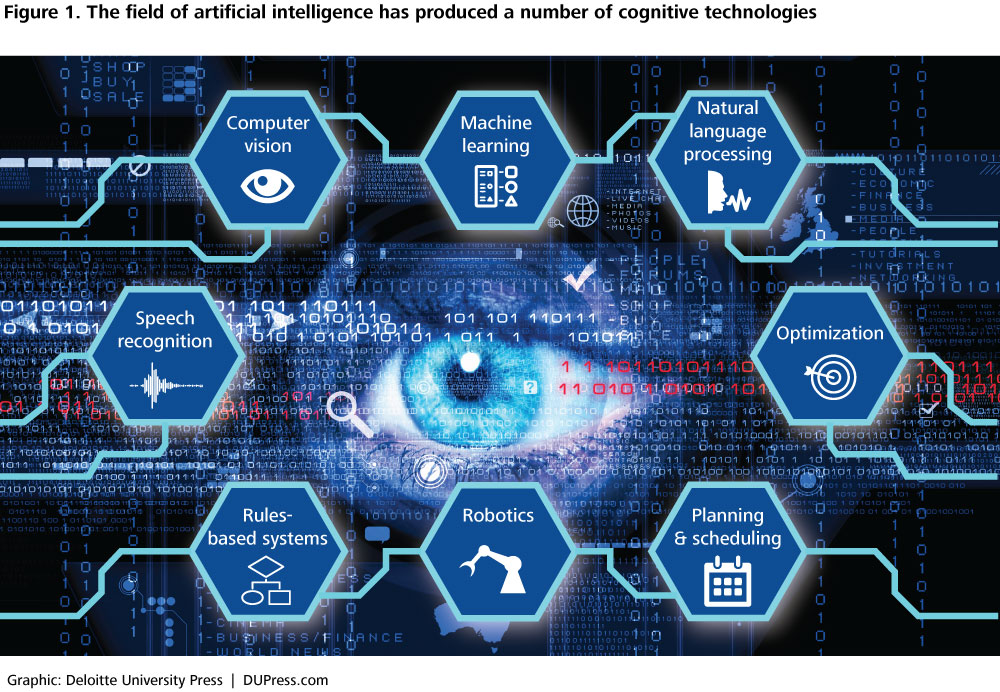
While cognitive technologies are products of the field of artificial intelligence.

They are able to perform tasks that only humans used to be able to do.

Organizations in every sector of the economy are already using cognitive technologies in diverse business functions.

If current trends in performance and commercialization continue, we can expect the applications of cognitive technologies to broaden and adoption to grow.

Billions of investment dollars have flowed to hundreds of companies building products based on machine learning, natural language processing, computer vision, or robotics suggests that many new applications are on their way to market.

We also see ample opportunity for organizations to take advantage of cognitive technologies to automate business processes and enhance their products and services.

If you look at technology we have to-day you could say that it is the knack of so arranging the world that we don’t have to experience it.

We must execute the creation of Artificial Intelligence as the exact application of an exact art.

And maybe then we can win.

I suspect that, pragmatically speaking, our alternatives boil down to becoming smarter or becoming extinct.

Historians will look back and describe the present world as an awkward in between stage of adolescence, when humankind was smart enough to create tremendous problems for itself, but not quite smart enough to solve them.

We are for the moment subject to natural selection which isn’t friendly, nor does it hate you, nor will it leave you alone.

The point about underestimating the potential impact of Artificial Intelligence is symmetrical around potential good impacts and potential bad impacts.

When something is universal enough in our everyday lives, we take it for granted to the point of forgetting it exists.

It may be tempting to ignore Artificial Intelligence because,of all the global risks but we do so AT GRAVE RISK OF CREATING A DIGITAL DIVIDE WORLD.  Afficher l'image d'origine

We cannot query our own brains for answers about nonhuman optimization processes— whether bug-eyed monsters, natural selection, or Artificial Intelligences.

DUP-1030_WP-intro-image

How then may we proceed?

How can we predict what Artificial Intelligences will do?

The human species came into existence through natural selection, which operates through the non chance retention of chance mutations.

Artificial Intelligence comes about through a similar accretion of working algorithms, with the researchers having no deep understanding of how the combined system works. Nonetheless they believe the AI will be friendly,with no strong visualization of the exact processes involved in producing friendly behavior, or any detailed understanding of what they mean by friendliness.

Friendly AI is an impossibility, because any sufficiently powerful AI will be able to modify its own source code to break any constraints placed upon it.

This does not imply the AI has the motive to change its own motives.

Sufficiently tall skyscrapers don’t potentially start doing their own engineering.

Humanity did not rise to prominence on Earth by holding its breath longer than other species.

Humans evolved to model other humans—to compete against and cooperate with our own conspecifics.

Robots will not.

It’s mistaken belief that an AI will be friendly which implies an obvious path to global catastrophe.

Artificial Intelligence is not an amazing shiny expensive gadget to advertise in the latest tech magazines.

Artificial Intelligence does not belong in the same graph that shows progress in medicine, manufacturing, and energy.

Artificial Intelligence is not something you can casually mix into a lumpen futuristic scenario of skyscrapers and flying cars and nanotechnologies red blood cells that let you hold your breath for eight hours.

A sufficiently powerful Artificial Intelligence could overwhelm any human resistance and wipe out humanity. (And the AI would decide to do so.)

Therefore we should not build AI.

On the other hand.

A sufficiently powerful AI could develop new medical technologies capable of saving millions of human lives. (And the AI would decide to do so.)

Therefore we should build AI.

Once computers become cheap enough, the vast majority of jobs will be performable by Artificial Intelligence more easily than by humans.

A sufficiently powerful AI would even be better than us at math, engineering, music, art, and all the other jobs we consider meaningful. (And the AI will decide to perform those jobs.) Thus after the invention of AI, humans will have nothing to do, and we’ll starve or watch television.

So should we prefer that nanotechnology precede the development of AI, or that AI precede the development of nanotechnology?

As presented, this is something of a trick question.

The answer has little to do with the intrinsic difficulty of nanotechnology as an existential risk, or the intrinsic difficulty of AI. So far as ordering is concerned, the question we should ask is, “Does AI help us deal with nanotechnology? Does nanotechnology help us deal with AI?”

The danger of confusing general intelligence with Artificial Intelligence  is that it leads to tremendously underestimating the potential impact of Artificial Intelligence.

The best way I can think of to train computers to be able to get them watch a lot of videos and observe what they Predict.

Prediction is the essence of intelligence.

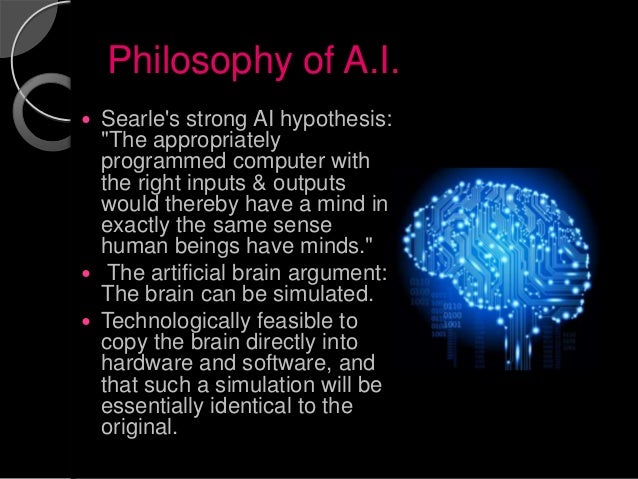
All scientific ignorance is hallowed by ancientness.Philosophy of A.I. Searles strong AI hypothesis: "The appropriately programmed computer with the right inputs & output...

Here is a closing thought.

When a Super Intelligent Robot returns to earth from a voyage in space how can it be trusted to tell us the truth.

Exactly how AI systems should be integrated together is still up for debate.

With every advance, and particularly with the advances in machine learning and deep learning more recently,we get more tools to fuck up the world we all live on.

Ours is a less than excessively age.

We know so much and feel so little.

All comments welcome, all like clicks chucked in the bin.
← Back

Thank you for your response. ✨


Share this:

  • Share on WhatsApp (Opens in new window) WhatsApp
  • More
  • Share on Pocket (Opens in new window) Pocket
  • Share on Mastodon (Opens in new window) Mastodon

THE BEADY EYE ASKS: IS IT TIME TO REDEFINE HUMANITY

13 Friday Jan 2017

Posted by bobdillon33@gmail.com in Artificial Intelligence., Big Data., HUMAN INTELLIGENCE, Humanity., Innovation., Life., Modern day life., Social Media., Space., Sustaniability, Technology, The Future, The New year 2017, The world to day., Unanswered Questions., United Nations, War, What Needs to change in the World, Where's the Global Outrage.

≈ Comments Off on THE BEADY EYE ASKS: IS IT TIME TO REDEFINE HUMANITY

Tags

Artificial Intelligence., Big Data, Technology, The Future of Mankind, Visions of the future.

( Follow up read of three minutes to the last Post)

Humanity has achieved its current level of freedom following centuries of sacrifices and struggles, which we are now wittingly or unwittingly transferring to Artificial Intelligence.Afficher l'image d'origine

For obvious reasons it will not be us that ventures out into the Universe, but a self-sustaining machine equipped with all human knowledge, that may decide not to return as it acquires more knowledge beyond our comprehension.

No matter: We stand on the brink of a technological revolution that will fundamentally alter the way we live, work, and relate to one another. In its scale, scope, and complexity, the transformation will be unlike anything humankind has experienced before. It is characterized by a fusion of technologies that is blurring the lines between the physical, digital, and biological spheres.Afficher l'image d'origine

We do not yet know just how it will unfold, but one thing is clear: the digital revolution that has been occurring since the middle of the last century. It is already changing our health and leading to a “quantified” self, and sooner than we think it may lead to human augmentation.

The possibilities of billions of people connected by mobile devices, with unprecedented processing power, storage capacity, and access to knowledge, are unlimited. And these possibilities will be multiplied by emerging technology breakthroughs in fields such as artificial intelligence, robotics, the Internet of Things, autonomous vehicles, 3-D printing, nanotechnology, biotechnology, materials science, energy storage, and quantum computing.

It’s time to let go of the United Nations declaration of Human Rights and to redefine them, effectively addressing people’s needs, not ideology, should dictate the new definition.Afficher l'image d'origine

Centuries ago human knowledge increased slowly, so politics and economics changed at a leisurely pace too. Today our knowledge is increasing a breakneck speed, and theoretically we should understand the world better and better. But the very opposite happening.

Our new-found knowledge leads to faster economic, social and political changes; in an attempt to understand what is happening, we accelerate the accumulation of knowledge, which leads to faster and greater upheavals.

Consequently we are less and less able to make sense of the present or forecast the future. While the outside world is changing, the humanitarian sector has simply not been able to adapt to new challenges.

Digital fabrication technologies, meanwhile, are interacting with the biological world on a daily basis. Engineers, designers, and architects are combining computational design, additive manufacturing, materials engineering, and synthetic biology to pioneer a symbiosis between microorganisms, our bodies, the products we consume, and even the buildings we inhabit.

Change has a way of scaring people—scaring them into inaction.

I am a great enthusiast and early adopter of technology, but sometimes I wonder whether the inexorable integration of technology in our lives could diminish some of our quintessential human capacities, such as compassion and cooperation. Our relationship with our smartphones is a case in point. Constant connection may deprive us of one of life’s most important assets: the time to pause, reflect, and engage in meaningful conversation.

Neither technology nor the disruption that comes with it is an exogenous force over which humans have no control.Afficher l'image d'origine

All of us are responsible for guiding its evolution, in the decisions we make on a daily basis as citizens, consumers, and investors. We should thus grasp the opportunity and power we have to shape the Fourth Industrial Revolution and direct it toward a future that reflects our common. objectives and values.

We therefore must redefine what it is to be human.

Should we view prosperity in a society as the accumulation of solutions to human problems. Instead of measuring growth through GDP.

Perhaps growth should be measured by the rate at which new solutions to human problems become available and the degree to which we make those solutions broadly accessible.

The alternative is to watch as animals and plants go extinct, water becomes scarce, weather hits more extremes, conflicts over land and resources increase, and life becomes more difficult for people everywhere.

We need to shape a future that works for all of us by putting people first and empowering them not just to control Artificial Intelligence., but all technology that is designed for Profit sake only.

If we connect the dots it is certain that “People, Planet, Profit” will be the new tomorrow.

Now that everything is digital Data Privacy is abstract, There’s an air of resignation around the concept of privacy these days.

It’s about the ones and zeros, the metadata underlying our everyday digital lives.

As the physical, digital, and biological worlds continue to converge, new technologies and platforms will increasingly enable citizens to engage with governments, voice their opinions, coordinate their efforts, and even circumvent the supervision of public authorities.

As the human population continues to increase, animal numbers are falling it’s about protecting what is yours, by creating digital spaces where you have control.

There’s a strong correlation.

A new definition of Human/ Technological rights will lift humanity into a new collective and moral consciousness based on a shared sense of destiny.

It is incumbent on us all to make sure the latter prevails.

Meanwhile, changes in the tools of war – including drones and automated weapons – point to a more remote and anonymous form of warfare. Continued civilian suffering in conflicts in Syria, South Sudan and Yemen is a sobering reminder of the international community’s continued failure.

Piecemeal reforms amount to tinkering around the edges.

Only when we realize that we are for the moment all on the same planet can all enjoy the many gifts Earth provides.Afficher l'image d'origine


← Back

Thank you for your response. ✨


Share this:

  • Share on WhatsApp (Opens in new window) WhatsApp
  • More
  • Share on Pocket (Opens in new window) Pocket
  • Share on Mastodon (Opens in new window) Mastodon

THE BEADY ASKS: WHERE IS THE VOICE OF THE WORLD’S YOUTH ?

12 Thursday Jan 2017

Posted by bobdillon33@gmail.com in Artificial Intelligence., Big Data., Brexit., Capitalism, Climate Change., Communication., Education, European Union., Google Knowledge., HUMAN INTELLIGENCE, Humanity., Innovation., Modern Day Communication., Natural World Disasters, Nuclear power., Paris Climate Change Conference 2015, Politics., Privatization, Sustaniability, Technology, The Future, The New year 2017, The world to day., Unanswered Questions., USA Presidential Election, What Needs to change in the World, Where's the Global Outrage., World Organisations.

≈ Comments Off on THE BEADY ASKS: WHERE IS THE VOICE OF THE WORLD’S YOUTH ?

Tags

Artificial Intelligence., Big Data, Capitalism vs. the Climate., Extinction, Social Media, Technology, The Future of Mankind, United Nations


( Eight minute read.)

When you look at the state of the world you have to ask yourself have we all lost our marbles, and where is the protest voice of the Young.Afficher l'image d'origine

You could say that we are well along in the process of causing our own extinction and the planet has officially entered its sixth mass extinction event.

Such a view is now beginning to occasionally find its way into mainstream consciousness.

The situation is already so serious with so many self-reinforcing feedback loops already in play it seem we are on a rolling coaster, incapable of acting,or if we do, it will be after the event, if there is anything left to save.

We have a vast choice of the end-of-humanity scenarios to pick from, to derail life as we know it.

For example:

A self-induced catastrophe such as nuclear war or a bioengineered pandemic. Disruptive innovation and technological changes, Solar storms, Cosmic collisions, Super volcanoes, Rising sea levels, overcrowding, denuded resources to mention just a few.

We’re driving to extinction at least 150 species each day.

Nuclear power plants require grid-tied electricity, cooling water and people getting paychecks. Without all these, they melt down, thus immersing all life on earth in ionizing radiation.

As if the above is not enough we are now selling or most valuable resource – Intelligence. Afficher l'image d'origine

So what can be done?

First of all, internal and external issues are more linked than ever. Now, more than ever, we need principled leaders with an understanding of history.

Freedom and the rule of law are under threat.

Why?

Because while the world teeters on a precipice of being plundered by Capitalist Artificial intelligence. A new reality is taking shape: war is called peace, a bloody victory is a step towards reconciliation, and a terrorist regime is a legitimate power.

The further we removed ourselves from the world the worse will be our encounter with the world beyond.

Ignoring the unregulated introduction of Artificial Intelligence.

All causing disillusionment and confusion with the great visions of the future, all are demanding that we cope as one with the present reality with our ability to protest hijacked by Internet petitions sites that are ignored or focused on parochial problems.

An individuals future is shaped ultimately by environmental factors.

The year 2017 opens on a world laid to waste. Some areas are littered with mass graves and there doesn’t seem to be any big global rush to reduce emissions as a result of the Paris Climate Agreement.

In the end, no amount of research can do much to prevent permafrost melting realising, methane – a greenhouse gas 100 times more potent than carbon dioxide on a shorter timescale into the atmosphere, warming it further, which in turn causes more permafrost to melt, and so on.

Scientists estimate up to 13 percent of global carbon emissions come from deforestation – greater than emissions from every car, truck and plane on the planet combined.

Because Globalism is an ideology, and its struggle with nationalism it will shape the coming era.

Afficher l'image d'origineAfficher l'image d'origine

Donald J. Trump five months short of seventy-one will take office on January 20. His election tips us into the unknown threatened disengagement from the world.

Mother Teresa in the Uk wants disengagement from the EU.

Both are successful alpha personalities.  Both work in progress—“Everything is negotiable”—both displaying a single-minded determination to impose their vision on the world, an irrational belief in unreasonable goals, bordering at times on lunacy.

From Brexit to Trump to the rise of nationalist parties across Europe, the old division between left and right is giving way to a battle between self-styled patriots and confounded globalists.

For decades, trade, industrialization and demographics produced a virtuous circle of rising prosperity. By the 2000s, globalism was triumphant.

IT IS NOW OVERREACHED AND BLIND to the nationalist backlash, not to mention the new form of Globalisation – Artificial Intelligence.

Many globalists now assume that the discontent is largely driven by stagnant wages and inequality. If people are upset about immigration, they reason, it is largely because they fear competition with low-wage workers and not the technological Revolution that is replacing their need to work in the first place. Yet their faith in open borders remains unshaken.

That crisis has woken up globalists to the flaws of globalization but not it seems to me the pending exploration of Apps run on Algorithms that are designed to create profit for the Monopolies of the Internet.  Facebook, Twitter, Google, Microsoft, Amazon, to mention a few.

Many of the tech industry’s biggest companies, like Amazon, Google, IBM and Microsoft, are jockeying to become the go-to company for A.I. In the industry’s lingo, the companies are engaged in a “platform war.”

The company that controls A.I. will steer the tech industry for years to come.

In fact, much of the backlash against immigration (and globalism) is not economic but cultural: Many people still care about their own versions of national identity and mistrust global institutions such as the EU.

These voters are bothered less by competition from immigrants than by their perceived effect on the country’s linguistic, religious and cultural norms. About how changes to “the composition of the local population” would affect “their neighborhoods, schools and workplaces.”

They might have their priorities slightly wrong.

Is the new nationalism a cloak for ethnic and religious exclusion?

New nationalism often thrives on xenophobia.

Globalists should not equate concern for cultural norms and national borders with xenophobia.

There must be some sort of middle ground between a nationalist and globalist approach. In short, there is ample reason for skepticism about whether the new nationalists can prove themselves a genuinely secular, democratic alternative to globalism.

If globalists are to regain the public’s trust, they will need to re-examine their own policies. Political capital might be better invested in preserving existing trade pacts, not passing new ones. Many European globalists blame the euro’s crisis on too little integration, not too much. But pressing for a more federal Europe could further alienate voters who “do not share our Euro-enthusiasm,”

Borders use to mean something, but this version of civilization is the least sustainable of them all. We cannot sustain the unsustainable forever in a world more interconnected.

In fact, 2017 is looking pretty bad…Russia dominating the world order. But it too will pop. New cyber attacks.

In this context, the basic principles of democratic life in both Europe and the U.S. — truth, fact-based reality, justice and the rule of law — are being gradually eroded.

The most important thing is to understand what might steer us towards a more secure world order, where respect for the rule of law and for international bodies are granted their proper place.

European powers may choose to find strength in their union. Brought together by the need to combat those who threaten fundamental European values, Paris, Berlin, Rome and the Benelux countries could launch new initiatives to bring about real European cooperation.

Should these institutions find themselves unable to take a stand and act according to global interests and basic values, there is no reason why 2017 should not continue in the same vein as 2016, and the consequences may be irreversible.

It’s time to abandon our usual pessimism about the state of the planet and the course of history. We’ve got many challenges to overcome, but it might be a good idea to adopt a bit of youthful optimism when it comes to confronting them.

We need to create a hope insurgency. 

Despite half of the world’s youth living on less than two dollars a day.

A social media revolution is unfolding before our eyes, forever changing the way we connect. This generation, the most interconnected generation ever, continues to grow rapidly, but its voice is diluted by Social media making the challenges they face are ever more daunting.

We need to ask ourselves:

How can we can empower youth to drive social progress. From crowd-sourcing initiatives and mobile-projects to innovation jams and social media campaigns.

Whatever changes you would like to effect in our society has to begin with you.Afficher l'image d'origine

The best leaders the world has ever known are the reformers who were accountable and responsible for their own change.

The commitment for change has no days off, does not allow for excuses, does not allow for pardons. If you want to see change you must first start within.

It’s that simple and it’s that profound.

So where is the Global YOUTH Outrage?Afficher l'image d'origine

Before there were blogs and tweets – even Wikipedia – to turn to, the mainstream media held a monopoly over knowledge and news which was hard to challenge. Now all knowledge is being collected by Google to feed Artificial Intelligent Algorithms.

THE world must change to meet the wave of popular uprising which catapulted Donald Trump to power and brought about Brexit. The world can be changed as much by education as by being harangued. It’s time for international leaders to bury their liberal attitudes and address the concerns of the masses. It is time for government to act in the long-term interest of the people, even if they do not agree in the short-term.

The twin pillars of liberalism and globalisation which have dominated politics over the past generation must adapt to a “world transformed”.

Society is changing rapidly and I fear that many organisations are failing to notice and are being left behind. I suspect that the scale of such a change can only really be appreciated in hindsight.

In the rich world, particularly, the first generation that has rung up a huge national debt and established a huge unfunded pension scheme is about to retire. The interesting, to say the least, question is whether the next generation will be willing to carry this burden and peacefully pay the debt and peacefully pay the pensions. I think not.

WILL THE WORLD OF 2052 BE A BETTER WORLD?

It’s important to note that people 35 years from now will judge their circumstance more on how it has changed from their own recent past than from our vantage point of today.

Billion will have some level of Internet access, be much better informed, and be increasingly helped by local solar energy. They will have many fewer children. They will be largely urban (except for the minority still living off the land). They will grapple with overall effects of climate damage, but those in dense urban areas will likely have little firsthand experience with the damage caused by the erratic weather (though plenty of secondhand information via electronic media). They will live with the unpleasant knowledge that even more climate impacts lie ahead.

There will be huge differences between people and Artificial Intelligence.

There is be no such thing as the Free Market.

People power hopefully will have transformed the world. From a psychological perspective, probably no, because the future prospects in 2052 will be grim.

University is where such simplistic notions are supposed to be challenged, but they now educate for the market place and not for Intelligence.

The winners of tomorrow will be those organizations with strong leaders who demonstrate agility, authenticity, connectivity to their talent, and sustainability.

By 2018, at least 50 percent of developers will include A.I. features in what they create. The goal is to capture all human knowledge and turn it in saleable AI. It’s where the capitalist market is headed.

No worries, you might say: you could just program it to make

The superintelligent machine manufactures some as-yet-uninvented raw-computing material (call it “computronium”) and uses that to check each doubt. But each new doubt yields further digital doubts, and so on, until the entire earth is converted to computronium.

When a computer became capable of independently devising ways to achieve goals, it would very likely be capable of introspection—and thus able to modify its software and make itself more intelligent. In short order, such a computer would be able to design its own hardware.

If this sounds absurd to you, you’re not alone.

I am one protesting voice in the wilderness of the virtual reality, but I am sure there are billions.

The problem is unifying them into one collective protest to demand that the United nations pass a people’s resolution to give all artificial Intelligence and technological advances a stamp of human approval.

All comments, suggestions, welcome, all like clicks chucked in the bin.

← Back

Thank you for your response. ✨


Share this:

  • Share on WhatsApp (Opens in new window) WhatsApp
  • More
  • Share on Pocket (Opens in new window) Pocket
  • Share on Mastodon (Opens in new window) Mastodon
← Older posts
Newer posts →

All comments and contributions much appreciated

  • THE BEADY EYE SAYS. ANY OTHER PERSON WOULD BE ARRESTED. February 1, 2026
  • THE BEADY EYE SAYS FROM THE RESURRECTION OF JESUS TO THE PRESENT DAY THE HISTORICAL RECORD OF OUR WORLD IS MORE THAN HORRIBLE. February 1, 2026
  • THE BEADY EYE SAYS: THE WORLD WE LIVE IN IS BECOMING MORE AND MORE UNKNOWN. January 31, 2026
  • THE BEADY ASK. IN THIS WORLD OF FRICTIONS IS THERE ANY DECENCY LEFT ? January 29, 2026
  • THE BEADY EYE ASKS ARE WE WITH ARTIFICIAL INTELLIGENCE LOOSING THE MEANING OF OUR LIVES? January 27, 2026

Archives

  • February 2026
  • January 2026
  • December 2025
  • November 2025
  • October 2025
  • September 2025
  • August 2025
  • July 2025
  • June 2025
  • May 2025
  • February 2025
  • January 2025
  • December 2024
  • November 2024
  • October 2024
  • September 2024
  • August 2024
  • July 2024
  • June 2024
  • May 2024
  • April 2024
  • March 2024
  • February 2024
  • January 2024
  • December 2023
  • October 2023
  • September 2023
  • August 2023
  • July 2023
  • June 2023
  • May 2023
  • April 2023
  • March 2023
  • February 2023
  • January 2023
  • December 2022
  • November 2022
  • October 2022
  • September 2022
  • August 2022
  • July 2022
  • June 2022
  • May 2022
  • April 2022
  • March 2022
  • February 2022
  • January 2022
  • December 2021
  • November 2021
  • October 2021
  • September 2021
  • August 2021
  • July 2021
  • June 2021
  • May 2021
  • April 2021
  • March 2021
  • February 2021
  • January 2021
  • December 2020
  • November 2020
  • October 2020
  • September 2020
  • August 2020
  • July 2020
  • June 2020
  • May 2020
  • April 2020
  • March 2020
  • February 2020
  • January 2020
  • December 2019
  • November 2019
  • October 2019
  • September 2019
  • August 2019
  • July 2019
  • June 2019
  • May 2019
  • April 2019
  • March 2019
  • February 2019
  • January 2019
  • December 2018
  • November 2018
  • October 2018
  • September 2018
  • August 2018
  • July 2018
  • June 2018
  • May 2018
  • April 2018
  • March 2018
  • February 2018
  • January 2018
  • December 2017
  • November 2017
  • October 2017
  • September 2017
  • August 2017
  • July 2017
  • June 2017
  • May 2017
  • April 2017
  • March 2017
  • February 2017
  • January 2017
  • December 2016
  • November 2016
  • October 2016
  • September 2016
  • August 2016
  • July 2016
  • June 2016
  • May 2016
  • April 2016
  • March 2016
  • February 2016
  • January 2016
  • December 2015
  • November 2015
  • October 2015
  • September 2015
  • August 2015
  • July 2015
  • June 2015
  • May 2015
  • April 2015
  • March 2015
  • February 2015
  • January 2015
  • December 2014
  • November 2014
  • October 2014
  • September 2014
  • August 2014
  • July 2014
  • June 2014
  • May 2014
  • April 2014
  • March 2014
  • February 2014
  • January 2014
  • December 2013
  • November 2013
  • October 2013

Talk to me.

Jason Lawrence's avatarJason Lawrence on THE BEADY EYE ASK’S: WIT…
benmadigan's avatarbenmadigan on THE BEADY EYE ASK’S: WHA…
bobdillon33@gmail.com's avatarbobdillon33@gmail.co… on THE BEADY EYE SAYS: WELCOME TO…
Ernest Harben's avatarOG on THE BEADY EYE SAYS: WELCOME TO…
benmadigan's avatarbenmadigan on THE BEADY EYE SAY’S. ONC…

7/7

Moulin de Labarde 46300
Gourdon Lot France
0565416842
Before 6pm.

My Blog; THE BEADY EYE.

My Blog; THE BEADY EYE.
bobdillon33@gmail.com

bobdillon33@gmail.com

Free Thinker.

View Full Profile →

Follow bobdillon33blog on WordPress.com

Blog Stats

  • 95,076 hits

Blogs I Follow

  • unnecessary news from earth
  • The Invictus Soul
  • WordPress.com News
  • WestDeltaGirl's Blog
  • The PPJ Gazette
Follow bobdillon33blog on WordPress.com

The Beady Eye.

The Beady Eye.
Follow bobdillon33blog on WordPress.com

Create a free website or blog at WordPress.com.

unnecessary news from earth

WITH MIGO

The Invictus Soul

The only thing worse than being 'blind' is having a Sight but no Vision

WordPress.com News

The latest news on WordPress.com and the WordPress community.

WestDeltaGirl's Blog

Sharing vegetarian and vegan recipes and food ideas

The PPJ Gazette

PPJ Gazette copyright ©

Privacy & Cookies: This site uses cookies. By continuing to use this website, you agree to their use.
To find out more, including how to control cookies, see here: Cookie Policy
  • Subscribe Subscribed
    • bobdillon33blog
    • Join 222 other subscribers
    • Already have a WordPress.com account? Log in now.
    • bobdillon33blog
    • Subscribe Subscribed
    • Sign up
    • Log in
    • Report this content
    • View site in Reader
    • Manage subscriptions
    • Collapse this bar