THE BEADY EYE : HERE BELOW IS A CRY FOR HUMANITY THAT CAN NO LONGER BE IGNORED.
29 Sunday Nov 2015

29 Sunday Nov 2015
25 Wednesday Nov 2015
Posted in Humanity., Life., Sustaniability, The Future, The world to day., Where's the Global Outrage.
≈ Comments Off on THE BEADY EYE ( PART FIVE) ASK’S WHY IS THE WORLD LIKE THIS.
In the last post of this series I mentioned that our canvas of the world needed Woman.
Since we men focus on the exterior so much, you would think they are entirely different species. But they are not.
The question is how do we introduce them to our painting.
Inside they couldn’t be any similar.
Both men and women want to be loves and accepted. Both men and women are capable of human tendencies like sympathy and empathy. Both men and women are just as fallible when it comes to greed and vices.
In short, I have no idea what it’s like to be a woman. Every answer will be different.
The belief that women are inferior to men is no more a ‘label’ of inferiority for women it affected their lives and actually made them inferior.
Women presently bear the brunt of economic injustice, violence, poverty and hunger.
The modern global conversation around women’s rights and political participation has been taking place for almost 40 years.
Gender roles have been assigned by society. Examples of this are everywhere.
At the top of industry and government, the faces remain stubbornly male.
You don’t have to believe in patriarchy to realise that the law was made by men and is dominated by men, and that the same goes for parliament. Which means that in all the making of the law, women are largely absent. It is not surprising that the law doesn’t work for women.
More importantly, as a growing world of humanists, we understand that no society can truly be free until every citizen has the same rights; to deny even the least of its members carries the potential to deny all of its members freedom and liberty.
But the question remains do women want absolute parity in all things measurable.
Equality-by-numbers advocates should be thinking about women’s progress in terms of what women show that they want, not what the spreadsheets say they should want.
One way or the other Women are stymied by the need for humanity to reproduce. The ultimate magic trick in the universe.
Being a woman feels like being a human being, with the power to grow another human being inside oneself, and all that entails, including what society thinks you should be doing with that power.
The failure to root out prejudice against women is one of the major barriers to progress and prosperity.
Gender discrimination also breaches international human rights agreements and domestic laws in most countries.
As our canvas is depicting the state of Earth which is mother to us all we will place woman above the grinning men of humanity.

Why?
Because as we know humanity, without woman there would be no humanity. Behind every human is a woman. It is the best feminine qualities which will help us to develop peace on earth. They shared a faith in humanity, whether born of religious conviction or humanism.
In the good fight for peace and reconciliation, we are dependent on persons who set examples, persons who can symbolize what we are seeking and mobilize the best in us.
However fewer than 3 percent of signatories to peace agreements are women. No women have been appointed chief or lead peace mediators in UN-sponsored peace talks.
Is this because woman are primarily ruled by their emotions. It’s not that they lack logic; it’s just that their logic is over-ruled by their emotions.
Human fertility was the highest premium factor in existence
As long as we remain mysterious to ourselves, so will the universe.
We know now that no organization can prosper without tapping into the full mental and emotional potential of both genders.
Recognizing the importance of long-term investments in gender
equality at different stages of the life cycle has never being more important.
This will be the problem with Artificial Intelligence.
There is no magic key to unlocking gender equality in the world of work.
Not only has the United States not ratified the Equal Rights Amendment it is the only developed nation that has not ratified the Convention on the Elimination of all Forms of Discrimination against Women (CEDAW).
Countries who ratify the CEDAW are required to enshrine gender equality into their domestic legislation, repeal all discriminatory provisions in their laws, and enact new provisions to guard against discrimination against women.
The only countries in the United Nations who haven’t ratified CEDAW are: Iran, Palau, Somalia, Sudan, South Sudan, Tonga, and the United States.
Every human being must feel the same because we are all the same species ( Homo Sapiens)
So, to put it plainly, women had a place in society that wasn’t just dictated by male prejudice. There is no mystery in being a woman, whatever a human being wants and need that’s exactly what a woman needs too.
The rights of women in particular are being shunned massively throughout the globe. Sadly, in many countries, women are believed to be inferior. The belief that men are superior to women, otherwise known as patriarchy, has to end.
Human rights are defined as rights that are afforded to all human beings universally on the basis of their common humanity.
So as woman is the foundation stone of all humanity we will apply her with a pallet knife in a seated position with her back towards us (so men are not distracted) right in the center of the top of our canvas.
All that is left is to frame our painting and display it.

Adultry is Haram in Islam and I think in most religions as well, but you know what the consequence is? Stone to death ONLY THE WOMEN! This leads to fear of sex, fear or making love, fear of men, fear of public, fear of love itself!
But middle east is life for men, women are odalisques and servants to please men. That’s how they are raised from childhood, teach them to clean the house well, obey their father, obey their husbands, and obey until death.
23 Monday Nov 2015
Tags
Capitalism and Greed, Distribution of wealth, Extinction, Global warming, Globalization, Inequility, The Future of Mankind, World aid commission
Our painting now has a wash of money, a random application of religion and the Gun with a transparent over wash of humanity.
I think it would be a grave injustice to speak of the human species ( Other than ISIS and their like) as in some sense evil, even though we are destroying the environment so efficiently at the present time.
The nature of humankind is to expand its population, to gain security, to control, to alter. For millions of years that paid off without undue damage.
But then what happened was, as we developed a modern industrial capacity, and then the techno scientific capacity to eliminate entire habitats quickly and efficiently, we succeeded too well and at long last we broke nature. And now, almost too late, we are waking up to the fact that we have overdone it and that we are destroying the very foundation of the environment on which humanity was built.
Its time to add a healthy dollop of Earth to our canvas.
One frequently quoted piece of evidence against a Christian green ethic is the command to our first parents to ‘fill the earth and subdue it’ (Genesis 1:28).
How should we interpret this?
Does this mean we should be thrilled at increasing populations?
Well, to start with, ‘filling’ is not the same as over-filling. We should also remember that it is only in the last 100 years, that over-populating the world has become a real prospect.
In giving us “dominion”, God appointed us as His stewards or care-takers, and will hold us accountable for the way we discharge our responsibility, just like the husband-men and talent-holders in Jesus’ parables (Mat. 25:14-30, Luke. 20:9-16).
It does not matter whether you are a believer or not the ‘State of the Planet’ makes clear that we are unique in terms of our destructive potential, and we alone must change our behavior in response to moral beliefs and challenges.
People with or without religious belief can (and do) recognise and accept that we have a role as Stewards. It is agreed by ALL RELIGIONS that humans are not simply answerable to future generations for their management of nature, but that they are answerable to the one God who created them in his image so that they would manage the earth on his behalf.
The key or ethical argument – an argument of stewardship, an argument of handing on a world as rich as the one we inherited does not need any religious belief.
The rate at which species are becoming extinct as a consequence of human activity is staggering.
The problem is all around us and we are all part of the problem.
The problem now is recognising this fact. It can be the first step in becoming an active part in the solution
Human beings have created derelict industrial sites, open-cast mines, scrap yards and polluted rivers and beaches. Our current actions are producing greater and more rapid changes than ever before.
There is some pallet of colors to pick from. Soil erosion and loss of fertility. Deforestation Water-quality pollution Waste. Generation and global toxification. Human and cultural degradation. Alterations of earth’s energy exchange with the sun – green house gasses keep in too much heat resulting in global warming.
Our life-styles tend to keep us isolated from the awesome power and beauty of creation. Consequently we loose sight of its wonder, and as a result, we have a poorer understanding of the mess we ARE ALL IN.
Most of us are disconnected from our actions and their environmental effects.
We seldom if ever see our food growing, because it comes from shops. Few people who buy petrol from garages have ever seen an oil production platform or refinery. We may claim to deplore environmental damage, but by acquiescing in the system makes us accomplices in the crime.
We can just continue with the inevitable consequences of ignorance and greed, thoughtlessly bending the world to creating more bits of garbage to amuse ourselves…
No matter which course we take knowledge does not lead automatically to action.
The time has come… to destroy those who destroy the earth.
Why is it that the activities of our one species, aiming at no more than living in reasonable comfort and avoiding hunger, should cause such devastation on the rest of the natural world?
The answer is in our back ground wash, and how it has being applied with greed and corruption of power by all societies.
By now we should understand which of humanity’s activities inflict the greatest damage on the diversity of animal and plants of this planet.
But the problem is we are self centered and look like remaining so.


The average American consumes 40 times as much energy as the typical third-world inhabitant and the average European some 20 times as much.
One European uses as much energy as 20 Bangladeshis.
In short, a change to our societies, our economics, and our politics and our world organisations is needed.
Here is a snap shot of what the Paris Climate Change Conference 2015 is up against.
Qatar’s carbon emissions per capita are the highest in the world and three times as high as the United States’. Qatar, gas prices in Kuwait are among the lowest in the world, while GDP is among the highest. This, coupled with a lack of public transit infrastructure, makes road travel the sole means of mobility for both citizens and businesses moving goods. According to the Global Footprint Network, the average Kuwaiti uses 22 times more resources than the country provides per person.
A fuel farm on the outskirts of Dublin, Ireland, grows rapeseed (canola) plants to ultimately make biofuel.
In 2008, however, Ireland’s greenhouse gas emissions per capita were the second highest in the European Union.
Agriculture is the largest source of emissions, but emissions from vehicles have more than doubled since 1998.
However, there have been improvements in recent years: 2009 was the second year in a row in which transport emissions declined, and an increase in renewable sources of energy in the early 2000s reduced emissions from the energy sector by 10 percent in 2009.
The United Arab Emirates:
Despite being the world’s fourth largest oil exporter (behind Saudi Arabia, Russia, and Iran), the United Arab Emirates has publicly pushed for a renewal of the Kyoto protocol (the agreement among industrialized nations to cap emissions), announced a plan to increase renewable energy production, and even launched a 1-gigawatt concentrated solar generation project.
Yet Dubai, a city of 1.5 million people (many of whom are immigrants seeking their fortunes, like the workers pictured above), the world’s largest shopping mall, and an indoor ski resort, currently gets all its energy needs from the burning of natural gas, which is why it ranks third on Global Footprint’s list.
A Danish farmer surveys his Christmas trees shortly before they are sold in December 2008.
Denmark’s carbon emissions are half that of the United States’, but its cropland (the amount of viable land that can be used to produce crops) requirements are much higher. Because so much meat is eaten per capita in Denmark, the country must import a large amount of grain—so much that it would take up 215,000 square feet (2 hectares) of land per person, or 2.5 times more land than the country has.
New York City twinkles at night, with Fifth Avenue and Broadway clogged with cars.
If everyone lived like the average American, the Earth’s annual production of resources would be depleted by the end of March, the Global Footprint Network’s report said.
Americans’ love of road trips, suspicion of public transit, and growing energy demands fuel the country’s high per-capita carbon emissions.
A Belgian farmer drives his tractor in this undated photo.
Belgium’s biocapacity of cropland is extremely low, so much of its food must be imported. This begins to explain Belgium’s high ranking on Global Footprint’s list.
A lumberman cuts down a karri tree, a type of eucalyptus, in Western Australia.
Australians emit 28.1 tons of carbon dioxide equivalent per person, one of the highest per-capita rates in the world. In addition, the country’s demand for wood, food, and pasture uses the equivalent of 753,000 square feet (7 hectares) of land per person, nearly four times greater than what is available on average around the world.
Canada’s biocapacity is 14.92 hectares per capita, 5.5 times average global consumption. So if the world’s resources were as abundant everywhere as in Canada, we’d have more than enough to go around.
Even so, Canada’s cities are energy hogs. The country has the seventh highest rate of carbon dioxide emissions per capita. Total greenhouse gas emissions in Canada rose 24 percent between 1990 and 2008.
Sheep near a village in the Netherlands will go toward feeding Dutch citizens, yes, but for the most part, the Dutch consume more than they produce.
The small country, with its high population density and relatively little land area for crops and pasture, consumes six times more resources (energy, food, and more) than it is able to produce, and about three times more than the Earth overall is able to sustain.
God only know what China, India, and Russia and the rest of the world would add.
This can only be achieved by making Profit for profit sake create a World Aid Fund ( see previous posts) to tackle the Inequalities, Correct the damage to the climate, and protect what is left.

We all know that there is little point to any thing if we are not alive.
Its time to change from selfie square heads, and like button pressers to searchers.
Where there is poverty we must find it. Where there is pain we must find it. Where there is abuse we must find it. Where there is modern day slavery we must find it. Where there is inequality we must find it. Where there is pollution we must find it.
In fact its time to find what is of value to us all. 
Don’t be a square head contribute. All comments are valued.
You might think our canvas is now completed but you be wrong. There is one more color to add and that is Woman.
19 Thursday Nov 2015
Posted in The Future, The world to day., Where's the Global Outrage.
What lies ahead rests on entire speculation or instinct because we live in a world of great threats that we cannot foresee that is turning everyone to his own way. 
Things never stayed still.
Humans are not limited anymore that much to their instincts, they are able to go beyond using their will power and imagination. However we will always be limited by the technology of our time.
This is a disturbing fact which is not fully understood.
So in this post ( Which I am sure will require further investigation) I will try avoiding the obvious biological reasons and historical truths in approaching the explanation.
I will present it more like a painting where you chose the wash to paint the picture on.
Of course, it’s never that simple.
It should be obvious that we are all far better off today than we were a half-century ago. That this should have been the easiest period in human history in which to make progress and peace.
Never before had there been so many inventors and entrepreneurs. Never before had they so much accumulated science and capital to work with. Never before had there been so many people making things… and so many consumers with money in their pockets to buy them.
And never before were there so many earnest lawmakers, PhD economists, curious researchers, diligent policymakers, and nonprofit-employed do-gooders – millions of people all doing their level best to make us happier, healthier, and richer!
As recent events in Paris highlight, something seems to have gone BADLY wrong on the way to the future… we are still nearer to the animal behavior than to advanced capabilities.
Global peace built on a foundation of nation-states is an oxymoron.
So lets start the painting with the wash of Money and Inequality.
If something grows too big, then it destroys itself from the inside.
To lay claim of bringing tectonic changes to capitalism remains a far cry!
Humans are still in development of their individual personalities.
The truth can be difficult to stomach. Most governments loathe the truth.
Government wants the benefits of what people create, but it doesn’t want anyone to get rich from the creating. Yet economies all over the world are in trouble. Government leaders and economists galore talk about monetary policy as if it could rev up economies that are staggering under excessive taxation, suffocating regulation and massive government spending.
Governments have virtually no concept of taxes being a barrier or hindrance to commercial activity; they simply see them as a way of controlling an economy’s total purchasing power, or “aggregate demand.”
Not to benefit ALL the people.
They pretend that we owe them a portion of our money (our labour, our time) and collect it through taxes and interest on loans and fees. They don’t own the money they only own the currency. They are not unaware of this fact they are simply trying to hide it so that they can justify their claim against our labour which is the only thing of real value in the economy.
When in fact “Economic actors” are the drivers. ( See previous posts-Sovereign Wealth Funds/ High Frequency Trading/ Foreign Exchange transactions.)
Government can either impede their activities or create an environment in which they can rise and flourish. The only single economy is the global economy which is now under attack from Trade Deals.
Free markets are inherently unstable, and capitalists are their own worst enemies. They both see the economy as a machine that should run smoothly. So-called business cycles — booms and busts — irreverent of the consequences to us that make the economy.
Austerity is for losers. There’s always money to wage war and build weapons, indeed, to continue developing weapons, generation after generation after generation. National interests are business interests.
When it comes down to it the economy is a reflection of how people spend their time. Some of their time is dedicated to labouring (creating products and services) while other time is dedicated to eating and sleeping and leisure activities (consuming those products and services).
Money is a value store for the time spent labouring. Currency is how we exchange that value. Money measures wealth; it is not wealth itself. Money reflects what we do in the marketplace.
The problem with our modern economy is that most people (bankers, etc) lead us to believe that currency and money are the same time and they use the terms interchangeably. The banks own the currency but they do not own the money (value store for labour).
Too many countries today formulate policies under a similar assumption.
Economists, bankers and political leaders don’t understand the most basic of subject: ” Money”
When it comes to monetary policy, they have it backwards.
The argument is over eradication of mass poverty. Many are bias to the fact that capitalism has done a great job in lifting billions out of the penniless syndrome. This may be totally or partially true or completely wrong.
Highest GDP and poverty-free are two developments that most like to cheer.
Countries treat their economy as if it is an isolated entity from the prosperity of their people, putting the economy first and not the happiness of the population as a whole.
Just look at the results of Quantitative Easing. (PRIVATELY OWNED Bank’s, with a chairman’s that are appointed and not voted on by, we the people.) They are now printing currency without any legal permission to do so.
When the government does this, it’s called quantitative easing” Although its name sounds official it is NOT part of the government! It is a PRIVATELY OWNED BANK, with a chairman that is appointed and not voted on by, we the people.
Government, not the marketplace, is the real driver of commerce. Money does not controls the economy.
Money as we all know some say is the root of all evil. It certainly has driven such an appetite for profit that is has put our planet into a death spiral of confusion WITH THE HOPE OF technological escape.
The United Nations is that it’s a unity of entities defined by their hatred of one another and committed to the perpetuation of “the scourge of war.
From the very beginning, the principle of nationalism and the United Nations was almost indissolubly linked, both in theory and practice, with the idea of war.
Five centuries of European colonialism and global culture-trashing, and the remaking of the world in the economic interests of competing empires, cannot be undone by a single institution and a cluster of lofty ideals.
Our ‘way of life’, our behavior, our goals and values are making us blind, are confusing us and are driving us more and more into disease and destruction.
Now that we have the wash let’s dip our brush into the color of Religions. The role of religion and religious organizations.
Since the awakening of religion, wars have been fought in the name of different gods and goddesses. When conflicts are couched in religious terms, they become transformed in value conflicts.
By value conflicts I mean they have a tendency to become mutually conclusive or zero-sum issues. They entail strong judgments of what is right and wrong, and parties believe that there cannot be a common ground to resolve their differences except by force or separation.
Obviously religious and spiritual rules made up by humans doesn’t protect humanity from being distinguished. Its more or lees an accident of birth which religion you use. It could be treated it as a marginal variable which would be a mistake so we will apply it to the canvas randomly a dash here and there. Because unless we are born with a piercing eyesight, what lies ahead rests on entire speculation or instinct not religion.
Humans have mostly lost this religious instinct and they are ‘eating’ each other as much as they can and are allowed by others.
There is one part of the population of the world who are overweight and sick because of too much food and an other part who are starving to death. It’s no wonder we have terrorists in all forms.
On one side we have freedom and possibility to make decisions, on the other side they are losing the protection which was given through the instinct that life is sanctimonious.
Religion gives dignity to death.
The West is characterized by a desecularisation of politics and a depolitisation of religion. In the Communist bloc, religion was officially stigmatized as the opium of the people and repressed.
One could start by investigating systematically which positive or negative roles religion plays now.
It should, however, be remembered that it was not religion that has made the twentieth the most bloody century. Lenin, Stalin, Hitler, Mao Tse-tung, Pol Pot and their apprentices in Rwanda maimed and murdered millions of people on an unprecedented scale, in the name of a policy which rejected religious.
It is therefore important to develop a more profound understanding of the basic assumption underlying the different religions and the ways in which people adhering to them see their interests.
It would also be very useful to identify elements of communality between the major religions.
They all could hold a world meeting and at least agreed to differ without the need to inflict Crucifixion on the unborn. The major challenge of religious organizations remains to end existing and prevent new religious conflicts.
Civilizations are differentiated from each other by history, language, culture, tradition and, most importantly, religion. There are no ‘ pure ‘ religious conflicts. People can be empowered by providing them with theological support against injustice. More than two-thirds of the world population belongs to a religion.
Religious organizations have the capacity to mobilize people and to cultivate attitudes of forgiveness, conciliation. They can do a great deal to prevent dehumanization. They have the capacity to motivate and mobilize people for a more peaceful world. Religions and religious organisations have an untapped and under-used integrative power potential.
To assess this potential and to understand which factors enhance or inhibit joint peace ventures between the Christian religions, but also between the prophetic religions (Judaism, Christianity, Islam), the Indian religions (Hinduism and Buddhism) and the Chinese wisdom religions, is an urgent research challenge.
Unfortunately attention is now paid to the militant forms of religious fundamentalism as a threat to peace.

How can we find a way out of the mess?
It is only us, the people, who can change the course of action.
The world cannot survive without a new global ethic, and religions play a major role, as parties in violent conflicts, as passive bystanders and as active peace-makers and peace-builders.
Hans Küngs’ thesis that there cannot be world peace without a religious peace is right.
Our Canvas is now ready for some additional work so if you have any suggestions my paint brush is ready.
The truth in this when you believe “the media”, the unsavory courtisane of “the politics”, is playing to create division, anger and hate. It is their game and they make money from this.
Here below is a woman that talks sense as to what we are in such a mess.
14 Saturday Nov 2015
Posted in Climate Change., Paris Climate Change Conference 2015, Paris terrorist attack., Politics., The world to day., War, Where's the Global Outrage.
≈ Comments Off on THE BEADY EYE SAY’S RECENT EVENTS IN PARIS SHOWS ITS TIME TO FOCUS ON THE BIG PICTURE.
Tags
Capitalism and Greed, Climate change, Globalization, Inequility, Terrorism., The Future of Mankind
We must focused on the “big picture” exploring all avenues for influencing humans everywhere.
How societies have developed through all of human history – from Neanderthals to i Phones.
At the rate things are going, the Earth in the coming decades could cease to be a “safe operating space” for human beings.

The question is why a pretty small group of nations around the shores of the North Atlantic had come to dominate the planet in the last 200 years in a way that the world’s never really seen before is now rapidly becoming irrelevant.
Since no CLARITY is being provided by any of our World Organisations or Political leaders regarding a solution I will offer in this post the reasons why this is true and a solution that is achievable in our life time.
We have four primary issues that must be addressed for us to live in harmony with nature: Overpopulation, Over consumption, dependence on fossil fuels and our harmful and wasteful typical western consumerism.
We have already crossed four “planetary boundaries.”
They are the extinction rate; deforestation; the level of carbon dioxide in the atmosphere; and the flow of nitrogen and phosphorous (used on land as fertilizer) into the ocean.
The urgency now is driven by the fact that we simply don’t have the necessary time to address the first three. They will take many decades (if not centuries) to resolve and we may be down to just a few years as the experts agree that we’re rapidly approaching or passing certain tipping points, beyond which there is no possibility of avoiding the worst effects of crossing all these planetary boundaries.
In the end of all of this mess amounts to simple massive transfers of wealth from the middle classes and the poor to the rich.
Because whatever you’re fighting for: Racism, Poverty, Feminism, Gay Rights, or any type of Equality. It won’t matter in the least, because if we don’t all work together to save the environment, we will be equally extinct.
It has brought us to a situation of the greatest schism between rich and poor in history. The utter breakdown of democratic government in favour of the new technological driven Feudalism.
As our social development continues to accelerate, we continue to change the meaning of the word poor.
We are not apart from nature, we are a part of nature.
I’m sorry that we paid so much attention to ISIS, and very little how fast the ice is melting in the arctic.
It is imperative now than ever that France in honor its recent unnecessary lost of innocent lives insures that the Climate Change Conference is not effected.
Unfortunately we must tried to see beyond the horrific events in Paris – into the misery beyond.
If we cannot see something, it is difficult to know how we can possibly begin to devise ways to avoid it.
It is time to attend to this generation’s apocalypse, and to do so we must recover both the fear and the hope of early ’80s politics.
There has to be another way, and this time it must include all of humanity, and all of our planet.
So far, few works have managed to put the unthinkable in front of our eyes –
The Internet, is the public face of globalization. Corruption is not only thriving online, but winning. The digital revolution has degenerated into an underworld of organized crime, dirty tactics, black ops and terrorism.
There is no such thing as “national cyberspace.” International cooperation will be needed, but be warned that the Internet will not go away in any place it touches.
“Lets just say that today’s Internet is a dirty mess waiting to be cleaned up.”
I am sure that there is no need to give a history lesson but here is one that tells the truth and which I admire.
Written by Roberto Savio.
It out lines why we are in the current mess and if you want to understand why it is so it is compulsory reading.
Roberto Savio, founder and president emeritus of the Inter Press Service (IPS) news agency and publisher of Other News, offers ten explanations of how the current mess in which the world finds itself came about.
1) ” The world, as it now exists, was largely shaped by the colonial powers, which divided the world among themselves, carving out states without any consideration for existing ethnic, religious or cultural realities. This was especially true of Africa and the Arab world, where the concept of state was imposed on systems of tribes and clans.
2) After the end of the colonial era, it was inevitable that to keep these artificial countries alive, and avoid their disintegration, strong men would be needed to cover the void left by the colonial powers. The rules of democracy were used only to reach power, with very few exceptions. The Arab Spring did indeed get rid of dictators and autocrats, just to replace them with chaos and warring factions (as in Libya) or with a new autocrat, as in Egypt.
The case of Yugoslavia is instructive. After the Second World War, Marshal Tito dismantled the Kingdom of Yugoslavia and created the Socialist Federal Republic of Yugoslavia. But we all know that Yugoslavia did not survive the death of its strongman.
The lesson is that without creating a really participatory and unifying process of citizens, with a strong civil society, local identities will always play the most decisive role. So it will take some before many of the new countries will be considered real countries devoid of internal conflicts.
3) Since the Second World War, the meddling of the colonial and super powers in the process of consolidation of new countries has been a very good example of man-made disaster.
Take the case of Iraq. When the United States took over administration of the country in 2003 after its invasion, General Jay Garner was appointed and lasted just a month, because he was considered too open to local views.
Garner was replaced by a diplomat, Jan Bremmer, who took up his post after a two-hour briefing by the then Secretary of State, Condolezza Rice. Bremmer immediately proceeded to dissolve the army (creating 250,000 unemployed) and firing anyone in the administration who was a member of the Ba’ath party, the party of Saddam Hussein. This destabilised the country, and today’s mess is a direct result of this decision.
The current Iraqi Prime Minister, Nouri al-Maliki, whom Washington is trying to remove as the cause of polarisation between Shiites and Sunnis, was the preferred American candidate. So was the President of Afghanistan, Hamid Karzai, who is now virulently anti-American. This is a tradition that goes back to the first U.S. intervention in Vietnam, where Washington put in place Ngo Dihn Dien, who turned against its views, until he was assassinated.
There is no space here to give example of similar mistakes (albeit less important) by other Western powers. The point is that all leaders installed from outside do not last long and bring instability.
4) We are all witnessing religious fighting and Islam extremism as a growing and disturbing threat. Few make any effort to understand why thousands of young people are willing to blow themselves up. There is a striking correlation between lack of development/employment and religious unrest. In the Muslim countries of Asia (Arab Muslims account for less than 20 percent of the world’s Muslim populations), extremism hardly exists.
And few realise that the fight between Shiites and Sunnis is funded by countries like Saudi Arabia, Qatar and Iran.
Those religions have been living side by side for centuries, and now they are fighting a proxy war, for example in Syria. Saudi Arabia has been funding Salafists (the puritan form of Islam) everywhere, and it has provided nearly two billion dollars to the new Egyptian autocrat, Abdel Fattah el-Sisi, because he is fighting the Muslim Brotherhood, which predicates the end of kings and sheiks and power for the people. Iraq is also becoming a proxy war between Saudi Arabia, defender of the Sunnis, and Iran, defender of the Shiites.
So, when looking at these wars of religion, always look at who is behind them. Religions usually become belligerent only if they are used. Just look at European history, where wars of religion were invented by kings and fought by people. Of course, once the genie is out of the bottle, it will take a long time to put it back. So this issue will be with us for quite some time.
5) The end of the Cold War unfroze the world, which had been kept in stability by the balance between the two superpowers.
Attempts to create regional or international alliances to bring stability have always been stymied by national interests. The best example is Europe. While everybody was talking about Crimea, Ukraine and Vladimir Putin (who had been made paranoiac about Western encirclement, from the George Bush Jr. administration onwards) and how to bring him to listen to the United States and Europe, European companies continued trade in spite of a much talked about embargo. And now, Austria has quietly signed an agreement with Russia to join the South Stream, a pipeline that will bring Russian gas to Europe – so much for the unity of a Europe which has been clamouring about the need to reduce its energy dependence on Russia.
A multipolar world is in the making, but it has to be seen how stable it will be.
In Asia, China and Japan are increasing their military investments, as are surrounding countries. And while local conflicts, like Syria, Iraq and Sudan, are not going to escalate into a larger conflict, this would certainly be the case in Asia.
6) In a world more and more divided by a resurgence of national interests, the very idea of shared governance is losing its strength, and not only in Europe.
The United Nations has lost its significance as the arena in which to reach consensus and legitimacy. The two engines of globalisation – trade and finance – are not part of the United Nations, which is stuck with the themes of development, peace, human rights, environment, education and so on. While these issues are crucial for a viable world, they are not seen as such by those in power. Conclusion: the United Nations is sliding into irrelevance.
7) At the same time, values and ideas which were considered universal, such as cooperation, mutual aid, international social justice and peace as an encompassing paradigm are also becoming irrelevant.
French President Francois Hollande meets U.S. President Barack Obama, not to discuss how to stop the genocide in Sudan, or the kidnapping of children in Nigeria, but to ask him to intervene with his Minister of Justice to reduce a giant fine on a French bank, the BNP-Parisbas, for fraudulent activities. The outstanding problem of climate control was largely absent in the last G7 meeting, not to talk of nuclear disarmament … and yet these are the two main threats to the planet!
8) After colonialism and totalitarian regimes, the key phrase after the Second World War was “implementation of democracy”. But after the end of the Cold War, democracy was taken for granted. In fact, in the last twenty years, the formula of representative democracy has been losing its glamour. Pragmatism has led to the loss of long-term vision, and politics have become more and more mere administration.
Citizens feel less and less related to parties, which have basically become self-centred and self-reliant. International affairs are not considered tools of power by parties, and decisions are taken without participation. This leads to choices which often do not represent the feelings and priorities of citizens.
The way in which the bailout of Cyprus from its financial crisis a few years ago was treated in the European Commission was widely recognised as a blatant example of lack of transparency. Few people certainly make more mistakes than many …
9) A very important element of the mess has been the growth of what its proponents, especially in the financial world, call the “new economy” – an economy that contemplates permanent unemployment, lack of social investments, reduced taxation for large capital, the marginalisation of trade unions, and a reduction of the role of the State as the regulator and guarantor of social justice.
Inequalities are reaching unprecedented levels. The world’s 85 richest individuals possess the same wealth as 2.5 billion people.
10) All this brings its corollary. It is not by chance that all mainstream media worldwide have the same reading of the world.
Information today has basically eliminated analysis and process, to concentrate on events. Their ability to follow the world mess is minimal, and they just repeat what those in power say. It is very instructive to see media which are very analytical about national affairs and very superficial about international issues. The media depend largely on three international news agencies, which represent the Western world and its interests. Have you read anywhere about the gas agreement between Austria and Russia?
So, a final point: never be satisfied with what you read in the newspapers, always try to get additional and opposite viewpoints through the net. This will help you to look at the world with your eyes, and not with the eyes of somebody else who is probably part of the system which has created this mess. Do not go with the tide … search for the other face of the moon. And if they tell you that they know, well, just look at the results. So, be yourself and, if you make a mistake, at least it will be your mistake. “
I thank him and I could not agree more with his advise in his summing up. He states what I have being advocating in post after post.
Many factors influenced the civil war in Syria, including long-standing political, religious, and ideological disputes; economic dislocations from both global and regional factors; and the consequences of water shortages influenced by drought, ineffective watershed management, and the growing influence of climate variability and change.
Here is my solution.
Greed is the real terrorist operating under the banner of Profit for Profit sake.
Make Profit for Profit Sake Pay;
By placing a World Aid Commission of 0.05% on all High Frequency Trading, on all Foreign Exchange Transactions (over $20,000) on all Sovereign Wealth Funds Acquisitions, on all new drilling and mining Licences.
A commission rate ranging from 0.005 to 0.25 percent would generate between $15 and $300 billion per year, of which a substantial amount could be allocated to promote international peace and development and resolving Climate Change.
This would create a perpetual Funded Fund to contributed to rectifying the very thing that caused the problems in the first place. Greed.
And as we look forward into a world increasingly dominated by technology, what will geography mean in the 21st century?

What will all the deaths achieve? Every death is a tragedy.
This is a good starting point for a wider debate about the justifications and rationalisations for the great swathe of global violence unleashed in response to the 9/11 attacks.
The under reporting by the media of this human toll attributable to ongoing Western interventions, whether deliberate, or through self-censorship, has been key to removing the “fingerprints” of responsibility.’
The new age of humanitarian war which suggests that war is not as bad as it used to be, or at least that it’s not so bad that the costs outweigh the gains. Is totally naive.
High-tech precision weapons, precision targeting enabled by lawyers, new ethical norms, population-centric counterinsurgency – all this has made it possible to vaporise the bad guys is not true as we all saw up close yesterday in Paris.
Mr Hollands declaration of war is understandable, as was Americas after 9/11. But it should not be the first choice rather than a last resort.
The first choice should be to convince their populations that war will not only be cost-free for them, but that its effects on the countries on the receiving end of it will also be minimal and ultimately beneficial.
This is what we have been told ever since the US invasion of Panama and the first Gulf War and throughout the last fourteen years of the ‘war on terror,’ whenever the US and its allies are considering who next to bomb or hit with a drone.
War used to be a way to learn Geography – Fool me once.
04 Wednesday Nov 2015
Tags
Capitalism and Greed, Extreme poverty, Food waste in the World, Globalization, Inequility, The Future of Mankind
Our routine practices, unfortunately, make it difficult for us to conceptualize the magnitude of global food waste.
Everyday we hear appeals and yet there are one billion starving people in the world.

40% of all the food produced in the United States is never eaten.
In Europe, we throw away 100 million tonnes of food every year.
These are shamefully shocking facts in their own right. In a world full of hunger, volatile food prices , and social unrest, these statistics are more than just shocking when half the world’s population goes to sleep each night malnourished they are obscene.
They are environmentally, morally and economically outrageous.
Add to this that fact that obesity is rapidly growing in the western world, particularly among children, while 6 million children in the developing world die annually from undernourishment and it is a damning indictment of capitalism – the dominant ideology and economic system that has governed much of the world for the last two centuries.
The rampage of globalisation has given monopoly buying power to a few massive western multinational enterprises, who trample all over the globe sourcing farm supplies from the lowest bidders of impoverished nations.
Prices of farm produce are squeezed to such an extent that it’s more profitable to leave ‘inadequate’ quality crops in the ground to rot or to throw away than to pay the price for its air transport, storage and quality packaging to bring to western supermarkets with discerning consumers.
Today, we produce about four billion metric tonnes of food per annum. Yet due to poor practices in harvesting, storage and transportation, as well as market and consumer wastage, it is estimated that 30–50% (or 1.2–2 billion tonnes) of all food produced never reaches a human stomach.
Furthermore, this figure does not reflect the fact that large amounts of land, energy, fertilisers and water have also been lost in the production of foodstuffs which simply end up as waste. This level of wastage is a tragedy that cannot continue if we are to succeed in the challenge of sustainably meeting our future food demands.
But the problem is bigger than we think.
Here are some hard facts to swallow.
Wasting food means losing not only life-supporting nutrition but also precious resources, including land, water and energy. As a global society therefore, tackling food waste will help contribute towards addressing a number of key resource issues:
About one-third of all food produced worldwide, worth around US$1 trillion, gets lost or wasted in food production and consumption systems.
Every year, consumers in industrialized countries waste almost as much food as the entire net food production of sub-Saharan Africa (222 million vs. 230 million tons)
1.4 billion hectares of land – 28 percent of the world’s agricultural area – is used annually to produce food that is lost or wasted.
The direct economic consequences of food wastage (excluding fish and seafood) run to the tune of $750 billion annually.
The amount of food lost and wasted every year is equal to more than half of the world’s annual cereals crops (2.3 billion tons in 2009/10)
In the USA, organic waste is the second highest component of landfills, which are the largest source of methane emissions.
In the USA, 30-40% of the food supply is wasted, equaling more than 20 pounds of food per person per month.
The Food wastage’s carbon footprint is estimated at 3.3 billion tonnes of CO2 equivalent of GHG released into the atmosphere per year.
Much of it ends up in landfills, and represents a large part of municipal solid waste.
The water used to irrigate wasted crops would be enough for the daily needs of nine million people.
Wasted production contributes 10% to the greenhouse gas emissions of developed countries.
One hectare of land can, for example, produce rice or potatoes for 19–22 people per annum. The same area will produce enough lamb or beef for only one or two people.
The total volume of water used each year to produce food that is lost or wasted (250km3) is equivalent to the annual flow of Russia’s Volga River, or three times the volume of Lake Geneva.
Over the past century, fresh water abstraction for human use has increased at more than double the rate of population growth. Currently about 3.8 trillion m3 of water is used by humans per annum. About 70% of this is consumed by the global agriculture sector,
Indeed, depending on how food is produced and the validity of forecasts for demographic trends, the demand for water in food production could reach 10–13 trillion m3 annually by mid-century. This is 2.5 to 3.5 times greater than the total human use of fresh water today.
Considerable tensions are likely to emerge, as the need for food competes with demands for ecosystem preservation and biomass production as a renewable energy source.
Agriculture is responsible for a majority of threats to at-risk plant and animal species.
A low percentage of all food wastage is composted:
What can be done about it?
Part of the problem is poor shopping habits, but the confusion many consumers have with “use by” and “best before” food labels is also a factor. “Use by” refers to food that becomes unsafe to eat after the date, while “best before” is less stringent and refers more to deteriorating quality.
Consumer households need to be informed and change the behavior which causes the current high levels of food waste. Instead of buying packets of vegetables buy loose veg.
Boycott Supermarkets that don’t accept imperfections and nicks. There’s nothing wrong with a deformed Veg. It’s fine to eat.
Support redistribution urban food programmes.
UK supermarket chain Waitrose is attacking food waste in all parts of its business. The upmarket grocery chain cuts prices in order to sell goods that are close to their “sell by” date, donates leftovers to charity and sends other food waste to bio-plants for electricity generation.
The idea is for Waitrose to earn “zero landfill” status.
Home composting can potentially divert up to 150 kg of food waste per household per year from local collection authorities.
Buy local produced food items not those produced, transformed and consumed in very different parts of the world.
Considering that food security is a major concern in large parts of the developing world. Conflicts around the world mean there is “donor fatigue.
Food crises don’t just affect the countries where people go hungry. It’s a global challenge. Recent data shows the number of hungry in the world has fallen but still stands at 842 million people.
World Food Programme WFP operations in and around Syria are costing around $31 million a week.
Hidden Hunger is a weapon of mass destruction.
Hidden hunger weakens the immune system, stunts physical and intellectual growth, and can lead to death. It wreaks economic havoc as well, locking countries into cycles of poor nutrition, lost productivity, poverty, and reduced economic growth.
Investing in nutrition is one of the smartest development investments we can make.



16 Friday Oct 2015
Posted in The world to day., Uncategorized, World Organisations.
≈ Comments Off on THE BEADY EYE LOOKS AT OUR WORLD ORGANISATIONS. PART THREE- THE WORLD BANK.
Tags
Capitalism and Greed, Capitalism vs. the Climate., Distribution of wealth, Inequility, The Future of Mankind, World Bank
The World Bank system was created as an integral element of the post-World War II Bretton Woods system of international and multilateral institutions. The Bank was designed to avoid future world wars by ensuring an open international trading system and global financial stability.
The same as the Nato and the United Nations it is another World Organisation that should be either shutdown, reinvented or amalgamated. 
Like the IMF the World Bank is empowered by the governments which control it (led by the U.S., the U.K., Japan, Germany, France, Canada, and Italy — the “Group of 8,” which holds over 40% of the votes on their boards) with imposing economic austerity policies in the countries of the so-called “Third World” or “global South.”
 The World Bank, the IMF and central banks such as the Federal Reserve literally control the creation and the flow of money worldwide.
They want all of us enslaved to debt, they want all of our governments enslaved to debt, and they want all of our politicians addicted to the huge financial contributions that they funnel into their campaigns.
According to the World Bank Articles of Agreement, all its decisions must be guided by a commitment to the promotion of foreign investment and international trade and to the facilitation of capital investment. Here is a dated example.
The first country to receive a World Bank loan was France. The French loan was for US$250 million, half the amount requested, and it came with strict conditions.
France had to agree to produce a balanced budget and give priority of debt repayment to the World Bank over other governments. Before the loan was approved, the United States State Department told the French government that its members associated with the Communist Party would first have to be removed. The French government complied with this diktat and removed the Communist coalition government. Within hours, the loan to France was approved.
When the Marshall Plan went into effect in 1947, many European countries began receiving aid from other sources. Faced with this competition, the World Bank shifted its focus to non-European countries.
The size and number of loans to borrowers was greatly increased as loan targets expanded from infrastructure into social services and other sectors mostly for the personal interest of larger world nations ignoring the like Vietnam because they were communist who were fighting for their lives to reject democracy from running over their country.
To finance more loans, the Bank used the global bond market to increase the capital available to the bank.
One consequence of the period of poverty alleviation lending was the rapid rise of third world debt.
From 1976 to 1980 developing world debt rose at an average annual rate of 20%.
During the 1980s, the bank emphasized lending to service Third-World debt, and structural adjustment policies designed to streamline the economies of developing nations.
UNICEF reported in the late 1980s that the structural adjustment programs of the World Bank had been responsible for “reduced health, nutritional and educational levels for tens of millions of children in Asia, Latin America, and Africa.”
And it left millions of families poor and children unprotected subject to Mason sponsored Child Sex trafficking.
Beginning in 1989, in response to harsh criticism from many groups, the bank began including environmental groups and NGOs in its loans to mitigate the past effects of its development policies that had prompted the criticism.
It also formed an implementing agency, in accordance with the Montreal Protocols to stop ozone-depletion damage to the Earth’s atmosphere by phasing out the use of 95% of ozone-depleting chemicals, with a target date of 2015.
Less recently, a project in Seychelles to promote local tourism by the name of project MAGIC was launched in 2010. Its successor project TIME was scheduled to be launched in 2012. Nothing more of it was heard of it since and was a project that at least to me makes no sense in its disclosure.
Traditionally, based on a tacit understanding between the United States and Europe, the president of the World Bank has always been selected from candidates nominated by the United States. In 2012, for the first time, two non-US citizens were nominated.
In 1991, the bank announced that to protect against intentional deforestation, especially in the Amazon, it would not finance any commercial logging or infrastructure projects that harm the environment.
About that time, in order to promote global public goods and free trade commercial market, the World Bank tried to control communicable disease created by laboratories in Intelligence agencies around the world, but could not stop the tragic effects of Ebola.
Since then, in accordance with its so-called “Six Strategic Themes,” the bank has put various additional policies into effect to preserve the environment while promoting development.
The World Bank is best known for financing big projects like dams, roads, and power plants, supposedly designed to assist in economic development, but which have often been associated with monumental environmental devastation and social dislocation.
In recent years, about half of its lending has gone to programs indistinguishable from the IMF’s: austerity plans that “reform” economic policies by suffocating the poor and inviting corporate exploitation.
The World Bank Group is the second largest public development institution in the world. Reform is long overdue. However, the most influential players are the finance ministers of the G8 countries, above all the US Treasury which sees no need for reform.
In 1992, an internal World bank review found that more than a third of all Bank loans did not meet the institution’s own lending criteria.
Unlike the United Nations, where each member nation has an equal vote, voting power at the World Bank and IMF is determined by the level of a nation’s financial contribution. Therefore, the United States has roughly 17% of the vote, with the seven largest industrialized countries (G-8) holding a total of 45%.
Because of the scale of its contribution, the United States has always had a dominant voice and has at all times exercised an effective veto. At the same time, developing countries have relatively little power within the institution, which, through the programs and policies they decide to finance, have tremendous impact throughout local economies and societies.
The global rise in prosperity and personal freedoms over the past 65 years has been an immense human achievement despite a string of horrible regional conflicts and pockets of terrible suffering.
However we are now facing the latest “Four Horsemen of the Apocalypse” — climate change, food security, infectious disease and urban youth unemployment — are rapidly approaching. It is hard to believe that the seven billion people living in 200 nations on earth today will be successful in holding them off without strong truly global institutions.
Its time to make our global institutions look and feel more global.
If we ask the question are these institutions ready to meet the challenge? The answer from most analysts is “No.”
While the WTO is based in Geneva, Switzerland, both the IMF and the World Bank are headquartered in Washington, D.C. The time has come to move at least one of them out of the United States.
The almost universal perception that there is no significant difference between the IMF and the World Bank. They work so closely together and have so many overlapping activities that they look like conjoined twins.
Their missions, however, are fundamentally different. Separation could make each one more effective.
Because the World Bank’s operations are overwhelmingly in developing countries, a case can be made for moving the World Bank to Africa, Asia or Latin America.
The biggest obstacle to moving the World Bank out of Washington is the veto power that only the United States wields. So re-locating the World Bank is a political non-starter.
By enhancing the Bank’s legitimacy, it would help to make the World Bank more effective in meeting the global challenges that are likely to become more difficult in the years to come.
The huge gap between the world’s richest and poorest countries remains one of the great moral dilemmas for the west. It also presents one of the greatest challenges for development economics. Do we really know how to help countries overcome poverty?
At least a billion people on the planet live in desperate circumstances resembling conditions that prevailed hundreds of years ago. Our failure to alleviate their plight is morally reprehensible. But where, exactly, are the greatest concentrations of poor people? Data is hard to come by and even harder to interpret. How can one compare cost-of-living indices in different periods when new goods are constantly upending traditional consumption models?
Consider the impact of cell phones in Africa, for example, or the internet in India.
The World Bank investment policy consolidates the position of the corrupt, inefficient and undemocratic regimes of many developing countries.
The Bank has evinced willingness to deal directly with almost any government without sensitivity to their human rights record.
Given that developing countries are both shareholders and clients in the Bank, the agencies are unlikely to admit that loans to a particular regime will not achieve any benefit until a reformed government achieves power.
The negotiation process between the Bank and the regime is invariably closed and the circulation of Bank reports restricted to the participants.
The poor are disenfranchised from the very institution supposed to support their development.
It is not necessary to deny that some of the infrastructure projects supported by the IBRD, from the road-building schemes in the 1980s to the dam construction programmes of the 1990s, failed to reduce poverty and caused a degree of environmental damage.
Only 3% of the Bank portfolio is set aside to protect against the loss of revenue from defaulting debtors.
Faced with mounting attacks from all sides, the IMF and World Bank are scrambling to assuage critics. On Apr. 10, the IMF set up an independent review board to evaluate its policies. The World Bank is pushing an initiative to combat the global scourge of AIDS. And both are working on a new strategy for fighting global poverty. But in the end, more radical reforms may be needed to get the demonstrators off the streets and the politicians off the two agencies’ backs.
The IMF — along with the WTO and the World Bank — has put the global economy on a path of greater inequality and environmental destruction.
Over the past decade an estimated 3.4 million people have been displaced by bank-funded projects.
There’s always a price tag for development. But the question is: Who should pay the price?
Should poor people be the ones who sacrifice when the government tries to do a big project? Even the World Bank says the budget for a project should include money to cover people’s losses.
The World Bank’s role in the global climate change finance architecture has also caused much controversy. Civil society groups see the Bank as unfit for a role in climate finance because of the conditionalities and advisory services usually attached to its loans.
The Bank’s undemocratic governance structure – which is dominated by industrialised countries – its privileging of the private sector and the controversy over the performance of World Bank-housed Climate Investment Funds
The World Bank working in partnership with the private sector may undermine the role of the state as the primary provider of essential goods and services, such as healthcare and education, resulting in the shortfall of such services in countries badly in need of them.
As an increasing shift from public to private funding in development finance has been observed recently, the Bank’s private sector lending arm – the International Finance Corporation (IFC) – has also been criticised for its business model, the increasing use of financial intermediaries such as private equity funds and funding of companies associated with tax havens.
As the World Bank and the IMF are regarded as experts in the field of financial regulation and economic development, their views and prescriptions may undermine or eliminate alternative perspectives on development.
There are also criticisms against the World Bank and IMF governance structures which are dominated by industrialised countries.
The World Bank hasn’t even adopted specific human rights policies, and doesn’t recognize that it has organizational responsibilities to abide by international human rights law.
Before I sign off on this post I should mention the Bank for International Settlements (BIS) established on 17 May 1930, is the world’s oldest international financial organisation. The BIS has 60 member central banks, representing countries from around the world that together make up about 95% of world GDP.
The BIS was created out of the Hague Agreements of 1930 and took over the job of the Agent General for Repatriation in Berlin. When established, the BIS was responsible for the collection, administration and distribution of reparations from Germany – as agreed upon in the Treaty of Versailles – following World War I. The BIS was also the trustee for Dawes and Young Loans, which were internationally issued loans used to finance these reparations.
After World War II, the BIS turned its focus to the defense and implementation of the World Bank’s Bretton Woods System. Between the 1970s and 1980s, the BIS monitored cross-border capital flows in the wake of the oil and debt crises, which in turn led to the development of regulatory supervision of internationally active banks.
The BIS has also emerged as an emergency “funder” to nations in trouble, coming to the aid of countries such as Mexico and Brazil during their debt crises in 1982 and 1998, respectively. In cases like these, where the International Monetary Fund is already in the country, emergency funding is provided through the IMF structured program.
The Bank for International Settlements is an organization that was founded by the global elite and it operates for the benefit of the global elite, and it is intended to be one of the key cornerstones of the emerging one world economic system.
Its head office is in Basel, Switzerland and there are two representative offices: in the Hong Kong Special Administrative Region of the People’s Republic of China and in Mexico City.
The mission of the BIS is to serve central banks in their pursuit of monetary and financial stability, to foster international cooperation in those areas and to act as a bank for central banks.
Given the continuously changing global economic structure, the BIS has had to adapt to many different financial challenges. However, by focusing on providing traditional banking services to member central banks, the BIS essentially gives the “lender of last resort” a shoulder to lean on. In its aim to support global financial and monetary stability, the BIS is an integral part of the international economy.
The BIS is a global center for financial and economic interests. As such, it has been a principal architect in the development of the global financial market. Given the dynamic nature of social, political and economic situations around the world, the BIS can be seen as a stabilizing force, encouraging financial stability and international prosperity in the face of global change.
In the old days World Bank and maybe in the future will act as a lender of last resort to the banking sector during times of bank insolvency or financial crisis.
As the face of hunger has changed, so has its address.
The Wealth of Nations and the inheritance for humankind and all forms of life rest with World Organisation that are out of date – this should explain to many as to the disappearance of an equal World.
Money Talks as is evident with the latest Trade deal TTPI.
However, in today’s modern economy we are witnessing a rapidly expanding array of services with mobile technologies as their backbone, but what a World we are making. Our priorities are driving by growth at all costs, and a media owned by our Capitalist culture. We produces 1.3 billion metric tons of garbage each year, and that number is expected to double by 2025.
Is it not time that we the guardians of the Planet got together to shut some doors by tabling a peoples UN resolution to place a World Aid Commission on all High Frequency Trading, on all Foreign Exchange Transactions (over $20,000) and on all Sovereign Wealth Funds Acquisitions ( See previous posts)
The chances of this ever happening are minuscule as self-interest is deep rooted.
Take a Selfie, or comment 
07 Monday Sep 2015
Tags
Capitalism and Greed, Capitalism vs. the Climate., Community cohesion, Distribution of wealth, Globalization, Inequility, World aid commission
To understand the role of capitalism in modern economic times you must understand the word Growth.
Growth at any cost. Which we are just coming to apprentice thanks to the Internet.
For a long time nothing much happened till Wheat conned humans into growing it.
It is not my intention here to address Money and Power. It is sufficient to say that money leads to power and corruption and that all three intermingle in the notoriously subject of Economics.
What I want you to do is to look at Capitalism that founded states and ruined them, opened up new horizons and enslaved millions, moved the wheels of Industry and drove hundreds of species of plants and animals into extinction, plundered the earth resources for profit, promoted science, all to the dethronement of a sustainable planet and ask yourself is it easier to imagine the end of the world than the end of capitalism.
There can be no doubt without some system the human race would descend into barbarism based on nothing but self-interest.
Our cultural output throbs with this notion of self-interest. Just look at the present Refugee problem facing the European Union.
So would the collapse of Capitalism lead to misery?
Capitalism in all its credulity and inequality reflects mans barbarous nature. Indeed the horrors of ISIS are trumpeted so vehemently by the western press precisely because they fill this narrative.
However a dog eat dog world with which capitalism and the state justify themselves is in part a fallacy.
In fact nature teems with co-operation – both between animals, between species and within the ecosystem as a whole.
We are the same, but it is no coincidence that where we do co-operate these areas are dominated by capital and constructed in a way that systematically reward the uglier sides of our common nature.
We know that the world in unfair where the few have too much and the most have too little.
The feeling that Capitalism, inequality, and injustice are inevitable and the idea that to struggle for a better world is naive is coming to an end.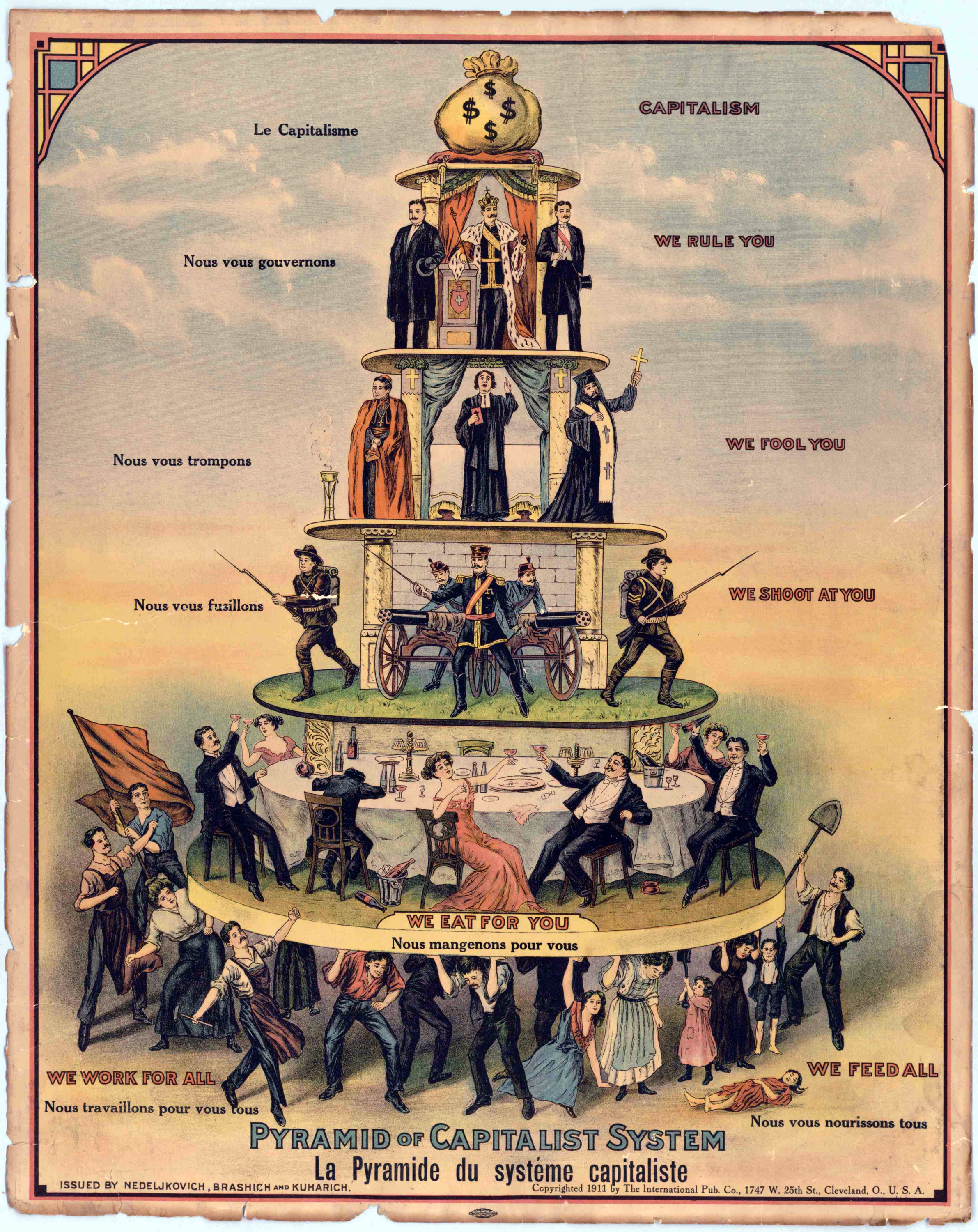
If we could only entrench the cooperative compassionate and empathetic sides of our nature as dominant values in society we would redesign our Capitalist world – to a world worth while living in.
The current state of our planet is affording all of us this opportunity.
How can we tackle the world problems ?
A good place to start would be to get Capitalism to pay for it.
By placing a World Aid Commission on all High Frequency Trading, on all Foreign Exchange Transactions over ($20,000) on all Sovereign Wealth Funds Acquisitions, on all Drilling Wells. This would create a perpetual pot out of Profit for Profit sake that could fund the inevitable cost of climate change.
In doing so we would redistribute the world’s wealth from the whole of the world. ( see previous Posts)
Sooner than later we are going to exhaust the raw materials and energy of the planet Earth. What will happen then?
Which is why, whenever the opportunity arises, we must be prepared to seize it.
23 Thursday Jul 2015
Posted in Humanity.
≈ Comments Off on The Beady Eye looks at Man and Woman.
Tags
Stating the oblivious.
We see one or the other every day. We love, hate, kill, and sell them, in all colors, shapes and sizes but we have little understand of them.

But what does it mean to-day when we say “mankind.” Is it referring to both male and female.
For centuries, the differences between men and women were socially defined and distorted through a lens of sexism in which men assumed superiority over women and maintained it through domination.
Sexual attraction is controlled mainly by factors hardwired into the brain, due to evolutionary forces.
The vision of equality between the sexes has narrowed the possibilities for discovery of what truly exists within a man and within a woman. As the goal of equality between men and women now grows closer we are also losing our awareness of important differences.
” Men know life too early. Woman knows life too late”. That is the difference between men and woman” Oscar Wild.
The word ‘men’, meaning “to think” or “to have a cognitive mind”, was also gender neutral and connected to “man”, which meant “the thinker”.
It is my position that men and women are equal but different. When I say equal, I mean that men and women have a right to equal opportunity and protection under the law. None of us would argue the fact that men and women are physically different.
Modern society hasn’t made relationships between men and women any easier.
The challenge facing men and women is to become aware of their identities, to accept their differences, and to live their lives fully and as skillfully as possible.
It’s not that men and women live in completely different realities. It’s not that men are from Mars and women are from Venus. To understand the difference we must first understand in what ways we are different.
The world will be less interesting when everything is same. The stereotype that men are more “thick-headed” than women is not far-fetched. Let me clearly state that I do not believe that men (or women) are locked into these negative stereotypes.
 Typically, men’s brains are 11-12% bigger than women’s brains. Sadly, this difference in size has absolutely nothing to do with intelligence, but does explain the difference in size between men and women. Men need a bigger brain to control their bigger bodies and muscles.
Women on the other hand have four times as many brain cells (neurons) connecting the right and left side of their brain.
So where does that get us in any understanding?
Women are apparently extremely complex and mysterious creatures while men are a simple-minded species.
The most obvious difference is probably the emotions.
Men rely easily and more heavily on their left brain to solve one problem one step at a time. Women have more efficient access to both sides of their brain and therefore greater use of their right brain.
Most men are less concerned and do not feel the same as women when solving a problem. Men approach problems in a very different manner than women. Men have a tendency to dominate and to assume authority in a problem solving process.
Women consider and process information differently.
Women tend to be intuitive thinkers. Women have a larger deep limbic system than men, it allows them to be more in touch with their feelings and better able to express themselves, which promotes bonding with others.
It must be emphasized that they can and do solve problems in a similar manner.
Men have a hard time understanding emotions that are not spoken, while women tend to intuit emotions and emotional cues. In stress situation men have a response reaction that resembles “fight or flight” while women react with a “tend and befriend” strategy. Men are more turned on by visual stimuli.
Recent evidence suggests that humanity is not only still evolving but that human evolution is actually accelerating. Neanderthals did not die out, but instead were absorbed into modern humanity.
Woman: https://youtu.be/Xrp0zJZu0a4
Men: https://youtu.be/wkOo_znVJF0
Facebook may soon need to add “Just got served divorce papers” to its list of relationship statuses.
A Manhattan judge ruled in the case of Ellanora Baidoo, 26, who wanted to divorce her husband, Sena Blood-Dzraku, but had no mailing address for him and therefore no place to which she could send the paperwork. The judge is allowing Baidoo to serve her estranged husband with a divorce summons through Facebook.
Maybe the word ‘man’ should be replaced with dude.
30 Tuesday Jun 2015
Posted in Big Data., Politics., Privatization, Technology, The Future
≈ Comments Off on The Beady Eye looks at Big Data.
Tags
Artificial Intelligence., Big Brother., Big Data, Distribution of wealth, Drones., Globalization, Inequility, Technological revolution
Is our world along with humanity disappearing into the Cloud.?
We as individuals are turning into “walking data generators” ” App Material”
The Beady eye is only going to look a the most contentious realms of Big Data. Technologies that drive the explosion of growth of digital information such as the information collected.
Big Data is disseminated from trillions of devices such as smartphones and embedded sensors.
Huge quantities of digital trace data are collected through digitized devices (captured, for example, via social networks, online shopping, blogs, Apps, ATM withdrawals and the like) and through in-built sensors. The latter technologies include those that are equipped with GPS systems (e.g., smartphones and other surveillance and monitoring devices) and thus have the ability to identify a user’s location.
Ever since the dawn of life with language man has been collecting information. Not until written letters or symbols arrived was this information stored for future generations.
It is now being collected to replace us all with AI.
Knowledge was and still is the power that split the world into cultures- the rich in information and the poor with illiteracy – Slave or Master.
To day data is money and it is re splintering the world into the have and have not’s.
A next-generation retailer will be able to track the behavior of individual customers from Internet click streams, update their preferences, and model their likely behavior in real-time. Traditional advertising is shifting rapidly into the realm of personalized and highly targeted online and mobile ads—the realm of data driven marketing. 
Across all industries, including government, healthcare, media, energy, among others, data is becoming central to business operations. Every business is a digital company; and, every customer or employee is a content producer.
Today’s organizations use a plethora of information systems to support their business processes.
Advances in technologies and the increasing amount of information are transforming how business is conducted in many industries, including government.
Every business sector now collects data of one form or another, and the future marketplace will have even more computing power at their fingertips to mine customer behavior. Someone from every major industry is looking at the impact of being able to glean data from multiple data sources, structured and unstructured, from Healthcare to agriculture and more.
Businesses are using the power of insights provided by big data to instantaneously establish who did what, when and where.
The world’s volume of data doubles every 18 month.
In all forms it will grow 650 percent over the next five years.
Despite feeling overwhelmed, there’s an insatiable desire for more data.
The information overload is real and causing problems.
There is little or no regulations governing every time you click on a website, post on social media, use a mobile app and comment via email or to call centers, your data is collected for future use.
In my opinion, the world needs proper regulations about how and what kind of data should be collected.
My bigger concerns are related to unsanctioned organizations using my data and inferences about my interests, passions, affiliations and associations for borderline uses about my political, religious, sexual, etc. preferences. Just because a company can collect all kinds of personal information on consumers, it doesn’t mean they should use it willy nilly.
The more is better” philosophy. There in lies the trouble.
Tracking customer preferences and purchases can reveal all kinds of private information, like illnesses, financial problems, even pregnancy.
For example a father recently discovered that his daughter was expecting a baby only because of Target’s TGT – 0.5% customer advertising technology. It analyzing his daughter shopping patterns so the store started to send her coupons for baby products which alerted the father.
Data gathering is not going away.
This should have us concerned, not just about targeted marketing but about what can be inferred about all of us every time we “like” something on FACEBOOK or post a snarky tweet on TWITTER.
From what I can tell, what Big Data does best is spy on individuals and collect useless data that helps people develop false and inaccurate assumptions.
Big Data may have wonderful potential, but we’re still going to have to get better at data exchange and integration before it’s going to have its biggest impact. We’ve spent decades digitizing everything, we should be able to analyze it. The problem is, that’s really hard – and it always has been.
THE BIG QUESTION REMAINS: Who does it belong to, and who should have access to it?

Big Data will let us watch flu outbreaks bloom and direct scarce vaccines to the most critical area’s. Schools are collecting more data than ever on how children are doing. Companies and nonprofits, meanwhile, are racing to put that data to use in the classroom.
Today, we’re at the convergence of these innovations—biotechnology, the ability to remote monitor and sensor, and now Big Data—which puts an augmented reality at our disposal.
However there is an undercurrent of concern about who owns big data and who has the right to access it.
Big Data technologies are at the heart of the intelligent economy and the solutions that enable it.
Big Data technologies are analyzing massive data sets, in science and research as well as mine data to prevent bad actors from committing acts of terror and/or to prevent waste, fraud, and abuse.
Government data generation and digital archiving rates are on the rise due to the rapid growth of mobile devices and applications, smart sensors and devices, cloud computing solutions, and citizen-facing portals.
As digital information expands and becomes more complex, information management, processing, storage, security, and disposition become more complex.
Information is a strategic asset, and government needs to protect, leverage, and analyze both structured and unstructured information to better serve and meet mission requirements.
New technology brings new challenges, and they should be properly educated to use it wisely and critically. It is used to study employee performance and retention.
The younger generations are not always aware of the challenges and dangers that come with big data.
Privacy here is a key issue to consider.
I sometimes get frightened to see what younger generations publish on their social media, without being aware how they expose themselves to the outside world. Just think about recommender systems.
When you want to buy a product or service from an online retailer, you are often frustrated because of the many choices and configurations possible. Thanks to an intelligent, analytical recommender system, purchases (and their customer feedback) are continuously monitored to better tailor future recommendations to customers.
Credit card fraud detection system.
In fact, thanks to credit risk analytics, our savings money is now efficiently safeguarded since every bank is obliged (via the Basel III capital accord) to analytically estimate credit losses and make sure it has enough provisions or equity buffers for worst-case scenarios.
Big Data is being used to detect social security fraud, to detect tax evasion fraud, to employ and fire people.
New data stores have emerged increasing the distribution of data and the complexity of securing and protecting that data along with it. It is now harder to protect sensitive data as it may move around between different transactional and analytical data stores as companies create new analytical workloads.
While there is more to do to wrestle big data to the ground. Defense (DOD) is investing approximately $60 million annually for new projects that will harness and utilize massive data in new ways and bring together sensing, perception, and decision support to make truly autonomous systems that can learn from experience, maneuver and make decisions on their own, and understand the limits of their knowledge.
Governments are facing more and more challenges in managing the life cycle of Big Data as government’s traditional silo approach hinders sharing knowledge and working across organizational boundaries.
While emails, instant messages, data files, document files, and scanned images are all driving the growth of Big Data, managing and storing this information — and its growth — are not trivial tasks. It has raised red flags about privacy, which remain unresolved.
The only way to make data totally safe is to not ever use it or keep it. Big Data Discriminates.
Our currents Laws cannot adequately handle the issues raised by Big data.
Just look at the legal complications created by systems using data and algorithms to include and exclude people from various programs.
What we have are porous laws on how this new technology changes previous understandings of civil liberties, not to mention data analysis, machine learning and the work scientists have been doing on non-discriminatory data mining models.
Individuals should be granted meaningful opportunities to challenge adverse decisions based on scores miscategorizing them.
Where data goes in and a decision comes out it’s unclear, or certainly opaque, just how that decision was arrived at. There is no way to trace why a decision was made.
With programmers doing real-life damage without even knowing it. The question is: How do we update our understanding of due process for the 21st century?
These black box issues such as credit-scoring systems should be legal required to make their Systems Transparent.
If you take Google’s search algorithms for instance no one knows how it chooses the direction of its search. Perhaps it directs your search only to its profit. It’s not just about the quality of the user experience.
Drones are becoming more widespread globally, the non military use of drones will add a further deluge of big data:
Cameras, heat and motion sensors, GPS, Bluetooth, Wi-Fi signals, facial recognition and bio metric scanners allow for the growing use of drones in the industrial, agricultural, transportation and retail areas.
The use of drones—theoretically—should only be possible upon individual permit irrespective of the drone’s starting point and final destination.
However enforcement may be difficult.
The only way is a world license that creates an official record of the individuals operating/using drones for a commercial purpose.
In practice, the widespread use of drones for private purposes may result in unreasonable administration in connection with the above, drone users and operators may also be reluctant to provide so detailed information on their activities for confidentiality reasons.
If the drone records flight details for aviation safety considerations, personal data captured but not relevant for this purpose should be anonymised and stored separately or should be made unidentifiable, unrecognizable and inaccessible by the controller immediately after the drone finished flying.
Data should be stored on the drones only temporarily.
For example, during the security surveillance of a property, the drone may record pedestrians’ faces, movements, body-temperature etc., and the devices should be configured in a way which prevents them from this kind of processing. Drones should solely be able to signal the location and fact of an allegedly unauthorized attempt at entry onto the premises.
In practice, this principle should be assessed on a case-by-case basis, as the actual use of the drone may require more extended data processing than envisaged at the beginning. The drone may locate a trespasser who needs to be identified (to ensure to security surveillance purpose), and, in such a case, privacy-by-default settings should not prevent the enforcement of the drone operator’s legitimate interests.
For example, a recording of an agricultural land cannot be used for the surveillance of agricultural workers.
Given the amount of data governments store on citizens and the sensitivity of some of that data, it makes sense for state budgets to carve out funds for someone to shepherd how that data is collected, treated and stored.
Should there be a meaningful data life cycle amidst the sea of data.
In fact , big data may ultimately be a key factor in how nations, not just companies , compete and prosper . Algorithmic decision-making:
In a nutshell, the problem with ‘datification’ is that somebody else may … use the data thus produced – often with purposes different from those originally intended.
Make no mistake about it:
Our future, the future of humanity and the planet hangs in the balance.
Do we have what it takes to disrupt what is…in order to create what can be?
Big data as a high concept will never fully define itself it’s just a big scam. Surveillance programs. High Frequency Stock Trading. Electronic Currency Trading. Dooming us all down to rely on Google.
I hope it die’s a miserable death.
WITH MIGO
The only thing worse than being 'blind' is having a Sight but no Vision
Sharing vegetarian and vegan recipes and food ideas
PPJ Gazette copyright ©


 bobdillon33blog