If you’re were to be asked a year or two ago could you imagine the United States being run by a convicted felon
It would be fair to say that 99.9% would have answered in the negative.
I suppose the only true answer is that like the morons that vote for Brexit the USA has its fair share of them to vote for a MORON called DONALD TRUMP.
If asked the question how in god’s name did such a man Donald Trump get into power never mind politics.
Now on a salary of over 500.000$ a year. Plus 50,000 expensive, 100,000 travel and 19,000 entertainment expenses.
Plus a pension for 250,000$ for life and a wife pension of 20,000$
It is estimated that Mr Dump is worth around 5.1 billion.
On top off that he has an expense account re running the White House.
He employs around 22,000 people. Has around 300 agents protecting him
Not bad for a man currently lining his own pockets with trade deals not worth the paper they are writing on.
The White House runs on 81 staff out of which 40 earn 180,000$ with the rest are on $ 20.000.
To become a president of the USA is to spend billions on Media so the Morans believe you, just like Brigit in the UK that had its fair share of morons believe that after fifty years of being in the eurozone it was right thing to do and turn your back on the biggest market in Europe, every country has them.
If you don’t believe me the department of homeland security has spent 51 million $ this year thanking DONALD DUMP for securing the borders.
He is spending 20 billion on Argentina.
The future of civilisation is what we can make it.
Not Donald Trump. We must all come together to tackle Climate Change that use to take decades to change buy is now happening in front of our eyes.
No matter how much money Donald Trump puts in your pocket it will not pay for what’s coming with climate change.
All human comments appreciated. All like clicks and abuse chucked in the bin.
Science shows that Europe is a continent of immigrants and always has been. All Europeans today are a mix. The people who live in a place today are not the descendants of people who lived there long ago.
When one looks back on history most countries were established by migration with the removable of the Aboriginal (original) inhabitants. The tribes of America, the Maori of New Zealand, the Aborigines of Australia, and three waves of immigrants settled in prehistoric Europe.
In an era of debate over migration and borders, Migrant and refugee are just two of the many terms we use to describe people who are seeking new homes in other countries. It is becoming increasingly common to see the terms ‘refugee’ and ‘migrant’ being used interchangeably in media and public discourse.
But is there a difference between the two, and does it matter?
Simply speaking, a migrant is someone who chooses to move, and a refugee is someone who has been forced from their home.
The distinction is an important one, as there are certain rights for people deemed refugees, whereas migrants have no such rights.
All people are born with fundamental rights and dignity. That includes migrants.
Behind every migrant family and host community is a story. The stories can be positive or negative, but we cannot hope to understand migration without hearing them. There are presently around 258 million international migrants. That figure is proliferating since the turn of the millennium when there were 173 million.
Migrants are subjected to a country’s immigration laws and procedures and can be turned away or deported back to their homeland.
No matter what name migration is given it is just not the movement of people from one place to another it is a mixing of cultures. (Cultural diffusion is the spread of cultural beliefs and social activities from one group of people to another. The mixing of world cultures through different ethnicities, religions, and nationalities has only increased with advanced communication, transportation, and technology.)
An asylum seeker is someone who has asked the government for refugee status and is waiting to hear the outcome of his or her application.
It becomes clear that we cannot just look at migration at the national level. Of course, governments decide on their own migration laws and policies – whether they have to do with security, education, health, or employment. They have done this throughout history. They do it today.
Our current response to international migration is sustainable.
In general, migrants pay more taxes than receive benefits. Newcomers also enrich the cultures of their host communities, and those who return to their countries of origin bring back new skills and ideas. Yet irregular migration is a continuous challenge that exposes migrants themselves to exploitation and abuse. And host communities also have legitimate concerns that we need to listen to.
For example.
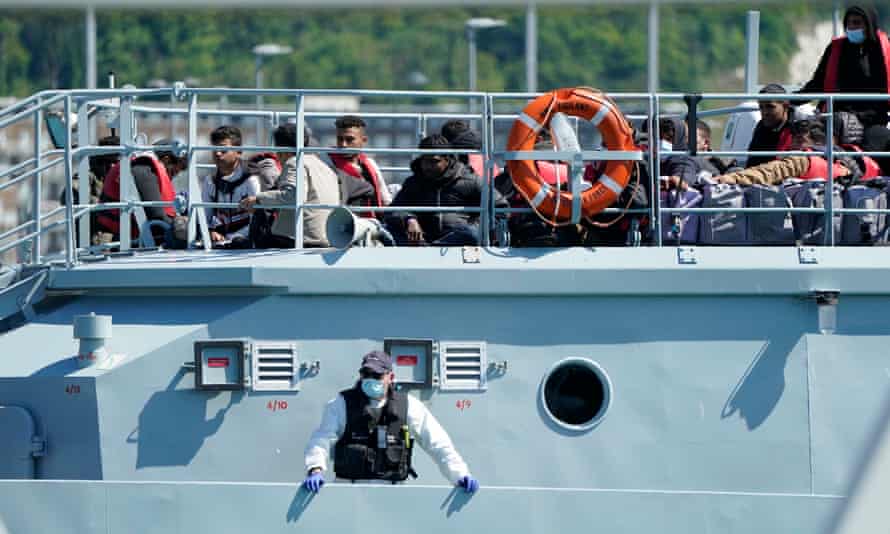
The recent UK and Rwanda migration and economic development partnership to address shared international challenge of illegal migration and break the business model of people-smuggling gangs. Rwanda where a genocidal war killed 800,000 people has already around 150,000 refugees from neighboring Burundi and DR Congo.
( It is not the first time England has exported the unwanted. Today, one in five Australians is the descendant of a convict from Ireland or England. Australia’s oldest city Sydney in the late 18th century was a penal colony to house its surplus of petty criminals — a murky past that continues to leave its mark on the country today.)
——————————
The reality of migration as seen in statistics does not always correspond to what we hear in public discussions.
There are an estimated 272 million international migrants – 3.5% of the world’s population. Although refugees and internally displaced persons make up a relatively small portion of the total number of migrants, they are often most in need of help.
India remains the main origin of international migrants, with 17.5 million Indian-born people living abroad. Mexico and China both also have more than 10 million former residents spread around the world.
Asia hosts the most migrants, with 80 million residing in the region.
In fact, almost 80 percent of English speakers in the world are non-native speakers due to the spread of the language through imperialism and trade.
Cultural diffusion is rapidly becoming the human face of climate change.
Internal climate migrants are Sub-Saharan Africa, South Asia, and Latin America could see more than 140 million people move within their countries’ borders by 2050.
Although migration is a global phenomenon, there is still no global understanding of how to manage it. No single country can manage migration on its own because it is motivated, first and foremost, by the lack of economic opportunities at home.
If migration is managed properly, migrants can boost economic growth by filling gaps in fast-growing sectors and by increasing the working-age population.
This is the true beauty of cultural diffusion, that expansion of the mind.
——————————-
The global approach to asylum and migration is broken.
We have a small window now, before the effects of climate change deepen, to prepare the ground for this new reality.
Together with the increasing volume, we are seeing changing demographics, advancing technology, evolving needs of labor markets, and continued challenges posed by wars, shortages, human rights violations, and climate change WHEN ANY HOPE OF ORDERLY AND REGULATED MIGRATION WILL DISAPPEAR WITH THE GLOBAL SOUTH POURING INTO THE THE GLOBAL NORTH.
Moreover, climate change, as indicated by a recent World Bank report, will accelerate the trend, by driving an estimated 140 million people from their homes in the coming decades.
Be under no illusion; people smugglers are not humanitarians. They are organized criminals whose evil business finances other serious crimes. The challenge, then, is to find a sustainable solution that is fair to everybody. There is no single solution.
All human comments are appreciated. All like clicks and abuse chucked in the bin.
≈ Comments Off on THE BEADY EYE OPEN LETTER TO THE DELEGATES OF THE FORTHCOMING UNITED NATIONS CLIMATE CHANGE CONFERENCE IN GLASGOW: If you thinks they we have a problem with migration today … wait 20 years.
Although climate change undoubtedly posed an “existential threat to our world” it is not too late to take decisive action.
So far we had the Cop-out 15 to Cop 25, the Kyoto Protocol in 1997 the Paris Agreement in December 2015 and now the 2020 United Nations climate change conference in Glasgow.
As you know dealing with climate change will require coordinated action by nations around the world.
Up to this point what we have seen are countries and industries trying to gut, block or water down all efforts, in a rearguard manoeuvre that mirrors President Donald Trump’s rollback of climate policy in Washington.
24 million people were displaced by weather-related disasters this year.
As climate change begins to alter patterns of disasters, we can imagine these figures will get worse. Understand how changing weather patterns and disasters will alter patterns of migration. This will be both difficult and almost impossible to predict.
Reduction of carbon emissions has no chance of being reached through a voluntary cap and trade system utilizing the free market system. Why would countries strongly enforce caps and targets on their emissions if it puts them at a competitive disadvantage in the market place?
The fact is that if we are to save the planet from a devastating ecological meltdown, it is going to require an immediate and I mean immediate, reduction in greenhouse gases.
We must abandon the absurd notion that the invisible hand of the free market system will solve the crisis.
Why?
Because a market-driven voluntary system will not work.
Because they are traded for huge profits. There is no baseline from which true carbon reductions can be measured, verification is lacking.
Because it is cheaper to pollute and buy credits than it is to change production processes.
It is totally unrealistic to believe that carbon reductions on a large scale can be attained unless mandatory reductions are implemented and a full scale global.
While rewarding carbon-reducing technologies makes sense we will only be able to take worthwhile actions if they are funded by a self-perpetuating fund with outright non-repayable subsidies.
However, I don’t have to tell you that when it comes down to the wire as who and how we are going to fund the way forward to tackle fairly any actions the simple answer is that we do not have enough time to haggle about it.
It can be achieved tomorrow by placing a 0.005% commission on all world activities that seek profit for profit sake. ( See previous posts)
The world stock markets are 99% run by high-frequency algorithms. Exploiting market conditions that can’t be detected by the human eye.
Of course, this begs an important question will such a commission affect the free market and can it be applied worldwide.
Yes to both.
It will not be climate change that creates another refugee crisis.
Rather, it will be the attempts to stop this migration that will be creating a crisis.
Climate change will not wait. Neither can we for climate refugees.
Regardless of how fast we cut emissions, we are going to see more and more people on the move and there is no single global agreement that can be signed and ratified to change this fact.
Most of what you know about climate-linked migration is probably wrong.
We all know that climate change is the unpredictable ingredient in our rapidly changing world – and it’s potential to trigger both violent conflict and mass migration – needs to be considered as an urgent priority for policymakers.
As its effects spread, it will destabilise entire economies and overwhelm poorer countries lacking resources and infrastructure.
When added to existing social, economic and political tensions, it has the potential to ignite violence and conflict with disastrous consequences.
You cannot strike a bargain with Climate.
The choice faced by politicians and all of us is not about how to prevent climate-linked migration.
That possibility is gone, several decades ago.
There is now a stark choice between two very different options:
One: Trying to stop people from moving—which will lead to something that looks like a crisis—or helping people migrate out of the most badly hit areas.
Two: Is to facilitate climate-linked migration in a legal and organised way.
Support for migrants and refugees is at an all-time low. People are already using migration as a way of adapting climate change, with little or no help.
When migration isn’t illegal there is no need to do it secretly. No need for traffickers and smugglers. And no need for migrants to hide as soon as they arrive.
There is no simple law that could be passed that would “fix” climate-linked migration.
The problem is this won’t stop people moving so we need to start by defining exactly what a climate refugee is.
Droughts, hurricanes, floods and sea-level rise are all forcing people to move but picking out one group of people to call “climate refugees” is very difficult.
WHY?
Political responses to climate-linked migration are complicated, and it’s a field where the answers are often not simple.
Because if climate change plays a role in displacement it becomes difficult to draw the line.
What do we know about the links between climate change and conflict?
Climate-linked migration is very often from rural areas into cities.
So if the seas do rise to the predicted levels and people move within there own countries they will not be refugees climate or otherwise.
To be a refugee you have to have crossed an international border which is part of the official definition of what makes someone a refugee. But, as the impacts of climate change worsen, more people will want to migrate across borders.
Therefore there is only one course of action and that is to open approved channels into the EU and other world nations in order to determine who is a genuine refugee and who is not.
Few politicians will risk making bold statements about making provision for more people. Climate change is also a low priority for electorates in developed countries.
This is the climate crisis, not the coronavirus. tomorrow is too late.
These changes cannot take place tomorrow. They should have been implemented yesterday!
Capitalism caused the problem now it should pay to resolve it.
Climate change is unequivocal, that we are responsible, and that our choices before us matter”.
We were never going to get there in one go unless we spread the cost in a way that is acceptable to one and all.




 bobdillon33blog