• About
  • THE BEADY EYE SAY’S : THE EUROPEAN UNION SHOULD THANK ENGLAND FOR ITS IN OR OUT REFERENDUM.

bobdillon33blog

~ Free Thinker.

bobdillon33blog

Tag Archives: Capitalism vs. the Climate.

THE BEADY EYE SAYS: CAPITALISM’S IS DRIFTING TOWARDS A CULTURAL APOCALYPSE.

30 Monday Jan 2017

Posted by bobdillon33@gmail.com in Artificial Intelligence., Donald Trump Presidency., European Union., HUMAN INTELLIGENCE, Humanity., Life., Modern day life., Natural World Disasters, Our Common Values., Social Media., Sustaniability, Technology, The Future, The USA., The world to day., Unanswered Questions., United Nations, What Needs to change in the World, Where's the Global Outrage., World Organisations., World Politics

≈ Comments Off on THE BEADY EYE SAYS: CAPITALISM’S IS DRIFTING TOWARDS A CULTURAL APOCALYPSE.

Tags

Artificial Intelligence., Capitalism and Greed, Capitalism vs. the Climate., Community cohesion, Distribution of wealth, European Union, Globalization, Inequility, Technology, The Future of Mankind, THE UNITED NATIONS, Visions of the future.

( A two-minute follow-up read to the Post ” What is happening to what we call common values.)

Afficher l'image d'origine

Perhaps with the election of Donald Trump it has already happened.

Why?

Because capitalism has and still is creating an explosion in economic and geographic inequality which is now fueled by commercial Artificial Intelligence.

The tragedy is that our World leaders and World Organisations seem inapt to do anything about it.

The main lesson for European and the rest of the world is clear:Afficher l'image d'origine

As a matter of urgency globalization must be fundamentally reorientated.

Trade agreements must be revisited to become a means in the service of higher ends.

They must include quantifying and binding measures to combat the digital fiscal and climate dumping.

They must have a prosecutor capable of enforcing what is agreed.

Its time to change the political discourse on globalization, trade is a good thing, but fair and sustainable development also demands public services, infrastructure, health and education. These demand fair taxation systems

If we fail to deliver these the ludicrous fantasy of Trumpism testosterone imperialism will win with the dignity of world leaders reduced to one’s shopping choices.

Here are a few other thought as to why:Afficher l'image d'origine

Because: Globalisation it is being replaced in economic by Artificial Intelligence calculation to satisfy consumer demands.

Because: With Trump closing of the USA will change the domination of the capitalism globe.  It will now exist for a Chinese Communist party that gives delocalised capitalist enterprise cheap labour to lower prices.

Because:  Technology – along with its turbo economic disruption is causing what seems to me to be the hastening of both a cultural and environmental apocalypse.

Because:  Digital consumerism makes us too passive to revolt or save the world. Humans have been transferred into desirable readily exchangeable commodities. Culture appears more monolithic than ever. Google, Apple, Facebook, Amazon, are now presiding over unprecedented monopolies.

Because: The Internet discourse has become tighter, more coercive.

Because:  Human personality is being corrupted by false news creating false consciousness that there is hardly anything worth the name anymore.

Because:  Common Values are scarcely signifies any more – than white skin, white teeth and freedom from odour and emotions.

Because:  Popularising, is a failure of the US and the EU to democratise in an attempt to create a one-dimensional society.

Because:  Social Media operates on an eternal feeding loop.

Because:  Our world organisations are out of date.

Because: Trade agreements aren’t worth the paper they are written.

Because: If we destroy or Atmosphere , or Seas, or Fresh Water all for the sake of profit, there is little reason to believe in a Christian or Muslim God or for that matter any other Gods that will make a difference.Afficher l'image d'origine

All comments appreciated. All likes clicks chucked in the bin.

← Back

Thank you for your response. ✨


Share this:

  • Share on WhatsApp (Opens in new window) WhatsApp
  • More
  • Share on Mastodon (Opens in new window) Mastodon

THE BEADY ASKS: WHERE IS THE VOICE OF THE WORLD’S YOUTH ?

12 Thursday Jan 2017

Posted by bobdillon33@gmail.com in Artificial Intelligence., Big Data., Brexit., Capitalism, Climate Change., Communication., Education, European Union., Google Knowledge., HUMAN INTELLIGENCE, Humanity., Innovation., Modern Day Communication., Natural World Disasters, Nuclear power., Paris Climate Change Conference 2015, Politics., Privatization, Sustaniability, Technology, The Future, The New year 2017, The world to day., Unanswered Questions., USA Presidential Election, What Needs to change in the World, Where's the Global Outrage., World Organisations.

≈ Comments Off on THE BEADY ASKS: WHERE IS THE VOICE OF THE WORLD’S YOUTH ?

Tags

Artificial Intelligence., Big Data, Capitalism vs. the Climate., Extinction, Social Media, Technology, The Future of Mankind, United Nations


( Eight minute read.)

When you look at the state of the world you have to ask yourself have we all lost our marbles, and where is the protest voice of the Young.Afficher l'image d'origine

You could say that we are well along in the process of causing our own extinction and the planet has officially entered its sixth mass extinction event.

Such a view is now beginning to occasionally find its way into mainstream consciousness.

The situation is already so serious with so many self-reinforcing feedback loops already in play it seem we are on a rolling coaster, incapable of acting,or if we do, it will be after the event, if there is anything left to save.

We have a vast choice of the end-of-humanity scenarios to pick from, to derail life as we know it.

For example:

A self-induced catastrophe such as nuclear war or a bioengineered pandemic. Disruptive innovation and technological changes, Solar storms, Cosmic collisions, Super volcanoes, Rising sea levels, overcrowding, denuded resources to mention just a few.

We’re driving to extinction at least 150 species each day.

Nuclear power plants require grid-tied electricity, cooling water and people getting paychecks. Without all these, they melt down, thus immersing all life on earth in ionizing radiation.

As if the above is not enough we are now selling or most valuable resource – Intelligence. Afficher l'image d'origine

So what can be done?

First of all, internal and external issues are more linked than ever. Now, more than ever, we need principled leaders with an understanding of history.

Freedom and the rule of law are under threat.

Why?

Because while the world teeters on a precipice of being plundered by Capitalist Artificial intelligence. A new reality is taking shape: war is called peace, a bloody victory is a step towards reconciliation, and a terrorist regime is a legitimate power.

The further we removed ourselves from the world the worse will be our encounter with the world beyond.

Ignoring the unregulated introduction of Artificial Intelligence.

All causing disillusionment and confusion with the great visions of the future, all are demanding that we cope as one with the present reality with our ability to protest hijacked by Internet petitions sites that are ignored or focused on parochial problems.

An individuals future is shaped ultimately by environmental factors.

The year 2017 opens on a world laid to waste. Some areas are littered with mass graves and there doesn’t seem to be any big global rush to reduce emissions as a result of the Paris Climate Agreement.

In the end, no amount of research can do much to prevent permafrost melting realising, methane – a greenhouse gas 100 times more potent than carbon dioxide on a shorter timescale into the atmosphere, warming it further, which in turn causes more permafrost to melt, and so on.

Scientists estimate up to 13 percent of global carbon emissions come from deforestation – greater than emissions from every car, truck and plane on the planet combined.

Because Globalism is an ideology, and its struggle with nationalism it will shape the coming era.

Afficher l'image d'origineAfficher l'image d'origine

Donald J. Trump five months short of seventy-one will take office on January 20. His election tips us into the unknown threatened disengagement from the world.

Mother Teresa in the Uk wants disengagement from the EU.

Both are successful alpha personalities.  Both work in progress—“Everything is negotiable”—both displaying a single-minded determination to impose their vision on the world, an irrational belief in unreasonable goals, bordering at times on lunacy.

From Brexit to Trump to the rise of nationalist parties across Europe, the old division between left and right is giving way to a battle between self-styled patriots and confounded globalists.

For decades, trade, industrialization and demographics produced a virtuous circle of rising prosperity. By the 2000s, globalism was triumphant.

IT IS NOW OVERREACHED AND BLIND to the nationalist backlash, not to mention the new form of Globalisation – Artificial Intelligence.

Many globalists now assume that the discontent is largely driven by stagnant wages and inequality. If people are upset about immigration, they reason, it is largely because they fear competition with low-wage workers and not the technological Revolution that is replacing their need to work in the first place. Yet their faith in open borders remains unshaken.

That crisis has woken up globalists to the flaws of globalization but not it seems to me the pending exploration of Apps run on Algorithms that are designed to create profit for the Monopolies of the Internet.  Facebook, Twitter, Google, Microsoft, Amazon, to mention a few.

Many of the tech industry’s biggest companies, like Amazon, Google, IBM and Microsoft, are jockeying to become the go-to company for A.I. In the industry’s lingo, the companies are engaged in a “platform war.”

The company that controls A.I. will steer the tech industry for years to come.

In fact, much of the backlash against immigration (and globalism) is not economic but cultural: Many people still care about their own versions of national identity and mistrust global institutions such as the EU.

These voters are bothered less by competition from immigrants than by their perceived effect on the country’s linguistic, religious and cultural norms. About how changes to “the composition of the local population” would affect “their neighborhoods, schools and workplaces.”

They might have their priorities slightly wrong.

Is the new nationalism a cloak for ethnic and religious exclusion?

New nationalism often thrives on xenophobia.

Globalists should not equate concern for cultural norms and national borders with xenophobia.

There must be some sort of middle ground between a nationalist and globalist approach. In short, there is ample reason for skepticism about whether the new nationalists can prove themselves a genuinely secular, democratic alternative to globalism.

If globalists are to regain the public’s trust, they will need to re-examine their own policies. Political capital might be better invested in preserving existing trade pacts, not passing new ones. Many European globalists blame the euro’s crisis on too little integration, not too much. But pressing for a more federal Europe could further alienate voters who “do not share our Euro-enthusiasm,”

Borders use to mean something, but this version of civilization is the least sustainable of them all. We cannot sustain the unsustainable forever in a world more interconnected.

In fact, 2017 is looking pretty bad…Russia dominating the world order. But it too will pop. New cyber attacks.

In this context, the basic principles of democratic life in both Europe and the U.S. — truth, fact-based reality, justice and the rule of law — are being gradually eroded.

The most important thing is to understand what might steer us towards a more secure world order, where respect for the rule of law and for international bodies are granted their proper place.

European powers may choose to find strength in their union. Brought together by the need to combat those who threaten fundamental European values, Paris, Berlin, Rome and the Benelux countries could launch new initiatives to bring about real European cooperation.

Should these institutions find themselves unable to take a stand and act according to global interests and basic values, there is no reason why 2017 should not continue in the same vein as 2016, and the consequences may be irreversible.

It’s time to abandon our usual pessimism about the state of the planet and the course of history. We’ve got many challenges to overcome, but it might be a good idea to adopt a bit of youthful optimism when it comes to confronting them.

We need to create a hope insurgency. 

Despite half of the world’s youth living on less than two dollars a day.

A social media revolution is unfolding before our eyes, forever changing the way we connect. This generation, the most interconnected generation ever, continues to grow rapidly, but its voice is diluted by Social media making the challenges they face are ever more daunting.

We need to ask ourselves:

How can we can empower youth to drive social progress. From crowd-sourcing initiatives and mobile-projects to innovation jams and social media campaigns.

Whatever changes you would like to effect in our society has to begin with you.Afficher l'image d'origine

The best leaders the world has ever known are the reformers who were accountable and responsible for their own change.

The commitment for change has no days off, does not allow for excuses, does not allow for pardons. If you want to see change you must first start within.

It’s that simple and it’s that profound.

So where is the Global YOUTH Outrage?Afficher l'image d'origine

Before there were blogs and tweets – even Wikipedia – to turn to, the mainstream media held a monopoly over knowledge and news which was hard to challenge. Now all knowledge is being collected by Google to feed Artificial Intelligent Algorithms.

THE world must change to meet the wave of popular uprising which catapulted Donald Trump to power and brought about Brexit. The world can be changed as much by education as by being harangued. It’s time for international leaders to bury their liberal attitudes and address the concerns of the masses. It is time for government to act in the long-term interest of the people, even if they do not agree in the short-term.

The twin pillars of liberalism and globalisation which have dominated politics over the past generation must adapt to a “world transformed”.

Society is changing rapidly and I fear that many organisations are failing to notice and are being left behind. I suspect that the scale of such a change can only really be appreciated in hindsight.

In the rich world, particularly, the first generation that has rung up a huge national debt and established a huge unfunded pension scheme is about to retire. The interesting, to say the least, question is whether the next generation will be willing to carry this burden and peacefully pay the debt and peacefully pay the pensions. I think not.

WILL THE WORLD OF 2052 BE A BETTER WORLD?

It’s important to note that people 35 years from now will judge their circumstance more on how it has changed from their own recent past than from our vantage point of today.

Billion will have some level of Internet access, be much better informed, and be increasingly helped by local solar energy. They will have many fewer children. They will be largely urban (except for the minority still living off the land). They will grapple with overall effects of climate damage, but those in dense urban areas will likely have little firsthand experience with the damage caused by the erratic weather (though plenty of secondhand information via electronic media). They will live with the unpleasant knowledge that even more climate impacts lie ahead.

There will be huge differences between people and Artificial Intelligence.

There is be no such thing as the Free Market.

People power hopefully will have transformed the world. From a psychological perspective, probably no, because the future prospects in 2052 will be grim.

University is where such simplistic notions are supposed to be challenged, but they now educate for the market place and not for Intelligence.

The winners of tomorrow will be those organizations with strong leaders who demonstrate agility, authenticity, connectivity to their talent, and sustainability.

By 2018, at least 50 percent of developers will include A.I. features in what they create. The goal is to capture all human knowledge and turn it in saleable AI. It’s where the capitalist market is headed.

No worries, you might say: you could just program it to make

The superintelligent machine manufactures some as-yet-uninvented raw-computing material (call it “computronium”) and uses that to check each doubt. But each new doubt yields further digital doubts, and so on, until the entire earth is converted to computronium.

When a computer became capable of independently devising ways to achieve goals, it would very likely be capable of introspection—and thus able to modify its software and make itself more intelligent. In short order, such a computer would be able to design its own hardware.

If this sounds absurd to you, you’re not alone.

I am one protesting voice in the wilderness of the virtual reality, but I am sure there are billions.

The problem is unifying them into one collective protest to demand that the United nations pass a people’s resolution to give all artificial Intelligence and technological advances a stamp of human approval.

All comments, suggestions, welcome, all like clicks chucked in the bin.

← Back

Thank you for your response. ✨


Share this:

  • Share on WhatsApp (Opens in new window) WhatsApp
  • More
  • Share on Mastodon (Opens in new window) Mastodon

THE BEADY EYE ASKS:WHAT IS IT ABOUT US THAT MAKES US WHOLLY INCAPABLE OF RESPONDING? TO CLIMATE CHANGE- IS IT GREED OR ARE WE JUST PLAIN STUPID.

13 Saturday Aug 2016

Posted by bobdillon33@gmail.com in Climate Change., HUMAN INTELLIGENCE, Humanity., Paris Climate Change Conference 2015, Sustaniability, The Future, The world to day., Unanswered Questions., What Needs to change in the World, Where's the Global Outrage.

≈ Comments Off on THE BEADY EYE ASKS:WHAT IS IT ABOUT US THAT MAKES US WHOLLY INCAPABLE OF RESPONDING? TO CLIMATE CHANGE- IS IT GREED OR ARE WE JUST PLAIN STUPID.

Tags

Capitalism vs. the Climate., Climate change, Climate change and Intelligence, Climate Change Solution's., Environment, The Future of Mankind, United Nations


It’s a beautiful hot day, 34 celsius.

The Olympics are in full swing with its opening message long forgotten by those how win a medal.

The world since the first farmer grew two carrots has had its winners, losers, wars, famines, rich, and poor, you name it the World has weathered all.Afficher l'image d'origine

You could be a faitheist  and say  “What happens happens”  but as Lone Man ( Isna la wica) ( late 19th century Teton Sioux said ” I have seen that in any great undertaking it is not enough for a man to depend simply upon himself.”Afficher l'image d'origine

I have written on Climate Change before the Paris Agreement and after.

Since then every day of the week there is some new evidence that the climate is changing.

The global meltdown has begun.

Long predicted and long denied, the effects of climate change are arriving faster than even the gloomiest prophets expected.

The earth is dying, yet those who spread this message are treated as dangerous and mad.

This week we learnt that the Arctic ecosystem is collapsing.

Three weeks ago, marine biologists reported that almost all the world’s coral reefs could be dead by the end of the coming century.

One month ago, the Red Cross reported that natural disasters uprooted more people in 1998 than all the wars and conflicts on earth combined.

The demographer Dr Norman Myers calculates that 25m people have already been displaced by environmental change, and this will rise to 200m within 50 years.

The London School of Hygiene and Tropical Medicine reports that nine of the 10 most dangerous diseases carried by insects and other vectors are likely to spread as a result of global warming.

You would think that with our combined World Intelligent we would be by now well beyond the point of discussing the implementation of the Paris Agreement.

Not on your Nelly.

And yet, far from addressing this coming catastrophe, we curse or mock anyone who draws attention to it.

What is it about this pattern of living that demands that those who challenge it must be treated as if they were dangerous or mad?

Is it just plain stupidity or that we have found the key to undying happiness, the transactable elixir of life?

What is it about this crisis, what is it about us, that makes us wholly incapable of responding?

Is it the drive to make more money than you could possibly need, to buy more goods than you could possibly enjoy, is a species of mental illness. Success in this system brings not happiness, but, at best, an alleviation of the pain required to sustain it. Even its beneficiaries are also its victims.

Climate change is perhaps the gravest calamity our species has ever encountered. Its impact dwarfs that of any war, any plague, any famine we have confronted so far. It makes genocide and ethnic cleansing look like sideshows at the circus of human suffering.

To date we have not reached the necessary number of countries to represent 55% of global emissions to sign up to the agreement to implement the Paris Agreement. (Which I advocate will have little effect as the agreement has no means of enforcing anything agreed.)

Negotiations and meetings have been marred by special interest groups trying to prevent effective action to combat climate change. In addition, there has been a lack of political will to take effective steps and measures.

Many large corporations, have opposed climate change treaties seemingly afraid of profit impacts if they have to make substantial changes to how they do business.

All countries are affected by, and contribute to, the buildup of greenhouse gases, and should be willing to join in the effort to stop it. However, it is far from easy to agree what to do, and how to do it….

Because : Poor countries face the brunt of the problems caused by global warming, and point out that most of the current global warming are the results of the rich countries’ pollution.

Current consumption patterns also see far more greenhouse emissions per person in the rich countries than the poorer ones.

As evidence of climate change mounts the impacts will be worse for more vulnerable people around the world, and could destabilize the world economy.

However, some are ( Donald Trump) still trying to undermine climate change action through deception.

The EU is in crisis, and the USA will be soon.

Brazil’s “interim” government, led by Michel Temer, signed an emergency loan to the State of Rio de Janeiro to help finance infrastructure for the 2016 Olympics. The bailout was conditional to selling off the State’s public water supply and sanitation company, the Companhia Estadual de Águas e Esgotos (Cedae).

What will it take to persuade us to stop using the world as our punchbag?

Many are agreed that climate change may be one of the greatest threats facing the planet.

All the words, pledges, agreements mean nothing without the political will, and financial backing.

There is only one way to make any difference worthwhile happening world-wide and that is to tap into World Greed.

Profit for Profit sake.Afficher l'image d'origine

By placing a World Aid commission of 0.05% on all High Frequency Financial Transactions, on all Sovereign Wealth Funds Acquisitions, on all Foreign Exchange transactions over $20,000, on all Lottery wins over $100000, on all gambling.

This would create a perpetual Fund of trillions to tackle Climate Change.

Will it happen.

Not without all of us demanding it of the United Nations.

The Earth is the mother of all people and all people should have equal rights upon it.

← Back

Thank you for your response. ✨


Share this:

  • Share on WhatsApp (Opens in new window) WhatsApp
  • More
  • Share on Mastodon (Opens in new window) Mastodon

THE BEADY EYE ASKS: IS OUR PRECONDITION OF IGNORANCE GOING TO BE OUR DOWNFALL.

16 Monday May 2016

Posted by bobdillon33@gmail.com in Climate Change., Environment, Humanity., Natural World Disasters, Sustaniability, The Future, The world to day., Where's the Global Outrage.

≈ Comments Off on THE BEADY EYE ASKS: IS OUR PRECONDITION OF IGNORANCE GOING TO BE OUR DOWNFALL.

Tags

Capitalism vs. the Climate., Climate change, Environment, The Future of Mankind


We all live our own lives but we are all subject to consequences of our own and each other’s ‘ignorance’.Afficher l'image d'origine

The problem is that we are literally ‘born in ignorance’ and raised in a world of people likewise born and raised which means then, that there is a very nearly overwhelming amount of misinformation, opinion, predisposition et cetera regarding what we ‘know’ about ourselves and how we ‘should’ deal with each other or there wouldn’t be the mass of troubles there is in the world today.

The human condition in this especially negative sense is a measure of our ignorance with respect to what we know about ourselves as ‘a life-form in its configuration space’ -biology, anthropology, the resource/environment, government/economy and ‘the nature and course of human evolution and progression’, as the idea of that whole and its parts varies throughout the world.

This has led us to a point that the idea of wealth and ownership beyond ‘base-domain human requirements’ is fundamentally antithetical to best well-being and viability in the nature and course of the life-form’.

Not only is there something of ‘a human condition’ endemic (the individuals) of people’s and nations, but one compounded by typically profound differences between their ‘autonomous’ governments and economics due to natural resources, geography, climate et cetera.

Up to now our attempts to understand nature and generally to know about things not produced by man, have turn us instead exclusively to things that owed their existence to man.

As I have said we are evolved out of ignorance and continue to be born in ignorance, and that means that even as we discover and amass knowledge – the ‘if this, then that-ness’ of matter and existence, ‘new situations’ and ‘new ignorances’ will always present something of a problem to someone as long as we exist.

Unfortunately, the new Technological age is adding to this and contrary to what is currently assumed about the proverbial ivory tower independence of thinkers, no other human capacity is so vulnerable, and it is in fact far easier to act under conditions of tyranny than it is to think.

We have entered the age of Igorance-Smart phone.

The action of the scientists, since it acts into nature from the standpoint of the universe and not into the web of human relationships, lacks the revelatory character of action as well as the ability to produce stories and become historical, which together form the very source from which meaningfulness springs into and illuminates human existence.

If like me you ponder on why it is that we seem incapable of grasping that human activities in the last two centuries have effected the Earth’s climate.

We have taken all the carbon from hundreds of million of years which had been locked up in fossil fuels and stuck it into the atmosphere in a time of two hundred years.

We don’t need to wait for the Paris Climate agreement ( Which is just a joke) there is a Methane nuclear boom under the Arctic that we could see our temperatures go up by 6c in the next 30 years.

We have buggered around with the atmosphere beyond a joke or promises.

We need some Big decisions to stop the march of climate change.Afficher l'image d'origine

Surely we are not going to wipe ourselves out through ignorance when they are so many choices but if we do at least most of us will still be ignorant.

To address the problems that derive from the grotesque Inequalities and structural poverty of our world.  Quite as hoc diplomacy is not enough. Some thing more structured is needed. Like an World Aid Commission of 0.005%. (See previous posts)

Click the Ignorant like button or make an intelligent comment.

← Back

Thank you for your response. ✨


Share this:

  • Share on WhatsApp (Opens in new window) WhatsApp
  • More
  • Share on Mastodon (Opens in new window) Mastodon

THE BEADY EYE SAYS: WE ARE LIVING IN A SORT OF DELIRIUM–NOT REALLY KNOWING THE FACTS ABOUT ANYTHING-

02 Monday May 2016

Posted by bobdillon33@gmail.com in The Future, The world to day., Unanswered Questions., What Needs to change in the World, Where's the Global Outrage., World Organisations.

≈ Comments Off on THE BEADY EYE SAYS: WE ARE LIVING IN A SORT OF DELIRIUM–NOT REALLY KNOWING THE FACTS ABOUT ANYTHING-

Tags

Capitalism and Greed, Capitalism vs. the Climate., Distribution of wealth, Earth, The Future of Mankind, Visions of the future., World aid commission

As soon as we really know the facts you would think that we would all begin to behave very differently, of course.

If we could, would not your heart swell with something far from anger. We might see our power of duty as custodians to the world that we all live in.Afficher l'image d'origine

Instead nothing much happens, except swallow high words on what needs to be done to achieve change in order to see the real power, the real dignity, our real responsibility in the world.

Over the next couple of decades the world will be facing new problems (in addition to the well-known challenges of creating economic growth and maintaining social stability), some of which cannot be easily solved by the market.

Forty years from now, how much will energy cost? What will happen with the climate?  Most importantly, will you be richer?

Let me tell you it is more important that you are satisfied with life than whether you are somewhat richer or poorer.

Empirically, for some, income is the sole determinant of life satisfaction. But for the majority, a whole host of factors influence our well-being—job, health, family, community, prospects for the future—in addition to income.

It is the sum total of all aspects of life that determine your wellbeing, both now and in the future.

If humanity rose to the occasion and ran a rational world how much better life would be for all of us and the generation to come.

Many argue that this does not matter because we are leaving for future generations a whole lot of capital, infrastructure, and technology. But to paraphrase the World Business Council for Sustainable Development, “People cannot succeed in ecosystems that fail.”

The prime example is the climate challenge.

It is a truly global problem:

The forecast maximum in 2080 is above the threshold that world leaders agreed would place us in the danger zone for runaway climate change; but it is important to realize this is a politically negotiated goal. Views differed, and still differ, on what will be safe. Or in other words, what will hurt us.

Does it matter?

Will the world of 2052 be a better world?

From a psychological perspective, probably no, because the future prospects in 2052 will be grim because of the increasingly uneven distribution of income and wealth that has built up over time as a natural consequence of the free market.

In my opinion there will be huge differences between people. But on average the world will be a better place.

It’s important to note that people 40 years from now will judge their circumstance more on how it has changed from their own recent past than from our vantage point of today.

Even the most diehard liberalists appear to agree that redistribution is something that is not automatically undertaken by the market by itself, but needs to be done via political action

In order to reduce some of the tension implicit in the rapid increase in inequity in the capitalist world.

It’s time to commence down the road of re thinking how or world works and reconsider what kind of world we want to live in.

Although we refer to most of it as civilization it is anything but civilized.

We have being killing each other and everything around us since time millennium.

It’s no wonder that the social arrangements up to the present have largely failed to produce a peaceful and productive world.

While we appear to be technically advanced our values and behaviours are not.

The possibility of an optimistic future is in stark contrast to our current social,economic,and environmental dilemmas.

If we stay the present course, the familiar cycles of crime, economic booms and busts, wars, and further environmental destruction are inevitable.

Will the young generation calmly accept the Debt and pension burden of the old.

No. The simplest reason is they don’t have to. In the rich world, particularly, the first generation that has rung up a huge national debt and established a huge unfunded pension scheme is about to retire.

The interesting, to say the least, question is whether the next generation will be willing to carry this burden and peacefully pay the debt and peacefully pay the pensions. I repeat my answer: I think not.

At the moment we have an unsustainable world, where the environment is going to have a bigger than ever say in shape our behavior.

Where our global monetary system is going to become obsolete, and increasingly insufficient to meet the needs of most people.

Where the banking , media, criminal justice systems, and world Organisations are tools of social control managed by the established political and economic elite.


We need a redesign of all our cultures. We need to up date to the new era of technological revolution.

Our problems are mostly of our own making and now it is the time to come together under a new World Organisation to resolve them.

In 2052 a full 60% of the energy used will still be fossil. As a result climate damage will be growing fast, as will the unavoidable costs for repair of that damage. Paradoxically this means that humanity will choose to pay bills for repair after the crises, rather than paying the same amount of money for renewable energy ahead of time and avoiding the damage.


We all know that if we continued willy nilly with the I am all right jack scenario we are heading for a cesspool of troubles that will put our very existence in question.

There are numerous solutions but the hard fact is man is incapable of acting as one.  Furthermore no one wants to pay for change. Not a Country , not a Government, not a social system.

It’s true that all the money in the world will make no difference if we don’t change.

It is also true that any change will have to just and fair to all.

If you have not looked at the below video you should do so.


You might think that the only thing that matter is a  Job.

It is the only way in which the individual can get part of the societal pie—without engaging in theft. Society—at least in the long run—will do its utmost to ensure there are jobs, typically by seeking rapid economic growth. But we know from recent history that this is a taxing task, and that politicians often fail.

This video misses the big question. Who is going to pay.

Here is the answer:  Profit for Profit’s Sake.  We must place a world Aid commission on all High Frequency Trading, on all Foreign Exchange transactions (over $20,000), on all Sovereign Wealth Funds Acquisitions, on all Hedge Funds, on all Lotto Wins. Curbing greed is a first and very important step in that direction.

(see previous posts) —— 0.005% will do the trick. A perpetual Fund to address all our problems fairly spread over what is causing our problem in the first place.

Technologies will not save us.

All contributions other than like are needed.

← Back

Thank you for your response. ✨


Share this:

  • Share on WhatsApp (Opens in new window) WhatsApp
  • More
  • Share on Mastodon (Opens in new window) Mastodon

THE BEADY EYE SAY’S: HERE WE GO AGAIN. THE COTTON WOOL BEING PULLED OVER OUR EYES.

24 Sunday Apr 2016

Posted by bobdillon33@gmail.com in Climate Change.

≈ Comments Off on THE BEADY EYE SAY’S: HERE WE GO AGAIN. THE COTTON WOOL BEING PULLED OVER OUR EYES.

Tags

Capitalism vs. the Climate., Climate change, Extinction, Global warming, The Future of Mankind, THE UNITED NATIONS

Yesterday we told that 175 leaders signed an agreement to limit future global warming be least 2%

Ban Kimoon says this is a moment in history, which I agree but signing the Paris Agreement doesn’t mean emissions will go down. Afficher l'image d'origine

Are we being hoodwinked or Shakespeare by worthless words on paper that don’t come into effect till the year 2020.

By then the great barrier reef in Australia will be a bleached dead sheet.

THE FIFTY FIVE COUNTRIES THAT ARE RESPONSIBLE FOR 55% OF THE WORLDS GREENHOUSE EMISSIONS WILL HAVE BY THEN PUMPED ENOUGH CO2 INTO THE ATMOSPHERE TO NULLIFY ANY REDUCTIONS. 

NOT FORGETTING THE AMOUNT OF METAIN THAT THE OCEANS AND THE ARCTIC ARE GOING TO RELEASE.

HERE ARE A FEW HARD FACTS:

No country has shared a detailed, credible strategy to achieve what scientists think is necessary: Ending the era of fossil-fuel emissions and converting entirely to clean energy no later than the middle of this century.

Not one country has said where is the Money coming from. If we want change we have to pay for it and there is only one fair way of doing this. (SEE previous posts)

There are 195 countries in existence. This does not include Kosovo (disclaimer), or  Palestine or Western Sahara or Taiwan or  Greenland or many other partly recognized states .

UN Members: 193
UN Observer States: 2
Total: 195

Whether they make good on their pledges to slow dangerous greenhouse gas emissions will depend in large part on the actions in the years ahead by the world’s largest polluters.

The United States, pledged was thrown into question in February, when the Supreme Court unexpectedly put a hold on implementing a major environmental regulation aimed at curbing greenhouse gas emissions from coal-fired power plants. Now it remains in limbo until all legal challenges have been resolved, which is likely to take at least another year.

China, has pledged to have its emissions of carbon dioxide reach a plateau or decline “around 2030,”

The European Union’s, pledge to cut emissions by at least 40 percent by 2030. Member states still must reach consensus in important areas on climate policies.

Perhaps the most significant pledge by India has been to increase solar power generation to 100 gigawatts by 2022, up from about three gigawatts generated in India last year. “That’s an earthshaking commitment,”

Russia has yet to make any binding pledges to reduce greenhouse gas emissions.

Brazil, President Dilma Rousseff committed to an ambitious plan to reduce her country’s emissions 43 percent from 2005 levels by 2030.

Indonesia, one of the world’s largest greenhouse gas polluters due to mass deforestation, pledged under the Paris Agreement to cut its emissions 29 percent from a business-as-usual scenario by 2030, or by 41 percent if it receives substantial assistance from the developed world.  But even with those pledged reductions, Indonesia’s emissions would still soar, nearly doubling from 2010 levels.

After a quarter-century of failed diplomatic efforts, big uncertainties hang over the climate deal even as the wording oil and gas companies continue to invest billions of dollars a year searching for new reserves of fossil fuels.

The announcement of 175 countries signing the Agreement hide’s the true position and gives the impression that the problem is being tackled.

It is already too late to eliminate the risks entirely.

We are looking at climate effects so severe that they might destabilize governments, produce waves of refugees, precipitate the sixth mass extinction of plants and animals in Earth’s history, and melt the polar ice caps, causing the seas to rise high enough to flood most of the world’s coastal cities.

So speaking up and exercising your rights as a citizen matters as much as anything else you can do.

The signing ceremony on Friday is only an intermediate step. After, countries will still have to present formal ratification documents, and the Paris Agreement will not take effect until 55 countries representing 55 percent of global greenhouse-gas emissions have done so.

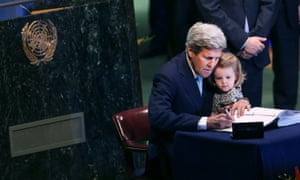
All the World’s a stage– and some people are desperately unrehearsed. The US secretary of state, John Kerry, holds his granddaughter for the signing of the accord at the United Nations Signing Ceremony for the Paris Agreement climate change accord in New York.

← Back

Thank you for your response. ✨

Share this:

  • Share on WhatsApp (Opens in new window) WhatsApp
  • More
  • Share on Mastodon (Opens in new window) Mastodon

THE BEADY EYE SAY’S: THE NIGHTMARE IS WELL ON THE WAY.

24 Sunday Jan 2016

Posted by bobdillon33@gmail.com in Sustaniability, The world to day., Unanswered Questions., What Needs to change in the World, Where's the Global Outrage., World Organisations.

≈ Comments Off on THE BEADY EYE SAY’S: THE NIGHTMARE IS WELL ON THE WAY.

Tags

Capitalism vs. the Climate., Climate change, Environment, Extinction, Inequility, Natural disaster, The Future of Mankind, THE UNITED NATIONS, Visions of the future., World aid commission


( A one minute obligatory read if you are interested in the planet you live on) .

It is not amazing that the contemporary world is marked by a growing number of problems that are genuinely Global in scope.Afficher l'image d'origine

Yet instead of addressing them we spend our time discussing ISIS, North Korea, Mr Putin, Worthless Trump, Air Brain Palin, The price of Oil, Stem cells, New Planets billion of light years away, the list is endless rubbish.

In the mean time we have the spread of Zika virus, a blizzard to beat all blizzards, thousands of Refugees, billions being spend of Presidential Campaigns while Inequality spreads like a cancer.

So forgive me for thinking we must be one of the most selfish, stupid, technology driven like button idiots that ever existed on this planet.

Based on the Best current science we are looking down the barrel of a gun with the bullet fired.

There could be no more extreme than current weather patterns, melting glaciers, sea level rising, megadroughts, desertification, deforestation, food supply disruption, famines, infectious disease, mass migration, social upheaval, economic distress, political instability.

All conflict multipliers that will turn Earth into an unlivable cauldron of I am alright Jack.

It seems that few realise how dire this situation has become or is becoming.

All down to human activity that continues to prune the evolutionary tree of life with gay adabondament.

And if that is not enough evidence that we are heading full speed to oblivion. The last Global Biodiversity Report presented some hard facts that the population of vertebrates that include mammals, birds, reptiles, sharks, rays, and amphibians – living within the tropics declined by 59% from 1970- 2006.

Just in case that has not sunk in what they are saying is that more than half of the vertebrate population between the Tropic of Capricorn and the Tropic of Cancer has disappeared in the last 36 years.

They also found that birds in Europe declined by 50% since 1980. Birds in North America declined by 40%.

Just one more hard fact that it is time to open our eyes. All plants species the foundation of the food chain upon which we depend – are currently ” threatened with extinction.

Yet humans around the world are either unaware of the situation or have their heads buried in the sand, when we should be taking immediate action.

Our consumerist economy that promotes the endless acquisition of products over the conservation of nature would need 1.5 Earths to meet the demands we currently make on Nature.

You might not still appreciate just how bad things are. By 2048 there will be virtually no more wild caught seafood. Our oceans are dying from Lake Erie to the Baltic Sea, the Gulf of Mexico the coastal water of Australia New Zealand, dead zones are growing. The Baltic is already Dead.  60% of all coral reef have being turned in to white ghost towns.

I have being lucky in my life to have traveled both by sea and land extensively.

Experiencing nature first hand let me tell you that there is a critical threshold that once crossed will result in a sudden and irreversible change. A tipping point that will arrive overnight.  There is no technology that can restore it to its original state.

I might sound overblowing and alarmist but look around you. We have little real knowledge of how the ecosystem works but just because we can’t see the catastrophe doesn’t mean it not real.

After all 99.9% OF MATTER is empty space, yet no amount of squinting will reveal this fact to the naked eye.

What does matter is that our fears accurately track the totality of the evidence presented.

This is why solving the problem ought to be on the top of the list of all superpowers in the world.

The likelihood of this happening is the same as asking is the Pope a Catholic.

Even if it does happen, nobody, no Government, no World Organisation, no Country, no Economy, no joe soap has the will or money to rectify a world that is bent on self-destruction.

This is why we must create a World Aid Fund. ( see previous posts)

It is the only solution that is non Political, spreading the cost across all beliefs all colours evenly.

Go on press the like button if you are one of the Googlefied that think you are living on the Planet. If on the other hand you are truly alive get involved and leave your thoughts. Afficher l'image d'origine

Afficher l'image d'origine


← Back

Thank you for your response. ✨

Share this:

  • Share on WhatsApp (Opens in new window) WhatsApp
  • More
  • Share on Mastodon (Opens in new window) Mastodon

THE BEADY EYE; ASK’S WHAT IF ANYTHING CAN BE DONE TO CHANGE CAPITALISM.

06 Wednesday Jan 2016

Posted by bobdillon33@gmail.com in Capitalism, Humanity., Life., Politics., Sustaniability, Technology, The Future, The world to day., Unanswered Questions., Wealth., What Needs to change in the World, Where's the Global Outrage., World Organisations.

≈ Comments Off on THE BEADY EYE; ASK’S WHAT IF ANYTHING CAN BE DONE TO CHANGE CAPITALISM.

Tags

Capitalism and Greed, Capitalism vs. the Climate., Community cohesion, Democracy, Distribution of wealth, Earth, High - Frequency Trading, Inequility, SMART PHONE WORLD, Sovereign wealth fund, Technology, The Future of Mankind, Visions of the future., World aid commission

It’s only right that I follow the last series of posts on what is Wrong with a post that asks the above question.

BECAUSE ITS MONEY THAT IS AT THE HEART OF THE PROBLEM.

I guess the answer to the question “What is wrong with capitalism today?” is dependent on who you ask.

Capitalism works for capitalists.

The Problem is 90 percent of us are not capitalists, we are employees.

Without us noticing, we are entering the post capitalist era.

We need to reexamine the models that have gotten us to this point.

Complete change will not happen overnight. Nor will it be built on the back of one investor or one innovative entrepreneur.

It will be something that business owners, investors, political leaders, consumers and entrepreneurs must all work together toward.

Currently, our planet is on track to fly past the 2 degrees Celsius warming that scientist have repeatedly warned marks the safe range for humans on this planet, but at the heart of further change to come is information technology, new ways of working and the sharing economy.

The old ways will take a long while to disappear but millions of people are beginning to realise they have been sold a dream at odds with what reality can deliver.

The democracy of riot squads, corrupt politicians, magnate-controlled newspapers and the surveillance state looks as phoney and fragile as East Germany did 30 years ago.

Why should we not form a picture of the ideal life, built out of abundant information, non-hierarchical work and the dissociation of work from wages?

So are we witnessing the first stage of an economy beyond capitalism?

Is technology creating a new route out or is it consolidating power into the hands of a few like Google, Microsoft and Apple?

Will its future be shaped by the emergence of a new kind of human being,  reshaping the economy around new values and behaviours?

Will Capitalism as we know it be abolished by creating something more dynamic that exists, at first, almost unseen within the old system, but which will break through because of what Information technology has brought about in the past 25 years.

It is blurring the edges between work and free time and loosened the relationship between work and wages?

Or is the current wave of automation, currently stalled because our social infrastructure cannot bear the consequences, will hugely diminish the amount of work needed – not just to subsist but to provide a decent life for all.

These are all questions to be answered before we see what I call post capitalism.

The Questions are numerous, and there have been hundreds of books, papers, and talks on the subject few however with any positive suggestions.

Before I put the only suggestion that is viable lets start with what is wrong with the present state of Capitalism.

Here is way I see what is wrong;

Today capitalism isn’t about real markets and commodities with the price mechanism being fixed by competing supply and demand, now today it is about casino economics. You throw the dice and when you loose … all that global connectivity means you lose globally. We are all in this together – that is why we call it a global economy – oh apart from the 0.1% – they are the ones throwing the dice. We are just the ones picking up the tab when the bets don’t come off.

Although economics likes to think of itself as a science in reality it ignores the fundamental laws that govern science – the first two laws of thermodynamics. This isn’t a smart thing to do. There actually are limits to growth.

They told us wealth creation was a trickle down theory but in reality it is a trickle up theory. The rich really do get richer and richer and it is not down to merit. The question is what is going to stop them: war or politics?

The big problem is humans are human, both doing bad things and good things. Capitalism only works if enough of us do the right thing.

The price mechanism is faulty unless it includes the environmental cost now and in the future of our consumption. This it doesn’t done at present and we are free-loading off nature.

Often we think it is the only way to do things. It is not the only way to even do capitalism! Alternatives exist, other brands are available. There are even other ways of thinking about economics that we don’t even call capitalism; they may be a bit racy for us right now so lets start with re-imagining what a good effective form of capitalism could be like if humanity fully realized its role and impact upon the planet that sustains it.

Modern capitalism is so big and complex that who can say that really understand it.

I don’t.

But I do understand by building business models and share valuations based on the capture and privatisation of all socially produced information, Google and such firms are constructing a fragile corporate edifice at odds with the most basic need of humanity, which is to use ideas freely.

Never has humanity been better fed, lived longer, used more energy and had more stuff than today so what is wrong.

One of the fundamental faults of capitalism is the basic axiom that if everybody tries to accumulate as much property as possible the general interest of the people will be served.

All this seems to do is create exploitation.

The problem with capitalism is that it isn’t very good as what it says it is good at, spreading wealth, enabling good technological progress and helping us become more human, more free.

Adam Smith – you know him graces the back of the £20 note – founding father of modern capitalism back in the 18th century – hero of Margaret Thatcher.   When he famously asserted:

“It is not from the benevolence of the butcher, the brewer, or the baker that we expect our dinner, but from their regard to their own interest.” 

What Smith was talking about was the idea that self-interest – the rational underpinning of economic man – was not only good for you but for everybody else – society.

Unfortunately the line between self-interest and greed is always fine – and we are human man not economic man and we find it very easy to cross that line – or certainly some of us do – lets call them the 0.1% – the 700,000 of us who have a lot – somewhere north of $5 million each.

The consequence of this trend as it unwinds over time is that wealth progressively becomes concentrated in fewer and fewer hands.

The rich get richer – that’s that 0.1% again. Or to put it another way wealth stays with those that are born to it and the idea that merit – how good you are at something – determining your economical price in the market place, or wages as most of would say, becomes far less important than we thought.

In fact there are plenty of things wrong with capitalism.

Those that shout this apparent self-evident reality the loudest own the media, the means of communication, they own your stability through the derivative bets they hold and they are telling you don’t blink – this is the natural way of things , capitalism the way we see it, the way the 0.1% see it.

So the more we have of everything, food, power, stuff, the more energy we must use (even if we get more energy-efficient in doing things).

The nitty-gritty of it is we have fucked up the world with Capitalism idealism.

I don’t approve of Communism or Socialism either, the truth is that every system is flawed.

I think a system which is based on an assumption that man is basically piggish and therefore only fit to look after his own needs; such system impedes rather than promotes the good within each person.

Geographers have away of describing this situation it is called the IPAT equation.

Impact = population x affluence x technology. You note there is no Money in the equation.

The impact.

Physicists would call it entropy, biologists pollution and economists externalities – is of an order defined by how many of us are using how much however efficiently.

If you want impact in a nutshell it is climate change, it is salinization of soil, it is depleting geological resources , it is reducing biodiversity.

There really are limits to growth.

Capitalism is a perpetual motion machine, striving for more and more growth makes us in the long run weaker not stronger. Well, if only we were all-knowing, rational and optimal in our behavior maybe it would be so. But we are not.

In the past the trend towards greater and growing inequality has been neutered by war – nothing equalizes society more effectively than war – we do tend to be all in it together at such moments.

Today in our global economy is held together with a digital architecture that enables the reduction of wealth to so much digital code life has become one big transaction.

The most spectacular aspect of this transactional world is the derivatives markets.

(A derivative is a bet on a price changing within a market – say interest rates, or currency exchange values or a commodity price such as that for coffee. The value of all derivatives worldwide in 2013 is thought to be about $1.2 quadrillion although nobody knows exactly as, a like a lot ordinary betting the betters don’t want necessarily want to admit to it.)

So that is $1,200,000 billion laid out in bets about what may or may not happen.

Billions of transactions.

Let’s quickly remind ourselves. The global economy – the real economy – is worth about $85 trillion – that is about 7% of the notional sum bet on what that economy will do.

Now, take a deep breath and think about it.

If you don’t now believe that we could have another global economic crash in the style of 2008 – a massive bursting asset bubble – you need to think again and cast your eyes to Asia – you might be wondering where much of that quantitative easing – free money that the US and the UK created ended up. Try property speculation in Asia.

We are quickly reaching the tipping point where growth in GDP in any particular country comes at the expense of growth in GDP of another.

We do not have global organizations capable of managing these tension points nor are societies willing to curb growth and consumerism.

Capitalism as currently practiced is simply not sustainable.

Modern market capitalism has shifted recently with the emerging supremacy of money markets and the financial system over the actual trade of goods. Under this, you’ll make more money trading in derivatives than actually physically trading in commodities.

Capitalism, or the recent move into financial market dominated capitalism.

The “new capitalism” is based on mathematics rather than trade; credit default swaps over goods and services; when odds are stacked in the favor of big banks because of hedging, derivatives and CDS’s; when there is little to no penalty for market manipulation by investment banks, power brokers, Ponzi schemers … these inefficiencies in the market cause redistribution of wealth to the people in power who design the system.

The mass media is becoming more and more an opiate, an aid for living the unexamined life. replace it (capitalism)?”

Through the millions spent in lobbing reasonable controls upon business have been removed. The desire for economic success and the influence of the powerful elite have ruined the mass media.

Our political problems have deepened with the demise of unions as an effective political force, the continued growth in the belief in the desirability of pyramid economics and class structure (which has been sold by a media controlled by those at the top of the pyramid), and the dependence of our two-party system upon those at the top of the pyramid for funds to cover their election expenses.

Around the world the gains of increased productivity are wasted by this pyramid structure.

For over 40 years I have watched the gradual drift in the minds of the average person from an understanding of our political economic reality and the need for corrective actions.

Those who dominate the means for the production of ideas have served their class well.

This endless cycle of production and consumption for profit is suicide and profit is pretty pointless when we run out of things to burn and things to eat.

I would suggest a world government dedicated to seeing that: (a) every­body was properly fed, clothed, and housed; (b) everyone worked and received a fair return for their work with none receiving too much; (c) intellectual development for all to be encouraged; (d) businesses are the servant to man; (e) the production of war materials end; (f) the ending of all exploitation, including one region by another or one class by another; (g) and the ending of a press which is controlled by those who make up the ruling class.

We is needed is a project based on reason, evidence and testable designs, that cuts with the grain of history and is sustainable by the planet.

Capitalism is not and has never been designed to work in an environment dominated by market controls, regulations, artificial barriers to entry, monetary manipulation and a myriad of other government interventions.

It is Profit at any cost and having taxpayers bail it out when it goes wrong simply means the risk has shifted from corporation to state, or you and me.

Many would say that means a broken model.

Has a new model started.  It all depends on what kind of capitalism we are talking about and what force will be applied either at the ballot box or on the barricades or by the Smart Phone or the Gun.

Another question raised about the proposed strategy is whether it actually adds up to the defeat of capitalism.

Do the numerous tactics described above, most of which focus on what not to do, really do the job? How will capitalism actually be defeated? It’s true that many of these recommendations are about what not to do.

this strategy calls for pulling time, energy, and resources out of capitalist civilization and putting them into building a new civilization. The image, then, is one of emptying out capitalist structures, hollowing them out, by draining wealth, power, and meaning from them until there is nothing left but shells.

To think that we could create a whole new world of decent social arrangements overnight, in the midst of a crisis, during a so-called revolution or the collapse of capitalism, is foolhardy.

Our new social world must grow within the old, and in opposition to it, until it is strong enough to dismantle and abolish capitalist relations.

Such a revolution will never happen automatically, blindly, determinable, because of the inexorable materialist laws of history.

It will happen, and only happen, because we want it to, and because we know what we’re doing and how we want to live, what obstacles have to be overcome before we can live that way, and how to distinguish between our social patterns and theirs.Afficher l'image d'origine

To achieve change we need unlimited finance.  Where  can we find this?  We don’t have to look far.

If a new socialist democratic system is to emerge:

We must place an World Aid Commission on all High Frequency Trading, on all Foreign Exchange Transactions over $ 20,000, on all Sovereign Wealth Funds Acquisitions. This will created a perpetual funded Fund to address the damage Greed and Profit for profit sake has done. ( See Previous Posts)

Who do we achieve this.

Our lives have been shaped by developments which most of us couldn’t have imagined a decade ago.

In effect, they are nine distinct psychological orientations toward the world that structure our perceptions, expectations, and demands whenever and wherever other human beings may be involved. These instincts represent our most basic assumptions about how the social world works, and that includes how the political world works.

With the power of our Smart phones the new political weapon of the future.

In the next decade upwards of 100 billion objects from smartphones to street lamps and our cars will be connected together via a vast ‘internet of everything’. This will impact every aspect of our lives.

The interfaces to all our devices from phones to computers, cars and home appliances will be highly intelligent and adaptive – learning from our behaviours and choices and anticipating our needs.

The all-seeing eye is your own.

← Back

Thank you for your response. ✨


.


Share this:

  • Share on WhatsApp (Opens in new window) WhatsApp
  • More
  • Share on Mastodon (Opens in new window) Mastodon

THE BEADY EYE LOOKS AT WHAT NEEDS TO CHANGE IN THE WORLD. PART FIVE- WHO OR WHAT CONTROLS US?

04 Monday Jan 2016

Posted by bobdillon33@gmail.com in The Future, The world to day., Unanswered Questions., Where's the Global Outrage.

≈ Comments Off on THE BEADY EYE LOOKS AT WHAT NEEDS TO CHANGE IN THE WORLD. PART FIVE- WHO OR WHAT CONTROLS US?

Tags

Capitalism and Greed, Capitalism vs. the Climate., Community cohesion, Distribution of wealth, Environment, FOUNDATIONS /FORUM THINK TANKS, Inequility, The Future of Mankind, Visions of the future.

How many times have you heard that we humans are “using up” the world’s resources, “running out” of oil, “reaching the limits” of the atmosphere’s capacity to cope with pollution or “approaching the carrying capacity” of the land’s ability to support a greater population?Afficher l'image d'origine

When we hear conspiracy theorist talk about this or that powerful group (or alliance of said groups) “pulling strings” behind the scenes, we tend to dismiss or minimize such claims, even though, deep down, we may suspect that there’s some degree of truth to it, however distorted by the theorists’ slightly paranoid perception of the world.

The simple answer to who or what controls us is easy when it come to Who but not so with the What.

It will take more than this post to explain the what.

So in acknowledgment of the posts that accompany this one and the fact that we now all seem to suffer from confusion, lack of attention we will tackle the who on its own.

The most important thing to know about prehistoric humans is that they were unimportant. Their impact on the world was very small, less than that of jellyfish, woodpeckers or bumblebees.

Today, however, humans control this planet, or they like to think so. 

How did we reach from there to here? What was our secret of success, that turned us from insignificant apes minding their own business in a corner of Africa, into the rulers of the world?

We often look for the difference between us and other animals on the individual level. We want to believe that there is something special about the human body or human brain that makes each individual human vastly superior to a dog, or a pig, or a chimpanzee. But the fact is that one-on-one, humans are embarrassingly similar to chimpanzees. If you place me and a chimpanzee together on a island, to see who survives better, I would definitely place my bets on the chimp.

Humans control the world because we are the only animal that can cooperate flexibly in large numbers.

Ants and bees can also work together in large numbers, but they do so in a very rigid way. If a beehive is facing a new threat or a new opportunity, the bees cannot reinvent their social system overnight in order to cope better. They cannot, for example, execute the queen and establish a republic. Wolves and chimpanzees cooperate far more flexibly than ants, but they can do so only with small numbers of intimately known individuals. Among wolves and chimps, cooperation is based on personal acquaintance. If I am a chimp and I want to cooperate with you, I must know you personally: What kind of chimp are you? Are you a nice chimp? Are you an evil chimp? How can I cooperate with you if I don’t know you?

One-on-one or ten-on-ten, chimpanzees may be better than us. But pit 1,000 Sapiens against 1,000 chimps, and the Sapiens will win easily, for the simple reason that 1,000 chimps can never cooperate effectively.

Put 100,000 chimps in Wall Street or Yankee Stadium, and you’ll get chaos. Put 100,000 humans there, and you’ll get trade networks and sports contests.

Cooperation is not always nice, of course.

Prisons, slaughterhouses and concentration camps are also systems of mass cooperation. Chimpanzees don’t have prisons, slaughterhouses or concentration camps.

Yet how come humans alone of all the animals are capable of cooperating flexibly in large numbers, be it in order to play, to trade or to slaughter?

We can cooperate with numerous strangers because we can invent fictional stories, spread them around, and convince millions of strangers to believe in them. As long as everybody believes in the same fictions, we all obey the same laws, and can thereby cooperate effectively.

This is something only humans can do.

You can never convince a chimpanzee to give you a banana by promising that after he dies, he will go to Chimpanzee Heaven and there receive countless bananas for his good deeds. No chimp will ever believe such a story. Only humans believe such stories. This is why we rule the world.

It is relatively easy to accept that religious networks of cooperation are based on fictional stories. People build a cathedral together or go on crusade together because they believe the same stories about God and Heaven.

But the same is true of all other types of large-scale human cooperation. Take for example our legal systems. Today, most legal systems are based on a belief in human rights. But human rights are a fiction.  In reality, humans have no rights, just as chimps or wolves have no rights. Cut open a human, and you won’t find there any rights. The only place where human rights exist is in the stories we invent and tell one another.

Human rights may be a very attractive story, but it is only a story.

The same mechanism is at work in politics. Like gods and human rights, nations are fictions. A mountain is something real. You can see it, touch it, smell it. But the United States or Israel are not a physical reality. You cannot see them, touch them or smell them. They are just stories that humans invented and then became extremely attached to.

It is the same with economic networks of cooperation. Take a dollar bill, for example. It has no value in itself. You cannot eat it, drink it or wear it.

But now come along some master storytellers like the Chair of the Federal Reserve and the President of the United States, and convince us to believe that this green piece of paper is worth five bananas. As long as millions of people believe this story, that green piece of paper really is worth five bananas. I can now go to the supermarket, hand a worthless piece of paper to a complete stranger whom I have never met before, and get real bananas in return. Try doing that with a chimpanzee.

Indeed, money is probably the most successful fiction ever invented by humans.

Not all people believe in God, or in human rights, or in the United States of America. But everybody believes in money.  Even Osama bin Laden. He hated American religion, American politics and American culture — but he was quite fond of American dollars. He had no objection to that story.

To conclude, whereas all other animals live in an objective world of rivers, trees and lions, we humans live in dual world. Yes, there are rivers, trees and lions in our world. But on top of that objective reality, we have constructed a second layer of make-believe reality, comprising fictional entities such as the European Union, God, the dollar and human rights.

And as time passes, these fictional entities have become ever more powerful, so that today they are the most powerful forces in the world.

The very survival of trees, rivers and animals now depends on the wishes and decisions of fictional entities such as the United States and the World Bank — entities that exist only in our own imagination.

So in the end the who is us.

Not Governments, not Secret Societies ( Although since in 1891, when Rhodes organized a secret society with members in a ‘Circle of Initiates they have and are still manipulating the world), not the Rothschilds, not Religions, Computers, Artificial Intelligence, not History or Geography, not Climate Change and definitely not Technology.

Unfortunately we seem to be ruled by Money and Greed and our Population of the plant.

To the extent that if we continue using 50% more resources than the Earth can sustainably produce, and unless we change course, that number will grow fast—by 2030, even two planets will not be enough.Afficher l'image d'origine

But here’s a peculiar feature of human history:

After all, as a Saudi oil minister once said, the Stone Age didn’t end for lack of stone. Ecologists call this “niche construction”—that people (and indeed some other animals) can create new opportunities for themselves by making their habitats more productive in some way. Agriculture is the classic example of niche construction: We stopped relying on nature’s bounty and substituted an artificial and much larger bounty.

Economists call the same phenomenon innovation.

What frustrates them about ecologists is the latter’s tendency to think in terms of static limits. Ecologists can’t seem to see that when whale oil starts to run out, petroleum is discovered, or that when farm yields flatten, fertilizer comes along, or that when glass fiber is invented, demand for copper falls.

There were limits to growth.

I nowadays lean-to the view that there are no limits because we can invent new ways of doing more with less.

In the climate debate, for example, pessimists see a limit to the atmosphere’s capacity to cope with extra carbon dioxide without rapid warming. So a continuing increase in emissions if economic growth continues will eventually accelerate warming to dangerous rates. But optimists see economic growth leading to technological change that would result in the use of lower-carbon energy. That would allow warming to level off long before it does much harm.

Most economists expect a five or tenfold increase in income, huge changes in technology and an end to population growth by 2100: not so many more people needing much less carbon.

This disagreement about growth goes to the heart of many current political issues and explains much about why people disagree about environmental policy.

In 1679, Antonie van Leeuwenhoek, the great Dutch microscopist, estimated that the planet could hold 13.4 billion people, a number that most demographers think we may never reach. Since then, estimates have bounced around between 1 billion and 100 billion, with no sign of converging on an agreed figure.

Economists point out that we keep improving the productivity of each acre of land by applying fertilizer, mechanization, pesticides and irrigation. Further innovation is bound to shift the ceiling upward. Jesse Ausubel at Rockefeller University calculates that the amount of land required to grow a given quantity of food has fallen by 65% over the past 50 years, world-wide.

Ecologists object that these innovations rely on nonrenewable resources, such as oil and gas, or renewable ones that are being used up faster than they are replenished, such as aquifers. So current yields cannot be maintained, let alone improved.

In his recent book “The View from Lazy Point,” the ecologist Carl Safina estimates that if everybody had the living standards of Americans, we would need 2.5 Earths because the world’s agricultural land just couldn’t grow enough food for more than 2.5 billion people at that level of consumption.

Harvard emeritus professor E.O. Wilson, one of ecology’s patriarchs, reckoned that only if we all turned vegetarian could the world’s farms grow enough food to support 10 billion people.

Economists respond by saying that since large parts of the world, especially in Africa, have yet to gain access to fertilizer and modern farming techniques, there is no reason to think that the global land requirements for a given amount of food will cease shrinking any time soon.

Indeed, Mr. Ausubel, together with his colleagues Iddo Wernick and Paul Waggoner, came to the startling conclusion that, even with generous assumptions about population growth and growing affluence leading to greater demand for meat and other luxuries, and with ungenerous assumptions about future global yield improvements, we will need less farmland in 2050 than we needed in 2000. (So long, that is, as we don’t grow more biofuels on land that could be growing food.)

But surely intensification of yields depends on inputs that may run out? Take water, a commodity that limits the production of food in many places.

Estimates made in the 1960s and 1970s of water demand by the year 2000 proved grossly overestimated: The world used half as much water as experts had projected 30 years before.

The reason was greater economy in the use of water by new irrigation techniques.

Some countries, such as Israel and Cyprus, have cut water use for irrigation through the use of drip irrigation. Combine these improvements with solar-driven desalination of seawater world-wide, and it is highly unlikely that fresh water will limit the human population.

The best-selling book “Limits to Growth,” published in 1972 by the Club of Rome (an influential global think tank), argued that we would have bumped our heads against all sorts of ceilings by now, running short of various metals, fuels, minerals and space. Why did it not happen? In a word, technology: better mining techniques, more frugal use of materials, and if scarcity causes price increases, substitution by cheaper material. We use 100 times thinner gold plating on computer connectors than we did 40 years ago. The steel content of cars and buildings keeps on falling.

Until about 10 years ago, it was reasonable to expect that natural gas might run out in a few short decades and oil soon thereafter. If that were to happen, agricultural yields would plummet, and the world would be faced with a stark dilemma: Plow up all the remaining rain forest to grow food, or starve.

But thanks to fracking and the shale revolution, peak oil and gas have been postponed. They will run out one day, but only in the sense that you will run out of Atlantic Ocean one day if you take a rowboat west out of a harbor in Ireland. Just as you are likely to stop rowing long before you bump into Newfoundland, so we may well find cheap substitutes for fossil fuels long before they run out.

The economist and metals dealer Tim Worstall gives the example of tellurium, a key ingredient of some kinds of solar panels. Tellurium is one of the rarest elements in the Earth’s crust—one atom per billion. Will it soon run out? Mr. Worstall estimates that there are 120 million tons of it, or a million years’ supply altogether. It is sufficiently concentrated in the residues from refining copper ores, called copper slimes, to be worth extracting for a very long time to come.

One day, it will also be recycled as old solar panels get cannibalized to make new ones.

Or take phosphorus, an element vital to agricultural fertility. The richest phosphate mines, such as on the island of Nauru in the South Pacific, are all but exhausted. Does that mean the world is running out? No: There are extensive lower grade deposits, and if we get desperate, all the phosphorus atoms put into the ground over past centuries still exist, especially in the mud of estuaries. It’s just a matter of concentrating them again.

In 1972, the ecologist Paul Ehrlich of Stanford University came up with a simple formula called IPAT, which stated that the impact of humankind was equal to population multiplied by affluence multiplied again by technology.

In other words, the damage done to Earth increases the more people there are, the richer they get and the more technology they have.

Many ecologists still subscribe to this doctrine, which has attained the status of holy writ in ecology. But the past 40 years haven’t been kind to it. In many respects, greater affluence and new technology have led to less human impact on the planet, not more.

Richer people with new technologies tend not to collect firewood and bush meat from natural forests; instead, they use electricity and farmed chicken—both of which need much less land.

In 2006, Mr. Ausubel calculated that no country with a GDP per head greater than $4,600 has a falling stock of forest (in density as well as in acreage).

Haiti is 98% deforested and literally brown on satellite images, compared with its green, well-forested neighbor, the Dominican Republic. The difference stems from Haiti’s poverty, which causes it to rely on charcoal for domestic and industrial energy, whereas the Dominican Republic is wealthy enough to use fossil fuels, subsidizing propane gas for cooking fuel specifically so that people won’t cut down forests.

Part of the problem is that the word “consumption” means different things to the two tribes. Ecologists use it to mean “the act of using up a resource”; economists mean “the purchase of goods and services by the public” (both definitions taken from the Oxford dictionary).

But in what sense is water, tellurium or phosphorus “used up” when products made with them are bought by the public? They still exist in the objects themselves or in the environment. Water returns to the environment through sewage and can be reused. Phosphorus gets recycled through compost. Tellurium is in solar panels, which can be recycled. As the economist Thomas Sowell wrote in his 1980 book “Knowledge and Decisions,” “Although we speak loosely of ‘production,’ man neither creates nor destroys matter, but only transforms it.”

Given that innovation—or “niche construction”—causes ever more productivity, how do ecologists justify the claim that we are already overdrawn at the planetary bank and would need at least another planet to sustain the lifestyles of 10 billion people at U.S. standards of living?

Examine the calculations done by a group called the Global Footprint Network—a think tank founded by Mathis Wackernagel in Oakland, Calif., and supported by more than 70 international environmental organizations—and it becomes clear. The group assumes that the fossil fuels burned in the pursuit of higher yields must be offset in the future by tree planting on a scale that could soak up the emitted carbon dioxide. A widely used measure of “ecological footprint” simply assumes that 54% of the acreage we need should be devoted to “carbon uptake.”

But what if tree planting wasn’t the only way to soak up carbon dioxide? Or if trees grew faster when irrigated and fertilized so you needed fewer of them? Or if we cut emissions, as the U.S. has recently done by substituting gas for coal in electricity generation? Or if we tolerated some increase in emissions (which are measurably increasing crop yields, by the way)? Any of these factors could wipe out a huge chunk of the deemed ecological overdraft and put us back in planetary credit.

Helmut Haberl of Klagenfurt University in Austria is a rare example of an ecologist who takes economics seriously. He points out that his fellow ecologists have been using “human appropriation of net primary production”—that is, the percentage of the world’s green vegetation eaten or prevented from growing by us and our domestic animals—as an indicator of ecological limits to growth. Some ecologists had begun to argue that we were using half or more of all the greenery on the planet.

This is wrong, says Dr. Haberl, for several reasons. First, the amount appropriated is still fairly low: About 14.2% is eaten by us and our animals, and an additional 9.6% is prevented from growing by goats and buildings, according to his estimates. Second, most economic growth happens without any greater use of biomass. Indeed, human appropriation usually declines as a country industrializes and the harvest grows—as a result of agricultural intensification rather than through plowing more land.

Finally, human activities actually increase the production of green vegetation in natural ecosystems. Fertilizer taken up by crops is carried into forests and rivers by wild birds and animals, where it boosts yields of wild vegetation too (sometimes too much, causing algal blooms in water). In places like the Nile delta, wild ecosystems are more productive than they would be without human intervention, despite the fact that much of the land is used for growing human food.

If I could have one wish for the Earth’s environment, it would be to bring together the two tribes—to convene a grand powwow of ecologists and economists.

I would pose them this simple question and not let them leave the room until they had answered it:

How can innovation improve the environment?

Finally perhaps it is Male biology that has brought the world war, corruption and scandal.

Perhaps it time for Women to lead us to a better place.

But the most important factor has been technology, which has made men’s physical strength and martial prowess increasingly obsolete.

Male muscle has been replaced to a large extent by machines and robots. Today, women operate fighter jets and attack helicopters, deploying more lethal force than any Roman gladiator or Shogun warrior could dream of.

Women won’t make a perfect world, but it will be less flawed than the one that men have made and ruled these thousands of years.

Afficher l'image d'origine

Of course all of the above does not address what should be done to make the world a place where we all can live in respect of each other and the planet we all live on.

However its is us who control where we go from here. but unfortunately the majority are not concerned with what happens outside their bubble of self-interest.

We along with any aspirations that might slow Growth at any costs to Profit are being herded into the cloud.

History, Nature, and Current World affairs are used as a form of Entertainment while communication is being use as Data harvesting.

If we truly want a World controlled by us we must turn our Smart phones, into the voices that cannot be ignored.

We must demand electronic voting on all policies that affects us.

We must demand that a World Aid Commission is placed on all High Frequency Trading, on all Foreign Exchange transactions over $20,000 on all Sovereign Wealth Funds Acquisitions. ( see previous Posts) 

The truth which makes men free is for the most part the truth which men prefer not to hear.

Herbert Sebastian Agar (1897–1980)

← Back

Thank you for your response. ✨


Share this:

  • Share on WhatsApp (Opens in new window) WhatsApp
  • More
  • Share on Mastodon (Opens in new window) Mastodon

THE BEADY EYE ASK’S WHAT DOES CHRISTMAS MEAN. Have we lost the true Christmas spirit?

19 Saturday Dec 2015

Posted by bobdillon33@gmail.com in Happy Christmas., Uncategorized

≈ Comments Off on THE BEADY EYE ASK’S WHAT DOES CHRISTMAS MEAN. Have we lost the true Christmas spirit?

Tags

Capitalism and Greed, Capitalism vs. the Climate., Globalization, The Future of Mankind

Has commercialism hijacked the spiritual meaning of Christmas?

No Christian would justify much that goes on in the name of Christmas.

No one disputes that the holiday is grossly prostituted to unchristian purposes.Afficher l'image d'origine

Are we more interested in receiving than giving? 

I wonder how long it will be before Christmas as a holiday is cancelled.

Before it is Happy Xmas to my readers.

For the greater part of humanity, Christmas has no legitimate meaning at all.

Over the Christmas period there is more family conflict and more people attempt suicide than at any other time of the year.Afficher l'image d'origine

Perhaps to avoid offending other religions the midwinter break should take place over the New Year, 31 December and 1 and 2 January. This way no religious group is favoured, not even those who still follow the pagan traditions.

The meaning is still there for those who seek it.

For me it’s about CONSCIOUSNESS.

The word Christmas comes from the Old English term Cristes maesse, meaning “Christ’s mass.”  This is the name for the festival service of worship held on December 25th to commemorate the birth of Jesus. Christians have been celebrating Jesus’ birth on December 25 since at least the early fourth century.

Christmas is obnoxious to some because it represents the combination of two words, “Christ” and “mass.” The word means “the mass of Christ.”

But what does “mass” really mean in the compound word Christmas? Any authoritative dictionary will reveal that the English term mass evolved from the Anglo-Saxon word maesse, which derived in turn from the Latin missa, which is a form of the verb mittere, which means “to send.”

The use of the abbreviation Xmas takes Christ out of Christmas!” opponents allege. “Xmas is an irreverent modern substitute for Christmas. The abbreviation represents the substitution of X (which means the unknown quantity) for Christ.”

There is neither certain information on the date of his birth, nor even on the year.

One reason for this uncertainty is that the stories of his birth, recorded in the New Testament books of Matthew and Luke, were written several decades after the event. Those who wrote it gave no specific dates for the events they mentioned.

For several centuries the Christian Church itself paid little attention to the celebration of Jesus’ birth.

It ranked after Easter, Pentecost, and Epiphany in liturgical importance.

The major Christian festival was Easter; the day of Jesus’ purported resurrection. Only gradually, as the church developed a calendar to commemorate the major events of the life of Jesus did the celebration of his birth become significant.

Christmas is not a Muslim holiday, therefore, Muslim countries do not celebrate it.

Although the history of relations between Muslims and Christians has not always been good, it is important to remember that Muslims always stood for a society where the rights of all individuals are not only tolerated, but respected and protected.

In the Christian religion, Christmas is the celebration of the birth of Jesus Christ by the virgin Mary, which is observed on December 25 by Roman Catholics and Protestants.

Many in the Eastern Orthodox branch of Christianity observe the Christmas holiday, Epiphany.

So when was Jesus actually born?

Modern scholarship estimates the year of his birth from 7 to 4 BC.

Although the Gospel narratives offer no indication as to the date, they do seem to indicate it was not in the winter. Luke describes the shepherds “keeping watch over their flocks by night” and this was not done in the coldest winter months.

But as early as 273 AD, Western Christians had decided on December 25 to celebrate the birth of Jesus.

The December date for the holiday probably arose from a desire to provide an alternative to the Roman “birthday of the unconquered sun” and the Persian birthday of Mithras, both of which were celebrated on or around the winter solstice. A Christian writer explained in 320 AD:

The Eastern church celebrated Christ’s birth and baptism on January 6 until the middle of the 5th century, when the December date for Christmas was adopted there as well and Jesus’ baptism was celebrated on January 6.

An exception to the December date is the Armenian Church, which continues to commemorate both the birth and baptism of Christ on January 6.

In addition to the date, other aspects of Christmas owe their origins to pagan celebrations, such as the Yule log, the Christmas tree, gift-giving, and lights.

The modern Christmas tree tradition probably began in Germany in the 18th century, though some argue that Martin Luther began the tradition in the 16th century.

The popular image of Santa Claus was created by the German-American cartoonist Thomas Nast (1840-1902), who drew a new image of the character annually, beginning in 1863.  By the 1880s, Nast’s Santa had evolved into the form we now recognize. The image was standardized by advertisers in the 1920s.

Father Christmas, who predates Santa Claus, was first recorded in the 15th century and then associated with holiday merrymaking and drunkenness.

In Victorian Britain, his image was remade to match that of Santa. The French Père Noël evolved along similar lines, eventually adopting the Santa image.

In Italy, Babbo Natale acts as Santa Claus, while La Befana is the bringer of gifts and arrives on the eve of the Epiphany. It is said that La Befana set out to bring the baby Jesus gifts, but got lost along the way. Now, she brings gifts to all children. In some cultures, such as Germany, Santa Claus is accompanied by Knecht Ruprecht, or Black Peter.

Its difficult in such a troubled world to justify purposely over indulge without a tinge of shame.

So Christmas for me is sharing no matter how small some of my good fortune with those of us less fortunate. Christmas is becoming Consciousness of the world around you.

Our minds cannot begin to understand what was involved in God’s becoming man. For nearly 2,000 years, debate has been raging about who Jesus really is. Cults and skeptics have offered various explanations.

They’ll say He is one of many gods, a created being, a high angel, a good teacher, a prophet, and so on.

The common thread of all such theories is that they make Jesus less than God.

No matter what, CHRISTMAS IS ABOUT THE NEED TO BE CONSCIOUSNESS OF OUR EXISTENCE AND WHAT IS ABOUT. SHOULD BE PARAMOUNT.  Afficher l'image d'origine

WHERE DID WE COME FROM. HOW DID THE UNIVERSE COME INTO EXISTENCE.  WHO MADE ALL OF IT?

Some scientists say there was this big explosion that eventually formed a primordial swamp, and … Science cannot explain it.

WHEN YOU REALIZE THE SIZE OF EARTH IN THE VASTNESS OF THE UNIVERSE IT IS INCOMPREHENSIBLE.

Paul was writing to the Christians at Colossae.

The city was under the influence of what came to be known as gnosticism. Its adherents fancied themselves the only ones who had access to the truth, which they believed was so complex that common people couldn’t know it. Among other things, they taught philosophical dualism–the idea that matter is evil and spirit is good. They believed that because God is spirit, He is good, but He could never touch matter, which is evil.

Therefore they also concluded that God couldn’t be the creator of the physical universe, because if God made matter, He would be responsible for evil. And they taught that God could never become a man, because as a man He would have to dwell in a body made of evil matter.

Those pre-gnostics explained away the incarnation by saying that Jesus was a good angel whose body was only an illusion.

That teaching and others like it pervaded the early church; many of the New Testament epistles specifically refute pre-gnostic ideas.

No matter how flagrantly men may abuse this holiday, they cannot rob devout believers of its wonder and glory as expressed by the angel of old, “Fear not: for, behold, I bring you good tidings of great joy, which shall be to all people. For unto you is born this day in the city of David a Savior, which is Christ the Lord” (Luke 2:10, 11).

How little people seemed to value their lives as they were living them—how busy, terribly busy, everyone seemed to be, mortal in their fears, immortal in their desires and wasteful of their time.

So this Christmas be Consciousness:

Remember every time you hit the like button everything you do not like is being filtered.

← Back

Thank you for your response. ✨

Share this:

  • Share on WhatsApp (Opens in new window) WhatsApp
  • More
  • Share on Mastodon (Opens in new window) Mastodon
← Older posts
Newer posts →

All comments and contributions much appreciated

  • THE BEADY EYE SAYS. EQUALITY, FAIRNESS, JUSTICE ARE INDIVISIBLE CONCEPTS IF ARE ANYTHING. March 18, 2026
  • THE BEADY EYE SAYS. IT DOES MATTER WHAT YOU THINK ABOUT WAR WHETHER ITS JUSTIFIED OR NOT. March 17, 2026
  • THE BEADY EYE ASKS HOW ARE WE TO MAINTAIN HUMAN DIGNITY IN A WORLD DOMINATED BY TECHNOLOGY. March 15, 2026
  • THE BEADY EYE SAYS THANKS TO CURRENT TECHNOLOGIES WE ARE UNABLE TO BELIEVE ANYTHING WE SEE OR HEAR? March 15, 2026
  • THE BEADY EYE SAYS LET’S PUT THE IRAN/ ISRAEL/ USA WAR IN CONTEX. March 12, 2026

Archives

  • March 2026
  • February 2026
  • January 2026
  • December 2025
  • November 2025
  • October 2025
  • September 2025
  • August 2025
  • July 2025
  • June 2025
  • May 2025
  • February 2025
  • January 2025
  • December 2024
  • November 2024
  • October 2024
  • September 2024
  • August 2024
  • July 2024
  • June 2024
  • May 2024
  • April 2024
  • March 2024
  • February 2024
  • January 2024
  • December 2023
  • October 2023
  • September 2023
  • August 2023
  • July 2023
  • June 2023
  • May 2023
  • April 2023
  • March 2023
  • February 2023
  • January 2023
  • December 2022
  • November 2022
  • October 2022
  • September 2022
  • August 2022
  • July 2022
  • June 2022
  • May 2022
  • April 2022
  • March 2022
  • February 2022
  • January 2022
  • December 2021
  • November 2021
  • October 2021
  • September 2021
  • August 2021
  • July 2021
  • June 2021
  • May 2021
  • April 2021
  • March 2021
  • February 2021
  • January 2021
  • December 2020
  • November 2020
  • October 2020
  • September 2020
  • August 2020
  • July 2020
  • June 2020
  • May 2020
  • April 2020
  • March 2020
  • February 2020
  • January 2020
  • December 2019
  • November 2019
  • October 2019
  • September 2019
  • August 2019
  • July 2019
  • June 2019
  • May 2019
  • April 2019
  • March 2019
  • February 2019
  • January 2019
  • December 2018
  • November 2018
  • October 2018
  • September 2018
  • August 2018
  • July 2018
  • June 2018
  • May 2018
  • April 2018
  • March 2018
  • February 2018
  • January 2018
  • December 2017
  • November 2017
  • October 2017
  • September 2017
  • August 2017
  • July 2017
  • June 2017
  • May 2017
  • April 2017
  • March 2017
  • February 2017
  • January 2017
  • December 2016
  • November 2016
  • October 2016
  • September 2016
  • August 2016
  • July 2016
  • June 2016
  • May 2016
  • April 2016
  • March 2016
  • February 2016
  • January 2016
  • December 2015
  • November 2015
  • October 2015
  • September 2015
  • August 2015
  • July 2015
  • June 2015
  • May 2015
  • April 2015
  • March 2015
  • February 2015
  • January 2015
  • December 2014
  • November 2014
  • October 2014
  • September 2014
  • August 2014
  • July 2014
  • June 2014
  • May 2014
  • April 2014
  • March 2014
  • February 2014
  • January 2014
  • December 2013
  • November 2013
  • October 2013

Talk to me.

Jason Lawrence's avatarJason Lawrence on THE BEADY EYE ASK’S: WIT…
benmadigan's avatarbenmadigan on THE BEADY EYE ASK’S: WHA…
bobdillon33@gmail.com's avatarbobdillon33@gmail.co… on THE BEADY EYE SAYS: WELCOME TO…
Ernest Harben's avatarOG on THE BEADY EYE SAYS: WELCOME TO…
benmadigan's avatarbenmadigan on THE BEADY EYE SAY’S. ONC…

7/7

Moulin de Labarde 46300
Gourdon Lot France
0565416842
Before 6pm.

My Blog; THE BEADY EYE.

My Blog; THE BEADY EYE.
bobdillon33@gmail.com

bobdillon33@gmail.com

Free Thinker.

View Full Profile →

Follow bobdillon33blog on WordPress.com

Blog Stats

  • 97,811 hits

Blogs I Follow

  • unnecessary news from earth
  • The Invictus Soul
  • WordPress.com News
  • WestDeltaGirl's Blog
  • The PPJ Gazette
Follow bobdillon33blog on WordPress.com

The Beady Eye.

The Beady Eye.
Follow bobdillon33blog on WordPress.com

Blog at WordPress.com.

unnecessary news from earth

WITH MIGO

The Invictus Soul

The only thing worse than being 'blind' is having a Sight but no Vision

WordPress.com News

The latest news on WordPress.com and the WordPress community.

WestDeltaGirl's Blog

Sharing vegetarian and vegan recipes and food ideas

The PPJ Gazette

PPJ Gazette copyright ©

Privacy & Cookies: This site uses cookies. By continuing to use this website, you agree to their use.
To find out more, including how to control cookies, see here: Cookie Policy
  • Subscribe Subscribed
    • bobdillon33blog
    • Join 222 other subscribers
    • Already have a WordPress.com account? Log in now.
    • bobdillon33blog
    • Subscribe Subscribed
    • Sign up
    • Log in
    • Report this content
    • View site in Reader
    • Manage subscriptions
    • Collapse this bar