• About
  • THE BEADY EYE SAY’S : THE EUROPEAN UNION SHOULD THANK ENGLAND FOR ITS IN OR OUT REFERENDUM.

bobdillon33blog

~ Free Thinker.

bobdillon33blog

Category Archives: What Needs to change in the World

THE BEADY EYE SAYS: ALGORITHMS AND SOCIAL MEDIA ARE PUTTING PAY TO SHARED VALUES.

14 Saturday Oct 2017

Posted by bobdillon33@gmail.com in Algorithms., Artificial Intelligence., HUMAN INTELLIGENCE, Humanity., Our Common Values., Social Media., Technology, The Future, The Internet., The Obvious., The world to day., Unanswered Questions., United Nations, What Needs to change in the World, Where's the Global Outrage., WiFi communication.

≈ Comments Off on THE BEADY EYE SAYS: ALGORITHMS AND SOCIAL MEDIA ARE PUTTING PAY TO SHARED VALUES.

Tags

Algorithms trade., Artificial Intelligence., Technology, The Future of Mankind


( A twenty-minute read, before we are all raped by Algorithms)

Strength from cultural diversity is being eroded by Algorithms.

At the moment while we’ll be striving to understand the impact of “information flows” — shared value is going out the window.

You could say that 99.4 percent of physical objects are still unconnected but algorithms but they are already transforming the world around us — in education, healthcare, manufacturing, commerce, transportation and other sectors.

In the coming years, the Internet of Everything Economy will be run by Algorithms that control smart grid, smart buildings, connected healthcare and patient monitoring, smart factories, connected private education, connected commercial (ground) vehicles, connected marketing and advertising, and connected gaming and entertainment, among others, will rule the world.

If we are honest, we have been living with the ambiguity created by SHARED VALUE for a long time.

The United nations being the prime example.

Its shared ideology values are ignored daily because they do not possess any legal or constitutional power. (They have however attained limited success in generating greater ideological consensus, whether it is the impact on the environment, on society, or in terms of how it governs itself) Now unfortunately it is trying to operate in a world that is in the middle of a technological revolution which is exposing its limits to the point of being relevance.

Technology trends (including cloud and mobile computing, Big Data, increased processing power, and many others) and business economics (such as Metcalfe’s law) are driving the IoE (The Internet of Everything economy.)

The Internet of Everything (IoE) brings together people, process, data, and things to make networked connections more relevant and valuable than ever before — turning information into actions that create new capabilities, richer experiences, and unprecedented economic opportunity for businesses, individuals, and countries.

On the other hand in my opinion it is and will be a mistake to greet every invention with applause and just let it go its way.

There are many aspect to the Technological Revolution that are desirable and needed, but at what sacrifice, and where to draw red lines is not being addressed. You could say its evolution and can not be changed or stopped.

However Artificial intelligence which is run by Algorithms is void of emotional intelligence.

The future will no doubt push for higher level automated capabilities by integrating human spoken and linguistic capabilities with other human skills such as vision, motor skills, and emotions.

This future will bring about a society of human and machine experts, that collaborate together for improved outcomes in complex processes such as decision-making.

These decisions which will be based on vast quantities of data rather than share values. They will be driven by our old friend capitalist profit, managed by platforms that are totally unregulated, unaccountable.

In a world where we are all supposed to be accountable, Artificial Intelligence must also be accountable not just to its algorithms. It must be totally transparent and regulated by an independent Organisation that ensure it enhances our shared values. As we explore all the possibilities these technologies present,  it will be critical to place us at the forefront.

The conversations around these technologies, I suppose in the future will reach an equilibrium and we will understand as a society how to use them responsibly or will it be too late. 

I think the more interesting thing that’s happening is we’re evolving into a kind of meta organism, which is the whole species on the planet connected through the Web, sharing information, sharing thoughts, sharing ideas.

We are not sharing empathy and sharing emotions, exploring and expanding the boundaries of what it means to be human, today and far into the future.

People will end up having no sense of control over their changing environments other than what their Virtual Personal Assistant lets them know.

The world we live in has and always will have problems because it is impossible of humans to act as one for the general good of all.

Rest assured that Algorithms will also suffer from the same flaw.

If left to their own devices they will destroy any sense of collaboration, reducing us to smart phone workers with no shared values or jobs for life.

We are more and more desensitized by social media platforms that are run by algorithms to ensure we remain so, we are all too busy checking our smart phones to take any notice. Most of us can not recognize our self.

HUMANIZING TECHNOLOGIES: Are smile that fits the lock of everybody’s heart.Image may contain: 2 people, people smiling

Robots are learning how to detect your personality and even your gender with just a handshake, so giving robots a personality is the only way our relationship with artificial intelligence will survive.

We have all experienced “dehumanizing” technology – software or hardware that seems to diminish our ability to communicate with others or to function effectively in the world.

Technology such as Algorithms for profit are creating new boundaries between people rather than erasing old ones, with Touchy-feely robots becoming the false face of the Algorithms, that run them. Capitalize on our unique strengths and weakness, new technologies are and will further integrate themselves seamlessly into our lives.

We are already accustomed to Amazon’s anticipatory shipping practices, where the company identifies items we may want to buy before we even begin our search. Artificial Intelligence is making technology more personal and purposeful than ever before.

I don’t know about you. Just because I bought something, viewed something, commented on something, or sent an email to someone, I don’t want Watson, Google, Facebook or any other platform invading my Privacy with annoying suggestions, as I have no shared values with any of their Algorithms.

If we don’t get a grip of what I call Algorithms for Profit connecting the unconnected: people, process, data, and things we are going to be looking at a very sad world.

Since the industrial revolution, concerns have been raised about the negative effect of development on human exploitation, inequality, the environment, and by extension, greater society.

Of all the concerns that development brings, environmental damage has a high-profile due to its long, and sometimes cruel, history from business self-interest, to a sense of responsibility, or a combination of both.

Now it is the time to make capitalism more responsive to social challenges, as corporations are directly facing the trade-offs between private costs and social benefits.

The pursuit of profit and increasing shareholder value are the only responsibilities of business.

The inclusion of non-financial issues into investment decision-making must be a priority.

Why?

Because in terms of corporate social responsibility, the long-term risk of damage to the economic system and long-term value creation, and therefore investment returns, is a palpable threat to asset owners.

National identity and nationhood are not principles that can be “mandated and managed from the top”. Instead, the nation is an “imagined reality” that transcends institutions such as government and civil society. Consequently, the citizen creates the nation.

It is the responsibility of the investor to protect an economy’s ability to create long-term value.

Given long-term horizons, diversification, and long duration liabilities, it is beneficial to work together to reduce Artificial Intelligence future risk. To verify if shared value strategies can be found in practice.

This is so that today’s efforts to create value do not impair the ability of future generations to do the same.

Driven by advances in mobile technology the United nations is total out of date.

The importance of the family as a “basic unit of society”, no longer fully address family related issues.

In today’s investment world, there is no Algorithm that is going pre-empt social change and direct it in “suitable” directions.

Artificial Intelligence is making technology more personal and purposeful than ever before. We are trying to leverage data science with natural interfaces to provide solutions tailored to human behavior, attitudes and comprehension, also known as cognitive systems.

So the Question is:

Are these profit Algorithms degrading our humanity.

Today, the most successful technology goes beyond the technical specs and is all about the user experience. The best use of technology is the one people barely notice.

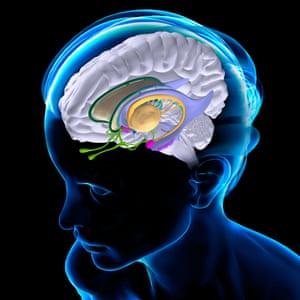
Our emotions influence every aspect of our lives, from our health and well-being, to the way we learn, the decisions we make and how we communicate with one another.

Try telling that to a Digital banking Algorithm.  The only point of contact between banks and their customers.

Now we can have a whole new social class system.

Since people can be judged by their emotions, and since a persons emotional state has legal consequences in a court of law, and since corporations would love nothing more than to know how we feel so that they can control our behavior by controlling what information we receive when we are connected, and since we are always connected. ….
Well that couldn’t possibly be a problem, or could it?

We are handing over our privacy and our lively mental freedom, step by step, to the lifeless and emotionless domain of machines. We are becoming more and more dependent upon mechanistic mimicking of human qualities, and call it Machine Intelligence.

“The biggest privacy-invasive is no the way with face recognition applications”.

Why? Because the majority of how people experience each other is through screens.

this will bring a new leveraged on degrees of freedom for smart life.

Just because you want to believe it is true doesn’t mean it is true.

The goal should be making people to become aware of the trends and processes they are being involved by their own deeds and making them to ask important questions

In short:

Predictions are hard, but TRYING to fore see and not being blind to what is already happening is immensely important.

I wouldn’t want “devices” to sense anything. Anything.

Constantly arguing with your device about how you really feel.

What a sick world that is going to be.

Ask google why do people die before their time.

You get many answers: How can we know these things?….We can’t, unless we ask and who do we ask in order to get the correct answer.. not a Algorithm.  The basic recipes for Capitalist slavery.

How much messiness should we accept? What balance of the new and familiar is the most fulfilling? These may seem like uniquely human quandaries, but they are not. Computers, like us, confront limited space and time with no shared values.Résultat de recherche d'images pour "pictures of computer algorithms"

All human comments ( Not that I will know if they are generated by Algo) appreciated. All like clicks chucked in the bin.

← Back

Thank you for your response. ✨


Share this:

  • Share on WhatsApp (Opens in new window) WhatsApp
  • More
  • Share on Mastodon (Opens in new window) Mastodon

THE BEADY EYE: LOOKS AT THE TREATMENT OF REFUGEES.

10 Tuesday Oct 2017

Posted by bobdillon33@gmail.com in Humanity., Refugees., The Obvious., The world to day., Unanswered Questions., United Nations, What Needs to change in the World, Where's the Global Outrage., World Leaders, World Organisations.

≈ Comments Off on THE BEADY EYE: LOOKS AT THE TREATMENT OF REFUGEES.

Tags

Capitalism and Greed, Mediterranean refugee crisis., Migrants/Refugees., The Future of Mankind, THE UNITED NATIONS

( A shameful read of twenty minutes)

One of this century’s greatest tragedies.Résultat de recherche d'images pour "papers on refugees"

This is an issue that is long on rhetoric, as newspaper and TV news reports testify. The number of people forcibly displaced from their homes due to conflict and war continues to increase at a staggering rate and will soon be overshadow by Global warming climate change migration.

This post attempts to look at where we have been, and where we are likely to go, in coping with this worlds endless stream of refugees. The refugee problems and crises are far from over and will continue to require urgent international cooperative treatment.Résultat de recherche d'images pour "papers on refugees"

Half of all current refugees have been displaced for over ten years.

At the moment most displaced people stay in their own country this will not be so with climate change.

We all know what causes refugee displacements and asylum flows, but the effects of conflict, political upheaval and economic incentives to migrate, are going to be dwarfed by climate migration.

Universal Declaration of Human Rights, adopted by the United Nations General Assembly resolution 217A (III), on the 10 December 1948 will be out of date. 

“All human beings are born free and equal in dignity and rights.”

This may well represents the first global international expression of rights to which all human beings are inherently entitled but Artificial Intelligence, and technology combined with global warming is going to create a different kind of refugee or migrant.

The right to life is humanity’s most fundamental value.   Résultat de recherche d'images pour "papers on refugees"

More than 65 million people are today, asylum seekers, internally displaced persons (IDPs) or refugees, illegal immigrants, to put a label on them.

The distinction between an economic migrant and a refugee is simple:

Are you running from or to? all are escaping.

Half of the world’s refugees are children under 18 years of age. The average length of time a refugee spends in exile is about 20 years, which is more than an entire childhood, and represents a significant portion of a person’s productive working years.

So let’s try to comprehend ( not that it is possible to do so with written or spoken words)  what refugees have to face.

What is a camp?  What characterizes a camp and how camps affect the lives of those who are placed in them.

On a global scale, millions of refugees are contained in camps of one sort or another.

Life goes on in camps—albeit a life that is affected by the camp.

They are places where the depoliticization of life takes place, due to humanitarian government, paradoxically they also produces a hyper-politicized space where nothing is taken for granted and everything is contested.

They are places of social dissolution, of new beginnings where sociability is remolded in new ways.

They are places with little or no human rights, dignity strippers, with no education, they are terrorist recruitment centers.

Camps are defined along two dimensions: spatially and temporally.

Temporally, refugee camps are meant to be temporary, while in practice this temporariness are becoming permanent.

Temporary are legal anomalies, in which the administration of justice is virtually in the hands of the humanitarian agencies that exercise this function either directly, or by delegating it to community leaders.

In reality temporary camp are exceptional space put in place to deal with populations that disturb the national order of things, while spatially, camps always have boundaries the fact is that in despite of ubiquitous images of sprawling refugee camps the majority of refugees are no longer confined to camps they now live in cities or towns.

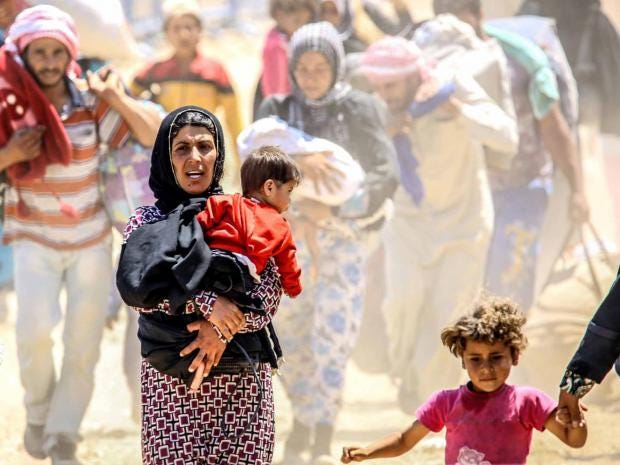
So try to imagine yourself in Zaatari a Jordanian Camp set on a lump of desert.A Syrian refugee woman walks in Zattari Syrian refugee camp, Mafraq city, Jordan

It has a current population of over 100,000 souls,( Equivalent to the population of Exeter Uk or  Reykjavík  Iceland.) of which 70% are woman and children.

People are reduced to ants in this dystopian, chronically parched science – fiction setting in Jordan.

A population that is utterly poverty-stricken and powerless, reduced to de facto prisoners with no hope no food no running water, imagine the toilets. Anger blooms, mothers sell their daughters, gangs roam, children go feral:

(Non of this can be blamed on Jordan who have contributed over £500 million against contributions from other countries of around £150 million. With 14,000 new arrivals a week a half a million will only keep the camp open for a few months.)

Or

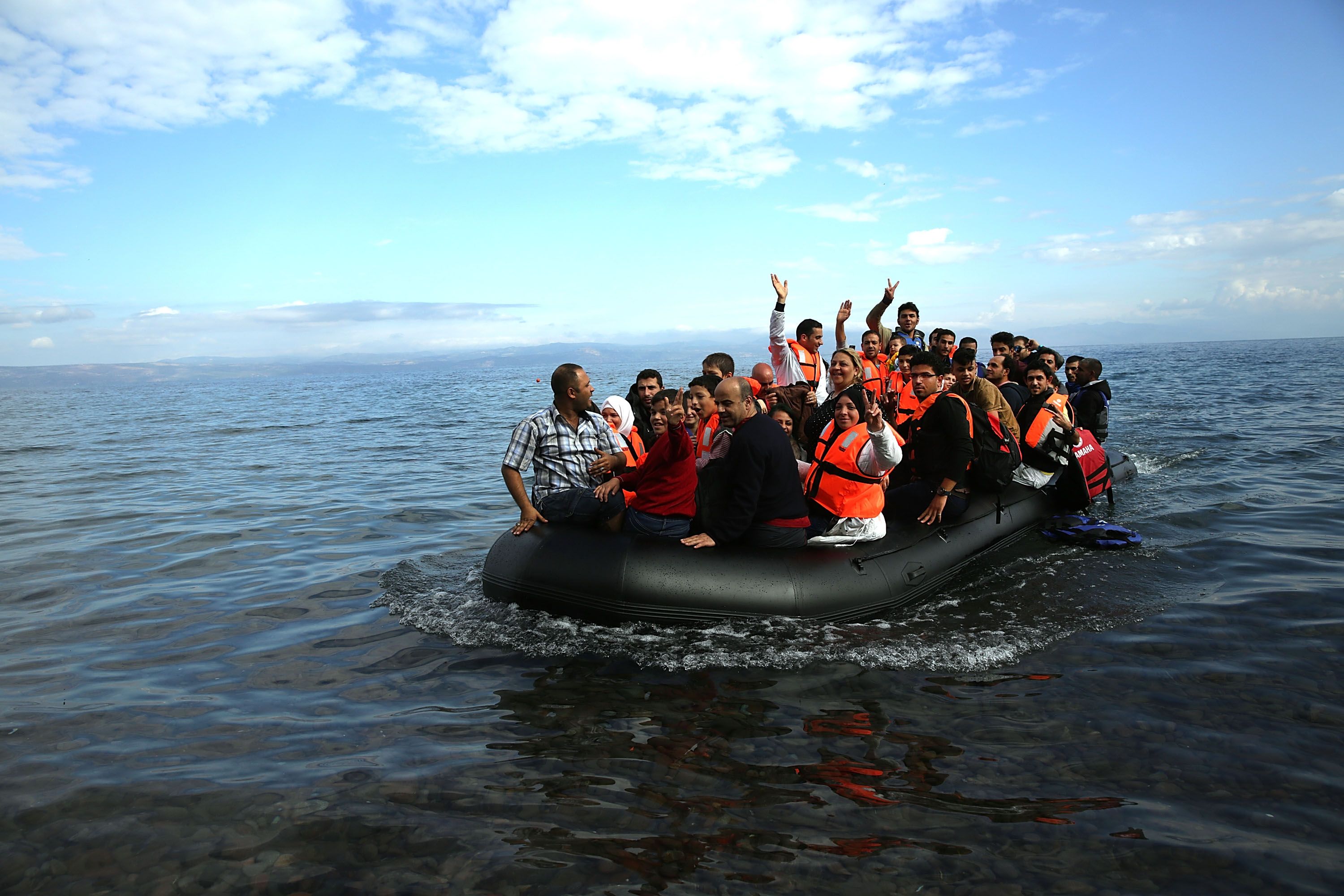
Imagine you are on a disposable barque approaching Lampedusa with 500 passenger packed like sardines having paid traffickers $ 1000 to $1600. ( Newspapers headlines constantly refer to these people as illegal immigrants. They’er not, they’er refugees. ) You have survived crossing of the Sahara, the violence in Libya and all told your family have raised $6000 for you to make the journey in the likelihood that they will never see you again.

Anyway lets say you don’t drown, now add the screaming and crying ringing in your ears as you scramble the shore to be warped in a tinfoil, and bused to a reception camp, fingerprinted though you are not a criminal.

Your only option is to vanish to continue your journey in the hands of traffickers and gangs who exploit, enslave, rape and bully.

The EU Dublin convention stipulates that people political asylum must remain in the first safe country you land in. There is no picking and choosing.

According to the 1951 UN Refugee Convention and the EU Charter of Fundamental Rights, European countries have the obligation to provide asylum to those who seek it. This is not the matter of politics and economy, but of basic human rights. There is no person that should live in fear for their life and the lives of their close ones.

Its only by not looking, by turning or backs that we can sail away and think that this is sad, but it is not our sadness.

Refugees are not spread evenly across the world.

Seven countries – Syria, Iran, Pakistan, Lebanon, Turkey, Palestine and Jordan – host more than 50% of all refugees. Many countries, including some of the richest and most developed countries like the US, UK and Australia, are not fully living up to their responsibility under the Refugee Convention.

At the moment, there are over 9 million refugees seeking asylum.

If all refugees were distributed evenly across all the countries in the world, each country would host 100,000 refugees.

By mid-2015, the World Bank’s estimated cost of the Syrian war for the Middle Eastern countries is $35 billion.

Current funding models for displacement are no sustainable.

Whether greater international coordination could produce better outcomes for refugee-receiving countries and for the refugees themselves is of course governed by funds.

The United Nations’ annual appeal for international aid has risen 500% in 10 years due to the “new norm” of multiple humanitarian crises. Only 26% of the money needed has been committed, to enable the UN to provide assistance to 78.9 million people in 37 countries.

To quote António Guterres: The UN high commissioner for refugees. “Today’s needs are at unprecedented levels and without more support there simply is no way to respond to the humanitarian situations we’re seeing in region after region and in conflict after conflict.”

It has been widely suggested that more resources should be devoted to providing aid to refugees closer to home. “80% of our emergency response is to man-made crises which are now “apocalyptic” with displacement of people the highest since the second world war and multiple crises being the “new norm”.

On average, around 100 million people are affected by natural disasters per year and disasters now cost more than $100bn in economic damages. The number of displaced people has also increased, with 65 million people displaced at the close of 2015 compared with 33.3 million in 2013.

While donors give more generously every year, the gap between funds needed and funds provided continues to widen.

This raises questions about our ability to continue to meet affected people’s needs.

Then there is the question whether to devote resources directly to repatriation and reintegration programs, or simply to provide some form of economic incentive to return.

Neither will stem the flow of long-distance illegal migrants, once such flows have become established.

The best option by far is to find ways of preventing civil wars or to stop them recurring. Civil wars suggest that the causes are chiefly economic rather than political.

To really help displaced people, aid agencies must better understand how people are helping themselves, to figure out how to support these initiatives and advocate on behalf of refugees to overcome the barriers.

Education is to be seen as key to contributing to long-term solutions for refugees, ensuring that displaced generations are equipped to rebuild their lives and communities − either in the country of asylum or upon
their return home.

Résultat de recherche d'images pour "papers on refugees"

We need to fix the system – not for today, but to be ready for what the situation will be like five years from now never mind 20 or 30 years in the future.

It’s no wonder that we are living in disturbed times.

It is now time to unite and provide a new home for those who need it the most. What is needed, therefore, is a comprehensive, fully funded global program.

The world can’t keep pretending the refugee catastrophe is a European problem. The brunt of the crisis has fallen on the Turks, the Egyptians, the Jordanians, the Iraqis and the Lebanese.

All the goodwill, all the technology, all the appeals, all the solutions will not stop people fleeing wars, or climate change.

A smart phone can be a lifeline if you’ve had to leave everything else behind, because when you take to the roads, to the boats and to the trains, all our political leaders can think of is fences, barbed wire and more police.

There is only one way to help:

And that is to get Profit for Profit sake to contribute.

By placing a world Aid Commission on all High Frequency Trading, on all Foreign Exchange Transactions over $50,000, on all Sovereign Wealth funds Acquisitions. Combined this with a 0.00005% charge on all tweets, and all online purchases, on all google inquires, on all Facebook postings, etc.

Will create a permanent self funding resource of funds doing away with begging for resources.

Mr António Guterres should call a world summit of all Industrial world leaders not countries with a view to passing a people resolution to implement such a World Aid commission.

Then we might have some hope of a more peacefully world for all.

All suggestions and comments appreciate. All like clicks chucked in the bin.

← Back

Thank you for your response. ✨


Share this:

  • Share on WhatsApp (Opens in new window) WhatsApp
  • More
  • Share on Mastodon (Opens in new window) Mastodon

THE BEADY EYE RETURNS TO THE ISRAELI- PALESTINIAN PROBLEM.

01 Sunday Oct 2017

Posted by bobdillon33@gmail.com in THE ISRAELI- PALESTINIAN PROBLEM., The Obvious., The world to day., Unanswered Questions., United Nations, What Needs to change in the World, Where's the Global Outrage.

≈ Comments Off on THE BEADY EYE RETURNS TO THE ISRAELI- PALESTINIAN PROBLEM.

Tags

THE ISRAELI- PALESTINIAN PROBLEM., United Nations


( A four-minute read.)

Are you “pro-Israel” or “pro-Palestine”?

It isn’t even noon yet as I write this, and I’ve already been accused of being both.Résultat de recherche d'images pour "pictures of israel"

These terms intrigue me because they directly speak to the doggedly tribal nature of the Israeli-Palestinian conflict.

You don’t hear of too many other countries being universally spoken of this way. Why these two?

Both Israelis and Palestinians are complex, with diverse histories and cultures, and two incredibly similar (if divisive) religions.

After World War II, Britain decided to let the United Nations decide what to do with Palestine.

The common representation of Israel’s birth is that the UN created Israel, that the world was in favor of this move, and that the US governmental establishment supported it.

All these assumptions are demonstrably incorrect.

The United Nations suggested dividing Palestine into two countries, one Arab and one Jewish.

The Arab leaders said no to the plan, but the Jewish leaders accepted it and declared the state of Israel. The American President gave his support to the new state.

In reality, while the UN General Assembly recommended the creation of a Jewish state in part of Palestine, that recommendation was non-binding and never implemented by the Security Council.

The General Assembly passed that recommendation only after Israel proponents threatened and bribed numerous countries in order to gain a required two-thirds of votes.

In 1967 it took still more Palestinian and Syrian land, which is now illegally occupied territory, since the annexation of land through military conquest is outlawed by modern international law.

Israel, which claims to be the “only democracy in the Middle East,” decided not to declare official borders or to write a constitution, a situation which continues to this day.

To this day it has continued this campaign of growth through armed acquisition and illegal confiscation of land.

So where are we?

To come down completely on the side of one or the other doesn’t seem rational to me.

It is telling that most Muslims around the world support Palestinians, and most Jews support Israel.

This, of course, is natural — but it’s also problematic.

It means that this is not about who’s right or wrong as much as which tribe or nation you are loyal to. It means that Palestinian supporters would be just as ardently pro-Israel if they were born in Israeli or Jewish families, and vice versa.

It means that the principles that guide most people’s view of this conflict are largely accidents of birth — that however we intellectualize and analyze the components of the Middle East mess, it remains, at its core, a tribal conflict.

By definition, tribal conflicts thrive and survive when people take sides. Choosing sides in these kinds of conflicts fuels them further and deepens the polarization. And worst of all, you get blood on your hands.

It’s still too early to call Israel an apartheid state, but when John Kerry said Israel could end up as one in the future, he wasn’t completely off the mark. It’s simple math.

Israel was carved out of Palestine for Jews with help from the British in the late 1940s just as Pakistan was carved out of India for Muslims around the same time. The process was painful, and displaced millions in both instances.

There are now only a limited number of ways a bi-national Jewish state with a non-Jewish majority population can retain its Jewish identity.

Let’s face it, the land belongs to both of them now.

BUT Israelis and Palestinians remain caught in a sad, frustrating and vicious cycle that must be broken.
The Israeli occupation of Palestinian lands will turn 50 years old this year.

Some considerable time ago I wrote a blog on the subject.

Then as now I stated that the two state solution is not possible and that the only solution is for Israel to grant Palestinians full Israeli citizenship, creating one state for all.

Settlement expansion is simply incomprehensible. No one really understands the point of it. Virtually every US administration — from Nixon to Bush to Obama — has unequivocally opposed it.

It’s been almost 70 years since Israel came into existence.

There are now at least two or three generations of Israelis who were born and raised in this land, to whom it really is a home, and who are often held accountable and made to pay for historical atrocities that are no fault of their own. They are programmed to oppose “the other” just as Palestinian children are.

At its very core, this is a tribal religious conflict that will never be resolved unless people stop choosing sides.

With Israel now legalizing land grab is it not time to stop dealing with Israel as a country above the law and to make it responsible for systematic violations of international conventions and the rights of the Palestinian people.

There is no justification for it except a Biblical one which makes it slightly more difficult to see Israel’s motives as purely secular.

Let’s go straight to the point:

To end the Israeli-Palestinian conflict, everyone would like a two-state solution.

This solution is impossible.

But if it Israel doesn’t work harder towards a two-state (maybe three-state, thanks to Hamas) solution, it will eventually have to make that ugly choice between being a Jewish-majority state or a democracy.

Nothing in the current situation excuses the abhorrent and immoral attacks on civilians, whether coming from Palestinians or Israelis, and any lasting solution must work to guarantee peace and security for everyone.

It’s high time we recognize that the Oslo Accords are as likely to bring peace to the Middle East as Donald Trump is to unite America.

From its conception, Oslo never required Israel to recognize Palestinian rights to statehood and has instead enabled Israeli encroachment on the West Bank.

Until now, the international consensus has been focused on a state-oriented resolution as a way to confer rights and stability to Palestinians and Israelis.

But what if that equation were flipped, if the focus were instead on enshrining full equality for everyone before even considering the creation of two states?

If this was supported by a larger Arab consensus framework, Israel would have little option as would Palestine but to come together.

This is the only realistic goal at this juncture.

To create interim arrangements to set the ground for a final agreement.

Of course both sides as in any conflict would have to want peace which now seems very unlikely.

On the Palestinian side, a lack of internal consensus remains challenging while security is the most important issue to Israel.

In such a context, nearly seventy years after the creation of Israel and the beginning of the conflict, whether the result of such an approach leads to one state or two states or 21 states on the land is immaterial.

We must put aside the concept of an Israeli-Palestinian agreement in favor of an Israeli-Arab agreement as the only realistic means to end the Israeli-Palestinian conflict.

The reality on the ground shows that the search for a two-state solution is a farce that suits those who aim at apartheid.

Although the entire world knows that a durable resolution to the conflict is imperative, not in the interests of justice but also in the pursuit of peace in the region. There is only one solution the creation of a single state, in which the safety and the right to the dignity of each one will be preserved.

There are 2,898,927 Palestinians living in the West Bank, 1,850,559 in the Gaza Strip, 1,471,201 in Israel, and a total of 12,365,761 worldwide.

Palestinian citizens of Israel struggle under a system that accords them fewer rights and opportunities than their Jewish counterparts. And regardless of what one thinks of Hamas, the siege that Israel imposes (with Egyptian collusion) on Gaza affects all of its inhabitants and is unconscionable.

According to the Israeli organization Gisha, over 70% of Gaza’s population relies on humanitarian aid, while 47% suffer from food insecurity. In the second quarter of 2016, unemployment was at 41.7%, and at a staggering 57.6% among young people.

(In fact, slim majorities of both Palestinians and Israelis still support a two-state solution.)

What matters is that we finally wake from the 23-year-old slumber induced by Oslo, the numbing half-century of occupation, and the nearly 70 years of Palestinian dispossession, to see that the only durable resolution to this conflict will be one that protects Israelis and Palestinians equally, with liberty and justice for all.

Israelis “deserve security” (and Palestinians don’t?)

Such a move would break with the political history of the United States and would run counter to the UN position, for which the status of Jerusalem, the Palestinian eastern part was occupied in 1967 and annexed by Israel in 1980, could be settled through negotiation.

A Confederation of Districts according to the historical name, defined by the good geographical and ethnic sense. As homogeneous as possible, they would necessarily include religious minorities.

Each have a Parliament and a Constitution which legislate on everything related to religion, taxation, police and education.

Insurance law, the management of national research institutes, diplomacy and the army remain the prerogative of the Confederation.

Thus, the cantonal tax authorities collect the tax and return a minority share to the central power, the wealth of each canton being largely the result of the labor of its inhabitants.

Each canton freely decides its name (in the image of Switzerland, where the Republic and Canton of Geneva, then the State of Vaud, and later the Canton of Valais, With whom everyone lives in peace).

Each district decides on the religion it wishes to inscribe in its Constitution (if it wishes to inscribe one … In Switzerland, the cases are very diverse).Image associée

Thus, Tel Aviv could decide that its official religion is Judaism, with a taxation in support of its religious institutions.

Many issues remain to be negotiated, including the division of districts, the question of return, the participation of the Palestinian populations in the army (with a staggering of the rules over several years), the creation of a national Constitution, a Constituent Assembly, etc.

From the outset, the state would be recognized by all the countries of the Arab world.

According to the initiative of Saudi Arabia in 2002, the benefits would no longer be counted: Disappearance of separation walls and checkpoints, development of very fruitful economic links, and especially the normal life, finally. For everyone.

So you really don’t have to choose between being “pro-Israel” or “pro-Palestine.” If you support secularism, democracy, and a two-state solution — and you oppose Hamas, settlement expansion, and the occupation — you can be both.

Again you don’t have to like what Israel is doing.

If Israel truly wanted to destroy Gaza, it could do so within a day, right from the air.

How can this possibly ever be in Israel’s interest?

 When civilians die, Israel looks like a monster. It draws the ire of even its closest allies. Horrific images of injured and dead innocents flood the media. Ever-growing anti-Israel protests are held everywhere from Norway to New York. And the relatively low number of Israeli casualties repeatedly draws allegations of a “disproportionate” response. Most importantly, civilian deaths help Hamas immensely.
Again, there is no justification for innocent Gazans dying.
So please tell me — how can anyone conclude that religion isn’t at the root of this, or at least a key driving factor?
People have all kinds of beliefs — from insisting the Earth is flat to denying the Holocaust. You may respect their right to hold these beliefs, but you’re not obligated to respect the beliefs themselves.
It’s 2017, and religions don’t need to be “respected” any more than any other political ideology or philosophical thought system. Human beings have rights. Ideas don’t.
Denying religion’s role seems to be a way to be able to criticize the politics while remaining apologetically “respectful” of people’s beliefs for fear of “offending” them. But is this apologism and “respect” for inhuman ideas worth the deaths of human beings?

Muslims have woken up around the world but is it really because of the numbers?

Bashar al-Assad has killed over 180,000 Syrians, mostly Muslim, in two years — more than the number killed in Palestine in two decades.

Thousands of Muslims in Iraq and Syria have been killed by ISIS in the last two months. Tens of thousands have been killed by the Taliban. Half a million black Muslims were killed by Arab Muslims in Sudan.

The list goes on.

All comments appreciated. All like clicks chucked in the bin.
← Back

Thank you for your response. ✨

Share this:

  • Share on WhatsApp (Opens in new window) WhatsApp
  • More
  • Share on Mastodon (Opens in new window) Mastodon

THE BEADY EYE ASKS: WHY DOES THE UNITED NATIONS TOLERATE SPEECHES THAT ARE IN BREECH OF ITS CHARTER.

22 Friday Sep 2017

Posted by bobdillon33@gmail.com in Artificial Intelligence., Climate Change., HUMAN INTELLIGENCE, Nuclear power., The Future, The world to day., Unanswered Questions., United Nations, What Needs to change in the World, Where's the Global Outrage., World Leaders, World Organisations., World Politics

≈ Comments Off on THE BEADY EYE ASKS: WHY DOES THE UNITED NATIONS TOLERATE SPEECHES THAT ARE IN BREECH OF ITS CHARTER.

Tags

Artificial Intelligence., Climate change, Greed, Inequility, The Future of Mankind, THE UNITED NATIONS, United Nations, Visions of the future.


 HomeUNITED NATIONS CHARTER.

Chapter I

                            PURPOSES AND PRINCIPLES

  • To maintain international peace and security, and to that end: to take effective collective measures for the prevention and removal of threats to the peace, and for the suppression of acts of aggression or other breaches of the peace, and to bring about by peaceful means, and in conformity with the principles of justice and international law, adjustment or settlement of international disputes or situations which might lead to a breach of the peace;
  • To develop friendly relations among nations based on respect for the principle of equal rights and self-determination of peoples, and to take other appropriate measures to strengthen universal peace;
  • To achieve international co-operation in solving international problems of an economic, social, cultural, or humanitarian character, and in promoting and encouraging respect for human rights and for fundamental freedoms for all without distinction as to race, sex, language, or religion; and
  • To be a center for harmonizing the actions of nations in the attainment of these common ends.

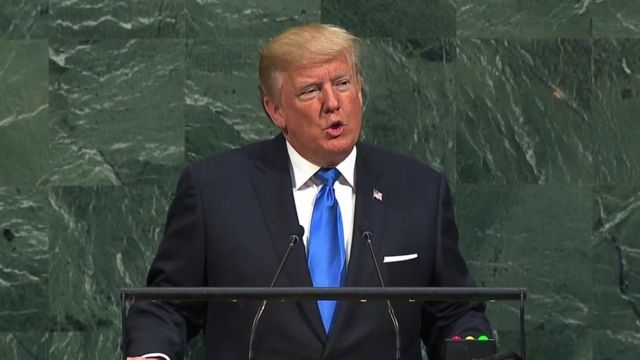
The Rt Hon Theresa May MPRésultat de recherche d'images pour "Donald trump recent speech at the un"

A charter represents a document that describes a project, its rationale, its goals and its participants. The purpose of a charter aims at aligning the expectations of all the contributors so that their energy focuses on the project’s priorities.

The Charter is not to be confused with The Universal Declaration of Human rights adopted after World War 11. It is perhaps the closest thing we have to a global Constitution- categorically states that the right to life is humanity’s fundamental value. Death is a crime.

It would appear that from the speeches given by either of the above that they DO NOT fully comprehended the above charter.

In his Sovereignty – centric speech Mr Trump threatened to totally destroy North Korea, called Iran a corrupt dictatorship whose main export is violence.

While Mrs May in her speech threatened withdrawal of funds.

This is not the first time not will it be the last that a World leader has used the UN to criticize other nations. Mr Bush with the axis of evil. Mr Khrushchev trumping the table and calling Filipino some obnoxious name in Russian.

Both Mr T and Mrs M appear to think that the yard stick to measure a nation’s success is GDP. This kind of thinking is driving humankind to make happiness a second goal for the twenty-first century which is highly unlikely unless inequality, war, and climate change disappear.

Surely the UN is not the platform for sovereign selfish nations to be expressing treats to other nations. Stirring up hornets nest is not what the world needs.

Here a few examples from each of their recent addresses to the UN.

MR D Trump first:

“The United States has great strength and patience, but if it is forced to defend itself or its allies, we will have no choice but to totally destroy North Korea. “Rocket Man” is on a suicide mission for himself and for his regime.”

” It has just been announced that we will be spending almost $700 billion on our military and defense.”

Then a raft of contradictions:

” In America, we do not seek to impose our way of life on anyone, but rather to let it shine as an example for everyone to watch.”

” We are celebrating the 230th anniversary of our beloved Constitution, the oldest constitution still in use in the world today. This timeless document has been the foundation of peace, prosperity and freedom for the Americans, and for countless millions around the globe whose own countries have found inspiration in its respect for human nature, human dignity and the rule of law.”

“But we can no longer be taken advantage of, or enter into a one-sided deal where the United States gets nothing in return.”

“As long as I hold this office, I will defend America’s interests above all else.”

“The United States is one out of 193 countries in the United Nations, and yet we pay 22 percent of the entire budget and more. In fact, we pay far more than anybody realizes.”

“The United States of America has been among the greatest forces for good in the history of the world and the greatest defenders of sovereignty, security and prosperity for all. Now we are calling for a great reawakening of nations, for the revival of their spirits, their pride, their people and their patriotism.”

“Our hope is a word and (sic) world of proud, independent nations that embrace their duties, seek friendship, respect others and make common cause in the greatest shared interest of all, a future of dignity and peace for the people of this wonderful Earth.”

“This institution was founded in the aftermath of two world wars to help shape this better future. It was based on the vision that diverse nations could cooperate to protect their sovereignty, preserve their security and promote their prosperity.”

The success of the United Nations depends upon the independent strength of its members.

“We do expect all nations to uphold these two core sovereign duties: to respect the interests of their own people and the rights of every other sovereign nation.”

“Today, if we do not invest ourselves, our hearts and our minds in our nations – if we will not build strong families, safe communities and healthy societies for ourselves – no one can do it for us.”

“This is the beautiful vision of this institution, and this is the foundation for cooperation and success. Strong, sovereign nations let diverse countries with different values, different cultures and different dreams not just coexist, but work side by side on the basis of mutual respect. Strong, sovereign nations let their people take ownership of the future and control their own destiny, and strong, sovereign nations allow individuals to flourish in the fullness of the life intended by God.”

We want harmony and friendship, not conflict and strife. We are guided by outcomes, not ideology. We have a policy of principled realism rooted in shared goals, interests and values.

And just as the founders of this body intended, we must work together and confront together those who threaten us with chaos, turmoil and terror.

“We will fight together, sacrifice together and stand together for peace, for freedom, for justice, for family, for humanity and for the almighty God who made us all.”

“Are we still patriots? Do we love our nations enough to protect their sovereignty and to take ownership of their futures? Do we revere them enough to defend their interests, preserve their cultures and ensure a peaceful world for their citizens?”

The UN relies on the independent strength of its members.

Theresa May:

“We face challenges that go right to the heart of who we are as nations.”

“I believe that the only way for us to respond to this vast array of challenges is to come together and defend the international order that we have worked so hard to create and the values by which we stand. For it is the fundamental values that we share, values of fairness, justice and human rights, that have created the common cause between nations to act together in our shared interest and form the multilateral system. And it is this rules-based system which we have developed, including the institutions.”

This statement in the light of Brixit is total hogwash and on we go.

“Indeed, the defining purpose of the UN Charter is to maintain international peace and security, to develop friendly relations among nations, to achieve international cooperation in solving problems of an economic, social, cultural or humanitarian character; and to be a center for harmonizing the actions of nations in the attainment of those common ends.”

“An outward-looking global Britain and the second biggest funder of the UN the UK will remain committed to spending 0.7% of GNI on development and humanitarian support. And that is why we will remain generous in our funding but set aside 30% to be paid only to those parts of the UN that achieve sufficient results.”

It is true to say that the UN needs reform, but it can only become relevant if it is financed to tackle world problems. ( See previous posts)

Both Speeches ignore Climate Change and the need to address inequality that is the spawning bed of all terrorism, driven by the technology of the smart phone.

The world is changing and we don’t have to be prophets to see if we as its intelligent guardians don’t address its underling problems there will be problems that will put all our technology, all our unsustainable greed, all our power of destruction, into the shade.

All comments appreciated, all like clicks chucked in the bin.

← Back

Thank you for your response. ✨

Share this:

  • Share on WhatsApp (Opens in new window) WhatsApp
  • More
  • Share on Mastodon (Opens in new window) Mastodon

THE BEADY EYE SHINES A LIGHT ON A WORLD WHERE NEARLY 20 PEOPLE ARE FORCIBLY DISPLACED EVERY MINUTE.

16 Saturday Sep 2017

Posted by bobdillon33@gmail.com in Humanity., Natural World Disasters, Our Common Values., Post - truth politics., Refugees., The world to day., Unanswered Questions., United Nations, What Needs to change in the World, Where's the Global Outrage., World Aid., World Leaders, World Organisations., World Politics

≈ 3 Comments

Tags

Migrants/Refugees., UNHCR

(A shameful twelve minute read)

We got it all wrong when it comes to helping Refugees.

They are not invisible people.

Camps are the wrong way to help today’s refugees.

We cannot turn our backs on the ten million people who have been forced to flee their homes. Every decent society knows this and knows that it’s our moral duty to come up with a workable way of helping the refugees.

So here’s the crucial question: what, beyond safety itself, are the critical elements of normality for any refugee?

The entire international refugee support system has presumed that the answer is food and shelter.

But is this really the right response in 2017?

The system was designed to cope with the displaced of post-war central Europe, many of them Germans who had fled the Russians, or Jews freed from the concentration camps.

Refugees nowadays do not have the luxury of a short-term solution. The problems they are fleeing are likely to last for a very long time. Imagine yourself in their position, displaced with your family. Would you really resign yourself to years in a refugee camp, living off food tokens, housed in a converted container?

UNHCR, and its penumbra of similar organisations, are designed for care.

Like all welfare programmes, theirs treats people as passive recipients. Inadvertently, it infantilises.

That so many refugees forgo this care, preferring the struggle of earning a living beneath the official radar of regulations that prohibit it, is testimony to the heroism of the human spirit. We shouldn’t, even with the best intentions, crush that spirit. We should do what we can to make autonomy less grim.

The key confusion has been to conflate refugees with migrants.

Refugees, by definition, are people who didn’t choose to be migrants: they wanted to live at home but their home became unsafe. Migrants are people who seek a better life. Migrants go to honeypots — dream locations can readily be ranked by their desirability.

Refugees do not go to dream locations; they are seeking proximate havens. All of the top ten destinations for refugees are themselves countries of emigration. All are poor countries in disorderly neighborhoods.

So this is the real answer for refugees, not tents and food but autonomy and community. It’s what you would want in their position.

In asking the development agencies to scale-up and integrate the new mechanisms for generating jobs for refugees with those for speeding post-conflict recovery, it would at last become possible to meet our true international duty of rescue. In the process we should free ourselves from the lazy trap of fitting the present into the past.

But try telling that to the current wave of some 65.6 million people around the world that have been forced from home from today’s wars and conflict zones. 65.3 million people on the run – most are now crammed into often squalid and unsafe camps as they wait in increasing desperation for a home, somewhere.

65.6 million is according to the UNHCR the latest figures (which should be taken with a dose of salt as many nations are not equipped with refugee registers or effective data collection procedures. It excluded people who were displaced by natural disasters such as floods and earthquakes, which separately uprooted at least 19 million people in 2015.

To put this number into perspective, one in about every 113 people in the world is currently a refugee. This means that of the 7 billion people on earth, over 65 million of them are living as refugees –– forced to leave their homes. The numbers are so breathtaking that they take a while to settle into the mind.  This is the largest number ever recorded – and a testament to massive failures of both the international community and the United States in dealing with this crisis.

(There are also 10 million stateless people who have been denied a nationality and access to basic rights such as education, healthcare, employment and freedom of movement.)

I say the US, because it is the worst offender. It led the invasion of Iraq in 2003 without a legitimate casus belli. It set in motion the events that produced the Arab Spring resulting in immense forcible displacement in the region.

Just compare this 65 million with one of the greatest humanitarian crises in history — when a shattered Europe at the end of the Second World War had to resettle a staggering 16 million displaced persons.

A horrifying number certainly, but only a third as many as we have now.

The fact that the average amount of time people worldwide are living in displacement is now a staggering 17 years suggest that something is going terribly wrong in how we’re dealing with this issue.

In this climate, it is not surprising that there is animosity towards refugees by so many people.  There has been a perceptible rise in racist and xenophobic acts in many nations, sometimes fueled by politicians and the media. The political reality suggests most countries will remain reluctant to house all but a very small minority of those displaced by violence.

We now live in a world where nearly 20 people are forcibly displaced every minute and we have seen anything yet. Wait till uninhabitable regions due to climate change then we will have millions turning into billions.

Combined this with the violence in the Middle East and North Africa, with nine civil wars now going on in Islamic countries between Pakistan and Nigeria and half of the 23 million population of Syria been forced from their homes, plus 2.6 million Iraqis displaced by Islamic State – Isis – and 1.5 million people displaced in South Sudan.

Religious, ethnic and separatist conflicts are tearing countries apart.

Nationalism and socialism no longer provide the ideological glue to hold together secular states or to motivate people to fight.

Wars are currently being waged in Afghanistan, Iraq, Syria, south-east Turkey,Yemen, Libya, Somalia, Sudan and north-east Nigeria and none of them show any sign of ending. sanliurfa-syrians-getty.jpg

Europeans were jolted by pictures of the little drowned body of Alyan Kurdi lying on a beach in Turkey and half-starved Syrians crammed into Hungarian trains.

What is to be done to stop these horrors? Perhaps the first question is how we can prevent them from getting worse, keeping in mind that five out of the nine wars have begun since 2011.

Let me begin by attempting to demonstrate why the refugee question must be addressed:

The waves of refugees now are just the leading edge of a global catastrophe, just watch as global warming takes its toll in the coming years.

The core problem remains the amount of violence we have in too many areas of the world. Until we figure out how to isolate wars and cut off their oxygen — as was done eventually in the Balkans in the 1990s — we will only delude ourselves in thinking our era grows less violent.

There is a danger that by attributing mass flight to too many diverse causes, including climate change, political leaders responsible for these disasters get off the hook and are free of public pressure to act effectively to bring them to an end.

Not an easy delusion to maintain as 48 million people call out to us from refugee camps that now seem as much prisons as safe havens. 

It is better first to be informed and draw an opinion, rather than only to be opinionated. Half of refugees worldwide are children.

But why has this topic been so often ignored, or if mentioned, referred to as a “taboo”?

The fact is that world media in all its forms is dissenting us all to the point that refugees from war-torn countries are considered collateral damage, making good news footage.

World leaders can no longer watch passively as so many lives are needlessly lost.

We must be smart about finding solutions to help refugees.

We must find humane and dignified means to ensure refugees don’t risk their lives and those of their families by resorting to ruthless traffickers.

We must open designated channels of entry and offer tagged shelter under repatriation once its is safe to do so.

We must stop the world media spreading a climate of xenophobia.”

We must stop the growing resistance from nations to providing asylum for refugees.

We must stop spreading (due to political rhetoric) painting refugees as terrorists or beggars. “Refugees… don’t bring danger” but “flee from dangerous places.


The world governments will resist doing anything until such time as it is profitable to do so. This will be too late.

One of the more comforting claims in recent years is that the world is a less violent place than the blood-soaked centuries gone by. Bull shit.

The modicum of UNHCR support before abandonment, puts a spotlight of Shame on our world!

I have this awful feeling of deja vu. One begging UN resolution after another.

However there are the beginnings of an awakening about all this. In October the World Bank approved its first refugee loan — for job generation for Syrian refugees in Jordan.

Perhaps if the top five Tech Conglomerations were to charge a cent on all like clicks, on all shared photos, on all sales, all up loads, on all searches, on all tweets, on all e mails, on all Skype calls, they could save the world from melt down.  This combined with a 0.05% world aid commission,( See previous posts) would create a perpetual fund of trillions to address inequality that leads to all our troubles.

In just a single minute on the web 216,000 photos are shared on Instagram, a total of £54,000 ($83,000) sales take place on Amazon, there are 1.8 million likes on Facebook and three days worth of video is uploaded to YouTube.

All suggestions and comments appreciated. All like click chucked in the bin till they are chargeable.

← Back

Thank you for your response. ✨


Share this:

  • Share on WhatsApp (Opens in new window) WhatsApp
  • More
  • Share on Mastodon (Opens in new window) Mastodon

THE BEADY EYE SAYS: CAPITALISM HAS IT ASS OVER TIT.

14 Thursday Sep 2017

Posted by bobdillon33@gmail.com in Capitalism, Our Common Values., Post - truth politics., Social Media, Sustaniability, The Future, The Obvious., The world to day., Unanswered Questions., What Needs to change in the World

≈ Comments Off on THE BEADY EYE SAYS: CAPITALISM HAS IT ASS OVER TIT.

Tags

Cap, Capitalism, Capitalism and Greed, Capitalism isn't working, Capitalism vs. the Climate., Capitalist World., Capitalistic Societies, Free market capitalism, Global capitalism, Neoliberal capitalism:


( A twelve-minute read.)

What is the problem with capitalism?

A question that has preoccupied its existence.

The answer is that there is nothing in its internal logic to interrupt its momentum – to stop it eating its way through our planet, and ultimately collapsing our global ecosystems.

We all know that capitalism has brought with it historically unprecedented material advances. But today it is more obvious than ever that the imperatives of the market will not allow capital to prosper without depressing the conditions of great multitudes of people and degrading the environment throughout the world.

After years of ill-health, capitalism is now in a critical condition.

Growth has given way to stagnation; inequality is leading to instability; and confidence in the money economy has all but evaporated.

We have now reached the point where the destructive effects of capitalism are outstripping its material gains.

No ‘developing’ economy setting out on the capitalist road today, for example, is likely to achieve even the contradictory development that England underwent and is now dismantling.

Résultat de recherche d'images pour "pictures of capitalism"

There is a growing disparity between the material capacities created by capitalism and the quality of life it can deliver.

This is visible not only in the growing gap between rich and poor but also, for instance, in the deterioration of public services in the very countries – such as the US and UK – where the principles of the capitalist market are most uninhibited.

Capitalism was born at the very core of human life, in the interaction with
nature on which life itself depends, and the transformation of that interaction by agrarian capitalism revealed the inherently destructive
impulses of a system in which the very fundamentals of existence are subjected to the requirements of profit.

In other words, the origin of capitalism revealed the essential secret of capitalism.

To day Capitalism is incapable of promoting sustainable development,
not because it encourages technological advances that are capable of straining the earth’s resources but because the purpose of capitalist production is exchange value not use value, profit not people. 

Whatever capitalism may do to enable the efficient use of resources, its own imperatives will always drive it further. Without constantly breaching the limits of conservation, without constantly moving forward the boundaries of waste and destruction, there can be no capital accumulation.

There is, in general, a great disparity between the productive capacities of capitalism and the quality of life it delivers.

Why?

Because the ethic of ‘improvement’ in its original sense, in which production is inseparable from profit, is also the ethic of exploitation, poverty, and homelessness.

The world is changing and the only profits matter approach to business is becoming harder to justify and get away with. The old style of the end justifies the means and the purpose of business is profit is dying.

The transparency of social media and the advent of the global economy, driven by Artificial Intelligence is demanding a change to how Capitalism works.

We are on call 24/7 through email and smart phones which is causing the line between money as the great motivator or happiness to blur.

The attempt to achieve material prosperity according to capitalist principles is increasingly likely to bring with it the negative side of the capitalist contradiction, its dispossession and destruction, more than its material
benefits – certainly for the vast majority.

The system’s contradictions have always gone far beyond the vagaries of economic cycles.

The use of wealth to create more wealth is coming to an end and will be hopefully replaced with intrinsic rewards than by pure financial ones. If values are not lived and only decorate the walls they can become a demotivating factor.

Life would indeed be nasty, brutish, and short if it were solitary, fortunately for all of us, in capitalist society it isn’t.

The beautiful thing about capitalism is that it’s ultimately based on
voluntary exchange for mutual benefit.

So why does it not get sufficient credit for the amazing value it has created.

Because the destructive effects of capitalism have constantly reproduced themselves, its positive effects have not been nearly as consistent since the system’s moment of origin.

So where does this leave us?

Unfortunately there will be no escape from exploitation. Increasingly significant numbers are not so much oppressed by capitalism as they are excluded by it.

The market can no longer act as a regulator of the economy as it becomes digitized. To guarantee some rationality, some correspondence between what people want and what is produced we all Technology to be verified in order to ensure it is complying with core human values. (See previous Posts)

While capitalist discipline celebrates consumption, not all of its subjects are rightly called consumers. To the contrary, many who are subject to its discipline do not so much struggle to consume and accumulate as merely survive, which suggests that capitalism works to deform humanity.

Capitalism has so construed the market that humans interact agonistically, competitively.

All of us, winners and losers, consumers and excluded, compete for resources, for market share, for a living wage, for a job, for the time for friendship and family, for inclusion in the market, and so forth.

Capitalism is now in the process of becoming invisible on the surface.

First, it is computerized and robotized, not to lessen everyone’s work time, but instead to raise profits by reducing payrolls.

Second, it exploited low-wage immigrant labor to offset wage increases won by years of labor struggles.

Third, it moved production to lower-wage countries such as China, India, Brazil and others.

Fourth, it divided and weakened the labor unions, political party groups and other organizations that pursued labor’s interests.

Growth for the sake of growth is the ideology of the cancer capitalist cell.

As a result, inside nearly every country of the global capitalist system, the rich-poor divide deepened.

Can anything be done?

Not much.

Capitalism makes a virtue of what an earlier era denounced as a vice, pleonexia or greed – a restless, possessive, acquisitive drive, but which today is celebrated as the aggressive, creative, entrepreneurial energy that distinguishes homo economicus.

Capitalism is bad for those who succeed by its standards as well as for those who fail by them.

In fact, in many countries today, and for much of human history, it has been widely understood that those who are rich are rich because they took from others, and especially because they have access to organized force—in today’s terms, the state.

Such predatory elites use this force to gain monopolies and to confiscate the produce of others through taxes. They feed at the state treasury and they benefit t from state-imposed monopolies and restrictions on competition. It’s only under conditions of capitalism that people commonly become wealthy without being criminals.

It fails not simply on the grounds of what it fails to do but because of what it succeeds in doing: distorting human desire and relations.

It is often unclear what exactly is being condemned when it comes to Capitalism.

The term “capitalism” refers not just to markets for the exchange of goods and services, which have existed since time immemorial, but to the system of innovation, wealth creation, and social change that has brought to billions of people prosperity that was unimaginable to earlier generations of human beings.

The above may be true but it is now being exploited by what I call the fearsome five empty calorie connections” Google, Apple, Microsoft, Amazon, Facebook and Twitter.

Even if they remain in possession, or indeed outright ownership, of the means of production – they are subject to the demands of competition, increasing productivity, capital accumulation, and the intense exploitation of
labor.

In this barren space, they and us are now locked in competition and struggle for scarce resources.

If you have got this far I can hear you saying come to the point.

What might be the alternatives to capitalism look like?

Capitalism is a cultural system and not simply an economic one, it cannot be explained by material factors alone.

It is now obvious, that the value Capitalism created is at a cost, which we are now reaping:  Our environment, (Climate change) our core values, (We all have a core value in the unknown.) our Humanity all of which have been and are being hijacked by Greed/Profit and now technological progress.

Even if capitalism succeeds in reducing poverty, it is still wrong on account of its distortion of human desiring and human relations, rendering them antagonistic, competitive.

Over the last century, capitalism has repeatedly revealed its worst tendencies: instability and inequality. Inequality has proved to be an inherent trend of capitalism. Resting everything on self-interest is relying on a very incomplete theory of human nature.Résultat de recherche d'images pour "pictures of capitalism"

Now that the capital markets are run by Algorithms and the world has an apparent love-hate relationship with the economic social system, capitalism, is it not time to create a new model of Capitalism.

“Conscious Capitalism.” or Social-Capitalism the seeds of which can be seen in countries like Sweden, Norwegian.

The first principle is that business has the potential to have a higher purpose that may include making money, but is not restricted to it.

Truly moving beyond capitalism means breaking from the employer-employee core relationship.

It means no longer assigning a relatively tiny number of people inside each enterprise to the employer position of exclusively making the sorts of decisions.

(In private corporations the employers are the boards of directors selected by the major shareholders. In state or public enterprises of the traditional socialist economies, the employers are state officials.)

Instead of either kind of employer-employee relationship, system change installs a different core relationship inside enterprises. A different group of people — all workers in the factory, office or store — democratically makes those same decisions. The rule is “one worker, one vote,” and in general, the majority decides. The difference between employer and employee dissolves.

Every business has the potential for a higher purpose. And if you think about it, all the other professions in our society are motivated by purpose, beyond a narrow interpretation of purpose as restricted to maximizing profits.

I think that capitalism and business should fully reflect the complexity of
human nature.

Capitalist interaction is highly structured by ethical norms and rules. Indeed, capitalism rests on a rejection of the ethics of loot and grab, the means by which most wealth enjoyed by the wealthy has been acquired in other economic and political systems.

Capitalist contradictions are increasingly escaping all our efforts to control
them. The hope of achieving a humane, truly democratic, and ecologically sustainable capitalism is becoming transparently unrealistic.

In the midst of the descending darkness of capital, the difference this time is that we know what happened last time.

Postmodern society thwarts our innate desire to participate politically. Just voting in an election every few years, marching once in a while, or signing petitions on Avaaz or MoveOn doesn’t count for much.

We need new avenues for passionate participation – not just in elections every few years, but continuously.

A more generous, egalitarian, patient, deliberate, and accountable form of capitalism must begin with incisive and interdisciplinary social inquiry, without which policy change cannot be successful.

All suggestions all comments appreciated, all like clicks chucked in the bin.

← Back

Thank you for your response. ✨


Share this:

  • Share on WhatsApp (Opens in new window) WhatsApp
  • More
  • Share on Mastodon (Opens in new window) Mastodon

THE BEADY EYE SAYS: WAKE UP-THE PARIS CLIMATE CHANGE AGREEMENT IS A JOKE.

09 Saturday Sep 2017

Posted by bobdillon33@gmail.com in HUMAN INTELLIGENCE, Paris Climate Change Delegates., Post - truth politics., Social Media., Sustaniability, Technology, The Obvious., The world to day., Unanswered Questions., United Nations, What Needs to change in the World, Where's the Global Outrage., World Leaders

≈ Comments Off on THE BEADY EYE SAYS: WAKE UP-THE PARIS CLIMATE CHANGE AGREEMENT IS A JOKE.

Tags

Artificial Intelligence., Capitalism and Greed, Climate change, Inequility, Natural disaster, The Future of Mankind, Visions of the future.

( A One minute Read)

Wake up. The Paris Climate Change Agreement which covers the period 2020 to 2030, : A system of voluntary, unenforceable pledges relies on peer pressure for ambitious commitments and the “naming and shaming” of countries that drag their feet, is a JOKE. It’s just worthless words. All major industrialized countries are failing to meet the pledges they made to cut greenhouse-gas emissions.

Climate change is an issue of huge public interest.

One of the biggest problems that the world is facing aside from the economic pitfalls is the unprecedented occurrences of natural calamities. Not only does a calamity bring about massive death and destruction to the country, but it also causes great financial issues.

The exit of the United States could multiply those troubles, or it could provide an opportunity to fix the looming problem of incredible goals.

Time has nearly run out for limiting warming to 2 °C. “If we wait until 2020, it will be too late.”

The talks were rigged to ensure an agreement is reached regardless of how little action countries plan to take. The final submissions are not enforceable, and carry no consequences beyond “shame” for noncompliance — a fact bizarrely taken for granted by all involved.

Demonstrating, yet again, the utter folly of an approach that is attempting to save the world by putting it on a collective energy diet.

Every major climate change initiative to date has gone up in smoke.

The 1997 Kyoto Protocol, which sought to cut emissions 5 percent below 1990 levels by 2012, was doomed from the start.

The 2009 Copenhagen conference to hammer out a Kyoto sequel was an even bigger debacle.

The carbon market is a concept based on “polluter pays” and cap-and-trade principle. The objective is to reduce gas emissions through the use of market law. It assembles voluntary organizations that exchange the rights to issue carbon dioxide.

During the year, if a company manages to emit less than the allowable amount, it can sell the remainder to another company. This transaction doesn’t change the total emissions of the group. Therefore, one company must emit a lower-than-allowable amount in order for another company to emit more.

It works pretty much like the stock exchange. The problem with this system is that it needs rigid regulations and enforcement in order to have a large impact. There is no law limiting the amount of carbon emissions by a company. The carbon market is purely based on volunteerism, which works well for the companies already involved. This system was at the heart of Kyoto.


We watch large global corporations make billions, we watch governments spend billions on arms, we watch drug companies make trillions, energy giants make trillions,we watch Google/Alphabet/Apple/Microsoft/Amazon/ Facebook/Twitter/Algorithms plunder the world, while the United Nations has to beg for funds.

So where are we.

We either spend trillions and sacrificing millions of jobs, to reduce the average global temperature. Or Spend trillions on mopping up disasters and stopping mass immigration.

Or

Place a world aid commission on all Transactions that are Profit for Profit sake, on all High Frequency Trading, on all Foreign Exchange Transactions of $50,000, on all Sovereignty Funds Acquisitions, on all form of online Gambling. Creating a perpetual fund to address the problem and reduce inequality.

Ban all air/road/sea traffic one day a month.

Even if the always-wrong climate change computer models turned out to be right, no one wants to pay the cost.

Recent images bear little resemblance to reality;

Bangladesh underwater, Mexico shaking, Vast areas on fire, West Indies blown away, Wars a bucket full and inequality rampant. Résultat de recherche d'images pour "the top world forest fires"

Résultat de recherche d'images pour "pictures of the latest hurricane"

May all those caught up in any of the above survive.


Stupidity consists in wanting to come to a conclusion.

All support appreciated, all like clicks chucked in the bin.

← Back

Thank you for your response. ✨

Résultat de recherche d'images pour "pictures of the latest hurricane"

Share this:

  • Share on WhatsApp (Opens in new window) WhatsApp
  • More
  • Share on Mastodon (Opens in new window) Mastodon

THE BEADY EYE SAYS: WE LIVE IN A WORLD OF LIP SERVICE.

08 Friday Sep 2017

Posted by bobdillon33@gmail.com in Capitalism, Climate Change., Environment, Evolution, Google, Humanity., Life., Natural World Disasters, Our Common Values., Social Media, Sustaniability, Technology, The Obvious., The world to day., Unanswered Questions., United Nations, What Needs to change in the World, Where's the Global Outrage., World Organisations.

≈ Comments Off on THE BEADY EYE SAYS: WE LIVE IN A WORLD OF LIP SERVICE.

Tags

Capitalism and Greed, Climate change, Distribution of wealth, Inequility, Natural disaster, The Future of Mankind, Visions of the future.

( A three-minute read)

We live in a world where turning on the news every day means getting updated on the latest tragedy and not just finding out what the weather will be like tomorrow.Résultat de recherche d'images pour "pictures of the living world"

2017 is a year of unrelenting misery and fear. We live in a world where people feel more afraid of someone with a gun than protected.

We live in a world where text messages surpass face to face conversations.

Image associée

We live in a world run by Algorithms. In a world where if you didn’t snap chat it or post it to Facebook, “it didn’t happen”.

We live in a world that has so many people without the words, “thank you” in their vocabulary.

We live in a world where people would rather sit in the comfort of their anguish and anxiety than take a small step to a better life.

What happened to the world where everyone minded their own damn business?

What happened to the world where people actually knew their neighbors, and didn’t fear them? What happened to the world where people got together and lost track of time because they didn’t have their phone attached to their hip?

What happened to the world where people could voice their opinion without getting hate mail? What happened to the world as one nation?

We live in a world where our self-esteem is managed by the amount of “likes” on our selfies and statuses.

I don’t need to tell you world news is pretty grim right now – if you use social media, it’s nigh on impossible to avoid articles about bubbling permafrost, drug-resistant gonorrhoea, and deadly obesity treatments.

And that’s just the science headlines.

We live in a world with rampant inequality due to capitalist greed, void of any common values.

We live in a world with global environmental changes locked into our future, with hidden threats to sustainability,not just because of migration that is just beginning due to lack of fresh water.

Stop, take a step back and think.

Isn’t it absurd that we, 7 billion of us living in the same planet, have grown further apart from each other? What sense does it make to turn your back on the thousands, maybe millions, of people living around you.

If we want wars we have all the ingredients.

We live in a world where our i pads and cell phones get thinner and our bodies get thicker.

We live in a world where people pass each other on the street and can’t even smile back.

We live in a world where people dish hatred out on a serving platter.

We live in a world where our world organisation called the United nations s just a gossip shop that has to beg for funds. Unable to cuts through the rhetoric because of

We live in a world where people take more than they give. We live in a world where people have completely forgotten what they were given knees for.

What happened to our world?

Most of us haven’t quite realized there is something extraordinary happening. I want to see it through a child’s eyes again.

Why is the world-changing?

We live in a world where  because we are too afraid of hurting kid’s feelings instead of teaching them the value of hard work. You get a participation trophy for merely showing up.3278764814_4d666f44ee_o-crop

We live in a world of lip service.

We are reaching our limits. It’s time for people to switch on the blender, stirring events in the non-human part of the world into their everyday lives, and see what happens.

Google might knows our names but it knows Sweet Fanny Adam about the natural world. The rest of the living world can get along without us, but we can’t get along without them.

Perhaps all living things comprise one biological entity, one large functioning ecosystem (life-force) with planet Earth as skeleton if so we had better learn quick that a skeleton earth whether it is due to Climate change, Nuclear war, or Algorithms will be worthless.

We are not isolated from the world around us by the boundaries of our bodies. Modern science has blurred the lines of the individual by shedding light on how interdependent life is. We are dependent on microbes. In essence, all life is connected to other life because we all exist in the same space.  If you don’t like bacteria, you’re on the wrong planet.”

When it comes to making sense of the incomprehensible we can only place our trust in tales of the imagination.Résultat de recherche d'images pour "videos of the living world"

The problem is that no one is will to bear the cost not even earth so why not make Greed pay. ( See previous Posts)

All comments appreciated all like clicks chucked in the bin.

← Back

Thank you for your response. ✨


Share this:

  • Share on WhatsApp (Opens in new window) WhatsApp
  • More
  • Share on Mastodon (Opens in new window) Mastodon

THE BEADY EYE ASK’S: ARE WE BEGINNING TO THINK THE UNTHINKABLE.

07 Thursday Sep 2017

Posted by bobdillon33@gmail.com in HUMAN INTELLIGENCE, Humanity., Life., Post - truth politics., Terrorism., The Obvious., The world to day., Unanswered Questions., What Needs to change in the World, Where's the Global Outrage., World Leaders

≈ Comments Off on THE BEADY EYE ASK’S: ARE WE BEGINNING TO THINK THE UNTHINKABLE.

Tags

The Future of Mankind, Visions of the future.

( A ten minute read.)

The empty brain:

No one really has the slightest idea how the brain changes after we have learned to sing a song or recite a poem. But neither the song nor the poem has been ‘stored’ in it.

The human brain isn’t really empty, of course. But it does not contain most of the things people think it does – not even simple things such as ‘memories’.

For more than half a century now, psychologists, linguists, neuron scientists and other experts on human behavior have been asserting that the human brain works like a computer.

However the state of our understanding today of an integrated plan of brain function remains incomplete. The brain consists of at least several hundred distinct cell types whose complete classification is still at present elusive.Blog post featured image

Ever since man walked out of Africa, developed different cultures and different languages we have being using his brains to kill.

To date we have burnt more neurons on self-destruction than survival.

Step back and view our species objectively from the outside, the way a zoologist would carefully observe any other animal, or see us the way every other creature perceives human beings.  The brutal reality could not be more evident or more horrifying.

We are the most relentless yet oblivious killers on Earth. 

Our violence operates far outside the bounds of any other species.  Human beings kill anything.  Slaughter is a defining behavior of our species.  We kill all other creatures, and we kill our own. We kill strangers. We kill people who are different from us, in appearance, beliefs, race, and social status.  We kill ourselves in suicide.  We kill for advantage and for revenge, we kill for entertainment:

I would venture to say that there has not been one day — not one single day — since the beginning of recorded history when one human being has not killed another. And I don’t mean by accident. I mean deliberately. With purposeful intent.

Not one.

Single.

Day.

…in thousand and thousands of years.

So is violence in our genes.  As Mr Darwin put it; Survival of the Fittest. Evolution requires a struggle to survive, so killing is a must.

Just look at the twentieth century, numerous people were killed in the Armenian Genocide in Turkey, the Jews suffered in the II World War, Ethnic massacres happened in Rwanda and former Yugoslavia.

Today, several Islamic terrorist groups like ISIS and Boko Haram are butchering people in the name of Islam, while thousands of Rohingya Muslims flee Myanmar due to ethnic cleansing the shadow of a nuclear war ( that will bring equality to all, save us all from climate change and mass migration, ) can be summed up in one word: BRAINLESS.  Brain

Yet there’s no reason to assume that our empty brains will be adequate vessels for the voyage towards that answer.

Humanity has been trying to figure out how to bring an end to war since living beings evolved into self-consciousness on this planet. This effort now involves thousands of researchers, consumes billions of dollars in funding, and has generated a vast literature consisting of both technical and mainstream articles and books.

This latest up tick in the hostilities between these parties is almost irrelevant at this stage. Each side, of course, insists that it is only defending itself. And it is. Seen from each side’s point of view, all each side is doing is defending itself. Aggression is always called defense. Unfortunately every religion thinks it is the right one.

All that matters today is what it would take to end the killing, to end the aggression and counter-aggression that is threatening to embroil a whole region — and even, conceivably, the entire world at some level, if not directly — in a war that could prove unspeakably tragic for the entire human race, turning anyone that survives into an atheist, as there will be no invisible means of support as everything will glow.

But if there is a biological explanation for something, it is impossible to hold someone responsible for it. This is simply untrue.

This is a question that has been asked for many centuries. The Greeks philosopher Plato explained violent behavior by the fact that humans had a dual character because of their greedy nature. The Church always blamed the devil for possessing violent people.

Branding behaviors as incurable is hogwash fortuitously most humans are endowed with a sense of disgust but our kinship is often exploited by nations and religions, not surprisingly they are two institutions that are responsible for most, if not all, wars.

There is no satisfying answer to the question of why we go to war other than it feels good to protect our kinship.

All behavior is the product of the brain, and the brain is a product of genetics and the environment. Genes change at a glacial pace.  But territory and society shift constantly and they are molded by man.

So here is what we are not born with: information, data, rules, software, knowledge, lexicons, representations, algorithms, programs, models, memories, images, processors, subroutines, encoders, decoders, symbols, or buffers – design elements that allow digital computers to behave somewhat intelligently. Not only are we not born with such things, we also don’t develop them – ever. We never did, never will.

We don’t store words or the rules that tell us how to manipulate them. We don’t create representations of visual stimuli, store them in a short-term memory buffer, and then transfer the representation into a long-term memory device. We don’t retrieve information or images or words from memory registers.

The idea that memories are stored in individual neurons is preposterous:

Given this reality, why do so many scientists talk about our mental life as if we were computers?

Now here is the good or bad news.

Computers do all of these things, but organisms do not. Computers really do operate on symbolic representations of the world. They really store and retrieve. They really process. They really have physical memories. They really are guided in everything they do, without exception, by algorithms.

Uncontrolled Algorithms will kill us. Now more people have mobile phones than have toilets.

Everything we know about the universe tells us that reality consists only of physical things: atoms and their component particles, busily colliding and combining.

If a smartphone could be conscious, and were it to ultimately prove that the one thing the human mind is incapable of comprehending is itself.

Since anything at all that matters, in life, only does so as a consequence of its impact on conscious brains, could you ever know that it was true?'Because it is limited in characters, texting discourages thoughtful discussion or any level of detail, and its addictive problems are compounded by its hyper-immediacy.'

Our smartphones have become Swiss army knife–like appliances that include a dictionary, calculator, web browser, email, Game Boy, appointment calendar, voice recorder, guitar tuner, weather forecaster, GPS, texter, tweeter, Facebook updater, and flashlight.

The future of the brain and the implications on ethics and human behavior is now in the hands of Algorithms.

Speculating about the ‘algorithms’ of the brain, how the brain ‘processes data’, and even how it superficially resembles integrated circuits in its structure is now all the rage.

In 2013 the European Commission awarded neuron scientist Henry Markram $1.3 billion to pursue an audacious goal: building a simulation of the human brain. It is now in disarray. There’s a fly in the ointment. Although we think we’re doing several things at once, multitasking, this is a powerful and diabolical illusion.

It is the ultimate empty-caloried brain candy.

Instead of reaping the big rewards that come from sustained, focused effort, we instead reap empty rewards from completing a thousand little sugar-coated tasks.

We are sacrificing efficiency and deep concentration. Each time we check a Twitter feed or Facebook update, we encounter something novel and feel more connected socially (in a kind of weird, impersonal cyber way) and get another dollop of reward hormones.

It is the dumb, novelty-seeking portion of the brain driving the limbic system that induces this feeling of pleasure, not the planning, scheduling, higher-level thought centres in the prefrontal cortex. Make no mistake:  texting, email-, Facebook- and Twitter-checking constitute a neural addiction to brainless thought.

Because it is limited in characters, it discourages thoughtful discussion or any level of detail. Texting discourages thoughtful discussion or any level of detail, and its addictive problems are compounded by its hyper-immediacy.

Faulty conclusion: All entities that are capable of behaving intelligently are information processors.

It is safe to say that we aren’t completely doomed to continue killing each other, as the advancement of culture appears not to be having a civilizing effect on us.

The enormous industry of print and broadcast journalism serves predominantly to document our killing.

You know who to write to. Write to them. You know whom to contact. Contact them. Right now. Our world’s leaders need someone to lead them. We thought they were going to lead us, but they can’t. Or won’t. So we need to lead them.

With the amount and duration of wars happening right now in 2017, it’s hard not to get desensitized to death and violence. It really is. That means we have to work harder to stay informed.

Remember the killing fields of Cambodia.Résultat de recherche d'images pour "pictures of killing fields cambodia"

← Back

Thank you for your response. ✨


Share this:

  • Share on WhatsApp (Opens in new window) WhatsApp
  • More
  • Share on Mastodon (Opens in new window) Mastodon

THE BEADY EYE ASKS: WHO WANTS TO LIVE IN A WORLD RUN BY GOOGLE .

11 Friday Aug 2017

Posted by bobdillon33@gmail.com in Artificial Intelligence., Big Data., Capitalism, Google, Humanity., Innovation., Technology, Wealth., What Needs to change in the World, World Organisations.

≈ Comments Off on THE BEADY EYE ASKS: WHO WANTS TO LIVE IN A WORLD RUN BY GOOGLE .

Tags

Artificial Intelligence., Big Data, Capitalism and Greed, Distribution of wealth, Elon Musk: take note., Inequility, Technology, The Future of Mankind, Visions of the future.


( A Twenty minute read)

We might not yet be living in a world  that is run by Google but the way we are accepting artificial intelligence algorithms we will soon if not already be living in a world run by a Google Algorithm brain.

Algorithm, complex mathematical formulas, are playing a growing role in all walks of life: from health, to shopping, and jobs

The complex mathematical formulas of Algorithms are playing a growing role in all walks of life: deciding who gets a job, how police resources are deployed, who gets insurance at what cost, or who is on a ‘no fly’ list.

There decisions are often based on data collected about people, sometimes without their knowledge inferring all sorts of things about you from your digital crumbs.

They are being used – experimentally – to write news articles from raw data, while Donald Trump’s presidential campaign was helped by behavioral marketers who used an algorithm to locate the highest concentrations of ‘persuadable voters.

Completely lacking any form of transparency they are both untraceable, and subject to no form of accountability. They can infer your sexual orientation, your personality traits, your political leanings, with predictive power, with high levels of accuracy.

We’re already halfway towards a world where algorithms run nearly everything.

As their power intensifies, wealth will concentrate towards them.

They will ensure the 1%-99% divide gets larger.

If you’re not part of the class attached to algorithms, then you will struggle.

They will further stratify society, creating a world of haves and have-not’s.

So why are we ‘blindly trusting’ formulas to determine a fair outcome.

The main reason is because most people don’t yet know or understand what they are doing or could be doing.

Algorithms are not inherently fair, because the person who builds the model defines success. This is the reason why there is no popular outrage about Wall Street being run by algorithms.

For techno-evangelists, Google is a marvel of Web brilliance … For Wall Street, it may be the IPO (An IPO is short for an initial public offering. Like the name says, it’s when a company initially offers shares of stocks to the public. It’s also called “going public.” An IPO is the first time the owners of the company give up part of their ownership to stockholders.) that changes everything (again) …

The vast majority of trades these days are performed by algorithms. The idea that the world’s financial markets – and, hence, the well-being of our pensions, shareholdings, savings etc – are now largely determined by algorithmic vagaries is unsettling enough for some.

But in my opinion we should not automatically see algorithms as a malign influence on our lives, we should debate their ubiquity and their wide range of uses.

The online gallery reveal the interior of eight of Google's secretive server farms around the globe, from Finland to Iowa

wonderful attention to detail.

Why?

Because we now spend so much of our time online that we are creating huge data-mining opportunities.

Because there is the possibility of using big-data predictions about people to judge and punish them even before they’ve acted. Doing this negates ideas of fairness, justice and free will. This presents an entirely new menace: penalties based on propensities.

Because we risk falling victim to a dictatorship of data, whereby we fetishise the information, the output of our analyses, and end up misusing it.

Because by far the most complicated algorithms are to be found in science, where they are used to design new drugs or model the climate.

We all urgently need to consider the implications of allowing commercial interests and governments to use algorithms to analyse our habits:

How are they being used to access and interpret “our” data? And by whom?

Big data is a useful tool of rational decision-making. Wielded unwisely, it can become an instrument of the powerful, who may turn it into a source of repression.

But there is a bigger question about the oversights involving AI.

The questions being raised about algorithms at the moment are not about algorithms per se, but about the way society is structured with regard to data use and data privacy. It’s also about how models are being used to predict the future.

There is currently an awkward marriage between data and algorithms. As technology evolves, there will be mistakes, but it is important to remember they are just a tool. We shouldn’t blame our tools. At the moment there is consensus, that in the next twenty years we will be looking at seeing AI as smart as humans.

Difficulties come when they are used in the social sciences not to mention again financial trading.

Targeted Algorithms can now calculate whether a woman is pregnant and, if so, when she is due to give birth: Teenage daughters can be identified pregnant by retailers long before her own father knows.

From dating websites and City trading floors, through to online retailing and internet searches (Google’s search algorithm is now a more closely guarded commercial secret than the recipe for Coca-Cola), algorithms are increasingly determining our collective futures. “Bank approvals, store cards, job matches and more all run on similar principles.

“The algorithm is the god from the machine powering them all, for good or ill.”

They are now so integrated into our lives we barely notice them.

Pharmacists are already seeing some of their prescribing tasks replaced by algorithms. Data analysis as a factor in deciding whether to release somebody from prison or to keep him incarcerated.”

On the one hand, they are good because they free up our time and do mundane processes on our behalf.

However as their ubiquity spreads, so too does the debate around whether we should allow ourselves to become so reliant on them – and who, if anyone, is policing their use.

Here’s the scary bit:

We will be at the mercy of algorithms. How will they work when they are combined together. The result will be a system that will never be completely understood, that they could fail in unpredictable ways.

We are currently creating AI without fully understanding intelligence or cognition first.

Google released a developer’s kit last spring that lets anyone integrate Google’s search engine into their own application. The download is simple, and the license is free for the taking. The developer’s kit is a classic Trojan-horse strategy, putting Google’s engine in places that the company might not have imagined. Basically, those developers can do whatever they want.

Google doesn’t market itself in the traditional sense. Instead, it observes, and it listens. Their Algorithms will run everything from shopping to gods only knows what in the future. Googlers will be living amid semantic, visual, and technical esoterica.

Google now processes over 40,000 search queries every second on average, which translates to over 3.5 billion searches per day and 1.2 trillion searches per year worldwide A single Google query uses 1,000 computers in 0.2 seconds to retrieve an answer.

In February 2016, Google briefly overtook Apple to become the most valuable company in the world – worth more than $500bn (£350bn).

In 2015 alone, Google had revenues of $75bn (£53bn). That’s about £1,675 a second. Yet its core service – search – costs nothing to use. Simply, everyday in 2016 Google earned a over $58 million (£45m).

Google at the moment controls around 70% of all online searches.How much does Google make a day?

It could and should be viewed as a monopoly, but most of us don’t give a toss as it is already impossible to stop using it.

We are all already essentially sentenced to a digital death out side any laws or regulations.

Innovation at Google is as democratic as the search technology itself. One reason Google puts its innovations on public display is to identify failures quickly. Another reason is to find winners.

We will all have a Google Assistant connected to the Cloud.

The question is: Will they be accountable to us or Google.

Will it make our lives better or improve its quality?

Not so as technologies have little to do with human thought or indeed intelligence.

GOOGLE RATTLES THE TECH WORLD WITH A NEW AI CHIP FOR ALL.

Google says it will not sell the chip directly to others. Instead, through its new cloud service, set to arrive sometime before the end of the year, any business or developer can build and operate software via the internet that taps into hundreds and perhaps thousands of these processors, all packed into Google data centers more recently, it has worked to sell time on this hardware via the cloud—massive computing power anyone can use to build and operate websites, apps, and other software online.

Unlike the original TPU, it can be used to train neural networks, not just run them once they’re trained. Also setting the new chip apart: it’s available through a dedicated cloud service.

Several companies, including chip giant Intel and a long list of startups, are now developing dedicated AI chips that could provide alternatives to the Google TPU.

Why?  Because, this is the good side of capitalism which is in the process of disappearing into the cloud.

Most of Google’s revenue still comes from advertising, however IN A MOVE that could shift the course of multiple technology markets, Google will soon launch a cloud computing service that provides exclusive access to a new kind of artificial-intelligence chip designed by its own engineers.

The company sees cloud computing as another major source of revenue that will carry a large part of its future: deep neural networks—machine learning systems behind the rapid evolution of everything from image and speech recognition to automated translation to robotics.

Algorithms will still need a human to collect blood and urine samples for them to analyse. Even the best data scientists would struggle to know what to do with all that data. But it’s the next step that we need to keep an eye on. They could really screw up someone’s life with a false prediction about what they might be up to.

The European Union’s data protection law, set from next year to create a ‘right of explanation’ when consumers are impacted by an algorithmic decision, as a model that could be expanded but in practices algorithms will be made the scapegoat for societal ills. Absolving Humanity.

The protection law or laws will be Unworkable.

With most of us not realizing that there is a race before AI becomes conscious and self-aware, AI is here to stay, luckily there is more to mere intelligence than a chip or implant can explain.

The danger is that Super Artificial Intelligence will con us into to thinking that it is consciousness without being conscious. We could be using brain-computer interfaces to link us to the cloud and there will be no clear moment when we emerge as trans human whether we like it or not. If the world takes the shape of whatever the most powerful AI is programmed (or reprograms itself) to desire it opens the possibility of evolution taking a turn for the entirely banal.

Should we now be regulating AI.

The problem is how the rules are set: it’s impossible to do this perfectly.

Without a doubt and it should not be left to a small group or self-regulation.

We should now set up an new world organisation that is totally transparent and self financing to vet all AI.  This organisation should not only vet AI it should establish a virtual bank where all programs are stored.The Iowa campus network room, where routers and switches allow data centers to talk to each other. The fiber cables run along the yellow cable trays near the ceiling.


Each server rack has four switches, connected by a different coloured cable. Colours are kept the same throughout data centres so staff know which one to replace in case of failure.


Diversity has a value all in itself but when you look at humanity as a whole there is a lot wrong.

We at the start of a major technology revolution with AI no longer a far-fetched fiction.

Fortunately we do not have to justify our existence as yet.

Saying that we want to save this precious puny planet and doing it successfully is still a long way off. If we don’t find a way of distributing the earth wealth we will end up fueling capitalism with Artificial Intelligence that serves only the few not the many.

There are people searching the Web for ‘spiritual enlightenment and so they should as the needle of our beliefs will continue to swerve away from the universality of God.

When someone enters a query on Google for “spiritual enlightenment,” it’s not clear what he’s seeking. The concept of spiritual enlightenment means something different from what the two words mean individually. Google has to navigate varying levels of literary to guess at what the user really wants.

At some point, all of this great stuff has to turn a profit by Google.

What we have at present, academic inquiry devoted primarily to acquiring knowledge and technological know-how dissociated from any intellectually more fundamental concern to help us resolve our conflicts and problems of living in more cooperatively rational ways – dissociated, that is, from the pursuit of wisdom – is a recipe for disaster.

It is hardly too much to say that all our current global problems have come about because of the successful scientific pursuit of knowledge and technological know-how dissociated from wisdom.

The appalling destructiveness of modern warfare and terrorism, vast inequalities in wealth and standards of living between first and third worlds, rapid population growth, environmental damage – destruction of tropical rain forests, rapid extinction of species, global warming, pollution of sea, earth and air, depletion of finite natural resources – all exist today because of the massively enhanced power to act (of some), made possible by modern science and technology.

Every branch and aspect of academic inquiry need to change if we are to have the kind of inquiry, both more rational and of greater human value than what we have at present, that we really need.

All comments appreciated, all like clicks chucked in the bin.

PS: I did not bother to address the effects that Algorithms will have on our vision, our language, our writing, our necks, our figures, our memory, our brains etc.

← Back

Thank you for your response. ✨


Share this:

  • Share on WhatsApp (Opens in new window) WhatsApp
  • More
  • Share on Mastodon (Opens in new window) Mastodon
← Older posts
Newer posts →

All comments and contributions much appreciated

  • THE BEADY EYE SAYS AMERICA IS SHOOTING ITS SELF (NOT JUST IN THE FOOT) BUT IN THE EYES OF ITS ALLIES AND THE WORLD MARKET PLACES. AS THE IRAN WAR IS SPIRALLING OUT OF CONTROL. March 20, 2026
  • THE BEADY EYE SAYS. THE BATTLE TO HAVE A LIFE WORTH LIVING BECOMES MORE AND MORE DIFFICULT WITH AGE .. COMMUNITY MATTERS MORE THAN MONEY. March 20, 2026
  • THE BEADY EYE SAYS. EQUALITY, FAIRNESS, JUSTICE ARE INDIVISIBLE CONCEPTS IF ARE ANYTHING. March 18, 2026
  • THE BEADY EYE SAYS. IT DOES MATTER WHAT YOU THINK ABOUT WAR WHETHER ITS JUSTIFIED OR NOT. March 17, 2026
  • THE BEADY EYE ASKS HOW ARE WE TO MAINTAIN HUMAN DIGNITY IN A WORLD DOMINATED BY TECHNOLOGY. March 15, 2026

Archives

  • March 2026
  • February 2026
  • January 2026
  • December 2025
  • November 2025
  • October 2025
  • September 2025
  • August 2025
  • July 2025
  • June 2025
  • May 2025
  • February 2025
  • January 2025
  • December 2024
  • November 2024
  • October 2024
  • September 2024
  • August 2024
  • July 2024
  • June 2024
  • May 2024
  • April 2024
  • March 2024
  • February 2024
  • January 2024
  • December 2023
  • October 2023
  • September 2023
  • August 2023
  • July 2023
  • June 2023
  • May 2023
  • April 2023
  • March 2023
  • February 2023
  • January 2023
  • December 2022
  • November 2022
  • October 2022
  • September 2022
  • August 2022
  • July 2022
  • June 2022
  • May 2022
  • April 2022
  • March 2022
  • February 2022
  • January 2022
  • December 2021
  • November 2021
  • October 2021
  • September 2021
  • August 2021
  • July 2021
  • June 2021
  • May 2021
  • April 2021
  • March 2021
  • February 2021
  • January 2021
  • December 2020
  • November 2020
  • October 2020
  • September 2020
  • August 2020
  • July 2020
  • June 2020
  • May 2020
  • April 2020
  • March 2020
  • February 2020
  • January 2020
  • December 2019
  • November 2019
  • October 2019
  • September 2019
  • August 2019
  • July 2019
  • June 2019
  • May 2019
  • April 2019
  • March 2019
  • February 2019
  • January 2019
  • December 2018
  • November 2018
  • October 2018
  • September 2018
  • August 2018
  • July 2018
  • June 2018
  • May 2018
  • April 2018
  • March 2018
  • February 2018
  • January 2018
  • December 2017
  • November 2017
  • October 2017
  • September 2017
  • August 2017
  • July 2017
  • June 2017
  • May 2017
  • April 2017
  • March 2017
  • February 2017
  • January 2017
  • December 2016
  • November 2016
  • October 2016
  • September 2016
  • August 2016
  • July 2016
  • June 2016
  • May 2016
  • April 2016
  • March 2016
  • February 2016
  • January 2016
  • December 2015
  • November 2015
  • October 2015
  • September 2015
  • August 2015
  • July 2015
  • June 2015
  • May 2015
  • April 2015
  • March 2015
  • February 2015
  • January 2015
  • December 2014
  • November 2014
  • October 2014
  • September 2014
  • August 2014
  • July 2014
  • June 2014
  • May 2014
  • April 2014
  • March 2014
  • February 2014
  • January 2014
  • December 2013
  • November 2013
  • October 2013

Talk to me.

Jason Lawrence's avatarJason Lawrence on THE BEADY EYE ASK’S: WIT…
benmadigan's avatarbenmadigan on THE BEADY EYE ASK’S: WHA…
bobdillon33@gmail.com's avatarbobdillon33@gmail.co… on THE BEADY EYE SAYS: WELCOME TO…
Ernest Harben's avatarOG on THE BEADY EYE SAYS: WELCOME TO…
benmadigan's avatarbenmadigan on THE BEADY EYE SAY’S. ONC…

7/7

Moulin de Labarde 46300
Gourdon Lot France
0565416842
Before 6pm.

My Blog; THE BEADY EYE.

My Blog; THE BEADY EYE.
bobdillon33@gmail.com

bobdillon33@gmail.com

Free Thinker.

View Full Profile →

Follow bobdillon33blog on WordPress.com

Blog Stats

  • 97,855 hits

Blogs I Follow

  • unnecessary news from earth
  • The Invictus Soul
  • WordPress.com News
  • WestDeltaGirl's Blog
  • The PPJ Gazette
Follow bobdillon33blog on WordPress.com

The Beady Eye.

The Beady Eye.
Follow bobdillon33blog on WordPress.com

Blog at WordPress.com.

unnecessary news from earth

WITH MIGO

The Invictus Soul

The only thing worse than being 'blind' is having a Sight but no Vision

WordPress.com News

The latest news on WordPress.com and the WordPress community.

WestDeltaGirl's Blog

Sharing vegetarian and vegan recipes and food ideas

The PPJ Gazette

PPJ Gazette copyright ©

Privacy & Cookies: This site uses cookies. By continuing to use this website, you agree to their use.
To find out more, including how to control cookies, see here: Cookie Policy
  • Subscribe Subscribed
    • bobdillon33blog
    • Join 222 other subscribers
    • Already have a WordPress.com account? Log in now.
    • bobdillon33blog
    • Subscribe Subscribed
    • Sign up
    • Log in
    • Report this content
    • View site in Reader
    • Manage subscriptions
    • Collapse this bar