• About
  • THE BEADY EYE SAY’S : THE EUROPEAN UNION SHOULD THANK ENGLAND FOR ITS IN OR OUT REFERENDUM.

bobdillon33blog

~ Free Thinker.

bobdillon33blog

Category Archives: Unanswered Questions.

THE BEADY EYE SAY’S OUR FUTURE IS NOT INEVITABLE. PART FOUR WHAT NEEDS TO CHANGE IN THE WORLD: POLITICS.

31 Thursday Dec 2015

Posted by bobdillon33@gmail.com in Politics., Technology, The Future, The Internet., The new year 2016., Unanswered Questions.

≈ Comments Off on THE BEADY EYE SAY’S OUR FUTURE IS NOT INEVITABLE. PART FOUR WHAT NEEDS TO CHANGE IN THE WORLD: POLITICS.

Tags

Community cohesion, Government, Inequility, politics, Technology, The Future of Mankind

Mankind must learn how to appropriately respond to the crises and opportunities that await us, and grow cognizant of the fact that large-scale violence can be so dangerous to humanity so that we become “aware of the need for a radical change in attitude.

So the question is:  Are humans fundamentally too flawed to be trusted with their own paradise?  Should we scrap Politics as we know it? Is it the politician’s very humanity that we distrust?

HAPPY NEW YEAR.

Politicians aren’t popular in WORLD.Politics is rated as the least trustworthy profession and we all know Why.

Elected to represent the people they represent Inequality.

Afficher l'image d'origine

Politics in the Future: Will it be worse or better with the technologies of the Internet.

Let’s say you can no longer make it in society without using technology you don’t understand to buy things at a store, to talk to other people, to conduct business.

People are increasingly dependent, but they don’t have any idea how these things actually work.” In other words, people may fear technology, but does that fear even matter?

There’s no mass movement to completely scrap technological innovation.

But there is a movement operating at the other end of the spectrum composed of people who embrace even greater hybridity between humans and technology as something not just inevitable, but desirable.

They would love to see like Wall Street a truly altruistic entity running our governments.

Right now, all politicians, are motivated by self-interest. This is just how humans are.

So wouldn’t it be nice to have something like a super-intelligent AI running things and it be entirely after our best interest?”

Emerging Technologies, a human enhancement and techno progressive non-profit, the AI politician mostly hinges on the negative personality traits of “meat-bag” politicians, specifically: vanity, rage/revenge, and sex addiction.

Basically, the idea would be that an AI politician would have an ego (“if it has a drive for self-improvement … it will have an ego”), but would be programed to turn off negative impulses that would get in the way of implementing policy or following the law. It would be paideia in binary code.

The rule of reason over desires.

One can look to modern elected American officials—pick almost any name, Donald Trump —and lament their lack of self-knowledge, anemic rhetoric, paucity of wisdom, and wonder what they might have been had they been exposed to paideia.

So what would be wrong with a political system run by “altruistic” machine overlords.

Algorithms so completely permeate our day-to-day lives that it can be difficult for people to recognize when and how technology is helping them.

Consumer devices like phones and laptops are obvious, but there are less visible things like the network of satellites used for GPS, distribution software used by power companies, and high-end medical equipment.

On the other hand, abuses of cutting-edge technology have been prominent in the last decade: National Security Agency data collection, cyber warfare, hacks of financial information.

Christopher Bader, a co-author of the fear study and a professor in sociology at Chapman University, recently articulated our fear of technology: “People tend to express the highest level of fear for things they’re dependent on but that they don’t have any control over, and that’s almost a perfect definition of technology.”

But should we really outsource morality to machines?

Unfettered by personality, machines would be rulers without greed, fear, hate, or love, going about the drudgery of administering to human clients free of the disastrous trappings of the ego.(Image: Mopic/Shutterstock)

Back to Reality.

The Politics of the future will be connected to technological and data advances, campaigns will increasingly be personalized to the individual.

From the television to the smart phone to the doorstep, campaigns will target you.

Perhaps eventually as you walk through a store or through a subway station. Not you as a member of a voter cohort. But you, the individual.

Campaigns cannot have a million different messages, however; these personalized messages still must be connected to an overall message architecture.

The ability to deliver the right message to the right voter and measure its effectiveness will continue to take more of the guesswork out of politics.

We are entering the age of the billionaire political arms race. Like missiles soaring over the Earth in space, these big spenders will fire back and forth at one another, attempting to control more of our politics.

In some races, the candidates will be mere bystanders to the super PAC main event. But this inevitably will lead to positions being taken, votes being cast, and legislation being sponsored to please political benefactors—or to court them.

This super PAC era is in its infancy.

Strong candidates with a compelling message and the right timing will still matter more than anything else. But the campaigns around them will continue to change rapidly.

As we get deeper into the 21st century, new factors will impact, if not help shape, our politics, including: more concrete changes brought on by global warming, more sophisticated and frequent cyber warfare and cyber attacks, technology companies that claim to know more about you than you do (and the attendant privacy issues), baby boomers moving fully into retirement, increasing urbanization, and the rise and fall of competitor nations.

Data and its smart use will only improve campaigns’ understanding of the electorate.

Campaigns will increasingly be fought out on mobile devices as much as television and computers.

The there is the coming use of holograms. Politicians will use them  throughout the country to extend his or hers  reach. With advancements in artificial intelligence, you could soon have holograms of government candidates at your door, interacting with you and asking and answering questions.

Will it change anything? No other than “transhumans” will emerge from the ashes of mid-21st century planetary warfare is a bit hard to swallow.

Every time you press the like button you are voting.  So go on press the button as you have no opinion worth while expressing. What you vote for is not what you get.

If we want Politics to represent us all decisions that affect us must be vote on by the people for the people.  Lets have a Government Political Voting App. Then we will have true representation.

← Back

Thank you for your response. ✨

Share this:

  • Share on WhatsApp (Opens in new window) WhatsApp
  • More
  • Share on Mastodon (Opens in new window) Mastodon

THE BEADY EYE LOOKS AT WHAT NEEDS TO CHANGE IN THE WORLD: PART TWO: EDUCATION.

30 Wednesday Dec 2015

Posted by bobdillon33@gmail.com in Education, Humanity., Modern Day Communication., Social Media., Technology, The Future, The Internet., Unanswered Questions., Where's the Global Outrage.

≈ 1 Comment

Tags

Capitalism and Greed, Distribution of wealth, Education in the Future., Inequility, Internet, Modern day education, The Future of Mankind

Education can contribute significantly to the promotion of mutual understanding and tolerance.

Today’s revolution in social communications involves a fundamental reshaping of the elements by which people comprehend the world about them, and verify and express what they comprehend. The internet has significant effects on communicating, teaching and learning.

What today is called the digital divide, will be the Educational Disaster of the Future.

Afficher l'image d'origine

It takes a wide range of different communication styles to get across to all the different learning styles that exist, but as our modern world evolves and becomes more sophisticated, so must our learning institutions.

Technology enthusiasts have long heralded the power of technology—from the printing press, to blackboards, to the laptop—to transform education.

The potential of technology to help improve education has significance beyond teaching children reading and math.

Quality education plays an important role in promoting economic development, improving health and nutrition and reducing maternal and infant mortality rates. Economic growth, for example, can be directly impacted by the quality of the education systems in developing countries.

Our first problem is that the internet is not always accessible by all learners and teachers. The second problem is though English all over the world is taught widely as a second language its is the primary language of the internet.

As a result in most of the non-English speaking parts of the world the internet it is only a tool for educational activities.

In my previous post in this series we looked at Communication.

I ended that post by stating that Education is Communication.

With most of the world deprived of any Internet connection we are WiFi our way to a digital divide that will have more than serious consequences for those countries but for all of us. 

Of course, education has used technology for centuries, from blackboards to textbooks, yet in recent history very little has changed in how education is delivered.Afficher l'image d'origine

Modern information and communications technology holds great promise in helping bring quality learning to some of the world’s poorest and hardest to reach communities. But it is highly unlikely that this will happen.

Many emerging and developing nations will be left out of the internet revolution entirely.

Indeed, in some of the most remote regions of the globe, mobile phones and other forms of technology are being used in ways barely envisioned in the United States or Europe.

Here are a few examples.

About half of online Chinese (52%) have used the internet to buy products in the past 12 months.

Majorities of internet users in Bangladesh (62%) and India (55%) say they have looked for a job online in the past year.

54% of internet users across emerging and developing countries use the internet to get political news and information.

In Venezuela, three-quarters of cell phone owners (who constitute 88% of the adult population) use their device to take pictures or video.

More than six-in-ten internet users in Poland (64%) say they have gotten health information online in the past 12 months.

Over half of the reduction in child mortality worldwide since 1970 is linked to “increased educational attainment in women of reproductive age.”Internet Has Most Positive Influence on Education, Least Positive on Morality

Back to Education.

Four years ago the iPad didn’t even exist.

We don’t know what will be the current technology in another four. Perhaps it will be wearable devices such as Google Glass.

You don’t have to be a genius or a clairvoyant to see that Education as we know it is rapidly becoming obsolete.

So what is the future?

On the possibilities of recent forms of technology, often known as Information Communication Technology (ICT). ICT refers to technologies that provide access to information through telecommunications. It is generally used to describe most technology uses and can cover anything from radios, to mobile phones, to laptops.

The future is about access, anywhere learning and collaboration, both locally and globally.

But the questions are:

What will education be? Who or what will be doing the Education? For what purpose?  Is it desirable that we all end up being educated by the cloud if the future of education technology is all about the cloud and anywhere access. 

Thanks to the cloud and mobile devices, technology will be integrated into every part of school. In fact, it won’t just be the classrooms that will change. Games fields, gyms and school trips will all change. Whether offsite or on site the school, teachers, students and support staff will all be connected.

In my ideal world, all classrooms will be paperless.

Unfortunately educators working in and with developing countries rarely have an expertise or even a basic grounding in the wide range of technological innovations and their potential uses for education.

Even the most seasoned education expert is likely to stare blankly if terms such as ‘cloud computing’, ‘m-learning’, or ‘total cost of ownership’ are introduced into the conversation.

Students will take ownership of their own learning. Rather than being ‘taught.’

Students can learn independently and in their own way. They could be in the same room or in different countries.

Will this form of education be mass brainwashing?

The cloud will set, collect and grade work online. Students will have instant access to grades, comments and work via a computer, smart phone or tablet.

The great disadvantage will be the lack of oral communication.

The iPads and other mobile technology are the ‘now’.

Reflecting western style democracy.

Schools of the future could have a traditional cohort of students, as well as online only students who live across the country or even the world. Things are already starting to move this way with the emergence of massive open online courses (MOOCs).

Infrastructure is paramount to the future of technology in education.

This should be happening now.

Teaching and learning is going to be social but people are even more leery of the internet’s effect on morality. It is should be driven by the question: How is this changing your capacity to engage the world effectively?

Universities should teach students how to deal with a world in constant motion, a world that doesn’t come labeled and arranged for you, a world in which you have to work with a lot of other people both because you need their help and because they need to understand why you think what you’re doing makes sense.

This is what is going to be importance to our world which is reminding us so every day of the week that Inequality is at the source of all our troubles.

We’ve lost sight of this, but we can reclaim it through education. 

It is possible to say that technology is not a purpose but only a tool for all humanistic necessities. This at the moment is totally untrue.

If you don’t believe me, look a Wall Street.

 The winner in this process will be humanity as a whole” and not just “a wealthy elite that controls science, technology and the planet’s resources”;

The Internet transmit and help instill a set of cultural values—ways of thinking about social relationships, family, religion, the human condition—whose novelty and glamour can challenge and overwhelm traditional cultures.

The Internet far from diminishing our concern to develop this earth, the expectancy of a new earth should spur us on, for it is here in Education that the body of a new human family grows, foreshadowing in some way the age which is to come”

The Internet can make an enormously valuable contribution to human life. It can foster prosperity and peace, intellectual and aesthetic growth, mutual understanding among people’s and nations on a global scale. If it is married into Education for all.


Afficher l'image d'origine


Wall Street : Every trillionth of a second shares, stock, currency, futures, are bought and sold for profit by Computer programs.

It’s no wonder that a median of only 29% say the internet is a good influence on morality, while 42% say it is a bad influence.

There’s still a way to go to ensure all schools are ready for the future of technology.

So go now, and look with your newly educated eyes at this world.

Afficher l'image d'origine

If students aren’t proficient in their studies to begin with and technology is used incorrectly, a whole mess of problems will arise.

← Back

Thank you for your response. ✨

Share this:

  • Share on WhatsApp (Opens in new window) WhatsApp
  • More
  • Share on Mastodon (Opens in new window) Mastodon

THE BEADY EYE SAY’S WE ALL BEING BRAINWASHED. THE WAY YOU THINK IS BEING CHANGED.

11 Friday Dec 2015

Posted by bobdillon33@gmail.com in Google it., Google Knowledge., Humanity., Life., Social Media., Technology, The Internet., The world to day., Unanswered Questions., Uncategorized

≈ Comments Off on THE BEADY EYE SAY’S WE ALL BEING BRAINWASHED. THE WAY YOU THINK IS BEING CHANGED.

Tags

Big Data, Brainwashing., Internet, SMART PHONE WORLD, The Future of Mankind


A little knowledge can be a dangerous thing.Afficher l'image d'origine

THE INTERNET IS CHANGING THE WAY WE THINK.

There’s been little consideration of how, exactly, it’s reprogramming us.

My mind isn’t going—so far as I can tell—but it’s changing. I’m not thinking the way I used to think. I can feel it most strongly when I’m reading.

For me, as for others, the Net media are not just passive channels of information. They supply the stuff of thought, but they also shape the process of thought. And what the Net seems to be doing is chipping away my capacity for concentration and contemplation. My mind now expects to take in information the way the Net distributes it: in a swiftly moving stream of particles.

Once I was a scuba diver in the sea of words. Now I zip along the surface like a guy on a Jet Ski.

When we read online, we tend to become “mere decoders of information.” Our ability to interpret text, to make the rich mental connections that form when we read deeply and without distraction, remains largely disengaged.

We’re assaulted with facts, pseudo facts, jibber-jabber, and rumour, all posing as information. Trying to figure out what you need to know and what you can ignore is exhausting.

Never has a communications system played so many roles in our lives—or exerted such broad influence over our thoughts—as the Internet does today.

It is replacing real wisdom with the conceit of wisdom.

It is filling us up with “content,” to the point that we are sacrifice something important not only in our selves but in our culture.

It is destroying deep thinking, and eroding quiet spaces.

It is replacing compassion with selfishness. It is partly to blame for the current world conflicts.

Our thinking, has taken on a “staccato” quality. A form of skimming activity,” hopping from one source to another and rarely returning to any source we have already visited.

Smartphones  have become Swiss army knife–like appliances that include a dictionary, calculator, web browser, email, Game Boy, appointment calendar, voice recorder, guitar tuner, weather forecaster, GPS, texter, tweeter, Facebook updater, and flashlight.

They are  becoming a universal medium, the conduit for most of the information that flows through our eyes and ears and into our minds.time from human events.

We are becoming ever more adept at scanning and skimming, but what we are losing is our capacity for concentration, contemplation, and reflection.

The Internet is a machine designed for the efficient and automated collection, transmission, and manipulation of information, and its legions of programmers are intent on finding the “one best method”—the perfect algorithm—to carry out every mental movement of what we’ve come to describe as “knowledge work.”

The idea that our minds should operate as high-speed data-processing machines is not only built into the workings of the Internet, it is the network’s reigning business model as well.

But there comes a design point when there are so many tools available that our environments lose their simplicity and the cost in added complexity outweighs the benefits of convenience.

In fact it is makes us demonstrably less efficient. Instead of reaping the big rewards that come from sustained, focused effort, we instead reap empty rewards from completing a thousand little sugar-coated tasks.

The faster we surf across the Web—the more links we click and pages we view—the more opportunities Google and other companies gain to collect information about us and to feed us advertisements.

Most of the proprietors of the commercial Internet have a financial stake in collecting the crumbs of data we leave behind as we flit from link to link—the more crumbs, the better.

The Internet, an immeasurably powerful computing system, is subsuming most of our other intellectual technologies. It’s becoming our map and our clock, our printing press and our typewriter, our calculator and our telephone, and our radio and TV, our conscience.

When the Net absorbs a medium, that medium is re-created in the Net’s imageDaniel J Levitan

Email, telephone calls, electronic discussion groups, websites, pushed intranet news, letters and memos, faxes, stick-ems, calendars, pagers, and, of course, physical conversations and meetings, are just a few of the communicative events that bombard today’s knowledge worker. Thanks to the ubiquity of text on the Internet, not to mention the popularity of text-messaging on cell phones, we may well be reading more today than we did in the 1970s or 1980s, when television was our medium of choice.

But it’s a different kind of reading, and behind it lies a different kind of thinking—perhaps even a new sense of the self.

Printed book served to focus our attention, promoting deep and creative thought. In stark contrast, the Internet encourages the rapid, distracted sampling of small bits of information from many sources.

Although we think we’re doing several things at once, multitasking, this is a powerful and diabolical illusion.

It injects the medium’s content with hyperlinks, blinking ads, and other digital gewgaws, and it surrounds the content with the content of all the other media it has absorbed. A new e-mail message, for instance, may announce its arrival as we’re glancing over the latest headlines at a newspaper’s site. The result is to scatter our attention and diffuse our

We can turn the ringer off our phones, we can close our doors, we can auto-filter our email, we can personalize search engines, ask people to honor privacy, and so forth. But blocking out sacred time segments or sealing ourselves off from outside contact and even filtering email is not a serious solution. 

The last thing these companies want is to encourage leisurely reading or slow, concentrated thought. It’s in their economic interest to drive us to distraction.

Google carries out thousands of experiments a day, according to the Harvard Business Review, and it uses the results to refine the algorithms that increasingly control how people find information and extract meaning from it.

The company has declared that its mission is “to organize the world’s information and make it universally accessible and useful.” It seeks to develop “the perfect search engine,” which it defines as something that “understands exactly what you mean and gives you back exactly what you want.”

The more pieces of information we can “access” and the faster we can extract their gist, the more productive we become as thinkers. Which is totally untrue.

Their desire is to turn their search engine into an artificial intelligence, a HAL-like machine that might be connected directly to our brains. “The ultimate search engine is something as smart as people—or smarter.”If you had all the world’s information directly attached to your brain, or an artificial brain that was smarter than your brain, you’d be better off.”

A load of cobblers. To solve problems that have never been solved before, and artificial intelligence is the hardest problem out there.

If our brains were supplemented, or even replaced, by an artificial intelligence it would be more than unsettling. We would drain of our “inner repertory of dense cultural inheritance,” turning  our thoughts and actions into scripted, as if they’re following the steps of an algorithm.

Weakening our capacity for the kind of deep reading that emerged when an earlier technology, the printing press, made long and complex works of prose commonplace.

Remapping the neural circuitry, reprogramming the memory.

The technologies we use to find, store, and share information can literally reroute our neural pathways.  Every information technology carries an intellectual ethic. We stopped listening to our senses and started obeying the clock.

What the sociologist Daniel Bell has called our “intellectual technologies”—the tools that extend our mental rather than our physical capacities—we inevitably begin to take on the qualities of those technologies.

The missing premise is quality: The ratio of high quality to low quality information is falling.

In Google’s world, the world we enter when we go online, there’s little place for the fuzziness of contemplation. Ambiguity is not an opening for insight but a bug to be fixed. The human brain is just an outdated computer that needs a faster processor and a bigger hard drive.

Last year, Page told a convention of scientists that Google is “really trying to build artificial intelligence and to do it on a large-scale.

Information is relentlessly pushed at us, and no matter how much we get we feel we need more, and of better quality and focus.

  • Pushed information is information arriving in our work space over which we have little short-term control – the memos, letters, newspapers, email, telephone calls, journals, calendars etc. that land in one of our in boxes. To deal with it we have to make decisions. Is this garbage? Might it be useful? When? Where should I put it? Must I make a new file or new category for this?
  • Pulled or retrievable information is information we can tap into when we want to find an answer to a question or acquire background knowledge on a topic. Most people harbor a lingering belief that even more relevant information lies outside, somewhere, and if found will save having to duplicate effort.

Our lives ought to get easier in information rich environments but the question is at what cost.

He who knows it not and can no longer wonder, no longer feel amazement is as good as dead.

← Back

Thank you for your response. ✨


Yet no search engine seems to return hits with sufficient precision to save us from having to browse dozens of useless pages in our effort to berry pick the best items. The result is that we spend more time searching

more people have mobile phones than have toilets. This has created an implicit expectation that you should be able to reach someone when it is convenient for you, regardless of whether it is convenient for them.

we need a new theoretical understanding of our activity space and our dynamic relation to our environments.Cognitive overload is a brute fact of modern life. It is not going to disappear. In almost every facet of our work life, and in more and more of our domestic life, the jobs we need to do and the activity spaces we have in which to perform those jobs are ecologies saturated with overload.

As technology increases the omnipresence of information, both of the pushed and pulled sort, the consequence for the workplace, so far, is that we are more overwhelmed. There is little reason to suppose this trend to change.

Share this:

  • Share on WhatsApp (Opens in new window) WhatsApp
  • More
  • Share on Mastodon (Opens in new window) Mastodon

THE BEADY EYE LOOKS AT YOUR DREAMS.

04 Friday Dec 2015

Posted by bobdillon33@gmail.com in Unanswered Questions., Uncategorized

≈ 4 Comments

Tags

Dreams.

For 90 minutes to two hours or more each night, every single person on Earth dreams.DREAMING

The best creative ideas occur while we’re sleeping.

Dreams can be a rich source of inner wisdom.

Most dreams operated on the level of stories, myths and archetypes — making them a wonderful source of ideas and inspiration.

No longer dismissed by psychologists as random neuron firings or meaningless fantasies, dreams are now considered an ongoing thought process that just happens to occur while we are asleep.Afficher l'image d'origine

In 1816, the story of Frankenstein, often cited as the world’s first science fiction novel, was inspired by a vivid nightmare..

In 1845, Howe, invented the sewing machine based on a famous dream that helped him understand the mechanical penetration of the needle.

Niels Bohr, saw the nucleus of the atom, with electrons spinning around it, much as planets spin around their sun.

Einstein As it happens came to the extraordinary scientific achievement – discovering the principle of relativity – after having a vivid dream.

Ramanujan said that, throughout his life, he repeatedly dreamed of a Hindu goddess known as Namakkal. She presented him with complex mathematical formulas over and over, which he could then test and verify upon waking. Once such example was the infinite series for Pi:

In 1886, Stevenson, dreamed up three key sequences from the infamous fantasy thriller novel The Strange Case of Dr Jekyll and Mr Hyde.

Otto Loewi, a German-born pharmacologist upon awakening went directly to his lab to prove the Noble Prize-winning theory of chemical transmission of the nervous impulse.

August Kekulé, insightful dreamed of the structure of the Benzene molecule

Frederick Banting, had a dream telling him to surgically ligate (tie up) the pancreas of a diabetic dog in order to stop the flow of nourishment. He did – and discovered a disproportionate balance between sugar and insulin.

John Lennon, wrote a best-selling song — one of his most iconic solo works — based on a dream he had.

Surrealist painter Salvador Dali, has called many of his works “hand-painted dream photographs,” and one of his most famous renderings was inspired by an actual dream. “Persistence of Memory,

Paul McCartney, composed the melody for “Yesterday” — the most-covered song in music history — in a dream one night in 1964.

Edgar Allan Poe, suffered from nightmares throughout his life, and they were said to sometimes inspire his poems and short stories.

Stephen King, dreams formed the basis of the 2001 novel turned film Dream Catcher.

James Cameron, had a fever dream — there was an explosion, and coming out of it was a robot, cut in half,after he awoke, and once back in the United States, he hammered out a draft of what would become The Terminator.

Carl Jung, “The Red Book,” is a massive collection of years of Jung’s dreams, fantasies, surrealist dialogues and psychedelic drawings.Like Nolan, director

Richard Linklater, used his dreams as inspiration for some of his greatest films, including the animated film “Waking Life,”

On Aug. 28, 1963, the Rev. Martin Luther King Jr. delivered his “I Have a Dream” speech from the steps of the Lincoln Memorial.

But dreams don’t always tell a simple story, and the field of dream research becomes even more fascinating when people from different cultures and backgrounds report having similar dreams.

“Dreams are a universal language, creating often elaborate images out of emotional concepts.”

What are dreams for?

No one really knows the precise function of dreams.

We’ve evolved to dream about scary situations more than positive ones.

Dreaming sleep starts late, and can erupt into consciousness.

“During rapid-eye movement (REM) sleep, our muscles become paralyzed — a good thing, since that keeps our bodies from acting out jumping, running, punching, etc.

You may not always remember your dreams, but scientists say we all dream at some point during sleep.

You can try to control the content and stickiness of your dreams — if you believe the many new smart phone apps that are available.

App-influenced dreams are exactly like the movie “Inception” — not yet, anyway.

The fewer fluctuations in the earth’s magnetic field (geomagnetic activity), the more dream-inducing sleep hormone the body produces.

The more you play video games, the more control and awareness you’ll have in your dreams — like playing your “character” in your sleep,

The prefrontal cortex, which usually keeps these things in check, goes offline as you dream.

The fantasies you deny or otherwise make taboo are also likelier to play out in your sleep.

Unfortunately most of our dreams are about >

Being Chased:  The fear of actually being chased, but rather what we’re running from.

Water:  Our emotions or our unconscious minds.

Vehicles: What direction we feel our life is taking.

People: Dreaming of a lover.

2013-12-27-shutterstock_136470932_Dreams_Cloud_People_Romance.jpg

Paralysis: Lack control in our waking life.

2013-12-27-shutterstock_168376433_Dreams_Cloud_Paralysis.jpg

Death: The end of one thing, in order to make room for something new.

2013-12-27-shutterstock_95252467_Dreams_Cloud_Death.jpg

Falling: Letting go.

Nudity: Vulnerability.

2013-12-27-shutterstock_103830623_Dreams_Cloud_Naked.jpg

Food:  Energy.

2013-12-27-shutterstock_116466427_Dreams_Cloud_Food.jpg

Sex: Outlet for sexual expression. Sex happens in only 4 percent of women’s dreams and 12 percent of men’s. Erotic and perverse dreams are more common among stomach sleepers than among those who favor other positions, found a Hongkongese study (face down in the pillow, privates pressed, you can imagine how).

2013-12-27-shutterstock_147194561_Dreams_Cloud_Sex.jpg

House: The dreamer’s mind.

2013-12-27-shutterstock_108205049_Dreams_Cloud_House.jpg

Baby: Represents something new.

2013-12-27-shutterstock_144900970_Dreams_Cloud_Baby.jpg

Flying: Control we feel we have in our lives.

2013-12-27-shutterstock_162685259_Dreams_Cloud_Flying.jpg

Money: Wining the Lotto. All problems solved or just beginning.

Afficher l'image d'origine

Are you desperate to wake up and be able to recount all your bizarre dreams to some poor friend or unsuspecting colleague?

If you want to be that person start taking Vitamin B-6.

Your dreams will be more vividly and it will help you to recall the dreams the following morning, according to a study. But hold back on those bananas as too much of the vitamin can mean you won’t get to sleep at all.

Ninety percent of us have had a nightmare in the past year.

Nightmares can be good for your mental health.

On a subconscious level, dreaming about conflicts helps to resolve inner turmoil at the times when we need to most. This is how we work through our emotions.

Oh, and incidentally, women have more nightmares than men.

Nightmares may actually result in a shorter labor, found researchers at the University of Messina in Italy. Eighty minutes, on average — that’s how much faster women with nightmares gave birth, compared to those who had pleasant dreams. (They also have a lower rate of postpartum depression.)

A day’s events often come back to us in dreams that night — but just as often, they show up a week later. It’s the “dream-lag effect.”

During REM, the hippocampus takes five to seven days to transfer select memories to long-term storage in the neocortex, found a study led by Mark Blagrove, director of the Sleep Lab at Swansea University.

This means that if you spot your ex today, next week’s dream will put him in a softer, kinder light than tonight’s.

Happy Dreams, don’t let the flees bite.

http://go.ted.com/CByL

← Back

Thank you for your response. ✨


Share this:

  • Share on WhatsApp (Opens in new window) WhatsApp
  • More
  • Share on Mastodon (Opens in new window) Mastodon

THE BEADY EYE ( FINAL INSTALLMENT) ASK’S WHY IS THE WORLD LIKE THIS.

26 Thursday Nov 2015

Posted by bobdillon33@gmail.com in Humanity., Paris Climate Change Conference 2015, The Future, The world to day., Unanswered Questions., Where's the Global Outrage.

≈ Comments Off on THE BEADY EYE ( FINAL INSTALLMENT) ASK’S WHY IS THE WORLD LIKE THIS.

Tags

The Future of Mankind

We don’t have to be united. We don’t have to agree. We don’t always have to “stand together,” even.  If one thing changes everything will change.

We do however have to live on the same planet with conflicts of ideologies political, or religious.

Our painting now has all its elements Money, Religion, the Gun, Humanity, Earth and Woman,and it need of completion, framed and displayed.

Before we go any further if there is an Artist out there and a Sponsor or rich person that wants to do something with this piece of incredible art, fee free to do so on a crediting me with the concept.

We have placed Woman sitting on top of Earth which is represented by a background wash of intense color that shines through a transparent wash of humanity. She is sitting with her back to us. We have then peppered our canvas with the gun, money and religion.

The question is how do we make all the elements come together.Afficher l'image d'origine

Rather than the usual frame we are going to use a circular frame which will be hung in a large Plexiglas dark glass Pipe. The pipe to represent tunnel vision.

We will fill the pipe with crystal clear waters the source of life and illuminate it with pulsing white light from back-end.  This will simply enhances the natural beauty of our painting which is hidden in the transparent wash of humanity.

Light in general changes as it penetrates into the ocean., which is exactly what to achieve with our painting of the world. Placing the viewer in the euphotic zone.

Because all life in the oceans is ultimately dependent upon the light which is selectively scatters and absorbs in water it will act as a filtration of the viewers wavelengths of visible.

Our Pipe will be suspended from the ceiling at the height of an average person.

This will represent Space in which our planet exists. It will also create a clear space for the viewer cutting out any peripheral distractions.

The viewer will be invited to take a set of earphone, because sound is the one element we could not capture on canvas.

The CD will reflect the sounds that are relevant to our elements in the composition.

The “goodness” of sound is a totally scientific and quantifiable thing that allows no room for personal preference, bias, or interpretation. Its heard in a thousand different directions.
There you have it.

I hope the this series of posts has led you through the looms of life that has made our world so difficult to live as one family of humans.

We can only hope with these many-coloured skeins, may we weave the pattern of or spiritual tapestry to give covering for lives yet unborn.

When you don’t know how to do something; where the first place you turn?

The internet Right?

It doesn’t help you truly.

All it takes is for you to imagine the average human being is like you.

If you can do that, you make a better world, and a more difficult one for groups like ISIS to exist in.

The international community is by now quite experienced in pretending that the massive humanitarian crisis exists in some acceptable and remediable form, destined to improve with time.

Insisting on the humanity of the victims is also a political act, and as tragedy is spun into civilisational conflict or an excuse to victimise those who are already victims, it’s a very necessary one.

The world has been encouraged in this dangerously expedient ignorance by the media. The history of misrepresentation is long and ugly.

“Entire generations may be lost” It requires a willful blindness not to see what is occurring.

Don’t close your eyes to the truth. The truth is difficult to accept at

times. This is a humanitarian crisis !! not just caused by Climate

Change but by Greed. (see previous posts)

http://go.ted.com/Cig9

← Back

Thank you for your response. ✨

Share this:

  • Share on WhatsApp (Opens in new window) WhatsApp
  • More
  • Share on Mastodon (Opens in new window) Mastodon

THE BEADY EYE ( PART FOUR) ASK’S WHY IS THE WORLD LIKE THIS.

23 Monday Nov 2015

Posted by bobdillon33@gmail.com in Climate Change., Corruption., Humanity., Life., Paris Climate Change Conference 2015, Paris terrorist attack., The Future, The world to day., Unanswered Questions., Where's the Global Outrage., World Organisations.

≈ 1 Comment

Tags

Capitalism and Greed, Distribution of wealth, Extinction, Global warming, Globalization, Inequility, The Future of Mankind, World aid commission

Our painting now has a wash of money, a random application of religion and the Gun with a transparent over wash of humanity.Afficher l'image d'origine

I think it would be a grave injustice to speak of the human species ( Other than ISIS and their like) as in some sense evil, even though we are destroying the environment so efficiently at the present time.

The nature of humankind is to expand its population, to gain security, to control, to alter. For millions of years that paid off without undue damage.

But then what happened was, as we developed a modern industrial capacity, and then the techno scientific capacity to eliminate entire habitats quickly and efficiently, we succeeded too well and at long last we broke nature. And now, almost too late, we are waking up to the fact that we have overdone it and that we are destroying the very foundation of the environment on which humanity was built.

Its time to add a healthy dollop of Earth to our canvas.

One frequently quoted piece of evidence against a Christian green ethic is the command to our first parents to ‘fill the earth and subdue it’ (Genesis 1:28).

How should we interpret this?

Does this mean we should be thrilled at increasing populations?

Well, to start with, ‘filling’ is not the same as over-filling. We should also remember that it is only in the last 100 years, that over-populating the world has become a real prospect.

In giving us “dominion”, God appointed us as His stewards or care-takers, and will hold us accountable for the way we discharge our responsibility, just like the husband-men and talent-holders in Jesus’ parables (Mat. 25:14-30, Luke. 20:9-16).

It does not matter whether you are a believer or not the ‘State of the Planet’ makes clear that we are unique in terms of our destructive potential, and we alone must change our behavior in response to moral beliefs and challenges.

People with or without religious belief can (and do) recognise and accept that we have a role as Stewards. It is agreed by ALL RELIGIONS that humans are not simply answerable to future generations for their management of nature, but that they are answerable to the one God who created them in his image so that they would manage the earth on his behalf.

The key or ethical argument – an argument of stewardship, an argument of handing on a world as rich as the one we inherited does not need any religious belief.

The rate at which species are becoming extinct as a consequence of human activity is staggering.

The problem is all around us and we are all part of the problem.

The problem now is recognising this fact. It can be the first step in becoming an active part in the solution

Human beings have created derelict industrial sites, open-cast mines, scrap yards and polluted rivers and beaches. Our current actions are producing greater and more rapid changes than ever before.

There is some pallet of colors to pick from. Soil erosion and loss of fertility. Deforestation Water-quality pollution Waste. Generation and global toxification. Human and cultural degradation.  Alterations of earth’s energy exchange with the sun – green house gasses keep in too much heat resulting in global warming.

Our life-styles tend to keep us isolated from the awesome power and beauty of creation. Consequently we loose sight of its wonder, and as a result, we have a poorer understanding of the mess we ARE ALL IN.

Most of us are disconnected from our actions and their environmental effects.

We seldom if ever see our food growing, because it comes from shops. Few people who buy petrol from garages have ever seen an oil production platform or refinery. We may claim to deplore environmental damage, but by acquiescing in the system makes us accomplices in the crime.

We can just continue with the inevitable consequences of ignorance and greed, thoughtlessly bending the world to creating more bits of garbage to amuse ourselves…

No matter which course we take knowledge does not lead automatically to action.

The time has come… to destroy those who destroy the earth.

Why is it that the activities of our one species, aiming at no more than living in reasonable comfort and avoiding hunger, should cause such devastation on the rest of the natural world?

The answer is in our back ground wash, and how it has being applied with greed and corruption of power by all societies.

By now we  should understand which of humanity’s activities inflict the greatest damage on the diversity of animal and plants of this planet.

But the problem is we are self centered and look like remaining so.

Afficher l'image d'origine

Afficher l'image d'origine

The average American consumes 40 times as much energy as the typical third-world inhabitant and the average European some 20 times as much.

One European uses as much energy as 20 Bangladeshis.

In short, a change to our societies, our economics, and our politics and our world organisations is needed.

Here is a snap shot of what the Paris Climate Change Conference 2015 is up against.

Qatar :

Qatar’s carbon emissions per capita are the highest in the world and three times as high as the United States’. Qatar, gas prices in Kuwait are among the lowest in the world, while GDP is among the highest. This, coupled with a lack of public transit infrastructure, makes road travel the sole means of mobility for both citizens and businesses moving goods. According to the Global Footprint Network, the average Kuwaiti uses 22 times more resources than the country provides per person.

Ireland:

A fuel farm on the outskirts of Dublin, Ireland, grows rapeseed (canola) plants to ultimately make biofuel.

In 2008, however, Ireland’s greenhouse gas emissions per capita were the second highest in the European Union.

Agriculture is the largest source of emissions, but emissions from vehicles have more than doubled since 1998.

However, there have been improvements in recent years: 2009 was the second year in a row in which transport emissions declined, and an increase in renewable sources of energy in the early 2000s reduced emissions from the energy sector by 10 percent in 2009.

The United Arab Emirates:

Despite being the world’s fourth largest oil exporter (behind Saudi Arabia, Russia, and Iran), the United Arab Emirates has publicly pushed for a renewal of the Kyoto protocol (the agreement among industrialized nations to cap emissions), announced a plan to increase renewable energy production, and even launched a 1-gigawatt concentrated solar generation project.

Yet Dubai, a city of 1.5 million people (many of whom are immigrants seeking their fortunes, like the workers pictured above), the world’s largest shopping mall, and an indoor ski resort, currently gets all its energy needs from the burning of natural gas, which is why it ranks third on Global Footprint’s list.

Denmark :

A Danish farmer surveys his Christmas trees shortly before they are sold in December 2008.

Denmark’s carbon emissions are half that of the United States’, but its cropland (the amount of viable land that can be used to produce crops)  requirements are much higher. Because so much meat is eaten per capita in Denmark, the country must import a large amount of grain—so much that it would take up 215,000 square feet (2 hectares) of land per person, or 2.5 times more land than the country has.

United States :

New York City twinkles at night, with Fifth Avenue and Broadway clogged with cars.

If everyone lived like the average American, the Earth’s annual production of resources would be depleted by the end of March, the Global Footprint Network’s report said.

Americans’ love of road trips, suspicion of public transit, and growing energy demands fuel the country’s high per-capita carbon emissions.

Belgium :

A Belgian farmer drives his tractor in this undated photo.

Belgium’s biocapacity of cropland is extremely low, so much of its food must be imported. This begins to explain Belgium’s high ranking on Global Footprint’s list.

Australia :

A lumberman cuts down a karri tree, a type of eucalyptus, in Western Australia.

Australians emit 28.1 tons of carbon dioxide equivalent per person, one of the highest per-capita rates in the world. In addition, the country’s demand for wood, food, and pasture uses the equivalent of 753,000 square feet (7 hectares) of land per person, nearly four times greater than what is available on average around the world.

Canada :

Canada’s biocapacity is 14.92 hectares per capita, 5.5 times average global consumption. So if the world’s resources were as abundant everywhere as in Canada, we’d have more than enough to go around.

Even so, Canada’s cities are energy hogs. The country has the seventh highest rate of carbon dioxide emissions per capita. Total greenhouse gas emissions in Canada rose 24 percent between 1990 and 2008.

The Netherlands :

Sheep near a village in the Netherlands will go toward feeding Dutch citizens, yes, but for the most part, the Dutch consume more than they produce.

The small country, with its high population density and relatively little land area for crops and pasture, consumes six times more resources (energy, food, and more) than it is able to produce, and about three times more than the Earth overall is able to sustain.

God only know what China, India, and Russia and the rest of the world would add.

What ever it is we must spread the riches of World more evenly.

This can only be achieved by making Profit for profit sake create a World Aid Fund ( see previous posts) to tackle the Inequalities, Correct the damage to the climate, and protect what is left.Afficher l'image d'origineAfficher l'image d'origine

We all know that there is little point to any thing if we are not alive.

Its time to change from selfie square heads, and like button pressers to searchers.

Where there is poverty we must find it. Where there is pain we must find it. Where there is abuse we must find it. Where there is modern day slavery we must find it. Where there is inequality we must find it. Where there is pollution we must find it.

In fact its time to find what is of value to us all.     

Don’t be a square head contribute. All comments are valued.

http://go.ted.com/CjNh

http://go.ted.com/CjNk

http://go.ted.com/CjNs

http://go.ted.com/CjN3

You might think our canvas is now completed but you be wrong. There is one more color to add and that is Woman.

← Back

Thank you for your response. ✨

Share this:

  • Share on WhatsApp (Opens in new window) WhatsApp
  • More
  • Share on Mastodon (Opens in new window) Mastodon

THE BEADY EYE SAY’S : WE HAVE NEVER HAD FREEDOM AND WHAT WE HAVE NOW IS AN ILLUSION.

07 Saturday Nov 2015

Posted by bobdillon33@gmail.com in Freedom, Humanity., Life., Social Media., The world to day., Unanswered Questions.

≈ 1 Comment

Tags

Democracy, Freedom, Freedom of expression, SMART PHONE WORLD, The Future of Mankind, Visions of the future.


These days our Freedoms (which so many died for) are being eroded to the point where there is no such thing as Freedom in our Lifetime.In this post I am going to try to express what exactly personal Freedom is these days.

Afficher l'image d'origine

I am not going to exam the United Nations Declaration of Human Rights which has over 30 Articles, or what is left of free speech, or the Black freedom struggle, or woman’s struggle for freedom.  Or the idea of free speech which is a view of freedom that is inseparable from the
political arena, flawed in theory and politicised in practice.

⌈ Human rights are rights inherent to all human beings, whatever our nationality, place of residence, sex, national or ethnic origin, color, religion, language, or any other status. We are all equally entitled to our human rights without discrimination. These rights are all interrelated, interdependent and indivisible.

Universal human rights are often expressed and guaranteed by law, in the forms of treaties, customary international law, general principles and other sources of international law. International human rights law lays down obligations of Governments to act in certain ways or to refrain from certain acts, in order to promote and protect human rights and fundamental freedoms of individuals or groups.⌉

All of which are impossible to implement, and has never been implemented anywhere historically – not even today, in liberal societies.

The freedoms that we once had are now dissolving because of the Internet, and the need for blanket surveillance due to fear mongering politics over terrorists plots ever since 9/11.

Our every move is tracked, we are under surveillance around the clock, our buying habits are logged, our preferences are hacked, and most of us don’t raise an eyebrow.

It is a mistake to think of a search engine as an oracle for anonymous queries they can set off a chain reaction that can have troubling consequences both online and offline. All this is because being online increasingly means being put into categories based on a socioeconomic portrait of you that’s built over time by advertisers and search engines collecting your data—a portrait that data brokers buy and sell, but that you cannot control or even see.

Our background and our relationships are becoming inescapable features of our human existence.

So what is freedom.

In the modern sense freedom is achieved by one’s individual nature, or inner voice.  A sovereign self – a monological consciousness that fundamentally excludes the other.

However one can still be imprisoned by an oppressive internal forced liberation from an interior force.

So how can one reconcile two seemingly opposed senses of freedom?

One sense views freedom as bound and situated, while the other sense views freedom as liberation from such bonds.

What is required is a notion of self hood that recognizes and embraces both senses of freedom –  to see the self not as an isolated and detached entity from the social world, but one that is deeply enculturated and dialogical while simultaneously liberated.

These are the limits, the boundaries, of what allow us to be free and for things to be meaningful.

So instead of viewing boundaries as something that disables our freedom, we should recognize that boundaries are what might actually enable our freedom.

The received ideas of our present-day institutions are composed of the religious, philosophical, economic, and political status quo.

The goal for each of us is to break free of these ideologies and re describe our world as a whole. This sense of freedom, which I referred to earlier as freedom-within-boundaries, is what ultimately makes possible a freedom-from-oppression.

If men wish to be free, it is precisely sovereignty they must renounce.

As Charles Taylor puts it, this sovereign and self-determining freedom characteristic of the modern individual “demands that I break the hold of all such external impositions, and decide for myself alone.

In this view, individuals could exercise their gifts and powers only by
participating in the common life.

That is to say, our freedom is contingent upon the greater public world.

Modern thought (especially evident in the political philosophy of Rousseau) externalized the source of oppression onto authoritative forces such as society, church, law, and government.

This is no longer true due to the indebtedness of the world.

At the expense of eliminating fundamental characteristics that make us human we are now confronting a world with unlimited new possibilities but having no meaningful boundaries.

Modern Social media come to see others as a part of – Us/Selfies.

Unfortunately this unchecked freedom is leading us to a void in which nothing would be worth doing, nothing would deserve to count for anything.

Life is dialogical by its very nature.

To live means to engage in dialogue, to question, to listen, to answer, to agree, to return to your own position, enriched. We need to identify with others in order to open ourselves up to new ways of being without forgetting where we come from to achieve any freedom.

In the past our background was essential to our identity. These days one’s uniqueness is maintained through continuous exposure to novelty  in a consumer culture that thrives on the latest fad.

Is it this quantity of novelties that appears to take precedent over quality of relationships. So where do we turn for redescription of Freedom, to open us up to new and fresh ways of being human?

That can enable us to break free from our own pasts and increase our level of sensitivity and sympathy to those without freedom?

Is it severance from the status quo.

I fear that if you were to ignore you background, and try to break from your own past, “You would be crippled as a person, because you would be repudiating an essential part out of which you evaluate and determine the meanings of things. Our background, often times inarticulate and unformulated, carries the values and traditions that constitute who we are. This background is no longer not just our personal past and memories, but it may also be the lineage, tradition, and culture from which we have emerged.

Instead of dropping our historicity, we should be interested in owning up to the background and tradition that gives significance to our identity.

Meaningful freedom can only be achieved through enculturation.

Therefore, our freedom is bound in a sense, or situated in the environment that has shaped us, because that is likely to be the most meaningful environment to us.

Perhaps it is only in a bounded space that we can move about freely.

Fusion of horizons’ between ourselves and others..we must always have a horizon in order to be able to transpose ourselves into a situation.

Background is what initially provides persons with the possibility for understanding anything at all. Our background, or tacit knowledge of the world, is the horizon out of which things have meaning for us. It gives us our “referential context of significance.” A liberating freedom, which occurs when our world is enlarged not downloaded on to a data base.

Our identity is formed by the web of relationships that surround us.  Therefore, it is precisely ourselves, which implies our background, that we must bring into the other’s situation.

The fundamental significance of language and conversation, and its ability to bring us closer to understanding one another is now rapidly diluted by technology.

We are not born precocial and fully hard-wired creatures.

Instead, we are born as incomplete beings, needing enculturation and society for healthy maturation.

Our biological need for one another requires certain physiological signals, that are not possible on the Web. Through facial expressions, infants learn to not only replicate another’s face, but to empathically feel what the face exhibits.

Biologists consider this skill of emotional matching to have been “crucial for escape from predation, foraging, hunting, and mass migrations” before spoken language entered our evolutionary history.

In spite of the modern liberating sense of freedom which may encourage isolation and detachment, we should also note that it can promote a healthy release from oppressive external forces. These forces can manifest in a variety of forms, everything from an abusive relationship to a manipulative religious group.

Afficher l'image d'origine

Emphasis on a socially dependent self can lead to passivity in daily life or submission to totalitarian regimes.

By being sympathetic we are capable of being liberated from ourselves.

On the other hand egocentrism shouldn’t be overcome at the expense of forgetting ourselves. So freedom is one that respects the boundaries of selfhood, instead of annihilating it.

Although we may be transported into the sandals of the Buddha, we still need to come back to our point of departure in order to be enriched.

Because in recognizing the necessity of one’s interpersonal relationships, social and moral commitments, culture, tradition, memories, and of course, biology as constitutive of one’s experience of liberation.

Freedom doesn’t necessarily mean fleeing to a new land. It can also mean discovering the oceanic depth of a single, bounded situation. And this entails having new eyes. Remember, “Life is immense!”

We are free to become authentic only after we accept our boundary, which is our finitude.

Death is the ultimate boundary of human existence, it is only by facing up to this limit that we are capable of becoming truly authentic Free.

Where the mind is without fear and the head is held high;
Where knowledge is free;
Where the world has not been broken up into fragments
by narrow domestic walls;
Where the words come out from the depth of truth;
Where tireless striving stretches its arms towards perfection;
Where the clear stream of reason has not lost its way
into the dreary desert sand of dead habit;
Where the mind is led forward by Thee into ever-widening
thought and action–
Into that heaven of freedom, my Father,
let my country awake.

99.gif (1038 bytes)

–Guru Rabindranath Tagore
National Poet, Freedom Fighter

Modern day freedom-is freedom within boundaries.

← Back

Thank you for your response. ✨

Share this:

  • Share on WhatsApp (Opens in new window) WhatsApp
  • More
  • Share on Mastodon (Opens in new window) Mastodon

THE BEADY EYE LOOKS AT FOOD WASTE IN THE WORLD.

04 Wednesday Nov 2015

Posted by bobdillon33@gmail.com in Humanity., Life., Politics., Sustaniability, The Future, The world to day., Unanswered Questions., Uncategorized, WORLD POVERTY WHERE'S THE GLOBAL OUTRAGE

≈ 1 Comment

Tags

Capitalism and Greed, Extreme poverty, Food waste in the World, Globalization, Inequility, The Future of Mankind

Our routine practices, unfortunately, make it difficult for us to conceptualize the magnitude of global food waste.

Everyday we hear appeals and yet there are one billion starving people in the world.

40% of all the food produced in the United States is never eaten.

In Europe, we throw away 100 million tonnes of food every year.

These are shamefully shocking facts  in their own right. In a world full of hunger, volatile food prices , and social unrest, these statistics are more than just shocking when half the world’s population goes to sleep each night malnourished they are obscene.

They are environmentally, morally and economically outrageous.

Add to this that fact that obesity is rapidly growing in the western world, particularly among children, while 6 million children in the developing world die annually from undernourishment and it is a damning indictment of capitalism – the dominant ideology and economic system that has governed much of the world for the last two centuries.

The rampage of globalisation has given monopoly buying power to a few massive western multinational enterprises, who trample all over the globe sourcing farm supplies from the lowest bidders of impoverished nations.

Prices of farm produce are squeezed to such an extent that it’s more profitable to leave ‘inadequate’ quality crops in the ground to rot or to throw away than to pay the price for its air transport, storage and quality packaging to bring to western supermarkets with discerning consumers.

Today, we produce about four billion metric tonnes of food per annum. Yet due to poor practices in harvesting, storage and transportation, as well as market and consumer wastage, it is estimated that 30–50% (or 1.2–2 billion tonnes) of all food produced never reaches a human stomach.

Furthermore, this figure does not reflect the fact that large amounts of land, energy, fertilisers and water have also been lost in the production of foodstuffs which simply end up as waste. This level of wastage is a tragedy that cannot continue if we are to succeed in the challenge of sustainably meeting our future food demands.

But the  problem is bigger than we think.Afficher l'image d'origine

Here are some hard facts to swallow.

Wasting food means losing not only life-supporting nutrition but also precious resources, including land, water and energy. As a global society therefore, tackling food waste will help contribute towards addressing a number of key resource issues:

About one-third of all food produced worldwide, worth around US$1 trillion, gets lost or wasted in food production and consumption systems.

Every year, consumers in industrialized countries waste almost as much food as the entire net food production of sub-Saharan Africa (222 million vs. 230 million tons)

1.4 billion hectares of land – 28 percent of the world’s agricultural area – is used annually to produce food that is lost or wasted.

The direct economic consequences of food wastage (excluding fish and seafood) run to the tune of $750 billion annually.

The amount of food lost and wasted every year is equal to more than half of the world’s annual cereals crops (2.3 billion tons in 2009/10)

In the USA, organic waste is the second highest component of landfills, which are the largest source of methane emissions.

In the USA, 30-40% of the food supply is wasted, equaling more than 20 pounds of food per person per month.

The Food wastage’s carbon footprint is estimated at 3.3 billion tonnes of CO2 equivalent of GHG released into the atmosphere per year.

Much of it ends up in landfills, and represents a large part of municipal solid waste.

The water used to irrigate wasted crops would be enough for the daily needs of nine million people.

Wasted production contributes 10% to the greenhouse gas emissions of developed countries.

One hectare of land can, for example, produce rice or potatoes for 19–22 people per annum. The same area will produce enough lamb or beef for only one or two people.

The total volume of water used each year to produce food that is lost or wasted (250km3) is equivalent to the annual flow of Russia’s Volga River, or three times the volume of Lake Geneva.

Over the past century, fresh water abstraction for human use has increased at more than double the rate of population growth. Currently about 3.8 trillion m3 of water is used by humans per annum. About 70% of this is consumed by the global agriculture sector,

Indeed, depending on how food is produced and the validity of forecasts for demographic trends, the demand for water in food production could reach 10–13 trillion m3 annually by mid-century. This is 2.5 to 3.5 times greater than the total human use of fresh water today.

Considerable tensions are likely to emerge, as the need for food competes with demands for ecosystem preservation and biomass production as a renewable energy source.

Agriculture is responsible for a majority of threats to at-risk plant and animal species.

A low percentage of all food wastage is composted:

What can be done about it?

Part of the problem is poor shopping habits, but the confusion many consumers have with “use by” and “best before” food labels is also a factor. “Use by” refers to food that becomes unsafe to eat after the date, while “best before” is less stringent and refers more to deteriorating quality.

Consumer households need to be informed and change the behavior which causes the current high levels of food waste. Instead of buying packets of vegetables buy loose veg.

Boycott Supermarkets that don’t accept imperfections and nicks. There’s nothing wrong with a deformed Veg. It’s fine to eat.

Support redistribution urban food programmes.

UK supermarket chain Waitrose is attacking food waste in all parts of its business. The upmarket grocery chain cuts prices in order to sell goods that are close to their “sell by” date, donates leftovers to charity and sends other food waste to bio-plants for electricity generation.

The idea is for Waitrose to earn “zero landfill” status.

Home composting can potentially divert up to 150 kg of food waste per household per year from local collection authorities.

Buy local produced food items not those produced, transformed and consumed in very different parts of the world.

Considering that food security is a major concern in large parts of the developing world. Conflicts around the world mean there is “donor fatigue.

Food crises don’t just affect the countries where people go hungry. It’s a global challenge. Recent data shows the number of hungry in the world has fallen but still stands at 842 million people.

World Food Programme WFP operations in and around Syria are costing around $31 million a week.

Hidden Hunger is a weapon of mass destruction.

Hidden hunger weakens the immune system, stunts physical and intellectual growth, and can lead to death. It wreaks economic havoc as well, locking countries into cycles of poor nutrition, lost productivity, poverty, and reduced economic growth.

Investing in nutrition is one of the smartest development investments we can make.

← Back

Thank you for your response. ✨

Afficher l'image d'origine

Afficher l'image d'origine

Share this:

  • Share on WhatsApp (Opens in new window) WhatsApp
  • More
  • Share on Mastodon (Opens in new window) Mastodon

THE BEADY EYE ASKS. DO YOU EVER WONDER WHY YOU WONDER?

31 Saturday Oct 2015

Posted by bobdillon33@gmail.com in Emotions., Google it., Humanity., Life., The Future, Unanswered Questions.

≈ Comments Off on THE BEADY EYE ASKS. DO YOU EVER WONDER WHY YOU WONDER?

Tags

Awesome., Community cohesion, SMART PHONE WORLD, Social Media, The Future of Mankind, Visions of the future.

He who knows it not and can no longer wonder no longer feel

amazement is a good as dead.

“If you worry about what might be, and wonder what might have been, you will ignore what is.” Unknown.  

Awe can rock our world, making us reassess our beliefs and revise our theories of how things work. 

What may sometimes appear to be devious or deceptive, is, in the end mysterious, and (almost?) magical. 

Wonder is the accidental impetus behind our greatest achievements.


There in may lie the power of priests, doctors, politicians, psychoanalysts, and, (dare we say it?) teachers.

We are creatures of boundless curiosity.

For example: To think or speculate curiously; To be filled with admiration, amazement, astonishment, or awe; To doubt; something strange and surprising; producing puzzlement or curiosity; the reverse of what might be expected are disappearing down a Smart Phone or a Google Search.

These days everything is awesome.

We marvel at mundane everyday experiences and not objects that evoke mystery, doubt, and uncertainty.

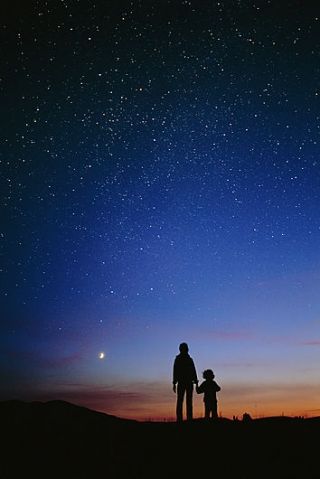
For most city-dwellers, the night sky is merely a murky orange haze. We are becoming estranged from natural sources of awe with electronic media becoming the only source of awe.

Image of night sky

One can’t say when, in our evolutionary history, our ancestors first got blown away by something immense or amazing.

SENSE OF WONDER  n.

A feeling of awakening or awe triggered by an expansion of one’s awareness of what is possible or by confrontation with the vastness of space and time, as brought on by reading science fiction or standing on the top of Everest.

The sense of inspired awe that is aroused in a reader when the full implications of an event or action become realized, or when the immensity of a plot or idea first becomes known, or (Not that I have ever stood on the summit of Everest) the view of the Himalayan peaks.

What do we really desire from our future technologies?

We claim that just as in life, it should assist us in solving problems and improving our everyday efficiency. However, we could further argue that technology also must prompt us to think, be curious, and wonder.

If we fail or, worse yet, ignore this vital design space of wonderment for technology, we are almost certainly doomed to live amongst emotionless, servant-like, lifeless, problem solving, scientific systems.

We deserve more.

Feelings of wonderment are difficult to measure and nearly impossible to assign a value. Nonetheless, these episodes are part of our lives and as such deserve a place within the discussion of our future digital technologies.

We still need to understand how conviction and belief actually arise in a human being.

How far have I walked today? How many people have ever sat on that bench? Does that woman own a cat? Did a child or adult spit that gum onto the sidewalk? These are all feelings of what we call “wonderment” that color and enrich our lives.

Step back with me for a moment. What really matters?

Everyday life spans a wide range of emotions and experiences – from improving productivity and efficiency to promoting wonderment and daydreaming.

Our successful future technological tools, the one we really want to cohabited with, will be those that incorporate the full range of life experiences.

We are at an important technological inflection point.

The value of invisibility, but does not make it visible.

It is this important element of human mystery and curiosity that is underrepresented as a design practice for technological interactive systems.

Currently our mobile phones are doomed to live out only short product lifespan. As these fully functional objects fail to satisfy our technological fetishes and trends, they are replaced by I Pads, by Watches, by Glasses, by Virtual Reality.

Changing people’s sense of control can influence the kinds of scientific explanations they prefer: if you feel that you don’t have control, you’ll be more drawn to explanations that promise order and predictability.

People have become more individualistic, more self-focused, more materialistic and less connected to others.

To reverse this trend, I suggest that people insist on experiencing more everyday awe, to actively seek out what gives them goose bumps, be it in looking at trees, night skies, patterns of wind on water.

While as I have said it is difficult to place quantitative measurements on wonder in terms of enjoyment, benefit, or even improved quality of life, it is indeed a essential element of daily human life.

We need to understand two elements of belief:

Suggestibility and Surrender.

“These are not only elements of religious conviction, they are part and parcel of the experience of learning and teaching, of certainty and persuasion, as much as they are part of various social strategies to modulate and sooth doubt and anxiety, as well as strategies meant to shock and gain influence.” (Frank 1974, Galanter 1993).

Education comes in all different forms and many people believe if they can look up information on their phone, including current news, then they are learning and expanding their mind. So what’s the problem?

Although mobile apps and texting have made our lives easier, some question the impact they’ve having on the relationships we have with one another.  The use of texting and Facebook and Twitter and other sites as a form of communication is eroding people’s ability to write sentences that communicate real meaning and inhibit the art of dialogue of the impossible.

We will soon have a generation that has no clue how to read any of the cues of wonderment.

Wonders never cease!

Nine days’ wonder:  No wonder: Time works wonders: Gutless wonder: Wonder about: Wonder at: Wonders will never cease: A one-hit wonder: A chinless wonder: Little wonder: Wonder Drugs: Wonder boy.

The sky would have been the most pervasive natural influence of wonder now it’s the Mobil Phone. There ringtones have a private meaning but are a public experience. They are as expressive as the clothing we wear and an obvious extension of our public presentation of self.

Ringtone sales are a $4 billion market worldwide. Now ain’t that awesome.

Wonder is sometimes said to be a childish emotion, one that we grow out of.  But that is surely wrong. Wonder might be humanity’s most important emotion.

Wondrous things engage our senses.

Wonder is what leads us to try to understand our world. 

Knowledge does not abolish wonder; indeed, scientific discoveries are often more wondrous than the mysteries they unravel. 

Wonder, then, unites science and religion, two of the greatest human institutions.

Art, science and religion are all forms of excess; they transcend the practical ends of daily life.  Science, religion and art are unified in wonder. 

Without wonder, it is hard to believe that we would engage in these distinctively human pursuits. 

We needed to master our environment enough to exceed the basic necessities of survival before we could make use of wonder.

Afficher l'image d'origine


Art, science and religion are inventions for feeding the appetite that wonder excites in us. They also become sources of wonder in their own right, generating epicycles of boundless creativity and enduring inquiry.

Each of these institutions allows us to transcend our animality by transporting us to hidden worlds.

In harvesting the fruits of wonder, we came into our own as a species.

Personally I wonder who read this blog.

For those that do:

I leave with a wonder of all time but don’t spend too long contemplating the wonder.

Infinity.

It’s enough to drive anyone mad, as well as a good point at which to bring to an end this blog.

← Back

Thank you for your response. ✨

Share this:

  • Share on WhatsApp (Opens in new window) WhatsApp
  • More
  • Share on Mastodon (Opens in new window) Mastodon

THE BEADY EYE LOOK AT WORLD ORGANISATIONS. PART TWO- IS NATO RELEVANT.

14 Wednesday Oct 2015

Posted by bobdillon33@gmail.com in Climate Change., Environment, European Union., Politics., The Future, The world to day., Unanswered Questions., War, World Organisations.

≈ Comments Off on THE BEADY EYE LOOK AT WORLD ORGANISATIONS. PART TWO- IS NATO RELEVANT.

Tags

European Union, Nato, UN, Visions of the future., World Organisations.

In the past 60 plus years, many changes have taken place with society, technology and governments but world peace is for the most part pie in the sky.

It is true that their have been no major global conflicts in the latter half of the twentieth century and into the twenty-first.

So is Nato still relevant?  Or is it just a pension club for the military old boys.

Since 1999 Nato has struggled in performing ever mission it has launched- Bosnia, Kosova, Afghanistan.

When Estonians pulled the Nato emergency chain on a cyber attack it was left with a lukewarm response raising the question what constitutes an attack on a country that Nato will react to.

What would happen if a war started, or the market crashed? I don’t think that NATO would fight a war together ( Including USA and Canada there are currently 28 member states) to be honest.

The conflicting priorities of Europe and the USA and the absence of a common foe all point to the need for Nato to be refilled into either a new European defense force or into the United Nations as a total peaceful organisation. Since the end of the cold war, NATO and the UN have become nearly interchangeable.

However some still say that the North Atlantic Treaty Organization (Nato) is more relevant than it has been for years even if many of its members are moving further away from meeting their defense spending obligations.An Italian sailor from the frigate "Alieso" removes a cover from a cannon in the Black Sea port of Varna, Bulgaria, March 9, 2015.

The end of the Cold War and, consequently, the absence of the Soviet threat, did not render NATO ( The North Atlantic Treaty Organisation) obsolete. There is no Warsaw Pact anymore, so why is there NATO?

The Alliance is now expanding like crazy. Faster than EU itself.

This means they either feel their power is crumbling and need more power, more allies, or the simple fact NATO has no more meaning.

It is the last surviving relic of the Cold War and is now the centerpiece of US-European relations. It has served as an integrating mechanism for Europe for more than sixty-five years.Afficher l'image d'origine

Here what it cost to-day.

Nato                         2014 Actual         2014                2015              2015

  • Member State        Expenditure       % of GDP      Project Exp        % of GDP
  1. Bulgaria              $604 million              1.3           $565 million        1.16
  2. Canada              $14.3 billion              1             $12.2 billion          null
  3. Estonia               $430 million              2             $461 million          2.05
  4. France                $40.90 billion            1.5          $41.2 billion          1.5
  5. Germany             $44.3 billion             1.14         $41.72 billion        1.09
  6. Hungary              $1.03 billion             0.79          $0.79 billion          0.75
  7. Italy                    $17.3 billion             1.2            $16.3 billion         null
  8. Latvia                  $252 million            0.9            $283 million          1
  9. Lithuania             $359 million             0.78            $474 million        1.11
  10. Netherlands         $8.7 billion             1                $9 billion              null
  11. Norway                $5.8 billion              1.58           $6.8 billion           1.6
  12. Poland                  $10.4 billion           1.9             $10.4 billion         1.95
  13. Romania               $2 billion                1.4         Not yet announced   1.7
  14. UK                        $55 billion              2.07            $54 billion           1.88
  15. US                       $582.4 billion          3.6              $585 billion          3.1
  16. Turkey                   Not known
  17. Albania                         “
  18. Czech Rep                    “
  19. Denmark                      “
  20. Greece                         “
  21. Iceland                        “
  22. Luxembourg                 “
  23. Poland                          “
  24. Slovakia                       “
  25. Slovenia                       “
  26. Portugal                       “
  27. Spain                           “
  28. Belgium                         “

Unfortunately the US funding of  Nato has it wrapped around its finger. It funds between one-fifth and one-quarter of Nato’s budget.

The civil budget for 2015 is € 200 million. The civil budget provides funds for personnel expenses, operating costs, and capital and programme expenditure of the International Staff at NATO Headquarters.

The military budget for 2015 is €1.2 billion. This budget covers the operating and maintenance costs of the NATO Command Structure. It is composed of over 50 separate budgets, which are financed with contributions from Allies’ national defence budgets (in most countries) according to agreed cost-shares.

While there is stagnation in military expenditure from the larger military powers in NATO — the UK, France, Germany, and Canada — that has led to several smaller NATO states to increase their funding. Not coincidentally, some of them would be front line states in a future military conflict between Russia and the NATO alliance.

NATO was founded to promote democratic values and encourage cooperation on defense and security issues. What started as a good idea that was backed by powerful nations, now is not the case.

With Russia involvement in Syria not to mention the Ukraine the real question is: Do we need what I see as a duplication Organisation that appears determined, for the first time in its history, to intervene beyond its borders.

Operational partnerships, such as the one Nato established with Australia in Afghanistan, are an additional source of personnel and resources for Nato-led operations.

Even militarily it does not make sense to have an European Union relining on an Organisation that has as its linchpin of the alliance Article 5 of the North Atlantic Treaty, which states that “an armed attack against one or more of them [NATO members] in Europe or North America shall be considered an attack against them all” and that all members are obliged to assist the state(s) under attack.

Article 5 has been invoked only once in NATO’s history, after the terrorist attacks against the US homeland on September 11, 2001.

It says it committed to the peaceful resolution of disputes.

NATO provides security to the world because of their rules and regulations that prevent war. Considering those FACTS it is foolish to say that NATO is not relevant.

No wars have taken place in any country that is part of NATO after they joined.

It is supposed to act under resolutions that are carried out under Article 5 of the Washington Treaty – NATO’s founding treaty – or under a UN mandate, alone or in cooperation with other countries and international organizations.

So tell me what irresolution was passed about ring fencing Russia with rockets.

NATO’s incessant push to the east is an attempt to reinstate a Berlin Wall that spans the entire western border of Russia. This has no place in a peaceful world.

It’s no wonder that Russia is worries about that, as well as the new identity and tasks that NATO has awarded itself.

Russia opposes expansion mainly because she fears that the West is trying to isolate her in the corner of Europe, deprive her of her privileged relationship with her former satellites and undermine her national interests. This is why she is so fiercely opposing enlargement to include the Baltic States and Ukraine. NATO is viewed by Russia as nothing more than the club wielded by capitalist sharks.

Without a unified military force Europe (an area of the world that for many centuries was the most warlike on the globe) relies on the Nato. The dissolution of which without a replacement would leave the Continent without the existence of a military option to ensure stability within in its borders.

There is one thing for sure in light of NATO’s character as a political forum of democratic nations, expansion to incorporate those states that had authoritatively been excluded from it and pushed into the arms of the Soviet Union seems a logical consequence.

It can no longer be seen merely as a military Alliance with a defensive character, but as a political one as well, gathering the nations that share common democratic values and respect for human rights and the rule of law. However this is a new world where NATO seems confrontational and counter productive with limited capability to undertake even crisis management operations.

One of the major problems with the preceding league of nations, was the lack of ‘teeth’.

Instead of focusing on the rapidly declining interstate conflicts (as a result of interdependence), maybe Nato should be focusing more on threats such as cyber warfare, terrorism, and piracy, and vetting refugees.

It would be impossible to think a couple of decades ago that the Americans and the Russians might sit at the same table and plan common military operations.

You would think that Nato which is deeply involved in the Syrian war and the United Nations would be encouraging such a move to avoid Turkey being dragged into the War.

Instead Jens Stoltenberg, the Nato secretary-general, said that the organisation intended to “send a clear message” to show that the world’s most powerful military alliance was prepared to act in defence of its citizens. “Nato will defend you, Nato is on the ground, Nato is ready,” he said.

Nato says it is prepared to send troops to Turkey to defend its ally after violations of Turkish airspace by Russian jets,

Then all hell breaks loose as if this was the ultimate pretext for a NATO-Russia war.

But wait; NATO is actually too busy to go to war. The priority, until at least November, is the epic Trident Juncture 2015; 36,000 troops from 30 states, more than 60 warships, around 200 aircraft, all are seriously practicing how to defend from the proverbial “The Russians are Coming!”

Russia’s spectacular entry into the war theater threw all these elaborate plans into disarray.

Surely, there are differences between the US and Russia, but these can be overcome step by step with constructive dialogue and mutual understanding. They are no longer afraid of each other. They do have their differences, as it is natural that they should.

As events in the Ukraine, Syria and now Turkey are tragically demonstrating Nato could become a source of potential danger for the entire world.

The World has enough problems this is not a time for Nato saber-rattling.

Finally it is otter stupidity to think that if a nuclear device designed to emit an EMP (Electro Magnetic Pulse) were detonated about 300 miles over EUROPE ( most of Europe as we now know it would be gone) that Nato or the USA would do anything other than issue wet wipes.

Also one may wonder why Turkey — a country that is about 2,000 miles to the east of the Atlantic Ocean — finds itself in an entity called the “North Atlantic Treaty Organization. The answer is the roots of accepting non-North Atlantic nations into NATO, mainly Greece and Turkey lies at the heart of the Truman Doctrine — extending military and economic aid to states vulnerable to Soviet threat / expansion. NATO membership should guarantee, in essence, that Turkey would not become a Soviet ally.

Moving forward means dissolving what does not work and finding what will work.

The next two decades will make or break humanity.

Perhaps Nato should stand down as a military force and take up the mantel of fighting Climate Change.

Finally how can we have an ordered world where Russia and China are excluded from the police force?

If Nato is to be relevant it could start by building a world environmental police force.

← Back

Thank you for your response. ✨


Share this:

  • Share on WhatsApp (Opens in new window) WhatsApp
  • More
  • Share on Mastodon (Opens in new window) Mastodon
← Older posts
Newer posts →

All comments and contributions much appreciated

  • THE BEADY EYE ASKS. HAVE YOU EVER WONDERED OR ASKED YOUR SELF. WHERE OR WHY IS THE WORLD IN SUCH A MESS. March 23, 2026
  • THE BEADY EYE SAYS. HAVE YOU NOTICED THAT THE NEWS COVERAGE ON THE WAR IN THE MIDDLE EAST IS DOMINATING BY MATERIALISM. March 21, 2026
  • THE BEADY EYE SAYS AMERICA IS SHOOTING ITS SELF (NOT JUST IN THE FOOT) BUT IN THE EYES OF ITS ALLIES AND THE WORLD MARKET PLACES. AS THE IRAN WAR IS SPIRALLING OUT OF CONTROL. March 20, 2026
  • THE BEADY EYE SAYS. THE BATTLE TO HAVE A LIFE WORTH LIVING BECOMES MORE AND MORE DIFFICULT WITH AGE .. COMMUNITY MATTERS MORE THAN MONEY. March 20, 2026
  • THE BEADY EYE SAYS. EQUALITY, FAIRNESS, JUSTICE ARE INDIVISIBLE CONCEPTS IF ARE ANYTHING. March 18, 2026

Archives

  • March 2026
  • February 2026
  • January 2026
  • December 2025
  • November 2025
  • October 2025
  • September 2025
  • August 2025
  • July 2025
  • June 2025
  • May 2025
  • February 2025
  • January 2025
  • December 2024
  • November 2024
  • October 2024
  • September 2024
  • August 2024
  • July 2024
  • June 2024
  • May 2024
  • April 2024
  • March 2024
  • February 2024
  • January 2024
  • December 2023
  • October 2023
  • September 2023
  • August 2023
  • July 2023
  • June 2023
  • May 2023
  • April 2023
  • March 2023
  • February 2023
  • January 2023
  • December 2022
  • November 2022
  • October 2022
  • September 2022
  • August 2022
  • July 2022
  • June 2022
  • May 2022
  • April 2022
  • March 2022
  • February 2022
  • January 2022
  • December 2021
  • November 2021
  • October 2021
  • September 2021
  • August 2021
  • July 2021
  • June 2021
  • May 2021
  • April 2021
  • March 2021
  • February 2021
  • January 2021
  • December 2020
  • November 2020
  • October 2020
  • September 2020
  • August 2020
  • July 2020
  • June 2020
  • May 2020
  • April 2020
  • March 2020
  • February 2020
  • January 2020
  • December 2019
  • November 2019
  • October 2019
  • September 2019
  • August 2019
  • July 2019
  • June 2019
  • May 2019
  • April 2019
  • March 2019
  • February 2019
  • January 2019
  • December 2018
  • November 2018
  • October 2018
  • September 2018
  • August 2018
  • July 2018
  • June 2018
  • May 2018
  • April 2018
  • March 2018
  • February 2018
  • January 2018
  • December 2017
  • November 2017
  • October 2017
  • September 2017
  • August 2017
  • July 2017
  • June 2017
  • May 2017
  • April 2017
  • March 2017
  • February 2017
  • January 2017
  • December 2016
  • November 2016
  • October 2016
  • September 2016
  • August 2016
  • July 2016
  • June 2016
  • May 2016
  • April 2016
  • March 2016
  • February 2016
  • January 2016
  • December 2015
  • November 2015
  • October 2015
  • September 2015
  • August 2015
  • July 2015
  • June 2015
  • May 2015
  • April 2015
  • March 2015
  • February 2015
  • January 2015
  • December 2014
  • November 2014
  • October 2014
  • September 2014
  • August 2014
  • July 2014
  • June 2014
  • May 2014
  • April 2014
  • March 2014
  • February 2014
  • January 2014
  • December 2013
  • November 2013
  • October 2013

Talk to me.

Jason Lawrence's avatarJason Lawrence on THE BEADY EYE ASK’S: WIT…
benmadigan's avatarbenmadigan on THE BEADY EYE ASK’S: WHA…
bobdillon33@gmail.com's avatarbobdillon33@gmail.co… on THE BEADY EYE SAYS: WELCOME TO…
Ernest Harben's avatarOG on THE BEADY EYE SAYS: WELCOME TO…
benmadigan's avatarbenmadigan on THE BEADY EYE SAY’S. ONC…

7/7

Moulin de Labarde 46300
Gourdon Lot France
0565416842
Before 6pm.

My Blog; THE BEADY EYE.

My Blog; THE BEADY EYE.
bobdillon33@gmail.com

bobdillon33@gmail.com

Free Thinker.

View Full Profile →

Follow bobdillon33blog on WordPress.com

Blog Stats

  • 97,913 hits

Blogs I Follow

  • unnecessary news from earth
  • The Invictus Soul
  • WordPress.com News
  • WestDeltaGirl's Blog
  • The PPJ Gazette
Follow bobdillon33blog on WordPress.com

The Beady Eye.

The Beady Eye.
Follow bobdillon33blog on WordPress.com

Create a free website or blog at WordPress.com.

unnecessary news from earth

WITH MIGO

The Invictus Soul

The only thing worse than being 'blind' is having a Sight but no Vision

WordPress.com News

The latest news on WordPress.com and the WordPress community.

WestDeltaGirl's Blog

Sharing vegetarian and vegan recipes and food ideas

The PPJ Gazette

PPJ Gazette copyright ©

Privacy & Cookies: This site uses cookies. By continuing to use this website, you agree to their use.
To find out more, including how to control cookies, see here: Cookie Policy
  • Subscribe Subscribed
    • bobdillon33blog
    • Join 222 other subscribers
    • Already have a WordPress.com account? Log in now.
    • bobdillon33blog
    • Subscribe Subscribed
    • Sign up
    • Log in
    • Report this content
    • View site in Reader
    • Manage subscriptions
    • Collapse this bar