Time spent looking at a cellphone is time spent oblivious to the world.
Humanity’s first steps into the digital world could be lost to future historians.
We faced a “forgotten generation, or even a forgotten century.” through “bit rot,” when old computer files become useless junk.
There is a sense of powerlessness and fatalism about TECHNOLOGY.
If consciousness or HISTORICAL intelligence are lost, it might mean that value itself becomes absent from the universe.
We are nonchalantly throwing all of our data into what could become an information black hole without realising it.
Ancient civilizations suffered no such problems, because histories written in cuneiform on baked clay tablets, or rolled papyrus scrolls, needed only eyes to read them.
To day “intelligence” is related to statistical and economic notions of rationality – colloquially, the ability to make good decisions, plans, or inferences. To study today’s culture, future scholars will be faced with PDFs, Word documents, and hundreds of other file types that can only be interpreted with dedicated software and sometimes hardware too.
From This to This
Most of the images we take today are uploaded straight from a digital camera or a phone, with the picture never actually existing as a physical artifact.
The significance of documents and correspondence is often not fully appreciated until hundreds of years later.
We’ve learned from objects that have been preserved purely by happenstance that give us insights into an earlier civilisation,”
We need history to embrace new values and institutions in pursuit of a just, fulfilling, and sustainable civilization not a “digital black hole”.
In fact, due to the intricate disconnectedness of production and economies around the world today, our technological civilization is perhaps more prone to a sudden collapse than other societies through history.
When you think about the quantity of documentation from our daily lives that is captured in digital form, like our interactions by email, people’s tweets, and all of the world-wide web the more important it is that we create legal permissions to copy and store software before it dies.
So digital objects we create today can still be rendered far into the future.
Deciding on the best format to preserve them for the next hundred years relies on anticipating what technology is likely to still be available in the future.
Computer hard disks can hold vast amounts of digitised information, but everything is lost if it fails or is wiped.
How do we preserve our interaction on Facebook, Twitter, comment threads and citizen journalism across the web?
In fact, due to the intricate disconnectedness of production and economies around the world today, our technological civilization is perhaps more prone to a sudden collapse than other societies through history. Plenty of once-great civilisations have collapsed, and our current industrialised society is by no means invulnerable –
Who will decide what worth keeping and where will we preserve a core kernel of human knowledge.
The significance of documents and correspondence is often not fully appreciated until hundreds of years later.
Even though Wikipedia represents a vast repository of information, it is not structured in a way that would guide a post-catastrophe society through stages of recovery.
Google certainly is not.
It has already changed the world by altering the way we interact with technology and there can be no questions its long-term ambitions.
Its mission is to collect information which you will have to buy with a google wallet.
“We envision a marketplace for payment instruments, commerce and loyalty services”
It’s not hard to envision a fully intact ecosystem of Google offerings with location-based mobile ads driving tracked incremental revenue via etail integrated mobile commerce, or via sales that are picked up in-store, via mobile payment.
“Now toss in Google Offers, NFC and QR codes for trigger point marketing, and the fact that Google already has the accounts open and the pot gets even richer.”
Personally I have little time for Banks but I would rather have a bank to provide a of mobile wallet products, not technology companies that can disappear into the cloud.
If Google was to make a move into supporting bank-branded wallets we would all become Googlefyed.
Google has far more on its plate than just financial services.
It’s a major player in telecommunications with its Android smart phone platform. It’s made forays into thermostats, home security and satellite imaging.
So it’s not just words and images that we risk losing for ever it’s the “grey literature” of official reports, briefings and policy statements that are only published online also risk being lost to the future?
Bit rot, a digital dark age is on the horizon unless we store information in DNA.
“It is very possible that … one machine would suffice to solve all the problems … of the whole [world]” – Sir Charles Darwin, 1946.
“Technology gives us the facilities that lessen the barriers of time and distance – the telegraph and cable, the telephone, radio, and the rest.” – Emily Greene Balch.
Perhaps The ETHEREUM IS THE ANSWER.
Importantly, because there is not a company or indeed any entity in charge of or controlling Ethereum, the cost of running the infrastructure doesn’t have to include any profit margin.
It might allow us to push the boundary on what the digital realm can cover.
As if there are not enough problems in the world here is another that is out of control.
THIS IS THE LADY, that initiated the privatisation boom.
She saw privatisation as “fundamental to improving Britain’s economic performance”.
But it also chimed with her political ideology.
“It was one of the central means of reversing the corrosive and corrupting effects of socialism,” she declared, adding: “Just as nationalisation was at the heart of the collectivist programme by which Labour governments sought to remodel British society, so privatisation is at the centre of any programme of reclaiming territory for freedom.”
England is now one of the most sold off countries on earth.
Here is just a few items recently sold.
Before you look remember that the rest of the world governments are doing the same thing flogging off what is not belong to them but belongs to the generations of people who worked and payed taxes.
Governments of very different political and ideological streams are bent on privatizing, and governments that are already privatizing are moving from selling small retail outlets and industries to selling larger mining and infrastructure enterprises. Just look what happened when the World Bank forced Bolivia to sell its water to Privatization.
Above all, perhaps, in shifting the democratic to market-based principles of allocation, it favors those who are strongest in their control of the market, and who also happen to represent the social basis of Conservatism.
The UK has sold: Gold Reserves, Transportation, Mail, Water, Banks, Health, Universities, Prisons, Power, Car parking, Schools, Telecom, Gas, Steel, Airports, Gambling, Fire and Ambulance services, Rolls Royce, Jaguar, British Airways, Shipbuilding, Council Housing, Sea link, and the list goes on.
Whats’ left: Scotland, and the crown Jewels. It has already sold Northern Ireland and Democracy many times ( MP Expenses Scandal)
Privatisations by share offer, 1981-91 From Nigel Lawson, The View from No. 11(Bantam, 1992).
Date
Company
% of equity initially sold
Proceeds £m
Feb 1981
British Aerospace
51.6
150
Oct 1981
Cable & Wireless
50
224
Feb 1982
Amersham International
100
71
Nov 1982
Britoil
51
549
Feb 1983
Associated British Ports
51.5
22
June 1984
Enterprise Oil
100
392
July 1984
Jaguar
99
294
Nov 1984
British Telecom
50.2
3,916
Dec 1986
British Gas
97
5,434
Feb 1987
British Airways
100
900
May 1987
Rolls-Royce
100
1,363
July 1987
British Airports Authority
100
1,281
Dec 1988
British Steel
100
2,500
Dec 1989
Regional Water Companies
100
5,110
Dec 1990
Electricity Distribution Companies
100
5,092
Mar 1991
National Power and PowerGen
60
2,230
May 1991
Scottish Power and Scottish Hydro Electric
100
2,880
Whatever way you look at it the acceleration of interest in privatization evident in the last two to three years is striking.
Here is the list of sales in the rest of the world-wide.
You will be shocked and hopefully made a aware or appreciate what is going on.
We have rampaging Sovereign Wealth Funds buy up the world resources, and manipulating Governments. This combined with the World Bank and the IMF SUPPORT IT IS THE GREATEST SALE OF ALL. EARTH. BUY AND GET NOTHING FOR FREE.
So what is privatization and what is happening in privatization?
Privatization is the transfer of ownership of assets to the private sector. Through management contracts and leases and sell off (sale of minority shares.)
Why privatize?
All types of privatization have the potential to increase so-called static efficiency-what economists like to call X-efficiency-which means pushing enterprises to operate cost effectively on their production frontier.
What Is Being Privatized?
There are virtually no limits on what can be privatized.
The argument that privatization creates additional public resources is illusory.
Attempts to sell nonviable firms as going concerns may not only invite special protection or subsidies, but may also lead to subsequent government bail-outs.
Markets fail, but so do governments. which lead to government bail-outs, financed either through taxes or inflation and the new buzz word Austerity a Capitalist word for Privatization by the back door. Greece!
Both taxes and inflation hit the poorer citizen harder than the rich.
The World Bank and the IMF act as a catalyst for privatization.
From Water, to Oxygen, to Time, everything that you take for granted will be privatized and subject to easy and affordable payments.
Not in your wildest dreams will it be affordable.
Get used to it. For there is absolutely nothing that you can do.
Or is there. (See below)
The most concerning effects of all this is – The Race to Buy Up the World’s Fresh Water supplies.
Out of the 1,226 billionaires around the world four billionaires including filmmaker James Cameron and Google co-founder Larry Page are backing a newly unveiled asteroid-mining venture, Planetary Resources Inc adding to an impressive list of ultra-rich people trying to reshape spaceflight and exploration in the 21st century. Each man is worth $1 billion or more, according to recent estimates by Forbes magazine, with Google execs Page and Schmidt having about $16.7 billion and $6.2 billion to their names, respectively. Film maker James Cameron worth $700 million or so.
H20 will open up a Trillion dollar market in Space.
We are in the midst of a global freshwater crisis.
Around the world, rivers, lakes, and aquifers are dwindling faster than Mother Nature can possibly replenish them; industrial and household chemicals are rapidly polluting what’s left.Meanwhile, global population is ticking skyward.
Goldman Sachs estimates that global water consumption is doubling every 20 years, and the United Nations expects demand to outstrip supply by more than 30 percent come 2040.
Water has been a public resource under public domain for more than 2,000 years,”
If all goes according to plan, 80 million gallons of Blue Lake water will be siphoned into the kind of tankers normally reserved for oil—and shipped to a bulk bottling facility near Mumbai. From there it will be dispersed among several drought-plagued cities throughout the Middle East.
The project is the brainchild of two American companies. One, True Alaska Bottling, has purchased the rights to transfer 3 billion gallons of water a year from Sitka’s bountiful reserves.
The other, S2C Global, is building the water-processing facility in India. If the companies succeed, they will have brought what Sitka hopes will be a $90 million industry to their city, not to mention a solution to one of the world’s most pressing climate conundrums.
They along with Nestle are turning life’s most essential molecule into a global commodity.
Fresh Air is next on the list.
By definition, a commodity is sold to the highest bidder, not the customer with the most compelling moral claim.
As the crisis worsens, companies like True Alaska that own the rights to vast stores of water (and have the capacity to move it in bulk) won’t necessarily weigh the needs of wealthy water-guzzling companies like Coca-Cola or Nestlé against those of water-starved communities
In Phoenix or Ghana; privately owned water utilities will charge what the market can bear, and spend as little as they can get away with on maintenance and environmental protection. Other commodities are subject to the same laws, of course. But with energy, or food, customers have options: they can switch from oil to natural gas, or eat more chicken and less beef.
There is no substitute for water, not even Coca-Cola.
The Colorado River Basin is struggling through its 11th year of drought. In the USA the real water barons cannot be reduced to a simple archetype. They include a diverse array of buyers and sellers—from multinational water giants like Suez and Veolia that together deliver water to some 260 million taps around the world, to wildcatter oil converts like T. Boone Pickens who wants to sell the water under his Texas Panhandle ranch to thirsty cities like Dallas.
Eventually every last drop will be privately controlled.
And when that happens, the world will find itself divided along a new set of boundaries: water haves on one side, water have-nots on the other. The winners (Canada, Alaska, Russia) and losers (India, Syria, Jordan)will be different from those of the oil conflicts of the 20th century, but the bottom line will be much the same: countries that have the means to exploit large reserves will prosper.
The rest will be left to fight over ever-shrinking reserves. Some will go to war.
The World Bank infamously required scores of impoverished countries—most notably Bolivia—to privatize their water supplies as a condition of desperately needed economic assistance. These days, global water barons have set their sights on a more appealing target: countries with dwindling water supplies and aging infrastructure,
Nowhere is this truer than China.
As the water table under Beijing plummets, wells dug around the city must reach ever-greater depths (nearly two-thirds of a mile or more, according to a recent World Bank report) to hit fresh water. Since 2000, when the country opened its municipal services to foreign investment, the number of private water utilities has skyrocketed. But as private companies absorb water systems throughout the country, the cost of water has risen precipitously. “It’s more than most families can afford to pay,
Meanwhile, more than half a million pipes burst every year, according to the American Water Works Association, and more than 6 billion gallons of water are lost to leaky pipes.
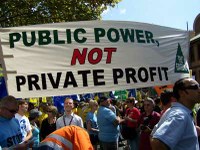
Privatization of basic human needs is never good.
Our governments are controlled by private corporations and banks.
Privatization of government services (such that benefit the people, all the people) is perverting Democracy.
Privatization of public services is the death knell of parliamentary democracy, the death knell of the extreme form of capitalism currently practiced in too many countries.
We face a global water crisis, made worse by the warming temperatures of climate change.
A quarter of the world’s people don’t have sufficient access to clean drinking water.
Water privatization is used here as a shorthand for private sector participation in the provision of water services and sanitation. has turned a public good into a private good.
Many believe that the privatization of water is incompatible with ensuring the international human right to water.909 million people were served by “private players” in 2011 globally, up from 681 million people in 2007.
The World Bank Group pushes privatization as a key solution to the water crisis.
Instead of using its position to line the pockets of water companies, the World Bank should support what is most needed: affordable and clean – and public – water for all. When the private sector engages in water provision, greater disparities in access and cost follow.
The current Chairman and former CEO of Nestlé, the largest producer of food products in the world, believes that the answer to global water issues is privatization.
For profit” everything! Profit is killing the planet.
Human males seek dominance even at the price of self-annihilation.
Are we all mad, it looks like it.
We can talk till the cows come home > We Can have Summits on Climate Change > We can listen to the G8 the G7 the United Nations, the World Health, the President of the USA, the technocrats, the Economic Gurrous, Religious Leaders, the Free market, China, the International space station, your neighbor.
If the truth was known no one has a blind notion how to change course.
WELL LET ME TELL YOU AS CAPTAIN OF THIS BLOG AND POST THERE IS ONLY ONE SOLUTION’S.
That is to make Capitalism with its insatiably greed for profit PAY by placing a World Aid Commission of all High frequency stock trading, on all Foreign Exchange transactions over $20,000, on all Sovereign Wealth Funds Acquisition. (See previous posts). This can be achieved with little or no cost to the world economy by the click of a button. Producing a vast perpetual fund to address the Inequality the bane of the modern world.
Before I finish I can hear you saying who, how, where this fund would operate.
It does not matter as long as the funds are allocated on a lotto bases.
Every deserving project (world wise) after a vetting process to see if viable would be placed in a once a year draw according to its capital requirements.
Unlike the World bank or IMF the winners would not have to repay the funds, (provided the project undertake was totally transparent and completed in full. ) any residual funds could be places in a People World fund to protect against privatization.
Any comments, ideas, positive or negative – Welcome.
I dare you to change the course of humanity with me.
Is our world along with humanity disappearing into the Cloud.?
We as individuals are turning into “walking data generators” ” App Material”
The Beady eye is only going to look a the most contentious realms of Big Data. Technologies that drive the explosion of growth of digital information such as the information collected.
Big Data is disseminated from trillions of devices such as smartphones and embedded sensors.
Huge quantities of digital trace data are collected through digitized devices (captured, for example, via social networks, online shopping, blogs, Apps, ATM withdrawals and the like) and through in-built sensors. The latter technologies include those that are equipped with GPS systems (e.g., smartphones and other surveillance and monitoring devices) and thus have the ability to identify a user’s location.
Ever since the dawn of life with language man has been collecting information. Not until written letters or symbols arrived was this information stored for future generations.
It is now being collected to replace us all with AI.
Knowledge was and still is the power that split the world into cultures- the rich in information and the poor with illiteracy – Slave or Master.
To day data is money and it is re splintering the world into the have and have not’s.
A next-generation retailer will be able to track the behavior of individual customers from Internet click streams, update their preferences, and model their likely behavior in real-time. Traditional advertising is shifting rapidly into the realm of personalized and highly targeted online and mobile ads—the realm of data driven marketing.
Across all industries, including government, healthcare, media, energy, among others, data is becoming central to business operations. Every business is a digital company; and, every customer or employee is a content producer.
Today’s organizations use a plethora of information systems to support their business processes.
Advances in technologies and the increasing amount of information are transforming how business is conducted in many industries, including government.
Every business sector now collects data of one form or another, and the future marketplace will have even more computing power at their fingertips to mine customer behavior. Someone from every major industry is looking at the impact of being able to glean data from multiple data sources, structured and unstructured, from Healthcare to agriculture and more.
Businesses are using the power of insights provided by big data to instantaneously establish who did what, when and where.
The world’s volume of data doubles every 18 month.
In all forms it will grow 650 percent over the next five years.
Despite feeling overwhelmed, there’s an insatiable desire for more data.
The information overload is real and causing problems.
There is little or no regulations governing every time you click on a website, post on social media, use a mobile app and comment via email or to call centers, your data is collected for future use.
In my opinion, the world needs proper regulations about how and what kind of data should be collected.
My bigger concerns are related to unsanctioned organizations using my data and inferences about my interests, passions, affiliations and associations for borderline uses about my political, religious, sexual, etc. preferences. Just because a company can collect all kinds of personal information on consumers, it doesn’t mean they should use it willy nilly.
The more is better” philosophy. There in lies the trouble.
Tracking customer preferences and purchases can reveal all kinds of private information, like illnesses, financial problems, even pregnancy.
For example a father recently discovered that his daughter was expecting a baby only because of Target’s TGT – 0.5% customer advertising technology. It analyzing his daughter shopping patterns so the store started to send her coupons for baby products which alerted the father.
Data gathering is not going away.
This should have us concerned, not just about targeted marketing but about what can be inferred about all of us every time we “like” something on FACEBOOK or post a snarky tweet on TWITTER.
From what I can tell, what Big Data does best is spy on individuals and collect useless data that helps people develop false and inaccurate assumptions.
Big Data may have wonderful potential, but we’re still going to have to get better at data exchange and integration before it’s going to have its biggest impact. We’ve spent decades digitizing everything, we should be able to analyze it. The problem is, that’s really hard – and it always has been.
THE BIG QUESTION REMAINS: Who does it belong to, and who should have access to it?
Big Data will let us watch flu outbreaks bloom and direct scarce vaccines to the most critical area’s. Schools are collecting more data than ever on how children are doing. Companies and nonprofits, meanwhile, are racing to put that data to use in the classroom.
Today, we’re at the convergence of these innovations—biotechnology, the ability to remote monitor and sensor, and now Big Data—which puts an augmented reality at our disposal.
However there is an undercurrent of concern about who owns big data and who has the right to access it.
Big Data technologies are at the heart of the intelligent economy and the solutions that enable it.
Big Data technologies are analyzing massive data sets, in science and research as well as mine data to prevent bad actors from committing acts of terror and/or to prevent waste, fraud, and abuse.
Government data generation and digital archiving rates are on the rise due to the rapid growth of mobile devices and applications, smart sensors and devices, cloud computing solutions, and citizen-facing portals.
As digital information expands and becomes more complex, information management, processing, storage, security, and disposition become more complex.
Information is a strategic asset, and government needs to protect, leverage, and analyze both structured and unstructured information to better serve and meet mission requirements.
New technology brings new challenges, and they should be properly educated to use it wisely and critically. It is used to study employee performance and retention.
The younger generations are not always aware of the challenges and dangers that come with big data.
Privacy here is a key issue to consider.
I sometimes get frightened to see what younger generations publish on their social media, without being aware how they expose themselves to the outside world. Just think about recommender systems.
When you want to buy a product or service from an online retailer, you are often frustrated because of the many choices and configurations possible. Thanks to an intelligent, analytical recommender system, purchases (and their customer feedback) are continuously monitored to better tailor future recommendations to customers.
Credit card fraud detection system.
In fact, thanks to credit risk analytics, our savings money is now efficiently safeguarded since every bank is obliged (via the Basel III capital accord) to analytically estimate credit losses and make sure it has enough provisions or equity buffers for worst-case scenarios.
Big Data is being used to detect social security fraud, to detect tax evasion fraud, to employ and fire people.
New data stores have emerged increasing the distribution of data and the complexity of securing and protecting that data along with it. It is now harder to protect sensitive data as it may move around between different transactional and analytical data stores as companies create new analytical workloads.
While there is more to do to wrestle big data to the ground. Defense (DOD) is investing approximately $60 million annually for new projects that will harness and utilize massive data in new ways and bring together sensing, perception, and decision support to make truly autonomous systems that can learn from experience, maneuver and make decisions on their own, and understand the limits of their knowledge.
Governments are facing more and more challenges in managing the life cycle of Big Data as government’s traditional silo approach hinders sharing knowledge and working across organizational boundaries.
While emails, instant messages, data files, document files, and scanned images are all driving the growth of Big Data, managing and storing this information — and its growth — are not trivial tasks. It has raised red flags about privacy, which remain unresolved.
The only way to make data totally safe is to not ever use it or keep it. Big Data Discriminates.
Our currents Laws cannot adequately handle the issues raised by Big data.
Just look at the legal complications created by systems using data and algorithms to include and exclude people from various programs.
What we have are porous laws on how this new technology changes previous understandings of civil liberties, not to mention data analysis, machine learning and the work scientists have been doing on non-discriminatory data mining models.
Individuals should be granted meaningful opportunities to challenge adverse decisions based on scores miscategorizing them.
Where data goes in and a decision comes out it’s unclear, or certainly opaque, just how that decision was arrived at. There is no way to trace why a decision was made.
With programmers doing real-life damage without even knowing it. The question is: How do we update our understanding of due process for the 21st century?
These black box issues such as credit-scoring systems should be legal required to make their Systems Transparent.
If you take Google’s search algorithms for instance no one knows how it chooses the direction of its search. Perhaps it directs your search only to its profit. It’s not just about the quality of the user experience.
Drones are becoming more widespread globally, the non military use of drones will add a further deluge of big data:
Cameras, heat and motion sensors, GPS, Bluetooth, Wi-Fi signals, facial recognition and bio metric scanners allow for the growing use of drones in the industrial, agricultural, transportation and retail areas.
The use of drones—theoretically—should only be possible upon individual permit irrespective of the drone’s starting point and final destination.
However enforcement may be difficult.
The only way is a world license that creates an official record of the individuals operating/using drones for a commercial purpose.
In practice, the widespread use of drones for private purposes may result in unreasonable administration in connection with the above, drone users and operators may also be reluctant to provide so detailed information on their activities for confidentiality reasons.
If the drone records flight details for aviation safety considerations, personal data captured but not relevant for this purpose should be anonymised and stored separately or should be made unidentifiable, unrecognizable and inaccessible by the controller immediately after the drone finished flying.
Data should be stored on the drones only temporarily.
For example, during the security surveillance of a property, the drone may record pedestrians’ faces, movements, body-temperature etc., and the devices should be configured in a way which prevents them from this kind of processing. Drones should solely be able to signal the location and fact of an allegedly unauthorized attempt at entry onto the premises.
In practice, this principle should be assessed on a case-by-case basis, as the actual use of the drone may require more extended data processing than envisaged at the beginning. The drone may locate a trespasser who needs to be identified (to ensure to security surveillance purpose), and, in such a case, privacy-by-default settings should not prevent the enforcement of the drone operator’s legitimate interests.
For example, a recording of an agricultural land cannot be used for the surveillance of agricultural workers.
Given the amount of data governments store on citizens and the sensitivity of some of that data, it makes sense for state budgets to carve out funds for someone to shepherd how that data is collected, treated and stored.
Should there be a meaningful data life cycle amidst the sea of data.
In fact , big data may ultimately be a key factor in how nations, not just companies , compete and prosper . Algorithmic decision-making:
In a nutshell, the problem with ‘datification’ is that somebody else may … use the data thus produced – often with purposes different from those originally intended.
Make no mistake about it:
Our future, the future of humanity and the planet hangs in the balance.
Do we have what it takes to disrupt what is…in order to create what can be?
Big data as a high concept will never fully define itself it’s just a big scam. Surveillance programs. High Frequency Stock Trading. Electronic Currency Trading. Dooming us all down to rely on Google.
We all know there are Political Frauds, Military Frauds, Cover-ups & Conspiracies.
Other than mentioning some of them here I will leave it to you to look and make up your own minds.
John F. Kennedy, Aliens & UFOs, Pearl Harbor, CIA Drug Testing On Civilians, Catholic Church — 3 Secrets Of Fatima, James Earl Ray & Martin Luther King, Big Tobacco’s Big Denial, Jimmy Hoffa, The Philadelphia Experiment, Celebrity Deaths,Watergate, and Iraq War.
Then we have the others.
The below list unfortunately leaves out the greatest: Cons Scams Frauds (what ever you want to call them) of all.
The Sale of the Roman Empire (193 A.D.)
The Mississippi Scheme (1719)
The Diamond Necklace Hoax (1785)
The Wright Panic (1900)
The Original Ponzi Scheme (1920)
The Eiffel Tower Sale (1925)
The Match King Hoax (1929)
The Baker Estate Swindle (1936)
ZZZZ Best Cleaners (1986)
The Great Insider Trading Scam (1986)
The Savings & Loan Scandal (1989)
Tyco International (1996)
CEO Dennis Kozlowski (pictured)and CFO Mark Swartz soaked Tyco for more than $150 million in unearned bonuses and loans from 1996 until 2002.
Cendant (1997)
Shortly after the company was created by the merger of CUC International and HFS in 1997, a massive, decade long accounting fraud at CUC was uncovered.
Fannie Mae (1998)
Fannie Mae paid the SEC $400 million in 2006 to settle charges of misstating financial statements from 1998 through 2004.
Qwest Communications (2000)
Qwest’s stock traded as high as $64 in 2000 before plummeting in 2002 to less than $1 because of a multiyear accounting fraud.
Enron (2001)
The energy company’s bankruptcy in 2001 after allegations of massive accounting fraud wiped out $78 billion in stock market value.
World Com (2002)
The 2002 fraud-induced bankruptcy of the telecom company wiped out a firm that once had $103.9 billion in assets on its books.
Health South (2003)
In March of 2003, the SEC accused CEO Richard M. Scrushy of overstating earnings by at least $1.4 billion over four years.
Bernard Madoff (2008)
New York money manager Bernard Madoff’s $65 billion Ponzi scheme, the largest fraud ever by an individual.
Lehman Brothers (2008)
Investment bank Lehman, with $600 billion in assets, failed in late 2008. It was the largest bankruptcy in history and a spark to the worldwide financial crisis.
MF Global (2008)
The brokerage firm, led by former Goldman Sachs Chairman and former New Jersey Senator then Governor Jon Corzine, had $41 billion in assets.
The Great Wall Street Rip-Off (Ongoing)
Zhang Shuguang, a former railway-ministry official, admitted to having spent nearly half of $7.8m in bribes that he had collected trying to get himself elected to the Chinese Academy of Sciences.
Bell Labs. Jan Hendrik Schön (born 1970 ) is a physicist German, who enjoyed a brief fame after a series of advanced scientific apparent that eventually turn out to be fraud.
HSBC. (2014) ongoing. Helped customers to hide millions from taxman.
La Cour. The VAT fraud costs 10 billion euros per year.
Sadly, it seems that corruption/fraud is to be found wherever there are human beings.
THE GREATEST OF ALL:
The Agricultural Revolution was history’s biggest Fraud.
A sweeping statement. Not on your nanny.
Now you might think it cannot get any worse. Read and learn.
Wheat:
Manipulated us to its advantage, not the other way around. (Which by the way was a wild grass)
We became enslaved by its master plan.
With in a few short millennia it was growing all over the world. World wise it covers 2.25 million square kilometers of the globe’s surface.
It demanded a lot of attention from Mankind. It did not like sharing its space with others so we spend every hour of our waking day weeding. It got sick so we spend billions on fighting its enemies worms and blight. It was attacked by locust and rabbits so we build fences and stood guard. It has an unquenchable thirst so we built irrigation canals and dams. It even has us collecting animal faeces to feed the ground it grew in. We did not domesticate wheat it domesticated us.
How did it convince us to exchange a rather good life for a miserable life of existence.? What did it offer in return?.
Not a better diet. Hard to digest it is bad for our gums and teeth. It did not give economic security. When it was hit by a drought or a swarm of locusts we died by the thousands or fought each other because we could not move.
It did nothing for us as individuals but it allowed us as a species to grow exponentially.
It created armies. It created Political Systems. Being the most successful plant in the history of the Earth it created Capitalism.
Capitalism:
Which we are now beginning to see its true colors. One of the biggest Scams, Con jobs, or Fraud what ever label you like to attach en flicked on mankind.
It has allowed a few elitist to become wealth on the promise that some of the wealth might rub off on all of us.
It sure did.
It has turned us all into trading commodities in order to acquire more wealth for the greedy few.
It has produced Poverty, Inequality, Migration, Wars, Terrorist Groups, Corruption, Disease, Racism, Climate Change, treating the very existence of Our Common Planet. You name it and you can be sure that the free Global Greed Market it created will exploit it to create more short-term Profit.
It has and it is robbing all of our common resources to create profits for Corporations that now want Legal Rights to sue Nations. (See Previous post: The TTP and TTIP TRADING AGREEMENTS.)
It has promoted Massive theft of government (i.e., taxpayer) funds and property, which is going on and is tolerated decade after decade.
It has produced Sovereign Wealth Funds currently plundering the World.
Not forgetting the Stock Markets, where Capital greed has no bounds.
And where are we to-day in the Technology Age (A product of Capitalism) that has little or no regulation using our vanity to pilfer all knowledge which will be sold back to us or others to make profit. Google, Facebook, Twitter. Amazon, Apple. The Cloud.
Google has already changed the world by altering the way we interact with technology.
As it enters its second decade as a public company, Google wants to repeat the trick.
Fuse man and machine. Drive Your Cars. Bring the Internet to everyone, everywhere. Solve Death.
How exactly does Google plan to pull this off?
Apart from announcing some high-profile hires, Google hasn’t shared much about its vision. Last month Google announced a new medical company called Calico, whose explicit aim is to take on aging itself.
In the absence of any real information, many commentators have speculated that Calico will pursue a “big-data approach to health: gathering massive amounts of information from patients and ‘crunching it’ to help speed the way to health care discoveries. Some have suggested that Calico’s new CEO will take the view that the best way to tackle aging is to focus on preventing diseases.
All pretty bright for a plant don’t you think.
Corruption, Fraud, Scams, whatever you want to call it cannot be tackled in isolation, but only in the context of efforts to reduce world poverty.
If we are not vigilant we are all going to end up Slave of the Wheat of Technology. Call Data.
If your eyes could speak, this is what they would say.
Unfortunately for us technology is blurring our global vision of what humanity means or can achieve.
The question is how long are we going to keep our eyes shut to a world run by Private Corporations, and out of date World Organisations, and Elected Corrupt Governments that are signing trade deals that put Corporate power above people power called TTIP ( The Transatlantic Trade Deal or tee-tip for short) that none of us have a say in. https://youtu.be/YVrDF0nSIAU
Now I know that Apple, Facebook, Amazon, Exxon Mobil, Express Scripts Holdings, Wal-Mart Stores, Google and World Fuel Services by the year 2025 will have made vast profits in the trillions. But they are likely to take our species to the brink of extinction. Why because if we continue to allow Capitalism to serve the bottom line of the Balance Sheet and not to contribute to resolving global problems we are all insane. ( See Previous Post: ) 0.05% WORLD AID COMMISSION)
How long are we going to allow all of our values along with the Earth just to become products to fuel the Stock Exchanges and Balance sheets of Privatization and Greed.
There is one thing sure about life. It makes no promises.
But I make you a promise THAT our eyes are going to be opened by Climate Change.
If we do not reduce emissions ( Don’t tell me with the mountain of data dealing with global warming that you STILL believe it will resolve itself or that teleology will be your Savior. ) they will not only threaten Society as a whole with food shortages, refugee crises, flooding, wars, and mass extinction of plants and animals, but make us all realize to late that Capitalism is the ultimate cause of global warming and climate change.
Our City bit living and greed along with our Social Media interconnected world has not only blinded us to the crises it is also eroding our understanding of what it means to live a fulfilled life.
The must have materialism that is dumped within months irrelevant of where it comes from other than it is affordable must stop.
Imagine an alternative where Capitalism and collectivism live together.
Open your eyes and take a look at our world in 2015. (see previous post)
The Planet currently seems on the cusp of a decidedly unharmonic convergence.
The world is rife with crime, corruption, growing inequality and militarism.
The USA was once about the little guy– the rights of individual — the success of small business– it has gone big in the worst possible way.
The International community ( what ever that is) is now facing an unholy trinity of authoritarian politics, cutthroat economics and big brother surveillance, and far-right party anti-immigrant.
Indeed even if you were to take a squint through those eyes of yours. No matter whether we live under Capitalism or Communism they are both struggling to adapt to the same environmental factors.
You would think that the forces of modernity — of technological development, of growing bureaucratization would push both systems in the same evolutionary direction. Not on your nanny. Just look at their feeble reactions to ISIS.
If you cant rely on visual clues, listen to the sound waves rippling around the Globe.
Currently 2.5 degrees centigrade warming by 2100 is cited as the tipping point for catastrophe. However by 2050 at the current levels of Co2 emissions never mind the methane we will be at twice the pre-industrial level.
(The permafrost in the Arctic is melting pumping Methane into the atmosphere adding to the Co2. The Greenland ice sheet will be totally melted causing a sea level rise of 39″ and so forth and so forth.)
If no MAJOR POLICY CHANGES ARE ACHIEVED Now to curtail the greed of Capitalism which exist on the rampant, uncontrolled use of natural resources the human race can kiss its ass goodbye.
Capitalism depends upon the exploitation of natural resources at the highest possible level. And we are, of course, not talking just about fossil fuels. With no thought to conservation, recycling and what will happen when the sources, from iron ore to copper, to say nothing of the fossil fuels themselves, run out.
But capitalism can exist only if the rampant, uncontrolled use of natural resources continues unabated, for that is within the very nature of the system.
But when the natural resources go, so will capitalism and by that time it will be too late to replace it with anything else.
“The suicide of capitalism.”
By it’s very nature, operating to the greatest degree possible with no thought to anything other than the accumulation of profit, capitalism is leading to this possible outcome.
When the critical resources are gone, or at least the supply is reduced to such an extent that their cost makes making profit from their exploitation increasingly difficult, capitalism will die, even without workers’ revolution.
Indeed, by its very nature of focusing exclusively on profit-making, it will eventually kill itself, as well as taking many humans and many other species along with it.
According to a recent report in Nature, 41 percent of amphibians, 26 percent of mammals and 13% of birds are threatened with extinction, if nothing is done about global warming.
But the point here is that even without global warming, with no controls on the utilization of natural resources other than fossil fuels, capitalism is essentially killing itself.
And so, what is to be done?
There is of course hope.
While it may be too late to slow carbon emissions down enough to prevent reaching the “tipping point,” as some scientists think, it may very well be possible to develop a series of environmentally safe methods for capturing carbon and methane, shielding the earth from the increasing heat levels, and so on and so forth.
It is definitely possible to institute economic planning on a massive scale to conserve and re-use natural resources that will otherwise run out.
But that will require the replacement of capitalism with some form of socialism.
What form that system might take and how we will get there are matters for further consideration.
But given historical experience and an analysis of how capitalism has dealt with the socialist experiments that have come along so far (see, e.g., The 75 Years War Against the Soviet Union), we will not get there spontaneously, we will not get there without the formation of a series of leading parties and universal world organisations with clout, around the world to promote Humanity other than religions dominance.
If that series of events does not occur, then indeed capitalism will commit involuntary suicide with disastrous results for ours and many other species. It will indeed vault us into a full-blown “Sixth Extinction.”
The burning question: Can any of this be achieved other than Extinction.
A world where one is for all and all are for one. History tells us highly unlikely.
So I will leave you with another promises. That is– You and I will be long departed. So why bother? Because we and earth are worth It.
A new word in the English language has recently been coined: investor-state.
The term refers to corporations who have the power to sue nations before a jurisdictional tribunal for infringements on their commercial interest.
Phillip Morris, for example, has sued Australia over that country’s rules requiring hazardous warning labels on cigarette packaging.
Now they say that there is nothing so useful to man in general, nor so beneficial to particular societies and individuals, as trade.
This however is a step to far by Capitalism. The notion that an agreement is clothed with a public interest and has been devoted to the public use is little than fiction intended to beautify what is disagreeable to the sufferers. US
The TPP is a far-reaching proposed multinational agreement among a dozen Pacific Rim countries (but not including China) designed to lower or eliminate tariff and trade barriers among the subscribing nations.
The pact deals with monetary tariffs, intellectual property rights, trade regulations and quotas imposed by the signatory nations with a goal of reducing those to a minimum to allow trade to flow freely among countries.
The countries involved include Brunei, Chile, New Zealand, Singapore, the U.S., Australia, Peru, Vietnam, Malaysia, Mexico, Canada and Japan.
Advocates note that domestic markets alone aren’t sufficient to create the sales, the return on investment and the innovation needed to advance the production of goods and services efficiently among Pacific Rim nations.
The trade agreement has been characterized as “NAFTA on steroids,”
A deal that will easily allow foreign competitors in low-wage nations or multinational companies with overseas operations to pay extremely low wages to workers and to ignore pollution and worker and consumer safety rules that prevail in the more developed countries when producing goods in less-regulated environments.
What particularly alarms ( in the USA) is that TPP critics on both sides of the political aisle is that the TTP partnership’s advocates are pushing for Congress to give the president fast-track authority to finish negotiating the deal, to limit debate on the pact’s provisions and prohibit Congress from amending the deal, giving elected representatives the power only to reject or approve the deal as a package.
The TPP is a back-room secret trade deal that will have a huge negative impact on FOOD SAFETY, internet freedom, environmental protection, national sovereignty, intellectual property and more. It is basically a permanent power grab by corporations and financial companies that will make it impossible for the citizens of countries joining the TPP to choose what laws and rules they want to live under.
The TPP is a massive giveaway to multi-national corporations like Chevron and Monsanto and Phillip Morris.
Well, besides , Monsanto, the Bank of America, Chevron and Exxon Mobil are among them and they’ve been granted their power though a negotiated agreement known as the Trans-Pacific Partnership (TPP).
Ironically, only 5 of the 29 measures in this agreement speak directly to trade issues. The other 24 reach into areas previously unthinkable.
It restricts, for example, a sovereign nation’s ability to support local produce within its borders and proposes sweeping changes with regard to the internet. The United States government rejected SOPA, the bill that would have instituted rigid copyright laws on intellectual property, but those same rules are proposed under TPP.
To say that the negotiations underway lack transparency is an understatement. So far, the measures have been kept under lock and key. Even members of Congress are beginning to complain about the lack of information.
All signatory countries will be required to conform their domestic laws and policies to the provisions of the Agreement.
Why should you be concerned?
Because the,
TPP raises significant concerns about citizens’ freedom of expression, due process, innovation, the future of the Internet’s global infrastructure, and the right of sovereign nations to develop policies and laws that best meet their domestic priorities.
Because the,
TPP will affect countries beyond the 11 that are currently involved in negotiations. Like ACTA, the TPP Agreement is a plurilateral agreement that will be used to create new heightened global IP enforcement norms. Countries that are not parties to the negotiation will likely be asked to accede to the TPP as a condition of bilateral trade agreements with the US and other TPP members.
Because we must,
truly address the secrecy or the private-industry-dominated process.
In sum, the TPP puts at risk some of the most fundamental rights that enable access to knowledge for the world’s citizens.
Below is a 10 minute clip from Democracy Now which speaks to the issue:
In fact, it still is — at least in nations blessed with plentiful clean tap water but that doesn’t stop the world from spending over $100 billion on bottled water a year.
I have posted on the subject of Fresh water as recently as the 31st of March this year. ( Fresh Water, Essential for human survival or a commodity for profit)
We all know that our Earth has and will continue to face many problems, some caused by nature itself and others caused by us its most intelligent inhabitants.
The problems caused by us are mostly related to excess of self-indulgence to the detriment of what effect it has on everything around us.
We seem incapable of acting for the common good, and when we try to do so our attempts are retrograded to profit. ( For example; Carbon Credits, Fishing Quotas, Arms Trade, Governments, Religions, you name it and its governed by money.)
We ourselves are now becoming commodity to be exploited and it will not be long before we will have no rights to clean Air never mind water.
Water is more than a chemical substance containing one oxygen and two hydrogen atoms it has become a reason for conflicts and a controversial commodity, and yet, it is inevitable for every human being and animal on the planet.
The global inequalities in access to clean water is only going to increase due to its Privatization. It is literally being turned into a commodity to produce profit.
So what do we see when it comes to Fresh Water.
It is purified and then sold to us at thousandfold increase in price:
As still water, carbonated water, functional water, and flavored water, as absolute water” and “harmony water” as mineral water, pure water, the ecological water, soda water, alkaline water, coconut water, deep-sea water, mint water, tonic water, sparkling waters, naturally sparkling, still waters,natural water, distilled water, wild water, absolute water, preserved water, controlled water, etc;
The category of “wild water” includes products like Pepsi-owned Enchant’s marketed so as to convey through its label, strength, vitality, and human’s fusion with nature.
Absolute water is in a league of its own, and uses neither nature-themed nor industry-themed signs. The designs of the bottles are revolutionary and futuristic. Their beyond-nature and beyond-human appearance suggest that this water is extremely pure and transcendent.
Then we have preserved water, marketed as nature to contemplate, a source of peace and quietness, a preserved nature, untouched.
And last but not least controlled waters which are totally safe and clean called still water. It sales makes up 64.9% of the overall market.
Oops I nearly forgot tamed water. It is adapted for consumer benefit. Nestlé’s Pure Life, for instance, uses more dynamic shapes and human figures to demonstrate its tamed water’s message of happiness, liveliness, and cooperation.
In terms of revenue, Asia-Pacific dominated the global market in 2013, accounting for a market share of 33%. Europe surfaced as the second largest contributor in the global market for bottled water, accounting for a market share of 28.8%.
The bottled water world industry is a market dominated by European water brands.
Shifting patterns of consumer preference in favor of flavored and vitamin-rich functional water and innovation in terms of portability and packaging of hygienic water has propelled the demand for bottled water in the global market to highs where the producers are buying up resources at an alarming rate.
You might be surprised to learn that 25% of bottled water comes from municipal supply.
While the world’s population continues to grow at an alarming rate, water is becoming an increasingly scarce commodity. 80% of the world’s population are exposed to some risk of insecure freshwater resources.
The global water market is dominated by major players like Groupe Danone, Coca- Cola Company, Icelandic Water Holdings ehf., Mountain Valley Spring Company, The PepsiCo Inc., Nestle Waters, Hangzhou Wahaha Group Co. Ltd., and LLC.
Nestlé currently controls more than 70 of the world’s bottled water brands, among them Perrier, San Pellegrino and Vittel.
Nestlé’s annual sales of bottled water alone total some CHF 10 billion. And yet the company prefers not to discuss its water business.
To be able to sell and make money from water, you first have to own it.
Every year the company pumps out millions of cubic metres of water, for transportation in road tankers to huge bottling factories.
In the small towns of Fryeburg, Newfield and Shapleigh, journalist Res Gehriger witnessed how Nestlé tries to stifle and suppress local opposition to its operations with an army of powerful PR consultants, lawyers and lobbyists.
The company sells mainly spring water with a designation of origin. In developing countries, however, the corporation pursues another concept – namely Nestlé Pure Life. This product is purified groundwater, enriched with a Nestlé mixture of minerals. Nestlé Pure Life is a clever business concept. And particularly so in the developing world.
In countries such as Pakistan where the public water supply has failed or is close to collapse, the company proudly presents its bottled water as a safe health-enhancing alternative. But for the overwhelming majority of consumers, it is an expensive out-of-reach alternative.
The scenario of a city in which everyone has to pay for life-giving water, is already a sad reality in Lagos. Families eking out an existence in the slums spend half their meagre budget on canisters of water. The upper class? They purchase Nestlé Pure Life.
Nestlé is a company intent on amassing resource rights worldwide. With the aim of dominating the global water market of the future.
The global bottled water market was valued at US$157.27 billion in 2013 and is expected to reach US$279.65 billion by the end of 2020, registering an impressive growth at a CAGR of 8.7% from 2013 to 2020.
In terms of volume the market is expected to grow at a CAGR of 8.3% and reach a market size of 465.12 billion liters by 2020. Over half of all Americans 54% drink bottled water. There are over 700 brands. America is now drinking more bottled water than milk or beer.
According to the Beverage Marketing Corporation (BMC), in 2014 the total volume of bottled water consumed in the United States was 11 billion gallons, a 7.4% increase from 2013. That translates into an average of 34 gallons per person. While that may sound like a lot, it actually puts the U.S. in 10th place when it comes to global per-capita consumption
Bottled water is the second largest commercial beverage category by volume in the United States. However, bottled water consumption is about half that of carbonated soft drinks and only slightly ahead of milk and beer.
60% of the global bottled water market is dominated by the national and regional players.
The commercialization of water, which on a global scale finds its manifestation in the bottled water industry:
Global consumption of bottled water goes up 10 percent each year.
China is now the second largest consumer market for bottled water in the world. China drank roughly eight billion liters in 2000, and just under 21 billion liters in 2009. It is now drinking around two billion liter less than U.S. 2014.
China Water (1.5 liter bottle)
Cost 3.66 ¥
us$ 0.56
France-based Evian is the most popular bottled water brand in the world. Pepsi-owned Aquafina is the best-selling bottled water brand in United States. Both have mountains on their packages, signifying the pursuit of something greater.
You don’t have to be a genius to see where all this is leading.
Water insecurity is a global phenomenon, and in most of the populated places on earth water resources are under some form of stress that poses a potential risk.
“The biggest enemy is tap water ” said a Pepsi VP in 2000. “When we’re done, tap water will be relegated to irrigation and washing dishes,” said Susan D. Wellington of Quaker Oats, the maker of Gatorade.
But its more than just words: Coca-Cola has been in the business of discouraging restaurants from serving tap water and pushing bottle water for years.
Fear of tap water is part of the reason for the bottled water surge.
The production of water bottles uses 17 million barrels of oil a year, and it takes three times the water to make the bottle as it does to fill it.
For a product that claims to be environmentally responsible the bottled water industry does more than its fair share of planet trashing.
The amount of oil used to make a year’s worth of bottles could fill one million cars for a year. It takes about 72 billion gallons of water a year just to make the empty bottles. Another words it takes about two liters of water to make every liter you see on shelves of supermarkets and the like.
What do we get in return:
Out of all the plastic bottles that pollute our seas, our oceans, that are tossed out the windows of our cars, left to roll up on to our beaches fewer than 20% are recycled to a second life. To put this in perspective the California Department of Conservation estimated that roughly three million water bottles are trashed every day. The bottle that takes three minutes to drink takes up to a thousand years to biodegrade.
Pepsi Co claims to have diverted 196 million beverage containers to recycling using its own resources since it made its initial commitment in 2010, yet this represents only about one-third of one day’s sales of beverages in the United States.
More than 40 countries worldwide, including most European Union nations, have adopted some form of EPR (extended producer responsibility) mandate that shifts some or all financial responsibility for packaging recycling from taxpayers to producer brands.
Brands that place packaging into commerce need to take more responsibility for its life cycle impact.
Recycling produces so many benefits to society that it should be a priority for corporate sustainability programs.
The biggest threat to increasing recyclability in the beverage sector is the growing use of flexible packaging….Using nonrecyclable packaging when recyclable alternatives are available wastes enormous amounts of resources, in contrast to aluminum and PET, which can be recycled many times over.
According to Doug James, a professor of computer science and computer graphics at Cornell University and a recycling advocate, we are left with 25 billion bottles world-wide that are dumped in landfills, littered or incinerated.
Essentially, there is no way for bottled water to be as environmentally responsible as tap water.
Many regions of the world lack access to clean drinking water, and bottled water is the only safe alternative. Companies know this and have been cleaning up in countries like China, Pakistan and India in recent years.
The 2011 global forecast for bottled water called for over $86 billion in profits. This includes sparkling flavored water, sparkling unflavored water, still flavored water and still unflavored water. A very impressive number considering a similar product comes basically free from the kitchen sink.
The global water market could be worth $800 billion by 2035, with Asia making up half that value as rapid economic growth and a rising population boosts demand, the president and chief executive of Finnish chemicals firm Kemira said.
“Water is the fastest growing market at the moment, with a size of $500 billion globally,” Harri Kerminen said in an interview in London.
Some experts foresee the water market hitting $1 trillion by as early as 2020.
So don’t be a Wally get your self a reusable stainless steel canteen.
It will pay for its self, stop you picking up some horrendous disease, and save on large dental bill if you leave the fluoride in. (Put it uncovered in the fridge for 24 hours and any chlorine will dissipate.)
The alternative is to carry on drinking bottled water which I am sure is subject to the same safety regulations as Tap water which covers all washing machine tablets, all washing up liqet, all shampoos, all industrial run off, all farming fertilizers run off, all lead piping, all landfill toxins, toilet cleaners, all fracking ( 7.5 trillion gallons of water mixed with dangerous chemicals a year in the US) all brown water shower/bath. We know that pollution is a human problem because it is a relatively recent development in the planet’s history:
According to the environmental campaign organization WWF: “Pollution from toxic chemicals threatens life on this planet. Every ocean and every continent, from the tropics to the once-pristine polar regions, is contaminated.”
There is no easy way to solve water pollution; if there were, it wouldn’t be so much of a problem. There are three different things that can help to tackle the problem- education, laws, and economics.
Why am I bothered or for that matter why should any of us be bothered that water is being turned into profit.
Perhaps we are focused too much on reducing carbon emissions and have failed to take a sufficiently broad view including end-of-life fate and impact.
Materials that are “designed for the dump” reinforce a message to consumers that it’s okay to continue to throw away materials that could have been made to be recycled.
The very least we can do is work to protect and preserve earth. It’s not all about making massive profit.
The time for global action” to protect the integrity of our planetary home is now to develop a new set of guiding global goals. We must embrace a culture of shared responsibility, one of all actors–governments, international institutions, private sector actors, and organizations of civil societies, and in all countries, to the people themselves.
We must remove this responsibility from the United Nations and create a new world Organisation.
What kind of new worldwide organisation could be established that would truly defend humankind’s common resources and limit the major powers?
The UN’s imperfections were manifest from its creation. It was built upon some obvious contradictions.
The UN was premised on the idea that the gravest threat to mankind was cross-border aggression, the main cause of the second world war: history later showed that the gravest threats came from states abusing citizens within their borders, or from terrorists who disregarded borders. Instead of strengthening collective structures to perform essential humanitarian and peacekeeping tasks, rich countries have decided to go it alone or stay home. The strings that member states attach to payment of their UN dues are even more demoralising.
If we want a healthy earth we need an organisation that represents Earth irrelevant of religion or power. That is Self financing, that rewards good practice and applies penalties for not. That is not governed by the might of Capitalism. ( See Previous Posts)
Mark my words if we don’t soon start seen our world as we there will be no Freshwater worth drinking.
Nobody is winning right now on this thing. We’re not moving the needle.
Life is ultimately about choices—and so is pollution.


 From This to This



 Meanwhile, global population is ticking skyward.


 bobdillon33blog