• About
  • THE BEADY EYE SAY’S : THE EUROPEAN UNION SHOULD THANK ENGLAND FOR ITS IN OR OUT REFERENDUM.

bobdillon33blog

~ Free Thinker.

bobdillon33blog

Tag Archives: Politics of the Future

THE BEADY EYE SAYS. THE SOURCES OF POLITICAL POWER IS CHANGING. SOCIAL MEDIA IS RUNNING POLITICS.

24 Thursday Nov 2016

Posted by bobdillon33@gmail.com in Artificial Intelligence., Big Data., Communication., Elections/ Voting, Facebook, HUMAN INTELLIGENCE, Modern Day Democracy., Politics., Social Media., Technology, The world to day., Twitter, Unanswered Questions., What Needs to change in the World, Where's the Global Outrage.

≈ Comments Off on THE BEADY EYE SAYS. THE SOURCES OF POLITICAL POWER IS CHANGING. SOCIAL MEDIA IS RUNNING POLITICS.

Tags

Artificial Intelligence., Fair Political System., Political power., Politics of the Future, Power of Social Media, Social networking, Technology


( A ten minute read)

Some posts back I wrote a piece asking if there was any Intelligence between Donald Trump’s ears and a subsequent post on what a vote is worth. ( see previous posts)

We live in turbulent times and the structure of the source of power is changing.

Gathering political information via social media brings an increased risk of digesting information from questionable sources.

Why?

Because Facebook now dominates the news being read by young people and its domination is not just national – it is global.

It may well be time to think about what societies need to do to counter this growing, global news monopoly. Facebook may not be in the business of news production but its impact on news is already profound and not always positive.

Because it is provided by organisations or politicians that are paying Facebook for their attention. Gone are the days of the blind following the blind it’s now the misinformed following the distracted reading their news on their Facebook/Twitter feeds.

Ever since the so-called Facebook Obama election of 2008, our political discourse is shrinking to fit our smartphone screens, where we find cover political campaigns more like a horse race, rather than focusing on the issues.

Donald Trump, he’s the first candidate optimized for the Google News algorithm.

Donald Trump got the equivalent of about $55 million in free advertising space from the eight major media outlets.

Trump a vast web audience—four million followers on Twitter alone.

The best way to dominate the online discussion is not to inform but to provoke which is the changing dynamics of political races. You’re only as relevant as your last tweet. What’s important now is not so much image as a personality that bursts into focus at regular intervals without ever demanding steady concentration.

The more visceral the message, the more quickly it circulates and the longer it holds the darting public eye.

Elections are pivotal in shaping that world – for better or worse.
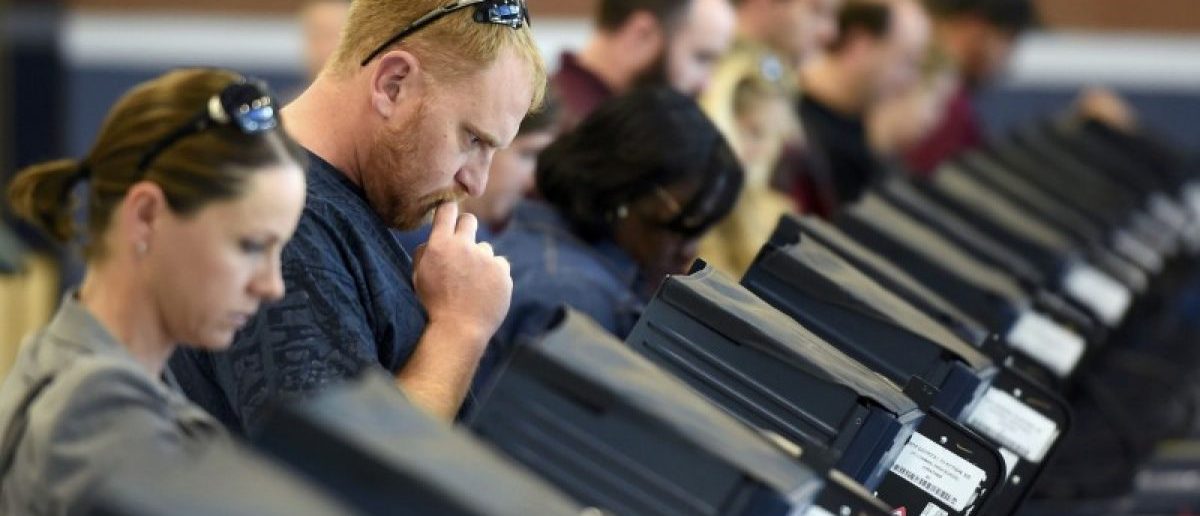
Up to recently elections were the voice of the people expressed by voting.

Hopefully this will remain so, however fears of a robot apocalypse mask the actual problems that we face by increasingly letting our lives be run by algorithms.

AIs will have and are having a knock-on effects that we have not prepared for.

When a computer spits out an answer we are typically unable to see how it got there.

There are algorithms all around us they may seem neutral and objective and unbiased but in a world of pervasive connectivity AI is the key to harnessing the power of electrical data prior to voting. It allows for millions of election related options that are posted online to be classified automatically and analysed to understand the pulse of an election.

Algorithms are now being used to make life-changing decisions such as when a prisoner should be given parole, or who gets elected. So it is time to forget everything you know about democracy.

Microsoft is building an A.I. empire and will appoint its leaders.

Twitter did exactly that : Producing a man who bankrupted his companies not once, not twice, but six times.

( The Trump Taj Mahal, 1991, Trump Castle, 1992,Trump Plaza and Casino, 1992, Plaza Hotel, 1992, Trump Hotels and Casinos Resorts, 2004, Trump Entertainment Resorts, 2009,) and Trump America in 2020, which currently has a National Debt bordering on 20 trillion. 

Since his election to be the next President of the US the media headlines are littered with the rhetoric of powerful people in the form of CRINGING WORLD POLITICAL LEADERS CHANGING THEIR SPOTS IN ORDER TO LICK UP TO A MAN THAT HAS MANY CHARACTERISTICS OF A FASCIST.Afficher l'image d'origine

Mr Trump’s views are some of the most extreme in American politics.

[He has:

  • advocated deporting nearly 11 million undocumented workers.
  • called for a border wall to be built between the US and Mexico.
  • said he would force Mexico to pay for the wall by threatening to ban Mexicans in the US from sending remittances home.
  • Mr Trump changed his position on abortion at least five times, alarming many social conservatives. This flexibility has convinced many social conservatives that Mr Trump cannot be trusted to appoint a Supreme Court justice who would oppose abortion rights.
  • Mr Trump has aggressively criticised international trade agreements.
  • He has repeatedly said the US should rethink its commitments to Nato, saying other member countries do not pay their fair share of the organisation’s budget. He has also floated an idea that South Korea and Japan could arm themselves with nuclear weapons – eliminating the need for US protection.]Afficher l'image d'origine

In the last few years the Internet has borne witness to and facilitated a great deal of social and societal change.

While undoubtedly carrying the potential to do great good, the Internet has been plagued with numerous impediments NONE WORSE THAN ITS ASSISTANCE IN THE ELECTION OF DONALD TRUMP.

I am aware that the Internet cannot be blamed in isolation.

The inequalities of the Capitalist system is a major contributor, but the dumbing down by the smart phone Apps are also influencing the reasons why we cast a vote.

If you not convinced the only thing that might be more perplexing than the psychology of Donald Trump is the psychology of his supporters. It isn’t just that they are misinformed; it’s that they are completely unaware that they are misinformed.

We now find ourselves looking a man and his team of advisors that has an ultimate goal to pursue national greatness in disrespect of the cost which will take the form of a state that will be anti-democratic and totalitarian. The state needed to fulfill this goal is a state that breeds ( As did all major fascist regimes that have ever existed) political parties that spend more time arguing than implementing policies.

At the same time, there is a paradoxical here with a resurgence of interest in universalism within the international legal context and the discourse of human rights, which at this point lack a firm philosophical foundation.

With a world facing problems that requires a vast resurgence of interest in universalism.

Power use to be what goes on in the head, and what goes on is a recognition of a reason – or better and more often: various reasons – to act differently than one would have without that reason…Power rests on perceived and recognized justifications – some good, some bad, some in between.  A threat can be seen as a justification, as can a good argument.

We are turning a blind eye to the day when we will have websites that are themselves artificially intelligent .

This type of power is not accountable and nobody can make it accountable. All AI decision-making is by definition, unknowable and will remain so till 2018 when a new European union comes into force giving citizens –  right to an explanation.

This however will not be of much use as AI processes data in ways we can’t. Ask its creator how it achieves a certain result and you get a shrug.

These  AIs brain responses are automatic, and not influenced by logic or reason.

What does it mean to act, and to act well?

We now have software writing software and soon we have unsupervised learning.

Even with all the technological advances we have seen over the last few years there still remains a large disconnect between technology and the general public.

How do we determine which actions are those which are moral, and which fall outside this sphere? And how do we negotiate the priority of all of these questions?

In fact, digital technology, particularly the internet, offers potential complications into human beings’ discussion and understanding of free will; even as the internet appears to open up options and capacities for individuals to exercise increased autonomy, it also has the potential to change the very ways in which human beings think, thereby impeding human capacities for meaningful self-reflection, a necessary if not sufficient criterion for rational autonomy.

The Internet, we’ve often been told, is a force for “democratization.

It’s worth asking, though, what kind of democracy is being promoted.

People skimmed headlines and posts, seeking information that reinforced their biases and rejecting contrary perspectives. The Internet inspired “participation,” but the participants ended up in “cloistered cocoons of cognitive consonance.”

The social networks operated by companies like Facebook, Twitter and Google don’t just regulate the messages we receive. They regulate our responses. They shape, through the design of their apps and their information-filtering regimes, the forms of our discourse.

All social networks impose these kinds of formal constraints, both on what we see and on how we respond. The restrictions have little to do with the public interest. They reflect the commercial interests of the companies operating the networks as well as the protocols of software programming.

With the instantaneous transmission of information, the internet has revolutionized the way we do business, obtain knowledge, vote, and communicate with others. Instead of a one-way relationship in which the human agent has total control as the sole actor and the tool is merely the object acted upon – a mere means to an end which the human agent has in mind, it would be more accurate today in the face of digital technology, specifically the internet, to recognize that tools also act on their users. When we create things to use for our own purposes, these tools can and do indeed act back on us, in some cases changing the very ways we think.

It is especially poignant to make this observation in the face of the development of the internet because of information technology’s potential to dramatically augment or infringe on human autonomy.

While the internet may indeed open up choices and opportunities to people that were never there before, it also has the potential to degrade individuals’ deep reading capacities, which is a dangerous threat to these individuals’ claims to free will since deep reading is necessary for meaningful introspection which is necessary to claims on rational autonomy.

On the other hand as we continue to enter the digital age, the neutrality of the internet becomes a resource that we must fight to protect, or we risk our further advancement.

Maintaining net neutrality is not simply a matter of protecting existing standards and preventing the extension of authoritative powers, but instead is a matter of establishing a new fundamental human right in the digital age. We can only hope that in unity we can break the barriers which stand between us, and in so doing, provide a living and evolving blueprint for our mutual future.

The Internet is changing the way we think about power and its interaction with economic and international relations.

A blind acceptance of a narrative provided by the Algorithmic world is not acceptable.

Therefore before the names of just and unjust can have place, there must be some coercive power to compel men equally to the performance of their covenants, by the terror of some punishment greater than the benefit they expect by the breach of their covenant, and to make good that propriety which by mutual contract men acquire in recompense of the universal right they abandon.

As a matter of urgency must establish a world governing body to overlook all technology. ( see previous posts)

When it comes to Algorithms the stakes for society are too high because AI may have arbitrarily negative consequences. Algorithms are a source of power and how they manifests themselves in the world cannot be let to the wimp of Capitalism.

If we are to read beyond the archaic dichotomous representation of international conflict, daring to create your own mind on the matter, doing so involves more than simply good intentions and determination.

It requires obtaining a new type of dignity as “selfs.”

Moreover, a willingness to engage in a dialogue concerning Being will allow for a creative and broad interpretation of man’s relationship to his world, and the responsibilities and interconnectedness that characterize it when it is not defined simply as an atomistic “standing reserve.”

This shallow consideration of the context plagues the headlines and propagates a facile belief in domineering great powers as the ‘be all and end all’ saviors of world conflict. The two leading competitors for the prize of… (peace?) in Syria leads one down a dangerous path that bolsters a bellicose Waltzian ‘balance of power’ attitude and neglects the voice of the people. This can be seen in the unacceptable bloodstains of millions around the world to this day.

The implications of Internet Freedom and its assistance or impediment has a knock on effect for International Relations as a whole.

The internet has become such an indispensable part of our everyday life that it is incredibly difficult to imagine life before it. Luckily the general public can align with interest groups via the web, thus making such groups much larger and more powerful than ever before. Unfortunately Ethicists are still confronted by the traditional questions that have plagued them since the ancients. They have been cut adrift from the context out of which they developed, searching for a foundation which is not forthcoming.

The disproportionate impact of the internet on the presidency and special interest groups only furthers the gap of influence between the public and the president.

As we move forward into an era of increasingly powerful digital technologies we have to ask the question WHY IT IS that the electrical system of one of the most powerful country can only produce two candidates that endeavored to buy with billions of $ the position of USA President.

WHEN YOU OBSERVE what are the power dynamics and systems of knowledge in our modern world, and what are their relationships to concepts of morality in general? All men having right to all things: power only exists when such an acceptance exists. Therefore where there is no commonwealth, there nothing is unjust.Two Jewish men lean against a barrier with the New York skyline behind them

The power to decide how things shall be done, the power to shape frameworks within which states relate to each other, relate to people, or relate to corporate enterprises, control over security, production, finance, and knowledge.

What is authenticity? In that respect, like all forms of honesty—intellectual and other— a principle of authenticity stems above all from a powerful sense of universal respect and love.


Charismatic’ domination derives from a population that perceives their leader to be virtuous and deserving of their dedication.

Furthermore, because people perceive their leader’s charisma as being the basis for the validity of the state’s legitimacy, one may infer that they also view their leader as a virtuous person who they understand has an inner calling to lead.

That the supporters and friends of a charismatic leader orient their interests to be in line with his/hers because they genuinely believe in the allure of their leader’s personal qualities.

Hence, because a charismatic leader is someone who many people favor, and due to them believing in his/her devotion to the state, it follows that the validity of a state’s authority under a charismatic leader is dependent on their charisma.

Efforts to engage the public are meant to sidestep the special interest groups that have dominated governmental discourse over the past several decades. The dominant theme according to the “We The People” rollout is to open a dialogue directly between the people and the administration, one that will meaningfully impact policy and legislation. Yet, the website has not led to any significant legislation at present and so far it has failed to promote meaningful interaction between the people and the presidency.Afficher l'image d'origine


Parliament is problematic because This weakens the state and, ultimately, the nation

This writing has merely touched the surface of the issues at hand.


http://www.bbc.com/news/world-us-canada-37999969

http://www.bbc.com/news/world-us-canada-37999969


.


Share this:

  • Click to share on WhatsApp (Opens in new window) WhatsApp
  • More
  • Click to share on Pocket (Opens in new window) Pocket
  • Click to share on Mastodon (Opens in new window) Mastodon

THE BEADY EYE ASKS: IS IT TIME TO REPLACE POLITICAL PARTIES. PART THREE.

29 Friday Jul 2016

Posted by bobdillon33@gmail.com in Modern Day Democracy., Politics., Social Media., Technology, The Future, The world to day., Unanswered Questions.

≈ Comments Off on THE BEADY EYE ASKS: IS IT TIME TO REPLACE POLITICAL PARTIES. PART THREE.

Tags

Fair Political System., Inequalities of opportunity, Political leaders, Politicians, politics, Politics of the Future

I can’t help but to return to the fascinating question.Afficher l'image d'origine

WHY?

Because DIVERSITY is absolutely necessary to justice.

Because Biometric E-Voting is on the horizon with a new paradigm in political communications. Look at your desktop, and you’ll see the ways the new media are changing the political scene from the bottom up.

Because of the outmoded ways we allow politicians to make decisions on our behalf.

Because candidates who would have had no chance before the Internet can now overcome huge odds.

Because we are becoming aware of what today’s Capitalism is doing to culture.  A top-down, big-money view of politics while the unresolved tensions between morals and markets are getting worse.

Because of corporate funds in political which are devastating to the public interest.

Because more and more of the new Generation want to balance individual autonomy with civic virtue. New social media are already changing the way organizations attract supporters.

Because we need a balanced society without turning persons into clients, cogs or worse. Facebook addicts. The potential mobile universe of grassroots text messagers is now over 136 million.

Because most social mayhem now arising around us is driven by seduction and stresses of public decay under a capitalism that’s no longer tempered.

Because with today’s casino like, predatory, intensively degrading capitalism is ruining social equality.

Because if we don’t want the curtain to drop on Sapiens history we have to answer the question. What do we want to become?

Do we want a digital existence. With hundreds of cable TV channels and satellite radio stations, millions of bloggers, and literally billions of Web pages all pouring out trillions of unadulterated verbal and written diarrhea that nobody gives a shit about.

The media today are more diffuse and chaotic than ever.

Because there are thousands of other reasons but it is naive to think or imagine that we might hit the brakes and stop scientific project that are upgrading Homo sapiens into a different kind of being, or a computer with a mind inside. ( Nobody is willing to argue such a proposition as the answer is we are doing it to cure diseases and save human lives.)

So I suppose we are left with the real question that is not what we want to become, but what do we want to want?

It is obvious that we all want to live, but up to now we have not given the question of living enough thought.

In my mind no political power should have the power to declare war without asking its people first, never mind getting a United Resolution it is the Young of a country that dies.

If you don’t agree with me here have a look at what happens.

The 20th century is described as the “bloodiest”, with an estimated 187 million deaths due to the various wars combined.

The death tolls for various conflicts throughout history, the best estimates put the total death toll due to all wars at 341.7 million people.

The United States most likely has been responsible since WWII for the deaths of between 20 and 30 million people in wars and conflicts scattered over the world.

The wars in Iraq, Afghanistan, and Pakistan have taken a tremendous human toll on those countries. As of March 2015, approximately 210,000 civilians have died violent deaths as a result of the wars. The number of displaced people exceeded 50 million in 2013.

Our subjective well-being is not determined by external parameters such as wars, salary, social relations or political rights. Biologists hold that our mental and emotional world is governed by biochemical mechanisms shaped by million of years of evolution.

Any decision that has a direct effects should be put to the nation as a whole not delegated to those that happen to be in power at any given time.

So here is my suggestion.

In this age of instant communication there should be a Free Government App (for argument sake called Vote Now.)

Afficher l'image d'origineThis App delegates an unique password to all.

When any political party in power want to commit a country to any project that will cost the nation let’s say over 6 billion.

We the people of the country are asked to approve or disapprove the project within a given number of days, weeks or whatever.

The app provides all relevant information connected to the project.

The E-voting system using biometric enables a voter to cast his vote using internet without additionally registering himself for voting in advance and going to a polling place. Why not an App.

This App will stop governments from sell of the country’s natural resources to Sovereign Wealth Funds and cut out lobbyist and any form of corruption.

Here are a few recent UK decisions that should have been put to the people.

For examples 300 odd sitting Conservative MP under the leadership of a Prime Minister Theresa May (a Prime Minister that has no mandate) recently voted in favour of spending over £31bn over the lifetime of the programme, including adjustment for inflation over that period, and an additional £10bn as a “contingency” to renew four worthless submarines carrying Trident nuclear missiles.

It’s no wonder they got cold feet on the total lifetime cost of the planned Hinkley Point C nuclear power plant which could be as high as £37bn. Which is was to be funded by the EDF and a Chines Sovereign Fund against 35 years of guarantee returns at twice the present cost of power.

The two new carriers that has attracted criticism over its £6.2bn cost.

Maybe I am nive but I would not let elected or non elected people sell my future.

All views and suggestions welcome.

Go back

Your message has been sent

Warning
Warning
Warning
Warning

Warning.


Share this:

  • Click to share on WhatsApp (Opens in new window) WhatsApp
  • More
  • Click to share on Pocket (Opens in new window) Pocket
  • Click to share on Mastodon (Opens in new window) Mastodon

THE BEADY EYE ASKS: IS IT TIME TO REPLACE POLITICAL PARTIES: PART TWO.

28 Thursday Jul 2016

Posted by bobdillon33@gmail.com in Humanity., Politics., Sustaniability, The Future, The world to day., Unanswered Questions., What Needs to change in the World, World Aid., World Organisations.

≈ Comments Off on THE BEADY EYE ASKS: IS IT TIME TO REPLACE POLITICAL PARTIES: PART TWO.

Tags

Fair Political System., Political ignorance, Politicians, Politics of the Future, The Future of Mankind, The Lethargy of our Political leaders, United Nations, Visions of the future., World Politics

IN THE FIRST PART ON THIS BLOG I ATTEMPTED TO SHOW THAT TECHNOLOGY IS CHANGING THE WAY WE VIEW DEMOCRACY AND AS A CONSEQUENCE POLITICAL PARTIES WILL OR ARE BECOMING OBSOLETE.

For those of us who still think that because we support a particular party AND that it will deliver on its pre-election promises I can only say we are living in cloud cuckoo land.

Governance use to be understood as ‘a system of values, policies and institutions by which a society manages its economic, political and social affairs through interaction within and among the State, civil society and the private sector.

This for now holds true for the most part but it is changing as we enter the Technology Revolution.

Why?

BECAUSE MOST SOCIETIES ARE NOW A MIX OF SEVERAL CULTURES DRIVEN BY A WORLD MEDIA THAT HAS TURNED EVERY FORM OF GREED AND VIOLENCE INTO AN ENTERTAINMENT.

POLITICIANS ARE NO LONGER CAPABLE OF REPRESENTING THE PEOPLE WHO VOTE FOR THEM.

THERE IS NO LONGER ANY LONG TERM PLANNING ONLY KNEE JERK REACTIONS.

INDEED WHEN IT COMES DOWN TO THE BEAR TRUTH- THEY ARE ALL DRIVEN BY DATA ON THE ECONOMY, AND MANIPULATED BY BIG MONEY OR THE LACK THEREOF.

Where does this leave us.

Just look at the current USA presidential election. Two candidate that are viewed as a threat to world peace.

There is an urgent need not just in the United States to invest in cultural diversity and dialogue.

Culture is increasingly recognized as a cross-cutting dimension of the three economic, social and environmental pillars of sustainability.

We must strengthen social cohesion and provide sources of inspiration for renewing forms of democratic governance if we are to put a break on governance for the sake of money rather than for the values we all cherish. 

We must places more emphasis on ‘unity in diversity.’

Indigenous knowledge can direct us towards more sustainable modes of living.

Similarly, ignoring the increasingly multicultural makeup of societies would amount to negating the existence of large sections of the population, which compartmentalizes society and damages the social fabric by creating competition between the different communities over access to resources (for education, health, social services) rather than promoting a sense of solidarity.

The expansion of digital networks, for example, has sometimes helped to revitalize endangered or even extinct languages; and the development of new technologies has greatly increased the possibilities of communicating and exchanging cultural content in time and space. Moreover, in certain cultural contexts, global cities in particular, the varied cultural flows and sometimes unexpected encounters produced by globalization are reflected in a growing range of consumer habits and trends.

You might ask why more emphasis on ‘unity in diversity.

Because Cultural diversity, characterized as it is by space-time compression linked to the speed of new communication and transportation technologies, and by the growing complexity of social interactions and the increasing overlap of individual and collective identities — cultural diversity has become a key concern, amid accelerating globalization processes, as a resource to be preserved and as a lever for sustainable development.

Intercultural dialogue must be seen as a complex and ongoing process that is never completed.

Unfortunately Globalization is NOT ACHIEVING THIS but is leading inevitably to cultural homogenization. Facebook, Twitter, Linked In etc.

While it is true that globalization induces forms of homogenization and standardization, it cannot be regarded as inimical to human creativity, which continues to engender new forms of diversity, constituting a perennial challenge to featureless uniformity.

Digital technology has drastically changed the modes of producing and disseminating cultural products, and cultural industries that previously were kept separate by analogue systems of production (film, television, photography and printing) have now converged.

We can’t hold a computer program like Google hostage to our demands.

We must move away from elite level deal making by allowing diverse interests to influence and design our own debating and decision-making rules.

Take for instance the eradication of world poverty, which is an intolerable violation of human rights in terms of both the hardships and the loss of dignity it causes – must be approached in terms of each specific social and cultural setting.

No amount of money is going to make any long-term worthwhile difference.

This can only be done with massive investment in Education.

Without education we are blowing in the wind, because rights and freedoms are exercised in very varied cultural environments and all have a cultural dimension that needs to be acknowledged so as to ensure their effective integration in different cultural contexts.

Education is a fundamental human right to which all children and adults should have access, contributing as it does to individual freedom and empowerment, and to human development.

We must escape National dialogues and engage in collective world mandates, that have legal status, and are independence from the government.

We must re- invent the United Nations changing it from a gossip shop on world problems to an Organisation that is fully funded with total transparency.

Irrivalent of the changes in technology quit hoc resolutions diplomacy is not enough.

Human beings relate to one another through society, and express that relationship through culture.

New technologies have not yet rendered the older technologies obsolete.

If we are to respond to the challenges inherent in a culturally diverse world, we must develop new approaches to intercultural dialogue, approaches that go beyond the limitations of the ‘dialogue among civilizations’ paradigm. Too often, dialogue events have stressed collective identities (national, ethnic, religious) rather than identities of individuals or social groups.

We must ensure a level playing field for cultural encounters and guaranteeing equality of status and dignity between all participants in initiatives to promote intercultural dialogue involve recognizing the ethnocentric ways in which certain cultures have hitherto proceeded.

The founding Vetoes in the United Nations must be scraped by give all nations an equal voice.

While virtually all human activities are shaped by and in turn help to shape cultural diversity, the prospects for the continued vitality of diversity are crucially bound up with the future of languages, education, the communication of cultural content, and the complex interface between creativity and the marketplace.

Recent decades have witnessed an unprecedented enmeshment of national economies and cultural expressions, giving rise to new challenges and opportunities.

The emergence of genuine ‘knowledge societies’ implies a diversity of forms of knowledge and of its sources of production, We are creating Internet technological Sahara Deserts that are and will drive millions to seek a better life or wars.

Communication networks have shrunk or abolished distance, to the benefit of some and the exclusion of others.

To address the problems that derive from the grotesque inequalities and structural poverty of our world which is at the foundations of 90% of the mess we now find ourselves in. We must recognise that successful intercultural dialogue lies in the acknowledgement of the equal dignity of the participants… based on the premise that all cultures are in continual evolution and are the result of multiple influences throughout history.

All rights and freedoms have a cultural dimension that contributes to their effective exercise. It is precisely this dimension that forms the link between the individual, the community and the group, which grounds universal values within a particular society.

All communities do not experience and respond to phenomena such as globalization in the same way.

As migration flows have intensified with globalization, they have significantly modified the ethno-linguistic makeup of a number of countries and have created new linguistic and translation needs, especially in administrative, legal and medical circuits worldwide.

Characterized as it is by space-time compression linked to the speed of new communication and transportation technologies, and by the growing complexity of social interactions and the increasing overlap of individual and collective identities — cultural diversity has become a key concern, amid accelerating globalization processes, as a resource to be preserved and as a lever for sustainable development.

Finally, forms of democratic governance can be renewed by deriving lessons from the different models adopted by diverse cultures.

We the people of the world must make our collective voices heard which is becoming almost impossible due to all of the above.

If we don’t want to rule byAfficher l'image d'origine

AI has officially made its way into Google’s search algorithm.

(The artificial intelligence of RankBrain comes in the form of mathematical entities called vectors that can be understood by computers. When presented with an unfamiliar word, RankBrain will help formulate a guess at what the query was about and filter accordingly.)

There are many possibilities as to how Rank Brain could work into being a signal to direct your choice to making any decision.

Central to the many problems arising in this context is the Western ideology of knowledge transparency, which cannot do justice to systems of thought recognizing both ‘exoteric’ and ‘esoteric’ knowledge and embodying initiatory processes for crossing the boundaries between them.

Diversity of traditions and cultures has for centuries been one of Europe’s riches and that the principle of tolerance is the guarantee of the maintenance in Europe of an open society.

Take England’s recent referendum on the EU.

So far the English referendum has resulted in transitional period now represented by an unelected interim governments whose authority to press the out button and start negotiations to leave may lack legitimacy in the eyes of the public.

Political transitions are tumultuous processes that celebrate advances and suffer setbacks several times before they can conclude with a new, widely accepted constitutional order.

There is a whole new class of millionaires as the new generation takes control of banks, government, and other institutions. The stage is set for another depression and the collapse of the welfare state.

How this can be achieved I leave to you to suggest.

But I am convinced that with the smart phone we should create a new political platform where the voice of people would hold weight in decision taken by our political masters.

If every eligible voting age citizen had a phone, any project that cost over x billions could be electronically sent for approval or disapproval.

As how to finance the United Nations ( see previous post : A World Aid Commission)

Can any of what I am writing about be achieved.  Yes it Can.

Go back

Your message has been sent

Warning
Warning
Warning
Warning

Warning.


Share this:

  • Click to share on WhatsApp (Opens in new window) WhatsApp
  • More
  • Click to share on Pocket (Opens in new window) Pocket
  • Click to share on Mastodon (Opens in new window) Mastodon

THE BEADY EYE ASKS: IS IT TIME TO REPLACE POLITICAL PARTIES

25 Monday Jul 2016

Posted by bobdillon33@gmail.com in Capitalism, Humanity., Modern Day Democracy., Politics., Social Media., Technology, The Future, The world to day., Unanswered Questions., World Politics

≈ Comments Off on THE BEADY EYE ASKS: IS IT TIME TO REPLACE POLITICAL PARTIES

Tags

Democracy, Fair Political System., Political ignorance, Politics of the Future, SMART PHONE WORLD, The Future of Mankind, Visions of the future.

( Six minute Read)

You might think this is a stupid thing to contemplate.

But just look around you.

Every minute on the web there is a new petition to vote on.

People are invited on Facebook and twitter to vote and for that matter to get killed ( as reported on the Shooting in Germany)

And now Hillary Clinton has just released a mobile game app that allows the user to build your own campaign headquarters by completing ” Fun” challenges to earn credit stars which you can cash in a virtual shop. You get a free Autograph and a Trump or False Quizzes and a lovely virtual plant to be watered.

You don’t have to be a genius to know what is behind the App.

And just the other day Paddy Ashdown in the UK set up a new political group called MoreUnited.UK which intends to support political candidates it agrees with – regardless of their party affiliation – with cash and on-the-ground campaigners.

So where or what next.

This is a serious question as the world is shaped by big, powerful forces or trends that nobody can control.

These forces are now driven by technology.

Right now these forces are driving the biggest change in 500 years and I don’t have to tell you that they are not all good despite the new environmental spirit.

Governments are preoccupied with cloaking democratic sovereignty in order to do business for the kept classes. A source of great social unrest, state violence, and public pressure for institutional reform. I.E. the English referendum to leave the European union.

The modern capitalist system has been charged more and more by its critics with crushing the spirit and substance of representative self government.

The subject of capitalism versus democracy is back.Afficher l'image d'origine

Market failures are having political effects: they are breathing new life into demands for fresh thinking and a new democratic politics that, so far, has not happened on any scale.

Capitalist markets have been a mixed blessing for democracy in representative form. The dynamism, technical innovation and enhanced productivity of the free market have been impressive. Equally notable with the free market is the rapaciousness unequal ( class-structured) outcomes, reckless exploitation of nature.

Pauperism mixed with plutocracy is today a feature of practically every democracy on our planet.

Enough is Enough.

With the gap between the rich and poor grows even wider there is political trouble ahead.

This is why every form of democracy worth its salt has stood against the presumption that the wealthy are ‘naturally entitled to rule.

Is capitalism the only moral economic system or a deeply flawed socio-economic system that has to be addressed by more government intervention and control? Or is it foundations no long based on individual rights? Each individual is an end in themselves and not a means to achieve the wishes of others.

If you adopt the view that capital belongs to everyone  it is the only moral system because it respects the volitional reason of the individual to engage with others and further their own happiness as they see fit and it allows them to fail and learn from the consequences if they should make a mistake.

But the above is no longer true as we enter a new form of Capitalism which Oliver Stone recently christened as ‘ SURVEILLANCE CAPITALISM, ROBOT TOTALITARIANISM .

POKEMON GO’S collects names and locations of the user. It can also access the contents of your USB storage, your accounts, photographs, network connections, and phone activities, and even activate your phone when it is on standby mode.  It reserves the right to share all the data it collects with a third parties such as advertisers. It is a sinister trade-off for playing a game that you think is free.

So the question asked in the heading of this blog is more than serious.

Are Politicians representing or will they be able to represent the people in the future?

In democratic election campaigns, do political parties any longer compete freely for votes?

Do Political parties (in this world of fast developing technologies) any longer provide a way for voters to easily identify a candidate’s positions?

As Parliaments gain greater control, the issues on which they disagree often are not goals so much as means: how best to keep the economy growing, protect the environment, and maintain a strong national defense.

Such competition is one of the hallmarks of democracy.

Parties’ views on government’s role often depend on the specific issue or program in question.

A political party use to be a group of voters organized to support certain public policies. The aim of a political party is to elect officials who will try to carry out the party’s policies. This is no longer true.

In the modern age where everything is connected to everything. 

The United States has a two-party system.

Political parties are often a standard by which a country’s political freedom can be measured. Some countries have only one political party. In China, for example, there is only one party, the Communist Party.

Democracies usually operate under either a two-party or a multiparty system. Like the United States, Britain has a two-party system. The major parties are the Labour Party and the Conservative Party, though there are active third parties.

Multiparty systems are common in Europe and other parts of the world. In this system, three or more parties each enjoy substantial support from voters. France, Germany, Israel, and South Africa are just a few examples.

In these countries there may be many parties representing a wide range of political views. Because of the number of competing parties, it is sometimes difficult for any one party to get a clear majority of the votes. In such cases, leading parties that can agree on general policies form a coalition (a combination of parties) to run the country.

In the past 30 years, party membership has dropped significantly across Europe, whereas other forms of political participation have developed.

Social Media has rapidly grown in importance as a forum for political activism in its different forms.

Social media platforms, such as Twitter, Facebook and YouTube provide new ways to stimulate citizen engagement in political life, where elections and electoral campaigns have a central role.

Personal communication via social media brings politicians and parties closer to their potential voters.

Although the presence of social media is spreading and media use patterns are changing, online political engagement is largely restricted to people already active in politics and on the Internet.

Social media has reshaped structures and methods of contemporary political communication by influencing the way politicians interact with citizens and each other. However, the role of this phenomenon in increasing political engagement and electoral participation is neither clear nor simple.

In the past few years, the way that citizens communicate with one other about politics has been fundamentally altered by the emergence of social media.

In view of recent political developments as diverse as Occupy Wall Street in the United States, the rise of Indignados in Spain, protests in Moscow and Tehran, and the overthrow of Hosni Mubarak in Egypt, it has become increasingly clear that social media are now intertwined with political activity.

However we know surprisingly little about exactly how social media affects political participation.

We are only beginning to scratch the surface of developing theories linking social media usage to political participation.

At the same time, the data being generated by users of social media represents a completely unprecedented source of data recording how hundreds of millions of people around the globe interact with politics.

The M5S Movement in Italy has evolved rapidly to become a significant political player by using social media to engage like-minded people in virtual and real life political action.

The impact of social media on political communication.

New ways of building an online campaign and the trend of personalisation in politics. The possibility to communicate directly with voters via social media is groundbreaking and essential for the development of citizens-initiated campaigning.

Well known cases such as the Obama Presidential campaign, the Arab spring uprisings and UK Uncut demonstrations.

A new concept of virtual political support.

Freedom became capitalism’s self-celebration which it largely remains.

Yet the reality of capitalism is that the mass of employees are not free inside capitalism or any other system for that matter to participate in the decisions that affect their lives ( e.g., what the enterprise will produce,what technology will it use, where production will occur, and what will be done with the profit workers’ efforts help to produce)

In fact their exclusion from such decisions modern-day employees resemble slaves and serfs.

Parliaments and universal suffrage have accompanied capitalism – an advance over serfdom and slavery. An Advance undermined by inequality of opportunity and income a discomforting fact mostly overlooked.

It is not likely that Capitalism is going to disappear in the near or distant future.

There is every likelihood with the arrival of AI ( Artificial Intelligence) that democracy as we know it will be eroded further.

At the moment it all boils down to Smart phone Democracy.

Perhaps in the near future we see a Smartphone political party.

Which might not be a bad way to go provided everyone has a Smart phone and everybody is requested to vote on any project that costs us the taxpayers  and the nation over a billion.

Go back

Your message has been sent

Warning
Warning
Warning
Warning

Warning.


Share this:

  • Click to share on WhatsApp (Opens in new window) WhatsApp
  • More
  • Click to share on Pocket (Opens in new window) Pocket
  • Click to share on Mastodon (Opens in new window) Mastodon

THE BEADY EYE ASKS: ARE WE CONDEMNED TO REACTION POLITICS FOR THE FORESEEABLE FUTURE

08 Friday Jan 2016

Posted by bobdillon33@gmail.com in Politics., Technology, The Future, The world to day., What Needs to change in the World

≈ Comments Off on THE BEADY EYE ASKS: ARE WE CONDEMNED TO REACTION POLITICS FOR THE FORESEEABLE FUTURE

Tags

Politicians, politics, Politics of the Future, SMART PHONE WORLD, The Future of Mankind

When you look at the state of the Planet is it time for world Governments to have   a third level of Governance.

Our political discourse is shrinking to fit our smart phone screens.

( If we don’t open our eyes we will be governed by natural-born troll, such as MR TRUMP who is adept at issuing inflammatory bulletins at opportune moments, he’s the first candidate optimized for the Google News algorithm.)

A pro active house of power with non political representatives immune from lobbing that know what they are talking about.

Such a house would address the long-term views about family welfare, social conditions, the environment, crime and virtually every aspect of our lives that our national government policy effects.

“When you’re up to your ass in alligators, it’s difficult to remind
yourself that your initial objective was to drain the swamp.”

Our political actors can only focus on a few core issues simultaneously, the construction and selection of the problems on the agenda constitute a key phase of the policymaking process.

It is far more effective and cheaper to prevent problems from occurring than to let problems grow and then try to solve them.

A proactive approach to change is needed to avoid a potential future threat or to capitalize on a potential future opportunity.

It would not be effected by the political strategies surrounding the construction of insecurity or the currently political needs of focusing on the acquisition and retention of power.

Unfortunately, as human organizations or societies get bigger, older and more complex, “Destructive Achievers” tend to become dominant. They are promoted or elected to power because they are willing to satisfy the short-term desires of the most powerful members of the group, even at the expense of the group’s long-term health.

Every political power has to go through the media.

These days it is impossible to deny the significant role of the media in the life of societies it influence the opinions and beliefs prevailing in society through content management – which is more difficult now with social media , however, to categorically determine the nature of this impact.

While this maybe true political actors wanting to create and maintain their place in the media must comply with the policies of the mass media, based primarily on the desire to garner the greatest possible interest in the message.

Hence, politicians in their activity must adapt not only to the needs of potential voters, but also to the needs of the media, among which the most prominent ones are the sensational nature of the content and availability of the politician.

As a Result the politics presented is superficially world that is reduced to news, schemas and scandals.

A pro active Chamber may cause in the electorate the expectation of integrity, reliability, conscientiousness from their potential political leaders.

Is such a suggestion feasible or foolish?

Both the development of transmission technology and dissemination of information, increased strength and importance of the media in society. As a result political discourse is contaminated.

Reactive Vs Proactive Change 119

It would be feasible if all decisions from this house were electronically vote on by the electorate before submission too Parliament for approval.

The Internet revolution has transformed the way knowledge is disseminated and how people unite over causes.

It is now more than ever necessary to understanding some of the most influential social and political processes of our time. Social networks are playing a key.  It is and has transformed elections.

In the 1920s, radio disembodied candidates, reducing them to voices. It also made national campaigns far more intimate. In the 1960s, television gave candidates their bodies back, at least in two dimensions. Today, with the public looking to smartphones for news and entertainment, we seem to be at the start of the third big technological makeover of modern electioneering.

This shift is changing the way politicians communicate with voters, altering the tone and content of political speech. But it’s doing more than that. It’s changing what the country wants and expects from its would-be leaders.

What’s important now is not so much image as personality.

Social media favors the bitty over the meaty, the cutting over the considered.

It also prizes emotionalism over reason.

The more visceral the message, the more quickly it circulates and the longer it holds the darting public eye.

In something of a return to the pre-radio days, the fiery populist now seems more desirable, more worthy of attention, than the cool wonk.
SOCIAL MEDIA ARAB SPRING

In my eyes, social media is one of the most important global leaps forward in recent human history. It provides for self-expression and promotes a mutual understanding. It enables a rapid formation of networks and demonstrates our common humanity across cultural differences. It connects people, their ideas and values, like never before.

It is in its infancy.

Once we truly learn how to harness this new technology and these new ways of communicating, we will feel the full impacts of social media.

It is responsible for the roots of the Arab Spring in the Middle East, Twitter, YouTube, Facebook and others have played not just an important role, but also an instrumental one.

The truth is the fear that some governments have about truly empowering their citizens through these new technologies. They are afraid of power of human connections online forming communities of interest because they are self-monitoring, with their own norms and expectations.

In China, the government of President Xi Jinping has expressed concern about the real power that social media has to spread information

From the printing press to the telephone to the Internet, each of these tools has been a way to organize and activate — to give people the voice they want and deserve.

Forward-thinking governments will listen to those voices and empower them. Others will be fearful of the voice of the people and remain on the losing side of history.

Today’s society, in a similar manner to liquid, adopts various unstable forms under small amounts of pressure. They are incapable of stabilizing in a consistent form, which results in consequences to social relationships and politics.

Meanwhile, political parties, bureaucracy and institutions seem to remain firmly in the 17th Century.

Democracy has to reinvent itself in accordance with this new “liquid society” where collaboration happens between many millions of people directly.

Leadership is not vertical, as in the past, but horizontal.

There is no time and space limitation for public accountability on the Internet.

Creative commonality is standard and does not resemble the authoritarian style of the dead communist experience.

It seems that it is no longer society’s obligation to understand legislation, it is a duty for governments to be understood by their people.

More than ever, the citizen is now part of the solution. Decision-makers must take advantage of technological tools to listen to the people and raise public awareness of controversial debates. If society has logged out of the virtual world it is time for government to realistically log on in an effective way to chat with citizens.

Ultimately, the discussion is all about what government is doing to the people, as in France in 1779, Russia in 1917 and 1991, in addition to many other uprisings in past. After all, it is much easier to listen to people now.

Open government is what politics will be in the Future.

While the possibilities are promising, there is also risk and danger.

It is now evident that there is no such thing as privacy. Google is omniscient of what people search for and do. Facebook has over a billion subscribers meaning Mark Zuckerberg has personal information about one in every seven people on earth. USA, Brazil, Mexico, India and Indonesia are at the top of that list.

Companies collect and negotiate information about customers and often without permission. There have been notorious cases of non-authorized government investigations on people, from autocratic regimes to alleged democracies.

Evgeny Morozov calls for a cyber utopia of ingenuity with the perspective for digital technologies. The dark side seems closer to scenarios depicted in fiction such as 1984, A Brave New World or, more recently, the Guy Fawkes face mask borrowed by the Anonymous movement from the V for Vendetta movie that has become omnipresent throughout the latest uprisings in Turkey, Egypt, Brazil and the United States.

President Obama is the best-known politician to be exploring the possibilities of new technologies to converse with the people.

Others must follow his lead and innovate. It is inevitable.

Facebook´s average user is 22 years old and the digital world continues to evolve bringing greater potential. Soon, every protester will have a smart phone with an HD 3D camera. The ascension of mobile caused Steve Wozniak to announce the end of the personal computer, which he himself invented with Steve Jobs three decades ago.

Politics needs to adapt. Like it or unlike it.

The technology is just scratching the surface of its promise.

Smartphones are cheaper than computers and will become ubiquitous; Everyone will be connected through phones.

Afficher l'image d'origine

A major effort needs to be made to educate voters about proactive vs. reactive approaches to issues.

It’s not just about economics. Afficher l'image d'origine

We are dealing with the mechanism of the spiral of silence, which pulls individuals into a paradox of sorts: to ensure social acceptance, he or she resigns from forming own thoughts and views on certain topics, withdrawing from discussion

The culture of diversity removes any moral (good/bad) and evaluative (positive/negative) dimension that justifies the political, social and ethical associations linked to the dynamics of diversity.

Of course, I’m open to suggestion!

http://go.ted.com/Cuah

http://go.ted.com/Cuaq

http://go.ted.com/CuaH

Go back

Your message has been sent

Warning
Warning
Warning
Warning

Warning.

Share this:

  • Click to share on WhatsApp (Opens in new window) WhatsApp
  • More
  • Click to share on Pocket (Opens in new window) Pocket
  • Click to share on Mastodon (Opens in new window) Mastodon
Newer posts →

All comments and contributions much appreciated

  • THE BEADY EYE ASKS: HOW MUCH LONGER IS THE WORLD GOING TO TOLERATE THE PLUNDERING OF USA? January 10, 2026
  • THE BEADY EYE SAYS WARS USE TO BE MAN AGAINST MAN, NO LONGER. WAR IS NOW DRONE AGAINST DRONE. January 9, 2026
  • THE BEADY EYE SAYS. WE HAVE SURROUND THE EARTH WITH SATELLITES. HERE TO DAY GONE TO MORROW. January 9, 2026
  • THE BEADY EYE SAYS GOVERNANCE IS BECOMING MORE BY REALITY TV, ALGO January 9, 2026
  • THE BEADY EYE SAYS. DONALD TRUMP IS EXPOSING THE WEAKEST OF OUR WORLD ORGANISATIONS January 7, 2026

Archives

  • January 2026
  • December 2025
  • November 2025
  • October 2025
  • September 2025
  • August 2025
  • July 2025
  • June 2025
  • May 2025
  • February 2025
  • January 2025
  • December 2024
  • November 2024
  • October 2024
  • September 2024
  • August 2024
  • July 2024
  • June 2024
  • May 2024
  • April 2024
  • March 2024
  • February 2024
  • January 2024
  • December 2023
  • October 2023
  • September 2023
  • August 2023
  • July 2023
  • June 2023
  • May 2023
  • April 2023
  • March 2023
  • February 2023
  • January 2023
  • December 2022
  • November 2022
  • October 2022
  • September 2022
  • August 2022
  • July 2022
  • June 2022
  • May 2022
  • April 2022
  • March 2022
  • February 2022
  • January 2022
  • December 2021
  • November 2021
  • October 2021
  • September 2021
  • August 2021
  • July 2021
  • June 2021
  • May 2021
  • April 2021
  • March 2021
  • February 2021
  • January 2021
  • December 2020
  • November 2020
  • October 2020
  • September 2020
  • August 2020
  • July 2020
  • June 2020
  • May 2020
  • April 2020
  • March 2020
  • February 2020
  • January 2020
  • December 2019
  • November 2019
  • October 2019
  • September 2019
  • August 2019
  • July 2019
  • June 2019
  • May 2019
  • April 2019
  • March 2019
  • February 2019
  • January 2019
  • December 2018
  • November 2018
  • October 2018
  • September 2018
  • August 2018
  • July 2018
  • June 2018
  • May 2018
  • April 2018
  • March 2018
  • February 2018
  • January 2018
  • December 2017
  • November 2017
  • October 2017
  • September 2017
  • August 2017
  • July 2017
  • June 2017
  • May 2017
  • April 2017
  • March 2017
  • February 2017
  • January 2017
  • December 2016
  • November 2016
  • October 2016
  • September 2016
  • August 2016
  • July 2016
  • June 2016
  • May 2016
  • April 2016
  • March 2016
  • February 2016
  • January 2016
  • December 2015
  • November 2015
  • October 2015
  • September 2015
  • August 2015
  • July 2015
  • June 2015
  • May 2015
  • April 2015
  • March 2015
  • February 2015
  • January 2015
  • December 2014
  • November 2014
  • October 2014
  • September 2014
  • August 2014
  • July 2014
  • June 2014
  • May 2014
  • April 2014
  • March 2014
  • February 2014
  • January 2014
  • December 2013
  • November 2013
  • October 2013

Talk to me.

Jason Lawrence's avatarJason Lawrence on THE BEADY EYE ASK’S: WIT…
benmadigan's avatarbenmadigan on THE BEADY EYE ASK’S: WHA…
bobdillon33@gmail.com's avatarbobdillon33@gmail.co… on THE BEADY EYE SAYS: WELCOME TO…
Ernest Harben's avatarOG on THE BEADY EYE SAYS: WELCOME TO…
benmadigan's avatarbenmadigan on THE BEADY EYE SAY’S. ONC…

7/7

Moulin de Labarde 46300
Gourdon Lot France
0565416842
Before 6pm.

My Blog; THE BEADY EYE.

My Blog; THE BEADY EYE.
bobdillon33@gmail.com

bobdillon33@gmail.com

Free Thinker.

View Full Profile →

Follow bobdillon33blog on WordPress.com

Blog Stats

  • 94,498 hits

Blogs I Follow

  • unnecessary news from earth
  • The Invictus Soul
  • WordPress.com News
  • WestDeltaGirl's Blog
  • The PPJ Gazette
Follow bobdillon33blog on WordPress.com

The Beady Eye.

The Beady Eye.
Follow bobdillon33blog on WordPress.com

Blog at WordPress.com.

unnecessary news from earth

WITH MIGO

The Invictus Soul

The only thing worse than being 'blind' is having a Sight but no Vision

WordPress.com News

The latest news on WordPress.com and the WordPress community.

WestDeltaGirl's Blog

Sharing vegetarian and vegan recipes and food ideas

The PPJ Gazette

PPJ Gazette copyright ©

Privacy & Cookies: This site uses cookies. By continuing to use this website, you agree to their use.
To find out more, including how to control cookies, see here: Cookie Policy
  • Subscribe Subscribed
    • bobdillon33blog
    • Join 223 other subscribers
    • Already have a WordPress.com account? Log in now.
    • bobdillon33blog
    • Subscribe Subscribed
    • Sign up
    • Log in
    • Report this content
    • View site in Reader
    • Manage subscriptions
    • Collapse this bar