• About
  • THE BEADY EYE SAY’S : THE EUROPEAN UNION SHOULD THANK ENGLAND FOR ITS IN OR OUT REFERENDUM.

bobdillon33blog

~ Free Thinker.

bobdillon33blog

Tag Archives: Distribution of wealth

THE BEADY EYE LOOKS AT OUR WORLD ORGANISATIONS. PART THREE- THE WORLD BANK.

16 Friday Oct 2015

Posted by bobdillon33@gmail.com in The world to day., Uncategorized, World Organisations.

≈ Comments Off on THE BEADY EYE LOOKS AT OUR WORLD ORGANISATIONS. PART THREE- THE WORLD BANK.

Tags

Capitalism and Greed, Capitalism vs. the Climate., Distribution of wealth, Inequility, The Future of Mankind, World Bank

The World Bank system was created as an integral element of the post-World War II Bretton Woods system of international and multilateral institutions. The Bank was designed to avoid future world wars by ensuring an open international trading system and global financial stability.

The same as the Nato and the United Nations it is another World Organisation that should be either shutdown, reinvented or amalgamated.   Afficher l'image d'origine

Like the IMF the World Bank is empowered by the governments which control it (led by the U.S., the U.K., Japan, Germany, France, Canada, and Italy — the “Group of 8,” which holds over 40% of the votes on their boards) with imposing economic austerity policies in the countries of the so-called “Third World” or “global South.”

Company Images ™World Bank ® is a regeistered trademark © all rights reserved. In partenership with the Holy Spirit and ™Crown Interntional © all rights reservedThe World Bank, the IMF and central banks such as the Federal Reserve literally control the creation and the flow of money worldwide.

They want all of us enslaved to debt, they want all of our governments enslaved to debt, and they want all of our politicians addicted to the huge financial contributions that they funnel into their campaigns.

According to the World Bank Articles of Agreement, all its decisions must be guided by a commitment to the promotion of foreign investment and international trade and to the facilitation of capital investment. Here is a dated example.

The first country to receive a World Bank loan was France. The French loan was for US$250 million, half the amount requested, and it came with strict conditions.

France had to agree to produce a balanced budget and give priority of debt repayment to the World Bank over other governments. Before the loan was approved, the United States State Department told the French government that its members associated with the Communist Party would first have to be removed. The French government complied with this diktat and removed the Communist coalition government.  Within hours, the loan to France was approved.

When the Marshall Plan went into effect in 1947, many European countries began receiving aid from other sources. Faced with this competition, the World Bank shifted its focus to non-European countries.

The size and number of loans to borrowers was greatly increased as loan targets expanded from infrastructure into social services and other sectors mostly for the personal interest of larger world nations ignoring the like Vietnam because they were communist who were fighting for their lives to reject democracy from running over their country.

To finance more loans, the Bank used the global bond market to increase the capital available to the bank.

One consequence of the period of poverty alleviation lending was the rapid rise of third world debt.

From 1976 to 1980 developing world debt rose at an average annual rate of 20%.

During the 1980s, the bank emphasized lending to service Third-World debt, and structural adjustment policies designed to streamline the economies of developing nations.

UNICEF reported in the late 1980s that the structural adjustment programs of the World Bank had been responsible for “reduced health, nutritional and educational levels for tens of millions of children in Asia, Latin America, and Africa.”

And it left millions of families poor and children unprotected subject to Mason sponsored Child Sex trafficking.

Beginning in 1989, in response to harsh criticism from many groups, the bank began including environmental groups and NGOs in its loans to mitigate the past effects of its development policies that had prompted the criticism.

It also formed an implementing agency, in accordance with the Montreal Protocols to stop ozone-depletion damage to the Earth’s atmosphere by phasing out the use of 95% of ozone-depleting chemicals, with a target date of 2015.

Less recently, a project in Seychelles to promote local tourism by the name of project MAGIC was launched in 2010. Its successor project TIME was scheduled to be launched in 2012.  Nothing more of it was heard of it since and was a project that at least to me makes no sense in its disclosure.

Traditionally, based on a tacit understanding between the United States and Europe, the president of the World Bank has always been selected from candidates nominated by the United States. In 2012, for the first time, two non-US citizens were nominated.

In 1991, the bank announced that to protect against intentional deforestation, especially in the Amazon, it would not finance any commercial logging or infrastructure projects that harm the environment.

About that time, in order to promote global public goods and free trade commercial market, the World Bank tried to control communicable disease created by laboratories in Intelligence agencies around the world, but could not stop the tragic effects of Ebola.

Since then, in accordance with its so-called “Six Strategic Themes,” the bank has put various additional policies into effect to preserve the environment while promoting development.

The World Bank is best known for financing big projects like dams, roads, and power plants, supposedly designed to assist in economic development, but which have often been associated with monumental environmental devastation and social dislocation.

In recent years, about half of its lending has gone to programs indistinguishable from the IMF’s: austerity plans that “reform” economic policies by suffocating the poor and inviting corporate exploitation.

The World Bank Group is the second largest public development institution in the world. Reform is long overdue. However, the most influential players are the finance ministers of the G8 countries, above all the US Treasury which sees no need for reform.

In 1992, an internal World bank review found that more than a third of all Bank loans did not meet the institution’s own lending criteria.

Unlike the United Nations, where each member nation has an equal vote, voting power at the World Bank and IMF is determined by the level of a nation’s financial contribution. Therefore, the United States has roughly 17% of the vote, with the seven largest industrialized countries (G-8) holding a total of 45%.

Because of the scale of its contribution, the United States has always had a dominant voice and has at all times exercised an effective veto. At the same time, developing countries have relatively little power within the institution, which, through the programs and policies they decide to finance, have tremendous impact throughout local economies and societies.

The global rise in prosperity and personal freedoms over the past 65 years has been an immense human achievement despite a string of horrible regional conflicts and pockets of terrible suffering.

However we are now facing the latest “Four Horsemen of the Apocalypse” — climate change, food security, infectious disease and urban youth unemployment — are rapidly approaching. It is hard to believe that the seven billion people living in 200 nations on earth today will be successful in holding them off without strong truly global institutions.

Its time to make our global institutions look and feel more global.

If we ask the question are these institutions ready to meet the challenge? The answer from most analysts is “No.”

While the WTO is based in Geneva, Switzerland, both the IMF and the World Bank are headquartered in Washington, D.C. The time has come to move at least one of them out of the United States.

The almost universal perception that there is no significant difference between the IMF and the World Bank. They work so closely together and have so many overlapping activities that they look like conjoined twins.

Their missions, however, are fundamentally different. Separation could make each one more effective.

Because the World Bank’s operations are overwhelmingly in developing countries, a case can be made for moving the World Bank to Africa, Asia or Latin America.

The biggest obstacle to moving the World Bank out of Washington is the veto power that only the United States wields.  So re-locating the World Bank is a political non-starter.

By enhancing the Bank’s legitimacy, it would help to make the World Bank more effective in meeting the global challenges that are likely to become more difficult in the years to come.

The huge gap between the world’s richest and poorest countries remains one of the great moral dilemmas for the west. It also presents one of the greatest challenges for development economics. Do we really know how to help countries overcome poverty?

At least a billion people on the planet live in desperate circumstances resembling conditions that prevailed hundreds of years ago. Our failure to alleviate their plight is morally reprehensible. But where, exactly, are the greatest concentrations of poor people? Data is hard to come by and even harder to interpret. How can one compare cost-of-living indices in different periods when new goods are constantly upending traditional consumption models?

Consider the impact of cell phones in Africa, for example, or the internet in India.

The World Bank investment policy consolidates the position of the corrupt, inefficient and undemocratic regimes of many developing countries.

The Bank has evinced willingness to deal directly with almost any government without sensitivity to their human rights record.

Given that developing countries are both shareholders and clients in the Bank, the agencies are unlikely to admit that loans to a particular regime will not achieve any benefit until a reformed government achieves power.

The negotiation process between the Bank and the regime is invariably closed and the circulation of Bank reports restricted to the participants.

The poor are disenfranchised from the very institution supposed to support their development.

It is not necessary to deny that some of the infrastructure projects supported by the IBRD, from the road-building schemes in the 1980s to the dam construction programmes of the 1990s, failed to reduce poverty and caused a degree of environmental damage.

Only 3% of the Bank portfolio is set aside to protect against the loss of revenue from defaulting debtors.

Faced with mounting attacks from all sides, the IMF and World Bank are scrambling to assuage critics. On Apr. 10, the IMF set up an independent review board to evaluate its policies. The World Bank is pushing an initiative to combat the global scourge of AIDS. And both are working on a new strategy for fighting global poverty. But in the end, more radical reforms may be needed to get the demonstrators off the streets and the politicians off the two agencies’ backs.

The IMF — along with the WTO and the World Bank — has put the global economy on a path of greater inequality and environmental destruction.

Over the past decade an estimated 3.4 million people have been displaced by bank-funded projects.

There’s always a price tag for development. But the question is: Who should pay the price?

Should poor people be the ones who sacrifice when the government tries to do a big project? Even the World Bank says the budget for a project should include money to cover people’s losses.Afficher l'image d'origine

The World Bank’s role in the global climate change finance architecture has also caused much controversy. Civil society groups see the Bank as unfit for a role in climate finance because of the conditionalities and advisory services usually attached to its loans.

The Bank’s undemocratic governance structure – which is dominated by industrialised countries – its privileging of the private sector and the controversy over the performance of World Bank-housed Climate Investment Funds

The World Bank working in partnership with the private sector may undermine the role of the state as the primary provider of essential goods and services, such as healthcare and education, resulting in the shortfall of such services in countries badly in need of them.

As an increasing shift from public to private funding in development finance has been observed recently, the Bank’s private sector lending arm – the International Finance Corporation (IFC) – has also been criticised for its business model, the increasing use of financial intermediaries such as private equity funds and funding of companies associated with tax havens.

As the World Bank and the IMF are regarded as experts in the field of financial regulation and economic development, their views and prescriptions may undermine or eliminate alternative perspectives on development.

There are also criticisms against the World Bank and IMF governance structures which are dominated by industrialised countries.

The World Bank hasn’t even adopted specific human rights policies, and doesn’t recognize that it has organizational responsibilities to abide by international human rights law.

Before I sign off on this post I should mention the Bank for International Settlements (BIS) established on 17 May 1930, is the world’s oldest international financial organisation. The BIS has 60 member central banks, representing countries from around the world that together make up about 95% of world GDP.

The BIS was created out of the Hague Agreements of 1930 and took over the job of the Agent General for Repatriation in Berlin. When established, the BIS was responsible for the collection, administration and distribution of reparations from Germany – as agreed upon in the Treaty of Versailles – following World War I. The BIS was also the trustee for Dawes and Young Loans, which were internationally issued loans used to finance these reparations.

After World War II, the BIS turned its focus to the defense and implementation of the World Bank’s Bretton Woods System. Between the 1970s and 1980s, the BIS monitored cross-border capital flows in the wake of the oil and debt crises, which in turn led to the development of regulatory supervision of internationally active banks.

The BIS has also emerged as an emergency “funder” to nations in trouble, coming to the aid of countries such as Mexico and Brazil during their debt crises in 1982 and 1998, respectively. In cases like these, where the International Monetary Fund is already in the country, emergency funding is provided through the IMF structured program.

The Bank for International Settlements is an organization that was founded by the global elite and it operates for the benefit of the global elite, and it is intended to be one of the key cornerstones of the emerging one world economic system.

Its head office is in Basel, Switzerland and there are two representative offices: in the Hong Kong Special Administrative Region of the People’s Republic of China and in Mexico City.

The mission of the BIS is to serve central banks in their pursuit of monetary and financial stability, to foster international cooperation in those areas and to act as a bank for central banks.

Given the continuously changing global economic structure, the BIS has had to adapt to many different financial challenges. However, by focusing on providing traditional banking services to member central banks, the BIS essentially gives the “lender of last resort” a shoulder to lean on. In its aim to support global financial and monetary stability, the BIS is an integral part of the international economy.

The BIS is a global center for financial and economic interests. As such, it has been a principal architect in the development of the global financial market. Given the dynamic nature of social, political and economic situations around the world, the BIS can be seen as a stabilizing force, encouraging financial stability and international prosperity in the face of global change.

In the old days World Bank and maybe in the future will act as a lender of last resort to the banking sector during times of bank insolvency or financial crisis.

As the face of hunger has changed, so has its address.

The Wealth of Nations and the inheritance for humankind and all forms of life rest with World Organisation that are out of date  – this should explain to many as to the disappearance of an equal World.

Money Talks as is evident with the latest Trade deal TTPI.

However, in today’s modern economy we are witnessing a rapidly expanding array of services with mobile technologies as their backbone, but what a World we are making. Our priorities are driving by growth at all costs, and a media owned by our Capitalist culture. We produces 1.3 billion metric tons of garbage each year, and that number is expected to double by 2025.

Is it not time that we the guardians of the Planet got together to shut some doors by tabling a peoples UN resolution to place a World Aid Commission on all High Frequency Trading, on all Foreign Exchange Transactions (over $20,000) and on all Sovereign Wealth Funds Acquisitions ( See previous posts)

The chances of this ever happening are minuscule as self-interest is deep rooted.

Take a Selfie, or comment       Afficher l'image d'origine

← Back

Thank you for your response. ✨

Share this:

  • Share on WhatsApp (Opens in new window) WhatsApp
  • More
  • Share on Mastodon (Opens in new window) Mastodon

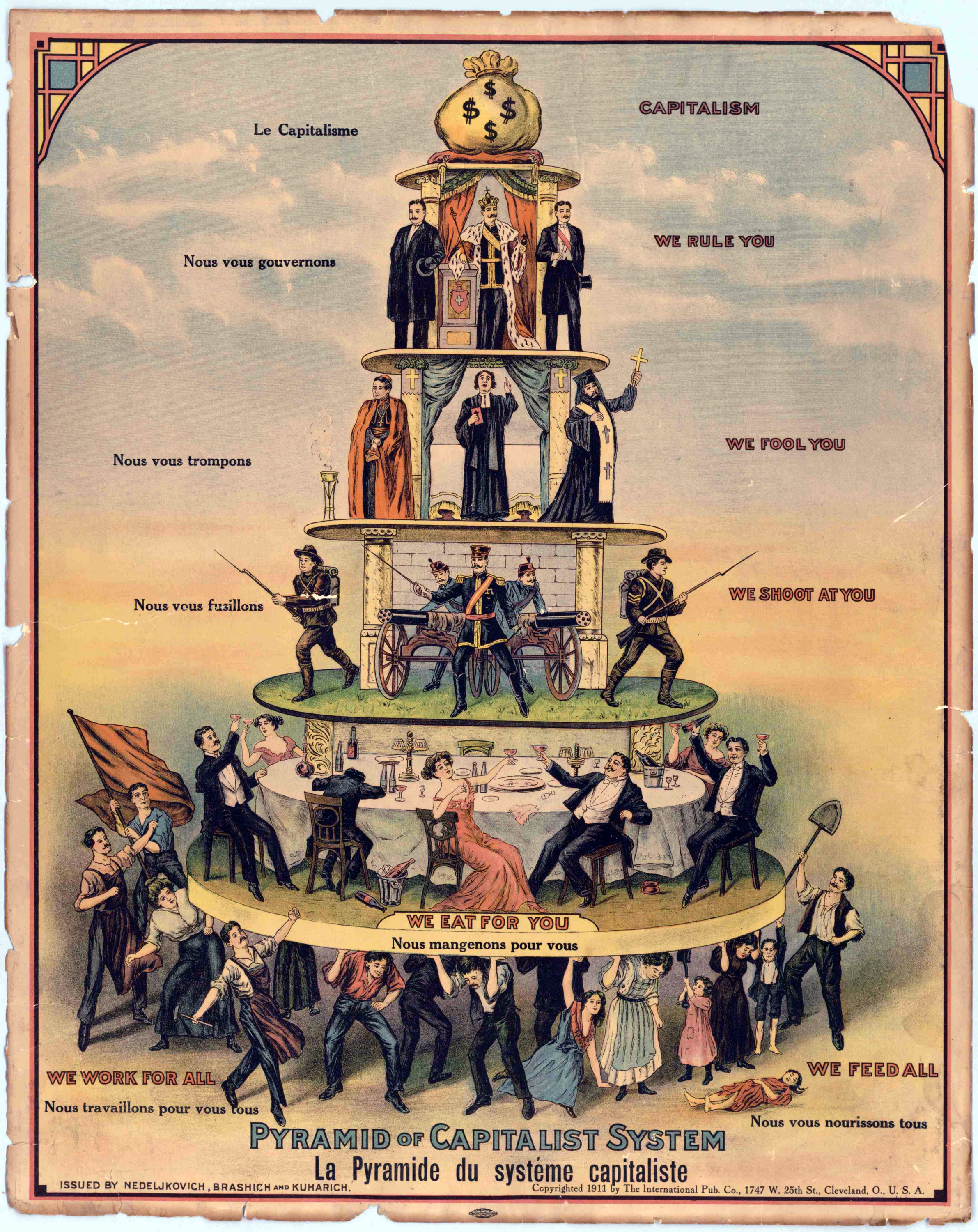
THE BEADY EYE ASK’S WHAT HAS CAPITALISM ACHIEVED

07 Monday Sep 2015

Posted by bobdillon33@gmail.com in Capitalism, Humanity., Unanswered Questions., WORLD POVERTY WHERE'S THE GLOBAL OUTRAGE

≈ 6 Comments

Tags

Capitalism and Greed, Capitalism vs. the Climate., Community cohesion, Distribution of wealth, Globalization, Inequility, World aid commission

To understand the role of capitalism in modern economic times you must understand the word Growth.

Growth at any cost.  Which we are just coming to apprentice thanks to the Internet.

For a long time nothing much happened till Wheat conned humans into growing it.

It is not my intention here to address Money and Power. It is sufficient to say that money leads to power and corruption and that all three intermingle in the notoriously subject of Economics.

What I want you to do is to look at Capitalism that founded states and ruined them, opened up new horizons and enslaved millions, moved the wheels of Industry and drove hundreds of species of plants and animals into extinction, plundered the earth resources for profit, promoted science, all to the dethronement of a sustainable planet and ask yourself is it easier to imagine the end of the world than the end of capitalism.

There can be no doubt without some system the human race would descend into barbarism based on nothing but self-interest.

Our cultural output throbs with this notion of self-interest. Just look at the present Refugee problem facing the European Union.

So would the collapse of Capitalism lead to misery?

Capitalism in all its credulity and inequality reflects mans barbarous nature. Indeed the horrors of ISIS are trumpeted so vehemently by the western press precisely because they fill this narrative.

However a dog eat dog world with which capitalism and the state justify themselves is in part a fallacy.

In fact nature teems with co-operation – both between animals, between species and within the ecosystem as a whole.

We are the same, but it is no coincidence that where we do co-operate these areas are dominated by capital and constructed in a way that systematically reward the uglier sides of our common nature.

We know that the world in unfair where the few have too much and the most have too little.

The feeling that Capitalism, inequality, and injustice are inevitable and the idea that to struggle for a better world is naive is coming to an end.

If we could only entrench the cooperative compassionate and empathetic sides of our nature as dominant values in society we would redesign our Capitalist world – to a world worth while living in.

The current state of our planet is affording all of us this opportunity.

How can we tackle the world problems ?

A good place to start would be to get Capitalism to pay for it.

By placing a World Aid Commission on all High Frequency Trading, on all Foreign Exchange Transactions over ($20,000) on all Sovereign Wealth Funds Acquisitions, on all Drilling Wells.  This would create a perpetual pot out of Profit for Profit sake that could fund the inevitable cost of climate change.

In doing so we would redistribute the world’s wealth from the whole of the world. ( see previous Posts)

Sooner than later we are going to exhaust the raw materials and energy of the planet Earth. What will happen then?

Which is why, whenever the opportunity arises, we must be prepared to seize it.

← Back

Thank you for your response. ✨


Share this:

  • Share on WhatsApp (Opens in new window) WhatsApp
  • More
  • Share on Mastodon (Opens in new window) Mastodon

THE BEADY EYE WRITES AN OTHER OPEN LETTER TO THE PARIS SUMMIT ON CLIMATE CHANGE.

31 Monday Aug 2015

Posted by bobdillon33@gmail.com in Climate Change., Environment, European Union., Humanity., Natural World Disasters, Politics., Sustaniability, The Future, Where's the Global Outrage.

≈ Comments Off on THE BEADY EYE WRITES AN OTHER OPEN LETTER TO THE PARIS SUMMIT ON CLIMATE CHANGE.

Tags

Climate change, Distribution of wealth, Environment, Extinction, Global warming, Natural disaster, United Nations, World aid commission

31st August 2015.

Dear Delegate,

When policies on emissions reductions collide with policies focused on economic growth, economic growth will win out every time.

There is no point in spending a lovely week in Paris talking about what should be done about Climate change and coming up with an agreement to cut emissions by placing A Price Tag on carbon.

The true financial costs of climate change is away beyond any price tag or unenforceable agreement.

What value do we place on the ocean’s coral reefs and the myriad animals they support, and how do we weigh their loss against other values? What price tag do you put on a species of bird or fish or mammal which, once gone, will never return?

How does humanity weigh moral accountability if our own carbon emissions contributed to that destruction?

Isn’t it about a sustainable planet? A sustainable and biologically diverse planet?

Most likely our descendants will be left to adapt to a warmer world where greater climatic uncertainties, depleted resources and human migrations, amongst other, will be the norm.

If climate change affects not only a country’s economic output but also its growth, then that has a permanent effect that accumulates over time, leading to a much higher social cost of carbon than any price tag agreed.

The economic damage caused by a ton of carbon dioxide emissions – often referred to as the “social cost” of carbon – will actually be far higher than any of us can imagine.

There is no solution to an event that is all ready taking place.

There can only be a change to the event or a confinement to the end result.

If there is no solution to how the world is going to finance this change your and you fellow delegates might as well go home and bask in the sunshine of an agreement that is as porous as the paper it is written on.

In his fascinating book “Catastrophe: Risk and Response”, published in 2004, Richard Posner argues that we do not do enough to hedge against catastrophic risks such as climate change, asteroid impacts or bioterrorism.

In light of the “competition” of existential risks, how much should humanity invest in the mitigation of climate change?

The answer is:  Human extinction is a risk we all share—and it would be an unprecedented event that can happen only once.

Growth at all costs is the mantra of the technological world we live. Climate policies that require public sacrifice and limiting economic growth are doomed to failure.

Believe in the current pledge-and-review mechanism is a farce.

From current projections we know that climate change will pose a serious challenge by 2040 for many organisations. Putting a true economic cost on these risks can act as a catalyst to taking action today in order to help organisations better prepare for the future.

There is only one way to achieve this and that is the creation of a World Aid Commission or tax on profit   for profit sake.

Would you rather have a one percent tax increase on everyone in the country or kill one percent of the population?  This will not work as the cost of collection and administration, or culling, would out weigh any benefits.

The solution is a Universal 0.05% commission on all High Frequency Trading, on all Foreign Exchange Transactions (over $20,000) on all Sovereign Wealth Funds Acquisitions and on all Drilling Wells.  

This will create a perpetual Fund to tackle the world problems.  


The expected loss to society because of catastrophic climate change is so large that it cannot be reliably estimated.

Climate policies should flow with the current of public opinion rather than against it, and efforts to sell the public on policies that will create short-term economic discomfort. People are willing to bear costs to reduce emissions, but they are only willing to go so far.

The Dangerous Underestimation of Climate

Change’s Cost and the

financing of any agreement is self-evident.

← Back

Thank you for your response. ✨


Share this:

  • Share on WhatsApp (Opens in new window) WhatsApp
  • More
  • Share on Mastodon (Opens in new window) Mastodon

THE BEADY EYE TAKES A LOOK AT WHAT HUMANITY HAS ACHIEVED TO DATE.

28 Friday Aug 2015

Posted by bobdillon33@gmail.com in Environment, Humanity., Sustaniability, Technology, The Future

≈ Comments Off on THE BEADY EYE TAKES A LOOK AT WHAT HUMANITY HAS ACHIEVED TO DATE.

Tags

Capitalism and Greed, Capitalism vs. the Climate., Community cohesion, Distribution of wealth, Environment, High - Frequency Trading, Sovereign wealth fund, The Future of Mankind

The most accurate simulation of the human brain ever has been carried out, but a single second’s worth of activity took one of the world’s largest supercomputers 40 minutes to calculate.Men’s and women's brains are wired differently

SO LET’S HAVE A LOOK AT WHAT WE HAVE ACHIEVED SINCE WE CAME DOWN OUT OF THE TREES AND STOOD UPRIGHT.

( I am sure there will be many gaps in what I write here so you will have plenty of ammunition to comment. Those of you who are shadow people lead by the like button feel free to press it. )

Right: On your marks we off.

At first we were of no significance till we discovered that we could walk up right, discovered fire, tools, and language. We became foragers/ hunters with no hierarchy spreading all over the world providing there was a land bridge developing new weapons and new clothing due to climate change and perhaps unfriendly rivals.

All that changed when we began to devote our efforts to manipulating the lives of animals and plants. The Farmer had arrived. More babies to be fed, so we burnt down forests and planted wheat thus becoming wheat slaves living in settled artificial enclaves dedicated to growing wheat.

Because of this we discovered writing and numbers, money and religion.

This lead to placing a material value not just on possession but on ourselves resulting in a conscious effort to create laws, customs, procedures, to run societies.

By this time with the human brain going into hibernation due to all the information that needed to be stored we are well on the way to creating religious gods, empires, armies, taxes, etc  Thus the arrival of bureaucracy, rulers, social division, ruling classes, slaver, gun power, the wheel and sea worthy ships.

Of course building, pollution, masculine dominance and exploration were now in full swing and it’s not long before the world is dividing into Empires of different cultures, different languages, different belief, most still using their legs and horses with the odd set of wheels to get around.

The Roman empire broke up, the Mongol empire went to pieces, the Chines empire built a wall, America and Europe did not know each other existed. Alexander the Great conquered most of the known world.

90% of humans lived in a single mega world ; the world of Afro- Asia the rest lived in America, central America, the Andean world, the Australian world, islands of the Pacific.

They were all swallowed up by the Afro-Asian world.

Resources were plentiful. Till along came How Much is it.  Money the foundation of Greed and cooperation between strangers drastically reducing diversity. The first step to we becoming US against the Rest.

The European Industrial Imperial steamroller gradually obliterated our uniqueness.

The Spanish quashed the Inca, Ferdinand Magellan circumnavigate the globe, Marco Polo gave the Vatican a Chines map of America, they sending Columbus off to discover it, while Queen Vic with the help of Darwin, Livingstone, Nelson, expanded the British Empire with ball and chain, cannon.

At this stage there is no evidence that history is working for the benefit of humans. Science, engineering, flight, medical advances, power, religious rightness, profit, wealth, corruption, greed and reckless plundering of the earths resources, ignorance, and credit now come into play.

Empirical observations are being put together with the help of mathematical tools.

All of this cost money and it did much more than just charting the universe, mapping the planet and cataloging the animals than did Galileo, Columbus and Darwin. If there had being no funds or these geniuses and they had not being born we would be still waiting on some others to do so.

Of course none of the above is in strict chronological order and I have left out, Michelangelo Meriwether Lewis and William Clark, William Shakespeare, Bach, Confucius, Aristotle, Newton, to mention a few but I hope you get the gist.

I grow sick and tired of all the same old lies
I might be a little young, so what’s wrong?
You don’t have to be old to be wise

— Judas Priest

Anyway it is suffice to say that European imperialism was entirely unlike all other imperial projects.

So here we are. WE CREATED THE WORLD THAT YOU SEE AROUND YOU.
After numerous wars and two million years of being marginal creatures, thirteen odd billion years after the big bang we have arrived at the Capitalist creed OF THE FREE MARKET and a belief that Science which is about 500 years old can solve all our problems.
The question is how many people want to live in a world that you see around you.
We need to ignite a second cognitive revolution. It is unclear whether bio engineering could really resurrect Neanderthals. Tinkering with our genes won’t necessarily kill us. But we might fiddle to such an extent that we would no longer be Homo sapiens.
ayn rand apollo 11 human achievement day
In a previous post I asked what do we want to become. A human who stood on the moon and saw a dying world that could be so beautiful if we learned to share.
                                               Paradise Lost or Found.
Unlike other animals, we humans need to create the means for our physical survival as well as our spiritual well-being. We need to figure out how to acquire food, build shelters, cure illnesses, build cities, travel to the Moon, and create everything that deserves the label “civilization.”
Take a moment to look around you. Reflect on your own achievements and take pride in them. Reflect on the virtues that have allowed you to achieve the things you value.
The potential for human achievement is endless, but only if we truly value achievement and appreciate that the achievements we create in our modern world are manifestations of the moral virtues we each create in our character. Not Twitter, not Face book, not the internet, or the web of everything, not Google, not Apple.
If there’s one thing that many science and reality-minded people tend to do quite a bit, it’s over analyze every little detail.
The answer is right in front of your eyes . Open them.
We must tap Greed by creating a World Aid Fund by placing 0.05% commission on all High Frequency Stock Exchange Transactions, on all Foreign Exchange Transactions over $20.000. on all Sovereign Wealth Funds Acquisitions, on all new Drilling wells. ( See previous Posts)

← Back

Thank you for your response. ✨

Share this:

  • Share on WhatsApp (Opens in new window) WhatsApp
  • More
  • Share on Mastodon (Opens in new window) Mastodon

THE BEADY EYE LOOKS AT WHAT WRONG WITH THE WORLD.

28 Tuesday Jul 2015

Posted by bobdillon33@gmail.com in Humanity., Sustaniability, Technology, The Future

≈ Comments Off on THE BEADY EYE LOOKS AT WHAT WRONG WITH THE WORLD.

Tags

Climate change, Distribution of wealth, Earth, Environment, Greed, Solutions to world problems, Technology, Visions of the future.

OK, a list of what is wrong will go from here to eternity, so before you read this post take a look at the two U tube videos below, and then do something.

If you Goggle the question you will quickly find that there’s no shortage of people who know what is wrong with the world.

The most frequently cited reason is probably the decline of religion, specifically the religion of the person writing it.

Second to “the fall of religion” the most popular answer is probably “religion.” But there are other themes too: lack of respect for elders, unregulated capitalism, greed, alcohol, the economy, the rich, attachment, premarital sex, liberals, the unemployed, pride, lawyers, apathy, Starbucks, Mc Donalds.

Googling the question myself, they all sounded more like symptoms to me.

If certain behaviors are widespread and problematic, whatever causes them must be a bigger, more fundamental problem. Right? Maybe not.

Most people cannot even intelligently discuss the pressing issues of our day.

For me it is that we are too ignorant to open our minds to the problems around us. To selfish to open our hearts to what else is out in the world. To indoctrinated to accept an opinion other than our own, deaf to other people’s voices, blind to the pain and suffering we see in the streets and scared to do anything about it.

Our planet is now slowly dying and we are the reason to blame for its slow demise.

We fill her oceans with black poison. We fill her skies with acid. We cut down all the trees she spent years to grow. We cover her soil with blood and we use her as our own personal dump.

Worst of all we just sit back and watch as it falls apart.

Why?

Because as the twenty-first century unfolds, immensely powerful currents of capitalism, labour, and information turn and shape the world with a growing disregard for the boards and opinions of states.

So the world we see in front of our eyes is not governed by any particular state, organisation or ethic group, but by greed and profit. All run by the stock exchanges and algorithms

What is left is mindless adoption of technology as the end-all-be-all solution to humanity’s problems rather than global cooperation to the appearance of essentially global problems.

I think most people would not say there isn’t something wrong.

But if we’re going to regard the world as if there’s something wrong with it, shouldn’t we be able to identify it, at least with ballpark-level precision?

Here the Beady eye list of what is wrong.  Feel free to add.

Climate Change: Overpopulation: Thirst:  Poverty:  Inequality of opportunity:  Equal rights:  A lack of Education:  Terrorists:  Atomic arsenals:  Corruption:  Distribution of Wealth:  Religious Extremists: Political Extremists of Far Left & Far Right: Lying Politicians:Racists:  Class structure: Reality TV:  Farmer Subsidies:  Sexists:  Bestiality:  High Cost of Space Programmes:  Hopeless addiction to entertainment, technology, and celebrity gossip:  Soulless of suburbs, sprawls, and office parks create stress, malaise, and depression:  The existence of Hollywood, which poisons the world’s culture by normalizing narcissism, consumerism, and bad movies:  Pervasive politically correct environment where dissenting thought is labeled sexist, racist, or homophobic:  Treatment of smartphones as both friend and passionate lover, which replaces time spent in face-to-face interactions with real friends and lovers:  Universities that serve as liberal brainwashing factories instead of palaces of wisdom, enlightenment, and masculinity:  Disposable culture where still-functional items are thrown away instead of being repaired or reconditioned:  Competitive conversation culture where people talk about themselves instead of listening. Contemplative silences are looked upon as boring or even creepy:  Rule by an oligarchy that spies on citizens who don’t even care about its government’s illegal acts because they are too busy playing Candy Crush: Homosexuality openly embraced and displayed in public around children who don’t yet understand the nature of human sex:  Complete ignorance of world affairs by citizens due to being comically manipulated by media propaganda. Russia bad! Saudi Arabia good!:  People who can no longer handle original thoughts without being offended or“triggered.”: Militarization of police whose monopoly on violence allows them to taze and kill with impunity:  Welfare state that redistributes money from hard-working provider men to a growing population of single mothers who are subservient to the state instead of husbands:  Calling corporate customer service and having to converse with robots:  People who favor tweets for no apparent reason:

Out of date World Organisation are in need of radical reform.

  • For some reason THE US GOVERNMENT still thinks they should have to take care of the whole planet. The U.S. national debt is over 14 times larger than it was back in 1981:
  • OPEC nations are going to bring in over a trillion dollars from exporting oil this year:

So where do we stand in regard to Solutions.?

I would really love to hear your answer to that question, in the comment section below. Whatever comes to mind. The question does presume that there is actually something wrong with the human world. If you think there isn’t, please say so too.

Fans of singer Justin Bieber scream as he performs on NBC's Today Show in New York

I know it’s a pretty broad question, and any answer is welcome. There’s no need to do up an essay or anything, but you’re welcome to. I know Raptitude readers are a thoughtful bunch and I just want to know what kinds of ideas you people have in your minds about what’s wrong with this world.

Here are few Solutions:

Make education FREE not a product.

Place a World Aid commission of 0.05% on all High Frequency Trading, on all Sovereign wealth Funds Acquisitions, on all Foreign Exchange transactions over 20,000 dollars, creating a perpetual World aid fund. ( See previous posts) This would close down all need for Charity.

The poverty trap,” “the ladder of development”—go limp under the magnifying glass of actually being tested.

Leaders who lack wisdom approach problems with linear vision – thus only seeing the problem that lies directly in front of them and blocking the possibilities that lie within the problem. As such, they never see the totality of what the problem represents; Problem solving is the greatest enabler for growth and opportunity.

Out of this fund make available non repayable solar-panel grants. The direction to go is obvious: toward energy independence. THIS IS WHAT THE PARIS CLIMATE CHANGE SUMMIT IN PARIS SHOULD BE LOOKING AT. (https://youtu.be/qlTA3rnpgzU  Probably, a key factor, if not the key factor, in solving our environmental problem is time.

2.5bn people still lack basic sanitation and diarrhoea is the second largest killer of children. 1.1 billion people, or 15 percent of the world’s population, practice open defecation.

Parts of the world could see a supply-demand gap of up to 65% IN WATER RESOURCE BY 2030. Currently, more than one billion people don’t have access to clean water. And with 70 percent of the world’s freshwater used for agriculture, water’s critical role in food production must be considered as climate and resource conditions change.

Reform the United Nations giving equal rights to all Nations.

Legalism of Soft Drugs would reduce the prison population.

Re Introduce National Service to deliver dignity not war.

People think about their own perceived world and part of the challenge is to get people out of that world.

The question now for all of us in the 21st century is will we realize that this is indeed an urgent problem and take bold enough action in sufficient time? The answer to this question is yet to be given.

Here lies the land of technology opportunity, a place where the upside of technology benefits is enormous and world changing.” We’re just the technologists. And actually I think those questions are for society as a whole.” Wrong.

What would happen if we applied our knowledge and skills in these pockets with the resources, creativity and speed of giants like Google and Apple? Let’s give it a try. Let’s encourage our biggest companies to tackle some of the world’s biggest problems. Let’s apply technology tools like hackathons and lab days and rapid prototyping toward solving social and environmental issues. Let’s do some good.”Résultat de recherche d'images pour "pictures of the world"


← Back

Thank you for your response. ✨

Share this:

  • Share on WhatsApp (Opens in new window) WhatsApp
  • More
  • Share on Mastodon (Opens in new window) Mastodon

The Beady takes a look at getting Rich Quick.

07 Tuesday Jul 2015

Posted by bobdillon33@gmail.com in Education

≈ Comments Off on The Beady takes a look at getting Rich Quick.

Tags

Distribution of wealth, Exploitation, Rich and Poor, Scratch cards, The Lotto., TV Game Shows., When Money Talks

We have all done it.

Dream boated that we have won the Lotto.  Dreams of Easy Money.Pretty Eye

And why not, most people have a strong fascination with easy money.

If you look at history money is a comparatively recent invention. It seems that most people who got rich by creating wealth did it by developing new technology.

Making wealth is not the only way to get rich. Until a few centuries ago, the main sources of wealth were mines, slaves and serfs, land, and cattle, and the only ways to acquire these rapidly were by inheritance, marriage, conquest, or confiscation.

These days people who pursue happiness through material possessions are liked less by their peers than people who pursue happiness through life experiences.

We all know that there are many senses of the word “wealth,” not all of them material. Here I am talking not about what people will give you money for (materialism), but the quick wealth fix, winning a vast amount of cash.

If You Do Win: There is the painful proposition of managing sudden, Unearned Wealth. The argument that people always use when talking about lottery tickets is “What if I win?”

Well, what if you do win?

People you’ve known all your life suddenly start viewing you as their meal ticket. You’re now a target to criminals, a meal ticket and/or a lender to the people who used to form your close inner circle, and the source of angst not only in virtually every relationship you have with others, but often in the relationship between people you care about.

Anyway just in case your dreams have not come true here are a couple of other ways to get Rich:

Rob A Bank.

Inherit a fortune.

Bet on the right horse, with free money.

Get a hole-in-one for $1 million.

Buy and hold Long-term stock that clicks.

Find treasure.

Get lucky at a car booth sale and buy a Picasso.

Marry rich- with strings attached.

Divorce a Beatle or Rolling Stone- with strings attached.

Be born rich.

Sue.

Unearth gold with a metal detector.

Register a generic domain name.

Have a “non-affair” with a bigwig.

Live on a lake of oil.

Or crack the algorithm that produced the numbers. You will be able to plunder the lottery.10 Million Dollars

Most of us chase success by working hard, sacrificing our personal lives and even our health in an all-out pursuit of Mammon. But it doesn’t always have to be that way. For a fortunate few, it doesn’t mean a Harvard MBA or years spent perfecting a new drug. It just means doing as little as possible and still making more money than you ever dreamed of.

As much as industrious overachievers hate to admit it, sometimes all you need to get rich is dumb luck.

So what are the odds of winning the Lotto.

A 1 in 80,089,128 chance, or roughly 1 in 80 million.

Matching four of five normal numbers plus the “power ball” is a 1 in 1,668,523 chance.

Matching all five white numbers is a 1 in 1,906,884 chance.

You have a better chance of being struck by lightning than you do of winning either the grand prize or a top secondary prize.

If buying 1,906,884 tickets it could guarantee you that you would win $200,000, which is the prize (in Florida, at least) for matching all five white numbers, you’d still be spending $1,906,884 to win $200,000 – a roughly 90% loss on your investment.

If you were to play the “Power Play” version, you’d spend $3.8 million to win $1 million – a roughly 72% loss on your investment.

The Beady eye does not question your right to buy a ticket or for you to have dreams on whether you sue, marry, divorce, or buy or whatever.

It’s concerned is whether our TVs, our Governments should be promoting wealth.

Are Government Lotteries a regressive tax. They suck billions out of the economy.

Most people buy tickets and win little or nothing.

This is taking more money from the poor, working and lower middle-classes than from those most able to pay taxes. These billions also are diverted away from local businesses.

In other words, why is the government in the lottery business at all?

Government-run lotteries generated more than $70 billion in gross sales in North America during the fiscal year ended June 2010, up $1 billion year on year.

In North America every Canadian province, 43 U.S. states, the District of Columbia, Mexico, Puerto Rico, and the U.S. Virgin Islands all offer government-operated lotteries.

Elsewhere in the world publicly-operated lotteries exist in at least 100 countries on every inhabited continent. In some cases they are operated by national governments, in other cases by state or provincial governments, and in still others by cities.

Lottery proceeds benefit different programs.

In many cases lottery profits are combined with tax and other revenues in a government’s general fund. In other cases lottery proceeds are dedicated to a wide range of causes, including education, economic development, the environment, programs for senior citizens, health care, sports facilities, capital construction projects, cultural activities, tax relief, and others. Lottery beneficiaries.

Therefore the lottery is not a tax. Webster defines a tax as “a compulsory payment … for the support of government.” No one is coerced to play the lottery. The purchase of a lottery ticket is completely voluntary.

Some say its the poor who are targeted to play. The poor are allowed to vote, get married, and sign contracts. Economic status is not a measure of intelligence.

But make no mistake. Profit is what the state is after.

In other words, governments are raising revenue by tempting the worst off of their citizens to hand over their hard-earned money by playing a game with a ridiculously low return.

So are our Governments teaching our young people who Gambling that it is cool.

Scratch Cards; Online betting: TV Game Shows, all feast on Greed.

If you take Scratch cards.

The tickets are clearly mass-produced, which means there must be some computer program that lays down the numbers. Of course, it would be really nice if the computer could just spit out random digits. But that’s not possible, since the lottery corporation needs to control the number of winning tickets. The game can’t be truly random. Instead, it has to generate the illusion of randomness while actually being carefully determined.”

Money is Not Wealth.

Money is a way of moving wealth.

They are usually interchangeable. People think that what a business does is make money. But money is just the intermediate stage– just a shorthand– for whatever people want.

In fact; ants have wealth. 

When you hear someone talking about how x percent of the population have y percent of the wealth. This is a fallacy.

There is not a fixed amount of wealth in the world. You can make more wealth.

A programmer can sit down in front of a computer and create wealth. A good piece of software is, in itself, a valuable thing. A great programmer, on a roll, could create a million dollars worth of wealth in a couple of weeks. A mediocre programmer over the same period will generate zero or even negative wealth.

Wealth can be created without being sold. We are all richer for knowing about penicillin. The same recipe that makes individuals rich makes countries powerful.

So let the Lions DEN nerds keep their lunch money, for you and I rule the world.

(The Lion DEN by the way is a BBC program where five millionaires sit with large bundles of money in front of them. Young and old Hopeful’s present their innovations or business in the hope of securing an offer of cash for a percentage of their invention or business. If an offer is made the millionaires then squabble with each other offering more or less cash for a percentage share in the victims dream’s of making it Rich.)

Ask yourselves:  Is this family entertainment or Capitalist rape.

The same goes for;

The Briefcase: Millionaire Misers: Rich As Finns: Still Pretty Rich: Money For Nothing: Job Creators In Action: Undercover Employee:

The Undateables:  Exploiting people with disabilities for entertainment

The Hunger Games: New CBS reality show exploits poor families by making them grovel for $101,000.

There are plenty of others.

Screen-Shot-2015-05-30-at-6.57.09-AM

What leads people astray here in all cases is the abstraction of money.

Both Worldstar videos and these television programs dehumanize the people they show and will continue to do so unless we, as viewers, choose to stop watching.

← Back

Thank you for your response. ✨

Share this:

  • Share on WhatsApp (Opens in new window) WhatsApp
  • More
  • Share on Mastodon (Opens in new window) Mastodon

The Beady Eye looks at Big Data.

30 Tuesday Jun 2015

Posted by bobdillon33@gmail.com in Big Data., Politics., Privatization, Technology, The Future

≈ Comments Off on The Beady Eye looks at Big Data.

Tags

Artificial Intelligence., Big Brother., Big Data, Distribution of wealth, Drones., Globalization, Inequility, Technological revolution

Is our world along with humanity disappearing into the Cloud.?

We as individuals are turning into “walking data generators”  ” App Material”

The Beady eye is only going to look a the most contentious realms of Big Data. Technologies that drive the explosion of growth of digital information such as the information collected.

Big Data is disseminated from trillions of devices such as smartphones and embedded sensors.

Huge quantities of digital trace data are collected through digitized devices (captured, for example, via social networks, online shopping, blogs, Apps, ATM withdrawals and the like) and through in-built sensors. The latter technologies include those that are equipped with GPS systems (e.g., smartphones and other surveillance and monitoring devices) and thus have the ability to identify a user’s location.

Ever since the dawn of life with language man has been collecting information. Not until written letters or symbols arrived was this information stored for future generations.

It is now being collected to replace us all with AI.

Knowledge was and still is the power that split the world into cultures- the rich in information and the poor with illiteracy – Slave or Master.

To day data is money and it is re splintering the world into the have and have not’s.

A next-generation retailer will be able to track the behavior of individual customers from Internet click streams, update their preferences, and model their likely behavior in real-time. Traditional advertising is shifting rapidly into the realm of personalized and highly targeted online and mobile ads—the realm of data driven marketing. Big Data and Advertising Case Study

Across all industries, including government, healthcare, media, energy, among others, data is becoming central to business operations. Every business is a digital company; and, every customer or employee is a content producer.

Today’s organizations use a plethora of information systems to support their business processes.

Advances in technologies and the increasing amount of information are transforming how business is conducted in many industries, including government.

Every business sector now collects data of one form or another, and the future marketplace will have even more computing power at their fingertips to mine customer behavior. Someone from every major industry is looking at the impact of being able to glean data from multiple data sources, structured and unstructured, from Healthcare to agriculture and more.

Businesses are using the power of insights provided by big data to instantaneously establish who did what, when and where.

The world’s volume of data doubles every 18 month.

In all forms it will grow 650 percent over the next five years.

Despite feeling overwhelmed, there’s an insatiable desire for more data.

The information overload is real and causing problems.

There is little or no regulations governing every time you click on a website, post on social media, use a mobile app and comment via email or to call centers, your data is collected for future use.

In my opinion, the world needs proper regulations about how and what kind of data should be collected.

My bigger concerns are related to unsanctioned organizations using my data and inferences about my interests, passions, affiliations and associations for borderline uses about my political, religious, sexual, etc. preferences. Just because a company can collect all kinds of personal information on consumers, it doesn’t mean they should use it willy nilly.

The more is better” philosophy.  There in lies the trouble.

Tracking customer preferences and purchases can reveal all kinds of private information, like illnesses, financial problems, even pregnancy.

For example a father recently discovered that his daughter was expecting a baby only because of Target’s TGT – 0.5% customer advertising technology. It analyzing his daughter shopping patterns so the store started to send her coupons for baby products which alerted the father.

Data gathering is not going away.

This should have us concerned, not just about targeted marketing but about what can be inferred about all of us every time we “like” something on FACEBOOK or post a snarky tweet on TWITTER.

From what I can tell, what Big Data does best is spy on individuals and collect useless data that helps people develop false and inaccurate assumptions.

Big Data may have wonderful potential, but we’re still going to have to get better at data exchange and integration before it’s going to have its biggest impact. We’ve spent decades digitizing everything, we should be able to analyze it. The problem is, that’s really hard – and it always has been.

THE BIG QUESTION REMAINS: Who does it belong to, and who should have access to it?
Human Face of Big Data

Big Data will let us watch flu outbreaks bloom and direct scarce vaccines to the most critical area’s. Schools are collecting more data than ever on how children are doing. Companies and nonprofits, meanwhile, are racing to put that data to use in the classroom.

Today, we’re at the convergence of these innovations—biotechnology, the ability to remote monitor and sensor, and now Big Data—which puts an augmented reality at our disposal.

However there is an undercurrent of concern about who owns big data and who has the right to access it.

Big Data technologies are at the heart of the intelligent economy and the solutions that enable it.

Big Data technologies are analyzing massive data sets, in science and research as well as mine data to prevent bad actors from committing acts of terror and/or to prevent waste, fraud, and abuse.

Government data generation and digital archiving rates are on the rise due to the rapid growth of mobile devices and applications, smart sensors and devices, cloud computing solutions, and citizen-facing portals.

As digital information expands and becomes more complex, information management, processing, storage, security, and disposition become more complex.

Information is a strategic asset, and government needs to protect, leverage, and analyze both structured and unstructured information to better serve and meet mission requirements.

New technology brings new challenges, and they should be properly educated to use it wisely and critically. It is used to study employee performance and retention.

The younger generations are not always aware of the challenges and dangers that come with big data.

Privacy here is a key issue to consider.

I sometimes get frightened to see what younger generations publish on their social media, without being aware how they expose themselves to the outside world. Just think about recommender systems.

When you want to buy a product or service from an online retailer, you are often frustrated because of the many choices and configurations possible. Thanks to an intelligent, analytical recommender system, purchases (and their customer feedback) are continuously monitored to better tailor future recommendations to customers.

Credit card fraud detection system.

In fact, thanks to credit risk analytics, our savings money is now efficiently safeguarded since every bank is obliged (via the Basel III capital accord) to analytically estimate credit losses and make sure it has enough provisions or equity buffers for worst-case scenarios.

Big Data is being used to detect social security fraud, to detect tax evasion fraud, to employ and fire people.

New data stores have emerged increasing the distribution of data and the complexity of securing and protecting that data along with it. It is now harder to protect sensitive data as it may move around between different transactional and analytical data stores as companies create new analytical workloads.

While there is more to do to wrestle big data to the ground. Defense (DOD) is investing approximately $60 million annually for new projects that will harness and utilize massive data in new ways and bring together sensing, perception, and decision support to make truly autonomous systems that can learn from experience, maneuver and make decisions on their own, and understand the limits of their knowledge.

Governments are facing more and more challenges in managing the life cycle of Big Data as government’s traditional silo approach hinders sharing knowledge and working across organizational boundaries.

While emails, instant messages, data files, document files, and scanned images are all driving the growth of Big Data, managing and storing this information — and its growth — are not trivial tasks. It has raised red flags about privacy, which remain unresolved.

The only way to make data totally safe is to not ever use it or keep it. Big Data Discriminates.

Our currents Laws cannot adequately handle the issues raised by Big data.

Just look at the legal complications created by systems using data and algorithms to include and exclude people from various programs.

What we have are porous laws on how this new technology changes previous understandings of civil liberties, not to mention data analysis, machine learning and the work scientists have been doing on non-discriminatory data mining models.

Individuals should be granted meaningful opportunities to challenge adverse decisions based on scores miscategorizing them.

Where data goes in and a decision comes out it’s unclear, or certainly opaque, just how that decision was arrived at. There is no way to trace why a decision was made.

With programmers doing real-life damage without even knowing it. The question is:  How do we update our understanding of due process for the 21st century?

These black box issues such as credit-scoring systems should be legal required to make their Systems Transparent.

If you take Google’s search algorithms for instance no one knows how it chooses the direction of its search. Perhaps it directs your search only to its profit.  It’s not  just about the quality of the user experience.HUNGARY–DPA Requesting a Flyby

Drones are becoming more widespread globally, the non military use of drones will add a further deluge of big data:

Cameras, heat and motion sensors, GPS, Bluetooth, Wi-Fi signals, facial recognition and bio metric scanners allow for the growing use of drones in the industrial, agricultural, transportation and retail areas.

The use of drones—theoretically—should only be possible upon individual permit irrespective of the drone’s starting point and final destination.

However enforcement may be difficult.

The only way is a world license that creates an official record of the individuals operating/using drones for a commercial purpose.

In practice, the widespread use of drones for private purposes may result in unreasonable administration in connection with the above, drone users and operators may also be reluctant to provide so detailed information on their activities for confidentiality reasons.

If the drone records flight details for aviation safety considerations, personal data captured but not relevant for this purpose should be anonymised and stored separately or should be made unidentifiable, unrecognizable and inaccessible by the controller immediately after the drone finished flying.

Data should be stored on the drones only temporarily.

For example, during the security surveillance of a property, the drone may record pedestrians’ faces, movements, body-temperature etc., and the devices should be configured in a way which prevents them from this kind of processing. Drones should solely be able to signal the location and fact of an allegedly unauthorized attempt at entry onto the premises.

In practice, this principle should be assessed on a case-by-case basis, as the actual use of the drone may require more extended data processing than envisaged at the beginning. The drone may locate a trespasser who needs to be identified (to ensure to security surveillance purpose), and, in such a case, privacy-by-default settings should not prevent the enforcement of the drone operator’s legitimate interests.

For example, a recording of an agricultural land cannot be used for the surveillance of agricultural workers.

Given the amount of data governments store on citizens and the sensitivity of some of that data, it makes sense for state budgets to carve out funds for someone to shepherd how that data is collected, treated and stored.

Should there be a meaningful data life cycle amidst the sea of data.

In fact , big data may ultimately be a key factor in how nations, not just companies , compete and prosper . Algorithmic decision-making:

In a nutshell, the problem with ‘datification’ is that somebody else may … use the data thus produced – often with purposes different from those originally intended.

Make no mistake about it:

Our future, the future of humanity and the planet hangs in the balance.

Do we have what it takes to disrupt what is…in order to create what can be?

Big data as a high concept will never fully define itself it’s just a big scam. Surveillance programs. High Frequency Stock Trading. Electronic Currency Trading. Dooming us all down to rely on Google.

I hope it die’s a miserable death.

← Back

Thank you for your response. ✨

Share this:

  • Share on WhatsApp (Opens in new window) WhatsApp
  • More
  • Share on Mastodon (Opens in new window) Mastodon

Roughly half of global aid—is “phantom aid”

28 Tuesday Apr 2015

Posted by bobdillon33@gmail.com in WORLD POVERTY WHERE'S THE GLOBAL OUTRAGE

≈ Comments Off on Roughly half of global aid—is “phantom aid”

Tags

Agricultural subsidies, Development Aid., Distribution of wealth, Earth Quakes in Nepal, Hurricane Katrina., Inequility, Mediterranean refugee crisis., Natural disaster, THE UNITED NATIONS, Typhoon Hagupit.

Many in the first world imagine the amount of money spent on aid to developing countries is massive.

In fact, it amounts to only 0.3% of GNP of the industrialized nations.

Most wealthy nations spend far more on military than development.  Northern countries exhibiting mercantilist, or monopoly capitalist principles, rather than free market capitalism, even though that is what is preached to the rest of the world.

Aid Amounts are dwarfed By Effects Of First World Subsidies, Third World Debt, Unequal Trade, Etc.  Aid does not aid the recipient, it aids the donor.

There are numerous forms of aid, from humanitarian emergency assistance, to food aid, military assistance, etc. Development aid has long been recognized as crucial to help poor developing nations grow out of poverty. In 1970, the world’s rich countries agreed to give 0.7% of their GNI (Gross National Income) as official international development aid, annually.

This year it is estimated that $37 billion—roughly half of global aid—is “phantom aid”  

Year after year almost all rich nations have constantly failed to reach their agreed obligations of the 0.7% target.  Instead of 0.7%, the amount of aid has been around 0.2 to 0.4%, some $150 billion short each year.

Considering the typical aid amount at around 0.25 to 0.4% of GNI for over 40 years, the total shortfall is a substantial and staggering amount: just under $5 trillion aid shortfall at 2012 prices:

And you wonder why we have problems in the world. 

Rich nations have rarely met their actual promised targets. Recent increases [in foreign aid] do not tell the whole truth about rich countries’ generosity, or the lack of it. Moreover, development assistance is often of dubious quality.

For example, the US is often the largest donor in dollar terms, but ranks amongst the lowest in terms of meeting the stated 0.7% target.

Most aid does not actually go to the poorest who would need it the most.

For example,

  • The US recently increased its military budget by some $100 billion dollars alone
  • Europe subsidizes its agriculture to the tune of some $35-40 billion per year, even while it demands other nations to liberalize their markets to foreign competition.
  • The US also introduced a $190 billion dollar subsidy to its farms through the US Farm Bill, also criticized as a protectionist measure.
  • While aid amounts to around $70 to 100 billion per year, the poor countries pay some $200 billion to the rich each year.

Some of the largest benefactors of European agricultural subsidies include the Queen of England and other royalties in Europe. 

Furthermore, aid has often come with a price of its own for the developing nations:

Sub-Saharan Africa is a massive $272 billion worse off because of ” free” trade policies forced on them as a condition of receiving aid and debt relief.

Aid amounts are also dwarfed by rich country protectionism that denies market access for poor country products, while rich nations use aid as a lever to open poor country markets to their products.

Aid systems based on the interests of donors instead of the needs of recipients’ make development assistance inefficient.

  • In effect then, there is more aid to the rich than to the poor.
  • The US, Europe and Japan spend $350 billion each year on agricultural subsidies (seven times as much as global aid to poor countries)
  • These subsidies are crippling Africa’s chance to export its way out of poverty.

Rich countries might be going through some tough times but that doesn’t change the fact that they owe the rest of the world. Rich countries need to switch from traditional forms of aid-giving to supporting global goods in new ways.

The UK gave not £10, not £1, but 56p ($0.91) in overseas aid for every £100 ($163) we earned as a country. On average, since 1990, we have given even less, 35p ($0.57).

Being truly generous requires rich countries to undergo fairly profound changes in the way they have lived for the last few decades.

We are creating is hugely unequal societies that will in the long run bite our hands off.

To suggest that we should seek to help the poorest at home by withdrawing support from people abroad who are much poorer, while the rich make off with their millions, is surely morally indefensible in any philosophy. It will take a long time to carry out the radical reform needed to bring aid to something verging on sanity and fairness.

Rich countries need to be more generous not less and, they should be proud when they stand in solidarity with the worse off. For the OECD countries to meet their obligations for aid to the poorer countries is not an economic problem.

It is a political one.

Just look at the most recent EU plans to allow only 5,000 refugees for resettlement by asylum seekers in response to the Mediterranean refugee crisis.

Wow I can’t say but I am impressed.

If they offered 5,000 places to persons qualifying for protection. That would be one 30th of the number of immigrants who reached Europe in 2014. This year more than 36,000 of them have arrived in countries like Italy, Malta and Greece.

https://soundcloud.com/rttv/worse-boat-capsizing

They need to make a commitment to resettle all the refugees who get over to Europe immediately as a basic humanitarian gesture, and then they need to get onto the problem of providing the resources and the funds to countries that have been decimated by Western foreign policy over the last 10-15 years. That would cost again a fraction of the amount of money that was spent on occupying Afghanistan, bombing Iraq; the amount of money that is pumped into Israel to ensure that they clamp down and repress the Palestinian people.

Western powers need to end their war policy in the Middle East, recognize the responsibility for the catastrophe in the region, and pump billions of pounds of emergency aid into the destroyed countries.

With the recent Earth Quakes in Nepal the eyes of the world will once again focus for a few weeks on the disaster and Aid. There will be the usual outpouring of support and offers of aid.

Every country’s foreign aid is a tool of foreign policy.

For example you would wonder why when Hurricane Katrina hit the richest country in the world.

  • Bangladesh offered $1 million and a disaster management team. The monetary aid was accepted, but the disaster management team was ultimately turned down on September 14, 2005.
  • “Pakistan offered doctors and paramedics, and $1 million to the American Red Cross, tents, sheets and pillows. The monetary aid was accepted, but the material aid was turned down on September 14, 2005.
  • “Honduras offered experts on flooding, sanitation and rescue personnel. This aid was turned down on October 6, 2005.
  • The government of Kuwait made the largest offer, with $100 million in cash and $400 million in oil. Because of the delay in accepting this aid, Kuwait eventually gave its monetary support to two private groups in order to support relief indirectly.

Not forgetting the most embarrassing diplomatic snafu during Hurricane Katrina involved the donation of nearly 400,000 Meals Ready to Eat (MREs) from the United Kingdom, which the U.S. government gladly accepted in September of 2005. That acceptance, however, had to be rescinded shortly thereafter when it was learned that the British MREs contained beef, which the U.S. still banned at that time due to the outbreak of mad-cow disease in the UK in the mid-1990s.

Furthermore, while $854 million was pledged, not all of this money reached the U.S.

My point here is-  if the USA could not handle the assistance on offer so what hope had the Philippines and now Nepal.

It begs the question as to why in this age of technology there is no software package to coordinator and track the Aid on offer.

It appears that the sheer number of donations from foreign countries only help complicate matters.

Take the Philippines currently suffering from Typhoon Hagupit. The country was donated by the US more than $37 million worth of food and relief goods to those who were affected by the typhoon. Whether it was ever delivered no one knows.

Too little aid reaches countries that most desperately need it;  All too often, aid is wasted on overpriced goods and services from donor countries.

'Total aid from all development assistance committee countries at a Glance, 2011-2012' from the OECD

Some aid money that is pledged often involves double accounting of sorts. Sometimes offers have even been reneged or just not delivered.

Aid tied with conditions cut the value of aid to recipient countries by some 25-40 percent, because it obliges them to purchase uncompetitive priced imports from the richer nations.

European and American farm subsidies “are crippling Africa’s chance to export its way out of poverty. It kicks away the ladder by which Africa could eventually climbed out of poverty. It purpose is to deprive others of the means of climbing up the ladder.

And to top it all we are now looking at the privatization of water and water services where the poor often can no longer access clear drinking water.

I suppose we have to grateful for the aid that does reach where it is needed whether it is privately donated or otherwise. As we all know when in need you get to know your friends.

← Back

Thank you for your response. ✨

Share this:

  • Share on WhatsApp (Opens in new window) WhatsApp
  • More
  • Share on Mastodon (Opens in new window) Mastodon

Democracy is clearly suffering from serious structural problems.

02 Thursday Apr 2015

Posted by bobdillon33@gmail.com in Politics.

≈ Comments Off on Democracy is clearly suffering from serious structural problems.

Tags

Capitalism V Democracy., Distribution of wealth, Inequility, Labour Party, UK Elections.

Welcome to a world where the bottom line trumps the common good and government takes a back seat to big business.

I have addressed this subject before. We all have our opinions on Capitalism and Democracy or Capitalism V Democracy.

Capitalism’s role is to increase the economic pie, nothing more.

While Democracy, at its best, enables citizens to debate collectively how the slices of the pie should be divided and to determine which rules apply to private goods and which to public goods.

If we are to restructure the relationship we could not start at a better place than by Putting Ownership Back into Democracy.

Our Governments are paying the penalty for the years they allowed corporations and elites buoyed by runaway economic success to undermine the government’s capacity to respond to citizens’ concerns which has lead to:  A sense of political powerlessness which is on the rise among citizens in Europe and the USA.

Today, the tasks of re balancing is increasingly being left to the market.

Companies have shed their loyalties to communities with CEOs who take home exorbitant paychecks from industries that often wreak havoc on the environment. They have morph into global supply chains of great power plundering the world for Profit.

Much of labor inequality comes because high earners getting paid through stock options and capital ownership.

Relative poverty, what we are now calling inequality cannot be viewed in isolation from the larger economy. We must take disparities in the way the benefits of growth and productivity are distributed into account. We haven’t really begun to tackle this problem.

The result is an arms race for political influence that is drowning out the voices of average citizens.

If the Labor Party in the UK were to adopted Putting Ownership Back into Democracy such a policy which would return it to its core values would win them the forthcoming election.

While corporations are increasingly writing their own rules, they are also being entrusted with a kind of social responsibility or morality which of course does not exist as Corporate executives are not authorized by anyone — least of all by their investors — to balance profits against the public good.

Shareholders do not invest in firms expecting the money to be used for charitable purposes. They invest to earn high returns.

Now it the time to create Tax breaks for any privately owned company that offer participating of employees in a share of their profits or losses through stock options. Such a course of action should be encouraged – so that workers can supplement their wages with significant capital ownership stakes and meaningful capital income and profit shares.”

In other words, let’s turn everyone into a capitalist.

The purpose of democracy is to accomplish ends we cannot achieve as individuals.

But democracy cannot fulfill this role when companies use politics to advance or maintain their competitive standing, or when they appear to take on social responsibilities that they have no real capacity or authority to fulfill.

That leaves societies unable to address the trade offs between economic growth and social problems such as job insecurity, widening inequality, and climate change. As a result, consumer and investor interests almost invariably trump common concerns

It is worth contemplating for a moment Civilization advances by extending the number of important operations which we can perform without thinking about them.

Indeed if any Political party were to recognizes that the worsening inequality is an inevitable outcome of free market capitalism it would be large a step in the right direction.

Entrepreneurs are become increasingly dominant over those who own only their own labor. For instance Zero Hour Contracts or for a better word Modern day slavery.

Politicians are surrendered more and more power to trade, to global markets and to what I call supranational bodies like the International Monetary Fund, the World Bank, the world trade organisation, the EU.

The question is, what is the point in electing any one when globalization is changing national politics and our states are activity selling your countries resources to privatization for short-term profit.

Fresh Water, Clean Air, Power, Rail Transport, Medical Care and Education should be state-owned.  Run by the Nation for the Nation not for the GDP.  

We are on a path toward a degree of inequality that will reach levels likely to cause severe social disruption. I don’t have to tell you where to look.

Politicians forget about the constant small changes which make up the whole economic picture and spend their time fighting between the past and future, between inherited entitlements and future investment. They put too much emphasis on elections and too little the other essential features of democracy.

It’s no wonder that politicians have to lie all the time.

There was a time that people elected representatives who pulled the levers of national power for a fixed period.

You don’t have to have a crystal ball when looking at the world to realize that economic growth worldwide is very likely to be stuck at 1 to 1.5 percent through the rest of this century.

And that the digital revolution it turning democracy’s institutions into out of date institutions that are handing more powers to special interests turning politics into the struggle of who gets what, when, how.

Technological changes and discontinuities (or globalization) have created a surge in inequality, where online hyper democracy rules and will continue to do so.

The Internet makes it easier to organise and agitate, in a world where people are voting daily in reality TV or supporting a petition with the click of a mouse. They only vote for Government every five years.

Political power changing is also a major contributor to the rise in inequality in advanced economies.

If we are honest with ourselves today, we will acknowledge that the ideal of Democracy has never failed, but that we haven’t carried it out, and in our lack of faith we have debased the human being who must have a chance to live if Democracy is to be successful.

The Moral Basis of Democracy (1940)

When the Clean Air Act was passed in the United States, the joke in Tokyo and Osaka was that while Ford and General Motors called in their lawyers, Toyota and Nissan called in their engineers.

Here is what going wrong.

If political power exactly followed economic power there is little hope for Democracy.

We all know that it is not possible to please all the people all of the time.

The problem is that democracy and capitalism are not bed partners.

Traditional liberal government policies on spending, taxation and regulation will fail to diminish inequality. The higher” the rate of return on capital is in comparison to the rate of growth of the economy. The higher this ratio is, the greater inequality is.

It all starting roughly with the onset of World War I.

The owners of capital – those at the top of the pyramid of wealth and income – absorbed a series of devastating blows. These included the loss of credibility and authority as markets crashed; physical destruction of capital throughout Europe in both World War I and World War II; the raising of tax rates, especially on high incomes, to finance the wars; high rates of inflation that eroded the assets of creditors; the nationalization of major industries in both England and France; and the appropriation of industries and property in post-colonial countries.

In Eisenhower’s words, “Should any political party attempt to abolish Social Security, unemployment insurance, and eliminate labor laws and farm programs, you would not hear from that party again in our political history.”

Leaving us with a belief that the economy is the be all and the end all to keep the masses happy.

However personal income distribution is getting more unequal — which indeed is what we have witnessed in the past 30 years. Zero Hour Contracts, no security, higher and higher Vat.

There is no point in creating millions of modern-day slavery jobs. They are worthless in galvanizing a nation’s wealth. Pride of ownership is what produces productivity and happiness. It’s not rocket science.

On a world scale to halt inequality there are a few options:

Create a World Aid Fund which feeds of Profit by placing a world aid Commission on all High Frequency Trading, on all Foreign Exchange Transactions ( over $20,000) on all Foreign Wealth Funds Acquisitions. (see previous Posts)

Or

Impose a global progressive tax on wealth – global in order to prevent (among other things) the transfer of assets to countries without such levies. A global tax, in this scheme, would restrict the concentration of wealth and limit the income flowing to capital.

Or

Impose an annual graduated tax on stocks and bonds, property and other assets that are customarily not taxed until they are sold.

The very infeasibility of establishing a global wealth tax serves to reinforce the argument concerning the inevitability of increasing inequality.

The International Labor Organization, an agency of the United Nations, reported recently that the number of unemployed grew by 5 million from 2012 to 2013, reaching nearly 202 million by the end of last year. It is projected to grow to 215 million by 2018.

No country can deal with Climate Change, and the forthcoming shortage of fresh water, never mind tax evasion.

The political economy is such that the political power to enact those taxes also requires a mobilized citizenry and institutional power, such as a robust labor movement.  When in fact all that people want is equal opportunity.

I am no Karl Marx but the capitalist economic system is in its present state undermining the democratic system by compromising the very values that democracy was founded upon.

It is imperative to remember that we are also citizens who have it in our power to reduce social costs, making the true price of the goods and services we purchase as low as possible for all.

Conclusion:

Since capitalism means the rule of a small elite in the economy, and democracy means the rule of all people, the option of capitalism as the base for democracy is questionable regardless of the wishes of the workers or the community.
Are there any authentic democratic institutions left.  No.
Lets hope Capitalism as we know it is obsolete well before machines do everything.
The contradictions between democracy and capitalism will be on full display in the UK elections if you are interested over the coming weeks.
https://youtu.be/9uNYsbOKIFw
https://youtu.be/iFDe5kUUyT0

← Back

Thank you for your response. ✨


Share this:

  • Share on WhatsApp (Opens in new window) WhatsApp
  • More
  • Share on Mastodon (Opens in new window) Mastodon

THE FUTURE OF TAXATION.

02 Tuesday Dec 2014

Posted by bobdillon33@gmail.com in Uncategorized

≈ Comments Off on THE FUTURE OF TAXATION.

Tags

Business and Economy, Community cohesion, Consumption Tax, Distribution of wealth, Fiscal stimulus, Inequility, Inflation, ongoing Privatization of the world, Over-consumption, Political spectrum, Sovereign wealth fund, Tax, VAT, Wealth Tax

Tax Due Warning - A single, angled spotlight reveals a...

A common thief does not typically act with greater force or stealth.

I would guess like me you have tried to get your head around the taxes you pay without much success.

With the rising inequality concerns maybe it time you did as taxation has a future that will affect you and your love ones.

But where, and in what guise? Let’s have a look.

Slow population growth is depressing income growth, which leads to higher taxes.

Virtually every government could pay off its debts by taxing wealth.

Luckily for the rich such taxes are often politically unacceptable.

In other words, fiscal problems are best regarded as problems of dysfunctional governance by governments that are selling off state assets into Privatization until there will not be enough national wealth to pay off any debts.

Anyway for the purpose of this post it is essential that we try to appreciate the difference between real taxes and current (or nominal) taxes.

The real tax over any significant period is the level of government spending in relation to national output. The higher public spending as a percentage of GDP, the higher the real tax. That amount must in time be transferred from private to public hands—be it now or later.

The current tax, for its part, is the amount actually paid to a government in any given period, and is almost never equal to the real tax.

Got it. No. Shame on you. Try again.

A current tax lower than the real tax (that is, a public deficit) implies higher current taxes in the future, while a current tax higher than the real
tax (a public surplus—a phenomenon observable in only three of the past 50 years) implies lower current taxes in the future.

Now. You have.

So the stated political orientation of the administration presiding over a gap between current and real taxation—be it social democratic or of the supply side right—does not matter.

Because deferred taxes are simply claims against the public.

There are two ways to meet these claims:

1) higher current taxes in some future period or 2) inflating the claims away.

Inflation, which generally induces a shift of wealth from private to public hands, is the functional equivalent of a tax increase. These relations do not follow from any policy or ideology, but are purely matters of arithmetic.

Any clearer.? It’s of no matter.

Because what appears on the surface to be public debate over the appropriate level of taxation—and this goes on all the time—is in fact political maneuver by interested constituencies to get out of the line of fire of inevitable tax increases while deflecting the higher taxes onto someone else.

Now you have.

Different taxes do have different allocative effects.

Future taxes will perpetuate or even compound the misallocative effects of the present tax system.

Taxes in the next ten years, even though considerably higher than today’s, will nonetheless be insufficient, in all likelihood, to fill the revenue gap that opened wide during the last ten.

Inflation is all that remains to look forward to.

For a governments it will be like letting go to the pull of gravity.

Most wealth has already been subjected to income and other taxes, perhaps multiple times. It doesn’t seem fair to the holders of that wealth to suddenly pay additional taxes on assets that they thought were in the clear, and such taxes would signal that previous policy has failed.

It seems to me that on both ends of the political spectrum there is remarkably little concern with the allocative effects of taxation in its various forms.

However it matters how you tax if we are to halt the growing inequality in our life styles as over the next 10 to 15 years current taxes will increase mightily. Why?  Because our own consumption, fueled by debt, outstripped our incomes in recent years, while foreign savers, predominantly from Asia/China/and the Far East financed the bulk of new investment in our economies.

Why aren’t foreign savers put off by double tax on capital income?

The answer is that they would be, if they paid it. But they don’t.

Another reason it that the massive fiscal stimulus that have been pumped into our economies by Quantitative easing and the selling off of state Assets (To Sovereign Wealth Funds, see previous posts) will in their wake pull up current taxes or spread inflation, another form of higher taxation —whether consumers or savers, suppliers of capital or suppliers of labor, or both in a maelstrom of inflation.

When income from labor is saved rather than consumed, the income from that saving (now capital income, in economic terms) is taxed again.

This “second” tax on saving makes the tax cost of capital income greater than that of labor income spent on immediate consumption. The two separate layers of income tax imposed on corporate earnings and then again on dividends distributed to shareholders actually imply a third tax on corporate profits. This goes far toward explaining why we don’t save.

What can be done:

What is needed is a shift in the burden of taxation away from capital income and onto consumption.  In short, some form of consumption tax should be the predominant national tax.

The problem with a value-added tax is that people can to a considerable extent earn their incomes in one tax environment and spend them (either at retail on vacation or wholesale in retirement) in a different (and VAT-free) environment, so that ultimately both their incomes and their consumption are untaxed.

Value-added taxes and payroll taxes are analogous to an income tax that is imposed territorialy, whereas a tax on consumed income is imposed on worldwide income, minus the component of saving, and is therefore a tax on the worldwide consumption of a taxpayer.

(Turnover-type taxes such as sales taxes and value-added taxes are widely and correctly understood as consumption taxes. So is any tax that does not reach capital income.)

A tax on consumed income is an income tax in which personal saving is deducible from taxable income, thus excluding capital income and leaving only the amount of income that is consumed subject to current taxation.

In stead of contemplating such a tax in many EU Member States we got political, academic and public debate on wealth taxation which always gains traction in times of strained public finances.

The question is who ultimately bears the burden of wealth taxation (tax incidence)

The existence of a blurry frontier between capital and labor, income for the high-income earners, the role of transparency and automatic exchange of information in facilitating tax compliance and the serious political economy constraints makes any form of wealth tax unworkable.

Just imagine the difficulty to evaluate one’s wealth and the administrative costs along with the risks of tax evasion and capital flight.

Many people have become distressed about their taxes because they have been led to believe that the property they acquired would not he taxed to the extent that it has been. Accordingly, they have paid prices for the property that have reflected those expectations. They may be the reasons they are “mad as hell” simply because they feel that they have been misled by their government and that they not only have had to give up taxes but also have had to give up wealth in terms of reduced market prices for their property.

Economics have performed the heroic task of measuring wealth for eight leading economies: the United States, Canada, Britain, France, Italy, Germany, Japan and Australia.

Their estimates reveal some striking trends. For instance, wealth accumulation in these eight countries has risen relative to yearly production.

Wealth-to-income ratios in these nations climbed from a range of 200 to 300 percent in 1970 to a range of 400 to 600 percent in 2010. Behind the changing ratios is some bad news, namely that slow productivity growth and but also some good news — that relative peace and capital gains have preserved wealth up to now.

Virtual economies pose a real-world tax compliance risk, even if citizens aren’t purposefully shielding their money.

No one has a clue on how to manage the Planet. The only way forward is a consumption tax regime.


← Back

Thank you for your response. ✨


Share this:

  • Share on WhatsApp (Opens in new window) WhatsApp
  • More
  • Share on Mastodon (Opens in new window) Mastodon
← Older posts
Newer posts →

All comments and contributions much appreciated

  • THE BEADY EYE SAYS WE NOW LIVE IN A WORLD WHERE YOU CANT TRUST YOUR OWN VOICE NEVER MIND YOU IMAGINE. April 28, 2026
  • THE BEADY EYE SAYS ENGLAND IS POLITICALLY TEARING ITSELF ASUNDER, AND HERE IS WHY. April 23, 2026
  • THE BEADY EYE SAYS WITH THE ARRIVAL OF SMART GLASSES THE CONCEPT OF ANY PRIVACY IN A LIFE IS ABOUT TO DISAPPEAR FOR GOOD. April 19, 2026
  • THE BEADY EYE LOOKS AT TRUMP’S DERANGEMENT SYNDROME AND ASKED HOW MUCH LONGER DO WE HAVE TO WAIT BEFORE WE ALL FUCKED. April 18, 2026
  • THE BEADY EYE. LOOKS AT TODAYS WARS. April 15, 2026

Archives

  • April 2026
  • March 2026
  • February 2026
  • January 2026
  • December 2025
  • November 2025
  • October 2025
  • September 2025
  • August 2025
  • July 2025
  • June 2025
  • May 2025
  • February 2025
  • January 2025
  • December 2024
  • November 2024
  • October 2024
  • September 2024
  • August 2024
  • July 2024
  • June 2024
  • May 2024
  • April 2024
  • March 2024
  • February 2024
  • January 2024
  • December 2023
  • October 2023
  • September 2023
  • August 2023
  • July 2023
  • June 2023
  • May 2023
  • April 2023
  • March 2023
  • February 2023
  • January 2023
  • December 2022
  • November 2022
  • October 2022
  • September 2022
  • August 2022
  • July 2022
  • June 2022
  • May 2022
  • April 2022
  • March 2022
  • February 2022
  • January 2022
  • December 2021
  • November 2021
  • October 2021
  • September 2021
  • August 2021
  • July 2021
  • June 2021
  • May 2021
  • April 2021
  • March 2021
  • February 2021
  • January 2021
  • December 2020
  • November 2020
  • October 2020
  • September 2020
  • August 2020
  • July 2020
  • June 2020
  • May 2020
  • April 2020
  • March 2020
  • February 2020
  • January 2020
  • December 2019
  • November 2019
  • October 2019
  • September 2019
  • August 2019
  • July 2019
  • June 2019
  • May 2019
  • April 2019
  • March 2019
  • February 2019
  • January 2019
  • December 2018
  • November 2018
  • October 2018
  • September 2018
  • August 2018
  • July 2018
  • June 2018
  • May 2018
  • April 2018
  • March 2018
  • February 2018
  • January 2018
  • December 2017
  • November 2017
  • October 2017
  • September 2017
  • August 2017
  • July 2017
  • June 2017
  • May 2017
  • April 2017
  • March 2017
  • February 2017
  • January 2017
  • December 2016
  • November 2016
  • October 2016
  • September 2016
  • August 2016
  • July 2016
  • June 2016
  • May 2016
  • April 2016
  • March 2016
  • February 2016
  • January 2016
  • December 2015
  • November 2015
  • October 2015
  • September 2015
  • August 2015
  • July 2015
  • June 2015
  • May 2015
  • April 2015
  • March 2015
  • February 2015
  • January 2015
  • December 2014
  • November 2014
  • October 2014
  • September 2014
  • August 2014
  • July 2014
  • June 2014
  • May 2014
  • April 2014
  • March 2014
  • February 2014
  • January 2014
  • December 2013
  • November 2013
  • October 2013

Talk to me.

Jason Lawrence's avatarJason Lawrence on THE BEADY EYE ASK’S: WIT…
benmadigan's avatarbenmadigan on THE BEADY EYE ASK’S: WHA…
bobdillon33@gmail.com's avatarbobdillon33@gmail.co… on THE BEADY EYE SAYS: WELCOME TO…
Ernest Harben's avatarOG on THE BEADY EYE SAYS: WELCOME TO…
benmadigan's avatarbenmadigan on THE BEADY EYE SAY’S. ONC…

7/7

Moulin de Labarde 46300
Gourdon Lot France
0565416842
Before 6pm.

My Blog; THE BEADY EYE.

My Blog; THE BEADY EYE.
bobdillon33@gmail.com

bobdillon33@gmail.com

Free Thinker.

View Full Profile →

Follow bobdillon33blog on WordPress.com

Blog Stats

  • 99,149 hits

Blogs I Follow

  • unnecessary news from earth
  • The Invictus Soul
  • WordPress.com News
  • WestDeltaGirl's Blog
  • The PPJ Gazette
Follow bobdillon33blog on WordPress.com

The Beady Eye.

The Beady Eye.
Follow bobdillon33blog on WordPress.com

Create a free website or blog at WordPress.com.

unnecessary news from earth

WITH MIGO

The Invictus Soul

The only thing worse than being 'blind' is having a Sight but no Vision

WordPress.com News

The latest news on WordPress.com and the WordPress community.

WestDeltaGirl's Blog

Sharing vegetarian and vegan recipes and food ideas

The PPJ Gazette

PPJ Gazette copyright ©

Privacy & Cookies: This site uses cookies. By continuing to use this website, you agree to their use.
To find out more, including how to control cookies, see here: Cookie Policy
  • Subscribe Subscribed
    • bobdillon33blog
    • Join 222 other subscribers
    • Already have a WordPress.com account? Log in now.
    • bobdillon33blog
    • Subscribe Subscribed
    • Sign up
    • Log in
    • Report this content
    • View site in Reader
    • Manage subscriptions
    • Collapse this bar