• About
  • THE BEADY EYE SAY’S : THE EUROPEAN UNION SHOULD THANK ENGLAND FOR ITS IN OR OUT REFERENDUM.

bobdillon33blog

~ Free Thinker.

bobdillon33blog

Tag Archives: Climate change

THE BEADY EYE: WRITES ONE MORE OPEN LETTER TO THE DELEGATES OF THE PARIS CLIMATE CHANGE CONFERENCE.

31 Saturday Oct 2015

Posted by bobdillon33@gmail.com in Climate Change., Paris Climate Change Conference 2015

≈ Comments Off on THE BEADY EYE: WRITES ONE MORE OPEN LETTER TO THE DELEGATES OF THE PARIS CLIMATE CHANGE CONFERENCE.

Tags

Capitalism vs. the Climate., Climate change, global climate change, The Future of Mankind, THE UNITED NATIONS, Visions of the future., World aid commission

Dear Delegate,

I am sure that there is no need to remind you of the outcomes of previous Climate Change Conferences.Afficher l'image d'origine

They all failed.

In the vain hope that any one of you might read this:

HERE IS THE REASON WHY and THE SOLUTION.

The debates that are likely to dominate the Paris talks will not be about emissions but about – Money.

If nations can meet and agree equitable goals on the climate, on economic development, on social and environmental issues, and do so in a spirit of cooperation, this alone will be a huge achievement.

That as you know this is hoping for a “miracle.”

We already know that the commitments made, and likely to be made by December, will not by themselves be enough to hold the world to no more than 2C of warming.

So far, countries have made formal emissions pledges. They cover more than 65 percent of current global emissions. The pledges vary. Some are absolute targets expressed as tons of carbon dioxide per year in 2030; others are targets measured against business as usual, or promises to reduce emissions for every dollar of economic activity.

The EU is to cut its emissions by 40%, compared with 1990 levels, by 2030. The US is to cut its emissions by 26% to 28%, compared with 2005 levels, by 2025. China is to agree that its emissions will peak by 2030.

Nations responsible for about two-thirds of global emissions have come up with their targets known in the UN jargon as Intended Nationally Determined Contributions or INDCs – but some countries, most notably India.

Are the current pledges enough to keep global warming below 2 degrees C?

Nobody can be certain.

Serious doubts remain as to whether these promised cuts will be nearly enough to avoid the most severe impacts of climate change.

There are too many scientific uncertainties about exactly how sensitive the atmosphere is to growing concentrations of greenhouse gases. We could get lucky, but equally there might be tipping points that could suddenly accelerate warming.

In the Unite Nations own words it is attaching a set of “sustainable development goals,”  on to the Conference which will take over from the millennium development goals that were pegged to 2015.

These will include issues such as access to clean water and sanitation, access to energy, gender equality, education and health. ” Those SDGs will have a profound effect on whether the world can meet its climate change targets, and meet them in an equitable fashion that allows poor countries to lift their citizens out of poverty while not passing climate thresholds.”

While these United Nations aspirations are essential Climate Change has to tackled without interference.

Poor nations want all the money to come from rich country governments, but those governments are adamant that they will not provide such funding solely from the public purse. They want international development banks, such as the World Bank, to play a role, and they want most of the funding to come from the private sector.

There is strong disagreement over how this should be done.

At Copenhagen, where the finance part of the deal was only sorted out at the very last-minute, rich countries agreed to supply $30bn ($20bn) of “fast-start” financial assistance to the poor nations, and they said that by 2020, financial flows of at least $100bn a year would be provided.

These pledges are already backsliding.

This is a hugely contentious issue:

Why because any core agreement, will be contested over issues such as “loss and damage”, by which developing countries want assistance on coping with extreme weather events, likely to be made worse by climate change. An agreement on this is still possible.

African countries, and others with little or no responsibility for climate change, want a separate fund to compensate them for “loss and damage” resulting from climate disasters such as extreme heat, wild weather, floods, and droughts. This would be a 21st century equivalent of war reparations — for climate crimes rather than war crimes.

This will be one of the main obstacles to a Paris deal.

While you as a negotiator will be mired in the paragraphs, sub-headings and addenda of texts thick with square brackets denoting unresolved issues, heads of government have the power to sweep aside such details and order them to agree.

What can we expect before Paris?

Most delegates believe that funding issues are the most likely deal breakers in Paris.

That would be bad for the world.

So here is the solution:

Make Profit for Profit Sake Pay;

By placing a World Aid Commission of 0.05% on all High Frequency Trading, on all Foreign Exchange Transactions (over $20,000) on all Sovereign Wealth Funds Acquisitions, on all new drilling and mining Licences.

A commission rate ranging from 0.005 to 0.25 percent would generate between $15 and $300 billion per year, of which a substantial amount could be allocated to promote international peace and development and Climate Change.

This would create a perpetual Funded Fund to contributed to rectifying the very thing that caused the problems in the first place.   Greed. 

There will be one further week of negotiations, in October, before the Paris meeting agrees, so there is much work to be done on the software to make this possible.

Yours faithfully,

Robert De Mayo Dillon,Afficher l'image d'origine

World Citizen.

← Back

Thank you for your response. ✨


Share this:

  • Share on WhatsApp (Opens in new window) WhatsApp
  • More
  • Share on Mastodon (Opens in new window) Mastodon

THE BEADY EYE DRAWS ITS CONCLUSION ON WORLD ORGANISATIONS.

23 Friday Oct 2015

Posted by bobdillon33@gmail.com in Climate Change., Humanity., Sustaniability, The world to day., World Organisations.

≈ Comments Off on THE BEADY EYE DRAWS ITS CONCLUSION ON WORLD ORGANISATIONS.

Tags

Capitalism and Greed, Climate change, Globalization, The Future of Mankind, United Nations, World aid commission

Over many centuries, human societies across the globe have established progressively closer contacts.

Recently, the pace of global integration has dramatically increased.

Unprecedented changes in communications, transportation, and computer technology have given the process new impetus and made the world more interdependent than ever.

All giving rise to the question:

Why is our world in such a mess and our World Organisations so helpless to do anything about it.

The Answer is simple and can be summed up in one Paragraph.

Self Interest, no long-term planning, greed, unsustainable consumption, religion beliefs, drugs, guns, inequality and our out of date reactionary World Organisations which are not funded and have zero power to do anything about it.

At the turn of the Millennium, the atmosphere of optimism at the end of the Cold War and the confidence that globalization would “lift all boats” led to the belief that extreme deprivation could be overcome without any major change in global economic governance.

Now, after two decades of increasing inequalities and having reached or surpassed many of the planetary boundaries identified by science, it is extremely difficult to argue that the SDGs (Sustainable Development Goals) can be achieved without affecting some privileges of the rich and powerful.

This won’t happen without social and political struggle.

The good news is that the emerging global consensus is not any more on the side of plutocracies.

The Globalization of Politics, of Culture and of Law sweeps away regulation and undermines local and national politics, just as the consolidation of the nation-state swept away local economies, dialects, cultures and political forms.

Globalization may well create new markets and wealth, but it is a source of repression and a catalyst for global movements of social justice and emancipation.

Even as it causes widespread suffering, disorder, and unrest and now threatens the very atmosphere that we all rely on we carry on regardless of its consequences.

It is beyond comprehension, that we all sit in front of our TV, walk about with our Smart phones and worry about personnel satisfaction when the very world we live in is going to rack and ruin.

In the global partnership for development the focus has shifted towards private sector involvement while minimizing the goals for fair trade, debt relief and neglecting the regulation and control of capital movement.

Multinational corporations manufacture products in many countries and sell to consumers around the world. Money, technology and raw materials move ever more swiftly across national borders. Along with products and finances, ideas and cultures circulate more freely.

As a result, laws, economies, and social movements are forming at the international level are woven together in a complex manner, making it difficult to summarize positive or negative effects.

For example, giving the business sector the key role, being a contributor to job-generating growth. This comes before the adoption of “business-binding human rights standards.

However, it also reflects a new concept for “international partnership for development,” which has been based on the following:

(1) promoting fair trade to help developing nations improve their economic performance and revenues; (2) reconsidering foreign debts, which are consuming large public budget revenues; (3) increasing development aid in quantity and quality (the aid effectiveness track was launched in 2003); (4) speeding up technology transfer to help developing nations overcome the challenges of improving development tools; and (5) addressing the issue of medicines for dangerous illnesses, which is part of commitments by rich nations towards developing ones.

However there is little point to the above if there is no funds to effect the reforms. Why adopt goals at all?

Any systematic effort to answer this seemingly elementary conceptual question has been disturbingly absent in all our World Organisations.flag_2_access
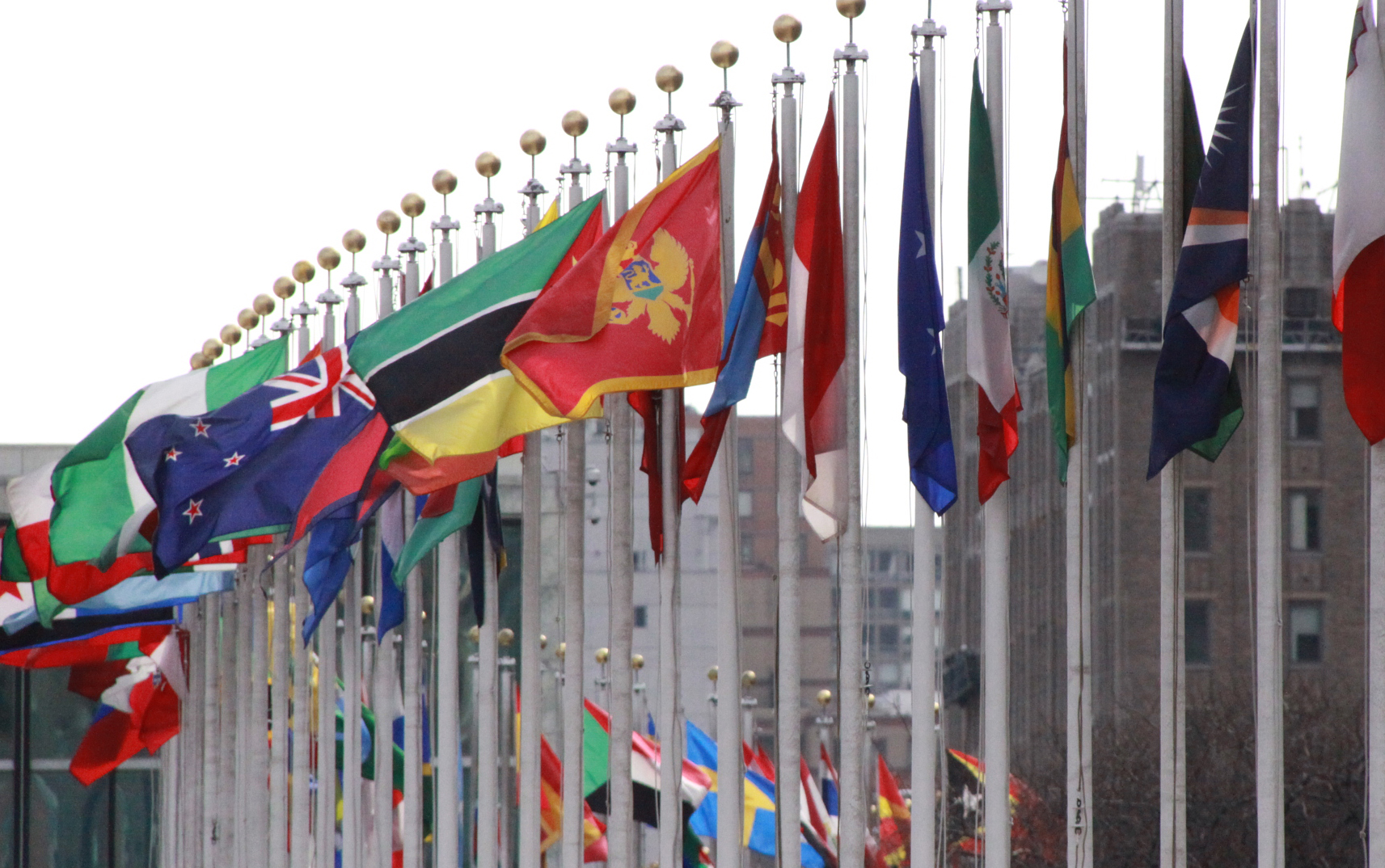
UN reform is endlessly discussed, but there is sharp disagreement on what kind of reform is needed and for what purpose.

UN ‘fit for purpose’, but it is important to ask, ‘whose purpose will it be fit for’?

Funding of all UN system-wide activities is around US$40 billion per year.

While this may seem to be a substantial sum, in reality it is smaller than the budget of New York City, less than a quarter of the budget of the European Union, and only 2.3 per cent of the world’s military expenditures.

We needs to move from ‘Billions’ to ‘Trillions.

Member States have failed to provide reliable funding to the UN system at a level sufficient to enable it to fulfill the mandates they have given it.

With the ongoing financial constraints, it has opened the space for corporate sector engagement.

Increasingly the UN is promoting market-based approaches and multi-stakeholder partnerships as the business model for solving global problems.

Driven by a belief that engaging the more economically powerful is essential to maintaining the relevance of the UN.  This practice has harmful consequences for democratic governance and general public support, as it aligns more with power centers and away from the less powerful.

Donors’ priorities are limited to humanitarian intervention to help refugees and victims of wars and conflicts and to dealing with security concerns in countries torn by wars and conflicts.

The UN working methods reflect a bygone era.

The question of how a fair sharing of costs, responsibilities and opportunities among and within countries can be achieved in formulating and implementing a Post-2015 Sustainability Agenda is overlooked.

The goal to reduce inequality within and among countries, the goal to ensure sustainable consumption and production patterns, and the goal to strengthen the means of implementation and revitalize the global partnership for development are all unattainable without funding.

The Post-2015 Agenda will only succeed if these goals include specific and time-bound targets and commitments for the rich that trigger the necessary regulatory and fiscal policy changes.

This will never happen.

The five permanent members of the Security Council (China, France, Russia, United Kingdom, and United States) enjoy the privilege of veto power. This power has been intensely controversial since the drafting of the UN Charter in 1945.

Without the veto privilege. Fifty years later, the debate on the existence and use of the veto continues, reinvigorated by many cases of veto-threat as well as actual veto use.

The UN cannot perform effectively as long as its budget remains tightly constrained.

For all the talk about auditors and oversight bodies, the UN mainly needs cash. Financial reforms must consider new ways to raise funds, including “alternative financing” such as a global system of revenue-raising must be put in place to fund genuinely international initiatives.

There is only one way to achieve this. 

By placing a world Aid Commission of 0.05% on all High Frequency Trading, on all Foreign Exchange Transactions over $20,000, on all Sovereign Wealth Funds acquisitions and on all New Drilling licences Gas/Oil.

The foreign exchange market is the largest market in the world, with an estimated $4 trillion of foreign exchange traded per day (2011).

This means that in less than one year, currency worth 25 times the global GDP is traded.

Of this massive amount, international trade in goods and services, which requires foreign exchange, accounts for only a small percentage ($9 trillion per year) of the total trading.

A commission rate ranging from 0.005 to 0.25 percent would generate between $15 and $300 billion per year, of which a substantial amount could be allocated to promote international peace and development.

Add High Frequency Trading and SWFs not forgetting Oil and Gas Drilling and you have a perpetual funded UN.

Apart from the potential to tackle inequalities and injustices worldwide, it would trigger decisive action to protect the integrity of our planet, to combat climate change, and put an end to the overuse of resources and ecosystems by acknowledging planetary boundaries and promoting the respect for nature.

This is the only real solution.

Meanwhile exchange rate speculation accounts for at least 80 percent of the global currency market. These speculative movements, which can take place rapidly and unpredictably, threaten to empty central banks’ currency reserves and trigger financial crises such as those in Mexico (1994), East Asia (1997-98), Russia (1998), Brazil (1999), Turkey (2000) and Argentina (2001).

These crises have had far-reaching socio-economic consequences, throwing millions of people into poverty and unemployment.

Unfortunately, social achievements in reality are often fragile particularly for the socially excluded and can easily be rolled back as a result of conflict (as in the case of Ukraine/Syria/ Middle East), of capitalism in crisis (in many countries after 2008) or as a result of wrong-headed, economically foolish and socially destructive policies, as in the case of austerity policies in many regions, from Latin America to Asia to Southern Europe.

In the name of debt reduction and improved competitiveness, these policies brought about large-scale unemployment and widespread impoverishment, often coupled with the loss of basic income support or access to basic primary health care.

More often than not, this perversely increased sovereign debt instead of decreasing it.

In the United States poverty increased steadily in the last two decades and currently affects some 50 million people, measured by the official threshold of US$23,850 a year for a family of four. In Germany, 20.3 percent of the population – a total of 16.2 million people – were affected by poverty or social exclusion in 2013. In the European Union as a whole, the proportion of poor or socially excluded people was 24.5 percent.

Last, but not least, rich countries tend to be more powerful in terms of their influence on international and global policy making and standard setting. Actions by international institutions like the IMF or World Bank are shaped by their governing bodies, whose composition is directly linked to the affluence of member countries.

Similar patterns exist in donor-recipient relationships or in the dynamics of international and/or inter-state negotiations.

The results can be very tangible, as in the case of the creditor-debtor-relationship between Greece and EU and IMF, or rather subtle as sometimes in the voting behavior of smaller actors in the UN Security Council.

If we are to have a global transformation, it would require not only the mobilization of the international community but also a fair sharing of costs, responsibilities and opportunities among and within the countries of the World. Include fair trade and investment regimes and migration policies, and international financial system reforms; more specifically they include the revision of bilateral and international investment agreements, the creation of a global regulatory framework for transnational corporations, greater flexibility in intellectual property rights protection for developing countries, genuine efforts to combat tax evasion and profit shifting, the creation of a debt workout mechanism for highly indebted countries as well as the reform of existing global economic governance institutions.

Not secret Trade Agreements like the TTP and the TTIP

All countries have responsibilities in this regard, but the rich have a greater responsibility given their capacity, resources and influence in international institutions and economic governance.

A UN study has estimated that about $150 billion per year is needed to meet the Millennium Development Goals, including halving the proportion of people living in extreme poverty and hunger by 2015, ensuring primary schooling for all children, and reversing the spread of HIV/AIDS, malaria and other major diseases.


The richest 85 people in the world own more wealth than the bottom half of the entire global population.

Yes, that equation works out to: 85 > 3,000,000,000.

By the end of 2016 the wealthiest 1% to own more than 50% of the world’s wealth

People everywhere want to be free to determine their own future so we must take the profit out of war and profit for profit sake.

The Conclusion can only be:  

That unless we the citizens of the Planet demand change nothing or any reform will be possible. We must make profit for profit sake provide the Funds. Take the current Climate Change Conference in Paris. With no funds any agreements to tackle the problem will be worthless.   

If you agree: Join me. Get off your rear end and get involved. ( see previous posts.)

← Back

Thank you for your response. ✨


Share this:

  • Share on WhatsApp (Opens in new window) WhatsApp
  • More
  • Share on Mastodon (Opens in new window) Mastodon

THE BEADY EYE WRITES AN OTHER OPEN LETTER TO THE PARIS SUMMIT ON CLIMATE CHANGE.

31 Monday Aug 2015

Posted by bobdillon33@gmail.com in Climate Change., Environment, European Union., Humanity., Natural World Disasters, Politics., Sustaniability, The Future, Where's the Global Outrage.

≈ Comments Off on THE BEADY EYE WRITES AN OTHER OPEN LETTER TO THE PARIS SUMMIT ON CLIMATE CHANGE.

Tags

Climate change, Distribution of wealth, Environment, Extinction, Global warming, Natural disaster, United Nations, World aid commission

31st August 2015.

Dear Delegate,

When policies on emissions reductions collide with policies focused on economic growth, economic growth will win out every time.

There is no point in spending a lovely week in Paris talking about what should be done about Climate change and coming up with an agreement to cut emissions by placing A Price Tag on carbon.

The true financial costs of climate change is away beyond any price tag or unenforceable agreement.

What value do we place on the ocean’s coral reefs and the myriad animals they support, and how do we weigh their loss against other values? What price tag do you put on a species of bird or fish or mammal which, once gone, will never return?

How does humanity weigh moral accountability if our own carbon emissions contributed to that destruction?

Isn’t it about a sustainable planet? A sustainable and biologically diverse planet?

Most likely our descendants will be left to adapt to a warmer world where greater climatic uncertainties, depleted resources and human migrations, amongst other, will be the norm.

If climate change affects not only a country’s economic output but also its growth, then that has a permanent effect that accumulates over time, leading to a much higher social cost of carbon than any price tag agreed.

The economic damage caused by a ton of carbon dioxide emissions – often referred to as the “social cost” of carbon – will actually be far higher than any of us can imagine.

There is no solution to an event that is all ready taking place.

There can only be a change to the event or a confinement to the end result.

If there is no solution to how the world is going to finance this change your and you fellow delegates might as well go home and bask in the sunshine of an agreement that is as porous as the paper it is written on.

In his fascinating book “Catastrophe: Risk and Response”, published in 2004, Richard Posner argues that we do not do enough to hedge against catastrophic risks such as climate change, asteroid impacts or bioterrorism.

In light of the “competition” of existential risks, how much should humanity invest in the mitigation of climate change?

The answer is:  Human extinction is a risk we all share—and it would be an unprecedented event that can happen only once.

Growth at all costs is the mantra of the technological world we live. Climate policies that require public sacrifice and limiting economic growth are doomed to failure.

Believe in the current pledge-and-review mechanism is a farce.

From current projections we know that climate change will pose a serious challenge by 2040 for many organisations. Putting a true economic cost on these risks can act as a catalyst to taking action today in order to help organisations better prepare for the future.

There is only one way to achieve this and that is the creation of a World Aid Commission or tax on profit   for profit sake.

Would you rather have a one percent tax increase on everyone in the country or kill one percent of the population?  This will not work as the cost of collection and administration, or culling, would out weigh any benefits.

The solution is a Universal 0.05% commission on all High Frequency Trading, on all Foreign Exchange Transactions (over $20,000) on all Sovereign Wealth Funds Acquisitions and on all Drilling Wells.  

This will create a perpetual Fund to tackle the world problems.  


The expected loss to society because of catastrophic climate change is so large that it cannot be reliably estimated.

Climate policies should flow with the current of public opinion rather than against it, and efforts to sell the public on policies that will create short-term economic discomfort. People are willing to bear costs to reduce emissions, but they are only willing to go so far.

The Dangerous Underestimation of Climate

Change’s Cost and the

financing of any agreement is self-evident.

← Back

Thank you for your response. ✨


Share this:

  • Share on WhatsApp (Opens in new window) WhatsApp
  • More
  • Share on Mastodon (Opens in new window) Mastodon

THE BEADY EYE LOOKS AT WHAT WRONG WITH THE WORLD.

28 Tuesday Jul 2015

Posted by bobdillon33@gmail.com in Humanity., Sustaniability, Technology, The Future

≈ Comments Off on THE BEADY EYE LOOKS AT WHAT WRONG WITH THE WORLD.

Tags

Climate change, Distribution of wealth, Earth, Environment, Greed, Solutions to world problems, Technology, Visions of the future.

OK, a list of what is wrong will go from here to eternity, so before you read this post take a look at the two U tube videos below, and then do something.

If you Goggle the question you will quickly find that there’s no shortage of people who know what is wrong with the world.

The most frequently cited reason is probably the decline of religion, specifically the religion of the person writing it.

Second to “the fall of religion” the most popular answer is probably “religion.” But there are other themes too: lack of respect for elders, unregulated capitalism, greed, alcohol, the economy, the rich, attachment, premarital sex, liberals, the unemployed, pride, lawyers, apathy, Starbucks, Mc Donalds.

Googling the question myself, they all sounded more like symptoms to me.

If certain behaviors are widespread and problematic, whatever causes them must be a bigger, more fundamental problem. Right? Maybe not.

Most people cannot even intelligently discuss the pressing issues of our day.

For me it is that we are too ignorant to open our minds to the problems around us. To selfish to open our hearts to what else is out in the world. To indoctrinated to accept an opinion other than our own, deaf to other people’s voices, blind to the pain and suffering we see in the streets and scared to do anything about it.

Our planet is now slowly dying and we are the reason to blame for its slow demise.

We fill her oceans with black poison. We fill her skies with acid. We cut down all the trees she spent years to grow. We cover her soil with blood and we use her as our own personal dump.

Worst of all we just sit back and watch as it falls apart.

Why?

Because as the twenty-first century unfolds, immensely powerful currents of capitalism, labour, and information turn and shape the world with a growing disregard for the boards and opinions of states.

So the world we see in front of our eyes is not governed by any particular state, organisation or ethic group, but by greed and profit. All run by the stock exchanges and algorithms

What is left is mindless adoption of technology as the end-all-be-all solution to humanity’s problems rather than global cooperation to the appearance of essentially global problems.

I think most people would not say there isn’t something wrong.

But if we’re going to regard the world as if there’s something wrong with it, shouldn’t we be able to identify it, at least with ballpark-level precision?

Here the Beady eye list of what is wrong.  Feel free to add.

Climate Change: Overpopulation: Thirst:  Poverty:  Inequality of opportunity:  Equal rights:  A lack of Education:  Terrorists:  Atomic arsenals:  Corruption:  Distribution of Wealth:  Religious Extremists: Political Extremists of Far Left & Far Right: Lying Politicians:Racists:  Class structure: Reality TV:  Farmer Subsidies:  Sexists:  Bestiality:  High Cost of Space Programmes:  Hopeless addiction to entertainment, technology, and celebrity gossip:  Soulless of suburbs, sprawls, and office parks create stress, malaise, and depression:  The existence of Hollywood, which poisons the world’s culture by normalizing narcissism, consumerism, and bad movies:  Pervasive politically correct environment where dissenting thought is labeled sexist, racist, or homophobic:  Treatment of smartphones as both friend and passionate lover, which replaces time spent in face-to-face interactions with real friends and lovers:  Universities that serve as liberal brainwashing factories instead of palaces of wisdom, enlightenment, and masculinity:  Disposable culture where still-functional items are thrown away instead of being repaired or reconditioned:  Competitive conversation culture where people talk about themselves instead of listening. Contemplative silences are looked upon as boring or even creepy:  Rule by an oligarchy that spies on citizens who don’t even care about its government’s illegal acts because they are too busy playing Candy Crush: Homosexuality openly embraced and displayed in public around children who don’t yet understand the nature of human sex:  Complete ignorance of world affairs by citizens due to being comically manipulated by media propaganda. Russia bad! Saudi Arabia good!:  People who can no longer handle original thoughts without being offended or“triggered.”: Militarization of police whose monopoly on violence allows them to taze and kill with impunity:  Welfare state that redistributes money from hard-working provider men to a growing population of single mothers who are subservient to the state instead of husbands:  Calling corporate customer service and having to converse with robots:  People who favor tweets for no apparent reason:

Out of date World Organisation are in need of radical reform.

  • For some reason THE US GOVERNMENT still thinks they should have to take care of the whole planet. The U.S. national debt is over 14 times larger than it was back in 1981:
  • OPEC nations are going to bring in over a trillion dollars from exporting oil this year:

So where do we stand in regard to Solutions.?

I would really love to hear your answer to that question, in the comment section below. Whatever comes to mind. The question does presume that there is actually something wrong with the human world. If you think there isn’t, please say so too.

Fans of singer Justin Bieber scream as he performs on NBC's Today Show in New York

I know it’s a pretty broad question, and any answer is welcome. There’s no need to do up an essay or anything, but you’re welcome to. I know Raptitude readers are a thoughtful bunch and I just want to know what kinds of ideas you people have in your minds about what’s wrong with this world.

Here are few Solutions:

Make education FREE not a product.

Place a World Aid commission of 0.05% on all High Frequency Trading, on all Sovereign wealth Funds Acquisitions, on all Foreign Exchange transactions over 20,000 dollars, creating a perpetual World aid fund. ( See previous posts) This would close down all need for Charity.

The poverty trap,” “the ladder of development”—go limp under the magnifying glass of actually being tested.

Leaders who lack wisdom approach problems with linear vision – thus only seeing the problem that lies directly in front of them and blocking the possibilities that lie within the problem. As such, they never see the totality of what the problem represents; Problem solving is the greatest enabler for growth and opportunity.

Out of this fund make available non repayable solar-panel grants. The direction to go is obvious: toward energy independence. THIS IS WHAT THE PARIS CLIMATE CHANGE SUMMIT IN PARIS SHOULD BE LOOKING AT. (https://youtu.be/qlTA3rnpgzU  Probably, a key factor, if not the key factor, in solving our environmental problem is time.

2.5bn people still lack basic sanitation and diarrhoea is the second largest killer of children. 1.1 billion people, or 15 percent of the world’s population, practice open defecation.

Parts of the world could see a supply-demand gap of up to 65% IN WATER RESOURCE BY 2030. Currently, more than one billion people don’t have access to clean water. And with 70 percent of the world’s freshwater used for agriculture, water’s critical role in food production must be considered as climate and resource conditions change.

Reform the United Nations giving equal rights to all Nations.

Legalism of Soft Drugs would reduce the prison population.

Re Introduce National Service to deliver dignity not war.

People think about their own perceived world and part of the challenge is to get people out of that world.

The question now for all of us in the 21st century is will we realize that this is indeed an urgent problem and take bold enough action in sufficient time? The answer to this question is yet to be given.

Here lies the land of technology opportunity, a place where the upside of technology benefits is enormous and world changing.” We’re just the technologists. And actually I think those questions are for society as a whole.” Wrong.

What would happen if we applied our knowledge and skills in these pockets with the resources, creativity and speed of giants like Google and Apple? Let’s give it a try. Let’s encourage our biggest companies to tackle some of the world’s biggest problems. Let’s apply technology tools like hackathons and lab days and rapid prototyping toward solving social and environmental issues. Let’s do some good.”Résultat de recherche d'images pour "pictures of the world"


← Back

Thank you for your response. ✨

Share this:

  • Share on WhatsApp (Opens in new window) WhatsApp
  • More
  • Share on Mastodon (Opens in new window) Mastodon

The Beady Eye, Looks at Our Common Future Under Climate Change.

01 Monday Jun 2015

Posted by bobdillon33@gmail.com in Climate Change., Environment, The Future

≈ Comments Off on The Beady Eye, Looks at Our Common Future Under Climate Change.

Tags

Capitalism vs. the Climate., Climate change, global climate change

The hope of the twentieth century rests on its recognition that war and depression are man-made and needless as is so with Climate Change.

Over the past 50 years, humans have changed ecosystems more rapidly and extensively than in any comparable period of time in human history, largely to meet rapidly growing demands for food, fresh water, timber, fiber and fuel.

All can be avoided in the future by turning from … nineteenth-century characteristics … and going back to other characteristics that our Western society has always regarded as virtues: generosity, compassion, cooperation, rationality, and foresight, and finding an increased role in human life for love, spirituality, charity, and self-discipline.

We now know fairly well how to control the increase in population, how to produce wealth and reduce poverty or disease. We may, in the near future, know how to postpone senility and death but to what avail if we continue to deny Climate Change.

It certainly should be clear to those who have their eyes open that violence, extermination, and despotism do not solve problems for anyone and that victory and conquest are delusions, as long as they are merely physical and materialistic.

Our problem is that capitalism provides very powerful motivations for economic activity because it associates economic motivations so closely with self-interest.

Money and goods are not the same thing but are, on the contrary, exactly opposite things. Most confusion in economic thinking arises from failure to recognize this fact.

Goods are wealth which you have, while money is a claim on wealth which you do not have. Thus goods are an asset; money is a debt.

You would think that policymakers with the dark future of Climate Change ahead would be addressing a new set of existential questions.

Such as: Should Economics that grew wealth bear more of the burden to stop climate change.  Another words developed countries should take the lead allowing less developed countries to maintain emissions.

As we all know to date no international mitigation and abatement efforts have taken place on a large enough scale to freeze emissions. We don’t see any intense geopolitical cooperation. Countries will not do anything on behalf of other that requires them to sacrifice their own interests.

Off course when you introduce future generations into the question democracy as it stands is not equipped to represent the interests of future generations never mind the here and now. Humans that don’t exist have no say as to what will it mean to live a meaningful life in a world that has eliminated all wildness, and forms of life from the planet.

So here we are poised to become agent of the greatest catastrophic events ever to hit our planet which could have to support over 10 billion people by 2050.

We are currently on a trajectory to warm the planet 4°C. In such a 4ºC world most of us will not be able to adapt never mind our natural systems.

As we move beyond the stable state we are already well beyond the zone of uncertainty.  The risk for all species – including ours- grow and grow.

planetary boundaries

We need to start thinking in terms that we are just not used to thinking of as a human species.

Will it be left to the market to decide.  With businesses as hubs for democratic engagement this could unfairly shift costs onto either consumers or taxpayers.

I’m not convinced.. that we’ve ended up with a society that’s really able to harness the innovation potential of business.

Climate change challenges democracy. But climate change also needs democracy.

We live in a carbon dependent world. And for the most part, we are loath to forego this somewhat cosy arrangement. Carbon dependency is promoted in part by technology which gives us many good things on the cheap: electricity, personal mobility, affordable consumer goods, cooling and warmth. It is also encouraged by governments which promise easy options to low-carbon outcomes, without delivering these options. And for the most part, we do not seem to care, as the goodies continue to arrive.

We all know in our hearts that this is a cop out: we are duped but we connive in the deceit. Democracy is not a system that forces us to face up to these contradictions. We want to live in a sustainable society but the political system does not reward or support the innovators and entrepreneurs who would guide us to it.

Political institutions manipulate us, as do the power brokers who shape political opinion and guide policy.  Democracy shuns the long-term.

The goal of equipping democracy to mitigate and adapt to climate change is not a one-time endeavor but a continuous process.

Today, the formerly contented European middle classes, sitting in the gap between the rich minority and the poor majority, for the first time in living memory cannot be sure their children will be better off than they are. Confronted by this austere prospect, this group – the natural allies of climate stability – will become unsettled.

The world’s nations are desperately looking for guaranteed techno-fixes to climate change. Democracy around the world has suffered as governments seek to lean on eco-technocrats to cut back on investment in education and health and invest instead in technology for climate mitigation and adaptation.

I really do believe that people can provide the answers – if only we could unleash the real power of that creative potential. Environmental innovation has to be about much more than technology. I’ve realized that, and I’m going to make it my business to ensure that as many other people as possible do too.

So where best to start than requesting your Television Stations to highlight Climate Change in their Weather Forecast.   Join me. This is a war against no enemy other than ourselves.

← Back

Thank you for your response. ✨

Share this:

  • Share on WhatsApp (Opens in new window) WhatsApp
  • More
  • Share on Mastodon (Opens in new window) Mastodon

The clock is ticking for: A new world DISASTER AID REACTION Organisation.

03 Sunday May 2015

Posted by bobdillon33@gmail.com in Natural World Disasters, WORLD POVERTY WHERE'S THE GLOBAL OUTRAGE

≈ 2 Comments

Tags

Aid, “Forgotten” disasters, Climate change, Natural disaster, United Nations

On January 12, 2010, a 7.0-magnitude earthquake struck Haiti, affecting more than 3 million people — one of every three. The quake killed 222,570 people and injured more than 300,000. More than 1 million people were left homeless and vulnerable.

On August, 2005, Hurricane Katrina hit the Gulf of Mexico and various Southern regions of the United States. A 100,000 people were displaced. 10,000 originally feared dead — revised down by government.

On March 11, 2011, a tsunami some 40 meters (133 feet) high hit northeast coast of Japan.15,000 people were killed, 300,000 were evacuated, and 3,100 people are still unaccounted for. A nuclear emergency was triggered in the Fukushima area.

On April 25,2015 a 7.8-magnitude earthquake rocked the south-central Asian country of Nepal. 8 million people have been affected by the quake. To date the death toll is above 6,000.

Extreme disasters catch the public eye, often resulting in massive infusions of aid that affect not just individual well-being but the fabric of societies.

What I want to address here is  (with the predicted effects of Climate Change we are going to witness a massive increase in natural disaster world-wide) how if any of our various UN organizations are in a position to meet the challenges that lie ahead: (World Food Program, World Health Organisation, Relief Web, UNICEF, Oxfam International, International Federation of Red Cross, Red Crescent Societies, International Rescue Committee, Medicins Sans Frontiers, Doctors Without Boards) to mention just a few.

And the question I want an answered to is:  How do we evaluate their efficacy.

Understanding and analyzing the organization of aid delivery is essential to evaluating aid efficacy. Disaster relief projects involve multiple parties in different organizational configurations delivering in-kind aid, where each party has distinct objectives.

The behavior of an aid agency that operates on the ground is a composite outcome of the organizational structure of the donating and implementing arms.

Depending on how that organization is set up, the quality of hard aid and the delivery of social agendas may vary considerably within the same disaster area. Donors face potential trade-offs between higher quality aid, pursuit of certain social agendas, and paying the cost to do their own implementation.

In a nutshell, industry and private donations are feel-good, short-term interventions and no substitute for the vastly larger, and essentially political, task of bringing aid to poor people in need.

It is the long-term Recovery phase of disaster which places the most severe financial strain on local or state.

The needs of the poor don’t get met because the poor have little money or political power with which to make their needs known and they cannot hold anyone accountable to meet those needs. They are stuck with Planners. The … tragedy [of failed foreign aid] continues.

A big part of the problem originates with the rich-country governments who set the mandates of the aid agencies. ( See previous post: Roughly half of global aid – is phantom aid or The Clock is ticking for a New World Aid Organisation)

I hardly think your/our measly donations to charity are worth talking about;

Media coverage of natural disasters seems to vary a lot depending on the disaster. Is it selective?

An Example is the Present Nepal Disaster lasted three days on the top of the BBC news.

It was replaced by a Royal princess presented to world. One new life against thousands lost.

If you compare what the new born Royal can expect from life to the 360,000 other children all born on the same day elsewhere in the world.

〈 While the Duke of Cambridge does not receive money directly from the Sovereign Grant ( that’s £35.7m the taxpayer gives to the Royal Family each year), he does receive from the Queens Grant-in-Aid fund and the Duchy of Cornwall (the tax-exempt estate valued at £763m in 2013 with an annual income of £19m, bestowed on the family in 1337) , the surplus of which traditionally goes to the eldest son ( i.e. Prince William). If you break that £19m down into a a weekly rate, the Duke and Duchess of Cambridge can expect a share of £365,384.61, compared to the £34.40 ( combined Child Benefit for two babies) for the average family in the UK. 〉 

There is certainly no need for any Aid.

It does not take long in this days media world for Disasters to become Forgotten

 “Forgotten” disasters are often chronic and diffuse, changing little day by day. Unlikely to qualify as news, such crises may feature as current affairs stories – especially on the websites of news organizations.

It is more than obvious that if we are to manage the pending Disasters ( And there will be many).

We need one Organisation under one roof to handle all aspects.

Examine the whole process/system/operation of providing relief supplies in a disaster scenario. Think of total packaging re-use of all materials and containers from the shipping/air container onwards.

This can be achieved by all the world aid organisations assembling at a World Response Aid conference to form a One World Response/Reaction Team.

This conference should present the UNITED NATIONS WITH A RESOLUTION TO PLACE: a 0.05% AID COMMISSION ON ALL HIGH FREQUENCY STOCK EXCHANGE TRANSACTIONS ON ALL FOREIGN EXCHANGE TRANSACTIONS (OVER $20,000) AND ON ALL SOVEREIGN WEALTH FUNDS ACQUISITIONS)

This resolution could be adopted by a its veto members without lost of power.

Instead of holding aid agencies individually responsible for what they own program achieve, we would have Instead of letting different agencies specialize in different areas we would have Capitalism for once WOULD contributing to the world by creating a perpetual fund, giving the reaction team total independence.

IT WOULD ONLY TAKE A COMPUTER PROGRAM TO COLLECT THE FUNDS.

We would have global goals. Instead of letting different agencies specialize in different areas we would have coordination.

Instead of wasting aid and relief to victims of natural disasters there would be a professional action PLAN IN PLACE THAT COULD BE ACTIVATED NOT TO SET UP BY A BEGGING BOWL.

  ‘How did the rich countries really become rich?’

The short answer to this question is that the developed countries did not get to where they are now through the policies and the institutions that they recommend to developing countries today.

  • In 1970, rich countries of the OECD agreed at the United Nations (Resolution 2626) to give 0.7% of their GNP (now GNI) as aid to the developing countries.
  • Known as ODA, this aid would be for long-term development.
  • Over 40 years on, most of the 20 or so rich OECD countries have never reached that figure, or come close.

Annually, the global foreign aid shortfall is high.

Although rich countries have given an enormous $3.62 trillion dollars in aid since 1970, the accumulated total shortfall in their aid since 1970 (when the target of 0.7% was set) amounts to $4.98 trillion (at 2012 prices).

Don’t tell me that it is not time for change INORDER to save lives when the next natural disaster strikes.

← Back

Thank you for your response. ✨

Share this:

  • Share on WhatsApp (Opens in new window) WhatsApp
  • More
  • Share on Mastodon (Opens in new window) Mastodon

Life goes on.

01 Friday May 2015

Posted by bobdillon33@gmail.com in Environment

≈ Comments Off on Life goes on.

Tags

Climate change, Earth, en, Environment, environmental degradation, Extinction, Natural disaster

While the scary numbers pile up.

The state of the Planet hit several remarkable records.Earth From Moon Wallpaper Hd Earth from moon hd crescent

The amount of carbon dioxide gas hits the highest level in at least the last 800,000 years.

The Arctic Ice since satellite records is at it lowest. 13.3% per decade.

We dump 19.4 billion pounds of plastic into our oceans every year.

An estimated 18 million acres of forest are lost each year.

We will be facing a 40% shortfall in water supply by 2030.

Climate change-related extreme events, plus population growth, could increase hunger by up to 20% by 2050.

What are we doing about it. Not much that will make a difference. Curbing emissions which is a joke wont be enough to halt a looming climate catastrophe.

When you take something out of the Earth, you need to put something back in.

The Selfish wasteful ways of Capitalism combined with modern humans is destroying the very planet we all have to live on.

Thoughtless mindless use of its limited resources for short-term profit, and the use of pesticides and there like is destroying life forms that took million of years to appear on our planet.

We all know the interconnectedness of all life. The we’re here, we’re powerful with nuclear weapons , we’ve got the technology, we therefore are entitled to every dame thing on this planet, is at the root of much of our problems.

Perhaps our current ecological crisis is telling us that something is wrong with our relationship with ourselves, with others, and earth.

The Dangers are clear.

We all want to live.

Without a reverence for all life that lives in the midst of other life we the brainy ones will be going no further than the moon, space station or not. 

If you are interested there are plenty of previous post covering a verity of subjects interconnected to this post.

← Back

Thank you for your response. ✨

Share this:

  • Share on WhatsApp (Opens in new window) WhatsApp
  • More
  • Share on Mastodon (Opens in new window) Mastodon

We’re all gonna die!! Life on Earth has only 1.75 billion years left

08 Sunday Feb 2015

Posted by bobdillon33@gmail.com in Uncategorized

≈ Comments Off on We’re all gonna die!! Life on Earth has only 1.75 billion years left

Tags

Climate change, Disaster., Earth, environmental degradation, Human influences., The Future of Mankind

Sorry for the over the top headline but Scientists have done the maths and according to their calculations, life on Earth has 1.75 to 3.25 billion years left to thrive.

Even short geologic time scales outrun our ability to project human history.

One common, frequently unconscious misconception is that history is linear, progressing toward an inevitable end point.

Our inability to see ourselves as part of a continuum of processes that will continue into the future is also directly linked to our shortsightedness in managing our environment. Human impacts already equal or surpass many natural processes. For example, human earth-moving processes exceed natural erosion in the volume of material moved (Hooke, 2000; Wilkinson, 2005).

Let’s peer into the future.  The reasons for disaster are not hard to conjecture.

Technology might become so advanced that humans will no longer need to modify the natural environment extensively, but any attempt to predict technology far in advance is bound to be almost pure speculation.

Space Weather (which includes any and all conditions and events on the sun, in the solar wind, in near-Earth space and in our upper atmosphere)  can affect space-borne and ground-based technological systems and through these, human life and endeavor.  Not to mention Yellowstone National Park that could decide to erupt.

Even if humans avoid causing a mass extinction, many species will have become naturally extinct and new ones will have evolved.

The truth is we don’t have a particularly detailed idea of what is going on inside out own planet never mind on the surface.

When the Earth’s molten core eventually cools and hardens to the point that there is little or no slip-sliding of different substances, it more than likely its magnetic field will die out as well. The Earth is thought to have begun this cooling sometime in the last billion years.

That’s good, since one way or the other we certainly have a lot of time left; while a magnetic flip is largely meaningless, magnetic death certainly would not be.

In all likelihood, the Sun will swallow the Earth long before then, as it convulses and expands as a part of its natural death throes and that’s if a giant asteroid or a nuclear war doesn’t finish us off first.

However the 92.9 million miles between us and our host star will not be enough to keep us comfortable.

For those of you that need to use Google the Sun is a magnetic variable star at the center of our solar system that drives the space environment of the planets, including the Earth. The distance of the Sun from the Earth is approximately 93 million miles. At this distance, light travels from the Sun to Earth in about 8 minutes and 19 seconds. The Sun has a diameter of about 865,000 miles, about 109 times that of Earth. Its mass, about 330,000 times that of Earth, accounts for about 99.86% of the total mass of the Solar System. About three-quarters of the Sun’s mass consists of hydrogen, while the rest is mostly helium. Less than 2% consists of heavier elements, including oxygen, carbon, neon, iron, and others. The Sun is neither a solid nor a gas but is actually plasma. This plasma is tenuous and gaseous near the surface, but gets denser down towards the Sun’s fusion core.

Where was I?  The earth will become inhospitable to humans long before the planet enters the hot zone ( Stars like our Sun shine for nine to ten billion years. The Sun is about 4.5 billion years old, judging by the age of moon rocks. Based on this information, current astrophysical theory predicts that the Sun will become a red giant in about five billion (5,000,000,000) years.  So there is not much to worry about.

However I am pushing on in years and I often wonder how my generation will survive the impending climate crisis never mind the future of our planet. There is a tragic alienation between us and nature.

There’s not much money in the end of civilization, and even less to be made in human extinction.” The destruction of the planet, on the other hand, is a good bet, because there is money in this, and as long as that’s the case, it is going to continue. The amount we consume each year already far outstrips what our planet can sustain, and the World Wildlife Fund estimates that by 2030 we will be consuming two planets’ worth of natural resources annually.

Over the course of this century, the relationship between the human world and the planet that sustains it has undergone a profound change. When the century began, neither human numbers nor technology had the power radically to alter planetary system.

We know that in two billion years or so, an expanding sun will boil away our oceans, leaving our home in the universe uninhabitable—unless, that is, we haven’t already been wiped out by the Andromeda galaxy, which is on a multi billion-year collision course with our Milky Way. Moreover, at least a third of the thousand mile-wide asteroids that hurtle across our orbital path will eventually crash into us, at a rate of about one every 300,000 years.

Perhaps Google is a good idea after all to prepare a copy of our civilization and move it into outer space and out of harm’s way—a backup of our cultural achievements and traditions.

There is hope on the horizon during my Nuclear Warheads reading ( See The Series of Posts) I learned that a regional nuclear war between India and Pakistan could decrease global surface temperature by 1°C–2°C for 5–10 years and have major impacts on precipitation and solar radiation reaching Earth’s surface. No much help. We will hit the average of 400 ppm…within the next couple of years.  Arctic permafrost soils have accumulated vast stores of organic carbon—an estimated 1,400 to 1,850 pentagrams of it (a pentagram is 2.2 trillion pounds, or 1 billion metric tons). That’s about half of all the estimated organic carbon stored in Earth’s soils.

In the short-term, we need to make it in the economic interests of people to do the right thing. The chances of that happening in a Capitalist world I will leave up to yourself to decide. 

Here is what is happening.

The signs of a worsening climate crisis are all around us, whether we allow ourselves to see them or not.

Unintended changes are occurring in the atmosphere, in soils, in waters, among plants and animals, and in the relationships among all of these.

Life-threatening challenges of desertification, deforestation, and pollution, of toxic chemicals, toxic wastes, and acidification of carbon dioxide and of gases that react with the ozone layer, and from any future war fought with the nuclear arsenals including increasingly powerful floods, droughts, wildfires, heat waves, and storms are underway.  Evacuations from low-lying South Pacific islands have already begun.

The onslaught of droughts, earthquakes, epic rains and floods over the past decade is triple the number from the 1980s and nearly 54 times that of 1901, when this data was first collected.

Yet we are aware that such a re-orientation on a continuing basis is simply beyond the reach of present decision-making structures and institutional arrangements, both national and international and endure most of the poverty associated with environmental degradation.

The rate of change is outstripping the ability of scientific disciplines and our current capabilities to access and advise. It is frustrating the attempts of political and economic institutions, which evolved in a different, more fragmented world, to adapt and cope.

This planet has not experienced an ice-free Arctic for at least the last three million years. Guy McPherson, professor emeritus of evolutionary biology, natural resources, and ecology at the University of Arizona ” the implications are truly dire and profound for our species and the rest of the living planet.”

We are currently in the midst of what scientists consider the sixth mass extinction in planetary history, with between 150 and 200 species going extinct daily, a pace 1,000 times greater than the “natural” or “background” extinction rate.

The ability of the human psyche to take in and grasp such information is being tested. And while that is happening, yet more data continues to pour in—and the news is not good.

Thanks to climate change oceans have already lost 40 percent of their phyto plankton, the base of the global oceanic food chain, because of climate-change-induced acidification and atmospheric temperature variations.

So you might well ask if some version of extinction or near-extinction will overcome humanity.

It deeply worries many people who are seeking ways to place those concerns on the political agendas. 

Climate-change-related deaths are already estimated at five million annually,

We’ve still got plenty of time left to enjoy planet Earth but we need to know how to respond, to changes that are already happening—and to those coming in the near future. It’ll happen very fast. 

It appears that there is not much hope for the future, nor for a governmental willingness to make anything close to the radical changes that would be necessary to quickly ease the flow of greenhouse gases into the atmosphere; nor can we expect the mainstream media to put much effort into reporting on all of this because we are all more interested in leaving a legacy of material wealth that will be totally worthless.

Read more at: http://phys.org/news/2013-08-scientists-earth-deep-future-effects.html#jCp

Climate change and other human influences are altering Earth’s living systems in big ways, such as changes in growing seasons and the spread of invasive species,”

Read more at: http://phys.org/news/2013-08-scientists-earth-deep-future-effects.html#jCp

← Back

Thank you for your response. ✨


Share this:

  • Share on WhatsApp (Opens in new window) WhatsApp
  • More
  • Share on Mastodon (Opens in new window) Mastodon

At Long Last a World Figure Speaking the Truth:

27 Thursday Nov 2014

Posted by bobdillon33@gmail.com in Uncategorized

≈ Comments Off on At Long Last a World Figure Speaking the Truth:

Tags

Climate change, European Union, Pope Francis, Syria, Tony Blair

The other day Pope Francis addressed the Strasbourg Parliament.

Pope Francis addresses the European Parliament

In his speech he referred to the European Union as an Institution/ Organisation run by aloof and opulent leaders that treat their citizens as cogs in a machine. ” They have forgotten how to talk about anything but economics, and treat people as humans beings”

He went on to Call the Europe a ” Barren Grandmother” run by bureaucratic technicalities of Institutions.

How right he is.

When technology is allowed to take over there is a confusion between ends and means. This can be seen in all aspects of present day life. The inevitable consequence of throwaway culture and uncontrolled consumerism.

He believes that people of faith must build bridges from one community to another, and from the present to a future of peace, tolerance and goodwill.

Another words prosperity and dignity for all in a world where humankind lives in harmony with nature. He is not the first or will he be the last to have this aspiration.

Never before has man had such capacity to control his own environment: to end thirst and hunger; to conquer poverty and disease, to banish illiteracy and massive human misery. We have the power to make this the best generation of mankind in the history of the world—or to make it the last.”

What we have is a world faces multiple crises with most if not all of our world organisations out of date and in dire need of reform. ( See previous Posts.)

Conflict continues to rage in Syria, Iraq and beyond. The Ebola virus continues its deadly grip on West Africa. Threats such as drug trafficking, transnational crime and terrorism are growing in intensity and feeding off each other.

Today’s pre-eminent powers seem to have forgotten that they are elected by the people for the people not the Economy. They need to go back to Basics before we all forced to do business in a new way.

Climate change is the defining issue of our time. We can no longer afford to burn our way to prosperity and we cannot eradicate extreme poverty without fighting climate change. We must all act – as individuals, communities, businesses and governments – individually and together to transform our world. Lives of innocent people are being claimed in unacceptable numbers from Syria to Iraq, from Ukraine to the Central African Republic and South Sudan. Children are being drawn into conflict and kidnapped simply for wanting to learn to read and write.

There is no good in verbalizing these challenges we must surmount them, or together we will suffer the consequences of inaction. We need change in mindset from one of arguing over dividing the work, to one where we all do the maximum that we can, always asking, What more can we do.

The first concrete commitment of any Government be to ensure that any economy gains are inclusive of all its people not the Privatization of its peoples rights to clean water, to clean sustainable energy, to affordable health, education, and public transport. Not to manufacturing arms, bailing out Banks.

Multinational corporations search the globe for the lowest possible labor costs and weakest environmental safeguards. It is not unusual for them to get help from governments that compete in the global marketplace by refusing to protect their citizens from environmental degradation and workplace abuse—ranging from below-survival wages to physical attacks.

Take Immigration as an example.  View by the economy as useful only to grow the economy. A form of modern-day slavery labor that leads to social tensions, as you can see in Great Britain.

Global economy is the exchange of goods and services integrated into a huge single global market that ignores and is blind to the unheard voices.

Copernicus the father of modern-day Astronomy taught the Vatican that the center of the Universe was not earth. Pope Francis has just discovered that the Ten Commandants have to be voiced to be heard.

When you boil down all the valiant words they all fall on deaf ears, and will continue doing so till you and I learn to vote with our wallets, and demand change with our Smart phones.( see post;  what a 0.05% aid commission on all High frequency trading, Sovereign wealth funds and foreign exchange transactions could achieve.) We deserve to do more than just survive.

He did not mention the Hippocratic disease that is spreading throughout our world leaders. Sell arms with one hand and give aid with the other.

This Disease now seems to have spread to a world charity Save the Children how recently awarded Mr Blair a Legacy award.

The Iraq war, George W Bush and Tony Blair – est killed – 500,000. The Syria’s civil war more than doubled in the past year to at least 191,000.

They say that Sarcasm is the lowest for of wit. For such a well supported Charity that does excellent work you would think that with the sadness they see in the world they could pick some one deserving of a Legacy.

Here is a list of some well known people that perhaps they might consider giving a retrospective legacy award too >

Mao Ze Dong         –  killed – 49 – 78,000,000

Adolf Hitler           –  killed   12,000,000

Stalin                   –  killed   7,000,000

Lenin                    – killed       30,000

Pol Pot                  –  killed   1,700,000

IDI Amin                – killed        300,000

Castro                   – killed       30,000                   (All to depressing.)

Milosevic                – killed      100,000

Saddam Hussein   – killed       600,000

Mugaba                  – killed       20,000

Bin Laden               – killed         3,300

 If you want to get a grip of what humanity is have a look the below Videos.. which you might not have viewed. 

Marshallese poet Kathy Jetnil-Kijiner speaks on behalf of civil society during the opening ceremony of the UN Climate Leaders Summit in New York City. Check out this high-quality version of Kathy’s poem with footage of climate action around the world: https://www.youtube.com/watch?v=DJuRj…

http://youtu.be/L4fdxXo4tnY

 http://youtu.be/DIIrrPyK0eU

Shanghai   The best cruises for 2014

Aerial night view of Liverpool Street on August 6, 2007 in London.    Tokyo at night

← Back

Thank you for your response. ✨

Share this:

  • Share on WhatsApp (Opens in new window) WhatsApp
  • More
  • Share on Mastodon (Opens in new window) Mastodon

What is prevents us from collaborating in a global effort to solve the climate crisis?

02 Sunday Nov 2014

Posted by bobdillon33@gmail.com in Uncategorized

≈ Comments Off on What is prevents us from collaborating in a global effort to solve the climate crisis?

Tags

Capitalistic Societies, Climate change, Distribution of wealth, Environment, Extinction, Global warming, Inequility, Sovereign wealth fund, United Nations

The expression, not a hope in hell comes to mind when you consider the likelihood of human beings working together. Human beings are deeply divided by nationality, and sectarian belief and the environmental crises.

Most Societies that have perished have done so through neglect and self delusion; they have failed to rise to the challenges they faced.

It is much more difficult to understand human history than to understand problems in the field of science. But do we see the historical of human societies shaping the modern world?

No.

Instead the great majority of us are passive robots helplessly programmed by  the Media, must have advertising, short-term memory, and the capitalist mantra I am all right Jack.

Why?

If we were serious about caring for the world, about people living in the misery of poverty, now and about future generations we should be mobilizing resources to develop sustainable technologies with the single mind determination seen when countries prepare for war.

So riddle me this; While it is with you, it is with me. It flies without wings.

While it flies, our out of date World Organisations struggling to function in a quagmire of power struggles all disguised by the cloaked language of Foreign Policies.

While our Capitalistic Societies is encouraged to consume 24/7 in order to drive our economies of the sake of vast profit made by computer algorithms.

While our real values are being privatized by Sovereignty Wealth Funds.

While mass immigration will be the result of ignoring Climate change.

While population growth is unstoppable.

While inequality is leading to conflicts.

While the effects of antibiotics are becoming diluted.

While Social media is distorting the truth.

While extinction of animal life accelerates.

While we spend trillions on space exploration.

While we watch our finite resources diminish.

While we all see are the pictures of the world below,

.     JAN GOLDSTEIN    

Is it not time to do something before Inequity and Greed the two elements that contribute the most to the Worlds problems, destroy us all long before Climate Change.  We can talk till the cows come home, but all our Political ideologies will fail till the distribution of wealth gains traction, which can only be achieved by Capping Greed.

Conventional wisdom’s seldom collapse on their own. They collapse only when challenged, only when advocates for change trust forward initiatives that expose the bankruptcy of the conventionally wise.

(See previous posts. What 0.05% Aid Commission could achieve)

Feel free to add to the while lists, perhaps someone in a while might read it before time runs out.

← Back

Thank you for your response. ✨

Share this:

  • Share on WhatsApp (Opens in new window) WhatsApp
  • More
  • Share on Mastodon (Opens in new window) Mastodon
← Older posts
Newer posts →

All comments and contributions much appreciated

  • THE BEADY EYE SAYS: AS A SPECIES WE HUMANS ARE SLOWLY LEARNING THAT CHANGE IS ESSENTIAL BEFORE ARTIFICIAL INTELLIGENCE MAKES US ALL DIGITAL SLAVES. September 17, 2026
  • THE BEADY EYE SAYS. EVERY THING AND I MEAN EVERY THING THATS PRODUCED BY ARTIFICIAL INTELLIGENCE MUST BE IDENTIFIED. September 7, 2026
  • THE BEADY EYE ASKS. ARE YOU A MEAT PROXIE? August 28, 2026
  • THE BEADY EYE SAYS BEFORE ITS TOO LATE WE MUST BUILD A GLOBAL FRIENDLY FUTURE. August 21, 2026
  • THE BEADY EYE SAYS. August 20, 2026

Archives

  • September 2026
  • August 2026
  • July 2026
  • June 2026
  • May 2026
  • April 2026
  • March 2026
  • February 2026
  • January 2026
  • December 2025
  • November 2025
  • October 2025
  • September 2025
  • August 2025
  • July 2025
  • June 2025
  • May 2025
  • February 2025
  • January 2025
  • December 2024
  • November 2024
  • October 2024
  • September 2024
  • August 2024
  • July 2024
  • June 2024
  • May 2024
  • April 2024
  • March 2024
  • February 2024
  • January 2024
  • December 2023
  • October 2023
  • September 2023
  • August 2023
  • July 2023
  • June 2023
  • May 2023
  • April 2023
  • March 2023
  • February 2023
  • January 2023
  • December 2022
  • November 2022
  • October 2022
  • September 2022
  • August 2022
  • July 2022
  • June 2022
  • May 2022
  • April 2022
  • March 2022
  • February 2022
  • January 2022
  • December 2021
  • November 2021
  • October 2021
  • September 2021
  • August 2021
  • July 2021
  • June 2021
  • May 2021
  • April 2021
  • March 2021
  • February 2021
  • January 2021
  • December 2020
  • November 2020
  • October 2020
  • September 2020
  • August 2020
  • July 2020
  • June 2020
  • May 2020
  • April 2020
  • March 2020
  • February 2020
  • January 2020
  • December 2019
  • November 2019
  • October 2019
  • September 2019
  • August 2019
  • July 2019
  • June 2019
  • May 2019
  • April 2019
  • March 2019
  • February 2019
  • January 2019
  • December 2018
  • November 2018
  • October 2018
  • September 2018
  • August 2018
  • July 2018
  • June 2018
  • May 2018
  • April 2018
  • March 2018
  • February 2018
  • January 2018
  • December 2017
  • November 2017
  • October 2017
  • September 2017
  • August 2017
  • July 2017
  • June 2017
  • May 2017
  • April 2017
  • March 2017
  • February 2017
  • January 2017
  • December 2016
  • November 2016
  • October 2016
  • September 2016
  • August 2016
  • July 2016
  • June 2016
  • May 2016
  • April 2016
  • March 2016
  • February 2016
  • January 2016
  • December 2015
  • November 2015
  • October 2015
  • September 2015
  • August 2015
  • July 2015
  • June 2015
  • May 2015
  • April 2015
  • March 2015
  • February 2015
  • January 2015
  • December 2014
  • November 2014
  • October 2014
  • September 2014
  • August 2014
  • July 2014
  • June 2014
  • May 2014
  • April 2014
  • March 2014
  • February 2014
  • January 2014
  • December 2013
  • November 2013
  • October 2013

Talk to me.

benmadigan's avatarbenmadigan on THE BEADY EYE LOOKS AT THE EXP…
Jason Lawrence's avatarJason Lawrence on THE BEADY EYE ASK’S: WIT…
benmadigan's avatarbenmadigan on THE BEADY EYE ASK’S: WHA…
bobdillon33@gmail.com's avatarbobdillon33@gmail.co… on THE BEADY EYE SAYS: WELCOME TO…
Ernie's avatarOG on THE BEADY EYE SAYS: WELCOME TO…

7/7

Moulin de Labarde 46300
Gourdon Lot France
0565416842
Before 6pm.

My Blog; THE BEADY EYE.

My Blog; THE BEADY EYE.
bobdillon33@gmail.com

bobdillon33@gmail.com

Free Thinker.

View Full Profile →

Follow bobdillon33blog on WordPress.com

Blog Stats

  • 104,525 hits

Blogs I Follow

  • unnecessary news from earth
  • The Invictus Soul
  • WestDeltaGirl's Blog
  • The PPJ Gazette
Follow bobdillon33blog on WordPress.com

The Beady Eye.

The Beady Eye.
Follow bobdillon33blog on WordPress.com

Create a free website or blog at WordPress.com.

unnecessary news from earth

WITH MIGO

The Invictus Soul

The only thing worse than being 'blind' is having a Sight but no Vision

WestDeltaGirl's Blog

Sharing vegetarian and vegan recipes and food ideas

The PPJ Gazette

PPJ Gazette copyright ©

Privacy & Cookies: This site uses cookies. By continuing to use this website, you agree to their use.
To find out more, including how to control cookies, see here: Cookie Policy
  • Subscribe Subscribed
    • bobdillon33blog
    • Join 222 other subscribers
    • Already have a WordPress.com account? Log in now.
    • bobdillon33blog
    • Subscribe Subscribed
    • Sign up
    • Log in
    • Report this content
    • View site in Reader
    • Manage subscriptions
    • Collapse this bar