We’re all gonna die!! Life on Earth has only 1.75 billion years left

Tags

, , , , ,

Sorry for the over the top headline but Scientists have done the maths and according to their calculations, life on Earth has 1.75 to 3.25 billion years left to thrive.

Even short geologic time scales outrun our ability to project human history.

One common, frequently unconscious misconception is that history is linear, progressing toward an inevitable end point.

Our inability to see ourselves as part of a continuum of processes that will continue into the future is also directly linked to our shortsightedness in managing our environment. Human impacts already equal or surpass many natural processes. For example, human earth-moving processes exceed natural erosion in the volume of material moved (Hooke, 2000; Wilkinson, 2005).

Let’s peer into the future.  The reasons for disaster are not hard to conjecture.

Technology might become so advanced that humans will no longer need to modify the natural environment extensively, but any attempt to predict technology far in advance is bound to be almost pure speculation.

Space Weather (which includes any and all conditions and events on the sun, in the solar wind, in near-Earth space and in our upper atmosphere)  can affect space-borne and ground-based technological systems and through these, human life and endeavor.  Not to mention Yellowstone National Park that could decide to erupt.

Even if humans avoid causing a mass extinction, many species will have become naturally extinct and new ones will have evolved.

The truth is we don’t have a particularly detailed idea of what is going on inside out own planet never mind on the surface.

When the Earth’s molten core eventually cools and hardens to the point that there is little or no slip-sliding of different substances, it more than likely its magnetic field will die out as well. The Earth is thought to have begun this cooling sometime in the last billion years.

That’s good, since one way or the other we certainly have a lot of time left; while a magnetic flip is largely meaningless, magnetic death certainly would not be.

In all likelihood, the Sun will swallow the Earth long before then, as it convulses and expands as a part of its natural death throes and that’s if a giant asteroid or a nuclear war doesn’t finish us off first.

However the 92.9 million miles between us and our host star will not be enough to keep us comfortable.

For those of you that need to use Google the Sun is a magnetic variable star at the center of our solar system that drives the space environment of the planets, including the Earth. The distance of the Sun from the Earth is approximately 93 million miles. At this distance, light travels from the Sun to Earth in about 8 minutes and 19 seconds. The Sun has a diameter of about 865,000 miles, about 109 times that of Earth. Its mass, about 330,000 times that of Earth, accounts for about 99.86% of the total mass of the Solar System. About three-quarters of the Sun’s mass consists of hydrogen, while the rest is mostly helium. Less than 2% consists of heavier elements, including oxygen, carbon, neon, iron, and others. The Sun is neither a solid nor a gas but is actually plasma. This plasma is tenuous and gaseous near the surface, but gets denser down towards the Sun’s fusion core.

Where was I?  The earth will become inhospitable to humans long before the planet enters the hot zone ( Stars like our Sun shine for nine to ten billion years. The Sun is about 4.5 billion years old, judging by the age of moon rocks. Based on this information, current astrophysical theory predicts that the Sun will become a red giant in about five billion (5,000,000,000) years.  So there is not much to worry about.

However I am pushing on in years and I often wonder how my generation will survive the impending climate crisis never mind the future of our planet. There is a tragic alienation between us and nature.

There’s not much money in the end of civilization, and even less to be made in human extinction.” The destruction of the planet, on the other hand, is a good bet, because there is money in this, and as long as that’s the case, it is going to continue. The amount we consume each year already far outstrips what our planet can sustain, and the World Wildlife Fund estimates that by 2030 we will be consuming two planets’ worth of natural resources annually.

Over the course of this century, the relationship between the human world and the planet that sustains it has undergone a profound change. When the century began, neither human numbers nor technology had the power radically to alter planetary system.

We know that in two billion years or so, an expanding sun will boil away our oceans, leaving our home in the universe uninhabitable—unless, that is, we haven’t already been wiped out by the Andromeda galaxy, which is on a multi billion-year collision course with our Milky Way. Moreover, at least a third of the thousand mile-wide asteroids that hurtle across our orbital path will eventually crash into us, at a rate of about one every 300,000 years.

Perhaps Google is a good idea after all to prepare a copy of our civilization and move it into outer space and out of harm’s way—a backup of our cultural achievements and traditions.

There is hope on the horizon during my Nuclear Warheads reading ( See The Series of Posts) I learned that a regional nuclear war between India and Pakistan could decrease global surface temperature by 1°C–2°C for 5–10 years and have major impacts on precipitation and solar radiation reaching Earth’s surface. No much help. We will hit the average of 400 ppm…within the next couple of years.  Arctic permafrost soils have accumulated vast stores of organic carbon—an estimated 1,400 to 1,850 pentagrams of it (a pentagram is 2.2 trillion pounds, or 1 billion metric tons). That’s about half of all the estimated organic carbon stored in Earth’s soils.

In the short-term, we need to make it in the economic interests of people to do the right thing. The chances of that happening in a Capitalist world I will leave up to yourself to decide. 

Here is what is happening.

The signs of a worsening climate crisis are all around us, whether we allow ourselves to see them or not.

Unintended changes are occurring in the atmosphere, in soils, in waters, among plants and animals, and in the relationships among all of these.

Life-threatening challenges of desertification, deforestation, and pollution, of toxic chemicals, toxic wastes, and acidification of carbon dioxide and of gases that react with the ozone layer, and from any future war fought with the nuclear arsenals including increasingly powerful floods, droughts, wildfires, heat waves, and storms are underway.  Evacuations from low-lying South Pacific islands have already begun.

The onslaught of droughts, earthquakes, epic rains and floods over the past decade is triple the number from the 1980s and nearly 54 times that of 1901, when this data was first collected.

Yet we are aware that such a re-orientation on a continuing basis is simply beyond the reach of present decision-making structures and institutional arrangements, both national and international and endure most of the poverty associated with environmental degradation.

The rate of change is outstripping the ability of scientific disciplines and our current capabilities to access and advise. It is frustrating the attempts of political and economic institutions, which evolved in a different, more fragmented world, to adapt and cope.

This planet has not experienced an ice-free Arctic for at least the last three million years. Guy McPherson, professor emeritus of evolutionary biology, natural resources, and ecology at the University of Arizona ” the implications are truly dire and profound for our species and the rest of the living planet.”

We are currently in the midst of what scientists consider the sixth mass extinction in planetary history, with between 150 and 200 species going extinct daily, a pace 1,000 times greater than the “natural” or “background” extinction rate.

The ability of the human psyche to take in and grasp such information is being tested. And while that is happening, yet more data continues to pour in—and the news is not good.

Thanks to climate change oceans have already lost 40 percent of their phyto plankton, the base of the global oceanic food chain, because of climate-change-induced acidification and atmospheric temperature variations.

So you might well ask if some version of extinction or near-extinction will overcome humanity.

It deeply worries many people who are seeking ways to place those concerns on the political agendas. 

Climate-change-related deaths are already estimated at five million annually,

We’ve still got plenty of time left to enjoy planet Earth but we need to know how to respond, to changes that are already happening—and to those coming in the near future. It’ll happen very fast. 

It appears that there is not much hope for the future, nor for a governmental willingness to make anything close to the radical changes that would be necessary to quickly ease the flow of greenhouse gases into the atmosphere; nor can we expect the mainstream media to put much effort into reporting on all of this because we are all more interested in leaving a legacy of material wealth that will be totally worthless.

Read more at: http://phys.org/news/2013-08-scientists-earth-deep-future-effects.html#jCp

Climate change and other human influences are altering Earth’s living systems in big ways, such as changes in and the spread of ,”

Read more at: http://phys.org/news/2013-08-scientists-earth-deep-future-effects.html#jCp

← Back

Thank you for your response. ✨


Our Politicians need to wake up to the fact that- Globalization and technology stop at no border.

Tags

, , , ,

After seven or eight post on Nuclear Weapons its back to what’s wrong with Capitalism/ Democracy.

Those of you that have been reading my blog will have already seen that I have advocated that Greed is the root problem when it comes to both the above.

I have suggested that we need to come together through Social media to stop Sovereign Wealth Funds privatizing the resources that we all rely on. To stop Computer Algorithms from plundering the Foreign Exchange, Stock Exchange, not to mention E Bay Auctions.

I have also stated that this is impossible, but that it is not impossible to place a 0.05% WORLD AID COMMISSION TO CREATE A PERPETUAL SOURCE OF FUNDS TO REMOVE INEQUALITIES IN THE WORLD.

Unfortunately to date most of my readers are to busy living their lives to engage in developing such an idea other than pressing the like button.

Not to despair. Today, we are living in the age of globalization and technological revolution.

Both have delivered much benefit to society, but have reshaped the political economy of western industrialized countries in ways that challenge the middle class and those striving to get into it.

THE TROUBLE FOR CAPITALISM IS THAT IT HAS SOMEHOW OR OTHER STOPPED SERVE THE VAST MAJORITY OF SOCIETY AND IT IS THEREFORE TURNING – DEMOCRACY INTO WORTHLESS VOTES –  that are now turning to Internet Petitions and reality TV. 

This sea change has been facilitated by technology that has loosened the connections between top management and ordinary workers. Corporations have become less committed to their work forces and their communities.

Institutions on all levels are deeply mistrusted by the public. However, part of that mistrust has developed precisely because both government and business have failed to offer broadly shared prosperity. Today, the ability of free-market democracies to deliver widely shared increases in prosperity is in question as never before.

So how do we create a stronger, fairer, and more sustainable economic model in which the many and not just the few benefit from rising prosperity now and into the future?

This is not just a question for governments but for companies and citizens as well.

My first contention HAS NOT CHANGED it is impossible to remove Greed but where we see profit for profit sake we should cap it.

We all know what is wrong, but just in case you are a Politician:  It is the GROWING GAP BETWEEN THE HAVE AND HAVE NOT’S ( NOT MONEY BUT INEQUALITY OF OPPORTUNITY)

Confidence in government is at an all-time low, and consequently, the public resists intervention by a government it viewed as incapable of solving its problems. This forces families that could benefit from public support to face the challenges of the evolving economy on their own. It is a vicious cycle — and a cycle we can and must break by renewing confidence through a government that works effectively and efficiently for its citizens.

SO WHAT CAN BE DONE?

While some on the left seek to turn away from globalization and technology, that is not a realistic option. No country can prosper in isolation.

Those on the right who argue for a return to laissez-faire, trickle-down economics — cutting taxes at the top, stripping out regulation, and making deep cuts to public services — do not provide a viable alternative.

Developed countries cannot succeed through a race to the bottom in which companies simply compete on cost as workers see their job security erode and their living standards decline. When democratic governments and market systems cannot deliver prosperity to their citizens, the result is political alienation, a loss of social trust, and increasing conflict across the lines of race, class, and ethnicity.

HERE IS WHAT I SEE THAT NEEDS TO BE ADDRESSED.

1) There are still too many people who are unemployed.

2) Minimum wages have lost their real value.

3) Workers must benefit from increased productivity rather than seeing returns accrue primarily to shareholders.

4) Remove barriers to women’s labor-force participation, such as inflexible work environments and high-cost child care.

5) Focusing on early childhood education, increasing the quality of our schools, eliminating financial barriers to higher education, and providing support for apprenticeship programs are all critical to driving higher skill levels across economies in both tradable and non-tradable sectors.

6) Cities and regions must be given the tools to make their own local decisions to help drive growth.

7) Increasing numbers of workers find themselves in contractual relationships that do not guarantee hours worked or provide benefits such as paid vacation, sick days, or pension benefits. No hours contracts are slavery.

8) Large corporate attention has shifted to financial engineering, particularly with the goal of minimizing tax payments. Restoring the integrity of corporate taxation will require more than a simple reversal of the policies of the past 30 years. It will require governments to develop a taxation system that can withstand the pressures of a globalized economy, promote long-term investment, and provide a stable, fair, and predictable policy framework for businesses.

9) Create Profit-sharing and share-ownership schemes provide a direct way to ensure that employees have an incentive to help their company to succeed.

10) Raising skills levels.

 These challenges are formidable, but they must be met, and any politician worth his privileged position would do well to take note.

These are essential for democracy itself. Advocates and apologists for anti-democratic regimes argue that the democracies are no longer capable of managing their problems or creating a sense of social dynamism. For democracies to thrive, rising prosperity must be within reach of all citizens.

The profound technological changes that brought down the cost of many goods and services are also replacing traditional middle-income jobs. It is changing balance of economic power away from domestic workers and toward mobile, international corporations.

Internet and computer technology has made cross-border business organization less costly and more efficient, it has become easier for businesses to outsource or relocate all or part of their operations to countries where wages, labor, and environmental standards are low.

In addition to unskilled labor — which has, in some cases, been squeezed by globalization and off shoring –advances in robotics and artificial intelligence have put intermediate-skill jobs at risk in what economists call a hollowing out of the labor market.

This trend is set to continue with 3-D printers, Google’s driver less cars, and Amazon’s drones. This is creating an even greater premium on higher levels of skills and qualifications, making the returns from ideas, capital, and top-class qualifications greater and greater.

Employment is less likely to be stable or long term.

Powerful forces of globalization and technological change must be navigated or inequalities will continue to widen, and for many, precarious low-skill work will increasingly become the norm. The consequence is that growth will stall.

Finally, it is essential that markets work in the public interest and for the long term rather than focusing only on short-term. Infrastructure investments deteriorating facilities, unpredictable service disruptions, congestion, and higher costs to businessesj and households is the result.

In summary, declining growth, the effects of the financial crisis, and increasing inequality have combined to put substantial economic stress on middle-and low-income families across the developed world.

Poor policy choices have only made matters worse. Concerns about financial instability, immigration, and tax avoidance are not the causes of our problems they are fruits ripening on the tree.

To ensure that all of society’s citizens have a stake in prosperity, and therefore all of  citizens have a stake in the future we need new social and political institutions to make 21st century capitalism work for the many and not the few.

( If you are English reading this blog feel free to forward this post to your candidate in the forthcoming General Election.)

2015 will see the creation of new political parties organised in radically different ways, – See more at: http://www.nesta.org.uk/news/2015-predictions/democracy-makes-itself-home-online#sthash.vxQJ1BiK.dpuf

Five Star in Italy prides itself on its internet-based decision making structure, as do the Pirate Parties in Iceland, Germany and Sweden. Democracy OS in Argentina has designed a sophisticated way for all its members to propose ideas and shape them online. – See more at: http://www.nesta.org.uk/news/2015-predictions/democracy-makes-itself-home-online#sthash.vxQJ1BiK.dpuf

Democracy could be reenergised. There are other possible futures, of course. A sullen anti-political mood could fuel populist demagogues. But there is at least a good chance that those with their eyes on the future rather than the past will have the edge. – See more at: http://www.nesta.org.uk/news/2015-predictions/democracy-makes-itself-home-online#sthash.vxQJ1BiK.dpuf

← Back

Thank you for your response. ✨


.


The global economy has fundamentally changed over the past 40 years.

As communism collapsed and countries gradually liberalized their economies, rapid reductions in poverty and increases in living standards have taken place in Asia and especially China, in South America, and in Eastern Europe, with growth increasingly taking off in Africa. Some of those countries that have produced economic growth have done so in a manner that has left most of their citizens no better off.

This is an economic problem that threatens to become a problem for the political systems of these nations — and for the idea of democracy itself.

Governments in developed countries must stay open to the world, seek new trade deals and regional partnerships, and continue their commitment to a dynamic market economy. While the economic mission of progressives is unchanging, the means of its achievement change from generation to generation as the economy evolves.

We need a smarter, and fairer society that returns to long-termism which will not only meet our fulfillment of environmental commitments, but will created a world worth living in.

Inclusive prosperity nurtures tolerance, harmony, social generosity, optimism, and international cooperation. Left to their own devices, unfettered markets and trickle-down economics will lead to increasing levels of inequality, stagnating wages, and a hollowing out of decent, middle-income jobs. This outcome is morally wrong, economically myopic, and at fundamental odds with a democracy in which everyone quite reason- ably asks for an equal chance to succeed.

understand and can respond to voters political systems restore their vitality and reclaim their ability to deliver on the promise of prosperity for all.

Here is the most amazing fact, when it comes to Nuclear Power.

Tags

,

While reading up on Nuclear Weapons my path led me in and out of material on Nuclear Power for energy.  I came across some stuff called Thorium. Now I am no expert and I am sure there are hundreds in the long tall grass, but the future of nuclear power is important for the world to meet future energy needs without emitting carbon dioxide (CO2) and other atmospheric pollutants. Nuclear power could be one option for reducing carbon emissions. Any alternative to uranium is worth having: if it removes the nuclear, how are you threats. 

Existing reactors use uranium or plutonium—the stuff of bombs. 

Uranium reactors need the same fuel-enrichment technology that bomb-makers employ, and can thus give cover for clandestine weapons programmes. Plutonium is made from en-riched uranium in reactors whose purpose can easily be switched to bomb-making.

We have seen (If you have read) the series on Nuclear weapons that nuclear power entails potential security risks, notably the possible misuse of commercial or associated nuclear facilities and operations to acquire technology or materials as a precursor to the acquisition of a nuclear weapons capability.

It also has perceived adverse safety, environmental, and health effects, heightened by the 1979 Three Mile Island and 1986 Chernobyl reactor accidents, but also by accidents at fuel cycle facilities in the United States, Russia, and Japan. There is also growing concern about the safe and secure transportation of nuclear materials and the security of nuclear facilities from terrorist attack.

However if in the future carbon dioxide emissions carry a significant “price,” nuclear energy could be an important — indeed vital — option for generating electricity.

At present, however, this is unlikely: nuclear power faces stagnation and decline.

In 2002, carbon equivalent emission from human activity was about 6,500 million tonnes per year; these emissions will probably more than double by 2050. It ain’t the CO2, it’s the methane that is in real runaway problem.

Today, nuclear power is not an economically competitive choice, to clear up the environment but it must be preserve as an option while it endeavors to overcoming the four challenges described above—costs, safety, proliferation, and wastes, and to zap the odd incoming Asteroids ever few thousands year.

Anyway it appears to achieve any of the  targets a critical factor for the future of an expanded nuclear power industry is the choice of the fuel cycle.

Atomic energy is seen by many, and with reason, as the misbegotten stepchild of the world’s atom-bomb programs: ill begun and badly done. But a clean slate is a wonderful thing. And that might soon be provided by two of the world’s rising industrial powers, India and China, whose demand for energy is leading them to look at the idea of building reactors that run on thorium.

According to what I have read on the subject Thorium, though hard to turn into a bomb; is not impossible, but sufficiently uninviting a prospect that America axed thorium research in the 1970s.

Here is the amazing thing.

It is also three or four times as abundant as uranium.

In a world where nuclear energy was a primary goal of research, rather than a military spin-off, it is certainly worthy of its investigation. It could be the solution to Iran problem and perhaps the first positive move by governments to dismantle the nuclear cloud hanging over the earth.

Recently, thorium has generated a fair amount of excitement for its potential as so-called “green nuclear” power, especially in the wake of the Fukushima Daiichi nuclear plant meltdown that occurred after the 2011 Japanese tsunami.

What is Thorium I hear you saying. What’s green about thorium? If Thorium was an economic solution why hasn’t it been taken up?

Thorium named after the Norse god of thunder is a silvery-black metal basic element of nature, like Iron and Uranium. Its properties allow it to be used to fuel a nuclear chain reaction that can run a power plant and make electricity (among other things). Thorium itself will not split and release energy. Rather, when it is exposed to neutrons, it will undergo a series of nuclear reactions until it eventually emerges as an isotope of uranium called U-233, which will readily split and release energy next time it absorbs a neutron. Thorium is therefore called fertile, whereas U-233 is called fissile. Don’t ask me why.

Thorium reactors are more efficient than uranium reactors, because they waste less fuel and produce far more energy. Thorium yields little waste and is less radioactive. It is its relative abundance in the Earth’s crust. Thorium may at least do for nuclear power what shale fracking has done for natural gas,

The energy potential of the element thorium was discovered in 1940 at the University of California at Berkeley, during the very early days of the US nuclear weapons program. Although thorium atoms do not split, researchers found that they will absorb neutrons when irradiated. The United States has tried to develop thorium as an energy source for some 50 years.  They have dropped the ball. Why? The answer is nuclear weapons. The 1960s and ’70s were the height of the Cold War and weaponization was the driving force for all nuclear research. Any nuclear research that did not support the US nuclear arsenal was simply not given priority.

Almost all its nearly 100 remaining reactors will be more than 60 years old by 2050.

China’s thorium project was launched as a high priority by princeling Jiang Mianheng, son of former leader Jiang Zemin. He estimates that China has enough thorium to power its electricity needs for “20,000 years”to build the first fully functioning thorium reactor within ten years, instead of 25 years as originally planned.

China’s nuclear reactors account for almost 40% of the world’s total.

India has abundant thorium reserves, and the country’s nuclear-power programme, which is intended, eventually, to supply a quarter of the country’s electricity (up from 3% at the moment), plans to use these for fuel. This will take time. The Indira Gandhi Centre for Atomic Research already runs a small research reactor in Kalpakkam, Tamil Nadu, and the Bhabha Atomic Research Centre in Mumbai plans to follow this up with a thorium-powered heavy-water reactor that will, it hopes, be ready early next decade.

China’s thorium programme looks bigger.

The Chinese Academy of Sciences claims the country now has “the world’s largest national effort on thorium”, employing a team of 430 scientists and engineers, a number planned to rise to 750 by 2015. This team, moreover, is headed by Jiang Mianheng, an engineering graduate of Drexel University in the United States who is the son of China’s former leader, Jiang Zemin (himself an engineer). Some may question whether Mr Jiang got his job strictly on merit. His appointment, though, does suggest the project has political clout. The team plan to fire up a prototype thorium reactor in 2015. Like India’s, this will use solid fuel. But by 2017 the Shanghai Institute of Applied Physics expects to have one that uses a trickier but better fuel, molten thorium fluoride.

Will thorium be a fool’s errand or the fuel that heralds the dawn of a new age of nuclear power? It is certainly too early to say, but one thing is for sure: Thorium has great potential and with the right backers, could become a viable adjunct to uranium, if not a serious competitor.nuclear plant

Nuclear fission using thorium is easily within our reach, and, compared with conventional nuclear energy, the risks are considerably lower. Thorium’s faces formidable technological challenges and it may take at least a decade or more for the technology to become feasible. Until that time, uranium miners have other things to worry about.

Have a look at the below Video.

<iframe width=”322″ height=”181″ src=”https://www.youtube.com/embed/DSbTaOHt5rA&#8221; frameborder=”0″ allowfullscreen>

← Back

Thank you for your response. ✨

The only valid argument for a Nuclear Weapon is an incoming Asteroid. China.

Tags

, ,

At the dawn of the nuclear age, the United States hoped to maintain a monopoly on its new weapon, but the secrets for making nuclear weapons soon spread.

Four years after the United States dropped atomic bombs on Japan in August 1945, the Soviet Union detonated its first nuclear device. The United Kingdom (1952), France (1960), and China (1964) followed.

China never threatens any other country with its nuclear weapons.

It has never provided nuclear umbrella for any other country, never deployed nuclear weapons in any other country, never taken part in nuclear arms race in any form.

Chinese nuclear weapons and delivery vehicles remain a classified subject. China does not disclose any official information regarding its nuclear forces and their development programs. China is purported to have approximately 250 nuclear warheads.

This post is the last in the series of looking at the Nuclear Club members: China.

The PRC had spent an estimated $4.1 billion on its nuclear weapons program. The 1964 test made China the fifth nuclear power in the world. The weaponization of space, and cyber warfare capabilities will likely influence China’s future military development.

China’s nuclear weapons program began in 1955 and culminated in a successful nuclear test in 1964.China conducted 45 nuclear tests, including tests of thermonuclear weapons and a neutron bomb. The Chinese are widely understood to have supplied design information (including warhead design), and fissile material to the development of Pakistan’s nuclear weapons program that were later transferred to Libya’s program. China has provided technology and expertise to the missile programs of several additional countries with suspected WMD programs, including Iran, Iraq, Libya, North Korea, and Syria. China transferred 36 DF-3 medium-range missiles to Saudi Arabia in 1988, and supplied Pakistan with 34 DF-11 short-range missiles in 1992.

China is the first nuclear weapon state to adopt a nuclear “no first use (NFU)” policy and an official pledge not to use nuclear weapons against non-nuclear weapons states. China acceded to the Treaty on the Non-Proliferation of Nuclear Weapons in 1992.  In 2004, China joined the Nuclear Suppliers Group (NSG). China ratified the IAEA Additional Protocol, making it the first nuclear weapon state to do so.

China is diversifying and modernizing its nuclear arsenal to ensure that China’s nuclear deterrent can reach the entire continental U.S., as well as a variety of other potential foes. China’s nuclear-armed submarines will be “useful as a hedge to any potential nuclear threats, including those from North Korea.

Much now depends on how China approaches the expansion, apart from the modernization, of its nuclear arsenal.   

We probably aren’t headed back to the reality of the 60s and 70s, when the US and the USSR faced off with thousands of tactical and strategic warheads apiece but we all definitely need to take the NUCLEAR shades off.

We have arrived at the end of the series and there is no doubt in my mind that as long as there is one Nuclear Warhead there will be some idiot some where that will press the button.  Whether it’s a terrorist, or what ever is of no consequence. There is no such thing as limited or no first use. (NFU)

If it was decided to eliminate ISIS by dropping a nuclear bomb, it would probably do the job resulting in a free for all.

The only valid argument for having them is an incoming Asteroid. The problem is who or where could we trust to keep a few and under whose authority would they be fired. 

By the way if the Chines population had to migrate due to CLIMATE CHANGE IT WOULD BE just as Earth shaking as the fallout of any nuclear explosion.

← Back

Thank you for your response. ✨

Can the United States trust itself not to start a nuclear war.

Tags

,

U.S. nuclear advantage is a major problem in the Club.

Why do I say this?

Because Nuclear weapons are still the most potent military tools on Earth, and they will remain central to geopolitical competition into the Future. There are far from Relics of the Cold War.

Great-power political competition is heating up once again, and as it does, nuclear weapons will once again take center stage.

The writing is already on the wall. Russia, China, India, Pakistan, and North Korea are modernizing or expanding their nuclear arsenals, and Iran is vigorously pursuing its own nuclear capability. As Yale University political scientist Paul Bracken notes, we are entering a “second nuclear age” in which “the whole complexion of global power politics is changing because of the reemergence of nuclear weapons as a vital element of statecraft and power politics.”

Competition between nuclear powers is like a game of chicken, and in a game of chicken, we should expect the smaller car to swerve first, not so these days.

Let’s look at the United States. The Inventor of Atom Bomb/ Nuclear Power.

There is little point in examining the History other than to remind ourselves that the opening for signature of the Nuclear Non-Proliferation Treaty (NPT) — occurred in 1968, at nearly the peak of the U.S. arsenal’s size. And, remember, 177 countries have never pursued nuclear weapons at any point, including when the United States possessed more than 30,000 warheads.

So I am going to concentrate on the present day.

Nuclear weapons have not been central to America’s national security for the past two decades because its primary foes — Serbia, Iraq, Afghanistan, and al Qaeda — did not have them.

To day the number of countries believed to host U.S. non-strategic nuclear weapons are Belgium, Germany, Italy, the Netherlands and Turkey.

A report released in January by the James Martin Center for Nonproliferation Studies (CNS) – The United States has a total inventory of 4,650 nuclear weapons, including nearly 2,000 actively deployed warheads. Russia has roughly the equivalent. In contrast, China possesses an estimated 300 nuclear weapons, or roughly 6 percent of the U.S. stockpile.

A recent estimated put the cost of the modernization plan for the current U.S. nuclear arsenal, including operating costs, life extension programs for nuclear weapons and procurement of new delivery systems to replace aging elements of the strategic triad is estimated to be ( over the next three decades at roughly $900 billion a decade)  $1.1 trillion.

This expansion comes under a president who campaigned for “a nuclear-free world” and made disarmament a main goal of American defense policy.

Remember The Nobel committee, citing his disarmament efforts, announced it would award Mr. Obama the Nobel Peace Prize. ( 13/DEC/2009)

The Trillion Dollar Nuclear Triad, details the administration’s plans to spend at least $100 billion for 100 new long-range strategic manned bombers, and a further $30-40 billion to build the nuclear bombs and cruise missiles to arm them.

These weapons are irrelevant to the most urgent security challenges the United States and its allies face in the 21st century, including cyber threats, weak and failing states, global pandemics such as Ebola, climate change, terrorism and more.

On the other hand it could be said that the number and role of nuclear weapons  in U.S. security although reduced still provide important security benefits to the United States and its allies. The prospects for moving to lower levels than those in New START now appear limited.

The big question is:  Can the United States trust itself not to start a nuclear war, it doesn’t want to make a Russian or Chinese leader feel the need to “use ‘em or lose ‘em.”

According to a Department of Defense report, there have been at least 32 “accidents involving nuclear weapons.”  And the report only counts US accidents which occurred before 1980.

These “nuclear accidents” –which the report defines as  “unexpected event[s] involving nuclear weapons or nuclear weapons components”–  have occurred over the Pacific Ocean (twice), over the Atlantic Ocean (twice), and over the Mediterranean Sea;  they’ve happened on the territory of their allies in Spain, Greenland, England, Morocco, an another undetermined overseas base;

Here are a few declassified accounts that occurred between 1950 and 1968 of aircraft-related incidents in which nuclear weapons were lost, accidentally dropped, jettisoned for safety reasons or on board planes that crashed.

In 1957 a nuclear bomb fell through the bomb bay doors of a B-36 bomber near Kirkland Air Force Base, New Mexico.  The bomb fell 1,700 feet to the ground and its high explosives detonated, showering fragments as far as one mile from the impact point.

In 1958 a B-47 “accidentally jettisoned an unarmed nuclear weapon” which fell and detonated on a garden owned by the Gregg family in Mars Bluff, South Carolina.

In 1960 a 47-foot-long BOMARC air defense missile (which could be readied to launch within minutes) caught fire at McGuire Air Force Base near Trenton, New Jersey.  According to the New York Times, the missile “melted under an intense blaze fed by its 100-pound detonator of TNT… The atomic warhead apparently dropped into the molten mass that was left of the missile, which burned for forty-five minutes.”

Two Mark 39 hydrogen bombs that were accidentally released in 1961 from a U.S. Air Force B-52  broke up in midair over Goldsboro, North Carolina. Neither bomb detonated, but each had a yield of 3.8 megatons; the detonation of one would have been some 260 times more powerful than the weapon dropped on Hiroshima.

Only a single switch” prevented the nuclear detonation of these two 24 megaton device.

In 1966 a B-52 carrying four nuclear weapons crashed into a KC-135 aircraft over Palomares, Spain.  Two of the bombs did not explode and were eventually recovered after a search described as “the most expensive, intensive, harrowing and feverish underwater search for a man-made object in world history.” Two of the bombs’ high explosive material exploded on impact with the ground.  The explosion –though conventional– released substantial amounts of radioactive materials. 1400 tons of soil and vegetation were eventually removed and transported to the United States.

On September the 19th 1980 during a routine maintenance in a Titan silo an Air force repairman dropped a heavy wrench socket. The socket struck the missile causing a leaf from a pressurized fuel tank. Eight and a half hours later the vapors within the silo ignited and exploded, with the loss of one life which could have been thousands.


This small sampling of harrowing accounts clearly chinks the counter-intuitive and commonly argued position that nuclear weapons actually make the world a safer place.  It reminds us that the shattering blast and fiery rain of a nuclear detonation may not occur because of war, terrorism, or miscalculation, but rather, because of something more common: an “accident.

And as If you are not already horrified the Warheads in the nation’s stockpile are an average of 27 years old.

After recent training failures, at least 82 missile launch officers are facing disciplinary action for cheating when examined on launching procedure.

Combine this with security missteps, leadership lapses, moral problems and stunning breakdowns in discipline it is no wonder that it prompted Defense Secretary Chuck Hagel to demand action to restore public confidence in the nuclear force.

The above Nuclear plant ( The Kansas City Plant) was built-in World War II to produce aircraft engines and went nuclear in 1949, making the mechanical and electrical parts for warheads.  ( Its computer systems are so out of date they that here is hardly anyone left who knows how to operate them.)
 
So where does all of this leave us:

As Iran’s leaders decide whether to push forward with, or put limits on, their nuclear program the exact number of nuclear weapons in global arsenals is not known.

With little exception, each of the nine countries with nuclear weapons guards these numbers as closely held national secrets. What is known, however, is that more than a decade and a half after the Cold War ended, the world’s combined stockpile of nuclear warheads remain at unacceptably high levels estimated to be 16,000.

The American nuclear umbrella over nations in Asia and the Middle East, which has instilled a sense of military security and kept many from building their own arsenals is now useless.

Few people differentiate between having 10 million dead, 50 million dead, or 100 million dead. It all seems too horrible. However, it does not take much imagination to see that there is a difference.

This video below sum up the danger of the USA Nuclear Weapons.

← Back

Thank you for your response. ✨

The treat of a nuclear weapon being used today is very real. – Russia

Tags

, , ,

With world peace in constant danger it depending on how one views nuclear weapons and their influence as to how the world is perceived in present time.

This series of posts is an attempt to bring that perception into to focus.

Historians of the cold war have shown that mistakes and miscalculation have brought the world closer to accidental nuclear warfare more often than is commonly realized.

Some involved computer malfunctions that led either the US or the USSR to believe that they were under nuclear attack.  Individual decision making, often in disobedience of protocol and political guidance, has on several occasions saved the day.

When one looks at the trends of nuclear weapons, the world population needs to be getting more concerned as they are getting smaller and smaller.  It is a very scary idea that a drone could be equipped with a nuclear war head.  Life, as we know it could completely be eliminated by some freak that used to play war games.

We can blame the United States and Russia for the trend of nations wanting as many “nukes” as possible.

Now it not my wish here to lay blame or to write pages and pages of history as to why Russia is to day one of the big bears when it comes to Nuclear Weapons. So I am only going to provide a simplistic and patchy outline of its status which it inherited as the legal successor of the Soviet Union.

However I can hear many of you saying that if Japan had nuclear weapons in World War II, Truman would have thought twice when sanctioning a the nuclear bombs to be dropped on Hiroshima and Nagasaki that shortened the time expected for the war in the Pacific to end and thus saving thousands of lives. It was however at the expense of introducing the world to the horrors of radiation.

In retrospect this might scenario in terms of world security might have been good. Knowing that if your nation launched missiles on a nuclear state, retaliation would be deadly. The exact scenario that exist to day but sadly, we are now be returning to an era in which the threat of nuclear warfare can no longer be treated as the stuff of science fiction or hypothetical scenario’s.

Let’s look at Russia the world’s second nuclear weapon state.

As the World War II came to an end the three big powers led by Franklin Roosevelt, Winston Churchill and Josef Stalin met in Yalta to compromise on a treaty.

Roosevelt failed to realize that Stalin wanted revenge and was going to create a buffer around its land to protect future invasions by Germany. This allowed the Russians to expend and become more powerful resulting in the Cold War/Iron curtain and the beginnings of the Soviet nuclear weapons program.

Some scientists working on the Manhattan Project, such as Klaus Fuchs, provided a steady stream of information to the Soviets that included a blueprint for the Fat Man implosion device dropped on Nagasaki. After the U.S. bombing of Hiroshima in August 1945, Stalin became convinced of the atomic bomb’s strategic importance and ordered a crash development program.

On the 29 August 1949 it tested its first device named RDS-1 at Semipalatinsk, Kazakhstan. It was meant to convey a political message that the Soviet Union had arrived on the atomic scene.

Following Stalin’s death in 1953- the military assumed responsibility for the Soviet weapons program. Subsequent Soviet leaders would increasingly view military strategy and international relations through the prism of nuclear weapons.

Under the leadership of Nikita Khrushchev, Soviet nuclear weapons were increasingly used as a tool for the pursuit of military and diplomatic strategies.

In 1956 Moscow issued veiled nuclear threats to France and the United Kingdom during the Suez Crisis, and a continuation of this strategy – coupled with a perception of U.S. weakness following the failed Bay of Pigs invasion – led to the October 1962 Cuban Missile Crisis, when the Soviet Union deployed medium- and intermediate-range ballistic missiles in Cuba.

After the fall of communism there was one remaining element of uncertainty related to future U.S. policy on nuclear weapons: if the United States proceeded with the development of a new, more ‘usable’ nuclear weapon and especially if it resumed nuclear testing …, then Moscow’s nuclear arsenal will continue to play a significant role in the country’s security for the foreseeable future.

Today it is one of five recognized nuclear weapon states under the Treaty on the Non-Proliferation of Nuclear Weapons (NPT)

The Strategic Offensive Reductions Treaty (SORT), also known as the Moscow Treaty, was a nuclear disarmament treaty between the U.S. and Russia that was signed by Presidents Bush and Vladimir Putin on 24 May 2002.

According to SORT, each party would reduce the number of its deployed strategic nuclear weapons arsenal to a quantity between 1,700-2,200 by the end of 2012.

On 5 December 2009, Russia and the United States began negotiations on a follow-on treaty that was signed in April 2010. The agreement, named the “New START Treaty,” limits each side to 1,550 warheads, and 800 deployed and non-deployed strategic nuclear delivery vehicles (of which a maximum of 700 can be deployed). After heated debate, the U.S. Senate ratified the treaty on 22 December 2010, with the Russian Duma following suit on 25 January 2011.

All steps in the right direction but the world’s nuclear arsenals were not abolished after the cold war.

To day Russia possesses approximately 536 strategic delivery platforms capable of carrying 2, 300 nuclear warheads, and has deployed new intercontinental ballistic missiles (ICBMs) and new strategic nuclear submarines with associated ballistic missiles.

Recent Russian military doctrine those not assign any specific missions to nuclear weapons and those not define any threats to which nuclear weapons are supposed to respond to but it has formally dropped the Soviet Union’s no-first-use policy.

As a result  NATO staged a military exercise that acted out a western nuclear strike on the USSR. Operation Able Archer was so thorough and so realistic that many in Moscow interpreted it as preparation for a NATO first-strike. In response, the Russians readied their own nuclear weapons. It appears that intelligence services alerted the west to how Able Archer was being seen in Moscow, allowing for de-escalation.

Nuclear weapons do not exist in isolation.

As long as NATO’s nuclear capabilities exists so will Russian nuclear weapons. The Alliance must now consider ways in which it can reach a practical consensus over its nuclear policy, with a greater understanding of the current security environment in which it must operate.

The call for disarmament is becoming ever clearer.

Here is what a Russian Nuclear Missile can do on its way to a target.

The missile above is designed to be immune to any current or planned U.S. missile defense system [note the special emphasis on U.S.]. It is capable of making evasive maneuvers to avoid a kill by terminal phase interceptors, and carries targeting countermeasures and decoys. It is shielded against radiation, EMP, nuclear explosions at distances over 500 meters [that’s very close], and is designed to survive a hit from any laser technology. One of the Topol-M’s most notable features is its short engine burn time following take-off, intended to minimize satellite detection of launches and thereby complicate both early warning and interception by missile defense systems during boost phase. The missile also has a relatively flat ballistic trajectory, complicating defense acquisition and interception.

Whether nuclear weapons play any role in the ongoing crisis in Ukraine, and, at the request of FRS, a counter-factual question, to wit, “What if Ukraine had kept Soviet nuclear weapons?” remains unanswered.

I would say that the Russian annexation of Crimea has unfrozen 19th Century animosity, ethnic conflict and modern Russian reinterpretations of its Soviet and post-Soviet past. Russia has way too much invested in Crimea to allow the Europeanization of Ukraine to spread to Crimea.

Ukraine is more likely to join NATO than to ever try to obtain nuclear weapons of its own. If the Ukraine somehow did have nuclear weapons, including some or all of the forces it inherited and all the warheads on them, what course would Russian revanchism in Crimea, or otherwise, have taken?

With Ukraine’s status as the world’s third largest nuclear weapons state I am becoming a little less secure in my belief that nukes will never be used. For my generation, the very idea of nuclear warfare seems like something from science-fiction or even dark comedy, such as Dr Strange love.

We all know that the world has not become safer in recent years, but it has undoubtedly become more complicated. Threats to sustainable development are increasingly diverse. Trouble zones prone to violence outbreaks and social tensions are multiplying, and the system of international law is losing ground.

Unless we all go to zero nukes; then at least we’ll all be equal in that respect.

Unfortunately, too many strategists assume they can conduct limited strikes and keep them limited.

There is no such thing as making a “limited nuclear war” calculations all nations should assume “whatever can go wrong, will go wrong.”

Use it or lose it” would be the philosophy until most of the planets’ 20,000 odd nuclear weapons are exhausted.  Such a globally destructive war with such pervasive weapons ranks with asteroid impact, a hostile technological singularity, and catastrophic climate change as an “extinction-level event”.

Effectively civilization would be ended.

Gone are the days that such a war could only be triggered by a direct military showdown between the two major nuclear powers.

Such a war could start through a reaction to terrorist attacks, or through the need to protect against overwhelming military opposition, or through the use of small battle field tactical nuclear weapons meant to destroy hardened targets.


If the radiance of a thousand suns were to burst at once into the sky, that would be like the splendor of the mighty one…

…Now I am become Death, the destroyer of worlds.

Those were the words of Robert Oppenheimer in 1945 after Trinity atomic bomb test – the first ever nuclear test.

← Back

Thank you for your response. ✨

The Road to a Nuclear World War III. Israel’s nuclear-weapons.

Tags

, , ,

Our next Nuclear Club Member is Israel:

Israel personifies what is wrong with the Club and its Members.

It managed to assemble an entire underground nuclear arsenal – now estimated at 80 warheads, on a par with India and Pakistan with the help of nations that secretly sold Israel the material and expertise to make nuclear warheads, or who turned a blind eye to its theft, they include today’s staunchest campaigners against proliferation: the US, France, Germany, Britain and even Norway.

Israel a Nuclear Club Member Since 1974 is the world’s sixth most powerful nuclear state.

Israel’s nuclear-weapons program began in the 1950s, and the country is widely believed to have assembled its first three weapons during the crisis leading to the Six-Day War in 1967.

Israel itself has wrapped its nuclear program in a policy it calls amimut, meaning opacity or ambiguity. By hinting at but not confirming that it has nuclear weapons, Israel has sought to deter its enemies from a major attack without provoking a concerted effort by others to develop a matching arsenal. For decades, however, that other Middle Eastern nations have feel threatened by Israel’s coming out of the nuclear closet.

The pretense of ignorance about Israeli bombs does not wash anymore.

It’s policy of ambiguity is both “outdated and childish.” Living a lie as it has few qualms about proliferating nuclear weapons know how and materials.

The secrecy surrounding Israel’s nuclear weapons is “obsolete and fraying around the edges. Israel has been stealing nuclear secrets and covertly making bombs since the 1950s. And western governments, including Britain and the US, turn a blind eye.  How can we then expect Iran to curb its nuclear ambitions if the Israelis won’t come clean?

Israel’s nuclear-weapons project would never have got off the ground, without an enormous contribution from France. The country that took the toughest line on counter-proliferation when it came to Iran helped lay the foundations of Israel’s nuclear weapons program, driven by a sense of guilt over letting Israel down in the 1956 Suez conflict, sympathy from French-Jewish scientists, intelligence-sharing over Algeria and a drive to sell French expertise and abroad. Mendès France gave the order to start building bombs in December 1954. And as it built its arsenal, Paris sold material assistance to other aspiring weapons states, not just Israel.

Its consequence has been to help Israel maintain a distinctive military posture in the Middle East while avoiding the scrutiny—and occasional disapprobation—applied to the world’s eight acknowledged nuclear powers.

The British were kept out of the loop, along with the Americans, who were also kept in the dark by both Israel and France. However the US role progressed from unwitting dupe to reluctant accomplice. The US policy of silence continues to this day, because of the fear it could compromise the very basis of the Israeli-US understanding.

“Let me quote General Moshe Dayan: “Israel must be like a mad dog, too dangerous to bother.” I consider it all hopeless at this point. We shall have to try to prevent things from coming to that, if at all possible. Our armed forces, however, are not the thirtieth strongest in the world, but rather the second or third. We have the capability to take the world down with us. And I can assure you that will happen, before Israel goes under.”

This Quote serves as a historical counterpoint to today’s drawn-out struggle over Iran’s nuclear ambitions. The parallels are not exact – Israel, unlike Iran, never signed up to the 1968 NPT so could not violate it. But it almost certainly broke a treaty banning nuclear tests, as well as countless national and international laws restricting the traffic in nuclear materials and technology.

All of this would sent a sent a shiver up our backs.

In the Arab world and beyond, there is growing impatience with the skewed nuclear status quo.

Iran is surrounded by “powers with nuclear weapons,” including “the Israelis to the west.

When the Senate Foreign Relations Committee published a 2008 report titled “Chain Reaction: Avoiding a Nuclear Arms Race in the Middle East,” it included chapters on Saudi Arabia, Egypt, and Turkey—but not Israel. The 61-page report relegated Israel’s nuclear arms to a footnote that suggested that Israel’s arsenal was a “perception.”

For Israel’s neighbors, this perception is more important than reality.

Iran has yet to build a nuclear weapon.

The Iranian Supreme Leader, Ayatollah Ali Khamenei, issued a fatwa on September 2004 that “the production, stockpiling, and use of nuclear weapons are forbidden under Islam and that the Islamic Republic of Iran shall never acquire these weapons”

Considering who is now represented the violent element of Islam these days this Fatwa would have to view with a pinch of salt.  The possibility exists more than ever that Iran has nuclear facilities for military purposes, which it hasn’t declared to the IAEA. The IAEA has found no evidence for this, but the possibility cannot be completely ruled out. That being so, the ongoing demands that Iran suspend these enrichment facilities is a denial of its “inalienable right” under Article IV(1) of the NPT to engage in nuclear activities for peaceful purposes.

The significance of Iran acquiring nuclear weapons is not that Iran would become a threat to Israel and the US, but that Israel and the US would no longer contemplate attacking Iran.

Nuclear weapons are the ultimate weapons of self-defense — a state that possesses nuclear weapons doesn’t get attacked by other states.

Egypt in particular has threatened to walk out of the NPT unless there is progress towards creating a nuclear-free zone in the Middle East. The western powers promised to stage a conference on the proposal in 2012 but it was called off, largely at America’s behest, to reduce the pressure on Israel to attend and declare its nuclear arsenal.

If it is admitted that Israel has nuclear weapons at least you can have an honest discussion. It seems to me it’s very difficult to get a resolution of the Iran issue without being honest about that. President Barack Obama made clear that this four-decade-old U.S. policy would persist at his first White House press conference in 2009, “With respect to nuclear weapons, you know, I don’t want to speculate,” Obama said, as though Israel’s established status as a nuclear-weapons state was only a matter of rumor and conjecture.

Instead:

In January 1992, Israel’s Technion University procured two “parallel” computers capable of reaching supercomputer speeds from the U.K. company Meiko Scientific Ltd.. The sale effectively circumvented U.S.- and Japanese-imposed restrictions for countries that had not signed the Nuclear Nonproliferation Treaty (NPT). But in November 1994, the United States approved the sale of nine supercomputers to Israel: two from Cray Research, five from IBM and two from Silicon Graphics. (The speeds of the nine computers ranged from 1,071 to 6,796 MTOPS.) The end-users–Technion University, Hebrew University and the Weizmann Institute–all have links to Israel’s nuclear and missile programs. U.S. officials opposed to the sales were concerned that Israel would get a boost in computing power to work on a major engineering problem: shrinking thermonuclear warheads to fit on long-range missiles.

Nuclear weapons did not deter Egypt and Syria from attacking Israel in 1973, Argentina from attacking British territory in the 1982 Falklands War or Iraq from attacking Israel during the 1991 Gulf War not will they save Israel.

If you don’t believe any of the above have a look at this:    http://youtu.be/F04-Zzoij8Y

The last two posts to come in this series will address the two big players: Russia and the USA.

From what I have learned so far the Nuclear Club is full of gangsters. Everyone puts his gun on the table, if you have no gun you are nobody. So we must have a nuclear program.

We all know that there is no future for the Jews-only- Nuclear or Not  State in Palestine; they may have to try somewhere else before the whole region is nuked. 

Israel will not solve its conflict with unilateral declarations of statehood.

It will have to reach a mutual compromise, in which a demilitarized Palestinian state becomes one with Jewish State and say goodbye to its War Heads.( See Previous Post)

← Back

Thank you for your response. ✨


Are we sleepwalking our way into a nuclear Armageddon.

Tags

, ,

Because we have learnt to live with nuclear weapons for 68 years, we have become desensitized to the gravity and immediacy of the threat they pose.

A nuclear catastrophe could destroy us any time.

The tyranny of complacency could yet exact a fearful price if we sleep walk our way into a nuclear Armageddon.

This series of post is a layman attempt to lift the shroud of the mushroom cloud from the international body politic that governs Nuclear Power.

The next member in the Nuclear Club is India. 

The world’s largest democracy and second most populous country (over 1.18 billion people) has emerged as a major power after a period of foreign rule and several decades during which its economy was virtually closed.

Often seen by outsiders as a crippled country, emaciated by poverty, and emasculated by philosophy India tested its first fission device in May 1974, and now possesses full nuclear fuel cycle capabilities.

It is supposed to have a declared nuclear no-first-use policy and is in the process of developing a nuclear doctrine based on “credible minimum deterrence, a policy of “retaliation only.  (Without of course defining what ‘‘minimum’’ meant or toward whom.)

On No First Use (NFU): is away with the fairies as it implies probable large-scale destruction of India before it presses the button with constraints. “It will not be the first to initiate a nuclear first strike, but will respond with punitive retaliation should deterrence fail.”  Pull the other leg.

India has closely guarded the details of its nuclear posture since it became an overt nuclear weapons state in 1998. Its entire nuclear journey has been shrouded in remarkable secrecy.

Like its fellow members of the club it is addicted to power. It enjoys submitting to it, the aesthetic of it. I would venture to say that it is not concerned with any practical reality, but with hypotheses or dogma.  Its to old to care. With its sense of hierarchy which contributes to the bafflement of India reality is a deception.

Indian acquired its nuclear weapons with the intention of deterring China’s territorial ambitions. It failed to achieve that purpose and—worse—provoked a weaker power, Pakistan, to develop a nuclear deterrent to its benefit. China pursued a policy until the early 1990s of supporting Pakistan’s nascent nuclear program, a move very much directed at containing India. Chinese assistance proved an impetus for India’s nuclear-weapon pursuit, not the other way around.

For a relatively mature democracy with a vibrant political culture, the level of opacity surrounding India’s nuclear posture is extraordinary.

A pluralistic, multilingual and multicultural society that these days has no need for a Nuclear Warhead.  India voted against the UN General Assembly resolution endorsing the Comprehensive Test Ban Treaty (CTBT) or the Non-Proliferation Treaty (NPT) which was adopted on September 10, 1996.

It now has a stockpile of approximately 30-35 nuclear warheads and claims that it is producing additional nuclear materials which we are told is held in a disassembled state. ( A complete myth for obvious reasons)

How has India benefited from its nuclear weapons?

You tell me.  I can see no benefit other than have a  mutual deterrence, a facade of corrupt power which it has in abundance.

Would you mind telling we what is the use of building an indigenous nuclear-powered submarine armed with the ‘K’ series nuclear-tipped ballistic missiles, named  the INS Arihant.  After all, nuclear weapons did not prevent American and Soviet allies from killing tens of millions of each other’s people between 1945 and 1991, nor did they deter the 9/11 attacks.

It might be a good idea if some one in the Club released that 50 Hiroshima-size bombs, are enough to kills up to a billion people around the world, and in addition to direct blast, heat and radiation deaths would severely disrupt global food production and markets and cause a nuclear war-induced famine.

This why nuclear powers must accept defeat at the hands of non-nuclear states rather than escalate armed conflict to the nuclear level.  Nor can they be used for defense against nuclear-armed rivals.

The normative taboo against this most indiscriminately inhumane weapon ever invented is so comprehensive and powerful that under no conceivable circumstances will its use against a non-nuclear state compensate for the political costs.

As long as anyone has nuclear weapons, others will want them; as long as nuclear weapons exist, they will be used again some day by design, accident, miscalculation or rogue launch; any nuclear exchange anywhere would have catastrophic consequences for the whole world.

The prospects of major conflict are ever more remote.

Nuclear weapons cannot be credited with these developments.

Nuclear weapons again cannot be credited or blamed for the contrasting fortunes of the two subcontinental powers, but perhaps India did stand to gain in relative terms from the modicum of stability they provided.

In April 2013, Canada and India signed a bilateral safeguards agreement for trade in nuclear materials and technology used in IAEA safeguarded facilities. India has long sought to secure a bilateral civilian nuclear agreement with Japan. However, the stalemate continues since the two parties failed to secure an agreement during a five-day meeting between the two Prime Ministers in September 2014.  Also in September 2014, Australia’s Prime Minister Tony Abbott and India’s Narendra Modi signed a nuclear cooperation agreement. This agreement paves the way for Australia to export uranium for India’s civilian nuclear program.“nuclear weapons are an integral part of our national security and will remain so pending the global elimination of all nuclear weapons.”

Both the benefits and limitations of nuclear weapons are best captured by a single fact:

Of all nuclear-armed adversaries, only the Soviet Union and China in 1969 and India and Pakistan in 1999 ever fought a war with one another.

The fact that such conflict took place at all and that military competition between and against nuclear powers often took other forms, including the use of proxies and non state actors.

Amid volatile energy costs, the accompanying push to expand nuclear energy, growing concerns about the environmental impact of fossil fuels, and the continued diffusion of scientific and technical knowledge, access to dual-use technologies seems destined to grow.

The shortcomings of the Treaties to reduce or total remove nuclear weapons are equally obvious: They have proven inadequate to arrest the spread of nuclear technology, never mind the odd warhead.

International instruments for combating nuclear proliferation are proving unable to meet today’s challenges not a single known or suspected case of proliferation since the early 1990s—Pakistan, Iraq, Iran, North Korea, Libya, or Syria—was deterred or reversed by the multilateral institutions created for this purpose.

← Back

Thank you for your response. ✨


“Those who cannot learn from history are doomed to repeat it. Let’s look at Pakistan.

Tags

, ,

With a global climate now deeply hostile to Islamic militancy, these are dismal times for peace. The whole globe has a stake in this.

Can there ever be peace while one Nuclear War Head exists.

The answer is no.

One War head as I said in the last post gives birth to another.

Because nuclear war is considered a distant abstraction, most people lack basic information about nuclear dangers. Even educated people seem unable to grasp basic nuclear realities.

The Next one in the Club- Let’s look at Pakistan.

It is obsession to maintain military parity with India.

Pakistan doesn’t really have the money or the technological capabilities for a premeditated strike so it is developing a secured second-strike capability. An other words it moves its nukes from one location to another so that there might be one lunatic left to press the button.

Pakistan’s loose nuke problem underscores a global danger that may already be out of control. Even in the best of times, Pakistan’s nuclear-weapons program warrants alarm.

The terrorist attacks on September 11th raised concerns about the security of Pakistan’s nuclear arsenal with the Americans now paranoid that a nuclear weapon could fall into the hands of a Terrorist Group.

Remember that man whose name you could not mentioned on the phone without the resulted click he took refugee in Pakistan.

No body wants to openly discuss the nightmare scenario of terrorists getting hold of nuclear material or weapons.

Most Pakistanis believe the jihadist scenario is something that the West has created as a bogey,” says Hoodbhoy, “an excuse, so they can screw us, defang, and denuclearize us.”

After the defeat of Pakistan by India in the 1971 war Pakistan was pushed further into the nuclear arena by the Indian test of May 1974.  So Pakistan’s motive for pursuing a nuclear weapons program is to counter the threat posed by its principal rival, India, which has superior conventional forces and nuclear weapons.

No one can never be sure whether Pakistan will refrain from using nuclear weapons.

Like all good members of the club China played a major role in the development of Pakistan’s nuclear infrastructure. In return Pakistan provided assistance in the development of its uranium enrichment program in exchange for North Korean missile technologies.

Pakistan now sees nuclear weapons as a talisman. Nukes, after all, are a valuable political tool, ensuring continued economic aid from the United States and Europe.

India and Pakistan have already fought three conventional wars since they gained independence in 1947, including two over Kashmir.

Pakistan’s nuclear weapons program was established in 1972 by Zulfiqar Ali Bhutto,shortly after the loss of East Pakistan in the 1971 war with India.

The US did apply sanctions. However, the U.S. suspended sanctions each time developments in Afghanistan made Pakistan a strategically important “front line state,” such as the 1981 Soviet occupation and in the war on terrorism.

By 2020, it could have sufficient weapons-grade uranium and plutonium to manufacture more than 200 nuclear weapons, roughly equivalent to the size of the United Kingdom’s nuclear arsenal. Pakistan has the fastest-growing nuclear program in the world.

Today, deterrence has fundamentally changed but there is a fundamental link between crises and nuclear weapons in South Asia.

The U.S. withdrawal from the Anti-Ballistic Missile Treaty is the first withdrawal from any arms control treaty by a state, creating a possibly terrible precedent.

These steps have cleared the way for a more aggressive set of nuclear policies.

The United States and Pakistan are by now a classic example of a dysfunctional nuclear family (with an emphasis on “nuclear”). The White House appears to have made a tacit trade-off with Islamabad: for your cooperation in Afghanistan, we’ll leave you to your own nuclear devices.

Al-Qaeda unsuccessfully sought nuclear weapons.

So should we be concerned that other states or terrorist organizations could obtain material or expertise related to nuclear weapons from elements in Pakistan.

It’s the very least you can.  Considering that the Trinity Test ( First ever detonation of a nuclear device) is only one of the five experiments that could have destroyed the world.= Kola Super Deep borehole, Hadron Collider, Starfish Prime, and Seti.


← Back

Thank you for your response. ✨


These weapons proved to be useless .especially in this day and age—is perplexing.” It’s extremely dangerous.”


As the Berlin Wall came down, as the wall of apartheid came down, it is time to take down the wall of nuclear weapons.

Not all nuclear weapons are omnipotent. Let’s look at North Korea

Tags

, , , ,

One Warhead gives birth to others.

The subject of these series of post is to EXAM THE PRESENT DAY NEED FOR NUCLEAR WEAPONS.

In doing so I have decided to exam the eight countries that make up the so-called Nuclear Club ( Sovereign states that have successfully detonated a Nuclear Weapon.)  It is not my purpose here to condone or oppose but to show what I think is the reasons why they are maintaining a nuclear deterrent that can never be used without causing self-destruction. The posts give a brief outline on each country reasons for doing so.

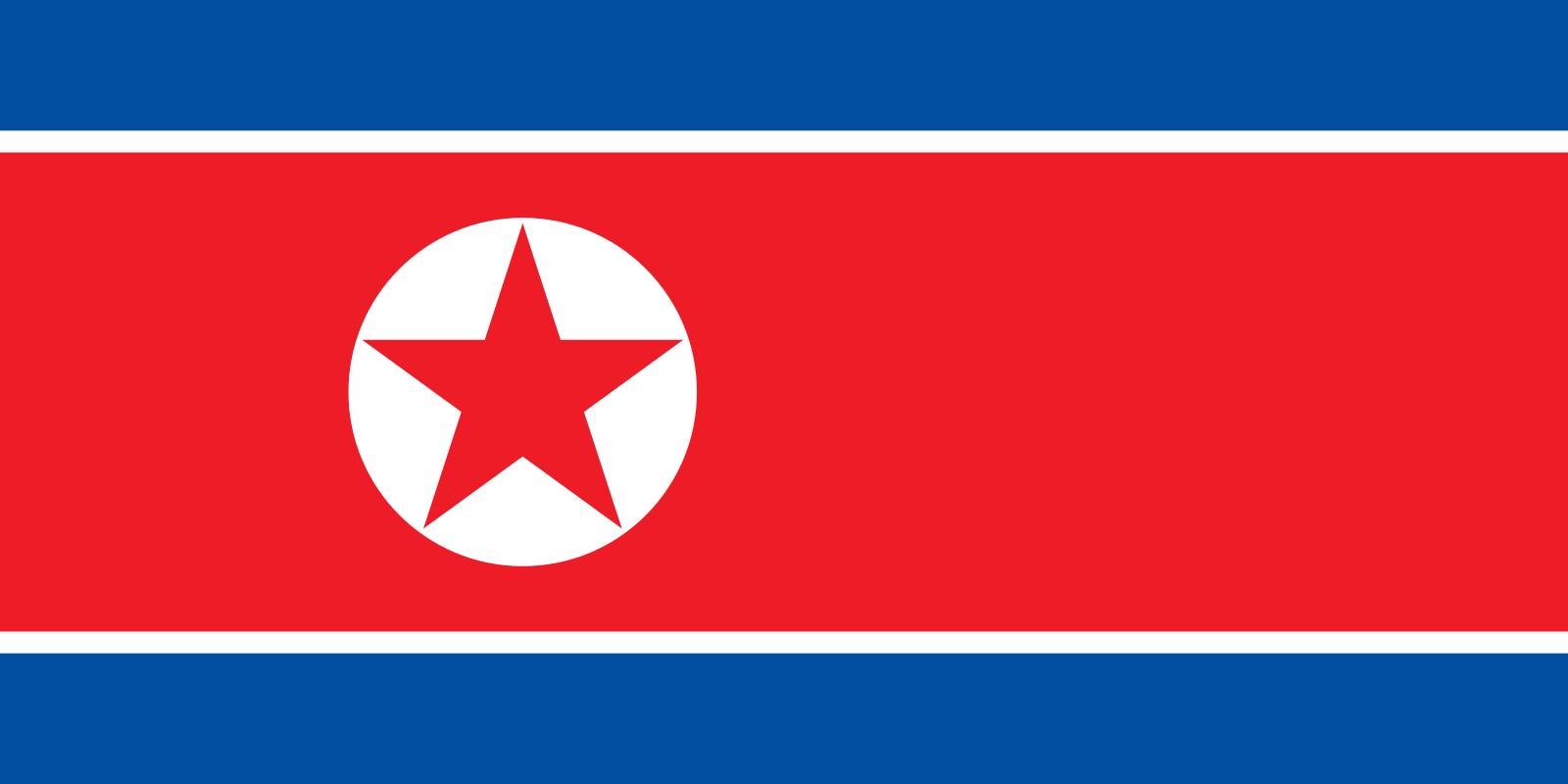
Let’s look at North Korea: Officially the Democratic People’s Republic of Korea (DPRK)

North Korea and Finland are separated by one country.

North Korea has long been vilified and condemned by the Western press as bellicose, provocative and unpredictable, it’s difficult to cut through the fog of vituperation that obscures any kind of dispassionate understanding of the country to grasp that the DPRK represents something praiseworthy.

The North represents the traditions of struggle against foreign domination, both political and economic, while the South represents the tradition of submission to and collaboration with a foreign hegemony. Significantly, there are no foreign troops stationed in North Korea, but are in South Korea.

No nation in the world has been exposed to the nuclear threat so directly and for so long as the Koreans both North and South.

North Korea’s regime is often casually dismissed as “crazy.” Indeed, the existence of a hermetically sealed state — a combination of communism and national fascism — so closed-off to the outside world that the Internet does not exist except for a privileged few, strikes outside observers as beyond belief.

Many aspects of North Korean totalitarianism, especially the personality cult surrounding its leader, Kim Jong Un, and trade and agricultural policies that cause widespread shortages, may border on the insane. But in one key aspect, in particular, there is nothing insane about its nuclear weapons program. North Korea’s nuclear program makes perfect sense it would be  crazy to give up its nuclear capability.

Why?

The reason is simple.

No country exploits the political utility of nuclear weapons as vigorously as the United States does.

In pursuing its foreign policy goals, Washington threatened other countries with nuclear attack on 25 separate occasions between 1970 and 2010, and 14 occasions between 1990 and 2010. On six of these occasions, the United States threatened the DPRK.  (The United States’ record of issuing threats of nuclear attack against other countries over this period is: Iraq, 7; China, 4; the USSR, 4; Libya, 2; Iran, 1; Syria.  Significantly, all these countries, like the DPRK, were under communist or economically nationalist governance when the threats were made.)

Since early in the 1950s, the US has turned South Korea into the biggest nuclear arsenal in the Far East, gravely threatening the DPRK through ceaseless manoeuvres for a nuclear war.  It has worked hard to deprive the DPRK of its sovereignty and its right to exist and develop….thereby doing tremendous damage to its socialist economic construction and the improvement of the standard of people’s living.”

The breadth and depth of US economic warfare against North Korea can be summed up in two sentences:

• North Korea is “the most sanctioned nation in the world” — George W. Bush.

• ”There are few sanctions left to apply.” – The New York Times.

You could ask why is it incumbent on North Korea alone to disarm? Why not the United States too?

From a North Korean point of view its nuclear arsenal does not increase the chances of war—it reduces the likelihood that the United States and its South Korean marionette will attempt to bring down the communist government in Pyongyang by force.

This is to be welcomed by anyone who opposes imperialist military interventions and supports the right of people to organize its affairs free from foreign domination; and has an interest in the survival of one of the few top-to-bottom, actually existing, alternatives to the global capitalist system of oppression, exploitation, and foreign domination.

If territories aren’t voluntarily opened to capital penetration through trade and investment agreements, their doors are battered down by the Pentagon, the enforcer of last resort of a world economic order supporting, as its first commitment, the profit-making interests of the US ruling class.

Its attitude can be summed up one word: Libya.

American behavior toward Libya over the past decade may have convinced North Korea’s ruling elite never to negotiate away its nukes. And that is true no matter what the Iranians may do.

In 1945, when Japan was defeated in World War II, Korea was divided into two occupied zones, with the north occupied by the Soviet Union and the south by the United States. The two countries remain officially at war because a formal peace treaty was never signed. Both states were accepted into the United Nations in 1991. The tradition of struggle against oppression and foreign domination, rooted in the experience of a majority of Koreans dating back to the end of WWII and the period of Japanese colonial rule.

Korea as a divided half-state is a relatively recent invention.

For the North Korean elite, the goal isn’t necessarily a North Korea kept alive through Western investment — it is a unified Korea under the North’s leadership. But opening up the regime would likely lead to the reverse: the collapse of the North’s elite and the absorption by the South.

North Korea conducted its first underground test of a nuclear weapon in 2006.

It has fewer than 10 functional nuclear devices — compared to the more than 7,650 warheads in the U.S. arsenal.

North Korea’s main priority is its military, which it spends an inordinate amount of money on, disproportionate to its GDP.

A February 21, 2013 comment by Pyongyang’s official Korean Central News Agency (“Nuclear test part of DPRK’s substantial countermeasures to defend its sovereignty”) noted that, “The tragic consequences in those countries which abandoned halfway their nuclear programs, yielding to the high-handed practices and pressure of the U.S. in recent years, clearly prove that the DPRK was very far-sighted and just when it made the option. They also teach the truth that the U.S. nuclear blackmail should be countered with substantial countermeasures, not with compromise or retreat.”

It’s also possible that much of Pyongyang’s rhetoric is meaningless, or a blustery show meant for domestic consumption. Considering, however, that just yesterday a top North Korean military official threatened a nuclear strike on the White House, it might be a bit too early to be so complacent, especially with U.S. foreign policy in so many difficult binds across the globe.

For Kim Jong Un is clear: that while his safety with nuclear weapons is clearly uncertain, he would be even less safe if he gave them up. The best chance that Koreans in the north have for preserving their sovereignty is to build nuclear weapons to deter an US military conquest.

Whether Pyongyang has or doesn’t have nuclear weapons makes little difference to US national security. Since the threat to the United States of a nuclear-armed North Korea is about the same as a disarmed North Korea—approximately zero.

Since a North Korean first-strike would be suicidal (and this is not lost on the North Korean leadership), North Korea’s nuclear weapons capability is a defensive threat alone. U.S. strategy is outdated and overstates the risk from North Korea. The United States is not threatened by North Korea.

However North Korea remains the only nation with which China maintains a defense treaty which requires assistance if Pyongyang comes under “armed attack from any state.

It is the world’s most militarized society, with a total of 9,495,000 active, reserve, and paramilitary personnel. Its active duty army of 1.21 million is the 4th largest in the world, after China, the U.S., and India. It is a nuclear-weapons state and has an active space program. As a result of its isolation, it is sometimes known as the “hermit kingdom”. All images of the country depict the whole peninsula, what today is North and South Korea combined. In their view, they are proud Koreans, living in Korea, the south half of which is unfortunately currently occupied by the Imperialist Americans.

It’s not cool to call North Korea “North Korea.” The correct term is, “Korea.”

A report from the United Nations details human rights atrocities taking place in North Korea. Though the North Korean government denies it, nearly 200,000 political prisoners are reportedly held in camps against their will and without trial.

2013-11-11-170387569.jpg

These days we all like to think that gone are the days when some deranged idiot might presses the button.

Welcome to life as we know it.

The disarming of countries that deny the US ruling class access to markets, natural resources, and investment opportunities, in order to use these for their own development, doesn’t reduce the risk of wars of conquest—it makes them all the more certain.

The elimination of weapons of mass destruction (WMDs) in Iraq didn’t reduce the chances of US military intervention in that country—it increased them.  Libyan leader Muammar Gaddafi’s voluntary elimination of his WMD didn’t prevent a NATO assault on Libya—it cleared the way for it.

Four years after the United States dropped atomic bombs on Japan in August 1945, the Soviet Union detonated its first nuclear device the United Kingdom (1952), France (1960), and China (1964) followed.

Nuclear weapons also have political utility for countries menaced by nuclear and other military threats. They raise the stakes for countries seeking to use their militaries for conquest, and therefore reduce the chances of military intervention.

There is little doubt that the US military intervention in Iraq and NATO intervention in Libya would not have been carried out had the targets not disarmed and cleared the way for outside forces to intervene with impunity.

These radical views locates the cause of wars of conquest since the rise of capitalism in the drive for profits. This compulsion chases the goods, services and capital of corporate-dominated societies over the face of the globe to settle everywhere, nestle everywhere, and establish connections everywhere, irrespective of the wishes, interests, development needs and welfare of the natives.

Where does leave us on our Journey of the so-called Nuclear Club?

The two superpowers – China and the United States – that could put pressure on North Korea have done virtually nothing to bring about a change.

The Cold War–style stand-off, peaceful as it has largely been, cannot last indefinitely. Meanwhile, the inhuman suffering of North Koreans continues.

Nuclear weapons constitute an indelible part of the legacy of both Kims.   There is no evidence that there are forces within the country prepared to envision a future without a nuclear identity. Both Kim Il-sung and Kim Jong-il were determined to build and sustain, no matter what the costs and consequences. North Korea’s history is the history of the Kim dynasty.

If the United States has the ability to take a more calculated and dispassionate look at North Korea’s future. A soft landing involving a gradual liberalization of the North Korean economy along with the creation of some personal freedoms until it peacefully reunifies with the South is

It is the least visited country in the world, but it can’t remain hidden in an increasingly interconnected world. Google Earth spotted a Mosque.

I may have glosses over some important historical details, some disturbing history but I am sure you get the gist.

They are the constant, painful reminders of North Korea’s profound alienation from the international system.  All in the name of a regime that with formidable nuclear arsenals and the means of delivering warheads that remains the Genie in the Nuclear Club.

Nuclear weapons can be used to extort political concessions from non-nuclear-armed states through terror and intimidation, but the removal of World Inequalities can get rid of the need to have them in the first place.


← Back

Thank you for your response. ✨