THE BEADY EYE’S UNPUBLISHED BOOK. CHAPTER EIGHT. SECTION TWO.

Tags

, , ,

( CONTINUATION)

Afficher l'image d'origine

In the early stillness of the morning, we board Williwaw.   Skirting the town we once more cross by ferry to join the main drag the Mopti road. It’s not long before the hot dusty dirt road leaves the river Bani to evaporate its way north to join the Niger in its long search for its gateway to the sea. Making good time our shale landscape has little to offer to occupy the mind.   Fanny has draped her open window against the blazing sun with muslin material. Florence perched on her high rear seat is battling with her Game Boy.

(Top TIP: A piece of muslin large enough to cover those lily-white knees and arms can be especially useful when seated in your vehicle for any duration.)

It comes as a great relief to us all to swing right before Mopti. We had heard on the grapevine in Djénné that Mopti had turned itself into a pain in the butt. Full of smart Smert spies; rip off tourist kids, bureaucrat police and flies. So assured by our new Merc overlanders we take a new Chinese constructed road to Bandiagara. The preferred way but not quite yet recognised by our Michelin 953 map, which designates the route as a dangerous passage.

Avoiding the odd charging bulldozer and completely disregarding any road closed and men at work signs we arrive covered in dust at hotel Les Arbies well ahead of the Mercedes.

After a good meal is another rooftop pegging Pitch number 50. Bankas is nothing to write home about. A collection of mud-walled housing facing each other forms the main thoroughfare. Dust devils dance on their whirling dervish way in or out of the flat shapeless surrounding landscape.

Along with our Hotel, there is a baby Djénné style mosque, a Smert office all of which owe their existence to the Bandiagara escarpment or Falaise of Dogon country that lies twelve kilometres out the back door of our Hotel.   Bankas is the alternative route into Dogon country – Mali’s top tourist attraction. Now a protected World Heritage site with the Placenta of the world called Amma and now Fanny’s birthday present.

Lying 14º00′-14º45’N, 3º00′-3º50’W from Douentza in the north to Ouo in the south the area that houses the Dogons culture is world-famous.   Its greatest threat today to its rich traditions, rituals, art and folklore is hard-core tourism thanks to its World Heritage status. Within its Placenta, not a pubic hair has been left unruffled.Afficher l'image d'origineAfficher l'image d'origine

Early morning our Guides Sambaquine Dallo and Moussa Drabo arrive. A command of English and French selects Dallo.

(Top TIP: Selecting a Guide without any prior knowledge of his or her abilities is not to be recommended.   You should always have a friendly chat before taking him or her on to establish whether they truly have the gift of the gab. Also never pay all their fee up front.) 

Dallo fee settled we all pile into the Merc for an extremely bumpy and get out and pushing ride to the base of the Bandiagara escarpment.

The escarpment extends over a 150 km in a southwest to northeast direction, says Dallo. “We will overnight at Teli a village on the southern end of the escarpment it is one of the less visited villages.” Again with our vast knowledge of Mail Teli could be on the moon for all we knew. What we did know is that it is getting hotter and hotter by the minute.

Parking the Merc at the side of a mud building with a lean-to acting as a bar/ restaurant we are invited to partake in a spot of lunch before we set off up to the cliff face. Fanny’s face is a Mask of Dogon anticipation. ‘Up that’ it says. ‘Not on your Nellie my necklace is just fine’. Too late. Dallo is well into informing us that human occupancy of the cliffs was a long time before the Dogons arrived.   “For some strange reason beyond our comprehension the village communities are divided into the inneomo and innepuru, ( living men and dead men) respectively they exist in symbiotic union with each other.” I can only hope that by the time we get back I will not be living in the doghouse for having suggested the hike as a birthday present.

Our lunch hosts lose no time in trying to sell us Dogon doors, intricate door locks, elaborate carvings, painted masks, wooden bowls, and pots. All available irrelevant of UNESCO, Law No. 86-61/AN-RM of 26 July 1986 and Decree No.299/PG-RM of September 1986 which is supposed to specifically control excavations, commerce and the export of cultural objects.

Back in the car, Dallo rattles on “Po is hello, Konjo is beer.”   “Every inhabitant of each village has the same surname.” “Their houses represent human figures and each village keeps a semi-domestic crocodile.”

“You have missed the Sigui gig, which represents the renewal of the Universe.” “ It takes place every sixty years when Sirius companion star is known to the Dogons as Po Tolo. “ (Po this time meaning the smallest seed known to the Dogons and Talo = star) comes into view.” “ Only the Dogons can see it without a telescope.”   Not bad considering it is a mere 8.6 light years from the earth.

Apparently, according to their oral traditions, the Nommos visited them thousands of years ago > An ugly lot resembling mermen and mermaids who landed on their doorstep in an Ark. “ It was these scale boy’s, extraterrestrial visitors from the Sirius system that told them about Jupiter’s four major moons and Saturn’s rings and that we all spun around the sun. They knew that the earth’s moon is dry and infertile long before Armstrong left his footprint. They also knew that the Milky Way is a spiral galaxy of stars and they the Nommos equipped them with, especially advanced eyesight to see the lot. Circumcision and clitoridectomy is a must. There are temples everywhere. Every door and lock is an orgy of meaning. They used to file their teeth.”

Never having seen a photo, full of ignorance, the first views of the Cliffside houses with their clay granaries is gobsmacking.   It is an entirely individual tangible exhilarating experience > a magical hierarchy of mythical fathomless mysteries. Florence, on the other hand, accepts the Dogon Einstein’s Theory of Relativity as a matter of fact taking it all in her stride.Afficher l'image d'origine

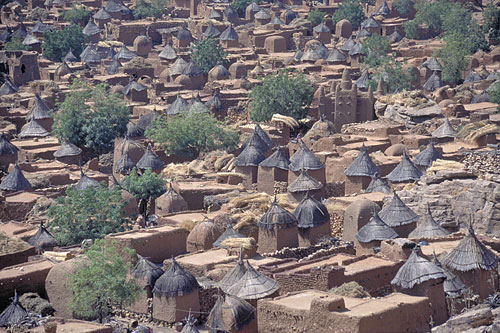
Still surrounded by fields of maze the views are surreal. The granaries look like large telephone boxes wearing enormous pointed straw hats all standing on stilts beneath the overhanging escarpment. As we get closer we begin to see the village houses woven in amongst the rock ledges. Dallo asks us to wait for him while he goes ahead and announce our arrival and gets permission for us to visit.

Await his signal to follow all eyes are looking upwards.   Whirling eagles pass overhead their high nest sites clearly marked against the rustic rock.

We eventually open the door of our earth craft.   Unsettling the settled dust any moment now the earthlings with their Hubbell telescope sight will spot us advancing up the cliff to emerge from their skull protected caves. With each and every footstep echoing against the overhanging outcrop of rock, Florence blazes the trail. Arriving at our first village of the living and dead there is not a humanoid to be seen.

Stumbling along behind Dallo we reach our first Dogon ladder. A large log with steps cut into it that requires a proficiency in high wire balancing or suffer the painful consequences. Scrambling up I associate it more with ascending into the heavens rather than entering a village. Up we go in single file through the Stargate into a world created by Dogon’s for Dogons where all life, nature, mind and matter are comprehended in a single scheme of interconnecting myths.

Myths that not only explain the origin of the universe but the characteristic archetype to which all in it including our societies and us should knuckle under.

The main one according to Dallo is an Egg called Amma the seed of the earth who quivered seven times before the first Nommos arrived to create the sky, day and night, the seasons, and the universe.   To be more precise the world egg was shaken by seven big stirrings of the universe. It broke into two birth sacs, each holding twins, who were looked after by Amma, God on the maternal egg. In each placenta were a male and a female twin, each male and female contained both the male and female basic nature.

“Jesus the heat is getting to me Dallo I don’t think I can take much more of this”

There was no stopping him he is in full tour guide flow. “A male twin named Yorugu got out of one of the placenta before he was supposed too. A piece of the sac from which he busted out of formed the earth. However, when Yorugu tried to get back into the egg to rescue his twin she had done a bunk and had been placed in the other placenta with the other set of twins. So he took a trip to the new earth and copulated with it—his own motherly placenta, but did not succeed in creating people. Seeing what was going on Amma sent the other lot of twins down to have a go and that where we all came from the first joining of brothers, sisters, and cousin twins.

” Long live Darby O’ Gill and the little people is all I can say.

Standing outside one of the Granaries, which is to the Dogons what earth is to the cosmos and the stomach is to the individual. They are not just granaries Says Dallo but a form of defence. “Each Granary is divided into sections. The first floor is against famine. The next is the man of the house and his first wife and her jewellery. The next floor is the second wife.” Slopping against the Granary is a log ladder (a tree trunk in the shape of a Y with steps cut into it. The Y section is the top of the stairs) that leads up to a top window above a smaller window some twelve meters off the ground. With two hands gripping the log I venture up to have a look.   Curiosity kills the cat. The interior is sectioned walled into four orange shape segments but before I can explore further we are on the move again upwards.Afficher l'image d'origine

Next stop is the hunter, the high priest dwellings and courthouse all three set into the cliff face. We never make it to the top as Florence has discovered the witch doctors cave.

Inside the cave, there are four small baked round clay mounts in a circle. Each mount is about the size of those Austrian dumplings that stay in your stomach till the next black ski run. Apparently, these mounts are used to administer justice. The accused have to enter the cave one after the other and rest their hand on the mounts, which are covered in blood. The hand that refuses to touch the mounts is the guilty one.   Florence is fascinated. I am mystified as to how it actually works. Perhaps a Dogon riddle that goes something like this:   Riddle-me ree. Locked up inside you and yet they can seal it from me. Fanny has had enough; Dallo at long last stops for a breath of air.

Above the sorcerer pad again reached by Dogon style ladders are smaller caves and ledges. The caves were utilised by a Pygmy tribe called Tellem who shared the escarpment with the Dogons for a few hundred years – as to why no one knows not even God or Mohammed can figure out says Dallo who is showing signs of wanting to leave. Other ladders go up further to Dogon cemeteries that are taboo to all.

With Dallo’s ankles twisting and turning inside his designer sneakers we start our descent. His ankles remind me of many a chicken wishbone I pulled in deadly battle against my brother for a wish that never came true.

On the way down I lag behind in the hope of spotting a live Dogon, or a living dead one that might not be to camera-shy. Dallo has already warned us those caught taking photos could set the cosmos wobbling but with no one around I cannot resist taking a few shots.

Once more we arrive at the foot of the escarpment.   The odd Acacia dots the otherwise Sahelian dominating species on the plain of Séno.

Stage two is just a short walk along the escarpment face to a crack where we can climb up to the top of the plateau.   After one kilometre we are well spread out Fanny to the rear, Florence up front without the twists and turns matching Dallo’s African paces step for step.

By late afternoon in the simmering heat large chunks of fallen cliff face are watching us trudge our way up. Nothing stirs. On our right, the rock cliff face looks brittle and barren. Here and there large enormous blocks of rock have detached themselves to slide hundreds of meters out from the foot of cliff face.   On our left a small dry riverbed and fields of parched millet.

After nine kilometres we are all beginning to believe in the three Dogon revelations. Nature speaks through the sounds of the grasses. Order is symbolized by weaving. Not quite the same type of weaving that all of us are doing.   Communications is the work of the drum.   The last one we have no problems with the scorching heat as all of our heads are drumming.

Dallo points to crack in the cliff face. “This is the way up.”   What is visible to us is a rocky passage blocked by large sections of broken rock covered in dense vegetation. The shade looks inviting but the climb looks intimidating.   Fanny’s face reads beam me up.

Following a spring line of water, we pass through a botanical garden of vegetation and flowers that none of us can name.   Surrounded by trouble hawks and the ever-present sound of rock dove and plovers the climb turns out to be relatively easy. Gradually we leave the humid microclimate of the crack to emerge on the top of plateau. Our sandstone plateau is a labyrinth of holes, mixed with areas of hard impervious rock, somewhat resembling the Burren in County Clare in the west of Ireland but without the blue of the sea in the distance.

An energy field of rising heat blocks any possibility of long vision so our view (from the top) is disappointing. With an announcement of a further five kilometres to the nearest village Fanny’s weaning energy evaporates while Florence on the other hand god bless her little pins is off strutting out front once more.   One hour later with large helpings of TLC, I nurse a sore, weary, and parched Fanny into the village.

After a few beers, we are shown our sleeping quarters.   The choice is dismal a bamboo slattern bed or the flat mud roof.   Just as the evening light begins to paint the hues of a warm night sky I brave one of the Dogon ladders to a roof nights sleep. With no mossie net, it’s a night of pure torture.   Sleep is almost impossible. What I get is snatched between the high-pitched piercing sound of an incoming mosquito attack and the eerie silence while he or she sucks their fill. – I awake drained.

The new day is rung in at six am. A group of Dogon ladies standing in a circle start the day’s heartbeat with the arithmetic sound of dull thudding of maize. Without a drop of perspiration there pounding poles gliding up and down in time to their ever-swinging breasts. From my rooftop, the gathering light casts shadows in long curved thin lines across the rocky surface. Bending at the foot of my ladder the shadows like the living dead returning to their life bodies as the sun rises. The colour scheme of the new day flamed out in a time-compressed experience.

Djiguibombo our host village awakes with many of us suffering from millet beer hangovers from the night’s consumption of Konjo – the local brew. By the time Dallo appears breakfast is on its third untouched push around our enamelled plates.

Reluctantly we set off on a walkabout of the village.   Avoiding Holy ground on which no feet must tread we visit all the important structures. The Toguna an open-air stone structure roofed with millet stakes, (the pub) where the village elders (men only) meet for their daily chinwag over a fresh pint of Konjo. Across the street a round stone hut that bears no name where ovulating young ladies sweat it out.

Next is the Gina a type of sanctuary where the honoured ancestors hang out. Luckily for us, Dallo’s enthusiasm for long explanations is muted by the early start.   We are spared his unquestionable narration as to why’s and why not’s of every doorknob, stone, shapes and colour.   Then it is off to the main square where the stilt dance takes place in celebration of the sighting of Po Tolo the Dog Star of Sirius (booking in advance).  As to why the dance takes place on six meters high stilts is a mystery that Florence explained. “You need to be up high to see the stars.”   As none of us other than Florence has a hope of climbing up again in the year 2020 we will never know if her observation is true.

What we do know is that the thought of walking to the next village Enndé and on to Doundourou for more of the same is a large no-no.

With Florence setting the pace determined as ever to finish in front we arrive at the top of the three hundred meters high escarpment to descend to the floor before the sun requires us to take a block 35 stop.

(Top TIP: Sunblock is expensive and not always available in the bush. Bring lots and Calamine lotion.)

By late afternoon we have struggled back into Kani-Komble where the awaiting green Merc connects us once more to the real world.   After savaging a few cool beers, and once more resting the purchase of a large carved door that one would die for we jar and jolt our way back to our Hotel.

Karen and Chris their time-limited decide to head for the Burkina Faso border. We with our three arses pointing at Sirius B the Po tolo star of the Dogon crash out on the rooftop and pass out for the night. Pitch No 51.

Afficher l'image d'origine


THE BEADY EYE’S UNPUBLISHED BOOK. CHAPTER EIGHT.

Tags

, ,

MALI.Afficher l'image d'origineAfficher l'image d'origine

What we know
Timbuktu. Sahel Region. Dogon

By way of one last bomb crater of a pothole, we bump our way into Mali.

There is no obvious difference to our surroundings. The tall grass and the silent running Niger on our right are still with us. At the first village, we refuel and top up our water. Lighting a large fire to keep the Mali brigade of flies at bay we camp early. (Pitch number forty-eight) Dinner is excellent a la Fanny. The rummy game named ‘Mossy Slap’ to the Cricket Chorus is won hands down by Florence, snoring is participated in by all.

Morning greets us with the usual backdrop of African sounds. A crowing cock calling its flock to early revel pinpoints the nearest village in the long grass. The ever-present cicadas crescendo is pierced by the call of a bird every four or five minutes tells us it is time to arise.

In a few weeks, we will be turning south long before the Niger does the same. It’s time to start our Malaria pills.

(Top TIP: As you know there is loads of advice to be had on Malaria. We found that the best advice is to cover up at feeding times and to soak your mosquito nets in neat DEET.   A Mosquito coil, or Avon beauty cream, which has an element of deet, has limited value. Don’t get bitten – cover up. Take out Masta medical membership they fly in blood to you if needed. (See – cd for further information)

Our tablets are Chloroquine and Paludrin.   Larium was not an option for us due to the length of the journey. Malaria is carried by sixty different species of mosquitoes. It is not restricted to humans, birds, lizards, rodents, monkeys, and other primates suffer from its effects. There are about one hundred million cases a year with one percent being fatal.

It comes in four flavours, Tertian, malaria-mild, Jungle, fever-malignant, Quartan, hidden for weeks. One of Africa greatest killer alongside Aids, the bullet, starvation, and the like it remains one of the greatest hang our heads in shame achievements when it comes to the Developed world aid packages.

What would one week of bombing the whole joint with Mossy nets cost? A fraction compared to too days cost of flying out designed dinner to American troops in Afghanistan.

Eradicated from Europe it is on the way back with twelve thousand cases reported in 1997.

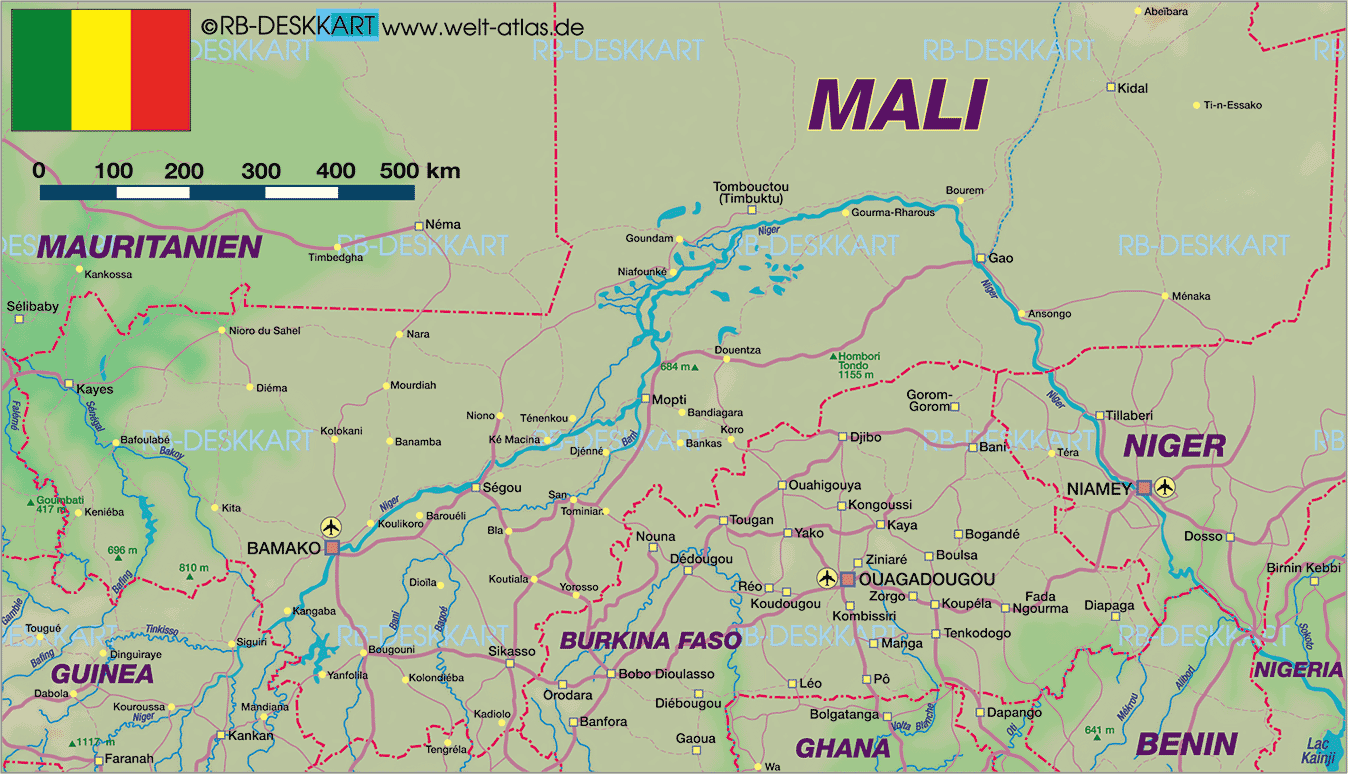
Bamako the capital is on the bow clinging to the lifeline of the country the River Niger. Situated at 12° 38N, 7° 57W in the south-east of Mali’s one point two million square kilometres. (Ireland 70,000km, England 224,000km) A one-legged wheelchair hustler guide in the city centre points us to a parking spot.  Afficher l'image d'origine

Our knowledge of Mali is as minuscule as its vastness, but we were not expecting a city of new buildings, nightclubs, modern hotels, streetlights, pavements, traffic lights, and parking meters.   Not to mention supermarkets supplied daily by Air France.

Slipping into the first bar we come upon to slake my thirst I can only wonder what Mongo Park and Rene Caillié saw when they visited it in the eighteen century.

Inside the bar, the late afternoon heat is enhanced with cheap perfume from the cliché of old bar trollops mixed with the stale smell of urine. The blended scents waft their way upwards to a slow circling ceiling fan. We have hit the wrong bar for a cool beer. A rapid downing and hasty escape with a large sigh of release has us in the Patisserie Phoenicia for a spot of lunch.

Here we had escaped the den of iniquity only to be hassled by every passing street vendor that spotted us through the window. In the bar we were at least recognised as a family and left in peace now we were being offered the best grass to view Timbuktu with cream to relieve camel piles after you get there.   We settle for directions to the best hotel, which rewards Florence’s strained patience with a large swimming pool.

By early morning we have left the unseen pleasures of Bamako in our wake. It was named after Bama-Kong a hunter of heroic dimensions says, Fanny.   “He was given permission to name the town by the Bambara Empire after he killed an elephant.”   All enlightened we arrive within four hours at Ségo Mali’s second largest town also ruled by the Niger River. In a Lebanese hotel, it is my turn to spend the night locked to the loo seat.

Next day with me rather drained Fanny’s lecture continues. Ségo situated at the head of the Niger’s inland delta is a port after which the river spreads a cobweb of channels, marshes, and lakes, as far as Timbuktu.

The Shale Empire of the Sahara stretches without boundaries some four thousand five hundred kilometres from Senegal through Mauritania, Mali, Burkina Faso Niger and Chad, and onwards to Sudan > A mere two point five million square miles of homicidal sub-Sahara lands.   Between the early 1960s and 1980s, this region suffered the worst drought of the 20th century.

Worldwide is it estimated that fifteen to sixty-seven million acres of land are lost each year to desertification. Colorado alone in the USA lost over one million acres of topsoil in 1990. The Shale is at the heart of most African major environmental emergency.

Before leaving Ségo for Djénné we luckily run into some English tourists how are kind enough to take a package of African dolls back to Florence’s Williwaw club in the UK.

(Top TIP: If you are travelling with a toddler it is an idea to make a tangible tie to home base. We formed an African club in Florence’s school called the Williwaw Club. Before leaving I gave a talk on our trip and each child was allocated an animal contact name. The idea was for the club members to write care of American Express at designated cities where Florence would pick up their mail. They could track, our progress, ask questions etc. Florence in return would send item of interest, and letters answering their queries. For a young explorer such as Florence, it is a wonderful method of encouraging her to keep a diary. Its rewards are invaluable.)

They say that the exploration of the world is over. There is not a centimetre left of it to be discovered. I say that man has to discover himself first before he can see what he sees, only then he will be capable of new discoveries. It is for the young to see the world before he or she is cloned into thinking that all natural beauty, animals, birds, insects, trees, and the like are only products to be exploited to satisfy the sofa Television public.

The Savannah surroundings of our last few days now slowly give way to treeless arid scrub. We decide to leave the Niger, which during this time of the year makes the choice of a route to Timbuktu, or Timbucktoo, or Tombouctou, or Timbuctou.

Faces with impassable marsh, soft sand, dykes, sand filled ruts, dunes, and dead ends all of which we can do without Tim buck whatever will have to wait.

Not so bad as it’s once legendary reputation these days has been reduced to a stamp on the passport. Tin- Buktu in Arabic may stand for “the well of Buktu” and in the Songhoi tongue the word means a Hollow)

The footsteps of Gordon Laing, René Callié, Heinrich Barth and Oskar Lenz, together with billion camel’s footprints have long disappeared.

“If I were a castaway on the plains of Timbuctoo, I would eat a missionary – cassock, band, and hymn-book too” (Samuel Wilberforce 1805 – 1873)

I suffering from a dose of Montezuma’s revenges am in no mood to eat anything as we leave Ségo and the Niger River to join the Bani one of its major tributaries to Djénné. From here to Timbuktu or for that matter from Montezuma to Timbuktu will have to wait for the final decision till we get to Mopti.

Five hours of driving brings us the first view of Djénné.   Founded in the 13th century, as a trading centre it remained unchanged to this day.   First inhibited in 250BC it was designated a World Heritage Site in 1988.   Somewhat a remarkable achievement to its unbeaten spirit of endurance, its irrefutable life force against its hostile surroundings it remains closely associated with Timbuktu. Our Lonely planet 6th edition hardly rates it worthy of a mention. It matters little, as our deep knowledge of Mali does not let us down.Afficher l'image d'origine

A small ferry takes us across its surrounding waterway.  Djénné is so far removed from what we have so far seen of Mali Bamako architecture that we expect to see Sinbad arriving from the surrounding desert on his flying carpet. Another word our first views have us by the short and hairies, spell-bound.

Driving over the town dykes right in front of us nestling behind its large mud walls is a large Mosque. Baked to perfection, fresh out of the kiln with no sharp edges or angles to be seen anywhere. Exalted in rank it towers above a cowpat of grey clay smooth surrounding buildings. The Mosque the largest mud structure in the world imparts a sense of no permanence. Its smooth façade is lorded over by three towers of over eleven meters high with an ostrich capping each tower. Wooden beams poke out of its mud walls giving a feeling that it could be washed away in any downpour right in front of your eyes.

As to how the whole place has survived a mere century or two, never mind making it on to the top five hundred and eighty-two World Heritage Sites list leaves us flabbergasted.

Entering the town gate (there is only one by terra firma) we make our way to the Campement. This is the only place in town to stay. Using months of ‘Get lost’ tactics on a swarm of guides we install ourselves on the roof. Pitch number 49. Camp beds, pillows, sleeping bags, mossie nets, torches, makeup, bags, books, are all unloaded and huffed up to the roof by the chief puka sahib – me.

Florence and I can’t wait to go off and explore so we leave Fanny sorting out the sleeping arrangements, and set off down one of the dusty narrow passageways on foot. We have not gone far before we come across an Arab of Tuareg presentation (indigenous people of the Sahara. Controlled the Trans Sahara caravan routes – founders of Tomboctou in the 14th) sitting outside a Moroccan style doorway.   Resting against the mud wall alongside him is an old flintlock Lawrence of Arabia long barrel ivory stock rifle.

I invite him to fire his gun for a Photo for Florence.   Before we could say Jack Rabbit, he is on the feet pouring gun power from a small pouch and ramming a ball down the barrel. There is a tremendous bang and flash that makes both Florence and I jump out of our skins.   Where the ball went is anyone’s speculation. What is absolutely certain is that he is as pleased as punch.   Displaying a set glittering golden teeth he pats Florence blond hair with distant memories of day’s gone bye.

Returning to our rooftop we are once more descended upon by Mali tourist guides. SMERT Mali official tourist organisation has given these tenacious individuals a license to spoil its countries main attractions.   Aggressive in their insistence to accompany you for a fee we see them as pests that we could do without. (Officially one of them is supposed to guide you around the town whether you like it or not) We resolve to give them the slip in the morning.

(Top Tip:   SMERT guides destroy the exquisite aura of Djénné architecture and will blemish you soaking up of the true nature of this once Trans – Saharan trading town. If you can avoid them do so)

Under a net of stars, a wonderful and welcome nights sleep is had by all. We awake to find the roof full to capacity. Several land cruisers and a green Mercedes have arrived during the night for the market. Djénné Market although small has to be one of the liveliest in Africa so described by René Caillié in the 19th century in his Travels through Central Africa to Timbuktu.

It took him three years to reach Timbouctou his journey halted by five months of illness. Disguised as a beggar he stayed two weeks to collect the ten thousand French francs prize money offered by the Geographical Society of Paris to the first European to visit Timbuktu and come out alive.   Some Scot named Alexander Laing had beaten him by a year. (He did not live to tell the tale because he was bumped off shortly after leaving the place.)

The market spread out on the ground is in front of the Grand Mosque against the backdrop of the surrounding mud-baked houses all surrounded by water set in a vast desert has the appearance of a Max film set.

Large Mali hats float through the air like small flying saucers. Gold earrings big enough to moor a small boat dangle from vale covered heads all adorned with the colours of the rainbow. The small alleyways that lead from the Mosque are crammed with incoming and outgoing produces borne head high.

The market is a long way from the large supermarket of this world where time itself and nature are resources to be continually exploited in a ghost-like culture > where cultural distinctiveness is placed second to the demands of globalisation in order to meet the demands of a wholly commercial society. – Buy one get one free.

Here everyone knows his customer and every customer knows his vendor. The checkout benefits not just the shareholders but imparts an all-embracing cultural experience, full of bonding, information, energy, and above all offers a dignity of difference that celebrates deeper things than get and spend.   Here one gets a sense that your life is part of a greater narrative. There is a meaning to one’s existence, which empty, pleasure-maximising utilitarianism lacks.

Leaving the girls to barter I decide to take a wander.   Armed with my hard-core tourism badge – my camera I set off down one of the many narrow streets behind the Grand Mosque. Restraining my trigger photo finger is an effort. Every door, every corner, every passing load warrants a shot.

Emerging from the city wall on to the dyke I arrive at a ferry crossing. Large Pinasses and smaller canoe-like pirogues are busy ferrying the waiting people, bundles, animals, and bikes across to the town.   Every boatload carries all of Mali’s cultures. Watching I reel off two films before I know it.

On the far side of the dyke, the land stretches away as far as the eye can see into the vast treeless shimmering sands. Clouds of approaching far off dust marked incoming traffic some of it at a gallop. I venture down to the water edge and hop abroad one of the returning empty boats. Closing the opposite bank I am poled through clutches of awaiting woman, long-horned cattle, horses and camels.   Long before we reach land massive bundles of firewood are thrown aboard securing their owner’s place for the return trip.

Stepping ashore completely ignored I walk towards one of the incoming dust clouds. Sir Dave Lane was going to be proud of this shot. A deux vaches long horn drawn cart is approaching at speed. Kneeling right in its path I prepare to capture its whip whirling driver, its vapour trail of rising dust.

I had forgotten all about those western movies one sees as a young lad you know those John Wayne cattle drive flick when all those long-horned steers stampede and bellow their way to the waterhole. My two approaching critters had long got the smell of water and no kneeling tourist was going to stop them. I jump aside baptised in dust completely forgetting to press the camera gotcha button.

(Top TIP: Bring a small working digital camera. 7.1 pixels and learn how to use it before leaving.)

Returning on a small pirogue I find the girls waiting.   We are about to continue our tour when there is a crescendo of shrieks. One of the arriving large canoes has deposited its passengers prematurely into the water. The yelling is not throwing me a boy I am drowning its get your effing hands off my bundle in a variety of different tongues. Each woman having spent days scavenging the vast expanses of treeless territories for every twig. Firewood is more precious than gold or the risk of drowning.

The ensuing struggles look refreshing and we can see why Sunni Ali ruler of Songhai who drove the Tuereg from Timbouctou and destroyed the Mossi and Dogon tribes spent seven years in siege of Djénné walls.

With all the action over – midday has us by the throat. I get a bollixing for being capless and having no sun lotion on. (Top TIP: Wear a hat in the noonday sun.) Half not wanting to leave I lag behind Fanny and Florence as they make their way back into the mud walls. In a flicker of the eye, they both disappear up one of the maze of narrow streets.

Emerging on the Market Square now a volcano of colour I find Florence attempting to buy a wonderful necklace of polished stone. “Its Mum’s birthday tomorrow” I am saved by the bell. No amount of haggling could secure the necklace so we settle for some smaller items.   The main present will have to be from Dogon Mythology our next port of call. This means sweet damn all to Florence so while she and her mother are knocking back a bottle of Tombouctou recommandée pour toute la famille (Insert: Bottle label) I slip back into the fray and purchase the necklace.

Over dinner, we receive an invitation to join Karen and Chris (the green Mercedes OverLanders) to meet up with them in Bankas, one hundred and fourteen kilometres to the east. They are in possession of a letter of introduction to a Dogon Guide who has worked with the Dogon people for some years. We need no convincing the chance to avoid the SMERT Mali official tourist organisation guides is an absolute yes if we are to enjoy the Dogans.

Afficher l'image d'origine

( To be continued)

Donations so far:  ARE SOMEWHAT LIKE THE DOGANS. PROTECTED BY ZERO.

IF YOU ARE INCLINED TO BRAKE THAT ZERO:  R Dillon. Account no 62259189.

Ulster Bank 33 College Green Dublin 2. Sorting Code; 98-50-10. Many thanks.


THE BEADY EYE’S UNPUBLISHED BOOK. CHAPTER SEVEN. SECTION FOUR.

Tags

, , , ,

Afficher l'image d'origineThis time by the back door I give the posse the slip. There is a tangible difference in the stillness of the air, which was not present on my morning walk. I pass through fields of peanuts until once more I am on a track, with high grass on either side. I come upon the first fork. “Keep to the right” …Almo had said, so right I go. Another fork, right again, yet another, right again.

If I am on the right track I should arrive at a three-fingered fork where I am to take the middle finger. I hit it right on the button, onward march. The next junction I am not too sure but right looks good. Subconsciously I take note of a large tree as a reference for the way back.   Confronted by and an array of tracks I stick to the M1 until it runs out of well-trodden earth. I halt at the edge of a rocky surface. Straight across looks the natural line. Yes, Yes, You Boy, Captain Cook is nothing on you.

On the right track once more there is a humanoid coming in the opposite direction.   I am tempted to inquire if this is the way to Paris. His passing look gives me the feeling that you don’t see many white Cadillac’s passing this way. Oblivious to oncoming traffic he keeps looking in his wing mirrors until I disappear into the trees.

A wall tells me that all is well. Sure enough on the other side of it, there is the rock outcrop. It lies on the opposite side of a steeply studded narrow wild overgrown gorge. Scrambling down > the ever-vigilant lookouts spot my approach. While the troop scatters up the rocky outcrop and out of sight the dominant males in a sudden uproar at my intrusion bear their teeth.olive baboon teeth mouth

I have a lot to learn about obligatory silence and direction of approach if I am not to be mooned by all African Wildlife. I hang around for a while in the hope of things settling down but to no avail. The troop remains well hidden and I soon lose interest in the odd view courtesy of my field binoculars.

As I walk back the first drops of rain are exploding in puffs of dust, and the grass is stirring. There is a pungent release of vegetation smells and a strong sense of movement all around. Thank Almo I make it back. In his wisdom, he has sent a young lad to find me.

Just after dark the village elders wearing tall coarse woollen fez type hats and their wives begin to arrive.  In the flickering candlelight, problem after problem is presented and discussed. Almo displays great untiring patience. He explains to me that the grievances are the same every year.

“You can see here”, he says, “That education is an emptiness – it helps me to escape into the wider world, but I cannot impart it here so that it passes from one age group to the next.   Bonding to a school is all jolly fine, but in these people’s case, the only bonding is by making them form a group as you see before you to run their village. To buy their seeds, to sell their crops, to oversee their health, to join with other farming groups, to record and keep records and only then they have something that has a strong chance of surviving.”

“Training children to recite the whole of the Koran is all jolly fine, but to teach them to be more confident in themselves, to take their own decisions, to manage on their own must all be done in their own language. To make them discover themselves is the only way forward.”

“One must know how one is before learning who others are and there is a constant tug of war between tradition and the existing world.”

Our world glistens in the dark eyes of those present during a pause for a cup of Kinkilibar.

The morning news is that Almo has been given more land to build a hospital. The young man with the elephantine upper lip is on the back of a truck and hopefully should arrive tomorrow, that the corrupted pill dispenser has been replaced and that we decide to stay another day and depart in the morning.

The next day has only one more surprise it comes in the form of vet whom I collide into head-on rounding a blind corner in the long tall grass. He has dressed in a full business suit white shirt and tie carrying a briefcase. Our meeting surprises him just as much it surprises me. I had just crossed a tree suspension bridge without falling in when we collided. He was descending the track at speed and I was paying no attention to oncoming traffic.   It was weird, to say the least, to see a suit in a jungle setting.

Over the evening meal, Almo shows us some photos of his morning patient prior to his first op a year ago. The young mans’ upper lip hang’s down below his chin.   He also tells us he is having a problem with a container of medicine, which is in the docks at Conakry.   Apparently, some corrupt customs official won’t release it. I tell him that perhaps I can help. Referring to my list of if in trouble contacts I come up with two contacts for a phone call in the morning.

Early morning Almo is up preparing for ‘Gumdrops’, the phone rings. When Almos patient – ‘Bottom Lip’, drops in, I ring my man Souleymane Souare -Chief du Protocol de la Prefecture de Mali Republique de Guinea Conakry, and. Lieutenant Colonel la Vile Beavogui Directeur General Adjoint des Sevices de Police Conakry République de Guinea.   Miracles don’t just happen on the operating table the container is on its way and so are we. (The container arrived ten days later.)

With Fanny driving we descend out of the mountains passing Mount Kavendou on our left arriving out onto savannah land we stop at Dabola for lunch. It is a small village described by some American in the Bible as a town with a Wild West ambience, obviously helped by some local grass. Pushing on we arrive at Kouroussa with one hour to make the ferry crossing fifteen kilometres away. However, the roller coaster ride with the odd thrilling water splashes defeats us. Pitch number forty-six is under a Kinkilibar tree> a good fire, a good meal and a game of rummy named by Florence as the Cricket Chirp Game. We all sleep solidly through heavy rain.

Our first dawn visitor is a dog followed by his owners one of which informs us that the ferry crossing is anything up to five hundred meters or five kilometres down the road. We leisurely break camp and arrive within two bends at the ferry.   Six trucks and two cars are waiting to be loaded.   Frenetic repairs are in progress to the landing platform, which is a quagmire of oozing mud. With loud encouragement from all in sundry two trucks get aboard with great difficulties.

We are told to wait until the next crossing. In the meantime, a few rock are added to the quagmire. The ferry arrives back within the hour. The first car to disembark sinks to its doors, it eventually arriving on terra firma minus a front bumper. More rocks are added all disappearing after the others into the unknown. Next is a truck, which lands pushing a mudslide. To the amusement of all looking on the foot passengers fair little better. Afficher l'image d'origine

A few more rocks and it’s our turn to board, which is achieved with a panache deserving a round of applause worthy of a champion rally driver. On board, we emerge from a mud-splattered Williwaw to watch the bizarre scene as one truck after the other takes the plunge engulfing the odd slow foot passenger in a coating of chocolate icing. Fares collected we are on our way. Guinea Conakry has no coins and most of the paper currency has spent its lifetime being handled by muddy fingers till it is almost impossible to read their denominations.

The river crossing as with most river crossings in Africa imparts the impression that time is standing still.   The adventures of your travels surround you. There is a mixture of the captivating natural flowing grace of the river a quickening of the heart and a warm feeling of love. It’s a phenomenon, which you can never quite believe in until you experience it yourself.

Our river is the Milo a tributary of the Niger.   A resounding thud announces the arrival on the opposite bank. Without much attention to the positioning of his ramp, our captain has to some degree arrived at his disembarkation point.

The car beside us refuses to take the jump ashore.   After much-heated discussion, it has no choice but to leap.   Leap it does and there right in front of the ramp it stays for the next hour.   Williwaw watches the proceedings with disdain and contempt until it is pushed and pulled to dry land in kit form.

Firing Williwaw up I move her to the opposite side of the ramp. She makes mincemeat of it roaring out beside the stuck car whose demented driver is now demanding a refund from Capitano.

We push on towards Kankan some sixty kilometres away. The journey requires circumnavigation of potholes that could swallow a jumbo jet. They almost double the distance to be travel.   With Kankan on the horizon, a small army of uniformed men halts us – “Pull over.”

Stopping under the shade of a tree one over-weight dude in blue police garb, sporting the obligatory dark sunglasses smells of trouble.   Sure enough, he’s spot on. Passports, Williwaw’s documents followed by the question, “What is the real purpose of your visit?” he demands, I open the back. I feel like telling him that we are here to blow up the Presidents Palace, but instead, while I open Williwaws back door let drop that Lieutenant Colonel la Vile Beavogui Directeur General Adjoint des Sevices de Police Conakry is a personal friend. His face turns ashen, and a small squeaky voice says, “Close please”.   We wave goodbye continuing on our way winding in and around and over the mine-crated road to Kankan.

We are now in Kissi country that makes up about five percent of Guineas population of six odd million people.   The Kissi says Fanny according to our Bible have a strong respect for witchcraft.   According to Florence, she can see no one kissing.

Kankan the second largest town in Guinea is in Malinke country. Populated by the Mandigo group that makes up about thirty-two percent of the southeast highlands population. The Malinke traditionally used cowry shells as a medium of exchange. With the dollar worth about one thousand four hundred to one thousand six hundred Guinean francs (1999) depending on where you exchange – they might be wise to bring back the cowry shell.Afficher l'image d'origine

The Bible says Chez Madame Marie is the best place to stay in Kankan > A guesthouse par excellence where woman travellers are especially welcome. The trouble is that no one knows of its whereabouts. We stop at a bar named London down a few cans of Guinness, which have the immediate effect of enlightening our navigation.

Visiting several dead ends we splash our way in and out of many potholes the size of duck ponds. With patience running low we eventually find the place now called the ‘Refuge’. It is up a laneway that subs up as a rubbish dump. We enter a small courtyard surrounded by prison-like rooms with an open-air kitchen backing onto a sheep pen.   Whoever stayed here must have been high as a kite or dear Madame God rest her youth was offering some Saigon attractions, not on the menu.   It is obvious that the bible has not seen this dump for some years.

With Kankan in total darkness, it is too late for us to go looking for anywhere else. The room is clean, and Williwaw is safe in the courtyard. Madame, a small frail Vietnamese is stretched out under a mosquito net in no mood to move. Only the threat of having her struck off the Bible motivates her to produce a few chips, which we eat to the sound of her generator been whipped and kicked and cursed into action. Resisting all attempts to cast any light, it joins her is a bout of coughing, farting, discharging clouds of smoke, with the odd death wheeze.

The sky opens. We sleep with a thousand Malinkes doing the Cancan on the galvanised roof.   In the morning there is no sign of her Ladyship.   We pack and move out to find breakfast and new lodgings. Driving past the train station, the university, down a wide long mango-shaded avenue, we once again plough our way through large potholes now all overflowing with dark brown water to hit rush hour Kankan style.

Bicycles, Peugeot, trucks, buses, carts, dogs, donkeys, motorbikes – you name it > stopping and starting to the flow of pedestrians who weave in and out of the traffic with the same suggestive body movements of a real Cancan. Most of who are oblivious to any right of way they risk their lives to well-worn disc pads.   We are sucked along with the great unwashed to stop for breakfast at one of the many downtown restaurants.

Drinking large espresso’s with French croissants it is hard to fathom that only a few days ago we were camping in the bush.

At forty-seven thousand guinea francs a room, Bate P’ is our new hotel > Air conditioning, TV, shower, with a large enclosed car park. In fact, everything that Mongo Parks (1771-1806) would have needed on his way down the Niger from Segou a town in southwest Mali. Our first encounter in the hotel is Kadir a Dutch photographer.   He is hoping to follow the Niger to its delta a mere four thousand kilometres away. The first part of his journey is by riverboat from Kankan down the Milo to join the Niger, and then on to Bamako in Mali – a five to a seven-day trip.

It sounds mouth-watering to just sit back and enjoy the scenery. Five hundred kilometres of smooth water after our last four weeks of jolting is just what the doctor ordered, we sign on.

A quick foot reconnaissance of town with the girls uncovers the largest pair of denim jeans this side of the Atlantic. Unlike some of its matching African cities that we have visited Kankan so far has a good-natured feel to it. With colour in competition everywhere the bustling streets are hassle-free. After some excellent yoghurt and a large dose of passing carbon dioxide, we return to our hotel.  Afficher l'image d'origine

Kadir suggests we walk down to the bus station after lunch to check on the ferry progress up river and to book our passage.   Arriving at the booking office we are assured after a long wait that the ferry is due any day now and there was no problem getting the jeep aboard.

I get back to tell Fanny the good news to find her talking to God on the big white telephone. “It’s the salad she moans “In sympathy, my Mount Vesuvius (the ant bite) explodes. The city is plunged once more into silent darkness. Without a flicker from the air-conditioning or the TV, the night is hot and sultry with Fanny beating a track back and forth to the loo. Our room unlike room 101 across the corridor that has a procession of working ladies to keep its occupying colonel cool late into the night our room is hot and sticky making sleep almost impossible.

Morning brings no satisfaction at the reception desk. “What is the point of paying over the top for an air condition room, when the hotel generator is turned off?”   We move to a cheaper room in the old part of the hotel that has ceiling fans.

Next morning Kadir – the Dutch photographer and I make another visit to the booking office.   Fanny’s recovery is helped by a packet of Dioralite. (See Medical list on cd)

(Top TIP:   A Water purification is a must.   We mounted the purification unit and a shower attachment unit on one wooden board. This board could be hung from the roof rack and plugs into one of the power points positioned on the outside of Williwaw under the back door.   A Hand pumped purifiers is too much hard work. We carried one only as a backup. During the whole African trip we used only three replacement filters.)

We are informed that the ferry has been sighted and should arrive shortly, as to exactly when is anyone’s guess. By the look of the depth of Milo River since yesterday, it might be never. It has dropped a good three feet with the dry season approaching.

The afternoon is spent poking our noses in and out of every shop. We visit Issa Traore and Daoudor Traore Antiquaries. According to their owners, some French buyers visit them twice a year and take all they can collect by the container load.

We meet Larry a large Aussi gold miner, and Matthew a retired Canadian geologist who has flown in for a week to do a field survey somewhere nearby, for a different gold mining firm. Unfortunately, Matthew spent most his time stuck in a Guinea pothole until Larry who happened to be passing by rescued him. We meet Leslie another prospector who hails from Fareham just down the road from Winchester, Fanny’s hometown.

Day three in Kankan > There is no sign of Godo the river steamer. From the look of the river, it is high and dry and more than likely will not be seen until next seasons rains. I tell Kadir if he hangs on in Kankan long enough he will be able to walk down the Milo to join the Niger or as it is otherwise known as the Dioliba, the Joliba, the Kworra, and the Timbiko. It is up anchor for us in the morning.

I spend the rest of day with the ice cream man who brings me to his brother a welder for some running repairs to Williwaw’s exhaust. I sell one of my old tyres to one of his many brothers and purchase a new tyre from another brother along with a death mask.   The mask is received by the girls with abject horror it being consigned to the toolbox on the roof under lock and key.

Somewhat disappointed that our African Queen voyage had not materialised we set out for Siguiri I getting a lecture about filling Williwaw with junk. The bible consoles us with a description of the riverside route to Siguiri as being one of the most beautiful one can take.   

Two river crossings later, mud mires that any decent Hippo would be proud to acquire, and potholes that could be seen from outer space, we pitch number forty-seven under a full moon. Exhausted and in excellent temper all around. The beauty is in the eye of the beholder.

Day breaks grey and overcast the first for some time. Just what we need says Fanny a drop of rain to fill the potholes. We cross the Niger at 11° 03? N – 9º 14? W. arriving in Siguiri some hours later. We push on after a quick tour of the market. We have not gone more than a few nautical miles from its outskirts when a police barrier stops us. We are sent back to have our passports stamped at the customs that we had driven past without noticing. It’s the first clue that we are about to leave Guinea – I turn down flat, a demand for ten thousand GF to stamp our passports.

Eventually clear to continue we drive on expecting the border at every turn. It does not appear for a further seventy miles of dust, bumps, and our first experience of corrugations.

(Top TIP: There is no happy speed driving corrugation. Coil springs or leak springs without shock absorbers make driving them a nightmare. They vary in depth and width depending on what uses the road, (usually heavy trucks). There is a real learning curve to driving them safely and finding a speed suitable to your vehicle. Short wheel vehicles are more inclined to turn over. The chances of a puncture and blowouts are high. They are not long in finding any loose weakness in your vehicle, be it in the inside, the engine, and the electrical, on top, underneath, your passengers’ tolerance.)

Fully conscious that any sudden requirement of the anchors is utterly a ‘no no’ I struggle to find a suitable speed. Eventually settling for sixty to seventy kilometres to avoid the blithers shaking us to death we drive by village after village leaving villagers who are walking home in clouds of dust   A few ventures on to sidetracks to avoid the corrugations with one last bump we arrive at the frontier Nafadji.

A small village with its centre in no man lands.   Clearing police and customs without too much difficulty, we are sorry to be leaving Guinea a country of unspoiled beauty. Our new hosts Mali at the other end of the village clears us with a pride in their efficiency informing us with glee that from here on it is a smooth ride to Bamako


THE BEADY EYE’S UNPUBLISHED BOOK. CHAPTER SEVEN. SECTION THREE

Afficher l'image d'origine

We limb back to Lebe. Here we meet Hassan a Lebanese trader. Some strong coffee, 1000 FG plus a few hundred bucks exchanged on the black market I am the owner of a two new Pirelli tyre plus new tubes. It’s too late to go any further so the girls check into a Hassan recommended hotel. I take Williwaw off in search of a puncture repairman.

(Top Tip: This profession is usually found at crossroads, in the proximity of bus station lorry depots, taxi ranks, or under an electrical pole.)

Thirty minutes of hammering by a young puncture repairman with the universal African trimmings swap the tube and vanishing tools trick if you have not seen it before and my new tyres are on the wheel hubs. A few bottles of beer later my two-punctured tyres are also fixed.

(Top Tip: Bring your own patches and solvent. African patches are made from old tubes and their glue leaves a lot to be desired.)

That night I have no difficulty sleep although a soldier ant bite between my thumb and index finger is giving some grief.

After weeks of unrestricted space Lebe, the capital of the Fouta Djolon gives us the urban shudders. According to the Bible, our next port of call should be the Chutes de Kinkon. King Kong himself being all of forty-six metres tall its name conjures up a gigantic waterfall. We puncture free arrive in Pita just before lunch. A short distance further on we find a bumpy track down to the falls.   Pass an old dam an ancient codger at a gate stops us. A pass is required to visit the falls to be had back in Pita. Some African bargaining saves the trip back.

A short walk brings us out onto a slippery wet rock platform with a vertical plunge not to be taken. Great wads of ivory smooth water tumble over in silent sheets. The eye follows each sheet in its silent fall to the rocks below where the water rearranges its self for its long journey to the sea. The heat of midday makes the rising spray a welcome soothing sensation on the skin.   The temptation to strip although powerful is put pay too by Florence’s insistence that someone might arrive at any moment. She need not have feared as I had once brought Fanny to the top of the Eiffel Tower where she locked herself onto the wire mesh with vertigo. No encouragement would bring her to edge for a shower.

Dates on a nearby commemorative plaque of some previous distinguished visitors and the less known graffiti recorded dates the possibility of anyone turning up seemed as likely as King Kong himself turning up selling ice cream >, In the end, vanity rules the day.

We leave with the feeling of being there done that bought the tee-shirt. On the road again we head for Dalaba. In its French colonial days a tuberculosis recovery centres, and according to our bible, it has a remarkable Fula Chiefs assemble hall.

Our arrival is announced by a few wandering dogs into a wide street lined on both sides by housing which gives the impression that the place is almost deserted. Dalaba looks as interesting as an Ohio municipal parking block, but surprise, surprise it is sporting a new hotel. Run by a French bloke of some wealth and his refined Guinian wife with two little daughters. Within minutes Florence is in heaven playing.

Over dinner, our host and hostess are both charming and interesting. Along after dinner discussion late into the night covers the French occupation till Charles de Gaulle chucked his hat at it when the Marxist Dictator Sekou Tour’s told him “Guinea prefers poverty in freedom to riches in slavery.”

After which the country was closed to the west for thirty odd years while the bastard Sekou purge all those who were not of the Faranah clan.

Our hosts convince us to stay a day and explore the area. A little luxury won’t go astray for the girls, hot water, comfortable beds, and good food and whisky has us agreeing without much resistance.

Shedding kilos of dead skin under a hot shower we assemble for breakfast. Armed with a map from the local OITD tourist office we set off for the day. The Assembly Hall and Le Pont de Dieu are the destinations.

Built in the thirties, the assembly hall is now surrounded by cheap ugly chalets. The hall itself is rapidly re-assembling itself within its own walls. Standing on a wooden floored in the main assembly room the wooden walls still have some carvings of long-lost animals. It is not difficult to visualise the Fula chiefs clapping hands, stomping their feet with their bracelets tinkling to a Fulani tune that echoed off the surrounding rolling hills.

In less than a wink down the road, we are mounting the steps of large hotel to be greeted into its marble flagged foyer by its young French manageress.   After a month of mostly wild camping and grass huts, a hotel of this size is the last thing we had expected to see.   It comes as somewhat of a shock to find such a large building in the middle of nowhere. Guests are non-existent the views are spectacular, lunch is a disaster, and the Skol isn’t Skol although it is in a Guinness can. The whole place is surreal a hotel in waiting or some enormous tax fiddle.

We leave for Gods Bridge. It is obvious that is has been some time since any others ventured down to Gods Bridge as the tourist desk in the hotel manned by the manageress never heard of it.

I can feel the girls tense as Williwaw wheels collect enough pottery clay to make a new dinner service for the Hotel. We are descending a steep track deeply rutted by running water.

Committed, with no place to turn we slide on. The feeling of skidding sends goose pimples down my back.   My foot is a shuddering and quivering to touch the brakes. Give me rocks anytime. We come to a section of the track that has been wasted away, exposing some large rocks. The drop on our left brings back memories of my Portuguese toilet roll disappearing at speed on its merry way to the Duoro.

I walk the track fully aware that I will have to dive up it on the way back > Tilted to one side it looks very uninviting. Grip is what it is all about so I hug the high ground and as much exposed rock as possible. In a jack-knife posture, we slid across the gap.

(Top TIP: Driving mud. Don’t stop. If feasible keep to where those have gone before in the highest gear possible. Where the rut is too deep get the passengers to risk their life and limb by filling them in with sticks or stones. We found our rope car mats quite useful.)  

It is not long after this excitement that our track comes to a stop. Taking to shanks mare faces of protest says it all. “It’s your fault.” Fanny trudges along like an old woman oblivious to the diversity of her natural surroundings. The bridge is still some distance away according to our map. The forest gives way to very large bamboo until we emerge into a labyrinth of small streams. Gods Bridge turns out to be a natural stone single rounded arch spanning one of the streams.

The walk back to Williwaw is all but too much for Florence. Combined with the anxiety of watching her dad drive the tricky section once more, there is a great sigh of relief for her to see her hotel friends again.

Over dinner, we receive an invitation from Dr Almo B.A. Barry to stay with him at his village of birth Kola Hendek. “Here you will see Guinea in its struggle to exist in the present world.”  “My village is on our route to Kourussa. “It’s some three clicks along the railway line. Just past Mamou, hang a right and you’re sure to find me.” I accept. The likely hood of us finding the exact turn off is a thousand to one.

Pushing on the next morning our lush countryside passes quickly with the driving surface improves by the mile. Fruit of all kinds dribbles down our chins. Oranges, tangerines, grapefruit, mangoes, pineapples, serve to quench our thirst. While I am in danger of developing perilous dodgy heat rash on my bum from sticking to synthetic leather the girls have a big sheepskin from Lancashire called Sourbutt to keep their bums cool.

(Top TIP: Take or buy a sheepskin to sit on for coolness, comfort, warmth etc. When travelling with a child, it can be of great comfort and can sub up as a cover for night-time in desert or at altitude.)

Reaching Mamou we hit a tar road.   Immediately Williwaw has a mind of her own. She is pulling to the left and then the right. Something wrong with the steering I think. Stopping, nothing appears visible wrong but the very minute we start again she needs constant corrections.

In my nitwit naivety, we stop again while I check the wheel bolts.

(Top TIP: A good habit when driving off-road is to go around your wheel bolts once in a while with your wheel brace.   We also had security bolts fitted to each wheel to prevent theft.)

Still waltzing it eventually dawns on me that the problem is my new Pirellis. Each tyre has a completely different tyre patterns. How I wish once more that I had invested in a decent set of off-road tyres. There is nothing for it but to stop and change the tyres back to a unified set.

Unlike Europe, a man with a flat tyre in Africa is offered assistance as a matter of course. The AA or RAC of Africa no matter where you happen to be is a willing internet of hands that materialize as if by magic. On this occasion, we happen to be just down the road from the turnoff to Kola Hendek marked by an invisible signpost.   A tree what else.

With the old tyres back on Fanny in true English demeanour is apprehensive about inflicting ourselves on a total stranger. “Sure we just stop for a cuppa.”   Back onto a dirt road, the lie of the land is now much flatter. We pass plantation after plantation of peanuts, cassava, with a few shallow stream crossings thrown in for good measure. One hour later from the main road we pull up outside Dr Barry’s holiday home. His welcome is open and full of delight to see us.Afficher l'image d'origine

Almo, known as Chief Doc Barry is in his early forties. He introduces us to his German girlfriend a Frankfurt nurse. He is the driving force behind a school and a small medical dispensary built out of his own pocket. A dynamo of energy continually on the move he speaks German, French, English, and Pulaar. He himself has just arrived a day or so in front of us. He introduces us to three village elders who have arrived for supper. . I get a feeling of almost complete dissociation as they exchange news.   “They are nothing without their cattle, just families living off their fields as the grain ripens.”

Almo later explained (over a cup of Kinkilibar his favourite drink made from a leaf with lemon and sugar or honey. The leaf is boiled to remove a poison, and then re-boiled. It bets all our thirst quenching purchases of the day. We learn that he is here to perform an operation on a young man who wants to get married. Some years ago he operated on the same fellow, who had the worst top lip deformation he had ever seen, hanging down over his chin.

We also learn that he was one of the last men to escape the reign of terror in Guinea. That he moved to Germany following the end of the Second World War, where he became a very successful surgeon. At that time in Germany, he describes to me that he had to stand with his hands behind his back at many an operation. “Blacks were not allowed to touch anything in those days.”

We chat long into the night covering everything from deep-rooted traditions and superstitions to his ambitions for the future. “Everything is a struggle against the backwardness and fatalism of his people who have given up expecting anything from the government.”

We agree that is almost impossible to marry the legacy of traditionalism with the need to come to terms with the modern world. That aid is not the World Bank or the IMF granting large loans to third world countries. That the very words ‘Third World’ should be abolished and replaced with ‘Developing’ and that private hands-on investment is far the better option.

When you think that one in five people have no access to safe drinking water and that we have been trying to eradicate Malaria for god knows how long its time to move away from voluntary Aid to a source of continual aid funding.

Our master plan developed into the early hours of the morning is that:

All stock exchanges, lotteries, Sovereign Wealth Funds, High-frequency Trading, Currency trading over $20,000 and world sporting bodies and the like should be brought into the United Nations and made sign a charter that would compel them to forsake a small percentage of their profits, 0.005%

A world aid COMMISSION

The funds generated would then be the corner-stone of a new World United Nations Investment Fund. 

The funds would change the United Nations Aid programmes from a helpless G2O begging organisation to an organisation with its own clout.  

The Investment funds to be operated by independently appointed experts from the world business community.

 THE UNITED NATIONS INVESTMENT FUND:

This fund would then to be placed on the world stock exchanges where

It would benefit from the one virus that is consuming the world.

Greed:

By placing The Fund on the world stock exchanges it would ensure the fund transparent. Standing, on its own successes and failures.

Each country to submit a candidate for election to its board:

 All successful candidates being subject to re-election every five years:

All projects requiring funding to be submitted (other than genuine humanitarian aid) for approved by the board to establish their cost and viability.

The successful projects to be funded would then be placed in a yearly drawn on a ‘lotto’ base.   This would cut out any interference from political corruption or pressure outside groups.  

 The yearly Draw to be featured on An independent United Nations TV channel.

 A dedicated United Nations Web site would monitor the projects > reporting on their progress and certify their completion.

The culture of growth for growth’s sake must be brought to a halt.

You know say’s Almo, “that one of the problems with Aid is the Aid culture itself.

Something for nothing gives no sense of pride to anyone. The world has a duty to Africa. The whole of the world was young in Africa once. “

That Kinkilibar tea is addictive. 

Morning:   With Almo long gone to his surgery, dawn breaks.  We visit his school and dispensary, after which I decide to take a hike into the surrounding countryside.   The girls decide to spend the day with girlish things that they have been neglected for some time.Afficher l'image d'origine

Before I am out of the village I have an escort, a youth of twelve with two others – one a toddler. An increase in pace, the waving of hands in a go home signal, shoo, shoo’s has no effect. On we march in convoy until the first stream crossing. No luck they all manage to wade across. Long grass now encloses the track. Yellow butterflies jig a merry dance; gathering here and there in bunches to form yellow stepping-stones on the reddish-brown earth of the track.

The second stream crossing does the trick, too deep for the little ones.   The arrival of a young man on the opposite side of the stream soon has them scampering home followed by some harsh Pulaar.   My new companion out of politeness now falls in with my stride. To the great annoyance of each household’s dog, we walk through a village. The conversation is limited to a smattering of French.

One more stream crossing and we arrive at his village. Here I am invited to meet his wife. She is a young, so frail in statue that she scarcely casts a shadow. Their home is surrounded by the usual fence of thorny bush with a small flower garden which I find novel – flowers are not a high priority in African eyes. Inside the house is a bed alongside one wall, a radio, a large canari (earthenware water pot), the classic three stone fire, the odd piece of cheap furniture, some posters, and the inescapable suitcase. It’s like an oven indoors so I take my tea outside.

Sitting in the shade surrounded by lush fertile land the last thing I was expecting to see is a television image of Africa. Brittle little legs supporting a large swollen stomach shock me into silence. Showing all the signs of malnutrition their first-born waddles towards me. It takes me completely by surprise, and I am sure I am visibly off guard. The young man esquires if Dr Barry has arrived.   I encourage him to bring his child saying that I will tell Dr Barry to expect him in the morning. He promises to call. Our departing handshake stays with me as I return along the same track.

The news back at base is that word has reached the young man who is hoping to be married. Unfortunately, he is some distance away and might not make it to the operating table in time. I tell Almo of my meeting with malnutrition. “Did she have red hair,” I had not noticed. “It’s probably Kwashiorkor a type of malnutrition in children caused by the traditional diet of corn meal,” says Almo > Curable. “

Almo asks if I had seen the school and the dispensary. “Who old do you think the buildings are? Fifteen years. Wrong, they are only three years old. As I said last night the god damned Africans have no respect for anything they get free.

You will see on your journey that all over Africa there is a donor’s disease called ‘get it for free’ “no training, no value, no change, no motive, only greed.”

Tonight say’s Almo, “there is a village meeting of the elders here in the house. You will witness what I mean and what I am up against. The man I left in charge of the dispensary has been screwing the locals. He was under my instructions not to charge for the medicines but I am told he is lining his own pockets. I will have to fire him and if I fire him, I will be out of favour with some of the elders.

I suggest that perhaps if I was to do the firing it could save him the politics.

For my afternoon entertainment, he suggests that I should walk over to a rock face where there is a large colony of baboons. The girls once more decide to stay with the manicuring non-baboon style.


THE BEADY EYE SAY’S IT’S TIME TO CUT OUT THE BULL SHIT RE CLIMATE CHANGE.

Tags

, , , ,

An academic feud swirls around how best or even whether to express the scientific consensus around climate change.Afficher l'image d'origine

Ever time I open the internet there are more and more articles on the subject.

It all boils down in the popular media to a much simpler message: that 97 percent of scientists believe climate change is caused by humans.Afficher l'image d'origine

This is correct in as much that we live in a world of greed created by unbridled Capitalism.

We have a world meeting after a world meeting, targets after targets, without any means of financial support.  Indeed we see governments issuing exempt green certificates to polluters rather than saying enough is enough before we hit the point of no return.

Lately, the Skeptical Science researchers have been battling a rear guard attack from within the climate science community itself. Some social scientists, political scientists, climate change communicators—question whether informing people of a scientific consensus serves any purpose.

To them, climate change is no longer a debate over science.

Rather, the climate debate is now ethical and political; it comes down to what we are willing to do today to address a problem that will largely affect our grandchildren.

As a father, ” I realized that we are handing over a world to our children that is worse than the world we were given,”

We can’t wait till we get a consensus. “How do you determine who qualifies to be surveyed and who doesn’t qualify?”

Its time to cut out the bull shit.  In fact, most people are already broadly aware of the scientific consensus on climate change, but remain silent. Even assuming the consensus message does work, it will not necessarily lead to climate action by policymakers.

Our out of date Skint World Organisation the United Nations can only aspire.

Its time it had the balls to pass a world people resolution to put a World Aid Commission of 0.05% on all High Frequency Trading, on all Sovereign Wealth Funds Acquisitions on all Foreign Exchange transactions over $20,000 and on any other Capitalist or other World activity whose sole purpose is to make profit for profit sake. 

Then we would have the means to reverse Climate change, which is is already causing wars over water whether it be rising or vanishing.

There are billions of tons of methane awaiting to escape which we cannot escape.

This could be us>

Afficher l'image d'origine

← Back

Thank you for your response. ✨


THE BEADY EYE’S UNPUBLISHED BOOK. CHAPTER SEVEN. SECTION TWO.

Tags

, , ,

Afficher l'image d'origine

It takes more than their good news to elevate my anxiety as I ease Williwaw around a most difficult bend which I had marked out on my early morning walk. Once more the girls have to watch as I mount one bank to the point of capsizing before swinging the wheel in a downward direction to cross the riverbed like a wall of death rider building up enough speed to mount the opposite wall.

For most of the morning, every inch forward is gained with the building of steps or using our tracks. Progress is slow a few hundred meters per hour.   By midday we are hot. Sunstroke is only avoided by Fanny’s assistance that we wear hats.

Eventually, we emerge onto rocky level ground.   There are no track or tyre tracks to follow. On we go using dead reckoning navigation till we come upon a lighthouse in the form of a young good-looking chap walking in our direction with a suitcase. It is the first time that Fanny offers a lift. She gives up her front seat comfort in exchange for his local knowledge. All we learn about our glamour boy is that he is returning home from Dakar.   He must have been in a rush as after an hour or so he has figured out he can walk faster. He leaves us pointing over the sparkling water of a cascading river to the track on the opposite side.   To our horror, it is another dry but trickling riverbed. With his scent still lingering in the cab, we strip and plunge into the first pool of water.

Refreshed and fed, I cross over the river by foot. There is no other route than up the riverbed. Returning I break the news to the girls “Another walk and mark the route with four major rock steps to be overcome. The good news is at the top the dirt track awaits us.”

Four hours later, four stone lighter, sweating more than any beer could quench we have broken the camel’s back the smooth ground even if it is deeply rutted is manna from heaven.

Leaving no man’s land we cross the frontier into Guinea. Eight miles further on Fanny lifts a bamboo pole for Williwaw to pass under.   Four army dressed men direct us to a round hut with no walls where we present ourselves.   Greetings are courteous.

Unbelievably we are required to explain where we had come from and where we are going and why.

As the saying goes “The frog at the bottom of the well believes that the sky is as small as the lid of a cooking pot.”   Anonymous Vietnamese proverb.

A jotter is produced for record purposes. Passport numbers, names, professions, colour of eyes, date of birth are all entered. Sitting in a circle we wait. “Have you any firearms, radios, what is in that box, where is your visa, why is your driving permit, not signed.” A few music CDs bribes and we on our way, with instructions to stop at the customs but we are not told where they are.

Pitch number 42 is in long grass; the day’s work and the heat had taken its toll. Overtiredness gives Fanny and I a fidgety nights sleep on our platform under the stars. Florence sleeps soundly to the gentle murmur of the grass a rustling in the balmy night airs.

The girls awake to a roaring fire and breakfast. There is a welcome chill in the air. Above us, the forest-covered hills promise a less tormented day than yesterday. Our first visitor arrives at eight am. A girl of eighteen or so, she takes a look and departs as we do an hour later.

Nothing so far in our travels had quite prepared us for the intense feeling of liberation we are now experiencing.   Without any target to achieve we are moving without difficulty. Simply just letting time go by has us bewitched. Our route is marked on the distant hills. A ribbon of red soil cut into the frantic greenness that surrounds us. Three river crossings and some thirty kilometres later we arrive at a police check > its mid-afternoon prayer time.

We are waved through to Pitch number 43.

Enclosed on all sides by endless hills and valleys we pull Williwaw off our red track into an alcove of long golden grass. The sky rumblings warn of rain to come from the southwest. Our chosen campsite is in a setting one would dream for. Intense physical wild beauty, unspoiled, uncontaminated. All is touch with a gracefulness that nature is only capable of delivering, polluted only by our human presence.

Darkness is arriving at speed so the pleasures of our surroundings will have to wait until morning. We rush to set up the platform, to cook dinner, and make ourselves ship-shape for the night before the promised rain.

I have just erected our tent secure it into position on the platform when we are hit by a hurricane blast of warm wind.   These gusts of wind seem to always materialise in front of a serious downpour and within seconds we are battling to get the tent off the roof.

Not as easy as it sounds for when it is erected on the roof platform it is secured to the platform by bolts that are dropped through the peg eye holes and locked under the platform by large wing washers.   In addition, the guy ropes are led down to the ground and made secure by tying them to hammering in the ground steel animal halter.

In seconds we suffer a broken suspension tent rod and a large tear under one of the tents department windows. Our tent is a three-department tent, One central department with two sleeping sections on either side each large enough to sleep, two people.

(Top Tip: Tents in Africa take a pounding from the sun. The Ultraviolet light not only weakness the tent material but also the stitching. Make sure your tent has good zippers and a tin of silicon to spray the stitching.)  

Almost simultaneously with the first squalls thunder brings large drops of driving rain.   In the ensuing downpour and flashes of lighting, the permanence of our surrounding hills are silhouetted in strobe lighting glory. The very ground seems to shake and the outer fringes of our world looks dark and uninviting. While we are struggling to re-erect our damaged tent on the ground we witness an extraordinary lighting performance. Apart from the tongues of forked lightning, at one point of the storm, the lighting looks like it is reconnected to itself in large circles.

Our oasis of natural beauty stands firm against the storm and our damaged tent hangs in for the night.

The coo coco doo chorus of African morning doves competing in their world of never-ending competition announce a new day with a new freshness of life.   We emerge blearily eyed into surroundings of breathtaking beauty that would redefine the meaning of earth for most.

Geophysiologists see it as a quasi-living system or a planetary sized Ecosystem called Gaia.   Climatologists see it as life and environment loosely coupled, but not self-regulating.   Geographers see it as a whole.   All of them see it as a large ball of melted and melting rock surrounded by water, where life organisms have adapted to it.   They all talk about it in their own worlds of stratospheric ozone holes, oceans and rocks, reflecting working priorities of the scientific community rather than the human race.   We see it as home, with too many interior decorators hiding behind the mask of modern science promising a materialist paradise for the worlds unprivileged.

Nature has presented earth we are told to our best estimate for over four billion years to its universe.   We all go around within the outer borders of our galaxy that is reported to be 100,000, light years away, never mind other galaxies.   Light alone travels at mere 9,500,000,000,000 km (Nine and a half trillion) in a year. Man is only just beginning to see the light and will have to someday follow it to Tir Tairngire- land of promise, to Tir na Mbeo- Land of the living, to Tir nan Og – land of Youth.

This morning above all mornings we are standing in all three lands.   Waterfalls glisten in the leaf-covered hills. A carpet of golden grass sparkles in the rising sunshine. Bacon frying.   Coffee sending the nostrils wild. Our senses are on fire. So we all notice the silent dark lines weaving its way through the grass our first visitors are about to arrive.

Are they animal or human? A few minutes pass. The line comes to a stop just in the cover of the tall grasses before venturing out onto one of the bare rock surfaces that divide the pools of gold grass.   An elderly woman with a large goitre (caused by iodine deficiency) emerges carrying what looks like a triangle on the end of stick made of bamboo. From each corner of the triangle, a length of bamboo about the same height as a thumbstick is lashed together to form a handle. A bizarre walking stick explained to us by our Safari ranger Fanny. “It’s a snake prodder for walking in the long grass.”

The woman stays her distance.   No coaxing could make her come any closer. Her Mount Vesuvius has broken nature’s spell. None of us had ever seen goitre least of all Florence. She stays for several minutes eventually disappearing into the long grass. The land of where the hell are we tribe.

It’s not long before the next arrivals two men also carrying the same sort of walking sticks. I marvel at Fanny’s knowledge concerning the snake prodders. They like our previous visitor stay their distance. I walk over to exchange morning salutations; they are from Deara a village nearby. Taking one of their walking sticks I give them an expert’s demonstration of snake clearance. They watch without showing any puzzlement to the new usage of their sticks. Slowly dawning smile spreads across their faces and large smiles burst forth as beautiful as the day that’s in it.   With a running of the hand up and down their legs the stick is taken back and it true usage revealed.

It is a simple device for pushing down the tall wet grass in front of oneself when walking. They don’t like getting their legs wet.

We return to our dirt road.   By twelve pm we are heading south to Mali. The driving is still tricky but navigable with care – that is if one is not distracted by the stunning views.   Section after section of the road requires walking in advance. With sheer steep drops covered in deep green vegetation on either side, we corkscrew our way up and up hugging the mountainside.   Every now and then we surface on a clear hilltop that overlooks villages dotted deep within the valleys. From on high they give the impression to have no visible way in or out them.

Passing small village after small village of smiling waving people suddenly on our right through the dense foliage one of distant early morning waterfalls appears.   Stopping for lunch we are entertained by a column of ants streaming down a trench they had dug across the dirt track to avoid getting crushed by passing traffic. Butterflies and dragonflies dance like crystal prisms of colour flashing on and off amongst the lush vegetation.

An hour later we stop at a small market, its prayer time, all bums are pointing it the opposite direction of Mecca. In a flash of sunlight, we are surrounded by one of those African phenomenons a circle of clambering children.  Florence wolf’s down some local sweet cakes; I purchase some unknown packet of fags.   Fanny buys some fresh vegetables.

Assured by the locals that the road will improve we press on up to terra rouge. For the first time in weeks, I slip Williwaw out of differential.

(Top Tip: When choosing your vehicle don’t buy for where there is nothing to guide you but the evening star an Automatic transmission. There are no fluids to be had, fuel consumption is considerably higher, oil overheats, and you must carry an extra battery to kick-start. Manual Transmission is for me.) 

Seven p.m. we arrive in the town of Mali. At one thousand four hundred odd meters high it is the highest Fouta community. We once more clear another army checkpoint.   It’s fresh to somewhat cold.   With the passport jotter entries over attention turns to Williwaw. Opening the back door the Tampax ploy (Top Tip A strategically placed packet of Tampax sometimes transmitted a sense of embarrassing modesty against prying eyes and can save a full search.) does not have the desired effect. A box is pointed at for examination.

To Fanny’s protests that this is the third time we have been searched I unload the back. Satisfied that we are not harbouring any Scud missiles we are told to report to the police. Out of the spectators walks Oumar Kana Diallo a friend of the young man returning from Dakar that Fanny had given up her seat too.   Apparently, our passenger had made prior arrangement to met Oumar.   He had been waiting on his motorbike at the top of the riverbed that we had been crawling up a few days back.

According to him, the police had long gone home so we could leave reporting to them until the morning. “Your best bet is Hotel de Mali.” “I will call in the morning.”

We bumped our way up a rough stone road to the Hotel. After a feed of beefsteak and believe it or not nine cans of Guinness the flea-ridden place turns into the Hilton of Mali.

Breakfast is a very hit and miss affair, coffees, with no hot water, or hot water with no coffee. The old codger running the place runs his hands through Florence’s blond hair every time he passes the table. In doing so he points to a painting behind the bar in which he is seated with two white toubabs (white foreigners) “I have a little girl with the same blue eyes” he says.

We can’t imagine which one of the toubabs accommodated him but she must have to be desperate for a bit or the fleas got the better of her.   From the look on her face in the painting, it is more likely the poor devil got into the wrong bed. The joint has no light or running water so if you are caught short during the night one has to venture outside. The chance of finding your room on your return in the dark is down to luck.

Oumar shows up at ten am. Squashed into Williwaw we bounce back down to the main street of Mali. Urban dwellings of galvanised iron sheeting replace conical huts of the last few weeks. The main street is the only smooth surface in the whole town. The three other streets are young goats mountaineering obstacle course.

While I go with Oumar to look for some tender love and care to Williwaw’s exhaust I drop Fanny and Florence with our damaged tent outside a shop with a sewing machine (One of those old Singer models you would die for)

(Top Tip: You will be amazed how usefully you will find a coil of fencing wire.)

Much to the annoyance of another client who had been waiting for Williwaw has her exhaust welded. He turns out to be the head of police.  I can only hope his nose is not too out of joint. Unfortunately in the eyes of a lot of Africans, white means money, and money has the habit of jumping queues, rank or number.

By the time I and Oumar get back to our tailor, he has moved his Singer out on to the street. Six hours later he has finished the job for 20,000 Guinean Francs. Of course, we don’t have a Guinean tosser between us. The mighty dollar comes to the rescue at 850gf to the dollar the work comes to about £15.

I change some extra bucks while Fanny fingers some material that is dark blue.   Florence chats up our wonderfully kind shy Fula speaking draper into making two outfits for her Barbie out of the material.

We visit the market, where I find some batteries and a new coup coup with a fresh goatskin handle just off the leg.   The girls sample an array of peanut paste.   Fanny with the negotiation skills of a local buys three spoons full of the deep brown paste. This transaction turns into a great scene of amusement as she ensures with her finger that every last morsel of paste is removed from each spoon onto the brown paper. Just as the local shopper did.

On Oumar’s invitation, we visit his mother. Williwaws welded exhaust is put to the test as we bounce over bare rock to reach his home. Mother treats us like royalty in her spotless clean, gadget-free, un-electrified, unpolluted, simple home.

Through a forest of poverty created by her perception of the western world her eyes shine in her pride for her son.   We learn that every last farthing she earns is spent on Oumar’s education in Conakry, which according to our Bible was once the Paris of Africa now to be avoided as one of Africa worst cesspools.

We leave them both we visit Souleymane Souare Chief du Protocale de la Prefecture de Mali Republique de Guinee Conakry, where we receive an invitation to lunch tomorrow. Because I had endeavoured to enforce the right of the queue first come first served the Police visit passed with Bollywood glamour.

On the way back to the dark hole of Guinness our hotel we are once more stopped by the army. Showing them our passports I tell them I am a visiting tourist Irish TD.

(Top Tip: It is easy these days to Scan some official Bureaucratic letter heading, and write yourself a letter. Congratulate yourself on your appointment as the first Lord of the Admiralty, Perfect of St Felix, or the Princess of Javasu, Doctor of Touristicus Africanus, whatever. It can be very useful in the right place.) 

My letter of appointment as TD written in Gaelic has the desired effect. Lieutenant Colonel la Vile Beavogui Directeur General Adjoint des Sevices de Police Conakry Republique de Guinee offers the chief of Staff quarters to us.

Accepting his kind offer we arrive back after a long and interesting day to roast chicken and potatoes Hotel Mali style.

The chicken bought early in the market arrives on our plates minus most of its carcass. With a hilarious reconstruction of the scrawny bird in front of the manager, he points to the cooks.   They had apparently helped themselves to a large portion of the bird. That night with darkness arriving Florence gives roller-skating lessons outside the hotel to a bunch of shrieking children.

Our new abode is perched on a rock cliff with breathtaking views of the mountains and valleys below. From a flea-ridden bedroom, we now installed in a massive roundhouse with an enormous bedroom, terrace and a lounge area big enough to have a dance in. Oumar arrives at eight am with a look of amazement on his face. As to how we went from tourist fotay (white people) to guests of the Chief of Staff is written all over his lips.

He suggests a trip out-of-town to Madame de Mali a rock face on the escarpment overlooking the jungle is suggested.   While Williwaw once more turns into a mule. The girls opt for a lazy day on the terrace.

(Top Tip: A good off-road driver requires very similar characteristic to a good helmsman. A feel for his vehicle, a weather eye, thumbs loose not wrapped around the wheel, and a lookout where necessary with hand signals that are clear and unmistakable.)

With Oumar repeating over and over that it has been many years since he visited the lady of Mali we creep along and up a loose stone track for two hours. I have learnt a lot over the last few weeks driving and I am now well aware of the whereabouts of the lowest elements of my undercarriage. Progress is slow but we eventually arrive without any damage.

Emerging on foot from the trees and scrub we stand on a cliff edge. The reward is engraved on my hard disc.

As far as the eye can see the green canopy of the forest spreads before our feet. Small specks of cleared ground mark a network of cobweb tracks from one or more houses to another group. To our left and right, a high cliff face stands immovable against the advancing green.

Madame de Mali turned to stone for being an unfaithful wife juts her Precambrian rock breast from the cliff for all below as leading lights. It is difficult to comprehend that amongst the gallery forests the Gambia, the Senegal and Niger Rivers run. All of them are born in the Fouta Djallon. I spend an hour soaking in the panoramic views.   It is difficult to turn one back on such grandeur but go we must back down over a thousand bumps to lunch.

On the way back Oumar shows some entrepreneur-ship suggesting a hotel on top of Madame would make a bomb. He settles for a bush, which has a liquorice pasty taste. “Good for a toothache” “that is if we have any teeth to worry about by the time we get back.”

As if he read my mind, we visit the local medical clinic run by a small white-haired German lady in her late sixties and her Guinean husband, a ringer for ‘ Day O’ (Harry Belafonte.)   The clinic is run on their private funds so we only stay for one cold much-appreciated beer.

Back in town over lunch with the Lord Mayor of Mali (rice, tomatoes, aubergines, potatoes, and a Maggi cube, onions, beans, peanut oil, leeks, lemon.) we learn that the day after tomorrow is the big market day not to be missed.

Arriving back we discover that during the night an army captain had moved in.   Greetings are exchanged, and an offer to move out on both sides is refused.   A lazy rest of the day is in order so we read, write, play rummy, and soak up the sunshine for tomorrow we will move on after the market.

Awake at six am. Market woman are already streaming up out of the valley tracks. Large baskets, pots, live chickens strapped upside down to bikes, fruit, and the enviable baby strapped to the backs of the younger woman accompany all.

Markets in Africa come in all forms, river markets, shantytown markets, roadside markets, and Arms markets. This one is an open air squat on the ground market. Whether you are selling and buying they are the thermoscope of living, a fusion of colour, smells, sounds and movement, and gossip.

Under a clear blue-sky line after line of faded umbrellas mark each vendor’s spot.   It is all-embracing with hemp ropes, gunpowder and ball, forest honey, pills, pots, cloth, animals, fruits, nuts, rolled fags, vegetables, writers, and a plaque that claims to cure-all ailments from aids to a common cold cover the hillside.

By the time we leave the market it is late into a deep red sky. After two hours of driving, we are on the lookout for a suitable spot to camp.   A football pitch cut into the hillside is our best bet. Lighting flashing in the distance hills more rain is promised. The storm passes to our right. Dining on steak cooked over our campfire we are watched by a group of thirty or more children. Only a wave of my new goats handle machete convinces our admirers that it is time to scarper.

Pitch forty-four is welcome after a long day and for once we all sleep like babes in the wood. Not even the odd monkey squabble disturbs us.

Rubbing our eyes we emerge into the African circle of children. The football pitch should have warned us that a school had to be nearby. In the chill of the morning we all hurry to pull on a pair of drawers.   Our circle of grey coloured school uniforms look healthy, dark hair with smiling faces that shine like the sun on the red soil. Only the arrival of the teacher saved us from being swamped by inquisitiveness.

Williwaw presents us with a flat tyre the twentieth of the trip so far.

(Top Tip: Bring a small bottle jack.)

Apart from two more punctures that day, we make good time on a vastly improved road up over the Massif du Tamque to Lebe covering eighty-four kilometres as the crow flies. God how I wish I had invested in good tyres. We are now in the heart of Fouta Djalon passing village after village with names like Yambering, Paraoual, and Sarekal.   We arrive in Lebe a much bigger town than Mali. It has little to offer so we press on in search of Pitch number forty-five.

A short distance out of Lebe we suffer a blow out that sends the tyre valve into outer space.   My language hits the vernacular.   Quite an achievement considering I don’t have a word of Fulfulde or Susu, which is related to Malinke.Afficher l'image d'origine

(TO BE CONTINUED)


THE BEADY EYE’S UNPUBLISHED BOOK. CHAPTER SEVEN.

Tags

, , ,

Afficher l'image d'origine


Afficher l'image d'origine

GUINEA (CONAKRY)

Afficher l'image d'origine

What we know:
Dictators, Bauxite, Diamonds, Gold.

Fanny at the wheel, formalities over, we drive off into the unknown. Even though Guinea Conakry is home to West Africa’s greatest rivers – the Gambia, the Niger, and Senegal, Guinea only beats Mauritania by four pages in our bible.
It has lingered far removed from tourism – France dumped it on the 2nd October 1958. It’s then-dictator Sekou Toures plunged the country into a period of widespread terror and isolationism well into the late eighties.

We arrive at Segou another police check. “How far is it to the Guinea border?” Is met with blank black faces. “Which way?” gets a pointed finger to a dirt track running behind the police station but first it’s the Douane (customs) to get Williwaws Carnet stamped out. Form filling and book entries show that we are the first thing on four wheels to pass this way in some considerable time, certainly this season, we are on the way again.

According to our map Michelin 953, we are entering Guinea over the Fouta Djalon highlands. Described in the Bible > as only needing time and average determination to explore they are Guinea’s major attraction.

With the driving becoming more difficult due to many deep pools full of grey water the track narrows. The larger of these pools often have tracks that lead off to one side or the other.   They generally show where the locals preferred to cross, rather than take a chance on getting stuck in the middle.

The girls are silent when entering these quagmires. Visions of biting snakes piranha and the like have them hoping we won’t get stuck. To tell you the honest truth I am also scared of having to wade in them so I ignored the advice of walking and poking with a stick. Some of these pools are more than intimidating taking several minutes cross. The way I figured it is if tracks go in they have to come out somewhere. The gods are with us we emerging on each occasion into the daylight without getting our feet wet.

Passing a village Fanny reads from the bible that Michelin Map 953 isn’t enough and that four-wheeled vehicle are a must, and that will run into repeated difficulties, with minimal levels of survivability. Too late there is only one way to go and that is in front over mires off hills and valleys as far as the eye can see.

Halfway through the village a chain stops us. The last police check. The arm of the law is sound asleep. Walking into courtyard a Canari – traditional water container looks cool an inviting.   A young lady with nipples still erect is sitting outside the cop’s door. She looks hot and bothered as she rearranges her dress in a hurry.   He wakes with a start.

Before his curiosity can become over inquisitive we thank him for his help pull the chain clear and are on our way.

Watched by the locals we pass up through the middle of the village. The quality of the housing is a far cry better than most of those in the shantytowns that lead into Dakar. Their large round thatched roofs are in complete harmony with the cotton and cornfields that surround them. Grouped in threes and fours they are mirrored along with the tree-covered hills behind them in the water-filled ruts.

With tongues of water here and there the bush track turns sandy.

Its midday and we are looking up the dry rocky bed of a small river just a little wider than Williwaw with high banks on either side. According to our disturbed sex-smelling siesta policeman, there is no other route.   It’s up and over or back through the shark-infested pools.

This time I walk up the track. Except for a few nasty rocky steps, I feel sure we can make it. The sun is shining the birds are singing, and male menopause is out the window.

All goes well we making steady slow progress in low dif.   I have marked some of the tricky spots with leading rocks (Markers to show the best route). After an hour of bouncing, crawling, stones tumbling, undercarriage pinging, with the shocks and coil suspension flexing to breaking point we come to terminator number one the first step up on to a smooth rock surface.

Three attempts later, we are out building two ramps of stone. The small trickle of water down the middle of the riverbed is getting stronger – it has rained higher up. The trickle is fast becoming a flow I realising the danger.   I walk further up the riverbed.   Some four hundred meters away from us I find a cut into high grass. The cut is steep covered with tall grass and has obviously not been used for some time.   From what I can see before we are to gain flat ground it cuts out the last bends of our Rocky River bed road.

By the time I am back the girls are looking more than anxious. They are standing under that Lotto brolly and it is now raining heavily. “This time the brolly is saying we are not amused,” I explain to Fanny the danger of a flash flood. The water is eroding the grip of the tyres. To reverse the whole way back down is not an option.

There is only one-way out the cut or get washed back down to the bottom.

Not for the first time, the girls have to watch as I reverse Williwaw lining her up with our now submerged stone ramp. Slipping her into second gear I take as much of a run as possible hoping that her momentum will push her over the step. She hits the ramp with a crunch of metal on a rock that sounds like some serious damage is being sustained   I am over the crest of the step, but have ripped off two of my Jerry cans against the high bank.

I tell the girls that it is better if they walk.

Throwing the cans in the back, I once again gingerly start to climb. Slipping into second with full power I enter the cut. All goes well until there is a loud bang. I floor the clutch and brake, slamming her into reverse. There is a dull thud on the rear door. Saved by a tree from disappearing over the edge I cut the engine and struggle to push the door forward to get out.

The girls come running out of the tall grass. I must have looked shocked. We are all trembling > a little pathetic shivering group in the middle of nowhere. Fanny has the common sense not to say I told you so, or the bible said so.

My first concern is to stop Williwaw from slipping over the edge.   Frantically we unload as much weight as possible. Opening the back door, toolboxes, Jerry cans, food, the lot, fall out on the ground.

I secure our webbing-towing strap to her front tow ball/pin jaw mounting, (Top TIP: Mount your front towing hitch off centre to the passenger side.) tying it to the nearest sturdy looking tree.   Removing the high jack I vice the strap taut, shackling it closed.

(Top TIP: Stitched loops Straps are the best.)

For added protection, I hammer two steel stakes that sub up as my two main tent pegs when pitched on the roof. To these with a few good bowline knots, I secure two further ropes with snatch blocks.

(TOP TIP: Learn how to tie a bowline, and a double sheet bend. Buy two snatch blocks, as they are extremely useful to alter the angle of pull. Bow shackles rather than D shackles.)

Wet through, tried to the point of exhaustion, we cover our pile of offloaded boxes, equipment etc with our roof tarpaulin. With darkness approaching, we trudge up the cut to Pitch number 40. There is nothing more that can be achieved. Fanny erects the tent while I go back to Williwaw to collect our army camp beds, sleeping bags, cooker, torches, and a machete.

(Top TIP: Don’t go without a good pocket knife and a jungle Coup, Coup, also a Mag-Lite/ Coleman broad beam torch with a small solar panel for recharging batteries.)

A pretty miserable night is had by all, wet, full of wild dangerous imaginary animals with the odd snake thrown in for good measure. Florence sleeps soundly while Fanny lays awake listing for passing traffic, snapping teeth, hissing, and distant drums. I get soaked and uptight having to go out and check out every imagined or not sound till she eventually falls asleep.

We’re all up at the first flicker of light none the worse but no better off. The first job is to examine the damage. The bang I thought to be a burst tyre turns out to be the front half shaft snapped in two. It is the least of Fanny worries or mine. If it had not been for the tree Williwaw and I would have ended up as scrambled egg at the bottom of the cliff.  It has to be a very narrow escape.

“There is nothing for it but to take the shaft off and go back down to look for help.”

To my better half, great credit tired as she was from the night swirling tide of fear she, like I knew there is no good in crying over spilt milk.

It takes most of the morning to remove the half shaft.

Standing down the cut, out of the tall grass in purple trousers, a flimsy rain Mack is our first visitor.   We are the last things he expected to see. The sight of our blue tent, I covered in oil, Florence’s blond hair and Fanny’s gre gre has him standing like a rabbit paralysed in headlights. He stares at us in total disbelief. It is as if all the superstitions that infest his mind have come home to roost   His ju-ju will not let him speak. Mamadou our paralysed savour is returning from guarding his cattle.

It appears that Fanny’s imaginary prowling animals of the night were not to be laughed at.   Mamadou watchtower which he points out is well off the ground.

It turns out that he is from the village we had passed at the start of our ascent.

The half shaft on my shoulder, I promise the girls that I will find porters to take them and the baggage back down to the village.

It’s a good two hours before we emerge onto the sandy track leading to the village.   Climbing over a foot stile I enter his family compound. Three round thatched houses behind woven fences, a little mud hut also thatched up on stilts with a ladder that is broad at the bottom narrowing to its entrance.   In the middle of the compound a large bamboo table under the shade of a baobab tree. Mamadou points to the middle hut – it is to be our home for the next week.

Four hours later while Fanny moves in, I return up the mountain with a list of what will be needed. It is a long haul up in the sun and sticky heat, but by the time I get back Fanny and Florence have swept out the hut and the news has spread that a family of Toubabs has hit town.

I leave Fanny with the gathering mob to pay a visit to our philandering village cop.   Somehow he is not surprised to see me.   Mamadou explains the problem. He looks perturbed but his smile smells of money. He offers a broken-down horse shed as a place to stay, and says he knows a man in Kedougou who will fix Williwaw.

I tell him we are staying with Mamadou> A traditional hut winning hands down against his corrugated shed. As for his man in Kedougou, I will think about his offer. The disturbing news is that there is only one car a week to Kedougou that is if it can get through in the first place.

The following morning with Mamadou and his brother I make one more trip back to Williwaw. We move most of the unloaded equipment into the tent. Mamadou will sleep in the tent on his night cattle guard duties.

His brother and I arrive back with our camp beds, mosquito nets, food, radio, books, and whatever else we could carry. I rig up our large mosquito net, and hit the sack knackered.

After a restless night due to excessive tiredness, we rise to our new surroundings. The reception committee of Mamadou two wives have brought breakfast.   Shy and unsure of themselves they stand outside the entrance till we emerge. Cumba the youngest wife is sweet and of a more gentle disposition than the older first wife.   She speaks only Pulaar but is eager to help while the older one looks at us as if to say what next.

The day is spent setting up home playing with the village children. I make another trip up to Williwaw to remove the contents of the safe.

After a good nights sleep, we listen to the early morning sounds of mother

Nature’s alarm clocks.   Down from their shelter up on the stilts the cock leads his flock.   Young boys and girls are returning from their cornfields night guard duties.

Fanny collects water from the spring after which she fully appreciates the benefits of having a few wives to carry a load. I discover that not all bird calls are of Mother Nature’s origin.

A high grasshopper come skylark sound I had heard on my way up to Williwaw turns out to be the mobile phone of the young.   In the wood covered hills the valley corn/cotton fields out of sight of their parents, from their high guard platforms they make this sound to say I am here let’s meet.

After breakfast, I take a wander into Kedougou. There is no sign of any transport. I am however reassured by all that it will come.

Fanny is content to laze away the day in the sunshine. I take our camera, a bottle of water and my trusty coup coup up into the wooded hills behind the village for the Photo of the Year.  Luckily I had remembered my Collins SAS Survival advice. No! Not hanging razor blades over a leaf full of water, or placing sewing needles on leaves and floating them in the water captured in the rotten tree trunk to find north. Luckily I had given the odd tree a slash of the coup coup.   Without the marks left on the trees, I would not have managed to find my way down before dark.

(Top TIP: Make sure you break into your walking shoes before you set out to preach the Gospel)

Day three a runner arrives to announce the pending arrival of the number 13A to Kedougou. With my half shaft, I squeeze into the last free corner aboard the vehicle.

Our driver is a tall individual in full camouflage gear – red biretta he is not to be messed with. A young lad sits beside him in the cab of the Peugeot. There are six other passengers all men carrying a collection of over the shoulder Chicago Bulls, New York Mets, Nike, Adidas, bags along with the inevitable sack that accompany all. I settle back for a long hot and dusty trip.

It not long before my driving of a few days ago is put to shame. I had given myself seven out of ten on my selection of slip routes around the pools full of water gods. For this driver every bump rock pool, river crossing has been negotiated a hundred times over. Without the slightest hesitation, we plunge headlong in with a splash that covers all surrounding vegetation emerging with an audible bow wave. The only sudden stops are when we pass this bloke or that bloke who is usually on a bicycle selling something such as milk.   Spoon by spoon of milk is transferred from one plastic container to another plastic container. The final count of spoons is checked against a small mount of pebbles with ten pebbles representing ten spoons. A price agreed and we on our way again.

No conversation is possible due to the wind, bumps, and ducking of overhanging branches. A drop off of a passenger is signalled by a good thumping on the roof. After what seems to me to be only half the time it took us to drive the obstacle course we arrive.

We stop on the outskirts of Kedougou.   My fellow passengers like stars of the night that twinkled in front of you are no more. They have melted into the passing pedestrian flow of people.   Before my karks can hit the ground I stick out like a long-lost soul. Out of nowhere a large hand is guiding me into the house we are parked outside. The grip is bone-crunching.   The beaming smile under the red beret says it all. There is no need for words I am a friend for life.   It is one of those rare moments which I am sure is similar to the bond of a drowning man’s grip.

We are welcomed into a small courtyard where I am taken under the protection of Dyqui Sidile our chauffeur. According to Mrs Sidile when he loves you, he loves you, and, that’s that.

Even though Dyqui has given me his best blanket I put in a very sleepless night.

At first light, we drive down to his mechanic. A man of Tyson stature who squeezes my already bruised knuckles in another handshake that makes me go to my knees. Tyson Caran lifts an engine block with his free hand offering it to me as a seat under his one hammer tree garage.

As he and Dyqui talk, rusting junk in different stages of disintegration surrounds my engine block seat.   There is not a tool to be seen other than the trusty hammer. It is being reshaped by one of the lads on a wheel hub that has long seen better days. The hub is being gently coaxed back onto a truck, which should have gone to the scrap yard when Senegal got its Independence. My first impressions are of deep despair, defeatism, and forlorn hopelessness.

To the background noise of resounding bangs sufficient to blow our eardrum, my problem is explained in detail to Caran. A winch with assorted lengths of chain and cable is laid out on the ground and paced up and down. With some effort, I convince Dyqui that it is not what is required. At least fifty meters of cable in one piece is what we are after to pull Williwaw to safety.

Back we go to his home for more discussion, a bucket shower with his best towel, and a large block of sunlight soap revives my spirits. More discussion on the likely cost of the whole rescue operation produces an agreed price of 24,000 CFA for his services and transportation back up the mountain to do the job.

A runner arrives to say that a cable has been located and that Tyson Caran has just remembered where there is a clapped out land rover that might offer a replacement half shaft.

(Top TIP: When buying your vehicle take into consideration when choosing your vehicle what you want to achieve, where you are going to achieve, and how you are going to achieve. Serious off-road 4 x 4’s are not for posers they are workhorses.)

They say that miracles never cease. Within the next few hours, I have a new half shaft. (A welding job that was to be tested by a further 65000 kilometres of African highways and byways to the point of being totally forgotten until we arrived back in the UK two years later.)

A section of the scavenged shaft is welded by a youth with skills that Dyque swears by. The weld is done by eye weld and for those of you who appreciate the art of welding the above achievement in brackets was indeed a miracle.

Back to Tyson tree garage.   It is now up to me to agree on a price for his work. With the odd fainted heart attack > a near broken hand, and a cracked vertebra from his frequent back slapping eventually gets the deal done.   We are to pick up everyone and everything in the morning at the crack of dawn.

Mrs Sidile a woman of nine children in the first twelve years of her marriage is awaiting our return with a couscous. I am presented with a bottle of coke, three oranges, two spoons and a small basin. The conversation revolves around my good luck. A black and white telly is placed on the balcony deck we all settling down to Bay Watch and East Enders. In the flittering light of the screen, I cannot help watching their faces and wonder if this is what they aspire too.

The bear bright blue walls of my room with the awaiting horsehair mattress and pillow and diving mosquitoes have no attraction to me so I stay and watch Jack Valance for an hour or two in the hope of nodding off.   Back in my room, I lay in a mixture of exhaustion, itching and anticipation of the next mossy bit.

Morning cannot come soon enough.

The revolution of the Internet, DNA, Genetic Engineering, Stem Embryology are further away than the Galaxy of stars I sleep under.

I awake with the fragments of a dream still in my head. I had been looking up to the top of a cliff from a valley floor and there is no sign of Fanny or Florence. All I can hear is love songs whistled on the breeze. Young legs stand over me. Hand in hand I see them walk away. This vision of where Williwaw could have ended up sends a shiver down my back.

“Faith, Sir, we are here today, and gone tomorrow” (Aphra Behn 1640-1689)

Breakfast of the milk mixed with sugar and water bread and corn does nothing to improve my ageing body.

By first light, we have collected Tyson and four others. Dyqui’s driving makes no allowances for the early morning nip in the air. He laughs and smiles as we weave and bounce our way back to Segou.

Hanging on for dear life there is just time for a quick holler to Fanny as we speed by. The uncompromising rocky bed river ascent to Williwaw is attacked without any reduction in speed.

Shrills of amazement announce our arrival. With the whole event being described once more to the Woes and Awa’s of all present.   The rock on which Williwaw came to a cropper on is inspected with great interest.

While Tyson slides under Williwaw the surrounding bush is hacked down. “Yes I can do the job on site,” he says. The steel cable replaces my towing strap. The winch ratchet is set up in the fork of a tree. The strap is passed through my rear-towing hitch and made secure around another tree trunk.

There is little I can do other than watch. The link axle rods are removed and hammered back as straight as possible.

(TOP TIP: Stubborn track-ends can be removed by soaking them in penetrating oil. Place a heavy hammer on one side of the track-end and give it a sudden wallop on the other side.)

The new driveshaft is fitted just before Cumba with her latest arrival strapped to her back followed by her young daughters and wife number one arrives. All are drenched in so much perspiration that their colourful dresses refused to move an inch as they unloaded the basins from their heads. Lunch has arrived.

After lunch watched by all, rubber-legged me is now sitting behind the wheel awaiting Tyson’s signal. Under the front wheels are my two steel perforated tank tracks projecting side up to get as much grip as possible.

(TOP TIP: There is an argument for and against which type of track/sand ladders one should bring. My preference is for the perforated heavier tank style tracks. Although heavier than sand tracks they are cheap and more versatile in their usage, affording good grip, they are interlocking and more durable than many designer tracks. I had one track cut into two lengths stored under the tent platform on the roof of Williwaw. A few sections of pipe insulation tubing interwoven through the holes in the tracks stopped any roof vibration from the tracks. They have however a habit of bending upwards and sagging under the vehicle.)   

I start the engine and let it run for a few minutes. It’s now or never, as the quotation goes, “Here today, gone tomorrow.” My faith hovers near.   The tyres spin for a fraction of a second. Frantic hands release chains, straps, and chocks. Williwaw inches forward. Dyqui yells, his eyes expressing all the encouragement he could muster. Before I can breathe a release of adrenaline makes me shiver. I am up and over.

With all the gear loaded a claque of thunder has Dyqui wanting to urgently departure. On arriving back at the village there is only time for a quick coffee before crashing out for the night.

That night not a drop of rain penetrates our round-grassed roof dwelling. We watch the lighting through our arched open doors, which are partially closed by a waterfall of water.   Sleep comes in dribs and drabs until the steam from the roof and the dull thudding of the maze being pounded in the courtyard announce morning.

By the time we surface all is in full swing.   The cooking huts one for each wife have their fires alight. Breakfast is served under the compound cotton tree. A mixture of rice with a peanut sauce, some Lyons yellow packs tea, with power milk.

(Top TIP: Powdered Milk (with full fat) can be found all over Africa.)  

The repack begins. Even with four porters, it is a long and arduous day trudging up the mountain. We decide to stay over for one more day in our village just to enjoy a lazy day without any worries. We tour the fields with their guards each showing us his sentry post with dangling pots to raise the alarm. We visit the bonking cop leaving him some music to make love to.

We shower, dine on pasta and fresh corn on the cob, exchange some gifts and present Amadou with enough money to treat his family to a day out. He never asked for the slightest payment of any kind.

Waves all around we once more march out of the village up the riverbed to Williwaw. We’re off.   One and a half kilometres passes Mamadou’s cattle my left tracking rod u bends with the axle swinging out of line. The girls are in tears. I let fly a string of language that would have choked the devil himself.

Six hours later I eventually get the axle link rods free. Heat them over a fire I hammer them out straight to the best of my ability.

All efforts to push back the axle to reinstate them fail. I try pulling the axle forward on one side with rope and pushing back on the other side with my feet. Eventually exhausted with every knuckle grazed I quit and settle for a spliff, supper and the calming psalms of Fanny’s support and logic. “It’s Murphy law”.

Luckily wild pitch number forty-one is hacked out of the bush on some raised ground between two rivulets of water. It is a night to remember > crawlers, mosquitoes, barking monkeys, with humour at a premium.

Fanny’s brave face say’s it all next morning as I leave them both to march down once more to Segou. I arrive at eleven am. Mamadou and his brother Boubacar are fetched from the cornfields. Their faces reveal not the slight’s sign of surprise only two large smiles that transcend language and race. We visit Cassanova the cop to see if there is any possibility of a car to Kedougou. As to how he would know is a mystery.   He is as helpful as the hot breathless, sticky day. After much discussion most of it blasé and unreassuringly, there is a vague possibility that a car was due later in the day. I deposited myself under a tree to wait.

Here I stayed for the next few hours listing to the solid thuds of the pounding poles of two young girls. The ancient African sound is punctuated by the odd hand clap as the pole is flung an extra inch higher or a yell to scatter the attending audience of chickens, goats and sheep that pounce on any grain seed lucky to escape.

I roll a spliff and all of a sudden remember my knife sharpening man across the street.   He has a forge. One hour later my link rods are welded to an old starting handle to give them extra strength and I have learnt that the shopkeeper has a certificate in motor mechanics. With him, in tow, I arrive back to the girls. Some brute force and by chucking the wheels we hammer the axle back inch by inch we are successful. Eureka we are back in business.

(TIP: Your vehicle undercarriage needs lots of tender love and care. Don’t skimp > fit the following. The best shock absorbers you can afford. If leaf springs add an extra leaf. Coil springs carry two compressed spare springs. Fit a heavy metal Sump Protection Plate. Last but not least beef up your axle link rods and fit tracking rod protection plates. O! Yes, don’t forget a bar of sunlight soap it comes in handy if you spring a leak in your fuel tank.) 

By the time we are ready to roll it’s too late in the day. A good meal and a game of rummy, which Fanny has taught to Florence whilst I was away, see us asleep pondering the morrow. It’s not long in coming as I am up at six am.

Slipping out of the tent I walk a few kilometres up the riverbed. There is tranquillity to the morning, which I hope and pray will stay with us for the day. The theoretical road our riverbed is now wider and flatter winding through a remoteness of trees and vegetation unknown to me.   Bird calls or the barks of a monkey from impenetrable trees are the only sounds that break the silence.

Not a car to be seen, only the undulating plateau of the Fouta Djalon bare and rocky stretches out before us under a freckled clouded sky. .

Packed and ready to go, I tell Fanny that I have walked the track earlier in the morning and as far as I could see once we make the plateau the going should be a lot easier. Starting Williwaw I listen like a father awaiting the cry of a newborn baby to every creek and moan from below. We have only just started when on the far side of an Island of scrub we hear an engine.   Through the foliage, a battered cream coloured land rover is making its way from the direction we are trying to go.

For the first time, our route is confirmed as the correct one. We exchange conditions of the slippery slope down to Segou and what lies ahead. According to our first Guineans, we are over the hump with only a few miles to go before we hit a dirt track.

( TO BE CONTINUED)

A quick update on Donations. Still at the magic figure of Zero. Be the first.

R Dillon. Account no 62259189. Ulster Bank 33 College Green Dublin 2.

Sorting Code: 98-50-10. Many thanks.


THE BEADY EYE SAY’S: EDUCATION IS NOT KNOWLEDGE

Tags

, ,


Quite recently I wrote a Post under the heading  : Are we all being Dumbed down. Have a look.

Many great people throughout history have claimed to be educated.Afficher l'image d'origine

But what does it mean these days to be educated?

Once upon a time a long time ago it was the ability to read ,write, add subtract and divide and multiply. Know the highest mountain the longest river in what country where. Who said what, in which play and who were your mother and father. All tested to see if you could go to University.

These days being educated cannot be determined by any means of standardized tests. Being graded in school can actually be quite degrading. Assigning a quality value to a young human being is simply not humanistic.

We should get rid of it as soon as possible and start building a system that would foster individuals who know how to push the progress of humanity forward. Because progress and innovation starts with embracing mistakes and failure and taking a risk in order to get to a greater good.

Education is not knowledge, although commonly confused as such.

A huge part of education is the consumption of knowledge.

The ability to listen carefully is the most effective way to absorb information on a subject.

Knowledge is being learned of many things, where as education is having an understanding of many things.

To be educated is having the ability to listen carefully, think critically, and explore viewpoints different from one’s own.

A listener must adamantly listen to each sentence, extract the idea within, ponder it, and chose to believe it or not.

The more one learns, the more one will realize that they know nothing.

The first step to becoming educated is to humble oneself to learn that they do not know.

The foundation of the society is based on education since it brings economic and social prosperity. It is through education that Technological advancement has been realized enabling communication and production of cost effective products and services to the society at large.

Google does not educate with its thoughtless accumulation of knowledge.

Twitter is trying to do so with iPads in Africa. Facebook is self-gratification. Social Media and the Internet is disconnecting us from what matters by overload of information and confusion.

This being said, the majority of the men and women who run the government that sets laws and restrictions on its people are not educated. Not to say that government officials are not qualified to hold their positions, but a majority of these men and women do not meet the criteria to be categorized as educated. Many politicians are controlled by their parties and do not make decisions on their own.

Because of these reasons, one will never know if a political figure is faking it and not living by his or her own ideas, or if they are one of the very few who truly speak what they believe. This is why the uneducated love the Donald Trumps of this world.

One cannot form opinions on a matter with a smart phone if that person does not know about that matter.

Dialogue is importance to the process of education. A society filled with people who understand themselves in relation to the others around them is a much better place to live.

Although an education can be paid for, no one can physically give you an education.

Experience and emotion are our real teachers.

I would like to see an educational system that embraces independent thought, personal talents, making mistakes along the way, humanistic values and fostering creativity and uniqueness.

I believe that education helps us achieve what we want to do but it’s actually up to each and every one of us to carry through.

I will argue that the primary long-term moral obligation of the world’s over-privileged have to the underprivileged is to provide those in need with the means necessary to develop a foundation for fair future interactions.

This will lead to the idea that a necessary part of the long-term obligation to the underprivileged, in addition to the redistribution of economic and material resources, is the redistribution of ideas and knowledge through educational programs.

I believe taking this argument seriously we could build a foundation for the creation of new kinds of international cooperation and understanding.

History has been traditionally told from the point of view of those with wealth and education.

But to truly understand history one must understand the history of the people who were not writing the history which includes the nation’s minorities, working class and those without a high level of education. Society is made up of a variety of people and history is not complete without telling all of their stories.

Our educational system is archaic.

It emerged in the time of the Industrial Revolution and it is designed to cater to that time of history and not current social reality. Education is still trying to grind children down to the size that would fit the needs of the industrial revolution. We can see this in the way we assign importance to different subjects.

It is inexcusable that we have so little useful life knowledge and skills. We should be spending much more time thinking critically, analyzing information instead of just learning it.

Let’s put the emphasis on the really fascinating stuff like the beauty, complexity and diversity of life instead of knowing each and every chemical reaction that is part of the Krebs cycle for Biology.

Let’s put the emphasis of Physics on the miseries of the universe and the mindbogglingly paradoxes of the quantum world instead of solving interchangeable mathematical problems and learning formulas by heart.

Let’s use Math class to talk about statistics and use it to analyze our own schools, lives and communities striving to understand things that matter to us and learning to do the math that goes with the analysis along the way. When there’s a will, there’s a way. We just need to recognize the deficiencies and start addressing them.

Our education is based on stereotyping people and so is our society, which is now desperately in need of free education. Not education with massive debt.

To my mind if we really want to get rid of inequality in the world and promote peace there is no better way than investing in Education.

So go now, and look with your newly educated eyes at this world and be sure to call me as soon as you hear about anywhere that’s looking into cyber-eye implants.

Afficher l'image d'origine

← Back

Thank you for your response. ✨

THE BEADY EYE’S UNPUBLISHED BOOK .CHAPTER SIX. SECTION TWO


Next morning Williwaw is loaded to the gunnels with chairs, goal posts, a large awning, jerseys, drums and the odd plaster. With the village VIP’s hanging on for dear life, we set off for the salt flats.

Danny the village South African is appointed team medic and his Unimog as the VIP’s grandstand. By the time I arrive back over the dunes to collect the girls the first taxi bus full to breaking point with Wolof supporters is arriving.
The pitch is marked out I am sent off once more with a guide to show me the overland route to fetch our Goalkeeper living near Rufisque. Arriving back the sun is setting; the drums are warmed up. The ladies just in case the love of their lives is present are in their best Boubous. (Cotton dresses worn on social occasions often elaborately embroidered).

In centipede formation, at either end of the pitch, both teams twist and flex with odd erratic movements > Warming up African style.

The kicks off > whistle approaches. The drum tempo mounts. Our referee who runs without bending his knees checks and double-checks that no new players have slipped onto either side.

In a flurry of dust, the game begins. The high trill voices of the ladies positioned on opposite side of the pitch increases in volume > Wolof on the right touch-line Pular on the left. The whistle splits the baked salt in an explosion of pain for a downed player.   The ball has burst. Danny scurries back over the sand to collect the spare ball. Somehow or other it had been left behind. There is much argument as to how much time has to be added on.

The Unimog > blasting exhaust fumes appears at full belt.

A further limbering up period the game recommences.   Places on the grandstand are rescued.

The play like the drumming is now hot and furious. A goal of the Wolof brings a note of urgency into our ladies hollering > Halftime. A circle of plastic bags (the curse of Senegal) marks the assembly point of each team on the dry salt pan. The second half promises fireworks. The sun in a blaze of glory disappears.   Allah is praised.

Stork-legs blow’s his whistle. The red togs of the Wolof against the Pular mixed bag of different jerseys seem all-powerful. A long ball of dubious quality bounces for once in our favour. A courageous knee crunching tackle by our winger earns him a dusting down by the coach for not passing the ball.

New blood is required and frantic signalling from the touch-line eventually brings an acknowledgement from stiff-legs. A quick swap of the saturated stained shirt and our new man is on. A goalmouth scramble leaves a Wolof Rastafarian, grazing with the cows. Our ladies are on trampolines. We have scored.

Timed by the watches under the awning the fat cats indicate that there is only ten minutes to go.

A sharp whistle followed by a bout of wailing that any Banshee would be proud of see the ball disappearing at speed up over the dunes. A penalty has been awarded to the reds jersey Wolof. It is never to be taken as the owner of the spare ball has had enough and is legging it home. Watering fresh slices of coconut are distributed. The game has come to a sudden halt. That night in the dunes the committee awards the game to Gorom the Wolof village.

We decide rain or no rain that its time to move on in the next few days.

We make a visit back up the beach to Kayar. Arriving early morning the catch is being landed. Hammerhead shark, small blue shark, horse mackerel, sole, conger eel, and sprats – all sold fish by fish.

Walking down the beach long spears of coloured pirogues bowsprits pointed seawards. A group of ‘to be’ circumcised children are playing in the surf. All of a sudden pandemonium breaks out. Amongst the flies and hoards of children, a real shark in the form of a public servant is tossing wads of CFA into the air. The fish ladies are in a free for all, frantically stuffing their cleavages each as deep as the Grand Canyon with what they can grab.

Is this the mask of depravity, which has become the cosmos view of Africa by the West?

The powerful exploiting the less Herculean, which in turn then, exploit the weak. It reminds me that our mask of Democracy is also riddled with such scenes but cloaked in a more purified form of power corruption.

Florence like us is riveted to the sand watching. All of a sudden to save his suite from being smothered in fish scales he draws a small revolver and discharges a few rounds over his head. The new tribe of Africa BMW owner retreats up the beach to the safety of his chauffeur-driven car leave-taking in a blurred cloud of dust greatness.

Simplicity returns everywhere. I arrange a day’s swordfishing.

Ablaze with conviction not to give in to corruption I set off the next morning to collect our visas from the Mali Embassy.   After beach sand up to the axel attempt, I settle for the long haul to Dakar by road by way of Rufisque the home of the green open sewers.   Once in Rufisque during a downpour rather than risk my feet in the flowing mosquito breeding green water I had commandeered a scrawny horse trap taxi just to cross a street.Afficher l'image d'origineAfficher l'image d'origine

Arriving in Dakar I am stopped by the first cop that spots me, an indefatigable symbol of corruption. What follows is the usual show me you’re Insurance, your Carnet, your Licence, your Passport, which can be for a dollar or two all to be rubber-stamped in a glitter of his sunglasses. This morning even if it is only after a few pittance he’s barking up the wrong tree.

With a wary eye, I make it over to the Embassy to collect the visas without any further harassment. I decided to celebrate this achievement with a beer, a mistake. The same Robocop spots me again. This time according to him I am parked in a no-parking zone in the courtyard of a petrol station that has a pleasant open-air bar. Once again I argue the toss rather than capitulate.   It spoils my beer. What goes around comes back, what goes up must come down and all that stuff.

You won’t believe it. On the way out-of-town there he is again the very same cop standing on the roundabout out to Rufisque. This time rather than press my luck I raise my hand and beckon him to come to the window of Williwaw. Before he can utter a word I tell him “This time you are lucky because it’s the third time, venue, venue”.

In a flash of rash Irish brashness, I stick my head out the window and plant a Blarney kiss on his lips. He is so startled that he does a little Irish jig, breaks into a full flashing ivory smile. We have met.

( Our trip to Isle de Goree later in the week has no police interference. We are waved through all barriers on our way to Dakar. The word has spread there is an Irish puff in town.)

Two hours later dirty and grimy, I cross the finishing line of the Paris Dakar 4×4 race.   The finishing line as I have said is at the southern end of Lake Rose a small tourist trap with a Robinson Crusoe type bar with a fridge of cool beer. After the hard day of dust, fumes and hassle the beer hardly touches my taste buds. A swim proves to be less than refreshing in the salt lake; even the ironwood has a problem sinking. I am revived by the compulsory dowsing down in a small spring-fed freshwater pool that is just outside the bar. Rain or no rain it’s definitely time to move on.

Arriving back with the normal load of lakeside rooftop hitchhiker’s, I have a feeling that the cinematic sense of Africa and the posed geology of the place are about to be revealed. Over the next few days, we start to break camp in African time.

Aziz an artist of sixty odd years the owner of one of the many tourist’s stalls that pave the entrance to Robinson Crusoe’s bar arrives in the village the next afternoon. He has walked around the lake because he has heard that I read tarot cards.   He wants to know why his paintings are not selling. With the help of the accompanying tarot card interruption pamphlet and some artistic licence, I trace his life from his birth to his paint pot.

“You must paint what is in your mind and not what you think the bucks can buy,” I tell him.   Two days later he is back with a large smile. Some Yank has bought his latest canvas, which he had created from a dream he had on the way home on the night he left us.

A word of this success reaches Chief Josef.   There was no escape without reading his cards > A mistake. Now I’m knobbled. Luckily I have the cop-on to send him away under the pretence that he must clear his mind of all thoughts before he is in a position to put his question to the cards. I learn in the meantime that his question is ‘Will he be wealthy?’ My performance is a classic. He is spellbound, wealthy one minute poor the next. I struggled to bring the reading down to earth to a man who has anxieties and disillusion about the future and who has to count on his efforts and financial resources to improve the standard of living.   Eventually, he is satisfied and promises a return reading of my stars before we go.

At the request of Amadou who has befriended me I pay a visit to Benaba another small village over the dunes from us. Benaba is six kilometres away set in a grove of Eucalyptus trees the village overlooks Lac Rose. Amodou and his friend float effortlessly over the soft sand at the usual African pace. We arrive – I losing a few kilos in sweat.

The village is under attack from roundworm, explained by the local teacher who draws the problem in the sand. Three village elders greet us and invite us to sit ourselves down under the village tree for tea.   All I can think of is please god we are not in for the full treatment, which entails drinking the premier, tea, the deuxieme, the troisieme tea, each one increasing in sweetness all served in a small glass. Wrong we are.

Over the first glass which is poured from on high over and over again and again until a froth forms we received a thousand Cead Mile Failte all invoking the blessings of Allah to descend upon the head of all who are gathered under the tree.

Before the second glass, I am acknowledged. The gathering has now swollen with some thirty-odd children varying in ages from one and a half to still on the nipple to five years.

I the Toubabh (the white man) am watched with wonderment that would do justice to an Alien having landed from some distant planet. Each little round hard stomach is pushed forward for inspection. “No stool for a few days,” is the general diagnosis.

I consult, WHERE THERE IS NO DOCTOR.

(Top Tip: Don’t go without a copy > Written by David Werner ISEN 0-333-51652-4. it’s worth weight in Gold.)

The old Paupau milk with three spoons of honey and hot water and for the older arse holes > add the crushed seeds, three times a day.

Tea glass number three arrives.

In the sand, I draw the design for a long drop latrine. This leads to a heated debate about the size of the hole not in the ground but the seat. The height of the drop and who would have the right to sit on it in the first place are discussed in length.   Thank God glass three arrives and the discussion moves from crapping, to if you don’t put a roof on the W.C. the President of the U.S A. will be able to watch you while he is having a cup of coffee in the White House.

On the way back I can only admire the villagers in their efforts to improve their living conditions. I wonder if all the foreign aid given to countries only saps the initiative, creativity and enterprise of the very people it is trying to help by surrogating irrelevant gilts of imported advice.

Arriving back we have visitors in the form of Albert Mohammed Ly a Vietnam Saigon war baby how is practising acupuncture and a French frog named Cher who has converted to Islam.   The evening soon turns into for lack of a better word, ‘A Gnu’ evening. A WHIFF OF THE CRATOR (i.e. Whisky) with some helping wacky herb and they have turned into “WILL-de-beast or VILL–de–bayst.   Naturally funny animals to start with they look weird > Heavy shaggy heads and necks, a goat’s beard and horse’s tail.

When you have seen one Gnu you have seen them all. At 3 am, we shoo the donkeys, the squabbling children the chief and our many village friends, plus the two Gnu’s for a few hours sleep.

It’s, Hit the road Jack’ for us in the morning.

Six am I am outside battening down the tent on the roof of Williwaw. The platform design is my brainchild a roofing area big enough for a six-man tent to be pitched on top. The supporting platform poles are carried in a plastic section of drain pipe strapped to the roof rack. With the flooring in position, the poles can be lowered or heightened according to what is required for a stable foundation. The results are two verandas on either side of the jeep. One side a cooking area, and the other side a shade and sitting area.   The design allows great flexibility, safety, and privacy when needed. The only downside we found after some teething problems were ironed out, was that we often got the feeling that we were on a TV show.

When you have seen one Gnu you have seen them all. At 3 am, we shoo the donkeys, the squabbling children the chief and our many village friends, plus the two Gnu’s for a few hours sleep.

(Top TIP: A roof platform provided a creepy crawly free zone, a wonderful wildlife viewing spot, or an open-air sleeping deck under the stars. Its design is available on request from 21st Century Limited. Moulin de Labarde L’Abbaye Nouvelle 46300, Gourdon, Lot, France)

Wild pitch 38 is outside Kaffrine about two hundred kilometres east as the crow flies from Lake Rose. All that can be said about the day’s drive is that it won’t be long before the Sahara will be pay this treeless flat over grazed countryside a visit.

It is difficult to believe that the Sahara is growing at a rate of 250, 000 acres a year presently covering an area of 9.1 million sq km. It is actually a visible marvel on the move right in front of your eyes. The Place of the Winds (Nouakchott) was once many days walk from the Sahara now it’s in it. It won’t be long before Senegal is swallowed.
Afficher l'image d'origine

We start the next day with a fuel stop. In no time you are surrounded by the usual human beehive swarm of blameless do-gooders, windscreen washers, tyre explosive merchants, fuel mixers, wiper benders, and ariel snappers, fruit vendors and the to be expected angel faces kids. Although we all have experienced being the centre of interest for some time whenever we stop, Florence still finds it all too much and pulls her sunshade closed.
(Tip: Sunshade > the pull-down type, worth fitting on your windows.)

In the middle of the bedlam, my spare on the bonnet is discovered to be flat. “These roads are not for travelling without fixing it” – good advice.   As Samuel Johnson once said, “When travelling: a man must carry knowledge with him if he would bring home knowledge.”   So we opt for a bit to eat on the recommendation of our puncture repairman. “Chep–bu–Jen” (rice with fish the national dish) A disaster.

After the accustomed battle to ensure that my tyre tube is indeed my tyre tube, we set off once more in a downpour that may, in the long run, prove me wrong that Senegal will turn Berber.

Pitch 39 is off the beaten track hidden up a dirt trail of red rusty coloured soil. No matter how out well concealed you think you are, you will always be found by some humanoid. Four youths on horseback arrive from the nearest village just in time for dinner. One carries a large club in good old emerald isle shillelagh style. “ Na stad anseo.” (vernacular Gaelic)   Don’t stop here it seems to be saying. (Photo no – cd) We do for the night.

The sound of approaching horse hooves breaks the morning silence. Our horseback riders of the night are back to observe in minute detail our every move. In their anxiety to please their helping hands have to be curtailed from helping themselves.

Rejoining the main drag to Tambacounda, which is eighty kilometres from our first game park Niokolo-Koba we cross the road to refill our water Jerry cans. The well is all of three hundred metres deep. By the time I have hauled a rubber tyre bucket full to the top there is a large crowd – once more, friendly and willing hands complete the job.

Tambacounda is described in the African Bible Lonely Plant as our last chance to stock up, on the other hand, it also recommends that one should just pass through. A one-horse town it sure is, but we discover a swimming pool in the back of Hotel Asta Kebe.   Most of the day is spent in the water and an air-conditioned room has us staying the night.

The hotel like the Post in Saint Louis shows all the signs of having had better days. Hotel Asta Kebe is clean and serves a mean couscous in a high ceiling oval dining room. Like the Post-it is adorned with some of the noblest sights of the African bush. The taxidermist display has put the kibosh on Niokola Koba National Park. The moth-ridden heads bear evidence that the chances of seeing large animals in the park are remote.

A quick visit to the bank is interrupted by a set of long legs silhouetted against the bank glass door.   The only teller’s fingers instantly take on a motion that has nothing to do with counting the notes in front of him but could have every chance of giving him a dose of Aids. A quick shop and a chance meeting with a French family on their way to Benin with whom we exchange some routing and weather updates has us saying goodbye to the last outpost of civilisation. Williwaw knows better, we have not gone more than thirty klms when we hit a brand new two lane super highway – compliments of the French government.

It takes us three and a half hours to cross Niokola Koba National Park, which according to the bible should have taken up to four days. Other than a few baboons there is zilch to see what used to be in the park is hanging on the walls of Hotel Asta Kebe. Surrounded on either side by lush green foliage the highway is four hundred odd kilometres of worthless foreign aid which has created a going nowhere large dark scar in the red soil.

Had I not put the foot on the brake for a refuelling stop we would have whistled into the Gambia River never mind Guinea (Conakry)

The four pump attendants pointing all together at a plump Madame sitting in a car. She is the owner of the hotel. It’s too late to go searching for a suitable camping site. On the promise of returning to complete the frontier formalities in the morning, we are waved through to follow her down the remains of a rutted dirt road.

To our great surprise, we disembark at the most wonderful position for a hotel.    Perched on a high cliff it is overlooking the Gambia River in full dark brown flood.   The views through the surrounding trees, bush, jungle the birthrights of Africa conjure up our first out of Africa setting. That evening without a Tarzan cry or some roaring distance lion, or beating drums one could hear, taste, and smell a sense of Hollywood Africa.

Sitting on a balcony in the sunset for dinner of warthog the silent sound of the river and sight of our first dugout canoe ferrying leaning and crouched passengers across the river had us truly enraptured. We could almost hear one of those beautiful invocative echoing African Chants full of resonance in the distance.

As gems of feather colour visit our breakfast table down below us wet dresses with 32a pointy breasts, bicycles, dogs, baskets carrying older woman are delivered to our side of the river on the half hour.

The first ferry of the morning divulges the power of the swirling water below us. Using the full advantage of the back eddies a canoe claws its way upriver hugging the bank. Sitting proudly on the stern or the bow depending on which way the hacked out log is facing the steersman thrusts his pole into the water. Once out into the current he swaps the pole for a spear-headed shaped paddle.

The current gripes the narrow frail craft, and then with the odd correction steerage stroke arrives below us in less than a minute. The skill is reading the sweep of the river for any miss calculation from the set off point is punished by five to ten minutes of hard labour against the flow to make the landing.

One little red bird with a black cap is particularly adventurous hopping from one plate to another with gay abandonment. Our knowledge of birds or to be more precise or avifauna of the region is non-existence. I once more resolve to get a decent book on our feathered friends.

Breakfast over Florence and I descend to the riverbank and cross the river in time-honoured style, for twenty CFA no money in the world could have bought such an experience.

Some hours later at the recommendation of Madame, our second ferry crossing is with Williwaw. She informs us that down river a short distance away there is a car ferry. “One can get to a small village just on the Guinea border, where there is a wonderful market.”   “An hour and a half trip that’s all.” The crossing point is at Sareboldo, down a small track – easier said than done.

With no signposts, tall grass to the left and right, and ruts that would ground the Queen Mary we struggle to find the river never mind the ferry.

(Top TIP: Fit bottle screws with a thin wire cable between the front wings or bull bar to the base of the roof rack. They deflect branches and high grass from the windscreen.)

Without warning out of the long grass the ferry crossing appears. It is my first steep muddy descent other than the one in Portugal, which I had managed to avoid.

Creeping to the riverbank the riverside bank looks much more frightening to the girls who are standing below. Highly conscious of keeping my foot off the brakes I edge forward engaging differential lock. At the point of no return, I slip into second arriving aboard like a great Hippo emerging from a mud bath. Hand over hand we are pulled across the river on a wire cable. There are no words to describe the feeling that Africa gives to a river crossing.   I am sure it is one of the reasons that Africa becomes a bosom friend that draws one back to it over and over again.

Three hours later on an ever-increasingly difficult track, which we slid more than once, we are at the point of deciding to head back when the village comes into sight. A forced march uphill on methane rather than oxygen nearly sees Fanny’s demise. Last night’s warthog producing more than its fair share of thrust. The ever-present dogs announce our arrival.

A collection of round mud-walled huts with a thatched overhanging roof that almost touches the ground. Each house chimney is capped with an upside down earthenware pot, and a shaft of maize strapped to the door entrances from the last few years’ harvests.

“No market today,” a youth tells us in French. A drink of water and some roasted sweet corn are our lot.   Through a rain of grass seeds deposited on the bonnet by our wire deflectors, we float our way back to a hot shower, dinner of wildfowl, a whiskey and the fishing rod.

(Top TIP: Don’t go without one. A fishing rod.)

Standing on the bank I am joined by some small boys. Nothing will satisfy me but Moby Dick. With a piece of string and the old trusty worm, my admiring fishermen land one fish after the other. I with the latest lures, rod and spinner, manage to land a specimen that wouldn’t have any difficulty squeezing into a can of Mr West sardine. A dozen or more bits not on the hook but on the neck and I am back to the laughter of the girls (Photo no -cd)

Eighty thousand CFA lighter we set off to the police station for clearance to leave Senegal.Afficher l'image d'origine


( to be continued)


THE BEADY EYE’S UNPUBLISHED BOOK. CHAPTER SIX.

Tags

, , ,


Afficher l'image d'origine

Afficher l'image d'origine


Afficher l'image d'origine

SENEGAL.

What we know.

Marabouts- Wolof – Dakar – St Louis – ĺle de Gorée – Slaves – Flies Malaria, Muslims.
Senegal is supposed to have got its name when some yobbo of an explorer pointing at a river. “What is the river name,” he asked of a local Wolof bloke. The Wolof seeing that he was pointing at a wooden canoe replied in his best Wolof
“Ii sunu gal le,” that’s my boat. We have the choice of two frontier crossings from Mauritania into Senegal, the Rosso–Richard ferry crossing > which by all accounts is to be given a wide berth, or around the back of Djoudj National Park.
Leaving Nouakchott in the late afternoon our first difficulty is finding the right exit. The main route out-of-town is called the road of hope. For most of the time it is buried in sand and riddled with cadeaux demanding police, it is well named.
Still exhausted from the ocean floor crossing and last night’s sounds in Hotel Sabah Room 4 at 7000 UM (Uuguiya) without breakfast it does not take long before Fanny’s morning radiance is taxed. In no time it is obvious that one more day in Mauritania will be one too many.

After eighty tar squeezed kilometres we pull over for our last night in a country of over one million km of moving sand driven by the Shahali winds from the south, that combine with the sand to manufacture flattened stones with one or more sides along with pointed grass seeds that form into balls to be blown across the desert floor in search of water.

We are never to know if Mauritania is worthy of its allocation of seven pages out of the one thousand plus pages in Africa Lonely Planet or for that matter the forty bravely mustered pages out of its thousand-plus pages in the West Africa Rough Guide. Or for that matter if the locals still believe in the Islamic Mythology of Muhammad riding on a fabulous beast named Borak (Lighting) part human part animal on his night of ascension into heaven.

However, there can be few places on earth that teaches us that we are all living with unseen hordes of living things, unnamed > vanishing before our eyes.

Over 600 million people live in rural isolation in Africa unaware of the IMF, World Bank, Television, and Electricity. I am told that all over this vast continent lies donor Aid, countries hardware rusting in the noonday sun bearing witness to the lost cause of technology. As we prepare to leave this barren land it is hard to believe that the greater part of Africa will soon turn into an information desert of underclasses due to the inability of the microchips being able to chat with each other. (A Job of the UN to address: Technology should not encroach on a nation’s people freedom of opportunities or intelligence. The smart card is the human card, not the internet > everyone is surely entitled to an equal opportunity to get smart.)

Wild pitch number 35 is alongside a watering hole hidden in a hollow, surrounded by brown sands. Our Sahara sand is still with us if only in a different colour. The well attracts every passing moth, mosquito, fly, ant, and what have you. That night all repellents fail miserably

Bitten to shreds early morning is announced by the local bird population, camels, goats, and well-going people.

After many enquiries, we find a dirt track that leads down to an irrigation canal.   Our route to Senegal is to be the top of the canal bank to the border. Djoudj National Park des Oiseaux is to our left.   With last night’s insect’s attacks, any appetite to visit the Park has long gone out the window.

Some hours later after a relatively easy frontier crossing with a salaam malekum here and a dash there we are on our way to Saint Louis the oldest French settlement in West Africa founded in 1659 and now a UNESCO protected World Heritage Site.

We find Saint Louis in a state of smelly quaint decay. It’s current status as a world heritage site somewhat hard to fathom.   Its island, (Ndar in Wolof) can be given a total miss.

Fought over by the British, French, and Portuguese it has a museum that is closed more often than open. A 500-meter iron Faidherbe Bridge built-in 1897, which was meant to span the Danube with a collection of St Louisienne Architecture that could do with some tender love and care.

The piece de- resistant is a wonderful old silk-cotton tree that has seen all of it in better times. It’s no wonder that UNESCO itself is presently sponsoring a global poll to find out what is worth saving and what is not.

We booked into the Old World colonial Post Hotel for the night. The linen napkins have long disappeared with Jean Mermoz a famous French first world war aviator. However, the ability to charge for past glory remains along with the musky stuffed head trophies of animals once found in Senegal.

Over dinner, we decided to give St Louis a few days but in accommodation more suited to our pocket. We move to Hotel Battling Sikri dedicated to the memory of the ghost of Mbarick Fall – the first African heavyweight-boxing champion of the World.   In 1925 he was bumped off for being black in the USA.

We secure a large room with a street balcony over the hotel bar for half the price of Post Hotel. With the girls needing a rest we decide to stay two nights. While the girls settle in with a shower and a soaking in a large tub I over a beer downstairs in a bar of loose rules get propositioned by one of Mbarick’s reincarnated sparring partners. The rather large lass is promising to go more than the distance for a price. In a dream horror ring, it turns out to be a restless night for me.

We head out on a day’s excursion south of the town.   Our target is a swim on one of those holiday brochure sandy palm tree beaches. Three hours later after digging Williwaw yet again out of more sand, we settle for a swimming pool.

Returning in the tingling light of night we have the misfortune of running into one of Saint-Louis not so saintly like occupants. A douane customs excise Wanker on the make. It takes an hour of argument to get rid of the blither.

Next morning in a cloudburst mixed with sand we leave for Dakar where we need to do some visa hunting.

(TOP TIP: When planning it is worth marking on a Map where and what visa can be had where.)

We make it as far as Kayar a fishing village, about 60ks north of Dakar.   Here amongst the pirogues, we learn that it is possible to cut out the potholes and dust by driving the beach to Dakar.

This time the sand looks firm smooth and inviting.   We whistle down until the tide makes us take a sharp turn up a sand gully between some pine trees. Halfway up the gully, the yellow sand is up to Williwaw’s axle.

The look on the girl’s faces is abundantly clear. O! No, not again. We get stuck within earshot of the breaking waves, and unfortunately in earshot of the adjacent wood night sounds. There is no option but to camp.   The pounding surf combined with the rustling fern trees and dark shadows do not take long to assert themselves on the insecurity of the girls. Pitch 36 turns into Pitch 3. Six hundred meters further up the gully. All six achieved with sand tracks. Here we pitch our tent on the ground.

With fatigue setting in tempers are on a short fuse when a group of young boys arrive. They make it quite obvious that camping where we are is inviting death by mugging.   With a collection of willing pushing hands, we move once more to the end of the gully. Pitch No 38 is alongside a compound wall on top of an ant nest.

The morning reveals the end of the gully opened out onto a small village with a Club Med type camping compound under construction.   The village consists of three or four-grass roof round huts overlooked by a large high water tower.

After the nights’ pitch outside the compound’s wall, no persuasion is required to move us into the village under the only shade-giving tree. Here we are to stay for the next three weeks until the rainy season comes to a halt.

The village is nothing to write home about.   Situated just above the sand line it is five kilometres north of Lake Rose. A sum total of four mud baked wall houses and another few dwellings scattered in amongst the sandy hollows outside the compound. Our accidental adopted villagers are Peulh > a nomadic ethnic group of cattle people, light-toned skin herders.

To Fanny’s undying relief there are two English-speaking people living in the village along with an ex-French Legionnaire in his early sixties who has a strong liking for dark pussy. He and the village chief are business partners in the camping project.

By week one we have met all the chief’s wives whom he refers to as problem one, problem two, and problem three. Problem four has done a bunk some time ago. He spends his days on the roof of the water tower, descending at speed when he spots a dust cloud coming along Lac Rose (Lake Rose). The dust announces the pending arrival of some tourist suckers that have been persuaded to come around the lake to visit his traditional village.

Two of three times a week he scurries across the village, whips on his only white jallaba.   Dons a few strings of beads, which no woman is allowed to touch and abracadabra he has transformed himself into a tourist attraction.

The tour starts with a welcoming speech.   Followed by a quick viewing of all his problems, the well, and then back to his house where he hopes to sell a few wood carvings. Called Josef he is a likeable enough scoundrel, tall, lazy and resourceful who has taken too relaxing in my hammock after any guided tour.

The two English turn out to be a Welsh divorcée and a South African with a visiting child from her first marriage. Living in one of the village sturdier one-room houses they are both playing the white doctors syndrome.

Lake Rose is a Picasso canvas, continually changes colour from silver in the mornings and a deep purple in the early evenings.   It’s a salt source worked by a large community living on its eastern shores, which is peppered with sparkling fresh pearl white conical blobs of salt. Depending on their age the salt mounds descend in intensity of white. In the glaring sun, they silently squat on the reddish soil like the tops of ice cream cones waiting for buyers from Dakar. Postcard of the Lake are grace by them with bare-breasted woman standing waist deep in the purple waters towing strings of colourful plastic washing – up basins.Afficher l'image d'origine

Each mound of salt represents hours of backbreaking work by the village woman. The Tupperware convoys of plastic basins follow their mothers like ducklings over the blue or purple mirror waters of the lake. When full with raked salt they are towed back by the woman to a flat-bottomed boat, which is then poled ashore where the salt is then added to its owner’s individual coned mounts.

By the end of the first week, we have become accustomed to the sound of breaking surf that rings in each morning, the cooing pigeons, and the village braying donkey. We make several trips from Deni Guedj our village to the nearest village Niaga.   It lies twenty minutes south of us along a dirt track that runs beside the lakeshore. Niaga has a small market, a pub and a gre gre maker. These are African miraculous medals that protect everything from mobile phones, vegetables, and your own body against theft, death and conversion. We commission three Gre Gres for our necks to protect us from unwanted events such as dieing from fright, yellow fever, or being eating by cannibals. We have become well-known around the Lake.

The salt village Gin distiller has never had it so good, nor does the large frying pan in the last of the salt village huts, at which we usually stop for a fried egg bread concoction, better known as a banjo which usually ended up being frantically wiping of or laps as we bump our way home.

By week two I am on the local football committee. The chief has got the hang of getting in and out of the hammock, along with twenty odd children.   Flo has made friends with a little adorable fellow named Gaddafi.   We have acquired an egg/chicken runner named Mansual aged twelve. Both are sons of the chief who practise polygyny one of the African continents main scourges. He is the proud sire to more than a handful of children.

I have gone on a night hunt with my widow’s memory catapult. “There, over there”, shouts Ngom for hours. A slim built man, with laser-beam eyes, the eldest son of the local Marabou, (a Muslim holy man and teacher, often gifted with special powers of healing) who by the end of the night is convinced that I am blind and could do with his father help.

We have met Dalie a Serere of twenty-five or six years.   He lives in one of the Legionnaire huts. Kind-hearted, he is a gentle soul, with an African smile that triumphs over the terrible efforts of making a living. Also Amadou in his late twenties, tall, reads English, speaks French, who bemoans being caught by his own culture and the extended family. He is genteel and intelligent, craving change. Lastly, there is Mamadou Da the village woe who has the ability to transfix one with a not overly friendly eye.   Suffering from piles, he hauntingly wanders around in a vagueness of the present, which is both complex and torturous.

Living adjacent to our campsite we also have three gardeners. They spend days attending small market gardens, drawing water by the bucket full hand over hand from a deep well. My suggestion of constructing a pulley over the well, with a demonstration of how to support their tomatoes with a stake, falls on deaf ears.   The mask of tradition win’s out every time I suggest any improvements to make their working lives easier.   It confirms to me that there is not the remote possibility of an African becoming so cosmopolitan that traditions will not apply in the long run. Whether you like it or not, you are part of Africa long-established cultural ways.

Fanny befriends Hassin Qusseynou Ba one of the gardeners who greets us each morning with a joining of his hands and a small bow under our Acacia tree. He is a shy man who’s gently spoken words finds a poetic justice in his onerous life.   Long into the night, he plays a simple one-stringed violin instrument (a small Gourd) producing a mosaic of sounds that float in the air, like the dancing tongs of fire.’

.By week three is it time to visit Dakar thirty kilometres by road or fifteen by the seashore. The city name in Wolof means tamarind tree. Built on a twin-pronged peninsula called Cap Vert it boasts Africa most westerly point Des Almadies.

Setting off early morning we opt for the road route.   Rufisqua/ Dakar. Half the village bumming a lift too different drop off points. Our Legionnaire arms us with a secure place to park in town.   Police barriers are neutralised by our mixed bag of passengers perched in and on top of Williwaw.   Our bibles, West Africa Rough Guide and Africa Lonely Planet describe Dakar as one of the capitalist capital of West Africa. They are not wrong. A melting pot of poverty, wealth and crime, it attracts the usual syringe of toxic human behaviour found in all big cities. A pleasant surprise if you have arrived overland from the north.

Our secure car parking is the Hotel Lagune II where for the price of a beer your car is watched over by the hotel parking attendance’s, for the duration of your stay. A service we later abuse staying over for a weekend on Ile de Goree.

Dakar is a nightmare to get into never mind drive around in. Each and every crossroads, roundabout, has its Rayban cop with Williwaw attracting more than her fair share.

With the normal shores completed, a wad of CFA currency treats us to an excellent lunch before visiting the British Embassy. We arrange for them to accept an envelope on our behalf > Some liquid funds.

(TIP: Credit cards, Bank drafts, Traveller cheques, all have their uses. The Bush bank, however, operates in cash. I had a small safe deposit box welded up under the back tyre mudguard painted black.)

After a futile talk on our proposed route, we exit the Embassy security gates to find we have a puncture. With the Spanish spectacle in mind, I have the changing of a tyre down to a fine art so it is not long before we are once more into the fray.

Dropping off our passports with visa applications at the Mali Embassy, we take a taxi from the parking lot of the hotel to the port to visit Île de Gorée the jewel of Dakar. Afficher l'image d'origine

It is from this small island that many a dark soul walked out of the gates of no return to be sold as a slave in the cotton fields of Alabama. Only one out of four ever reached the age of forty. The freedoms they left behind are to eventually shape the constitution of the USA and the freedoms they learnt to destroy Liberia their reward.

With the port hassles over we board a small sturdy ferry that slip out over the oil slick water of Dakar harbour to Île de Gorée.   The passage to the island is short less then half an hour but in the pre rains humidity, the sea breeze is fodder from heave.

From its small sandy beach swimmers clamber aboard and dive off the side of the ferry. The jetty is thronged with waiting return passengers but there is an air of tranquillity. In front of us a painters pallet of flaking pastoral coloured housing, narrow stoned streets dripping with bright hanging tropical flowers, make all of the harbour restaurants and bars erotically appealing.

Île de Gorée, unlike Saint Louis, has reaped some benefit from its UNESCO halo. Originally a Dutch colony named after an Island of the Dutch coast it has had a chequered history. British 1663, Dutch 1664, French 1677, British 1759, French 1763.

Catching the last ferry back we are booked into a small new hotel for the following weekend.   There is no easy way out of Dakar.

Collecting Williwaw we battle with the fumes, dust, potholes, and the police.   Not forgetting the great unwashed that weaver with total disregard to the dangers of the moving wheel, to escape the city.

Arriving at the finishing line for the Paris-Dakar race, which is on the southern end of Lake Rose, unlike the Chief parched end we find banana plantations and causuarina ironwood trees, we stop for a Biere la Gazelle. (Insert Beer label)  We watch the sunset turn Lac Rose into a deeper pink-purple colour that we have not seen to date.   Hard working bacteria discharging iron ore oxide into its waters are the cause of its colour moods. Behold an African evening when you can almost feel the earth revolving on its axis.

The waters of the lake I am told are as salty as the Dead Sea. Our trip home past the salt mounts, and out over the salt flats that subs up as the football pitch. Williwaw collects her normal load of highly relieved stragglers for a roof ride home.

Awaken by a downpour we learn that the village has gone down sick. Not good news as round two of the football league is only a few days away. We are drawn against Gorom, a Wolof village and every able body will be required both on and off the pitch.

That night I am invited by Ngom my hunting partner to visit each and every household to explain the necessity to boil the water. Our night journey over the dunes starts under a sky of immense beauty. On the distant horizon lighting punchers, dark clouds lit up by a red sunset.

“Don’t stand on that snake or that thorn-bush”, it takes hours, most of the night to visit all. The rains have begun.

By the next morning, the village is awash in more ways than one. Old and young are washing.   Breasts are released from cross your heart and hope to die western brassieres. Bums large and small are glistening in the early morning sun; modesty had gone out the window.

Later in the morning, one more washed body is found on the beach. A young Wolof man drowned.   At which Josef the village chief takes one look shrugged his shoulders and walked off “C’est pas grave “it’s not serious it’s only a Wolof “Tribalism the basic political illness of modern world and Africa> Nothing that a few hundred-year wars never mind two World Wars or the coming Soccer match won’t resolve.

That night the football committee meets under the stars. Voices rather than faces identifying each speaker. Each is allowed to summits their tactics without interruption.

It is an earnest business without much joking. The referee sets out the perimeters of fair play. I am commandeered to get the VIPs Awning and chairs and because I am viewed as a rich man when next up in Dakar I am to purchase a new football.

I point out that due to the village sickness we are weak in the back and that perhaps a little Irish fair play would not go astray.   I suggest that on the day of the match that the village grazing cattle behind our goal could be herded by their cattle dogs onto the pitch when we come under attack. Not a foul as it would be the cows that blocked the goal, not us.   Once understood there is an outburst of knee-slapping; laughter and shrieking that has every sleeping baby in the village-wide awake.

(TO BE CONTINUED)  Don’t miss the football match. Make a donation.

R Dillon. Account no 62259189. Ulster Bank 33 College Green Dublin 2.

Sorting Code: 98-50-10.