THE BEADY EYE’S UNPUBLISHED BOOK. CHAPTER TWELVE.

Tags

, , ,

NAMIBIA.Afficher l'image d'origine

What we know.Afficher l'image d'origine

Skeleton Coast. Diamonds. Walvis Bay. Kalahari.

We cross into a country we know sweet Fanny Adam about. Our bible has twenty-eight pages covering a daunting landmass. Armchair travel programmes conjure up visions of wilderness where little skinny men called Bushmen run for days under the blazing sun with their quivering spears to get a meal. White beaches littered with rusting ship hulls and diamonds. Merciless desert, Sidewinder adders, Scorpions, and Beetles, Elephants, Oryx and Zebra, that has developed ingenious methods of conserving moisture and slating their thirst.

The border asphalt peters out and the lush irrigated fields of yesterday give way to the stark beauty of a gasping land percolating under a hot sun. On our left is the Skeleton coast with the loneliest beaches in the world washed by the cold Benguela Current. To our right is the longest never-ending expanse of sand in the world the Kalahari Desert. In front the oldest Desert in the world the Namib one thousand nine hundred km long with an annual rainfall of 2 inches.   All in all the perfect blending of rock sand and sea.Afficher l'image d'origine

Our progress is under surveillance from the top of tar weeping electric poles. Is it an eagle, a buzzard, a kestrel, a falcon, or a hawk?   It is time to invest in a bird book. Without coming across one human all day we arrive in Ai-Ais at the southern end of Fish River Canyon. A small hot water thermal oasis set in a desolate rock- strewn landscape of the Huns Mountains. Under the lofty peaks of red rock the combined pale muddy waters of Orange River (South Africa largest with its source in Lasotho) and the seasonal Fish River have cut out a canyon second to the Grand Canyon in northwestern Arizona.   Well over one hundred mile long, it is wide and deep, with views that have been around for thousands of years.Afficher l'image d'origine

Pitch no 67 in the camping grounds is fortuitously out of sight of the large ugly gray hotel that makes no effort artistically to compliment the beauty of the area. A swim confirms that here is no way one would spot a snake or anything else in the orange water.   The very mention of snakes has the girls under our shower to cool off before dinner. Next day while the girls relax in the sun I make a sortie along the riverbank up into the canyon.   Normally the eighty kilometer/ four to five-day hike starts at the other end when the river is dry, and requires one to have a medical cert of fitness and to sign an indemnity form more to do with dying from heat than water. After the tenth of just around the next bend I decide the quickness way back snakes or no snake is in the soup. What took five hours of clambering up takes less than twenty minutes on my back to arrive back to my starting point?

Williwaw begins our climb out of Ai-Ais in the cool of the early morning sun.   The Hunsberg Mountains shadows fast disappear as our dust trail lingers in the still air. We surface onto the Huib Hochplato Plateau and follow the canyon wall to Hobas where according to the Bible the most spectacular views of the Canyon are to be had.   At high noon in searing heat we look down into the depths of thousands of years of aquatic carving.   Its immense antiquity is lost on us.   There is an atmosphere of menace imparted by the heat wobble trapped within the canyon and the orange color of the river waters. The view is not African in its true sense. Not a blade of grass or tree for miles. It is the water that is phony with its surroundings. No matter we are moved by the majesty of nature. I appreciating once more that nature is the great equalizer whether it be water, sand, ice or wind.

Leaving the canyon we skirt the largest restricted area called the Sperrgebiet, the Forbidden Zone, or Diamond Area #2 in the world.   A large hunk (200-kilometer) of the Namib-Naukluft national park is encircled by razor wire. I remember reading in the Geographical Magazine about some English bloke who traveled through up this area on camel back. I am sure he watched the ground for all that glittered.Afficher l'image d'origineAfficher l'image d'origine

Unfortunately for him he was shadowed all the way, just in case he swallowed a star of Africa.   Ignoring the lure to go and have a look for ourselves we swallow our first piece of game meat in a restaurant in Keetmanshoop before camping in its municipal campsite also behind razor wire. (Pitch No 68) Fortuitously the razor wire cannot keep the stars out.   Never the less our departure is delayed with several visits to the throne of knowledge. After which none of us are any the wiser whether it was Springbok, Steenbok, Gemsbok, Impala, Dikdik, Bushbuck, Duiker, or just plain Antelope that had changes the texture of our spoors.

(Top TIP: Diarrhea in this part of the world is almost impossible to avoid. Bring Lomotil. Drink lots of purified water. Keep a few empty bottles of Sprite or Coke so you don’t have to pay a deposit on the bottles you buy. Bottles are scarce in Africa.)

Stomachs rumbling we are once more immersed into the empty wilderness of Namibia. (Literally meaning nothing)

Passing the finger of God we follow the Fish River north to Hardap Dam our turning point to Walvis Bay. Turning due west at Mariental we arrive at the gates of the dam attached game reserve. The Gamekeeper relieves us of 79 Namibian dollars confirming that the wide-open spaces don’t come for naught. “Yes their are animals to be seen.” “There are four black rhino last spotted on there release back in 1990.”

We pitch No 69 in our designated spot. The camping center has a few purpose-built lodgings that pay their surroundings no effort to harmonize. A small island covered in white confirms a popular site for the dam lake Pelicans. Once more with the odd feather friend we have the place to our selves. It is obvious that the rhino are fabrication of the mind’s eye so morning see us packing up early and leave long before the rising sun.

The Naukluft Park is truly a topographical dry land of stone and sand carved by water and wind covers over 49,000 square kilometers. It presents a totally different experience from traveling in the bush. Not a patch of cultivation in any direction where the fragrances of a flowering plant can travel of miles> where lizards stand on two legs in order to allow the suspended legs to cool after contact with the hot desert sands. Very few have trod here.

We stop at Sesriem to visit its small canyon named after the small Kuiseb River. This one turns out to be more like an earthquake crack. Only a mile long and six feet wide its hundred foot high walls give us much welcome shade for a few hours.

We arrive at Sossusvlei camping site after a day’s dusty drive to beat all vacuum hovers with Doubting Thomas moments to beat the ban.

Pitch No 70 is somewhat questionable, not due to the fact that there is no official camping site in the Sossusvlei, but more to do with the waxing lyrics of our Bible, “You will never see anything quite like this.” With no reservation we are banished to a spot out in the blazing sun. What we see from our unshaded swirling dust windswept campsite, is the start of another ugly tourist building – a very large tree situated on the other side of the barrier blocking the road.   Unknown to us sixty kilometers further down this road waits what only can be described as a landscape that takes our breath away.   The Namib-Naukluft Park grew to its present size over a period of ninety years. Today it is almost the size of Belgium and Wales. A Permit is required to enter which is obtainable in Sesriem. (Top TIP: Firewood and water are expensive at Sesriem so bring your own, and deflate you tires before setting off.)

It’s three a.m. when Williwaw comes to life. Under the Milky Way we trundle down the dirt track leaving an apricot bank of drifting dust. Darkness throws itself at our bouncing headlights and spots while the sand muffles our sound.   By the time we come to the end of the track, dawn is hinting in the wing mirrors.   There is a sense of deep peace as if everything is preparing itself for the day’s heat.

What unfolds before us is a landscape shrieking with the beauty of contrast.   Our European culture has ill prepared us for this. The air starts to quiver with the first rays of the sunlight. All the shadows begin to shrink. Trapped in clear turquoise water of the lake is the biggest sand dune in the world.Afficher l'image d'origineAfficher l'image d'origine

Afficher l'image d'origine(Top TIP: Early morning or late evening is the best for photography.)

From under a large acacia tree, which is in full foliage, we watch our shadows recede like the incoming tide across the cracked surface of the saltpan.   The curving symmetrical edges of the dunes cut sharp clear lines in the blue sky and the water mirrors.   Our footsteps crunch and crackle on the baked surface of the receding waters of the saltpan.   The long curved scalpel dune 45 Photo Opportunity has a bewitching draw.   Standing at 300 meters it is said to be the tallest in the world.   I might not make it to the top of Everest in my lifetime but I am going to be king of the castle.

At the first sidewinder bend I say adieu to the girls. Two hours later after one-step backward for every two forward I sit on the top. The panorama views of the mountains in the distance, purple in color, kissed by red sand at their base and iced up their gullies with gold and white sand is rewarding beyond words. The ‘Piece de Resistance’ is however a solitary Oryx (Gemsbok) standing in the valley below me. The Gemsbok bye the way has a built-in radiator.   It is moments like this one finds oneself reflecting on life.   We humans are taught to think that we can be master of our destiny. Scientists may well in the future remodel man. However I fear that the destruction of their natural world, and its ecosystems never mind wars, and the urge to reproduce will wreak havoc.Afficher l'image d'origine
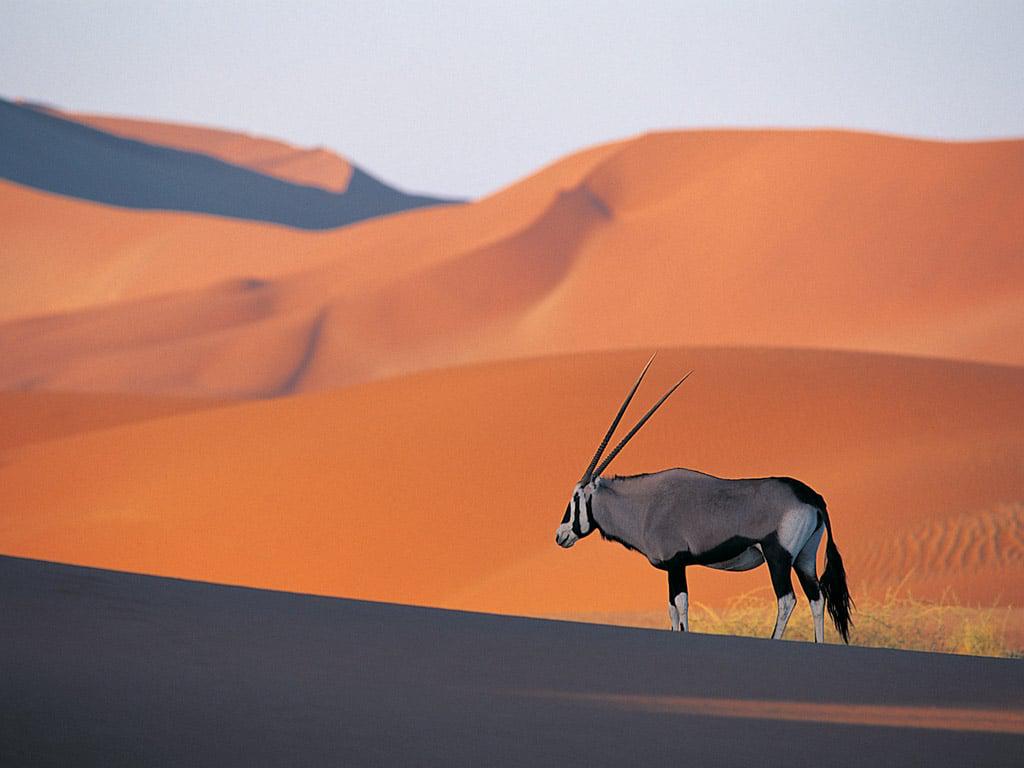
Looking back down the leading edge my footsteps trace the slog up.   The quickest way down is the slip side.   It is steep and the slightest foot pressure sends small avalanche of sand on its way to the mosaic of white tiles of the dry pan below. With each giant step the sand flows in front of my boots. I hit the deck in three minutes flat.   Not a trace of the Oryx or my descent is visible.   Petrified trees decorate one section of the pan.   Deformed twisted trunks and branches witness to there stop start once existence.

Rejoining the girls the voices of the first humanoids to arrive down the track breaks the porcelain of our natural surroundings. Their voices in the distance remind me of the virtual world — the new inhospitable surroundings in which our children will roam without any maps.   On arriving back to our campsite all efforts to get the park ranger to use his initiative to allocate us a new site away from a thumping generator and into the shade of one of the many unoccupied sites fails.   The decision is made we will move on in the morning.

TOP TIP: There is a saying that the early bird gets the worm. This applies very much in Africa. Apart from the obvious advantage of beating sun up early morning gives sharpness to hearing sounds, avoids the shimmers, and energy levels are high.

Dawn brings a total contrast in our surroundings.  Vast gravel plains, distant mountains, scrub, and our first Welwitschia a dinosaur of botany named after Friedrich Welwitch an Austrian Botanist. Darwin described it as “ the platypus of the plant kingdom.”Afficher l'image d'origine

Why? Your speculation is as good as ours. Apparently they are unique to Namibia with some of them a thousand to two thousand years old.   As far as we are concerned they sure picked one hell of a hostile place to grow their wind torn long green leathery leaves. Leaves been the operative word as they have only two leaves.

Fifty odd clicks from Walvis Bay disaster. Williwaw is belching smoke from under her bonnet.   First reaction is panic. We all bail out. Opening the bonnet horrors of horrors a small flame. Completely forgetting our fire extinguishers I jump up on Williwaw wing whip out my John Thomas and piss.   Success the human sprinkler does the job.   It looks like a long walk in the morning for we have not seen another human all day. Our map shows we are stranded at Vogefender Bergs (Birds feathers mountains.) We are just resigning ourselves to our situation when along the dirt track comes a car with a French journalist. Three hours later behind a V8 Ford I am towed into the only Land Rover Agency on the west coast of Africa.Afficher l'image d'origine

It’s the weekend in Walvis Bay. Nothing moves till Monday. We find a room and curse our luck and Nana Kodie back in Ghana.   If he had brought us here on one of his fishing shrimp boats none of this would have happened. All seemed extremely logical at the time. By Monday we have found out that we a prisoners of Walvis. There are no buses, no taxies, no camels, no boats, and no trains. Auto Fliess Land Rovers agent tells us that Williwaws starting motor is fried. They can only source three such starting motors in the whole of South Africa.   At 5780 N$ almost a thousand quid sterling never mind that it will take over a week to arrive some radical action is required.   I ring Brooklyn Engineering in the UK where I acquired Williwaw. DHL and 3000 N$ solves the rip off price but not our enforced stay.

Our depressing holiday lodging overlooking a Total petrol station brings on a bout of homesickness. It’s not surprising, as Walvis Bay according to some of its locals is a place where one cries twice during your life. Once when you’re a born and again when you leave the dump.   The smell of fish processing factories and a perpetual moaning wind that shapes the ever-changing, moving dunes called Soo-oop-wa make the prospects of a prolong stops in Walvis Bay less than attractive. Hazel in the local Chinese’s saves us. She sees the SOS on our foreheads and suggests that we should move to her friend’s house out on the lagoon.

Installed in some luxury things chirp up. Walvis is a mind-numbing hole. Once called Santa Maria da Conceicao (Conception Bay) or Bahia das Bahleas (Bay of whales) in Portuguese it is Namibias only deep-water harbor.

It has one restaurant out on an old wharf owned by one of the many who wants to escape – Danny. On learning that I am a yachtsman he brings us to a yard where he has purchased a partially finished steel hull for 30000 rand.

Some other poor Wally or Walvis went broke rolling his owe steel in an attempt to escape.   The hull lies alongside a steel lifeboat, steel motor cruisers all in different stage of rust warping.   The vision of Danny welding his way out of Walvis Bay is farcical, but rather than crush his dream I draw a picture of him one day sailing out into the blue yonder. (To join the rest of the rust buckets parked on Namibia’s insurance claims coast.)

We borrow a car from Lorna our new young wealthy Spanish landlady to visit Swakopmund. Namibia’s main get away from it all resort. A short drive to the north we pass large wooden raft platforms of the coast that adds to Walvis Bay aromas when the wind is in the right direction a touch of guano. Swakopmund turns out to be haven compared to Walvis. Small and compact its Germanic cleanliness, and buildings, are surrounded by nature’s timeless work of art sand dunes.

On our return to Walvis my yachting know-how has attracted new attention. Over dinner on Danny’s wharf I am invited to look over an old classic racing yacht of the sixties owned by a South African doctor. This time I find up on blocks totally exposed to the blazing sun a yacht of beautiful lines. Rumoured to have won the Sidney-Hobart in the sixties she is now a sorry sight. Her chances of seeing the open sea are as much as the doctor has in burying the horrors of his time in Angola. After two hours of indulging the doc’s life story I accept an invitation to the yacht club for a brier, and a few beers.

Here we are introduced to Colin and his second wife Kathy.   Colin works in one of Walvis Bay fish processing plants. His first wife was one of the founding members of save the desert elephants.   Unfortunately she died from kidney failure. It turns out that Colin in his time has trudged for ten years all over Namibia as a prospector for De Beers.   He knows the Kaokoland in the north of Namibia like the back of this hand. His eyes sparkle with a deep love for what he describes as one of the worlds last true wilderness. His descriptions of its topographical features, its animals, its birds, its vegetation, and its people are intoxicating.

When he invites me to go crayfish diving with a promise of a fish dinner to best all fish dinners I jump at the invitation.

An early start sees us in the middle of nowhere some thirty miles up the coast from Swakopmund. The sky is cloudless. Gold colored dunes are separated from the sea by twenty feet of flat black rock.   I have forgotten my dip in South Africa when my head never mind my balls ached from the cold Benguella current.

The sight of Colin donning a wet suite top brings it all rushing back with a venomous clarity. Also, I have never dived in kelp, which does not help my confidence. Colin, handing me a wet suit top assures me that there is nothing to it. All we have to do is dive down and stuff a few of the blighters in our net bags. Splash. I stand watching his air bubbles. Will I or won’t I test the waters before taking the plunge. It can’t be all that bad. He still has not surfaced. In I go without dipping the toe. Jesus, Mary and fuck me. I gasp for breath. Just my luck he pops up beside me before I can leap out. He dives again. I wait for my heart beat to take on some form of normality.   My first attempt to submerge leaves my backside on the surface. He resurfaces. I feel that my mercury has hit rock bottom. He gone again. I make another attempt this time getting down as far as the kelp. Man this is for the birds. I throw the towel in – Colin spends twenty more minutes in the water. He must have antifreeze for blood.

Dinner at his home that evening is as promised.   Crayfish, kingfish, octopus, seduces our taste buds. Several hours of marking our map with the best campsites and water holes beckon us to explore one of Africa’s remaining remote regions about 42,000sq km (17 to 20 deg S to 15 deg E) excluding the Skeleton coast. Bordered to the north by Angola, to the east by Owamboland and Etosha National Park. Damaraland to the south and the Atlantic Ocean to the west.

Colin describes clear pools with terrapins, crocodiles as big a battle ships in the Kunene River. Open golden grassveld areas with fairy circles (circular patches on the soil with no vegetation cover), dry mopean savanna near Sesfontein our point of entry. Natural bathtubs, on the very edge of Epupa Falls.

Vegetation east of the fall that is almost tropical.   Python fig with trunks as big as a man’s leg. Ana trees, Palm trees, Hairy Shepard’s tree, animals from the more famous unique desert-dwelling elephants almost on the point of extinsion to Hatmann’s (mountain) Zebra.

He also tells us not to camp in or on riverbeds. They are animal highways in the dry season. Some travel over 80 kilometers to watering holes and don’t take kindly to a blocking tent or whatever. Not to enter a Himba village without asking first.   There are burial sites and holy places.   Never to walk between the holy fire and their main hut or the holy fire and the cattle pen. The fire is sacred to the Himba who are a semi-nomadic peoples of around 26 tribes each with it own headman. For nearly half a century the Kaokoland has guarded the Himba from outside interference but according to Colin we will be one of the last to see these peoples and what left of their culture. Angola used them as trackers against South Africa in return for cheap booze. Now they are reduced to begging from tourists, exploited by coffee table photograph books what was once a beautiful and simple people are now a sorry sight.

We return in the late hours of the morning to Lorna.   Her Stafforshire hounds and her two African gray parrots have the run of the place. The parrots are busy eating the furniture and the joists when not guarding the pantry door. Her Spanish boyfriend Salivdor is crashed out on the sofa oblivious to all. In the morning we are somewhat late surfacing but we are in time to see that Salivdor like most of the place has being pecked clean.   The good news is that Williwaw is ready and that we have decided to venture into the Kaokoland for a few weeks.

I visit Colin who arranges a permit. Usually it is a requirement on visit the Kaokoland that one must travel in pairs in case there is a problem. Colin is sure we will not have a problem if we go it alone. I pick up Williwaw. Bump into Salivdor who is brainless as a wet squib but wealthy.   He asks me to give him a hand.   He has a Volkswagen combi, which needs a tow to get it started. Twenty minutes later the combi it standing in a pool of oil. Salivdor while being towed in reverse has slammed her into first gear. It is time to hit the road.

Afficher l'image d'origine


Afficher l'image d'origineAfficher l'image d'origine


THE BEADY EYE’S UNPUBLISHED BOOK: CHAPTER ELEVEN: SECTION TWO.

Tags

, , ,

(CONTINUATION)

Afficher l'image d'origine


The Cable Car is out of action.   The three-hour hike up does not appeal never mind all the steps to the girls. The iron ladder up the Lions Head is deemed less attractive.   Much to the horror of my credit card, I promise another dose of downtown Cape town for an assault up to an old Gun emplacement, which is situated halfway up the Table. It wins hands down. A short drive brings us to our departing point.   A crabby Florence follows us along a track with super views of the city that is to be sure, to be sure, set in one of the worlds beautiful spots. Cape Flats where most of the Cape inhabitants live remains hidden to our view.   My card pays the penalty for most the afternoon.

A day of rest is what the doctor orders. Where better than the municipal open-air swimming pool whose water is refreshed by the odd growler crashing on the sea wall.  Cascading a shower of white surf on all unsuspecting oiled covered sun worshippers. Flo to her joy and ours makes a new friend living opposite the Hostel.

The sunset on the bobbing heads of a few seals, playing in the glimmering kelp. Yawns, yawns, bring a new day and time to head up the coast.

Williwaw is back to one of its old tricks behaving like a drunken sailor as we rumba along the N2.   A long climb out of False Bay up over Sir Lowry’s pass test her worn out radiator to boiling point. The garden route starting at Mossel Bay ends at the Tsitskamma Coastal National park. With me fighting our odd tire we pass through one dreary town after another whose names seem to be added to over the years to make them more lifeless.   Or perhaps there is a hidden agenda to overthrow Newtownmountkennedy from the Guinness Book of records.   Riversonderend, Buffeljagsriver, Heidelberg pass by.   So far the Garden route raved by many as being one of the most beautiful drives on the continent is not up to scratch.   We are fast learning that it takes some considerable time for the scenery to change.Afficher l'image d'origine

We stop at Mossel Bay, take a wind-swept walk on a grey beach and move on to Knysna Lagoon the first spot of some beauty.   Resisting a Boerewor for lunch (large sausage), we push on to Plettenberbaai or Plettenberg Bay. All along this coastline short rivers to small to qualify naming on our map drag the muster colour soil from the Outeniqua Mountains into the sea.

The next eighty kilometres begins to live up to its reputation passing through South Africa largest native forest we arrive at Storm River. Here with cormorants that I have not seen before, we witness in dramatic colours the bleeding of the land. The clawless otter and the right whale, not the wrong whale favour this section of coast but we see neither.   Just up the road, we pull into Tsitsikamma Forest national park where the otter has a trail the whale and snorkelers an underwater trail. A Swiss-style chalet accommodation takes our fancy. We have arrived well off-season so the overnight rand rental against the dollar is a snip.

Superbly positioned on manicured green lawns the chalets come en suite with all towels, pillow covers, and napkins, blankets embroidered with the emblem of the park. The shower is more than welcome after the day’s struggle with keeping Williwaw on the straight and narrow. With full stomachs, not even the Indian Ocean can keep us awake. Long before the girls stir, I am on the otter trail all 100k of it in two hours. Not a hint of otter to be seen anywhere but Yellowwood, Stinkwood, Bastard Ironwood with intense, exquisite flashes of deep blue ocean mix the shadows and beams of sunlight. My two hours are a spell-bounding encounter with the Garden Route.

With Williwaw still acting like a drunken sailor we are once more in search of a true competitor for the Guinness book of records.   Eersterivierstrand, Gamtoosriviermond, don’t make it. Humansdorp   (Dorp meaning country town in South Africa) does, however, have a ring to it to be twinned with some suitable complimenting named city. Opting for a short day’s drive we stop at Jeffery’s Bay, Sea View house perched out on a sandy point of a beach that runs all the way over to Port Elizabeth is our target sand castles and a spot of founder fishing put the last touches to-day with all my toes intact. The art of spearing a founder before you are lifted off your feet by the incoming swell not to mention the shock of feeling it wriggle from under barefoot soul takes practice.

In the middle of nowhere with the sun at its apex, Williwaw still protesting about asphalt comes to a sudden halt. Sometimes I love her, other times I could take a sledgehammer and beat her to smithereens.   After two days of battling her lee helm, I am in no mood for one of her characteristical qualities which are all blamed on me.   With the girl’s reminding me that it I who attribute them to her in the first place a fuse is my first thought. No such luck. “The security system has cut off the fuel.” Any more bright ideas ladies! Bonnet up I might as well be looking over a field gate into the blue wonder. Not a thing I learned in my two-week car/engine/ change the oil course has a chance of reaching an electrode.   Wiggle the battery and the like.   Yo ho ho and a bottle of rum my oil covered hand happens on a loose cable.

The accelerator cable has snapped or to be more precise a small split pin holding the cable to the accelerator has given up the ghost.   I cannot believe that an off the road 4 wheel drive vehicle relies on such a tiny item. Let’s hope there is a spare in the box.   Luck shines on us packed in its plastic bag is a spare cable pin and all.

We pass through Grahamstown arriving in East London where over the next few days we are turned into that strange couple that is endangering their daughter’s life in darkest Africa.   To Florence’s delight, our friends live in a modern bungalow with the mandatory swimming pool. East London is a nondescript port town with an Aquarium was once named Port Rex after the illegitimate son of George Ш. We are introduced to friends of friends over braai (barbecue anywhere else in the world). Over the next few days our gnashers are biting into Kingklip (a fish) Bunny Chow (bread hollowed out and stuffed with curry) stakes with monkey gland sauce, and the trusty Boerwors. (Sausage) East London might be as dull as dishwater but we receive hospitality hard to forget.Afficher l'image d'origine

Borrowing a hardtop flat caravan trailer and local knowledge we set off for a few days to the meeting of the three rivers. Williwaw blows a tyre giving us all a missed heartbeat followed by a half an hour of effing and cursing compliments of my good self. Our hand-drawn map and directions eventually lead us down a dirt trail with a steep gradient into a superb hidden cove. Apart from us, there is only one other visitor.   Three fishermen, down from the Free State with a large deep-freeze.   In the morning we learn that they spend each years holidays filling the deep freeze with kingfish, bass, rock cod, before returning to their dry farms. Steaks all year round with biltong as a staple diet might also give one the urge to fish non-stop.   They fish from early morning to darkness, consuming enough beer for a piss every ten minutes.
We spend three wonderful days exploring our surroundings ultimately making the choice to give Swaziland and the Transvaal (Latin Trans meaning across and the river named Vaal) a miss. Rather than going up the Mozambique side where one is likely to lose a leg from landmines (It scoring ten pages of difficulties in the Bible) we opt for the Skeleton Coast.

After another round of east London social gathering, which sharpen my flirting abilities much to Fanny’s amusement we hightail it back to Cape Town.   Apart from some wind-swept beach walks, oysters, dragging a stranded car out of a river and a meeting with a wooden Boar owned Land Rover (1960th model rebuild in wood.) we arrive back in Bunkers.

Over the next week, I sort out Williwaw sobering her up with new treads.   Her carnet (proof of import and export document is out of date) valid for a year is in need of renewal. The South African AA turns out to be worthless so with a little doctoring I extend the validity for another year. Her larder is restocked, and Fox security system renewed compliments of its guarantee. We take in the Michael Collins movie, which I happened to be an extra in before leaving Ireland. Neither the girls nor I spotted me so the Oscar will have to wait. Seeing the movie left us with weird feelings of unfinished business.   Bunkers backpackers provide a gossip shop of fellow wanderers. Some raw prawns like one Irish Looney that stands out with a bike.   He is going to cycle to “Say that again Sam.” He arrives back with sunstroke a sore ass, and fear of wide-open places. Others, who opinions varied so widely they might have been talking about different subjects, would do well to take a leaf from Jonathan Seagull when advised by Chiang, “You must begin by knowing that you have already arrived”

The girls are reluctant to leave the civilized trappings.   As usual, Fanny and I get our knickers in a knot as to which is the best route out of Cape Town. It is an observable fact that I have a short fuse relying on a sense of direction (navigation by dead reckoning) when it comes to motorways, bypasses, traffic lights, roundabouts, and the like. Sulks over, I being the lemon, we head for the land of Oranges and Citrus fruits. A three-hour drive brings us to Citrusdal, and on to Clanwilliam.Afficher l'image d'origine

Here we pick up brochure advertising a camping spot on the Krom River, which borders the Cederberg Range. The Cederberg is the Western Capes wilderness covering seventy-one thousands hectares of Quartz and sandstone rocks and Bushman’s Art. A 57km gravel drive brings us to the gates of our first pitch since leaving Ghana. Pitch no 64. We have arrived at a place called Algeria situated on the western side of Pakhuis Pass. Algeria how are you. Just goes to show where one can end up with dead reckoning.

Our first problem is getting a spot on the camping site.   Although several sites are obviously visible from the gates are not occupied we are informed that they are full.   The gaffer turns up, and in no time the ramp is lifted.   Morning reveals a stunning setting of a landscape. We have indeed found a gem of a campsite to explore the area.   Famous for its sandstone formations I pick the Maltese cross a massive rock begging a Michelangelo.   After a false start, I eventually find a small sign pointing up a shale track to the start of the hike to the cross. Top TIP: Apart from the common sense things such as a cap, water, lip salve, decent shoes, sun block, tell someone where and when you are going.

Following a small stream. It’s banks peppered with wild orchards we climb up to a high of 1700 meters. Emerging onto the flat Fanny has had it. She and Flo’s head back. Continuing on, the first thing I notice is that the balancing monk of Tibet has been here. Small mounds of rocks like spoor to the trained eye mark the way to their shrine the Maltese cross. The cross appears and I have to admit it is an impressive piece of Cederberg art.   Back at base, we decide to move up-country to the Wolfberg cracks.

Pitch no 65 is a farm overlooked by a large cliff with four deep cracks.   “On the top, it’s like walking on the moon,” we are told.   Watched from a long way off by a large population of rock bunnies or to give them their proper name Hyraxes we arrive at the foot of the first crack.   (It is hard to come to term according to genes that these little buggers are related more to the horse, Manatee or elephant)   Our way up is blocked by a large rock fall. We watch a man coaxing a four to five-year-old along a ledge on one of the other cracks. Two teenagers looking more than anxious are following them.   They convince us that crack three is the quick way to the moon and blue yonder. Crack two and four are for the Hyraxes.   High up on our rock fall a small mound of stones is a sure giveaway sign that the balancing monks pass this way.   With some hoofing and pushing, we scramble over the rocks into the gut. One hour later we are emerging out onto a rock plateau.

A wander around confirms that the monks have been at it in every direction.   Not willing to follow any given trail we lunch, descend, and nurse our shock absorbers over a whisky or two.

We sleep late. Florence has teamed up with two kids her own age. We are free to go on an archaeology sniff around with two keen UK geomorphologies. After a wonderful day of red sandstone caves in all shapes and sizes each sculptured by thousands of years of erosion we move on to Vredendal (Vale of Peace) on the Oilfants river valley gateway to Namaqualand.

After a drive of some considerable beauty, we arrive in the middle of Vredendal.   About 25 kilometres from the Atlantic coast with its cold Benguella current giving the region a very low rainfall.   It is only a very large irrigation scheme that allows viticulture. Canals covering a distance of 261 kilometres deliver water to over 600 farms. It is the Cape Garden of Eden producing watermelons, spanspek (muskmelon) summer fruits, and vegetables, flowers. The wine harvest is in full swing with lines of tractors waiting their turn to have their golden loads crushed in the local Co-op. It’s not long before our lips are dipping into, Grand Cru, Ruby Cabernet, Merlot, Colombar, Cabernet Sauvignon, and Chardonnay. Sweet dreams come early in a local pad.

Still half asleep we slip out of the vale of peace on our last day in South Africa. Leaving the Western Cape we head for Springbok in the Northern Cape.   A long easy drive gives us time to reflect on our stay.

There is no arguing that Europeans have given Africa its written history and that South Africa contribution to its future history lies unknown. Its own path will in our opinion be shaped by land and by the sharing of its wealth for little has changed in the conduct and mentality of men.   There is no getting away from the feeling that Africans snatches from the present while the land takes them back to familiarity to something that has always been there. Our last Pitch no 66 is behind razor wire.   Early morning we check out at Vioolsdrif without a hitch.

(To be continued)

Donation news:  Perhaps its the word donation that is the problem. So how about leaving a TIP.

R Dillon. Account no 62259189. Ulster Bank 33 College Green Dublin 2.

Sorting Code: 98-50-10


THE BEADY EYE SAYS ITS NOW OR NEVER FOR THE UNITED NATIONS.

Tags

,

There is plenty of blame to go around for the state of the world we live in.

But to many decisions are now driven by political expediency instead of values.

Its is a sign of how perversely twisted the bureaucracy we have now in all our out of date World organisations that once had principles.

Personnel decisions are considered more dangerous than the responsibility to tackle a range of terrifying crises facing us all.

Terrorist breeding grounds in Syria, Iraq, Somalia, Afghanistan, Pakistan, Yemen, Libya,

Not to mention Climate Change and all its consequences.

I mean all of us the Rich, Poor, White, Black, Christian, Muslim, and the unborn.

The United Nations is failing and in desperate need of reform which can only be achieved by an outside examination that is Independent.

If this is not undertaken the UN should be scrapped and replaced with a new World Board that has the health of the earth and its people at its core.

Since the United Nations established its first peacekeeping operation—almost 70 years ago—more than 3300 people have died serving the UN in the pursuit of peace.

  • Peacekeeping operations since 1948: 71
  • Current peacekeeping operations:      16
    • Uniformed personnel: 104,503 (as of 29 February 2016)
      • Troops: 89,406
      • Police: 13,261
      • Military observers: 1,836
    • Civilian personnel: 16,471 (as of 31 July 2015)
      • International: 5,256
      • Local: 11,215
    • UN Volunteers: 1,804 (as of 29 February 2016)
    • Total number of personnel serving in 16 peacekeeping operations: 122,778
    • Countries contributing uniformed personnel: 124
    • Total fatalities in current operations: 1,679
    • Total fatalities in all peace operations since 1948: 3,454.
      • Approved resources for the period from 1 July 2015 to 30 June 2016: about $8.27 billion
      • Outstanding contributions to peacekeeping (30 June 2015): about $1.6 billion


Current operations Afficher l'image d'origine

United Nations Mission for the Referendum in Western Sahara (MINURSO)

In Western Sahara since April 1991
Strength: 495 total, including:

  • Uniformed personnel: 242
    • Troops: 26
    • Military observers: 216
  • Civilian personnel: 241
    • International civilians: 84
    • Local civilians: 157
  • UN Volunteers: 12

Fatalities: 15

Approved budget (07/2015– 06/2016): $53,190,000

United Nations Multidimensional Integrated Stabilization Mission in the Central African Republic (MINUSCA)

In the Central African Republic since April 2014
Strength: 12,627 total, including:

  • Uniformed personnel: 11,686
    • Troops: 9,639
    • Military observers: 164
    • Police: 1,883
  • Civilian personnel: 760
    • International civilians: 518
    • Local civilians: 242
  • UN Volunteers: 181

Fatalities:  19

Approved budget (07/2015– 06/2016): $814,066,800

United Nations Multidimensional Integrated Stabilization Mission in Mali (MINUSMA)

In Mali since April 2013
Strength: 13,170 total, including:

  • Uniformed personnel: 11,781
    • Troops: 10,645
    • Military observers: 39
    • Police:  1,097
  • Civilian personnel: 1,246
    • International civilians:  585
    • Local civilians:  661
  • UN Volunteers: 143

Fatalities:  81

Approved budget: (07/2015– 06/2016):  $923,305,800

United Nations Stabilization Mission in Haiti (MINUSTAH)

In Haiti since June 2004
Strength: 6,092 total, including:

  • Uniformed personnel: 4,750
    • Troops:  2,368
    • Police:  2,382
  • Civilian personnel: 1,245
    • International civilians: 304
    • Local civilians: 941
  • UN Volunteers: 97

Fatalities: 183

Approved budget (07/2015 – 06/2016): $380,355,700

United Nations Organization Stabilization Mission in the Democratic Republic of the Congo (MONUSCO)

In the Democratic Republic of the Congo since July 2010
Strength: 22,492 total, including:

  • Uniformed personnel: 18,618
    • Troops: 16,938
    • Military observers: 454
    • Police: 1,226
  • Civilian personnel: 3,470
    • International civilians: 816
    • Local civilians: 2,654
  • UN Volunteers: 404

Fatalities: 100

Approved budget (07/2015 – 06/2016): $1,332,178,600

African Union-United Nations Hybrid Operation in Darfur (UNAMID)

In Darfur since July 2007
Strength: 21,022 total, including:

  • Uniformed personnel: 17,453
    • Troops: 14,345
    • Military observers: 179
    • Police: 2,929
  • Civilian personnel: 3,412
    • International civilians: 811
    • Local civilians: 2,601
  • UN Volunteers: 157

Fatalities: 230

Approved budget (07/2015 – 06/2016): $1,102,164,700

United Nations Disengagement Observer Force (UNDOF)

In Syria since June 1974
Strength: 928 total, including:

  • Uniformed personnel: 788
    • Troops: 788
  • Civilian personnel: 140
    • International civilians: 50
    • Local civilians: 90

Fatalities: 46

Approved budget (07/2015 – 06/2016): $51,706,200

United Nations Peacekeeping Force in Cyprus (UNFICYP)

In Cyprus since March 1964
Strength: 1,067 total, including:

  • Uniformed personnel: 916
    • Troops: 861
    • Police: 55
  • Civilian personnel: 151
    • International civilians: 33
    • Local civilians: 118

Fatalities: 183

Approved budget (07/2015 – 06/2016): $52,538,500

United Nations Interim Force in Lebanon (UNIFIL)

In Lebanon since March 1978
Strength: 11,369 total, including:

  • Uniformed personnel: 10,521
    • Troops: 10,521
  • Civilian personnel: 848
    • International civilians: 257
    • Local civilians: 591

Fatalities: 309

Approved budget (07/2015 – 06/2016): $506,346,400

United Nations Interim Security Force for Abyei (UNISFA)

In Abyei, Sudan since June 2011
Strength: 4,795 total, including:

  • Uniformed personnel: 4,497
    • Troops: 4,410
    • Military observers: 135
    • Police: 17
  • Civilian personnel: 202
    • International civilians: 130
    • Local civilians: 72
  • UN Volunteers: 31

Fatalities: 20

Approved budget (07/2015 – 06/2016): $268,256,700

United Nations Mission in the Republic of South Sudan (UNMISS)

In South Sudan since July 2011
Strength: 15,509 total, including:

  • Uniformed personnel:  12,733
    • Troops: 11,782
    • Military observers: 185
    • Police: 1,105
  • Civilian personnel:  1,973
    • International civilians: 787
    • Local civilians: 1,215
  • UN Volunteers: 435

Fatalities: 42

Approved budget(07/2015 – 06/2016): $1,085,769,200

United Nations Operation in Côte d’Ivoire (UNOCI)

In Côte d’Ivoire since April 2004
Strength: 7,120 total, including:

  • Uniformed personnel: 6,022
    • Troops: 4,457
    • Military observers: 185
    • Police: 1,380
  • Civilian personnel: 961
    • International civilians: 301
    • Local civilians: 660
  • UN Volunteers: 137

Fatalities: 137

Approved budget (07/2015 – 06/2016): $402,794,300

United Nations Interim Administration Mission in Kosovo (UNMIK)

In Kosovo since June 1999
Strength: 366 total, including:

  • Uniformed personnel: 16
    • Military observers: 8
    • Police: 8
  • Civilian personnel: 328
    • International civilians: 109
    • Local civilians: 219
  • UN Volunteers: 24

Fatalities: 55

Approved budget (07/2015 – 06/2016): $40,031,000

United Nations Mission in Liberia (UNMIL)

In Liberia since September 2003
Strength: 5,224 total, including:

  • Uniformed personnel:  3,882
    • Troops: 2,626
    • Military observers: 77
    • Police: 1,179
  • Civilian personnel: 1,159
    • International civilians: 358
    • Local civilians: 801
  • UN Volunteers: 183

Fatalities: 196

Approved budget (07/2015 – 06/2016): $344,712,200

United Nations Military Observer Group in India and Pakistan (UNMOGIP)

In India and Pakistan since January 1949
Strength: 116 total, including:

  • Uniformed personnel: 44
    • Military observers: 44
  • Civilian personnel:  72
    • International civilians: 25
    • Local civilians: 47

Fatalities: 11

Appropriation (biennium 2014-2015): $19,647,100

United Nations Truce Supervision Organization (UNTSO)

In Middle East since May 1948
Strength: 384 total, including:

  • Uniformed personnel: 150
    • Military observers: 150
  • Civilian personnel: 234
    • International civilians: 88
    • Local civilians: 146

Fatalities: 50

Appropriation (biennium 2014 – 2015): $74,291,900

Value for money in a smart phone world.  You tell me.

← Back

Thank you for your response. ✨


THE BEADY EYE’S UNPUBLISHED BOOK. CHAPTER ELEVEN.

Tags

, , ,

Footnote ( We seriously looked at the possibilities of trying to pass through the Congo. Thank God we did not attempt to do so, as it would definitely have ended the trip.)

Afficher l'image d'origine


Afficher l'image d'origine

SOUTH AFRICA.

What we Know:

Zulu. Boers. Cape Town. Table Mountain. Cape Hope. Apartheid. Stephen Biko. Afrikaners. Nelson Mandela. Robben Island. Soweto. Johannesburg. ANC. Maguba. Winnie Mandela. Tutu. De Klerk. Christian Bernard. Diamonds. Kimberley. De Beers. Cecil Rhodes. Springbok/Rugby. Rand. Wine.

Downtown Jo’burg, the city of gold is somewhat of a shock from the air. Its skyscrapers and large grey office blocks never had the walking African in mind. The car rules.Afficher l'image d'origine

Looking distinctly like an American city, it is totally out-of-place with its outer suburbs.   Soweto galvanized rooftops glittering in the southwest. To its north the sheen of blue mark white middle-class housing with a steep geographical ridge running east to west.

Sporting a reputation for all things nasty day or night, black or white the heartbeat of the inner city has long stopped beating by the time we leave the airport.

Our first Jo’burg problem is not the city’s scant regard for a life it is Kurt the Racist terrier.

With the cargo doors fully open his mother is standing on the tarmac wailing, “He is dead, he is dead.”

One empty cardboard box has come down the ramp.

A security guard is dispatched into the bowels of the plane.   The disembarking passengers form a small crowd around the tail of the plane. Unlike them, we know that if Kurt had his way he would reinstate Apartheid. If he is alive there is every likelihood that the guard will emerge with a terrier locked onto his black backside. A few minutes pass by with no sign of the guard.   Anticipations run high. It looks like Kurt’s liberation from time and space will have a physical and psychological impact, if not on him we hope not on his panic-stricken Dutch mum.

A spontaneous round of applause greets Kurt’s survival. We all clear immigration and are set to venture out into the land of fast food, street lighting, four-lane highways, and traffic lights.   Kurt, however, is nabbed once more for questioning. By the time he is given the all clear we have no time to mess around looking for lodgings. A phone call confirms that dogs with attitude are accepted – we are off to the first Hostel mentioned in the Bible.   Fairview house situated three kilometres from the city centre. It is described as a large old house with sunny rooms and a cheerful atmosphere.

On arrival in South Africa, the first thing one become aware of is that there are a lot of uniforms standing absolutely still, like sticks or scarecrows supporting walls, pillars, windows, counters, cars, doors. The second is the warning notices on doorways – ARMED RESPONSE.   It is said you can tell the wealth of any household by the sharpness of the razor wire on top of the walls.

Glittering with two Doberman.        –            Wealthy.

Dull with one Alsatian.                  –           Not so well off.

Rusty or glass with a black guard. –           Middle class.

Just after the crack of dawn, we are ready to set forth into one of the world’s most dangerous cities. Our early start is more to do with the Fairview dorm accommodation than anything else. It must be said however that none of us have that feeling of security/familiarity with our surroundings as we walked downtown towards the nearest shopping district.

The fortified garden /backyard walls give off an air of danger from under their bright-coloured flowering fuchsia Bougainvillea covering. The boarded-up shop windows do little to dispel this feeling of insecurity. By the time we come upon our first group of blacks lounging on the grass surrounded by last nights beer cans we have decided that Jo’burg is a sorry sight for any new eyes.

With a few days to kill before training it down to Cape Town, we decide to venture where no Kurt dares to go to Soweto, the lion’s den of modern-day South Africa.

But first, a competent modern bank is required not to stick up but to arrange the transfer of funds to top up our now very much in short supply stock of US Dollar bills.

While the girls look at a second-hand clothes shop I thank Jo’burg for a bristling modern bank that agrees to facilitate the receipt of funds on my behalf for a small commission. I instruct my Irish bank to forward the required amount of US dollars, requesting them to ensure the packet against theft. It would be unwise to ignore all the Burg’s claims to fame.

Eight a.m. our guide to Soweto arrives in a white transit. He is so full of chat I have made up my mind long before we enter the township to escape his barrage.Afficher l'image d'origine

First stop is the Soweto museum. Housed in two sixty-foot containers it is the only Museum in the world perpetually packed.   As a relic of justice, it reminds us that it is not always the mighty that write history.   Paradoxically its black and white photos graphically depict what went wrong with White Supremacy.

A donation to the upkeep finds us outside once more.   After yesterdays helping of razor wire and welcome notices I can’t help wondering if the new fashion of justice in South Africa is what the doctor ordered. The big question remains can there ever be justice in an unjust world?   A deliberation way and beyond our guides brief.

Back aboard we pass Winnie Mandela’s pad with its manicured front lawn just as much out-of-place as Jo’burg skyscrapers. Spotting some of the local wildlife I call a halt outside a Shebeen.   No one seems too enthusiastic to give a mating call, so I slide the van door open and wave to our gobsmacked guide to continue the tour without me.   Perhaps here I will flavour some of to-days Sowetans and get some answers as to why I feel the hairs on the back of my neck stiffen in South Africa. I am stared at by one and all as I order my first bottle of Castle beer.

TOP TIP: It still pays in South Africa to announce that you are not a white South African if you want to unfasten some of the countries’ black soul, or for that matter in dealing with its police.

“Cunnis ta to I’m Irish.”   The ice broken, I am without further ado surrounded by the big heartiness of ordinary Soweto people.   Understanding I know is a kind of ecstasy, however, I am sure that the bottle of brandy I won in the pubs weekly draw had a lot to do with the ecstasy and the mistaken belief that I was in the market for a BMW.   There is something generous and rash in the spirit of their offer.

All are hungry to talk. So talk we did and as far as I can remember covering a wide range of subjects.  All agree that African leaders still think like chiefs telling their people what to do. Tourists are seen as a feeding frenzy to the street vendor, beggars, and the petty thief. National debts are the power kegs of African countries. That AIDS, lack of water and land will be the cause of future African wars.   That Afrikaners still think that they are gods chosen people of South Africa.

By the time the girls return the bottle of brandy is long finished I have also learned that Africa has 30% of the world minerals, 51% of diamonds, 47% gold, 5th of the worlds dry land and an 8th of the world’s population.   To the dismay of our guide, I have accepted an invite to play a game of pool. Firstly, a drink for the girls and then the guide has to be buttered up to drive us to another location, not on the tour route. A task set to by my learned doctor, teacher, car dealer, the Shebeen owner, and the pool game challenger. At the change of venue, we have a spot of dinner and a chuck and doris, (Last drink)

By the time my cruel hangover has lifted we are leaving Africa’s most dangerous city after a few hours delay on the overnight train to Cape Town. A year of youth work in Dublin’s inner city with a snooker cue had conquered the best that Soweto had to offer on the pool table. The brandy had conquered all fears of any armed response. The local cop shop has had its cash-dispensing machine pinched from the fourth floor – some feat it has to be said.

I begin to wonder as the train whistles towards Table Mountain, if Stephen Biko the founder of The Black Consciousness Movement was right when he said, “ Being black is not a matter of pigmentation – being black is a reflection of a mental attitude”.   I am sure if Biko were alive he would view modern-day South Africa not by the shadows of the past, but by the remaining razor wire. Regrettably, tribalism the deep-seated political illness of modern South Africa remains in the whole of the African Continent and we all know that one body can lead to thousands.

Enhanced by years of bad world press the vastness of South Africa slips by while we sleep to the sound of rolling stock.

Over breakfast, our train turns into a scenic kaleidoscope through which we pass one by one the many shanties town better known in South Africa as townships coming to a halt in downtown Cape Town.

We emerge into Africa’s best-known city famous worldwide – not because of its African culture or its African architecture or its stunning setting.   It is more to do with that it is here in 1910 the Union of South Africa was born by educated men who decided that there were only five species of humans left living in South Africa. Europeans (Dutch Calvinist / French Huguenots) becoming Afrikaans speaking Boers the Coloureds who made up of what was left of the Zulu, the Swazi, the Xhosa, the Sotho, the Nguni, the San or Bushmen referred to as the Khoi- San   is long gone leaving the Asians Indians who were brought in by the British as laborers not forgetting the Blacks leaving I suppose the Tourists– us.

It is here the Dutch East India Company arrived in 1652 establishing the Cape Colony in order to supply their ships on the way to and back from the East Indies and India only to have it grabbed off them by the English in 1795 and then given back 1803 then surrender, to be annexed in 1806 officially becoming a British Colony in 1814.

It is here where the British invented concentration camps to beat the Boers, (meaning farmers in Dutch). It is here where Michael Cane immortalized the Zulu or perhaps it was the Zulu’s who immortalized Mr Cane. It is here where Cecil Rhodes founder of De Beers in 1889 or thereabouts laid the seed for today’s troubles in Rhodesia (named in his honour) now Zimbabwe.   It is here where the Indian Ocean meets the South Atlantic.   It is here where the Portuguese navigator Bartholomew Dias discovered the Cape of Good Hope, naming it Cabo Tormentoso until John И renamed it Cabo de Bõa Esperangça.

It is here where the truth reconciliation commission in 1997 found that the five police officers had murdered Biko in 1977 while he was in police custody.   It is here where under the terms of the Commission all five were given amnesties.   It is here where one human’s heart is transplanted into another human in 1967.   It is here where we are to be reunited with Williwaw. It is here where homeward bound we turn and modern shopping malls called Victoria and Albert await the girls.

Installed in Bunkers hostel at Sea Point in the direction of Camps Bay one street removed from the seashore we are overlooked by the Lions head we are all set to go and explore, to see if the ‘too painful to recollect’ supine politics of the past is being washed away from this vast country that makes up small part (3% in total) of the African Continent.

Our plan is no plan at all. We begin with an early morning walk along the seafront.   Intoxicated by blue sky, refreshed by the power of the sea, we mingle totally unaware with the 5 million Europeans (Whites), 29 million Bantu (Blacks), 3 million Coloureds, (Mixed race) and 1 million Indians.

As we clamber aboard one of the local minibus taxis that rocks and rolls to the sounds of a local radio station Table Mountain named by Antonio de Saldanha a Portuguese navigator in 1503 is cloaked from our view with a reverse waterfall of white cloud. Fairs are passed forward and change arrives back in due course while the conductor toots all walking humanoids to fill any empty seats. Our first port of call is the port converted into a waterfront of shopping malls, restaurants, bars, smart shops, and a large covered market, the tourist trap. Resisting a Big Mac we marinate contentedly in the windows of consumerism. We take in an IMAX show and the day ends with a sundowner at Ferryman’s Tavern, which is just across the road from the Customs, and Excise building Josh, and I target for tomorrow to retrieve our vehicles.Afficher l'image d'origine

The next morning we enter the ground floor to secure clearance for our trusty Land Rovers. It is our intention to save some loot by filling in the required papers ourselves. Knocking on the door labelled Customs produces a gruff, ‘Enter’!

We are met with a torrent of language that would normally get one in jail for abuse. A discourse of sewer gutter tongue is being directed towards a black woman. It’s our first Boer, red-faced, an exact copy of his photo hanging on the wall behind his desk. The black and white photo portrays him in shorts with a cane in hand when white was white and black was Robin Island. We stand shocked. Josh looks like a rabbit caught in the headlights. Our request for clearance papers is met with another insurgence of vowel vile that has him retreating to the door. The fat bastard would do well to take a holiday in Northern Ireland where he would see two other colours, Orange and Green. I follow Josh out into the corridor.

Irish temper is well-known worldwide but it has never served me better on my re-entry.

I threaten the bastard in true Celtic Zulu gift of the gab. In full flow, my outburst is brought to a halt by his hand sliding across the desk to pick the phone up “ Is that you O’Donnell? You’d better get your ass over here before one of your tribe has my lunch”.   In a stunning silence, the desk phone is returned to the cradle.   A complete makeover has a glass of whisky in my hand. “Yes, the container has arrived. We can get it cleared as soon when O’D arrives.”

Two hours later the seal on the container is cut. Out rolls Williwaw and the other two jeeps. No immigration inspections are required. Carnets stamped, a full clean bill of health is given with a handshake and “Enjoy your stay in South Africa”.   Over a glass of beer O’D tells us that ulcer mouth has a good side to him helping many a young one that finds themselves on the bread line.   I am tempted to inquire whether it is brown or white bread.

I threaten the bastard in true Celtic Zulu gift of the gab. In full flow, my outburst is brought to a halt by his hand sliding across the desk to pick the phone up “ Is that you O’Donnell? You’d better get your ass over here before one of your tribe has my lunch”.   In a stunning silence, the desk phone is returned to the cradle.   A complete makeover has a glass of whisky in my hand. “Yes, the container has arrived. We can get it cleared as soon when O’D arrives.”
Afficher l'image d'origine

Some hours later parked in the car park we mount the steps to the Cape lighthouse (34°-23° South 18°-31°East). This is not as many believe the southernmost point of the Africa Continent.   Cape Agulhus 154k to its southeast is at (34°-51° South 20°-03° East.) Aghlhus. (Portuguese for needles) is the meridian boundary between the Atlantic and the Indian Ocean.   No matter! Being able to say ‘done that got the tee-shirt’ has us here.   For me, a Yachtsman Lighthouses warn of danger. The meeting of the waters some 256 meters below us looks far from inviting.   I am sure Mr Dias in 1488 gave it a wide berth when he first saw it.   Unfortunately, he perished off the cape – it could be the reason why Bartholomew Dias left the naming of Table Mountain to Antonio de Saldanha.   We resist the temptation to scrawl our names and date on the lighthouse, which appears to be the sole ambition of many, a visitor. The views, however, scrawl their images on our minds. We leave Bonne-Esperance without seeing a Cape buffalo, a Cape gooseberry, a Cape Sparrow, a Cape primrose or Cape jasmine.   We did see a Cape Pigeon.   Tomorrow it’s up Table Mountain.   TOP TIP: Bring some warm clothing. 

( To be continued)


THE BEADY EYE SAY’S GOVERNMENTS ARE FAILING US.

Tags

, , , , , , ,

WHY?

Because they no longer guarantee life and the pursuit of happiness.

I am not talking about you can’t please all the people all of the time.Afficher l'image d'origine

I am talking about when they come together in the United Nations an out of date organisation with no secure means of funding other than begging. Only when signatory nations are prepared to follow suit with firm domestic policies is a UN aspiration somewhat effective. This never happens on global issues as they are afraid of paying the political price.

On something as fundamental as changing the source of energy which is going to cost trillions. Only governments coming together will there be any effect.  They are supposed to be a trustee of the natural resources that citizens depend on for life, liberty and the pursuit of happiness.

In modern society, of course, much of the complexity in our lives is placed there by governments, supposedly acting to “help” us avoid failure or to “protect” us from failure.

Instead they are eroding our liberties by collecting reams of information from your digital footprint. Our societies where you’re free to be whatever you want, feels less and less so each year.

They are selling climate dispensations, flogging off natural resources and revenue earning industries to sovereign wealth funds for short gain profits.

Some failures were obviously. They are failing to adequately address global warming.  It seems to me that Politicians seem to think that the Marketplace will take care of it.

More visible recently were the bailing out of  high-profile banking institutions which are still considered by the government to be too big to fail without threatening the long-term well-being of consumers and the broader economy.

They have created confusing missions that are not be communicated and embraced, and are were easily undermined by rank corruption and unethical conduct, or are beyond careful monitoring through performance measurement and management. They don’t  ‘know’ enough to enable them to make effective decisions about the best way to allocate scarce resources with the top appointees unqualified to lead.

The days are gone when many economists believe in the efficient market hypothesis, which assumes that the market will always contain more information than any individual or government.

The implication is that market prices and market movements should be free from interference because markets cannot be improved upon by individuals or governments. However we all know that the invisible hand of the market place will not bring about the changes necessary.

Which brings us back to the United nations. An organisation so infiltrated by lobbying groups that it is danger onto itself.

The world is in a mess due to greed, and democracy as we know it is under attack from unbridled consumerism and Social Media. We have to accept the reality that markets are not motivated by the priority of care. Nor is it the United nations.

Why don’t we the voters demand better representation?

We must demand that the United Nations pass  binding people resolution placing a World Aid Commission on all High Frequency Trading, on all Sovereign Wealth Funds Acquisitions , on all Foreign exchange transaction over $20,000 on all other form of Capitalist Activities that function for profit for profit’s sake.( see previous posts)

This is the only way we can take care of our world make Greed pay for it.Afficher l'image d'origine

← Back

Thank you for your response. ✨

THE BEADY EYE’S UNPUBLISHED BOOK. CHAPTER TEN. SECTION FOUR.

(Continuation)

Accra port is 30km down the coast towards the Benin frontier in a separate town called Tema.   We arrive early morning at the fish market, which we walk through to the main fishing boat quay wall. Here a guard stops us. Some vigorous pointing at a large fishing vessel with a few smiles gets us past the gates.Afficher l'image d'origine

Most of the docked vessels have little or no deck room to carry a vehicle. Half way up the quayside I spot a potential victim.   It’s a stern trawler with its fishing Company office across the road painted in blue and white fittingly named the Six miles deep Limited Company. After a short wait we are shown into an office. An hour later we have established “Yes we do fish off the Skeleton coast ““You will have to talk to the Nana Prawn”

That evening Nana Barclay Bank has sent us an invitation to join him at his home. He is throwing a large garden party. It is to be the beginning of one of the worst headless chicken run about I have ever play a part in. On arrival we are allocated a table well removed from the all in sundry.   It is our first taste of ethnic group snobbery.   Across the swimming pool and the manicured lawn Mr Nana Barclay’s Bank is installed under a canopy on a large throne type chair greeting the arrival of his quests one by one. To our right under the eves of the main house a few Merc’s are parked. In the middle of the lawn Ghana’s number one band named the High Life are pumping out their latest hits.

Feeling every much on the fringes we watch the proceedings from our distance table. I notice that the Barclay fat cat Nana has a bottle of whiskey under his chair and that when there is a lull in the homage parade he slyly tops up his glass.

I chose my time before venturing over to introduce myself. A fat gold ringed hand firmly welcomes me with a broad smile. I request a glass of decent malt.

“Yes Nana Shrimp is here.” “I will arrange a meeting.”   One hour later I am called over again. Nana Shrimp has arrived. Smartly dressed with perfect polished English he listens to our travels so far and our problem re continuing. Revelling in the surrounding company he broadcast for all in hearing distance that the fleet will be returning in a few days, and he saw no problem in bring us down to Walvis Bay. “Ring me in a few days.” Our host retired, we taking our leave some hours later with renewed hope.

Five days later we have heard no word. A visit to Tema the port offices ensures us that the fleet is to arrive any day.   “Ring us.”

After handbag bashing one evening from Rosetta and two of her cronies for wearing a Rawlings tee-shirt Coco Beach resort is rapidly loosing it appeal. It is time to move.

On the grapevine we learn of a small camping site, which is only reachable by 4×4 or on foot. It is right out on the end of a sandy peninsular on the mouth of the Volta.   A grand council is called. All those interested in waiting for a lift to Walvis Bay are to move to Ada popular with the Ghanaians.

The next morning the Dutch family endears themselves to all by doing a runner. The rest of us set off in convoy one hundred kilometres as the crow’s flies to Ada.   The three Musketeers set the pace. It’s not long before Bob the electrician comes to a halt. His old girl is overheating and he has pulled a ligament in this shoulder from battling with the play in the steering wheel.

On we go at a more sober pace arriving late evening at Big Ada a smart Hotel set on the riverbank run by a German. The campsite is another hour down the river by canoe or drive along the seashore. We arrive at a small village at the start of the narrow peninsular. There is no sign of the three Musketeers we can only presume they are either lost or have decided to cross into Togo. Much to our relief there is also no sign of Dutch.

The first obstacle blocking our way onto the beach is a large marshy pound. Leading the way we all make the beach. The sand is depth. The beach lies at an acute angle to the sea with the sand forming a high ridge some meters above the high water mark. With no exit on to the beach there is no way of driving down the beach to reach the campsite other than driving along the soft sand ridge.   With all the gear a walk job is totally out of the question. There is nothing for it but the big deflation of the tyres.

(Top TIP:   Soft sand driving requires the highest gear possible to avoid wheel spin. Low range third, fourth. Watch the colour of the sand it can tell you a lot.   Practice double-declutching for smooth gear changes.)

We all make it to the end with very hot engines. A small piece of Paradise unwraps itself before us. Crystal clear blue water creeps over golden turd free sands in a small half-moon shaped lagoon that is tucked into the peninsular side of a wide Afficher l'image d'origineestuary.

Our campsite Pitch No 62 is o natural.   Under large Palm trees snuggle protected from the braking surf on the seaside by a high bank of sand we have the place to ourselves. After a long soothing swim we set up home.   Sleeping that night on the roof platform under our nets the stars with all our anxieties are washed away by the tender lapping of the incoming tide.Afficher l'image d'origine

Long before we awake to our first day daybreak is well up in this little spot of Ghana heaven. A fleet of ten to fifteen traditional brightly painted fishing boats each with its own mottos stencilled down the side are gathered at the river mouth.   On a given signal invisible from the shore they run the gauntlet of the sandbars and braking surf to the open sea. With the wonderful feeling of warm soft sand between our toes we spend the day exploring the lagoon.

The seaward side reveals turtle nests. A night visit will hopefully capture an arriving flipper friend in the act of coming ashore from its distant travels.   The lagoon side has a small island dividing the rivers entrance to the sea, which could also be worth a visit.

One day merges into another with my early morning attempts to hitch a lift on one of the fishing boats drawing a blank.

On a visit to Ada post office to find out if there is any progress in getting a lift to Walvis bay we learn that the Dutch rather than pay the local chief a few pittance for assistance spent the night in the marshy pool up to their axel and are now residing in a house at Ada. The phone call confirms that there is still no sign of Nana Shrimp making good on this word. “Yes the fleet is arriving, no the fleet is not arriving.” “Ring again in a day or so.”   It’s the Ghana run around big time.

That evening with the help of some local wacky tobacco Josh and I discover one of the great ecology mistakes of the world. It’s not turtles that are arriving up on the beach but Connochaetes taurinus better known as  Wildebeest’s. On the other hand it’s Turtles that are grazing on the open Savannah.

Day five I awake to the grinding sound of sand. It sounds like a whale has beached itself.   A young face looks up at the platform where I stand naked rubbing the sleep from my eyes. “Come, Come pointing at the beached boat.” My early morning silent signals have paid off twenty black curious faces are waiting my arrival with anticipation. I whip on a pair of trunks and luckily grab a hat.   The note say’s gone to sea.Afficher l'image d'origine

I clamber aboard: to broad smiles > a hush mummer of excited chat.   We rejoin the fleet at the mouth of the river. The outboard bursts into life and I am directed to sit down as we are commencing our seawards run. Except for a bowmen the whole crew has congregated aft.   There are no guard rails. With the whole crew standing up right the smooth water of the lagoon flashes by. Ignoring their anxious hand signals to sit I decide to stand like my fellow seamen. The bow meets the first breaker head on. Thank God for my sea legs. We plunge down the trough to rise sharply in a buck and bronco movement to meet the next growler. The spray brings me fully awake.

The propeller leave the water to bite again as the long narrow vessel turns hard a starboard to take cover behind one of the many sand banks. The throttle is now full open and all eyes remain firmly fixed on the bow as the helm goes over to hard a port. Two more spectacular Aussie lifeboat type surf clearances we turn once more to run along the sea ward side of the last sand barrier to the open sea and smooth waters. All eyes are now turning in my direction. Face splitting smiles all around tell me that I am judged worthy of my fellow seafarers. I have held my deck footing without going overboard. The rest of the fleet joined us on a vast blueness that reflects a cloudless sky.

We commence a large circle. Diving bird are the tell tail signal. The net is paid out over the stern. The circle completed the crew splits in two teams taking their places on the synthetic rope for the long hand over hand haul in.

Akin to two tug war teams one facing the bow and the other the stern we strain back and forth till the net mouth closes. Two youth dive overboard and swim to the mouth of the net where they slap the surface in an attempt to frighten any escapees back into the net. With the net closed both ends are then walked to amidships. The whole net is then heaved with pure physical strength on to the gunnels pouring its contents directly into the hold.

The entire operation taking well over two hours is played out to a background of roysting song.

Before it is time to turn homeward bound a second casting of the net does not produces as good a yield as our first.

The fleet arrives back at the mouth of the river.   A large wooden oar is slipped over the side just forward of the stern. It is indicated to me that this time in no uncertain terms that I should sit.   From the hand language is evident that many a boat has not made it back without capsizing. Each vessel picks its wave for the rolling coaster ride to the calm water of the lagoon. Our turn comes. A wave picks up the stern.   To get the boat up on a plane the throttle is opened wide. We surge forward. So does the catch in the hold due to the lack of bulkheads. The bow begins to dig in. The oar men arm mussel’s strain to braking point to keep her on an even keel. It’s all over in a flash. The boiling surf is left behind. We shoot out of the frothing surf into the river estuary.Afficher l'image d'origine

I am expecting to be left ashore where they had picked me up but there is no sign off that happening. We swept pass the island in the estuary I am hoping to visit. It is obvious that the priority is to get the catch of white bait to the market on time.

I am handed a banana leaf, which I unwrap to find smoked fish. We eat as the fleet makes it way up river. A half an hour later each boat is met by a group of woman standing waist deep with large enamel basins on their heads. The catch is unloaded basin by basin into squares marked out on the sandy rivers edge. One hundred squares of mounded white bait are then auctioned off square by square. Late that evening with a lifetime experience that will be hard to forget I am poled back down river to the campsite.

Several hours later into the evening a young man arrives and hands me my wages. The jester is flabbergasting. He has walked the fifteen miles down the river to deliver my share of the proceeds from the caught. I refuse the money to be rewarded next morning with an early call to go to sea again.

I return from this second trip exhausted with very sore hands. At the auction I learn that the proceeds of the catch is shared out in agreed percentages between the owner of the vessel, the owner of the engine, the owner of the net, the supplier of the fuel, the skipper and lastly the crew in order of rank. I once more turn down my share.

In the morning I am rewarded with the presentation of a freshwater barracuda. A round of very painful farewell handshakes and my new-found friends slide back into river to run the break water gauntlet once more.

I make another trip up river to ring Nana Shrimp.   The news is not great. The fleet is not going to sea for another ten days.   However there is a Russian Cargo ship due to arrive the captain of which is a friend of his. For a small greasing of the hand he is sure that he will take us on board. I have my doubts but as the saying goes ‘nothing ventured anything gained.’

Thanks to my fishermen friends I return down river with two pirogues for a visit to the estuary island. While I was up river a pit in the sand has been dug. Filled with rocks, coconuts shells, Palm tree branches and set alight to heat the stones. Our beautiful fish is dressed with garlic wrapped in tinfoil and buried in the pit. To night will be a feast on barracuda cooked O natural.Afficher l'image d'origine

There is nothing more Safaris like than setting of in a pirogue to cross an African River. The island is about four miles away from our camping site. Four miles of unadulterated turquoise, translucent blue water. To the silver drips of our paddles we set off. The silent smooth blue waters of the lagoon slip by in our own reflections and that of the hull and paddles.   The island approached in slow motion. A ball of blue the green itched into the surrounding blueness, its palm trees outline its shore in infertile motionless detail.   It seemed to grow taller as we approach. A small mango inlet is our landing point. A stone-carved face that makes our goose pimple tingle welcomes us.

Expecting a challenge by some dark face of a tribe yet to be discovered we start-up a small track.   Instead we come upon a deserted village in a small clearing. There is a heavy feeling of being watched by some guarding sprites or painted faces.   No humanoids appeared.

Following each other we pass around the southern end of the island returning to our dugout canoes. Our footprint on the virgin sand will mark our visit till the lapping tide washes all trace of our presence into invisible time.

The north of the island is impenetrable by land.   It is full of a solid thick dead kind of stillness with echoes of ancient ferocity. Even the birds seem utterly silent. Beneath the island canopy we slip by silently gaping at the vegetation struggle to reach the limitless blueness. Cloak of the forbidden enmeshed any thoughts of going ashore. Hidden eyes are everywhere.   It belongs to another world. The cooking fish calls us home.

Sitting around a dining table set in the blue water of the lagoon we are disappointed not to see the odd wildebeest arrive from its distance sea travels. No matter it is an odd feeling eating while one toe’s are being nibbled. Our full stomachs complement the overflowing injection of mother earth beauty.   We are all sorry to be leaving in the morning.

The whole group arrives back in Tema minus the Dutch and the three musketeers whom we assume are by now hacking their way south if not already hacked to death.   Our base is the Tema is a run down joint with an open-air squash court still in use and a cracked waterless swimming pool. It is the Social club that was built to entertain the harbour builders. Pitch No 63 in the car park does have one thing going for it a night watch man.

Another day of it “The ship arrives tomorrow.” “The Ship arrives to-morrow.” “To Morrow.” has our sultan turning grey and our petulance red. We start to look at the possibilities of shipping the vehicles and flying to South Africa.

Josh and I do the rounds of the shipping companies.   “Don’t touch that wanking shipping company. “You will never see you jeep again” “Yes we have a ship next month.” “Fuck me we did not come down in the last shower.” “Not every white man has a fat wallet.”

Day four: Nana shrimp informs us that “The Russian captain ship has arrived.” “It is docked in the container section of the port.” “You must go and negotiate a passage with the captain.”

The maximum bribe agreed Josh and I set out for the docks one more. We park at the container yard gates. A ten-buck dash gets us past the security guard. Emerging from a labyrinth of containers there she is moored to the dockside. The biggest rust bucket I have ever seen. A Davy Jones’s locker if I had ever seen one with all the potential of showing us the raptures of the deep long before she reaches Walvis bay or the scrap yard awaiting her arrival in South Africa.

Up the gangway we go to be met by one of her skeleton crew who shows us the way to the skipper cabin. A strong Russian face dressed in spanking white shorts and shirt extends a hand. He is totally out-of-place with his rusting surroundings. For the next hour over a few large Vodkas I explain our dilemma.   There is no visible acceptance of our proposition till I remove the envelope from my pocket. Running my thumb across the enclosed wad we hear music to our ears. “Ok, Ok we leave to-morrow, five hundred-dollar a vehicle to Walvis Bay.”

Early next morning we park the three vehicles outside the dock gates for customs clearance. I go aboard to inform Captain Rusty of our arrival to be informed that his shipping company in Russia has contacted him with instructions that he is under no circumstances to give us passage.

According to him Nana Shrimp had put a spanner in the works by talking with his company. Descending the gangway I hope that Nana Shrimp ends up in shrimp cocktail with king prawn the Banker. The anti climax is almost insufferable. It’s back to the drawing board.

Two more days of slogging around the shipping companies eventually produces a container big enough for all three vehicles at a price we can muster. The decision is taken that we will all fly to Joe Bourg spend a few days there and then train it down to Cape Town in time to pick our beloved land rovers. Easier said then done.

The first problem presents itself at the door of the container. Williwaw tent platform is too high to fit in. A big deflation of tyres does the trick. In she goes with a few centimetres to spare. All is made secure to the floor of the container with straps. With a large sigh of relief the doors are closed and sealed.

The next problem is Curt the racist terrier. To fly he has to have his rabies injection topped up.   Off we troop to the veterinary college where Curt has a large thermometer rammed up his ass by Ghana’s chief vet. It is decided that the best plan is to tranquillize the little bastard an hour before the flight just in case he sinks his ivories into half a dozen baggage handlers.

The following morning with Curt out of his head in a shoulder bag we all clear customs with no problems. Every thing runs smoothly till he is discovered by one of the cabin crew. Only in Africa would a doped terrier manage to hold up a Boeing 707 for a full hour. By the time it has being decided that the little blighter can travel in the baggage department African patience has worn somewhat thin aboard the plane.

A cardboard box is brought to the end of the stairs. Surrounded by armed security guards Curt is stuffed into the box. His whaling mother mum is lead back up the steps to a round of applauds from the passengers.   The engines come to life its good-bye Ghana.  Afficher l'image d'origine

( To be Continued)

Donations News.

Still to brake Zero.

R Dillon. Account No 62259189. Ulster Bank 33 College Green Dublin 2.

Sorting Code : 98-50-10


THE BEADY EYE’S UNPUBLISHED BOOK. CHAPTER TEN: SECTION THREE.

Tags

, , ,

(Continuation)

We slide down the track into Dixcove. A strong aroma of dead fish and raw sewage hangs in the air to meet us. Watched by an ever-hopeful vulture we slate our thirst in a dingy bar. Wherever we look there are photo opportunities to grace any travel magazines. The old shanty buildings of mud and wood look as weary as the few pathetic palm trees left standing. Like sentries, they cast their cooling shadows in the noonday sun.   We purchase a fish called Skip Jack for dinner back in the car park.

To the annoyance of Florence, the white walls of Metal Cross and its cannons beacon me. Two hours later we emerge after one of the most enthusiastic guided tours by the fort’s caretaker. The piece the resistance is the Blackhole into which new bewildered arrivals were lowered blindfolded to crawl through to their holding cells. “You can stay in the fort if you wish says or guide.” There are two rooms for rent. The very thought sent a shiver down the girl’s backs. We rather face crossing the turd minefield and dine on SkipJack.

We awake to Ghana national Hash day sponsored by Ashanti Gold mines. The runners are hopeful gold miners. Eight hundred cides gets you in the run with the all-important Hash tee-shirt. Running in the noonday sun is only for mad dog and English men. God only knows why I am on the start line. Fortuitously I team up some like-minded we hitching a lift back to Gloria arriving well ahead of the main contenders we are rewarded with cold beers.

That night the Hash turns into a late night of dancing to a steel band that plays the same number over and over for hours and hours non-stop.

It’s headaches all around in the morning.   We spend our fourth day in the surf venturing into Busua for the evening meal.   Over the meal, we run into an Aussie pufter. He turns out to be a left overlander named Harry who caught typhoid from the drinking the local water some years ago and never recovered enough to leave.

(Top TIP: Beaches, car parks, airports, ferry crossings, and the like are places not to leave your tent, vehicle unattended. Hire a watchman.) On Harry invitation, we agree to visit Takoradi in the morning up the coast towards Accra for a spot of shopping.

We arrive late morning dropping Harry off with a warning if he is not back to the Jeep by two pm its shank’s mare for him back to Busua.   The coastal town is nothing to write home about.   A large market constitutes the town heat beat. Set in the middle of a roundabout full of frustrated Ghana cops that spend the day sending the traffic in whatever direction they fancy.

Loaded with American football-shaped Pineapples that you would die for, McVitties, Digestives, Soups, Cheese, Guinness, Sweets, Sprit, Cooking oil, Scallions, Cabbage, Carrots, Tomato sauce just to mention a few of the essentials we arrive back sans Harry.

Over a delicious dinner with Pineapple juice drooling down our chins the decision is taken to move on. One more day is Busua to look after some domestic shores and car perseverance is agreed.

By eleven in the morning, I am covered in oil, and another tee-shirt has bit the dust.

The girl’s stay put in the afternoon I venturing up the beach to a village named Butrue.   Here I bump into Nana Edjuba Thea the village chief. No problem with a cup of tea on this occasion.   Butrue cuddle’s up to a golden sandy beach that runs as far as the eye can see and like Dixcove has a fort that overlooks it. A small river flows between large healthy palm trees into the surf. The village is set like a jewel on the end of a small peninsula that is covered, in lush tropical vegetation. Nana Edjuba informs me if I could buy the Peninsula that he would accept a knocking down fee of one bottle of the locally distilled gin and 50,000 cides.

Back at Busua it is rumoured that a disillusioned geologist in his search for gold bought a similar peninsula for 4000 US $.   Nothing ventured nothing gained.

Arriving back the good news is that Jerry wins hands down with an alleged few hundred thousand voted in the kitty just in case they were needed. We leave for Accra. Our route along the coast passes Sekondi, Cape Coast, Saltpond and Winneba. Each place has its slave forts. Fort Good Hope, fort Patience, fort Orange, and Fort Grossfriedrichsburg to name but a few.

Surprisingly fort Grossfriedrichsburg has not yet attracted a Mac Donald franchise. The day is hot and unbending. Williwaw suffering a blowout, with the welded exhausts cracking once more. We arrive on the outskirts of Accra as darkness descends with a very hot engine. Large cities are difficult enough in daylight to find ones way around combined with a very tired, hungry, and sticky short-tempered passengers it is a nightmare.

Our contact Sam is waiting for our arrival at a restaurant named the Country Kitchen. (Top TIP: If possible you should make up a list of contacts before leaving they can be more than useful when in need.) On completing the country verbal mile of around and around finding him several hours late.   I park Williwaw on a corner but decide to move her across the road. In the dark, I reverse her into a storm drain.   Down she goes with a loud thud on to her back axle. It is the last straw. There is no hope of getting her out. Sam comes to the rescue. Across the road is a gym. He returns in a few minutes with four iron-pumping blokes. With two lifts I am back on the road.

After a drink and something to eat, we set off in hot pursuit of Sam. We are booked into a small hotel a friend of Sam’s.

Accra has no visible landmarks nor does it seem to have any rhyme or reason to its layout or traffic. We seem to drive forever before arriving at a small modern building. The bed is more than welcome.Afficher l'image d'origine

SAfficher l'image d'origineam offices turn out not to be too far from the hotel. He is a well to do Accra newspaper and journal businessman how loves his status and Mercedes more than his family.   He knows everybody worth knowing in the city. It is just what we need as Accra is one of our main visa stops.

Most countries Embassies and consulates are represented in the city if you can find them. Also English being the first language of Ghana is a big bonus when it comes to looking for a visa. The first jobs on hand are to extend our Ghana visa and to get Williwaws strut bars straightened and strengthened. With Sam’s help, a garage is found. After much discussion two starting handles are welded to the back strut to give them added muscle and the exhaust get the once over.

Getting the additional time on our Ghana visas turns out to be easier said than done. The contact list comes to the rescue. There shining in big letters is the Foreign Minister name. Sam is impressed so am I.

A phone call has his driver Oliver on his way with the forms with an invitation to visit Sam’s house that evening which we are sure was not on his list of hospitality duties.

There is not much to see in Accra. A downtown trip with a wander around a huge parade grounds named Independence Square or Black star square as it is referred to by the locals has us wishing for the coast.   Although Accra is built on the coast it is to be five long days before we are to see water again.

Oliver brings the right forms on day three and on day four manages to bring back our passports with a three-month extension.   Sam has had his fill and we have more than our fill of the Triumphal Arch overlooking the square bashing parade grounds, the post office, and Jamestown the small lively commercial centre of Accra.

On the other hand, I have happened on an invitation to Rawlings re-election party in the football stadium. This is an opportunity not to be missed. You only live twice I tell the girls who are not too keen to attend. What a night they missed. It was not my introduction to the flamboyant audacious Mr Rawlings that stole the night but Angēlique Kidjo who gave non-stop performance.Résultat de recherche d'images pour "pictures of Angēlique Kidjo accra ghana"

Out of the wacky tobacco cloud, a spotlight finds me.   What followed begs to be believed.

While Rawlings bodyguards are battering a passage for him through the throng to the stage he stops right in front of me. My chance handshake meeting with coup de main is unlike the Ghana handshake, which usually ends with a click of the thumbs. I receive a firm western handshake from a man who looks more like a cowboy than a Nana dressed in traditional Kente cloth. God only knows if only Sam had got the picture I might be offered a job.

Fleeing Accra we check out of Faraware to Coco Beach camping recommended by the Bible. Will we ever learn? The name itself should have warned us but there is not much choice near Accra. If the extension of our Visa is anything to go by we are going to be around for quite a while waiting on visas for Benin, Togo, and Nigeria. Coco beach one saving grace according to the Bible is that it is popular with overland trucks. This is good news as from here onwards is difficult solo travel so we are hopeful of running into some like-minded travellers. We pull into a plot of shade less land the campsite, Pitch No 61Afficher l'image d'origine

Run by a deranged Accra woman of dubious reputation Coco Beach resort is a rundown joint serviced by one toilet and shower. Lambasted on all sides by disco music at night it is a dump of dumps.   It is to turn out that we shall not forget our stay in a rush. The Bible this time has got it right when it said it was a good place to run into some over Landers.

Parked near the rubbish dump standing on new tyres is a twenty-year-old series three petrol Landrover. Over near the fence are two Trucks with a swarm of small tents pitched out in front of them. Parked near us is a young couple named Josh and Annmarie with a small terrier named Curt. They are also travelling down to Cape Town in Landrover similar to ours bar their tenting arrangement that comes off the roof to covers the bonnet.

The piece the resistance is a Mercedes Mobil home decked out to the nines > owned by a Dutch family who according to Josh hit the headlines of the Dutch Newspapers on their departure expostulating their bravery in taking on such a trip. A few others on foot made up all the happy campers for Christmas.

Over the run-up to Christmas, the topic of conversation is the War in Zaire, the war in Chad, the war in Cameroon, the war in Congo, the war in the Central Africa Republic. There seems to be no way that one can tack around or cross these countries never mind the horror stories coming out of Nigeria.

The brave Dutch family are resigned to throwing in the towel. They had made a fundamental mistake with the Mercedes it is too wide to handle any off-road tracks not to mention its axle clearance.

The twenty-year-old Land Rover turns out to be suffering from an electrical meltdown. It’s proud owned penguin style walking Bob is an English electrician travelling with his rather plumb girlfriend an irresistible target for all short- tempered camp mosquitoes. Unfortunately, while he is up to his oxers replacing the congealed mess of wiring her rather large bikinied rear arse is begging for a bout of malaria.

Josh and Annemarie terrier Curt having being brought up on a diet of black and white photos spends his days demented by any passing dark-skinned humanoids. Josh spends a good part of his time calling him from the foot of various trees.

We also have another new arrival the three young musketeers who are agreed come hell or high water to hack their way through the Congo in their new TDI Landrover.

All in all, we are a mixed bunch waiting to go our separate. For the moment we are tied together awaiting visas, the passing of Christmas, or the confidence to take on the unknown.

For us, it is out with the contact list. Sam has done his bit is there anyone else how could help. How about the chairman of Barclay’s bank he might be useful.

Under a sun hot enough to examine everyone’s deepest emotions the days lumber bye.   The surf is our only relief. The beach is long and disinterested with a nasty undertow. I am to experience it first hand one early morning.

Luckily for one young man, I had taken to wearing fins when swimming. On the second day of our stay at Coco Beach resort, a lanky Australian presented me with the worst kind of dilemma.   Will I or will I not. A billion to one chance had me swimming just beyond the breaking surf when I hear that dreaded cry HELP!   From years of yachting, a drowning man has the grip of despair. Well appreciated by me.

On my second circle of the disappearing hand fortuitously for him, I overcome my fear of leaving my daughter and beloved for another world with or without a visa.

Too exhausted to ask if he was still alive one hour later I leave the fool to roast in the midday sun on the beach. Fanny and Flo are shocked on my return; my hard-earned suntan has all but disappeared being replaced by the shade of an opened coconut. That evening a red lobster backside appeared to thank me. All I can think of is that I hope the stupid blighter will have to stand for the rest of his African overland experience.

God is good, however. That evening up the coast in a posh suburb of Accra   I am rewarded with the discovery of Ryan’s Irish pub. It had just opened. I have no trouble in downing a few ball of malt with a chaser to get rid of those images of the six-mile deep. However, Ryan’s is to have a sting in its tail, which arrived on Christmas Eve.

After failing to recognise Fanny on the street she having a change of hairstyle for the Christmas Festivities I am left to my find my own way home with Williwaw.   The girls returned to base with Jose and Annmarie, so Williwaw and I have no trouble in finding Ryan’s.Afficher l'image d'origine

The X-Pat – American brigade in Ryan’s are also on their way home.   All encounters in the pub whether they are Accra Nanas, gold panniers, bull shiters, lost accountants, or just plain ordinary blokes have a story to tell.

Several hours later in no condition to walk in the early hours of the morning I rolled out into the night more than three sheets to the wind. Oblivious to the following blue lights there seemed to be a new slackness in Williwaws steering.

I am waltzing my merry way back to Coco Beach. Suddenly surrounded by a swarm of assorted police I am helping from the driver seat with the assistance of a very painful cold gun barrel up the nose.

The Blarney Stone is in for an extreme test. Thank god for Irish.

(Top TIP: You never really learn to swear until you learn not to drive with drink aboard.   Passport, Passport! )

” Nil thigem me” “English, you are English”. I am brought around to the back of Williwaw.   Pointing the gun at GB > “English”.   “Nil.” > Pointing at the IRL.   “Irish”. My nose is in the process of swelling when it is decided that I should follow them back to the station. I am told to drive Williwaw.

The rain starts a thunderous drumming on the tin roofs, and my head starts throbbing as I try to avoid the braking lights in front of me. The convoy arrives at a large flat grey building. I am put sitting in front of a large desk. An hour of Passport demands with two trips to the back of Williwaw. GB? IRL? Still preserving with on speak the English, Irish only.

A large book lies open on the desk. “Where are you staying?” “Nil thigem me” “You’re in big trouble.” “You will have to appear in court.” NIL THIGEM ME!

Dismissed from the large desk morning light is creeping in over the windowsill.   A large man appears in army camouflage uniform. Pointing at me the man behind the desk calls him over. What a sight I must be. A bright swollen nose with a look of total bafflement   “You served with the Irish in the United Nations.” “Can you ask him for his Passport?” He walks in my direction. Good morning I am Mr—- “Nil thigem me.” He turns to address the man behind the table. “ The Irish are all like this over Christmas the best thing to do is to let him go.”   I can believe my ears when I hear that I am a lucky man. “You can go.” Jesus that was too close for comfort. Whoops spoke too soon. “You escort him back to where he is staying” orders the man behind the desk.

I arrive back at Coco Beach with the blue flashing lights to awake the whole campsite.   A wave from the driver window sees my escort wave back in true Christmas spirit. To the alarm of Fanny and Florence on all fours, I crawl into the tent and crash out.   They have the sense to let sleeping dogs lie.

Christmas day starts with a large dose of humble pie. Curt has a red bow. I have a red nose. The rewiring is completed and Cass the girlfriend has taken to wearing long trousers after a bout of malaria.   The newspaper Dutch have turned into parasites. The Musketeers have decided on a route through the Congo.   By the time I surface the over Lander’s Christmas party is about to start or more to the point it has already started.

Feeling like Rudolph the red nose reindeer I wander over to the bar for the hair of the dog that bit me. “Happy Christmas.” “Many happy returns.” Ah! “You do speak English.” Fuck I’m nobbled.   “What would your children like for Xmas?” “A dash for Christmas cheer would not go astray”. “Thanks be to Jesus for that.”   The dark vapour shape behind last night’s desk smiles as if to say I always get my man.

Christmas night starts in earnest with a visit to the 7th Son of Jesus Church. It is packed to the gunnels. The altar is adorned with a five-piece Band, a backing group of halleluiah woman who could be heard on the other side of the galaxy. With a roving microphone, we are all asked to introduce ourselves to the faithful. After an hour of praising God no high in high-octane, it is not difficult to see why Ghana’s shops and business are named in such a way that you are not sure what you are entering for. Such as Fanny reappeared from the hairdresser called THE Divine Beauty Salon that she now wants to change too – God help You Salon or O! Well If I must look like these don’t laugh. In Ghana every lorry, taxi is bejewelled with signs on how to get to heaven. Be Merciful. Who cares God knows why. There is only one way up.   We dance and boogie until the early hours of the morning.

The New Year is not long in coming with the serious business of finding a way forward. Josh and I decided to pay a visit to the port to see if there is any possibility of securing a passage by ship to Walvis Bay in Namibia.Afficher l'image d'origine

( To be Continued)


THE BEADY EYE’S UNPUBLISHED BOOK. CHAPTER TEN. SECTION TWO.

Tags

, , ,

( continuation)

Williwaw to Florence’s horror is in no time attracting the normal vendors, give me’s, dogs, and no good do ours. The egg vendor having made a successful sale is commandeered to point out where the Mission lies. Up he pops on to the driver’s footstep, “OK left that right, straight on that’s left.   He has the gift of giving Irish directions. If I were you I would not start for here. I follow the pointed finger rather than the verbal and to my surprise arrive in a large yard sporting a workshop capable of repairing the whole of Ghana armed forces vehicles.Afficher l'image d'origine

We are welcome is in a strong German accent by Brother Keith. Our feet are no more on terra firma when we are off on a guided tour of the Missions piggery, chicken farm, and plantations. The Goldmine whereabouts are not revealed. In the meantime, Williwaw exhaust is under the acetylene torch for a re-welding.   Brother Keith suggests that we make camp in the Plantation for the night. We arrive at the gates to the Plantation to find that they are closed. The water pumps shut down with the security guard long gone home. Fanny is travel weary. Bole has nothing to offer other than a dose of fleas. We pass a flat dusty area with a small mud hut in the middle. Pitch no 58.

Bright and early next morning finds us all much rested making good mileage on a tar surface our target is Kumasi. The capital of the Ashanti region said to have the biggest market in western Africa. We make it a far as Techiman.

Here we stop outside a pink church. This time it is a Catholic mission unlike the sole welcome from Brother Keith we a confronted by the church committee and a few hundred children from the adjacent school. We are allocated the football pitch for Pitch No 59. Over the next few hours, we are bestowed with gifts of fruits. There is no stopping the line of people arriving with their gifts of welcome. A small mountain of Pineapples, Bananas, Papaws, Cacao, start to grow higher than Williwaws roof.

The early TV cooking class by Fanny is attended on mass with standing room only. To our amusement, a flash from my camera to record the attendance causes a near stampede. Oblivious to our need for some privacy some of the spectators sit on the grass within spitting distance in total silence observing our every movement.   After the cooking show the village dignitaries, one after another introduced themselves using their long formal names. Each one state when he was born, where he was born and what village they came from. It is not long before we get our first taste of Ashanti culture. A man approaches in a traditional dress. Black-robed with leather flip-flops a formal invitation is issued to join the villagers in the church in the morning.

The Ashanti region covers a mere 24,390sq km area. Founded in 1701 by Osei Tutu the region was annexed by the British from the gold coast colony after a war in 1873. There then king Prempeh 1 was exiled to Seychelles in 1901 and allowed back in 1906 ingratitude of the Ashanti steadfastness to the Allies in world war one.

It is said that the Sir Frederick Hodgson in 1900 demanded a Gold stool known as the Sika Dwa be handed over so he could park his ass on it. This golden stool embodied the soul of the Ashanti people. Neither the Asantehene nor the kings were allowed to grace the stool with their rears. The original, which had arrived down from heaven was the symbol and the foundation of the kingdom in the 17th century.   Fortunately, the Ashanti royal family had anticipated him providing him with a fake stool. The original had been hidden.

We all sleep wondering how many rows of eyes will be awaiting or waking in the morning. The first up is Florence to a round of applauds. Caught creeping out of her sleeping bag by the awaiting multitude she is the Asantehene of the moment with every woman wanting to touch her blond hair. Next is Fanny. With no affects whatsoever she makes strong appeals for some privacy. “I don’t live in a zoo”. Breakfast is a difficult meal.

The first job of the day on hand is to return without offending our hosts our mountain of fruit.   Explanations that it is impossible for us to fit, never mind eating the mountain all fall on deaf ears. In the end, sanity prevailed with the mountain being returned in the order of village echelon. This exercise takes hours as each village member once again introduced him or her self again with the full trimmings.

It is late afternoon and we are not relishing our formal visit to the pink church. It turns out not to be forgotten. On entering we are once again presented to the church VIP and the worshippers. What follows puts us to shame. Two beautiful carved wooden stools are presented to us in honour of our visit. I make a pathetic speech of thank before we all troop outside the church door for the obligatory photo.   A visit to the school it the next duty.   The whole school, teachers and students are awaiting our arrival. With a request to speak to them from the village elder we are presented formally.   In my best Irish brogue, I give them a short rundown on us.   From where we have come, and where we hope to go. Our third formal introduction to the elders follows.

One by one, full name, date of birth, origin, and status position. A guided tour of the school was next on the afternoon line-up.   Fanny looks at me in despair.   Luckily unknown to the girls before hitting the pit I had slipped off last night with the last man to be introduced Abou for a bottle of Guinness. I explained to our captured audience that I had promised Adou to visit his Plantation before we set off on our way in the morning. It made no difference as all two hundred children, teachers, elders tag along as we set off down into a maze of high Tropical growth. Pineapples, Papaws, Mangos, Chillies, Yams, you name it all grew in six months.   The piece the resistance according to Abou is his Palm wine still. Thank God we did not have to sample any of the wine. Past experience of three-day palm wine had left its mark. Once bitten not bitten twice thank you?

Suffering from lockjaw and throbbing face from hours of smiling we give a hoot to signal our early departure. Nothing stirs. Our route is across the Kwahu Plateau to Kumasi 107km as the crow flies, or 6º 41N -1º 35W. We make good time arriving early evening.   A room with a bath is top on the list. Check into a hotel recommended in the bible we soak, soak, soak, and sleep. The morning breakfast bill is an unadulterated rip-off. So much for the Bible, it could do with its information being dated. The manager is called.

“You are not dealing here with raw prawns, 8000 cides for three boiled eggs.” “It’s possible to buy a chicken farm for the same amount” One hour later with Fanny threatening damnation on the hotel in her next tourist guide publication a reduction of 700% reflects the going price of an eouf.

We move to the Kings hotel, which seems to have the price of omelettes right.

The Kumasi previously known as Coomassie derives its name from the Kum tree and seat. Akan speaking Ashanti people, who are named mostly after the days of the week, populate it. In modern-day Ghana, it remains an energetic city with its own Ashanti courts and a royal family. It is for some time our first taste of the city. Supermarkets, Banks, post office, co2.Afficher l'image d'origine

Into the hustle and bustle, we go armed with a map. The first call is the Market one of Africa biggest. Markets with all their smells, movement, noise, colour, give one a wonderful sense of being. The countries economic heartbeat pulses before your eyes. Our taxi drops us off at one of the many entrances. A mass of corrugated roof stalls spread out as far as we can see. A frontal attack looks far to life-threatening so we skirt the outer east boundary as if shy to enter. Here we find the main railway that circles the core market peppered on both sides with stalls that only move on hearing the blast of the train’s horn. From on top of the railway embankment, the brown rusty roofs of the market nestle as if welded together in a hollow.

Down we go disappearing in a flash under a canopy of galvanised tin. There are no organised isles leading to a checkout. No prices, no bar codes, no see your face on the floor, no artificial light, no trolleys, no massive car park, no loyalty cards, no buy one get one free, no name tags, no crèche, no credit cards. There is, however, that wonderful African quality dignity with a smile no matter how bad business is.

We wander for hours through well-defined areas, spices, flour, rice, and fresh tomato puree, vegetables, fruit, meat, fish, tub aware, plastic bottles, stainless steel, guns, medical cures, tablets, silk, tailors, firewood, sunglasses, shoes, car parts, money exchanges, greegree, jewellery, tapes, records, you name it and it is to be had.

A few items we noticed that might be hard to find these days were smoked bush meat and fetish items. The whole lot it is governed by supply and demand, market prices and market laws. We emerge into the sunshine promising ourselves another dose before we say our goodbyes.

Our second Kumasi day is Fannies. She has the bit between the teeth and is single-minded in that we are off to meet Nana for a cup of tea in the palace grounds.   She had met him back in London in the late sixties. The thirty odd stone Ashanti king had given her an open-ended invitation to call on him if she happened to be in the area.   Learning once more the use of the indicators and the horn we all troop across town in Williwaw to Manhyia the Asantehene’s Palace.Afficher l'image d'origineAfficher l'image d'origine

Arriving at the palace, which is colonial in its caricature we are directed to the secretary’s office. The only permanent resident in the offices is a large black cat. People roam in and out at will.   Fanny leaves a note with the cat for his highness. We learn that he will be meeting some of his Chieftains on Monday.   Come along and watch.

We console Fanny with a visit to the Prempeh II Jubilee Museum to see the fake stool, and a leather sack, which according to tradition if opened will cause the downfall of the Asante nation. But not to worry, as across the road there is a sword if pulled from the ground will have the same effect according to another legend.   Perhaps King Arthur had a practice session down here. We did not try. It looked like that the end was near, and the whole Asante culture, nation, is going to be conquered by rust.

Rust or not I am rapidly becoming ineffectual due to thirst. A watering hole is needed.   Some minutes later while pleasurably sipping a cool Guinness down the street comes a parade of people dressed in traditional black, sandals shuffling in my direction to the sound of drums.   Dancing is considered a highly recommended way of communication. This approaching thud was sure interconnecting with Fanny.   In a flash, she is up joined in the march past.   Hopping up and down in full swing with the rhythms till I bring her attention that to the rear of the procession is a coffin. How was she to know it was Ntan drumming? An Asante style of playing highly decorative drums to see the departed on their way to the pearly gates. We call it a day retiring to a swimming pool behind our hotel.

A visit to the Asante Gold mine Obuasi for a spot of lunch and a guided tour sounds a good idea. It is one of the largest open cast gold mines in the world. As a shareholder, I ring the mine.

(Top TIP: It a good move to invest in a few hundred shares in select corporations operating in Africa prior to departing they might give you a free meal or two.)

The mines PR man cannot make up his mind if he works in the mine or outside. It all sounds too messy to risk the 70km trip out-of-town so we decide to buy the tee-shirt and mess about town. Tomorrow is the royal oath.

One more with feeling we arrive to see Nan.   Entering the palace grounds we find a small crowd sitting under the shade of the royal trees. Apparently, four new district chief are to take the royal oath. The heat of the day marks time but Fanny’s determination to achieve her goal cannot be deflected. I take a walk over to the royal courts.   Five hardened thugs are up for swiping tomatoes. The outcome of the case I did not learn.   All four judges dressed in their Kente robes stood up all of a sudden and marched over under their sun umbrellas to the palace grounds the case can wait. The Oath of allegiance ritual is about to begin.

I arrive back to the girls to learn that the whole event is taking place inside the palace.   Apparently, Otumfuo Opoku-Ware II Asantehene is so fat he has outgrown the palace doors   Being the only ones not dressed in black robes, sporting a lighter shade of red from the sun we have no chance of infiltrating the chamber. I hoof Florence to a round of clapping from the multitudes stretched out under the royal king palm trees up on my shoulders for a squint through one of the windows. She gets somewhat a wobbly viewing of the proceedings.

In a tropical downpour, we eventually retire to the pool for a swim > Wonderful.

The next day after eight-hour driving including a company tour of the Goldmine we emerge gold dust free to that superb sight of the braking surf at Busua beach. Pitch No 60

Busua is a Jerry Rawlings resort 230 odd km west of Accra, 4º 46 N 2º 07 W. We are here because we are advised to avoid Accra for a few days due to elections.   How knows there might be another coup.   Mr Rawlings is a dab hand at coups.   Back in 1972 to take power he executed a few of his foe. But in 1979 he did a commendable thing for an African dictator. As promised when he took it over in 1972 he handed the country back to civilian power.

The next three years saw a country blessed with natural wealth plunged into debt till our man once more held another coup.   Son of a Scottish pharmacist he is Ghana current president and looks like remaining so with the help of the USA for some time to come.

Built for I billion cidies in 1996 Pleasure Beach hotel in Busua is a modern complex with twenty beach chalets with a restaurant and bar central block. Suffering from a large dose of African inanity the whole place is run by a beauty queen named Gloria.   Busua village in its own right gets quite a write-up in the bible mention as a favourite meeting place for over Landers.Afficher l'image d'origineAfficher l'image d'origine

Once again the Bible gets the prices of accommodation and the like way of the current mark. We spend two nights in one of the Hotel Chalets receiving a bill that puts in plain words the modern meaning of the Gold coast.   We move to the car park designated as their camped area for the rest of our enforced stay. It is not hard to see how Busua was once popular before the arrival of Pleasure Beach which has led to the disappearance of any genuine over Landers, not to mention the palm trees.

On day three of our stay, we wander over to Dixcove a small fishing village. It’s a short walk up the beach and over a hill. To our horror, less than ten minutes up the beach we find the local lavatory awaiting the incoming tide. Perhaps the hotel derived its name from such oblivious pleasure.   Shunning the crap minefield we cross a dubious small but deep stream. A steep climb follows up through the last of the surviving palm trees till we emerge overlooking the Cove.  Afficher l'image d'origine

Afficher l'image d'originePerched high on the rock cliff overlooking the cove is our first Slave trade fort. It is not difficult to envisage anchored in the small bay a large slave ship.

Descending the slope metal crosses built by the Portuguese stands in a silent proclamation to man’s greed.

All along this coastline forts built by the French, Portuguese, Dutch, British, Swedes, and Danish had doors of on return. Not so long ago over 10 million slaves were dragged through these doors to be packed like sardines on slave ships bound to the USA. The Gold Cost originally got its name from the slave trade meaning the payments made to slave hunters. It’s only one hundred and ninth five years ago that the USA abolished slavery. Their human stories remain a strong magnetism for any visitor to Ghana.

(To be continued)


THE BEADY EYES UNPUBLISHED BOOK. CHAPTER TEN.

Tags

, , ,


Afficher l'image d'origine


GHANA.Afficher l'image d'origine

WHAT WE KNOW

GOLD. SLAVE TRADE. ASHANTI. CACAO. COUPS. FLIGHT LIEUTENANT JERRY RAWLINGS. BRITISH COLONY. ACCRA.

Still shaken by our narrow escape we spend our first two days in Ghana pitched in the backyard of the customs. Pitch no 53&54. I give Williwaw a once over while the girls replenish their strained nerves.

Our first day back on the road sees us stopping in a small village just outside Tamale the Northern Capital of Ghana founded by the British in the 1900s as an administration centre. Fanny searches out the elders of the village for permission to camp.

(Top TIP: It is good policy to request camping approval when pitching near a village. The stamp of approval gives an element of protection. The courteousness in doing so is more than just good manners.)

In no time we are directed to a suitable spot. Pitch no 55 is a rooftop pitch. Every move we make is watched by the locals with the same intensity as that of a movie audience that is gripped by the hero’s dying words. The whole show is topped off by Fanny’s 7pm cooking program.

By the time the last set of unblinking eyes have returned to the village the girls are sound asleep.   I sit sipping a whisky listing to the African night sounds that I have become used to so far > the chainsaw sound of the forever present of crickets > The clanging sound of kamikaze flying insects against our hanging light. One of which is bound to do an Acapulco dive into whatever you are drinking.

Enjoying my large ball of malt there is, however, another faint sound drifting on the warm evening air > A drum. Another soon joins it, and then another.   Soon there is the champagne of rhythm so magnetic my heartbeat is keeping time. The snoring from the rooftop is also in time reassuring me that I will not be missed. I finish my whiskey arm myself with a stick and venture towards the village.

(Top TIP: Unannounced, unaccompanied, night village visits are usually met by sets of snarling canine teeth.) 

My entrance to the village is dog ivory free. As a complete stranger, I receive spontaneous hospitality. To attempt to describe such open hospitality is impossible. It’s a welcoming that only a real traveller can appreciate. It restores one’s belief in human nature and it is one of the great rewards of real travel. Not like the welcome one gets on making landfall, which is to a great extent somewhat false, short termed and governed by opportunity. This welcome is governed more by traditions handed down from one generation to the next.

I am immediately given the seat of honour. Right beside the Rat-tat tatter (a piece of tin that is being walloped with a stick) and the bass drum which is held by a small boy whose job is to hold it in place. As the beat increases the square is dampened down with water. The gig is full swing. With no common language, my ears vibrate to the rattle of my teeth. I am treated as an equal.

Three and half-hours later I slip into my sleeping bag but sleep is impossible. My brain is telling me that I am lying on a tin roof that is being belted with a frying pan.

Thankfully in the morning, the night’s gig has reduced the ratings for the breakfast show. We awake to find just a few of the elders sitting, waiting patiently for the main actors to rise and shine. Fanny breaks wind while I break camp. Before leaving we reward our loyal fans with reading glasses and an Instamatic photo in exchange for two yams. A short dusting later we arrive in Tamale the Capital of the North.

Tamale is covered in the same red dust that is covering Williwaw so we merge well with the surrounding traffic and buildings. The whole place is a large junction town with nothing to offer but the choice of straight on, turn right or left to get out as quick as possible.

We have the misfortune to spot a Chinese restaurant. Over no 46 with fried rice, Florence’s expresses her craving to see a proper African animal such as an Elephant or a Lion. It draws our attention to Mole Game Reserve laying to our west.

Getting to the Park is a cakewalk according to the Bible. A fuel stop later we turn right into the red dust haze and the sun.   We are on our way to our first Safari.   Safari comes from the Masie word for a journey. Our car chin waging summons up all the mysteries of the Dark Continent.   David Attenborough, here we come. Fuelled by years of National Geographic, Tarzan, Africa of our childhoods beckoned. It’s the real thing at long last. Trackers examining fresh signs while in the distance vultures swirl in decreasing circulars marking death, a kill.

We stop at an Asian shop for supplies and exchange 200 ff on the black market for 65000 Cedi.   Trundling along in the dust once more my stomach rumbles to no 46. Williwaw brakes begin to whine, as does Florence “how much further from here.”

The ride is uncomfortable due more so to our tyre mix than the need to travel at a reasonable speed over the corrugations.   We are forced to stop. The fine red dust has penetrated the brake discs. Luck is with us. Doctor Landrover is just up the road. In no time the brakes are on his operating table. A methodical cleaning is administered. Much to Florence’s annoyance all is done in unrushed African time. Every item is scrutinized.Afficher l'image d'origine

By the time we arrive at the gates to Mole’s National Park which is sponsored by Kumasi Brewery limited it is not just my stomach that is protesting. The main game lodge is a large run-down building. The stagnated water in the swimming pool should have warned us that this 2000 sq kilometre Game Reserve on its last legs.

If the pool was not warning enough the immediate the demand for 500 Cedi by the new park manager is such an off-putting greeting it almost makes us turn tail.   He is rewarded by a red dusting dressing down from Fanny and me only to be saved from further abuse by a cold beer.Afficher l'image d'origine

It sure did not look like above. The whole complex sat on an escarpment overlooking a large waterhole that was about half a kilometre away.

The room accommodation on offer is far from appealing.   We opt for a rooftop pitch No 56 overlooking a large watering hole just outside the lodge fencing.   While Fanny and I set up camp a very excited Florence stands transfixed by a large grey shape approaching us. “It’s an Elephant! An Elephant. “Sure enough old Tusker is on his way down to us.   The girls take to the roof platform. There is no need to panic for this fellow has seen it all before. Whether he likes it or not he is our first large if far from wild African animal.   Out come the cameras. Click, click.Afficher l'image d'origine

It is to be much later in our travels that we are to learn that the best pictures of wild animals are captured by patient observation. Indeed the very words Game Park/ Reserve somehow or other smudges our feelings that we are in the presence of a wild animal. We are also to learn that viewing an animal down the lens of a camera is not the way to appreciate its glory. Thank God we are not packing a video recorder.

Photographed from every angle tuskers eventually ambled off with the view that he is not being paid enough to be the opening star of Mole Reserve. With the excitement over, we settle down to supper. There is one thing for sure tusker has wetted our anticipation. Our next visitor is blue balls a black-faced Vervet monkey. (Top TIP: Buy a widow catapult you will need it to keep these cheeky blighters at bay.) Common to almost all game reserves they have little or no fear of man. They will raid your tent, seal your wallet, and give you the two fingers.   They are one of the few animals to have developed different sounding alarm calls that not only identify the predator but signal what the action is to be taken. Each alarm sounded tells the troop whether to bail out of the trees due to an incoming martial eagle, or run for hell or leather up a tree on spotting an advancing leopard.

All of this knowledge we are of course ignorant of. For the moment all we knew is that we have not seen there like before. More importantly, we learn that if it is a peaceful night rest you are looking for don’t park under their chosen roost.

A harsh barking sound in the distant awakes us. From the warmth of our sleeping bags, it sounds like someone with a bad case of smokers a cough. Emerging from the tent I spot a small troop of Baboons on their way to the waterhole. A large male escorting the group is the source of our early morning awaking.

After a late breakfast, we venture out on our first sortie. Staying close to the main buildings we soon realize that only mad dogs and English men go out in the noonday sun. There is no sign of any movement. The silence is absolute, and it seems impossible to get enough air. We struggled back to camp for a siesta with a plan to take a guide in the morning and venture up-country in the park.

Being the only park visitors, and more importantly equipped with a Land Rover our request to go up to the parks northern camping site is received with great enthusiasm. All is arranged for an early start.

Next day all three Mole game rangers are awaiting us. After some explanations, we depart with one rifle armed ranger on the roof. It’s not long before it becomes quite apparent even to us novus safari faiers that we are being taken for a ride. The first give away is the condition of the dirt track. Tricky driving would be an understatement.Afficher l'image d'origine

The first stream crossing causes Williwaw and us more than the usual unease. In less than three kilometres into the trip, Williwaw is now pushing her way through tall elephant grass showering us with grass seeds. The chances of seeing any wildlife are as good as the possibilities of seeing a bottle of Star lager made by our park sponsors.

The main problem is that we are committed as there is no possibility of making a U-turn. On we go arriving at the Parks central camping site some hours later. It’s a total dump convincing us beyond a doubt that this Safari outing should be terminated > this far and no further Mr Ranger. Zack our main ranger has to admit that no Park Rangers have being up the track for months. In the morrow, it is back boys back down the track before the Moles undermine it any further.

Zack guides us through some large trees out onto a lava rock covered area surrounded by large trees with a small water hole pitch no 57. On the rock surface, there is no alternative but to camp on the roof.   Watched by our fascinated ranger the whole camp operation takes thirty minutes.

For those of you who are interested in our rooftop set up designed by me.

Most commercial rooftop units on the market offered limited space with very cramped accommodation. Williwaws full roof rack apart from the front storage rack where we keep our empty water or jerry cans had the retaining walls removed leaving the frame flush with the Jeeps roof. On to the frame I placed three large boards. They make up our tent floorboards. The first floorboard the motherboard is permanently fixed to the roof rack frame. The two remaining boards each of the same dimensions as the motherboard rest on top of the motherboard. All are held in position for travelling by two large bolts that drop through all three boards. Using the same principle as sliding drawers I then designed two drawers frame to fit the boards. They could be pulled out and closed minus the bottoms on either side of the roof rack.

First, the floor retaining bolts holding our tent floorboards are removed. Once remover the floor frames are pulled out on opposite side of Williwaw. From the waving pipe attached to the underside of the roof rack the adjustable frame legs. With the frames level set, we then slide the two floorboards sections into the frames. Bob’s your uncle a level area to erect our six-man tent. Next, we peg the tent secure in position by large wing nuts bolts dropped through pre-positioned holes in the floor.

Mount our ladder from under the roof rack. We hang our sleeping compartments, our mosquito nets, put our army beds and bedding into our sleeping quarters, plug-in our reading lights.

From a distance, we are sure to Zack that Williwaw looks like as some type of alien craft that has just landed on the hard rock. He stands gobsmacked till I beckon him to dinner.

An after-dinner visit a small waterhole has our Ranger convinced that we are in the presence of poachers.   Gods only knows what they are hunting as we had not seen a living thing all day long. Their comments add a sense of danger that we could do without.

A game of cards, a large ball of Irish whisky, and some reassuring words to the girls see us all in bed early. I bed Zack down, gun and all for added security against possible poachers in the tent porch. We all sleep soundly awaking bright and early to the now very familiar call of the ring-necked dove coo coco. Zack is already up. Florence puts it gracefully he is out looking for fresh poo.

Although we are camped on a hard rock surface there is a disquieting lushness about our site. Like most of us, we have a vision of African game reserves as being open places with never-ending stretches of grassy plains, sprinkled with flat-topped acacia trees. This is due to excessive exposure of Masi Mara television images in the spring when in fact there are many arid regions and not too many Forests.

By the time Zack returns we are ready to go. He once more reports that there are poachers about. What did I tell you say’s Florence he has found fresh poo so we all marched over to the waterhole to have a look. A hand full of black stuff and some very smart rounded type stuff, brown in colour, confirms our collective opinion that whatever had dumped it had done so months ago.

Just in case we hit the road with some urgency before the moles indeed undermining the track. Florence enquiries of Zack if it’s true that the wild Ghana moles make the holes in the track. “Yes and no, sometimes it’s the ants.” The journey back is long hot and arduous, impossible for any run of the mill vehicle.   The only highlight is a Warthog.   Arriving back without one a wildlife phototrophy to write home about we are covered in grass seed. The rest of the day is a right off.

That night I like a fool try a local Ghana dish, which looks like wallpaper plastering glue > A catastrophe. An early night is on the cards. The waterhole produces nothing of interest and we are just about to call it a day when Fanny comes running up to the ladder out of breath. Old tuskers looking exhausted, and pissed off is on the move behind the tent.

Next morning long before tuskers realises that we are also pisses off we cross the southern boundaries of the park after seventy or eighty miles of bone-shuddering corrugations that has us all at the end of our tethers.

From the park entrance at Larabanga we drive west through non descript villages with wonderful sounding names such as Kabanpe, Grupe, Nyanoa, Swala, Mankuma, Bogada, and the Dole. Eventually, we roar into Bole for a well-earned Guinness.   Williwaw has once more cracked her exhaust pipe.

Fanny reading the Bible comes to the rescue the Mission in Bole is a good place to stay the night.   Bole has all the gloomy charm of the other villages we have passed > A few shabby houses facing each other across a pothole, rutted, rippling, and dust-covered road.

(To be continued)

All donations much appreciated; R Dillon. Account no 62259189. Ulster Bank 33 College Green. Sorting Code: 98-50-10


THE BEADY EYE’S UNPUBLISHED BOOK. CHAPTER NINE.

Tags

, , ,

BURKINA FASOAfficher l'image d'origineAfficher l'image d'origineAfficher l'image d'origine


What we know:

Landlocked. Poor. Military Coups. French Colony. Formerly Upper Volta. Flat. Hot. Droughts. Donkeys. Aids.


Time has disappeared from our daily lives but we know it is early November. Whether Fanny or I will ever revisit the Dogons seems highly unlikely and whether they will survive is another question. Spot lighted by UNESCO, the Malians are exploiting their culture for what it is worth. Our feeling is that our Animist friends will not be visiting or be visited by the outer Galaxy for much longer. It is far more likely that Big Mac will land and destroy them. In the mean time long may they believe that hashish comes from outer space.

(Top TIP: Visit soon.)

With unexpected ease we clear the police and customs at Koro crossing into the Fatherland of the Just Men or the Country of the Honourable people some miles later at Ka In.   Our chosen route will virtually cut Burkina Faso in half describes by bible as one of the poorest countries in the world < A vast lateritic plateau of some 274-200 sq km populated by roaming donkeys, with potholes capable of swallowing Concord.

It is not long before our dirt road has us healing to port with one wheel on top of the rut and the other locked in the gutter. Williwaw wheelbase is not quite wide enough to handle the truck ruts so we drive along the ruts at a 20º angle. Some times we are able to drive in the middle with a high likelihood of slipping off and breaking our repaired half shaft.   Fortuitously it is not long before the track improves widening to accommodating both potholes and corrugations.

Ouagadougou the capital our target lies eighty plus odd kilometres to the south of us at 12º 22′ N and 1º 28′ W. It is just one of those short Fanny hops on the map. Afficher l'image d'origine

The passing countryside is arid, flat, dotted with the odd surviving tree all watched over by a squadron of nature’s undertaker’s vultures.   Their necks turning with the same sinister movement of a high security camera scanning the earth smoothly and relentless for an ass that did not use the zebra crossing or has unfortunately disappear down one of the six meters deep roundabouts.

Our first witnessed vulture banquet is an explosion of survival of the fittest. In the inertia of the day’s heat, the stillness of land is shattered in a frenzy of feeding that blow apart the harmony of nature. Its harshness; its fury; its nakedness brings all awareness of time to a full stop.

Florence is enraptured by the horror of the explicate lesson from natures undertakers and Fanny is awakened to African wild life.   I promise to tell every Irish nacker to book his or hers holidays somewhere else.   There is an Irish expression “When a donkey bray’s a tinker dies”Afficher l'image d'origine

Some miles pass Ouahigouya the capital of northern Burkina we come upon a roundabout full to capacity. Deep within its bowls, lying on its side is a beer truck. Judging from the amount of waiting trucks, the empty cans and bottles it has been some days since it fell in. Off to its left there is yet another truck stuck up to its oxters in mud and deep reddish water. Any way around is totally blocked. We learn from one of the driver that a bulldozer is on its way, but it could well be a few days before it arrives.

This news is not surprising. Remembering that nothing is ever quite as it seems in Africa we have long come to appreciate that nothing ever happens quite as it is supposed to. Back in the capital of Mali there were men in western business suites were eating French food flown in by Air France while a few hundred clicks down the road Dogons collect soil from below their escarpment to grow the odd vegetable.

The quagmires to the right and left of the dirt track are to say the least uninviting. While the thought of spending four days waiting for a Caterpillar that might never make it due to odd missing part. Or for that matter staying put surrounded by an unlimited source of warm beer is far from appealing to the girls or me.Afficher l'image d'origine

I walk down into creator to have a look only to emerge with a coating of red lock tight mud right up to the balls that dries in the sun instantaneously cracks and flacks off like pealing paint with every step to hear an engine roar. Hallelujah it is the Cat. Not so. One of the awaiting trucks has come to life. The driver with the help of a few dozen bottles of Sobra the nationally brew beer followed by a few shots of Chapalo the local made millet beer, has cracked in the noonday sun.

Glazed eye he mounts his charge. In a cloud of exhaust fumes releases the clutch. Like a charging elephant he plunges headlong into the jaws of the trap to a round of approving applause from the thirsty on lookers he comes to a steaming halt.   All is not what it seems in Africa.

Braving the imaginary snakes I now decide to scout the adjacent hinterland of the crater. The right hand side is impenetrable, but the left shows some hope. Except for some tree stumps and a few muddy sections where the water has seeped across from the other side of the dirt road it looks possible. It’s either go on the binge native style for a few days or have a go.

The idea of daddy on the rip with the lads wins hands down. If I get stuck the cat is on the way. I walk my route once more taking note of all the sly traps. The course to be followed is a maze of turns with the high likelihood that I might find my African roots sooner than reading Alex Haley ‘Roots’.

The sound of Williwaw engine coming to life alerts a group of vultures huddled near by.   Moving forward with the help of the girls who are directing me on foot I squeeze past the waiting trucks.   For some reason a thought comes into my head “It is the land that owns the African by lying downs his fate.” A small crowd gathers to watch if I will make it.   After our experiences in Guinea Conakry the drive turned out to be a piece of cake. Apart from the clinging mud I have little trouble emerging back on to the dirt road safe and sound.

We are on our way again with mud flying in every direction.   Apart from a bright blue bird, (which we eventually identify some months later with the aid of Ian Sinclair, and Phil Hockey Illustrated Guide Birds of South Africa as an Abyssinian Roller) our surrounding colours are drab shade of browns and ashen greys. Village after village dots the barren land.   Their houses stand like clumps of large fat toadstools.   Nothing moves. Williwaw arrival and departure in each village is marked by a dust cloud on the way in and barking of dogs on the way out.

It’s not long before our dust cloud is mixing it with the traffic exhaust of Ouagadougou.   Referred to, as Wogoddogo by Mossi the largest ethic Burkina Faso group Ouagadougou is a big sprawling maze of villages with no apparent centre. We have arrived at midday. The place is heaving with mopeds all with minds of their own.

Our Bible says that L’Eau Vive is its most famous restaurant where the sister – waitresses down tools at midday to flex their cinctures with a rendering of the Ave Maria. Why not a spot of lunch before heading on to Ghana sound like a good idea. Due to the capitals square grit lay out we find the restaurant with little difficulty.

A quick look around the Nouveau Grand market put us of eating meat for life.   The market is housed on three floors in grey concrete building which I am sure started out in the mind of its architects as a parking lot. Heaving with commerce, noise, the entire place is enwrapped in the pungent smells of stale urine, body odours and flies. With escape routes to beat the ban it is a pickpocket’s paradises.

Some hours later it is us who are singing Ave Maria as we escape from the city straight into the first of many police/army barricades.   Following the southerly direction of the Red, White and Black Volats rivers we make it on an atrocious pothole tar road as far as Kombissiri forty odd kilometres from Ouagadougou. Pitch No 52

Refreshed after a peaceful night sleep with gum shields in once more we venture forth for a days driving.

“For Christ safe Fanny, avoid the Potholes.” “Jesus Bob slow down.” from the back “Stop arguing “, Florence. The road, the heat, the jolting and the boring flat landscape, has all of us on short fuses long before we arrive at the first point of departure from BURKINA FASO.  Afficher l'image d'origine

Just before noon we clear customs and the usual police formalities at Po. Twenty kilometres further of zigzagging we arrive at Paga where I shit myself.  It’s a major cock-up. We have no visa to enter Ghana. A blue-black scared-faced Ghana informs us that we have no option but to return to Ouagadougou. All contact names, string and bribes fail miserably. Luckily George over hears our efforts. He is the visa issuing man in Ouagadougou returning from his holidays.   Assured of his personal attention in the morning in Ouagadougou we set off back up the road. The journey needs no description. There is an African proverb that says, “Who travels alone tells lies.”   So when I say it was fucking awful believe me it was just that.

Murphy’s Law is now at play. The Po customs that had cleared us through to Ghana now refused to recognise Williwaw’s Carnet. I am forced to purchase a temporary importation licence. Offered at 50,000 CFA eventually bought for 10,000 CFA. Next Fanny fails to stop at a wooden sun blistered police barrier sign that is hidden behind some scrub with an attached rusty chain to the barrier buried in the dust that is only visible to those in the know.

One of those I hate whites bitter-faced menacing cop is now threatening a 10,000C FA fine for our non-arête. Some heated arguments revolving around the impossibilities of bring a three-ton vehicle to a sudden halt and promise of a few packets of fags on our return see us once more on our way.

One hundred thousand bone shattering pots later we arrive back in the fading light in Ouagadougou. After the usual dashes to the outskirt cops we decide to eat first, and sleep after > Another mistake. Around and around we go in search of a long close Vietnamese Restaurant.   Eventually giving up we check into a hotel. Knackered we eat and spend the best part of the night hunting the room lizard with a spray can.

After a morning of endless form filling George is true to his word. Armed with visas we set off once more down the obstacle course to Ghana. All goes well. Not even a scrub fires on either side of the road that endeavour to unite with each puff of wind slow us down.   In the firm knowledge that this time we are finally going to escape we cardiac from one pothole to another.

Arriving outside Po a Guinness sign atomises all thoughts of the wooden sun blistered police stop signs. With no sign of the die-hard bigot cop the Guinness sign is our beacon to cure our acute dose of the jitters.

Two bottles of the black stuff later we are back in the Customs. It is taking a long time to clear Williwaw when in the door hot off a motorbike arrives our in the heat of the day cop. Bristling with contempt his torrential tongue pour forth anger not for the promised packet of fags but for our failure to stop once more. .

Never far from the surface in Africa lies the unexpected. I begin to smell a rat, as there was no way he could have seen us passing over his rusty chain. We have no option but to return up the road and face the music. At the point of gun the arrogant faced bastard refusing to accept dollars for a fine of 12,000 CFA.

While I remain sitting in his shabby hut Fanny with Florence return to Guinness Bar to get the dollars changed.   Waiting for the girls return it dawns on me that there is a scam-taking place between the Customs and Mr Screw it cop.

The Ghana border is due to close in a few hours. My temporary importation licences for Williwaw will expire at six-o clock making the Jeep eligible for confiscation or subject to a demand for some extortion’s exportation fee.

Fanny god rests her soul returns with the CFA. With agonising calmness I watch as he counts the money note by note, then enters the amount in a school jotter and issues me with an unreadable receipt.   With no love lost we leave arriving once more at the customs.

Here we are met with more unnecessary demands, and a refusal to stamp out Williwaw Carnet.   With the clock ticking away our chances of getting across the border into Ghana are getting slimmer and slimmer. I tell Fanny to go out and start-up Williwaw.   There is nothing for it but to make a run for it.

The clock striking six, the customs post comes to attention as the national flag is lowered. It’s now or never.   I walk out the door jump aboard Williwaw slip her into gear and go for it.   In a blink of and eye we are hurtling down the dirt road in the direction of the border. In the bouncing wing mirror I get glimpses of a pursing motorbike. Endeavouring to stay out of our dust cloud it appears on my right then on my left.   The girls sit in silent terror as we crash from one pothole to the next.   Dusk is not far off.   A torso steps out in front of us. There is no stopping a three-ton Jeep charging like a rhino. With lights flashing and our horn endeavouring to sound loud and mean he jumps for cover.

We whistle through the border gates with a few minutes to spare. Enveloped in her following cloud of red dust Williwaw comes to a screeching halt. In perfect English a bone-crushing handshake a large scared dark smiling face conveys a significant and unmistakable message of welcome to Ghana.Afficher l'image d'origine

Covered in goose pimples and a large dosage of heebie – jeebies our James Bond style exit from Burkina Faso is over.

(TO BE CONTINUED)