• About
  • THE BEADY EYE SAY’S : THE EUROPEAN UNION SHOULD THANK ENGLAND FOR ITS IN OR OUT REFERENDUM.

bobdillon33blog

~ Free Thinker.

bobdillon33blog

Tag Archives: Water Issues.

The Beady Eye looks at the Privatization Revolution of Earth.

03 Friday Jul 2015

Posted by bobdillon33@gmail.com in Privatization, Where's the Global Outrage.

≈ Comments Off on The Beady Eye looks at the Privatization Revolution of Earth.

Tags

IMF, Privatisation, Sovereign Wealth Funds, the world bank, Water Issues.

As if there are not enough problems in the world here is another that is out of control.

THIS IS THE LADY,  that initiated the privatisation boom.

Margaret Thatcher on the 39th floor of the Canary Wharf Tower at London's Docklands.

She saw privatisation as “fundamental to improving Britain’s economic performance”.

But it also chimed with her political ideology.

“It was one of the central means of reversing the corrosive and corrupting effects of socialism,” she declared, adding: “Just as nationalisation was at the heart of the collectivist programme by which Labour governments sought to remodel British society, so privatisation is at the centre of any programme of reclaiming territory for freedom.”

England is now one of the most sold off countries on earth.

Here is just a few items recently sold.

Before you look remember that the rest of the world governments are doing the same thing flogging off what is not belong to them but belongs to the generations of people who worked and payed taxes.

Governments of very different political and ideological streams are bent on privatizing, and governments that are already privatizing are moving from selling small retail outlets and industries to selling larger mining and infrastructure enterprises. Just look what happened when the World Bank forced Bolivia to sell its water to Privatization.

Above all, perhaps, in shifting the democratic to market-based principles of allocation, it favors those who are strongest in their control of the market, and who also happen to represent the social basis of Conservatism.

The UK has sold: Gold Reserves, Transportation, Mail, Water, Banks, Health, Universities, Prisons, Power, Car parking, Schools, Telecom, Gas, Steel, Airports, Gambling, Fire and Ambulance services, Rolls Royce, Jaguar, British Airways, Shipbuilding, Council Housing, Sea link, and the list goes on.

Whats’ left:  Scotland, and the crown Jewels. It has already sold Northern Ireland and Democracy many times ( MP Expenses Scandal)

Privatisations by share offer, 1981-91 From Nigel Lawson, The View from No. 11(Bantam, 1992).
Date Company % of equity initially sold Proceeds £m
Feb 1981 British Aerospace 51.6 150
Oct 1981 Cable & Wireless 50 224
Feb 1982 Amersham International 100 71
Nov 1982 Britoil 51 549
Feb 1983 Associated British Ports 51.5 22
June 1984 Enterprise Oil 100 392
July 1984 Jaguar 99 294
Nov 1984 British Telecom 50.2 3,916
Dec 1986 British Gas 97 5,434
Feb 1987 British Airways 100 900
May 1987 Rolls-Royce 100 1,363
July 1987 British Airports Authority 100 1,281
Dec 1988 British Steel 100 2,500
Dec 1989 Regional Water Companies 100 5,110
Dec 1990 Electricity Distribution Companies 100 5,092
Mar 1991 National Power and PowerGen 60 2,230
May 1991 Scottish Power and Scottish Hydro Electric 100 2,880

Whatever way you look at it the acceleration of interest in privatization evident in the last two to three years is striking.

Here is the list of sales in the rest of the world-wide.

You will be shocked and hopefully made a aware or appreciate what is going on.

https://en.wikipedia.org/w/index.php?title=List_of_privatizations&oldid=666660418

We have rampaging Sovereign Wealth Funds buy up the world resources, and manipulating Governments. This combined with the World Bank and the IMF SUPPORT IT IS THE GREATEST SALE OF ALL.  EARTH.  BUY AND GET NOTHING FOR FREE.
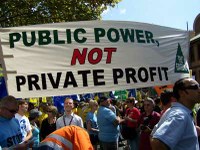
 

So what is privatization and what is happening in privatization?

Privatization is the transfer of ownership of assets to the private sector. Through management contracts and leases and sell off (sale of minority shares.)

Why privatize?

All types of privatization have the potential to increase so-called static efficiency-what economists like to call X-efficiency-which means pushing enterprises to operate cost effectively on their production frontier.

What Is Being Privatized?

There are virtually no limits on what can be privatized.

The argument that privatization creates additional public resources is illusory.

Attempts to sell nonviable firms as going concerns may not only invite special protection or subsidies, but may also lead to subsequent government bail-outs.

Markets fail, but so do governments. which lead to government bail-outs, financed either through taxes or inflation and the new buzz word Austerity a Capitalist word for Privatization by the back door.  Greece!

Both taxes and inflation hit the poorer citizen harder than the rich.

The World Bank and the IMF act as a catalyst for privatization.

From Water, to Oxygen, to Time, everything that you take for granted will be privatized and subject to easy and affordable payments.

Not in your wildest dreams will it be affordable.

Get used to it. For there is absolutely nothing that you can do.

Or is there. (See below)

The most concerning effects of all this is – The Race to Buy Up the World’s Fresh Water supplies.

Out of the 1,226 billionaires around the world four billionaires including filmmaker James Cameron and Google co-founder Larry Page are backing a newly unveiled asteroid-mining venture, Planetary Resources Inc adding to an impressive list of ultra-rich people trying to reshape spaceflight and exploration in the 21st century. Each man is worth $1 billion or more, according to recent estimates by Forbes magazine, with Google execs Page and Schmidt having about $16.7 billion and $6.2 billion to their names, respectively. Film maker James Cameron worth $700 million or so.

H20 will open up a Trillion dollar market in Space.

Deep Space Industries Wheel Habitat

We are in the midst of a global freshwater crisis.

Around the world, rivers, lakes, and aquifers are dwindling faster than Mother Nature can possibly replenish them; industrial and household chemicals are rapidly polluting what’s left.Meanwhile, global population is ticking skyward.

Goldman Sachs estimates that global water consumption is doubling every 20 years, and the United Nations expects demand to outstrip supply by more than 30 percent come 2040.

Water has been a public resource under public domain for more than 2,000 years,”

If all goes according to plan, 80 million gallons of Blue Lake water will be siphoned into the kind of tankers normally reserved for oil—and shipped to a bulk bottling facility near Mumbai. From there it will be dispersed among several drought-plagued cities throughout the Middle East.

The project is the brainchild of two American companies. One, True Alaska Bottling, has purchased the rights to transfer 3 billion gallons of water a year from Sitka’s bountiful reserves.

The other, S2C Global, is building the water-processing facility in India. If the companies succeed, they will have brought what Sitka hopes will be a $90 million industry to their city, not to mention a solution to one of the world’s most pressing climate conundrums.

They along with Nestle are turning life’s most essential molecule into a global commodity.

Fresh Air is next on the list.

By definition, a commodity is sold to the highest bidder, not the customer with the most compelling moral claim.

As the crisis worsens, companies like True Alaska that own the rights to vast stores of water (and have the capacity to move it in bulk) won’t necessarily weigh the needs of wealthy water-guzzling companies like Coca-Cola or Nestlé against those of water-starved communities

In Phoenix or Ghana; privately owned water utilities will charge what the market can bear, and spend as little as they can get away with on maintenance and environmental protection. Other commodities are subject to the same laws, of course. But with energy, or food, customers have options: they can switch from oil to natural gas, or eat more chicken and less beef.

There is no substitute for water, not even Coca-Cola.

The Colorado River Basin is struggling through its 11th year of drought. In the USA the real water barons cannot be reduced to a simple archetype. They include a diverse array of buyers and sellers—from multinational water giants like Suez and Veolia that together deliver water to some 260 million taps around the world, to wildcatter oil converts like T. Boone Pickens who wants to sell the water under his Texas Panhandle ranch to thirsty cities like Dallas.

Eventually every last drop will be privately controlled.

And when that happens, the world will find itself divided along a new set of boundaries: water haves on one side, water have-nots on the other. The winners (Canada, Alaska, Russia) and losers (India, Syria, Jordan)will be different from those of the oil conflicts of the 20th century, but the bottom line will be much the same: countries that have the means to exploit large reserves will prosper.

The rest will be left to fight over ever-shrinking reserves. Some will go to war.

The World Bank infamously required scores of impoverished countries—most notably Bolivia—to privatize their water supplies as a condition of desperately needed economic assistance. These days, global water barons have set their sights on a more appealing target: countries with dwindling water supplies and aging infrastructure,

Nowhere is this truer than China.

As the water table under Beijing plummets, wells dug around the city must reach ever-greater depths (nearly two-thirds of a mile or more, according to a recent World Bank report) to hit fresh water. Since 2000, when the country opened its municipal services to foreign investment, the number of private water utilities has skyrocketed. But as private companies absorb water systems throughout the country, the cost of water has risen precipitously. “It’s more than most families can afford to pay,

Meanwhile, more than half a million pipes burst every year, according to the American Water Works Association, and more than 6 billion gallons of water are lost to leaky pipes.

Privatization of basic human needs is never good.

Our governments are controlled by private corporations and banks.

Privatization of government services (such that benefit the people, all the people) is perverting Democracy.

Privatization of public services is the death knell of parliamentary democracy, the death knell of the extreme form of capitalism currently practiced in too many countries.

We face a global water crisis, made worse by the warming temperatures of climate change.

A quarter of the world’s people don’t have sufficient access to clean drinking water.

Water privatization is used here as a shorthand for private sector participation in the provision of water services and sanitation. has turned a public good into a private good.

Many believe that the privatization of water is incompatible with ensuring the international human right to water.909 million people were served by “private players” in 2011 globally, up from 681 million people in 2007.

The World Bank Group pushes privatization as a key solution to the water crisis.

Instead of using its position to line the pockets of water companies, the World Bank should support what is most needed: affordable and clean – and public – water for all. When the private sector engages in water provision, greater disparities in access and cost follow.

The current Chairman and former CEO of Nestlé, the largest producer of food products in the world, believes that the answer to global water issues is privatization.

For profit” everything! Profit is killing the planet.

Human males seek dominance even at the price of self-annihilation.

Are we all mad, it looks like it.

We can talk till the cows come home > We Can have Summits on Climate Change > We can listen to the G8 the G7 the United Nations, the World Health, the President of the USA, the technocrats, the Economic Gurrous, Religious Leaders, the Free market, China, the International space station, your neighbor.

If the truth was known no one has a blind notion how to change course.

WELL LET ME TELL YOU AS CAPTAIN OF THIS BLOG AND POST THERE IS ONLY ONE SOLUTION’S.

That is to make Capitalism with its insatiably greed for profit PAY by placing a World Aid Commission of all High frequency stock trading, on all Foreign Exchange transactions over $20,000, on all Sovereign Wealth Funds Acquisition. (See previous posts). This can be achieved with little or no cost to the world economy by the click of a button. Producing a vast perpetual fund  to address the Inequality the bane of the modern world.

Before I finish I can hear you saying who, how, where this fund would operate.

It does not matter as long as the funds are allocated on a lotto bases.

Every deserving project (world wise) after a vetting process to see if viable would be placed in a once a year draw according to its capital requirements.

Unlike the World bank or IMF the winners would not have to repay the funds, (provided the project undertake was totally transparent and completed in full. ) any residual funds could be places in a People World fund to protect against privatization.

Any comments, ideas, positive or negative –  Welcome.

I dare you to change the course of humanity with me.

Go back

Your message has been sent

Warning
Warning
Warning
Warning

Warning.


Share this:

  • Click to share on WhatsApp (Opens in new window) WhatsApp
  • More
  • Click to share on Pocket (Opens in new window) Pocket
  • Click to share on Mastodon (Opens in new window) Mastodon

Fresh Water. Essential for human Survival or a Commodity for Profit.

30 Monday Mar 2015

Posted by bobdillon33@gmail.com in Uncategorized

≈ Comments Off on Fresh Water. Essential for human Survival or a Commodity for Profit.

Tags

Capitalism vs. the Climate., global climate change, Water Issues.

The most valuable commodity in the world today, is not oil, not natural gas, not even some type of renewable energy. It’s water—clean, safe, fresh water and it is being privatized for short-term profit. 

A gift of nature, or a valuable commodity? A human right, or a luxury for the privileged few? Will the agricultural sector or industrial sector be the main consumer of this precious resource? Whatever the answers to these and many more questions, one thing is clear:

That water will be one of the defining issues of the coming decade, not the internet, not the current conflicts, not poverty or Inequality, nor climate change, or the far of distant stars. 

SAVE THE PLANET, WHEN WE DON’T KNOW HOW TO SAVE OURSELVES. 

Some estimates say that 768 million people still have no access to fresh water.

Water isn’t traded on commodity exchanges yet but you would wrong to think that the most valuable commodity more valuable than oil will remain so.

These days we hear that sustainable development is the only way forward. There will be no sustainable development while the water issues remain unsolved.

It is our responsibility that fresh water does not become a commodity to be exploited for short-term profit to pump out billions in profit.

The Oil Industry wastes 2 million gallons each day in California Fracking.

Across the world Nestlé is pushing to privatize and control water resources. In 2000 at the world Water Forum Nestlé successfully lobbied to stop water being declared a universal right. Profits over people and corporate rights over human rights.

There is now a hunting season on local water resources by multinational corporations looking to control them. This means billions in profits with us paying 2000 times more for drinking water because it comes in a plastic bottle.

Safe water will become a privilege only affordable for the wealthy.

What are our Out of Date World Organisations doing to safeguard the human right to water other than more verbal diarrhea. (They are discussing the goals)

The World Water Forum which is described as a mouthpiece for transnational companies and the World Bank are falsely claiming to head the global governance of water. (See Below)

Water is essential for human survival and well-being and important to many sectors of the economy. However, resources are irregularly distributed in space and time, and they are under pressure due to human activity. Today, freshwater is used unsustainable in the majority of the regions of the world.

Everyone is demanding more of everything, more houses, more cars and more water. And we are talking of a world where temperatures are forecasted to rise by two to three degrees Celsius, maybe more. The situation is already dire.

China’s energy needs alone will grow by 100 percent by 2050. Since 1990, half the rivers in China have disappeared.


Globally, water pollution is increasing.  Around 60 percent of the worlds nation’s groundwater resources are already polluted.  In developing countries, an estimated 90% of waste water is discharged directly into rivers and streams without treatment.

At present, most water policy is still driven by short-term economic and political concerns that do not take into account science and good stewardship. State-of-the-art solutions and more funding, along with more data on water resources, are needed especially in developing nations.

Here are some hard facts.

Fragmentation of river systems due to dams is the single greatest threat to freshwater ecosystems’ health.

There are an estimated 800,000 dams worldwide, including around 45,000 large dams (over 15 metres high) and 1,000 mega-dams over 100 meters high. Over 60% of the world’s 227 largest rivers have been fragmented by dams, diversions and canals . An estimated 60 to 80 million people have been displaced by dams and nearly 500 million people have had their lives and livelihoods negatively affected.

Some 20 percent of the world’s aquifers are facing over-exploitation, and degradation of wetlands is affecting the capacity of ecosystems to purify water supplies.

People use 54% of the planet’s “blue water” (water that flows through rivers, lakes, and groundwater). Estimates suggest that this may increase to 70% by 2025.

2.3 billion people live in river basins which are under water stress, where less than 1,700 cubic meters of water is available for each person per year. If current consumption patterns continue, at least 3.5 billion people will live in water-stressed river basins in 2025 – half the world’s projected population.

Our Freshwater Living Planet Index (which tracks changes in populations of 714 species of fish, birds, mammals, reptiles and amphibians found in temperate and tropical lakes, rivers and wetlands) showed populations of freshwater species fell by 35% between 1970 and 2007 – a larger decline than in marine and land ecosystems. In tropical regions the decline was almost 70%.

Around 10,000 of the world’s 25,000 known fish species live in fresh water. An average of 300 new freshwater fish species are discovered every year.

Wetlands around the world provide goods and services to people worth an estimated US$70 billion a year.

Climate change is predicted to have a whole range of impacts on water resources. Variation in temperature and rainfall may affect water availability, increase the frequency and severity of floods and droughts, and disrupt ecosystems that maintain water quality.

Over the last 50 years, the frequency of severe flooding and the damage it causes have increased, in part due to the degradation of freshwater ecosystems.

In parts of the United States, Europe, Australia and New Zealand, over half of wetlands were destroyed in the 20th century, and many more were degraded across the rest of the world.

Water running into sink


Freshwater is a highly valuable resource for a large number of competing demands, including drinking water, irrigation, hydroelectricity, waste disposal, industrial processes, transport and recreation, as well as ecosystem functions and services.

There is only one direction for water prices at the moment, and that’s up.

The United Nations estimates that by 2050 more than two billion people in 48 countries will lack sufficient water.

Approximately 97 percent to 98 percent of the water on planet Earth is saltwater (the estimates vary slightly depending on the source). Much of the remaining freshwater is frozen in glaciers or the polar ice caps. Lakes, rivers and groundwater account for about 1 percent of the world’s potentially usable freshwater.

95 percent of the world’s cities continue to dump raw sewage into rivers and other freshwater supplies, making them unsafe for human consumption.

Agriculture is responsible for 87 % of the total water used globally. Fresh water is crucial to human society – not just for drinking, but also for farming, washing and many other activities. It is expected to become increasingly scarce in the future, and this is partly due to climate change. Approximately 98% of our water is salty and only 2% is fresh. Of that 2%, almost 70% is snow and ice, 30% is groundwater, less than 0.5% is surface water (lakes, rivers, etc) and less than 0.05% is in the atmosphere.

Climate change will have several effects on these proportions on a global scale. The main one is that warming causes polar ice to melt into the sea, which turns fresh water into sea water, although this has little direct effect on water supply.

The direct impact of climate change is not the only reason.

The increasing global population means more demand for agriculture, greater use of water for irrigation and more water pollution. Rising affluence in some countries means a larger number of people living water-intensive lifestyles, including watering of gardens, cleaning cars and using washing machines and dishwashers.

Rapidly developing economies also result in more industry and in many cases this comes without modern technology for water saving and pollution control. Therefore concerns about climate change must be viewed alongside management of pollution and demand for water.

If we allow poverty related to water to exist in other countries, then we can expect jealousies between nations to rise, and we can expect acts of vengeance from those who are jealous. It is already a source of conflict in some parts of the world such as the Indus River, which runs between India and Pakistan. Another one would be, in fact, in Iraq, where the Tigris and the Euphrates rivers, rising in Turkey, flow into Syria, then into Iraq. And, in fact, much of Iraq’s water supply is from Turkey.

Fresh Water is why Palestinian must strive for a one nation-state solution with Israel.  It is why we must stop oil exploration in the Arctic.

By the middle of the 21st century, 2 billion to 7 billion people will be severely short of water. The WHO estimates that more than 5 million people die each year from diseases caused by unsafe drinking water. By 2030, global demand for water will outstrip supply by 40 percent, a surefire recipe for war.

It takes some 5000 liters of water to produce 1 kg of rice.

General Electric Chairman Jeffrey Immelt said the scarcity of clean water around the world will more than double GE’s revenue from water purification and treatment by 2010—to a total of $5 billion.

Saudi Arabia is expected to invest more than $80 billion in desalinization plants and sewer facilities by 2025 to meet the needs of its growing population.

While China is home to 20 percent of the world’s people, only 7 percent of the planet’s freshwater supply is located there.  Asian countries will have severe water problems by the year 2025. (demand is increasing)(supply is decreasing)

In France agricultural production is exempt from the Polluter – pays -principle and that it continues to deteriorate the quality of groundwater with impunity.

The state of the world’s fresh water warns that decreasing water supplies could lead to epidemics and international conflict.  Over the next 20 years, the average global supply of water per person is expected to drop by one-third.

What does the future hold? 

How can water resources be managed sustainable while meeting an ever-increasing demand?

We always have the same amount of water.

The six billion people of Planet Earth use nearly 30% of the world’s total accessible renewal supply of water. By 2025, that value may reach 70%. Yet billions of people lack basic water services, and millions die each year from water-related diseases.

And you Wonder why we have terrorism.

Water is a basis of international conflict.

Basic human needs for water should be fully acknowledged as a top international priority. Education and research will be essential to providing the knowledge, skills and technology needed to combat fresh water scarcity in the future.


The World Water Forum is a large-scale international conference that is held every three years since 1997 in cooperation with the public, private sectors, academia, and industries.

It was first launched in an effort to facilitate international discussions on global water challenges.

The last Forum attracted more than 35,000 participants in Marseille 2012.

This Council is made up of.

  • 15 heads of State, of governments and European Commissioners.
  • 145 represented countries.
  • 112 Ministers, Vice-Ministers and Secretaries of State.
  • 176 national delegations and international organisations taking part in the Ministerial Declaration.
  • More than 750 elected officials among which 250 mayors and 250 parliamentarians.
  • More than 500 sponsored persons.
  • 3,500 NGOs and civil society representatives.
  • More than 2,600 children and youth.

Like all our Unfunded World Organisations it is an other gossip shop that lacks financial clout to make a differences.

There is only one way we can guard our Fresh Water we must Buy It.

Which can be achieved by Placing a World Aid Commission on all High Frequency Trading, on all Foreign Exchange transactions ( over $20,000) and on all Sovereign Wealth Funds Acquisition.

We than can create Drought Banks, that give Farmers an allocation of water.  He must then decide what is the best return he can get from that amount of water on his property.  It might be a big wheat crop or a small cotton crop.  It doesn’t matter.  The water is the fixed in the equation, not the type of crop.

Drought in China: Chongqing Municipality

folsom lake

Foot Note:

Just in case you think that all of this is Hog Wash:

Here are over 80 organizations (community, academic, governmental, funding, and more) working on water and sanitation issues in multiple countries around the world.

Technologies are actually available but most of them are too expensive or far to time consuming to implement simultaneously with ongoing progress and changes.

Even within the European Union an estimated 20 to 30 million people do not have access to safe sanitation, and little action has so far been undertaken to address this problem.

The question is not whether we can afford it but can we afford not to do it?

For example, what is the cost of no action? Water is already under severe pressure and this will only increase with climate change. We cannot afford to lose the services and benefits that a healthy aquatic ecosystem provides. We need clean water in sufficient quantities for our living and for economic activities. In order to keep that, we need a determined action to protect water resources.

The global population is likely to reach 9.1 billion in 2050, if not sooner. While this alone has potentially dire consequences in terms of pressures on natural resources, especially water,  Climate change sets its own agenda,

The world is changing faster than ever and becoming more and more complex.

Uncertainties about water availability and demand are increasing, as are the associated risks to development and well-being of people, societies and the environment. Unless we can generate the awareness and political will to react now, the crises we are experiencing now are likely to escalate and the odds of meeting our developmental goals will degenerate. This is why the most recent economic crisis could be seen as an opportunity; it provides an occasion for reflecting on a desired collective future.

For once we might act as one to the benefit of all. The future of the planet and the human race both depend on it.

Water is a common heritage of humanity and of future generations and must be protected as a public trust in law and practice. Water belongs to the Earth and other species. Water might teach us how to live together. How to tread more lightly on the earth — in peace and respect with one another.

Just in case you want the whole picture.

Click to access WWDR4%20Volume%201-Managing%20Water%20under%20Uncertainty%20and%20Risk.pdf

 https://youtu.be/sQZd2_1q2F0

Go back

Your message has been sent

Warning
Warning
Warning
Warning

Warning.


Share this:

  • Click to share on WhatsApp (Opens in new window) WhatsApp
  • More
  • Click to share on Pocket (Opens in new window) Pocket
  • Click to share on Mastodon (Opens in new window) Mastodon

All comments and contributions much appreciated

  • THE BEADY EYE SAYS TRUST IS DISAPPEARING THANKS TO OUR INABILITY TO RELATE TO EACH OTHER. December 19, 2025
  • THE BEADY EYE SAYS. THE WORLD NEEDS PEOPLE GOVERNMENT NOT MONEY GOVERNMENTS. December 18, 2025
  • THE BEADY EYE ASKS WHAT ARE WE THE SAME GOING TO DO TO STOP THE WORLD BEING FUCK UP FOR PROFIT BY RIPOFF MERCHANT. December 17, 2025
  • THE BEADY EYE CHRISTMAS GREETING. December 16, 2025
  • THE BEADY EYE SAYS. TO THE NEXT GENERATION TO LIVE A LIFE WORTH WHILE YOU MUST CREATE MEMORIES. December 16, 2025

Archives

  • December 2025
  • November 2025
  • October 2025
  • September 2025
  • August 2025
  • July 2025
  • June 2025
  • May 2025
  • February 2025
  • January 2025
  • December 2024
  • November 2024
  • October 2024
  • September 2024
  • August 2024
  • July 2024
  • June 2024
  • May 2024
  • April 2024
  • March 2024
  • February 2024
  • January 2024
  • December 2023
  • October 2023
  • September 2023
  • August 2023
  • July 2023
  • June 2023
  • May 2023
  • April 2023
  • March 2023
  • February 2023
  • January 2023
  • December 2022
  • November 2022
  • October 2022
  • September 2022
  • August 2022
  • July 2022
  • June 2022
  • May 2022
  • April 2022
  • March 2022
  • February 2022
  • January 2022
  • December 2021
  • November 2021
  • October 2021
  • September 2021
  • August 2021
  • July 2021
  • June 2021
  • May 2021
  • April 2021
  • March 2021
  • February 2021
  • January 2021
  • December 2020
  • November 2020
  • October 2020
  • September 2020
  • August 2020
  • July 2020
  • June 2020
  • May 2020
  • April 2020
  • March 2020
  • February 2020
  • January 2020
  • December 2019
  • November 2019
  • October 2019
  • September 2019
  • August 2019
  • July 2019
  • June 2019
  • May 2019
  • April 2019
  • March 2019
  • February 2019
  • January 2019
  • December 2018
  • November 2018
  • October 2018
  • September 2018
  • August 2018
  • July 2018
  • June 2018
  • May 2018
  • April 2018
  • March 2018
  • February 2018
  • January 2018
  • December 2017
  • November 2017
  • October 2017
  • September 2017
  • August 2017
  • July 2017
  • June 2017
  • May 2017
  • April 2017
  • March 2017
  • February 2017
  • January 2017
  • December 2016
  • November 2016
  • October 2016
  • September 2016
  • August 2016
  • July 2016
  • June 2016
  • May 2016
  • April 2016
  • March 2016
  • February 2016
  • January 2016
  • December 2015
  • November 2015
  • October 2015
  • September 2015
  • August 2015
  • July 2015
  • June 2015
  • May 2015
  • April 2015
  • March 2015
  • February 2015
  • January 2015
  • December 2014
  • November 2014
  • October 2014
  • September 2014
  • August 2014
  • July 2014
  • June 2014
  • May 2014
  • April 2014
  • March 2014
  • February 2014
  • January 2014
  • December 2013
  • November 2013
  • October 2013

Talk to me.

Jason Lawrence's avatarJason Lawrence on THE BEADY EYE ASK’S: WIT…
benmadigan's avatarbenmadigan on THE BEADY EYE ASK’S: WHA…
bobdillon33@gmail.com's avatarbobdillon33@gmail.co… on THE BEADY EYE SAYS: WELCOME TO…
Ernest Harben's avatarOG on THE BEADY EYE SAYS: WELCOME TO…
benmadigan's avatarbenmadigan on THE BEADY EYE SAY’S. ONC…

7/7

Moulin de Labarde 46300
Gourdon Lot France
0565416842
Before 6pm.

My Blog; THE BEADY EYE.

My Blog; THE BEADY EYE.
bobdillon33@gmail.com

bobdillon33@gmail.com

Free Thinker.

View Full Profile →

Follow bobdillon33blog on WordPress.com

Blog Stats

  • 94,155 hits

Blogs I Follow

  • unnecessary news from earth
  • The Invictus Soul
  • WordPress.com News
  • WestDeltaGirl's Blog
  • The PPJ Gazette
Follow bobdillon33blog on WordPress.com

The Beady Eye.

The Beady Eye.
Follow bobdillon33blog on WordPress.com

Blog at WordPress.com.

unnecessary news from earth

WITH MIGO

The Invictus Soul

The only thing worse than being 'blind' is having a Sight but no Vision

WordPress.com News

The latest news on WordPress.com and the WordPress community.

WestDeltaGirl's Blog

Sharing vegetarian and vegan recipes and food ideas

The PPJ Gazette

PPJ Gazette copyright ©

Privacy & Cookies: This site uses cookies. By continuing to use this website, you agree to their use.
To find out more, including how to control cookies, see here: Cookie Policy
  • Subscribe Subscribed
    • bobdillon33blog
    • Join 223 other subscribers
    • Already have a WordPress.com account? Log in now.
    • bobdillon33blog
    • Subscribe Subscribed
    • Sign up
    • Log in
    • Report this content
    • View site in Reader
    • Manage subscriptions
    • Collapse this bar