• About
  • THE BEADY EYE SAY’S : THE EUROPEAN UNION SHOULD THANK ENGLAND FOR ITS IN OR OUT REFERENDUM.

bobdillon33blog

~ Free Thinker.

bobdillon33blog

Tag Archives: Russia

THE BEADY EYE ASK’S; WHAT DO YOU KNOW ABOUT RUSSIA?

07 Wednesday Sep 2022

Posted by bobdillon33@gmail.com in Uncategorized

≈ Comments Off on THE BEADY EYE ASK’S; WHAT DO YOU KNOW ABOUT RUSSIA?

Tags

Russia, RUSSIA/ UKRAINE/ US/ NATO/ EU., Russia’s invasion of Ukraine

What do we really know about the Russian.

The history of the name of Russia is just as convoluted as the history of Russia itself:

It like all countries involves conquest, power struggles, dissolution, and reunification, all are integral part of the way we perceive the world that we rarely ponder their origins.

Modern Russia derives its name from the Kevian Rus’, the ancestors of Russia, Ukraine, and Belarus.

The name Rus’ comes from an Old Norse word for ‘the men who row.’‘ and the men who rowed’ were Vikings who arrived from the territory of modern-day Sweden and became dominant in the region for at least a few centuries.

The Vikings rowed from Sweden to the now-Russian territories and down the rivers all the way to Ukraine. The earliest sources mentioning the Rus’ come from the beginning and middle of the ninth century from Byzantium, Persia, and France.

The Soviet Union Collapses On December 25, 1991 replaced by 15 independent countries: Armenia, Azerbaijan, Belarus, Estonia, Georgia, Kazakhstan, Kyrgyzstan, Latvia, Lithuania, Moldova, Russia, Tajikistan, Turkmenistan, Ukraine, and Uzbekistan.

Russia’s name truly is a mirror in which Russia itself is reflected with a tendency to swing from one extreme to the other has been very noticeable during the past quarter of a century.

We must remember that before 1914 Russia was predominantly a backward agricultural country.  Until modern times Russia’s geographic “remoteness” from the rest of the world and her inaccessibility except by land or air routes have had afar-reaching influence on her history.

If one thinks about Russia today it conjures up many names associated with its existence.

In no particular or historical order here are a few.

Peter the Great, Karl Marx, Josef Stalin, Lenin, Bolshevik Revolution,  Khrushchev, Leon Trotsky, Moscow Red Square, St Petersburg, Yuri Gagarin, Vodka, KGB, Trans-Siberian Railway. Stalingrad,  Volga River,  Doctor Zhivago, Mikhail Gorbachev,  Boris Yeltsin, Roman Abramovich, Oligarchs, Alexey Navalny, Communism. Chernobyl, Putin.

In fact what we are talking about is a enormous country with a surface area of 17.13 million square kilometres, with 643 billion trees –holding around 20% of the world’s freshwater, providing  27% of the EU’s crude oil imports, 41% of its natural gas, and 47% of its solid fuel (such as coal) with a population of 146,069,910, speaking at least 270 languages and dialects, a nuclear superpower, separated from the USA by just 4km of water. 

No country is entirely self-sufficient but it possesses some of the richest natural resources of any country in the world.

Indeed, as the world’s third-largest oil producer Russia has yet to make renewable energy an absolute priority.

For Russia’s domestic audience there is no doubt about the “greatness” of the country, which makes it an indispensable player in international politics and deserves recognition by other major powers.

This means that Moscow is driven primarily by security concerns; viewed from such a perspective, the actions against Georgia and Ukraine could be aimed at preventing NATO expansion.

The annexation of Crimea in 2013 and now its involvement into conflict with Ukraine have led to the country being perceived as a revisionist power and breaker of international norms.

——————–

Russia’s communist system is a form of socialism—a higher and more advanced form, according to its advocates. A political and economic doctrine that aims to replace private property and a profit-based economy with public ownership and communal control of at least the major means of production (e.g., mines, mills, and factories) and the natural resources of a society.

Although the term communism did not come into use until the 1840s—it is derived from the Latin communis, meaning “shared” or “common”— You might not believe it but for much of the 20th century, in fact, about one-third of the world’s population lived under communist regimes.

It was neither a religious upheaval nor a civil war but a technological and economic revolution—the Industrial Revolution of the late 18th and early 19th centuries—that provided the impetus and inspiration for modern communism.

Vladimir Putin’s invasion of Ukraine.

To understand Russia’s foreign policy we must bear in mind that, by and large, the Stalin regime has acted in world affairs not on the basis of Marxist doctrine, but on the basis of Russia’s national interests.

Stalin’s principal objectives have been to make Russia independent of the rest of the world in a military and economic sense and to protect the security of the Soviet Union against external attack during the period of “building socialism in one country.”

What is really puzzling about Russian foreign policy (and very much deserves further exploration) now is the positioning of Russia in various scales: regional, macro-regional (Eurasian), and global, and their compatibility and (in) consistency, as well as (and at the same time) Russian positioning with regards to its main neighbours, China and the European Union.

“The question we ought to be asking ourselves is why did NATO even exist after 1990?

If NATO was to stop Communism, why is it now expanding to Russia?”

It is important to note that not everyone in the world subscribes to the western ideas of democracy, or even to democracy itself. Not being a democracy is nothing illegal — it may sound regressive in today’s world but it is not illegal.

To try to intimidate and arm-twist a nuclear superpower in the name of democracy unfortunately now has terrible consequences for the Ukrainians and will never work.Global view of Russia and former Soviet satellite countries labeled.
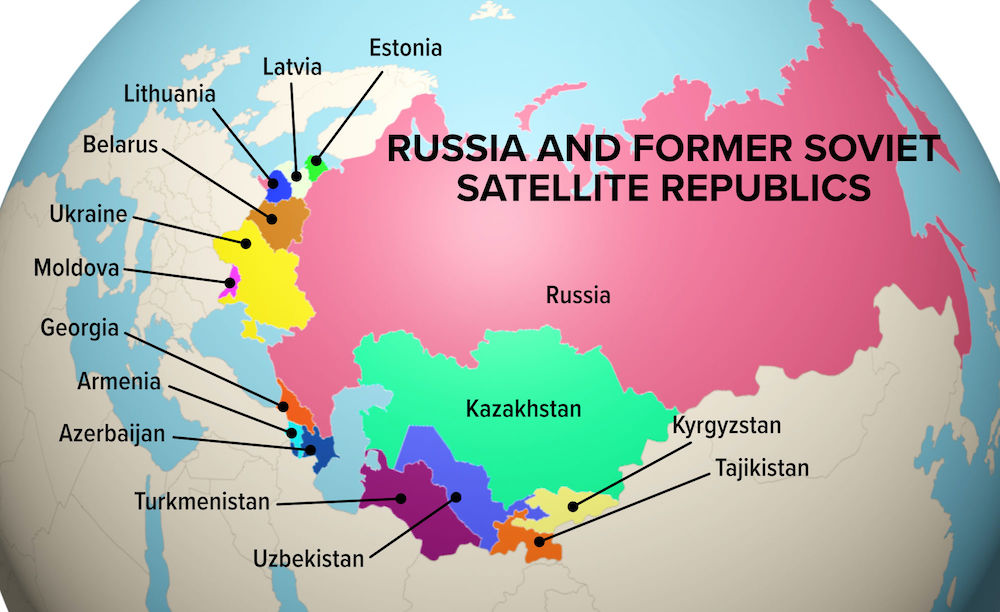
Whether the war in Ukraine lasts weeks, months, or years, depends on individual actions that run the gamut from those of world leaders, to ordinary citizens and soldiers. Soldiers are most likely to disobey orders when they recognize that a war will not achieve its objectives, or that they are fighting for their leaders’ survival and against their own interests.

In order to end a war, a leader’s chances of political and physical survival must be taken into calculation.

An outright defeat of Russia in Ukraine may actually translate into a death sentence for Russian President Vladimir Putin. One would expect Russia therefore to lower its demands but we’ve seen very little evidence of that so far—only the demand of denazification seems to have been dropped.

In a regime like Russia—which is clearly not a democracy, but also not quite a dictatorship—if you win a war, you’re the great hero; if you lose a war, you have shown your incompetence and you’ll be removed

In a recent speech, Putin called the borders drawn after World Wars I and II illegitimate. He said the borders that were drawn by Lenin and by Stalin, partially as a result of the First and Second World War, are illegitimate and have to go. And if those borders have to go, well, then there is no obvious stopping point:

The question is, which empire does he think needs reconstituting? Is it the Soviet Union? Or is it Tsarist Russia? And if it’s the latter—and there are some indications in his speeches that he does mean the latter—then Poland and other countries are going to be justifiably worried.

Putin, now seems to be committing himself to total victory. If he can’t get it, he’ll be responsible and that makes a coup against him more likely.

Putin must come home with some kind of victory because otherwise he’s literally dead.

Are Russians really going to bomb Kyiv, a so-called “hero city of the Soviet Union,” into rubble like they did with Chechnya’s capital Grosny?  Are they willing to kill tens of thousands of people?

No one knows.

He wants to prevent more of these revolutions and prevent a democratic encirclement of countries around him, which could provide a safe haven for Russian dissidents who’d be dangerous to Putin’s political survival. Both of these goals overlap in the sense that he is seeking regime change, which is a dangerous game.

There’s also an interlocking commitment problem here:

Ukraine cannot promise not to join NATO in the long term, which Russia sees as a threat to its borders. At the same time, Russia can’t promise credibly not to ask for more if Ukraine made some concessions now, whether it be territorial concessions, regime change, or a promise not to join NATO.

So the question is.

If there’s a coup against Putin, what would the new Russian government insist on? They’re not necessarily all going to say, “Okay, sorry Ukraine, we made a mistake. Please excuse us.” And Ukrainians would not necessarily accept that anyway. Most likely, Ukraine would strengthen its demands and want Crimea back, resulting in ongoing bloodshed, pulverizing of Ukrainian cities, coupled with insurgencies.

Russia will never have full control of Ukraine. The West—that is Western Democracies—cannot, in my opinion, accept a victorious Putin.

We should not forget those people who are fighting and the costs they are willing to shoulder. Many of them will die because of Putin’s folly.

We’re in a situation where either success or failure both present horrible, dangerous situations, we’d better be very careful and think very, very carefully about what we can do, and perhaps what we cannot do, and prepare accordingly. You don’t want to corner Putin with sanctions to the extent that he feels that he must gamble—all or nothing.

We now at the point that Putin is afraid domestic enemies might overthrow and kill him, and there’s little the West can do to address those fears. The only avenue worth exploring in peace negotiations might be true plebiscites, overseen by international observers.

All human comments appreciated. All like clicks and abuse chucked in the bin

Contact: bobdillon33@gmail.com.

Share this:

  • Click to share on WhatsApp (Opens in new window) WhatsApp
  • More
  • Click to share on Pocket (Opens in new window) Pocket
  • Click to share on Mastodon (Opens in new window) Mastodon

Quote

THE BEADY EYE LOOKS AT THE STORY OF THE SYRIAN WAR.

02 Friday Oct 2015

Posted by bobdillon33@gmail.com in War

≈ Comments Off on THE BEADY EYE LOOKS AT THE STORY OF THE SYRIAN WAR.

Tags

Islamic State militants, Russia, Syria, USA

What began as another Arab Spring uprising against an autocratic ruler has mushroomed into a brutal proxy war that has drawn in regional and world powers.

How’s this all going to end?

No one knows, really. While plenty of countries (including Germany, the U.K., Iran, Russia, France and the U.S.) have tried to offer support to one side or the other to try to end the conflict, there’s been little success.

What ever happens this war is developing into a war that is going to have far reaching  unseen effects not only on the Middle East but on the World. (Not to mention the balance of world power.)

So it important that we see it as such.

To the victor go the spoils:

That might be true for most other wars, but the Syrian conflict has proven to be far outside the established norms and conventions governing the conduct of battle . (That is if you are of the opinion that such things exist in a modern warfare.)

In Syria the spoils are going to whoever has a gun, and there are plenty of those about.

How did it all Start?

In March 2011 in the southern city of Deraa some teenagers painted revolutionary slogans on a school wall. THEY WERE ARRESTED AND TORTURED which lead to Pro-democracy protests which were fired on by security forces killing several demonstrators leading to more demonstrations triggering nationwide protests demanding President Assad’s resignation.

By July 2011, hundreds of thousands were taking to the streets across the country.

Violence escalated and the country descended into civil war as rebel brigades were formed to battle government forces for control of cities, towns and the countryside. Fighting reached the capital Damascus and second city of Aleppo in 2012.

Hundreds of people were killed in August 2013 after rockets filled with the nerve agent sarin were fired at several agricultural districts around Damascus. Western powers, outraged by the attack, said it could only have been carried out by Syria’s government.

The regime and its ally Russia blamed rebels.

Facing the prospect of US military intervention, President Assad agreed to the complete removal or destruction of Syria’s chemical weapons arsenal as part of a joint mission led by the UN and the Organisation for the Prohibition of Chemical Weapons (OPCW).

The destruction of chemical agents and munitions was completed a year later.

By June 2013, the UN said 90,000 people had been killed in the conflict.

However, by August 2014 that figure had more than doubled to 191,000 – and continued to climb to 220,000 by March 2015, according to activists and the UN. Despite the operation, the OPCW has since documented the use of toxic chemicals, such as chlorine and ammonia, by the government in attacks on rebel-held northern villages between April and July 2014 that resulted in the deaths of at least 13 people.

The conflict has now acquired sectarian overtones, pitching the country’s Sunni majority against the president’s Shia Alawite sect, and drawn in neighboring countries and world powers.

The rise of the jihadist groups, including Islamic State, has added a further dimension.

Both sides of the conflict have committed war crimes – including murder, torture, rape and enforced disappearances.

The so-called Islamic State has also been accused by the UN of waging a campaign of terror in northern and eastern Syria.

It has inflicted severe punishments on those who transgress or refuse to accept its rule, including hundreds of public executions and amputations. Its fighters have also carried out mass killings of rival armed groups, members of the security forces and religious minorities, and beheaded hostages, including several Westerners.

Almost 4 million people have fled Syria since the start of the conflict, most of them women and children.

It is one of the largest refugee exodus in recent history.

Neighboring countries have borne the brunt of the refugee crisis, with Lebanon, Jordan and Turkey struggling to accommodate the flood of new arrivals.

A further 7.6 million Syrians have been internally displaced within the country, bringing the total number forced to flee their homes to more than 11 million – half the country’s pre-crisis population.

Overall, an estimated 12.2 million are in need of humanitarian assistance inside Syria, including 5.6 million children, the UN says.

In December 2014, the UN launched an appeal for $8.4bn (£5.6bn) to provide help to 18 million Syrians, after only securing about half the funding it asked for in 2014.

Four in every five Syrians were now living in poverty – 30% of them in abject poverty. Syria’s education, health and social welfare systems are also in a state of collapse.

The armed rebellion has evolved significantly since its inception. Secular moderates are now outnumbered by Islamists and jihadists, whose brutal tactics have caused widespread concern and triggered rebel infighting.

Capitalising on the chaos in the region, IS or ISIS or ISIL – the extremist group that grew out of al-Qaeda in Iraq – has taken control of huge swathes of territory across northern and eastern Syria, as well as neighboring Iraq.

Its many foreign fighters in Syria are now involved in a “war within a war”, battling rebels and jihadists from the al-Qaeda-affiliated Nusra Front, who object to their tactics, as well as Kurdish and government forces.

In September 2014, a US-led coalition launched air strikes inside Syria in an effort to “degrade and ultimately destroy” IS, ultimately helping the Kurds repel a major assault on the northern town of Kobane. However, the coalition has little influence on the ground in Syria and its primacy is rejected by other groups, leaving the country without a convincing alternative to the Assad government.

In January 2014, the US, Russia and UN convened a conference in Switzerland to implement the 2012 Geneva Communique, an internationally-backed agreement that called for the establishment of a transitional governing body in Syria formed on the basis of mutual consent. The talks, which became known as Geneva II, broke down in February after only two rounds.

So who is backing who?

Iran and Russia have propped up the Alawite-led government of President Assad and gradually increased their support, providing it with an edge that has helped it make significant gains against the rebels. The government has also enjoyed the support of Lebanon’s Shia Islamist Hezbollah movement, whose fighters have provided important battlefield support since 2013.

The Sunni-dominated opposition has, meanwhile, attracted varying degrees of support from its main backers – Turkey, Saudi Arabia, Qatar and other Arab states along with the US, UK and France. However, the rise of hard-line Islamist rebels and the arrival of jihadists from across the world has led to a marked cooling of international and regional backing.

The US is now supposed to be arming a 5,000-strong force of “moderate” rebels to take the fight to IS on the ground in Syria, and its aircraft provide significant support to Kurdish militia seeking to defend three autonomous enclaves in the country’s north.

September 2015 Russia openly (in the United Nations) declares its supports for President Assad under the umbrella of tackling ISIS.  On 30 September, Russia’s parliament approved a request by President Vladimir Putin to launch air strikes in Syria. Within hours, the country’s first intervention in the Middle East in decades began. The following day, Russian Foreign Minister Sergei Lavrov clarified that the air campaign was targeting “all terrorists” in Syria, and not just IS.

But the US and its allies noted that the strikes took place where IS had little or no presence. They instead appeared to be aimed at rebels backed by Gulf Arab and Western states who are advancing on Latakia province – the coastal heartland of Mr Assad’s Alawite sect. At least one group that has been armed and trained by the CIA was hit. Says the Americans.

Russia has made clear that its intervention was approved by Mr Assad, who sent a letter to Mr Putin requesting military assistance. “By supporting Assad and seemingly taking on everyone who is fighting Assad, you’re taking on the whole rest of the country of Syria.”

The Russian president is one of Mr Assad’s most important international backers.

Ties between their countries go back four decades and the Syrian port of Tartous is the location of the last Russian naval base in the Middle East.

Russia has blocked several resolutions critical of Mr Assad at the UN Security Council and supplied weapons to the Syrian military, saying it is violating no international laws.

We are now facing new kind of mentality that rules those people doing the fighting in Syria, a complete disregard for the lives and property of ordinary civilians. This goes for both sides in the war.

The fortunes of some are fast accumulating, while the rest of the nation languishes in dreary poverty and destitution, waiting for an end to the greed and hatred that fuels this seemingly never-ending nightmare.

There’s also tons of conflict among European countries about what their responsibilities are and whether anything could’ve been done to prevent the Civil War and the massive loss of life. There are understandable hesitations, strategic rivalries and unwillingness to take on financial commitment, making it impossible to pursue potential solutions.

There is one thing for sure we would be better off legalizing the migration process in order to leave the slave traders of the 21st century empty-handed.

Why?, because there is growing major culture of fear and suspicion when it comes to Muslim refugees.

The struggle in Syria could be ended in one way only.

And that is when the US and Russia with Europe countries agree and support one man to take Bashar Alassad place.

But unfortunately this won’t happen because the U.S government believes that he is the best person to keep Israel safe from Syria. While Russia (which has been crippled by sanctions due to Ukraine ) see it as an opportunity to unshackle itself for isolation and a opportunity to boost its economy.

assadgraf, cc Flickr thierry ehrmann This was once just a civil war between Shiites and Sunnis in the wider Arab world, especially in Syria and Iraq. Now it is turning into a free for all. The consequences of which will be only seen by those left alive.

Meanwhile, the failure to understand the ‘Arab Spring’ for what it was facilitated the destruction of Syria’s delicate balance such that the Islamic State represents the first real challenge to the Middle East which emerged from the Sykes-Picot Agreement of 1916, under which the British and French empires secretly agreed to divide the Middle East domains of the dying Ottoman Empire between them.

As for the military route, proposed by several Conservative political leaders, masking as armchair generals, air raids are clearly insufficient yet no government wants to send ground troops.

Syria could remain at war for years.

There remains one more danger to the Free World ( for lack of a better noun) and that is the pressing of a nuclear button which will resolve the war leaving nothing to fight about. 

Go back

Your message has been sent

Warning
Warning
Warning
Warning

Warning.

Share this:

  • Click to share on WhatsApp (Opens in new window) WhatsApp
  • More
  • Click to share on Pocket (Opens in new window) Pocket
  • Click to share on Mastodon (Opens in new window) Mastodon

THE BEADY EYE LOOKS AT WHAT IS BEHIND MR PUTIN UNITED NATIONS ADDRESS ON THE MIDDLE EAST.

29 Tuesday Sep 2015

Posted by bobdillon33@gmail.com in The world to day., War

≈ Comments Off on THE BEADY EYE LOOKS AT WHAT IS BEHIND MR PUTIN UNITED NATIONS ADDRESS ON THE MIDDLE EAST.

Tags

Mr Putin., Russia, The Middle East, THE UNITED NATIONS, United States, Water Issues in the Middle East

Right I am no military general or foreign policy guru but Russia recent backing of Assad to tackle extremists and terrorists and the so-called Islamic State militants ( IS, formerly ISIS/ISIL) is a recipe for a war that is going to expand and last for some considerable time.However when you look on at the inability of the free world to resolve the Middle East problems now it is not an option to turn our backs on Mr Putin latest offer because there has being a cultural shift in the Middle East sparked by West and Smart phones.

There is no doubt that Mr Putin geo-political announcements at the United Nations emphasizes the problems of a joint international coalition to confront IS. ( The reporting of which by RT.Com keeps crashing on Flip Board Cover Stories. I wonder why? http://on.rt.com/6sg4 )

Perhaps his offer should be TAKEN SERIOUSLY.    

”There is a belief that “creative destruction and chaos” in the Middle East are beneficial assets to reshaping the Middle East, creating the “New Middle East,” and furthering the Anglo-American road map in the Middle East and Central Asia:

There is no denying that now more than ever we are achieved this with a new road map by Mr Putin.

The United Nations as usual is a lame duck, (with 7.5 million children displaced and over 16 million people homes and livelihoods destroyed) all it can do is pass resolution’s that are vetoed.

WE NEED TO SCRAP THE UN TO BE REPLACED it with A NEW PROTECTION WORLD ORGANISATION THAT REPRESENTS THE WORLD – FULLY FINANCED. ( SEE PREVIOUS POSTS)

While the two world powers will now be at logger heads and the small players like France and the UK play Ludo with the situation.  ISIS continues to extend the group’s self-styled caliphate, which now stretches from Turkey’s border with Syria to south of Fallujah in Iraq, an area roughly the size of Indiana.

For nearly 70 years, Lebanon was a proxy battleground for the conflict between Israel and Palestine.

As Paul Rodriguez said ” Sometimes I think war is God’s way of teaching us geography.”

If you ask yourself how did it all get into such a hell hole you can come up with reasons that cover every aspect of Power, Greed, Religion, History, Oil,etc.

The answer however to a great part is a lot more simple.

NO MATTER WHAT HAPPENS. Climate change and the issue of whether there will be enough water for a future global population double its present size is controversial and the answer to this question is of particular importance to the people’s and political leaders of the Middle East and North Africa.

It requires an inhuman level of political courage for a political leader of any country which for five thousand years has enjoyed water security to announce that water resources are no longer adequate.

To make the announcement would be political suicide.

SO BACK TO TODAY.

It has been nearly impossible for two U.S. presidents — Bush, a conservative evangelical; and Obama, a progressive liberal — to address the plight of Christians explicitly for fear of appearing to play into the crusader and ‘‘clash of civilizations’’ narratives the West is accused of embracing.

The above does not apply to Mr Putin, but there are limits to what the international community and Russia can do.’’

For instance the fate of Christians in the Middle East isn’t simply a matter of religion; it is also integral to what kinds of societies will flourish as the region’s map fractures.

No matter what solution’s presents itself there will be a requirement for a buffer between Sunni and Shia.

Across the region, that conflict is now secondary to the shifting tectonic plates of the Sunni-Shia divide, which threatens terrible bloodshed. Everyone has seen the ISIS forced conversions, crucifixions and beheadings that is displacing millions.

Even if ISIS is defeated, the fate of religious minorities in Syria and Iraq remains bleak because Iraq is devolving into three regions — Sunnis, Shia and Kurds — as it is obvious that there will be a need for a fourth region for minorities. Iraq is a forced marriage between Sunni, Shia, Kurds and Christians, and it has failed with the resulting wasted lives lost.

The term “New Middle East” was introduced to the world in June 2006 in Tel Aviv by U.S. Secretary of State Condoleezza Rice.

International borders are never completely just. But the degree of injustice they inflict upon those whom frontiers force together or separate makes an enormous difference — often the difference between freedom and oppression, tolerance and atrocity, the rule of law and terrorism, or even peace and war.

Our continuing failure to candidly depict the roots of the problems and conflicts in the contemporary Middle East has now being exposed by Mr Putin – POINTING A FINGER AT THE WEST FAILURE AND SECRETIVE TRADE DEALS.

His good news is complicated and indigestible as well as unsensational – throwing stones in a glass house is never a good idea.

The truth is that the Middle East has been conditioned by outside forces into a powder keg that is ready to explode with the right trigger, possibly the launching of Anglo-American and/or Israeli air raids against Iran and Syria. A wider war in the Middle East could result in redrawn borders that are strategically advantageous to Anglo-American interests and Israel.

We must think creatively about how to act on Mr Putin address to the United Nations.

What the media does not acknowledge or inform us about is the fact that almost all major conflicts afflicting the Middle East are the consequence of overlapping Anglo-American-Israeli agendas.

Many of the other problems affecting the contemporary Middle East are the result of the deliberate aggravation of pre-existing regional tensions.

Among the problems in the contemporary Middle East is the lack of genuine democracy which U.S. and British foreign policy has actually been deliberately obstructing.

The United States has deliberately blocked or displaced genuine democratic movements in the Middle East from Iran in 1953 (where a U.S./U.K. sponsored coup was staged against the democratic government of Prime Minister Mossadegh) to Saudi Arabia, Egypt, Turkey, the Arab Sheikdoms, and Jordan where the Anglo-American alliance supports military control, absolutists, and dictators in one form or another. The latest example of this is Palestine.

Attempts at intentionally creating animosity between the different ethno-cultural and religious groups of the Middle East have been systematic.

Even more ominous, many Middle Eastern governments, such as that of Saudi Arabia, are assisting Washington in fomenting divisions between Middle Eastern populations. The ultimate objective is to weaken the resistance movement against foreign occupation through a “divide and conquer strategy” which serves Anglo-American and Israeli interests in the broader region.

Where might one find a useful analysis of what is happening today in the market democracies of the West?

How about this: “The executive of the modern State is but a committee for managing the common affairs of the bourgeoisie.” Or this: “Modern bourgeois society…is like the sorcerer, who is no longer able to control the power of the nether world which he has called up by his spells.” Or this: “The productive forces no longer tend to further the development of the conditions of bourgeois property: on the contrary, they have become too powerful for these conditions…[and] they bring disorder into the whole of bourgeois society, endanger the existence of bourgeois property.”

Karl Marx and Friedrich Engels

The celebrated bearded communists had argued that capitalism would reduce all of society to only two classes: the prosperous bourgeoisie, who owned the capital, and the impoverished proletariat, who contributed their labor. Modern industrial production would inevitably depress the living standards of the proletariat, they believed, but also, in the end, increase their power. Having created a form of slavery, capitalism would be overthrown by its slaves. The proletarian masses would become the dictators.

This did not happen.

But now the West see itself as prisoners of the system that they helped to create.

I am no alarmist, and no one should worry that I have become a late convert to Marxism. Marx’s prescriptions were mostly wrong, and his spirit was intolerant and coercive. He did not understand markets or respect political institutions, and he thought liberty was a sham.

However, Sectarian division, ethnic tension and internal violence have been traditionally exploited by the United States and Britain in various parts of the globe including Africa, Latin America, the Balkans, and the Middle East. Iraq is just one of many examples of the Anglo-American strategy of “divide and conquer.” Other examples are Rwanda, Yugoslavia, the Caucasus, and Afghanistan.

Besides believing that there is “cultural stagnation” in the Middle East Western-style “Democracy” has been a requirement only for those Middle Eastern states which do not conform to Washington’s political demands.

Invariably, it constitutes a pretext for confrontation. Saudi Arabia, Egypt, and Jordan are examples of undemocratic states that the United States has no problems with because they are firmly alligned within the Anglo-American orbit or sphere.

Also we need to support Iran as a bulwark against Sunni extremism.

Additionally,

Turkey and Iran, the two most powerful states of the “Eurasian Balkans,” located on its southern tier, are “potentially vulnerable to internal ethnic conflicts [balkanization],” and that, “If either or both of them were to be destabilized, the internal problems of the region would become unmanageable.

In the end it all comes down who is willing to receive body bags.

Rest assured that the striking images of body bags depict the physical residue of war and time. Yet even more horrific than the physical scars of the war is the sense of sorrow and loss, floating in their expressions like ghosts.

Go back

Your message has been sent

Warning
Warning
Warning
Warning

Warning.


Share this:

  • Click to share on WhatsApp (Opens in new window) WhatsApp
  • More
  • Click to share on Pocket (Opens in new window) Pocket
  • Click to share on Mastodon (Opens in new window) Mastodon

The treat of a nuclear weapon being used today is very real. – Russia

02 Monday Feb 2015

Posted by bobdillon33@gmail.com in Uncategorized

≈ Comments Off on The treat of a nuclear weapon being used today is very real. – Russia

Tags

NATO's nuclear capabilities, Russia, Russia Nuclear Warheads., Ukraine

With world peace in constant danger it depending on how one views nuclear weapons and their influence as to how the world is perceived in present time.

This series of posts is an attempt to bring that perception into to focus.

Historians of the cold war have shown that mistakes and miscalculation have brought the world closer to accidental nuclear warfare more often than is commonly realized.

Some involved computer malfunctions that led either the US or the USSR to believe that they were under nuclear attack.  Individual decision making, often in disobedience of protocol and political guidance, has on several occasions saved the day.

When one looks at the trends of nuclear weapons, the world population needs to be getting more concerned as they are getting smaller and smaller.  It is a very scary idea that a drone could be equipped with a nuclear war head.  Life, as we know it could completely be eliminated by some freak that used to play war games.

We can blame the United States and Russia for the trend of nations wanting as many “nukes” as possible.

Now it not my wish here to lay blame or to write pages and pages of history as to why Russia is to day one of the big bears when it comes to Nuclear Weapons. So I am only going to provide a simplistic and patchy outline of its status which it inherited as the legal successor of the Soviet Union.

However I can hear many of you saying that if Japan had nuclear weapons in World War II, Truman would have thought twice when sanctioning a the nuclear bombs to be dropped on Hiroshima and Nagasaki that shortened the time expected for the war in the Pacific to end and thus saving thousands of lives. It was however at the expense of introducing the world to the horrors of radiation.

In retrospect this might scenario in terms of world security might have been good. Knowing that if your nation launched missiles on a nuclear state, retaliation would be deadly. The exact scenario that exist to day but sadly, we are now be returning to an era in which the threat of nuclear warfare can no longer be treated as the stuff of science fiction or hypothetical scenario’s.

Let’s look at Russia the world’s second nuclear weapon state.

As the World War II came to an end the three big powers led by Franklin Roosevelt, Winston Churchill and Josef Stalin met in Yalta to compromise on a treaty.

Roosevelt failed to realize that Stalin wanted revenge and was going to create a buffer around its land to protect future invasions by Germany. This allowed the Russians to expend and become more powerful resulting in the Cold War/Iron curtain and the beginnings of the Soviet nuclear weapons program.

Some scientists working on the Manhattan Project, such as Klaus Fuchs, provided a steady stream of information to the Soviets that included a blueprint for the Fat Man implosion device dropped on Nagasaki. After the U.S. bombing of Hiroshima in August 1945, Stalin became convinced of the atomic bomb’s strategic importance and ordered a crash development program.

On the 29 August 1949 it tested its first device named RDS-1 at Semipalatinsk, Kazakhstan. It was meant to convey a political message that the Soviet Union had arrived on the atomic scene.

Following Stalin’s death in 1953- the military assumed responsibility for the Soviet weapons program. Subsequent Soviet leaders would increasingly view military strategy and international relations through the prism of nuclear weapons.

Under the leadership of Nikita Khrushchev, Soviet nuclear weapons were increasingly used as a tool for the pursuit of military and diplomatic strategies.

In 1956 Moscow issued veiled nuclear threats to France and the United Kingdom during the Suez Crisis, and a continuation of this strategy – coupled with a perception of U.S. weakness following the failed Bay of Pigs invasion – led to the October 1962 Cuban Missile Crisis, when the Soviet Union deployed medium- and intermediate-range ballistic missiles in Cuba.

After the fall of communism there was one remaining element of uncertainty related to future U.S. policy on nuclear weapons: if the United States proceeded with the development of a new, more ‘usable’ nuclear weapon and especially if it resumed nuclear testing …, then Moscow’s nuclear arsenal will continue to play a significant role in the country’s security for the foreseeable future.

Today it is one of five recognized nuclear weapon states under the Treaty on the Non-Proliferation of Nuclear Weapons (NPT)

The Strategic Offensive Reductions Treaty (SORT), also known as the Moscow Treaty, was a nuclear disarmament treaty between the U.S. and Russia that was signed by Presidents Bush and Vladimir Putin on 24 May 2002.

According to SORT, each party would reduce the number of its deployed strategic nuclear weapons arsenal to a quantity between 1,700-2,200 by the end of 2012.

On 5 December 2009, Russia and the United States began negotiations on a follow-on treaty that was signed in April 2010. The agreement, named the “New START Treaty,” limits each side to 1,550 warheads, and 800 deployed and non-deployed strategic nuclear delivery vehicles (of which a maximum of 700 can be deployed). After heated debate, the U.S. Senate ratified the treaty on 22 December 2010, with the Russian Duma following suit on 25 January 2011.

All steps in the right direction but the world’s nuclear arsenals were not abolished after the cold war.

To day Russia possesses approximately 536 strategic delivery platforms capable of carrying 2, 300 nuclear warheads, and has deployed new intercontinental ballistic missiles (ICBMs) and new strategic nuclear submarines with associated ballistic missiles.

Recent Russian military doctrine those not assign any specific missions to nuclear weapons and those not define any threats to which nuclear weapons are supposed to respond to but it has formally dropped the Soviet Union’s no-first-use policy.

As a result  NATO staged a military exercise that acted out a western nuclear strike on the USSR. Operation Able Archer was so thorough and so realistic that many in Moscow interpreted it as preparation for a NATO first-strike. In response, the Russians readied their own nuclear weapons. It appears that intelligence services alerted the west to how Able Archer was being seen in Moscow, allowing for de-escalation.

Nuclear weapons do not exist in isolation.

As long as NATO’s nuclear capabilities exists so will Russian nuclear weapons. The Alliance must now consider ways in which it can reach a practical consensus over its nuclear policy, with a greater understanding of the current security environment in which it must operate.

The call for disarmament is becoming ever clearer.

Here is what a Russian Nuclear Missile can do on its way to a target.

The missile above is designed to be immune to any current or planned U.S. missile defense system [note the special emphasis on U.S.]. It is capable of making evasive maneuvers to avoid a kill by terminal phase interceptors, and carries targeting countermeasures and decoys. It is shielded against radiation, EMP, nuclear explosions at distances over 500 meters [that’s very close], and is designed to survive a hit from any laser technology. One of the Topol-M’s most notable features is its short engine burn time following take-off, intended to minimize satellite detection of launches and thereby complicate both early warning and interception by missile defense systems during boost phase. The missile also has a relatively flat ballistic trajectory, complicating defense acquisition and interception.

Whether nuclear weapons play any role in the ongoing crisis in Ukraine, and, at the request of FRS, a counter-factual question, to wit, “What if Ukraine had kept Soviet nuclear weapons?” remains unanswered.

I would say that the Russian annexation of Crimea has unfrozen 19th Century animosity, ethnic conflict and modern Russian reinterpretations of its Soviet and post-Soviet past. Russia has way too much invested in Crimea to allow the Europeanization of Ukraine to spread to Crimea.

Ukraine is more likely to join NATO than to ever try to obtain nuclear weapons of its own. If the Ukraine somehow did have nuclear weapons, including some or all of the forces it inherited and all the warheads on them, what course would Russian revanchism in Crimea, or otherwise, have taken?

With Ukraine’s status as the world’s third largest nuclear weapons state I am becoming a little less secure in my belief that nukes will never be used. For my generation, the very idea of nuclear warfare seems like something from science-fiction or even dark comedy, such as Dr Strange love.

We all know that the world has not become safer in recent years, but it has undoubtedly become more complicated. Threats to sustainable development are increasingly diverse. Trouble zones prone to violence outbreaks and social tensions are multiplying, and the system of international law is losing ground.

Unless we all go to zero nukes; then at least we’ll all be equal in that respect.

Unfortunately, too many strategists assume they can conduct limited strikes and keep them limited.

There is no such thing as making a “limited nuclear war” calculations all nations should assume “whatever can go wrong, will go wrong.”

Use it or lose it” would be the philosophy until most of the planets’ 20,000 odd nuclear weapons are exhausted.  Such a globally destructive war with such pervasive weapons ranks with asteroid impact, a hostile technological singularity, and catastrophic climate change as an “extinction-level event”.

Effectively civilization would be ended.

Gone are the days that such a war could only be triggered by a direct military showdown between the two major nuclear powers.

Such a war could start through a reaction to terrorist attacks, or through the need to protect against overwhelming military opposition, or through the use of small battle field tactical nuclear weapons meant to destroy hardened targets.


If the radiance of a thousand suns were to burst at once into the sky, that would be like the splendor of the mighty one…

…Now I am become Death, the destroyer of worlds.

Those were the words of Robert Oppenheimer in 1945 after Trinity atomic bomb test – the first ever nuclear test.

Go back

Your message has been sent

Warning
Warning
Warning
Warning

Warning.

Share this:

  • Click to share on WhatsApp (Opens in new window) WhatsApp
  • More
  • Click to share on Pocket (Opens in new window) Pocket
  • Click to share on Mastodon (Opens in new window) Mastodon

Quote

Our MR PUTIN is he Good or Bad.

02 Tuesday Sep 2014

Posted by bobdillon33@gmail.com in Uncategorized

≈ 3 Comments

Tags

Crimea', Nato, Putin, Russia, THE UNITED NATIONS, Ukraine


   I have not got a clue and there is no point telling me or you that history will tell as he is writing it at the moment.

He like most of us will be long departed from this world before the truth is revealed.

Who is Vladimir Putin? Why was he chosen as Yeltsin’s heir?

Mr. Putin is a career KGB officer who spent 16 years of his life in the KGB. … He graduated from then Leningrad State University from the law department, that like many things didn’t prepare laws–since law didn’t exist at the time of the Soviet Union–but prepared governmental bureaucrats.

Russia is a very infantile society. it is accustomed to having a state that was responsible for everything — medical care, schools, even the way they made kids.

The State was responsible for everything; the State got involved in everything. So he was well prepared for this job.

I don’t think that’s a good idea to judge Putin just by his KGB past.

He has this image of this big father, who is ready to take care and that’s definitely had and still has a great impact on Russians.

In Russia Putin is viewed as a dynamic, strong, honest, civil, modest and adequate leader, which is everything that Yeltsin wasn’t.

The war in Chechnya created Putin. It proved that there was someone on stage who can be decisive.

He appeals to nostalgia for the past and being from the KGB, means he supports a strong state.

He is against corruption and NATO which he is inadvertently reinventing.

What does Vladimir Putin want in Ukraine?

The fate of eastern Ukraine in the weeks ahead will help to reveal how far Mr Putin is prepared to go in his burning ambition to restore Russia’s greatness.

What exactly are Mr Putin’s long-term goals?

Either this is part of a long-term strategy to partition Ukraine. Or it’s a series of tactical moves designed to leverage influence over Kiev.

We are now embroiled in a full-scale standoff with Russia not seen since the Cold war.

NATO has been expanded to Russia’s borders and the long feared encirclement of Russia by Russians has already occurred.

No matter what Russia does next, we need not concern ourselves with Putin contributing to NATO new headquarters or the sounds coming out of Westminster or Capitol Hill.

The West will declare itself jolly cross while NATO opens its headquarters in Brussels, Belgium, at a construction costs of 750 million Euros  with an overruns that could reach 245 million euros.  

Putin’s theory on Crimea’s place in Russian history makes some sense: The peninsula had been part of Russia from 1783 to 1954, and even under Ukrainian rule housed Russia’s Black Sea Fleet. It’s not always a pretty history, though. For example, the entire Crimean Tatar population was deported from Crimea during World War II, and a huge number are believed to have died.

Correcting the historical mistake from 1954 that saw Crimea end up as part of Ukraine. It has always been a bugbear for Putin “Millions of people went to bed in one country and awoke in different ones,” he said, “overnight becoming ethnic minorities in former Union republics, while the Russian nation became one of the biggest, if not the biggest ethnic group in the world to be divided by borders.”

Putin will ask if the West has a right to preach about not invading foreign countries when it has sent in the tanks to Iraq and Afghanistan. The West’s fantasy of acting as world policeman — striking out dictators and returning countries to democracy — is finished.

Ultimately, Putin’s appeal to history makes sense in two strands of his political thought: the memories of a Russian empire that drive his plans for a Eurasian Union and his argument that the West’s international dominance is decadent and undeserved. Under the cover of the UN’s right to national self-determination, he is endeavoring to reassemble the Russian empire.

Perhaps if the Ukraine had not busied themselves dividing the spoils, instead of building a state they would not be in the position they now find themselves. History is often complicated and incoherent:

Europe’s ever changing borders don’t necessarily justify yet another change.

We the great unwashed will just have to wait and see.


.

Share this:

  • Click to share on WhatsApp (Opens in new window) WhatsApp
  • More
  • Click to share on Pocket (Opens in new window) Pocket
  • Click to share on Mastodon (Opens in new window) Mastodon

All comments and contributions much appreciated

  • THE BEADY EYE SAYS TRUST IS DISAPPEARING THANKS TO OUR INABILITY TO RELATE TO EACH OTHER. December 19, 2025
  • THE BEADY EYE SAYS. THE WORLD NEEDS PEOPLE GOVERNMENT NOT MONEY GOVERNMENTS. December 18, 2025
  • THE BEADY EYE ASKS WHAT ARE WE THE SAME GOING TO DO TO STOP THE WORLD BEING FUCK UP FOR PROFIT BY RIPOFF MERCHANT. December 17, 2025
  • THE BEADY EYE CHRISTMAS GREETING. December 16, 2025
  • THE BEADY EYE SAYS. TO THE NEXT GENERATION TO LIVE A LIFE WORTH WHILE YOU MUST CREATE MEMORIES. December 16, 2025

Archives

  • December 2025
  • November 2025
  • October 2025
  • September 2025
  • August 2025
  • July 2025
  • June 2025
  • May 2025
  • February 2025
  • January 2025
  • December 2024
  • November 2024
  • October 2024
  • September 2024
  • August 2024
  • July 2024
  • June 2024
  • May 2024
  • April 2024
  • March 2024
  • February 2024
  • January 2024
  • December 2023
  • October 2023
  • September 2023
  • August 2023
  • July 2023
  • June 2023
  • May 2023
  • April 2023
  • March 2023
  • February 2023
  • January 2023
  • December 2022
  • November 2022
  • October 2022
  • September 2022
  • August 2022
  • July 2022
  • June 2022
  • May 2022
  • April 2022
  • March 2022
  • February 2022
  • January 2022
  • December 2021
  • November 2021
  • October 2021
  • September 2021
  • August 2021
  • July 2021
  • June 2021
  • May 2021
  • April 2021
  • March 2021
  • February 2021
  • January 2021
  • December 2020
  • November 2020
  • October 2020
  • September 2020
  • August 2020
  • July 2020
  • June 2020
  • May 2020
  • April 2020
  • March 2020
  • February 2020
  • January 2020
  • December 2019
  • November 2019
  • October 2019
  • September 2019
  • August 2019
  • July 2019
  • June 2019
  • May 2019
  • April 2019
  • March 2019
  • February 2019
  • January 2019
  • December 2018
  • November 2018
  • October 2018
  • September 2018
  • August 2018
  • July 2018
  • June 2018
  • May 2018
  • April 2018
  • March 2018
  • February 2018
  • January 2018
  • December 2017
  • November 2017
  • October 2017
  • September 2017
  • August 2017
  • July 2017
  • June 2017
  • May 2017
  • April 2017
  • March 2017
  • February 2017
  • January 2017
  • December 2016
  • November 2016
  • October 2016
  • September 2016
  • August 2016
  • July 2016
  • June 2016
  • May 2016
  • April 2016
  • March 2016
  • February 2016
  • January 2016
  • December 2015
  • November 2015
  • October 2015
  • September 2015
  • August 2015
  • July 2015
  • June 2015
  • May 2015
  • April 2015
  • March 2015
  • February 2015
  • January 2015
  • December 2014
  • November 2014
  • October 2014
  • September 2014
  • August 2014
  • July 2014
  • June 2014
  • May 2014
  • April 2014
  • March 2014
  • February 2014
  • January 2014
  • December 2013
  • November 2013
  • October 2013

Talk to me.

Jason Lawrence's avatarJason Lawrence on THE BEADY EYE ASK’S: WIT…
benmadigan's avatarbenmadigan on THE BEADY EYE ASK’S: WHA…
bobdillon33@gmail.com's avatarbobdillon33@gmail.co… on THE BEADY EYE SAYS: WELCOME TO…
Ernest Harben's avatarOG on THE BEADY EYE SAYS: WELCOME TO…
benmadigan's avatarbenmadigan on THE BEADY EYE SAY’S. ONC…

7/7

Moulin de Labarde 46300
Gourdon Lot France
0565416842
Before 6pm.

My Blog; THE BEADY EYE.

My Blog; THE BEADY EYE.
bobdillon33@gmail.com

bobdillon33@gmail.com

Free Thinker.

View Full Profile →

Follow bobdillon33blog on WordPress.com

Blog Stats

  • 94,154 hits

Blogs I Follow

  • unnecessary news from earth
  • The Invictus Soul
  • WordPress.com News
  • WestDeltaGirl's Blog
  • The PPJ Gazette
Follow bobdillon33blog on WordPress.com

The Beady Eye.

The Beady Eye.
Follow bobdillon33blog on WordPress.com

Blog at WordPress.com.

unnecessary news from earth

WITH MIGO

The Invictus Soul

The only thing worse than being 'blind' is having a Sight but no Vision

WordPress.com News

The latest news on WordPress.com and the WordPress community.

WestDeltaGirl's Blog

Sharing vegetarian and vegan recipes and food ideas

The PPJ Gazette

PPJ Gazette copyright ©

Privacy & Cookies: This site uses cookies. By continuing to use this website, you agree to their use.
To find out more, including how to control cookies, see here: Cookie Policy
  • Subscribe Subscribed
    • bobdillon33blog
    • Join 223 other subscribers
    • Already have a WordPress.com account? Log in now.
    • bobdillon33blog
    • Subscribe Subscribed
    • Sign up
    • Log in
    • Report this content
    • View site in Reader
    • Manage subscriptions
    • Collapse this bar