
( Ten minute read)
The name Earth is a Germanic word, which simply means “the ground”
It’s formation remains a strange, scientific mystery, the third planet from the Sun, and the only place we know of so far that’s inhabited by living things.
Our planet began as part of a cloud of dust and gas.
But Earth did not always exist within this expansive universe, and it was not always a hospitable haven for life.
To answer this question one has only has to look at what the Webb telescope is showing us.
Looking back through billions of years of the history of the universe to the creation of stars it is not just showing us where we are, but what can be achieved when we corporate with each other.
The lifetime cost to NASA will be approximately $10.8 billion.
The European Space Agency provided the Ariane 5 launch vehicle and two of the four science instruments for an estimated cost of €700 million. The Canadian Space Agency contributed sensors and scientific instrumentation, which cost approximately CA$200 million.
This places the James Webb Space Telescope among the most expensive scientific platforms in history. The telescope was not always planned to be a megaproject. It was originally estimated to cost $4.96 billion and launch in 2014.
To quantify this, the United States government will spend, in total, approximately $101 trillion.
The James Webb Space Telescope accounts for a mere 0.0095% of all U.S. spending during its building — the equivalent of setting aside a single penny out of a 100 dollars to answer fundamental questions about our cosmos.
The dollars and cents it took to create this technological marvel will look paltry compared to the priceless insights it provides into our cosmos.
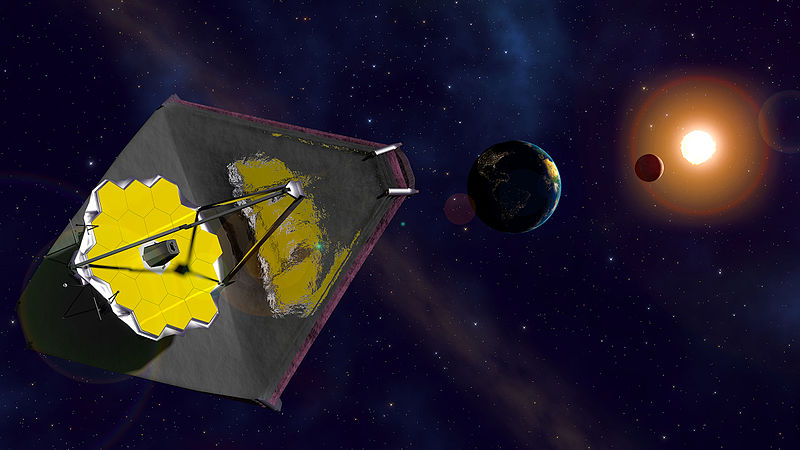
The James Webb Space Telescope is not in orbit around the Earth, like the Hubble Space Telescope is – it actually orbits the Sun, 1.5 million kilometres (1 million miles) away from the Earth. The telescope itself operates at about 225 degrees below zero Celsius (minus 370 Fahrenheit). The temperature difference between the hot and cold sides of the telescope is huge – you could almost boil water on the hot side, and freeze nitrogen on the cold side! It is actually similar in size to the Moon’s orbit around the Earth!
This orbit (which takes Webb about 6 months to complete once) keeps the telescope out of the shadows of both the Earth and Moon. Unlike Hubble, which goes in and out of Earth shadow every 90 minutes, Webb has an unimpeded view that allows science operations 24/7.
We have continuous communications with it as the Earth rotates through the Deep Space Network (DSN), using three large antennas on the ground located in Australia, Spain and California. Webb uplinks command sequences and downlinks data up to twice per day, through the DSN. It uploads a full week’s worth of commands at a time, and makes updates daily as needed.
Webb will study every phase in the history of our universe, ranging from the first luminous glows after the big bang, to the formation of solar systems capable of supporting life on planets like Earth, to the evolution of our own solar system.
To be able to send and receive data over such a distance is mind boggling. In order to carry out its mission, several innovative and powerful new technologies ranging from optics to detectors to thermal control systems have been developed. It has six major subsystems:
- Electrical Power Subsystem
- Attitude Control Subsystem
- Communication Subsystem
- Command and Data Handling Subsystem
- Propulsion Subsystem
- Thermal Control Subsystem
The first step toward understanding how AI can contribute to this area of science and knowledge is, once again, drawing a comparison between an AI and a human. There is a lot of uncertainty that comes with adopting such high-end technologies, but one thing is for sure:
It raises the question: Is Artificial Intelligence The New Guardian Of The Galaxy?
Should we be spending vast amounts on the exploration of the Universe where none of us will ever go or understand, without Quantum computers.
Why?
Because, Quantum computers are expected to be powerful enough to break modern-day ‘unbreakable’ encryption, accelerate medicine discover, re-shape how the global economy transports goods, explore the stars, and pretty much revolutionise anything involving massive number crunching.
The problem is, quantum computers are immensely difficult to make, and maybe even more difficult to run but God help us if we are relying on the human brain to function, as so far it appears to be designed for self destroying the earth never mind the universe.
———-
Artificial intelligences are promising in future societies, and neural networks are typical technologies with the advantages such as self-organization, self-learning, parallel distributed computing, and fault tolerance, but their size and power consumption are large. It’ll take some time before we entirely replace AI accelerators with something that resembles a brain.
Yet experiential attempts have already begun to replace classical computing as we know it.
Don’t worry as we’re only scratching the surface of AI’s uses today, and to unlock those deeper, more impactful uses there’s a whole new type of chip in the works, a neuromorphic computer/chip is any device that uses physical artificial neurons to do computations.
What is an Neuromorphic chip/ computer?
The answers in the name, neuro, meaning related to the nervous system. A neuromorphic computer aims to imitate the greatest computer, and most complex creation, ever known to man: The brain.
If a neuromorphic processor were to be developed and implemented in a GPU, the amount of processing power would surpass any of the existing products with just a fraction of the energy.
Neuromorphic computing is an approach to computing that is inspired by the structure and function of the human brain.
The goal of neuromorphic computing ( According to Wikipedia) is not to perfectly mimic the brain and all of its functions, but instead to extract what is known of its structure and operations to be used in a practical computing system. No neuromorphic system will claim nor attempt to reproduce every element of neurons and synapses, but all adhere to the idea that computation is highly distributed throughout a series of small computing elements analogous to a neuron.
Neuromorphic computers are not currently being used in real-world applications but it won’t be long before neuromorphic algorithmic, offer tremendous potential for computing beyond Moore’s law.
There’s more immediate potential for the future of computing in artificial intelligence, it really is a massive and life-changing development for many, and I’m not just talking about that clever-sounding, slightly-too-argumentative chatbot in your browser.
This is the world’s first hybrid chip where neuron elements and synapse devices of different functional semiconductors are integrated.
Neuromorphic computers are well poised to become the artificial intelligence accelerators and co-processors in personal computing devices such as smart phones, laptops and desktops. They will begin to emerge in these technologies in the future, first probably in the edge computing space as specialized processors and later in future heterogeneous computers.
As the Ukrain/ Russian war is the laboratory for drone warfare the Webb is the laboratory of Ai
All human comments appreciated. All like clicks and abuse chucked in the bin.
Contact: bobdillon33@gmail.com
 bobdillon33blog