
Tags
Best Travel unpublished book., Top readable travel book, Travel book that will inspire you to travel., Travel.
(CONTINUATION)
His welcome is warm and genuine and over dinner, we caught up on all his news and learn that he is to receive a visit in the morning in the form of some Vatican priests. They wish to look over his stewardship of Vatican Aid package. Their pending visit has him in a state of high stress. “How can you explain to these Druids the problems I have here? “ Take for instance the other week I attempted to introduce three tribal chiefs to the joys of eating shell-fish” “ You would not believe the reactions when I put a lobster on the table” > Two of them jumped out the window while the other unsheathed his knife and attacked the lobster as if it was a monster.
While Paulo rolls his fifth joint a change of bedding is secured and the girls retire for the night.
We are late rising. Paulo Papal visitors are getting an ear full as we slip out on foot to give Dirae Dawa the once over.
Established in 1902 to service the rail link from Djibouti to Addis Ababa it was once the second largest populated town of Ethiopia. If you take its name phonically we did not have to explore for long to confirm that Dirae Dawa is indeed a Dour Dump.
Apart from the old part of town with its market, it is void of any charm. It’s no wonder Paulo smokes to escape its hot sticky dust-rasping climate and the sense of desolation it etches into everyday living > A godforsaken corner of Ethiopia.
We take a horse-drawn taxi called a Gari back to the shade of Paulo small garden. We find him in good form. Overall the Papal envoy was pleased with his work even if they are completely baffled when it came to understanding the cultures he was dealing with. “Take the Afar people of the Danokil desert which you are going to cross in the next few days. “ They like lopping off the testicles of intruders they don’t like.” Say, Paul.
We arrive at a government-run Hotel. Paulo’s man turns up looking rather sheepish. I don’t understand a word but it is more than obvious that the Vatican visit is being discussed and that the cover-up operation is being put into action. I am commandeered to drive in the morning to a village named Arabi thirty-five kilometres from the Somalia border. That settled I spend the next hour talking about my coming crossing of the
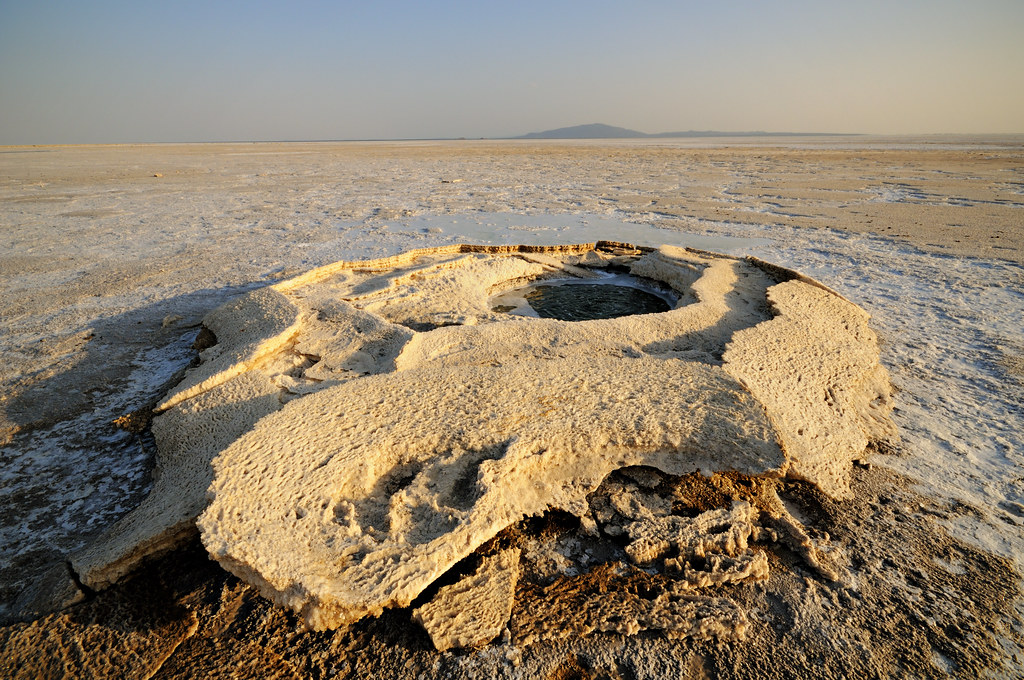
Apart from getting my goolies cut off by one of the fiercest people in the world. The good news or as the Afar call it the Dagu is that I won’t have to worry about the bureaucracy of getting out of Ethiopia. Paulo, as usual, is full of information such as don’t tangle with the Ugugumo > whoever they are. Never mind the dry sand, dry gravel beds, rocky lava flows, burning salt flats, and temperatures of up to 120º F – along with the odd carcase of camels tanks or goat.
I get him to marks out the route on my map. Follow the railway line to Āysha, and on to Ali Sabi, from there you cut inland to Wê’a, and then you are home and dry all the way to Djibouti. A mere three hundred and sixty kilometres without any hitches you should drive it in a day. Returning to his house I can’t help but think of the hitches > Punctures, overheating, fuel, water, not to mention Murphy’s law.
While the girls rest I take a run downtown with Paulo to search out one of his helpers. The short car ride after the Papal visit with Paulo is a running commentary a crash course in Ethiopian problems. “You know that when an Ethiopian say’s he would like to play with you he does not mean he or she wants to have sex with you.” All they want is to talk.” “ The problem is that when it comes to aid the Ethiopians are staggering between a good for nothing Western present and a collapsing African past.” “ It’s all to do with the unbridgeable traditions of other cultures.”
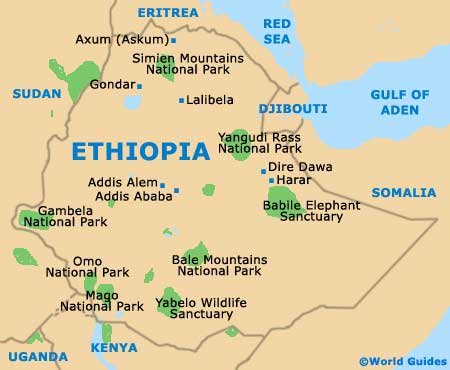
Next morning with the wind packing enough sand to scour windshields we set off for Arabi. In the first few kilometres, all signs of human habitation are left behind. Fanny observing that any cultures that had camped out here, had long disappeared. It soon became self-evident why Paulo had invited us. There was no way his clapped out car could have handled the territorial punishment being handed out.
We bump along with him rattling on about the IMF, the World Bank, and Anthropologists. “You know that almost every project that the World Bank is involved in here 24% of them are failures.” “Why you might ask because they know nothing about the weather and how it affects the bonds of friendship.”
“ The only Aid schemes that work are those run by the people themselves.”
“To be successful you must by-pass the local politicians, the government, tribalism you have to knit into how the people tick otherwise they have no interest in making the Aid sustainable.” “Small is beautiful and young a blessing as they are not yet tarnished by corruption or dim-witted by chat.”
We arrive midday into what I can only describe from a distance as a version of an Ethiopian or Somalia Eskimo village. The obvious difference being that this one is set in searing heat without a hint of white or for that matter any colour other than burnt brown. The igloos are built from cooking oil cans. Like giant CD they glisten in the sun with such intensity that I am sure one could see them from space. As to what Paulo is doing or wants here is anyone’s guess and we are made none the wiser as he disappears with a few shady looking characters.
Williwaw, as usual, is attracting in no time some considerable attention. What is quite apparent is that this place has a poisonous sense. Once a refugee camp it is now a Timbuktu on the Somalia border. Small arms carried by glazed eye men too dark to be Ethiopians are everywhere. The place imparted a sense smouldering danger.
With an ill of ease nagging feeling of being watched for an opportunity rather than out of curiosity, we are left to our own devices. Keeping Williwaw insight we take a wander over to a few women selling chat. They are less than welcoming. We are not of the tribe, the clan, the extended family, or a Fat cat buying Chat for his loyal subjects.
We are relieved when we eventually depart with a silent Paulo. No matter how I pressed him on the return journey as to what exactly he was doing he gave no definite answer just a load of dribble about how he needed to use his contacts.
Next morning we return to Addis after a long arduous day of motoring.
With a fitful night of sleep under our belts, I am waving Adios to the girls and heading downtown to make my own arrangements. Their journey has come to an end as the vapour trail disintegrates in the blue sky on another day.
I am expecting a long day of regulations which no one knows and which are made up on the spot. The shipping of Williwaw from Djibouti to the UK, my flights back to Addis from Djibouti and onwards home to the UK.
After all, I have heard and read about the difficulties of exiting Ethiopian to my surprise I have Williwaw booked on a ship, my return flight to Addis and departure flight to England all done and dusted before lunch.
I have allowed myself a day’s drive back to Dira Dawa – forty-eight hours to cross what is written by the National Geographic as ‘hard to imagine a more brutal landscape than Africa’s Danakil Desert’ > A day to see Williwaw off return flight to Addis a day’s rest in Paulo house before my departure from Africa in six days time.
I spend the rest of the day trading in Williwaw tyres for a new set of Perrelli’s and giving her a pre Desert check over > Oil Change, radiator, brake/clutch fluids, battery, fan belts, shock absorbers, wheel nuts, tyre, pressure, exhaust, in other words – the works.
At the crack of dawn, I set off knowing the road the long drive back to Dira Dawa. Wonderful until I reach the Arba Gugu foothills when the sky’s once again open making a mockery of my preparations for a crossing of a desert with an average 47ºC. Now there is a high likelihood by the time I arrive the Danakil will have returned to the red sea where it came from 10,000 years ago.
For the next few hours, I slip-slide my way along a very muddy road, avoiding miserable looking goats, and the odd donkey mounted by an Ethiopian with white tunics glued to their backs.
It’s hard to imagine that this country suffers from rainfall failures that result in millions dying from famine.
On arrival, there is no sign of Paulo.
Luckily in the morning, it is back to blue skies. Full fuel tanks, sun, and a high sense of adventure I set out for Djibouti. The rough rocky strewn road out of Dira Dawa disappears before the last building is out of my wing mirrors. The ground still has some drying to do after yesterday’s rain.
Following the railway line, the first obstacle is not what I expected to see > A river. Its sparkling brown muddy snaking waters give me an eerie feeling up my spine. There is no obvious crossing point and no signpost pointing up or down to a crossing. The only good thing is that it does not look too deep or wide.
To my right, the railway crosses are on a high bank the water passing underneath through two large concrete pipes. I drive up river and on seeing tracks commit the deadly sin of not walking the crossing before driving in. I am no more than a two-car length into the water when I take a nosedive up to the bonnet > Williwaw konks out to a resounding Fuck, Fuck, and Fuck.
Who is going to believe this? We have driven across the Sahara, the Namib, up Skeleton Coast, over the Caprivi Strip, around the Kalahari and here I am stuck in water on the verge of the Danakil. This is just too Irish to be true. Out I get up to my waist, wade ashore and sit on a rock. One thing is for certain there will be no help arriving. The last person I had passed was well over an hour ago. Walk back to town, which would take most of the day, was also a non-runner. Considering my ETA in Djibouti if I was to make the ship, there was nothing for it but to haul her out > Easier said than done with the nearest excuse for a tree some distance from the bank.
My only option is to winch her out. The first problem is that my hijack is bolted to the front bumper that now happens to be submerged in brown water.
One hour later with much cursing and the odd ducking, I have managed to undo it. Next problem is in securing a wincing point. With no handy tree, and no rocks in a suitable pulling position to jam the high jack behind I have to hammer in my own purchase points for the jack.
Thank god for my rear split pin towing point and more importantly that my chain reached the shore. Click by click, meter by meter, moving and securing the jack for every meter I slowly haul her out. Four hours later the bonnet is open my shorts are dry and now all I need is for the engine to start. A spry of anti-damp a turn of the ignition key, a cough or two and Eureka the lion roars. For once I want to kiss her.
Repacked I head further up the river losing sight of it for a half a kilometre. I eventually arrive at what looks like from the tracks the main crossing place.
This time I wade in up to my waist and explore the footing. All seem well. Reaching the opposite bank for a split moment I have my second Ethiopian Everest experience. An adrenalin shot associated with conquering Everest. Right in front of me is more water I am on a small Island or I am looking at another river. Cresting the bank I shit myself It turns out that the shock is more severe than the crossing. This water is shallow and its existence of the long strip of land can only be put down to yesterday’s rain that has taken a new split divide.
Midday > having spent most of the morning swimming I have not yet reached the outer parameters of the Danakil nor have I bumped into any Ugugumo so I still have my balls.
It’s now one thirty and I am back on track following the railway line. The next landmark according to Paulo is an outcrop of rocks on a raised foothill that has a sign on it saying if you have a drop of water to spare pour it on the plant. From here on it is down into the saltpan and then flat-out for Djibouti. To my surprise, an outcrop appears and there is a sign appealing for a drop of h2o.
The view is stunning sweeping away as far as the eye can see, clothed in hues of silver mixed with shades of browns, reds and yellows a vast silent empty landscape dances in the heat.
Djibouti lies Lat 11º: 35´N. Long 43º: 08´E. It is at this point I leave the rail line and become a microdot follow my compass. With windows wide open I disappear into the vastness.
The going is a lot slower than I had expected as my morning dip has put me way behind schedule. Thirty-odd kilometres it looks like I am not going to arrive in Djibouti before midnight. Slowly the piste gets flatter and my speed picks up. With the driving requiring 100% concentration, I am pretty exhausted and hungry but there is no time to stop.
With a deafening explosion two Mirage Fighters out of the setting sun pass overhead turning into a blip on a radar screen. I am no longer a microdot the prospects of a reception committee are now more than likely. My late arrival combined with the added likely hood of having to deal with unwanted braid make it touch and go that Williwaw will be on the ship for her departure in the morning.
With the ground turning to hard flat salt Williwaw afterburners are full on > An UFO being tracked by heat-seeking missiles on collision with Djibouti. The last sixty kilometres penetrated by my spots lights go whizzing by I arriving miraculously undetected.
(TO BE CONTINUED)
Donation News: Hopefully by the time I arrive in Djibouti some generous reader will have donated a few bob to the next trip.
Robert Dillon. Account no 62259189. Ulster Bank 33 College Green Dublin 2
Sorting Code 98-50-10.


 electrical or telephone poles. Pavements are marked out by a smooth trail over building debris, rubbish and open sewers. Behind every wrought iron gate lays a dog or two exhausted from the nights chorus of relentless barking.
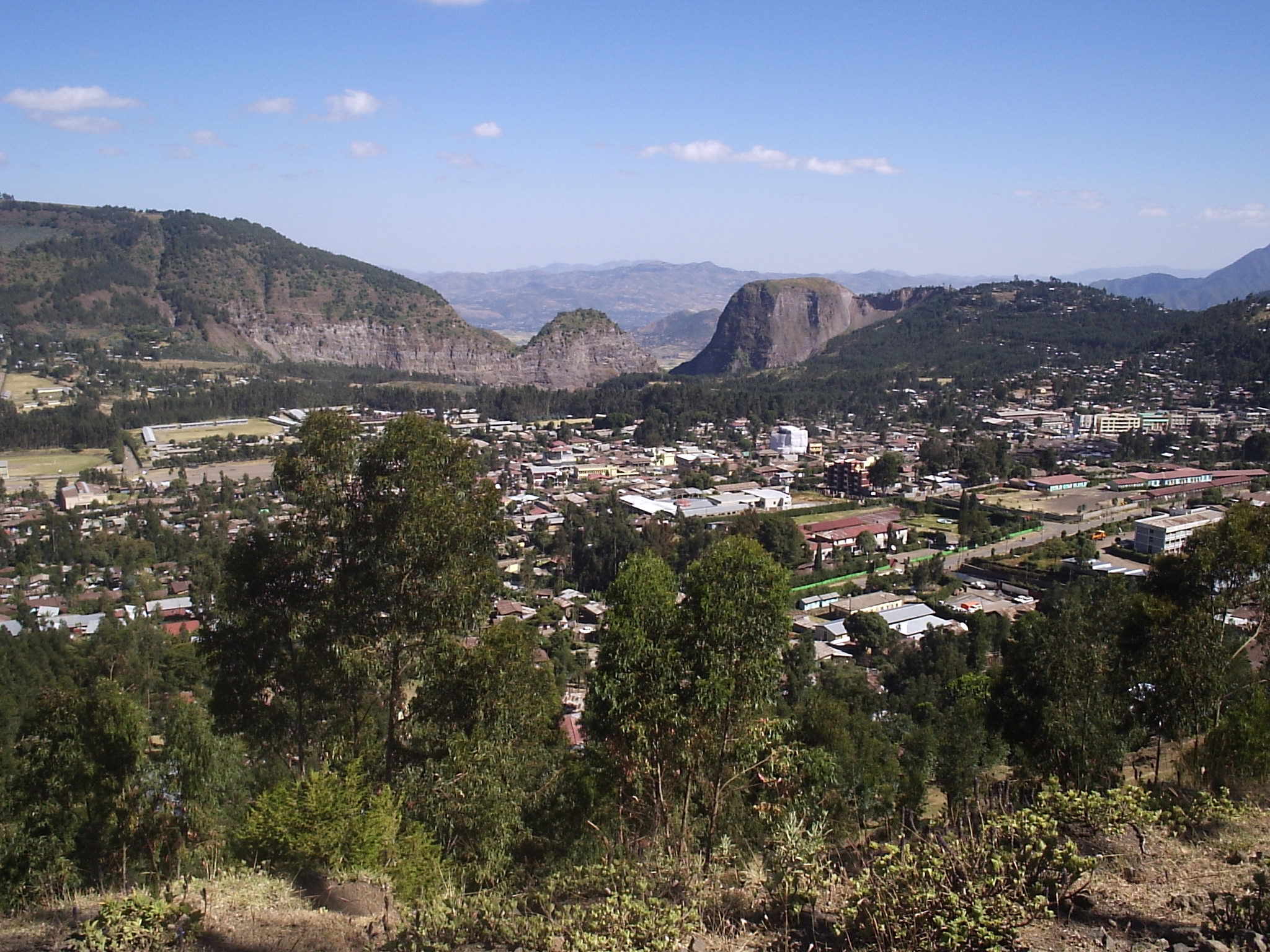
 We drive through the walls main gate, which is named after the town stopping at a bar in Feres Magala Square the centre. The first gulp of cold beer has hardly hit the back of my throat when we are surrounded by the hungry for a few dollars chat chewing Harer guides. “I show you Rambo house, Haile Selasie house, Hareri house, the Hyena man.”


 (Top TIP: It must be said that feeding Hyena has its down side they becoming less fearful of humans but if you get the chance it is an experience not to miss.)
 The road as always in Ethiopia has its striding crucified humans marching in either direction. (Ethiopians use their walking sticks to hang their arms from when walking long distances. They place the walking stick across the back of their necks holding it in position by looping their arms over it. When viewed by other they look like Christians captured by the Romans marching along the road to the coliseum. ) In some way their image captures for us the essence of Ethiopia which is an unforgiving land, immersed in Rituals of religion/traditions, grinding its way from one famine to the next into the modern world.




 Imitating a built up structure Biete Giorgis (House of George) is well worthy of its world heritage listing. It has no trouble standing alongside any of the above. Rising out of a 25msq trench to twelve meters in high from a triple stepped support platform it has like most Ethiopian churches three west-facing doorways.
 Then you have Bet Danaghil a little chapel in the south of the same courtyard. It is connected to the legend of the murder of pack of maiden nuns in the 4th century by a roman named Julian the Apostate other wise known as Emperor (361–363) Flavius Claudius Julianus.


 Reunited with the girls we wander around the obliterate ruins of the palaces of the Emperors Inda Mikael, Enda Simeon and Taeka Mariam. What left is beyond our architectural mind’s eye so we wander over to have a look at the Queen of Saba bathtub where she last scrub three thousand years ago.
 The ruins of the temple of Yeha date from the 5th century B.C. are a must according to Fanny. A few kilometres after Ādwa we branch off on to a very bumpy track in search of Yehas Temple of the Moon. It appears on a knoll > a rectangular edifice twelve meters high with a dollar demanding Youth.
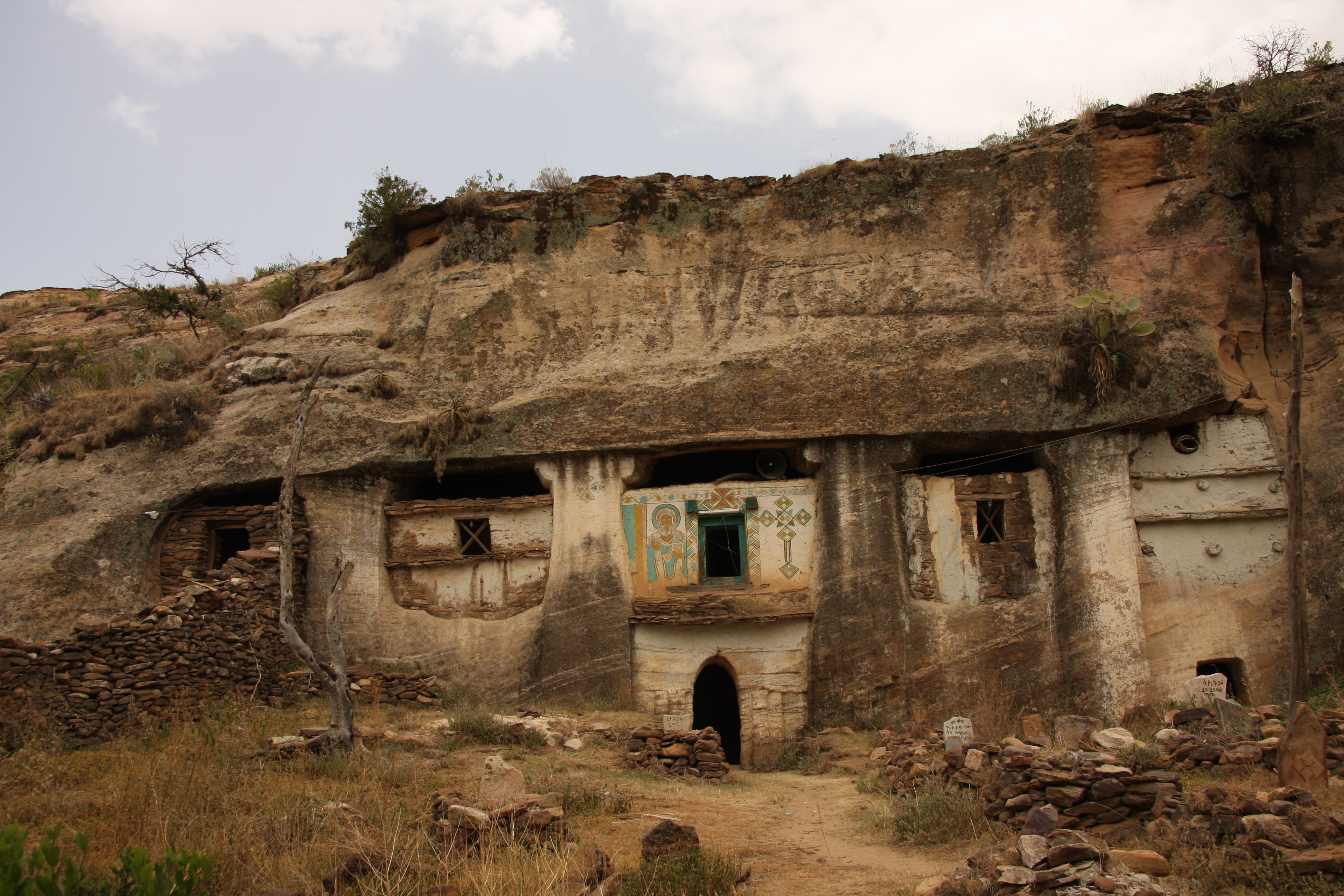 The church appears set into the rock it is surrounded by a small stone wall enclosure with a few olive trees. Cut free from the rock behind it is free-standing on three sides with four rock columns and a large door in front.

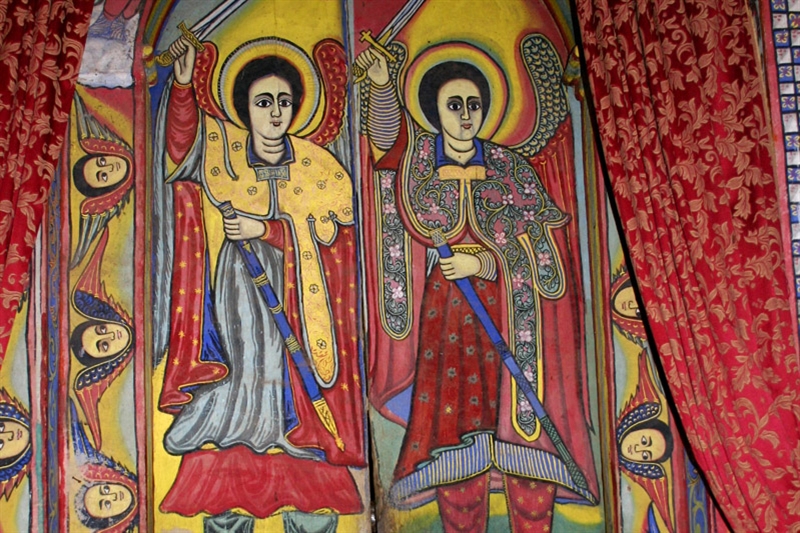
 colourful cartoon-like mural paintings depicting scenes from the Old and New Testaments cover the walls. Meanwhile, 80 cherubs (each with a slightly different Ethiopian face) stare down perpetually from the ceiling. Truly breathtaking: anywhere else this would be a World Heritage Site, removed to a museum or closed to the public. Here, it’s a functioning church on the rustic outskirts of a provincial town. In the middle of all these ecclesiastic frescoes, the 17th-century artist Haile Meskel for some unknown reason painted a rather amusing depiction of the Devil himself.

 The Bleeding heart baboon or Gelada or Lion monkey as it is sometimes called. The Simien fox that they have been looking for the last three-week without seen one. It is neither, a fox or a wolf but a member of the dog family sometimes referred to as the red Jackal. The Walia Ibex a type of wild goat that lives on near vertical cliffs. We, of course, have never heard of such creatures never mind seen one or the other.
 The morning’s glory is cracked by the distant sound of a cock’s crow. We on the road to Axum passing our first group of walking crucified (The name we have allocated to groups of walking Ethiopians due to men’s habit of draping their arms over their walking sticks which are carried across the back of their necks.) Axum or Aksum is three hundred and sixty kilometres to the north three hours driving on a good road but we know better allowing two and a half days.
 “There are over 200 species of Lobelia in the world but this one is only found here.” “It grows for fifteen to twenty years before flowering and then dies”. “How it comes to be here no one knows”.
 Stunning beautiful we stop for a break. We have now been on the go for five hours with every minute breathtaking. Our horseman, his boy and our arm guard with the cook have walked the whole way without the least sign of any effort. Anytime we have had to dismount we struggled with the altitude. Our destination Mietgogo a large peak according to Tedros lies two hours further on up at 3600 meters he is also on foot.
 The village roofs look like large field mushrooms. Hot coffee and bread are most welcome before we set off on day three to Chenek our last stop.






 We make good time to Yabello our turnoff for Jinka but as always in no time we are in very rocky terrain returning to atrocious road conditions.


 We eventually surface onto a relative large flat area. It is thronged with vendors sitting on the ground and shoppers from another world > A world of symbolism. Every thing is haggled over and is sold or not sold by the grain or the gram. My camera has me in trouble almost immediately. Over our journey I have taught myself all sorts of tactics to take photos without the subjects noticing. I am caught red-handed by a very annoyed young lady. She is a Mursi’s or a Surma I don’t have time to ask.

 My taxi turns up on time and in no time I am getting my first lesson in Amharigna > Ishee just does not mean just OK is also can be used to say hello and good-bye. “Chigger Yellem” says my driver. “Ishee” says I no problem says the driver which is chigger yellem. A spring says I, Ishee says he. We drive across the city with a small guide tour thrown in for good measure. Menelik 11 founded Addis Ababa or the New Flower in 1887 (our time). Addis has the largest market in Africa named Addis Ketema is about all I understood.
 We arrive in a street dedicated to the car industry. Stall after stall loaded to the hilt with scavenged car parts. It’s a breakers yard dream. As there is no possibility of I finding my way back to the hotel I indicate to my driver to wait on my. “Chigger Yellem,” with a large smile.
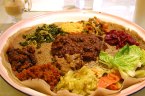 Those of you who have the fortune to visit Ethiopia can image my surprise when rather large pancake-like sourdough bread is placed in front of me. For all attentive purposes it looks like a tin brown sheet of foaming rubber called Injera. Normally it has what is called the wot served on top, but here in the Hilton the wot is served in separate little dishes. The wot is stewed meat and different vegetables. I look around at my fellow diners to get a hint on how to tackle it. Simple rip of a bit of Injera till it snaps off and then scoop up some wot. Deposit the wot on the Injera and hope the lot fits in your gob.
 bobdillon33blog