• About
  • THE BEADY EYE SAY’S : THE EUROPEAN UNION SHOULD THANK ENGLAND FOR ITS IN OR OUT REFERENDUM.

bobdillon33blog

~ Free Thinker.

bobdillon33blog

Tag Archives: Artificial Intelligence.

The Beady Eye looks at Big Data.

30 Tuesday Jun 2015

Posted by bobdillon33@gmail.com in Big Data., Politics., Privatization, Technology, The Future

≈ Comments Off on The Beady Eye looks at Big Data.

Tags

Artificial Intelligence., Big Brother., Big Data, Distribution of wealth, Drones., Globalization, Inequility, Technological revolution

Is our world along with humanity disappearing into the Cloud.?

We as individuals are turning into “walking data generators”  ” App Material”

The Beady eye is only going to look a the most contentious realms of Big Data. Technologies that drive the explosion of growth of digital information such as the information collected.

Big Data is disseminated from trillions of devices such as smartphones and embedded sensors.

Huge quantities of digital trace data are collected through digitized devices (captured, for example, via social networks, online shopping, blogs, Apps, ATM withdrawals and the like) and through in-built sensors. The latter technologies include those that are equipped with GPS systems (e.g., smartphones and other surveillance and monitoring devices) and thus have the ability to identify a user’s location.

Ever since the dawn of life with language man has been collecting information. Not until written letters or symbols arrived was this information stored for future generations.

It is now being collected to replace us all with AI.

Knowledge was and still is the power that split the world into cultures- the rich in information and the poor with illiteracy – Slave or Master.

To day data is money and it is re splintering the world into the have and have not’s.

A next-generation retailer will be able to track the behavior of individual customers from Internet click streams, update their preferences, and model their likely behavior in real-time. Traditional advertising is shifting rapidly into the realm of personalized and highly targeted online and mobile ads—the realm of data driven marketing. Big Data and Advertising Case Study

Across all industries, including government, healthcare, media, energy, among others, data is becoming central to business operations. Every business is a digital company; and, every customer or employee is a content producer.

Today’s organizations use a plethora of information systems to support their business processes.

Advances in technologies and the increasing amount of information are transforming how business is conducted in many industries, including government.

Every business sector now collects data of one form or another, and the future marketplace will have even more computing power at their fingertips to mine customer behavior. Someone from every major industry is looking at the impact of being able to glean data from multiple data sources, structured and unstructured, from Healthcare to agriculture and more.

Businesses are using the power of insights provided by big data to instantaneously establish who did what, when and where.

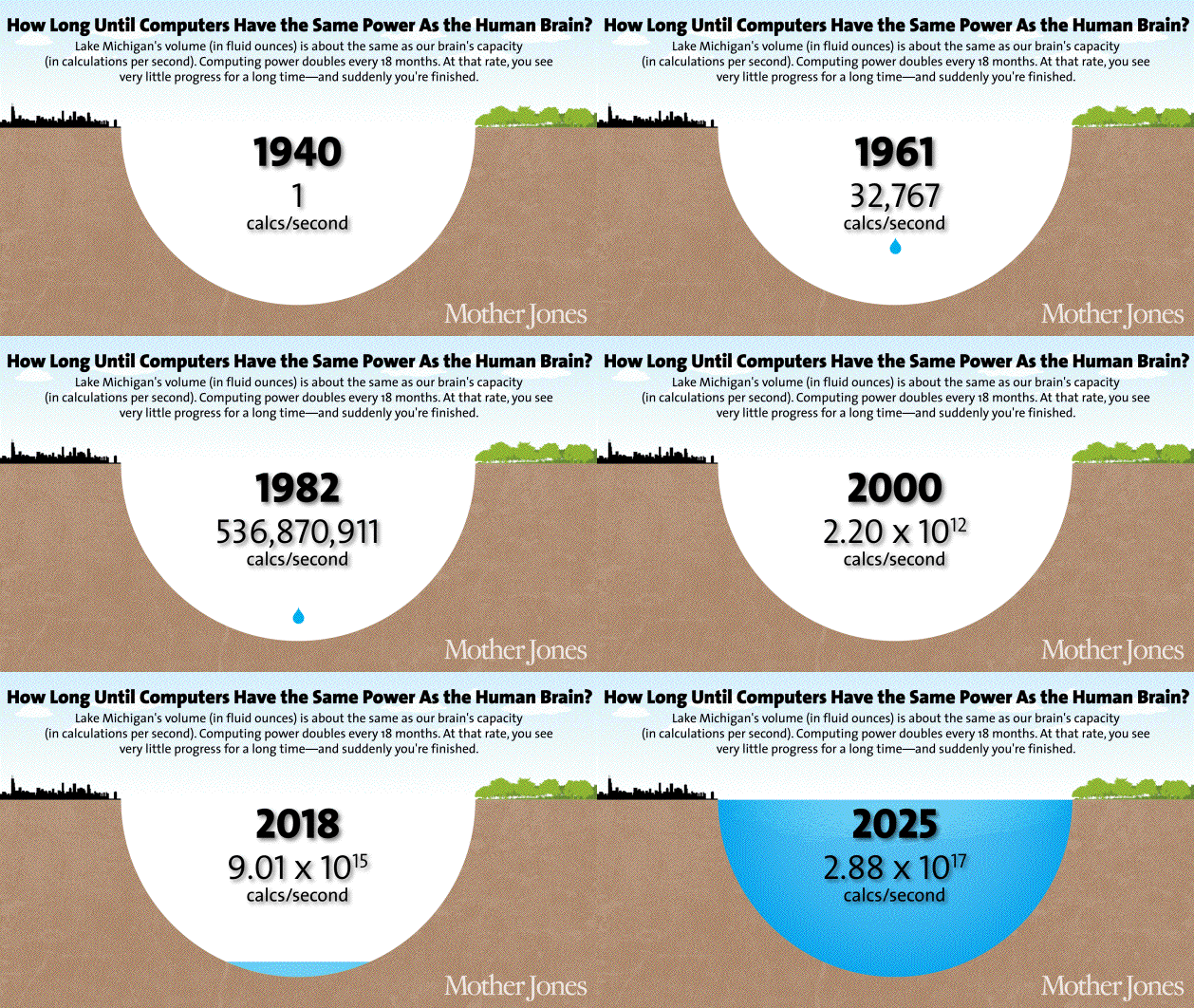
The world’s volume of data doubles every 18 month.

In all forms it will grow 650 percent over the next five years.

Despite feeling overwhelmed, there’s an insatiable desire for more data.

The information overload is real and causing problems.

There is little or no regulations governing every time you click on a website, post on social media, use a mobile app and comment via email or to call centers, your data is collected for future use.

In my opinion, the world needs proper regulations about how and what kind of data should be collected.

My bigger concerns are related to unsanctioned organizations using my data and inferences about my interests, passions, affiliations and associations for borderline uses about my political, religious, sexual, etc. preferences. Just because a company can collect all kinds of personal information on consumers, it doesn’t mean they should use it willy nilly.

The more is better” philosophy.  There in lies the trouble.

Tracking customer preferences and purchases can reveal all kinds of private information, like illnesses, financial problems, even pregnancy.

For example a father recently discovered that his daughter was expecting a baby only because of Target’s TGT – 0.5% customer advertising technology. It analyzing his daughter shopping patterns so the store started to send her coupons for baby products which alerted the father.

Data gathering is not going away.

This should have us concerned, not just about targeted marketing but about what can be inferred about all of us every time we “like” something on FACEBOOK or post a snarky tweet on TWITTER.

From what I can tell, what Big Data does best is spy on individuals and collect useless data that helps people develop false and inaccurate assumptions.

Big Data may have wonderful potential, but we’re still going to have to get better at data exchange and integration before it’s going to have its biggest impact. We’ve spent decades digitizing everything, we should be able to analyze it. The problem is, that’s really hard – and it always has been.

THE BIG QUESTION REMAINS: Who does it belong to, and who should have access to it?
Human Face of Big Data

Big Data will let us watch flu outbreaks bloom and direct scarce vaccines to the most critical area’s. Schools are collecting more data than ever on how children are doing. Companies and nonprofits, meanwhile, are racing to put that data to use in the classroom.

Today, we’re at the convergence of these innovations—biotechnology, the ability to remote monitor and sensor, and now Big Data—which puts an augmented reality at our disposal.

However there is an undercurrent of concern about who owns big data and who has the right to access it.

Big Data technologies are at the heart of the intelligent economy and the solutions that enable it.

Big Data technologies are analyzing massive data sets, in science and research as well as mine data to prevent bad actors from committing acts of terror and/or to prevent waste, fraud, and abuse.

Government data generation and digital archiving rates are on the rise due to the rapid growth of mobile devices and applications, smart sensors and devices, cloud computing solutions, and citizen-facing portals.

As digital information expands and becomes more complex, information management, processing, storage, security, and disposition become more complex.

Information is a strategic asset, and government needs to protect, leverage, and analyze both structured and unstructured information to better serve and meet mission requirements.

New technology brings new challenges, and they should be properly educated to use it wisely and critically. It is used to study employee performance and retention.

The younger generations are not always aware of the challenges and dangers that come with big data.

Privacy here is a key issue to consider.

I sometimes get frightened to see what younger generations publish on their social media, without being aware how they expose themselves to the outside world. Just think about recommender systems.

When you want to buy a product or service from an online retailer, you are often frustrated because of the many choices and configurations possible. Thanks to an intelligent, analytical recommender system, purchases (and their customer feedback) are continuously monitored to better tailor future recommendations to customers.

Credit card fraud detection system.

In fact, thanks to credit risk analytics, our savings money is now efficiently safeguarded since every bank is obliged (via the Basel III capital accord) to analytically estimate credit losses and make sure it has enough provisions or equity buffers for worst-case scenarios.

Big Data is being used to detect social security fraud, to detect tax evasion fraud, to employ and fire people.

New data stores have emerged increasing the distribution of data and the complexity of securing and protecting that data along with it. It is now harder to protect sensitive data as it may move around between different transactional and analytical data stores as companies create new analytical workloads.

While there is more to do to wrestle big data to the ground. Defense (DOD) is investing approximately $60 million annually for new projects that will harness and utilize massive data in new ways and bring together sensing, perception, and decision support to make truly autonomous systems that can learn from experience, maneuver and make decisions on their own, and understand the limits of their knowledge.

Governments are facing more and more challenges in managing the life cycle of Big Data as government’s traditional silo approach hinders sharing knowledge and working across organizational boundaries.

While emails, instant messages, data files, document files, and scanned images are all driving the growth of Big Data, managing and storing this information — and its growth — are not trivial tasks. It has raised red flags about privacy, which remain unresolved.

The only way to make data totally safe is to not ever use it or keep it. Big Data Discriminates.

Our currents Laws cannot adequately handle the issues raised by Big data.

Just look at the legal complications created by systems using data and algorithms to include and exclude people from various programs.

What we have are porous laws on how this new technology changes previous understandings of civil liberties, not to mention data analysis, machine learning and the work scientists have been doing on non-discriminatory data mining models.

Individuals should be granted meaningful opportunities to challenge adverse decisions based on scores miscategorizing them.

Where data goes in and a decision comes out it’s unclear, or certainly opaque, just how that decision was arrived at. There is no way to trace why a decision was made.

With programmers doing real-life damage without even knowing it. The question is:  How do we update our understanding of due process for the 21st century?

These black box issues such as credit-scoring systems should be legal required to make their Systems Transparent.

If you take Google’s search algorithms for instance no one knows how it chooses the direction of its search. Perhaps it directs your search only to its profit.  It’s not  just about the quality of the user experience.HUNGARY–DPA Requesting a Flyby

Drones are becoming more widespread globally, the non military use of drones will add a further deluge of big data:

Cameras, heat and motion sensors, GPS, Bluetooth, Wi-Fi signals, facial recognition and bio metric scanners allow for the growing use of drones in the industrial, agricultural, transportation and retail areas.

The use of drones—theoretically—should only be possible upon individual permit irrespective of the drone’s starting point and final destination.

However enforcement may be difficult.

The only way is a world license that creates an official record of the individuals operating/using drones for a commercial purpose.

In practice, the widespread use of drones for private purposes may result in unreasonable administration in connection with the above, drone users and operators may also be reluctant to provide so detailed information on their activities for confidentiality reasons.

If the drone records flight details for aviation safety considerations, personal data captured but not relevant for this purpose should be anonymised and stored separately or should be made unidentifiable, unrecognizable and inaccessible by the controller immediately after the drone finished flying.

Data should be stored on the drones only temporarily.

For example, during the security surveillance of a property, the drone may record pedestrians’ faces, movements, body-temperature etc., and the devices should be configured in a way which prevents them from this kind of processing. Drones should solely be able to signal the location and fact of an allegedly unauthorized attempt at entry onto the premises.

In practice, this principle should be assessed on a case-by-case basis, as the actual use of the drone may require more extended data processing than envisaged at the beginning. The drone may locate a trespasser who needs to be identified (to ensure to security surveillance purpose), and, in such a case, privacy-by-default settings should not prevent the enforcement of the drone operator’s legitimate interests.

For example, a recording of an agricultural land cannot be used for the surveillance of agricultural workers.

Given the amount of data governments store on citizens and the sensitivity of some of that data, it makes sense for state budgets to carve out funds for someone to shepherd how that data is collected, treated and stored.

Should there be a meaningful data life cycle amidst the sea of data.

In fact , big data may ultimately be a key factor in how nations, not just companies , compete and prosper . Algorithmic decision-making:

In a nutshell, the problem with ‘datification’ is that somebody else may … use the data thus produced – often with purposes different from those originally intended.

Make no mistake about it:

Our future, the future of humanity and the planet hangs in the balance.

Do we have what it takes to disrupt what is…in order to create what can be?

Big data as a high concept will never fully define itself it’s just a big scam. Surveillance programs. High Frequency Stock Trading. Electronic Currency Trading. Dooming us all down to rely on Google.

I hope it die’s a miserable death.

← Back

Thank you for your response. ✨

Share this:

  • Share on WhatsApp (Opens in new window) WhatsApp
  • More
  • Share on Mastodon (Opens in new window) Mastodon

The future impact of AI (Artificial Intelligence)

20 Friday Mar 2015

Posted by bobdillon33@gmail.com in Technology

≈ Comments Off on The future impact of AI (Artificial Intelligence)

Tags

Artificial Intelligence., Future Society., investments in science and technology.

I was told the other day that I had not addressing the last and perhaps the most important issue concerning the effects of Technology that the human race will ever faced. The dire warnings that machines run by Artificial Intelligence will one day take over from humans.

What better day to post my views an diamond eclipse. The last time it happened was in 1935 and the next time is 2206.  

Now don’t get me wrong I like being human! I want humans to retain autonomy over machines! Judgments of virtue are judgments of a whole life rather than of one isolated action. The development of moral character may take a whole lifetime. But once it is firmly established, one will act consistently, predictably and appropriately in a variety of situations.

However we will need a new set of practices for value creation; where data slaves dare to stand up and call for a revolution … But it will be very difficult to turn back the wheel that has already been set in motion several decades ago.

What is artificial intelligence and what is the media talking about? What ever it is it is a long way off before Machines turn on us never mind emulating human behavior to the point of mimicking communication.

Are these technologies beneficial to our society or mere novelties among business and marketing professionals?

Medical facilities, police departments, and manufacturing plants have all been changed by AI but how?

So far this bond has been one-sided because the ability to generate, recognize and express emotions are a unique prerogative of living human beings, but if this intelligence or abstract attribute could be taught to machines, it would re-conceptualize the perception of machines.

So in this post should I focus on the truly remarkable achievements of the technology or dwell on the dangers of what could happen if machines reach a level of Sentient AI, in which self-aware machines reach human level intelligence.

Let’s start with present day.  Do you believe that if all computers are stopped for a day, complete civilization comes to a halt!

Fifty years ago, this might have been a science fiction, but today it is a reality.

We cannot predict because of the great potential of AI what we might achieve when this intelligence is magnified by the tools AI (may provide) however the eradication of disease and poverty are not unfathomable.

So it is valuable to investigate how to reap its benefits while avoiding potential pitfalls.

The potential benefits are huge, since everything that civilization has to offer is a product of human intelligence.

Presently, applications in advanced robotic appeared so real that one can believe a humanoid robot will be capable to interact or work side by side with people in a near future.

If so are we ready for the bio mechanical future revolution. ( Or as I would call it synthetic intelligence implants, because it is not natural intelligence.)

For the sake of the length of this post I will stick with AI.

This questions;  Will AI be a reality and many others are and should be the concern of the general public.

A time will soon come (brought about by the lack of education concerning rapidly advancing computer technology) when this question will need to be answered.  On the ethical use of such technology and its impact on intimate human relationships and society.

When is the best time to discuss the ethical uses of these technologies?  NOW.

If robots are ready to plug safely into society the question is no longer a questions for future generations to sort through, it must be decided, and soon.

As technology rapidly improves, it is inevitable that it should begin to take on elements of its creator and believe me there are many routes that Artificial intelligence can go. 

Its impact on society is only likely to increase.

For instance: Once we begin to mesh technology more closely with ourselves as humans we can begin to accept it as a part of ourselves and as a part of our society. Some say it could be curtain for Society.

memories-maya

As I have said in previous posts Technology is transforming our social, economic, and political institutions; our understanding of what it means to be human; and the distribution of power in the world.


The threat of AI equipped computer systems and machinery taking jobs away from humans is becoming a harsh reality. When and in what order should we expect various jobs to become automated ?

How will this affect the wages of less skilled workers, creatives, and different kinds of information workers? Some have argued that AI is likely to greatly increase the overall wealth of humanity as a whole. This is a total misconception as the rich will own the Data. Increased automation may push income distribution further towards a power law and the resulting disparity may fall disproportionately along lines of race, class, and gender.

Research anticipating the economic and societal impact of such disparity could be useful to start asking the questions.

How should the ability of AI systems to interpret the data obtained from surveillance cameras, phone lines, emails, etc., interact with the right to privacy?

How will privacy risks interact with cyber security and cyber warfare?

We already have drones and it will not be long before we have a weapon that does everything on its own without human help.  These weapons will be a threat to civilians?  Can lethal autonomous weapons be made to comply with humanitarian law. No.

Sophisticated remote-controlled military robots are already in use with no tractability, that fire a weapon to AI algorithms is that not something to fear. We are programming them. If that’s not scary enough put a nuclear war head on one.

Smart weapons raises many questions on the price paid to develop these weapons; money which could be used to solve most of the world’s social problems such as poverty, hunger, etc.

http://www.military.com:80/video/ammunition-and-explosives/projectiles/iran-unveils-new-smart-weapons-system/1427781968001/

Of course none of this is going to change anything as we are incapable of making war against Poverty or Inequality. Why? Because human intelligence can be viewed as being as diverse as its population. However this type of analysis of Intelligence leads us to the individual and becomes useless.

Over the last decade, electronic tiny minuscule signals have fundamentally revolutionized the way we live. People are spending more hours per day with machines than humans and in the future, computers will evolve quicker than the human race.

Sorry I am diversifying.  Back to AI

An amazing a human-machine relationship is developing.

Fortuitously for us so far the possession of knowledge alone does not make a being or machine intelligent.

This is the problem when it comes to computer scientists and engineers understanding just how their work affects humans and human values.

So what role should computer scientists play in the law and ethics of AI development and use?  None. They are focus on getting software products to market, regardless of whether they instantiated interesting principles of intelligent systems that could also illuminate the human mind.

How should lawyers, ethicists, and policymakers engage the public on these issues?  Should such trade-offs be the subject of national standards?

Significant parts of the economy, including finance, insurance, actuarial, and many consumer markets, are already susceptible to disruption through the use of AI techniques to learn, model, and predict agent actions. These markets are identified by a combination of high complexity and high rewards for navigating that complexity. Artificial intelligence techniques can be applied to financial investing, especially in the areas of credit risk assessment and stock valuation.

In the future, we can expect that the techniques of artificial intelligence will be integrated into systems that simultaneously address investing activities.

The successes of industrial applications of AI, from manufacturing to information services, demonstrate a growing impact on the economy, although there is disagreement about the exact nature of this impact and on how to distinguish between the effects of AI and those of other information technologies.

Many economists and computer scientists agree that there is valuable research to be done on how to maximize the economic benefits of AI while mitigating adverse effects, which could include increased inequality and unemployment.

All that said; Artificial intelligence certainly has a place in the future of humanity.

The danger of machines taking over too much of human interaction and work, the human mind, is to far-fetched to my thinking.

There is no doubt that computers are being embedded in all of our life accessories like mobiles,watches, cars, even our bodies and brains.

These subsets of AI, such as data mining, neural networks, speech recognition and lip-reading, behavior recognition, and face recognition, to name a few, are becoming increasingly powerful—and indispensable—to human organizations.

The question of whether a human brain is necessary for thinking remains in Science Fiction Hollywood.  

No one has agreed on a concrete definition of artificial intelligence, largely because there is insignificant understanding as to what comprises intelligence.

Professor Jefferson’s Lister Oration for 1949, from which I quote sums up the problem for me.

“Not until a machine can write a sonnet or compose a concerto because of thoughts and emotions felt, and not by the chance fall of symbols, could we agree that machine equals brain-that is, not only write it but know that it had written it. No mechanism could feel (and not merely artificially signal, an easy contrivance) pleasure at its successes, grief when its valves fuse, be warmed by flattery, be made miserable by its mistakes, be charmed by sex, be angry or depressed when it cannot get what it wants.

Or a  machine which is under interrogation”What do you think of Picasso?” Be kind, resourceful, beautiful, friendly, have initiative, have a sense of humor, tell right from wrong, make mistakes, fall in love, enjoy strawberries and cream, make some one fall in love with it, learn from experience, use words properly, be the subject of its own thought, have as much diversity of behavior as a man, do something really new.

AI will remain valuable regardless of whether we’re able to build fully- functioning robots or human-esque brains.

AI, the harnessing of intelligence on the computer, will turn complex thought processes into fast computer simulations; it will be used to analyze past events and predict the future.

The ability of these systems to explain the reasoning process through back-traces and to handle levels of confidence and uncertainty provides an additional feature that conventional programming can’t handle.

Intelligence is defined as the ability to achieve goals through computational process. Although intelligence is only studied in humans, is it possible that machines may be more “intelligent” than those who created the machines in the first place?

Will computers reach human intelligence someday. They have already surpassed our calculation abilities and our speed of processing information.

There is no indication that microchip speed will not be multiplied in the future.

As with every innovative technology there are positive and negative externalities involved.

The Intelligent Robot-  Will Artificial Intelligence Replace Mankind?

No. This dream will remain elusive until machines attain the basic human virtue of common sense.

Our ability to take full advantage of the synergy between AI and big data will depend in part on our ability to manage and preserve privacy.

How we can ensure humans will be able to control AI once it achieves human-level intelligence? I would prefer humans maintain autonomy over technologies that could achieve sentience.

It is tempting to wonder what would happen if we spent more time focusing on helping each other directly, versus relying on machines to essentially grow brains for us.

We need to develop a science for understanding advanced Artificial Intelligence before we develop it further.

It’s just common sense. Intelligent machines won’t love you any more than your toaster does. Giving people a device that enhances intelligence may not be a terrific idea. What happens when a machine breaks the law?

Our AI systems must do what we want them to do. We ourselves don’t reason with precise truths. We don’t yet know really what consciousness is, what drives consciousness?

Why do we attend to only a portion of what we see and hear? It is obvious that given an event, observed by many, we each perceive it differently, and we take in differently. Do we each have individual filters that have to do with our own stories? Probably. But I think pondering this goes deeper. Is consciousness itself, somehow, directed? God forbid a machine is directing it.

John Cleese, Monty Python and the Holy Grail. Describes AI

Being human, has to have a component of humanity to it. The nature of the mind and of memory, and how intelligence can be manifested in physical form is a joke when it comes to a Machine.

For the robots or technology that may surpass our intelligence in the near future, observe my fleshy middle-digit and hear me cry: “I wave my private parts at your Auntie! Your mother was a hamster and your father smells of elderberry!” —

Tell me how do you model thought?  Give me a machine that can read a simple children’s book, understand what the story is about, and explain it in its own words or ask reasonable questions about it.

That is it. I have tried artificial intelligence and I don’t like it.

Artificial Intelligence Technology is learning by itself. The claim that a machine cannot be the subject of its own thought can of course only be answered if it can be shown that the machine has some thought with some subject matter.

Where is this technology going to be? No one knows for sure, what we can only say for certainty is that this Artificial intelligence, and Machine Learning will transform all software and hardware, all industries and businesses. Roads, bridges, Cars, Homes, will be connected to it.

While today we do not possess the technology to achieve a truly sentient machine we cannot because of that speculate too deeply as to the results of such an achievement.

Only if intelligence ceases to be a sacred mystery to us, and we can control our destructive nature should any of us accept an Apple from the Adam of AI. 

One thing is for sure; We will sure need some kind of global governance in the interest of the individual. 

We are just in the beginning in terms of where these technologies will take us.  Mars and back.

← Back

Thank you for your response. ✨

Share this:

  • Share on WhatsApp (Opens in new window) WhatsApp
  • More
  • Share on Mastodon (Opens in new window) Mastodon

WHERE DO WE GET OUR Thought’s FROM:

08 Monday Dec 2014

Posted by bobdillon33@gmail.com in Uncategorized

≈ Comments Off on WHERE DO WE GET OUR Thought’s FROM:

Tags

Artificial Intelligence., conceptual thinking, global climate change, positive thinking

Increasingly today, we are being asked to analyze environmental projects or activities whose effects will be spread out over hundreds of years. Prominent examples include: global climate change, radioactive waste disposal, loss of biodiversity, thinning of stratospheric ozone, groundwater pollution, minerals depletion, and many others.

Recently I posted some thoughts on Artificial Intelligence and the changes that technology will bring to our existence.

Now before I go any further perhaps this post should carry a warning that you might end up confused.

WHERE DO WE GET OUR THOUGHT FROM.

Here I am not talking about what frames our thoughts.  Like your present circumstances or your culture, your education, and the like. What I am interested in is exploring the source of thoughts.

You might ask why.  The answer is that there is not much mental shelf space left in the world to tackle its problems as we are all attracted by anything that commands our attention.

So lets hope the following commands your attention.

I suppose the first thought is that Human beings require language in order to become conscious of a thought. Language is indispensable for us in order to get access to thought. On the other hand, language – because of its sensible character – obscures thought (which by itself is insensible).

Perhaps Artificial Intelligence will be able to circumvent the obstacle of language and access concepts and thoughts directly.

Now there is a thought for you.

There are multiple versions of reality science but very few of them address or make comments on the purpose of the universe or the reason for life.

You are today where your thoughts have brought you; you will be tomorrow where your thoughts take you. – James Allen (author of As a Man Thinketh)

THAT LEADS ME TO THE GREATEST THOUGHT OF ALL:  Creation itself must have been an act of thought.

Long before the Big Bang which is mathematically indescribable there had to be a thought that brought the BIG BANG into consciousness?

From where did it come?  Not the Big Bang, but the thought to create it in the first place.

These things are not explained by science. Consciousness does not come from a combination of chemicals as it is a non-material energy.

So we must ask ourselves just how we can convey a certain piece of information to someone else if we are not able to represent this information to ourselves in conscious thought.

The Big Bang as a single point or particle falls well short of supplying any conceptual thought of what caused it in the first place.

For years, we’ve heard about the power of positive thinking, but without the ability to communication of one’s own thoughts to another which appears to be entirely dependent on representing and recording one’s own thoughts to yourself we can never raise ourselves to the level of specifically conceptual thinking.

If we disregard how thinking occurs in the consciousness of an individual, and attend instead to the true nature of thinking, we shall not be able to equate it with speaking.

Power of thinking denote a special mental capacity.

First, language is used to assist memory, or the representation and recording of one’s own thoughts; and second, it is used as a required vehicle of communication of one’s own thoughts to other people human. Language is needed to develop and/or employ our faculty of reasoning, on the one hand, but at the same time reason has to be presupposed to a certain degree in order for language to be possible.

But then again language is not required to grasp or become aware of thoughts about invisible things – does not by itself imply that the thoughts themselves could not be without language. Like the slips of the tongue, a blush full face, or mere movements of a face muscle, can only too well convey information about the thoughts or attitudes of the conveyor, and even indirectly about what these thoughts and attitudes are about.

Therefore thought depends in certain ways on language, or on symbols in general.

If you consider it we cannot find a convincing reason for the indispensability of language for thought.

However sense-impressions determine almost by themselves the course of our ideas, as is the case in animals.

So is it going to be possible for Artificial Intelligence to invented language without reason? Through symbols that we use to memorize ideas in such a way that we can call them up more or less at will.

So where does that leave us.

Without senses we would never think of them. So does it mean that language constitutes thought, so that the latter could not be without the former?

The power of pure thinking can set the stage for some inspiring change.

O! Just in case you have had a thought don’t blame me.  Shut down the left hemisphere of your brain that controls speech and thought and perhaps you will have discovered Artificial Intelligence.  As positive thinking changes the brain in a physical way, pure thinking can do the same.


Let’s have your THOUGHTS.


← Back

Thank you for your response. ✨


people generally discount the future

there are that the universe consists of pure thought


When you understand how the brain works somewhat better, you can use that information to literally enhance your own perspective, broaden your own sense of your capacities and, with that awareness, learn to focus on other things knowing that if you focus on other things consistently you can change what’s there. You can change the way that real estate is used.

”When you understand how the brain works somewhat better, you can use that information to literally enhance your own perspective, broaden your own sense of your capacities and, with that awareness, learn to focus on other things knowing that if you focus on other things consistently you can change what’s there.

You can change the way that real estate is used.”

how to reboot our brains in a positive, pure direction


Or does it merely mean that we could not become aware of our thoughts or could not grasp them without language?


A new perception would let these images sink into darkness and allow others to emerge. without symbols we would scarcely lift ourselves to conceptual thinking.concept is first gained by symbolizing it; without symbols we could not become aware of things that are physically absent or insensible.


Share this:

  • Share on WhatsApp (Opens in new window) WhatsApp
  • More
  • Share on Mastodon (Opens in new window) Mastodon

Perhaps the next century—we all be in a permanent identity crisis, constantly asking ourselves what humans are for.

03 Wednesday Dec 2014

Posted by bobdillon33@gmail.com in Uncategorized

≈ Comments Off on Perhaps the next century—we all be in a permanent identity crisis, constantly asking ourselves what humans are for.

Tags

Artificial Intelligence., Google, Steven Hawkins

You no doubt heard Steven Hawkins recently prediction that the human race as we know it will come to and end with the creation of a Super Artificial Intelligence.


He could be right.

Over the past 60 years, we have seen mechanical processes replicated behaviors and talents we thought were unique to humans,

We are not just redefining what we mean by AI—we are redefining what it means to be human. ( Greed v Poverty.  Muslim v Christian. Wealth v Benefits. Black v White. War v Peace. Health v Consumerism. Life v Death. Gratification v Pain. Space v Sustainability, Climate Change v Profit. To mention just a few)

It will be long before we’ve have to change our minds about what sets us apart. (ISIS v The Rest.)

Every day we are being forced to surrender more of what is supposedly unique about humans and we will spend the next decades doing so.

Indeed, the grandest irony of all, the greatest benefit of an everyday, utilitarian AI will not be increased productivity or an economics of abundance or a new way of doing science—although all those will happen.

The greatest benefit of the arrival of artificial intelligence is that AIs will help define humanity. We need AIs to tell us who we are.

In order to appreciate this we are we going to need a large dose of artificial smartness. Smartness is focused, measurable, specific.

If you think about it, much of the technology humans interact with is about putting you in a particular bucket. This is exactly what Online marketing is about. Making finer and finer distinctions as to which bucket you belong in.

The long-term scientific goal of artificial intelligence is human-level intelligence as it Artificial immortality is to the goals of modern medicine.

AI has attracted more than $17 billion in investments since 2009. Last year alone more than $2 billion was invested in 322 companies with AI-like technology.

Every time you type a query, click on a search-generated link, or create a link on the web, you are training the Google AI.

Each of the 12.1 billion queries that Google’s 1.2 billion searchers conduct each day tutor the deep-learning AI over and over again. With another 10 years of steady improvements to its AI algorithms, plus a thousand-fold more data and 100 times more computing resources, Google will have an unrivaled AI.

At first glance, you might think that Google is beefing up its AI portfolio to improve its search capabilities, since search contributes 80 percent of its revenue. But I think that’s backward. Rather than use AI to make its search better, Google is using search to make its AI better.

My prediction: By 2024, Google’s main product will not be search but AI.( See My Flip board ” Silent Wittiness to Google Ambitions.)

Where are we at the moment?

Parallel computation, bigger data, and deeper algorithms generated the 60-years-in-the-making overnight success of AI. As these technological trends continue—and there’s no reason to think they won’t—AI will keep improving. The smarter it gets, the more people use it. The more people that use it, the smarter it gets.

Our AI future is likely to be ruled by an oligarchy of two or three large, general-purpose cloud-based commercial intelligences offering more like IQ as you want but no more than you need.

It is transforming the Internet, the global economy, and civilization. It is enliven inert objects, much as electricity did more than a century ago.

There is almost nothing we can think of that cannot be made new, different, or interesting by infusing it with some extra IQ.

Non-Inheritable Neural Architecture intelligent machines will increasingly replace knowledge workers in the near future.

Many knowledge workers today get paid to do things that computers will soon be able to do. AI will increasingly move up the skill ladder to replace the middle-class workers.

There’s no way a human can keep on top of all possible financial instruments in the world or is it possible for doctors and nurses to stay on top of medical innovations.

Every success in AI redefines it.

A child born today will rarely need to see a doctor to get a diagnosis by the time they are an adult.  Computer Medical diagnostics is a potential “game changer,”

At this very moment it is possible to have you DNA sequence read by 23 and Me (for a fee.)

Curious.  Go on try it.

Find out if you are a suitable partner, what you are most likely to died from, WHETHER YOU ARE going to win the lotto – sorry not true.

We are still a ways off from equaling the processing power of the human brain.

An AI program may be able to write code to manipulate the stock exchange but not the lotto draw. It is still not able to “solve the problem of common sense, of endowing a computer with the knowledge that every 5-year-old is still a few years off.

Representations are the fruits of perception. Recognizing the centrality of perceptual processes makes artificial intelligence more difficult, but it also makes it more interesting, for the two types of process are inextricably intertwined.

As AIs develop, we might have to engineer ways to prevent consciousness in them—and our most premium AI services will likely be advertised as consciousness-free.

In fact, the business plans of the next 10,000 start ups are easy to forecast: Take X and add AI. 

So Is he Right.

New utilitarian AI will also augment us individually as people (deepening our memory, speeding our recognition) and collectively as a species.

Will it replace us.

Rather you than I too comeback in a few hundred years.

Food will differently be different. manufacturing materials  will differently be different, clothes, money, or any branch of science and art will have changed beyond recognition.

Concepts without precepts are empty. The essence of human perception lies in the ability of the mind to hew order from chaos. Perception goes on at many levels.

AI perception will be rigid, inflexible, and unable to adapt to the
problems provided by many different contexts.

Cognition is infused with perception.  If there is none neither human or non human will know which is which. Therefore there will be no interaction between humans and artificially intelligent beings other than war. 

So he is right.


Share this:

  • Share on WhatsApp (Opens in new window) WhatsApp
  • More
  • Share on Mastodon (Opens in new window) Mastodon
Newer posts →

All comments and contributions much appreciated

  • THE BEADY EYE ASKS. IS THERE ANY EVIDENCE THAT EARTH HAS BEEN VISITED BY AN AILING FORM OF LIFE. June 8, 2026
  • THE BEADY EYE SAYS WITH AI THE WHOLE OF ONE’S LIFE WILL BECOME A JOB INTERVIEW. June 8, 2026
  • THE BEADY EYE SAYS. THE WAY WE RECEIVE INFORMATION IS CHANGING THE WAY WE THINK. June 7, 2026
  • THE BEADY EYE SAYS THERE IS AN UNAVOIDABLE COLLISION BETWEEN MAN AND TECHNOLOGY ON THE HORIZON. June 7, 2026
  • THE BEADY EYE ASK HOW DOSE YOU BRAIN STORE MEMORIES. June 6, 2026

Archives

  • June 2026
  • May 2026
  • April 2026
  • March 2026
  • February 2026
  • January 2026
  • December 2025
  • November 2025
  • October 2025
  • September 2025
  • August 2025
  • July 2025
  • June 2025
  • May 2025
  • February 2025
  • January 2025
  • December 2024
  • November 2024
  • October 2024
  • September 2024
  • August 2024
  • July 2024
  • June 2024
  • May 2024
  • April 2024
  • March 2024
  • February 2024
  • January 2024
  • December 2023
  • October 2023
  • September 2023
  • August 2023
  • July 2023
  • June 2023
  • May 2023
  • April 2023
  • March 2023
  • February 2023
  • January 2023
  • December 2022
  • November 2022
  • October 2022
  • September 2022
  • August 2022
  • July 2022
  • June 2022
  • May 2022
  • April 2022
  • March 2022
  • February 2022
  • January 2022
  • December 2021
  • November 2021
  • October 2021
  • September 2021
  • August 2021
  • July 2021
  • June 2021
  • May 2021
  • April 2021
  • March 2021
  • February 2021
  • January 2021
  • December 2020
  • November 2020
  • October 2020
  • September 2020
  • August 2020
  • July 2020
  • June 2020
  • May 2020
  • April 2020
  • March 2020
  • February 2020
  • January 2020
  • December 2019
  • November 2019
  • October 2019
  • September 2019
  • August 2019
  • July 2019
  • June 2019
  • May 2019
  • April 2019
  • March 2019
  • February 2019
  • January 2019
  • December 2018
  • November 2018
  • October 2018
  • September 2018
  • August 2018
  • July 2018
  • June 2018
  • May 2018
  • April 2018
  • March 2018
  • February 2018
  • January 2018
  • December 2017
  • November 2017
  • October 2017
  • September 2017
  • August 2017
  • July 2017
  • June 2017
  • May 2017
  • April 2017
  • March 2017
  • February 2017
  • January 2017
  • December 2016
  • November 2016
  • October 2016
  • September 2016
  • August 2016
  • July 2016
  • June 2016
  • May 2016
  • April 2016
  • March 2016
  • February 2016
  • January 2016
  • December 2015
  • November 2015
  • October 2015
  • September 2015
  • August 2015
  • July 2015
  • June 2015
  • May 2015
  • April 2015
  • March 2015
  • February 2015
  • January 2015
  • December 2014
  • November 2014
  • October 2014
  • September 2014
  • August 2014
  • July 2014
  • June 2014
  • May 2014
  • April 2014
  • March 2014
  • February 2014
  • January 2014
  • December 2013
  • November 2013
  • October 2013

Talk to me.

Jason Lawrence's avatarJason Lawrence on THE BEADY EYE ASK’S: WIT…
benmadigan's avatarbenmadigan on THE BEADY EYE ASK’S: WHA…
bobdillon33@gmail.com's avatarbobdillon33@gmail.co… on THE BEADY EYE SAYS: WELCOME TO…
Ernest Harben's avatarOG on THE BEADY EYE SAYS: WELCOME TO…
benmadigan's avatarbenmadigan on THE BEADY EYE SAY’S. ONC…

7/7

Moulin de Labarde 46300
Gourdon Lot France
0565416842
Before 6pm.

My Blog; THE BEADY EYE.

My Blog; THE BEADY EYE.
bobdillon33@gmail.com

bobdillon33@gmail.com

Free Thinker.

View Full Profile →

Follow bobdillon33blog on WordPress.com

Blog Stats

  • 100,224 hits

Blogs I Follow

  • unnecessary news from earth
  • The Invictus Soul
  • WordPress.com News
  • WestDeltaGirl's Blog
  • The PPJ Gazette
Follow bobdillon33blog on WordPress.com

The Beady Eye.

The Beady Eye.
Follow bobdillon33blog on WordPress.com

Create a free website or blog at WordPress.com.

unnecessary news from earth

WITH MIGO

The Invictus Soul

The only thing worse than being 'blind' is having a Sight but no Vision

WordPress.com News

The latest news on WordPress.com and the WordPress community.

WestDeltaGirl's Blog

Sharing vegetarian and vegan recipes and food ideas

The PPJ Gazette

PPJ Gazette copyright ©

Privacy & Cookies: This site uses cookies. By continuing to use this website, you agree to their use.
To find out more, including how to control cookies, see here: Cookie Policy
  • Subscribe Subscribed
    • bobdillon33blog
    • Join 222 other subscribers
    • Already have a WordPress.com account? Log in now.
    • bobdillon33blog
    • Subscribe Subscribed
    • Sign up
    • Log in
    • Report this content
    • View site in Reader
    • Manage subscriptions
    • Collapse this bar