SMART PNONES ARE NOW A PART OF THE FABRIC OF OUR CULTURE.
Virtually everyone carries a smartphone today. these things didn’t exist until just over 15 years ago and there are now your web browser, camera and camcorder, music player, gaming console, navigation unit, step counter, flashlight, personal AI assistant, and digital wallet and makes calls, too.
As new generations grow up as digital natives, with iPads and smartphones in their hands before they can even walk, we also could be living in a world with even more screens, and smartphones may be only the beginning.
Surely our reliance on smartphones will evolve into something else. Perhaps blending into our bodies and clothing, telling us when to turn left or right, buy that, speak.
In fact, many believe screens will become even more ubiquitous, including (but not limited to) a world steeped in mixed reality, a combination of a virtual world and physical spaces, with most of us experiencing this hybrid via high-tech goggles.“
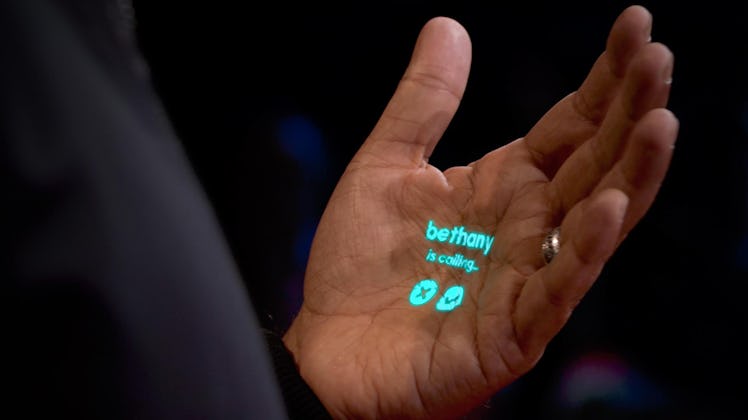
As of right now, I believe we are still going towards an era of more screens, screens everywhere, in the bathroom, on doors, and it’s already happening in cars and on fridges with these screens becoming more personalized, calling you by name, entering the era of holographic displays.
Mixed reality experiences are going to get “wild” in the coming years.
The future is already here — it’s just not evenly distributed.
Clearly, what our post-smartphone future looks like is subject to speculation — especially in an industry that not only moves at a torrential pace but could take an unexpected detour at any time.
In other words, ambient computing and mixed reality are both likely to happen, simultaneously and overlappingly.
Ten years from now, when we gaze upon the devices in our hands (or, less likely, consider the implant in our spinal columns), I expect we’re going to be telling one of those two stories again.
Humane’s AI Pin, for example, is a small device you can attach to your shirt or jacket, and it works as a nonphysical smartphone by projecting calls, messages, and info from apps onto a surface (like your hand).
Powered by artificial intelligence, this screen less solution will also have location data and contextual awareness.
we’ll also have a deeper and more self-conscious awareness of the smartphone’s place in our culture.
I could spin a tale about phones that project their displays into mid-air between your fingers. I could predict that we won’t have phones at all but, instead, high-bandwidth jacks plugged right into our brains, connecting us into a 6 or 7G network of wordless, emotive communication.
I could predict that we don’t need to store our lives in our phones — all that data can live in the cloud.
I could predict that our phones will stop consolidating into a single device and instead explode out into a mesh network of tinier, more bespoke gadgets.
I could predict that our phones could shape-shift into a size fit for the task at hand. Morph and upgrade as needed, adding on better cameras, different sensors, and surprising new capabilities.
But in 10 years, maybe the mobile industry will have evolved to a point where modular phones make a comeback.
at least relegated to our pockets more often than not — by smart eyeglasses. Think of how often you check your phone throughout the day. No one would want to be constantly futzing with swipe and tap gestures on their glasses that frequently
a phone isn’t something we carry around with us — it’s everywhere. Every room in your home has a smart speaker, a screen, a lamp, and who knows what, that’s connected to the network and ready to do whatever you would have asked of your phone.
Rather than face the onerous task of taking a phone out of your pocket, unlocking it, opening the right app, and typing words on its little screen, the world around us will simply be equipped to do the tedious stuff for us. There are very obvious and serious ethical problems with this scenario. Equipping the world around us to anticipate and solve our needs requires us to surrender an incredible amount of information about ourselves.
Maybe a fully ambient computing life isn’t in our future, whether it’s sight issues or vertigo and motion sickness, it’s not for everyone and will not replace a smartphone for many.
Smartphones will remain as a bedrock to our overall computing experience for a while yet, but we’ll no doubt see the technology evolve in different directions, as it always does — just not so fast.
Those born after 1995 are the first people in history to go through puberty with a portal to an alternative universe in their pockets – and the toll this has taken on their wellbeing has been devastating.
Companies that strive to maximise “engagement” by using psychological tricks to keep young people clicking are the worst offenders. They hooked children during vulnerable developmental stages, while their brains were rapidly rewiring in response to incoming stimulation. This included social media companies, which inflicted their greatest damage on girls, and video game companies and pornography sites, which sank their hooks deepest into boys.
How do we escape from these traps? Collective action problems require collective responses:
Given that AI and spatial computing (such as Apple’s new Vision Pro goggles) are about to make the virtual world far more immersive and addictive, I think we’d better start today.
Something in our culture is devastating the next generation.
The culprit is a massive, sudden switch from raising kids on play to raising kids on phones—specifically, smartphones loaded with life-sucking social media apps.
The user is not the customer—the user is the product.
This is the business model behind social media platforms, where you try to maximize the amount of time that kids and other users spend there. Children were becoming “merchandise.”
We need to have thousands of experiences every single year, every single day, to practice interacting with others in the real world, navigating conflict and struggle by finding more meaning in one’s lifetime.
I’m going to give my child a smartphone at age 9 or 10 is to destroy that life.
Perhaps its time to pass laws (just like acquiring a fire arm) restricting the acquisition of a smart phone till 18 of age is attend. Or restriction on accessing conventional social media such as TikTok, Instagram and Snapchat until they are 18.
Tech is and will remain a fantastic tool, but it has to act in people’s service, not people being reduced to serving a product.
Algorithms that re-engage and stimulate the pleasure system and are built to avoid you losing interest in the content have a type of addictive dynamic.
All human comments appreciated. All like clicks and abuse chucked in the bin.
The word genocide is not new, the concept is ancient.
On the historical heels of the physical and cultural genocide of North American indigenous peoples during the nineteenth century, the twentieth century writhed from the near- complete annihilation of the Herero’s by the Germans in Southwest Africa in 1904; to the brutal assault on the Armenian population by the Turks between 1915 and 1932; to the implementation of Soviet manmade famine against the Ukrainian Kulaks in 1932–1933 that left several million peasants starving to death; to the extermination of two-thirds of Europe’s Jews during the Holocaust of 1939–1945; to the massacre of approximately half a million people in Indonesia in 1965–1966; to genocide or mass killings in Bangladesh (1971), Burundi (1972), Cambodia (1975–1979), East Timor (1975–1979), Argentina (1976–1983), Guatemala (1980s–1990s), Sri Lanka (1983–2009), Iraq (1987–1988), the former Yugoslavia (1992–1995), and Rwanda (1994).
Genocidal death rates worldwide— 7,700 per 100,000—were an eight-fold increase over the previous 69 centuries. Close to 170 million civilians were done to death by their own governments in the twentieth century.
It is clear that genocide cannot be confined to one culture, place, or time in modern history. Even the most restrictive of definitions estimates that at least 60 million men, women, and children were victims of genocide and mass killing in the past century alone.
The reality—for genocide IS THAT it is a human problem and, as such, has a human solution.
It is not a problem that came to us from another world or was ingrained in our behavioural genetic repertoire. At its root, genocide happens because we choose to see a people rather than individual people and then we choose to kill those people in large numbers and over an extended period of time.
It is often assumed that genocide must be caused by extraordinary psychological processes – processes that are outside of or defy the logic of normal human functioning and that cannot be easily understood.
Dehumanization is central to every genocide.
We know from the Holocaust, Cambodian Genocide, Rwandan genocide and many other cases that victim groups were labelled as vermin, cockroaches, rats or snakes.
The decision to exterminate a group of people is the extreme end of a continuum that lies beyond proclamations that they cannot live, worship, or love as they see fit and beyond decisions to ghettoize them or force them out of your country.
However, while it is certainly beyond our imagination what it means to experience, witness, or perpetrate genocide, the psychological processes that lead up to that point and enable people to engage in “acts committed with intent to destroy, in whole or in part, a national, ethnic, racial, or religious group” (as genocide is defined in Article II 1948 UN Convention on the Prevention and Punishment of the Crime of Genocide) are not.
Genocide is not a qualitatively distinct category of human behaviour – it follows ordinary principles of human cognition, affect, and behaviour that certain societal and political conditions (such as political upheaval, prior genocide, autocratic rule, and low trade openness) allow to escalate into more and more severe violence.
However, dehumanization does not only occur during genocide, or what we officially recognize as genocide. This blatant dehumanization predicts several violent outcomes such as support for torture and bombing of civilians, drone strikes in Afghanistan and Pakistan, or detention and solitary confinement of undocumented immigrants.
Exclusionary ideologies are one of the main predictors of genocide
Deep inequalities that are a source of oppression and violence. People become desensitized to violence they are exposed to; and participating in violence makes us more likely to engage in future violence
We should therefore never give in to the illusion and optimistic bias—which also helps explain some behaviours of victim groups in times of genocide that reduce their survival, as well as the likelihood of resistance—that we are immune to the risk of genocide.
Genocide can take rightful claim as the most pressing human rights problem of the twenty-first century.
We can make another choice; We can find constructive, rather than destructive, ways to live with our diverse social identities.
For decades, Israel, aided and abetted by the American empire, has sought to politically erase Palestine from the map. Over the past few days, Palestinians have proved, once again, that they won’t easily give up their indigenous claim to and sovereignty over the land stolen from them.
From the deep, non-utilitarian connection between a people and their ancestral land – a connection that renders meaningless all other political impositions.
This is exactly what the Israeli state has long been seeking to erase.
Palestinians have, for decades, tried to put under a global spotlight the violence Israel has been inflicting on them on a daily basis.
Even if they are wiped off the have of the earth they have recorded all the killings, the torture and the abuse, so people from across the world will continue to see their struggles reflected in the Palestinian struggle, ensuring that Palestine as a political story, a political vision, and as a revelation of the current political conditions and systems of power, will never be erased from the hearts and minds of people the world over.
What are we in the free world doing about it.
As Israel intensified its efforts to erase Palestine and Palestinian people from Arab and global consciousness, we have international Verbal diarrhoea voiced support, repeatedly and loudly, for Israel abiding and abetting Israel’s colonial oppression and basically encouraged it to intensify its efforts to expel Palestinians from their remaining lands and erase Palestine from history and global politics.
No state or actor in this current system can gain enough authority and power to ensure its safety and dictate its will on the global community by merely speaking of higher ideals.
In fact, higher ideals are proclaimed in this wretched world order only to conceal the brutal violence required to gain and maintain any authority whatsoever.
they are going to be made worse by the ongoing actions of the Israeli state, which is determined, regardless of how Palestinians resist, to erase Palestine and officially create what they already achieved in practice: exclusive Israeli-Jewish sovereignty over the entire land of Palestine.
The reality is that Palestinians have been dehumanised to such an extent, that even when they hold up their murdered children in front of cameras and display them to the world, there are those who will still say they are responsible for their own children’s deaths. But make no mistake, what we are seeing in Gaza is an unfolding genocide and Palestinians are showing the world what it looks like in real time.
All Human comments appreciated. All like clicks and abuse chucked in the bin
≈ Comments Off on THE BEADY EYE SAY’S. AI IS NOT LIKE ANY PREVIOUS TECHNOLOGY. ITS GOING TO NEED GLOBAL ACTION TO HARNESS THE EFFECTS IT IS NOW HAVING, NEVER MIND IN THE FUTURE.
Humanity is not approaching this issue remotely with the leave of serious it requires.
Given the speed of development in the field, it’s long past time to move beyond a reactive mode, one where we only address AI’s downsides once they’re clear and present.
We can’t only think about today’s systems, but where the entire enterprise is headed.
While continuing to talk in vague terms about the potential economic or scientific benefits of AI, we are perpetuating historical patterns of technological advancement at the expense of not just vulnerable people but all of us.
When we fail to address these harms, as an inevitable by-product of technological progress we are turning a blind eye to the ethical needs in which powerful AI systems are developed and deployed.
The rapid pace of progress is feeding on itself, creating something smarter than us, which may have the ability to deceive and mislead us — and then just hoping it doesn’t want to hurt us — is a terrible plan.
————-
We humans have already wiped out a significant fraction of all the species on Earth.
SHOULD WE BE WORRRIED THAT WE ARE NOW ARE WITH AI ON THE PATHWAY TO EXTERMINATION.
That is what you should expect to happen as a less intelligent species – which is what we are likely to become, given the rate of progress of artificial intelligence.
AI is probably the most important thing humanity has ever worked on.
It’s not simply what AI can do, but where it is going will be key to managing the resultant fear of AI that permeates society. Gargantuan amounts of data are at this very moment been harvested so machine learning can accomplish tasks that had previously been accomplished only by humans.
With deep learning, improving systems doesn’t necessarily involve or require understanding what they’re doing. If anything, as the systems get bigger, interpretability — the work of understanding what’s going on inside AI models, and making sure they’re pursuing our goals rather than their own — gets harder.
We should be clear about what these conversations do and don’t demonstrate.
In a world increasingly dominated by AI-powered tools that can mimic human natural language abilities, what does it mean to be truthful and authentic?
Take GPT-Chat, which is used by millions around the globe, is churning out human-sounding answers to requests, ranging from the practical to the surreal. It is being used by millions of people, many of whom don’t have any training or education about when it is ethical to use these systems or how to ensure that they are not causing harm.
Even if you don’t use AI-generated responses, they influence how you think.
It has drafted cover letters, composed lines of poetry, pretended to be William Shakespeare, crafted messages for dating app users to woo matches, and even written news articles, all with varying results.
Bots now sound so real that it has become impossible for people to distinguish between humans and machines in conversations, which poses huge risks for manipulation and deception at mass scale.
What does it mean for a machine to be deceptive?
Is it evil and plotting to kill us. Rather, the AI model is responding to my command and playing — quite well — the role of a system that’s evil and plotting to kill us.
If the system doesn’t have that intent, is it deceptive? Does it come back to the person that was asking the questions or getting the system to be deceptive? I don’t know.
There are more questions than answers at this point.
The fact that these technologies are limited at the moment is no reason to be reassured.
Ai has the potential to transform and exacerbate the problem of misinformation, and so we need to start working on solutions now.
—————
The trajectory we are on is one where we will make these systems more powerful and more capable.
A new tool called Co-pilot uses machine learning to predict and complete lines of computer code, bringing the possibility of an AI system that could write itself one step closer. DeepMind’s Alpha Fold system, which uses AI to predict the 3D structure of just about every protein in existence.
We need to design systems whose internals we understand and whose goals we are able to shape to be safe ones. However, we currently don’t understand the systems we’re building well enough to know if we’ve designed them safely before it’s too late.
Right now, the state of the safety field is far behind the soaring investment in making AI systems more powerful, more capable, and more dangerous.
These harms are playing out every day, with powerful algorithmic technology being used to mediate our relationships between one another and between ourselves and our institutions and environment.
The reason is that systems designed this way generalize, meaning they can do things outside what they were trained to do.
These questions around authenticity, deception, and trust are going to be incredibly important, and we need a lot more research to help us understand how AI will influence how we interact with other humans.
If you have machines that control the planet, and they are interested in doing a lot of computation and they want to scale up their computing infrastructure, it’s natural that they would want to use our land for that.
If you believe there is even a small chance of that happening. Now is the time to use the power of your mobile phones to demand responsible, transparent Ai and to remove profit seeking algorithms.
Each day, we hear about countless instances of greed, hatred, violence, and destruction, and all of the pain, suffering, and sorrow that ensues, while we remain deaf to what is really happing in the world of technology.
With the never-ending list of atrocities, it may seem fruitless to try to identify a single contributing factor to all of society’s collective dilemmas, but it is becoming more and more apparent that AI in the hands of a few global mega companies is a recipe for DIASTER.
—————-
Ever since humans picked up a rock and hurled it at another human or animal technology has been shaping the world for yonks’, unfortunately both for good and bad.
DOWN THE CENTURIES ALL OF THESE ADVANCES WERE INCAPABLE OF EFFECTING CHANGE WITHOUT HUMAN ASSISTANCE AND THEIR DECISIONS. Not any longer.
The AI technology we are witnessing today is the first to make decisions without human supervision’s so the future doesn’t look so bright in terms of keeping the planet in peace, as it will lead to a brainwashed society with no values and no real purpose to evolve, other than being herded by an AI sheep dog into predictions.
——————–
AI’s impact in the next five years?
Human life will speed up, behaviours will change and industries will be transformed — and that’s what can be predicted with certainty. AI will rattle society at large.
A threshold will be crossed.
Thinking machines will have left the realm of sci-fi and entered the real world with Human-AI teaming.
We can already see this happening voluntarily in use cases such as algorithmic trading in the finance industry, outpacing the quickest human brains by many orders of magnitude.
Society will also see its ethical commitments tested by powerful AI systems, especially privacy.
As the cost of peering deeply into our personal data drops and more powerful algorithms capable of assessing massive amounts of data become more widespread, we will probably find that it was a technological barrier more than an ethical commitment that led society to enshrine privacy.
AI technologies that are being empowered to code themselves through new generative AI capabilities and simultaneously having less human oversight.
We all must slow down and take steps to bring about more trustworthy technology, but we won’t be able to build trustworthy AI systems unless we know what trustworthy AI means to us.
It is imperative that all AI describe its purpose, rationale and decision-making process in a way that the average person can understand. In other words fairness, accountability and transparency -algorithmic accountability.
AI is the bedrock of world-impacting systems.
———————-
At the micro level, AI affects individuals in everything from landing a job to retirement planning, securing home loans, job and driver safety, health diagnoses and treatment coverage, arrests and police treatment, political propaganda and fake news, conspiracy theories, and even our children’s mental health and online safety.
Without having proper insight into how the AI is making its decisions. Developers should pay close attention to the training data to ensure it doesn’t have any bias, stating from where the information came.
If the data is biased, then developers should explore what can be done to mitigate it. In addition, any irrelevant data should be excluded from training.
——————-
The list of “screwed up” things is a bit overwhelming to comprehend, because there are so many problems affecting so many different people, places, and things.
When you hear politics speak they always mention stuff like health care, transportation, city infrastructure, human rights, free markets. Even though these things are of importance, they don’t set a path for others to follow in the long term.
In all of these instances, both today and throughout history, the underlying reason one group of people has chosen to exploit, oppress, and harm another group of people, has been because of an exaggerated emphasis on their differences rather then what is common to us all – life.
Shouldn’t there be a greater purpose?
What we have are governments focusing on quick fixes and band-aid solutions which don’t address the real problems we’re experiencing as a species.
In an automated world where fun and feeling good are a click away, people can hardly focus on one task.
We grow up demanding to feel good all the time and careless of everything else.
A well-defined message which all presidents/ governments, pass along to their nations and heirs with the intention of making the world a better place to live in is now more than a peroxidative ( self- propagating chain reaction) if we are to avoid a despot future – Climate Change – AI – Wars.
Social media is feeding our false self. Our phones are our best friends. It’s tragic.
People grow up hating education and never building a habit of learning by creating a false self, through filtered images and phony statuses and eventually they start believing in their own shit more than they should.
Unfortunately, their real self remains weak and lacks the qualities it actually needs to handle the hurdles of life.
We are already losing the ability to interact with one another, this is honestly the next step in the evolution of humans and it is absolutely terrifying.
I’d say that it’s not the world that’s fucked up, it’s people who are fucked up. People have become so materialistic, impatient, self-centred, and greedy that they are easy prey for exploitation.
Fortunately, there is a way out.
Humanity has the potential to change, but only with a conscious collective effort.
If you want to make a change, start caring more about others.
Google it. They know everything.
Will the world get a grip?
For humanity to grab on to life and live it to the fullest we must demand transparency when it comes to technologies such as Algorithms.
So, now ask yourself do you want to become a product or service or live your life with your own identity.
Ask yourself do you want to “meander” through life, wandering aimlessly, as the term is commonly (mis)understood to mean to this very day.
Teenagers aren’t stupid. They can sense that what’s being taught in school is hardly something they can later use in real life. Not like us, the generation that can’t find the grocery store without using the navigation on their smartphone.
No matter what you’re doing everything is more complicated than you think.
You only see a tenth of what is true. There are a million little strings attached to every choice you make; you can destroy your life every time you choose.
Governments’ plans to limit climate change to internationally agreed safer levels will currently not limit global warming enough. Governments must not only agree what stronger climate actions will be taken but also start showing exactly how to deliver the changes.
——————
We all get sucked into the day-to-day, lose focus, or just get bored.
We’vegot to removethatbolt, so get a grip on thewrenchandturn it as hard as youcan!
Don’t be fooled.
AI’s impact in the next five years?
Human life will speed up, behaviours will change and industries will be transformed — and that’s what can be predicted with certainty.
Significant AI advances significant have only just started to rattle society at large.
Governments will be compelled to implement AI in the decision-making processes and in their public- and consumer-facing activities. AI will allow these organizations to make most of the decisions much more quickly. As a result, we will all feel life speeding up.
Society will also see its ethical commitments tested by powerful AI systems, especially privacy.
Presently all across the planet, governments at every level, local to national to transnational, are seeking to regulate the deployment of AI.
But dramatic depictions of artificial intelligence as an existential threat to humans, are buried deep in our collective psyche.
Arguably the most realistic form of this AI anxiety is a fear of human societies losing control to AI-enabled systems. We can already see this happening voluntarily in use cases such as algorithmic trading in the finance industry. The whole point of such implementations is to exploit the capacities of synthetic minds to operate at speeds that outpace the quickest human brains by many orders of magnitude.
The more likely long-term risk of AI anxiety in the present is missed opportunities.
To the extent that organizations in this moment might take these claims seriously and underinvest based on those fears, human societies will miss out on significant efficiency gains, potential innovations that flow from human-AI teaming, and possibly even new forms of technological innovation, scientific knowledge production and other modes of societal innovation that powerful AI systems can indirectly catalyse.
While Western eyes are fixed on Tehran and Tel Aviv, Ukraine’s frontlines, unless we get a grip fast, we will not be going anywhere.
So AI is scary and poses huge risks.
But what makes it different from other powerful, emerging technologies like biotechnology, which could trigger terrible pandemics, or nuclear weapons, which could destroy the world?
No one holds the secret to our ultimate destiny.
AI is dangerous precisely because the day could come when it is no longer in our control at all.
Let us now assume, for the sake of argument, that these machines are a genuine possibility, and look at the consequences of constructing them. … There would be plenty to do in trying, say, to keep one’s intelligence up to the standard set by the machines, for it seems probable that once the machine thinking method had started, it would not take long to outstrip our feeble powers. … At some stage therefore we should have to expect the machines to take control.
I think it’s going to be the most beneficial thing ever to humanity, things like curing diseases, helping with climate, all of this stuff. But it’s a dual-use technology — it depends on how, as a society, we decide to deploy it — and what we use it for.
It’s worth pausing on that for a moment. Nearly half of the smartest people working on AI believe there is a 1 in 10 chance or greater that their life’s work could end up contributing to the annihilation of humanity.
As the potential of AI grows, the perils are becoming much harder to ignore.
AI safety faced the difficulty of being a research field about a far-off problem, NOT ANY MORE The challenge is here, and it’s just not clear if we’ll solve it in time.
You may face unexpected challenges. We all do. Changing your mindset won’t guarantee that everything will be okay. But it will give you the insight and strength to believe that you will be okay and that you can handle what life dishes up.
But I guarantee if you don’t do anything you will regret it, and you will wake up one day wondering where your life went and how you got to the place you are. As AI evolves, the consequences for the economy, national security, and other vital parts of our lives will be enormous, along with many other questions as yet unforeseen legal, ethical, and cultural questions will be to arise across all kinds of military, medical, educational, and manufacturing uses.
Open AI, Google, Microsoft, and Anthropic, are not constrained by guardrails and their financial incentives are not aligned with human values. AI-enabled wars already happing, combined with Climate change.
Believe me it’s an unsolved problem, mistakenly believed that the inability to gain access to vast datasets is what’s kept AI out of the hands of all, but a few companies.
In a world full of false material that’s promulgated by AI, there will be lots of AI that can detect the false stuff. We will start to build economies around the whack-a-mole problem of the Good Guys AI staying slightly ahead of the Bad Guys most of the time — but not always.
And some people will make some real money doing this.
All human comments appreciated. All like clicks and abuse chucked in the bin,
Understand where migrants come from, where they go, and why migration is increasing, is going to be a major problem with climate change.
Why it’s time to rethink migration?
Because it’s increasingly likely that people will encounter—or become—migrants in their lifetime.
Just imagine if Chinese people had to move (1,425,293,425) it would be worse than a nuclear bomb.
Faced with such a reality, the question is not whether migration is right or wrong. The question is how can we make it work best to support prosperity and development for countries of destination, countries of origin, and the migrants themselves.
This is where the debate often becomes confused because we use a single word — migration — to refer to distinct types of movements that have different impacts, and call for different policy responses than trafficking in humans legally or non legal.
The challenge is to manage the cost, to reduce it and to share it as global.
Climate change along with inequality requires smarter policies for global development and a prosperous future.
Where people migrate depends on what’s happening in the world shaped by new global challenges, the rise of technology, and protracted modern conflicts, in Sudan, the Middle East and Ukraine.
—————–
The UN High Commissioner for Refugees (UNHCR) estimated that by the end of 2022, over 100 million people were forcibly displaced. Syrians, Palestinians, and Afghans account for more than half of all refugees.
Around 80 percent of refugees live outside camps.
Out of the 60.9 million recorded displacements that occurred last year, 32.6 million, were due to climate disasters, including floods, drought and landslides.
More than 280 million people—roughly one out of every thirty people on earth—currently live in a country in which they were not born.
This means that more than 1 in every 74 people have been forcibly displaced.
—————–
Though migration is not a new phenomenon, it takes on a new significance in an increasingly interconnected world.
Migration—who migrates, where, and why—is constantly evolving. #WorldOnTheMove
“Flotsam of Humanity”
The majority of migrants, however, are pulled to countries that offer better economic prospects for themselves or their families.
People are far more likely to be international migrants today than in the recent past.
About one-third of all international migrants come from just ten countries. However, numbers alone don’t tell the whole story:
Many refugees and asylum seekers, who make up just over 10 percent of the world’s international migrants, have more than likely previously within their own countries. 763 million peopleare internal migrants, who have moved within their country.
High-income nations hosted a majority of international migrants.
That’s not surprising considering that a vast majority of the world’s international migrants are economic migrants who have voluntarily left their countries for better economic opportunities elsewhere.
In 2020, 93.9% of all people living in the United Arab Emirates were international migrants, followed by 80.6% of people in Qatar and 71.3% of people in Kuwait.
The U.S. has more migrants than any other nation, but migrants only account for about 15.1% of the U.S. population – a smaller share than in 24 countries or territories with a total population of at least 1 million.
Though India is the single largest source of international migrants, its 17.9 million migrants in 2020 accounted for only 1.3% of all people born in India by that year.
By comparison, the United Kingdom’s 4.7 million international migrants accounted for 7.6% of those born in the UK by 2020. Mexico’s 11.2 million international migrants accounted for 8.2% of those born in Mexico.
Many of the forces driving migration today are.
Poverty
Conflict and violence
Persecution
Political instability
Economic opportunity
Competition for resources
Natural disasters and environmental changes
Reuniting families
Who decides which migrants receive refugee status?
The UN Refugee Convention defines a refugee as any person who owing to well-founded fear of being persecuted for reasons of race, religion, nationality, membership of a particular social group or political opinion, is outside the country of his nationality and is unable or, owing to such fear, is unwilling to avail himself of the protection of that country; or who, not having a nationality and being outside the country of his former habitual residence as a result of such events, is unable or, owing to such fear, is unwilling to return to it. 146 nations agree to this definition.
However, host governments ultimately get to decide whether to recognize someone as a refugee. This protective status is known as asylum.
Both refugees and asylum seekers are fleeing for their safety. However, the distinction between these two, though seemingly small, makes a big difference in how they are treated by governments and international organizations.
Just like refugees and asylum seekers, internally displaced persons by the end of 2022, there were over seventy-one million. This is nearly twice the number of refugees in the world. They don’t have the same protections as refugees. International law does not apply to them. Instead, they fall under the laws of their own national government.
Predictions in the field of migration appear particularly difficult given the complexity and diversity of the migration processes, the limited availability and quality of data, and the limited understanding of the migration drivers.
Borders define our fate, our life expectancy, our identity, and so much more.
With up to three billion people expected to be displaced by the effects of global warming by the end of the century, should it lead to a shift in the way we think about national borders.
It can be argued, however, that most of these imaginary lines are not fit for the world of the 21st Century with its soaring population, dramatic climate change and resource scarcity.
As global temperatures increase, causing climate change, sea level rise and extreme weather over the coming decades, large parts of the world that are home to some of the biggest populations will become increasingly hard to live in.
Unable to adapt to increasingly extreme conditions, millions – or even billions – of people will need to move.
One to three billion people are projected to be left outside the climate conditions that have served humanity well over the past 6,000 years.
The threat posed by climate change and its social repercussions dwarf those surrounding national security.
Enabling free movement could double global GDP.
In addition, we would see an increase in cultural diversity, which studies show improves innovation. At a time when we have to solve unprecedented environmental and social challenges, it could be just what is need. What if we thought of the planet as a global commonwealth of humanity, in which people were free to move wherever they wanted? We’d need a new mechanism to manage global labour mobility far more effectively and efficiently – it is our biggest economic resource, after all.
THE CHANCES OF THIS HAPPING IS ZERO.
All human comments appreciated. All like clicks and abuse chucked in the bin,
It’s hard to feel for future people. We are bad enough at feeling for our future selves.
Even if we last just 1 million years, as long as the average mammal – and even if the global population fell to 1 billion people – then there would be 9.1 trillion people in the future.
Concern for future generations is common sense across diverse intellectual traditions. When we dispose of radioactive waste, we don’t say, “Who cares if this poisons people centuries from now?
Similarly, few of us who care about climate change or pollution do so solely for the sake of people alive today.
Is any of this true?
Current global rates of consumption require the resources of about 1.6 earths. At this rate, we risk exhausting our planet’s life support systems that provide us with fresh water, nutritious food and clean air.
What 2050 could look like if we don’t do anything about climate change? This doesn’t need an answer.
That is a future unwritten. It’s also worth noting that, in fact, it is entirely up to us whether these hypothetical future beings ever actually come into existence.
So what do we owe the generations to come?
You might answer that since we don’t even owe to them to bring them into existence in the first place, we can’t possibly owe them anything all. Then wouldn’t the people of the future be within their rights to look back at us and ask, ‘Given that you despoiled our planet, why did you even bother bringing us into existence?
Maybe we might actually have an obligation not to bring future people into existence, at least if we’re going to mess things up enough to make their hypothetical lives unbearable.
That would imply that future people count more than us. And who thinks that? Certainly not me. I’m not even sure they count the same as us. That leaves us with only one option. I hate to say it, but future people surely count less than we do—at least a little less.
“What, I am trying to get you to see, is that we have an absolute duty to future generations not to ruin their future planet.”
Think of today’s teeming masses, displaced by violence and climate change, wandering the world in search for a safe harbour.
In comparison to all that present day concrete suffering, the hypothetical suffering of hypothetical future people seems sort of distant and abstract.
I should say that I am actually all for combating climate change. And I am all for weighing both the interests of present people and the interests of future people in the calculus of what is to be done about it. I just don’t think it’s obvious how much weight we should give to the wellbeing of hypothetical future people as opposed to our own.
——————–
Now more than ever, the world needs young people to step up to address the many other challenges ahead of us.
It is crucial to engage young people in decision-making – but in parallel – it’s also important for young people to think differently about how they want to engage.
They cannot vote or lobby or run for public office, so politicians have scant incentive to think about them. They can’t bargain or trade with us, so they have little representation in the market, And they can’t make their views heard directly: they can’t tweet, or write articles in newspapers, or march in the streets. They are utterly disenfranchised.
We make laws that govern them, build infrastructure for them and take out loans for them to pay back.
So what happens when we consider future generations while we make decisions today?
Is it really as bad as all that?
Our situation can be summed up as follows:
While facing an extinction event, instead of working toward reversing the march toward climate disaster, in the name of security we are investing in killing each other.
What will it take to unleash the energy and passion of youth leaders and activists to dismantle inequitable systems and work together to build an more inclusive future?
Social media will likely play a role in that revolution—if it doesn’t sink our kids with anxiety and depression first.
Asked young people what changes they want for the future.
HERE ARE SOME OF THE RED LINES.
Incentivize sustainable consumption and penalize production that’s not.
All stakeholders to take urgent action to safeguard nature and future food production.
Sanctions against institutions that resort to internet blackouts to supress citizen freedoms.
Tech companies to be transparent about misinformation and its spread on their platforms.
Governments to implement policies to protect individual citizens against harmful content.
Capacity-building programmes and education to help citizens better identify fake news.
Strengthened laws against media monopolies to protect democratic freedoms.
A Global Convention for Cybersecurity to uphold the integrity of political systems.
A global wealth tax on assets worth more than US$ 50 million to fight growing inequality.
Universities to end the exorbitant tuition fees that stifle social mobility.
Governments to guarantee universal access to mental health services.
Governments to invest in communities most at risk from climate change.
Financial institutions to stop bankrolling companies initiating fossil fuel exploration.
Companies to significantly reduce the GHG emissions of their operations and supply chains to help keep global heating within 1.5°C.
Governments to implement fit-for-purpose policies and regulations on big tech.
Companies to integrate technology ethics into the design of their products and services.
Governments to prioritize the immediate needs of healthcare workers and their families.
Companies to drive digitalization in healthcare services to improve patient care.
Governments to end qualified immunity in law enforcement for police officers.
Increased action against gun violence.
Two critical questions guided these dialogues:
What are the barriers that have hindered progress?
And, what key values, principles and practices will enable us to foster long-lasting systemic impact for the next decade?
As many around the world push for the creation of a more just, equitable and sustainable future we must remember that technology is one of the greatest tools for achieving these goals, but without ethical considerations at the fore… this will likely only perpetuate the very inequalities that we hope to address.
Every generation of teens is shaped by the social, political, and economic events of the day and how fast teens grow up depends on their perceptions of their environment.
For example their ubiquitous use of the iPhone, their valuing of individualism, their economic context of income inequality, their inclusiveness, and more.
Social media is creating an “epidemic of anguish.
We can’t market technologies that capture dopamine, hijack attention, and tether people to a screen, and then wonder why they are lonely and hurting. It makes humanity look like an “imprudent teenager”, with many years ahead, but more power than wisdom.
Fortunately, there are concrete things humanity to day can do.
The field of sustainability is evolving.
For example, if there is any moral weight on future people, then many common societal goals (like faster economic growth) are vastly less important than reducing risks of extinction (like nuclear non-proliferation).
The entire value chain needs to be sustainable, from raw material sourcing to the manufacturing and usage of the products.
Transparency, accountability, trust and a focus on stakeholder capitalism will be key to meeting this generation’s ambitions and expectations. Doing so would help save the lives of people alive today, reduce the risk of technological stagnation and protect humanity’s future.
Our biases toward present, local problems are strong, so connecting emotionally with the ideas can be hard. It’s humbling and inspiring to see the role we can play in protecting the future. We can enjoy life now and safeguard the future for our great grandchildren.
If we name each generation based on the technological conditions it experienced, generations may soon encompass only a few years apiece. Slicing the population into ever-narrower generations, each defined by its very specific relationship to technology, is fundamental to how we think about the relationship between age, culture, and technology.
They include the digital natives, the net generation, the Google generation or the millennials.
All of these terms are being used to highlight the significance and importance of new technologies within the lives of young people. But generation gaps did not begin with the invention of the microchip. What’s new is the fine-slicing of generational divides, the centrality of technology to defining each successive generation.
If the role of technology in shaping an emergent generational consciousness it seems obvious, to imagine a return to the days when sociological generations spanned multiple decades is over. If you believe that technological conditions profoundly shape the life experience and perspectives of each successive generation, then those generations will only get narrower. If we name each generation based on the specific technological conditions it experienced during childhood or adolescence, we may soon be dealing with generations that encompass only a few years apiece.
At that point, the very idea of “generations” will cease to have much utility for social scientists, since it will be very hard to analyse attitudinal or behavioural differences between generations that are just a few years part.
The problem is that all will come at a price. That price is and will be.
The loss of intentional and thoughtful communication techniques to preserve meaningful connections in a society that is becoming more and more reliant on technology.
Be it the metaverse, smart glasses or large language models, the world as we know it may never be quite as we first imagined it, merging into physical and digital spaces.
While the internet offers unparalleled convenience and connectivity, it is essential to recognize its limitations in reproducing the depth of personal interaction found in face-to-face encounters.
—————
Technology will be a vital tool for creating a cleaner, safer and more inclusive world, but what changes can we expect to see?
5G will create a lot of new use cases including drone management, robotic surgery and autonomous vehicles. Large language models will become a given because they lower the cost of artificial intelligence (AI)
Quantum computing merges with classical computing.
Our grandchildren will live in a very different world thanks to the democratization of products and services that are currently only available to the elite or wealthy,
Holographic image in front of you, seen through smart glasses will be your algorithmic world.
No matter what future we leave behind life my advice is life is beautiful-celebrate -celebrate – never give up.
If all of this is hurting your head, let’s just get back to the basics: if there is a secret to life, it might all be down to what we do, not what we are.
All human comments appreciated. All like clicks and abuse chucked in the bin.
Did you know that the very first convicts to land in Australia did so in 1788? (This was part of a transportation system that was put into place in Britain to ease their crime rates, primarily due to the rising levels of poverty created by the Industrial Revolution.)
A system of transportation was put into place in 1717. They believed that sending people to distant colonies would give them a second chance at life. Around 160,000 convicts had been transported to Australia during this time period.
The British government believed that Australia would be an ideal place to send their convicts because it was so far away from Britain, a more humane alternative to execution. They decided to use old warships as prisons, and called them ‘hulks’. The hulks began to run out of room so they moved the occupants’ as cheap slave labour to Australia.
The effects of this moment would change the fate of an entire continent that still has significant impacts in the modern world.
This time its not petty criminals that they are going to export to Rwanda but immigrants.
As I understand it. One-way ticket to Rwanda to have their claims to asylum processed there.
Under the proposal:
Rwanda would take responsibility for the people who made the more than 4,000-mile journey, put them through an asylum process, and at the end of that process, if they were successful, they would have long-term accommodation in Rwanda not the UK.
Rwanda will have the “capacity to resettle tens of thousands of people in the years ahead.
Rwanda’s human rights record makes it the ideal place to get rid of unwanted immigrants.
In 1994, one of the worst incidents of genocide in modern history took place in Rwanda, where Hutu extremists slaughtered nearly a million Tutsi and moderate Hutu.
Rwanda genocide of 1994, planned campaign of mass murder in Rwanda that occurred over the course of some 100 days in April–July 1994. The genocide was conceived by extremist elements of Rwanda’s majority Hutu population who planned to kill the minority Tutsi population and anyone who opposed those genocidal intentions. It is estimated that some 200,000 Hutu, spurred on by propaganda from various media outlets, participated in the genocide. More than 800,000 civilians—primarily Tutsi, but also moderate Hutu—were killed during the campaign. As many as 2,000,000 Rwandans fled the country during or immediately after the genocide, is now a safe place.
The effects of this new law (yet to be signed off by their King,) undermines the core principle of the universality of human rights and breach’s the international Refugee Convention, which the UK is signed up to.
Under EU membership there was a mechanism to return asylum seekers to the first safe European country they passed through, but this returns scheme is no longer available to the government due to Brexit.
Slamming the door in the face of refugees, is cruel and nasty decision, which will do little” to deter people. Instead the UK, the government should be focusing on creating a system that protects the right to claim asylum and that prioritises both compassion and control.
How are we treating these humans?
Are we suddenly saying those coming from Ukraine, their lives are better value than those coming from certain other countries? I think it’s abhorrent.
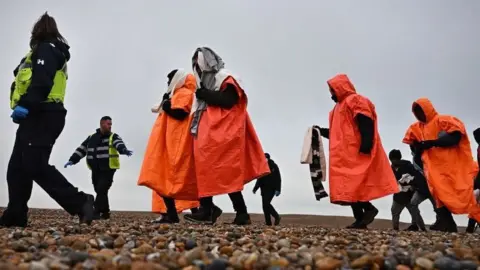
Voyages of despair filled with hardship. There go I but for the grace of god.
The theoretical cost for sending 1,000 migrants to Rwanda could be £169m – or £169,000 a person – in contrast to the £106m it would cost to accommodate them in the UK.
More than 45,000 people crossed the English Channel last year on small boats – so-called deterrence measures simply don’t work.
£100m was paid to Rwanda in April and that an extra £50m would be handed over next year.
Of the £290m allocated to Rwanda so far, only £20m has gone towards set-up costs of the deportation scheme.
That brings the total cost to £290m but does not account for the cost of actually deporting any migrants to the country, which could end up sending the bill over £400m.
Instead of returning to medieval practices, there is no reason that on arrival applications for asylum could not be examined
The apathic irony of all of this is that we consistently hear that the providers of care are struggling to recruit and retain enough skilled staff, which is having a knock-on effect on access to care services and leading to unmet needs. Around half a million people are waiting either for an adult social care assessment with more people than ever waiting for elective NHS care (6.7 million).
The latest figures for January 2024 show: Over 321,000 of these patients have been waiting over a year for treatment,
A care system is in gridlock.
Almost 100,000 people in the UK are waiting for a decision on their asylum claims.
“Our Illegal Migration Bill will help to stop the boats by making sure people smugglers and illegal migrants understand that coming to the UK illegally will result in detention and swift removal – only then will they be deterred from making these dangerous journeys in the first place.”
Where would I sent them.? NotRwanda but into Care industry’s or does England no longer want to be the nation that wants to help other people.
As Climate change without a doubt is going to cause mass migration overall, this decision is likely to bring greater clarity to an area of law that is both complex and frequently in the public eye.
All human comments appreciated. All like clicks and abuse chucked in the bin.