The future impact of AI (Artificial Intelligence)

Tags

, ,

I was told the other day that I had not addressing the last and perhaps the most important issue concerning the effects of Technology that the human race will ever faced. The dire warnings that machines run by Artificial Intelligence will one day take over from humans.

What better day to post my views an diamond eclipse. The last time it happened was in 1935 and the next time is 2206.  

Now don’t get me wrong I like being human! I want humans to retain autonomy over machines! Judgments of virtue are judgments of a whole life rather than of one isolated action. The development of moral character may take a whole lifetime. But once it is firmly established, one will act consistently, predictably and appropriately in a variety of situations.

However we will need a new set of practices for value creation; where data slaves dare to stand up and call for a revolution … But it will be very difficult to turn back the wheel that has already been set in motion several decades ago.

What is artificial intelligence and what is the media talking about? What ever it is it is a long way off before Machines turn on us never mind emulating human behavior to the point of mimicking communication.

Are these technologies beneficial to our society or mere novelties among business and marketing professionals?

Medical facilities, police departments, and manufacturing plants have all been changed by AI but how?

So far this bond has been one-sided because the ability to generate, recognize and express emotions are a unique prerogative of living human beings, but if this intelligence or abstract attribute could be taught to machines, it would re-conceptualize the perception of machines.

So in this post should I focus on the truly remarkable achievements of the technology or dwell on the dangers of what could happen if machines reach a level of Sentient AI, in which self-aware machines reach human level intelligence.

Let’s start with present day.  Do you believe that if all computers are stopped for a day, complete civilization comes to a halt!

Fifty years ago, this might have been a science fiction, but today it is a reality.

We cannot predict because of the great potential of AI what we might achieve when this intelligence is magnified by the tools AI (may provide) however the eradication of disease and poverty are not unfathomable.

So it is valuable to investigate how to reap its benefits while avoiding potential pitfalls.

The potential benefits are huge, since everything that civilization has to offer is a product of human intelligence.

Presently, applications in advanced robotic appeared so real that one can believe a humanoid robot will be capable to interact or work side by side with people in a near future.

If so are we ready for the bio mechanical future revolution. ( Or as I would call it synthetic intelligence implants, because it is not natural intelligence.)

For the sake of the length of this post I will stick with AI.

This questions;  Will AI be a reality and many others are and should be the concern of the general public.

A time will soon come (brought about by the lack of education concerning rapidly advancing computer technology) when this question will need to be answered.  On the ethical use of such technology and its impact on intimate human relationships and society.

When is the best time to discuss the ethical uses of these technologies?  NOW.

If robots are ready to plug safely into society the question is no longer a questions for future generations to sort through, it must be decided, and soon.

As technology rapidly improves, it is inevitable that it should begin to take on elements of its creator and believe me there are many routes that Artificial intelligence can go. 

Its impact on society is only likely to increase.

For instance: Once we begin to mesh technology more closely with ourselves as humans we can begin to accept it as a part of ourselves and as a part of our society. Some say it could be curtain for Society.

memories-maya

As I have said in previous posts Technology is transforming our social, economic, and political institutions; our understanding of what it means to be human; and the distribution of power in the world.


The threat of AI equipped computer systems and machinery taking jobs away from humans is becoming a harsh reality. When and in what order should we expect various jobs to become automated ?

How will this affect the wages of less skilled workers, creatives, and different kinds of information workers? Some have argued that AI is likely to greatly increase the overall wealth of humanity as a whole. This is a total misconception as the rich will own the Data. Increased automation may push income distribution further towards a power law and the resulting disparity may fall disproportionately along lines of race, class, and gender.

Research anticipating the economic and societal impact of such disparity could be useful to start asking the questions.

How should the ability of AI systems to interpret the data obtained from surveillance cameras, phone lines, emails, etc., interact with the right to privacy?

How will privacy risks interact with cyber security and cyber warfare?

We already have drones and it will not be long before we have a weapon that does everything on its own without human help.  These weapons will be a threat to civilians?  Can lethal autonomous weapons be made to comply with humanitarian law. No.

Sophisticated remote-controlled military robots are already in use with no tractability, that fire a weapon to AI algorithms is that not something to fear. We are programming them. If that’s not scary enough put a nuclear war head on one.

Smart weapons raises many questions on the price paid to develop these weapons; money which could be used to solve most of the world’s social problems such as poverty, hunger, etc.

http://www.military.com:80/video/ammunition-and-explosives/projectiles/iran-unveils-new-smart-weapons-system/1427781968001/

Of course none of this is going to change anything as we are incapable of making war against Poverty or Inequality. Why? Because human intelligence can be viewed as being as diverse as its population. However this type of analysis of Intelligence leads us to the individual and becomes useless.

Over the last decade, electronic tiny minuscule signals have fundamentally revolutionized the way we live. People are spending more hours per day with machines than humans and in the future, computers will evolve quicker than the human race.

Sorry I am diversifying.  Back to AI

An amazing a human-machine relationship is developing.

Fortuitously for us so far the possession of knowledge alone does not make a being or machine intelligent.

This is the problem when it comes to computer scientists and engineers understanding just how their work affects humans and human values.

So what role should computer scientists play in the law and ethics of AI development and use?  None. They are focus on getting software products to market, regardless of whether they instantiated interesting principles of intelligent systems that could also illuminate the human mind.

How should lawyers, ethicists, and policymakers engage the public on these issues?  Should such trade-offs be the subject of national standards?

Significant parts of the economy, including finance, insurance, actuarial, and many consumer markets, are already susceptible to disruption through the use of AI techniques to learn, model, and predict agent actions. These markets are identified by a combination of high complexity and high rewards for navigating that complexity. Artificial intelligence techniques can be applied to financial investing, especially in the areas of credit risk assessment and stock valuation.

In the future, we can expect that the techniques of artificial intelligence will be integrated into systems that simultaneously address investing activities.

The successes of industrial applications of AI, from manufacturing to information services, demonstrate a growing impact on the economy, although there is disagreement about the exact nature of this impact and on how to distinguish between the effects of AI and those of other information technologies.

Many economists and computer scientists agree that there is valuable research to be done on how to maximize the economic benefits of AI while mitigating adverse effects, which could include increased inequality and unemployment.

All that said; Artificial intelligence certainly has a place in the future of humanity.

The danger of machines taking over too much of human interaction and work, the human mind, is to far-fetched to my thinking.

There is no doubt that computers are being embedded in all of our life accessories like mobiles,watches, cars, even our bodies and brains.

These subsets of AI, such as data mining, neural networks, speech recognition and lip-reading, behavior recognition, and face recognition, to name a few, are becoming increasingly powerful—and indispensable—to human organizations.

The question of whether a human brain is necessary for thinking remains in Science Fiction Hollywood.  

No one has agreed on a concrete definition of artificial intelligence, largely because there is insignificant understanding as to what comprises intelligence.

Professor Jefferson’s Lister Oration for 1949, from which I quote sums up the problem for me.

“Not until a machine can write a sonnet or compose a concerto because of thoughts and emotions felt, and not by the chance fall of symbols, could we agree that machine equals brain-that is, not only write it but know that it had written it. No mechanism could feel (and not merely artificially signal, an easy contrivance) pleasure at its successes, grief when its valves fuse, be warmed by flattery, be made miserable by its mistakes, be charmed by sex, be angry or depressed when it cannot get what it wants.

Or a  machine which is under interrogation”What do you think of Picasso?” Be kind, resourceful, beautiful, friendly, have initiative, have a sense of humor, tell right from wrong, make mistakes, fall in love, enjoy strawberries and cream, make some one fall in love with it, learn from experience, use words properly, be the subject of its own thought, have as much diversity of behavior as a man, do something really new.

AI will remain valuable regardless of whether we’re able to build fully- functioning robots or human-esque brains.

AI, the harnessing of intelligence on the computer, will turn complex thought processes into fast computer simulations; it will be used to analyze past events and predict the future.

The ability of these systems to explain the reasoning process through back-traces and to handle levels of confidence and uncertainty provides an additional feature that conventional programming can’t handle.

Intelligence is defined as the ability to achieve goals through computational process. Although intelligence is only studied in humans, is it possible that machines may be more “intelligent” than those who created the machines in the first place?

Will computers reach human intelligence someday. They have already surpassed our calculation abilities and our speed of processing information.

There is no indication that microchip speed will not be multiplied in the future.

As with every innovative technology there are positive and negative externalities involved.

The Intelligent Robot-  Will Artificial Intelligence Replace Mankind?
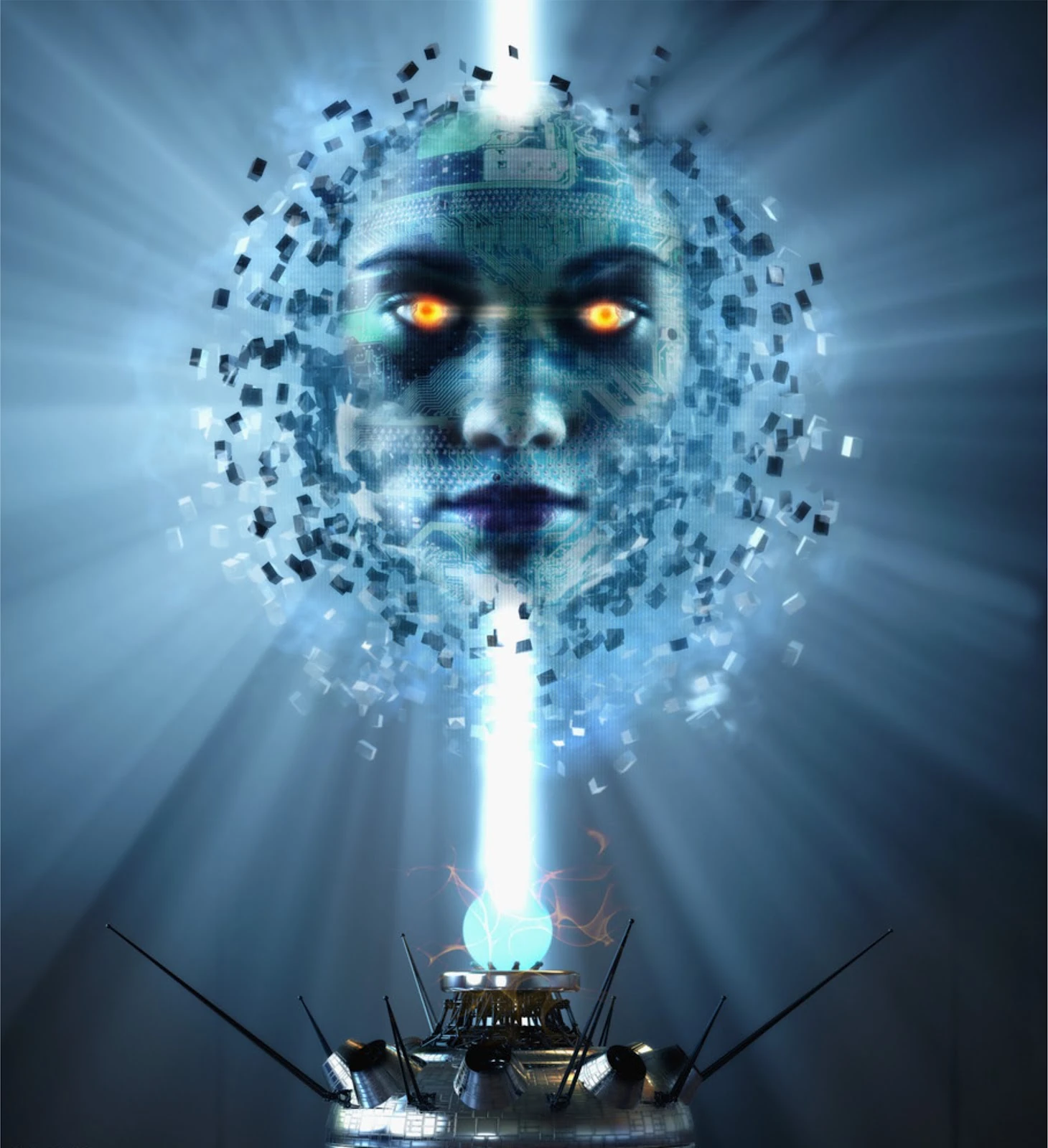
No. This dream will remain elusive until machines attain the basic human virtue of common sense.

Our ability to take full advantage of the synergy between AI and big data will depend in part on our ability to manage and preserve privacy.

How we can ensure humans will be able to control AI once it achieves human-level intelligence? I would prefer humans maintain autonomy over technologies that could achieve sentience.

It is tempting to wonder what would happen if we spent more time focusing on helping each other directly, versus relying on machines to essentially grow brains for us.

We need to develop a science for understanding advanced Artificial Intelligence before we develop it further.

It’s just common sense. Intelligent machines won’t love you any more than your toaster does. Giving people a device that enhances intelligence may not be a terrific idea. What happens when a machine breaks the law?

Our AI systems must do what we want them to do. We ourselves don’t reason with precise truths. We don’t yet know really what consciousness is, what drives consciousness?

Why do we attend to only a portion of what we see and hear? It is obvious that given an event, observed by many, we each perceive it differently, and we take in differently. Do we each have individual filters that have to do with our own stories? Probably. But I think pondering this goes deeper. Is consciousness itself, somehow, directed? God forbid a machine is directing it.

John Cleese, Monty Python and the Holy Grail. Describes AI

Being human, has to have a component of humanity to it. The nature of the mind and of memory, and how intelligence can be manifested in physical form is a joke when it comes to a Machine.

For the robots or technology that may surpass our intelligence in the near future, observe my fleshy middle-digit and hear me cry: “I wave my private parts at your Auntie! Your mother was a hamster and your father smells of elderberry!” —

Tell me how do you model thought?  Give me a machine that can read a simple children’s book, understand what the story is about, and explain it in its own words or ask reasonable questions about it.

That is it. I have tried artificial intelligence and I don’t like it.

Artificial Intelligence Technology is learning by itself. The claim that a machine cannot be the subject of its own thought can of course only be answered if it can be shown that the machine has some thought with some subject matter.

Where is this technology going to be? No one knows for sure, what we can only say for certainty is that this Artificial intelligence, and Machine Learning will transform all software and hardware, all industries and businesses. Roads, bridges, Cars, Homes, will be connected to it.

While today we do not possess the technology to achieve a truly sentient machine we cannot because of that speculate too deeply as to the results of such an achievement.

Only if intelligence ceases to be a sacred mystery to us, and we can control our destructive nature should any of us accept an Apple from the Adam of AI. 

One thing is for sure; We will sure need some kind of global governance in the interest of the individual. 

We are just in the beginning in terms of where these technologies will take us.  Mars and back.

← Back

Thank you for your response. ✨

WE CAN ALL BE PROUD. Four million Syrian refugees in 2015.

We are made to believe that we are all connected in an interconnected world.

But in fact we seem to be shackled to fear, misconceptions, false ideologies, material reward and held ransom to rules and laws laid down to safeguarded the interests of the few.

Syria’s civil war is the worst humanitarian disaster of our time. The number of innocent civilians suffering — more than ten million people are displaced, thus far — and the increasingly dire impact on neighboring countries can seem to overwhelming to understand.

So take a few minutes to understand the magnitude of this crisis.

Syria dayTHEY CAN TAKE A BOW. YOU ARE ALL DOING YOUR PART.

Nearly four years after it began, the full-blown civil war has killed more than 220,000 people, half of whom are believed to be civilians.

The U.N. estimates that over 7.2 million people are internally displaced — an increase of more than three million in just a year.

23 million is need urgent humanitarian assistance, whether they still remain in the country or have escaped across the borders.

In 2012, there were 100,000 refugees. By April 2013, there were 800,000. That doubled to 1.6 million in less than four months. There are now more than three million Syrians scattered throughout the region — an increasing number that will soon surpass Afghans as the world’s largest refugee population.

The worst exodus since the Rwandan genocide 20 years ago.
<br /><br /><br /><br /><br />
  <span class="field-credit"><br /><br /><br /><br /><br />
    Lisa Hoashi/Mercy Corps  </span><br /><br /><br /><br /><br />
The majority of refugees — about 70 percent — live outside camps.

The UN is asking for $5 billion in humanitarian aid to help the millions affected by the Syria crisis.

In December 2014, the U.N. issued its largest ever appeal for a single crisis — according to their estimates, $8.4 billion is necessary to meet the needs of all those affected by the crisis, both inside and outside Syria, an increase from last year’s $6.5 billion.

Yet that previous appeal was only funded less than 50 percent.

After four years of conflict, it is clear President Assad’s allies have been more determined to keep him in power than his enemies have been to remove him.

It is already clear that international divisions over the greatest crisis of the 21st century have contributed to its severity and longevity.

With China – which had also opposed the overthrow of Saddam Hussein – it vetoed a UN resolution condemning Syria.

The paralysing cold war-style battle lines that split the UN’s top table have not changed since.

There is little or no clear Arab demand for intervention.

Iraq and Algeria backed Assad while Saudi Arabia and Qatar encouraged the flow of money and weapons to rebel units, some linked to the Muslim Brotherhood, others to hardline Salafis.

Syria’s bloody stalemate thus seems destined to continue indefinitely beyond this anniversary.

So we are looking at another 10 years, or more, of conflict?

And what, in the meantime, is the best way to support people caught up inside Syria and in refugee communities?

Germany has provided 30,000 places. Norway and Sweden have taken 2,500 each.

In January 2014, Britain announced its own scheme to help the most vulnerable – victims of torture or rape, or suffering severe ill-health. So far, the scheme has helped exactly 143 people.

Here is the proud list March 2015.

Résultat de recherche d'images pour "pictures unhcr"

Pledges received since 2013:   61,648

Visas granted under other forms of admission: 12,354

Resettlement submissions made to the USA: 10,715

TOTAL confirmed pledges to date: 84,717

Country Total confirmed pledges (persons) received since 2013

Argentina humanitarian visa program.

Australia 5,600 resettlement and Special Humanitarian Program.

Austria 1,500 humanitarian admission.

Belarus 20 resettlement.

Belgium 300 resettlement.

Brazil open-ended humanitarian visa program.

Canada 200 resettlement 1,100 private sponsorship 10,000 resettlement/private sponsorship.

Czech Republic 70 resettlement.

Denmark 390 resettlement.

Finland 850 resettlement.

France 1,000 humanitarian admission/resettlement.

Germany 20,000 humanitarian admission 10,000 individual sponsorship.

Hungary 30 resettlement.

Ireland 310 resettlement.

Italy 400 resettlement/ 50 private sponsorship.

Liechtenstein 25 resettlement.

Luxembourg 60 resettlement.

Netherlands 500 resettlement.

New Zealand 100 resettlement.

Norway 2,500 resettlement.

Poland 100 resettlement.

Portugal 23 resettlement 70 emergency scholarships for higher education.

Spain 130 resettlement.

Sweden 2,700 resettlement.

Switzerland 3,500 resettlement and humanitarian visas.

United Kingdom Vulnerable Persons Relocation scheme.

United States of America open-ended resettlement.

Uruguay 120 resettlement.

TOTAL 61,648 + additional number to the United States of America  IN ADDITION…

Brazil has so far issued 6,053 humanitarian visas. Individuals admitted to Brazil under this program have the right to apply for refugee status.

Switzerland initiated a temporary extended family reunification program for Syrian refugees from September to November 2013. Under this program, 8,200 applications were received, and nearly 4,700 visas have been issued to date.

The United Kingdom of Great Britain and Northern Ireland has so far accepted 143 Syrian refugees under the Vulnerable Persons Relocation scheme (number of arrivals as at last quarterly published statistics).

Ireland has accepted 111 Syrian refugees under the Syrian Humanitarian Admission Program.

Since 2012, France has provided close to 1,400 asylum visas for Syrians, which enable them to travel to France for the purpose of applying for asylum.

UNHCR has so far submitted 10,715 Syrian refugees to the United States of America for resettlement consideration (as of 28 February 2015).

A number of scholarship programs have been created for Syrian students whose education has been interrupted by the conflict.

And you wonder Why we have ISIS.

All I can say is Bravo. That leaves 22,938,352.

“Our greatest motivations in life come from NOT knowing the future.”

Tags

, ,

“If you think we’re electronically dependent now, you haven’t seen anything yet.”

Wireless communications will dominate everything, everywhere.

“Humanity will change more in the next 20 years than in all of human history.”

From the web to wildlife, the economy to nanotechnology, politics to sport, even transforming what it means to be human.

In my last three post I addressed the subject of Society changes due to Technologies : The Internet, Big Data, and Smart Phones.  So it would seem remiss of me not to inform the sixteen years old of today what is in store for them when they are, lets say 65.

It’s hard to focus on the future when the present is changing so rapidly before our very eyes let alone what will happen in 50 years’ time.

I could predict that this and that is going to happen.

From the capturing and digitizing the entire information content of your brains to chips that will eventually may have the ability not just to store information, but to learn and remember, just as real brain cells do to create complete copies of our brains’ content.

I could draw up a list of WHAT IF’s:

Like: Like what if you could finding a method of copying and uploading human consciousness into a machine, or even a holographic virtual body — basically, a software replica of a person. Or what if Traditional pharmaceuticals is replaced by hyper-individualized medicines that are manufactured at the time they are ordered, or that most people will have stopped taking pills in favor of a new device that causes the body to manufacture it’s own cures.

I am sure they are (without looking) many sites that are doing exactly this; covering Science, Nature, Transport, Medical, and every other aspect of Life.

Happiness is a direction, not a place or perhaps it is dark matter yet to be discovered.

One way or the other it’s pretty clear that the future remains radically uncertain, and there’s not much we can do about it.

Living a public life is the new default.

It is not possible to live modern life without revealing personal information to governments and corporations. Few individuals will have the energy, interest, or resources to protect themselves from ‘data surveillance’; privacy will become a luxury.

It is also clear that there will be a need for a trusted infrastructure to be created in order to prevent massive fraud and massive public distrust in online transactions, and in online life, in general.

We will have to reinvent the entire Internet as we know it, shifting power from a few American tech companies to the individual who creates, and therefore owns, the data.

It is also clear that greed makes monsters of men and unless we put a harness on greed and make it serve the needs of humanity the next 50 and beyond will not be worth living.

We will need to create a personal dashboard, a safe haven, for every individual’s dossiers, transactions, money, and profiles.  In this dashboard, you could set your privacy and communications settings.

All of this will create a big struggle about the question: Who owns (my) data?

My statement:

There is no way the world’s varied cultures, with their different views about privacy, will be able to come to an agreement on how to address civil liberties issues on the global Internet.

In 2065, we will have a post-Facebook and post-Google world.

We will have new business models in which facilitating data is more lucrative than owning data. As I have said if we do not make this transition, we face a privacy and fraud nightmare in which our lives are dominated by a few global tech companies.

We will have new generations of psychoactive drugs and eventually emerge, cognitive technology is likely to really, really rock our world.

We will run out of resources. We will have Climate change. We will have wars, and massive inequality, we will get humans to the nearest stars, we will be using English if not in the same form.

We will be wearing smart cloths connected to the internet (and even have linked stuff inside their bodies), we will be walking into internet-connected rooms and down networked streets, driving in the connected cars and public transit, get food and other goods from smart refrigerators/toasters/ovens, move through spaces bristling with connected sensors, and monitor remote places via apps and cameras.

Hal Varian on the future of privacy

The backlash against this most egregious privacy invasions will bring a new equilibrium between consumers, governments, and businesses—and more-savvy citizens will get better at hiding things they do not want others to see.

However predicting how it will all shake out is just fantasy.

Governments trying to protect themselves and their cultures might split the global internet into divided mess of networks.

The situation will worsen as the Internet of Things arises and people’s homes, workplaces, and the objects around them will ‘tattle’ on them.

The incentives for businesses to monetize people’s data and governments to monitor behavior will become extremely potent.

On the other hand citizens and consumers will have more control thanks to new tools that give them the power to negotiate with corporations and work around governments. Individuals will be able to choose to share personal information in a tiered approach that offers varied levels of protection and access by others.

The constellation of economic and security complexities will get bigger and harder to manage, belittling micro religions and what it means to be ‘educated’ will be replaced by other capacities.

People will get used to this, adjust their norms, and accept more sharing and collection of data as a part of life—especially Millennials and the young people who follow them some will complain but most will not object or muster the energy to push back against this new reality in their lives.

Society’s definitions of ‘privacy’ and ‘freedom’ will have changed so much by 2025 that today’s meanings will no longer apply.

We will certainly leave nothing behind that survives long in the digital age other than a future of “unevenly distributed” one with more social fissures might arise, presenting hurdles to people who do not have the resources to afford the gadgetry or the skills and tech-literacy to navigate the more complicated environment of 2025 never mind 2065.

Over 50% of today’s Fortune 500 companies will have disappeared.

The terms of citizenship and social life will rapidly change.

70% of today’s occupations will likewise be replaced by automation, with most coming back in different forms in different industries, with over 50% structured as freelance projects rather than full-time jobs.

50% of traditional colleges will have collapsed, and India will have overtaken China as the most populous country in the world.

Advocacy groups, service providers, large e-commerce companies, Google/Amazon/Facebook/Twitter, secret services, security officers in companies and consultancies, and individual Internet users… will  also be very much involved with ongoing tension between these groups,

We’ll play games to solve problems.

There will be an extensive rise of anti-capitalism.

The Future will be an eerie spot.

Predicting the Future is much like predicting the weather, the farther we move into the future, the less accurate our predictions become. So why do we make them?

So we don’t wake up one morning and get a shock.

Feel free to giving serious consideration to each of them and deriving your own conclusions for good or bad.

← Back

Thank you for your response. ✨

Constantly Connected Impacts Our Lives. After humans , the Smartphone

Tags

, , , ,

Right, this is the last post on the subject of what is shaping our technology driven Society.

We are living in a world that relies on data communications.

It is hard to think of any tool, any instrument, any object in history with which so many developed so close a relationship so quickly as we have with our phones.

The Mobil Phone/Cell phone/I phone what ever you wish to call it has evolved into the Smart Phone. > voice and text services, cameras, alarm clock, and radio, access to the internet> all of which will be on your wrist shortly > Apple Smart Watch.

1 in 4 people check it every 30 minutes, 1 in 5 every 10 minutes.

There are almost as many mobile subscriptions (6.8 billion) as there are people in the world (7.1 billion)

I start this post by saying there is no argument when it comes to positive benefits to Society, that the mobile phone has contributed more to the individual than the Internet or Big Data has done to date.

On the other hand I believe it has also contributed to : The mess we have on our hands, to spreading the inequalities of the world, to fueling terrorist Organisations, to spreading non-thrusts, to making today, now it’s tomorrow, and to leading us to expect more from Technology and Less from Each Other.   

The Mobil Phone has become an indispensable feature of technology that is rapidly changing the face of communication not only in the most remote areas of the world but also the family structures of the world.

Returning to an Individual and an overall view:

Mobile phones are helping under served populations access the critical skills and empowering information they need to make informed decisions for themselves and their families, and move toward economic self-sufficiency.

They have done more than all the Aid given to Africa and beyond. In fact they are being used to facilitate and promote economic development and growth.

They reduce search costs and increase information availability, which makes markets function more efficiently.

In terms of the diffusion of ideas and knowledge, mobile phones make available information about market prices and employment.

The people who are growing your food, making your clothes, and assembling your electronic devices are often poor, low-wage workers around the world who don’t have Internet access. The way we are able to connect with them is through mobile,” it provides workers with a voice — individually and collectively — by having an anonymous tool to provide feedback.

But we’re also learning that organizations — large, for-profit corporations and small, nonprofit social enterprises alike — are using mobile technology to operate better and smarter. Organizations are using mobile phones to gather real-time data that help them make informed business decisions and that yield social impacts.

But what effect are they having on Society as a whole.

Smart phones have brought a whole new meaning to the term multitasking.

Smart phones are changing the way that people interact with each other, allowing the users to be in a conversation without showing their personal expressions. As a result, we are beginning to lose the face-to-face contact that was such an important part of our lives in the past. The need to belong.

They provide farmers with information on market prices and weather reports, and they link micro and small entrepreneurs to markets and potential buyers. And, they provide mothers with important information to keep themselves and their children healthy.

Just look at

Taro Works, a mobile enabled tool with a cloud-based back-end. In non-tech lingo, this means field-based workers can gather and submit data through a mobile phone, providing real-time intelligence to their home offices. One organization using Taro Works is Honey Care Africa, a social enterprise that promotes sustainable beekeeping and economic development by providing micro finance, training, and other services to bee farmers.

Vision Spring is another social enterprise that uses Taro Works for better business and social impact. Vision Spring fights poverty by selling affordable eyeglasses to the poor, enabling them to work and learn. Why reading glasses? Studies of the economic impact of reading glasses in India showed a 35% increase in individual productivity and 20 percent increase in individual monthly income.

We knew there is great potential for mobile phones. But how to approach the issue of development using mobile technologies, remains contentious. In conjunction with Big Data, the Internet, their impact on economic development and growth are numerous.

There is no doubting their ability of time-saving capabilities/conveyance or getting assistance in an emergency. Therefore, smart phone is an important device which people cannot leave home without it.  A social necessity that we teens and adults, cannot be without, an addiction.

It would make uninteresting reading to list all the possibility of Mobil usages.

There are a few to high light how they are changing our world and could be used to change it further.

Before the appearance of the smart phone; it was impossible to shop online during lunch time without a PC or laptop. However, with the support of smart phones, shopping online in these days is as easy as making a phone call.

Services to transfer money can also help counter human trafficking, crime.

Services/Apps have changed the way healthcare is delivered globally, with the potential to provide individuals with an unprecedented amount of access to health resources.

Mobile phones eliminates the need for clients to spend time traveling to the physical banks, enabling greater access to capital, which facilitates investment and productivity.

Services to conduct Surveys, to Petition government. To impose Western ideals and culture upon other nations, resulting in a “practical elitism, but smart phones also emit radiation which some believe may be harmful to human health.

The growth of the cell phone industry itself, adding more jobs and creating more demand for products and services is another way in which mobile phones have contributed to economic growth.

Recent studies show that radiation from mobile phones are interfering with navigation system of bees and causing them to lose their way back to their hive.  As a result of this their colonies are collapsing.

Cell phones have led to social evils such as ‘sexting’, harassment and bullying of teens, in addition to creating less unity with families and friends.

Social interaction does not lead to greater concern for others, and in fact may have the opposite effect of reducing concern for others, leading to decreased pro social behavior. Eroding people’s ability to write sentences that communicate real meaning and inhibit the art of dialogue resulting in a negative impact on people’s interpersonal skills. The next generation (or so) is not going to ever be able to connect with another person, confront someone, or talk to someone face to face.

Trans formative tool for Science, Research, Surveys.

And how much about our lives and work and relationships is left to be completely transformed as a result? is anyone’s guess.

Conclusion: 

For me all three ( Internet, Big Data, Smart Phones) are all connected to each other.

You will see from previous posts that I advocate that the power of Mobil phones as a lobbing force is untapped.  It could be used to force the United nations to pass a people’s resolution to place a 0.05% aid commission on all electronic trading on the world stock exchanges. ( See previous posts.)

We hear more and more communication, but less and less to communicate.

Half human, half machine almost god, this new link in the evolution will continue its exploration beyond the enclosure of time and space. Fortunately there are, not that our smartphones are intelligent.

R. Laing  already wrote in 1967: “The machines have become more and more able to communicate with each other as humans.

If we want a world that is more equal, access to information should be universal – it should not be limited to the privileged groups in a society, but available to all of us including the impoverished.

So what will be their future applications.  Feel free to add to my list.

Brain training.

iPod Finger, Smart Phone Finger, insurance will become big business.

Increase literacy.


Suddenly my smartphone vibrates mystique.

“The digital revolution is over, the digital won!  Because the more you consume, the more it abounds. The more stores, the more it circulates. The more you distribute, the more it flows.

← Back

Thank you for your response. ✨


Cell phones can also be used to deliver important information about health and to


Where has the Present gone?

Tags

, , , ,

We are the first humans to live in the future.

In my last post ” You are not a Gadget. Yet ” I attempted to outline how society is being reinvented by the internet, our connected devices – the internet of things.

You might not agree that they are having an effect. If not, you need to wake up.

As in all moments of major technological change, people, companies, and institutions feel the depth of the change, but they are often overwhelmed by it, out of sheer ignorance of its effects.

The Internet, as all technologies, does not produce effects by itself it is the storage of Data that will shape the future. 

Big Data is used almost anywhere these days; A vast subject- from news articles to professional magazines, from tweets to YouTube videos and blog discussions, impacting across virtually all academic disciplines.

Every minute of your existence is being stored and this vast storage is the most relevant subject of our times. DATA NOW STREAM from our daily life:

Today, machines seem to get better every day at digesting vast gulps of information from phones and credit cards and televisions and computers; from the infrastructure of cities; from sensor-equipped buildings, trains, buses, planes, bridges, and factories, you name it —

And they remain as emotionally inert as ever.       But for how long.

It is estimated that if all the data used in the world today were written to CD-ROMs and the CD-ROMs piled up in a single stack, the stack would stretch all the way from the Earth to the Moon and a quarter of the way back again.

The data flow so fast that the total accumulation of the past two years—a zettabyte—dwarfs the prior record of human civilization.

A report by the International Data Corporation in 2010 estimated that by the year 2020 there will be 35 Zettabytes (ZB) of digital data created per year.

All of what we do today leaves a digital trail:

Every bit of that information is being stored—but by whom? for what?

The US alone is home to 898 exabytes (1 EB = 1 billion gigabytes)—nearly a third of the global total.

Kilobyte     1,000 bytes

Megabyte  1,000,000 bytes

Gigabyte  1,000,000,000 bytes

Terabyte  1,000,000,000,000 bytes

Petabyte   1,000,000,000,000,000 bytes

Exabyte    1,000,000,000,000,000,000 bytes

Zettabyte   1,000,000,000,000,000,000,000 bytes

Yottabyte    1,000,000,000,000,000,000,000,000 bytes

Just in case you have no concept of a byte.  A byte is a sequence of 8 bits (enough to represent one alphanumeric character) processed as a single unit of information. A single letter or character would use one byte of memory (8 bits), two characters would use two bytes (16 bits).

So you would want to be certified to think that Society as we know it is not a changing. 

The question is:  What is all of this information going to produce.

There is already an algorithm to detect when women were pregnant by tracking purchases of items such as unscented lotions—and offered special discounts and coupons to those valuable patrons. To plunder the Stock Exchange/Foreign Exchange. (See previous Posts)

Credit-card companies have found unusual associations in the course of mining data to evaluate the risk of default: people who buy anti-scuff pads for their furniture, for example, are highly likely to make their payments.

They are trained computers to identify deep patterns in vocal pitch, rhythm, and intensity; their software can scan a conversation between a woman and a child and determine if the woman is a mother, whether she is looking the child in the eye, whether she is angry or frustrated or joyful.

Other machines can measure sentiment by assessing the arrangement of our words, or by reading our gestures. Still others can do so from facial expressions.

Before you think about anything it has already being done. Good bye to the Present.

Big data is not just about helping an organization be more successful – to market more effectively or improve business operations. It reaches to far more socially significant issues as well. It is transforming science, engineering, medicine, healthcare, finance, business, and ultimately society itself.

The first full human genome sequence took five to 15 years to complete, and cost $1 billion to $3 billion. Now a genome sequence takes a little more than 24 hours and costs about $1,000.

NASA receives over 4 TB of new Earth Science data each day.

It Uses THE SHADOW Internet THAT’S 100 TIMES FASTER THAN GOOGLE FIBER.

Like me you problem never hear of it and will never get to use it.

Google's data centre in Douglas Country, Georgia: The amount of data held by the internet giant means there may soon need to be a new number created to measure the quantity

So what am I exactly trying to say here.

I suppose the best starting point is the Human Brain.

Your brain is home to around 100 billion neurons, all of which are perpetually establishing and breaking connections, known as synapses, with other neurons.

There are trillions of these connections throughout your brain helping orchestrate everything from movement, to learning, to establishing and recalling memories. Just to give you some perspective on the storage capacity of your brain: It has a storage capacity of some estimates come in as low as 1 terabyte, or approximately 1,000 gigabytes.

You can easily buy a 1 gigabyte USB drive for under £15. A gigabyte is 1000 megabytes, so that means you’ve got three brains right there.

For comparison, if your brain worked like a digital video recorder in a television, 2.5 petabytes would be enough to hold three million hours of TV shows. You would have to leave the TV running continuously for more than 300 years to use up all that storage.

Now consider this:

A sweet little external hard drive can give you an entire terabyte of memory for about £70. That’s 1000 gigabytes, and roughly 3333 human brains. So for £70 bucks, you could store 3333 people’s brains in your backpack.  Nice!

If you want to back up your brain and upload it to a cylon body, IBM’s “neurosynaptic” chips are the closest thing to a synthetic brain yet.

Also, consider this:

A typical 3-minute song takes up about 5 megabytes of space. So that means your brain, can hold about 60 songs.

A computer chip that emulates the human brain - and might one day replace it

Now don’t get me wrong I acknowledge that every major scientific revolution has been driven by one thing, and that is data.

Data is pouring in from every conceivable direction: from operational and transactional systems, from scanning and facilities management systems, from inbound and outbound customer contact points, from mobile media and the Web.

Organizations are inundated with data – terabytes and petabytes of it. According to IDC, “In 2011, the amount of information created and replicated will surpass 1.8 zettabytes (1.8 trillion gigabytes), growing by a factor of nine in just five years.

That’s nearly as many bits of information in the digital universe as stars in the physical universe.

I have nothing against the collection of Data nor with sharing the data, which ultimately could improve the lives of the millions of people who are generating it—and the societies in which they are living – to provide a beneficial impact on society as a whole.

The potential for doing good is perhaps nowhere greater than in public health and medicine, fields in which, “People are literally dying every day” simply because data are not being shared.

There are over 200 satellites in orbit continuously collecting data about the atmosphere and the land, ocean and ice surfaces of planet Earth which might save us from Climate Change.

Some of this data is held in transactional data stores – the byproduct of fast-growing online activity. Machine-to-machine interactions, such as metering, call detail records, environmental sensing and RFID systems, generate their own tidal waves of data.  All these forms of data are expanding, and that is coupled with fast-growing streams of unstructured and semi structured data from social media.“

The challenges facing big data today and going forward including, but not limited to: data capture and storage; search, sharing, and analytics; big data technologies; data visualization; architectures for massively parallel processing; data mining tools and techniques; machine learning algorithms for big data; cloud computing platforms; distributed file systems and databases; and scalable storage systems.

In bio medicine the Human Genome Project is determining the sequences of the three billion chemical base pairs that make up human DNA.

Big Data is further expected to add more than €250 billion a year to the European public sector administration. Thus, the whole European Union could benefit from the cumulative financial and social impact of Big Data.

One clear example of Big Data is the Square Kilometer Array (SKA) (www.skatelescope.org) planned to be constructed in South Africa and Australia. When the SKA is completed in 2024 it will produce in excess of one exabyte of raw data per day (1 exabyte = 1018 bytes), which is more than the entire daily internet traffic at present.

Another example of Big Data is the Large Hadron Collider, at the European Organisation for Nuclear Research (CERN), which has 150 million sensors and is creating 22 petabytes of data in 2012 (1 Petabyte = 1015 bytes).

Smart cities, data gathered by sensors integrated with transport data, financial transactions, location of users, social network interaction will provide an entirely new dimension to thinking about how cities function.

These three examples are only scratching the surface.

Google almost certainly has more data storage capacity than any other organization on Earth. Their biggest data centers cost half a billion to a billion dollars, so they can’t have more than 20 or so of those. These are the storage centers we know about.

  1. Berkeley County, South Carolina
  2. Council Bluffs, Iowa
  3. Atlanta, Georgia
  4. Mayes County, Oklahoma
  5. Lenoir, North Carolina
  6. The Dalles, Oregon
  7. Hong Kong
  8. Singapore
  9. Taiwan
  10. Hamina, Finland
  11. St Ghislain, Belgium
  12. Dublin, Ireland
  13. Quilicura, Chilie
  14. Eemshaven, Netherlands
  15. Groningen, Netherlands
  16. Budapest, Hungary
  17. Wrocław, Poland
  18. Reston, Virginia
  19. Additional sites near Atlanta, Georgia

In 2010, they were operating around a million servers, with close to 10 exabytes of active storage attached to running clusters. Google has a hard drive die every few minutes.

Let’s assume Google has a storage capacity of 15 exabytes, or 15,000,000,000,000,000,000 bytes.

  • Amazon (They’re huge, but probably not as big as Google.)
  • Facebook (They’re on the right scale and growing fast, but still playing catch-up.)
  • Microsoft (They have a million servers, although no one seems sure why.)

However, it’s nothing compared to the ridiculous claims by some news reports about the NSA datacenter in Utah. This facility could hold “between an exabyte and a yottabyte” of data.Microsoft data center

Apple tends to make between three and five times as much revenue as Google does. Whether it is Apple or Google at the top of the heap, you cannot deny that they are both building platforms and business models that will shape the next decade in the tech industry.

Computing is definitely moving to the cloud, and Microsoft, Google, and Amazon are all in it to win it by manipulate us all.

Because the shifts in both the amount and potential of today’s data are so epic, businesses require more than simple, incremental advances in the way they manage information.

Public Sector Information (PSI) is the single largest source of information in Europe. Its estimated market value is €32 billion.

The value of Big Data to the UK economy alone, being £216 billion and 58,000
jobs in the next 5 years.

Data traffic is expected to grow to 10.8 Exabyte per month by 2016.

Could we have foreseen the mortgage meltdown, the financial institution crisis and the recession, if only we had gotten our arms around more data and done more to correlate it?

Could we trim millions of dollars in fraud from government programs and financial markets?

But big data wants more.

Not satisfied with seeing everything about everybody it wants to store your spoken words which for thousands and thousands of year were private and should remain private.

For us to allow or turn a blind eye to this kind of monitoring and storage would be the first steps to towards slavery.  

Such a move by Governments under the cloud of spotting terrorists plots is a form of terrorism on free speech.  All Smart Phone should be be encrypt to ensure the freedom of mankind.

So I will leave you with this.

Modern science demands the use and understanding of numerical methods.

Data is like an object approaching a fixed point. It is travelling at a constant speed, such that, after one second, the distance is halved: after 1.5 seconds, the distance is halved again; after 1.75 seconds, it is halved again and so on. So data will never actually reach the fixed point, because with each fraction of a second it only halves the distance remaining.  Both the Data and the distance can theoretically be split infinitely.

Big Data technologies to analyse and properly compare disperse and huge data sets would provide huge benefits in terms of discoveries in experimental sciences.

And you think you live in the Present- think again.

Exabytes, zettabytes and yottabytes definitely are on the horizon.

But tell me where is hindsight located? Only then we will be able to cut through the myths surrounding the key technology of our time.

No single person can make sense of what a billion other people are saying. The best way to Safeguard personal data is not to give it in the first place.

← Back

Thank you for your response. ✨

You Are not a Gadget. Yet!

Tags

, ,

This is what I call – A run up the flag pole post – see who salutes.

Sorry it’s also another rather long-winded post.

We can’t go anywhere, do anything without our Gadgets.

In my last post I said that Inequality was at the heart of most of our troubles in the world.

But is the Internet (which is without the qualities of Love and Tolerance) also contributing by having an effect on Society/Community and spreading discontent by highlighting these Inequalities? I would say (All technologies have their downsides) Yes.

To Say that humankind is now almost entirely connected, albeit with great levels of inequality in bandwidth, efficiency, and price, is not quite yet a reality.

There are about fifteen billion devices presently connected and there will be around forty billion devices connected by 2020.

There are about 16 million subscribers of wireless devices in the world.

In 2013 it was close to 7 billion (in a planet of 7.7 billion human beings). In 2014, nearly 75% (2.1 billion) of all internet users in the world (2.8 billion) live in the top 20 countries, sending around 114 billion e mails each day of which 68.8% are spam.

Ninety eight percent of all information existing in the planet is digitized and most of it is accessible on the Internet and other computer networks.

Think about what happens when we connect all of those unconnected devices.

We will all turn into Me-centered society.

Does anyone care other than those that have being effected that another Social relationships is being reconstructed on the basis of individual interests, values, and projects, and not on the values that are shared through out the World.

Today, social networking sites are the preferred platforms for all kinds of activities, both business and personal, and sociability has dramatically increased — but it is a different kind of sociability that conveys the best and the worse in humankind.

Technology is already a second skin for young people. 

While highlight the gaps between the Haves and Haves Nots. The Internet is on one hand desensitizing us as individuals.

It is doing this by disintermediating government and corporate control of communication.

Horizontal communication networks are creating a new landscape of social and political change. The consequences of which are not understood and will not be for some considerable time to come.

More than 50 billion ‘things’ are projected to be connected to the Internet by 2020, which, combined with advanced big data analytics, will constitute a giant, intelligent network that will change the way we govern, trade, and interact.

Technology is a material culture and the Internet is the technology of freedom that allows us to do what we wish with this material culture.

To date we are overwhelmed by it, out of sheer ignorance of its effects. It is like a Bulgarian riddle – Here I am, there I am, and yet they cannot catch me.

At the moment we are unable to access its effects and implications, so there will always be a gap between social change and its understanding. To the full understanding of the world in which we live is becoming an impossibility due to consent distraction.

So let us address some effects before virtual life becomes more social than the physical life, but it is less a virtual reality than a real virtuality.  If you get what I mean.

Community is formed through individuals’ quests for like-minded people in a process that combines online interaction with offline interaction, cyberspace, and the local space. Our social environment, how we enjoy ourselves, how we buy, what we study, how we travel,… Everything we do has changed thanks to the Internet and a host of spin-off technologies. From the alphabet to clocks and printing, every major new technology has profoundly altered the way in which humans think.

Take for instance Facebook users: They visit the site daily, and they connect on multiple dimensions, but only on the dimensions they choose.

Unquestionably this change has also reached the business world. How will the business of the future function? Big data is undoubtedly one of the key ingredients for a successful transformation that has already begun. Networks are global and know no boundaries,  but the network society is a global network society with no rules.

Many public issues and social voices are pushed to the margins of society by market values and commercial communication, making it difficult to get the attention of those living in the “walled gardens” of consumerism.

For example:

In work (entrepreneurship), in the media (the active audience), in the Internet (the creative user), in the market (the informed and proactive consumer), in education (students as informed critical thinkers, making possible the new frontier of e-learning and m-learning pedagogy), in health (the patient-centered health management system) in e-government (the informed, participatory citizen), in social movements (cultural change from the grassroots, as in feminism or environmentalism), and in politics (the independent-minded citizen able to participate in self-generated political networks).

If the dominant cultural trend in our society is the search for autonomy, and if the Internet powers this search, then we are moving toward a society of assertive individuals and perhaps cultural freedom.

Yet, the global network society is our society, and the understanding of its logic on the basis of the interaction between culture, organization, and technology, in the formation and development of social and technological networks is key to what society is going to be in the future.  For example the Intense use of the Internet increases the risk of isolation, alienation, and withdrawal from society.

Already from this Internet-based culture of autonomy here is emerging a new kind of sociability, networked sociability, and a new kind of sociopolitical practice, networked social movements and networked democracy.

Did it lend a hand in the creation of Jihad John and ISIS.

Whether it did or not the Web constitute the technological infrastructure of the global network society, yet it continues to feed the fears and the fantasies of those who are still in charge of a society that they barely understand.

The digital gadgets on which we now depend, have already begun rewiring our brains. We are offloading thinking to technology, using our phones as our extended minds.

Smartphones users Worldwide will surpass 2 billion in 2016 i.e. ¼ of the Global population and will be 3 billion by 2018. 

From a society that valued the creation of a unique storehouse of ideas in each individual, man is moving to a socially constructed mind that values speed and group approval over originality and creativity.

Some evolutionary biologists claim that the scholarly mind is a historical anomaly: that humans, like other primates, are designed to scan rapidly for danger and opportunity. If so, the net delivers this shallow, scattered mindset with a vengeance. Hyperlinks and over stimulation mean the brain must give most of its attention to short-term decisions.

The digital technology is already damaging the long-term memory consolidation that is the basis for true intelligence. 

In particular clicking, skipping, skimming—and especially on working and deep memory.                           Is Google Making Us Stupid?

Something is always lost, and something gained.

Here are a few unanswered Questions.

  • How will privacy issues impact upon the uptake of the Internet of Things in democratic institutions?
  • What is the role of Government in an age of Smart Cities and algorithmic regulation?
  • How can civil society institutions ensure that the Internet of Things is harnessed for the public good?
  • How can technologies be designed to create deeper civic engagement?
  • What are the global implications on foreign policy of connecting the unconnected?
  • How can the Internet of Things impact developing countries?
  • What is the potential impact of the Internet of Things on transnational crime?
  • Cyber crime and Cyber security.
  • How will the Internet of Things affect critical national infrastructure?
  • Hyper connected Diplomacy.
  • Encryption and Integrity.

And then you have Humor.

To what extent does the Internet function as a mediator of ‘old’ or traditional humorous forms and topics (e.g. jokes), and to what extent does it facilitate‘new’ humorous forms and topics (e.g. digitally manipulated photographs) in cyber-humor.

Since visual language can move across cultures more easily than verbal language ask yourself if the Internet has become a major actor in the production and distribution of humor.

Internet use empowers people by increasing their feelings of security, personal freedom, and influence, all feelings that have a positive effect on happiness and personal well-being.

Humor appears in many kinds of Websites, spanning personal/amateur blogs that provide funny and lighthearted commentary on events to commercial or professional Websites which often link to mass media such as newspapers (e.g. http://www.theonion.com) and television (e.g.www.comedycentral.com).

How do the new forms and topics of online humor relate to fundamental characteristics of the Internet, specifically interactivity, multimedia and global reach?

The joke might indeed be dead as an oral form since visual language can move across cultures more easily than verbal language. Jokes have been transformed to a popular Internet-based written form-home video’ and ‘media slapstick’ humor.

Why are the types of ‘home video’ and ‘media slapstick’ so popular on You Tube.

Is it because they are personal pieces that seem to reflect the bottom-up nature of the Internet as a space in which everyone, and not only professional comedians, can create humorous content. This kind of humor is not culture specific – a man who slips on a banana peel will probably be regarded as funny in many parts of the globe, by members of various age and gender groups.

How does comedy undermine or reinforce our attitudes towards race, gender, religion, class and ethnicity?

Does what makes us laugh reveal our deep social norms and taboos?

In viral Internet-based commercials, humor is an integral, almost obligatory component but violence as a means of humor in advertising is on the rise.

Viral advertisements,’  Top ten things men know about women’ or ‘Twenty excuses to miss a day of work.

Not only are the vast majority of texts in English, but they also reflect the values and priorities of Western, capitalist and youth-oriented cultures.  However, the definitions of interactivity, as well as the methods for their ope rationalization, remain in dispute.

Culture jamming argue that culture, politics, and social values have been bent by saturated commercial environments, from corporate logos on sports facilities, to television content designed solely to deliver targeted audiences to producers and sponsors. The Internet is wide open to this form of brain washing.

When it comes to humor has the Web has been corporatized?   Interactivity is perceived as an important key to understanding the social implications of the Internet.

That everything is worth making fun of, nothing should be taken seriously, not even a guy getting punched in the face until he bleeds or Hitler reacting to an incident.

Last but not least we come to the Question of Porn.

The Internet is saturated with porn that is debasing us all.

Should there be a safety door into a segregated area of the internet into which all pornographic content should be placed. Viewable only by those how supply online personal details, such as age, positive Id. It would be a step in the right direction. Not Censorship but sensible Stewardship.

If you are not already Gadgetry I would be interested to hear you views.

← Back

Thank you for your response. ✨


The Trans Pacific Partnership is a trade agreement so significant and important, its details can’t be disclosed.

Tags

, , , ,

As Promised in my last post. Sorry this is another long winded post.

My blog has numerous posts on Inequality. The principal reason that we have such a messed up world.

In my view Inequality is the fundamental driving force behind, Conflicts, Poverty of all Correlations, Climate Change, Slave Labor, Immigration, Corruption and the pending collapse of Capitalism as we know it.

I have pointed my figure at Sovereign Wealth Funds, Electronic Trading, Foreign Exchange Manipulation.  Each one of them is at this every moment plundering the world willy nilly in adoration of the God Greed/Profit.

I have said that it is naive to think that we can change or remove any of the them from our Technological Capitalist driven world.  On the other hand with our collective power through Social Media we can demand that a COMMISSION of 0.05% is placed on their activities. Creating a perpetual fund to tackle Inequality and return the world to a more even keel. ( See previous posts)

The possibility of this happening within our out of date World Organisation is Zero. It can only happen if we all exert pressure as global citizen on the United Nations to pass a people’s resolution to apply such a commission.

So we are left with business as usual.

And that is exactly what is taking place with The Trans-Pacific Partnership (TPP) a proposed regional regulatory and investment treaty. Which appears from what I can gather is a primary goal of the Obama administration in the United States of America.

So here we go again.

Profit before everything else with a vast potential to exacerbate economic inequality. A recipe for less protection for citizens and more rights for Big Business.  To increase trade for trade’s sake.

This agreement is basically a permanent power grab by corporations and financial companies that will make it impossible for the citizens of countries joining the TPP to choose what laws and rules they want to live under.

Now you might say with all the problems we have in the world so what.  It is just another Trade Agreement, it will have little or no effect on me.

You could be right.  It’ll be hard to notice at first, and it will depend on who you are and where you are.

Anyway if you’re just now hearing about the Trans-Pacific Partnership, don’t worry: Like me you’d also be forgiven for not hearing about it:

But in the off-chance that you might be interested here is what I have learned to date.

Its has now been under negotiation for nearly a decade.

It began in 2005 as an agreement between Singapore, Chile, New Zealand and Brunei, before the U.S. under George W. Bush took the lead in 2009. The last round of meeting was in Ottawa from 3–12 July 2014. The negotiations now include 600 corporate advisers.

The countries currently party to the agreement — currently include Australia, Brunei, Chile, Malaysia, Mexico, New Zealand, Canada, Peru, Singapore, Vietnam, most critically Japan and potentially Korea — are some of the U.S.’ biggest and fastest-growing commercial partners, accounting for $1.5 trillion worth of trade in goods in 2012 and $242 billion worth of services in 2011.

So what  big country is not in the TPP …That’s right: China. I wonder why not.

Probable like you I thought we already had a World Trade Organization. So why do we need a separate Asia trade deal? and without China.?

Is this trade agreement another neoliberal project. To maximize profit and domination, and to set the working people in the world in competition with one another so as to lower wages to increase insecurity.

Is it the currency manipulation, which wouldn’t directly affect China as a non-member the real target.

So just what are we talking about here.

Fortunately for those of us who live like mushrooms it has not gone totally unnoticed.

In March 2013, four thousand Japanese farmers held a protest in Tokyo over the potential for cheap imports to severely damage the local agricultural industry.

Malaysian protesters dressed as zombies outside a shopping mall in Kuala Lumpur on 21 February 2014 to protest the impact of the TPP on the price of medicines, including treatment drugs for HIV.

On 29 March 2014, 15 anti-TPP protests occurred across New Zealand, including a demonstration in Auckland attended by several thousand people

On 27 January 2015, protesters hijacked an US Senate hearing to speak out against the TPP and were promptly removed by capital police officers.

It is serving only the interests of the wealthiest.

Is it a secretive, multinational trade agreement that threatens to extend restrictive intellectual property (IP) laws across the globe and rewrite international rules on its enforcement?

It is a 21st-century trade agreement involving 11 Asian countries along the Pacific Rim, and said to cover 40% of the world’s economy. Representing 792 million people and accounting for 40 percent of the world economy.

Yet it’s been devised in secret. Written behind closed doors by the corporate world.

Trans-Pacific Partnership-2

Trade negotiations are usually conducted in private, on the theory that parties won’t be able to have a meaningful dialogue if their positions are disclosed to the public. Accordingly, TPP parties have signed a confidentiality agreement requiring them to share proposals only with “government officials and individuals who are part of the government’s domestic trade advisory process.

” So but wait, how will this actually affect my life?”

Global health advocates, environmentalists, Internet activists and trade unions are deeply concerns about what the deal might contain.

It’s expected to eliminate tariffs on goods and services, tear down a host of non-tariff barriers and harmonize all sorts of regulations when it’s finished early next year..

It raises significant concerns about citizens’ freedom of expression, due process, innovation, the future of the Internet’s global infrastructure, and the right of sovereign nations to develop policies and laws that best meet their domestic priorities.

What few seem to realize is that this agreement, if approved as is, could make it virtually impossible for the United States to meet its current and future climate pledges. 

In sum, the TPP puts at risk some of the most fundamental rights that enable access to knowledge for the world’s citizens.

Former national security adviser Tom Donilon called it  the “centerpiece of our economic re balancing” and a “platform for regional economic integration” — after too many years of American foreign policy being bogged down in the Middle East.

How is it different from other trade deals done? 

The entire process has shut out multi-stakeholder participation and is shrouded in secrecy.

Leaked draft texts of the agreement show that the IP chapter would have extensive negative ramifications for users’ freedom of speech, right to privacy and due process, and hinder people’s’ abilities to innovate.

The TPP — encompass a broad range of regulatory and legal issues, making them a much more central part of foreign policy and even domestic lawmaking.

Everything from financial services to telecommunications to sanitary standards for food.

Some parts of it have significant ramifications for countries’ own legal regimes, such as the part about regulatory coherence,” which encourages countries to set up a mechanism like the U.S.’ own Office of Information and Regulatory Affairs to conduct cost-benefit analyses on new rules.

One of the contentious issue of the TPP negotiations has been currency manipulation, where in a country devalues its currency to boost exports and gain a trade advantage. Organisations such as the WTO or IMF cannot control such currency manipulation, so some are calling upon the US to “use the free-trade talks to force an end to such actions.

The US has been seeking trade rules that secure and extend their patents, trademarks, and copyrights abroad, and protect their global franchise agreements, securities, and loans. But they want less protection of consumers, workers, small investors, and the environment, because these interfere with their profits.

What is wrong with trade rules that allow them to override these protections.

For example, that the pharmaceutical industry gets stronger patent protections, delaying cheaper generic versions of drugs. That will be a good deal for Big Pharma but not necessarily for the inhabitants of developing nations who won’t get certain life-saving drugs at a cost they can afford.

In other words, the TPP is a Trojan horse in a global race to the bottom, giving big corporations and Wall Street banks a way to eliminate any and all laws and regulations that get in the way of their profits.

Why You Should Care about the Trans-Pacific Partnership.

It’s worth considering the ramifications of  such an agreement which has unbelievable potential to exacerbate economic inequality.

Here are a few good reasons for consideration.

At a time when corporate profits are at record highs and the real median wage is lower than it’s been in four decades, most of us need protection — not from international trade but from the political power of large corporations and Electronic Stock Exchange Trading.

There are provisions in the TPP that will prevent whistle blowers and journalists from accessing or ‘disclosing’ trade secrets through a computer system.

The TPP also gives global corporations an international tribunal of private attorneys, outside any nation’s legal system, who can order compensation for any “unjust expropriation” of foreign assets.

The foreign subsidiaries of U.S.-based corporations could just as easily challenge any U.S. government regulation they claim unfairly diminishes their profits — say, a regulation protecting American consumers from unsafe products or unhealthy foods, investors from fraudulent securities or predatory lending, workers from unsafe working conditions, taxpayers from another bailout of Wall Street, or the environment from toxic emissions.

Even better for global companies, the tribunal can order compensation for any lost profits found to result from a nation’s regulations.

Philip Morris is using a similar provision against Uruguay (the provision appears in a bilateral trade treaty between Uruguay and Switzerland), claiming that Uruguay’s strong anti-smoking regulations unfairly diminish the company’s profits.

It is protecting the interests of the largest multinational corporations at the expense of workers, consumers, the environment and the foundations democracy.

The Trans-Pacific Partnership (TPP) is a secretive, multinational trade agreement that threatens to extend restrictive intellectual property (IP) laws across the globe and rewrite international rules on its enforcement.

The TPP would force the adoption of the US DMCA ( see below appendix) Internet intermediaries copyright safe harbor regime in its entirety. For example, this would require Chile to rewrite its forward-looking 2010 copyright law that currently establishes a judicial notice-and-take down regime, which provides greater protection to Internet users’ expression and privacy than the DMCA.

It will compel signatory nations to enact laws banning circumvention of digital locks( technological protection measures on TPMs) that mirror the DMCA and treat violation of the TPM provisions as a separate offense even when no copyright infringement is involved.

This would require countries like New Zealand to completely rewrite its innovative 2008 copyright law, as well as override Australia’s carefully-crafted 2007 TPM regime exclusions for region-coding on movies on DVDs, video games, and players, and for embedded software in devices that restrict access to goods and services for the device—a thoughtful effort by Australian policy makers to avoid the pitfalls experienced with the US digital locks provisions.

In the US, business competitors have used the DMCA to try to block printer cartridge refill services, competing garage door openers, and to lock mobile phones to particular network providers.

Dangerously vague text on the misuse of trade secrets, which could be used to enact harsh criminal punishments against anyone who reveals or even accesses information through a “computer system” that is allegedly confidential.

Create copyright terms well beyond the internationally agreed period in the 1994 Agreement on Trade-Related Aspects of Intellectual Property Rights (TRIPS). The TPP could extend copyright term protections from life of the author + 50 years, to Life + 70 years for works created by individuals, and either 95 years after publication or 120 years after creation for corporate owned works (such as Mickey Mouse).

The U.S. Trade Representative (USTR) is putting fair use at risk with restrictive language in the TPP’s IP chapter. (see below Appendix)

US and Australia have proposed very restrictive text, while other countries such as Chile, New Zealand, and Malaysia, have proposed more flexible, user-friendly terms.

Adopt criminal sanctions for copyright infringement that is done without a commercial motivation. Users could be jailed or hit with debilitating fines over file sharing, and may have their property or domains seized even without a formal complaint from the copyright holder.

In short, countries would have to abandon any efforts to learn from the mistakes of the US and its experience with the DMCA (Digital Millennium Copyright Act) over the last 12 years, and adopt many of the most controversial aspects of US copyright law in their entirety.

At the same time, the US IP chapter (see below Appendix) does not export the limitations and exceptions in the US copyright regime like fair use, which have enabled freedom of expression and technological innovation to flourish in the US. It includes only a placeholder for exceptions and limitations.

This raises serious concerns about other countries’ sovereignty and the ability of national governments to set laws and policies to meet their domestic priorities.

Don’t worry: Negotiations over the huge trade agreement — which, when finished, will govern 40 percent of U.S.’ imports and exports.

In sum, the TPP puts at risk some of the most fundamental rights that enable access to knowledge for the world’s citizens.

And I thought that Trade agreements used to deal mostly just with goods:

The TPP will affect countries beyond the 11 that are currently involved in negotiations. 

Like ACTA,( Anti-Counterfeiting Trade Agreement or Anti-Counterfeiting Trade Agreement) is an agreement secretly negotiated from 2007 to 2010 by a small “club” of countries (39 countries, including 27 of the European Union, the United States, Japan, etc) the TPP Agreement is a plurilateral agreement that will be used to create new heightened global IP enforcement norms.

Countries that are not parties to the negotiation will likely be asked to accede to the TPP as a condition of bilateral trade agreements with the US and other TPP members, or evaluated against the TPP’s copyright enforcement standards in the annual special 301 process administered by the US Trade Rep. (See below Appendix)

Six of the countries presently negotiating the TPP, and who have reportedly caved in and agreed on copyright term extension, would have been about to contribute cultural icons of their own to the public domain, enriching their own countries and the world with home-grown art, music, and film that is otherwise at risk of being forgotten. These countries are Brunei, Canada, New Zealand, Malaysia, Japan, and Vietnam.

We are left with the obvious question. Why is it that none of countries can see the damage this Agreement is going to inflict.

Many of the TPP’s current provisions are designed to exclude China, like those requiring yarn in clothing to come from countries party to the agreement, and could possibly invite retaliation.

As far as I can see the TPP is“disastrous”and its purpose should be denounced. It will extend problematic US laws into international law. One example: the Computer Fraud and Abuse Act, which prosecutors used to hound open-web advocate Aaron Swartz.

Any of the six countries above can stop this deal!

If even one of the countries—Brunei, Canada, Japan, Malaysia, New Zealand or Vietnam— is brave enough to stand up to the United States and block the extension of the copyright term, then that ill-advised deal could still fall through.

If you are from one of those countries, you can call your Member of Parliament, or your trade ministry, and demand that they save the public domain, by retaining the life plus 50 year copyright term that is your right under the Berne Convention.

If you are in the US, your best avenue to stop term extension, and the TPP’s other anti-user threats, is to support the Fast Track action group. For instance, there is a scuffle around the TPP’s rumored treatment of Digital Rights Management tools, which corporations use to limit access to digital devices – often to prevent piracy. TPP has provisions that make it a crime to break these locks, and to do things that aren’t even copyright infringement.

It includes provisions on intellectual property and copyright that are usually outside the boundaries of trade, critics say.

If it comes to fruition it will only encourage another regional pact that will just add complexity and undermine existing institutions.

The WTO ( World Trade Organisation) is too cumbersome.

Brussels, Jan. 7, 2015 — The European Commission published a raft of texts setting out EU proposals for legal text in the Transatlantic Trade and Investment Partnership (TTIP) it is negotiating with the US.

Not much different than the TTP other than it is more transparent. 

So let me ask you. You still think that it will have no effect on your life. Think again.

If you have concerns about the TPP,or the TTIP now is the time to speak up.

These trade negotiations are an assault on democracy. I would vote against them except… hang on a minute, I can’t Like you, I have no say whatsoever in whether TPP or TTIP goes through or not.

All I can do is tell as many people about it as possible, as I hope, will you.

We may be forced to accept an attack on democracy but we can at least fight against the conspiracy of silence.

← Back

Thank you for your response. ✨

Appendix:

⌈Digital Millennium Copyright Act⌋

⌈The IP Chapter covers topics from pharmaceuticals, patent registrations and copyright issues to digital rights. Experts say it will affect freedom of information, civil liberties and access to medicines globally.⌋

⌈Special 301 is an annual review process led by the Office of the United States Trade Representative (USTR). U.S. trade law (“Special 301”) requires an annual review of intellectual property protection and market access practices in foreign countries. Effective action under Special 301 by USTR has been essential in stemming the tidal wave of losses in U.S. jobs and competitiveness that have threatened one of our country’s most productive and fastest growing economic sectors. Special 301 and its leverage are a full-time process for the copyright industries which work with local private sector representatives, U.S. government officials, and U.S. Embassy officials to address and resolve copyright problems in scores of countries.⌋


The fewer young people that vote. The worse for the future.

Tags

, , , , ,


We are all too busy living our lives. Its time to wake up.

In my last post I endeavor to height-light just how complacent we are all becoming to the effects of Technologically advancement. ( The Internet is dissolving National Borders. Are we heading towards Electronic Governance)

It’s the 21st century! Why aren’t we voting online yet?

After all, we trust billions of financial transactions to the Internet every day: Why can’t we use technology to do something simple like vote? 

What if voting were extended to mobile phones?

Shifting to online voting would lower the costs of conducting elections by reducing the need for polling places, staff, and equipment. Just as it’s less expensive for Amazon to take an order via the Web, states could lower their costs conducting elections online.

Few would argue requiring citizens to show up in person at schools, churches, Mayor halls and other locations to cast votes is a perfect system.

In this technological, gadget-crazy world, where everyone is addicted to their Smartphone or their iPad or their laptop – or all three – it is hard to believe that voters are still having their say by placing a simple paper slip in an envelope through a slit in a cardboard box.

Estonia has offered online voting since 2007, with roughly a quarter of its population of 1.3 million voting online — although, it should be noted, Estonia also has a national smart-card ID card system.

The problem is even if we have all the software and connectivity necessary to operate widespread electronic voting, implementing it will probably involve at least as much politicking as technology.

So we are left with the problem of enfranchisement, empowering democracy by enabling more eligible voters to cast ballots – especially the Youth.

Instead of producing the leaders of tomorrow, the voting system is producing a bunch of sheep that are trained to take orders and that are pretty good at taking multiple choice tests.

On the other hand our early education systems are too focused on educating for the work market place. It absolutely amazes me that these days how students can get all the way through school without ever learning how to read, write or speak at a functional level.  They do not know how to form a sentence. They cannot write an intelligible paragraph but they can vote.

And we wonder why Young people today do not feel they have much of a stake in society.

What is more depressing is simply that in many places, young people do not feel that there is anyone worth voting for.Voting Printables

Well the freedom of speech lie at the tips of our fingers.

We know, from the hash tags that flood our screens, that there are other ways to get things done..if we don’t start now, in 20 years’ time there’ll be a huge swathe of 40-something year-olds with no idea how to interact with the electoral system.

With two major General Elections coming up this year – Spain, England,  there is never a better time for the Young to get involved.

Young people have borne the brunt of austerity because politicians knew they could get away with it, that there would be no repercussions come election day. The less the young vote, the more politicians will feel they can ignore them without risk of being punished at the ballot box.

We are just seeing the Results of the Greek Election.

We the people simply must recapture a sense of power, ideology, and imagination in our politics. Only with a massive turn out by Young educated voters can this be achieve.

The question is?  How do we achieve a fair Political system.

Here are some suggestions (in no particular order) that could transform how current day Politics are conducted.

1)  Remove money:

Reduce the number of seats in Parliament. Make the monetary reward sufficiently for those elected to fulfill they elected duties and term. Make it a legal offence with large finds against lobbied for favors, commercially or otherwise, applicable to both sides.

Another words Money is power; take money out of the electoral system, and you take away the corporations’ power and corruption.

2)  Introduce. Internet vote, same-day voter registration, and an Election Day Bank holiday.

The most practical way to validate people for online voting may be to send them one-time V PIN numbers via postal mail. The Pin opens My Vote app with the list of Candidates relevant to their post code.  The Pin self destruct on voting. This would make it impossible to hack.  

3)  Apathy and inconvenience need to be conquered.

The prolonged period of abnormally low-interest rates, combined with quantitative easing, has inflated the value of assets, which are concentrated in the hands of the more advanced in years. Sadly, cynicism breeds cynicism. If people think it is more “normal” not to vote than it actually is. If elected officials acted more on “bread and butter” economic issues, most people of all ages would consider their votes much more meaningful.

4) The point of a manifesto is to offer a bold and alternate vision for the future, for a party to declare what it is fighting for, what it thinks the country needs, regardless of how many votes it will win.  The issues in Manifesto presented by parties need to be more relevant to daily life-rather than visions of pie-in-the-sky utopianism.

We on the other hand need to re imagine the point of policies and manifesto’s. Policies aren’t there to win votes.

5)  Enriching and utilising social media and e-petitions instead of belittling them as the work of ‘keyboard warriors’.  Everyone says social media should be part of the solution and all the parties are trying to exploit it, but little of their effort is imaginative.

6) The current system of winner-take-all elections is out of date.

It is raising the threat of ever decreasing turnouts at elections and governments with less and less claim to have a proper mandate from the people.

Through the implementation of a PR system, the voice of more voters can be heard-and a more representative government created.

The lower threshold of votes needed to elect a candidate under PR will allow smaller groups to elect representative officials more in tune with their political philosophy without the having to constitute the majority of the voting body.

By providing a greater number of people voting incentives, paired with the increased likelihood that third-party candidates can be voted in, PR insures a more representative government that will better serve the people.

Furthermore, PR will eliminate much of the opportunity to predetermine elections through the mastery of gerrymandering, again allowing for a more accurately representative government.

The system of Proportional representation, allows for the evolution by creating a governing body that will change with the electorate, rather than one that continually alienates voters by ignoring their demands.

By implementing proportional representation we will be moving towards actually making every vote count and every perspective heard.

Proportional representation, if used in conjunction with programs to increase voter awareness and voting ease, will ensure a more politically involved youth and a more democratic democracy. This also translates into the vote of each person carrying a greater weight, thus giving that person more of an incentive to become involved in the political process. Then representative democracy could really have a chance to work again.

But the adoption of PR alone is not enough.

7) It has to be paired with the implementation of Internet voting that will engage the Youth vote. If people were allowed to vote over the Internet, many that did not vote previously would do so due to the ease with which it could be done.

If we don’t address this deficit in our democracy, it will become everyone’s problem at every election.

 8) We must change the dream from the success of the individual to the success of the group.

9)  The ideological platform of various parties should be introduced to student in schools so that when they come of voting age they have the background to vote for the parties that will best represent their interests. The better-informed youth are about the facts of issues, the more informed a decision they could make during elections. Better educated about the political process and the issues that they will face as voters.

10) We are often told that every vote counts but unfortunately in today’s system this is false, and a great deal of our votes count for nothing at all.

11) Reform the electoral registration system to bring it into the 21st century.

Young people should be automatically registered when they reach voting age. Online voter registration and automatic registration for young people as soon as they turn 16. The reason the young don’t get on the electoral register is that they move about more and are harder to capture on party databases.

12) Introduce a British version of the Skimm, a daily chatty breakdown of the main news stories of the day, sent straight to their inbox. This would shatter the illusion of impenetrability that lots of young Brits assume goes hand-in-hand with politics. The less politics has to offer to the young, the less they are likely to vote. Youth tend to get most excited about issues rather than politicians.

I don’t see a great future for Britain if it turns into a gerontocracy in which the political classes privilege the interests of the old over investing in the young.  British Politics is becoming little more than a brawl for the middle ground, devoid of ideology or passion. The only way to reverse this is through the adoption of a system of proportional representation. Thus, an alternative electoral system should be seriously considered.

By failing to get the young to the polling stations in May it could be said that we are raising the stupidest generation in English History.

The “illusion” of political democracy is under attack. We need to wake up. If you don’t believe me read my next post. THE – PACIFIC-PARTNERSHIP- AGREEMENT.

There you have it.  Even though you can’t do it from your smart phone or computer, please do vote.

product design, voting machines hacked, diebold voting machines, voting machine companies, voting machines for sale, voting machines 2012, voting machines manufacturers, electronic voting machines, why are voting machines used

As this is my 200 Posting I expect those that read this post either to comment or pass it on, I don’t want your like vote.

← Back

Thank you for your response. ✨


The Internet is dissolving National borders. Are we heading towards Electronic Governance

Tags

, ,

I have a feeling that this post will require more than one visit to the keyboard.

Sorry this is rather a long-winded post.

As technology is influencing every aspect of living the problem is where to start.

I am at this very minute using technology that is advancing at such a rate it seems to have control over our lives. So let’s start by saying that I am not against Technology but I don’t want to end up with my Fridge controlling my Life. (Previous Post on Technology)

In this post I want to look at the effects of Technology on Society in general. The impact of technology on human behavior.

As the barriers to information come down, we are all already living longer, eating, drinking, going about our business differently with totally complacency as to the effects it is having or will have on our lives.

The impact of technology on society is deep. It is both positive and negative.

Is it now the principal driving force of society, determining societies mode of operation?  I would not say yes, however we are fast coming to the point of no return.  We need to protect ourselves from its negative and predatory influences before it’s too late.

The meanings assigned to technologies are determined by the norms and values of social groups which draw on the “wider context” of sociocultural and political environment.

The heterogeneous and hierarchical community of technological development functions as a mediator of social values and forces value orientation in society to change. They bring new technological constructs or their complete generation to life.

For example;

Capital mobility has increased incredibly, the economy has shifted to the service sector, innovation has become the primary source of productivity growth in relation to engineering, organizations, institutions as well as individual workers. The “technical construction of society” has become a major issue, that is social processes are mainly mediated by technological development.

The nature of economic competition has been undergoing huge changes, as more and more people think that there have been profound changes in the relation between economy and society and innovation requirements.

People start moving on a different time scale, time has been speeded up. Space has become globalized, by turning into more unified and more complex at the same time. The society’s level of being informed, with exploiting the opportunities provided by information and communication technology, has been increased dramatically.

Socio-economic processes create new virtual spaces or even real spaces are modified: the processes are arranged in new ways in the interacting local, regional, national and supranational spaces. While integration processes are considered to be a general tendency, clear attempts for isolation also appear repeatedly.

Knowledge has become the main economic source, and learning abilities and skills have become a criterion of adaptation at the levels of individuals, companies, local communities, nations, supranational organizations and the world taken as a global system.

As the internet dissolves national borders how will we help indigenous cultures co-exist with an increasingly homogenous global culture?

The internet is stripping the world of privacy. More and more people store personal information on the internet, how will we ensure that information is kept secret?

It is causing massive changes to;

Social/Isolation/Social Skills/Obesity/Depression/Sleep Habits/E Waste/Cyber-bullying/Deceit/Reality/Stress/Social Boundaries/Sexual Boundaries/Social Bonds/Distraction/Attention Span /Addiction/Lack of Empathy/Violence/Energy Consumption/Neurosis.

People fail to realize that technology is the root cause of many of our modern troubles;

The current financial crisis might not of happened but for Technology. Internet gambling has become an addiction for many. Uncontrolled Porn is debasing us all. The development of smart weapons.

I believe that people have too readily embraced technology, seeking only the benefits, and ignoring the many downfalls.

The excessive use of machines in every field can result in an under-utilization of human brains. Over time, we may even lose our intellectual abilities. You know of the declining mathematical abilities in children due to use of calculators since school, don’t you?

Where is the digital divide going to take us? How is our ‘tomorrow’ going to be?

It has made life easy, but so easy that it may lose its charm one day. One can cherish an accomplishment only if it comes after effort. But everything has become so easily available due to technology that it has lost its value. There is a certain kind of enjoyment in achieving things after striving for them. But with everything a few clicks away, there is no striving, there’s only striking. With the developments in technology, we may be able to enjoy all the pricey luxuries in life but at the cost of losing its priceless joys.

If you read Google’s privacy policy carefully, it is clear that they retain the right to make significant decisions about our data without regard for our interests.

Nearly everything is being assimilated into technology Google Earth documented the entire map of the Earth; taxes, email, chatting, shopping, and work can be done over the internet; you can read on your Kindle; you can make home-made movies on Windows Movie Maker; and hundreds of other such ways.

According to a new creed, technologists are turning ourselves, the planet, our species, everything, into computer peripherals attached to the great computing clouds.

The news is no longer about us but about the big new computational product that is greater than us.

Is constant contact with the world really a good thing?

The continuous and self accelerating innovation processes characterized by the intense competition has brought about some changes in time relations.

If you are always in contact, there will be a decreasing amount of time to devote to yourself, and others will shape your opinions more and more.

The question is whether the hyper-connected life is taking us where we want to go.

It is it possible for technology to have value without facilitating a human goal?

We live more in our heads than any society has at any time in history, and for some the only reality is the one inside their heads.

By 2020 it will enabled the sending of messages via wireless headsets and visors”virtual telepathy”

At present, it is used largely for profit of individual or corporate gain.

It is used for short-term, monetary expediency, with little thought to the long-term survival of the human and other species on this planet.

Our present method of operations has become like a cancer, devouring its host.  It just cannot continue for much longer.

When we become habituated to the amazing technological achievements of recent years, we forget to be thrilled and amazed. We lose that great sense of wonder, of awe. We take brilliance for granted and so we ignore the human elements of fortitude, creativity, and intelligence” (Vaidnyanathan, 51-52).

When you stare at a screen too long, and it feels like your mind stops “Thinking.” You are socially and psychologically cut off from your fellow citizens.

You can see evidence everywhere.

It has become incredibly easy with the rise of the internet to become popular just by making the biggest impression. Being the funniest, cruelest, the one with the saddest story are all similar ways of becoming an internet phenomenon.

It is even reflected in popular culture, where being the fastest rapper or wearing the sexiest fashions all makes the headlines. These are all the same; they are shallow. You really do not have to work hard at being sexy, or rapping, or even having a sad story.

This generation leans on technology to serve their pleasures, and claim to be successful, or at least act like it. The internet is leading to a decline in “normal” social behaviors.

The news is a great example: Presented without any indebted analyst.  You see or read an interesting story, think about it for a second, and then you brush it over your shoulder, without any critical thinking, or wondering how it will affect your life.

So should we be concerned that an informational inequality often exists between governments and citizens.  More and more governments are using information and communication technology especially Internet or web-based network, to provide services between government agencies and citizens, businesses, employees and other  nongovernmental agencies.

Government activities that take place over electronic communications among all levels of government, citizens, and the business community, including: acquiring
and providing products and services; placing and receiving orders; providing and obtaining information; and completing financial transactions.

E Government is becoming an integrated tool of Governance – comprising three enabling sets of new technology: infrastructure, solutions and the exploitation of public portals.

Is E-governance beyond the scope of e-government?

Can Smart government equal smart governance resulting in Trans formative government, lean government, cloud computing, open government data, participation governance, digital divide, universal and mobile access, trust, security, identity, interoperability, and social media among others.

It might create a digital divide between those with ready access to electronic media and those without. It is changing the way people and businesses interact with government.

One of the most important aspects of e-government is how it brings citizens and businesses closer to their governments. An e-government infrastructure enabling the implementation of specific applications to address specific problems and issues of government management.

So when providing Internet access and email services in public portals, the most positive impact will come from the solutions and services that can be accessed from the exploitation of public portals with these communication tools.

Most recently we have seen agreements established between the U.S. and the EU on the transfer of personal data of airline passengers well beyond the scope of reasonable requirements.

Data retention, National Identification systems, e-government and joined-up databases, among other risks to privacy. What is the meaning of “identity”; the implications of turning several identities into one (without questioning consequences); what are the different scenarios and contexts for identification? This is changing the way information enters and flows around the system of government, introducing new—and sometimes uncontrollable—influences into decision-making

If we truly want to be successful we need to engineer the machines. ‘Machines replacing human beings’ does not portray a rosy picture, does it?

Overexposure to the Internet has taken its toll. In this virtual world, you can be who you are not, you can be virtually living even after you die. Isn’t this weird?

How can we prevent the invention of new purposes? That are often based on flawed assumptions, including dangerous ones.

In the current climate of fight against terrorism and cyber crime this imbalance is currently shifting towards greater government control over citizen data.

Is IT  a good thing’ for government?

Consequences and implications for e-government from wide-ranging surveillance and spying of digital communication. Ignoring the evidence about downsides to technology and ignoring the evidence of the widespread costs of failure of e ­government about how one should gather data about the world in e­ government as elsewhere – has always been about self ­promotion as much as promotion of knowledge.

Virtually unknown a decade ago impacts associated with e­ government, cost­saving and improvements in public service quality.  computers in the public sector cause job losses

It can lead to serious issues like unemployment and crime.


These days, smartphones don’t just make calls, they’re an electronic extension of our lives.


Have you ever stopped to think about how many people use the Internet in this world? The answers are astounding.

  • One-third of the entire global popular uses the Internet every day.
  • There are more tweets sent every second than the amount of breaths you take in an hour.
  • $116,220 worth of iPhone apps are downloaded each hour. That’s not even considered Android or others!
  • 98 years worth of digital video are uploaded to YouTube every day.
  • We spend more hours each day on devices than sleeping.

These technologies have completely redefined how companies carry out their most essential activities.

– 91% of employers screen prospective employees through social media

– 76% of employers screen prospective employees through Facebook

– 53% of employers screen prospective employees through Twitter

– 48% of employers screen prospective employees through LinkedIn

No matter what type of advancement we make, we’ll always have something to complain about and I can hear a lot of you saying I am just another nerd doing exactly that.

There is no doubt that we need technology but we must guard against technology that does not need us. I cannot imagine a single technology that only has upsides.

← Back

Thank you for your response. ✨

100 Years - Then and Now

100 Years - Then and Now


It’s one thing to be famous. It’s quite another to be notorious,

Tags

, ,

Some time ago I wrote a post under the Banner  “Adam and Eve were Black. They lived in Africa at the same time – but probably never met. ” Adam and Eve

Although there are much more serious subjects to be addressed for some unknown reason this post seems to be popular with my readers.

So let’s have another look.  Did they exist?  Did they meet?  What did they look like?

The Sumerian records reveal that “Adam” and “Eve” were not created by “God”, but rather they were genetically engineered by an advanced race of extraterrestrials called the Anunnaki.

Right so they did exist in alien form. They certainly did not exist in the form of human as we know it.

Leaving us with perhaps the most convoluted puzzle to ever exist, a timeline which pits some of today’s most dominant dogmas, whether scientific or theological, in an unrelenting war against one another.

The history of human civilization and evolution.

As Far as we know life on Earth began more than 3 billion years ago, evolving from the most basic of microbes into a dazzling array of complexity over time – to life in the universe develop from the primordial soup?

The question is :  Did the Garden of Eden exist before this soup.

Genesis puts Adam and Eve together in the Garden of Eden, but geneticists’ version of the duo — the ancestors to whom the Y chromosomes and mitochondrial DNA of today’s humans can be traced — were thought to have lived tens of thousands of years apart.

There is a saying that if you believe in God, you can’t believe in evolution. If you believe in evolution, you can’t believe in God.

According to the scientific knowledge that we have to-day man fell out of a tree, eventually stood up on two legs and walked out of Africa.

Now the problem is Adam was created as a Selfie of God and if he arrived at the time humans evolved (and I mean on offense to God) God would look like an Ape.

However God created Adam using the lowest element of the Earth, the dust. This part of the account of the creation of Adam being made from the dust indicates that man has a thanatos origin (an unconscious urge to die) being made up of the lowest form of the elements.

If ignorance is bliss, than Adam and Eve were the happiest people ever but they were set up by God.

Adam’s primary loyalty is meant to be towards God, while Eve is meant to submit and be loyal to Adam rather than God. For Adam, the constant gaze of the Other is almost maternal; to live without it would be to cease to exist. He just wants things to stay the same. Adam, who was once lifeless, could now move and speak and becomes a living organism that can learn and progress under the direction of with his newly found father, God.

The fact that God created Adam first “suggests that God saw Adam as having a leadership role in his family” (Grudem, 1994).  According to Genesis 2:18 and 2:20, Eve was created to be a helper for Adam.

So was Adam a superior to Eve?

He was created in the image of God, she in the image of man. Adam and Eve are created by the same God and have nature in common, but in some ways nurture separates them. Adam is given the gift of life and the responsibility of caring for God’s creation. Eve is created shortly thereafter as a companion and partner.

At the point of creation they knew no evil. It simply did not exist in their minds. In essence, children lose their innocence following the acquisition of knowledge. Knowledge is a powerful tool.

So why would God put the tree or the fruit or the knowledge of good and evil in their path unless he had wanted them to partake.

“Good and Evil, if they exist at all, are after all two sides of the same state of being.

Life is mapped out with no regard for individual choice while contrary belief tells us that mankind is capable of free will and therefore has control over his own life and the consequences of his actions. So once God has set things in motion, he pretty much exits.

So how does the story of Adam and Eve end?

They (or shall I say “we”) are still evolving.

If we compare the Bible to the Qur’an, we can clearly see that Eve, the mother of all human beings, has a different standing in each book.

Could that be why there has been so much abuse and disregard in the past for women; or why women have never received full equality rights with men, even if they are more qualified?

Do the men within the Christianity faith blame it on Eve?

Is this where Fundamentalism finds its origins.

Fundamentalism: The belief in old and traditional forms of religion, or the belief that what is written in a holy book, such as the Christian Bible, as being completely and literally true.

The Cambridge International Dictionary of English Fundamentalism: a: a movement in 20th century Protestantism emphasizing the literally interpreted Bible as Fundamental to Christian life and teaching; b: the beliefs of this movement; c: adherence t such beliefs.

Webster’s English Dictionary: Fundamentalism is a religious phenomenon which has taken 20th century politics by storm. As defined by Webster’s English dictionary fundamentalism has a direct correlation with Protestant Christianity; however, it has in the past, and is currently, impacting many other forms of religion. Since the 1970’s many religious movements have emerged into political governments and ideologies all over the world.

The dominating religion in Europe is Catholicism; Hinduism is very strong in eastern Asia; Judaism is the ranking religion in Israel and Israeli’s political decision; and finally, Islam is the principal religion in the Middle East.

According to Kepel (1994) all of these religions share the characteristic of challenging the way society is organized: either its secular foundation, or the way it has deviated from a foundation based upon religion, as in the United States for example. When the American government was constructed by its founding fathers, the guidelines for America’s laws and ideas were based on what Biblical principles, Christian values and morals.

Fundamentalism. How far can each be understood as a reaction to liberal-capitalist modernity?  Islam is the second largest religion in the world, second only to Christianity which has been the main religion in the United States and is actually making a strong comeback in America.

The roles of father and son played by God Adam was created on the 6th day..Gods intentions regarding this human capacity is very much in doubt.

Adam is the first man and the father of mankind. He prefigures the human race, representing the perfect male form. Adam is all fathers, sons and brothers rolled into one. Formed in the image of God, he is God-like, but not a God.

He and Eve are illusions, a Dreamboat of Fundamentalism and the original sin.
 

← Back

Thank you for your response. ✨