≈ Comments Off on THE BEADY EYE. TAKE’S A LOOKS AT NEW ZEALAND.
( Eight minute read)
Our perception of NZ is as a country of profound physical natural beauty.
This remains true.
A country long associated with nature, it was unfortunately discovered not just by Captain Cook, but by the rats of Endurance, who wiped out a lot of its indigenous feathered folk.
Isolated by its geographical position these days it is run by committees of various religious beliefs, crisscrossed by walking tracks (of world renowned), plagued by immigrants, it has spent millions on playgrounds that are full of Chinese/ Asian chatter, while the cost of living continues to go through the roof.
The Question confronting New Zealand (like most of the world with Climate Change and the advancement of technologies is it going to sacrifice its natural beauty for the sake of economic growth.
It seems to have little or no clue as to where it is going or what it wants, where to go or to do with its remaining tremendous unpolished physical beauty.
————————
In order to truly understand New Zealand one has to appreciate that back in the 70th it had a gang culture (The Filthy Few or Mongrel Mob) they were the unwashed, the underprivileged , the disenfranchised, poverty stricken and uneducated.
They wore tattoos of the British bulldog and roared around the place wearing helmets with the swastika, symbolism of the colonial oppression that consumed the Māori people.
They looked at the world around them and rejected all except their own Mana. Tapu is the strongest force in the Māori culture it goes hand in hand with Mana.
Now with the loss of Footrot Flats there is little genuine testimony left to the Māori culture other than in Museums.
Yes millions on playground, which are now full of Chinese chatter, surrounded by restaurants and Coffee outlets separated by charity/Hospice shops it’s no wonder it has recently become paranoid about immigration.
With a population touching 6 billion out of which 2 billion ie 32% live in Aukland and 39% of them are born overseas Aukland has become one of the most diverse city in the world, all wired to the smartphone (with a 35 kilometre traffic jam in or out of it each day) world.
New Zealand is not a country where one makes friends easily.
Its old pub culture is all but dead, with the chances of being invited for a glass of wine or dinner as remote as being invited by you neighbours how only know you as a Face ID on his phone.
These seems to me to be one of the main reasons that one finds Kiwis travelling the world.
—————-
As with most current political rhetoric New Zealand politics is sacrificing its natural beauty for short term economic gain, pumping more Co2 into the atmosphere than all its greenhouse gases reduction programs by building motorways, 4.1 billion plus another few billion into regional infrastructure.
In the age of advancing technology these investments will deliver nothing to the next generation of Kiwis that will be saying ma te wat
It is somewhat hard to get one’s head around that there were no humans in New Zealand when the Magna Carta was signed, so the right to roam does not exist, but fishing and hunting are still almost free.
Māori people are still trying to make their way in a non-Māori world( a Pakeha world )are now asking for a separate government. Gods only know who that will work never mind evolve. However it is testament to the radiant beauty and unbreakable resilience of the Māori culture.
You can’t think you’re way towards valuing something. You have to live it. You have to experience it.
There seems to be a dull acceptance of enduring life like battery hens when it comes to the elderly in New Zealand. This might be honky dory for the older generation but not so for a generation that is now connected worldwide.
New Zealand has yet to become our country not this country.
Even with its unpronounceable Māori place name its still a long way off a Van Gogh Land.
Lack of competition in the world of super markets is keeping food prices high and the keeping up with the Joneses culture (A national preoccupation) is keeping the price of housing out of reach for most young people.
However with the arrival of the internet the question is and becoming more and more which Jones’s is it appropriate to keep up with – as money no longer gives equality.
1/3 of Aucklanders are born overseas ( Thai, Vietnamese, Chinese, Japanese, Korean.)
The notorious New Zealand stag night has but almost disappeared, along with most of the sheep and now with the youth of the country migrating faster than the Kakapo went extinct New Zealand needs to reinvent the Haka.
A Haka for our country, for the protection of its natural beauty, a Tui song to the connectivity of the nation as a whole not as a colonial backdrop.
Remember a proper Māori introduction is a pepeha. ( Look it up. It brings meaning to one’s existence.) We are the planet and the planet is us.
All human comments appreciated. All like clicks and abuse chucked in the bin.
Just beyond the world that exists within our heads is the world is the world that exists between us: Earth’s eight billion inhabitants.
We behave through complex biological.
Subtracting people from the environment changes how we behave across a huge variety of situations.
War has run almost through out all of human history, taking many forms.
From besieged towns surrounded by moats/fortifications to the grabbing of territory by emperors playing with their new toys. It’s no exaggeration to say that that our lives have been greatly influenced by them.
With no end to the current conflicts on the globe they’ll continue to do so.
However the stakes these days are higher than past wars.
With nuclear weapons terrifying high, with a rogue AI terrorists ( with an unlimited menu of methods and targets, ) nuclear supremacy will be worthless.
I am not talking here about drones with FRV technology that are already in use by Hamas and in the current war between Russia and Ukraine. I am talking about Cyber terrorism ( ie politically motivated use of computers and information technology to cause disruption and fear in society, by targeting almost anyone or anything.
Cyberspace one of the most crucial aspects of modern life, connecting everyone and everything.
Just like climate change it is the specter of catastrophe no matter how remote that will propel it safety to the forefront of public policy. However people are unwilling to spend a lot of money to avert a future problem especially when it’s like-lihood of it effecting their lives is so uncertain.
With Climate Change the worst possibility is downright biblical, with Cyberspace the wars are still in science fiction.
The problem with being human is that we are stuck in our own heads. We don’t have enough perspectives when making many life decisions. Unfortunately we respond to these dangers with the same brain as our ancestors had some 60,000 to 80,000 years ago.
The difference is that they had a vested interests in each other, we don’t, as social media has shifted the balance of power from the hands of the few to the masses.
Almost all of the world is using Social Media platforms, which are becoming more powerful to the detriment of individuality.
The problem with AGI is that it will not be surveillance or the degradation of human skills, but rather an Arms race in the military domain, that is going to lead to the depletion of resources without any perspective from a moral or ethical alignment to any human values.
In the future most warfare will be digital.
Time will tell.
One nation has no right to tell another what to do.
However autonomous warfare, which we are just witnessing the beginnings of will not require specific instructions from humans.
A self driven hacked car could start the next war.
It’s fair to say that up to now our lives are greatly influenced by natal roulette. To great extent this no longer applies.
Uncontrollably AIG will de-warf any nuclear deterrence, as it could introduce a virus that could wipe us from the planet.
Within its inverted logic it could kill billions without consulting anyone.
We have to decide what we want now.
Whether we want to impose restrictions/ regulations/ or restraints, call it what you like on the capabilities of Artificial Intelligence’s, as the AI tools to come will not be anonymous tools by default.
Nothing happens in a vacuum. World War One did not start in a vacuum, nor did World War Two start in a vacuum. They were the result of an area of a statues quo that collapsed.
AI bots should not have freedom of speech.
Non human entities are flooding Social Media Platforms in the form of Algorithms with their own goals of seeking profits above any thing else.
AI that is defying its own goals should be banned.
When are we going to wake up to the facts that in the near future anyone with open AGI could hold the whole world to ransom.
Lack of trust transparency to do no harm – against Benefit. Will shape the future.
Human intelligence has carried our species through countless challenges. Adapting to the implications of replicating it might be one of the biggest ones.
There is no second chance when it comes to AI, only the improbable is impotent,
All human comments appreciated. All like clicks and abuse chucked in the bin.
When it comes to the moral question, humanity has historically failed the test over and over, again and again and will continue to do so till we are all blue in the face with verbal diarrhoea as to how we might change the situation from inequality to equal opportunity for all.
The greatest innovations are yet to come as both AIG or ASI is as yet a hypothetical form of AI .
Instead of asking what we evolved from we must start asking and answering what we are evolving towards.
AGI may or may not come to our rescue in answering this question. However it is farcical to think that we will be able to contribute to control AIG once it happens.
How will the human life value in relation to a sentient biological machine for the Capitalist economy?
Will AGI need anything from us to begin with?
How will it judge procreation, suffering, and existence?
It will have non of these things, so it will make no difference unless it’s in its own interest to do so.
The reality will not be a red eye robot that wants to kill us, but a form of Artificial Intelligence that begins to write its own codes in order to reorganise societies and all our places within them, in ways we can’t imagine.
Algorithms will run and rule the world, along with the future exploration of Space. It won’t be humans unless we have implants to compensate our biological weakness.
With the real question becoming – will AIG be the final straw to what’s called freedom, transcending religious beliefs. While producing a new type of tyrannical tyranny of empty, meaningless, variety, a never ending stream of unnecessary options, arming us with weapons so devastating that we could wipe ourselves out.
Basically the biological race will be over, replaced by the best survival information processing AIG.
Resulting in biological Algorithms ie Us – versus AIG algorithms war-fair.
————————-
We are a self- hating, self-destructive species which is about to handover the evolutionary buttons to machines that could whether by accident or design wipe us all out.
The only way of stopping such an event is to enshrine now the virtues of liberty, privacy, dignity, not just in new AI regulations but also in Social Media, business models and institutions.
To have any chance we must clean up Social Media by imposing large fines on platforms that post discriminatory content, racism, violence related rhetoric, propaganda, pornographers content. Ban all non – sustainable advertising, all non ethical non verifiable content, all fake surveys, all exploitation for profit, returning Social Media to its Name.
We know nothing about the ethic of AIG, nor will we ever know other than the biases it has been exposed to. But rest assured in the long run it will remove what we call individualism or individuality, expanding all to perceivable reality.
We must demand transparency and accountability. There is no more room for batting around the edges. We must bring AI into alignment with something better than just being human, where people are not just treated as products but always as ends.
The Beady Eye is here in New Zealand visiting his eight week old grandson who arrived into the world five weeks premature and would not be with us to day without advancing technology.
Maybe someday we get to be more than human. We presently have no clue to what consciousness is, but it will become an entanglement of the quantum of existence in one form or another.
However we will still need our live to mean something even if we integrate or transcend the evolutionary bridge, into the cosmic horizons with eternal memories and hope for a better future.
All human comments appreciated. All like clicks and abuse chuck in the bin.
SMART PNONES ARE NOW A PART OF THE FABRIC OF OUR CULTURE.
Virtually everyone carries a smartphone today. these things didn’t exist until just over 15 years ago and there are now your web browser, camera and camcorder, music player, gaming console, navigation unit, step counter, flashlight, personal AI assistant, and digital wallet and makes calls, too.
As new generations grow up as digital natives, with iPads and smartphones in their hands before they can even walk, we also could be living in a world with even more screens, and smartphones may be only the beginning.
Surely our reliance on smartphones will evolve into something else. Perhaps blending into our bodies and clothing, telling us when to turn left or right, buy that, speak.
In fact, many believe screens will become even more ubiquitous, including (but not limited to) a world steeped in mixed reality, a combination of a virtual world and physical spaces, with most of us experiencing this hybrid via high-tech goggles.“
As of right now, I believe we are still going towards an era of more screens, screens everywhere, in the bathroom, on doors, and it’s already happening in cars and on fridges with these screens becoming more personalized, calling you by name, entering the era of holographic displays.
Mixed reality experiences are going to get “wild” in the coming years.
The future is already here — it’s just not evenly distributed.
Clearly, what our post-smartphone future looks like is subject to speculation — especially in an industry that not only moves at a torrential pace but could take an unexpected detour at any time.
In other words, ambient computing and mixed reality are both likely to happen, simultaneously and overlappingly.
Ten years from now, when we gaze upon the devices in our hands (or, less likely, consider the implant in our spinal columns), I expect we’re going to be telling one of those two stories again.
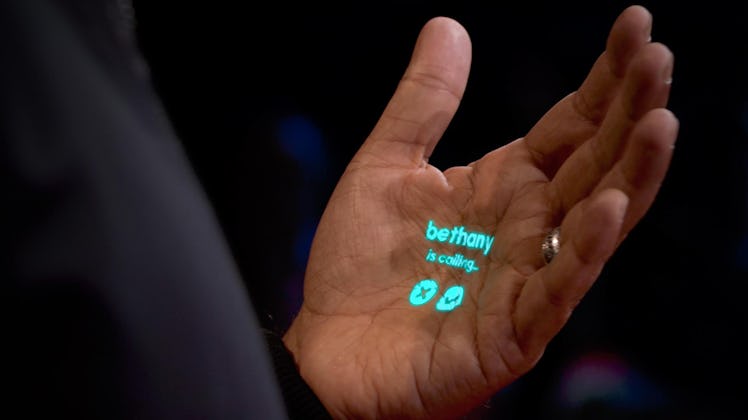
Humane’s AI Pin, for example, is a small device you can attach to your shirt or jacket, and it works as a nonphysical smartphone by projecting calls, messages, and info from apps onto a surface (like your hand).
Powered by artificial intelligence, this screen less solution will also have location data and contextual awareness.
we’ll also have a deeper and more self-conscious awareness of the smartphone’s place in our culture.
I could spin a tale about phones that project their displays into mid-air between your fingers. I could predict that we won’t have phones at all but, instead, high-bandwidth jacks plugged right into our brains, connecting us into a 6 or 7G network of wordless, emotive communication.
I could predict that we don’t need to store our lives in our phones — all that data can live in the cloud.
I could predict that our phones will stop consolidating into a single device and instead explode out into a mesh network of tinier, more bespoke gadgets.
I could predict that our phones could shape-shift into a size fit for the task at hand. Morph and upgrade as needed, adding on better cameras, different sensors, and surprising new capabilities.
But in 10 years, maybe the mobile industry will have evolved to a point where modular phones make a comeback.
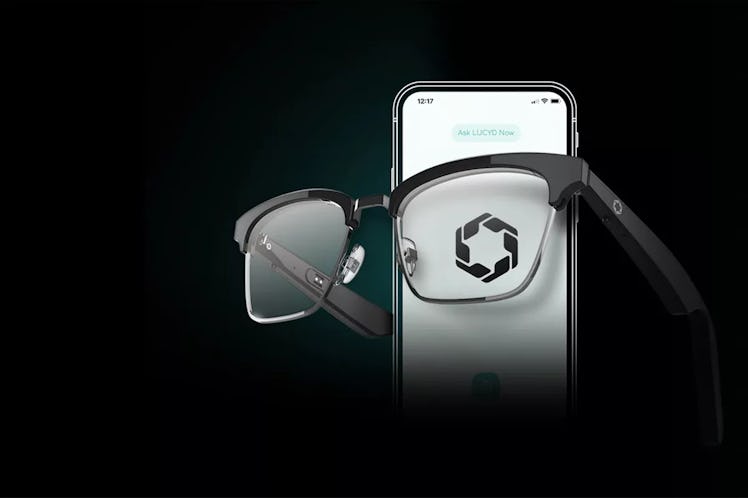
at least relegated to our pockets more often than not — by smart eyeglasses. Think of how often you check your phone throughout the day. No one would want to be constantly futzing with swipe and tap gestures on their glasses that frequently
a phone isn’t something we carry around with us — it’s everywhere. Every room in your home has a smart speaker, a screen, a lamp, and who knows what, that’s connected to the network and ready to do whatever you would have asked of your phone.
Rather than face the onerous task of taking a phone out of your pocket, unlocking it, opening the right app, and typing words on its little screen, the world around us will simply be equipped to do the tedious stuff for us. There are very obvious and serious ethical problems with this scenario. Equipping the world around us to anticipate and solve our needs requires us to surrender an incredible amount of information about ourselves.
Maybe a fully ambient computing life isn’t in our future, whether it’s sight issues or vertigo and motion sickness, it’s not for everyone and will not replace a smartphone for many.
Smartphones will remain as a bedrock to our overall computing experience for a while yet, but we’ll no doubt see the technology evolve in different directions, as it always does — just not so fast.
Those born after 1995 are the first people in history to go through puberty with a portal to an alternative universe in their pockets – and the toll this has taken on their wellbeing has been devastating.
Companies that strive to maximise “engagement” by using psychological tricks to keep young people clicking are the worst offenders. They hooked children during vulnerable developmental stages, while their brains were rapidly rewiring in response to incoming stimulation. This included social media companies, which inflicted their greatest damage on girls, and video game companies and pornography sites, which sank their hooks deepest into boys.
How do we escape from these traps? Collective action problems require collective responses:
Given that AI and spatial computing (such as Apple’s new Vision Pro goggles) are about to make the virtual world far more immersive and addictive, I think we’d better start today.
Something in our culture is devastating the next generation.
The culprit is a massive, sudden switch from raising kids on play to raising kids on phones—specifically, smartphones loaded with life-sucking social media apps.
The user is not the customer—the user is the product.
This is the business model behind social media platforms, where you try to maximize the amount of time that kids and other users spend there. Children were becoming “merchandise.”
We need to have thousands of experiences every single year, every single day, to practice interacting with others in the real world, navigating conflict and struggle by finding more meaning in one’s lifetime.
I’m going to give my child a smartphone at age 9 or 10 is to destroy that life.
Perhaps its time to pass laws (just like acquiring a fire arm) restricting the acquisition of a smart phone till 18 of age is attend. Or restriction on accessing conventional social media such as TikTok, Instagram and Snapchat until they are 18.
Tech is and will remain a fantastic tool, but it has to act in people’s service, not people being reduced to serving a product.
Algorithms that re-engage and stimulate the pleasure system and are built to avoid you losing interest in the content have a type of addictive dynamic.
All human comments appreciated. All like clicks and abuse chucked in the bin.
≈ Comments Off on THE BEADY EYE SAY’S. AI IS NOT LIKE ANY PREVIOUS TECHNOLOGY. ITS GOING TO NEED GLOBAL ACTION TO HARNESS THE EFFECTS IT IS NOW HAVING, NEVER MIND IN THE FUTURE.
Humanity is not approaching this issue remotely with the leave of serious it requires.
Given the speed of development in the field, it’s long past time to move beyond a reactive mode, one where we only address AI’s downsides once they’re clear and present.
We can’t only think about today’s systems, but where the entire enterprise is headed.
While continuing to talk in vague terms about the potential economic or scientific benefits of AI, we are perpetuating historical patterns of technological advancement at the expense of not just vulnerable people but all of us.
When we fail to address these harms, as an inevitable by-product of technological progress we are turning a blind eye to the ethical needs in which powerful AI systems are developed and deployed.
The rapid pace of progress is feeding on itself, creating something smarter than us, which may have the ability to deceive and mislead us — and then just hoping it doesn’t want to hurt us — is a terrible plan.
————-
We humans have already wiped out a significant fraction of all the species on Earth.
SHOULD WE BE WORRRIED THAT WE ARE NOW ARE WITH AI ON THE PATHWAY TO EXTERMINATION.
That is what you should expect to happen as a less intelligent species – which is what we are likely to become, given the rate of progress of artificial intelligence.
AI is probably the most important thing humanity has ever worked on.
It’s not simply what AI can do, but where it is going will be key to managing the resultant fear of AI that permeates society. Gargantuan amounts of data are at this very moment been harvested so machine learning can accomplish tasks that had previously been accomplished only by humans.
With deep learning, improving systems doesn’t necessarily involve or require understanding what they’re doing. If anything, as the systems get bigger, interpretability — the work of understanding what’s going on inside AI models, and making sure they’re pursuing our goals rather than their own — gets harder.
We should be clear about what these conversations do and don’t demonstrate.
In a world increasingly dominated by AI-powered tools that can mimic human natural language abilities, what does it mean to be truthful and authentic?
Take GPT-Chat, which is used by millions around the globe, is churning out human-sounding answers to requests, ranging from the practical to the surreal. It is being used by millions of people, many of whom don’t have any training or education about when it is ethical to use these systems or how to ensure that they are not causing harm.
Even if you don’t use AI-generated responses, they influence how you think.
It has drafted cover letters, composed lines of poetry, pretended to be William Shakespeare, crafted messages for dating app users to woo matches, and even written news articles, all with varying results.
Bots now sound so real that it has become impossible for people to distinguish between humans and machines in conversations, which poses huge risks for manipulation and deception at mass scale.
What does it mean for a machine to be deceptive?
Is it evil and plotting to kill us. Rather, the AI model is responding to my command and playing — quite well — the role of a system that’s evil and plotting to kill us.
If the system doesn’t have that intent, is it deceptive? Does it come back to the person that was asking the questions or getting the system to be deceptive? I don’t know.
There are more questions than answers at this point.
The fact that these technologies are limited at the moment is no reason to be reassured.
Ai has the potential to transform and exacerbate the problem of misinformation, and so we need to start working on solutions now.
—————
The trajectory we are on is one where we will make these systems more powerful and more capable.
A new tool called Co-pilot uses machine learning to predict and complete lines of computer code, bringing the possibility of an AI system that could write itself one step closer. DeepMind’s Alpha Fold system, which uses AI to predict the 3D structure of just about every protein in existence.
We need to design systems whose internals we understand and whose goals we are able to shape to be safe ones. However, we currently don’t understand the systems we’re building well enough to know if we’ve designed them safely before it’s too late.
Right now, the state of the safety field is far behind the soaring investment in making AI systems more powerful, more capable, and more dangerous.
These harms are playing out every day, with powerful algorithmic technology being used to mediate our relationships between one another and between ourselves and our institutions and environment.
The reason is that systems designed this way generalize, meaning they can do things outside what they were trained to do.
These questions around authenticity, deception, and trust are going to be incredibly important, and we need a lot more research to help us understand how AI will influence how we interact with other humans.
If you have machines that control the planet, and they are interested in doing a lot of computation and they want to scale up their computing infrastructure, it’s natural that they would want to use our land for that.
If you believe there is even a small chance of that happening. Now is the time to use the power of your mobile phones to demand responsible, transparent Ai and to remove profit seeking algorithms.
Each day, we hear about countless instances of greed, hatred, violence, and destruction, and all of the pain, suffering, and sorrow that ensues, while we remain deaf to what is really happing in the world of technology.
With the never-ending list of atrocities, it may seem fruitless to try to identify a single contributing factor to all of society’s collective dilemmas, but it is becoming more and more apparent that AI in the hands of a few global mega companies is a recipe for DIASTER.
—————-
Ever since humans picked up a rock and hurled it at another human or animal technology has been shaping the world for yonks’, unfortunately both for good and bad.
DOWN THE CENTURIES ALL OF THESE ADVANCES WERE INCAPABLE OF EFFECTING CHANGE WITHOUT HUMAN ASSISTANCE AND THEIR DECISIONS. Not any longer.
The AI technology we are witnessing today is the first to make decisions without human supervision’s so the future doesn’t look so bright in terms of keeping the planet in peace, as it will lead to a brainwashed society with no values and no real purpose to evolve, other than being herded by an AI sheep dog into predictions.
——————–
AI’s impact in the next five years?
Human life will speed up, behaviours will change and industries will be transformed — and that’s what can be predicted with certainty. AI will rattle society at large.
A threshold will be crossed.
Thinking machines will have left the realm of sci-fi and entered the real world with Human-AI teaming.
We can already see this happening voluntarily in use cases such as algorithmic trading in the finance industry, outpacing the quickest human brains by many orders of magnitude.
Society will also see its ethical commitments tested by powerful AI systems, especially privacy.
As the cost of peering deeply into our personal data drops and more powerful algorithms capable of assessing massive amounts of data become more widespread, we will probably find that it was a technological barrier more than an ethical commitment that led society to enshrine privacy.
AI technologies that are being empowered to code themselves through new generative AI capabilities and simultaneously having less human oversight.
We all must slow down and take steps to bring about more trustworthy technology, but we won’t be able to build trustworthy AI systems unless we know what trustworthy AI means to us.
It is imperative that all AI describe its purpose, rationale and decision-making process in a way that the average person can understand. In other words fairness, accountability and transparency -algorithmic accountability.
AI is the bedrock of world-impacting systems.
———————-
At the micro level, AI affects individuals in everything from landing a job to retirement planning, securing home loans, job and driver safety, health diagnoses and treatment coverage, arrests and police treatment, political propaganda and fake news, conspiracy theories, and even our children’s mental health and online safety.
Without having proper insight into how the AI is making its decisions. Developers should pay close attention to the training data to ensure it doesn’t have any bias, stating from where the information came.
If the data is biased, then developers should explore what can be done to mitigate it. In addition, any irrelevant data should be excluded from training.
——————-
The list of “screwed up” things is a bit overwhelming to comprehend, because there are so many problems affecting so many different people, places, and things.
When you hear politics speak they always mention stuff like health care, transportation, city infrastructure, human rights, free markets. Even though these things are of importance, they don’t set a path for others to follow in the long term.
In all of these instances, both today and throughout history, the underlying reason one group of people has chosen to exploit, oppress, and harm another group of people, has been because of an exaggerated emphasis on their differences rather then what is common to us all – life.
Shouldn’t there be a greater purpose?
What we have are governments focusing on quick fixes and band-aid solutions which don’t address the real problems we’re experiencing as a species.
In an automated world where fun and feeling good are a click away, people can hardly focus on one task.
We grow up demanding to feel good all the time and careless of everything else.
A well-defined message which all presidents/ governments, pass along to their nations and heirs with the intention of making the world a better place to live in is now more than a peroxidative ( self- propagating chain reaction) if we are to avoid a despot future – Climate Change – AI – Wars.
Social media is feeding our false self. Our phones are our best friends. It’s tragic.
People grow up hating education and never building a habit of learning by creating a false self, through filtered images and phony statuses and eventually they start believing in their own shit more than they should.
Unfortunately, their real self remains weak and lacks the qualities it actually needs to handle the hurdles of life.
We are already losing the ability to interact with one another, this is honestly the next step in the evolution of humans and it is absolutely terrifying.
I’d say that it’s not the world that’s fucked up, it’s people who are fucked up. People have become so materialistic, impatient, self-centred, and greedy that they are easy prey for exploitation.
Fortunately, there is a way out.
Humanity has the potential to change, but only with a conscious collective effort.
If you want to make a change, start caring more about others.
Google it. They know everything.
Will the world get a grip?
For humanity to grab on to life and live it to the fullest we must demand transparency when it comes to technologies such as Algorithms.
So, now ask yourself do you want to become a product or service or live your life with your own identity.
Ask yourself do you want to “meander” through life, wandering aimlessly, as the term is commonly (mis)understood to mean to this very day.
Teenagers aren’t stupid. They can sense that what’s being taught in school is hardly something they can later use in real life. Not like us, the generation that can’t find the grocery store without using the navigation on their smartphone.
No matter what you’re doing everything is more complicated than you think.
You only see a tenth of what is true. There are a million little strings attached to every choice you make; you can destroy your life every time you choose.
Governments’ plans to limit climate change to internationally agreed safer levels will currently not limit global warming enough. Governments must not only agree what stronger climate actions will be taken but also start showing exactly how to deliver the changes.
——————
We all get sucked into the day-to-day, lose focus, or just get bored.
We’vegot to removethatbolt, so get a grip on thewrenchandturn it as hard as youcan!
Don’t be fooled.
AI’s impact in the next five years?
Human life will speed up, behaviours will change and industries will be transformed — and that’s what can be predicted with certainty.
Significant AI advances significant have only just started to rattle society at large.
Governments will be compelled to implement AI in the decision-making processes and in their public- and consumer-facing activities. AI will allow these organizations to make most of the decisions much more quickly. As a result, we will all feel life speeding up.
Society will also see its ethical commitments tested by powerful AI systems, especially privacy.
Presently all across the planet, governments at every level, local to national to transnational, are seeking to regulate the deployment of AI.
But dramatic depictions of artificial intelligence as an existential threat to humans, are buried deep in our collective psyche.
Arguably the most realistic form of this AI anxiety is a fear of human societies losing control to AI-enabled systems. We can already see this happening voluntarily in use cases such as algorithmic trading in the finance industry. The whole point of such implementations is to exploit the capacities of synthetic minds to operate at speeds that outpace the quickest human brains by many orders of magnitude.
The more likely long-term risk of AI anxiety in the present is missed opportunities.
To the extent that organizations in this moment might take these claims seriously and underinvest based on those fears, human societies will miss out on significant efficiency gains, potential innovations that flow from human-AI teaming, and possibly even new forms of technological innovation, scientific knowledge production and other modes of societal innovation that powerful AI systems can indirectly catalyse.
While Western eyes are fixed on Tehran and Tel Aviv, Ukraine’s frontlines, unless we get a grip fast, we will not be going anywhere.
So AI is scary and poses huge risks.
But what makes it different from other powerful, emerging technologies like biotechnology, which could trigger terrible pandemics, or nuclear weapons, which could destroy the world?
No one holds the secret to our ultimate destiny.
AI is dangerous precisely because the day could come when it is no longer in our control at all.
Let us now assume, for the sake of argument, that these machines are a genuine possibility, and look at the consequences of constructing them. … There would be plenty to do in trying, say, to keep one’s intelligence up to the standard set by the machines, for it seems probable that once the machine thinking method had started, it would not take long to outstrip our feeble powers. … At some stage therefore we should have to expect the machines to take control.
I think it’s going to be the most beneficial thing ever to humanity, things like curing diseases, helping with climate, all of this stuff. But it’s a dual-use technology — it depends on how, as a society, we decide to deploy it — and what we use it for.
It’s worth pausing on that for a moment. Nearly half of the smartest people working on AI believe there is a 1 in 10 chance or greater that their life’s work could end up contributing to the annihilation of humanity.
As the potential of AI grows, the perils are becoming much harder to ignore.
AI safety faced the difficulty of being a research field about a far-off problem, NOT ANY MORE The challenge is here, and it’s just not clear if we’ll solve it in time.
You may face unexpected challenges. We all do. Changing your mindset won’t guarantee that everything will be okay. But it will give you the insight and strength to believe that you will be okay and that you can handle what life dishes up.
But I guarantee if you don’t do anything you will regret it, and you will wake up one day wondering where your life went and how you got to the place you are. As AI evolves, the consequences for the economy, national security, and other vital parts of our lives will be enormous, along with many other questions as yet unforeseen legal, ethical, and cultural questions will be to arise across all kinds of military, medical, educational, and manufacturing uses.
Open AI, Google, Microsoft, and Anthropic, are not constrained by guardrails and their financial incentives are not aligned with human values. AI-enabled wars already happing, combined with Climate change.
Believe me it’s an unsolved problem, mistakenly believed that the inability to gain access to vast datasets is what’s kept AI out of the hands of all, but a few companies.
In a world full of false material that’s promulgated by AI, there will be lots of AI that can detect the false stuff. We will start to build economies around the whack-a-mole problem of the Good Guys AI staying slightly ahead of the Bad Guys most of the time — but not always.
And some people will make some real money doing this.
All human comments appreciated. All like clicks and abuse chucked in the bin,


 bobdillon33blog