• About
  • THE BEADY EYE SAY’S : THE EUROPEAN UNION SHOULD THANK ENGLAND FOR ITS IN OR OUT REFERENDUM.

bobdillon33blog

~ Free Thinker.

bobdillon33blog

Monthly Archives: April 2024

THE BEADY EYE SAY’S: WHERE IS MIGRATION GOING TO GO?

30 Tuesday Apr 2024

Posted by bobdillon33@gmail.com in 'Refugee' and 'Migrant' 

≈ Comments Off on THE BEADY EYE SAY’S: WHERE IS MIGRATION GOING TO GO?

Tags

Asylum, Immigration, migrants, migration, Refugees.


( Five minute read) k;ldsa;k;


Understand where migrants come from, where they go, and why migration is increasing, is going to be a major problem with climate change.

Why it’s time to rethink migration?

Because it’s increasingly likely that people will encounter—or become—migrants in their lifetime.

Just imagine if Chinese people had to move (1,425,293,425) it would be worse than a nuclear bomb.

Faced with such a reality, the question is not whether migration is right or wrong. The question is how can we make it work best to support prosperity and development for countries of destination, countries of origin, and the migrants themselves.

This is where the debate often becomes confused because we use a single word — migration — to refer to distinct types of movements that have different impacts, and call for different policy responses than  trafficking in humans legally or non legal. 

The challenge is to manage the cost, to reduce it and to share it as global.

Climate change along with inequality requires smarter policies for global development and a prosperous future.

Where people migrate depends on what’s happening in the world shaped by new global challenges, the rise of technology, and protracted modern conflicts, in Sudan, the Middle East and Ukraine.

—————–

The UN High Commissioner for Refugees (UNHCR) estimated that by the end of 2022, over 100 million people were forcibly displaced. Syrians, Palestinians, and Afghans account for more than half of all refugees.

Around 80 percent of refugees live outside camps.

Out of the 60.9 million recorded displacements that occurred last year, 32.6 million, were due to climate disasters, including floods, drought and landslides.

More than 280 million people—roughly one out of every thirty people on earth—currently live in a country in which they were not born.

This means that more than 1 in every 74 people have been forcibly displaced.

—————–

Though migration is not a new phenomenon, it takes on a new significance in an increasingly interconnected world.

Migration—who migrates, where, and why—is constantly evolving. #WorldOnTheMove 

“Flotsam of Humanity”

The majority of migrants, however, are pulled to countries that offer better economic prospects for themselves or their families.

People are far more likely to be international migrants today than in the recent past.

About one-third of all international migrants come from just ten countries. However, numbers alone don’t tell the whole story:

Many refugees and asylum seekers, who make up just over 10 percent of the world’s international migrants, have more than likely previously within their own countries. 763 million people are internal migrants, who have moved within their country.

High-income nations hosted a majority of international migrants.

That’s not surprising considering that a vast majority of the world’s international migrants are economic migrants who have voluntarily left their countries for better economic opportunities elsewhere.

In 2020, 93.9% of all people living in the United Arab Emirates were international migrants, followed by 80.6% of people in Qatar and 71.3% of people in Kuwait.

The U.S. has more migrants than any other nation, but migrants only account for about 15.1% of the U.S. population – a smaller share than in 24 countries or territories with a total population of at least 1 million.

Though India is the single largest source of international migrants, its 17.9 million migrants in 2020 accounted for only 1.3% of all people born in India by that year.

By comparison, the United Kingdom’s 4.7 million international migrants accounted for 7.6% of those born in the UK by 2020. Mexico’s 11.2 million international migrants accounted for 8.2% of those born in Mexico.

Many of the forces driving migration today are.

  • Poverty
  • Conflict and violence
  • Persecution
  • Political instability
  • Economic opportunity
  • Competition for resources
  • Natural disasters and environmental changes
  • Reuniting families

Who decides which migrants receive refugee status?

The UN Refugee Convention defines a refugee as any person who owing to well-founded fear of being persecuted for reasons of race, religion, nationality, membership of a particular social group or political opinion, is outside the country of his nationality and is unable or, owing to such fear, is unwilling to avail himself of the protection of that country; or who, not having a nationality and being outside the country of his former habitual residence as a result of such events, is unable or, owing to such fear, is unwilling to return to it. 146 nations agree to this definition.

However, host governments ultimately get to decide whether to recognize someone as a refugee. This protective status is known as asylum. 

Both refugees and asylum seekers are fleeing for their safety. However, the distinction between these two, though seemingly small, makes a big difference in how they are treated by governments and international organizations. 

Just like refugees and asylum seekers, internally displaced persons by the end of 2022, there were over seventy-one million. This is nearly twice the number of refugees in the world. They don’t have the same protections as refugees.  International law does not apply to them. Instead, they fall under the laws of their own national government.

Predictions in the field of migration appear particularly difficult given the complexity and diversity of the migration processes, the limited availability and quality of data, and the limited understanding of the migration drivers.

Borders define our fate, our life expectancy, our identity, and so much more.

With up to three billion people expected to be displaced by the effects of global warming by the end of the century, should it lead to a shift in the way we think about national borders.

It can be argued, however, that most of these imaginary lines are not fit for the world of the 21st Century with its soaring population, dramatic climate change and resource scarcity.

As global temperatures increase, causing climate change, sea level rise and extreme weather over the coming decades, large parts of the world that are home to some of the biggest populations will become increasingly hard to live in. 

Unable to adapt to increasingly extreme conditions, millions – or even billions – of people will need to move.

One to three billion people are projected to be left outside the climate conditions that have served humanity well over the past 6,000 years.

The threat posed by climate change and its social reper­cussions dwarf those surrounding national security.  

Enabling free movement could double global GDP.

In addition, we would see an increase in cultural diversity, which studies show improves innovation. At a time when we have to solve unprecedented environmental and social challenges, it could be just what is need. What if we thought of the planet as a global commonwealth of humanity, in which people were free to move wherever they wanted? We’d need a new mechanism to manage global labour mobility far more effect­ively and efficiently – it is our biggest economic resource, after all.

THE CHANCES OF THIS HAPPING IS ZERO.

All human comments appreciated. All like clicks and abuse chucked in the bin,

Contact: bobdillon33@gmail.com

Share this:

  • Click to share on WhatsApp (Opens in new window) WhatsApp
  • More
  • Click to share on Pocket (Opens in new window) Pocket
  • Click to share on Mastodon (Opens in new window) Mastodon

THE BEADY EYE ASK’S. WHAT ARE WE LEAVING THE NEXT GERERATION?

27 Saturday Apr 2024

Posted by bobdillon33@gmail.com in #whatif.com

≈ Comments Off on THE BEADY EYE ASK’S. WHAT ARE WE LEAVING THE NEXT GERERATION?

Tags

Algorithms., Artificial Intelligence., Climate change, Environment, Future generations., Renewable Energy., Sustainability, Technology, Visions of the future.

( Fifteen minute read)

It’s hard to feel for future people. We are bad enough at feeling for our future selves.

Even if we last just 1 million years, as long as the average mammal – and even if the global population fell to 1 billion people – then there would be 9.1 trillion people in the future.

Concern for future generations is common sense across diverse intellectual traditions. When we dispose of radioactive waste, we don’t say, “Who cares if this poisons people centuries from now?

Similarly, few of us who care about climate change or pollution do so solely for the sake of people alive today.

Is any of this true?

Current global rates of consumption require the resources of about 1.6 earths. At this rate, we risk exhausting our planet’s life support systems that provide us with fresh water, nutritious food and clean air.

What 2050 could look like if we don’t do anything about climate change?  This doesn’t need an answer.

That is a future unwritten.  It’s also worth noting that, in fact, it is entirely up to us whether these hypothetical future beings ever actually come into existence.

So what do we owe the generations to come?

You might answer that since we don’t even owe to them to bring them into existence in the first place, we can’t possibly owe them anything all. Then wouldn’t the people of the future be within their rights to look back at us and ask, ‘Given that you despoiled our planet, why did you even bother bringing us into existence?

Maybe we might actually have an obligation not to bring future people into existence, at least if we’re going to mess things up enough to make their hypothetical lives unbearable.

That would imply that future people count more than us. And who thinks that? Certainly not me. I’m not even sure they count the same as us. That leaves us with only one option. I hate to say it, but future people surely count less than we do—at least a little less.

“What, I am trying to get you to see, is that we have an absolute duty to future generations not to ruin their future planet.”

Think of today’s teeming masses, displaced by violence and climate change, wandering the world in search for a safe harbour.

In comparison to all that present day concrete suffering, the hypothetical suffering of hypothetical future people seems sort of distant and abstract.

I should say that I am actually all for combating climate change. And I am all for weighing both the interests of present people and the interests of future people in the calculus of what is to be done about it. I just don’t think it’s obvious how much weight we should give to the wellbeing of hypothetical future people as opposed to our own.

——————–

Now more than ever, the world needs young people to step up to address the many other challenges ahead of us.

It is crucial to engage young people in decision-making – but in parallel – it’s also important for young people to think differently about how they want to engage.

They cannot vote or lobby or run for public office, so politicians have scant incentive to think about them. They can’t bargain or trade with us, so they have little representation in the market, And they can’t make their views heard directly: they can’t tweet, or write articles in newspapers, or march in the streets. They are utterly disenfranchised.

We make laws that govern them, build infrastructure for them and take out loans for them to pay back.

So what happens when we consider future generations while we make decisions today?

Is it really as bad as all that?

Our situation can be summed up as follows:

While facing an extinction event, instead of working toward reversing the march toward climate disaster, in the name of security we are investing in killing each other.

What will it take to unleash the energy and passion of youth leaders and activists to dismantle inequitable systems and work together to build an more inclusive future?

Social media will likely play a role in that revolution—if it doesn’t sink our kids with anxiety and depression first.

Asked young people what changes they want for the future.

HERE ARE SOME OF THE RED LINES.

  • Incentivize sustainable consumption and penalize production that’s not.
  • All stakeholders to take urgent action to safeguard nature and future food production.
  • Sanctions against institutions that resort to internet blackouts to supress citizen freedoms.
  • Tech companies to be transparent about misinformation and its spread on their platforms.
  • Governments to implement policies to protect individual citizens against harmful content.
  • Capacity-building programmes and education to help citizens better identify fake news.
  • Strengthened laws against media monopolies to protect democratic freedoms.
  • A Global Convention for Cybersecurity to uphold the integrity of political systems.
  • A global wealth tax on assets worth more than US$ 50 million to fight growing inequality.
  • Universities to end the exorbitant tuition fees that stifle social mobility.
  • Governments to guarantee universal access to mental health services.
  • Governments to invest in communities most at risk from climate change.
  • Financial institutions to stop bankrolling companies initiating fossil fuel exploration.
  • Companies to significantly reduce the GHG emissions of their operations and supply chains to help keep global heating within 1.5°C.
  • Governments to implement fit-for-purpose policies and regulations on big tech.
  • Companies to integrate technology ethics into the design of their products and services.
  • Governments to prioritize the immediate needs of healthcare workers and their families.
  • Companies to drive digitalization in healthcare services to improve patient care.
  • Governments to end qualified immunity in law enforcement for police officers.
  • Increased action against gun violence.

Two critical questions guided these dialogues:

What are the barriers that have hindered progress?

And, what key values, principles and practices will enable us to foster long-lasting systemic impact for the next decade?

As many around the world push for the creation of a more just, equitable and sustainable future we must remember that technology is one of the greatest tools for achieving these goals, but without ethical considerations at the fore… this will likely only perpetuate the very inequalities that we hope to address.

Every generation of teens is shaped by the social, political, and economic events of the day and how fast teens grow up depends on their perceptions of their environment.

For example their ubiquitous use of the iPhone, their valuing of individualism, their economic context of income inequality, their inclusiveness, and more.

Social media is creating an “epidemic of anguish.

We can’t market technologies that capture dopamine, hijack attention, and tether people to a screen, and then wonder why they are lonely and hurting. It makes humanity look like an “imprudent teenager”, with many years ahead, but more power than wisdom.

Fortunately, there are concrete things humanity to day can do.

The field of sustainability is evolving.

For example, if there is any moral weight on future people, then many common societal goals (like faster economic growth) are vastly less important than reducing risks of extinction (like nuclear non-proliferation).

The entire value chain needs to be sustainable, from raw material sourcing to the manufacturing and usage of the products.

Transparency, accountability, trust and a focus on stakeholder capitalism will be key to meeting this generation’s ambitions and expectations. Doing so would help save the lives of people alive today, reduce the risk of technological stagnation and protect humanity’s future.

Our biases toward present, local problems are strong, so connecting emotionally with the ideas can be hard. It’s humbling and inspiring to see the role we can play in protecting the future. We can enjoy life now and safeguard the future for our great grandchildren.

If we name each generation based on the technological conditions it experienced, generations may soon encompass only a few years apiece. Slicing the population into ever-narrower generations, each defined by its very specific relationship to technology, is fundamental to how we think about the relationship between age, culture, and technology.

They include the digital natives, the net generation, the Google generation or the millennials.

All of these terms are being used to highlight the significance and importance of new technologies within the lives of young people. But generation gaps did not begin with the invention of the microchip. What’s new is the fine-slicing of generational divides, the centrality of technology to defining each successive generation.

If the role of technology in shaping an emergent generational consciousness it seems obvious, to imagine a return to the days when sociological generations spanned multiple decades is over. If you believe that technological conditions profoundly shape the life experience and perspectives of each successive generation, then those generations will only get narrower. If we name each generation based on the specific technological conditions it experienced during childhood or adolescence, we may soon be dealing with generations that encompass only a few years apiece.

At that point, the very idea of “generations” will cease to have much utility for social scientists, since it will be very hard to analyse attitudinal or behavioural differences between generations that are just a few years part.

The problem is that all will come at a price. That price is and will be.

The loss of intentional and thoughtful communication techniques to preserve meaningful connections in a society that is becoming more and more reliant on technology.

Be it the metaverse, smart glasses or large language models, the world as we know it may never be quite as we first imagined it, merging into physical and digital spaces.

While the internet offers unparalleled convenience and connectivity, it is essential to recognize its limitations in reproducing the depth of personal interaction found in face-to-face encounters.

—————

Technology will be a vital tool for creating a cleaner, safer and more inclusive world, but what changes can we expect to see?

  • 5G will create a lot of new use cases including drone management, robotic surgery and autonomous vehicles. Large language models will become a given because they lower the cost of artificial intelligence (AI)
  • Quantum computing merges with classical computing.
  • Our grandchildren will live in a very different world thanks to the democratization of products and services that are currently only available to the elite or wealthy,
  • Holographic image in front of you, seen through smart glasses will be your algorithmic world.
  • No matter what  future we leave behind life my advice is life is beautiful-celebrate -celebrate – never give up.
  • If all of this is hurting your head, let’s just get back to the basics: if there is a secret to life, it might all be down to what we do, not what we are.

All human comments appreciated. All like clicks and abuse chucked in the bin.

Contact: bobdillon33@gmail.com

Share this:

  • Click to share on WhatsApp (Opens in new window) WhatsApp
  • More
  • Click to share on Pocket (Opens in new window) Pocket
  • Click to share on Mastodon (Opens in new window) Mastodon

THE BEADY EYE. NO COMMENT VIDEO

24 Wednesday Apr 2024

Posted by bobdillon33@gmail.com in Uncategorized

≈ Comments Off on THE BEADY EYE. NO COMMENT VIDEO

( VIEWING TIME 13 MINUTES)

All human comments appreciated. All like chuck in the bin.
Contact: bobdillon33@gmail.com

Share this:

  • Click to share on WhatsApp (Opens in new window) WhatsApp
  • More
  • Click to share on Pocket (Opens in new window) Pocket
  • Click to share on Mastodon (Opens in new window) Mastodon

THE BEADY EYE: NO COMMENT VIDEO

24 Wednesday Apr 2024

Posted by bobdillon33@gmail.com in Uncategorized

≈ Comments Off on THE BEADY EYE: NO COMMENT VIDEO

( Viewing time 1hr 30m)

https://youtu.be/Ixri-wviUTc?si=LVrBkEZ3SX2ZHhiZ

All human comments appreciated. All like clicks chucked in the bin.

Contact: bobdillon33@gmail.com

Share this:

  • Click to share on WhatsApp (Opens in new window) WhatsApp
  • More
  • Click to share on Pocket (Opens in new window) Pocket
  • Click to share on Mastodon (Opens in new window) Mastodon

THE BEADY EYE: NO COMMENT VIDEO.

23 Tuesday Apr 2024

Posted by bobdillon33@gmail.com in Uncategorized

≈ Comments Off on THE BEADY EYE: NO COMMENT VIDEO.

( Twenty-two minute watch)

All human comments appreciated. A like clicks chucked in the bin

Contact: bobdillon33@gmail.com

Share this:

  • Click to share on WhatsApp (Opens in new window) WhatsApp
  • More
  • Click to share on Pocket (Opens in new window) Pocket
  • Click to share on Mastodon (Opens in new window) Mastodon

THE BEADY EYE ASK’S: SHOULD THERE BE CONGRATULATIONS TO ENGLAND IN PASSING INTO LAW THE EXPORTATION OF IMMIGRANTS TO RWANDA.

23 Tuesday Apr 2024

Posted by bobdillon33@gmail.com in #whatif.com

≈ Comments Off on THE BEADY EYE ASK’S: SHOULD THERE BE CONGRATULATIONS TO ENGLAND IN PASSING INTO LAW THE EXPORTATION OF IMMIGRANTS TO RWANDA.

Tags

africa, Asylum, Care industry's, news, NHS, politics, Rwanda, UK

( Twelve minute read)

Did you know that the very first convicts to land in Australia did so in 1788? (This was part of a transportation system that was put into place in Britain to ease their crime rates, primarily due to the rising levels of poverty created by the Industrial Revolution.)

A system of transportation was put into place in 1717. They believed that sending people to distant colonies would give them a second chance at life. Around 160,000 convicts had been transported to Australia during this time period.

The British government believed that Australia would be an ideal place to send their convicts because it was so far away from Britain, a more humane alternative to execution. They decided to use old warships as prisons, and called them ‘hulks’. The hulks began to run out of room so they moved the occupants’ as cheap slave labour to Australia.

The effects of this moment would change the fate of an entire continent that still has significant impacts in the modern world.Reuters Rishi Sunak attends a press conference at Downing Street in London

This time its not petty criminals that they are going to export to Rwanda but immigrants.

As I understand it. One-way ticket to Rwanda to have their claims to asylum processed there.

Under the proposal:

Rwanda would take responsibility for the people who made the more than 4,000-mile journey, put them through an asylum process, and at the end of that process, if they were successful, they would have long-term accommodation in Rwanda not the UK.

Rwanda will have the “capacity to resettle tens of thousands of people in the years ahead.

Rwanda’s human rights record makes it the ideal place to get rid of unwanted immigrants. 

In 1994, one of the worst incidents of genocide in modern history took place in Rwanda, where Hutu extremists slaughtered nearly a million Tutsi and moderate Hutu.

Rwanda genocide of 1994, planned campaign of mass murder in Rwanda that occurred over the course of some 100 days in April–July 1994. The genocide was conceived by extremist elements of Rwanda’s majority Hutu population who planned to kill the minority Tutsi population and anyone who opposed those genocidal intentions. It is estimated that some 200,000 Hutu, spurred on by propaganda from various media outlets, participated in the genocide. More than 800,000 civilians—primarily Tutsi, but also moderate Hutu—were killed during the campaign. As many as 2,000,000 Rwandans fled the country during or immediately after the genocide, is now a safe place.

The effects of this new law (yet to be signed off by their King,) undermines the core principle of the universality of human rights and breach’s the international Refugee Convention, which the UK is signed up to.

Under EU membership there was a mechanism to return asylum seekers to the first safe European country they passed through, but this returns scheme is no longer available to the government due to Brexit.

Slamming the door in the face of refugees, is cruel and nasty decision, which will do little” to deter people. Instead the UK, the government should be focusing on creating a system that protects the right to claim asylum and that prioritises both compassion and control.

How are we treating these humans?

Are we suddenly saying those coming from Ukraine, their lives are better value than those coming from certain other countries? I think it’s abhorrent.

Voyages of despair filled with hardship. There go I but for the grace of god.

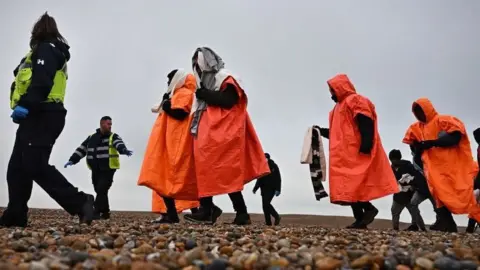
Getty Images A British Immigration Enforcement officer and an Interforce security officer escort migrants, picked up at sea by a lifeboat whilst they were attempting to cross the English Channel

The theoretical cost for sending 1,000 migrants to Rwanda could be £169m – or £169,000 a person – in contrast to the £106m it would cost to accommodate them in the UK.

More than 45,000 people crossed the English Channel last year on small boats – so-called deterrence measures simply don’t work.

£100m was paid to Rwanda in April and that an extra £50m would be handed over next year.

Of the £290m allocated to Rwanda so far, only £20m has gone towards set-up costs of the deportation scheme.

That brings the total cost to £290m but does not account for the cost of actually deporting any migrants to the country, which could end up sending the bill over £400m.

Instead of returning to medieval practices, there is no reason that on arrival applications for asylum could not be examined

The apathic irony of all of this is that we consistently hear that the providers of care are struggling to recruit and retain enough skilled staff, which is having a knock-on effect on access to care services and leading to unmet needs. Around half a million people are waiting either for an adult social care assessment with more people than ever waiting for elective NHS care (6.7 million).

The latest figures for January 2024 show: Over 321,000 of these patients have been waiting over a year for treatment,

A care system is in gridlock.

Almost 100,000 people in the UK are waiting for a decision on their asylum claims.

“Our Illegal Migration Bill will help to stop the boats by making sure people smugglers and illegal migrants understand that coming to the UK illegally will result in detention and swift removal – only then will they be deterred from making these dangerous journeys in the first place.”

Where would I sent them.?  Not Rwanda but into Care industry’s or does England no longer want to be the nation that wants to help other people.

As Climate change without a doubt is going to cause mass migration overall, this decision is likely to bring greater clarity to an area of law that is both complex and frequently in the public eye.

All human comments appreciated. All like clicks and abuse chucked in the bin.

Contact: bobdillon33@gmail.com

Share this:

  • Click to share on WhatsApp (Opens in new window) WhatsApp
  • More
  • Click to share on Pocket (Opens in new window) Pocket
  • Click to share on Mastodon (Opens in new window) Mastodon

THE BEADY EYE. NO COMMENT VIDEO’S

22 Monday Apr 2024

Posted by bobdillon33@gmail.com in Uncategorized

≈ Comments Off on THE BEADY EYE. NO COMMENT VIDEO’S

( 30 MINUTE LISTENING)

FORTY FINGER’S

Share this:

  • Click to share on WhatsApp (Opens in new window) WhatsApp
  • More
  • Click to share on Pocket (Opens in new window) Pocket
  • Click to share on Mastodon (Opens in new window) Mastodon

THE BEADY EYE ASK’S ARE OUR LIVES GOVERENED BY FEAR? THE FLIP SIDE OF HOPE.

21 Sunday Apr 2024

Posted by bobdillon33@gmail.com in 2024 the year of disconnection, FEAR, Israel and Palestine, Israeli-Palestinian conflict, The Ukraine., Uncategorized

≈ Comments Off on THE BEADY EYE ASK’S ARE OUR LIVES GOVERENED BY FEAR? THE FLIP SIDE OF HOPE.

Tags

anxiety, Artificial Intelligence., Climate change, FEAR, love, politics, The Future of Mankind

( Twenty minute read)

How much of our lives is governed by fear?

Fear is an ancient and conserved response that served humans well enough before the advent of civilisation, but it has become distorted in modern societies where primordial fears can readily transform into phobias.

Fear is part instinct, part learned, part taught. Some fears are instinctive: Pain, for example, causes fear because of its implications for survival. Other fears are learned and also partly imagined.  Imagined threats cause paralysis. Real threats, on the other hand, cause frenzy.

For instance social media is now fanning, the flames of fear and disseminating misinformation quickly and widely with fake news.

It’s hard to fully understand the way fear shapes our world without addressing its relationship to anger.

And anger is important for those who profit from fear because anger generates action.

People are more vulnerable when they’re in an angered state. When we’re angry, we don’t pay attention to the details of complex messages, the more one person expresses anger, the more others express anger, and then it becomes a kind of spiral where the anger is ratcheted up and up.

Many bemoan online when social media platforms seemingly descend into ranting and abuse but a great deal of the anger we find when perusing our devices isn’t organic, it’s engineered – for profit.

Provoking anger is rapidly becoming the standard for many online operations.

Why?

Because fidelity of the source is taken by social media sites and search engines as key factors for their Automated Decision Making (ADM) systems to classify content.

In their defence, social media platforms are between a rock and a hard place because of their need to balance free speech against repression of damaging or hateful material.

It works because in our algorithmically driven culture the popularity of any given content is no longer driven by the number of eyeballs that see it, but by the level of engagement it generates.

—————–

Fear sharpens the mind, which is why fear is used in campaigns, whether it’s public health, whether it’s to change people’s attitude to things like climate change.

Fear can steel resolve to do something.

After the second World War and the horrors that the world experienced, democratic countries became defensive.  In other words, they saw fear as an important tool for making sure that these kinds of perversions never happened again, but in the process of doing that, fear actually became too important as a component. It started to eclipse the very values that it was supposed to be protecting-  “enculturated” in fear – NATO.

But that’s not the whole story.

We can now register a fear with new characteristics in the fear taxonomy, and we could call it global fear.

.For example during COVID too much fear created apathy leading to disinterest and distrust.

What’s needed is a better public understanding of the role these emotions play in our lives, and a clearer appreciation that when emotions are manipulated, even good intentions can have disastrous consequences.

——————–

Fear and anger are dominating our world right now, but are we being manipulated for profit?

Fear and anger abound – in our politics, in our social discourse, and in our expectations for the future.

When fear is pervasive in a system — and it’s pervasive in all of our systems — what that means is that we lose dynamism, we lose innovation. Fears put a stranglehold on our life force. Fear paralyzes us. Fear diminishes us. And the more we conquer our fears, the more meaningful our life becomes.

Fear and anger have been monetised, the result of deliberate manipulation by commercial and political interests.

The antidote for our current malaise isn’t simply to suppress our emotional extremes. In fact, both fear and anger can help positive social change by fostering a thirst for justice and even revolution.

The difficulty for people today is empathising or imaginatively trying to situate themselves in the future … It’s very, very difficult.

The growing fear-based discourse around climate change, for example, and the use of fear-laden expressions and words often backfires on those who deploy them. When someone like [UN Secretary-General] António Guterres uses the term ‘global boiling’ the problem is a lot of people in their daily lives are not experiencing a climate crisis, they don’t experience excessive heat, they don’t have wildfires on their doorstep. They just switch off.

While we tend to equate fear-based leadership with totalitarianism or populism, there are many instances in democratic countries where politics is coloured by the use of fear as a blunt tool of coercion.

More people realise that we’re living in a vicious cycle, where manufactured fear fuels anger and anger in turn blinds us to the recognition that our fear is misplaced. Take the discourse around “illegal” immigration.


As George Orwell’s warnings 1984 to the world which are now coming true as we move into an age of totalitarian Ai dictatorial -an age in which freedom of thought will be a deadly sin and later on a meaningless abstraction. The autonomous individual is going to be stamped out of existence.

Totalitarianism relies on mass support so we need more people to realize what is at stake and start seeing all around us by taking the smart phone out of our ears.

With AI moving into the Physical world, algorithms are running more and more of life as we know it.

Combined they are evolving towards the same system, a form of oligarchical collectivism with manufactured fear.  The strategy of fear is one of their most valuable tactics.

Don’t let it happen. Face recognition becoming a thought or face crime.

————————-

You see the state of the world.

It is not important who is at war or with who, it’s the removal of freedoms and constant surveillance which is now conducted through the smartphones we carry around in our pockets, with every sound you make, every movement scrutinised.

The permanent lie becomes the only safe form of existence. Everything fades into mist. The past is erased, the erasure is forgotten and the lie comes truth.

No one can stand aside, dont let it happen it depends on you

It’s understandable that we may worry about world events but fear is hardwired in your brain, and for good reason.

—————–

War is peace freedom is slavery.

Israel is as we watch becoming a Totalitarian State.

How does one witness the cruelty of indiscriminate bombing? We cannot physically or mentally feel another’s pain, but we can empathize with it. We tend to still think of war as great power competition or as the Second World War.

The USA vetoed Palestine becoming a full member of the United nations then approved more than $61bn worth of military assistance to help Ukraine in its desperate defence against Russia, as well as billions for other allies including Israel and Taiwan.

The $95bn in total funding includes roughly $61bn for Ukraine (with much of the funding going towards replenishing American munitions); $26bn for Israel; $8bn for US allies in the Indo-Pacific region, including Taiwan; and $9bn in humanitarian assistance for civilians in war zones, such as Haiti, Sudan and Gaza, though the package also includes a ban on direct US funding for the United Nations Relief and Works Agency for Palestine Refugees (Unrwa), an agency providing key assistance to Gaza, until March 2025. The US has so far sent Ukraine roughly $111bn in weapons, equipment, humanitarian assistance and other aid since the start of the war more than two years ago.

The Israel bill includes about $4.4bn to replenish depleted US supplies given to Israel; $4bn for missile defence, including the much-vaunted Iron Dome, and $1.2bn for the Iron Beam; and $3.5bn to help Israel buy weapons. There are also provisions to make it easier to supply Israel with US munitions held in other countries.

What is what.

If you can have all the information that’s out there, crunch it into some kind of algorithm, that you can then target discriminately, proportionately.

The idea that machines are going to replace humans in wars  is fundamentally untrue.

We are seeing this to a certain extent right now, in Palestinian/Israel war with Ai deciding who and how to kill.  Both wars are is very much a battle of machines and soldiers, a high technology-driven conflict.

Where you can attack, use some surgically precise weapons, take care of the problem, eliminate your opponent and then extract yourself from a situation, has actually turned into a quagmire with new super weapons, whether it be cyber information warfare or artificial intelligence everyone wants to be ahead of the curve, right?

However, this approach also overshadows political considerations, including the causes of conflicts, obscures the costs of conflict, and creates illusions of quick and easy victories—all of which has led to two decades of war in the twenty-first century.

One of the problems here is this idea that you can simply solve problems by targeting them with cruise missiles, is simply not the case.

The belief that technology can help prevent war by creating a deterrent, is an illusion.

Wars will never be able to solve the difficult and complex political and cultural problems on the ground. Weapons can help produce ceasefires, but they cannot themselves create long-lasting, established peace.

Essentially, the idea that science can produce technologically advanced weapons so horrible that no one will ever want to fight is farcical. If we are ever going to get rid of war military culture it must be understood that it  does not exist in isolation.

Through the use of technology WE GOING TO CREATE WARS.

The rush to apply cutting edge technologies like artificial intelligence to military systems is well under way. A new breed of techno-evangelists, many of whom stand to make billions if we go down the high tech path they are so aggressively promoting.

The application of science to unpick the supposedly immutable principles of warfare, making conflicts shorter and more humane, or eliminating the need for large-scale campaigns, found a home in the United States by the middle of the nineteenth century.

Such views reached their zenith with the advent of nuclear weapons and the logic of deterrence.

Importantly,  technology-based approach emerges as a counter to the deterrence-based approach. Although nuclear weapons had made war unlikely, given the risks of mass casualties and devastation.

There is a need for much greater restraint in making assumptions as to what ends can be achieved militarily. Replacing people with machines on the battlefield, will not result in ‘clean’ conflicts.

Where there may be feelings of anger and betrayal, or even a sense of exhaustion, not uncovering the truth may lead to conspiracy or a turn to an engineering-infused idealism—that smarter systems will produce better results next time.

High-tech wars transfers the risk from soldiers to civilians.

It envisions the military drawing on US advanced technologies, such as AI, cyber resources, unmanned systems and machine learning to offset or create an overmatch of adversarial capabilities. Reducing the time that it takes from identifying a target to destroying it (known as the “kill chain”) and diminishing or eliminating human input could be a recipe for unprecedented disaster.

The Ukraine war is been used as a proof of concept for their systems, and a marketing tool to boot – after all, what’s more attractive than buying “battle proven” technology?

Revelations that Israel has used AI not to spare civilians but to step up the rate and scope of its devastation of Gaza is just the latest example of why we need to think twice before acquiescing in the rush towards a world dominated by automated warfare.

Between 2019 and 2022, U.S. military and intelligence agencies awarded major tech firms contracts with ceilings worth at least $53 billion combined. Resulting in large military contracts to big tech firms like Microsoft, Amazon and Google.

The idea that America alone has the ability (and the duty) to protect the world’s democratic societies; and a steadfast belief that the best way to preserve U.S. dominance is through a largely unregulated free market that prioritizes corporate needs is a farce. It is on the verge of losing an epic struggle for global geopolitical and economic supremacy—unless it can outpace China in the ‘AI arms race.

U.S. government for Israel’s war on Gaza, which the International Court of Justice has suggested can plausibly be considered a case of genocide.

Russia’s or Israeli nuclear status means that NATO countries are unlikely to become involved in direct fighting given the risk of escalation.

The time to act is now, because nobody has any idea if we have cyborg fighting wars.

There is another response in play when there is a perceived threat to survival. Physical harm, threats to property used for protection, threats to self value that erode a desire to survive come from the Caveman part of our brain that dictate the innate need to run, hide, fight. As to what is coming next is anyone’s guess.

My guess is that it will be self-help.

Physical aggression and violence dictate fear. the use of run, hide, fight.

All human comments appreciated. All like clicks and abuse chucked in the bin.

Contact: bobdillon33@gmail.com

Share this:

  • Click to share on WhatsApp (Opens in new window) WhatsApp
  • More
  • Click to share on Pocket (Opens in new window) Pocket
  • Click to share on Mastodon (Opens in new window) Mastodon

THE BEADY EYE. NO COMMENT VIDEO’S

19 Friday Apr 2024

Posted by bobdillon33@gmail.com in Uncategorized

≈ Comments Off on THE BEADY EYE. NO COMMENT VIDEO’S


( Viewing time 2hr 30 minutes)

Subject: Search for life beyond Earth,

https://youtu.be/dww8Hekngmg?si=aYK7KnWTTJow27fJ

Share this:

  • Click to share on WhatsApp (Opens in new window) WhatsApp
  • More
  • Click to share on Pocket (Opens in new window) Pocket
  • Click to share on Mastodon (Opens in new window) Mastodon

THE BEADY SAYS; ENTERTAINMENT IS NOW BEYOND THE PALE. WHAT CONSITUTES ENTERTAINMENT? WHERE DO WE DRAW THE LINE? IS THERE ANY LINE TO BE DRAWEN?

19 Friday Apr 2024

Posted by bobdillon33@gmail.com in 2024 the year of disconnection, Artificial Intelligence.,  Attention economy, Uncategorized

≈ Comments Off on THE BEADY SAYS; ENTERTAINMENT IS NOW BEYOND THE PALE. WHAT CONSITUTES ENTERTAINMENT? WHERE DO WE DRAW THE LINE? IS THERE ANY LINE TO BE DRAWEN?

Tags

Attention economy, ENTERTAINMENT, lifestyle, movies, news, pop-culture

( Ten minute read)

Even as violence is a concept that has long accompanied humanity, it is no easy task to make sense of what it is, or how it is exercised.

Ancient Romans flocked to carnage in the Colosseum.

Even the most brutal acts committed by our ancient ancestors pale in comparison to the organized assaults countries have executed in the last century alone.

Ongoing wars and human right violations suggest that we are living in one of the most vicious times in history.

The relationship between violent media and real-world violence has been the subject of extensive debate and considerable academic research, yet the core question is far from answered.

Portrayals of violence can manufacture our consent with government policies, encourage us to endorse the legitimacy of state power and state violence, and help determine who are “worthy victims”.

Results from the two studies suggest that socialization models of media violence may be inadequate to our understanding of the interaction between media and consumer behaviour at least in regard to serious violence.

Our media outlets from News to Gaming – Movies – Net flicks – Social Media – are saturated with violence.

More than 100 million people watched the gory Netflix show, Squid Game.

Hellblade: Senua’s Sacrifice wins Game Beyond entertainment.

This is a bit like benign masochism, the enjoyment of aversive, painful experiences in a safe context.

Whether or not screen violence is bad for us has been extensively studied and there are reasons to reconsider how much we like watching violence per se.

For example, violence creates tension and suspense, which may be what people find appealing. Another possibility is that it is action, not violence, which people enjoy. That it is violence being deemed off-limits that makes it appealing. It may be that it is justified punishment, rather than violence, that we enjoy watching.

All this suggests that media companies may be giving us violence that many of us don’t want or need.

—————–

We should hence consider what other corporate, political or ideological pressures may be encouraging onscreen violence globally causing us to become disconnected with reality.

Movies lie about the real impact of violence on the human body – with almost 90% of violent actions showing no realistic physical consequences to the victim.

The west won the world not by the superiority of its ideas … but rather by its superiority in applying organised violence.

————-

The question of how humans came to be domesticated — at the will of a deity, independently, as some sort of evolved trait — has plagued philosophers and scientists for hundreds of years.

It is tempting to try to answer this question by invoking biology and genetics, arguing that humanity is wired to be violent.

Whether humans will ever live in a violent-free, as digital technologies—such as social media platforms—become increasingly central to our daily existence they have become essential components in how violence is enacted and experienced. Indeed, as access to and use of social media continue to expand across the world so does the violence enacted through these digital platforms become more common.

For proof of that, just turn on your TV to the evening news and watch murder in all its forms.

What lies behind these episodes. Perhaps, some have argued, our intelligence and systems of culture, such as laws and social norms, are all that are holding that innate violence in check.

How good and evil may have come to co-exist in our unique species. Are humans, by nature, good or evil? The question has split opinions since people began philosophising. We have a low propensity for impulsive aggression, and a high propensity for premeditated aggression.

It raises a deeper question: Why did such an unusual combination of virtue and violence evolve?

A deeper understanding of how and why violence emerges, or doesn’t, might help us achieve a less violent future—or at least one in which we can better comprehend and manage our violence.

41% of people in the United States of America have suffered online harassment, from physical threats (14%) and sexual harassment (11%) to name-calling (31%).

But violence in digital environments is not only expanding, it is also becoming more complex as the evolving affordances, structures, and cultures of contemporary digital environments increase their scale, speed, reach, and visibility (Backe et al., 2018).

For instance, violence on social media is found in the new ways cultural and informational wars are enacted and deployed in the United States filled with school shootings and mugging and terrorist attacks and wars.

——————–

It is a widespread phenomenon that directly or indirectly affects many aspects of our lives.

Nonetheless, digital manifestations of violence are often thought to be less “real,” “serious,” or “harmful” than those enacted face-to-face (Dunn, 2021).

Capitalism is a dirty word for many intellectuals but there are a number of studies showing that open economies and free trade are negatively correlated with genocide and war.

Warfare provides people with a semblance of psychological positivity in oppressed societies where other outlets are lacking.

Any stable, lasting peace depends on creating societies with a richness of opportunity and variety that can meet human needs. The fact that so many societies throughout the world fail to do this makes our future prospects of peace look very bleak.

War and other destructive capabilities are merely the flip side of the same uniquely human faculty that has enabled us to coexist peacefully, to innovate, to travel in space and shape our world.

The evolution of entertainment into a global landscape signifies a world where cultural boundaries blur, and creativity knows no limits. In today’s interconnected world, the entertainment industry has expanded its reach, influencing and captivating audiences worldwide with diverse content and experiences.

Entertainment has transcended geographical boundaries, morphing into a global phenomenon that unites people across cultures, languages, and continents.

Social media is cursed with pervasive and impactful harmful content. Can we imagine addressing only part of this violence without considering the rest?

Can we continue to feign not to see that all of these forms of violence mutually reinforce one another.

Film and television have long been seen as legitimate and powerful means to educate, inspire and empower wider society. To deliver a transformational experience beyond pure entertainment – whether that is to raise awareness through empathy and emotional impact, to engage with real world problems, or to make the world a better place.

The prevalence of war, not just its persistence, could now be our future.

The past two years have seen the most conflicts of any time since the end of the Second World War.

(The list encompasses not just the wars in Gaza and Ukraine, but hostilities between Armenia and Azerbaijan in Nagorno-Karabakh, Serbian military measures against Kosovo, fighting in Eastern Congo, complete turmoil in Sudan since April, and a fragile cease-fire in Tigray that Ethiopia seems poised to break at any time. Syria and Yemen have not exactly been quiet during this period, and gangs and cartels continuously menace governments, including those in Haiti and Mexico. All of this comes on top of the prospect of a major war breaking out in East Asia, such as by China invading the island of Taiwan.)

What happens when a smart TV becomes too smart for its own good?

The answer, it seems, is more intrusive advertisements.

Reaching beyond video to monopolise the attention of audiences in the home TV violence increases aggression and social anxiety, cultivates a “mean view” of the world, and negatively impacts real-world behaviour.

We are exposed to social media violence just by being there.

The amount of violent content has helped normalise aggression. The reality is that social media platforms have got a lot to answer for. In practically every situation where we’ve seen violence happen there has been some sort of connection with an online platform in some form.

Why are these social media platforms not being held to account?

Why are we so scared of asking really difficult questions and why are these social media platforms not putting more money back in the communities that are being affected by violence?

We don’t fully know the impact of social media.

But social media and the fact that something that is say in passing becomes written down, causes what might have been nothing to become something.

For most violence isn’t at all normal, but there is a proportion whose lives are far too full of violence because of inequality and poverty.

The key driver of violence.

————

But what about games?

As our younger industry matures, what role should games play in reflecting and commenting on the world around us?

Already we have a number of implications that will define the future shape of the online entertainment market. As society seeks answers in the media they trust, streaming devices are now everywhere, pouring news into social media 7/7

People in entertainment, tries to make something for everyone/to make the most profit instead of making what they want, so personality and quality takes a hit.

There is definitely a cultural degradation taking place.

Violence is an almost ubiquitous phenomenon in contemporary digital environments.

Games beyond entertainment.

The advent of video games raise new questions about the potential impact of media violence, since the video game player is an active participant rather than merely a viewer. Video games that involve assuming the roles of aggressors or soldiers offer players the opportunity to be “virtual perpetrators.”

Rewarding players for successfully carrying out violent behaviour.

Online gaming communities, esports tournaments, and multiplayer platforms enable players worldwide to engage, compete, and connect in virtual worlds. Digital platforms have revolutionized entertainment accessibility. Social media influencers transcend borders, shaping entertainment trends and culture on a global scale, such as cultural sensitivities, censorship, and legal barriers that can hinder the free flow of content across borders.

There are fewer empirical studies of video game violence than other forms of media violence. Still, several meta-analytic reviews have reported negative effects of exposure to violence in video games. 

Content matters. much of the research into video game violence has failed to control for other variables such as mental health and family life, which may have impacted the results.

Given that effects on individual users may differ widely, policy discussion should be more focused on “more pressing” issues that influence violence in society such as poverty or mental health.

Rest assured that entertainment will need to master new forms of interactive entertainment — whether in video games, sports betting or the more social and communications-based services that thrive on smartphones — to keep audiences hooked.

There was no such thing as YouTube its their Tube.

U Tube now has a  War Channel created to appeal military enthusiasts around the world; offering viewers hours of programming on the American Civil war, WWI, WWII, Vietnam, Afghanistan, Iraq, Israel, Ukraine and all.

————————-

Why are people less imaginative?

Because we all have the internet and other high-information sources that fill in the gaps for us.

Story telling, character-building, authenticity, and originality have all gone out the window, as entertainment has become largely an industry as opposed to a genuine creative outlet.

Game makers have the opportunity – and responsibility – to offer their players an appropriate and powerful means to get close to challenging issues or subject matter.

Games are brilliant at engendering empathy by allowing you to experience the life of other people first hand. As game makers and storytellers we have the ability to take our audiences to places they haven’t been or to feel things they have yet to experience.Soldiers with rifles walking on a leafy hill, with tanks in the background. As the Ukraine war enters its second year, Tufts experts weight alternative endings—and the possibility it won’t be resolved any time soon.

There’s the possibility of vertical escalation—meaning that Russia would use more advanced weapons, including nuclear weapons—on the battlefield. And there is the possibility of horizontal escalation, the war spilling over to other countries.

What if anything can be done?

Here are a few key recommendations, which includes improve regulations and legislation for social media companies, greater responsibility so tech companies are held accountable for inaction, and for young people to be involved in panels that are consulted on tackling online harms and the development of games, new content and online spaces.

Legislation in relation to social media platforms is needed, but it is one aspect in an array of required measures, including education, the need to address social inequalities, the need for transparency by companies, by governments who should be constantly aware of how fake violence on our screens serves real violence in our world.

Why?

Because exposure to media violence can desensitize people to violence in the real world.

Yes, its true that  for some people, watching violence in the media becomes enjoyable and does not result in the anxious arousal that would be expected from seeing such imagery , but society as a whole is another question.

An average American youth will witness 200,000 violent acts on television before age

18. 46% of television violence occurs in cartoons.

———–

The prevalence and impact of violence portrayed in media and entertainment and the near-ubiquitous portrayals of violence in various forms of media must remained a topic of intense scrutiny.

Fear is what, anxiety and depression, wars, domestic violence, relationship breakdowns, child abuse, terrorism, mass shootings, self-harm and all forms of violence towards oneself and others have in common.

All comments appreciated. All like clicks and abuse chucked in the bin

Contact: bobdillon33@gmail.com

Share this:

  • Click to share on WhatsApp (Opens in new window) WhatsApp
  • More
  • Click to share on Pocket (Opens in new window) Pocket
  • Click to share on Mastodon (Opens in new window) Mastodon
← Older posts

All comments and contributions much appreciated

  • THE BEADY EYE SAYS TRUST IS DISAPPEARING THANKS TO OUR INABILITY TO RELATE TO EACH OTHER. December 19, 2025
  • THE BEADY EYE SAYS. THE WORLD NEEDS PEOPLE GOVERNMENT NOT MONEY GOVERNMENTS. December 18, 2025
  • THE BEADY EYE ASKS WHAT ARE WE THE SAME GOING TO DO TO STOP THE WORLD BEING FUCK UP FOR PROFIT BY RIPOFF MERCHANT. December 17, 2025
  • THE BEADY EYE CHRISTMAS GREETING. December 16, 2025
  • THE BEADY EYE SAYS. TO THE NEXT GENERATION TO LIVE A LIFE WORTH WHILE YOU MUST CREATE MEMORIES. December 16, 2025

Archives

  • December 2025
  • November 2025
  • October 2025
  • September 2025
  • August 2025
  • July 2025
  • June 2025
  • May 2025
  • February 2025
  • January 2025
  • December 2024
  • November 2024
  • October 2024
  • September 2024
  • August 2024
  • July 2024
  • June 2024
  • May 2024
  • April 2024
  • March 2024
  • February 2024
  • January 2024
  • December 2023
  • October 2023
  • September 2023
  • August 2023
  • July 2023
  • June 2023
  • May 2023
  • April 2023
  • March 2023
  • February 2023
  • January 2023
  • December 2022
  • November 2022
  • October 2022
  • September 2022
  • August 2022
  • July 2022
  • June 2022
  • May 2022
  • April 2022
  • March 2022
  • February 2022
  • January 2022
  • December 2021
  • November 2021
  • October 2021
  • September 2021
  • August 2021
  • July 2021
  • June 2021
  • May 2021
  • April 2021
  • March 2021
  • February 2021
  • January 2021
  • December 2020
  • November 2020
  • October 2020
  • September 2020
  • August 2020
  • July 2020
  • June 2020
  • May 2020
  • April 2020
  • March 2020
  • February 2020
  • January 2020
  • December 2019
  • November 2019
  • October 2019
  • September 2019
  • August 2019
  • July 2019
  • June 2019
  • May 2019
  • April 2019
  • March 2019
  • February 2019
  • January 2019
  • December 2018
  • November 2018
  • October 2018
  • September 2018
  • August 2018
  • July 2018
  • June 2018
  • May 2018
  • April 2018
  • March 2018
  • February 2018
  • January 2018
  • December 2017
  • November 2017
  • October 2017
  • September 2017
  • August 2017
  • July 2017
  • June 2017
  • May 2017
  • April 2017
  • March 2017
  • February 2017
  • January 2017
  • December 2016
  • November 2016
  • October 2016
  • September 2016
  • August 2016
  • July 2016
  • June 2016
  • May 2016
  • April 2016
  • March 2016
  • February 2016
  • January 2016
  • December 2015
  • November 2015
  • October 2015
  • September 2015
  • August 2015
  • July 2015
  • June 2015
  • May 2015
  • April 2015
  • March 2015
  • February 2015
  • January 2015
  • December 2014
  • November 2014
  • October 2014
  • September 2014
  • August 2014
  • July 2014
  • June 2014
  • May 2014
  • April 2014
  • March 2014
  • February 2014
  • January 2014
  • December 2013
  • November 2013
  • October 2013

Talk to me.

Jason Lawrence's avatarJason Lawrence on THE BEADY EYE ASK’S: WIT…
benmadigan's avatarbenmadigan on THE BEADY EYE ASK’S: WHA…
bobdillon33@gmail.com's avatarbobdillon33@gmail.co… on THE BEADY EYE SAYS: WELCOME TO…
Ernest Harben's avatarOG on THE BEADY EYE SAYS: WELCOME TO…
benmadigan's avatarbenmadigan on THE BEADY EYE SAY’S. ONC…

7/7

Moulin de Labarde 46300
Gourdon Lot France
0565416842
Before 6pm.

My Blog; THE BEADY EYE.

My Blog; THE BEADY EYE.
bobdillon33@gmail.com

bobdillon33@gmail.com

Free Thinker.

View Full Profile →

Follow bobdillon33blog on WordPress.com

Blog Stats

  • 94,154 hits

Blogs I Follow

  • unnecessary news from earth
  • The Invictus Soul
  • WordPress.com News
  • WestDeltaGirl's Blog
  • The PPJ Gazette
Follow bobdillon33blog on WordPress.com

The Beady Eye.

The Beady Eye.
Follow bobdillon33blog on WordPress.com

Create a free website or blog at WordPress.com.

unnecessary news from earth

WITH MIGO

The Invictus Soul

The only thing worse than being 'blind' is having a Sight but no Vision

WordPress.com News

The latest news on WordPress.com and the WordPress community.

WestDeltaGirl's Blog

Sharing vegetarian and vegan recipes and food ideas

The PPJ Gazette

PPJ Gazette copyright ©

Privacy & Cookies: This site uses cookies. By continuing to use this website, you agree to their use.
To find out more, including how to control cookies, see here: Cookie Policy
  • Subscribe Subscribed
    • bobdillon33blog
    • Join 223 other subscribers
    • Already have a WordPress.com account? Log in now.
    • bobdillon33blog
    • Subscribe Subscribed
    • Sign up
    • Log in
    • Report this content
    • View site in Reader
    • Manage subscriptions
    • Collapse this bar