
(Twelve minute read)
Understanding the many challenges facing our world isn’t easy, but surely it should be easy to understand that we all survive only because of ecosystems that provide us with life.
The picture is bleak.
The chief reason is that the world has no history of dealing with such a difficult problem, nor the institutions to do so. The harm done by climate change is not visited on the people, or the generations, that have the best chance of acting against it. Those who suffer most harm are and will be predominantly poor and in poor countries.
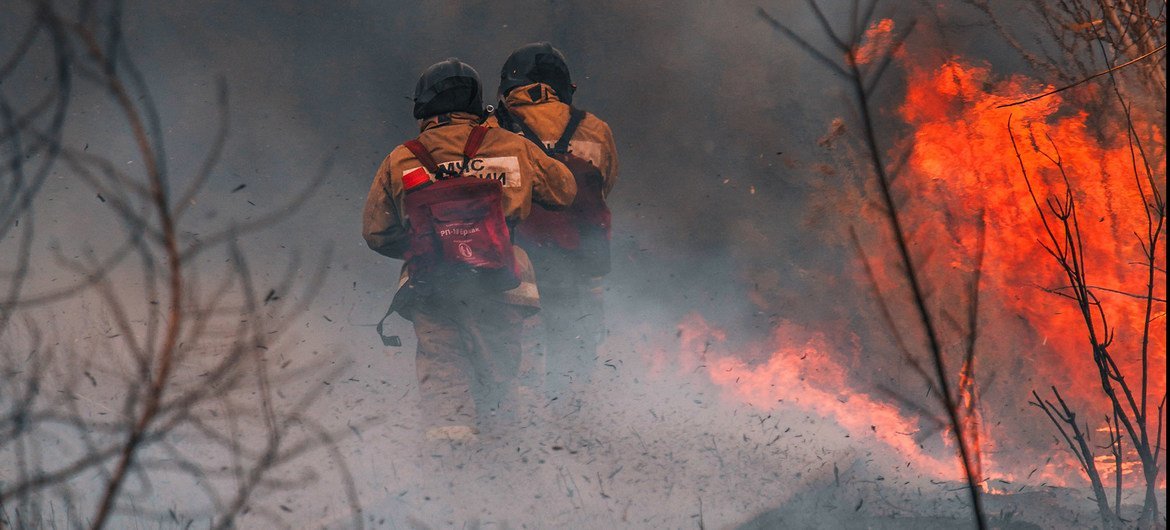
The rising global temperatures are already fuelling devastating extreme weather events around the world, with escalating impacts on economies and societies and fulling future wars.
What many don’t realise about the warming of the present Earth, is that once we pass a certain threshold, physics takes over, where multiple earth systems march past the point of no return.
We don’t understand the non-linear effects.
There’s are referred to tipping points, best described as domino pieces waiting to topple in only one direction to the end.
Tipping points we thought might happen well into the future are already underway.
It has been clear for decades that the Earth’s climate is changing.
Although positive things have started to happen, even if all countries commit to achieve net zero emissions by the middle of this century its too late to reverse.
Global climate change is not a future problem. Some changes (such as droughts, wildfires, and extreme rainfall) are happening faster than scientists previously assessed.
While natural drivers will modulate human-caused changes, especially at regional levels and in the near term, they will have little effect on long-term global warming, reversal is beyond reach.
We really are out of time,
The scale of recent changes across the climate system are unprecedented over many centuries to many thousands of years, and will not be reverse by any technology.
We cannot wait for decades to act, we have to start acting.
————
Already in this decade.
Concentrations of the major greenhouse gases – carbon dioxide (CO2), methane (CH4) and nitrous oxide (N2 O) continued to increase. The difference between where emissions are heading and where science indicate they should be in 2030 is as large as ever.
The lifetime of carbon dioxide is so long, one year anomaly in emissions doesn’t change the big picture.
The truth is before our very eyes, in the prism of social media videos of burning wild fires, flooding, immigration, food shortages, you name it and it is happing.
It’s hard to understand that there will be a fresh water crisis when some countries are flooding.
It’s hard to appreciate the Arctic ice is disappearing when the winter is filled with stories of extreme weather events.
We don’t know what’s going to happen to the Antarctic glacier, where we have the biggest mass of ice worldwide and in the worst case, we could see up to two meters of sea level rise by the end of this century if the melting of the Antarctic glacier happens in a speedier manner.
Tree planting isn’t enough.
Its hard to believe that 80% of all insect have died – no bees no pollination – no food.
Its hard to believe that our oceans alone are absorbing the heat equivalent of five Hiroshima atomic bombs dropping into the water every second.
Is hard to believe that we are in the process of unmoored ourselves from our past, as if we have transplanted ourselves onto another planet.
Its hard to believe that there will be ( Severe heatwave historically expected once a decade) heatwaves will happening every other year at 2C.
There is no huge chasm after a 2c rise, we are tumbling down a painful, worsening rocky slope rather than about to suddenly hit a sheer cliff edge – nearly one in 10 vertebrate animals and almost one in five plants will lose half of their habitat.
Its beyond belief that by most standards the world’s governments are currently failing to avert a grim fate with the fingerprint of climate change on recent extreme weather is quite clear to one and all.
The evidence is irrefutable.
We do know that the global average sea level will likely rise, putting the homes of 200 million below sea level in 70 years.
Around 216 million people, mostly from developing countries, will be forced to flee these impacts by 2050 unless radical action is taken. The frequency of heavy precipitation events, will start to climb, nearly doubling the historical norm once it heats up by 2C. Globally, extreme crop drought events that previously occurred once a decade on average will more than double in their frequency at 2C of temperature rise.
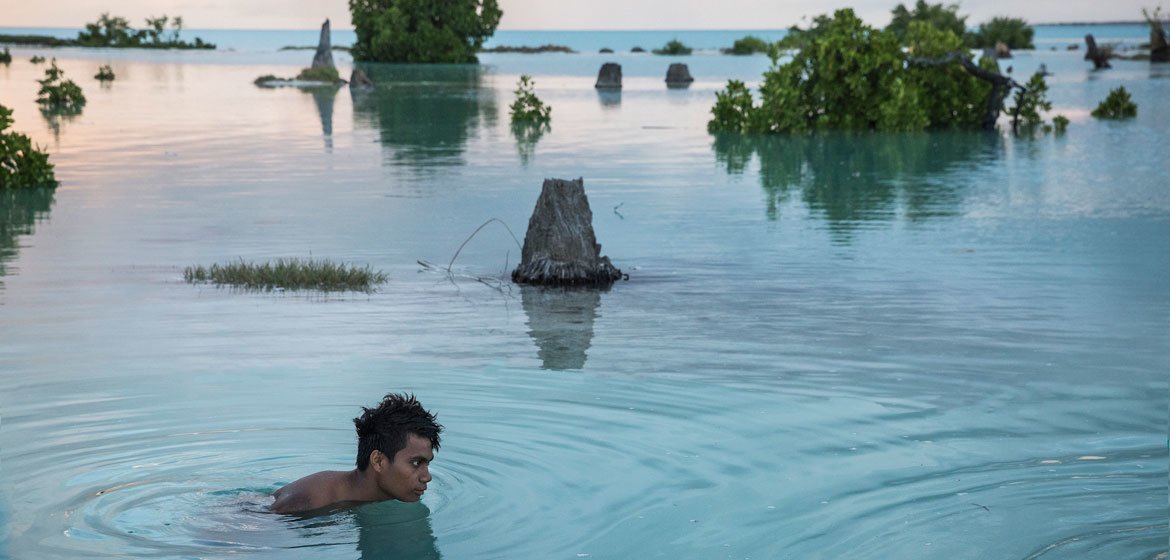
Extreme sea level events that previously occurred once in 100 years could happen every year by the end of this century.
Changes to the ocean, including warming, more frequent marine heatwaves, ocean acidification, and reduced oxygen levels, affect both ocean ecosystems and the people that rely on them, and they will continue throughout at least the rest of this century.
It won’t be just about temperature.
The consequences will devastate economies, infrastructure and political stability.
For example, climate change is intensifying the natural production of water – the water cycle. This brings more intense rainfall and associated flooding, as well as more intense drought in many regions.
The alarm bells are deafening.
The past 20 years there has been a 53·7% increase in heat-related mortality in people older than 65 years.
A chilling number of Earth’s other denizens, including 40 percent of all amphibians known to science (about 3,200 species) is under threat. Climate change, pollution, deforestation, overfishing, development, and invasive species are putting biodiversity in peril.
At least 155 million people, 2.3 times as many as live in the UK, were pushed into acute food insecurity in 2020 due to extreme weather,
In 2019, atmospheric CO2 concentrations were higher than at any time in at least 2 million years, and concentrations of methane and nitrous oxide were higher than at any time in the last 800,000 years.
The loss of the West Antarctic ice sheet and the Amazon rainforest, or extensive thawing of permafrost, as well as other key components of the climate system, are considered “tipping points” because they can cross critical thresholds, and then abruptly and irreversibly change.
Every fractional rise in temperature increases the risk of triggering one of 30 major tipping points. With just 1 degree C of current warming, nine of these are now thought to be beginning to tip. The Earth’s climate and ecological systems are deeply intertwined. A substantial change in one will affect others. Different tipping points are beginning to slowly crash into each other.
Arctic warming, along with melting of Greenland’s ice sheet, is driving fresh water into the North Atlantic, which could have contributed to a recent 15 percent slowdown of the Atlantic Meridional Overturning Circulation (AMOC) in the Atlantic Ocean. Those ocean currents drive heat from the tropics and are responsible for the relative warmth of the Northern Hemisphere.
We shouldn’t be discounting the legacy we’re leaving to future generations, no matter how far they are in the future.”
It is unclear when most of the tipping points will kick in, and the risk of those cascading into an irreversible global tipping point with tremendous impacts on human civilisation warrants a declaration of a planetary climate emergency.
No amount of economic cost-benefit analysis is going to help us now that we face an existential threat to civilization.
The risks posed by climate tipping points are not part of any economic analysis of climate policies, there there’s also a social tipping points, a broad societal awareness tipping point that will cause a stampede of migration.
Its hard to believe that we are just going to sit back and just watch.
It can be hard not to be despondent, so blinkered.
No wonder public opinion is not sending stronger signals to politicians that more urgent action is required.
How is it that we can have such strong emotional attachments when looking at nature, claim to love and appreciate it, yet be so indifferent to the destructive impact our way of living has on it?
We tend to be motivated by relatively short-term concerns. This may partly explain why we are so slow to accept what is happening. However if scientific knowledge about nature (which is what the natural sciences seek to produce) relies so heavily on producing facts which have been purified of their social, political, cultural and historical baggage, then when this baggage suddenly becomes visible, it causes anxiety and disbelief.
What if permafrost melting or flooding cuts off critical roads used by supply chains? What if storms knock out the world’s leading computer chip factory? What happens once half of the world is exposed to disease-carrying mosquitos?
The changes required are now so vast that many countries, companies, governments struggle to even articulate them.
Reaching a net-zero world will entail “wholesale transformation” in both infrastructure and how things are done. If business leaders truly grasped the seriousness of this crisis, they would immediately pivot their entire business models and resources toward scaling climate solutions full stop.
No matter what we do now, it’s too late to avoid climate change.
Perhaps most concerning of all is the fact that even if emissions of all greenhouse gases ceased entirely tomorrow, any warming would still persist for many centuries.
Countries will still remain umbilically connected to fossil fuels, subsidizing oil, coal and gas to the tune of around $11m every single minute. By the end of this year the world will have burned through 86% of the carbon “budget” that would allow us just a coin flip’s chance of staying below 1.5C.
Realistically what can be done ?
We know that every decision – every oil drilling lease, every acre of the Amazon rainforest torched for livestock pasture, every new gas or electrical -guzzling SUV that rolls onto the road – will decide how far we tumble down the hill.
To achieve anything requires a massive change in the Capitalist systems, away from GDP to Sustainability and Greed energy, benefiting not just the earth but all that live on it surface.
This will require the creation of a perpetual fund of trillions ( see previous posts) allowing every person to invest in a green future, closing the gap in inequality.
Such a fund could be distributed by non-repayable grants by the United nations under new UN blockchain plate form, with all country governments setting their own blockchain plate forms.
Each block is connected to the ones before and after it. Each additional block strengthens the verification of the previous block and hence the entire blockchain. This renders the blockchain tamper-evident, delivering the key strength of immutability. The result is newfound trust and transparency, because members share a single view of the truth, you can see all details of a transaction end to end.
Place a ban on all advertising that does not prompt sustainability.
Close all stock exchanges trading in Co2 as a product.
Cutting emissions tomorrow is better than the day after.
In the end the truth is that we live in a world of I am all right jack.
Not until our hair is burning and our tongues are hanging out, with our smartphone melted to our ears will we eventfully blame ourselves.
All human comments appreciated. All like clicks and abuse chucked in the bin.
Contact: bobdillon33@gmail.com
 bobdillon33blog