• About
  • THE BEADY EYE SAY’S : THE EUROPEAN UNION SHOULD THANK ENGLAND FOR ITS IN OR OUT REFERENDUM.

bobdillon33blog

~ Free Thinker.

bobdillon33blog

Tag Archives: Travel.

THE BEADY EYE’S UNPUBLISHED BOOK. CHAPTER FOURTEEN. SECTION TWO.

27 Wednesday Apr 2016

Posted by bobdillon33@gmail.com in Literature.

≈ Comments Off on THE BEADY EYE’S UNPUBLISHED BOOK. CHAPTER FOURTEEN. SECTION TWO.

Tags

Best Travel unpublished book., Top readable travel book, Travel book that will inspire you to travel., Travel.


Afficher l'image d'origineAfficher l'image d'origine


ZAMBIA.
What we know:

FORMER NORTHERN RHODESIA. VICTORIA FALLS. CECIL RHODES.

British need a visa 50$, car insurance 36$ and an hour of form filling we are on our way.
Stopping in Livingstone (renamed Maramba) we visit its small museum dedicated to a Scottish born doctor –missionary and explorer extraordinaire David Livingstone and his wife Mary nee Moffat. David, as you might remember, was one of my fantasy ferry acquaintances on our crossing to Africa from Europe. A forerunner of European Imperialism eventually converted to African Nationalism he had come a long way from Shuttle row in Blantyre eight miles outside Glasgow to be the first white man to see and name the falls on the 16 November 1855: Victoria (Known to the Kololo people who lived up-stream as smoke and thunder)

The museum does little to prepare us for what lie’s ahead the world’s widest expanse of falling water. It does, however, leave us with some appreciation of the determination of Livingstone. To put Livingston time in context the light bulb had just been invented one year before he was born. When he first laid eyes on the falls the bicycle still had iron wheels. Sparrows had arrived in the USA and it would be another thirty-nine years before moving pictures were invented. It’s only a year since the charge of the Light Brigade. There can be no doubt that he must have being gobsmacked as his canoe floated towards the lip. It’s no wonder he could not resist the temptation of some twenty-century graffiti carving his initials and date on a tree.
Indian smoke signals of white clouds are like him our only warning that the Zambezi waters are going to nose-dive headlong into a gigantic void. Will we be as gobsmacked? Not yet.

Our first view from the riverbank is restricted. White clouds of spray and dazzling rainbows block any clear view. The awesome power and majesty that captured Livingstone will have to wait till tomorrow. For us, it’s shower time at the Rainbow Lodge. Approaching the Zimbabwean border Victoria is coughing up a cloud every few minutes. Most are crossing in our direction. That is from Zambia to Zimbabwe. Over 95% of tourists arrive at Victoria on the Zimbabwe side. Formalities to cross over with Williwaw are a bit of a nightmare. As always calm, some good humour and the might of the dollar work’s wonders with the car papers causing most of the problems. Stamp, Stamp we over. Our one-day stay in Zambia is over.

See original imageAfficher l'image d'origine


ZIMBABWE.
What we know:

FORMER SOUTHERN RHODESIA. IAN SMITH. UN SANCTIONS. MUGABE. WHITE FARMERS. VICTORIA FALLS.  

We disappear one after the other into the tumbling hot water. Heaven in Africa is not difficult to find it’s a hot shower. How give a fuck about one millions of litres of tranquil Zambezi water that plunge over Victoria > Up to 650 million every minute in the rainy season. At this very moment in time for all, we care it might as well be a dribble. Situated right on the river edge just above the falls edge Rainbow Lodge is well named. Reborn we venture down to have another look.
David clean-shaven, sporting a moustache with long sideburns and a receding hairline found the falls while he navigated down the Zambezi in the hope of finding Gods Highway into central Africa. He first saw them some distance further down the river from where we are now standing. In another ten thousand years Rainbow lodge will have to move one and a half kilometres up river if it wants to stay from falling over the edge.

Disturbing two youths who are having an evening wash we emerge onto the very lip of the falls. The view across the leading edge is mesmerizing. Sheets of water reflect a canvas of the setting sun posing for a split second before, spilling over in long vaporizing blocks of water. One can follow individual chunks of water till they break into white drops right in front of your eyes. Further out the falls, the water disappears into large cracks where it gathers energy to make the jump into the unknown void below.

Twice the height of Niagara and one and a half times wider it impossible to get an overall view across the 1.6km width of the falls. Victoria is in fact made up of four falls: Devil’s Cataract, Main Falls, Rainbow Falls and Eastern Cataract. From its highest point at 108m water sprays up to 500m into the air creating a factory of perpetual white clouds that glide up into the sky. The only unquestionably unchanged caricature of the falls since David time is that the Zambezi River now dammed has changed its spirit utterly. On arriving at the edge as a smooth slow flowing river it changes in a wink into the rage of nature that David must have seen.

Afficher l'image d'origine

Returning to the Lodge under a full moon we are treated to a lunar rainbow, dinner and a deep sleep with water on the brain.

By the time we emerge next morning after yet another long shower session the sun is already poaching the land. Armed with some local knowledge the best way to get truly saturated is to head for the Chain Walk a pathway that descends down into a gorge called Devil’s Cataract on the Zimbabwean side of the falls. To fully understand the falls one has to realize that it is forever on the retreat. The present falls is the eight to appear on the river over the last million years. Each falls forming where the river finds a fault in the lava bed of the river. Devil’s crack is the latest and it is already 300m below the main fall line. Eventually, over the next few thousand years, the whole lot will pour down this crack to form the ninth site for Victoria.

Donning some wet weather gear we set off. The unremitting spray of Victoria gives the place its own microclimate. Just as in David’s time the falls are surrounded by lavish rainforest remaining both dramatic and dignified. Not so the hinterland, which has turned into a gold mine bastardized by the ever-increasing tourist commercialization. Now a major world tourist attraction with a population of 72000 living in and around its sides I am sure his Victorian constitution would take a turn for the worst.

Feeling somewhat strange dressed up in rain proofs we pay our entry fees. (Top TIP: Bring a waterproof bag for your cameras.) A trail through deep vegetation leads down to a jutting rock outcrop with many vantage points. Each stop taking ones breath away as the falls make’s public its claim to one of the world’s natural wonders. After the Sahara, the Kalahari and Namibian deserts we find it tricky to get our heads around so much water. God knows the way we are polluting the world drinking water it could be the source of many a forthcoming coming African war.

Around here you eventually realize that all paths lead to craft centres or craft villages and only a promise made at Danger Point overlooking Boiling Pot of lunch in the Victoria Falls Hotel saves the credit card from taking a pounding. The Victoria Falls Hotel is one of the few remaining old colonial old world hotels. Built in Edwardian style 1904 when the Cape to Cairo railway reached the falls it now caters to the well-heeled tourist.Afficher l'image d'origine

For the second time in our voyage, we feel inappropriately clad in shorts and tees shirts. In the splendid Livingstone Room, they don’t go with linen tablecloths, fine glassware, and an array of forks and knives to tax one’s dining table etiquette. This is made more than obvious by the standing waiter with a tray that is dressed in whites, gloves and red fez. “Madam” “Noilly Prat gin Martine please,” says Fanny “Would you like it served here or on the Stanley’s Terrace.” “Sir” “On the terrace; s’il vous paît; with a large Gin and tonic if you please. Perhaps the craft shop /village might have turned out more lenient on the plastic. To hell with it, this marks the starting point to the second half of our journey. With drinks in hand we watch a bungi jumper launch himself from Afficher l'image d'origine Over lunch I sign up for a one-day rafting trip in the morning down what called the Botaka Rapids.
7am the next morning “ Please sign the handed out forms.” Indemnities against all accidents and loss of life. Next the safety talk. Long swimmers. Hold on to the ropes on the side of the raft. Do as your raft leader requires and everything will be honkey dorey. Pay now drown later. My group consists of Dutch couple, an Aussie, a brother and sister, two employees of the rafting company and a black skipper. “OK, mount up.” I am sitting beside David our accompanying long swimmer canoeists. He hands out maps of the day’s river decent > Twenty-three rapids in total.

Looking at the map all the rapids are all suitably named to put the fear of God in those who have never done white water rafting before or who will never again. Rapid no 6 Devil’s Toilet Bowl. Rapid no 8 Midnight Diner > consisting of a choice of three runs. On the left “Star Trek” with a hole of 5m reserved for the brave, or down the middle called “Muncher Run”, or the right “ “Chicken Run.” rapid no 9 “Commercial Suicide”, “The Mother” rapid no 13, “Terminators One and Two” rapids no 16 and last but not least “ Oblivion “to name just a few.

Our converted Dutch army truck takes an hour to arrive at our launching pad so I have plenty of time to speak to David. Long swimmers turn out to be a bloke who has been swept some distance from the raft. It’s David’s job to go and fetch the drowning dude in his canoe i.e. long swimmers that are about to stop swimming. Short swimmers are those that pop up beside the raft. They are usually deal with by those who have not fallen out. If there is no left in the raft they should grab hold of the rope and climb aboard whether the raft is upside down or not.
The truck comes to a halt. Our first surprise is not long in coming. To get down to the river there is a long descent down the side of the gorge. Not by a track but step by step on a rickety ladder made from tree branches. With no handrails, it’s a true test of balance. The Dutch couples in front of me are making heavy weather of the decent. Our black captain raising his hand’s skywards in acknowledge of their difficulties. It looks like he has resigned himself to spending more time in the water than out of it. I can’t help sympathies with his premonitions. The Aussie brother and sister are attempting the descent by stepping in-between the ladder rungs. The inevitable happens. Crash! Down goes the long-legged sister chick ripping the ass out of her flimsy shorts exposing two juicy cheeks separated by a pink G-string. The panoramic view of which is not lost on our captain.

One hour later. Issued with life jackets and paddles we are assembled on the Rocky River shore. Raft places are allocated with two moons the sister getting the place of honour in the bow. Our rubber raft tethering on its painter in a backwater pool is then fitted with its steering oar. Twenty meters out from the shore the river boils. Pressure bubbles float into the backwater in long columns to explode like flashbulbs. “All aboard.” “Weil going to go twice around there for some practice.” Tayto > the captain announces indicating the circle with his hand.Afficher l'image d'origine
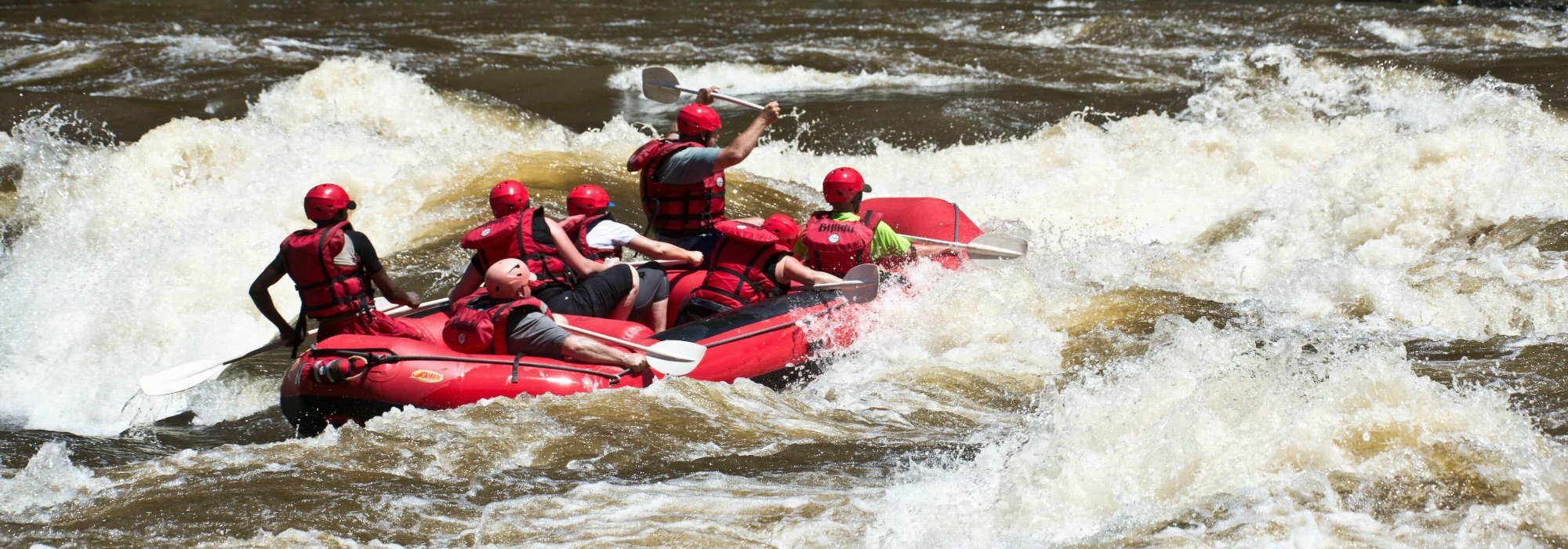
OK! “When I shout full steam ahead you are all paddle to getter.” “Good.” “When: I shout on the right.” “Those on the left are to paddle backwards and those on the right are to paddle forwards. “ On the left” those on the right paddle backwards and those on the left paddle forwards.” Good! Good! “High five all the paddles in the air like this.” He holds a paddle in the air over his head with his two hands. “Got It” “All aboard.” Around we go twice. ON THE RIGHT producing a clatter of paddles and ON THE LEFT producing a new command from Tayto, “All together please.” Round two. Not much better. The view, however, has improved with our bow lady throwing herself enthusiastically on Tayto command face down over the bow.

Hitting the main flow with paddles thrashing, Tayto’s legs muscle tense as the current takes the raft. Our first sight is David surfing upriver on a never advancing backwater wave. High five shouts Tayto we have just navigated our first rapid of twenty-three. The high-five apparently is also a team signal of our achievement. Neither of the Dutch Edams got wet. On we go. The next rapid presents no problem or the following three. Smiles with Orange Juice, all around.

The walls of the cannon tower on either side of us. Zambia on one side and Zimbabwe on the other. Next up is Morning Glory our first major rapid. On the bow, cheeks tighten. Toto’s voice disappears as we hit a hole and are swept towards the canyon wall to be dumped into another big hole. While those in the stern of the raft end up in the bow cheeks is catapulted head first into the drink. Toto’s black hand pulls her aboard revealing to all that she has lost the remaining tatters of her shorts. Stairway to Heaven is upon us before there is time for a short change even if she had a pair.
The Stairway is a class five rapid very steep and powerful with heaps of massive waves and holes. From where we are sitting it is an amazing spectacle. Its size and volume distract all eyes from the bow. Over we go in more ways than one. I surface beside the raft, which is upside down. A trusty Black Hand heave’s me out of the water. With some effort we right the raft. All are salvage except the Aussie our first long swimmer. Predictable being an Aussie he arrives aboard thanks to David with stories of never surfacing; see his life in a flash, escaping the jaws of a croc. The Devil’s hole shuts him up.
I am now well into the ride (Top TIP: Don’t miss it). With Toto working hard we enter Gulliver’s Travels the longest rapid. This is the most technically demanding rapid of our decent. Cheeks are in and out over the bow like a Yo-Yo. Accelerating the raft is like a bucking bronco. How we got through without turning turtle is all down to Toto skills. High five’s all around.
“All out here please.” “With this amount of water the next section is too dangerous.”
“You can stay Bob if you want.” Man what a buzz. The Zambezi’s most infamous rapid. This one is a river wide pour-over with a narrow slot less than a meter wide. Well named it is indeed not for the non-tutor. Commercial Suicide. Toto lines the raft to be spat out like a cork out of a bottle. The words, Awe-inspiring and humbling go a long way to describe the next few seconds, from beginning to end. A surge of acceleration a boom of exhilaration it’s no wonder mighty rivers of the world are the blood vessels of nature.
Safely through we pull in to pick up the waiting crew. Toto smile he can’t wait to put Cheeks back in the bow. The raft is given a few extra pumps of air. We pass Gnashing Jaws of death and Overland Truck Eater with on mishaps, other than Cheeks, whose cheeks begin to glow. Now over halfway the whirlies and squirts don’t seem so intimidating. We watch David spinning like a top in a whirlpool popping out to ride some more surf as we go at a speed through the Three Sisters and on to The Mother a massive wave train. Super. The Washing Machine then another wave train leads into Terminator one and two which are also wave trains but on the bigger size.
Toto reminds us all if we should turtle to look around when we surface. “There is always air under the raft if you need a gulp.” “ The Terminators are gigantic. I tell myself if anything is going to happen this is where it is most likely. Toto warns Cheeks to go to watertight. She grabs the lifeline with both her hands and feet.
He was right. The raft goes skywards depositing all in the lap of the River Gods. Toto like the waiting wave has already anticipated two hours previously that his luck would run out. With the agility of a Velvet monkey he somehow or other puts in a backwards somersault like as if he was taking the high jump. He lands on the upturned raft.
I have also seen it coming. There is no way I am going to be sucked into one of those boiling pressure points and burst an eardrum. I had also taken a firm grip on the rafts lifeline.
While two are manhandled aboard a black hand once more heaves me on to the raft. The Aussi surfaces right in front of me. Panic has set in. Looking in the wrong direction he is trashing the water like a hippo tail taking a dump. Luckily I still have hold of my paddle. There is nothing for it but to give him a smack of the paddle in the kisser. Now facing the right way he grips it. David gives the thumbs up sigh. I roar High Fives! No one seems to enthusiast as we plunge out of control in a crescendo of noise and foaming water towards Terminator number two. We whistle through the nearest to whistling down a warp hole in ao Flash Gordon book. Intensely > Spine-tingling > Call it what you want. It’s a hell of a buzz.
The raft flashes over Double Trouble with no trouble to coin a phrase. Oblivion makes it self-heard the last rapid of the day but not the least. This rapid is made up of three waves the last of which is responsible for more raft flips than any other in the world. Only about one in four attempts succeed. Not to worry Toto has it all worked out? We get fucked in the raft flips over we go head first to be flushed out into tranquil waters of a large backwater pool. “Never mind the crocs” “Right the raft.” Toto last instruct.

Righted the raft is now towed ashore where it is deflated by three waiting employees. It is then hoisted shoulder-high and carried at running speed up a similar ladder to the one we descended a few hours ago.

Before our long haul out of the gorge, a small waterfalls flowing over a smooth rock face into the pool catch the attention of a brave few. It inflicts a few extra sore bums to join Cheeks she preferring to stand in the cooling water rather than in the sun. (Top TIP: If you do it > make sure you plaster yourself with waterproof sun lotion and smear your lips with lip-gloss.)
Emerging from the long climb out we now treated to a cold buffet and a few tubes of Mosi a Zambia beer named after the local name for Victoria Falls. The beers go straight to our Aussie friend head he slurring to all in sundry who he was saved by his sister from Davy Jones locker. I did not have the heart to tell him that his sister had balls and it was I who gave him a whack of the paddle in the gob.
Several whiskeys later it is I who has verbal diarrhoea describing to the girls who I had spent the day in the fury of a giant tumble washer.

That evening we move I rather stiffly from Rainbow Lodge to Maramba River Lodge in the Mosi –oa- Tunya National Park and spend the next few lazy days swanning around somewhat reluctant to recommence our travels The Question is do we go around Lake Kariba on Zambia side or the Zambezi. A ferry up the lake from Saba to the Kariba Dam costs over 400$ one-way for two adults and a child with Williwaw. The trip takes over twenty-two hours to cover the 250 odd kilometres that are if the Ferry is running. On enquiring it’s no surprise that the invisible Ferry has not being seen for some time and that it is full. On consulting or maps and Oracle books, we opt for the Zambezi side.
First, we visit a small village outside Victoria. While I was in the Batoka Rapids cycle the girls had got wind off a village where there are excellent woodcarvings. Mad dogs and English men go out in the noonday sun. That is just what we do. Not for the first time or the last time. After several dead ends, wrong villages and near divorce proceedings we arrive. What we find is not wood carvings but an English Educated village Chief.
Parking Williwaw in some shade we are ushered into a large compound housing a large traditional African thatch house. On the clap of hands from inside, we bend on one knee and enter the Royal Chamber. Here we are greeted in perfect public boy school vernacular by his lordship. I have often heard of many a tribal Chief –tee working as a porter in Waterloo station. Here we have one for real, smirks and all. I take an on the spot dislike to his Highness. What follows is surreal. Here is a well-educated bloke exploiting his situation. Out the back of his time-honoured house are parked two top of the range 4×4 and a modern bungalow. You remember our village Chief back in Senegal who ripped off any willing tourist with a tour of this village and his four wives’. He at least had taught himself and providing for his village. This fat bastard was pocketing the lot. Tea and a Royal chat for a small fee if you please.
“What will happen if China invades Africa?” “Why did you not turn down your royal duties and stay in the UK?” “Is there a fee to walk around the village?” I can’t wait to escape this specimen of hip critical African. I leave the girls and take a wander. They emerge shortly after me with two wood carvings a Rhino and a Hippo, which I have to admit, are of exceptional quality but tainted by all he symbolizes.

(To be Continued)

Donation News: Like Victoria Falls they are flowing in. Zero. Be the First.

R Dillon Account no 62259189. Ulster Bank 33 College Green Dublin 2

Sorting Code 98-50-10


Share this:

  • Click to share on WhatsApp (Opens in new window) WhatsApp
  • More
  • Click to share on Pocket (Opens in new window) Pocket
  • Click to share on Mastodon (Opens in new window) Mastodon

THE BEADY EYE’S UNPUBLISHED BOOK: CHAPTER FOURTEEN: SECTION ONE.

26 Tuesday Apr 2016

Posted by bobdillon33@gmail.com in Literature.

≈ Comments Off on THE BEADY EYE’S UNPUBLISHED BOOK: CHAPTER FOURTEEN: SECTION ONE.

Tags

Best Travel unpublished book., Top readable travel book, Travel book that will inspire you to travel., Travel.


(Continuation)


The village awakes to the trundling of our convoy crossing the wooden bridge. We stop at the gate where our entry tickets are scrutinized to see if any more Pular can be squeezed out of us by the Gate warden.

He is unable to give us much information on the route up to Chobe other than no one has come down it this year since the rains. However, he warns us that there is no camping allowed between here and Chobe.   According to Warthog, we will have no option but to camp, as it will take more than a day to get across.

At first, the going is painless.

Slowly the track narrows into a deep v rutted narrow corridor.   The Ford driven by Warthog has one wheel in the rut and the other up in the edge of the bush.

The Germans with high ground clearance crawl along from one bump to the next bump fighting the steering wheel. While Williwaw in low range second gear wonders what all the fuss is about.

The ruts grow deeper. The Ford takes to the bush till she hits a root and puts his steering out of kilter. A halt is called. Straddling the ruts is not possible for the Ford so it’s back to one wheel in one wheel out.   I suggest that the Unimog should open his driver window and keep an eye on his front wheels. He would find it easier if his wheels were straight rather than battling the steering all the time. I am very much appreciative of our protection plate (A heavy metal shield attached to the underside of Williwaw to protect her engine sump.) (Top TIP: Don’t go to Africa driving without having one fitted.)

The track eventually flattens out onto a dry sandy ridge called the Magwikhew Sandridge. The going gets easier and we all arrive after a few elephants and pee stops at the southern gate to Chobe called Mababe. Afficher l'image d'origine

A stone-faced park warden welcomes us with the words that the camping site is fully booked out.   This appears to be a normal Botswana park tactics in order to squeeze a few extra dollars out of the visitor. “We are not stopping.” “All we want is a transit permit.” A few minutes pass while our man takes a radio call. He returns demanding our exit tickets from Moremi. Warthog has pulled a fast one back at Moremi when we were leaving. He had told the gate warden that he and his Aussie friend were on our Park permit. The Chobe gate is now demanding that I should pay. I blew a fuse and gave Warthog a verbal rollicking.

I can tell from his eye contact that he has not the balls to strike back if I were to lay one on him. They both cough up and all is settled African style. Some shouting, some foreign exchange a transit permit and smiles all around have us once more on our way into Savuti (Chobe National Park) a remote landscape embracing sandvelds, rocky outcrops, and acacia savanna, mopane forest that are highly vulnerable to fire and dry marshlands.   It used to be famous for its high intensity of wildlife. The current long dry spell has more or less put pay to that we seeing little sign of anything on four legs.

Twenty kilometres into the park we stop for the night.   With a transit permit we are not supposed to stop so we pull well off the track into the bush so as any passing wardens will not spot us easily.Afficher l'image d'origine

Pitch no 86, shows the tell-tale signs of Elephant Activity. Everything is dry as tinder. The slights spark would be whoosh for sure. Unexpected Warthog volunteers to make dinner and more amazingly show off some bush knowledge.   The construct a safe campfire avoiding a bushfire. .

First digging a deep hole he then digs a trench away from the hole at about half the holes depth.   He then inserts the grill of a barbecue into the hole above the trench depth.   Borrowing my machete he cuts some grass and kindling. When lit a large branch is then placed in the trench and pushed along it till the end of the branch is over the fire. More branches are fed down the trench till a good hot amber base is built. It is then covered to form an oven.

(Top TIP: Bush knowledge weights nothing. How to tie slip knots and a bowline is useful. Webbing strap knots > Double sheet bend knot > Splicing > How to read a compass. Buy one of those little SAS Survival Books. An off-road vehicle needs a high jack. You need to know all its applications. Winching and lifting > How to construct different ground anchors > the use of snatch pulley block.)

After an excellent dinner we all sleep soundly, but not before Florence and Fanny’s minds are put at rest about the possibility of any Jungle Trumpeting Patrol crashing out of the surrounding bush.

Chobe is divided into four distinctly different ecosystems. Where we are the Mabane Depression is Elephant land during the dry season. So we were lucky not to encounter some of Botswana’s population of over 120,000 some of which are the largest in body size in the whole of the African.

With the fire hole filled in so there is no chance of creating a bush, we bounce back out onto the track. Late afternoon after a hard drive we arrive at Chobe main port of entrance Sedudu gate.   On the requesting a visiting permit we are informed once more that the park is full.   “Full of what.” “We’ve just driven across the whole god dame park without seeing another human being, never mind an Elephant or for that matter any of its original inhabitants the San people otherwise known in Botswana as the Basarwa.”   It is obviously time to ring the bell and close the park, as the two park wardens are not willing to enter into discussions on the absurdity of their statements. We are marshal to the other side of the lowered barrier pole and told to come back in the morning.Afficher l'image d'origine

A few miles outside the gate we arrive in Kasane a small town that is situated not more than an hour from Victoria Falls in Zimbabwe. Pitch No 89 is in a private house garden. Warthog run foul of me, getting this second bollixing for helping himself to my gin and other items without asking if it’s ok. Not another word is heard till morning when last night’s reprimand is still smouldering. It’s time to go our separate ways before it comes to blows.   Warthog and Rickey roar off in the direction of Livingston while the Germans none the wiser shake hands as we depart our ways.

Returning to the Gate we decide to give Chobe a chance. Once more welcomed with the words, “the Park is full. “ Transit Permit please.” “ Please sign here.” We drive in and when out of sight we duck down a track onto the Chobe River. If there are any animals in this park they got to be near water. Not even a croc stirred. Perhaps they right the Park is full of sweet fuck all. We drive to Serondela campsite, which is supposed to be fully booked. There not a campsite occupied so we choose the best sit overlooking the river. Afficher l'image d'origine

Pitch No 90 is under some large trees with the tell-tale bark of Baboons.

Out of the twilight arrive two uniform park wardens on foot. Permit. “This is a transit permit,” I reply pointing to both sides of us. “I know back at the Gate there are no Visiting Permits to be had as the Park is full as you can see.” “You fellows look thirsty it’s a long way back to the Gate.” A drink is accepted and a half an hour later we have two friends for life. It’s agreed that I must return to the gate in the morning and get a permit. A bottle of whisky later our cards are marked as to where all the animals are hiding. With no sign of another bottle appearing they eventually get the message that we wished to retire for the night. Off they swagger into the darkness disturbing the resident baboon and monkey rookery that continues to bark its head off for hour after their departure.

We awake to a cold morning. Florence and I warm up with some monkey/baboon zapping. (Top TIP: A Widows Memory Catapult is an effective weapon against Hyena/Baboons and unwanted camp guests.) I eventually set off back to the Gate by the main track. Not far from where we are camped I pass a ramshackle of a building. It is from where our two friends of last night arrived.   No sign of either of them. I am not surprised. Once more my request for a visiting permit is met with the park is full. With what, I inquire? Fresh air. “You will have to move from site 5.” “OK, anything not to upset the other vacant sites.” On the way back, Williwaw develops a stiff gear change and seems to be overheating.

By the time I get back I am fit to leave Chobe to the maddening crowds. Florence has gone on a rooftop game drive with safari groups who have moved into site four. Fanny is feeding a real Warthog until I remind her that just because it is in a park does not mean it is not wild.

Warthog tusks can rip a lion belly open. They live in small family groups called Sounders; have no sweat glands so they wallow in mud to cover their bodies to keep cool. They have poor eyesight but an excellent sense of smell and hearing.   Run with erect tails up to 50km/h.   When under danger they scarper one following the other into their dens. The youngest ones go in headfirst while the male stands guard. When all are safe and sound he shuffles in backwards so his tusks are always facing any potential predators.  

We stay put on site 5 for the day. I brood over the cost of a new clutch while watching the medley of invisible campers going about their business. Fanny attending to some badly overdue house chores repacks our various boxes > Florence’s, books and education material box > our book box, medical box, herbs and flour, condensed milk and other goodies box. (Top TIP: Make sure that whatever boxes you take are waterproof.)

Manfred and his wife Julian take site 3 out of the thirty odd remaining sites. He turns out to be a German dentist and a keen motor mechanic. A few pushes of Williwaw clutch pedal reveals that it is clutch fluid or the lack of that is the problem.   (Top TIP: Make sure you carry spare transmission/brake/clutch fluid.)   With my gloom lifted we board Manfred Nissan for a short game drive. Three hours and five visits to locations supplied by my two whiskey-swilling wardens, we throw in the towel for a cold beer back at base.

 Before the final splash of the evening, color glistens on the river below us the heat of the days begins to vanish from the land without a trace. The silence is broken by two of Africa’s most recurring sounds, the early evening cricket chorus with the odd forlorn twit to woo of a distant plover. Both are a sure warning that darkness is not far off. Florence arrives back reporting not much more success than us. It seemed incomprehensible with the park so full of visitors that is has lost all of its animals.

A large full moon promises a chilly night. Long shadows in contrast to the ultraviolet rays of the sun that consume one all day long now turn every bush, every tree into ambush hides. In this sort of light, one gets a weird feeling that every sound announces the heartbreaking end to some animal’s life. You cannot help the edgy gut reaction to the slightness Crunch   Even when one take’s a pee you see eyes or movement where there are none.

By the time the girls hit the sack the bush TV is almost out.   We’ve all come to the conclusion that we are all still novices when it comes to spotting large herds of Chobe animals or people.   It’s time to pick up the bagpipes and follow in the footsteps of Doctor Livingstone 1831-1873 to one of the main attractions in the area Musi-oa-Tunya, the Smoke that Thunders, Victoria Falls.

In the bush when there is nothing much going on, one is prone to retire early with a book. I am just going to quench the last of the fire when out of the corner of my eye my two ranger friends are approaching down a long shadow. One looks as pale as the moonbeams, the other gibberish holding a plastic bag full of beers. I am silhouetted both by the moon and flickering bush TV. There is no escape.

It’s not long before eerie stories of Ghosts, Banshees, and Men turning into snakes and off your rocker beasts attacking gullible tourists is in full flow. The piece de resistance comes when I was asked if I believe in Magic. “Of course I do.” Well tell him encourages the gibberish one. Pale face announced that the other night when he had staggered back he had laid an egg. It is hard to keep a straight face as I enquire if it was hard-boiled.   By his looks of summoned up pain on his pale face, there is every chance he had indeed passed a gallstone. I feel somewhat sorry for taking the mic.

Before I surface Mr. and Mrs. Warthog have paid an early morning visit. Fanny takes one look at me calling off our departure. Chobe gets one more day to make public why it is so overcrowded. Due to my fragile state we hold fire until late afternoon to venture forth > Florence opting out.   Another fruitless excursion with Williwaw overheating does nothing to endear me to my loved ones. We arrive back at camp to find Florence has being holding the monkey population at bay. They had already done a job on the tent breaking one of the poles and ripping the foot of the tent. There is one male baboon that has been bearing his teeth at her, the clever little darling taking refuge in the jeep.   I give the bastard a ball bearing in the ass that sends it scarping.   Investigating Williwaw’s radiator for a leak I notice that the Universal joint on Williwaws back shaft needs replacing.   Down come the ammunition boxes off the roof rack. Tools and spares.

(Top TIP: Ammunition box are great for storing spares and tools. Make sure they have strong handles, and padlocks. I passed a chain through the handles padlocking them to the roof rack for security against theft. Buy padlocks that can be opened by one key (bring a spare). There is nothing more irritating than having a different key for each and every lock. Each vehicle needs its own spares/tools. What to bring and not what to bring is the question. The answer lies in many excellent publications on the market or talking to someone who has done a similar trip. The aim is to be self-sufficient as possible. One thing for sure you need your head in gear before tackling problems.)

The leak turns out to be controllable with a dart of Radweld but the Universal joint with a hangover is Another matter: (Top TIP: Like some bush crafts some tricks of the trade can make the difference between you arriving or not. The odd raw egg or curry powder in the radiator to seal a minor leak works.   If the leak is bigger remove the radiator cap to release the pressure. This requires regular topping up so not recommended where there is no water. There are hundreds of others tricks here are a few that are well worth noting. FUEL: Always take more than you think you will need. Use a filter when topping up from jerry cans. Sunlight soap can seal a hole in the fuel tank. If you can’t stop the leak put a Jerry Can on the roof connect with a pipe.   Know how to bleed you systems. ) 

An hour later I have uncoupled the shaft. A rummage in the spares discloses that my head is far from in gear. There is no spare. It’s a case of look before you leap. Nothing for it > Refit the old one and drive into Kasane.   The Four ways garage can’t help; there is a spare parts shop down the road. Eureka!   > Back to Four ways. Two cut knuckles, a throbbing head and the certainty that Murphy’s Law is waiting in the long tall grass blurs my recall of African mechanics. “Can you fit it for me?”   It takes all of three hours with a bill of 600 Pula. (Top TIP: Never leave your vehicle unattended. Mechanics are inclined to use excessive force. Never retighten bolts of nuts properly. Replace your new spares with old. Fry everything when electric welding (Forget to disconnect battery/alternator.)   I’m in no humor to suffer another Botswana rip off. A heated argument followed. “You’re not dealing with a raw prawn.” “I didn’t arrive in the last shower.” “I’ll call the police” have little effect.

Down the road to the spare parts shop > Back with the owner.   There is another half an hour of verbal diarrhoea before my headlights pierce the darkness for home 100 Pula lighter. The gate is closed and locked to keep the hoards in. I make short work of the Chinese lock. With every intention not to wake the girls or more importantly last nights storytellers, I drive the last few kilometres by moonlight.   Straining eyes are examining every bush in expectation of startling some critter. Not a soul moves. With no lights, there are no luminous eyes to be seen.

OK let’s hit the road Central Africa is calling. Zambia, Zimbabwe, Tanzania, Kenya, Uganda, not to mention the Democratic Republic of the Congo.   No one is very enthusiast. Some of Africa’s best-known names apart from Lion, Zulu, Famine, Aids, Coup d’état, and Tribe and the like receive a lukewarm reaction. OK! OK! How about? a decent hotel with a hot shower overlooking Victoria falls.

Chobe 11,000 sq kilometres of reserve waits until the final curtain call to show some of its huge elephant and buffalo population.   They have evidently learned that the outer limits of the park are the place stay. Well away from human meddling.   Not expecting to see anything, we drive into the middle of a buffalo herd. The Chobe bouncers. A mute silence surrounds them as they gawk at us as if savouring the moment. Not even the yellow-billed oxpeckers on their back move. It’s a stand-off.Afficher l'image d'origine

There is no question as to who has the right of way. Standing 1.7m at the shoulder, with massive horns ‘Syncerus Caffer’ to give them their scientific classification can weigh up to 800kg.   Close up these fellows are not to be messed with. Williwaws bull bars don’t look like much of a match against the fifty or so enormous horns all now turned towards us.   After what seems a never-ending period of time we slowly begin to back up only to become conscious that we are now surrounded.   Out of the bush to our rescue has come the Jungle Patrol.

A large bull elephant accompanied by aunties and young are now also disputing the right of way.   Ear flapping, making no distinction between us and the offending buffalos it not long before we receive a mock charge that tests our bodily functions.   Such charges make dramatic footage on TV wildlife programs here for real, it freaks the girls and exposes a definite yellow streak in my upbringing.   This is not the time to be hanging out the window offering bread buns.   Raw nature makes your hair stand on end in more ways than one. Panic!   All advice say’s “Hold your ground it’s only a mock charge.” The ground trembles. The spook buffaloes add an extra shuddering to terra firma. We turned a whiter shade of pale in a bat an eyelid the moment vanishes into the bush. We are left with a sense of sexual pleasure little shudders running up our bodies.   The exit gate to Chobe arrives and goes without us noticing.   For the first time in months, we are back on tarmac.Afficher l'image d'origine

An hour later at Kazangula still charged with excitement, we wait our turn to cross the Zambezi –  the forth-longest river of the Continent. (3,540 km) it drains an area of 1,300,000 sq km. Rising in northwestern Zambia it flows through eastern Angola crosses western Zambia, along the northeastern border of Botswana, forming the border between Zambia and Zimbabwe. Creating on its way the world’s famous Victoria Falls and man’s largest made lake – Kariba.   Giving its name to Zambia it crosses central Mozambique to become the only major African river to flow into the Indian Ocean.

Kazangula is one of those places on a map that exudes the idiosyncrasy of colonialism boundary making. Namibia, the Caprivi Strip, Botwswana, Zambia, Zimbabwe, all having shares in the dot.   As with all ferry crossings, it is a hive of activity, a gaudy mire of passing news, buying and selling, eating or drinking opportunities. A pickpocket’s favourite hunting grounds.   For us, it is where we leave Botswana, although the frontier crossing is another seven kilometres down the riverbank on the Zambia side of a mile wide rock rim that forms world’s widest expanse of falling water. Afficher l'image d'origine(To be continued)

Donation News: No change: Be the First. R Dillon Account No 62259189. Ulster Bank 33 College Green Dublin 2 Sorting Code: 98-50-10

Share this:

  • Click to share on WhatsApp (Opens in new window) WhatsApp
  • More
  • Click to share on Pocket (Opens in new window) Pocket
  • Click to share on Mastodon (Opens in new window) Mastodon

THE BEADY EYE’S UNPUBLISHED BOOK: CHAPTER FOURTEEN.

24 Sunday Apr 2016

Posted by bobdillon33@gmail.com in Literature., Uncategorized

≈ Comments Off on THE BEADY EYE’S UNPUBLISHED BOOK: CHAPTER FOURTEEN.

Tags

Best Travel unpublished book., Top readable travel book, Travel book that will inspire you to travel., Travel.


Afficher l'image d'origineAfficher l'image d'origine

BOTSWANA.

What we know:

Once known as Bechuanaland, we know zilch about Botswana other than it has a wonderful sounding name.

With four fifths of it covered by the Kalahari it is no wonder that its currency is called “Pula” the Setswana word for rain.Afficher l'image d'origine
Crossing the frontier near Sehengos we follow the Okavango on its journey to the world’s largest inland delta > (16,835sq km of lagoons, channels and islands before disappearing into the sands of the Kalahari.) Our day is spent avoiding donkeys and potholes, which we were, warned about at the border, not the potholes rather the donkeys. . By the time we arrive at the Island Safari Lodge we are shattered.

On checking in I enquire from less than a friendly moron named Nigel as to where the river is. He seems to think that all campers are only one step above the donkey shit that fertilizes the Botswana roads. I get a grunted answer that it has not rain enough for the water to reach the Island in years. In our tired state Pitch no 84 takes some arguing as to decide under which tree to camp. After a restless night I wake to my fiftieth birthday. An excursion by mokoro better known as a dugout canoe is the ideal present.Afficher l'image d'origineAfficher l'image d'origine

First we got to find our departure spot. Passing through the notorious buffalo fence that killed thousand upon tens of thousands Wildebeest and other wildlife. Set up in 1954 in an attempt to separate Botswana’s massive domestic bovine herd from their wilder cousins to stop foot and mouth it is over three thousand km long and 1.5 meters high. It blocked ancient wild migration pathways to sources of water.   A few corridors in the fencing would have saved and spared many an animal an encrusting death from thirst.   Somewhat sore of arsed after two-hour of bumping up and down in the back of our driver’s jeep we arrive out a sandy tongue.

As usual the competition for our business is in your face. Mokoro owners jostle for position each promising an experience of a life time > a trip better and cheaper than the other. All is eventually sorted. Fanny and Flo board their dugout with I in another. Two Canadian fellow excursions follow us out the narrow channel that appears too narrow for the dugouts to penetrate.

Sitting inches from the water this is one of Africa classical experiences. You glide along silently parting the Papyrus that cast their gleaming gold flowering color on clear waters. The feeling of being part of nature is overwhelming. The vast silence is punctuated only by the drip from the long pole as it pushes us out into our first lagoon. The papyrus acts as an immense filtering plant filtering millions of tons of silt and sand. Regrettably because of the buffalo fencing from our entry point, one has to travel a very long way to see wild life. Apparently for days if you want not to see reeds, reeds and more reeds.

Time waits for no man; my Birthday is celebrated on a small island to the cry of a fish eagle and a few egrets the pop of a Champagne bottle and a slice of birthday cake compliments of Fanny. A rendering of happy birthday with a ting of Canadian lumberjack beat breaks the Okavango slow rejuvenation.

With all returning to its relaxed pace I leave the girls to stretch their backs and legs for an hour while I try my luck at catching a tiger fish. Returning empty-handed we glide back to the awaiting bumpy trip back to camp which tests what remains of our best-padded backsides.

(Top TIP:   A dugout canoe has no backrests, shade, or seats. Bring a golf umbrella, some thing soft to sit on. If you have Bad back syndrome? – Steer clear. Golf umbrellas don’t take up much room. They are invaluable in the blazing sun when watching animals, fishing, or in those downpours in the wet season. )

On the dusty road home we decide that the only way to get an overview of the region is by light aircraft. When we enquire as to the possibilities of arranging a flight grunt face at the camping site is as helpful as a crocodile. With my ass having developed a rash from the ride back he gets a bit of my mind.Afficher l'image d'origine

Next morning at Maun, a young New Zealand pilot welcomes us. From the take off it is obvious that he fancied himself as a bit of a macho kamikaze merchant. Florence turns a whiter shade of pale and sees her breakfast for a second time as we bank steeply after take off.   The hour flight is disappointing animal wise.   We traverse mile after mile of reflecting waters. However it is obvious from the air that the waters of the Okavango are retreating.   “It takes anything up to six months for the water to arrive here from the Angola,” says our pilot, > “The Okavango heartbeat.”

“ It used to be the size of Wales “ Over ten billion tons of water that starts as the Cubango river in the Angolan highlands changes into the Okavango on entering Botswana to be channeled into the panhandle by two ridges fifteen kilometers apart at Seronga.” “ Here under the searing power of the sun it evaporates in a labyrinth of channels, and what left vanishes into the sands of Kalahari or the Kgalagadi as it is known to the Bushmen.”   “ You know that the Kalahari sands cover almost all of Botswana so it’s no wonder that there is a large temptation to siphon off some of the liquid jewels of the Delta. “Look two elephants.”   We bank so steep we all nearly see them in Technicolor.

Back on terra firma armed with the banks manager name I visit the bank, which seems to have the same crowd still waiting for service that were in the Rundu Bank.   Spotting the lesser-spotted manager I give him a shout. There is nothing like inside knowledge. My swollen sense of justice in skipping the queue is obvious for all to see as I leave unable to hold eye contact.

Returning to camp we learn of a pool not far away full of hippo and large crocs. A late afternoon sortie to the deep pool full of stinking green water we encounter our first hippopotami, > Far from the best introduction to the river horse of Africa.

Fossils of hippo have being found in Yorkshire in England. The live wild animal is now found nowhere in the world except in Africa. Weighting up to 1000-4500kg they can stay under water for up to 25 minutes at a time. Close their slit nostrils when they are submerged they can swim up to thirty-five kilometers a day in search of food. Eat 159kg of grass at on evening sitting.

Living in groups that can vary from ten up to one hundred and fifty their tusk-like canine teeth in the lower jaw ( weighting up to 3kg) settle many and argument and terminate many a foolish tourist that get between them and water. Their 5cm thick skin suffers from sun burn the reason they spend the day with only their ears and nostrils above water. Their meat is edible and a soup is made from their hides as well as whips known as an sjamboke. One of the best spreaders of fertilizer they get their name via Latin from Greek, Hippos – Horse+ Potamas – River.   They are the Okavango guardians in as much as they keeping the watercourses open by following clearly distinct pathways.

We slip out of Island Safari camp before sun up after a god nights rest. Moremi Wildlife Reserve located in the northeastern part of the delta and described by Mark Nolting as one of the most diversified and beautiful is our next port of call. Situated north of Maun in the Haila Plateau the hundred odd kilometers on atrocious dirt road is only negotiable by four –wheel drive.Afficher l'image d'origine

We arrive at the south gate “Have you booked?” No! “We are full” A group of South Africans are also at the gate. “We have paid by bank draft but the bastard has no record of receiving the payment and is now looking for Pula.” “Who the hell is Pula?” Standing in shorts with legs up to her armpits says a blond bombshell while she flutters her eyelashes at all and sundry.

“What’s your name I enquire of the gate warden?” “Moses” “Well Moses you’re my man.” How about 3rd bridge campsite is that full also? “You should have booked in Maun.”   “They told me that you Moses were the man, so how about it?” Ten to fifteen minutes later with 4/500 Pula lighter we camp just inside the gate pitch No 85 on the roof.

Morning breaks cold enough for Fanny to request our major kit bag.   Luckily the sun saves the struggle to find her thermal long johns. They never see the light of day.Afficher l'image d'origine

3rd bridge camp site is forty km up the middle of the 3000 km² reserve of swamp, dryland, floodplains, riverbank forest. On a narrow sandy track under trees that are taking on their autumn colors the drive is stunning.   We emerge onto a small airfield, which we are to see once more and once more. Around and around we go lost. Track after track bring us back to the airstrip. Not one bridge did we find never mind the 3rd bridge > A light aircraft lands. Fanny takes a prisoner of one of the awaiting driver, who thunders off down at full throttle one of the many tracks I now know as well as he does.   Pointing out the window “Ah that’s where we went wrong.”Afficher l'image d'origine

Arriving at the wooden bridge the reception – a small group of campers fully understand our need to drive right into the creek. What bliss swimming in the crystal clear water before setting up camp Pitch No 86. The first visitor is a hornbill unfortunately without the bottle of Guinness.

Later that night we awake to our first deep throat lion roar the sound of nobility of absolute authority.   Vibrating in the silence of the night it sends shivers of excitement and fear down one’s backs. It creates a unique atmosphere of menace and expectation. “How near it is dad?” “Are we safe?”   “What if it comes into the camp?” With all the assurance that we are not on its dinner list I am sure that Florence and Fanny listened for a long period like I did before shuteye arrives.

I am up early, keen to get started. Unlike Etosha this is a hand on reserve. Over breakfast our South African south gate friends arrive. A quick look in our bird book confirms that the blond is not such a rare poser or endemic.

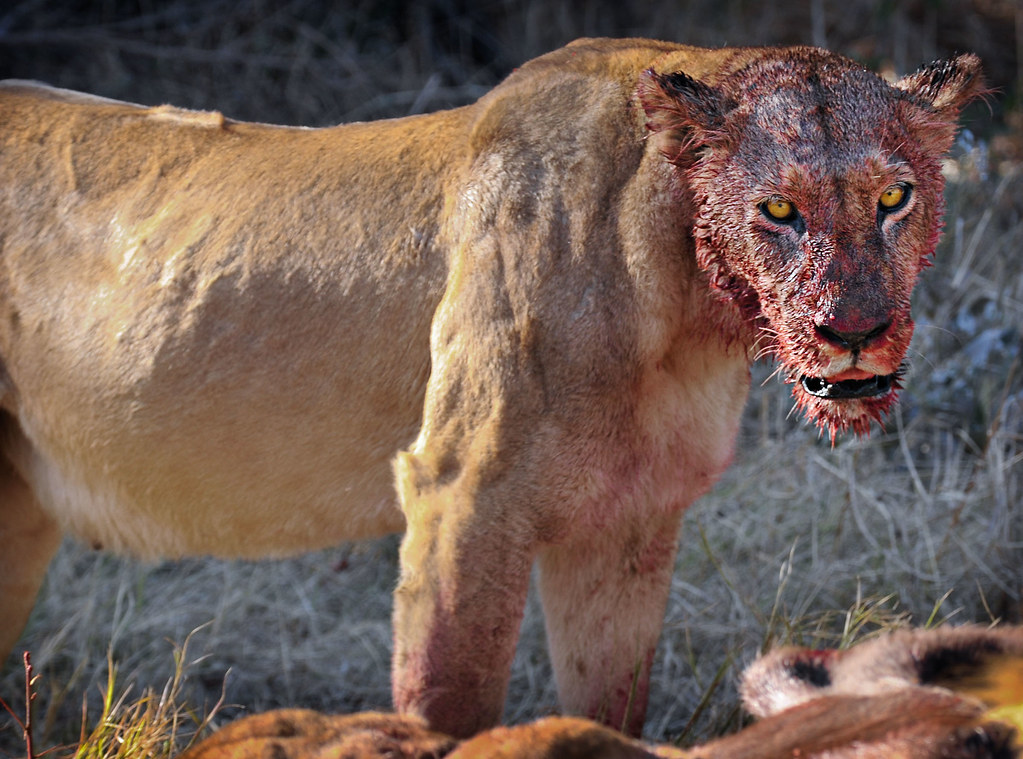
Nothing is Africa quite prepares one for your first lion kill.   All the wild life documentaries, photos, you name fall short of the real life event. They like here in these written words are incapable of capturing the smells, the raw senses of survival, the power, the pecking order, the flies, the heat, and the knowledge that you could be dessert.

Rounding a small lake we noticed some commotion in the bush. Lions!   Rolling up the windows we drive off the track closing to within three car lengths of the kill.   Nine furry ones are dining on a buffalo. They are aware of us but take little interest.   We watch for hours. Snarls, snaps, squabbles, yawns, blood stained whiskers, stink, skin and bone. A hundred shots later we leave them in peace determined to come back in the morning to claim the buffalo horns.  Afficher l'image d'origine

Arriving back at camp those yellow staring eyes remain with us late into the night.   A large campfire with fresh bush baked bread and some monkey theft finishes a day of days.

After a long good look around I open Williwaws door back at yesterdays kill site.   Not a scrap it left horns and all have disappeared. Returning for a spot of breakfast I spot the pride lounging on the other side of a pool.   With ballooned bellies they begrudgingly move when I drive up to them. I could have pushed the stuffed gathering into the pool with the bull bars for all they cared.

Back at camp two new arrivals have parked up > A bran new Unimog with a young German couple and an odd pair in a converted ford. The Unimog is decked out for serious business. Solar panels, winches, 700-liter fuel tanks, fridge, the works. The battered ford in contrast regurgitates a South African and an Aussie the odd couple both with a fondness for the grog.

Before we get trapped in conversation we mount up for our second wander of the day. Unlike Etosha one gets a real feeling of being out in the bush here. There are no speed limits, no times to be back inside walled campsite, no tourist shops, and no swimming pools or man-made water holes.   Moremi wildlife and scenery is much more relaxed without the constant fear of spotting something and attracting a herd of clicking tourist. Moremi offers wildlife on a more personal one to one base.   We have not ventured far when Florence spots a small group of antelope. They turn out to be Greater Kudu. Reddish brown to pale gray in color > white strips running down their sides and along their backs. Standing dead still they watch us with their spiraling horns. Elegant and graceful they go about their business slowly for ever watchful. Not a stone throw away content to allow the Kudu stand sentry a small herd of Impala the long and high jumpers of Africa are also grazing.

The rest of the afternoon spotting taxes our Ornithologist’s appreciate. Fish Eagles; parrots, egrets, kingfishers, herons, to mention just a few we could id. The day is rounded off with a few Hippopotamus with the ever-present crocodiles, and a fleeting glimpse of our first Cheetah to wet our appetites for to-morrow. What a privilege we have undergone. It is difficult to put into words that would justify our sense of living.

Back at camp darkness has not fallen more than a few minutes when over strolls our two Ford friends an Aussie named Rick with Bushy his South African friend.   Bushy helps himself to a beer without asking. He is one of these excellent merchants that the word covet describes him to a tee. Whatever he lays his eyes on is his. I could see that he was going to get up my nose sooner than later. Fanny and I take an instant dislike to him and I agree that he has all the attributes of a warthog.   Later that night around the Bush TV (the camp fire) he endears himself to one and all. We discover that during our absence two Norwegians fresh out of the fiords have joined the campsite. The Unimog couple is quiet and somewhat shy.

The campfire conversation is when, where, and what did one see.   The Norse men saying they saw a leopard up a tree not a mile away when they we driving over here.   A night drive is suggested so one Norwegian, one Aussie, one Paddy and one warthog set out in the ford. With us all looking up into the trees including the driver it not long before we come unstuck or I should say stuck in soft sand.   Warthog informing us that the ford is only two-wheel drive and proceeds to digs in even further.   So much so that we have to take the sand tracks down off the roof.   After a good deal of digging, grunting, and nervous looking around we are eventually back on the track.

On we go until we arrive at a bend to be confronted by the lion pride, which is on the move – yellow eyes dare us to go any further so we turn tail and return to the bush TV.   Over a few beers we learn that our young Germans have just started their dream trip a lifetime. They have driven down the side of lake Kariba at five miles an hour from Harare and at the moment have no real plans of where next. They are both disheartened, the causes of their problems being the choice of transport – the Unimog and the young man’s lack of off-road driving know-how.   Apparently he could not handle the ruts the Unimog acting like a trampoline. I promised to give him a driving lesson before we leave.

Our last day in Moremi confirms that beauty is eternal and wherever one finds it protection is needed.   We visit one of the Reserves Safari Lodges that caters for the richer tourist. Our visit over an expensive beer is accepted with less than a ‘You are welcome’ attitude.

We realize that our camp under stars you could pluck, surrounded by inexplicable stillness of the air, with a sense of being watched by some many eyes of passing animals or abandoned spirits, beats hands down the manicured lawns, waiters with silver trays, buffets, gin and tonics, safari rosters, the smell of anti mosquito aerosol.

We return to camp convinced that we are the spoiled ones.

That night while preparing for an early departure in the morning the young Germans approach us. They inquire where we were setting off too. Our plan is to go north into the Chobe National Park, which according to our map is just a short hop from Moremi north gate. They ask can they join us. “No problem” we’ll see you in the morning.   Somehow Warthog has got a sniff of our plans. The plot thickens. Over he saunters “I’ve been up that way before and I can tell you that from here to Chobe is a mother fucker of a track > Nothing but soft, soft sand.   Later on the bush TV it emerges that Warthog knows what he talking about.

Although Chobe is not more than sixty kilometers away there is no marked dirt road. The option of following the only map-marked road up to Livingston offers over three hundred hot kilometers of corrugations. By cutting cross-country and traversing Chobe we will save over a hundred kilometers. The plan is to enter the park through the Mababe Depression cut through the Savuti an arid region in the southern section of the park named after a dry river that has not flowed since 1981.   The fear of the unknown wins over the Germans. The prospect of some off-road driving combined with some excellent game viewing opportunities wins our agreement. Mark W. Nolting book (Africa’s Top Wildlife Countries) describes the Savuti area of Chobe as excellent for Elephants with large populations of Zebra, Eland, Kudu, Antelope Waterbuck, Impala, Wildebeest, and of course with that lot good lion country.

(Top TIP: BUY A COPY. It is packed with current up to date information, with no bullshit and has good attention to detail.)

Over breakfast the problems begin to surface. The easy part was last night, when we all agreed to team up.   Two bums with a clapped out Ford, two young German lovers with a Unimog decked out to the nines and one Irish man, wife and child with a seasoned Land Rover.   Fuel is the first problem. Where we are going there is no fuel to be had until we reach Kasane over two hundred kilometers away as the crow flies on the other side of Chobe. > The second largest of Botswana national parks covering over 11,000sq km. The nearest possibility is back in Maun. It is decided that the Unimog, which has a large spare tank, will go into Maun and fill up.   We still have over 150 liters but we have learned the hard way that any off-road driving especially in sand burns up more fuel than one assumes.   The last thing one wants it to have to lug a jerry can on foot through bush where there is every prospect you might run into hungry lion. Never mind the distances, the sun, and the impossibility of carrying a full jerry can which would all end in a spectacular failure.

Looking at the two Ford reprobates warthog has a face like a smacked bum as red as a beetroot when I insist that it’s money up front for the fuel. They have just discovered that Rickey’s credit card is missing > “Must have left it in the supermarket in Maud.” “He will have to go back with them and see if he can find it.”

A decision is taken to meet up at the North Gate later that evening. We leave in the late afternoon. Meandering along now with an inner knowledge of Moremi’s tracks we get one surprise an up to the bonnet fording of a large pothole.   Arriving at the North gate there is no sign of the others.   Pitch No 87 is on the roof looking out on a long narrow wooden bridge that crosses over a dried out river to a small village and North Gate.   Florence and I take a wander across the bridge while Fanny prepares dinner. We return with a few cold beers. There is still no sign of the others. Whether we see them tonight is now in doubt. Darkness is approaching fast.   An hour later the alarms of the local monkey population announces the fords arrival to be followed some thirty minutes later by the bouncing lights of the unimog.   The card has being recovered and everything is oxo for the morning.   Both Germans look a little worse for wear. Fanny serves dinner to all.

TO BE CONTINUED.

DONATION NEWS; The good news is that they might break Zilch any moment. The bad news is it look very unlikely to happen, but hope is eternal.

Robert Dillon. Account no 62259189. Ulster Bank, 33 College Green Dublin 2. Sorting code 98-50-10


Share this:

  • Click to share on WhatsApp (Opens in new window) WhatsApp
  • More
  • Click to share on Pocket (Opens in new window) Pocket
  • Click to share on Mastodon (Opens in new window) Mastodon

THE BEADY EYE’S UNPUBLISHED BOOK. CHAPTER THIRTEEN.

23 Saturday Apr 2016

Posted by bobdillon33@gmail.com in Literature., Uncategorized

≈ 2 Comments

Tags

Best Travel unpublished book., Top readable travel book, Travel book that will inspire you to travel., Travel.


(CONTINUATION)

THE CAPRIVI STRIP:

After a false start due to a cock-up on our camping bill we exit the north gate on our second attempt. Our map shows a long haul up to the strip so halfway to Tsumeb we gibe and take the rum line across the Huila Plateau. On the map it looks a good ploy saving buckets of kilometers. All goes well until we arrive at an unmarked T-junction. After some discussion we head off down the dirt track unknown to ourselves in the right direction. It not long before that famous and world-renowned invisible person named Doubting Thomas raises his voice. We put in a U-turn after taking some directions from two locals who like all Africans say Yes, Yes to any direction.

Arriving back at the T-Junction we decide that the GPS of our African friends is in their buts rather than their heads. We are saved by a passing lifeboat a Toyota, which Fanny flags down. It comes to a hesitant stop some five hundred meters up the track.   Four sturdy white faces march back to greet us. “Yes back down the road is good.” “You are going to the monument.” “The biggest Baobab tree in Africa.” Take a right at the first gate after that there are thirty odd gates to open and close.”

By gate ten all the saved kilometers are vanishing fast.   Fanny is driving and I am on gate duty.   By gate thirty it looks like it going to be a miserable pitch for the night out in the middle of nowhere. Gate forty we hit the main drag and there up the road is a motherfucker of a baobab tree. Monument it is with is very own plaque. Pitch No 82 is under an enormous branch as thick as the trunks of many a larger tree. The main trunk is all of 9 meters.   A hemispherical mass of foliage gives shade up to a diameter of 45meters.Afficher l'image d'origine

Baobabs trees are unlike other trees each is unique with its own individual style. We fuel our campfire with the husks of monkey bread as large as a small melon the fruit of the Baobab that has a white pulp inside with a very acidity chalky taste.

To our surprise morning breaks fresh and cold.   Without the hassle of opening another gate we arrive in Rundu by midday. Ten kilometers outside the town we camp on the roof overlooking the Cubango River.  Afficher l'image d'origine Across the water is Angola once more. Pitch No 83.   We’ve not quite yet reached the mouth of the Strip, which is another good day’s drive away. We are not in any rush Florence’s birthday is on hand. Our well-chosen campsite at the Kavango Lodge is compliments of our bible.   It has an excellent bar, hot showers, and a small restaurant. A birthday cake is arranged with an African evening trip down the Okanvango River followed by dinner in the lodge makes a birthday we hope she will remember.Afficher l'image d'origine

A visit to Rundu bank in the morning turns out to be an experience. Crammed full to the door the waiting clients watch one cashier counts a bundle of filthy notes oblivious to the mob. After one hour I leave with a soaked tee-shirt and a large thirst empty-handed. God knows how anyone gets any business done. We stay another day just enjoying the river activities.Afficher l'image d'origine

The Caprivi once a highly militarized zone patrolled by South African forces until 1968 has many game parks. There not an animal left in any of them. Bordered by Angola and Zambia in the north with Botswana to the south it does have two of Africa best know rivers flowing through its thirty-five wide and one hundred and eighty kilometers length > The Zambezi and the Okavango. It came into existence after a deal between Britain and Germany and is named after Georg Leo, Grat von Caprivi (1831- 1899) It’s now a limbo land owned by Namibia.   A poacher’s paradise with nothing left to shoot other than your own foot.

We move up river to Popa Falls our next pitch No 83. As to how they qualified to be called falls is anyone’s guess. A large weir would be more fitting.Afficher l'image d'origine Rather than pitch in the designated camping site we drive right down to the water edge. Fast water with no menacing eyes about but the girls feel safer on the roof. We have hardly set ourselves up for the night when down the small track leading to the river comes a red ford van.

Its two Etosha punters who had bored the long john’s off us each evening by showing us their video footage. Blue skies, the inside of the video camera bag when they had forgotten to turn the damn think off. Lions that went into focus elephant’s leg that panned out to the backside of a zebra. All topped off with a running commentary. “Not again I cry, hide, hide.” We are saved by the narrow rut of the track the van reverses back up the track without spotting us. The girls hit the sack early. Snuggle under their mossie nets; I take a wander down the track to see if our unwanted intruders have camped and to be put on alert of an early morning visit. No sign of them. Instead I find Daza and his merry band from the Brandberg. A broad open smile and firm handshake makes me welcome to the campfire. They have just come from doing the Etosha thing and are on their way up to the Okavango Delta.

Over more whiskies than I care to remember, I get to meet Daza group of Overlanders. Coming from far and wide they are a mixed group mostly in their late twenties. I don’t remember much about the campfire conversation except putting the following question to the group. What African sounds have you heard that you like the best so far? The roar of a lion, the bark of a baboon, and the trumpet of an elephant came the answers. “And You “For me it is the sound of a solid shit in a long drop. “How about you Daza?” He thinks for a minute and says with that wonderful smile of his > “My mother calling me in for dinner. I stagger back up the track oblivious to any sounds.

Daze team of two provide three meals a day erect the tents each night and according to him put up with every whim and whimper. He is the Tour leader, driver, and mechanic. The trip is thirty-nine days in all starting in Cape Town ending in Nairobi.   Popa falls is day eleven.

Breaking camp is slow and arduous. We decide to follow last night’s Daze advice to leave the strip and head south to Botswana and the Okavango Basin.   By the time we arrive at the Botswana border I am not much better suffering from slow eye disease. I struggle with the form filling. It’s a long flat bumpy drive to Maun. The girls, god love them struggling to put up with my ill temper as we drive through the strips main game reserve which I am more than critical about.

TO BE CONTINUED


Share this:

  • Click to share on WhatsApp (Opens in new window) WhatsApp
  • More
  • Click to share on Pocket (Opens in new window) Pocket
  • Click to share on Mastodon (Opens in new window) Mastodon

THE BEADY EYE’S UNPUBLISHED BOOK. CHAPTER TWELVE . SECTION FOUR

23 Saturday Apr 2016

Posted by bobdillon33@gmail.com in Literature.

≈ Comments Off on THE BEADY EYE’S UNPUBLISHED BOOK. CHAPTER TWELVE . SECTION FOUR

Tags

Best Travel unpublished book., Top readable travel book, Travel book that will inspire you to travel., Travel.


( CONTINUATION)

Afficher l'image d'origine

Banked by barren hills on either side the Kunene River widens to accommodate as few small lush islands before plunging down over twenty odd falls all combing into a gaping geological fault which creates the Epupa Falls. Compared to Victoria Falls it is small but its location is breathtaking.   This is a hand on waterfall with Jacuzzi baths pools on it’s every edge deep enough not to be swept over the side.   What more could one want after a long day in the blistering sun than to sit in a natural bathtub? Let the heat flush from our pores to the sound of cascading water, birdsong, all kissed by the setting sun. We can’t wait for the morning.

Back under the trees while darkness mutters too itself without pause our fire glows. The fall’s noise is designated into second place long before the sun peaks over the trees by insect song.

Morning comes with a din of feathered excitement amplified by the valleys vaulted walls. The bird population is having their morning bath> A twitches paradise. The Kunene River at this spot is characterized by dense reed banks and tall trees its life-giving perennially waters attract feathered friends of mind-boggling verity.

Our bird book receives many ticks. Blue-cheeked bee-eaters, Yellow-bellied bulbuls, Spectacled and Golden weavers, Giant and Grey-hooded kingfishers, Goliath heron, Martial and African fish eagles, White and red-billed hemetshrikes, not to mention the Rufous-tailed palm thrush and the Cinderella waxbill two of the rarest birds in the whole of South Africa. This is one of Namibia’s prime beautiful destinations.

As the sun cast its intense gaze from corner to corner the night’s air loiter on our nude bodies, fresh sparkling water pours over our heads into our private bathtubs pools.   We are reborn in an aura of adventure and discovery. Long live the needs for a four-wheeled vehicle to reach Epupa.

Up the bank from the falls, we find a swimming spot with no need to watch out for crocks.    They have a dislike for fast-moving water. We swim surrounded by plants that suck the colour from the rocks. Waving Makalani palms, Baobabs, and wild fig trees soak up the colour mist that wafts up from the gorge that is displaying three to four small rainbows.

Up from out campsite we find the first signs of the desecration to come.   A small luxury under canvas establishment offers visitors who fly in all the comfort of home from home.   Over a very expensive lunchtime beer, we learn that there are plans to dam the river below the falls. The death knell for the Himba and the falls are already in the balance. Epupa isolation sadly is under attack.   Like many an Amazon tribe, the need for protection has been sacrificed for short gains. The Himba need isolation to maintain their cultural vibrancy. Regrettable all the sign of another way of living and dying with or without ancestors is in the process of being consumed by world materialism.

It is a known fact that most visitors to Africa, never see further than the tarmac roads. Millions live in villages to which no roads lead but the current thinking about values: the way we view the world around us and how we behave how we measure costs are influenced regrettably by short-sighted roads without much symbiosis.

For us, the way north is blocked

The prospect of crossing over into Angola and making up to Cameroon crossing the Democratic Republic of the Congo, never mind the Republic of Congo and then Gabon not to mention the last stumbling block getting through Nigeria, is far from reality in the bounds of arriving home safely. We will turn us east and run the Caprivi Strip.

With breathtaking views, the rest of our day is spent climbing over rock washed to a silky and shiny texture exploring the Gorge. We return to our swimming spot for a late evening soak before dinner. A few elderly Himba women wander into camp to sell the family jewels and some home-made Himba dolls.

The power of trade is greater than the iron fist. Beads for gold, oil for dollars, land for peace, grace for heaven, sin for hell.   I wonder will the world end up trading drinking water and air for life or are we already doing it under the camouflage of the World Bank and its like.

The depth of darkness beyond one’s campsite is always a test in Africa. You never know what watching, waiting, is it >  a sting, a bit, a blow, a fright. Here in Kaokoland apart from the man-eating Kunene crocks sadly there is little hope of any animal disturbed your day or night.   Our bible say’s there is a chance of seeing black rhino, giraffe, and ostrich, lion. During our three weeks, we had only one magic moment when we came across in one of Colin Britz isolated spots five or six Hartman’s.  As for the rest, we fear that they are long in the cooking pot or god forbid hanging on some wall. We remember seeing a TV program on the Desert Elephant and can only hope like the Himba that they will both survive.

Morning brings a surprise. We wake to find two groups of South Africans camp on our doorstep. We are baffled as to why they have chosen to pitch camp on top of us when there are lashings of beautiful spots available. Maybe they are afraid of the dark, not the night dark, but the skin colour dark. An after breakfast polite request that they might consider giving us some breathing space is met with boar fuck you from a Burt Reynolds type.   We have long learned to step over dog turds, so rather than argue the toss we decide to pack up and leave the next morning. That night’s rowdiness confirms our wisdom.

Our Colin map shows a track that follows the Cunene up to Ruacana Falls the direction from which our new South African friends came from. We decided to enquire at the encampment as to the conditions of the track. “It could take anything up to three days to make it as far as Ruacana and then there is no certainty of you getting any fuel”.

As if we needed any further confirmation the banging and cursing of tire and wheel changes that last all morning with the look of the South African hired Toyota confirms that it is a long way around by way of Opowo.

Arriving midday the girls visit the only shop to replenish our dwindled stocks as best they can. I in the meantime struggle with a welding torch.   Eventually finding the proper mix to get the torch alight I use one rod after another till the exhaust is sealed with a weld that looks like a loaf of bread. (Top TIP: If you don’t have a clue re-welding a few hours learning might come in handy.)

We camp some twenty kilometres outside Opowo Pitch No 80.

We break camp early. Colin had advised us before leaving Walvis Bay that he would contact his old friend Steven Briane who runs a private small game park on the western side of Etosha called Hobatere Lodge. He would ask him to open the western gate to Etosha, which would save us some considerable dust time.

Heading south we climb over the Joubert Mountains.   Covering 144 kilometres we swelter by Otuzemba, Otjondeka, Okatijura, Okonjota till we eventually at Otikowarbe and are driving down the western boundary of one of Africa’s most famous Game ParksAfficher l'image d'origine

A hundred and forty clicks off pisé in one day in soaring temperatures takes its toll. We are grateful to arrive and open the gates to Hobatere Lodge. Steven turns out to be less than welcoming. He is in bad need of some PR training. He has heard from Colin but it is obvious that he has made no effort to get the Western gate open. He does not even have the grace to offer us a drink. We return down the track somewhat peeved but notice on the lodge’s entry gates reads – 15 Rand charge to any day visitors should have forewarned us of his unwelcoming attitude to us. Driving out the gates we are tempted to leave the fifteen Rand with a note to stick it where the sun doesn’t shine.

With the sun casting its evening palettes of red we turn off at another sign marked camping.   Up a fifteen km track, we come on another lodge. “Sorry the camping is full but we do have a lodge vacant.” It’s late and I can see the girls have had enough for one day. “What for dinner”?   We stay the night.

Prior to dinner, I spend a most agreeable hour in a small bird hide. Dinner is with our host and hostess and a hunting guest in the form of an overweight boring German cop and his wife. After dinner, Florence finds a new friend a Bat- Eared Fox. Grayish-brown with enormous ears it has little trouble in winning Florence’s heart.   Our host tells us that they mainly eat termites, and mate for life. This one they found injured and it is now a house pet.

With the girls tucked up in bed I have a long chat with our host over a few whiskeys. In his late forties, he has been farming the surrounding land for over fifteen years. It is hard living but it has improved with the establishment of Etosha in 1958.   Now all around the park, there are guest farms lodges to cater for the large tourist population that visit Etosha.   He knew the layout of the park like the back of this hand and is pleased to mark the best spots to see the big five the sole ambition of American Tourists > Lion, Elephant, Rhino, Cheetah and Leopard.

Like all farmers, he has a fully-equipped workshop with a car pit. In the morning my bread loaf welding is replaced with a professional job compliments of the house. We depart silent and refreshed.

We’ve not gone a half hour when it is about turn in our own dust and up another track with a sign market Cheetahs.   Flo and Fanny had heard from our overnight hostess that this lodge had several Cheetahs both tame and wild.Afficher l'image d'origine

They are our first large predator and our first classical Africa animal could not be passed by with all the promises had made to Florence since we had visited the Mole game reserve in Ghana some months ago.   Driving into the lodge we are met by a tame mongoose or to be more correct a Meerkat.

The lodge is constructed in a most strange stone.   According to the owners, it is some form of fossilized algae 600-700 million years old. One thing is sure it makes the bar of the lodge agreeably cool.

Stroking a Cheetah is a large jump up from a Meerkat.   It is the first large cat of Florence’s life and she is more than hesitant to afford it the same affections as she did to Mr Meerkat down the road. This close without any cage bars stoking its back is like petting a stick of dynamite with the fuse burning. The encounter wets our eagerness to get to Etosha (The great white Place.) one of the many Noah Arks of Africa we are to visit.

One can’t help wondering where all the animals of the world will be in another million years. The man has followed them all over the world since time began. Will he ever be able to communicate with them?   If there is no drinking water or pure air will animals outlive man?   Share the world with them. Will there be animal’s half animal half man?   We still have a lot still to learn from them.

Back in the bar, we learn that both the Kowares and the Galton Gate into Etosha are closed. We head for the main gate named Andersson’s gate after John Andersson who discovered the saltpan (the great white place) with Francis Galton in 1851.Afficher l'image d'origine

The first thing we are struck by on entering the gates and driving up to Namutoni (one of the three designated camping site in the park) is not an elephant but that we are entering a world of big business. Thirty minutes later we arrive at Namutoni a French Legionnaire fort established in 1851 it served as a control post during the rinderpest epidemic now the main complex of the Park. When the epidemic abated it remained as a trading post with the Owanboland.Afficher l'image d'origine

Destroyed by the Owambos in 1904 it was rebuilt in 1906 when the German First Lieutenant Adolph Fischer took command of the resident German garrison.

He was later to become the first warden of Etosha. Originally named Omutijamatinda in Hero language to describe ‘ the strong water coming from a raised place’ it is now a national monument and a sanctuary for what remains of Namibia’s four-legged creatures who depend on the thirty or so man-made water holes and springs.

Pitch No 81 is under a large Mopane tree with all modern amenities at hand, power point, water tap, and a barbecue. A large communal block with washing basins, showers, toilets resides in the middle of the trees. There are about twenty other campers on site, not South Africans as they are all well spread out.

The Tourist shop photos have Florence more than annoyed that we have to wait until morning. But she is in for a treat as the waterhole near of campsite is floodlit. So after dinner, we join the waiting congregation. We do not have to wait long. Out of the dark, an Elephant lumbers down to a barrage of flashlights and hissing video cameras. Within a minute, another joins it. It’s to be the first of many more Elephants photos to bore our friends with on our return.

Standing on the concrete terracing with floodlights lighting the waterhole is far removed from seeing a wild free animal. It is a thousand times better than a visiting the Elephant enclosure in a Zoo or for that matter seeing an Elephant in one of today’s large extravaganza circuses but there is no getting away from the feeling of the contrived setting.Afficher l'image d'origine

The waterhole has a magnetic hold on both animal and its human viewers.   Suddenly out of the blue or perhaps more fittingly out of two hundred kilos of vegetable matter with fifty gallons of water a methane bomb explodes. The larger of the two elephants has broken wind. It is a silent and deadly wafting over the terracing. It sends his admirers, tripods, video cameras, and still, photographer’s coughing for cover only a small black and white plover called a blacksmith plover stands its ground.   Pecking at the Elephants feet it defends its patch of territory without a gas mask.

Armed with the rules and regulations, a map, and the latest sightings of the big five we all set out for the morning hunt. To the sound of a bugle announcing sun up and the hoisting of the Namibian flag, we set off. Remembering that the gates to the compound close at sundown, we head west skirting the pan. We’ve not gone a few kilometres when we come across our first giraffe. Although we are less than fifty paces away we nearly missed them. The tallest of all four-legged animals standing at 5.3 meters it is hard to believe that one could drive by without noticing them. They are feeding on tall acacia.

With tongues of up to 40cm long, they pick off the early morning unfurling leaves. Giraffes can go without water for up to a month getting all the moisture required from leaves. This is one of the reasons that you can come across them a long way from water. They are non-migratory with a keen sense of smell and skyscraper sight. They are able to run a 56kmph not bad considering they can weight up to 800kg.

On the trot they look like as if they are in slow motion due to the hind legs reaching in front of the rear legs. Changing down to walking pace they switch to simultaneously moving the two legs on either side. It was the held thinking that the long necks evolved to eat high up but now it looks like they are sex symbols > The longer the better. During the mating season longer neck comes in handy to bash you rival suitors with > Called necking. Female’s necks are now also thought to signal I am the one for you. The female after 15 months produces one calf. The poor blighter all 2 meters of him or her is dropped from a high that would but off anyone having to stand up within twenty minutes. Stand they must if they are to avoided one of their few predators the lion.   They chew the cud like cows. Have valves to pump blood up to their brains, which are a long way from their hearts. Each has its own unique markings like the register plates of a car. These marking get darker as they age. In the wild unlike captivity where they are known to live up to 35 years they live to about 25/26 years. To drink or eat grass is a pain in the neck. They have to adopt a more compromising position – rather like doing the splits with their front legs.

Most of this we did not know until returning to camp and consulting a book called Africa’s Top Wildlife Countries: Mark W Nolting. (Top TIP: A good animal book gives one a far deeper appreciation of what you are watching.)

Our next encounter is a troop of Baboons > A powerful aggressive animal weighing up to 40 odd kg. Not to be tangled with.   There are many different kinds depending on what region of Africa you are in. Ours is a greyish-brown with a green tint along their backs > Known as pig-tailed baboons. They are one of the few animals that have a collection of calls each call signalling a different action. There is one to get up a tree and another to get the hell out of a tree depending on where the attack is coming from. Leopards have a liking for the odd baboon steak. They can distinguish colour and have good smell sense.   Live in large groups for social and protective reasons they avoid forests favouring open ground with wooded areas, rocky outcrops. They are not one of the girl’s favourite’s animals. A snarl, bearing those long teeth sends the heebie-jeebies up one’s spine.  

Etosha by African standards is a very large park originally 80,000k² has now been dwindled down to 20,700sq km of which quarter is a saltpan once a lake until the river disappeared. This Salt Pan gives the park a very unusual setting for its game. The shallow depression is in the middle of the park is classified as a saline desert.   Animals crossing the pan look like they are hovering in the thin air. With a total of over one hundred mammals and a rich bird population of which one-third are migratory, it is a photograph every minute of the day.Afficher l'image d'origine

We move on towards Etosha middle camp called Halali. The word halali is of German origin. Used to signify that the quarry has been brought to bay and the hunt is over it seems somewhat to fly in the face of what the Park aspires to.   Just beyond the campsite, there is a lookout point that looks out over the pan. We stop here for a bit to eat after which we venture out onto the pan on foot. This is a no; no in the park rules. Only your head and shoulders are allowed outside the vehicle. In the shimmering heat of the pan surface, not a thing moves as far as the eye can see. How anything could live out here is mind-blowing. But we don’t venture far just in case.

We move on up to the last camping site called Okaukuejo the main administration camp.   Okaukuejo originally meaning “The woman who has a child every year.” is where the Ecological research centre has its headquarters. It directs the conservation projects of Etosha. Along with the compulsory tourist shop, there is a large stone tower built-in 1963, and a vast restaurant, swimming pool. It was once a control post to stop the spread of rinderpest disease> A contagious cattle venereal disease which spreads like wildfire. The very same disease decimated the cattle herd of the Masai. Afficher l'image d'origine

We return to our base camp visiting a few waterholes on the way. Not another animal do we see. After dinner, the floodlit waterhole is a must. This time armed with gas masks. Out of the darkness, a shape appears. With twitching ears, a Rhino approaches. Very bad eyesight makes it approach agonizing slow. Stopping to smell its surroundings after each step forward it looks like we will be asleep by the time it reaches the water.  This one sure knows how to pose for those waiting cameras. Fully frontal ten minutes, side right profile ten minutes, side left profile ten to twelve minutes. Advance a step and repeat. (Top TIP: Telephoto lenses are essential in games parks. Slow film is the better bet, and it is advisable to fit all lenses fitted with UV or haze filters. Bring plenty of Film and spare batteries. A blower brush, cleaning fluid, lens tissue. Keep uses film in a cool box. Digital great but watch out for dust)

Day two: This time we decide not to go charging from one water hole to another but to stake out one of the waterholes recommended by our farmer friend whom we had stayed with the other night. We head off north to another pan edge, drive to a man-made watering hole named Andoni.   What a day, our first Lion.   He is an old codger that has seen it all.  Not a bit fazed by Williwaw he proudly scents a bush beside us and meanders off with attitude.

Top of the food chain their roar can be heard up to nine kilometres. Standing at 1.3 meters high at the shoulders and weighing up to 250kg they can sprint at 50 to 60 km/h and eat at one sitting up to 44kg of meat. They are polygamous breeding every 18 to 26 months. In captivity, they live for up to 20 years in the wild 12 years. They live in prides or groups of more than one family of up to 35 animals. Some, however, live nomadic lives. When they conquer a pride they often kill all the cubs fathered by their rival.

With the excitement over we move on. Next is a small herd of black-faced impala skirts some problematic bush watched over by the male. Favorite fodder of lions they use scattering tactics to confuse their predators leaping up to 9m and as high as 3m. They can live in herds up to a hundred animals breaking up into smaller breeding groups after the dry season. Those males that are not successful in establishing a territory remain in bachelor groups.

In amongst this small herd, we spot a few Kudu a larger antelope than the Impala it has long spiralling horns of up to 1m. Like the impalas only the males have horns. A shy animal it sticks to the cover of bushland.

Our next waterhole produces nothing except a convoy of safari vehicles. Etosha sadly has a large dose of park language. “Have you seen anything”? “Yesterday we saw” “There is an ——- up the road.”   At waterholes, you are lucky if you have more than an hour on your own without someone arriving either to scare off what you are watching or park their vehicle in front of you.

We decide to leave and try another spot. Out on the pan in the mid-day blazing sun, we spot a group of Zebra. They say their stripes act as heat deflectors. We can only marvel that they can withstand the heat, which bounces off the pan making them appear and disappear in waves of shimmering vision. Their blurred outline standing in such hostile surroundings gives one a twinge of sadness.   We throw in the towel and head back for a swim.

Day three our last and final day:   The girls decide to sleep in, so I take Williwaw out to another waterhole in a more isolated part of the park.   Nothing moves except the flies the tormentors of both man and beast.   An hour passes in silence. It’s like sitting in a block of time with your mind wandering up many avenues of thought but settling on none. Birds, mostly shrike, fuel up for the day. I am thinking to myself that any minute now something will appear and sure enough it does.   An American arrives with his private guide. Dressed in whites he is armed with a tripod and camera big enough to bring down a charging Rhino. We are fast approaching the hour of day 10am when most living things bugger off for the day to rest. I am just about to turn the key and scarper when I overhear him enquire from the guide as to what type of fox is that. Down at the water a mangey side-striped jackal is targeted in the lens of his camera. That is it for me I decide on the way back it is time to push on in the morning. Ark Etosha is a bit too commercialized for us but long may its work continue for there many an African who have never seen an Elephant, Rhino or Lion, never mind a Fox.

That night we witness the glorification of this commercialization with the arrival of an overland truck to dwarf all trucks > A land liner/cruise ship on twenty-four wheels. Out pour thirty ages tourists. God help the stars of the park tomorrow.

To be Continued,


Share this:

  • Click to share on WhatsApp (Opens in new window) WhatsApp
  • More
  • Click to share on Pocket (Opens in new window) Pocket
  • Click to share on Mastodon (Opens in new window) Mastodon

THE BEADY EYE’S UNPUBLISHED BOOK. CHAPTER TWELVE. SECTION THREE.

22 Friday Apr 2016

Posted by bobdillon33@gmail.com in Literature.

≈ Comments Off on THE BEADY EYE’S UNPUBLISHED BOOK. CHAPTER TWELVE. SECTION THREE.

Tags

Best Travel unpublished book., Top readable travel book, Travel book that will inspire you to travel., Travel.


( Continuation)

Long before one-armed Chris can cause any problems the convoy set off at the crack of dawn. We crawl up and over the rocky hill, I came down last night. Twenty kilometres into the day drive Williwaw blows her exhaust just at the sound box. In the silence of the desert, she roars like a tank. Temporary repairs reduce the noise.

The plan is to follow the Somadommi River and camp that evening at Purros.   The sun makes it difficult to hook up meaningfully impressions, with any scenery. Everything is warped, distorted. Shades of shale colour on the ground mingle into one block of a parched desert.

A midday stop brings to light that our new companions are two x Royal Navy captains. Robin and Robert with their perspective anchors Julian and Juliet.   It seems that Juliet daughter has marked a map, which is produced. My eyes read a note on the map < bare and beautiful sandy desert. > I make a mental note to veer to the right when we get going again.   The bare and beautiful can wait till mother and daughter are together. We have had enough sand for a lifetime.

A dust devil (mini tornado) passes over us lifting Williwaws sun canopy sucking Robin’s hat skywards.   Covered in a shower of dust it’s a sort of macho event as no one made a move even though we all saw the funnel approaching. I am sure that our two Captains as I had seen waterspout at sea. Mind you I had never experience been hit by of one. It gave us quite a wake up to take evasive action in the future and not to stand there with our mouth open.

After Purros, we push on to Orupembe our first Himba settlement/village. Not a Himba or Himbo to be seen.   Not to worry says the bible they are a nomadic cattle loving people who move from one location to another. We have a close look at one of their beehive style dwelling. Inside there are a few utensils and it is obvious from the number of empty bottles about that they are rapidly developing a liking for the daemon alcohol.Afficher l'image d'origine

Afficher l'image d'origineJuliet map has a campsite marked on their some ten to twelve kilometres to the north.   The lure of a gin and tonic, dinner with some British sarcasm and wit defeat any other course of action. However, pitch no 75 presents the first real test of 4×4 driving. The site is situated on an island at the source of the Somadommi River.

To reach it we are faced with a decent of a steep riverbank onto a sandy dry riverbed and an even steeper out on the opposite bank has to be negotiated. With Williwaw roaring I lead the way. The decent is no problem. The whole trick is not to get stuck in the soft sand and to have enough speed to attack the opposite bank. In low dif, we hit the floor a dart of smooth acceleration and we are across. Three car lengths from the out bank I whip her into high dif. We mount the opposite bank, doubling clutching I change her down as she drags herself out. We have just cleared the bank when Robin at the helm of their Toyota on their second attempt goes air born Dakar Rally style. Landing on all fours the Toyota bounces up and down on its suspension to the sound of Fuck my head. All inside hit the roof twice for good measure.

Installed in amongst the trees that night we all get to know each other better with Florence getting her first music lesson on the recorder.   Morning > my head won’t take another day of Williwaw blowing exhaust so with some effort I make a splint out of last night Heinz bake beans cans. Some wire and a substantial smearing of exhaust gum we once more have a silent Williwaw.

After a few slip up to find our bearings it is out with the compass. Gravel plains as far as the eye can see. Our target is a red drum about fifty kilometres to our north than another 80 or so more through the Mountains to the banks of the Cunene. The drive is rugged with striking topographical features. A craggy escarpment run’s parallel to the coast, dividing the interior plateau from the lower lying, semi-desert steppe, which gradually merges into the gravel, flats which we are on a haven for four-wheel driving.Afficher l'image d'origine

Arriving at the red drum our high point we crawl down into the stunning valley of the Hartmann’s, named after Hartmann’s zebra which aew extremely agile, more adapted than gemsbok at digging for water.   The drive is gobsmacking. Open grassveld country called the Marienflues.   Trees and shrubs are mostly absent.   A sea of golden grass dotted with large and small circles of exposed terra cotta earth some time called fairy circles or hardpans depending on the theories of their origin.

Prof. Theron South Africa theory: Euphorbia plants once grew in these circles then died leaving poisonous chemicals in the soil. Prof Moll’s South Africa theory:   Tropical termites are blown in during the wet cycles but snuff it during the dry season. Another is that the hardpans are layers in the soil, which are waterproof making plant life impossible. We like the fairy one. Florence theory: Fairies practice ground for weaving their wands burning the grass.Afficher l'image d'origine

On our right, the Otjihipa Mountain range comes into view and our first signs that we are approaching the Cunene. Birds:   Where there are birds water cannot be far. Furthermore we have been travelling downhill for some considerable time also there is a similar smell in the air as when you are at sea approaching an Island.

Our new bird book is in overdrive. There are ten species of birds, which are endemic to the Kokoland/Damaraland with two of the rarest in the whole of South Africa found only along the Cunene. They are the Cinderella waxbill and the Rufoustailed palm thrush.

We arrive at the banks of the Cunene full of the joys of the Kaleidoscope of Physical beauty. The landscape now changes from the dry Mopane savanna and the open grassveld to the dense riverbank vegetation almost tropical forest. Leadwoods >Sycamore fig> Boesmangif with a striking pink flower, Strangler fig, Makalani palms all too much for the amateur botanist.

Our campsite chosen by Colin is six kilometres beyond Otjinungwa just above some rapids. The water looks inviting but no one is in a rush to take the plunge.   Fourteen-meter crocs as large as fallen tree trunks slumber on sandy banks. With visions of one-armed Chris Pitch, no 76 is no the roof. Colin, however, has told us that far up the river there is a bend where it is shallow and safe for a wash. True to his word we find a sweeping bend. With Robin on croc watch, we strip off and soak the day’s heat away.   The sparkling crystal clear water has some little fish that nibble our bums or feet a Japanese treat in this unspoiled jewel of nature. In the true sense of the word an unforgettable day.

Morning brings a visitor. He appears as if out of thin air promising to return with some gemstones.   A lazy day with a spot of fishing is in order. (Top Tip: Bring a fishing rod and some tackle.)   I am obviously using the wrong bait for not a hint of a bit do I get. If only Chris was about I could have borrowed a morsel of his arm.

In the late afternoon, we the men drive down to the rapids. They are located down towards the Skeleton Coast. It does not take long before we meet sand.

Parking some distance from the river we walk past a dilapidated sign indicating mines. An old wreck of an army vehicle bears witness to the sign so our footsteps follow the leader till we reach the river. Across on the opposite bank set in dense tree cover the remnants of an army lookout post that add to our tingling hair sensation does not mention a dozen Goliath size crocodiles.

I know from Colin that many a poor soul was tossed into the river, as croc fodder during South Africa guerrilla war contra SWAPO (South West Africa People’s Organisation.) and later when a full-scale invasion of Angola to smash the Marxist-oriented Popular Movement (MPLA) who supported the UNITA which controlled much of the south of Angola. Angola is just a short swim.

The walk back is silent.

That evening our gems arrive. >Uncut garnets. My knowledge of gems does not surpass my knowledge of botany, but there is no need to worry thirty fingers around the campfire is vastly experience in these matters. The girls buy a bag full each.

Morning brakes with the news that Robin is suffering from heat exhaustion.   Not last night’s grog. There is no way up the river to Epupa falls located over a hundred kilometres to our east other than on foot. It is back to the red drum. For Robin’s sake, I suggest we drive it a night. In the silvery track of the moon, we lift anchor and are once more stunned into silence by the beauty of our surroundings. Other than the crocs we had not seen any large animals. No desert Elephants, No Zebra of any strips, No Rhino and no Himba. Arriving at the Red drum we camp looking back down the Hartmann’s valley. Pitch no 77

We awake to the sound of an approaching motor. One-armed Chris appears with another ranger. A cup of coffee rules out the Van Zyl’s Pass. It is a one-way system down not up from or side and anyway according to Chris the track is in bad condition after the rain. What a shame. Afficher l'image d'origineIt means a long haul over to Opuvio.   From Chris description of the Pass the girls are relived and to tell the truth so am I. Even though Colin map is in favor of this route there is no way with our English friends driving experience that I could attempt it.   There is one bonus to the Opuvio it is one of the two places in the whole of the Kaoko region that has fuel.

With a warning to watch out for Scorpions especially the one with a flat black tail deadly to all whether they be English or whatever.   Chris is not gone more than three minutes when a specimen turns up.   All look in horror. I decided to Caterpillar it with my Caterpillar boots. (Top Tip:   It is good advice to shake out one sleeping bag and one’s boots before putting them on.) It is not the last one we are to come across so we are not ungrateful for his advice. Before our meeting, we were pulling on boots without a care in the world and hopping into sleeping bags.

In the late morning, we start back to Orupembe.   Driving west from the drum we once more close the coast of Hell as the Portuguese seafarers knew it. Sculpted by the wind five hundred kilometres long it got its name after a Swiss pilot Carl Naver who crashed somewhere along it in 1933.

Twenty miles inland from the coast fog lingers till the sun burns it off usually by ten am when there is instantaneous sunshine. Turning south we run parallel to the coast over corrugated Desert floor.   The dunes on our right are said to drone when the hit by the East wind called Soo-oop-wa. The noise is caused by the slip face of the dunes collapse.   (Crumbling quartz)

It’s a hard drive in relentless heat, on the tiers; the girl, and on poor Robin who we are sure has had his fill of Namibia.

Its handshakes all around on reaching Orupembe. Afficher l'image d'origine“If you are in Etosha on the first or second of May it is Robin’s birthday.” The Toyota is swallowed by the land and dust. We are never to see them again. Fully fueled we turn east at a more leisurely pace towards the Hoarusib River that forges a passage between the Tonnesen Mountains and the Giraffen Mountains to the sea when it flows.   We call a halt in one of most exquisite places of all our camping so far.

Pitch No 78. Is surrounded on all quarter by mountains. Below us, a dry riverbed with large Palm trees sucking the last of the remaining waters captured in deep and shallow pools.   Next to us looking like large bee hives a Himba settlement stands silent and deserted. The greys and purple of the surrounding mountains make it a spell-bounding tender place in an unforgiving landscape.

To the sound of the gently swaying palms, our tent rustles in the evening breeze.   Over a few whiskeys, Fanny and I listen to Florence loving snoring. Namibia so far has shown us on many occasions, around many bends, and over many hilltops, there is a surprise waiting. Tonight is to be no different. To capture the moment on paper it is like sitting in an undiscovered painting by the master of all artists nature.

Here we are sitting in the haunted air of twilight, soaking up the unpopulated, unpolluted, pristine, natural surrounds when over the mountains Fanny notices a comet.   In the clarity of the ink coloured night sky it turns our surrounding into a surreal backdrop > A new world > A biblical scene > A science fiction movie. Halley’s Comet we cry the only comet name we know. Not so it is Hale-Bopp and won’t be back till the year 2400 unlike Halley’s which visits every 76 years or so. Over the next hour, we watch the captivating beauty of its bright tail and blue surround pass over us at 120,000 kilometres per hour. It is hard to believe that it is over 200 million kilometres away from, earth and a mere one million klms wide shell of gas.

The Majestic beauty of the earth and the far-off Galaxies gives us weird dreams.   We awake half afraid to open our eyes just in case it has all disappeared and that we will step out into what could be another world. In the silence, you could hear the grass drinking the water that ran deep in the earth.   Before breakfast, Florence and I explore the riverbed. There are many small animals’ tracks in the soft sand which fuel Florence desire to see a large animal, a lion, an elephant, anything. I assure her that when we arrive in Etosha we will see everyone from a dinosaur down.

Refueling before we depart calls us back into the real world. We cross our dry river past another larger Himba settlement, which we had not been aware of. No sign of any occupants.

Late afternoon we come on a sign declaring cold beers. We pull in to what can only be described as a container. Converted into a house it is owned by a German named Adi who grinds his false teeth constantly, and even more stridently after a few beers. As the sunset his alcoholic consumption increases.

Our host has a small shop and a garden full of basil. Watched by young faces through the wicker bamboo fence that surrounds his garden we discover that there is a village nearby.   Even more importantly I learn that he has a welding unit. He is all welcoming offering a hot shower. “Help your self to whatever you want.”   With an offer to weld Williwaw exhaust Pitch, no 79 is on his doorstep.

After dinner, Florence and I take a wander into the village.   Florence clings to me for there are many unwelcoming dogs. She spots a man tucking into a large bowl of caterpillars. Why caterpillar I don’t know as there is no sign of starvation. They must be some kind of out of the ordinary treat. I ask Florence would she like to try one. The look of horror on her face confirms that it will be some time before she will complain again about Mum‘s cooking.

Heir Germany is late-arising. In the daylight, he is a coarse sixty-five years or plus old. As to how he had come to be living in a container amongst the Himba out in the middle of nowhere there is no chance of finding out. To steady the hands and gets the teeth grinding he is already on the grog

Running out of gas and welding rods Williwaws exhaust ends up been riveted.   Several more beers are consumed to seal the exhaust after which he crashes out for an afternoon siesta. Before he passed out he has sent a young lad off to get a few Himba lassies to drop over and dance for us tonight.  Not exactly the ideal way we wanted to encounter our first Himba close up.   Three young Himba arrive. How young is difficult to say. At Adi command, they half heartily shuffle their feet and clap their hands.   It is a strange contrived encounter. Florence is spell-bound. Fanny and I are uncomfortable. Adi is drooling. They are the first partially unclothed Africans we have met.

The Himba still dress according to ancient customs and traditions.   They are a tall people characterized by their proud yet friendly manner. There are about ten thousand living in the Kaokoland (50,000 square klms.) broken up into 26 tribes each with its own headman. They arrived from SW Africa in the 16th century after migrating from North East Africa and are closely related to the Herero.     Not unlike the Dinka or Masai in looks, they are nomadic travel from one kraal to another on a temporary basis. Their cone-shaped homes are fashioned from Mopane trees and plastered with cow dung.   They rub their whole bodies with a sour butterfat and red ochre mixed with the aromatic resin of the Omuzumba bush > A suntan lotion of factor 1000 with a forceful reddish shine.   Both the men and woman adorn themselves with hand and ankle bracelets made from beaten copper.   Every newborn baby is adorned with a pearl necklace.   The women wear elaborate hairstyles, loincloths and a large shell dangling between their breasts. Like the Herero, they tend a sacred fire, which constantly burns in the middle of their campsite. To walk between the fire and the headman home is a large NO, NO.   It is looked on as the basic ingredient between the living and the dead. Also similar to the Herero they were almost wiped out. Angola and Namibia used them as trackers. Hardcore tourism is now finishing the job turning them into beggars for alcohol and whatever while coffee table photo books continue to exploit their beauty while it lasts. 

Resisting clicking our heels we wave our departure with a sigh of relief. Three hours later on what left in the spare tank, we pull into Opowo. While I fill Williwaw tanks and jerry cans Florence discovers a swimming pool behind the Fuel station. Another offer to get the exhaust fixed our covering of a fine film of dust, a clean room and of course the blue pool has us check in for the night.

We wake to a Sunday morning with no hope of anyone looking at Williwaw exhaust we leave. Our roar wakes the sleeping dogs. We pass sad evidence of the Himbas future empty vodka bottles on the one-kilometre of tarmac road out-of-town in the whole of the Kaokoland. A long drive with numerous retracing our steps one of which is to recover Florence’s new bought tin Himba toy car which she had parked during a pump ship stop. Made from coke cans and wire it is guided on four wheels over any terrain by an attached stick without any fear of engine failure, puncher, or lack of fuel. As always the drive is intoxicating with many stops to take shots of flowering stones, lichen, deformed rock outcrops, flowering cactus, bird book consultations, and our first unpretentiously meet the Himba.

Epupa falls at long last becomes audible. With a seasonal peak flow of 50,000 liters per second, it bears it Himba name meaning falling water. We choose a well-shaded spot for Pitch No 79 in amongst tall trees of which the Ana tree; Faidherbia albida is the most dominant.

There is a sense of adventure and discovery when looking at a waterfall for the first time. The same feelings I am sure that many an early explorer had.   So we can’t wait to go and have a look.Afficher l'image d'origine

( To be Continued )

Donation News:  Plenty of Free Likes. Nare a Tip.  Just in case there might be one reader or Publisher with a few bob. Robert Dillon. Account no 62259189 Ulster Bank 33 College Green, Dublin 2. Sorting code. 98-50-10


Share this:

  • Click to share on WhatsApp (Opens in new window) WhatsApp
  • More
  • Click to share on Pocket (Opens in new window) Pocket
  • Click to share on Mastodon (Opens in new window) Mastodon

THE BEADY EYE’S UNPUBLISHED BOOK. CHAPTER TWELVE. SECTION TWO.

21 Thursday Apr 2016

Posted by bobdillon33@gmail.com in Literature.

≈ Comments Off on THE BEADY EYE’S UNPUBLISHED BOOK. CHAPTER TWELVE. SECTION TWO.

Tags

Best Travel unpublished book., Top readable travel book, Travel book that will inspire you to travel., Travel.


( CONTINUATION)


With a new hartebeest hide cover for Williwaw front seats, fully provisioned we depart. It’s until we meet again Time. The longing in Colin’s eyes sums up Walvis Bay. We turn off the tar road towards Spitzkoope.Afficher l'image d'origine

Now begins a part of our journey where Christianity and Islam has been held a bay by the inaccessibility of the region.   Where we hope for the next few weeks there will be only the earth the sky and us. However, before we reach the Kaokoland there is arid Damaraland. Home to a massive mountain range that rises up out of the plains to a height of 2,570 odd meters above sea level called the Brandberg.

Williwaw seems to be running hot. Touch wood that we don’t have a repeat performance. The sun climbs higher and higher. Our shadows have abandoned us as with all other shadows long disappeared. The dreaded hours of the early afternoon are upon us. Fanny has her window draped with a black scarf. Florence is snoozing. The grey dusty road horizon is flat, empty, and lifeless.

We pull into a dry riverbed behind Spitzkoope.   Inspected by some long-legged beetles we set up camp.   Pitch no 71 looks out on two rock peaks that hang in the evening heat like Hover crafts.   Luckily our beetle friends are not good climbers so we all sleep on the roof thankful for the smallest breeze.

A quick water search in the village produces not a drop. The cloudless sky promises yet another sizzling day. So rather than waste time, we hit the road with some urgency to get as many kilometres under our belt before it becomes a joke to be out in the noonday sun. Two hours into the day’s drive we arrive at a bank of a dry river. Stuck in the middle of the riverbed sands are two Namibians > Telecommunication Men. By the look on their faces, it is their lucky day. They have been digging, stuffing rocks, and branches under their Toyota for some hours.   Mobiles don’t exist never mind work out here. When stuck you are stuck till someone happens bye, which is one in a million. Williwaw to the rescue to eternal gratitude.

Out of the stony landscape rises an eerie brown mountain range. The famous Brandberg’s with Konigstein the highest peak in Namibia. Standing at 2500 meters it might not be an Everest but against the blue, its burnt red-brown colour gives it a presence larger than its height. The range covers an area over nineteen miles by fourteen miles on first sighting it is somewhat like Alice Rock in Australia.   You can see it but it takes an eternity to reach it. Another hill, another dip, and another, and another till we eventually arrive at the sunset turns all in front of us to a rustic red.

As darkness begins to consume the Bergs magnitude our campfire under acacia crackles in a perfect silence. It is not long before new sounds of the African night fill our ears. Sounding like a machine gun fire the resident rock bunnies are in full communication till the moon rises and shuts them up.

Our campfire light dances on the Brandberg, Afrikaans for “burnt mountain.”   We are surrounded by total darkness. Not another light pierces our surroundings except the stars. Pitch No 72 is sensational in its purity of wildness.

(Top TIP:   Campfires. They attract attention. They fend off unwanted animal/ insect company. They cause bushfires. They have limited light penetration in heavy bush or jungles so don’t walk far away.   Use felled wood where possible. Always bury the ashes.)

After a game of Dominoes won by Florence, Fanny and I enjoy a glass of whisky to the night sounds. A lion roar, if there were any, would have capped our evening and made us jump out of our skins. The heat of the day releases itself from the Berg.

Morning > Not quite seven a.m. and the Berg is already reheating. The view from our pitch is a sea of golden savanna grass, dotted with blobs of green.   We treat ourselves to a hot shower. (Top TIP:   If you buy a solar shower fit it with a longer bit of piping.) Down below us, a cloud of dust warns us of an approaching vehicle.

A group of Over Landers arrive in a large truck almost before it stops regurgitating fifteen whites in various shades of sunburn. Without further ado, they evaporate into the mountains. We in the meantime over a leisurely breakfast are somewhat less than unenthusiastic to leave this first camping spot recommended by Colin. We remain undetected until I turn the key in Williwaw. Her coming to life rebounds of the rocks, startling the trucks tour guide from his siesta.   Daza the tour guide is a Mozambican of twenty or twenty-five years of age. He has one of those smiles that toothpaste manufacturers would die for.

He is more than mildly surprised by our appearance as if by magic out of the mountains. We learn that his group had gone to see the White Lady a rock painting.   We were going to do the same till he told us that it was a waste of time. Apparently, it is over one hour hike to see the old girl.   She is covered in graffiti and now rests behind a wire-protecting cage. Bowing to Daza knowledge we decide to push on the Twyfelfontein where the most far-reaching collection of early Stone Age art and engraving in the whole of Africa awaits our viewing. According to Colin the Louver of Africa rock art and one of Namibia best sites for camping.

Armed with what is best and stay away from that information, Daza waves us off promising a few beers on our next meeting.   In the coming weeks, he will be driving his group after they have visited Fish Cannon back up into Etosha, across the Caprivi Strip into the Okavango so our paths might cross again.

Our stay under the Brandbergs, with Daza metaphors, has lifted our Walvis Bay despondency.   The day’s drive is full of chat of expectancy. The orange ball of the setting sun is just visible on the horizon as we arrive in Twyfelfontein campsite named after Ada-Huab River, which is dry as a bone. There is a funny fact about driving after dark in rural Africa. Drivers avoid it like the plague because they speed up rather than slow down. The potholes, ruts, landslides disappear, while your eyes search either side of the road for the daemons of the night.

The campsite is peaceful. Pitch no 73. Rather than the usual ugly concrete synthetic round huts with thatched roofs and a utility block, it is at one with its surroundings.

The washing out the girls find a wonderful shower in a clump of bamboo worked by pulleys. We all sleep like bricks. Tomorrow seven kilometres down the road it is the Louve of rock art and engravings and around the corner the Burnt Mountain itself.Afficher l'image d'origineAfficher l'image d'origine

Arriving at high noon we find that a guided tour is unavoidable. Florence takes a fancy to an older guide sporting a Crocodile Dundee hat and very smart whiskers. There is no cover so hats, water, and a heavy smearing of sunblock and we on our way not before the formal welcome with a well-rehearsed speech. “This is the biggest concentration of rock engravings in Africa, dating back thousands of years there is the picture of lions, elephants, rhinos, giraffes back in the Stone Age.” “We will also visit the Lion’s Claw.” “First my fee.” As we are his only punters the fee parley is agreed without much argument.Afficher l'image d'origine

Unlike the Prehistoric art of the Vallee Vezere or the Dordogne in France, all housed in caves this art, is hands on. > Exposed to all.

After two hours of crawling over rocks, the heat is crucifying bouncing back of the polished rocks each engraving get the odd shower of our perspiration. The engravings are of animal’s long gone, eaten bearing witness that they once meandered in these parts. There is one of a whale somewhat out-of-place considering our surroundings. Our guide explained that some of the pictures are bushmen’s art but it still requires some imagination that a little bushman had gone to the coast and spotted Mobi Dick.

Under the unforgiving sun, the lion’s claw rock formation is of Picasso quality but is our limit.  For the sake of some cooling air, we drive on to the Burn Mountain.   A complete waste of effort as it turned out to be just a large mound of barren basalt shale and rock with one section somewhat like the giant causeway in Sligo in Ireland.

On we move arriving at Khorixas where the Michelin map has all but given up the ghost. Luckily we have Colin detailed map of the Kaokoland. There is a Petrified Forest marked nearby which we give a miss. Hallelujah, his map has a waterfall marked that fills a deep pool.  The promise of a swim kills the stoned trees a thousand times over.   We push on to Ongongo. Dusty, hot, tired, and grumpy we are lost in less than fifty miles. The pressure is on. Can you read a map or can’t you type hassle. A small broken board lying in the dust with an arrow is my only salvation. “How do you know it’s pointing the right way?” “I have a feeling.” Another few minutes and doubting Thomas would have taken over. A Hero saves us not the Hollywood type but a real Herero.

With two people to ever-square mile of Namibia landmass of 824,269 sq km the chances of meeting someone out here is like winning the Lotto. (Four-time the size of the Britain 27 times the size of Belgium)

We who know nothing about Herero people are totally flabbergasted by the vision of a woman dressed like a Victorian lady sitting in the middle of nowhere. She sporting an enormous crinoline dress puffed out by several petticoats down to her ankles.   On her head she is a horn-shaped hat or as Florence observes a corkscrew made from rolled red cloth.   Patently hearing the Jeep coming for miles she is not in the least fazed by our sudden appearance she. All we can think is that she must be steaming in gear like that. God forgive the puritanical missionaries that did penetrate this Wasteland to con them into wearing clothes.

Fanny who has a good grip of the language enquires after the waterfall.   Bob your uncle. In a jiffy we are alleviated of fifteen rands, engage low differential and disappear over a rocky cliff.  What that? > A stream.

Rather than subject our bodies to any more torture we settle on the side of the stream > A mistake. The insect life beside the water is overbearing. We move back up precipice to a spot under a large Acacia. Pitch No 74. Florence and I go on a reconnaissance trip up-stream. We not had gone more than a few minutes when we discover Colin’s pool > A sparkling diamond of crystal clear water fed by a small waterfall.   No invitations needed for us to drop our drawers. The resident terrapins dive for cover a Wilderness experience of a lifetime.Afficher l'image d'origine

The Herero are believed to have arrived in Namibia from east Africa lakes some 350 years ago. There are about 100 000 in Namibia found mostly in the central and eastern parts of the country.   They are divided into several sub-groups > The Tjima, the Ndamuranda the Mahereo and the Zeraua. Around the town of Gobabis once known as Hereroland, there is another group named Mabandero. The word Herero may be derived from Okuhara, meaning to throw an assegai. (A slender hardwood spear with an iron tip)

They are unique among South African indigenous people to recognize their descent from both the mother’s and the father’s families. Residence, religion and authority are taken from the father line, while the economy and inheritance of wealth are passed on via the mother clan. They believe in a Supreme Being called Omukuru the Great one, or Njambi Karunga.   Like the Himba, they have a holy, ritual fire, which symbolizes life, prosperity and fertility. Most are converted to Christianity although their church the Oruuano, combines Christian dogma with ancestor worship and magical practices.  Afficher l'image d'origine

Traditionally they are nomadic pastoralists. There is no private ownership of cattle since they belong to the lineage of the mother‘s tribe.     An heir is expected to share his inheritance with his brother’s and the sons of his mother’s younger sister.   He must also now take care of the wives and children of the deceased.   However, this system is changing and nowadays more children inherit cattle from their dead father.  They fought the Nama people who were migrating northwards.   The Nam descended from the Khoi-Khio groups (Hottentots) came from the South.   The Nama were responsible for the gradually displacing the San (Bushman) and the Herero in there turn displaced the Nam and what was left of the San.

They prospered till the colonial period. Namibia been colonized by Germany.   The Herero attempted to preserve their Independence rebelling in 1904. The response was genocide in which 80% were wiped out. Those that escaped fled to Botswana. The Herero gave the now named Kunene River its name from which the name Kaokoveld derived. When they arrived the river was on their right hand so they called it Okunene meaning big or right hand. They hold that their right hand is larger than the left. The land on their left they called Okaoko meaning exactly what it describes on the left.

It has now been several weeks if not more since we spotted a cloud of any description. The hard blue sky is almost touchable. Every Acacia, every hill slice opens its blueness. An early morning swim, a good breakfast, a leisurely braking of camp, we climb aboard wet and fresh. Damaraland gives way to the Kaokoland at Sesfontain.

Sesfontain gets its name from six perennial springs that have their source near bye.   A small Lawrence of Arabia style fort once manned by German police that had it signal hill outside its walls where a heliograph was erected by German soldiers. It is now owned by Sean Marshall a friend of Colin who has turned the fort into a hotel.   For us it is the thought of a cold beer, crisp sheets and good food, not forgetting the swimming pool that attracts us like a strong magnet.Afficher l'image d'origine

Gone are the days it was a desert oasis called Nani/ous with date palms, enormous fig trees and the ubiquitous Bushman who were ousted by the Bergdama who in turn were subjected by the Herero cattle nomads.

Now a day’s it all adds up to a spot of but who cares credit card bashing with a splash of Florence breaking the blue waters of the pool.   We decided to stay the night.   One beer leads to another. Florence is in conversation with the only other poolside occupant > a young red-haired clutching a beer with his only good arm. “What happened to your arm” “It was bitten off by a crock.” The pool looks less inviting. “Did it hurt?” “The Croc.” “NO!”   “You.” “Florence ——– dinner.”

A dusty friend who has just driven in for dinner joins Chris our one-armed, red hair, Croc killer.   I am invited over for a pre-dinner drink. Fifteen minutes into Who, Are you, Where are you going, Where, have you come from the type of conversation dinner is served. It is a dismal affair. German chicken al la the new German manageress with whiplash all washed down with some highly overpriced wine.

Chris turns out to be a ranger as is his dusty friend. They live in one of the twenty-odd houses up from the fort. He points it out to his friend and me up on the hill. “Drop by for a few beers when you are finished here.” The girls call it a day.

Armed with two six packs and the light of the moon it is not long before we spot the light in the window. “Hy it is us”, shouts Dusty through the window” Like a Springbok, a large breasted naked woman jumps out of the bed and starts yelling like a dog. Within a split second every dog within yelping distance has joined in. Whoops! > Wrong house. We stumble on up the hill towards a fire.

Croc Chris scar tissue looks the part in the flickering light.   The story goes that he went he was in the South African army he went for a swim in the Cunene River. A Lot of bodies were dumped into the river during those times. Apparently, he was watching a croc on the opposite bank when he entered the water and had not noticed a younger croc lurking underneath the bank he was standing on.   He was seizing by the arm. In the struggle not to be dragged into the river, he lost his hand from the elbow down.   He has nothing against crocs but after a few more beers some very warped views come to the surface. The English are not worth pissing on.   Might is the only thing that black understand. The banning of the word Kafar is a tragedy.   Apartheid was correct. He is proud of what he did in Angola. All lead to a heated discussion so by the time I staggered down the hill to the safe haven of the fort I was glad the croc had bitten his hand off.

Ironically overnight a group of British turn-up. They have a permit to enter the Kaokoland but have very little off-road driving experience and need to be accompanied under their permit. We agreed to team up for a few days. I will take them as far as Otjinungwa up on the Cunene River. Afficher l'image d'origine

(To Be Continued)

News on the Donations/ Tips. It’s not too late to be the first.

R Dillon. Account no 62259189. Ulster Bank, 33 College Green Dublin.

Sorting code: 98-50-10.


Share this:

  • Click to share on WhatsApp (Opens in new window) WhatsApp
  • More
  • Click to share on Pocket (Opens in new window) Pocket
  • Click to share on Mastodon (Opens in new window) Mastodon

THE BEADY EYE’S UNPUBLISHED BOOK. CHAPTER TWELVE.

20 Wednesday Apr 2016

Posted by bobdillon33@gmail.com in Literature.

≈ 3 Comments

Tags

Best Travel unpublished book., Top readable travel book, Travel book that will inspire you to travel., Travel.

NAMIBIA.Afficher l'image d'origine

What we know.Afficher l'image d'origine

Skeleton Coast. Diamonds. Walvis Bay. Kalahari.

We cross into a country we know sweet Fanny Adam about. Our bible has twenty-eight pages covering a daunting landmass. Armchair travel programmes conjure up visions of wilderness where little skinny men called Bushmen run for days under the blazing sun with their quivering spears to get a meal. White beaches littered with rusting ship hulls and diamonds. Merciless desert, Sidewinder adders, Scorpions, and Beetles, Elephants, Oryx and Zebra, that has developed ingenious methods of conserving moisture and slating their thirst.

The border asphalt peters out and the lush irrigated fields of yesterday give way to the stark beauty of a gasping land percolating under a hot sun. On our left is the Skeleton coast with the loneliest beaches in the world washed by the cold Benguela Current. To our right is the longest never-ending expanse of sand in the world the Kalahari Desert. In front the oldest Desert in the world the Namib one thousand nine hundred km long with an annual rainfall of 2 inches.   All in all the perfect blending of rock sand and sea.Afficher l'image d'origine

Our progress is under surveillance from the top of tar weeping electric poles. Is it an eagle, a buzzard, a kestrel, a falcon, or a hawk?   It is time to invest in a bird book. Without coming across one human all day we arrive in Ai-Ais at the southern end of Fish River Canyon. A small hot water thermal oasis set in a desolate rock- strewn landscape of the Huns Mountains. Under the lofty peaks of red rock the combined pale muddy waters of Orange River (South Africa largest with its source in Lasotho) and the seasonal Fish River have cut out a canyon second to the Grand Canyon in northwestern Arizona.   Well over one hundred mile long, it is wide and deep, with views that have been around for thousands of years.Afficher l'image d'origine

Pitch no 67 in the camping grounds is fortuitously out of sight of the large ugly gray hotel that makes no effort artistically to compliment the beauty of the area. A swim confirms that here is no way one would spot a snake or anything else in the orange water.   The very mention of snakes has the girls under our shower to cool off before dinner. Next day while the girls relax in the sun I make a sortie along the riverbank up into the canyon.   Normally the eighty kilometer/ four to five-day hike starts at the other end when the river is dry, and requires one to have a medical cert of fitness and to sign an indemnity form more to do with dying from heat than water. After the tenth of just around the next bend I decide the quickness way back snakes or no snake is in the soup. What took five hours of clambering up takes less than twenty minutes on my back to arrive back to my starting point?

Williwaw begins our climb out of Ai-Ais in the cool of the early morning sun.   The Hunsberg Mountains shadows fast disappear as our dust trail lingers in the still air. We surface onto the Huib Hochplato Plateau and follow the canyon wall to Hobas where according to the Bible the most spectacular views of the Canyon are to be had.   At high noon in searing heat we look down into the depths of thousands of years of aquatic carving.   Its immense antiquity is lost on us.   There is an atmosphere of menace imparted by the heat wobble trapped within the canyon and the orange color of the river waters. The view is not African in its true sense. Not a blade of grass or tree for miles. It is the water that is phony with its surroundings. No matter we are moved by the majesty of nature. I appreciating once more that nature is the great equalizer whether it be water, sand, ice or wind.

Leaving the canyon we skirt the largest restricted area called the Sperrgebiet, the Forbidden Zone, or Diamond Area #2 in the world.   A large hunk (200-kilometer) of the Namib-Naukluft national park is encircled by razor wire. I remember reading in the Geographical Magazine about some English bloke who traveled through up this area on camel back. I am sure he watched the ground for all that glittered.Afficher l'image d'origineAfficher l'image d'origine

Unfortunately for him he was shadowed all the way, just in case he swallowed a star of Africa.   Ignoring the lure to go and have a look for ourselves we swallow our first piece of game meat in a restaurant in Keetmanshoop before camping in its municipal campsite also behind razor wire. (Pitch No 68) Fortuitously the razor wire cannot keep the stars out.   Never the less our departure is delayed with several visits to the throne of knowledge. After which none of us are any the wiser whether it was Springbok, Steenbok, Gemsbok, Impala, Dikdik, Bushbuck, Duiker, or just plain Antelope that had changes the texture of our spoors.

(Top TIP: Diarrhea in this part of the world is almost impossible to avoid. Bring Lomotil. Drink lots of purified water. Keep a few empty bottles of Sprite or Coke so you don’t have to pay a deposit on the bottles you buy. Bottles are scarce in Africa.)

Stomachs rumbling we are once more immersed into the empty wilderness of Namibia. (Literally meaning nothing)

Passing the finger of God we follow the Fish River north to Hardap Dam our turning point to Walvis Bay. Turning due west at Mariental we arrive at the gates of the dam attached game reserve. The Gamekeeper relieves us of 79 Namibian dollars confirming that the wide-open spaces don’t come for naught. “Yes their are animals to be seen.” “There are four black rhino last spotted on there release back in 1990.”

We pitch No 69 in our designated spot. The camping center has a few purpose-built lodgings that pay their surroundings no effort to harmonize. A small island covered in white confirms a popular site for the dam lake Pelicans. Once more with the odd feather friend we have the place to our selves. It is obvious that the rhino are fabrication of the mind’s eye so morning see us packing up early and leave long before the rising sun.

The Naukluft Park is truly a topographical dry land of stone and sand carved by water and wind covers over 49,000 square kilometers. It presents a totally different experience from traveling in the bush. Not a patch of cultivation in any direction where the fragrances of a flowering plant can travel of miles> where lizards stand on two legs in order to allow the suspended legs to cool after contact with the hot desert sands. Very few have trod here.

We stop at Sesriem to visit its small canyon named after the small Kuiseb River. This one turns out to be more like an earthquake crack. Only a mile long and six feet wide its hundred foot high walls give us much welcome shade for a few hours.

We arrive at Sossusvlei camping site after a day’s dusty drive to beat all vacuum hovers with Doubting Thomas moments to beat the ban.

Pitch No 70 is somewhat questionable, not due to the fact that there is no official camping site in the Sossusvlei, but more to do with the waxing lyrics of our Bible, “You will never see anything quite like this.” With no reservation we are banished to a spot out in the blazing sun. What we see from our unshaded swirling dust windswept campsite, is the start of another ugly tourist building – a very large tree situated on the other side of the barrier blocking the road.   Unknown to us sixty kilometers further down this road waits what only can be described as a landscape that takes our breath away.   The Namib-Naukluft Park grew to its present size over a period of ninety years. Today it is almost the size of Belgium and Wales. A Permit is required to enter which is obtainable in Sesriem. (Top TIP: Firewood and water are expensive at Sesriem so bring your own, and deflate you tires before setting off.)

It’s three a.m. when Williwaw comes to life. Under the Milky Way we trundle down the dirt track leaving an apricot bank of drifting dust. Darkness throws itself at our bouncing headlights and spots while the sand muffles our sound.   By the time we come to the end of the track, dawn is hinting in the wing mirrors.   There is a sense of deep peace as if everything is preparing itself for the day’s heat.

What unfolds before us is a landscape shrieking with the beauty of contrast.   Our European culture has ill prepared us for this. The air starts to quiver with the first rays of the sunlight. All the shadows begin to shrink. Trapped in clear turquoise water of the lake is the biggest sand dune in the world.Afficher l'image d'origineAfficher l'image d'origine

Afficher l'image d'origine(Top TIP: Early morning or late evening is the best for photography.)
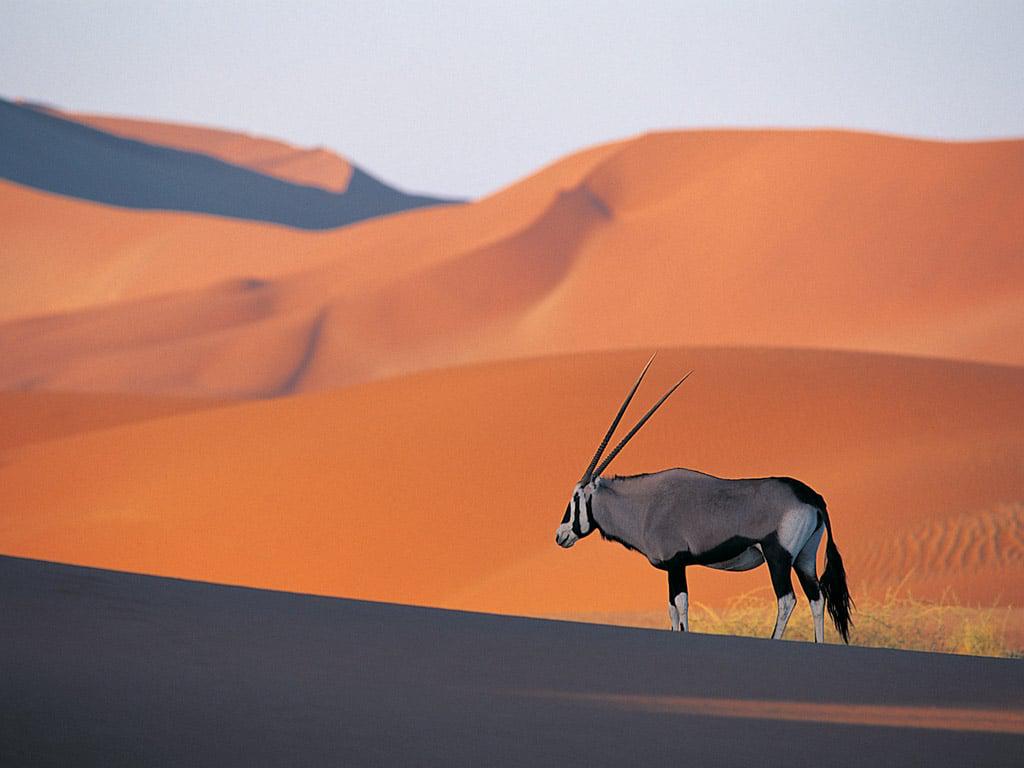
From under a large acacia tree, which is in full foliage, we watch our shadows recede like the incoming tide across the cracked surface of the saltpan.   The curving symmetrical edges of the dunes cut sharp clear lines in the blue sky and the water mirrors.   Our footsteps crunch and crackle on the baked surface of the receding waters of the saltpan.   The long curved scalpel dune 45 Photo Opportunity has a bewitching draw.   Standing at 300 meters it is said to be the tallest in the world.   I might not make it to the top of Everest in my lifetime but I am going to be king of the castle.

At the first sidewinder bend I say adieu to the girls. Two hours later after one-step backward for every two forward I sit on the top. The panorama views of the mountains in the distance, purple in color, kissed by red sand at their base and iced up their gullies with gold and white sand is rewarding beyond words. The ‘Piece de Resistance’ is however a solitary Oryx (Gemsbok) standing in the valley below me. The Gemsbok bye the way has a built-in radiator.   It is moments like this one finds oneself reflecting on life.   We humans are taught to think that we can be master of our destiny. Scientists may well in the future remodel man. However I fear that the destruction of their natural world, and its ecosystems never mind wars, and the urge to reproduce will wreak havoc.Afficher l'image d'origine

Looking back down the leading edge my footsteps trace the slog up.   The quickest way down is the slip side.   It is steep and the slightest foot pressure sends small avalanche of sand on its way to the mosaic of white tiles of the dry pan below. With each giant step the sand flows in front of my boots. I hit the deck in three minutes flat.   Not a trace of the Oryx or my descent is visible.   Petrified trees decorate one section of the pan.   Deformed twisted trunks and branches witness to there stop start once existence.

Rejoining the girls the voices of the first humanoids to arrive down the track breaks the porcelain of our natural surroundings. Their voices in the distance remind me of the virtual world — the new inhospitable surroundings in which our children will roam without any maps.   On arriving back to our campsite all efforts to get the park ranger to use his initiative to allocate us a new site away from a thumping generator and into the shade of one of the many unoccupied sites fails.   The decision is made we will move on in the morning.

TOP TIP: There is a saying that the early bird gets the worm. This applies very much in Africa. Apart from the obvious advantage of beating sun up early morning gives sharpness to hearing sounds, avoids the shimmers, and energy levels are high.

Dawn brings a total contrast in our surroundings.  Vast gravel plains, distant mountains, scrub, and our first Welwitschia a dinosaur of botany named after Friedrich Welwitch an Austrian Botanist. Darwin described it as “ the platypus of the plant kingdom.”Afficher l'image d'origine

Why? Your speculation is as good as ours. Apparently they are unique to Namibia with some of them a thousand to two thousand years old.   As far as we are concerned they sure picked one hell of a hostile place to grow their wind torn long green leathery leaves. Leaves been the operative word as they have only two leaves.

Fifty odd clicks from Walvis Bay disaster. Williwaw is belching smoke from under her bonnet.   First reaction is panic. We all bail out. Opening the bonnet horrors of horrors a small flame. Completely forgetting our fire extinguishers I jump up on Williwaw wing whip out my John Thomas and piss.   Success the human sprinkler does the job.   It looks like a long walk in the morning for we have not seen another human all day. Our map shows we are stranded at Vogefender Bergs (Birds feathers mountains.) We are just resigning ourselves to our situation when along the dirt track comes a car with a French journalist. Three hours later behind a V8 Ford I am towed into the only Land Rover Agency on the west coast of Africa.Afficher l'image d'origine

It’s the weekend in Walvis Bay. Nothing moves till Monday. We find a room and curse our luck and Nana Kodie back in Ghana.   If he had brought us here on one of his fishing shrimp boats none of this would have happened. All seemed extremely logical at the time. By Monday we have found out that we a prisoners of Walvis. There are no buses, no taxies, no camels, no boats, and no trains. Auto Fliess Land Rovers agent tells us that Williwaws starting motor is fried. They can only source three such starting motors in the whole of South Africa.   At 5780 N$ almost a thousand quid sterling never mind that it will take over a week to arrive some radical action is required.   I ring Brooklyn Engineering in the UK where I acquired Williwaw. DHL and 3000 N$ solves the rip off price but not our enforced stay.

Our depressing holiday lodging overlooking a Total petrol station brings on a bout of homesickness. It’s not surprising, as Walvis Bay according to some of its locals is a place where one cries twice during your life. Once when you’re a born and again when you leave the dump.   The smell of fish processing factories and a perpetual moaning wind that shapes the ever-changing, moving dunes called Soo-oop-wa make the prospects of a prolong stops in Walvis Bay less than attractive. Hazel in the local Chinese’s saves us. She sees the SOS on our foreheads and suggests that we should move to her friend’s house out on the lagoon.

Installed in some luxury things chirp up. Walvis is a mind-numbing hole. Once called Santa Maria da Conceicao (Conception Bay) or Bahia das Bahleas (Bay of whales) in Portuguese it is Namibias only deep-water harbor.

It has one restaurant out on an old wharf owned by one of the many who wants to escape – Danny. On learning that I am a yachtsman he brings us to a yard where he has purchased a partially finished steel hull for 30000 rand.

Some other poor Wally or Walvis went broke rolling his owe steel in an attempt to escape.   The hull lies alongside a steel lifeboat, steel motor cruisers all in different stage of rust warping.   The vision of Danny welding his way out of Walvis Bay is farcical, but rather than crush his dream I draw a picture of him one day sailing out into the blue yonder. (To join the rest of the rust buckets parked on Namibia’s insurance claims coast.)

We borrow a car from Lorna our new young wealthy Spanish landlady to visit Swakopmund. Namibia’s main get away from it all resort. A short drive to the north we pass large wooden raft platforms of the coast that adds to Walvis Bay aromas when the wind is in the right direction a touch of guano. Swakopmund turns out to be haven compared to Walvis. Small and compact its Germanic cleanliness, and buildings, are surrounded by nature’s timeless work of art sand dunes.

On our return to Walvis my yachting know-how has attracted new attention. Over dinner on Danny’s wharf I am invited to look over an old classic racing yacht of the sixties owned by a South African doctor. This time I find up on blocks totally exposed to the blazing sun a yacht of beautiful lines. Rumoured to have won the Sidney-Hobart in the sixties she is now a sorry sight. Her chances of seeing the open sea are as much as the doctor has in burying the horrors of his time in Angola. After two hours of indulging the doc’s life story I accept an invitation to the yacht club for a brier, and a few beers.

Here we are introduced to Colin and his second wife Kathy.   Colin works in one of Walvis Bay fish processing plants. His first wife was one of the founding members of save the desert elephants.   Unfortunately she died from kidney failure. It turns out that Colin in his time has trudged for ten years all over Namibia as a prospector for De Beers.   He knows the Kaokoland in the north of Namibia like the back of this hand. His eyes sparkle with a deep love for what he describes as one of the worlds last true wilderness. His descriptions of its topographical features, its animals, its birds, its vegetation, and its people are intoxicating.

When he invites me to go crayfish diving with a promise of a fish dinner to best all fish dinners I jump at the invitation.

An early start sees us in the middle of nowhere some thirty miles up the coast from Swakopmund. The sky is cloudless. Gold colored dunes are separated from the sea by twenty feet of flat black rock.   I have forgotten my dip in South Africa when my head never mind my balls ached from the cold Benguella current.

The sight of Colin donning a wet suite top brings it all rushing back with a venomous clarity. Also, I have never dived in kelp, which does not help my confidence. Colin, handing me a wet suit top assures me that there is nothing to it. All we have to do is dive down and stuff a few of the blighters in our net bags. Splash. I stand watching his air bubbles. Will I or won’t I test the waters before taking the plunge. It can’t be all that bad. He still has not surfaced. In I go without dipping the toe. Jesus, Mary and fuck me. I gasp for breath. Just my luck he pops up beside me before I can leap out. He dives again. I wait for my heart beat to take on some form of normality.   My first attempt to submerge leaves my backside on the surface. He resurfaces. I feel that my mercury has hit rock bottom. He gone again. I make another attempt this time getting down as far as the kelp. Man this is for the birds. I throw the towel in – Colin spends twenty more minutes in the water. He must have antifreeze for blood.

Dinner at his home that evening is as promised.   Crayfish, kingfish, octopus, seduces our taste buds. Several hours of marking our map with the best campsites and water holes beckon us to explore one of Africa’s remaining remote regions about 42,000sq km (17 to 20 deg S to 15 deg E) excluding the Skeleton coast. Bordered to the north by Angola, to the east by Owamboland and Etosha National Park. Damaraland to the south and the Atlantic Ocean to the west.

Colin describes clear pools with terrapins, crocodiles as big a battle ships in the Kunene River. Open golden grassveld areas with fairy circles (circular patches on the soil with no vegetation cover), dry mopean savanna near Sesfontein our point of entry. Natural bathtubs, on the very edge of Epupa Falls.

Vegetation east of the fall that is almost tropical.   Python fig with trunks as big as a man’s leg. Ana trees, Palm trees, Hairy Shepard’s tree, animals from the more famous unique desert-dwelling elephants almost on the point of extinsion to Hatmann’s (mountain) Zebra.

He also tells us not to camp in or on riverbeds. They are animal highways in the dry season. Some travel over 80 kilometers to watering holes and don’t take kindly to a blocking tent or whatever. Not to enter a Himba village without asking first.   There are burial sites and holy places.   Never to walk between the holy fire and their main hut or the holy fire and the cattle pen. The fire is sacred to the Himba who are a semi-nomadic peoples of around 26 tribes each with it own headman. For nearly half a century the Kaokoland has guarded the Himba from outside interference but according to Colin we will be one of the last to see these peoples and what left of their culture. Angola used them as trackers against South Africa in return for cheap booze. Now they are reduced to begging from tourists, exploited by coffee table photograph books what was once a beautiful and simple people are now a sorry sight.

We return in the late hours of the morning to Lorna.   Her Stafforshire hounds and her two African gray parrots have the run of the place. The parrots are busy eating the furniture and the joists when not guarding the pantry door. Her Spanish boyfriend Salivdor is crashed out on the sofa oblivious to all. In the morning we are somewhat late surfacing but we are in time to see that Salivdor like most of the place has being pecked clean.   The good news is that Williwaw is ready and that we have decided to venture into the Kaokoland for a few weeks.

I visit Colin who arranges a permit. Usually it is a requirement on visit the Kaokoland that one must travel in pairs in case there is a problem. Colin is sure we will not have a problem if we go it alone. I pick up Williwaw. Bump into Salivdor who is brainless as a wet squib but wealthy.   He asks me to give him a hand.   He has a Volkswagen combi, which needs a tow to get it started. Twenty minutes later the combi it standing in a pool of oil. Salivdor while being towed in reverse has slammed her into first gear. It is time to hit the road.

Afficher l'image d'origine


Afficher l'image d'origineAfficher l'image d'origine


Share this:

  • Click to share on WhatsApp (Opens in new window) WhatsApp
  • More
  • Click to share on Pocket (Opens in new window) Pocket
  • Click to share on Mastodon (Opens in new window) Mastodon

THE BEADY EYE’S UNPUBLISHED BOOK: CHAPTER ELEVEN: SECTION TWO.

20 Wednesday Apr 2016

Posted by bobdillon33@gmail.com in Literature.

≈ Comments Off on THE BEADY EYE’S UNPUBLISHED BOOK: CHAPTER ELEVEN: SECTION TWO.

Tags

Best Travel unpublished book., Top readable travel book, Travel book that will inspire you to travel., Travel.

(CONTINUATION)

Afficher l'image d'origine


The Cable Car is out of action.   The three-hour hike up does not appeal never mind all the steps to the girls. The iron ladder up the Lions Head is deemed less attractive.   Much to the horror of my credit card, I promise another dose of downtown Cape town for an assault up to an old Gun emplacement, which is situated halfway up the Table. It wins hands down. A short drive brings us to our departing point.   A crabby Florence follows us along a track with super views of the city that is to be sure, to be sure, set in one of the worlds beautiful spots. Cape Flats where most of the Cape inhabitants live remains hidden to our view.   My card pays the penalty for most the afternoon.

A day of rest is what the doctor orders. Where better than the municipal open-air swimming pool whose water is refreshed by the odd growler crashing on the sea wall.  Cascading a shower of white surf on all unsuspecting oiled covered sun worshippers. Flo to her joy and ours makes a new friend living opposite the Hostel.

The sunset on the bobbing heads of a few seals, playing in the glimmering kelp. Yawns, yawns, bring a new day and time to head up the coast.

Williwaw is back to one of its old tricks behaving like a drunken sailor as we rumba along the N2.   A long climb out of False Bay up over Sir Lowry’s pass test her worn out radiator to boiling point. The garden route starting at Mossel Bay ends at the Tsitskamma Coastal National park. With me fighting our odd tire we pass through one dreary town after another whose names seem to be added to over the years to make them more lifeless.   Or perhaps there is a hidden agenda to overthrow Newtownmountkennedy from the Guinness Book of records.   Riversonderend, Buffeljagsriver, Heidelberg pass by.   So far the Garden route raved by many as being one of the most beautiful drives on the continent is not up to scratch.   We are fast learning that it takes some considerable time for the scenery to change.Afficher l'image d'origine

We stop at Mossel Bay, take a wind-swept walk on a grey beach and move on to Knysna Lagoon the first spot of some beauty.   Resisting a Boerewor for lunch (large sausage), we push on to Plettenberbaai or Plettenberg Bay. All along this coastline short rivers to small to qualify naming on our map drag the muster colour soil from the Outeniqua Mountains into the sea.

The next eighty kilometres begins to live up to its reputation passing through South Africa largest native forest we arrive at Storm River. Here with cormorants that I have not seen before, we witness in dramatic colours the bleeding of the land. The clawless otter and the right whale, not the wrong whale favour this section of coast but we see neither.   Just up the road, we pull into Tsitsikamma Forest national park where the otter has a trail the whale and snorkelers an underwater trail. A Swiss-style chalet accommodation takes our fancy. We have arrived well off-season so the overnight rand rental against the dollar is a snip.

Superbly positioned on manicured green lawns the chalets come en suite with all towels, pillow covers, and napkins, blankets embroidered with the emblem of the park. The shower is more than welcome after the day’s struggle with keeping Williwaw on the straight and narrow. With full stomachs, not even the Indian Ocean can keep us awake. Long before the girls stir, I am on the otter trail all 100k of it in two hours. Not a hint of otter to be seen anywhere but Yellowwood, Stinkwood, Bastard Ironwood with intense, exquisite flashes of deep blue ocean mix the shadows and beams of sunlight. My two hours are a spell-bounding encounter with the Garden Route.

With Williwaw still acting like a drunken sailor we are once more in search of a true competitor for the Guinness book of records.   Eersterivierstrand, Gamtoosriviermond, don’t make it. Humansdorp   (Dorp meaning country town in South Africa) does, however, have a ring to it to be twinned with some suitable complimenting named city. Opting for a short day’s drive we stop at Jeffery’s Bay, Sea View house perched out on a sandy point of a beach that runs all the way over to Port Elizabeth is our target sand castles and a spot of founder fishing put the last touches to-day with all my toes intact. The art of spearing a founder before you are lifted off your feet by the incoming swell not to mention the shock of feeling it wriggle from under barefoot soul takes practice.

In the middle of nowhere with the sun at its apex, Williwaw still protesting about asphalt comes to a sudden halt. Sometimes I love her, other times I could take a sledgehammer and beat her to smithereens.   After two days of battling her lee helm, I am in no mood for one of her characteristical qualities which are all blamed on me.   With the girl’s reminding me that it I who attribute them to her in the first place a fuse is my first thought. No such luck. “The security system has cut off the fuel.” Any more bright ideas ladies! Bonnet up I might as well be looking over a field gate into the blue wonder. Not a thing I learned in my two-week car/engine/ change the oil course has a chance of reaching an electrode.   Wiggle the battery and the like.   Yo ho ho and a bottle of rum my oil covered hand happens on a loose cable.

The accelerator cable has snapped or to be more precise a small split pin holding the cable to the accelerator has given up the ghost.   I cannot believe that an off the road 4 wheel drive vehicle relies on such a tiny item. Let’s hope there is a spare in the box.   Luck shines on us packed in its plastic bag is a spare cable pin and all.

We pass through Grahamstown arriving in East London where over the next few days we are turned into that strange couple that is endangering their daughter’s life in darkest Africa.   To Florence’s delight, our friends live in a modern bungalow with the mandatory swimming pool. East London is a nondescript port town with an Aquarium was once named Port Rex after the illegitimate son of George Ш. We are introduced to friends of friends over braai (barbecue anywhere else in the world). Over the next few days our gnashers are biting into Kingklip (a fish) Bunny Chow (bread hollowed out and stuffed with curry) stakes with monkey gland sauce, and the trusty Boerwors. (Sausage) East London might be as dull as dishwater but we receive hospitality hard to forget.Afficher l'image d'origine

Borrowing a hardtop flat caravan trailer and local knowledge we set off for a few days to the meeting of the three rivers. Williwaw blows a tyre giving us all a missed heartbeat followed by a half an hour of effing and cursing compliments of my good self. Our hand-drawn map and directions eventually lead us down a dirt trail with a steep gradient into a superb hidden cove. Apart from us, there is only one other visitor.   Three fishermen, down from the Free State with a large deep-freeze.   In the morning we learn that they spend each years holidays filling the deep freeze with kingfish, bass, rock cod, before returning to their dry farms. Steaks all year round with biltong as a staple diet might also give one the urge to fish non-stop.   They fish from early morning to darkness, consuming enough beer for a piss every ten minutes.

We spend three wonderful days exploring our surroundings ultimately making the choice to give Swaziland and the Transvaal (Latin Trans meaning across and the river named Vaal) a miss. Rather than going up the Mozambique side where one is likely to lose a leg from landmines (It scoring ten pages of difficulties in the Bible) we opt for the Skeleton Coast.

After another round of east London social gathering, which sharpen my flirting abilities much to Fanny’s amusement we hightail it back to Cape Town.   Apart from some wind-swept beach walks, oysters, dragging a stranded car out of a river and a meeting with a wooden Boar owned Land Rover (1960th model rebuild in wood.) we arrive back in Bunkers.

Over the next week, I sort out Williwaw sobering her up with new treads.   Her carnet (proof of import and export document is out of date) valid for a year is in need of renewal. The South African AA turns out to be worthless so with a little doctoring I extend the validity for another year. Her larder is restocked, and Fox security system renewed compliments of its guarantee. We take in the Michael Collins movie, which I happened to be an extra in before leaving Ireland. Neither the girls nor I spotted me so the Oscar will have to wait. Seeing the movie left us with weird feelings of unfinished business.   Bunkers backpackers provide a gossip shop of fellow wanderers. Some raw prawns like one Irish Looney that stands out with a bike.   He is going to cycle to “Say that again Sam.” He arrives back with sunstroke a sore ass, and fear of wide-open places. Others, who opinions varied so widely they might have been talking about different subjects, would do well to take a leaf from Jonathan Seagull when advised by Chiang, “You must begin by knowing that you have already arrived”

The girls are reluctant to leave the civilized trappings.   As usual, Fanny and I get our knickers in a knot as to which is the best route out of Cape Town. It is an observable fact that I have a short fuse relying on a sense of direction (navigation by dead reckoning) when it comes to motorways, bypasses, traffic lights, roundabouts, and the like. Sulks over, I being the lemon, we head for the land of Oranges and Citrus fruits. A three-hour drive brings us to Citrusdal, and on to Clanwilliam.Afficher l'image d'origine

Here we pick up brochure advertising a camping spot on the Krom River, which borders the Cederberg Range. The Cederberg is the Western Capes wilderness covering seventy-one thousands hectares of Quartz and sandstone rocks and Bushman’s Art. A 57km gravel drive brings us to the gates of our first pitch since leaving Ghana. Pitch no 64. We have arrived at a place called Algeria situated on the western side of Pakhuis Pass. Algeria how are you. Just goes to show where one can end up with dead reckoning.

Our first problem is getting a spot on the camping site.   Although several sites are obviously visible from the gates are not occupied we are informed that they are full.   The gaffer turns up, and in no time the ramp is lifted.   Morning reveals a stunning setting of a landscape. We have indeed found a gem of a campsite to explore the area.   Famous for its sandstone formations I pick the Maltese cross a massive rock begging a Michelangelo.   After a false start, I eventually find a small sign pointing up a shale track to the start of the hike to the cross. Top TIP: Apart from the common sense things such as a cap, water, lip salve, decent shoes, sun block, tell someone where and when you are going.

Following a small stream. It’s banks peppered with wild orchards we climb up to a high of 1700 meters. Emerging onto the flat Fanny has had it. She and Flo’s head back. Continuing on, the first thing I notice is that the balancing monk of Tibet has been here. Small mounds of rocks like spoor to the trained eye mark the way to their shrine the Maltese cross. The cross appears and I have to admit it is an impressive piece of Cederberg art.   Back at base, we decide to move up-country to the Wolfberg cracks.

Pitch no 65 is a farm overlooked by a large cliff with four deep cracks.   “On the top, it’s like walking on the moon,” we are told.   Watched from a long way off by a large population of rock bunnies or to give them their proper name Hyraxes we arrive at the foot of the first crack.   (It is hard to come to term according to genes that these little buggers are related more to the horse, Manatee or elephant)   Our way up is blocked by a large rock fall. We watch a man coaxing a four to five-year-old along a ledge on one of the other cracks. Two teenagers looking more than anxious are following them.   They convince us that crack three is the quick way to the moon and blue yonder. Crack two and four are for the Hyraxes.   High up on our rock fall a small mound of stones is a sure giveaway sign that the balancing monks pass this way.   With some hoofing and pushing, we scramble over the rocks into the gut. One hour later we are emerging out onto a rock plateau.

A wander around confirms that the monks have been at it in every direction.   Not willing to follow any given trail we lunch, descend, and nurse our shock absorbers over a whisky or two.

We sleep late. Florence has teamed up with two kids her own age. We are free to go on an archaeology sniff around with two keen UK geomorphologies. After a wonderful day of red sandstone caves in all shapes and sizes each sculptured by thousands of years of erosion we move on to Vredendal (Vale of Peace) on the Oilfants river valley gateway to Namaqualand.

After a drive of some considerable beauty, we arrive in the middle of Vredendal.   About 25 kilometres from the Atlantic coast with its cold Benguella current giving the region a very low rainfall.   It is only a very large irrigation scheme that allows viticulture. Canals covering a distance of 261 kilometres deliver water to over 600 farms. It is the Cape Garden of Eden producing watermelons, spanspek (muskmelon) summer fruits, and vegetables, flowers. The wine harvest is in full swing with lines of tractors waiting their turn to have their golden loads crushed in the local Co-op. It’s not long before our lips are dipping into, Grand Cru, Ruby Cabernet, Merlot, Colombar, Cabernet Sauvignon, and Chardonnay. Sweet dreams come early in a local pad.

Still half asleep we slip out of the vale of peace on our last day in South Africa. Leaving the Western Cape we head for Springbok in the Northern Cape.   A long easy drive gives us time to reflect on our stay.

There is no arguing that Europeans have given Africa its written history and that South Africa contribution to its future history lies unknown. Its own path will in our opinion be shaped by land and by the sharing of its wealth for little has changed in the conduct and mentality of men.   There is no getting away from the feeling that Africans snatches from the present while the land takes them back to familiarity to something that has always been there. Our last Pitch no 66 is behind razor wire.   Early morning we check out at Vioolsdrif without a hitch.

(To be continued)

Donation news:  Perhaps its the word donation that is the problem. So how about leaving a TIP.

R Dillon. Account no 62259189. Ulster Bank 33 College Green Dublin 2.

Sorting Code: 98-50-10


Share this:

  • Click to share on WhatsApp (Opens in new window) WhatsApp
  • More
  • Click to share on Pocket (Opens in new window) Pocket
  • Click to share on Mastodon (Opens in new window) Mastodon

THE BEADY EYE’S UNPUBLISHED BOOK. CHAPTER ELEVEN.

19 Tuesday Apr 2016

Posted by bobdillon33@gmail.com in Literature.

≈ Comments Off on THE BEADY EYE’S UNPUBLISHED BOOK. CHAPTER ELEVEN.

Tags

Best Travel unpublished book., Top readable travel book, Travel book that will inspire you to travel., Travel.

Footnote ( We seriously looked at the possibilities of trying to pass through the Congo. Thank God we did not attempt to do so, as it would definitely have ended the trip.)

Afficher l'image d'origine


Afficher l'image d'origine

SOUTH AFRICA.

What we Know:

Zulu. Boers. Cape Town. Table Mountain. Cape Hope. Apartheid. Stephen Biko. Afrikaners. Nelson Mandela. Robben Island. Soweto. Johannesburg. ANC. Maguba. Winnie Mandela. Tutu. De Klerk. Christian Bernard. Diamonds. Kimberley. De Beers. Cecil Rhodes. Springbok/Rugby. Rand. Wine.

Downtown Jo’burg, the city of gold is somewhat of a shock from the air. Its skyscrapers and large grey office blocks never had the walking African in mind. The car rules.Afficher l'image d'origine

Looking distinctly like an American city, it is totally out-of-place with its outer suburbs.   Soweto galvanized rooftops glittering in the southwest. To its north the sheen of blue mark white middle-class housing with a steep geographical ridge running east to west.

Sporting a reputation for all things nasty day or night, black or white the heartbeat of the inner city has long stopped beating by the time we leave the airport.

Our first Jo’burg problem is not the city’s scant regard for a life it is Kurt the Racist terrier.

With the cargo doors fully open his mother is standing on the tarmac wailing, “He is dead, he is dead.”

One empty cardboard box has come down the ramp.

A security guard is dispatched into the bowels of the plane.   The disembarking passengers form a small crowd around the tail of the plane. Unlike them, we know that if Kurt had his way he would reinstate Apartheid. If he is alive there is every likelihood that the guard will emerge with a terrier locked onto his black backside. A few minutes pass by with no sign of the guard.   Anticipations run high. It looks like Kurt’s liberation from time and space will have a physical and psychological impact, if not on him we hope not on his panic-stricken Dutch mum.

A spontaneous round of applause greets Kurt’s survival. We all clear immigration and are set to venture out into the land of fast food, street lighting, four-lane highways, and traffic lights.   Kurt, however, is nabbed once more for questioning. By the time he is given the all clear we have no time to mess around looking for lodgings. A phone call confirms that dogs with attitude are accepted – we are off to the first Hostel mentioned in the Bible.   Fairview house situated three kilometres from the city centre. It is described as a large old house with sunny rooms and a cheerful atmosphere.

On arrival in South Africa, the first thing one become aware of is that there are a lot of uniforms standing absolutely still, like sticks or scarecrows supporting walls, pillars, windows, counters, cars, doors. The second is the warning notices on doorways – ARMED RESPONSE.   It is said you can tell the wealth of any household by the sharpness of the razor wire on top of the walls.

Glittering with two Doberman.        –            Wealthy.

Dull with one Alsatian.                  –           Not so well off.

Rusty or glass with a black guard. –           Middle class.

Just after the crack of dawn, we are ready to set forth into one of the world’s most dangerous cities. Our early start is more to do with the Fairview dorm accommodation than anything else. It must be said however that none of us have that feeling of security/familiarity with our surroundings as we walked downtown towards the nearest shopping district.

The fortified garden /backyard walls give off an air of danger from under their bright-coloured flowering fuchsia Bougainvillea covering. The boarded-up shop windows do little to dispel this feeling of insecurity. By the time we come upon our first group of blacks lounging on the grass surrounded by last nights beer cans we have decided that Jo’burg is a sorry sight for any new eyes.

With a few days to kill before training it down to Cape Town, we decide to venture where no Kurt dares to go to Soweto, the lion’s den of modern-day South Africa.

But first, a competent modern bank is required not to stick up but to arrange the transfer of funds to top up our now very much in short supply stock of US Dollar bills.

While the girls look at a second-hand clothes shop I thank Jo’burg for a bristling modern bank that agrees to facilitate the receipt of funds on my behalf for a small commission. I instruct my Irish bank to forward the required amount of US dollars, requesting them to ensure the packet against theft. It would be unwise to ignore all the Burg’s claims to fame.

Eight a.m. our guide to Soweto arrives in a white transit. He is so full of chat I have made up my mind long before we enter the township to escape his barrage.Afficher l'image d'origine

First stop is the Soweto museum. Housed in two sixty-foot containers it is the only Museum in the world perpetually packed.   As a relic of justice, it reminds us that it is not always the mighty that write history.   Paradoxically its black and white photos graphically depict what went wrong with White Supremacy.

A donation to the upkeep finds us outside once more.   After yesterdays helping of razor wire and welcome notices I can’t help wondering if the new fashion of justice in South Africa is what the doctor ordered. The big question remains can there ever be justice in an unjust world?   A deliberation way and beyond our guides brief.

Back aboard we pass Winnie Mandela’s pad with its manicured front lawn just as much out-of-place as Jo’burg skyscrapers. Spotting some of the local wildlife I call a halt outside a Shebeen.   No one seems too enthusiastic to give a mating call, so I slide the van door open and wave to our gobsmacked guide to continue the tour without me.   Perhaps here I will flavour some of to-days Sowetans and get some answers as to why I feel the hairs on the back of my neck stiffen in South Africa. I am stared at by one and all as I order my first bottle of Castle beer.

TOP TIP: It still pays in South Africa to announce that you are not a white South African if you want to unfasten some of the countries’ black soul, or for that matter in dealing with its police.

“Cunnis ta to I’m Irish.”   The ice broken, I am without further ado surrounded by the big heartiness of ordinary Soweto people.   Understanding I know is a kind of ecstasy, however, I am sure that the bottle of brandy I won in the pubs weekly draw had a lot to do with the ecstasy and the mistaken belief that I was in the market for a BMW.   There is something generous and rash in the spirit of their offer.

All are hungry to talk. So talk we did and as far as I can remember covering a wide range of subjects.  All agree that African leaders still think like chiefs telling their people what to do. Tourists are seen as a feeding frenzy to the street vendor, beggars, and the petty thief. National debts are the power kegs of African countries. That AIDS, lack of water and land will be the cause of future African wars.   That Afrikaners still think that they are gods chosen people of South Africa.

By the time the girls return the bottle of brandy is long finished I have also learned that Africa has 30% of the world minerals, 51% of diamonds, 47% gold, 5th of the worlds dry land and an 8th of the world’s population.   To the dismay of our guide, I have accepted an invite to play a game of pool. Firstly, a drink for the girls and then the guide has to be buttered up to drive us to another location, not on the tour route. A task set to by my learned doctor, teacher, car dealer, the Shebeen owner, and the pool game challenger. At the change of venue, we have a spot of dinner and a chuck and doris, (Last drink)

By the time my cruel hangover has lifted we are leaving Africa’s most dangerous city after a few hours delay on the overnight train to Cape Town. A year of youth work in Dublin’s inner city with a snooker cue had conquered the best that Soweto had to offer on the pool table. The brandy had conquered all fears of any armed response. The local cop shop has had its cash-dispensing machine pinched from the fourth floor – some feat it has to be said.

I begin to wonder as the train whistles towards Table Mountain, if Stephen Biko the founder of The Black Consciousness Movement was right when he said, “ Being black is not a matter of pigmentation – being black is a reflection of a mental attitude”.   I am sure if Biko were alive he would view modern-day South Africa not by the shadows of the past, but by the remaining razor wire. Regrettably, tribalism the deep-seated political illness of modern South Africa remains in the whole of the African Continent and we all know that one body can lead to thousands.

Enhanced by years of bad world press the vastness of South Africa slips by while we sleep to the sound of rolling stock.

Over breakfast, our train turns into a scenic kaleidoscope through which we pass one by one the many shanties town better known in South Africa as townships coming to a halt in downtown Cape Town.

We emerge into Africa’s best-known city famous worldwide – not because of its African culture or its African architecture or its stunning setting.   It is more to do with that it is here in 1910 the Union of South Africa was born by educated men who decided that there were only five species of humans left living in South Africa. Europeans (Dutch Calvinist / French Huguenots) becoming Afrikaans speaking Boers the Coloureds who made up of what was left of the Zulu, the Swazi, the Xhosa, the Sotho, the Nguni, the San or Bushmen referred to as the Khoi- San   is long gone leaving the Asians Indians who were brought in by the British as laborers not forgetting the Blacks leaving I suppose the Tourists– us.

It is here the Dutch East India Company arrived in 1652 establishing the Cape Colony in order to supply their ships on the way to and back from the East Indies and India only to have it grabbed off them by the English in 1795 and then given back 1803 then surrender, to be annexed in 1806 officially becoming a British Colony in 1814.

It is here where the British invented concentration camps to beat the Boers, (meaning farmers in Dutch). It is here where Michael Cane immortalized the Zulu or perhaps it was the Zulu’s who immortalized Mr Cane. It is here where Cecil Rhodes founder of De Beers in 1889 or thereabouts laid the seed for today’s troubles in Rhodesia (named in his honour) now Zimbabwe.   It is here where the Indian Ocean meets the South Atlantic.   It is here where the Portuguese navigator Bartholomew Dias discovered the Cape of Good Hope, naming it Cabo Tormentoso until John И renamed it Cabo de Bõa Esperangça.

It is here where the truth reconciliation commission in 1997 found that the five police officers had murdered Biko in 1977 while he was in police custody.   It is here where under the terms of the Commission all five were given amnesties.   It is here where one human’s heart is transplanted into another human in 1967.   It is here where we are to be reunited with Williwaw. It is here where homeward bound we turn and modern shopping malls called Victoria and Albert await the girls.

Installed in Bunkers hostel at Sea Point in the direction of Camps Bay one street removed from the seashore we are overlooked by the Lions head we are all set to go and explore, to see if the ‘too painful to recollect’ supine politics of the past is being washed away from this vast country that makes up small part (3% in total) of the African Continent.

Our plan is no plan at all. We begin with an early morning walk along the seafront.   Intoxicated by blue sky, refreshed by the power of the sea, we mingle totally unaware with the 5 million Europeans (Whites), 29 million Bantu (Blacks), 3 million Coloureds, (Mixed race) and 1 million Indians.

As we clamber aboard one of the local minibus taxis that rocks and rolls to the sounds of a local radio station Table Mountain named by Antonio de Saldanha a Portuguese navigator in 1503 is cloaked from our view with a reverse waterfall of white cloud. Fairs are passed forward and change arrives back in due course while the conductor toots all walking humanoids to fill any empty seats. Our first port of call is the port converted into a waterfront of shopping malls, restaurants, bars, smart shops, and a large covered market, the tourist trap. Resisting a Big Mac we marinate contentedly in the windows of consumerism. We take in an IMAX show and the day ends with a sundowner at Ferryman’s Tavern, which is just across the road from the Customs, and Excise building Josh, and I target for tomorrow to retrieve our vehicles.Afficher l'image d'origine

The next morning we enter the ground floor to secure clearance for our trusty Land Rovers. It is our intention to save some loot by filling in the required papers ourselves. Knocking on the door labelled Customs produces a gruff, ‘Enter’!

We are met with a torrent of language that would normally get one in jail for abuse. A discourse of sewer gutter tongue is being directed towards a black woman. It’s our first Boer, red-faced, an exact copy of his photo hanging on the wall behind his desk. The black and white photo portrays him in shorts with a cane in hand when white was white and black was Robin Island. We stand shocked. Josh looks like a rabbit caught in the headlights. Our request for clearance papers is met with another insurgence of vowel vile that has him retreating to the door. The fat bastard would do well to take a holiday in Northern Ireland where he would see two other colours, Orange and Green. I follow Josh out into the corridor.

Irish temper is well-known worldwide but it has never served me better on my re-entry.

I threaten the bastard in true Celtic Zulu gift of the gab. In full flow, my outburst is brought to a halt by his hand sliding across the desk to pick the phone up “ Is that you O’Donnell? You’d better get your ass over here before one of your tribe has my lunch”.   In a stunning silence, the desk phone is returned to the cradle.   A complete makeover has a glass of whisky in my hand. “Yes, the container has arrived. We can get it cleared as soon when O’D arrives.”

Two hours later the seal on the container is cut. Out rolls Williwaw and the other two jeeps. No immigration inspections are required. Carnets stamped, a full clean bill of health is given with a handshake and “Enjoy your stay in South Africa”.   Over a glass of beer O’D tells us that ulcer mouth has a good side to him helping many a young one that finds themselves on the bread line.   I am tempted to inquire whether it is brown or white bread.

I threaten the bastard in true Celtic Zulu gift of the gab. In full flow, my outburst is brought to a halt by his hand sliding across the desk to pick the phone up “ Is that you O’Donnell? You’d better get your ass over here before one of your tribe has my lunch”.   In a stunning silence, the desk phone is returned to the cradle.   A complete makeover has a glass of whisky in my hand. “Yes, the container has arrived. We can get it cleared as soon when O’D arrives.”
Afficher l'image d'origine

Some hours later parked in the car park we mount the steps to the Cape lighthouse (34°-23° South 18°-31°East). This is not as many believe the southernmost point of the Africa Continent.   Cape Agulhus 154k to its southeast is at (34°-51° South 20°-03° East.) Aghlhus. (Portuguese for needles) is the meridian boundary between the Atlantic and the Indian Ocean.   No matter! Being able to say ‘done that got the tee-shirt’ has us here.   For me, a Yachtsman Lighthouses warn of danger. The meeting of the waters some 256 meters below us looks far from inviting.   I am sure Mr Dias in 1488 gave it a wide berth when he first saw it.   Unfortunately, he perished off the cape – it could be the reason why Bartholomew Dias left the naming of Table Mountain to Antonio de Saldanha.   We resist the temptation to scrawl our names and date on the lighthouse, which appears to be the sole ambition of many, a visitor. The views, however, scrawl their images on our minds. We leave Bonne-Esperance without seeing a Cape buffalo, a Cape gooseberry, a Cape Sparrow, a Cape primrose or Cape jasmine.   We did see a Cape Pigeon.   Tomorrow it’s up Table Mountain.   TOP TIP: Bring some warm clothing. 

( To be continued)


Share this:

  • Click to share on WhatsApp (Opens in new window) WhatsApp
  • More
  • Click to share on Pocket (Opens in new window) Pocket
  • Click to share on Mastodon (Opens in new window) Mastodon
← Older posts
Newer posts →

All comments and contributions much appreciated

  • THE BEADY EYE SAYS TRUST IS DISAPPEARING THANKS TO OUR INABILITY TO RELATE TO EACH OTHER. December 19, 2025
  • THE BEADY EYE SAYS. THE WORLD NEEDS PEOPLE GOVERNMENT NOT MONEY GOVERNMENTS. December 18, 2025
  • THE BEADY EYE ASKS WHAT ARE WE THE SAME GOING TO DO TO STOP THE WORLD BEING FUCK UP FOR PROFIT BY RIPOFF MERCHANT. December 17, 2025
  • THE BEADY EYE CHRISTMAS GREETING. December 16, 2025
  • THE BEADY EYE SAYS. TO THE NEXT GENERATION TO LIVE A LIFE WORTH WHILE YOU MUST CREATE MEMORIES. December 16, 2025

Archives

  • December 2025
  • November 2025
  • October 2025
  • September 2025
  • August 2025
  • July 2025
  • June 2025
  • May 2025
  • February 2025
  • January 2025
  • December 2024
  • November 2024
  • October 2024
  • September 2024
  • August 2024
  • July 2024
  • June 2024
  • May 2024
  • April 2024
  • March 2024
  • February 2024
  • January 2024
  • December 2023
  • October 2023
  • September 2023
  • August 2023
  • July 2023
  • June 2023
  • May 2023
  • April 2023
  • March 2023
  • February 2023
  • January 2023
  • December 2022
  • November 2022
  • October 2022
  • September 2022
  • August 2022
  • July 2022
  • June 2022
  • May 2022
  • April 2022
  • March 2022
  • February 2022
  • January 2022
  • December 2021
  • November 2021
  • October 2021
  • September 2021
  • August 2021
  • July 2021
  • June 2021
  • May 2021
  • April 2021
  • March 2021
  • February 2021
  • January 2021
  • December 2020
  • November 2020
  • October 2020
  • September 2020
  • August 2020
  • July 2020
  • June 2020
  • May 2020
  • April 2020
  • March 2020
  • February 2020
  • January 2020
  • December 2019
  • November 2019
  • October 2019
  • September 2019
  • August 2019
  • July 2019
  • June 2019
  • May 2019
  • April 2019
  • March 2019
  • February 2019
  • January 2019
  • December 2018
  • November 2018
  • October 2018
  • September 2018
  • August 2018
  • July 2018
  • June 2018
  • May 2018
  • April 2018
  • March 2018
  • February 2018
  • January 2018
  • December 2017
  • November 2017
  • October 2017
  • September 2017
  • August 2017
  • July 2017
  • June 2017
  • May 2017
  • April 2017
  • March 2017
  • February 2017
  • January 2017
  • December 2016
  • November 2016
  • October 2016
  • September 2016
  • August 2016
  • July 2016
  • June 2016
  • May 2016
  • April 2016
  • March 2016
  • February 2016
  • January 2016
  • December 2015
  • November 2015
  • October 2015
  • September 2015
  • August 2015
  • July 2015
  • June 2015
  • May 2015
  • April 2015
  • March 2015
  • February 2015
  • January 2015
  • December 2014
  • November 2014
  • October 2014
  • September 2014
  • August 2014
  • July 2014
  • June 2014
  • May 2014
  • April 2014
  • March 2014
  • February 2014
  • January 2014
  • December 2013
  • November 2013
  • October 2013

Talk to me.

Jason Lawrence's avatarJason Lawrence on THE BEADY EYE ASK’S: WIT…
benmadigan's avatarbenmadigan on THE BEADY EYE ASK’S: WHA…
bobdillon33@gmail.com's avatarbobdillon33@gmail.co… on THE BEADY EYE SAYS: WELCOME TO…
Ernest Harben's avatarOG on THE BEADY EYE SAYS: WELCOME TO…
benmadigan's avatarbenmadigan on THE BEADY EYE SAY’S. ONC…

7/7

Moulin de Labarde 46300
Gourdon Lot France
0565416842
Before 6pm.

My Blog; THE BEADY EYE.

My Blog; THE BEADY EYE.
bobdillon33@gmail.com

bobdillon33@gmail.com

Free Thinker.

View Full Profile →

Follow bobdillon33blog on WordPress.com

Blog Stats

  • 94,168 hits

Blogs I Follow

  • unnecessary news from earth
  • The Invictus Soul
  • WordPress.com News
  • WestDeltaGirl's Blog
  • The PPJ Gazette
Follow bobdillon33blog on WordPress.com

The Beady Eye.

The Beady Eye.
Follow bobdillon33blog on WordPress.com

Blog at WordPress.com.

unnecessary news from earth

WITH MIGO

The Invictus Soul

The only thing worse than being 'blind' is having a Sight but no Vision

WordPress.com News

The latest news on WordPress.com and the WordPress community.

WestDeltaGirl's Blog

Sharing vegetarian and vegan recipes and food ideas

The PPJ Gazette

PPJ Gazette copyright ©

Privacy & Cookies: This site uses cookies. By continuing to use this website, you agree to their use.
To find out more, including how to control cookies, see here: Cookie Policy
  • Subscribe Subscribed
    • bobdillon33blog
    • Join 223 other subscribers
    • Already have a WordPress.com account? Log in now.
    • bobdillon33blog
    • Subscribe Subscribed
    • Sign up
    • Log in
    • Report this content
    • View site in Reader
    • Manage subscriptions
    • Collapse this bar