• About
  • THE BEADY EYE SAY’S : THE EUROPEAN UNION SHOULD THANK ENGLAND FOR ITS IN OR OUT REFERENDUM.

bobdillon33blog

~ Free Thinker.

bobdillon33blog

Tag Archives: Top readable travel book

THE BEADY EYE’S UNPUBLISHED BOOK. CHAPTER NINE.

15 Friday Apr 2016

Posted by bobdillon33@gmail.com in Literature.

≈ Comments Off on THE BEADY EYE’S UNPUBLISHED BOOK. CHAPTER NINE.

Tags

Best Travel unpublished book., Top readable travel book, Travel book that will inspire you to travel., Travel.

BURKINA FASOAfficher l'image d'origineAfficher l'image d'origineAfficher l'image d'origine


What we know:

Landlocked. Poor. Military Coups. French Colony. Formerly Upper Volta. Flat. Hot. Droughts. Donkeys. Aids.


Time has disappeared from our daily lives but we know it is early November. Whether Fanny or I will ever revisit the Dogons seems highly unlikely and whether they will survive is another question. Spot lighted by UNESCO, the Malians are exploiting their culture for what it is worth. Our feeling is that our Animist friends will not be visiting or be visited by the outer Galaxy for much longer. It is far more likely that Big Mac will land and destroy them. In the mean time long may they believe that hashish comes from outer space.

(Top TIP: Visit soon.)

With unexpected ease we clear the police and customs at Koro crossing into the Fatherland of the Just Men or the Country of the Honourable people some miles later at Ka In.   Our chosen route will virtually cut Burkina Faso in half describes by bible as one of the poorest countries in the world < A vast lateritic plateau of some 274-200 sq km populated by roaming donkeys, with potholes capable of swallowing Concord.

It is not long before our dirt road has us healing to port with one wheel on top of the rut and the other locked in the gutter. Williwaw wheelbase is not quite wide enough to handle the truck ruts so we drive along the ruts at a 20º angle. Some times we are able to drive in the middle with a high likelihood of slipping off and breaking our repaired half shaft.   Fortuitously it is not long before the track improves widening to accommodating both potholes and corrugations.

Ouagadougou the capital our target lies eighty plus odd kilometres to the south of us at 12º 22′ N and 1º 28′ W. It is just one of those short Fanny hops on the map. Afficher l'image d'origine

The passing countryside is arid, flat, dotted with the odd surviving tree all watched over by a squadron of nature’s undertaker’s vultures.   Their necks turning with the same sinister movement of a high security camera scanning the earth smoothly and relentless for an ass that did not use the zebra crossing or has unfortunately disappear down one of the six meters deep roundabouts.

Our first witnessed vulture banquet is an explosion of survival of the fittest. In the inertia of the day’s heat, the stillness of land is shattered in a frenzy of feeding that blow apart the harmony of nature. Its harshness; its fury; its nakedness brings all awareness of time to a full stop.

Florence is enraptured by the horror of the explicate lesson from natures undertakers and Fanny is awakened to African wild life.   I promise to tell every Irish nacker to book his or hers holidays somewhere else.   There is an Irish expression “When a donkey bray’s a tinker dies”Afficher l'image d'origine

Some miles pass Ouahigouya the capital of northern Burkina we come upon a roundabout full to capacity. Deep within its bowls, lying on its side is a beer truck. Judging from the amount of waiting trucks, the empty cans and bottles it has been some days since it fell in. Off to its left there is yet another truck stuck up to its oxters in mud and deep reddish water. Any way around is totally blocked. We learn from one of the driver that a bulldozer is on its way, but it could well be a few days before it arrives.

This news is not surprising. Remembering that nothing is ever quite as it seems in Africa we have long come to appreciate that nothing ever happens quite as it is supposed to. Back in the capital of Mali there were men in western business suites were eating French food flown in by Air France while a few hundred clicks down the road Dogons collect soil from below their escarpment to grow the odd vegetable.

The quagmires to the right and left of the dirt track are to say the least uninviting. While the thought of spending four days waiting for a Caterpillar that might never make it due to odd missing part. Or for that matter staying put surrounded by an unlimited source of warm beer is far from appealing to the girls or me.Afficher l'image d'origine

I walk down into creator to have a look only to emerge with a coating of red lock tight mud right up to the balls that dries in the sun instantaneously cracks and flacks off like pealing paint with every step to hear an engine roar. Hallelujah it is the Cat. Not so. One of the awaiting trucks has come to life. The driver with the help of a few dozen bottles of Sobra the nationally brew beer followed by a few shots of Chapalo the local made millet beer, has cracked in the noonday sun.

Glazed eye he mounts his charge. In a cloud of exhaust fumes releases the clutch. Like a charging elephant he plunges headlong into the jaws of the trap to a round of approving applause from the thirsty on lookers he comes to a steaming halt.   All is not what it seems in Africa.

Braving the imaginary snakes I now decide to scout the adjacent hinterland of the crater. The right hand side is impenetrable, but the left shows some hope. Except for some tree stumps and a few muddy sections where the water has seeped across from the other side of the dirt road it looks possible. It’s either go on the binge native style for a few days or have a go.

The idea of daddy on the rip with the lads wins hands down. If I get stuck the cat is on the way. I walk my route once more taking note of all the sly traps. The course to be followed is a maze of turns with the high likelihood that I might find my African roots sooner than reading Alex Haley ‘Roots’.

The sound of Williwaw engine coming to life alerts a group of vultures huddled near by.   Moving forward with the help of the girls who are directing me on foot I squeeze past the waiting trucks.   For some reason a thought comes into my head “It is the land that owns the African by lying downs his fate.” A small crowd gathers to watch if I will make it.   After our experiences in Guinea Conakry the drive turned out to be a piece of cake. Apart from the clinging mud I have little trouble emerging back on to the dirt road safe and sound.

We are on our way again with mud flying in every direction.   Apart from a bright blue bird, (which we eventually identify some months later with the aid of Ian Sinclair, and Phil Hockey Illustrated Guide Birds of South Africa as an Abyssinian Roller) our surrounding colours are drab shade of browns and ashen greys. Village after village dots the barren land.   Their houses stand like clumps of large fat toadstools.   Nothing moves. Williwaw arrival and departure in each village is marked by a dust cloud on the way in and barking of dogs on the way out.

It’s not long before our dust cloud is mixing it with the traffic exhaust of Ouagadougou.   Referred to, as Wogoddogo by Mossi the largest ethic Burkina Faso group Ouagadougou is a big sprawling maze of villages with no apparent centre. We have arrived at midday. The place is heaving with mopeds all with minds of their own.

Our Bible says that L’Eau Vive is its most famous restaurant where the sister – waitresses down tools at midday to flex their cinctures with a rendering of the Ave Maria. Why not a spot of lunch before heading on to Ghana sound like a good idea. Due to the capitals square grit lay out we find the restaurant with little difficulty.

A quick look around the Nouveau Grand market put us of eating meat for life.   The market is housed on three floors in grey concrete building which I am sure started out in the mind of its architects as a parking lot. Heaving with commerce, noise, the entire place is enwrapped in the pungent smells of stale urine, body odours and flies. With escape routes to beat the ban it is a pickpocket’s paradises.

Some hours later it is us who are singing Ave Maria as we escape from the city straight into the first of many police/army barricades.   Following the southerly direction of the Red, White and Black Volats rivers we make it on an atrocious pothole tar road as far as Kombissiri forty odd kilometres from Ouagadougou. Pitch No 52

Refreshed after a peaceful night sleep with gum shields in once more we venture forth for a days driving.

“For Christ safe Fanny, avoid the Potholes.” “Jesus Bob slow down.” from the back “Stop arguing “, Florence. The road, the heat, the jolting and the boring flat landscape, has all of us on short fuses long before we arrive at the first point of departure from BURKINA FASO.  Afficher l'image d'origine

Just before noon we clear customs and the usual police formalities at Po. Twenty kilometres further of zigzagging we arrive at Paga where I shit myself.  It’s a major cock-up. We have no visa to enter Ghana. A blue-black scared-faced Ghana informs us that we have no option but to return to Ouagadougou. All contact names, string and bribes fail miserably. Luckily George over hears our efforts. He is the visa issuing man in Ouagadougou returning from his holidays.   Assured of his personal attention in the morning in Ouagadougou we set off back up the road. The journey needs no description. There is an African proverb that says, “Who travels alone tells lies.”   So when I say it was fucking awful believe me it was just that.

Murphy’s Law is now at play. The Po customs that had cleared us through to Ghana now refused to recognise Williwaw’s Carnet. I am forced to purchase a temporary importation licence. Offered at 50,000 CFA eventually bought for 10,000 CFA. Next Fanny fails to stop at a wooden sun blistered police barrier sign that is hidden behind some scrub with an attached rusty chain to the barrier buried in the dust that is only visible to those in the know.

One of those I hate whites bitter-faced menacing cop is now threatening a 10,000C FA fine for our non-arête. Some heated arguments revolving around the impossibilities of bring a three-ton vehicle to a sudden halt and promise of a few packets of fags on our return see us once more on our way.

One hundred thousand bone shattering pots later we arrive back in the fading light in Ouagadougou. After the usual dashes to the outskirt cops we decide to eat first, and sleep after > Another mistake. Around and around we go in search of a long close Vietnamese Restaurant.   Eventually giving up we check into a hotel. Knackered we eat and spend the best part of the night hunting the room lizard with a spray can.

After a morning of endless form filling George is true to his word. Armed with visas we set off once more down the obstacle course to Ghana. All goes well. Not even a scrub fires on either side of the road that endeavour to unite with each puff of wind slow us down.   In the firm knowledge that this time we are finally going to escape we cardiac from one pothole to another.

Arriving outside Po a Guinness sign atomises all thoughts of the wooden sun blistered police stop signs. With no sign of the die-hard bigot cop the Guinness sign is our beacon to cure our acute dose of the jitters.

Two bottles of the black stuff later we are back in the Customs. It is taking a long time to clear Williwaw when in the door hot off a motorbike arrives our in the heat of the day cop. Bristling with contempt his torrential tongue pour forth anger not for the promised packet of fags but for our failure to stop once more. .

Never far from the surface in Africa lies the unexpected. I begin to smell a rat, as there was no way he could have seen us passing over his rusty chain. We have no option but to return up the road and face the music. At the point of gun the arrogant faced bastard refusing to accept dollars for a fine of 12,000 CFA.

While I remain sitting in his shabby hut Fanny with Florence return to Guinness Bar to get the dollars changed.   Waiting for the girls return it dawns on me that there is a scam-taking place between the Customs and Mr Screw it cop.

The Ghana border is due to close in a few hours. My temporary importation licences for Williwaw will expire at six-o clock making the Jeep eligible for confiscation or subject to a demand for some extortion’s exportation fee.

Fanny god rests her soul returns with the CFA. With agonising calmness I watch as he counts the money note by note, then enters the amount in a school jotter and issues me with an unreadable receipt.   With no love lost we leave arriving once more at the customs.

Here we are met with more unnecessary demands, and a refusal to stamp out Williwaw Carnet.   With the clock ticking away our chances of getting across the border into Ghana are getting slimmer and slimmer. I tell Fanny to go out and start-up Williwaw.   There is nothing for it but to make a run for it.

The clock striking six, the customs post comes to attention as the national flag is lowered. It’s now or never.   I walk out the door jump aboard Williwaw slip her into gear and go for it.   In a blink of and eye we are hurtling down the dirt road in the direction of the border. In the bouncing wing mirror I get glimpses of a pursing motorbike. Endeavouring to stay out of our dust cloud it appears on my right then on my left.   The girls sit in silent terror as we crash from one pothole to the next.   Dusk is not far off.   A torso steps out in front of us. There is no stopping a three-ton Jeep charging like a rhino. With lights flashing and our horn endeavouring to sound loud and mean he jumps for cover.

We whistle through the border gates with a few minutes to spare. Enveloped in her following cloud of red dust Williwaw comes to a screeching halt. In perfect English a bone-crushing handshake a large scared dark smiling face conveys a significant and unmistakable message of welcome to Ghana.Afficher l'image d'origine

Covered in goose pimples and a large dosage of heebie – jeebies our James Bond style exit from Burkina Faso is over.

(TO BE CONTINUED)


Share this:

  • Click to share on WhatsApp (Opens in new window) WhatsApp
  • More
  • Click to share on Pocket (Opens in new window) Pocket
  • Click to share on Mastodon (Opens in new window) Mastodon

THE BEADY EYE’S UNPUBLISHED BOOK. CHAPTER EIGHT. SECTION TWO.

15 Friday Apr 2016

Posted by bobdillon33@gmail.com in Literature.

≈ Comments Off on THE BEADY EYE’S UNPUBLISHED BOOK. CHAPTER EIGHT. SECTION TWO.

Tags

Best Travel unpublished book., Top readable travel book, Travel book that will inspire you to travel., Travel.

( CONTINUATION)

Afficher l'image d'origine

In the early stillness of the morning, we board Williwaw.   Skirting the town we once more cross by ferry to join the main drag the Mopti road. It’s not long before the hot dusty dirt road leaves the river Bani to evaporate its way north to join the Niger in its long search for its gateway to the sea. Making good time our shale landscape has little to offer to occupy the mind.   Fanny has draped her open window against the blazing sun with muslin material. Florence perched on her high rear seat is battling with her Game Boy.

(Top TIP: A piece of muslin large enough to cover those lily-white knees and arms can be especially useful when seated in your vehicle for any duration.)

It comes as a great relief to us all to swing right before Mopti. We had heard on the grapevine in Djénné that Mopti had turned itself into a pain in the butt. Full of smart Smert spies; rip off tourist kids, bureaucrat police and flies. So assured by our new Merc overlanders we take a new Chinese constructed road to Bandiagara. The preferred way but not quite yet recognised by our Michelin 953 map, which designates the route as a dangerous passage.

Avoiding the odd charging bulldozer and completely disregarding any road closed and men at work signs we arrive covered in dust at hotel Les Arbies well ahead of the Mercedes.

After a good meal is another rooftop pegging Pitch number 50. Bankas is nothing to write home about. A collection of mud-walled housing facing each other forms the main thoroughfare. Dust devils dance on their whirling dervish way in or out of the flat shapeless surrounding landscape.

Along with our Hotel, there is a baby Djénné style mosque, a Smert office all of which owe their existence to the Bandiagara escarpment or Falaise of Dogon country that lies twelve kilometres out the back door of our Hotel.   Bankas is the alternative route into Dogon country – Mali’s top tourist attraction. Now a protected World Heritage site with the Placenta of the world called Amma and now Fanny’s birthday present.

Lying 14º00′-14º45’N, 3º00′-3º50’W from Douentza in the north to Ouo in the south the area that houses the Dogons culture is world-famous.   Its greatest threat today to its rich traditions, rituals, art and folklore is hard-core tourism thanks to its World Heritage status. Within its Placenta, not a pubic hair has been left unruffled.Afficher l'image d'origineAfficher l'image d'origine

Early morning our Guides Sambaquine Dallo and Moussa Drabo arrive. A command of English and French selects Dallo.

(Top TIP: Selecting a Guide without any prior knowledge of his or her abilities is not to be recommended.   You should always have a friendly chat before taking him or her on to establish whether they truly have the gift of the gab. Also never pay all their fee up front.) 

Dallo fee settled we all pile into the Merc for an extremely bumpy and get out and pushing ride to the base of the Bandiagara escarpment.

The escarpment extends over a 150 km in a southwest to northeast direction, says Dallo. “We will overnight at Teli a village on the southern end of the escarpment it is one of the less visited villages.” Again with our vast knowledge of Mail Teli could be on the moon for all we knew. What we did know is that it is getting hotter and hotter by the minute.

Parking the Merc at the side of a mud building with a lean-to acting as a bar/ restaurant we are invited to partake in a spot of lunch before we set off up to the cliff face. Fanny’s face is a Mask of Dogon anticipation. ‘Up that’ it says. ‘Not on your Nellie my necklace is just fine’. Too late. Dallo is well into informing us that human occupancy of the cliffs was a long time before the Dogons arrived.   “For some strange reason beyond our comprehension the village communities are divided into the inneomo and innepuru, ( living men and dead men) respectively they exist in symbiotic union with each other.” I can only hope that by the time we get back I will not be living in the doghouse for having suggested the hike as a birthday present.

Our lunch hosts lose no time in trying to sell us Dogon doors, intricate door locks, elaborate carvings, painted masks, wooden bowls, and pots. All available irrelevant of UNESCO, Law No. 86-61/AN-RM of 26 July 1986 and Decree No.299/PG-RM of September 1986 which is supposed to specifically control excavations, commerce and the export of cultural objects.

Back in the car, Dallo rattles on “Po is hello, Konjo is beer.”   “Every inhabitant of each village has the same surname.” “Their houses represent human figures and each village keeps a semi-domestic crocodile.”

“You have missed the Sigui gig, which represents the renewal of the Universe.” “ It takes place every sixty years when Sirius companion star is known to the Dogons as Po Tolo. “ (Po this time meaning the smallest seed known to the Dogons and Talo = star) comes into view.” “ Only the Dogons can see it without a telescope.”   Not bad considering it is a mere 8.6 light years from the earth.

Apparently, according to their oral traditions, the Nommos visited them thousands of years ago > An ugly lot resembling mermen and mermaids who landed on their doorstep in an Ark. “ It was these scale boy’s, extraterrestrial visitors from the Sirius system that told them about Jupiter’s four major moons and Saturn’s rings and that we all spun around the sun. They knew that the earth’s moon is dry and infertile long before Armstrong left his footprint. They also knew that the Milky Way is a spiral galaxy of stars and they the Nommos equipped them with, especially advanced eyesight to see the lot. Circumcision and clitoridectomy is a must. There are temples everywhere. Every door and lock is an orgy of meaning. They used to file their teeth.”

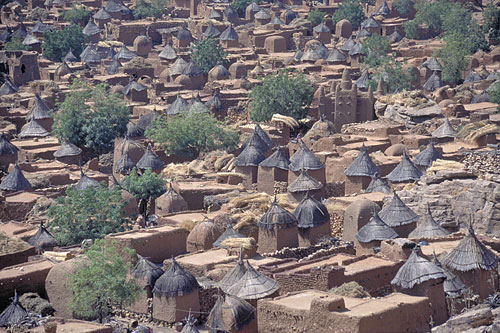
Never having seen a photo, full of ignorance, the first views of the Cliffside houses with their clay granaries is gobsmacking.   It is an entirely individual tangible exhilarating experience > a magical hierarchy of mythical fathomless mysteries. Florence, on the other hand, accepts the Dogon Einstein’s Theory of Relativity as a matter of fact taking it all in her stride.Afficher l'image d'origine

Still surrounded by fields of maze the views are surreal. The granaries look like large telephone boxes wearing enormous pointed straw hats all standing on stilts beneath the overhanging escarpment. As we get closer we begin to see the village houses woven in amongst the rock ledges. Dallo asks us to wait for him while he goes ahead and announce our arrival and gets permission for us to visit.

Await his signal to follow all eyes are looking upwards.   Whirling eagles pass overhead their high nest sites clearly marked against the rustic rock.

We eventually open the door of our earth craft.   Unsettling the settled dust any moment now the earthlings with their Hubbell telescope sight will spot us advancing up the cliff to emerge from their skull protected caves. With each and every footstep echoing against the overhanging outcrop of rock, Florence blazes the trail. Arriving at our first village of the living and dead there is not a humanoid to be seen.

Stumbling along behind Dallo we reach our first Dogon ladder. A large log with steps cut into it that requires a proficiency in high wire balancing or suffer the painful consequences. Scrambling up I associate it more with ascending into the heavens rather than entering a village. Up we go in single file through the Stargate into a world created by Dogon’s for Dogons where all life, nature, mind and matter are comprehended in a single scheme of interconnecting myths.

Myths that not only explain the origin of the universe but the characteristic archetype to which all in it including our societies and us should knuckle under.

The main one according to Dallo is an Egg called Amma the seed of the earth who quivered seven times before the first Nommos arrived to create the sky, day and night, the seasons, and the universe.   To be more precise the world egg was shaken by seven big stirrings of the universe. It broke into two birth sacs, each holding twins, who were looked after by Amma, God on the maternal egg. In each placenta were a male and a female twin, each male and female contained both the male and female basic nature.

“Jesus the heat is getting to me Dallo I don’t think I can take much more of this”

There was no stopping him he is in full tour guide flow. “A male twin named Yorugu got out of one of the placenta before he was supposed too. A piece of the sac from which he busted out of formed the earth. However, when Yorugu tried to get back into the egg to rescue his twin she had done a bunk and had been placed in the other placenta with the other set of twins. So he took a trip to the new earth and copulated with it—his own motherly placenta, but did not succeed in creating people. Seeing what was going on Amma sent the other lot of twins down to have a go and that where we all came from the first joining of brothers, sisters, and cousin twins.

” Long live Darby O’ Gill and the little people is all I can say.

Standing outside one of the Granaries, which is to the Dogons what earth is to the cosmos and the stomach is to the individual. They are not just granaries Says Dallo but a form of defence. “Each Granary is divided into sections. The first floor is against famine. The next is the man of the house and his first wife and her jewellery. The next floor is the second wife.” Slopping against the Granary is a log ladder (a tree trunk in the shape of a Y with steps cut into it. The Y section is the top of the stairs) that leads up to a top window above a smaller window some twelve meters off the ground. With two hands gripping the log I venture up to have a look.   Curiosity kills the cat. The interior is sectioned walled into four orange shape segments but before I can explore further we are on the move again upwards.Afficher l'image d'origine

Next stop is the hunter, the high priest dwellings and courthouse all three set into the cliff face. We never make it to the top as Florence has discovered the witch doctors cave.

Inside the cave, there are four small baked round clay mounts in a circle. Each mount is about the size of those Austrian dumplings that stay in your stomach till the next black ski run. Apparently, these mounts are used to administer justice. The accused have to enter the cave one after the other and rest their hand on the mounts, which are covered in blood. The hand that refuses to touch the mounts is the guilty one.   Florence is fascinated. I am mystified as to how it actually works. Perhaps a Dogon riddle that goes something like this:   Riddle-me ree. Locked up inside you and yet they can seal it from me. Fanny has had enough; Dallo at long last stops for a breath of air.

Above the sorcerer pad again reached by Dogon style ladders are smaller caves and ledges. The caves were utilised by a Pygmy tribe called Tellem who shared the escarpment with the Dogons for a few hundred years – as to why no one knows not even God or Mohammed can figure out says Dallo who is showing signs of wanting to leave. Other ladders go up further to Dogon cemeteries that are taboo to all.

With Dallo’s ankles twisting and turning inside his designer sneakers we start our descent. His ankles remind me of many a chicken wishbone I pulled in deadly battle against my brother for a wish that never came true.

On the way down I lag behind in the hope of spotting a live Dogon, or a living dead one that might not be to camera-shy. Dallo has already warned us those caught taking photos could set the cosmos wobbling but with no one around I cannot resist taking a few shots.

Once more we arrive at the foot of the escarpment.   The odd Acacia dots the otherwise Sahelian dominating species on the plain of Séno.

Stage two is just a short walk along the escarpment face to a crack where we can climb up to the top of the plateau.   After one kilometre we are well spread out Fanny to the rear, Florence up front without the twists and turns matching Dallo’s African paces step for step.

By late afternoon in the simmering heat large chunks of fallen cliff face are watching us trudge our way up. Nothing stirs. On our right, the rock cliff face looks brittle and barren. Here and there large enormous blocks of rock have detached themselves to slide hundreds of meters out from the foot of cliff face.   On our left a small dry riverbed and fields of parched millet.

After nine kilometres we are all beginning to believe in the three Dogon revelations. Nature speaks through the sounds of the grasses. Order is symbolized by weaving. Not quite the same type of weaving that all of us are doing.   Communications is the work of the drum.   The last one we have no problems with the scorching heat as all of our heads are drumming.

Dallo points to crack in the cliff face. “This is the way up.”   What is visible to us is a rocky passage blocked by large sections of broken rock covered in dense vegetation. The shade looks inviting but the climb looks intimidating.   Fanny’s face reads beam me up.

Following a spring line of water, we pass through a botanical garden of vegetation and flowers that none of us can name.   Surrounded by trouble hawks and the ever-present sound of rock dove and plovers the climb turns out to be relatively easy. Gradually we leave the humid microclimate of the crack to emerge on the top of plateau. Our sandstone plateau is a labyrinth of holes, mixed with areas of hard impervious rock, somewhat resembling the Burren in County Clare in the west of Ireland but without the blue of the sea in the distance.

An energy field of rising heat blocks any possibility of long vision so our view (from the top) is disappointing. With an announcement of a further five kilometres to the nearest village Fanny’s weaning energy evaporates while Florence on the other hand god bless her little pins is off strutting out front once more.   One hour later with large helpings of TLC, I nurse a sore, weary, and parched Fanny into the village.

After a few beers, we are shown our sleeping quarters.   The choice is dismal a bamboo slattern bed or the flat mud roof.   Just as the evening light begins to paint the hues of a warm night sky I brave one of the Dogon ladders to a roof nights sleep. With no mossie net, it’s a night of pure torture.   Sleep is almost impossible. What I get is snatched between the high-pitched piercing sound of an incoming mosquito attack and the eerie silence while he or she sucks their fill. – I awake drained.

The new day is rung in at six am. A group of Dogon ladies standing in a circle start the day’s heartbeat with the arithmetic sound of dull thudding of maize. Without a drop of perspiration there pounding poles gliding up and down in time to their ever-swinging breasts. From my rooftop, the gathering light casts shadows in long curved thin lines across the rocky surface. Bending at the foot of my ladder the shadows like the living dead returning to their life bodies as the sun rises. The colour scheme of the new day flamed out in a time-compressed experience.

Djiguibombo our host village awakes with many of us suffering from millet beer hangovers from the night’s consumption of Konjo – the local brew. By the time Dallo appears breakfast is on its third untouched push around our enamelled plates.

Reluctantly we set off on a walkabout of the village.   Avoiding Holy ground on which no feet must tread we visit all the important structures. The Toguna an open-air stone structure roofed with millet stakes, (the pub) where the village elders (men only) meet for their daily chinwag over a fresh pint of Konjo. Across the street a round stone hut that bears no name where ovulating young ladies sweat it out.

Next is the Gina a type of sanctuary where the honoured ancestors hang out. Luckily for us, Dallo’s enthusiasm for long explanations is muted by the early start.   We are spared his unquestionable narration as to why’s and why not’s of every doorknob, stone, shapes and colour.   Then it is off to the main square where the stilt dance takes place in celebration of the sighting of Po Tolo the Dog Star of Sirius (booking in advance).  As to why the dance takes place on six meters high stilts is a mystery that Florence explained. “You need to be up high to see the stars.”   As none of us other than Florence has a hope of climbing up again in the year 2020 we will never know if her observation is true.

What we do know is that the thought of walking to the next village Enndé and on to Doundourou for more of the same is a large no-no.

With Florence setting the pace determined as ever to finish in front we arrive at the top of the three hundred meters high escarpment to descend to the floor before the sun requires us to take a block 35 stop.

(Top TIP: Sunblock is expensive and not always available in the bush. Bring lots and Calamine lotion.)

By late afternoon we have struggled back into Kani-Komble where the awaiting green Merc connects us once more to the real world.   After savaging a few cool beers, and once more resting the purchase of a large carved door that one would die for we jar and jolt our way back to our Hotel.

Karen and Chris their time-limited decide to head for the Burkina Faso border. We with our three arses pointing at Sirius B the Po tolo star of the Dogon crash out on the rooftop and pass out for the night. Pitch No 51.

Afficher l'image d'origine


Share this:

  • Click to share on WhatsApp (Opens in new window) WhatsApp
  • More
  • Click to share on Pocket (Opens in new window) Pocket
  • Click to share on Mastodon (Opens in new window) Mastodon

THE BEADY EYE’S UNPUBLISHED BOOK. CHAPTER SEVEN. SECTION FOUR.

13 Wednesday Apr 2016

Posted by bobdillon33@gmail.com in Literature.

≈ Comments Off on THE BEADY EYE’S UNPUBLISHED BOOK. CHAPTER SEVEN. SECTION FOUR.

Tags

Best Read., Best Travel unpublished book., Best unpublished read., Top readable travel book, Travel book that will inspire you to travel.

Afficher l'image d'origineThis time by the back door I give the posse the slip. There is a tangible difference in the stillness of the air, which was not present on my morning walk. I pass through fields of peanuts until once more I am on a track, with high grass on either side. I come upon the first fork. “Keep to the right” …Almo had said, so right I go. Another fork, right again, yet another, right again.

If I am on the right track I should arrive at a three-fingered fork where I am to take the middle finger. I hit it right on the button, onward march. The next junction I am not too sure but right looks good. Subconsciously I take note of a large tree as a reference for the way back.   Confronted by and an array of tracks I stick to the M1 until it runs out of well-trodden earth. I halt at the edge of a rocky surface. Straight across looks the natural line. Yes, Yes, You Boy, Captain Cook is nothing on you.

On the right track once more there is a humanoid coming in the opposite direction.   I am tempted to inquire if this is the way to Paris. His passing look gives me the feeling that you don’t see many white Cadillac’s passing this way. Oblivious to oncoming traffic he keeps looking in his wing mirrors until I disappear into the trees.

A wall tells me that all is well. Sure enough on the other side of it, there is the rock outcrop. It lies on the opposite side of a steeply studded narrow wild overgrown gorge. Scrambling down > the ever-vigilant lookouts spot my approach. While the troop scatters up the rocky outcrop and out of sight the dominant males in a sudden uproar at my intrusion bear their teeth.olive baboon teeth mouth

I have a lot to learn about obligatory silence and direction of approach if I am not to be mooned by all African Wildlife. I hang around for a while in the hope of things settling down but to no avail. The troop remains well hidden and I soon lose interest in the odd view courtesy of my field binoculars.

As I walk back the first drops of rain are exploding in puffs of dust, and the grass is stirring. There is a pungent release of vegetation smells and a strong sense of movement all around. Thank Almo I make it back. In his wisdom, he has sent a young lad to find me.

Just after dark the village elders wearing tall coarse woollen fez type hats and their wives begin to arrive.  In the flickering candlelight, problem after problem is presented and discussed. Almo displays great untiring patience. He explains to me that the grievances are the same every year.

“You can see here”, he says, “That education is an emptiness – it helps me to escape into the wider world, but I cannot impart it here so that it passes from one age group to the next.   Bonding to a school is all jolly fine, but in these people’s case, the only bonding is by making them form a group as you see before you to run their village. To buy their seeds, to sell their crops, to oversee their health, to join with other farming groups, to record and keep records and only then they have something that has a strong chance of surviving.”

“Training children to recite the whole of the Koran is all jolly fine, but to teach them to be more confident in themselves, to take their own decisions, to manage on their own must all be done in their own language. To make them discover themselves is the only way forward.”

“One must know how one is before learning who others are and there is a constant tug of war between tradition and the existing world.”

Our world glistens in the dark eyes of those present during a pause for a cup of Kinkilibar.

The morning news is that Almo has been given more land to build a hospital. The young man with the elephantine upper lip is on the back of a truck and hopefully should arrive tomorrow, that the corrupted pill dispenser has been replaced and that we decide to stay another day and depart in the morning.

The next day has only one more surprise it comes in the form of vet whom I collide into head-on rounding a blind corner in the long tall grass. He has dressed in a full business suit white shirt and tie carrying a briefcase. Our meeting surprises him just as much it surprises me. I had just crossed a tree suspension bridge without falling in when we collided. He was descending the track at speed and I was paying no attention to oncoming traffic.   It was weird, to say the least, to see a suit in a jungle setting.

Over the evening meal, Almo shows us some photos of his morning patient prior to his first op a year ago. The young mans’ upper lip hang’s down below his chin.   He also tells us he is having a problem with a container of medicine, which is in the docks at Conakry.   Apparently, some corrupt customs official won’t release it. I tell him that perhaps I can help. Referring to my list of if in trouble contacts I come up with two contacts for a phone call in the morning.

Early morning Almo is up preparing for ‘Gumdrops’, the phone rings. When Almos patient – ‘Bottom Lip’, drops in, I ring my man Souleymane Souare -Chief du Protocol de la Prefecture de Mali Republique de Guinea Conakry, and. Lieutenant Colonel la Vile Beavogui Directeur General Adjoint des Sevices de Police Conakry République de Guinea.   Miracles don’t just happen on the operating table the container is on its way and so are we. (The container arrived ten days later.)

With Fanny driving we descend out of the mountains passing Mount Kavendou on our left arriving out onto savannah land we stop at Dabola for lunch. It is a small village described by some American in the Bible as a town with a Wild West ambience, obviously helped by some local grass. Pushing on we arrive at Kouroussa with one hour to make the ferry crossing fifteen kilometres away. However, the roller coaster ride with the odd thrilling water splashes defeats us. Pitch number forty-six is under a Kinkilibar tree> a good fire, a good meal and a game of rummy named by Florence as the Cricket Chirp Game. We all sleep solidly through heavy rain.

Our first dawn visitor is a dog followed by his owners one of which informs us that the ferry crossing is anything up to five hundred meters or five kilometres down the road. We leisurely break camp and arrive within two bends at the ferry.   Six trucks and two cars are waiting to be loaded.   Frenetic repairs are in progress to the landing platform, which is a quagmire of oozing mud. With loud encouragement from all in sundry two trucks get aboard with great difficulties.

We are told to wait until the next crossing. In the meantime, a few rock are added to the quagmire. The ferry arrives back within the hour. The first car to disembark sinks to its doors, it eventually arriving on terra firma minus a front bumper. More rocks are added all disappearing after the others into the unknown. Next is a truck, which lands pushing a mudslide. To the amusement of all looking on the foot passengers fair little better. Afficher l'image d'origine

A few more rocks and it’s our turn to board, which is achieved with a panache deserving a round of applause worthy of a champion rally driver. On board, we emerge from a mud-splattered Williwaw to watch the bizarre scene as one truck after the other takes the plunge engulfing the odd slow foot passenger in a coating of chocolate icing. Fares collected we are on our way. Guinea Conakry has no coins and most of the paper currency has spent its lifetime being handled by muddy fingers till it is almost impossible to read their denominations.

The river crossing as with most river crossings in Africa imparts the impression that time is standing still.   The adventures of your travels surround you. There is a mixture of the captivating natural flowing grace of the river a quickening of the heart and a warm feeling of love. It’s a phenomenon, which you can never quite believe in until you experience it yourself.

Our river is the Milo a tributary of the Niger.   A resounding thud announces the arrival on the opposite bank. Without much attention to the positioning of his ramp, our captain has to some degree arrived at his disembarkation point.

The car beside us refuses to take the jump ashore.   After much-heated discussion, it has no choice but to leap.   Leap it does and there right in front of the ramp it stays for the next hour.   Williwaw watches the proceedings with disdain and contempt until it is pushed and pulled to dry land in kit form.

Firing Williwaw up I move her to the opposite side of the ramp. She makes mincemeat of it roaring out beside the stuck car whose demented driver is now demanding a refund from Capitano.

We push on towards Kankan some sixty kilometres away. The journey requires circumnavigation of potholes that could swallow a jumbo jet. They almost double the distance to be travel.   With Kankan on the horizon, a small army of uniformed men halts us – “Pull over.”

Stopping under the shade of a tree one over-weight dude in blue police garb, sporting the obligatory dark sunglasses smells of trouble.   Sure enough, he’s spot on. Passports, Williwaw’s documents followed by the question, “What is the real purpose of your visit?” he demands, I open the back. I feel like telling him that we are here to blow up the Presidents Palace, but instead, while I open Williwaws back door let drop that Lieutenant Colonel la Vile Beavogui Directeur General Adjoint des Sevices de Police Conakry is a personal friend. His face turns ashen, and a small squeaky voice says, “Close please”.   We wave goodbye continuing on our way winding in and around and over the mine-crated road to Kankan.

We are now in Kissi country that makes up about five percent of Guineas population of six odd million people.   The Kissi says Fanny according to our Bible have a strong respect for witchcraft.   According to Florence, she can see no one kissing.

Kankan the second largest town in Guinea is in Malinke country. Populated by the Mandigo group that makes up about thirty-two percent of the southeast highlands population. The Malinke traditionally used cowry shells as a medium of exchange. With the dollar worth about one thousand four hundred to one thousand six hundred Guinean francs (1999) depending on where you exchange – they might be wise to bring back the cowry shell.Afficher l'image d'origine

The Bible says Chez Madame Marie is the best place to stay in Kankan > A guesthouse par excellence where woman travellers are especially welcome. The trouble is that no one knows of its whereabouts. We stop at a bar named London down a few cans of Guinness, which have the immediate effect of enlightening our navigation.

Visiting several dead ends we splash our way in and out of many potholes the size of duck ponds. With patience running low we eventually find the place now called the ‘Refuge’. It is up a laneway that subs up as a rubbish dump. We enter a small courtyard surrounded by prison-like rooms with an open-air kitchen backing onto a sheep pen.   Whoever stayed here must have been high as a kite or dear Madame God rest her youth was offering some Saigon attractions, not on the menu.   It is obvious that the bible has not seen this dump for some years.

With Kankan in total darkness, it is too late for us to go looking for anywhere else. The room is clean, and Williwaw is safe in the courtyard. Madame, a small frail Vietnamese is stretched out under a mosquito net in no mood to move. Only the threat of having her struck off the Bible motivates her to produce a few chips, which we eat to the sound of her generator been whipped and kicked and cursed into action. Resisting all attempts to cast any light, it joins her is a bout of coughing, farting, discharging clouds of smoke, with the odd death wheeze.

The sky opens. We sleep with a thousand Malinkes doing the Cancan on the galvanised roof.   In the morning there is no sign of her Ladyship.   We pack and move out to find breakfast and new lodgings. Driving past the train station, the university, down a wide long mango-shaded avenue, we once again plough our way through large potholes now all overflowing with dark brown water to hit rush hour Kankan style.

Bicycles, Peugeot, trucks, buses, carts, dogs, donkeys, motorbikes – you name it > stopping and starting to the flow of pedestrians who weave in and out of the traffic with the same suggestive body movements of a real Cancan. Most of who are oblivious to any right of way they risk their lives to well-worn disc pads.   We are sucked along with the great unwashed to stop for breakfast at one of the many downtown restaurants.

Drinking large espresso’s with French croissants it is hard to fathom that only a few days ago we were camping in the bush.

At forty-seven thousand guinea francs a room, Bate P’ is our new hotel > Air conditioning, TV, shower, with a large enclosed car park. In fact, everything that Mongo Parks (1771-1806) would have needed on his way down the Niger from Segou a town in southwest Mali. Our first encounter in the hotel is Kadir a Dutch photographer.   He is hoping to follow the Niger to its delta a mere four thousand kilometres away. The first part of his journey is by riverboat from Kankan down the Milo to join the Niger, and then on to Bamako in Mali – a five to a seven-day trip.

It sounds mouth-watering to just sit back and enjoy the scenery. Five hundred kilometres of smooth water after our last four weeks of jolting is just what the doctor ordered, we sign on.

A quick foot reconnaissance of town with the girls uncovers the largest pair of denim jeans this side of the Atlantic. Unlike some of its matching African cities that we have visited Kankan so far has a good-natured feel to it. With colour in competition everywhere the bustling streets are hassle-free. After some excellent yoghurt and a large dose of passing carbon dioxide, we return to our hotel.  Afficher l'image d'origine

Kadir suggests we walk down to the bus station after lunch to check on the ferry progress up river and to book our passage.   Arriving at the booking office we are assured after a long wait that the ferry is due any day now and there was no problem getting the jeep aboard.

I get back to tell Fanny the good news to find her talking to God on the big white telephone. “It’s the salad she moans “In sympathy, my Mount Vesuvius (the ant bite) explodes. The city is plunged once more into silent darkness. Without a flicker from the air-conditioning or the TV, the night is hot and sultry with Fanny beating a track back and forth to the loo. Our room unlike room 101 across the corridor that has a procession of working ladies to keep its occupying colonel cool late into the night our room is hot and sticky making sleep almost impossible.

Morning brings no satisfaction at the reception desk. “What is the point of paying over the top for an air condition room, when the hotel generator is turned off?”   We move to a cheaper room in the old part of the hotel that has ceiling fans.

Next morning Kadir – the Dutch photographer and I make another visit to the booking office.   Fanny’s recovery is helped by a packet of Dioralite. (See Medical list on cd)

(Top TIP:   A Water purification is a must.   We mounted the purification unit and a shower attachment unit on one wooden board. This board could be hung from the roof rack and plugs into one of the power points positioned on the outside of Williwaw under the back door.   A Hand pumped purifiers is too much hard work. We carried one only as a backup. During the whole African trip we used only three replacement filters.)

We are informed that the ferry has been sighted and should arrive shortly, as to exactly when is anyone’s guess. By the look of the depth of Milo River since yesterday, it might be never. It has dropped a good three feet with the dry season approaching.

The afternoon is spent poking our noses in and out of every shop. We visit Issa Traore and Daoudor Traore Antiquaries. According to their owners, some French buyers visit them twice a year and take all they can collect by the container load.

We meet Larry a large Aussi gold miner, and Matthew a retired Canadian geologist who has flown in for a week to do a field survey somewhere nearby, for a different gold mining firm. Unfortunately, Matthew spent most his time stuck in a Guinea pothole until Larry who happened to be passing by rescued him. We meet Leslie another prospector who hails from Fareham just down the road from Winchester, Fanny’s hometown.

Day three in Kankan > There is no sign of Godo the river steamer. From the look of the river, it is high and dry and more than likely will not be seen until next seasons rains. I tell Kadir if he hangs on in Kankan long enough he will be able to walk down the Milo to join the Niger or as it is otherwise known as the Dioliba, the Joliba, the Kworra, and the Timbiko. It is up anchor for us in the morning.

I spend the rest of day with the ice cream man who brings me to his brother a welder for some running repairs to Williwaw’s exhaust. I sell one of my old tyres to one of his many brothers and purchase a new tyre from another brother along with a death mask.   The mask is received by the girls with abject horror it being consigned to the toolbox on the roof under lock and key.

Somewhat disappointed that our African Queen voyage had not materialised we set out for Siguiri I getting a lecture about filling Williwaw with junk. The bible consoles us with a description of the riverside route to Siguiri as being one of the most beautiful one can take.   

Two river crossings later, mud mires that any decent Hippo would be proud to acquire, and potholes that could be seen from outer space, we pitch number forty-seven under a full moon. Exhausted and in excellent temper all around. The beauty is in the eye of the beholder.

Day breaks grey and overcast the first for some time. Just what we need says Fanny a drop of rain to fill the potholes. We cross the Niger at 11° 03? N – 9º 14? W. arriving in Siguiri some hours later. We push on after a quick tour of the market. We have not gone more than a few nautical miles from its outskirts when a police barrier stops us. We are sent back to have our passports stamped at the customs that we had driven past without noticing. It’s the first clue that we are about to leave Guinea – I turn down flat, a demand for ten thousand GF to stamp our passports.

Eventually clear to continue we drive on expecting the border at every turn. It does not appear for a further seventy miles of dust, bumps, and our first experience of corrugations.

(Top TIP: There is no happy speed driving corrugation. Coil springs or leak springs without shock absorbers make driving them a nightmare. They vary in depth and width depending on what uses the road, (usually heavy trucks). There is a real learning curve to driving them safely and finding a speed suitable to your vehicle. Short wheel vehicles are more inclined to turn over. The chances of a puncture and blowouts are high. They are not long in finding any loose weakness in your vehicle, be it in the inside, the engine, and the electrical, on top, underneath, your passengers’ tolerance.)

Fully conscious that any sudden requirement of the anchors is utterly a ‘no no’ I struggle to find a suitable speed. Eventually settling for sixty to seventy kilometres to avoid the blithers shaking us to death we drive by village after village leaving villagers who are walking home in clouds of dust   A few ventures on to sidetracks to avoid the corrugations with one last bump we arrive at the frontier Nafadji.

A small village with its centre in no man lands.   Clearing police and customs without too much difficulty, we are sorry to be leaving Guinea a country of unspoiled beauty. Our new hosts Mali at the other end of the village clears us with a pride in their efficiency informing us with glee that from here on it is a smooth ride to Bamako


Share this:

  • Click to share on WhatsApp (Opens in new window) WhatsApp
  • More
  • Click to share on Pocket (Opens in new window) Pocket
  • Click to share on Mastodon (Opens in new window) Mastodon

THE BEADY EYE’S UNPUBLISHED BOOK. CHAPTER SIX.

10 Sunday Apr 2016

Posted by bobdillon33@gmail.com in Literature.

≈ Comments Off on THE BEADY EYE’S UNPUBLISHED BOOK. CHAPTER SIX.

Tags

Best unpublished read., Top readable travel book, Travel book that will inspire you to travel., Travel.


Afficher l'image d'origine

Afficher l'image d'origine


Afficher l'image d'origine

SENEGAL.

What we know.

Marabouts- Wolof – Dakar – St Louis – ĺle de Gorée – Slaves – Flies Malaria, Muslims.
Senegal is supposed to have got its name when some yobbo of an explorer pointing at a river. “What is the river name,” he asked of a local Wolof bloke. The Wolof seeing that he was pointing at a wooden canoe replied in his best Wolof
“Ii sunu gal le,” that’s my boat. We have the choice of two frontier crossings from Mauritania into Senegal, the Rosso–Richard ferry crossing > which by all accounts is to be given a wide berth, or around the back of Djoudj National Park.
Leaving Nouakchott in the late afternoon our first difficulty is finding the right exit. The main route out-of-town is called the road of hope. For most of the time it is buried in sand and riddled with cadeaux demanding police, it is well named.
Still exhausted from the ocean floor crossing and last night’s sounds in Hotel Sabah Room 4 at 7000 UM (Uuguiya) without breakfast it does not take long before Fanny’s morning radiance is taxed. In no time it is obvious that one more day in Mauritania will be one too many.

After eighty tar squeezed kilometres we pull over for our last night in a country of over one million km of moving sand driven by the Shahali winds from the south, that combine with the sand to manufacture flattened stones with one or more sides along with pointed grass seeds that form into balls to be blown across the desert floor in search of water.

We are never to know if Mauritania is worthy of its allocation of seven pages out of the one thousand plus pages in Africa Lonely Planet or for that matter the forty bravely mustered pages out of its thousand-plus pages in the West Africa Rough Guide. Or for that matter if the locals still believe in the Islamic Mythology of Muhammad riding on a fabulous beast named Borak (Lighting) part human part animal on his night of ascension into heaven.

However, there can be few places on earth that teaches us that we are all living with unseen hordes of living things, unnamed > vanishing before our eyes.

Over 600 million people live in rural isolation in Africa unaware of the IMF, World Bank, Television, and Electricity. I am told that all over this vast continent lies donor Aid, countries hardware rusting in the noonday sun bearing witness to the lost cause of technology. As we prepare to leave this barren land it is hard to believe that the greater part of Africa will soon turn into an information desert of underclasses due to the inability of the microchips being able to chat with each other. (A Job of the UN to address: Technology should not encroach on a nation’s people freedom of opportunities or intelligence. The smart card is the human card, not the internet > everyone is surely entitled to an equal opportunity to get smart.)

Wild pitch number 35 is alongside a watering hole hidden in a hollow, surrounded by brown sands. Our Sahara sand is still with us if only in a different colour. The well attracts every passing moth, mosquito, fly, ant, and what have you. That night all repellents fail miserably

Bitten to shreds early morning is announced by the local bird population, camels, goats, and well-going people.

After many enquiries, we find a dirt track that leads down to an irrigation canal.   Our route to Senegal is to be the top of the canal bank to the border. Djoudj National Park des Oiseaux is to our left.   With last night’s insect’s attacks, any appetite to visit the Park has long gone out the window.

Some hours later after a relatively easy frontier crossing with a salaam malekum here and a dash there we are on our way to Saint Louis the oldest French settlement in West Africa founded in 1659 and now a UNESCO protected World Heritage Site.

We find Saint Louis in a state of smelly quaint decay. It’s current status as a world heritage site somewhat hard to fathom.   Its island, (Ndar in Wolof) can be given a total miss.

Fought over by the British, French, and Portuguese it has a museum that is closed more often than open. A 500-meter iron Faidherbe Bridge built-in 1897, which was meant to span the Danube with a collection of St Louisienne Architecture that could do with some tender love and care.

The piece de- resistant is a wonderful old silk-cotton tree that has seen all of it in better times. It’s no wonder that UNESCO itself is presently sponsoring a global poll to find out what is worth saving and what is not.

We booked into the Old World colonial Post Hotel for the night. The linen napkins have long disappeared with Jean Mermoz a famous French first world war aviator. However, the ability to charge for past glory remains along with the musky stuffed head trophies of animals once found in Senegal.

Over dinner, we decided to give St Louis a few days but in accommodation more suited to our pocket. We move to Hotel Battling Sikri dedicated to the memory of the ghost of Mbarick Fall – the first African heavyweight-boxing champion of the World.   In 1925 he was bumped off for being black in the USA.

We secure a large room with a street balcony over the hotel bar for half the price of Post Hotel. With the girls needing a rest we decide to stay two nights. While the girls settle in with a shower and a soaking in a large tub I over a beer downstairs in a bar of loose rules get propositioned by one of Mbarick’s reincarnated sparring partners. The rather large lass is promising to go more than the distance for a price. In a dream horror ring, it turns out to be a restless night for me.

We head out on a day’s excursion south of the town.   Our target is a swim on one of those holiday brochure sandy palm tree beaches. Three hours later after digging Williwaw yet again out of more sand, we settle for a swimming pool.

Returning in the tingling light of night we have the misfortune of running into one of Saint-Louis not so saintly like occupants. A douane customs excise Wanker on the make. It takes an hour of argument to get rid of the blither.

Next morning in a cloudburst mixed with sand we leave for Dakar where we need to do some visa hunting.

(TOP TIP: When planning it is worth marking on a Map where and what visa can be had where.)

We make it as far as Kayar a fishing village, about 60ks north of Dakar.   Here amongst the pirogues, we learn that it is possible to cut out the potholes and dust by driving the beach to Dakar.

This time the sand looks firm smooth and inviting.   We whistle down until the tide makes us take a sharp turn up a sand gully between some pine trees. Halfway up the gully, the yellow sand is up to Williwaw’s axle.

The look on the girl’s faces is abundantly clear. O! No, not again. We get stuck within earshot of the breaking waves, and unfortunately in earshot of the adjacent wood night sounds. There is no option but to camp.   The pounding surf combined with the rustling fern trees and dark shadows do not take long to assert themselves on the insecurity of the girls. Pitch 36 turns into Pitch 3. Six hundred meters further up the gully. All six achieved with sand tracks. Here we pitch our tent on the ground.

With fatigue setting in tempers are on a short fuse when a group of young boys arrive. They make it quite obvious that camping where we are is inviting death by mugging.   With a collection of willing pushing hands, we move once more to the end of the gully. Pitch No 38 is alongside a compound wall on top of an ant nest.

The morning reveals the end of the gully opened out onto a small village with a Club Med type camping compound under construction.   The village consists of three or four-grass roof round huts overlooked by a large high water tower.

After the nights’ pitch outside the compound’s wall, no persuasion is required to move us into the village under the only shade-giving tree. Here we are to stay for the next three weeks until the rainy season comes to a halt.

The village is nothing to write home about.   Situated just above the sand line it is five kilometres north of Lake Rose. A sum total of four mud baked wall houses and another few dwellings scattered in amongst the sandy hollows outside the compound. Our accidental adopted villagers are Peulh > a nomadic ethnic group of cattle people, light-toned skin herders.

To Fanny’s undying relief there are two English-speaking people living in the village along with an ex-French Legionnaire in his early sixties who has a strong liking for dark pussy. He and the village chief are business partners in the camping project.

By week one we have met all the chief’s wives whom he refers to as problem one, problem two, and problem three. Problem four has done a bunk some time ago. He spends his days on the roof of the water tower, descending at speed when he spots a dust cloud coming along Lac Rose (Lake Rose). The dust announces the pending arrival of some tourist suckers that have been persuaded to come around the lake to visit his traditional village.

Two of three times a week he scurries across the village, whips on his only white jallaba.   Dons a few strings of beads, which no woman is allowed to touch and abracadabra he has transformed himself into a tourist attraction.

The tour starts with a welcoming speech.   Followed by a quick viewing of all his problems, the well, and then back to his house where he hopes to sell a few wood carvings. Called Josef he is a likeable enough scoundrel, tall, lazy and resourceful who has taken too relaxing in my hammock after any guided tour.

The two English turn out to be a Welsh divorcée and a South African with a visiting child from her first marriage. Living in one of the village sturdier one-room houses they are both playing the white doctors syndrome.

Lake Rose is a Picasso canvas, continually changes colour from silver in the mornings and a deep purple in the early evenings.   It’s a salt source worked by a large community living on its eastern shores, which is peppered with sparkling fresh pearl white conical blobs of salt. Depending on their age the salt mounds descend in intensity of white. In the glaring sun, they silently squat on the reddish soil like the tops of ice cream cones waiting for buyers from Dakar. Postcard of the Lake are grace by them with bare-breasted woman standing waist deep in the purple waters towing strings of colourful plastic washing – up basins.Afficher l'image d'origine

Each mound of salt represents hours of backbreaking work by the village woman. The Tupperware convoys of plastic basins follow their mothers like ducklings over the blue or purple mirror waters of the lake. When full with raked salt they are towed back by the woman to a flat-bottomed boat, which is then poled ashore where the salt is then added to its owner’s individual coned mounts.

By the end of the first week, we have become accustomed to the sound of breaking surf that rings in each morning, the cooing pigeons, and the village braying donkey. We make several trips from Deni Guedj our village to the nearest village Niaga.   It lies twenty minutes south of us along a dirt track that runs beside the lakeshore. Niaga has a small market, a pub and a gre gre maker. These are African miraculous medals that protect everything from mobile phones, vegetables, and your own body against theft, death and conversion. We commission three Gre Gres for our necks to protect us from unwanted events such as dieing from fright, yellow fever, or being eating by cannibals. We have become well-known around the Lake.

The salt village Gin distiller has never had it so good, nor does the large frying pan in the last of the salt village huts, at which we usually stop for a fried egg bread concoction, better known as a banjo which usually ended up being frantically wiping of or laps as we bump our way home.

By week two I am on the local football committee. The chief has got the hang of getting in and out of the hammock, along with twenty odd children.   Flo has made friends with a little adorable fellow named Gaddafi.   We have acquired an egg/chicken runner named Mansual aged twelve. Both are sons of the chief who practise polygyny one of the African continents main scourges. He is the proud sire to more than a handful of children.

I have gone on a night hunt with my widow’s memory catapult. “There, over there”, shouts Ngom for hours. A slim built man, with laser-beam eyes, the eldest son of the local Marabou, (a Muslim holy man and teacher, often gifted with special powers of healing) who by the end of the night is convinced that I am blind and could do with his father help.

We have met Dalie a Serere of twenty-five or six years.   He lives in one of the Legionnaire huts. Kind-hearted, he is a gentle soul, with an African smile that triumphs over the terrible efforts of making a living. Also Amadou in his late twenties, tall, reads English, speaks French, who bemoans being caught by his own culture and the extended family. He is genteel and intelligent, craving change. Lastly, there is Mamadou Da the village woe who has the ability to transfix one with a not overly friendly eye.   Suffering from piles, he hauntingly wanders around in a vagueness of the present, which is both complex and torturous.

Living adjacent to our campsite we also have three gardeners. They spend days attending small market gardens, drawing water by the bucket full hand over hand from a deep well. My suggestion of constructing a pulley over the well, with a demonstration of how to support their tomatoes with a stake, falls on deaf ears.   The mask of tradition win’s out every time I suggest any improvements to make their working lives easier.   It confirms to me that there is not the remote possibility of an African becoming so cosmopolitan that traditions will not apply in the long run. Whether you like it or not, you are part of Africa long-established cultural ways.

Fanny befriends Hassin Qusseynou Ba one of the gardeners who greets us each morning with a joining of his hands and a small bow under our Acacia tree. He is a shy man who’s gently spoken words finds a poetic justice in his onerous life.   Long into the night, he plays a simple one-stringed violin instrument (a small Gourd) producing a mosaic of sounds that float in the air, like the dancing tongs of fire.’

.By week three is it time to visit Dakar thirty kilometres by road or fifteen by the seashore. The city name in Wolof means tamarind tree. Built on a twin-pronged peninsula called Cap Vert it boasts Africa most westerly point Des Almadies.

Setting off early morning we opt for the road route.   Rufisqua/ Dakar. Half the village bumming a lift too different drop off points. Our Legionnaire arms us with a secure place to park in town.   Police barriers are neutralised by our mixed bag of passengers perched in and on top of Williwaw.   Our bibles, West Africa Rough Guide and Africa Lonely Planet describe Dakar as one of the capitalist capital of West Africa. They are not wrong. A melting pot of poverty, wealth and crime, it attracts the usual syringe of toxic human behaviour found in all big cities. A pleasant surprise if you have arrived overland from the north.

Our secure car parking is the Hotel Lagune II where for the price of a beer your car is watched over by the hotel parking attendance’s, for the duration of your stay. A service we later abuse staying over for a weekend on Ile de Goree.

Dakar is a nightmare to get into never mind drive around in. Each and every crossroads, roundabout, has its Rayban cop with Williwaw attracting more than her fair share.

With the normal shores completed, a wad of CFA currency treats us to an excellent lunch before visiting the British Embassy. We arrange for them to accept an envelope on our behalf > Some liquid funds.

(TIP: Credit cards, Bank drafts, Traveller cheques, all have their uses. The Bush bank, however, operates in cash. I had a small safe deposit box welded up under the back tyre mudguard painted black.)

After a futile talk on our proposed route, we exit the Embassy security gates to find we have a puncture. With the Spanish spectacle in mind, I have the changing of a tyre down to a fine art so it is not long before we are once more into the fray.

Dropping off our passports with visa applications at the Mali Embassy, we take a taxi from the parking lot of the hotel to the port to visit Île de Gorée the jewel of Dakar. Afficher l'image d'origine

It is from this small island that many a dark soul walked out of the gates of no return to be sold as a slave in the cotton fields of Alabama. Only one out of four ever reached the age of forty. The freedoms they left behind are to eventually shape the constitution of the USA and the freedoms they learnt to destroy Liberia their reward.

With the port hassles over we board a small sturdy ferry that slip out over the oil slick water of Dakar harbour to Île de Gorée.   The passage to the island is short less then half an hour but in the pre rains humidity, the sea breeze is fodder from heave.

From its small sandy beach swimmers clamber aboard and dive off the side of the ferry. The jetty is thronged with waiting return passengers but there is an air of tranquillity. In front of us a painters pallet of flaking pastoral coloured housing, narrow stoned streets dripping with bright hanging tropical flowers, make all of the harbour restaurants and bars erotically appealing.

Île de Gorée, unlike Saint Louis, has reaped some benefit from its UNESCO halo. Originally a Dutch colony named after an Island of the Dutch coast it has had a chequered history. British 1663, Dutch 1664, French 1677, British 1759, French 1763.

Catching the last ferry back we are booked into a small new hotel for the following weekend.   There is no easy way out of Dakar.

Collecting Williwaw we battle with the fumes, dust, potholes, and the police.   Not forgetting the great unwashed that weaver with total disregard to the dangers of the moving wheel, to escape the city.

Arriving at the finishing line for the Paris-Dakar race, which is on the southern end of Lake Rose, unlike the Chief parched end we find banana plantations and causuarina ironwood trees, we stop for a Biere la Gazelle. (Insert Beer label)  We watch the sunset turn Lac Rose into a deeper pink-purple colour that we have not seen to date.   Hard working bacteria discharging iron ore oxide into its waters are the cause of its colour moods. Behold an African evening when you can almost feel the earth revolving on its axis.

The waters of the lake I am told are as salty as the Dead Sea. Our trip home past the salt mounts, and out over the salt flats that subs up as the football pitch. Williwaw collects her normal load of highly relieved stragglers for a roof ride home.

Awaken by a downpour we learn that the village has gone down sick. Not good news as round two of the football league is only a few days away. We are drawn against Gorom, a Wolof village and every able body will be required both on and off the pitch.

That night I am invited by Ngom my hunting partner to visit each and every household to explain the necessity to boil the water. Our night journey over the dunes starts under a sky of immense beauty. On the distant horizon lighting punchers, dark clouds lit up by a red sunset.

“Don’t stand on that snake or that thorn-bush”, it takes hours, most of the night to visit all. The rains have begun.

By the next morning, the village is awash in more ways than one. Old and young are washing.   Breasts are released from cross your heart and hope to die western brassieres. Bums large and small are glistening in the early morning sun; modesty had gone out the window.

Later in the morning, one more washed body is found on the beach. A young Wolof man drowned.   At which Josef the village chief takes one look shrugged his shoulders and walked off “C’est pas grave “it’s not serious it’s only a Wolof “Tribalism the basic political illness of modern world and Africa> Nothing that a few hundred-year wars never mind two World Wars or the coming Soccer match won’t resolve.

That night the football committee meets under the stars. Voices rather than faces identifying each speaker. Each is allowed to summits their tactics without interruption.

It is an earnest business without much joking. The referee sets out the perimeters of fair play. I am commandeered to get the VIPs Awning and chairs and because I am viewed as a rich man when next up in Dakar I am to purchase a new football.

I point out that due to the village sickness we are weak in the back and that perhaps a little Irish fair play would not go astray.   I suggest that on the day of the match that the village grazing cattle behind our goal could be herded by their cattle dogs onto the pitch when we come under attack. Not a foul as it would be the cows that blocked the goal, not us.   Once understood there is an outburst of knee-slapping; laughter and shrieking that has every sleeping baby in the village-wide awake.

(TO BE CONTINUED)  Don’t miss the football match. Make a donation.

R Dillon. Account no 62259189. Ulster Bank 33 College Green Dublin 2.

Sorting Code: 98-50-10.


Share this:

  • Click to share on WhatsApp (Opens in new window) WhatsApp
  • More
  • Click to share on Pocket (Opens in new window) Pocket
  • Click to share on Mastodon (Opens in new window) Mastodon
Newer posts →

All comments and contributions much appreciated

  • THE BEADY EYE SAYS TRUST IS DISAPPEARING THANKS TO OUR INABILITY TO RELATE TO EACH OTHER. December 19, 2025
  • THE BEADY EYE SAYS. THE WORLD NEEDS PEOPLE GOVERNMENT NOT MONEY GOVERNMENTS. December 18, 2025
  • THE BEADY EYE ASKS WHAT ARE WE THE SAME GOING TO DO TO STOP THE WORLD BEING FUCK UP FOR PROFIT BY RIPOFF MERCHANT. December 17, 2025
  • THE BEADY EYE CHRISTMAS GREETING. December 16, 2025
  • THE BEADY EYE SAYS. TO THE NEXT GENERATION TO LIVE A LIFE WORTH WHILE YOU MUST CREATE MEMORIES. December 16, 2025

Archives

  • December 2025
  • November 2025
  • October 2025
  • September 2025
  • August 2025
  • July 2025
  • June 2025
  • May 2025
  • February 2025
  • January 2025
  • December 2024
  • November 2024
  • October 2024
  • September 2024
  • August 2024
  • July 2024
  • June 2024
  • May 2024
  • April 2024
  • March 2024
  • February 2024
  • January 2024
  • December 2023
  • October 2023
  • September 2023
  • August 2023
  • July 2023
  • June 2023
  • May 2023
  • April 2023
  • March 2023
  • February 2023
  • January 2023
  • December 2022
  • November 2022
  • October 2022
  • September 2022
  • August 2022
  • July 2022
  • June 2022
  • May 2022
  • April 2022
  • March 2022
  • February 2022
  • January 2022
  • December 2021
  • November 2021
  • October 2021
  • September 2021
  • August 2021
  • July 2021
  • June 2021
  • May 2021
  • April 2021
  • March 2021
  • February 2021
  • January 2021
  • December 2020
  • November 2020
  • October 2020
  • September 2020
  • August 2020
  • July 2020
  • June 2020
  • May 2020
  • April 2020
  • March 2020
  • February 2020
  • January 2020
  • December 2019
  • November 2019
  • October 2019
  • September 2019
  • August 2019
  • July 2019
  • June 2019
  • May 2019
  • April 2019
  • March 2019
  • February 2019
  • January 2019
  • December 2018
  • November 2018
  • October 2018
  • September 2018
  • August 2018
  • July 2018
  • June 2018
  • May 2018
  • April 2018
  • March 2018
  • February 2018
  • January 2018
  • December 2017
  • November 2017
  • October 2017
  • September 2017
  • August 2017
  • July 2017
  • June 2017
  • May 2017
  • April 2017
  • March 2017
  • February 2017
  • January 2017
  • December 2016
  • November 2016
  • October 2016
  • September 2016
  • August 2016
  • July 2016
  • June 2016
  • May 2016
  • April 2016
  • March 2016
  • February 2016
  • January 2016
  • December 2015
  • November 2015
  • October 2015
  • September 2015
  • August 2015
  • July 2015
  • June 2015
  • May 2015
  • April 2015
  • March 2015
  • February 2015
  • January 2015
  • December 2014
  • November 2014
  • October 2014
  • September 2014
  • August 2014
  • July 2014
  • June 2014
  • May 2014
  • April 2014
  • March 2014
  • February 2014
  • January 2014
  • December 2013
  • November 2013
  • October 2013

Talk to me.

Jason Lawrence's avatarJason Lawrence on THE BEADY EYE ASK’S: WIT…
benmadigan's avatarbenmadigan on THE BEADY EYE ASK’S: WHA…
bobdillon33@gmail.com's avatarbobdillon33@gmail.co… on THE BEADY EYE SAYS: WELCOME TO…
Ernest Harben's avatarOG on THE BEADY EYE SAYS: WELCOME TO…
benmadigan's avatarbenmadigan on THE BEADY EYE SAY’S. ONC…

7/7

Moulin de Labarde 46300
Gourdon Lot France
0565416842
Before 6pm.

My Blog; THE BEADY EYE.

My Blog; THE BEADY EYE.
bobdillon33@gmail.com

bobdillon33@gmail.com

Free Thinker.

View Full Profile →

Follow bobdillon33blog on WordPress.com

Blog Stats

  • 94,157 hits

Blogs I Follow

  • unnecessary news from earth
  • The Invictus Soul
  • WordPress.com News
  • WestDeltaGirl's Blog
  • The PPJ Gazette
Follow bobdillon33blog on WordPress.com

The Beady Eye.

The Beady Eye.
Follow bobdillon33blog on WordPress.com

Create a free website or blog at WordPress.com.

unnecessary news from earth

WITH MIGO

The Invictus Soul

The only thing worse than being 'blind' is having a Sight but no Vision

WordPress.com News

The latest news on WordPress.com and the WordPress community.

WestDeltaGirl's Blog

Sharing vegetarian and vegan recipes and food ideas

The PPJ Gazette

PPJ Gazette copyright ©

Privacy & Cookies: This site uses cookies. By continuing to use this website, you agree to their use.
To find out more, including how to control cookies, see here: Cookie Policy
  • Subscribe Subscribed
    • bobdillon33blog
    • Join 223 other subscribers
    • Already have a WordPress.com account? Log in now.
    • bobdillon33blog
    • Subscribe Subscribed
    • Sign up
    • Log in
    • Report this content
    • View site in Reader
    • Manage subscriptions
    • Collapse this bar