• About
  • THE BEADY EYE SAY’S : THE EUROPEAN UNION SHOULD THANK ENGLAND FOR ITS IN OR OUT REFERENDUM.

bobdillon33blog

~ Free Thinker.

bobdillon33blog

Tag Archives: The Nuclear Club

Not all nuclear weapons are omnipotent. Let’s look at North Korea

28 Wednesday Jan 2015

Posted by bobdillon33@gmail.com in Uncategorized

≈ Comments Off on Not all nuclear weapons are omnipotent. Let’s look at North Korea

Tags

Democratic People's Republic of Korea (DPRK), elimination of weapons of mass destruction, Nuclear threat., The Nuclear Club, United States

One Warhead gives birth to others.

The subject of these series of post is to EXAM THE PRESENT DAY NEED FOR NUCLEAR WEAPONS.

In doing so I have decided to exam the eight countries that make up the so-called Nuclear Club ( Sovereign states that have successfully detonated a Nuclear Weapon.)  It is not my purpose here to condone or oppose but to show what I think is the reasons why they are maintaining a nuclear deterrent that can never be used without causing self-destruction. The posts give a brief outline on each country reasons for doing so.

Let’s look at North Korea: Officially the Democratic People’s Republic of Korea (DPRK)
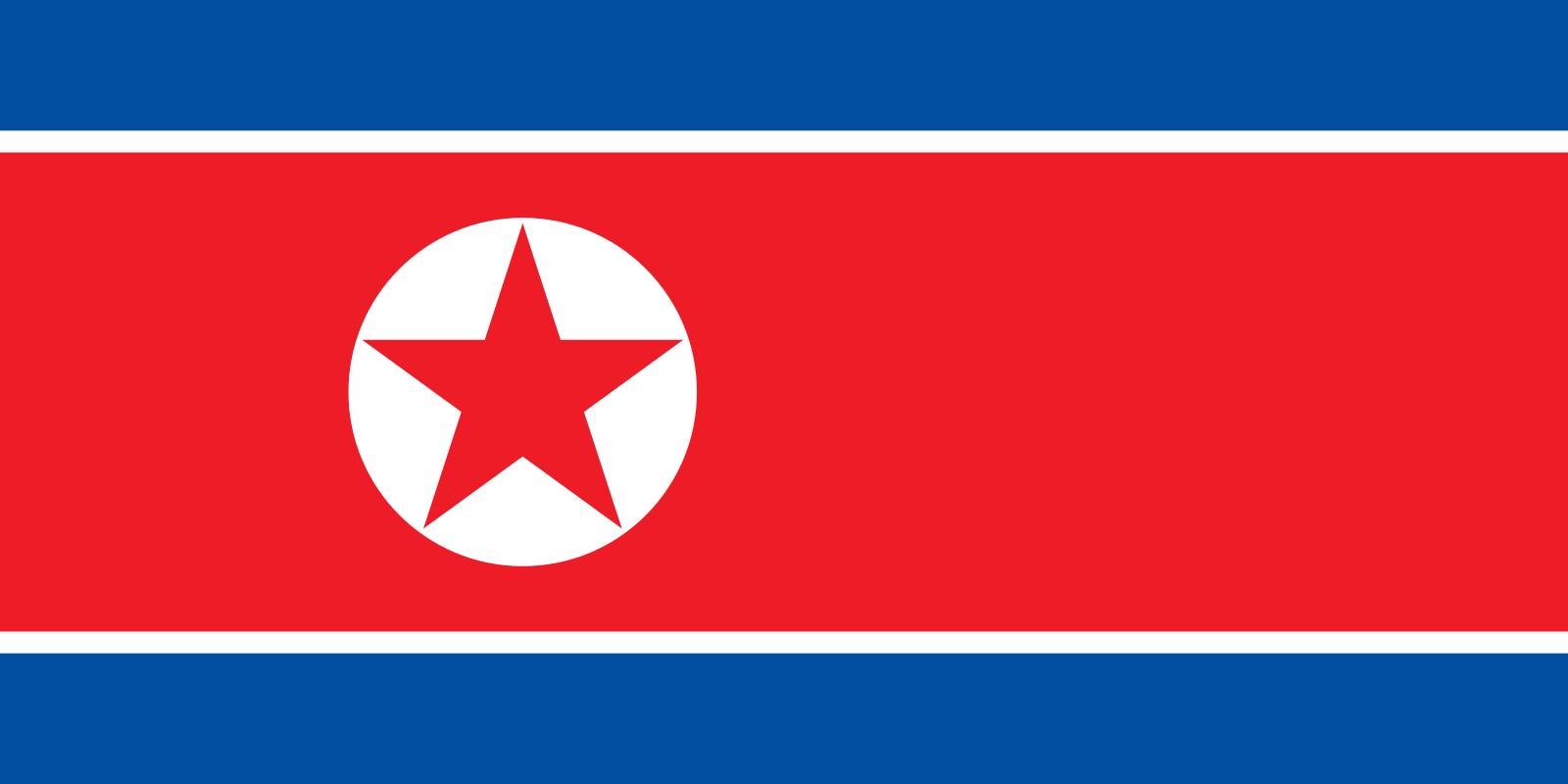
North Korea and Finland are separated by one country.

North Korea has long been vilified and condemned by the Western press as bellicose, provocative and unpredictable, it’s difficult to cut through the fog of vituperation that obscures any kind of dispassionate understanding of the country to grasp that the DPRK represents something praiseworthy.

The North represents the traditions of struggle against foreign domination, both political and economic, while the South represents the tradition of submission to and collaboration with a foreign hegemony. Significantly, there are no foreign troops stationed in North Korea, but are in South Korea.

No nation in the world has been exposed to the nuclear threat so directly and for so long as the Koreans both North and South.

North Korea’s regime is often casually dismissed as “crazy.” Indeed, the existence of a hermetically sealed state — a combination of communism and national fascism — so closed-off to the outside world that the Internet does not exist except for a privileged few, strikes outside observers as beyond belief.

Many aspects of North Korean totalitarianism, especially the personality cult surrounding its leader, Kim Jong Un, and trade and agricultural policies that cause widespread shortages, may border on the insane. But in one key aspect, in particular, there is nothing insane about its nuclear weapons program. North Korea’s nuclear program makes perfect sense it would be  crazy to give up its nuclear capability.

Why?

The reason is simple.

No country exploits the political utility of nuclear weapons as vigorously as the United States does.

In pursuing its foreign policy goals, Washington threatened other countries with nuclear attack on 25 separate occasions between 1970 and 2010, and 14 occasions between 1990 and 2010. On six of these occasions, the United States threatened the DPRK.  (The United States’ record of issuing threats of nuclear attack against other countries over this period is: Iraq, 7; China, 4; the USSR, 4; Libya, 2; Iran, 1; Syria.  Significantly, all these countries, like the DPRK, were under communist or economically nationalist governance when the threats were made.)

Since early in the 1950s, the US has turned South Korea into the biggest nuclear arsenal in the Far East, gravely threatening the DPRK through ceaseless manoeuvres for a nuclear war.  It has worked hard to deprive the DPRK of its sovereignty and its right to exist and develop….thereby doing tremendous damage to its socialist economic construction and the improvement of the standard of people’s living.”

The breadth and depth of US economic warfare against North Korea can be summed up in two sentences:

• North Korea is “the most sanctioned nation in the world” — George W. Bush.

• ”There are few sanctions left to apply.” – The New York Times.

You could ask why is it incumbent on North Korea alone to disarm? Why not the United States too?

From a North Korean point of view its nuclear arsenal does not increase the chances of war—it reduces the likelihood that the United States and its South Korean marionette will attempt to bring down the communist government in Pyongyang by force.

This is to be welcomed by anyone who opposes imperialist military interventions and supports the right of people to organize its affairs free from foreign domination; and has an interest in the survival of one of the few top-to-bottom, actually existing, alternatives to the global capitalist system of oppression, exploitation, and foreign domination.

If territories aren’t voluntarily opened to capital penetration through trade and investment agreements, their doors are battered down by the Pentagon, the enforcer of last resort of a world economic order supporting, as its first commitment, the profit-making interests of the US ruling class.

Its attitude can be summed up one word: Libya.

American behavior toward Libya over the past decade may have convinced North Korea’s ruling elite never to negotiate away its nukes. And that is true no matter what the Iranians may do.

In 1945, when Japan was defeated in World War II, Korea was divided into two occupied zones, with the north occupied by the Soviet Union and the south by the United States. The two countries remain officially at war because a formal peace treaty was never signed. Both states were accepted into the United Nations in 1991. The tradition of struggle against oppression and foreign domination, rooted in the experience of a majority of Koreans dating back to the end of WWII and the period of Japanese colonial rule.

Korea as a divided half-state is a relatively recent invention.

For the North Korean elite, the goal isn’t necessarily a North Korea kept alive through Western investment — it is a unified Korea under the North’s leadership. But opening up the regime would likely lead to the reverse: the collapse of the North’s elite and the absorption by the South.

North Korea conducted its first underground test of a nuclear weapon in 2006.

It has fewer than 10 functional nuclear devices — compared to the more than 7,650 warheads in the U.S. arsenal.

North Korea’s main priority is its military, which it spends an inordinate amount of money on, disproportionate to its GDP.

A February 21, 2013 comment by Pyongyang’s official Korean Central News Agency (“Nuclear test part of DPRK’s substantial countermeasures to defend its sovereignty”) noted that, “The tragic consequences in those countries which abandoned halfway their nuclear programs, yielding to the high-handed practices and pressure of the U.S. in recent years, clearly prove that the DPRK was very far-sighted and just when it made the option. They also teach the truth that the U.S. nuclear blackmail should be countered with substantial countermeasures, not with compromise or retreat.”

It’s also possible that much of Pyongyang’s rhetoric is meaningless, or a blustery show meant for domestic consumption. Considering, however, that just yesterday a top North Korean military official threatened a nuclear strike on the White House, it might be a bit too early to be so complacent, especially with U.S. foreign policy in so many difficult binds across the globe.

For Kim Jong Un is clear: that while his safety with nuclear weapons is clearly uncertain, he would be even less safe if he gave them up. The best chance that Koreans in the north have for preserving their sovereignty is to build nuclear weapons to deter an US military conquest.

Whether Pyongyang has or doesn’t have nuclear weapons makes little difference to US national security. Since the threat to the United States of a nuclear-armed North Korea is about the same as a disarmed North Korea—approximately zero.

Since a North Korean first-strike would be suicidal (and this is not lost on the North Korean leadership), North Korea’s nuclear weapons capability is a defensive threat alone. U.S. strategy is outdated and overstates the risk from North Korea. The United States is not threatened by North Korea.

However North Korea remains the only nation with which China maintains a defense treaty which requires assistance if Pyongyang comes under “armed attack from any state.

It is the world’s most militarized society, with a total of 9,495,000 active, reserve, and paramilitary personnel. Its active duty army of 1.21 million is the 4th largest in the world, after China, the U.S., and India. It is a nuclear-weapons state and has an active space program. As a result of its isolation, it is sometimes known as the “hermit kingdom”. All images of the country depict the whole peninsula, what today is North and South Korea combined. In their view, they are proud Koreans, living in Korea, the south half of which is unfortunately currently occupied by the Imperialist Americans.

It’s not cool to call North Korea “North Korea.” The correct term is, “Korea.”

A report from the United Nations details human rights atrocities taking place in North Korea. Though the North Korean government denies it, nearly 200,000 political prisoners are reportedly held in camps against their will and without trial.

2013-11-11-170387569.jpg

These days we all like to think that gone are the days when some deranged idiot might presses the button.

Welcome to life as we know it.

The disarming of countries that deny the US ruling class access to markets, natural resources, and investment opportunities, in order to use these for their own development, doesn’t reduce the risk of wars of conquest—it makes them all the more certain.

The elimination of weapons of mass destruction (WMDs) in Iraq didn’t reduce the chances of US military intervention in that country—it increased them.  Libyan leader Muammar Gaddafi’s voluntary elimination of his WMD didn’t prevent a NATO assault on Libya—it cleared the way for it.

Four years after the United States dropped atomic bombs on Japan in August 1945, the Soviet Union detonated its first nuclear device the United Kingdom (1952), France (1960), and China (1964) followed.

Nuclear weapons also have political utility for countries menaced by nuclear and other military threats. They raise the stakes for countries seeking to use their militaries for conquest, and therefore reduce the chances of military intervention.

There is little doubt that the US military intervention in Iraq and NATO intervention in Libya would not have been carried out had the targets not disarmed and cleared the way for outside forces to intervene with impunity.

These radical views locates the cause of wars of conquest since the rise of capitalism in the drive for profits. This compulsion chases the goods, services and capital of corporate-dominated societies over the face of the globe to settle everywhere, nestle everywhere, and establish connections everywhere, irrespective of the wishes, interests, development needs and welfare of the natives.

Where does leave us on our Journey of the so-called Nuclear Club?

The two superpowers – China and the United States – that could put pressure on North Korea have done virtually nothing to bring about a change.

The Cold War–style stand-off, peaceful as it has largely been, cannot last indefinitely. Meanwhile, the inhuman suffering of North Koreans continues.

Nuclear weapons constitute an indelible part of the legacy of both Kims.   There is no evidence that there are forces within the country prepared to envision a future without a nuclear identity. Both Kim Il-sung and Kim Jong-il were determined to build and sustain, no matter what the costs and consequences. North Korea’s history is the history of the Kim dynasty.

If the United States has the ability to take a more calculated and dispassionate look at North Korea’s future. A soft landing involving a gradual liberalization of the North Korean economy along with the creation of some personal freedoms until it peacefully reunifies with the South is

It is the least visited country in the world, but it can’t remain hidden in an increasingly interconnected world. Google Earth spotted a Mosque.

I may have glosses over some important historical details, some disturbing history but I am sure you get the gist.

They are the constant, painful reminders of North Korea’s profound alienation from the international system.  All in the name of a regime that with formidable nuclear arsenals and the means of delivering warheads that remains the Genie in the Nuclear Club.

Nuclear weapons can be used to extort political concessions from non-nuclear-armed states through terror and intimidation, but the removal of World Inequalities can get rid of the need to have them in the first place.


Go back

Your message has been sent

Warning
Warning
Warning
Warning

Warning.


Share this:

  • Click to share on WhatsApp (Opens in new window) WhatsApp
  • More
  • Click to share on Pocket (Opens in new window) Pocket
  • Click to share on Mastodon (Opens in new window) Mastodon

Superpowers Don’t Get to Retire. They make themselves redundant – Let’s look at FRANCE.

26 Monday Jan 2015

Posted by bobdillon33@gmail.com in Uncategorized

≈ Comments Off on Superpowers Don’t Get to Retire. They make themselves redundant – Let’s look at FRANCE.

Tags

European leaders, France., Inequalities of opportunity, The Nuclear Club

For centuries, Italy, Spain, France, Germany, Britain and other Western European countries ran global empires that steered or influenced the course of world events.

These nations operated from a position of strength: They possessed the military might to force their will upon weaker countries—and were not afraid to use it.     “Peace must be kept by force.”

In the twenty-first century, no less than in the nineteenth and twentieth centuries, force remains the ultima ratio.

The question, today as in the past, is not whether nations are willing to resort to force but whether they believe they can get away with it when they do. Victory is as much a curse as a blessing. Take the Soviet invasion of Afghanistan, a country that not two Americans in a million could have found on a map and where no direct American interest could be identified, other than the fact that the Soviets were there.

A world in which autocracies make ever more ambitious attempts to control the flow of information, and in which autocratic kleptocracies use national wealth and resources to further their private interests, may prove less hospitable to the kind of free flow of commerce the world has come to appreciate in recent decades. The widespread flowering of democracy around the world in recent decades may prove to have been artificial and therefore tenuous.

We have signs of the global order breaking down are all around us. Russia’s invasion of Ukraine and seizure of Crimea was the first time since World War II that a nation in Europe had engaged in territorial conquest.

The international system is an elaborate web of power relationships, in which every nation, from the biggest to the smallest, is constantly feeling for shifts or disturbances. Since 1945, and especially since 1989, the web has been geared to respond primarily to the United States. Not now. The Russia-Ukraine and Syria crises, and the world’s tepid response.

The general upheaval in the greater Middle East and North Africa, the growing nationalist and great-power tensions in East Asia, the worldwide advance of autocracy and retreat of democracy—taken individually, these problems are neither unprecedented nor unmanageable. But collectively they are a sign that something is changing, and perhaps more quickly than we may imagine.

Since the end of World War Two the Inequalities of the world  are widening.

For nearly 70 years the U.S. has maintained a nuclear deterrent second to none but it has learnt recently that to influence other people’s and other nations without simply annihilating remains one of  the most difficult of all human tasks.

It has also extended its deterrent over some 31 allies in Europe and Asia. The result? The U.S. has maintained the peace between the nuclear super powers for nearly 70 years.

Before, the great powers, each century, averaged between five and eight great wars, in which each year, on average, more than 1% of the world’s population perished.

These days we have tribal religious terrorism attacks on the West, and against non-Muslims in particular, that are sensationalized in the media while those afflicting non-Westerners and Muslims are normalized and treated as business as usual, generating limited public interest and, in turn, limited outcry from activists and institutions that could actually affect change.

We have  Boko Haram insurgents in Nigeria committing a massacre of unbelievable proportions in Borno State. Over the period of a few days, the terrorist group killed more than 2,000 people in the town of Baga, as well as 16 neighboring towns and villages, burning entire communities to the ground.

In all likelihood, you probably didn’t hear about it until just now.

The last month has been one of horror for France. After a three-day rampage in which terrorists killed 17 people both at the Charlie Hebdo offices and at a Jewish kosher supermarket.  An estimated 3.7 million French citizens took to the streets of Paris in a solidarity march for free Speech. Two Tunisian journalists, Sofiene Chourabi and Nadhir Ktari, were beheaded by Islamic State militants in Libya and received almost no coverage for their sacrifice.

The 9/11 attacks resulted in 2,996 casualties. the resulting  War on Terror launched by George W. Bush Jr. has led to at least 227,000 people (more than 300,000 according to other estimates). This includes 116,657 civilians (51%) between 76  – 108,000 insurgents or Taliban Islamists (34% to 36%), 25,297 Iraqi and Afghan soldiers (11%), and 8,975 American, British, and other coalition forces (3.9%).

Yet these statistics do not take into account that the deaths tolls were only from the coalition reports. icasualties.org has listed 4,770 coalition troops (4,452 American and 179 British) who have died in combat in Iraq since 2003, and 2,441 soldiers (1,566 American, 364 British, and 56 French) who died in Afghanistan since 2001.

It is worth mentioning the number of  pro-Saddam forces that died in Iraq: 16,595 security forces from the post-Saddam era, 1,764 private contractors, 1,002 Sons of Iraq, and between 38,778 and 70,278 other supporters of the regime. Civilians suffered the greatest number of deaths. The Iraq Body Count documented between 100 and 110,000 civilians who died violent deaths since 2003 the estimated number of victims from the Iraqi War could range from 100,000 to over one million.

In Afghanistan, there were 7,500 casualties from Afghan security forces – 200 were from the Northern Alliance, and more than 38,000 were either part of the Taliban or insurgents.

It’s no wonder that Iran wants to acquire a nuclear weapon, which will more than likely lead other powers in the region to do the same. As to why they would want to is beyond comprehension, other than self-destruction.

A nuclear war head might be useful to destroy an incoming Asteroid but it is useless in stopping MILLIONS of Rwandans being hacked to death with nothing more than farming implements.

In total, the War on Terror has cost $1,283 billion since 2001.

In this series of post I am asking the Question:  What is the use of maintaining a Nuclear Arsenal in a world where power has little to do with War heads.

We saw in the first post on the subject that Britain failed to prevent the rise of German hegemony twice in the twentieth century, leading to two devastating wars that ultimately undid British global power.

The conclusion of WWII ushered in the Cold War, which left Europe caught between the competing interests and politics of America and the USSR. With their economies and infrastructures in shambles—and no longer possessing the military means to impose their national will—were relegated to being minor players on the world stage.

The next country in the Nuclear Club of today is France.

Like Britain France suffers from not be able to recognizes that the post-French world is a reality — and embraces and celebrates that fact that is not a Superpower.

Prior to World War II France tended to consider the United States as another nation among many, one lacking a worthy cultural heritage and, for all its size and wealth, not in the same class as France and other European powers. The war changed all that. The U.S. was suddenly a Super-Power, then the sole super-power and as a powerful player in European and word affairs, consequently a major threat to French power and influence.

The French are typically characterized as being passionate, sophisticated, globally minded, whimsical, diplomatic, stylish, proud, impractical and refined. One of France’s national symbols—the strutting, preening rooster—evokes the country’s grandiose showiness and sense of self-importance.

France still maintains a fleet of nuclear-armed submarines and strike planes – and more than 300 warheads. These submarines are gradually being adapted to carry a new ballistic missile – the M51 – and between now and 2015 a new nuclear warhead will also be deployed.

Why bother?  other than reaffirming the country’s reintegration into Nato’s command structure.

France ratified the Comprehensive Test Ban Treaty in 1998 and dismantled its nuclear test site in the South Pacific. France also stopped producing plutonium and enriched uranium for weapons and dismantled the production facilities for these materials. In 2010, France and Britain agreed to pursue closer cooperation in nuclear matters, establishing for the first time a joint simulation center to for their nuclear arsenals. France and the United Kingdom intend to save money by pooling certain support activities for their nuclear forces. An additional motivation may be sending a signal of mutual political backing for each country’s long-term commitment to war-prevention through nuclear deterrence.”

Since the late-1980s France has eliminated approximately half its nuclear warheads and all of its ground-based delivery systems. It currently spends the equivalent of 1.56 per cent of gross domestic product on defense that is to creep ever so slowly to €32.51 billion in 2019.

French nuclear test at Mururoa Atoll in 1970

Are the French people still comfortable with being a nuclear power?

French policy on nuclear disarmament has explicitly stressed the idea that the goal should not be simply the abolition of nuclear weapons but the achievement of increased security for all.

However in France there is an absence of any real political debate about the future of its nuclear arsenal. Few French politicians challenge the relevance of nuclear deterrence.Support for the deterrent is deeply rooted in French society and history, ever since it became a nuclear power in the 1960s.

The traditions of French culture and identity are facing challenges on two fronts.

One is the difficulty of integrating non-European immigrants (especially Muslims) into a thoroughly European (and majority Catholic) nation. To make multiculturalism the new model for France. It would no longer be up to immigrants to adopt French culture, but for France to abandon its own culture, language, history and identity to adapt to other people’s cultures…’”

The country’s nuclear deterrent does nothing to reduce its unemployment rate of nearly 11 percent and a public debt that is 95 percent of GDP.

Quarrelsome” is the word that best described the French character. This is sometimes called “isolationism.”


The future demands that we learn to see ourselves and our nations “from the outside in” — the way others see us.

The next few decades are crucial. The time has come to break out of past patterns.

Attempts to maintain social and ecological stability through old approaches to development and environmental protection will increase instability.

Terrorism is often defined as unlawful violence or systematic use of terror against civilians or politicians for ideological or political reasons, with the intention to create fear. Terrorism is practiced by nationalistic groups, religious groups, revolutionaries and ruling governments.

The dynamic nature of terrorism means individual events are impossible to predict,”

Security must be sought through change. Ben Franklin, said “Any nation who gives up some freedom to gain a little security, will deserve neither and lose both.”

Europe/USA are founded on “Genocidal Expansionism” Not “Isolationism.”

If we are to learn anything from the elections in Greece people are where power rests, not in Nuclear Deterrents. It is quite obvious Governments must invest in this source of Power by removing Inequalities of opportunity and stop wasting revenues on worthless Warheads.

Go back

Your message has been sent

Warning
Warning
Warning
Warning

Warning.


American ignorance of the outside world, however, pales in comparison to our infamous “monolingualism.”It is as if after it emerged as the only global superpower following the Cold War, the United States decided that the defense of its interests — and the effective management of global conflict — would not require Americans who understood the world in terms other than their own.

September 11 brought home the horrible cost of shortchanging international education.September 11 may have awakened Americans to the degree to which we are disliked and resented around the world.
“We are what connect you to the world. The solution to end terrorism is international educational exchange.”international education can produce the leaders needed by the global knowledge economy — and the profound changes it will bring about.

our country will retain its identity and its autonomy, likewise its capacity to assume its place in command and wield influence over planning, policy and strategy. between 2014 and 2025, of 364 billion euros 2013 to the « Defence » mission. It is a substantial effort considering the context of public finances.

The White paper acknowledges the defence industry as a driver of competitiveness for the French economy and employment. With 4.000 companies, revenues of almost 15 billion euros, and a workforce of about 165.000 France’s avowed goal of creating a multi-polar world, attributing it to France’s superpower

“envy.”the United States may appear to be the world’s only superpower, spending more than the next 15 nations combined on military power.

Europe is no longer dependent on the United States for any real security or defense needs.the United States still relies on European bases and infrastructure for non-NATO missions.

Remember that the United States has had very little success in helping create stable democracies in any part of the world over the last two decades, to help balance an increasingly powerful China, check Taliban-like extremists and terrorists in Central Asia and the Caspian Sea, help stop nuclear proliferation in Iran — and stabilize the world oil market.

China has neutralized U.S. power Elsewhere, the troubled underdeveloped regions of the world, struggling with disorder, bad governance and arrested development, if not outright poverty, do not seem to be the beneficiary of American dominance.terror cannot be eradicated by military action alone.We need to ask ourselves not only why they hate us, but also why we did not know they hated us so much.

September 11 exposed an international knowledge gap

25% of college-bound high school students surveyed did not know the name of the ocean that separates the United States from Asia. 80% of those questioned did not know that India is the world’s largest democracy.83% — could not find Afghanistan or Israel on a world map. An even a larger number — 87% — could not locate Iraq or Iran.Less than half could find the United Kingdom, France, or Japan on a world map. Less than two-thirds could correctly identify a much larger landmass — China.

most boundaries in the Arab world, had been arbitrarily drawn by the British Empire.

twenty-first-century Europeans, for all the wonders of their union, seem incapable of uniting against a predator in their midst, and are willing, as in the past, to have the weak devoured if necessary to save their own (financial) skins.

A liberal world order, like any world order, is something that is imposed, and as much as we in the West might wish it to be imposed by superior virtue, it is generally imposed by superior power.The world economy, and the American economy, lurched from crisis to crisis.France cannot ignore its obligation to rethink its military model, the functioning of its defence,

Share this:

  • Click to share on WhatsApp (Opens in new window) WhatsApp
  • More
  • Click to share on Pocket (Opens in new window) Pocket
  • Click to share on Mastodon (Opens in new window) Mastodon

The question for the superpower of the current age is. What purpose is there in having a Nuclear capability other than mutual destruction.

24 Saturday Jan 2015

Posted by bobdillon33@gmail.com in Uncategorized

≈ Comments Off on The question for the superpower of the current age is. What purpose is there in having a Nuclear capability other than mutual destruction.

Tags

Britain., General Election., Global superpowers, nuclear and non-nuclear weapons, The Nuclear Club, TRIDENT:, UK today.

Now this rather long post might be a whole lot of Hogwash. I will leave the Judgement up to you the reader. Feel free to let me know.

Among the dangers facing the environment, the possibility of nuclear war is undoubtedly the gravest but the distinction between nuclear and non-nuclear weapons is fading away so what is the purpose of being a superpower?

We need to rethink the hierarchical categories we use to describe and analyze power. Some state leaders view nuclear weapons as an “icon of power” They see nuclear weapons not as weapons but as powerful political symbols that confer enormous status and influence, and that (nuclear weapons) are not particularly dangerous because they will never be used, that will put intense pressure on them to acquire nuclear weapons.

Why is Power Redundant?

Because the act of self-defense will be carried out years before the attacked accesses that he could, perhaps, be hit, i.e. preemptively.

Unfortunately for the UN, international law holds no provisions for such preemptive policies or wars.

In the days when the Soviet Union was reluctant to accept the notion that there were two superpowers, which implied commonality with its capitalist adversary the need for nuclear weapons might have been justified.

The Nuclear Club these days has nine members with Global military expenditure standing at over $1.7 trillion in annual expenditure at current prices for 2012.

On the other hand  the United Nations and all its agencies and funds spend about $30 billion each year, or about $4 for each of the world’s inhabitants.

This is a very small sum compared to most government budgets and it is less than three percent of the world’s military spending. Yet for nearly two decades, the UN has faced financial difficulties and it has been forced to cut back on important programs in all areas, even as new mandates have arisen. Many member states have not paid their full dues and have cut their donations to the UN’s voluntary funds. As of December 31, 2010, members’ arrears to the Regular Budget topped $348 million, of which the US owed 80%.

I have said in previous post that the UN is now out of date, skint, toothless, a gossip shop, amply demonstrated by ISIS, and the Veto. Only a global Aid commission on on currency or financial transactions ( See previous posts), a carbon tax or taxes on the arms-trade might provide enough revenue for it to survive as a world Organisation with any clout. But states are jealous of their taxing powers and not keen to transfer such authority to the UN.

Here are the Club Members.

USA, RUSSIA,UK,FRANCE,CHINA,INDIA,PAKISTAN,NORTH KOREA, AND ISRAEL.

The USA to-day is responsible for 39 per cent of the world total military expenditure distantly followed by the China (9.5% of world share), Russia (5.2%), UK (3.5%) and Japan (3.4%)

When the fundamental goal is to prevent the use of nuclear weapons just how much military force does a global superpower require and why?

With some $2.4 trillion (£1.5tr), or 4.4%, of the global economy “is dependent on violence”.

There is no definite answer to this question.

Is it the ability to fight in two geographically separated regions of the world at approximately the same time?

Is it because Poverty fuels violence and defense spending has a tendency to rise during times of economic hardship.

Is it because of the global financial crisis, that started from the US is ushering in enormous economic hardship around the world?

Geopolitics and strategic interests are still factors to project or maintain power.

It is to keep nuclear weapons as a tool of war-fighting rather than a tool of deterrence?

It has been argued that an arms race and large military build ups by the more powerful nations in general can be detrimental to global security because of the insecurity it may cause to smaller nations who might feel that they need to arm themselves even more so.

In short, instead of moving towards general and complete disarmament world-wide, or the abolition of all WMD (Weapons of Mass-Destruction) the tragic September 11, 2001 terrorist attacks on America and the resulting War on Terror is a significant factor in moving from MAD (Mutually Assured Destruction) to the fundamentally immoral and destabilising NUTs ( Nuclear Use Theories)

Military might is often one of the first considerations when looking at the world’s superpowers but its far from the truth these days.  : Look at me I have a nuclear weapons. Don’t mess with me or I will press the button (with people living rough, food banks, national debts, unemployment  all of which could be irradiated in the morning) has nothing to do with power in the world ample demonstrated by the annexing of the Ukraine by Mr Putin.

The question is, do the world’s superpowers hold the most influence when it comes to economic and political decisions? Or is their military might just superficial to real power.

Power these days is a mix of a number of factors including economic might, military resources, human resources, and political influence.

So lets start by looking at Britain. Superpower or Not. 

To begin with Britain has an antiquated 760 year old political system that is overly rigid.

Name me the country in which more than 50 new members of parliament have just been appointed for life. Most of them have been nominated by a political party, without any vote. No secret is made of the fact that for several of the appointees, as has long been the custom in that country, this life membership of the legislature is a reward for their generous financial contributions to one or other party. And, unlike for prisoners, “life” means until they die. As a result, one in three members of the existing chamber is over 75 years old.

In the UK today, record numbers of people are homeless, record numbers rely on food banks to feed their families, and record numbers face fuel poverty as energy prices rise eight times faster than wages. At the same time, inequality is back on the rise, making it one of the most unequal countries in the developed world…

A country that once adhered to a Puritan ethic of delayed gratification, has become one that revels in instant pleasures; the population has lost interest in the basics — math, manufacturing, hard work, savings — and becoming a society that specializes in consumption and leisure.  A society that retained a feudal cast, given to it by its landowning aristocracy with a growing inequality (the result of the knowledge economy, technology, and globalization) has become a signature feature of the new era in Britain.

It is now saddled with a do-nothing political process, designed for partisan battle rather than problem solving. The result is ceaseless, virulent debate about trivia — politics as theater — and very little substance, compromise, or action.

When it was empire it was indeed once a superpower in a period before the onset of nationalism, when there were few obstacles to creating and maintaining control in far-flung places.

Then along came  World War I cost over $40 billion, and Britain, once the world’s leading creditor, had debts amounting to 136 percent of domestic output afterward. By the mid-1920s, interest payments alone sucked up half the government’s budget. World War II was the final nail in the coffin of British power.

To day it is shortly to have a General Election that will shred its world image as a global power. Nobody is voting to be made homeless, hungry or unemployed in order to maintain a world image of Power. In the coming election it has a chance to recognizes that the post-Britain world is a reality — and embraces and celebrates that fact that is not a Superpower.

In a country where politics has been captured by money, special interests, a sensationalist media, and ideological attack groups its problems are not because of bad politics but because of bad economics which is reflected in the burden of their military budgets.  Its arms trade serves as a reminder that Britain’s claim to be a promoter of democracy is a myth. Its military power is not the cause of its strength but the consequence of its present position.

Its current nuclear weapons capability costs on average around 5-6 per cent of the current defense budget. The equivalent of between £2 to £2.4 billion. (That is less than 1.5 per cent of the annual benefits bill). The replacement of Trident will cost “£20 billion to £25 billion at out-turn.

Between now and main gate [in 2016] The cost of long lead items is expected to amount to about £500 million. This is the cost of taking part in an US program to extend the lives of the D5 missiles agreed to by Tony Blair, in 2006 and run by arms giant Lockheed Martin. Trident missiles were made in the US. Most Americans couldn’t care less about Britain’s election, so why not get rid of them.

Britain in recent years has been overextended and distracted, its army stressed, its image sullied.

Viewed by the other Super powers it is now perceived as a small Island with dimensioning world relevance, including its military power — industrial, financial, social, cultural — the distribution of power has long shifting away from British dominance.

So why bother being in the club when we are now living through the third great power shift of the modern era — the rise of the rest.

The emerging international system is likely to be quite different from those that have preceded it. A hundred years ago, there was a multipolar order run by a collection of European governments, with constantly shifting alliances, rivalries, miscalculations, and wars. The first was the rise of the Western world, a process that began in the fifteenth century and accelerated dramatically in the late eighteenth century. It produced modernity as we know it: science and technology, commerce and capitalism, the agricultural and industrial revolutions. It also produced the prolonged political dominance of the nations of the West.

Over the last 20 years, globalization has been gaining breadth and depth. More countries are making goods, communications technology has been leveling the playing field, capital has been free to move across the world.

There have been three tectonic power shifts over the last 500 years, fundamental changes in the distribution of power that have reshaped international life — its politics, economics, and culture.

To day in England we are lead to believe that although they have had booms and busts, the overall trend economically has been vigorously forward. Of course this growth conveniently forgets the vast amounts pumped into the economy by Quantitative easing. The fact that in a few years there will be twice as many seniors older than 65 than children under 15, with drastic implications for future aging.

The only real way to avert this demographic decline is for Britain to take in more immigrants. The effects of an aging population are considerable. For advanced industrialized countries, bad demographics are a killer disease.

First, there is the pension burden — fewer workers supporting more gray-haired elders. Second, the most innovative inventors — and the overwhelming majority of Nobel laureates — do their most important work between the ages of 30 and 44.

A smaller working-age population, in other words, means fewer technological, scientific, and managerial advances. Third, as workers age, they go from being net savers to being net spenders, with dire ramifications for national savings and investment rates. The coming election is a window of opportunity to shape and master immigrants to become the backbone of the working class.

It is the British political system that is dysfunctional, unable to make the relatively simple reforms that would place the country on extremely solid footing for the future. It is quite obvious for a country to prosper it must be a source of ideas or energy for the world, not as an Island for the elite that have money.

Because Britain is going in the wrong direction; closing immigration, maintaining Trident, privatizing its public services, selling its future energy needs to Sovereign Wealth Funds, all combined with a destablising of its economy by treating to leave Europe, while putting its young in hock for education. The next General Election will be critical to the British people.  Learning from the rest is no longer a matter of morality or politics. Increasingly, it is about competitiveness and you can only have competitiveness with a contented population.

The wonder is not that it declined but that its dominance lasted as long as it did. Britain is in the early stages of a crisis of democracy. Westminster has been shielded from the full consequences of voter disaffection by the fact that the anger has remained unfocused and unorganized for many years.

Progress requires broad coalitions between the two major parties and politicians who will cross the aisle. When democracy devolves to an empty ballot-box ritual, the meaning of which is forgotten once the newly elected officials take office, what is the democracy we’re left with?

The existing political system is coming under pressure from non-mainstream forces who promise to deliver these things, even if this comes at the expense of other features of liberal democracy. First Past the Post hopefully will be replaced by Proportional Representation.

Military might deliver geopolitical supremacy, but peace delivers economic prosperity and stability.

If you consider the industries of the future it is a long way behind.

Nanotechnology (applied science dealing with the control of matter at the atomic or molecular scale) is likely to lead to fundamental breakthroughs over the next 50 years, and the United States dominates the field.

Biotechnology (a broad category that describes the use of biological systems to create medical, agricultural, and industrial products) is also dominated by the United States.

The real money is in designing and distributing products — which the United States dominates — rather than manufacturing them. A vivid example of this is the iPod: it is manufactured mostly outside the United States, but most of the added value is captured by Apple, in California.

The Iraq/Afghanistan war may be a tragedy or a noble endeavor. Democracy, like freedom, is double-edged.

Rogue states such as Iran and Venezuela and great powers such as China and Russia are taking advantage of inattention and bad fortunes while capitalist terrorists, represented by pin-striped bully-boys with bombs under their bowlers called Sovereign Wealth Funds plunder the earth.

” Of all the enemies to public liberty war is, perhaps, the most to be dreaded because it comprises and develops the germ of every other. War is the parent of armies; from these proceed debts and taxes … known instruments for bringing the many under the domination of the few.… No nation could preserve its freedom in the midst of continual warfare. ” James Madison, Political Observations, 1795

So.

What country is poised to become the next global superpower?” is a question for the past. In the future, nationality will cease to be relevant so what really matters is which slice of society will you be in, the rich or the poor.

It is the age of Soft Power where our common future is facing looming climate chaos and depletion of oil and other resources. To keep options open we must have representative democracy for future generations, the present generation must begin now, and begin together by returning genuine power to a fully financed, renewed United Nations.

Only if we break free of the bonds of Capitalism can we take the actions that are needed.

Extremists are all too happy to take credit for fighting off the Soviets in Afghanistan, never acknowledging that it would have been impossible without their so-called “great Satan” ( friend-turned-enemy!)

The Question in a perverted way is answered by the above. Extreme anything is not power it is isolation.

Go back

Your message has been sent

Warning
Warning
Warning
Warning

Warning.


Share this:

  • Click to share on WhatsApp (Opens in new window) WhatsApp
  • More
  • Click to share on Pocket (Opens in new window) Pocket
  • Click to share on Mastodon (Opens in new window) Mastodon

All comments and contributions much appreciated

  • THE BEADY EYE SAYS TRUST IS DISAPPEARING THANKS TO OUR INABILITY TO RELATE TO EACH OTHER. December 19, 2025
  • THE BEADY EYE SAYS. THE WORLD NEEDS PEOPLE GOVERNMENT NOT MONEY GOVERNMENTS. December 18, 2025
  • THE BEADY EYE ASKS WHAT ARE WE THE SAME GOING TO DO TO STOP THE WORLD BEING FUCK UP FOR PROFIT BY RIPOFF MERCHANT. December 17, 2025
  • THE BEADY EYE CHRISTMAS GREETING. December 16, 2025
  • THE BEADY EYE SAYS. TO THE NEXT GENERATION TO LIVE A LIFE WORTH WHILE YOU MUST CREATE MEMORIES. December 16, 2025

Archives

  • December 2025
  • November 2025
  • October 2025
  • September 2025
  • August 2025
  • July 2025
  • June 2025
  • May 2025
  • February 2025
  • January 2025
  • December 2024
  • November 2024
  • October 2024
  • September 2024
  • August 2024
  • July 2024
  • June 2024
  • May 2024
  • April 2024
  • March 2024
  • February 2024
  • January 2024
  • December 2023
  • October 2023
  • September 2023
  • August 2023
  • July 2023
  • June 2023
  • May 2023
  • April 2023
  • March 2023
  • February 2023
  • January 2023
  • December 2022
  • November 2022
  • October 2022
  • September 2022
  • August 2022
  • July 2022
  • June 2022
  • May 2022
  • April 2022
  • March 2022
  • February 2022
  • January 2022
  • December 2021
  • November 2021
  • October 2021
  • September 2021
  • August 2021
  • July 2021
  • June 2021
  • May 2021
  • April 2021
  • March 2021
  • February 2021
  • January 2021
  • December 2020
  • November 2020
  • October 2020
  • September 2020
  • August 2020
  • July 2020
  • June 2020
  • May 2020
  • April 2020
  • March 2020
  • February 2020
  • January 2020
  • December 2019
  • November 2019
  • October 2019
  • September 2019
  • August 2019
  • July 2019
  • June 2019
  • May 2019
  • April 2019
  • March 2019
  • February 2019
  • January 2019
  • December 2018
  • November 2018
  • October 2018
  • September 2018
  • August 2018
  • July 2018
  • June 2018
  • May 2018
  • April 2018
  • March 2018
  • February 2018
  • January 2018
  • December 2017
  • November 2017
  • October 2017
  • September 2017
  • August 2017
  • July 2017
  • June 2017
  • May 2017
  • April 2017
  • March 2017
  • February 2017
  • January 2017
  • December 2016
  • November 2016
  • October 2016
  • September 2016
  • August 2016
  • July 2016
  • June 2016
  • May 2016
  • April 2016
  • March 2016
  • February 2016
  • January 2016
  • December 2015
  • November 2015
  • October 2015
  • September 2015
  • August 2015
  • July 2015
  • June 2015
  • May 2015
  • April 2015
  • March 2015
  • February 2015
  • January 2015
  • December 2014
  • November 2014
  • October 2014
  • September 2014
  • August 2014
  • July 2014
  • June 2014
  • May 2014
  • April 2014
  • March 2014
  • February 2014
  • January 2014
  • December 2013
  • November 2013
  • October 2013

Talk to me.

Jason Lawrence's avatarJason Lawrence on THE BEADY EYE ASK’S: WIT…
benmadigan's avatarbenmadigan on THE BEADY EYE ASK’S: WHA…
bobdillon33@gmail.com's avatarbobdillon33@gmail.co… on THE BEADY EYE SAYS: WELCOME TO…
Ernest Harben's avatarOG on THE BEADY EYE SAYS: WELCOME TO…
benmadigan's avatarbenmadigan on THE BEADY EYE SAY’S. ONC…

7/7

Moulin de Labarde 46300
Gourdon Lot France
0565416842
Before 6pm.

My Blog; THE BEADY EYE.

My Blog; THE BEADY EYE.
bobdillon33@gmail.com

bobdillon33@gmail.com

Free Thinker.

View Full Profile →

Follow bobdillon33blog on WordPress.com

Blog Stats

  • 94,154 hits

Blogs I Follow

  • unnecessary news from earth
  • The Invictus Soul
  • WordPress.com News
  • WestDeltaGirl's Blog
  • The PPJ Gazette
Follow bobdillon33blog on WordPress.com

The Beady Eye.

The Beady Eye.
Follow bobdillon33blog on WordPress.com

Blog at WordPress.com.

unnecessary news from earth

WITH MIGO

The Invictus Soul

The only thing worse than being 'blind' is having a Sight but no Vision

WordPress.com News

The latest news on WordPress.com and the WordPress community.

WestDeltaGirl's Blog

Sharing vegetarian and vegan recipes and food ideas

The PPJ Gazette

PPJ Gazette copyright ©

Privacy & Cookies: This site uses cookies. By continuing to use this website, you agree to their use.
To find out more, including how to control cookies, see here: Cookie Policy
  • Subscribe Subscribed
    • bobdillon33blog
    • Join 223 other subscribers
    • Already have a WordPress.com account? Log in now.
    • bobdillon33blog
    • Subscribe Subscribed
    • Sign up
    • Log in
    • Report this content
    • View site in Reader
    • Manage subscriptions
    • Collapse this bar