• About
  • THE BEADY EYE SAY’S : THE EUROPEAN UNION SHOULD THANK ENGLAND FOR ITS IN OR OUT REFERENDUM.

bobdillon33blog

~ Free Thinker.

bobdillon33blog

Tag Archives: Best Travel unpublished book.

THE BEADY EYE’S UNPUBLISHED BOOK. CHAPTER NINETEEN. SECTION ONE.

05 Thursday May 2016

Posted by bobdillon33@gmail.com in Literature.

≈ Comments Off on THE BEADY EYE’S UNPUBLISHED BOOK. CHAPTER NINETEEN. SECTION ONE.

Tags

Best Travel unpublished book., Top readable travel book, Travel book that will inspire you to travel., Travel.


(CONTINUATION)


Afficher l'image d'origineAfficher l'image d'origine


With one of our passenger stuffed in the back we set off early to Marsabit on one of the worst roads on offer in Africa. True to form the radiator gives trouble. Our spirits plummet to one of the lowest point of the whole journey. The landscape is desolate to the point of being intimidating. Every stop is agonising while we wait for the engine to cool. (Top TIP: It is best to leave you engine running when cooling down an overheated engine. It allows the engine to cool quicker and at an even temperature.)

The heat of the day is so intense that our crammed in passenger in the back opt on several occasions between stops to hang on to Williwaw by standing on the door footplate. We arrive after nine hours of driving looking like a group of people about to take part in some science fiction move. The only visible features through the layers of dust are our eyes.

Marsabit surrounded by a dust bowel has three hotels with a large extinct volcano on its outskirts that stick out like a sore thumb.   Covered in dense forest it is totally out of kilter with the surrounding landscape. The town itself without difficulty could pass as an out post. A Wild West frontier town except for that large extinct volcano covered in trees to its south.   All esquires as to the possibilities of a convoy up to the Ethiopian border fall on def ears. With quite a few shady blokes giving Williwaw the eye we have no option but to stay the night in the hotel. Not the most congenial joint.

I place Williwaw under guard for the night with the strict orders that if I find either of my guards asleep on the job there will be no pay in the morning. Visiting her at two am I deliver a kick to the arses of each guard ensure they both stay awake for the rest of the night.

Awaking to yet another a blistering hot day we discover that our two passengers have arranged a lift in a truck. After a miserable breakfast we fuel Williwaw ensuring that the fuel is put through a filter from a large drum. (Top TIP: Fueling in remote places can be a disaster. The last thing one wants it to have to bleed the system. So never let the last few inches of a fuelling drum be pumped into you tank or Jerry cans. It will have sediment and water. When topping up you fuel in hot dry climate always earth your Jerry can and the vehicle. Static electricity is one of major causes of fire especially if it’s a petrol vehicle.)

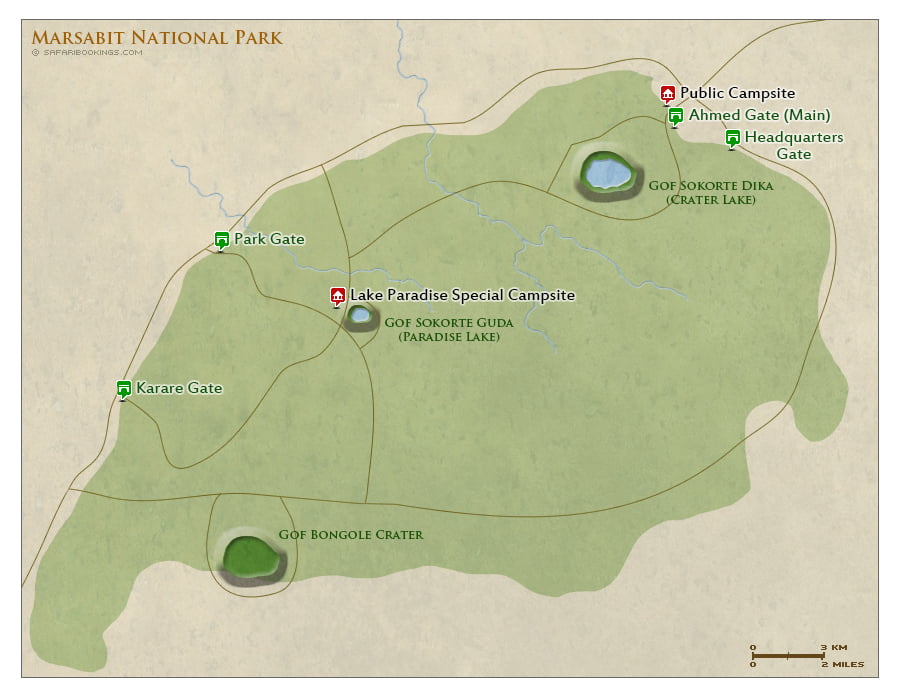
Eventually with a sigh of relief we get going. We are relieved to be leaving Marsabit convey or not.   Anywhere will do but we are not expecting paradise. Consulting our bible it describes a campsite in the Marsabit national park & Reserve, which apparently is the extinct volcano we saw on the way into Marsabit as the Kenyan camping site of camping site. Hidden on the floor of the volcano is a small lake named Lake Paradise. We decide to have a look.

An empty hotel at the entrance to the Paradise does not inspires much optimism. The bible states that to camp in the park one must be accompanied by a ranger so before lifting the barrier we have a look for Saint Peter. We find a cat that gives Florence a smack for imitating the call of a lion cub.

Eventually we unearth the cat owner the only living humanoid. He is just as surprised to see us, as we are to have found him. We discover that we are the first people to visit this year and it takes a large quantity of control when the park attendant demands a 100US$ a day. I am tempted to tell him to stuff his campsite up his dark hole. Over a drink I cool off haggling the outrageous fee down to a reasonable amount. Assured that we could look after ourselves the invisible ranger requirement is also dispensed with. The gate is unlocked.Afficher l'image d'origine

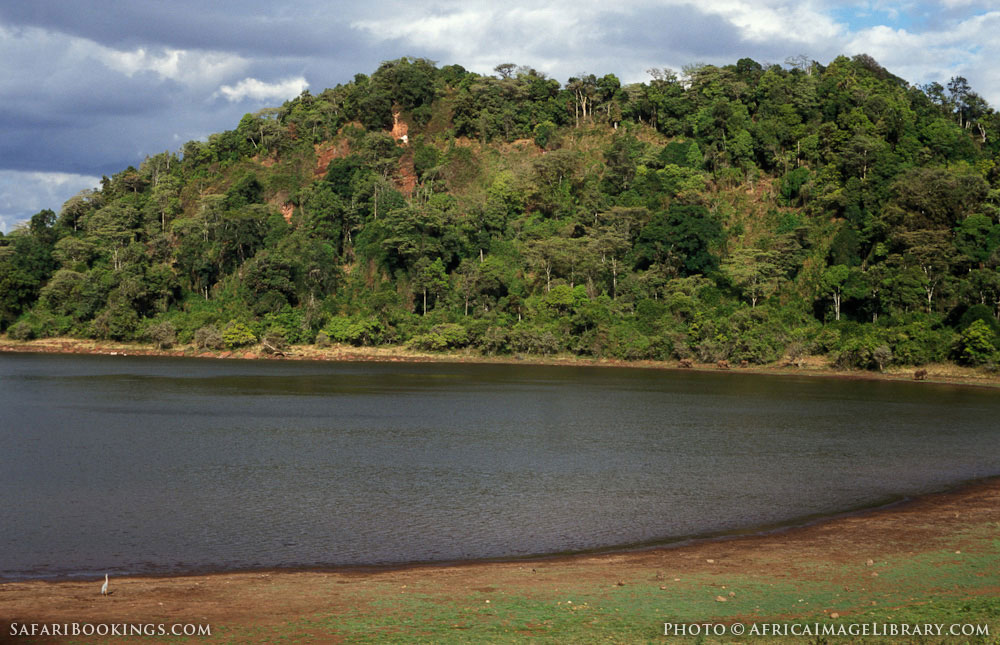
We commence a slow tricky climb to the volcano summit.   Emerging out of the trees onto the core edge the bible for once has got it right.   Below us captured in the reflection waters of a small lake is the complete core duplicated in faultless detail. A further twenty minutes of bouncing and lurching from one side to the other we arrive on the lakes shore disturbing twenty odd Coots sending them dashing like scud missiles in every direction.

Pitch No111 is truly in seventh heaven. We park on a high bank in amongst trees with large dangling vines. Our choice of site commands a clear view of the whole lake. There is utter and absolute silence with an eerie feeling that some thing will either roar or crash out of the woods at any moment.   On the other hand if one of us were to break wind the spell of the place would be shattered.   The sun is dipping fast with it becomes surprisingly cool quickly. A hot puff of air ruffles the lake waters making the surrounding reeds and tall grasses whisper.   A bird call sounds the alarm announcing the arrival of our first thirsty visitors. Two elephants appear on the lakeshore opposites us. A blacksmith plover is going mental at the uninvited intrusion. We are riveted to our binoculars. It is as if our souls are in communication with the natural tempo of life. Devoid of any other human interference and cocooned from the surrounding desert the countless documentaries that we had watched over the years come to life in one of the most beautiful and strange places.   This is our very own private safari.Afficher l'image d'origine

(OUR VIEW)

With the excitement over I get a larger than usual campfire going while Florence practices some Tarzan moves on one of the large hanging vines. Dinner, a few whiskeys and the sound of the girls snoring bring an out of this world day to a close.

I awake early to bird sounds as clear as an alarm.   The air is still and has a crisp chill to it so I poke the amber of our fire to life. . The lake removes it misty cover slowly and is in its full sky blue by the time the girl’s surface. A hearty breakfast is interrupted with a snatch for the glasses. The early morning bathers have arrived. A herd of Buffalo emerge from where we had spotted the elephants. In no time the lake is full of swimming buffalo. Their massive horns float like Viking ships each with yellow-billed Oxpecker’s manning the deck.

We spend the day sitting under our plate form in the shade sketching, reading, and sweeping the lakeshore with our glasses. The bird book takes another bashing. Fly time comes and goes. A troop of jumpy baboon entertains us with their sympathetic nervous systems on approach the water edge. A spooked gazelle gives us a scare.   Late in the afternoon with a ware eye on the now grazing buffalo I venture down on to the lakeshore. The tall grass makes visibility untrustworthy and it not long before I feel uncomfortable and exposed. Better to be safe than sorry so I give up any hope of walking around the lake.

As much as we want to stay it’s time to packed up and make ready to leave. I make on last visit to the lake with a bucket. Our campfire needs a dousing to ensure that it is well extinguished. (Top TIP: Campfires might look out, but in very dry area the ground its self-will catch fire. It is good practice to ensure that every last ember has no life.)

Climbing out of the core Williwaw engine booms like a roaring dragon emerging from its den.   On the way in we had not notices it due to the beauty of Paradise but now we could be heard in hell. Cresting the lip of the core the surrounding desert bellows out before us looking far from welcoming. Arriving back at the gate we stop for a drink “You know that our famous attraction Mohammed died some time ago.” “Mohammed was one of the best known elephants in Kenya.” “He had tusks that every poacher would have died for.”

“Over a 100 lbs each side.”  Afficher l'image d'origine

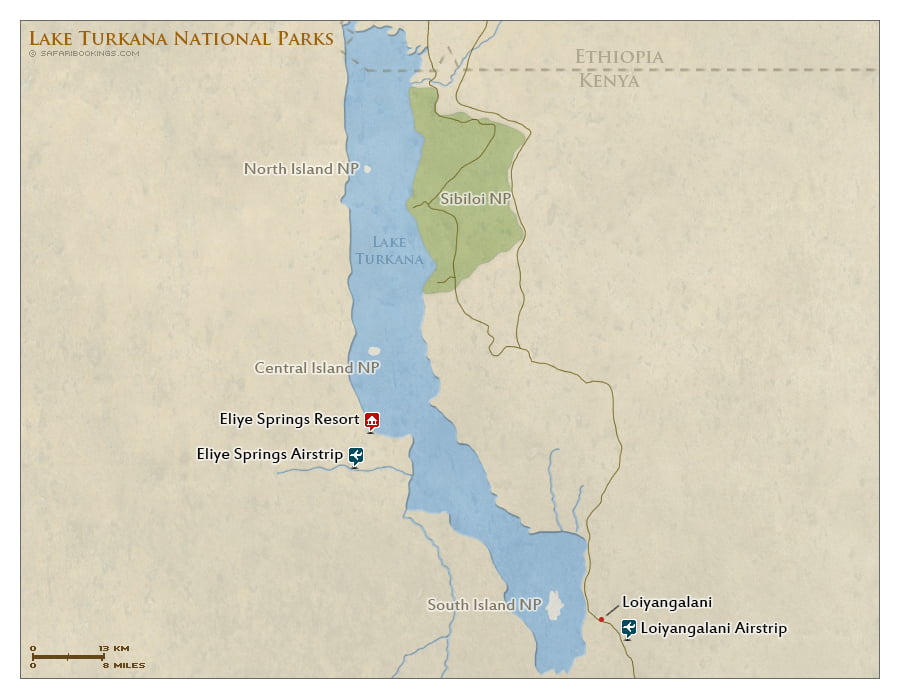
Our destination is Lake Turkana 250 km long and 40 km wide to our west. Like Lake Nakuru, Lake Bogoda, Lake Baringo, Lake Turkana is a fast shrinking lake. Once connected to the White Nile when it was over a hundred meters higher it is still the largest permanent desert lake in the world.   When it was considerably larger and long before white man laid his exploration eyes on its waters it was known as Lake Zambura or by its local name Basso Narok (Great Water). Since then in time–honour practice Count Samuel Teleki von Szek renamed the Lake Rudolf in honour of the Crown prince of Austro- Hungarian. It remained so named for quite some time till acquiring other names such as the Jade Sea the cradle of mankind till in 1975 it reverted to Lake Turkana.Afficher l'image d'origineAfficher l'image d'origine

While we bump our way over rusty sun-baked rocks we also feel obliged to rename it.

Considering it is evaporating at a phenomenal rate each year and in honour Richard Eskine Fere Leakey we rename it. Lake Leakey. Quite appropriate in such a harsh part of the world where a cloud or a raindrop is a rare as any Turkana Boy skeleton a mere 1.6 million years old.

The lake very existence is an amazing glitch in its self. Back then it must have been quite a different place. Looking around now nothing appears to survive except the hardiest acacia and the odd tuff of wiregrass. Survival is very much the key anxiety of any day-to-day life. This is the land of the Turkana Kenyan’s third largest tribe related to the Maasai. With no towns or roads to speak of the Turkana are detached to this day from any modernisation. Described as one of Kenyan’s most confrontational and belligerent people we look forward to our first encounter.

In a country that is basically overrun with the need to cash in on the Tourist frantic search for time compressed experiences in the virtual reality of exotic locations we once more skirt Marsabit with a great feeling of privileged to have had Paradise all to ourselves.  

With the benefits of Paradise long forgotten in searing heat with a heartless hot wind that blows continuously we labour on over kilometre after kilometre of unrelentingly brutal landscape.   Eventually the windswept vastness of the lake appears. In the land of droughts an utterly new world spread itself out before our eyes. Reaping the rewards of deforestation, topsoil erosion the polished surface of the soda-dense water stretching away beyond what the eye can see. In this land of drought the lake is one of nature’s wicked tricks for there is not a drop to drink. We arrive at Lyangalai and settle into sunset strip campsite for the night Pitch No 112.

Although we are just north of the hottest region in Kenya the Suguta it is once more surprisingly fresh. With no wood to be had for miles a fire is out of the question.   It’s a night for the sleeping bags.

Morning divulge a land of violent volcanic upheaval. Black sand, rocky hinterland and extinct volcanic cores dot the shoreline. Our Camping host tells us that a mere two million or so year ago the lake used to stretch 160 kilometres further south beyond the Elephants Stomach (an Extinct Volcano).

Preferring to try my hand at catching a Nile perch, a Tiger fish, or for that matter anything we turn down an offer to visit south Island by boat. “Watch out for the crocs” gives me plenty of confidence. Several hours later having tried every lure in my box, and resisting the temptation of sticking my toe in the drink I return empty-handed.


That evening we listen to a story that encapsulates what can and does go wrong with an Aid programme. During the course of our travels, all the projects we saw that worked well were small and sustainable, built with the full participation of the locals, and combined local environmental and social knowledge.   More importantly they gave dignity, not aid for the sake of aid. .

You would think that the west would by now have coped on. After years of ploughing aid into projects that had no convincing overall concept other than they look good on paper, rely on expensive western expertise and costly hi-tech input it is obvious to us that such aid is futile. Africa black hole has received over the last decade $294 billion in loans. It’s good to see at long last that the donor interests are now being put on the back burner with more responsible Aid. However the IMF, the African Development Bank and World Bank still continue to judge countries by the scale to which they embrace privatisation and liberalisation when they would be better off to support loans on the basis of accountability policies of the participating countries and the bodies involved.

The west nevertheless continues to thinks that money is the solution to the entire African problem with plenty-abandoned projects bearing baring witness. > Groundnuts in Tanzania, Bottled Milk in Sudan, Canned Mangoes in Ghana, Grain Storage in Senegal, Wheat growing in Tanzanian, Lemons in Kenya, Eucalyptus trees in Uganda and Water in the Sahara.

Sausages and beans in cans to predominantly Muslim areas where there was and still is great famine.

But all of these don’t quite live up to the story we are now listening to. Back in 1980 Norway attempted to set up a fish processing plant at Kalokol on Lake Turkana.

IT IS NOW A SHRINE TO AID MONSTROSITIES a blot on the landscape and a gravestone of sheer folly.

We all know that the Norwegians love fish. But why grow them in Africa.

Without asking the locals, and with little or no prior study of the lake (that is subject to wild fluctuations depending on the rains in the Ethiopian highlands) or the environment it was decided to turn the nomadic cattle loving Turkanas into fishermen.   Millions were invested in setting up a plant in a scorching hot region where there were no roads; no fuel no fishing boats and where fishing was considered as an unworthy occupation.

Then apparently along came someone who dumped a few Nile perch from a helicopter into the lake. They promptly went about eating every other fish scale companion fish. (Nile Perch with the assistance of another well thought out programme had already cleaned out Lake Victoria to the extent that they are turning cannibalistic.)

It is no wonder that we are becoming more and more sceptical of government aid when it is disappearing down dark holes in the creation of show case projects that have little relevance to everyday living.   We all know that there is no easy fix for a continent where over 300 million people survive on less than a dollar a day > Where sickness in the form of a wave floods over it every day > Where corruption, greed, and illogical use of power is widespread > Where over 600 million people live in rural isolation > Where as a whole they are unaware of the IMF, World Bank, Television, and Electricity> Where all over the place lies donor aid rusting in the noonday sun, bearing witness to the lost cause of technology.

There is great talk these days of the developed world removing its protective subsidies on food and trade barriers in order to help the third world, make poverty history. Africa countries however must be still sheltered by trade barriers to allow them build up their industries before entering the free market otherwise fair trade will destroy them.

In the mean time it is not the job of the IMF, the World Bank, to place countries in hock for the sake of a few dollars rather it’s their job to maintain the diversity of African cultures and to let Africa have space to borrow from the western influences so they can adapt them to their own beliefs.

Most people on the continent lived in societies that define both self and others by ties of blood or power. The cruellest gift of colonialist days is the persistent inferiority complex, a befuddled sense of identity. Considering all that the continent has endured from slavery to colonialism most Africans display a racial tolerance, which is short of miraculous. We all know that in the final shout that it is only the people’s of Africa that will resolve their tragic dilemma but one way or the other.   We all belong ultimately to Africa.

The days of thinking that Africa cultures and the societies of Sub Sahara Africa form a single continuum, reflecting an underlying racial unity, which articulate itself in the “savage rhythms” of African music, the “sensuality” of African dance, the “primitive vigour” of sculpture and masks, from which was once called the “Dark Continent” are not yet totally over.

Just walk into any AFRICAN ART EXPOSITION and you will see.

Objects are still labelled with not the name of the maker but with the name of a “tribe” or some ethnic group. The legacy of the old European way of thinking what unites Africa is that it is the home of the Negro.

There can be little doubt that resolving the problem of trading barriers will do a lot to balance the haves and have-nots but one of the great dangers is that developing countries are fast becoming the information deserts of the underclass’s. There is a need too to prevent technology from encroaching on a nation’s people freedom of opportunities or intelligence. The United Nations should be addressing this problem as urgent perhaps by insisting that all microchips should be able to talk to each other.

Today’s Africa’s life (as it did long before it was subject to Colonisation, to slavery, to aid programmes that painted it with the one colour) remains in its diversity. It is still far too simple when speaking of a continent of hundreds of millions of people to lob the whole continent into a singular, coherent, African nature. Just look at the recent European Union problems.

All aspirations and diversity of cultures must be at the core of any assistance to gain any respect. Unfortunately to today’s technologies have a life of their own no longer subordinate to larger social goals. Globally Mobil capital of the world has only profit as it goal. Our journey bear’s out that most the developing trajectories that most African countries are on have little to do with the real needs of their people.

The G8th pontificating can’t pacify the vested interests of large multinational corporations bottom line.

As I have already said the only hope for a fairer world, for fairer trade, for an end to poverty is to harness the might of the world’s Stock Markets.

By morning we are having second thoughts about running parallel with the lake up to the Ethiopian border. Considering the condition of the dirt road and potholes it is a daunting journey of 250 kilometres. Prudence triumphs so we give the petrified forest of Sibiloi a UNESCO world heritage site a miss and double back to North Horr crossing into Ethiopia at Moyale.Afficher l'image d'origine

   (To be continued)

Donation News. Zilch/

Robert Dillon. Account no 62259189. Ulster Bank 33 College Green Dublin 2.

Sorting Code; 98-50-10.                    


Share this:

  • Click to share on WhatsApp (Opens in new window) WhatsApp
  • More
  • Click to share on Pocket (Opens in new window) Pocket
  • Click to share on Mastodon (Opens in new window) Mastodon

THE BEADY EYE’S UNPUBLISHED BOOK. CHAPTER EIGHTEEN. SECTION TWO.

03 Tuesday May 2016

Posted by bobdillon33@gmail.com in Literature.

≈ 1 Comment

Tags

Best Travel unpublished book., Top readable travel book, Travel book that will inspire you to travel., Travel.


(Continuation)

Afficher l'image d'origine

Locked in central differential for the next four hours we battle our way forward. Fortunately there is little wind otherwise vision would be non-existence. In the infernal growing days heat our frustrations grow. Williwaws suspension coil springs are working overtime. Fanny’s back, our backsides, our nerves, Florence tolerance of her parents.   Every bit of my driving skills is tested to the limit. “Why the Fuck did you have to come this way”Afficher l'image d'origine

From under a cloud of following dust a vehicle appears approaching us in the opposite direction. Its driver is just as shocked as we are to meet another. To the question as to how much more of this dust we must put up with we are informed that there are is no problem from bandits in the area as the police were about.   How comforting.

Apparently unknown to us some Italians came a cropper a few weeks ago. They were held up by an AK47 and given their marching orders as their 4×4 disappeared into the shimmering shocking dust. “Another forty kilometres or so and you will come to a dry riverbed”. “After that its hunky dory”.   On we press over one dry riverbed after another. Up rock cuts covered in thick layers of dust, which at times consumes Williwaw, blocking out all daylight. Remote is not the word. As we bounce over the millionth bump a glimmer of blue confirms water in the distance.

The dust changes to hard basil ash with stones strewn all over the joint. Mount Ol Doinyo Lengai the holy mountain of the Masai comes into view. Standing at 3231 meter it has being squirting since 1966 the source of our dust. Photo No —cd

 Pitch No 105 is in a narrow canyon out of which clear fresh water flows. After such a day the water is a Champagne magnet. To the shirking protesting of the resident baboons its off with the gear and plunge in. Our campsite an enclosed wooden/ broken corral is run by a Maasai family. It consists of one of the few grassy patches in the area with a few trees.

To our surprise we are not the only visitors – Overlanders with their group leader. They have arrived from Mombasa in a hired jeep with the intention of climbing Mt Lengai but their jeep has run out of fuel (Petrol) and there is none to be had in them these parts.

The owner and driver of the Jeep is none pulsed by the problem, he is not in the least disturbed that they might have to wait a few days for fuel to arrive.   His attitude LIKE MOST AFRICANS is that it is resolved when it is resolved   so why not relax in the mean time. Isn’t the group leader white with a wallet of money?   What is there to worry about? Afficher l'image d'origineLongitude : 35° 90 E
Latitude : 2° 75 S
Altitude : 2898 m

After such a trying day we sleep late. By the time we surface the governor of all movement in Africa – the sun – is well in charge. Our fellow campers have long departed to climb Lengai, The Mountain of God which has to be considered somewhat of a mind-boggling feat in the heat of the day. We on the other hand set forth to explore the gorge. The smooth river rocks promise a deep pool somewhere. Following the crystal clear water once more to the protest of large male baboons we work our way up river.   Progress is slow but at least it is in the shade. After twenty minutes a deep pool of exquisite beauty rewards us. Three vines of cascading water flow from a cave that leads finally to an impassable surge of water. If I ever had the money to build a swimming pool this would be it. Totally renewed in a cooling breeze that is funnelled up the gorge we return to camp.

A sorry sight awaits us the Mount Lengai task force is back in camp half dead.   Apparently according to the local Maasai sign language it is quite often that a helicopter arrives to take a pounding fluttering heart away. The bedraggled bunch bum a lift on a passing truck promising to send a can of fuel back to the driver who seems rather relieved that they have gone.

Later that evening I arrange with Danny Maasai, spear and all for a night assault on the home of Eng’ai, (GOD) Ol Doinyo Langai 2.751° S – 35.902°E (pronounced ol doyn-yo len- guy).

After another day in the glorious water of our magnificent pool I get a kick through the tent. Danny in his red checkered robe is standing in the moonlight with the top of his spear gleaming. I awake a bleary eyed Fanny; pack a few high-energy bars and water. Slip on my Cat walking boots, a hat and some high PH suntan oil. With the spear sticking out the window Danny points the direction. On emerging from the camping site the Volcano comes into view almost immediately. The moon’s reflective light holds it in relief against the surrounding bare foothills.   It looks tranquil enough not stirring, helpless and unmoving. All around is hushed into the depths of the night sky.   Its presence gazes down on a world in sliver light while its blackness invites death without terror.

One hour later looking up towards the summit I realise that one of the greatest objects of life is sensation. I feel exceptionally alive. While Danny stands beside me shoeless I check with Fanny that she can make it back to pick us up in one-piece. There were a few dry riverbed crossings on the way that required some skilled driving. “No bother”

The Break lights of Williwaw disappear and reappear several times before I give up looking over my shoulder. Danny up ahead is setting that long endurance pace and rhythm of walking where he glides along without any bending of the knees effortlessly. It not long before we are climbing.

Langai does not require crampons or roping together. From a distance it might look like a toy volcano because of its candy white sugar-coating. In fact it is a demanding climb of some eight hours. (Top TIP: Not be tackled in blazing sunshine like mad dogs land English men.)  A volcanologist dream it has being described as the perfect laboratory volcano. The only volcano too squirts natrocarbonatite lava in the world > highly fluid lava, far less hot than ordinary lava. Newly solidified lava is black with crystals that sparkle in the sun, while the moving lava looks like black olive oil or brown foaming mud that turns white on contact with moisture.

I soon find out that the solidified stuff that has been lying about for some time is so soft that my boots sink into it with great ease. There is no way I am going to make it too the top if I try to keep with Danny’s dangling balls that come in view every time I take a look upwards.

He doesn’t mind if I make it or not for him the summit is a place of pilgrimage where his people request their God for rain, more cattle, or for a barren wife to be blessed with a child > For me it all about pace.

After three hours he calls a halt. All communication is by sign language. An offer of a bit of high-energy bar gets a distant look of disdain. Water is also refused. A jab of the spear indicates the route up. We jump a dry lava channel some meters deep but less than a few feet wide. The going gets steeper and I get blacker. Apparently Langai lava breaks down so quickly you can tell its age by its colour. Black just out of the oven, muddy browns and greys a few hours old, frosty white a few days.

Seven hours later we arrive at the rim. It’s still dark. Frozen in silver escaping fizz ejects from one of the many active vents onto the caped floor.Ol Doinyo Lengai - Natron lake, Arusha

In the airless gleam of a waning moon the stuff jingles like breaking glass. I have the energy of a semi-invalid. Even Danny is sweating heavily as we look down onto a land from outer space. My legs need to rest. We sit and rest and cool off. Danny sits crossed legged; slowly blinking with his unfathomable eyes he smiles.   It’s a place for angels. They say that travel broadens the mind; this place blows your mind asunder.

The first peep of day scatters light over the weirdest place I have ever stood on dry land. Hypnotised by so much beauty and by the presence of the earth’s heart throbbing less than sixty meters away the erupting hornitos (Vent/steep hollow pinnacle) shoot orange lava skywards.

The whole scene amplified in the dark is immensely moving. It makes ones head spin. On each and every explosion, waves of illumination sweep out over the dust coloured floor of the crater. It’s like creating a Hubble penetrating vision of an alien planet.

The Japanese have a word Aware, for the feelings that arise from the beauty of an Ephemeral thing. Up here one can’t help but to be aware. It is one of those places where deep thoughts penetrate the mind.

Looking at Danny with his spear I wonder is the technological industrial collective machine trying to enchain the whole of nature – put the whole lot to work for the sake of human self-indulgence and human supremacy is not the decisive evil of our modern age.

The first rays of the new day drew back the curtain of surrounding darkness. A hot descent is promised.

Without or with shoes nothing would entice Danny down onto caped floor for a photo session. So my first step on to the crust is a faltering one. A meandering flow eight inches wide invites a dipping of the finger to see if it is hot. It might look cool but the sole of my boots feel sticky so I resist getting my first lava burn.

What a sensation walking towards a rumbling vent with activity all around formations change before your very eyes. Photo no -cd

Returning to Danny on the rim the view of the surrounding landscape is breath-taking. Not a building, road, to be seen as far as the horizon only barren ground parched of water. To our left a range of mountains bearing their geological birth marks run in the direction of where we should see Williwaw appearing from. Sure enough a distant dust trail marks Fanny progress. Danny spear jabs in her direction it time to descend. Within minutes Danny has disappeared. Like a skier he criss-cross his way down at speeds away beyond my capabilities. My technique is more to do with on the bum than standing.

It is obvious on catching up with him only because he has stopped to see me over the lava jump that he is highly pleased with himself. The jump back is not quite as easy as coming up. This time the jump platform is lower than the landing platform. It requires a two-stage leap. First onto a ridge, than follows a large step up on to a rock and lastly a leg over the top. The Lava below concentrates the mind.

Once over, Danny points with his spear in the direction of Williwaw. She is nowhere too be seen. We take a rest, still no sign. There could be on other dust trail approaching so where has she gone. Danny hits the deck some twenty minutes before I do. No Williwaw. No water left. Nothing for it Danny’s spear says walk. Seven kilometres from the base of the mountain we find Fanny with Williwaw stuck in the sand of a dry riverbed.   I look a sight covered from top to toe in black dust, tongue hanging out like a panting dog. Water, water is all I can utter. A few rocks under the wheels and we say adieu to the Mountain of God.Afficher l'image d'origine(Footnote it erupted lucky some years later)

Next morning taking a guide in the form of a fellow that wants a ride up-country we break camp.   The way ahead is reported to be bandit land and therefore rumour has it that it is dangerous. Our route is Lake Natron and then up over the Gol mountains into the Serengeti. We arrive without much difficulty on the southern shore of Lake Natron one of East Africa largest breeding ground for Flamingos. During the breeding season one of the earth’s weirdest pompous looking birds converge here in their ten of thousands.

Daily they Hoover the whole lake for microscopic invertebrates and algae until they turn themselves and lake turn into a lighter shade of pink. Protected by Lake Natron’s unbearable heat, undrinkable water, and un-walkable mudflats they prance in flocks up to 100,000 thousand at a time eating tons with their upside down sieving bills. One of natures most photographed birds from the air; they form long queues to drink, enact mass takeoff when attacked and provide pictures of helpless isolation when an awaiting fish eagles swoops.

Our attempt to get a closer for a look by driving out on the baked mud fails when it starts shows signs of leakage. We settle for a distant sizzling view before climbing up from the lake floor on a rocky twisting track that put Williwaw tyres through the shredder. With our guide assuring us on several occasions that this is the way for the next three hours the anxieties of some of Williwaw efforts test us all. Many a section requires advance survey to avoid wheel spin, stones, tree stumps, and potholes > with some sections requiring a second and third attempt to make it up.   On reaching the top of the climb our guide smells like the mud on the lakeshore – rotten eggs. God only knows what we smelt like.

“From here on in to Loliondo is a piece of cake – Boss.” Not to mention the bandits. Following from a high the lake western shore we arrive late afternoon. Loliondo could be one of those Australian outback settlements in the middle of nowhere. A few houses surrounded by a few fields, a large man- made trench containing mossy infected water, and a campsite. Pitch No 106 is under the watchful eye of the Maasai guard.

Our guide eventually gets the message that it time to scram and go on about his own business. Our Maasai guard is a handsome bloke, gentle, shy inquisitive and obliging muscle with classical Maasai ear lobes. We bucket shower, while he rustles up a three stone fire to cook the evening meal.   Over the meal with a cold beer his smile is wonderful every time he finally understands what we are trying to explain.   Like so many Africans they have no concept of Africa. Their world is there world. He demonstrates the throwing on of his single piece of cloth, which fell from one shoulder over his tall body. Standing with his long blade spear we are assured that no intruders shall disturb our sleep. This is Maasai land land.   Tomorrow we cross into the land of cattle, wildebeest and the never-ending plains of the Serengeti and the Maasai Mara.

(To be continued)

Donation News; Awaiting the First.

Robert Dillon. Account no 62259189. Ulster Bank 33 College Green Dublin 2.

Sorting Code; 98-50-10

Share this:

  • Click to share on WhatsApp (Opens in new window) WhatsApp
  • More
  • Click to share on Pocket (Opens in new window) Pocket
  • Click to share on Mastodon (Opens in new window) Mastodon

THE BEADY EYE’S UNPUBLISHED BOOK. CHAPTER EIGHTEEN.

02 Monday May 2016

Posted by bobdillon33@gmail.com in Literature.

≈ Comments Off on THE BEADY EYE’S UNPUBLISHED BOOK. CHAPTER EIGHTEEN.

Tags

Best Travel unpublished book., Top readable travel book, Travel book that will inspire you to travel., Travel.

You are lucky to see Kilimanjaro (Shining Mountain) as it spends a great deal of its time caped with a cloud but when you do it is a gob smacking sight. In mountaineering terms it is no Everest. However, raising from the surrounding flat plains without any competition its beauty passes like a dream that has dropped from its snow caped summit to dance on all below. On a clear day one can catch sight of it from over 300 kilometres away making it the highest mountain in the world that’s not part of a range. (Top Tip: If you most climb it remember drink a lot more water than you think you need. Bring high-energy bars against altitude appetite loss. When you stop for the night climb a couple of hundred meter further up to acclimatize then come back down to sleep.)Afficher l'image d'origine

We arrive on the slops of Mount Meru in Arusha the administrative and processing shipping hub for the region. Refueled and stocked up with supplies from the market we turn off at Makuyuni one hundred and eighty clicks west of Arusha for Ngorongoro.   A massive souvenir shop marks the exact spot to turn to begin the climb up to the creator rim. One hundred and twenty thousand craters later on one of the worst tooth rattling roads we reach Mto, Wa, Mdu or Karatu for the night. Gibbs Farm for some reason is marked on our Mitch élan map as the place to kip. It turns out to be one bump too much cost wise. However the luxury of washing the road away, an excellent dinner with comfortable air-conditioned bedrooms and a wonderful breakfast takes some of the sting out of the bill.

From here the road winds its way up to the gates of the eight wonder of the world – Ngorongoro crater. After a few kilometres we begin to wonder if the road should not be given the title. Although being work upon it is atrocious. At the gates we are screwed once more for being white by the three-tier pricing structure practiced by the Tanzanians. So what. Who can blame them for cashing in one of the most  well-known Game Parks in the world? For all that we have heard it is an amphitheatre, one of the world’s biggest un-flooded and intact colander deserving of its reputation as the Garden of Eden.Afficher l'image d'origine

On reaching the rim of the crater our first view is breathtaking. Trapped by the crater flippantly forested walls the floor shimmer’s in a kaleidoscope of colour. Nineteen kilometres wide and up to one thousand six hundred meters deep it is a mind imprinting sight.

We drive along the rim to the camping area where we find the only flat grass spot left at Simba Camping. Pitch no 103. Luckily for us we are well removed from the sanitary block that stinks. With no wild camping allowed in the area the site facilities can only be described as a national shame. We get the distinct feeling that campers are not welcome. It is stay in one of the very expensive lodges or don’t come in the first place.

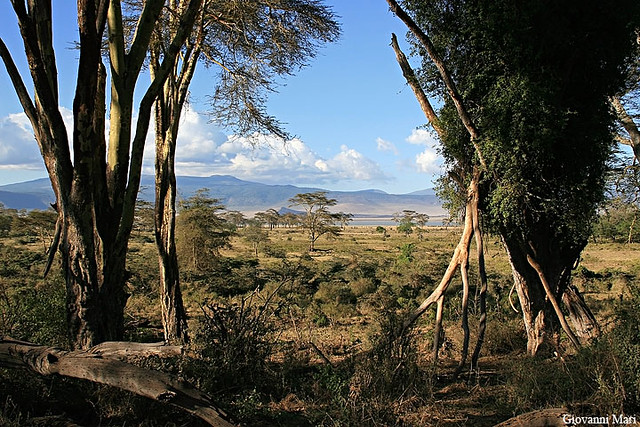
Once settled in we walk through the bush out on to the sloping crater wall. Here in long grass for the rest of the afternoon we give the crater floor the once over with our binoculars. The floor for the most part is grassland dotted with Acacia trees.   Right in front of us a small forest of very large fever acacia trees providing shade for a few dust-flapping Elephants. Away to our right a glittering salt pan half full of water looks like a waiting steam train pending departure. The entire floor is zigzagged by dust trails and flecked by small black dots that turn out to be animals as big an elephants and as small as zebra. All framed by the craters walls the whole panoramic view can only be described as both dramatic and inspirational.

In the course of the afternoon we count over fifty cars roaming the creator. Trails of dust mark their progress. In another five to seven years if not limited they will turn this conservation now a world heritage site into a dust bowl. With the sun cooling, the small dots are on the move. Emerging from the Lerai Forest our elephants make for one of the natural spring fed watering holes, it being the main reason that Ngorongoro has such a large intensity of wildlife.Afficher l'image d'origine

With permanent water there is no need to migrate. Hippo, Elephant, Spotted Hyena, Zebra, Buffalo, Wildebeest, Jackals, Lion, Cheetah, Leopard, Bat-eared fox, Baboons, Vervet monkeys, and the star of the show Black rhino. With a bird population of over 350 species the only worth mentioning missing punters are Giraffes.


The Big Five:

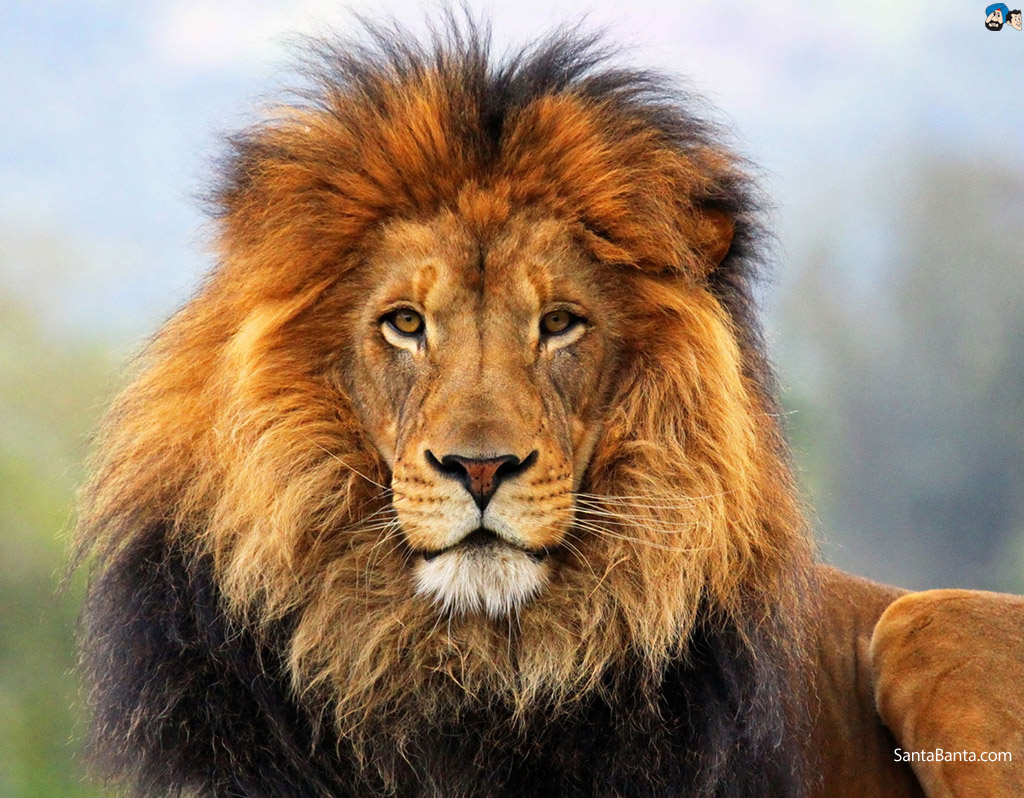
Lions:   Panrhera loaAfficher l'image d'origine

Facts:

Originally a Desert Animal:

Became extinct in Europe 2000 years ago:

Male Weigh: Up to 225kg:

Life span in the wild; 10-15 years:

Only Cats to live in groups called a pride:

Only cat to have a tuff at the end of its tail In the middle of which is a curious horny appendage called a thorn.

Most prides consist of a dominant male with up to 37 related females:

Can roar till it is two-year old:

Roar can be heard up to five miles way:

Worst enemy – Porcupine:

Simba is Swahili for Lion:

Elephants:   Loxodonta Africana.Afficher l'image d'origine

Facts:

Can’t Jump every other mammal can:

A tooth can weigh up to 12lbs:

Largest Land Animal:

Needs 50 gallons of water a day:

Life span 55-60 years

Two separate species In Africa:

Four toes on forefeet, five on hind feet:

Have no breeding season:

Males find Randy females by listing to their tummy-rumbles which they can hear up to four km distance.

Females stay fertile up to sixty years: Breed every four years and are only receptive between 3-4 days

Male Elephants enter an annual condition called Musth (Meaning madness, marked by secretions from a gland behind the eye. This is when they are at the most dangerous, aggressive and sexually aroused:

Only animal in Africa to dig holes in search of water:

Cheetah:   Acinonyx jubatus.Afficher l'image d'origine

Facts:

Fastest animal on land: 70 miles per hour for 400-600 yards before it is exhausted:

Only big cat that purrs:

Over the ages being trained for hunting purposes:

Were pets of Louis X1, Charles V11, and Louis X 11:

Kills by more by suffocation than bit:

The name Cheetah comes from a Hindi word meaning “Spotted one” or from the Sanskrit word “Chitaka”:

Movers it young ever few days to new hiding places:

It has a “tear drop” black markings below its eyes:

Weigh 80 -140 pounds:

Leopard: Panthera pardus.Afficher l'image d'origine

Facts:

 Tree climbers:

Each Animal has “rosette” – spots unique to its self:

Powerful neck and shoulders:

Cunning and Adaptable:

Nocturnal:

Solitary:

Feline in its hunting behaviour:

Can haul a carcass of at least its own body weight up the vertical trunk of a tree:

Distinctive call that sound like a wood plank being cut with a saw:

Rhino: Diceros bicornis (black)Afficher l'image d'origineAfficher l'image d'origine

Ceratotherium simum (white)

Facts:

 A group of Rhinos is called a crash:

White is not white and black is not black. The white Rhino get it name from the Afrikaans word “weit” meaning “ wide” misinterpreted by early English settler in South Africa to white:

Can run up to 40 miles per hour:

Pregnancy last 15-16 months:

Suffers from sun stroke:

Horns made of keratin, same material that makes up your hair and fingernails:

Largest land animal after an elephant – up to 6000 pound:

Symbiotic relationship with oxpeckers called “Tick birds”:

Use their dung to leave messages for other Rhino: This is my territory.

Each Rhino has its own unique smell:

Have existed on earth for 50 million years:

Once roamed throughout North America – Europe:

Poor eyesight: good hearing and smell;

The Word Rhinoceros comes from the Greek rhino (Nose) and ceros (horn):   Swahili name – Punda Milia:

Life spans 30- 50 years:

Two other Rhino species in the world Javan Rhino- Sumatran: All are on endangered Listing:

Horn is not used as an aphrodisiac in traditional Asian Medicine but to reduce pain and fever with on scientific evidence.

Williwaw crawls down a steep track coming out at the back of the Lerai Forest without the compulsory guide thank god. From our day of surveillance on high we turn left on a dirt road that travels clockwise around the crater floor in the direction of the steaming train Lake Magadi or Lake Makat depending on which map you have. It’s only nine a.m. and the temperature is already in the high c –twenties. Apart from a few elephants in the forest the only other moving animal is a hyena lopping along the shallows of the soda lakeshore.Afficher l'image d'origine

Passing the Mandusi Swamp area a permanent water source, we have no additional luck > Sweet Fanny Adam. Arriving at what’s called the Round Table hill we are beginning to wonder where the estimated 30,000 large mammals are, perhaps they have buggered off over the rim.   Leaving the Layanai forest to our right we cross the Munge River arriving at the Ngoitokitoh Springs, three-quarters of the circuit completed.

Ngoitokitoh turns out to be the main watering hole for all the other tour operators. In the blink of an eye our view of the waterhole with its few hippo is obliterate by the rear of a fleet of Toyota’s that have lined up right in front of us. Fanny rightly so sees red. She asks one of the drivers to move his vehicle. The request is met with a torrent of abusive language simply translated from English into the two fingers, which originated in the one hundred year war when English longbow archers gave the French the two fingers in triumph. “We still got them”. It’s no wonder that the animals have buggered off.

Next to arrive is another fleet with a group of South Koreans. They have no more stopped when the little buggers are on their mobile phones. “Two Hippos, two hippos,” one of them is reporting to his mother somewhere in Korea and to all within hearing distance of his high-excited voice.

Next we have a fully equipped ten zips, dozen pockets, green jacket, white socks, safari hat American holding up a dried sandwich to an incoming swooping kite.   His wife is on the video camera to capture the pending red vapour trail as his fingers disappear into the sky.

All of a sudden and just a suddenly as they all appeared, they are all mount up and roar off in search of that one photo of whatever to prove they know Africa.

Somewhat uglified we make our way back on to the race circuit. The feeling does not last long for almost straight away we come across our first rhino sighting. Ears twitching, they take a vague interest in us. Looking down the lens of my binoculars I would much prefer a charging lion coming at Williwaw than a charging rhino. At least the lion would bounce off but the Rhino impact would be like getting run over by a tank. They impart a powerful sense of resistance. While complimenting their natural environment they are a symbol of evolution staying power.

One hour later at our own speed we climb out of the crater to the annoyance of Mr Fuck at the water hole who is stuck behind Williwaw getting a large dose of nostril filling dust. Well pleased with our repayment to Mr Fuck we stop at crater village, which has a small general store run by a few Masai.

It is hard to believe that not far from here at Laetoli Mr Fuck and all of us originated as modern man. The dawn of the human race walked out of this region some millions of years ago to colonise the world as we know it. Maybe a few went into outer space.

Having decided that one lap of the Ngorongoro is enough; we pass back through the gates feeling somewhat sorry for its true inhabitants, the animals that will have to install Zebra crossings in the near future for their young ones.   Avoiding Gibbs Farm we arrive back at Karatu or Mto-Wa –Mdu known as Safari Junction. Afficher l'image d'originePitch No 104. In residence are our Jewish friends from Pangani.   They are also saddened by their Ngorongoro experience not by its natural beauty like us it’s over exploitation.

We spend the next, day clearing up Williwaw and preparing for our crossing into Kenya by way of Lake Natron.   With fuel and water tanks full we set off to skirt behind the Ngorongoro crater.   A long track leads off into the distance promising some superb off-road pistes driving. Its early morning the time most things move in Africa > all movement is dictated by the sun and then never in a rush. There is not a soul to be seen in any direction. An inclusive sense of freedom, space, purity, and adventure has us all in high spirits. With the crater on our left the horizon looks flat an inviting. Our track soon peters out turning to dust, then slowly turns to what is known as bull dust right up to the footsteps of Williwaw.

Donations News: Still Zero.


Share this:

  • Click to share on WhatsApp (Opens in new window) WhatsApp
  • More
  • Click to share on Pocket (Opens in new window) Pocket
  • Click to share on Mastodon (Opens in new window) Mastodon

THE BEADY EYE’S UNPUBLISHED BOOK. CHAPTER SEVENTEEN.

01 Sunday May 2016

Posted by bobdillon33@gmail.com in Literature.

≈ Comments Off on THE BEADY EYE’S UNPUBLISHED BOOK. CHAPTER SEVENTEEN.

Tags

Best Travel unpublished book., Top readable travel book, Travel book that will inspire you to travel., Travel.


ZANZIBAR.

What we know:

An Island in the Indian Ocean.


Afficher l'image d'origine Afficher l'image d'origine


Armed with our walking backpacks we bum a lift into the docks. The land of Muggers (Top TIP: It is well worth the money spent on good quality walking backpacks.) We’ve barely arrived when behind a grilled window we spy their latest victims > All whimpering in time three young lassies awaiting the arrival of the police. The hustlers and the general chaotic pushing and jostle at the ferry ticket windows make it an ideal place for pickpockets and the like.   A bloke offering his assistance approaches us. I give him the bum’s rush, but he lingers on. We learn that the fast ferry has slipped harbour some hours ago so we move on down the line to the next window. The slow ferry does not leave for another few hours. The next window Express Ferries has a Hydrofoil just about to rev up.

Our self-appointed assistant makes another bid to have him self-employed. This time in perfect Swahili I tell him to get lost “You might not believe it buddy but I am perfectly capable of purchasing a ferry ticket”.   He is still unwilling to let go. He shifts his weight from one foot to the other showing the palms of his hand as if to say I have not got your wallet yet.

 The ticket clerk asks if he is with us. Why, I don’t know but I get the feeling its code for to be on your guard. With no time to waste we start to walk down the gangway. Some second sense tells me this is the most dangerous time. Our man’s harassment and pestering is all part of a well-drilled plan to disorient the potential target. Sure enough two finger happy blokes are sauntering up through the boarding passengers.   They stick out like sore thumbs.   It’s the old knock on the side from one to the other trick. I shift my backpack to my right side. On receiving the bump I stick my elbow into his partner with some force along with a large smile of apology.   I point to his co-worker. ‘Not my fault old buddy blame your man, he I am sorry to say pushed me’.

We board intact. Ten minutes on a rattle of well-worn rivets the Russian Hydrofoil comes to life. We don’t quite glide out of harbour passing the moored Dows but resort to a better-known old Royal Navy tactic of slipping out to sea unnoticed.   A large diesel smoke screen wafts its way from the stern as a film of oil calm turbulent flat blue seas begins to slide by. The spurting engines labour to bring her up to foil speed. Scarcely are we in the clear when she not surprisingly digs her port foil into the oncoming swell.   The resulting lurch sends all those on the upper deck staggering from one side to the other. If it’s going to be like this the whole way to Zanzibar there will be many aboard that will see their breakfast for the second time long before they see the Spice Islands.

Florence is definitely a daughter of a seafaring man. She soon finds her sea legs and is mobile around the decks.   She returns after a mooch around the vessel to report that Nick is aboard. Definitely a leading contender for one of the sick bags he is sitting alongside the engine compartment looking a rather vanilla colour. Zanzibar cannot come into view too soon for him.

One hour later we arrive not to the smell of Spices but to the stench of over flowing sick bags. Our first view on approaching the landing wharf is a large fort overlooking the harbour. Typically Arab in style it was the last sight for many a slave in the middle of the eighteenth-century.   Over 50,000 slaves were auctioned in the slave market ever year.   It was one of the last places in Africa to give up human trafficking. To the right of the fort the people palace and further to the right a tree covered gardens overlooked by the House of Wonders, or Beit-el-Ajaib, as it is better known. Everything is evoking expectations exceptionally exuberantly, but not until one gets ashore.Afficher l'image d'origine

First, it’s a stand in front of the table job, Passport, Yellow card, ten US dollar bills. With the wail of Allah announcing noonday prayer followed closely by Taxi, Taxi, we take our first steps ashore.

With Nick once more in tow ignoring the cluster of Taxi drivers who are in a state of confusion as whether to face Mecca or the incoming passengers we walk towards the Old Town known as Stone Town.  Afficher l'image d'origine

Pungent mouth-watering smells pour out of the Jamituri Gardens. (The garden we saw on our way into the landing jetty).   Stalls shaded from the tropical sun under lampposts of trees are selling spiced curries; fried octopus, roasted sugar cane, cassava, meat, and ice cream are in full swing. We walk through licking wonderful mango ice creams clearly the place to visit later. The heat is oppressive so we hop into a taxi and head for the African House Hotel which had been the ‘British Club’ in days long gone, when the Island was a British protectorate.Afficher l'image d'origine

The hotel stuffed with arcane memorabilia, a packed bar, and a restaurant over the bar overlooking the sea, it is the place for us. Nick on the other hand cannot free himself from the anxieties of security.   He finds the standard of the rooms not to his liking. Following a few beers he departs to find a more modern set up. Crashing out for an afternoon siesta we install ourselves in room five under two hefty ceiling fans. Our room is charming, large and spacious with old world beds and a rough iron balcony that looks out onto one of the many narrow pedestrian street of Stone Town.

We awake to the evening shriek to get the prayer mats out. The maze called Stone Town has comes to life, with every turn and bend bringing a surprise. Heavy decorative doors pepper the narrow whitewashed lined streets with their brass-studded facades indicating the occupant’s wealth while hiding family lives from public view.   Well-trodden flagstones lead from one street into another. Tree-studded squares full of hole in the wall shops selling local crafts, art, and fruit.   Thanks to the tourists revenue, restoration is going on everywhere in a rush to save the remains of this unique old town. Overhanging balconies, verandas, decaying bath houses and the Sultans palaces are all getting a makeover.   It is one of those places where the hours fly by without you noticing.   Daily life is right in your face. School children chant the Koran through open classroom windows while upstairs a family row can be heard coming to boiling point.

It is a massive puzzle you’re looking around, waiting for each other to reappear from a doorway or around a corner.

Luckily all alleyways eventually lead either down to the sea or out onto the wrong side of town. We emerge alongside a restaurant named Sinbad the Sailor. According to the bible this is where Mitu an Indian Spice guide hangs out who gives the best Spice tour on the island. Natural Chewing gum tree, natural lipstick tree, hair gel tree, cinnamon, cloves, vanilla, and between the lines some natural grass. We have no trouble finding him and signing up for tomorrow’s tour, which includes a big-hearted lunch. That arranged we wander over to kitchens under the trees where we had passed by on the way from the docks. A large helping of fried prawns has us truly stuffed we return to our lodgings to find the bar heaving. We sleep like logs.

Breakfast with Mitu blowing his taxi horn is a gobble and go job. Still munching we are greeted not by Mitu but Mohammad. Our tour group consists of a large US marine type plus girlfriend, a Dutch family and one or two of those ‘don’t say a word unless spoken to’. Mohammad enjoys his work and it shows in the response he gets from all except of course our two ‘avoid speaking to strangers’. He is well versed in his subject and by the time he has introduced us to turmeric, soap ball tree and every other spice you wish to name. All are obliged over a very spicy lunch to buy the visitors pack that will remain on a kitchen shelf well passed its best before date.

On the way back we make a pit stop for fresh coconut milk.

It takes little persuasion to convince Mohammed that we also need a cooling off in the Indian Ocean. A short bumpy ride brings us to the end of a rough track and we fall out of the truck and walk out of the dense vegetation onto a very small beach. The swim is wonderful. All those too shy to strip bake.

Just up from the beach are the remains of a slave holding hole, the function of which Mohammed explains to the discomfort of our American. Apparently after or before the sale of the merchandise they were held in these holes.   One could almost hear their cries of fear echo from the grey walls. It’s not a pretty sight.Afficher l'image d'origine

This is not the first time Mohammed has been here and I get the distinct feeling it is one of his little extra earners. Out of nowhere two youths appear. What follows is a demonstration of how to get one of those coconuts from the top of one of those bending trunks called a palm tree. All that is required is a length of rope or raw hemp. Wrap it around the trunk and twist to form a second loop. Step into the loop. Crouch and with hands extended leap onto the nearest trunk. It is however advisable to check that no other has scaled the tree while you were not looking and replaced all the nuts on high with empty ones. Before you could hear the Awa our climber is dropping nuts.

He has scaled the trunk baboon technique. Grabbing the trunk with his feet he whips the loop that is around the tree upwards while pushing with his feet. Then leaning back into the loop around his back he repeats the procedure till with lighting speed he reaches the canopy some sixty-meters up.   He is back down as quick as a fireman’s greasy pole decent.   Mohammed invites any of us punters to have a go. I put my money on the hefty marine. With some good Corps rhetoric he makes it up just about as far as his own nuts. The hat is passed around to show our appreciation even the gob smacks are hooked. Following a prolonged pee the hat contents has being dive out! Mohammed takes the driver seat. (Top TIP: Do the tour it’s an excellent day out.)

We are dropped off at the Jamituri Gardens much to Florence’s delight. for the evening meal > Pressed sugar cane, fried prawns, fresh lemon drinks, and Pizza.  Returning to the African Rest House the bar is heaving. There is not a corner of the Island that some one or other has not been to. Afficher l'image d'origine

We learn of a small Island where a German woman has set up the most incredible Eco friendly huts. The island is total made from living coral and has a reef of superb diving quality. The snag is that the accommodation is not quite finished and the only way of getting out to it is by local boat. Furthermore, one has to book back in Dar es Salaam.

With coconuts tree climbing hermit crabs the whole description over a few beers is far to mouth-watering not to give it a try. I place a radio phone call to the mainland see if it possible. We sleep with dreams of slaves, spices, blue water, Man Friday and Robinson Crusoe.

Morning and I get a call from the Silver Sands to say that we can indeed visit Chumbe for 80$ US each for two nights Florence free.   The accommodation is not quite up to scratch yet, but if we are interested there is a boat departing later in the afternoon from Mbweni Ruins Hotel.Afficher l'image d'origine

Bragging one of the most spectacular marine coral gardens to be found in the world I book without hesitation.

Eddy the taxi drives us out to Mbweni Ruins hotel where we lunch and partake of the hotels swimming pool while awaiting the return of the Chumba ferry. Eventually a small boat makes its way ashore through the Mangroves. All too soon after lunch the blue, blue water is slopping over the gunnels.   Florence takes refuge in the bow while Fanny and I get soaked. Afficher l'image d'origine

The Island to the south of Stone City appears in the channel between Zanzibar and the mainland. A white lighthouse looms larger as we approach a deep shelving rocky beach. Set in a small cove in a semi-circular arc are seven simple decorated Banda’s that look like a line of fifteenth-century Spanish Conquest helmets standing on their peaks look towards the turquoise Indian ocean. We come ashore beside a small pier to be greeted by the brilliant smile of a large German woman. She is somewhat taken aback that we have arrived in the first place.   She is also obviously leaving stepping on to the boat.chumbe island coral park, zanzibar/tanzania

Ya, Ya, you booked by phone, Ya no problem we make a Afficher l'image d'origineplan Ya. While the boat is loaded for the return journey we are issued with curtains for blankets and eventually given a friendly wave from the Fräulein as the boat reverses out into deeper waters. With a parting assurance that there is an abundance of cold beers the boat disappears. A young man dressed in ranger shorts leads the way up to our Castaway hut. I have an uneasy feel about the Fräulein (which was indeed to prove right a few days later).

Our home for the next two nights is state of the art eco architecture. Wooden stairs lead up to a latted floor to reveal a wonderful airy room with a bamboo shutter that open upwards making public the whole room to the Ocean. There is no ground water on the island so each hut unit collects its own water from the roof which is then stored below to be heated by solar panels for hot showers or kept cool for drinking water by passing through a sophisticated, filtering system. Any surplus water is drained down to the veggie plot.   Photovoltaic panels provide light, and composting toilets provide fertilizer for the garden.

Without another soul around apart from Man Friday the cook and his wife I forget my flatline trepidation. Two days of pure adventure lie ahead. Enjoy, enjoy perhaps my early feelings are a little over the top.

Settled in we venture forth into the islands home-grown forest, home-grown being the operative word. (All trees have arrived either by birds dropping seeds or by the ocean coughing up the odd coconut.)   The battle of roots is a beauty all on its own. Every root twisting and fighting for what little freshwater there is. Some hang in the air while others; disappear in a tangle of large communication cables into the very coral itself. Florence finds it all a bit creepy and we have to agree in the fading light that it imparts a feeling of death and rebirth all at once. The trail itself also feels weird underfoot > A mix of composting vegetation on top of the hard and uneven dying or dead coral that is changing slowly to stone. After a few minutes the thud of the breaking waves marks the end of the trail. We come out on what side of the Island we don’t know. Large coral blowholes give us our earliest hint of just how high the island is standing above the sea.

An incoming wave reminds me that Neptune has not done with me as yet. During the high of the weather bomb in the Fastnet in 1979 individual waves had your name written on them. This one, which has my name, only explodes out of the coral puffing hole to soak me to the laugher of the girls.

Resisting venturing down any other tracks with the light fading we return in time for dinner a rather dismal effort but the sundowners on top of the lighthouse one hundred and twenty-three steps up make up for the culinary disaster. The day ends with a canvas framed in our open window hard to surpass. The emerald-green of the island is surrounded by vivid shade of translucent hues of blue. Like the blues one sees when flying over coral reefs. All is ablaze in the setting sucking horizon sunset. The whole painting is a canvas of tranquil peace with an enormous sun reminding us of our fragile vulnerability. Sleep is to the whisper of lapping waves than caress the shore and tantalising whiff of tropical breeze.

With the heat of the early morning rays creeping up along our toes we awake at the crack of dawn. Breakfast lives up to dinner. The tide is on the ebb and the Island is emerging from its watery surrounds. We set off on a foot on a circumnavigation exploration of Chumbe, which now stands like a mushroom on its exposed bed of coral and rock foundations.Afficher l'image d'origine

Crystal clear pools containing bishop hat starfish guard pools containing money – cowries’ shells. There is nothing like rock combing pools and crevices to pass the time away. We just complete the walk around the Island with the incoming tide up around our knees. A batty artist and his nephew have materialized along with a Norwegian red-headed babe off the afternoon visits by the boat.   Over lunch with the added visitors our ranger has an urge to explain the whole Chumbe project.   He gets as far as explaining that the reefs around the Island were designated as off-limits to the local fisherman before any further explanations are nipped in the bud by incoming tide.Afficher l'image d'origine

With some coaxing we prevail on him to swim out and get the smaller boat that is moored on the opposite side of the pier. It’s time for a dive on the reef. Splash! Four hours later with fingers crumpled we swim ashore. (Top TIP: If you go snorkelling wear a tee-shirt and get someone to coat your back with anti Lobster juice.) There is little point in describing this dive other than Fire coral, Leather coral, Brain coral, Fan coral, Table coral, Whip coral, Parrotfish, Butterfly fish, Triggerfish, Sweet lips fish, Bat fish, Hawksbill fish, Blue spotted fish, Groupers, Unicorn fish, Trumpet fish, Lionfish, Stingrays, Moorish idols, Black spotted puffer fish, Skunk, Anemone fish, Cray fish all in full colour. If only the food had complimented the day we would have spent a day in Paradise.

A warm beer and more of last nights dish is a far cry from what we were demanded to pay with the full force of the Zanzibar Police lead by Rommel herself on our return to Stone town. For now all we want to do is dive again in the morning.

This time Florence is taken under the wing of a ranger who has joined us. It is wonderful to see her swimming below me pointing. I try to find some Turtles feeding on a large boulder coral with no luck. Time slips by so quickly we are surprised to see our man approaching to take us off the Island. We pack and say our good-bye to the Roseate Terns and arriving back at the Mbweni Ruins Hotel. There is no sign of Rommel to be had anywhere but our loyal taxi driver Eddy has turned up. We can’t wait around all day for her so I leave a note stating that I presume that we will settle our bill on my return to the Silver beach hotel through whom we had made the booking in the first place. A Bad Move.

We stay the night in the Haven hotel disturbed by a phone call from Rommel demanding 400$US > somewhat of a jump from the 160 bucks quoted by the Silver Beach.   I explain that we are only on Zanzibar for a few days and I was not carrying that amount of hard cash on me.   She would have to wait until I returned to the Silver beach on the mainland to be paid.   There was no fear that we would do a runner as my Jeep was in their compound. She could ring and verify the fact if she wished to put her mind at rest.

Furthermore they had in their safe a wad of dollars belonging to me for safekeeping. The old cow seems happy enough with this arrangement, while I felt more than pissed off with the rip off.

We have another few days so we set off to visit Nungwi at the northernmost tip of Zanzibar. It is not in the Bible but we heard that it had a wonderful beach. Here we stay for two days soaking up the silver beach and warm Indian Ocean. Photo no – cd In the meantime Rommel unknown to us has called up reinforcements.   An undercover cop approaches us flashing his secret service anti terrorist badge. I am requested to report to the northern Island District Police barracks. I explained that we are without wheels to be informed that a jeep is on its way with more enforcement. On its arrival it becomes clear that Fanny, Flo and I are not a security risk so we all settle down for a spot of lunch.

We arrive at the police station where the Commissioner advised me that Rommel is on her way. What arrived was a woman in a state of high paranoia due to lack of funds. She claims that she was relying on the 400$ to pay her staff. I am somewhat sceptical of this remark, as in the first instant she had no idea that we were arriving on Chumbe to be ripped off. Not speaking the local lingo I am at some disadvantage when she speaks to Commissioner. The whole affair is becoming ugly and extremely distasteful. Eventually it is decided that the matter would be resolved back in Stone Town.

With all of us back on the jeep I calm Fanny and Florence. Rommel sitting in fronts of us with the commissioner produces a portfolio containing photos of Chumbe and the overall plan for its development. He is suitably impressed. More so than the President of Zanzibar who according to Rommel when presented with the project retorted that …“So you here to prove that the rocks are alive…” Yet in his ignorance of the nature of coral he granted a lease to Rommel by placing a conservation order on the reef and the Island with the undertaking that its prime function should be education. I think if he only knew that education has long been put on the long finger and replaced by extortions on unsuspecting tourists. the Nincompoop now sitting in front of me would long be chucked off the Island.

We arrive at the police station in Stone Town this most unpleasant woman has the effrontery to threaten my wife and child with the possibility of prison. Nice one Rommel just the attitude Zanzibar could do with. It takes all my Gaelic blood not to clock her one. The District Commissioner has thank God enough cop-on to call Silver Sands. They confirm that Williwaw is in their compound and funds in their safe. The Bitch had never bothered to ring. The commissioner apologies for the hassle and requests a lift home with his bag of rice. Herr Rommel leaves with a display befitting the swine she is.

Boarding the Ferry in the morning, the old bags’ long shadow touches us once more with the port officials enquiring had the matter being settled. Once more while the Commissioners sleep is disturbed with a phone call we are made to wait. (On my return to Ireland I wrote to the Minister of Tourism making him aware of the whole event. A letter of deep apology was received. I can only hope the cow got an earful as Chumbe deserves better. Irrelevant of all the hassle it was superb.)

Aboard is Nick he had escaped to Pemba Island for the duration of his visit.   With Florence on the bridge the ferry pull away from the dock. Rommel no doubt is instigating a full Island search for us once more. A taxi to the Silver Sands and a fax to the Mbweni Ruins Hotel confirming payment of 160$ ends our Zanzibar Adventure.

Fanny’s Nikon gave up the ghost on Zanzibar so before we move on it is a trip into Dar es Salaam in the hope of getting it fixed.

I give a mature lady of Nicks vintage and nationality a lift into town. She is another South African full of bullshit with the same problem as Nick, wanting to get from one dot on the map to the next without mixing with the great unwashed or stopping.   She turns out however to be of gentile stock. Her eyes speak of a tender and hurt person.   Revealing that she is travelling with a good friend or lover she has verbal diarrhoea the whole way into town.   Her trip has turned turtle and she is thinking of jumping ship and taking a job back in the Old Farm House.   It’s a small world – maybe Nick can drop her off on his way back.

With the camera in sick bay we head off to get our small gas bottle refilled.   After several bum steers we eventually arrive at Agrip Fuel Depot. Parking outside the gates “I’ll just be just a jiffy, back in a few minutes” – boy was I wrong.   Black African bureaucracy brings its full might to bear. To fill my 2.9-kilo bottle takes twelve bits of paper, six miles of walking from one office to the next and two hours of queuing time before I escape back out the gates without official clearance to do so. We just make it back to the camera shop in time. The news is good the Nikon is Oxo.

That night around the bush TV we meet up with Paulo a Sicilian he has just arrived from the Masai Mara on the Serengeti Plains.   He is living in Ethiopia where he administrates the Vatican Aid program. A wild weedy bloke full of energy and extremely partial to the weed he invites us to visit him in the only country of Africa that has not changed since King Solomon’s times. “It is full of unknown cultures, tribes, and beauty that will take your breath away.” Paulo is so passionate about us making the effort to visit Ethiopia we promise to look him up if we venture in that direction.

By the time he has described how he fixed the engine mounting out on the Serengeti in the middle of nowhere (carving a temporary mounting out of wood with his penknife) it is the early hours of the morning when I retire. We awake to booming music coming from an orange Russian Man truck. Paulo with the crack of his ass showing has been at it covered in oil since first light. The news is not good and major surgery is required. We depart later in the morning wondering if he will ever make it back to Ethiopia in one piece.

For some stupid reason we go up the coast to Tanga by way of an unmarked road. Four hours of mud and a ferry crossing convinces us that the better option in the main drag. We eventually find our way inland onto a main looking route arriving in Tanga to dine in an Indian restaurant and kip for the night in an old world majestic colonial building called the Bandorini Hotel. Owned by an Indian/English who is still lamenting the bygone days of colonial panache living. Our room echoes of opulent living is overlooking the harbour over a tiled archway much in need of repair.Afficher l'image d'origine

Tanga, Tanzania’s deuxième port is a lethargic backwater somewhat off the beaten track for Overlanders.   In the morning we take a short trip out to Pangani recommended by the Bible as being fantastic. Pitch No 101 is in a friendly Aussies new compound. He has a fetish for boats, trucks, and any other junk.   There is sweet f a in Pangani except the river estuary and a mediocre beach, which is hardly worth the long walk down to. Whoever checked the place out for the Bible must have got laid when they were here.Afficher l'image d'origine

Apart from us the only two other people around are an Israeli and his brothers who have difficulty proving that they are Tanzanian with their American Twang. “You know buddy that Jerusalem is the only three-dimensional city in the world – you can walk across it on the rooftops, on the ground, and under the ground.” WOW!

Hugging the Kenyan border we head inland skirting the Usambara Mountains up to Moshi the gateway to Kilimanjora, Kilima Njaro in Swahili, or Oldoinyo Oibor in Masai.

After a long drive we arrive. Pitch no 102 is in behind a bar and disco so it’s not surprising that we take off early in the morning. Our destination is not Kilimanjaro 5895m first climbed in 1889 by Hans Meyer/ Ludwig Putscheller nor its summit craters Kibo and Mawensi both of which are connected by a broad saddle of 4660m across. The thought of lugging a backpack for three to four days uphill even if the views are out of this world has zero appeal in the stifling heat.   Ngorongoro is for us.

Afficher l'image d'origine

Résultat de recherche d'images pour "pictures oF Ngorongoro TANZANIA"


Donation News:

Share this:

  • Click to share on WhatsApp (Opens in new window) WhatsApp
  • More
  • Click to share on Pocket (Opens in new window) Pocket
  • Click to share on Mastodon (Opens in new window) Mastodon

THE BEADY EYE’S UNPUBLISHED BOOK: CHAPTER SIXTEEN.

30 Saturday Apr 2016

Posted by bobdillon33@gmail.com in Literature.

≈ 1 Comment

Tags

Best Travel unpublished book., Top readable travel book, Travel book that will inspire you to travel., Travel.

Afficher l'image d'origine


Afficher l'image d'origine


TANZANIA:

What we know:

LAKE VICTORIA: LAKE TANGANYIKA: MT KILIMANJARO: SERENGETI:
NGORONGORO CREATOR: DAR ES SALAAM: TEA: THE LEAKEY’S NYERERE.

This frontier crossing is into one of the best-known countries of the African continent. Humans’ first upright specimen happened to walked out of here on two legs instead of four to take possession of the world.

Lying between Africa’s highest mountain and largest lake with the second deepest lake in the world Tanzania is about the same size as France. Volcanic highlands in the north descend to the Serengeti to give way to semi desert in the middle and climb once again to the highlands of the south. With lakes shaped by the Rift valley and a coastline shaped by Arabs, Egyptians, Indians, Chinese, and Slavery it is no wonder we are excited to have arrived.

The road up to the border tests every nut and bolt that holds Williwaw together.

We, that is modern humans, may or may not have walked out of this part of the world, however a mere handful of Evolution millineu on, we are not going to walk back in with such ease. “Sorry you need a visa.” Fanny’s passport is being handed back. “All British subjects require a Visa”.   “You will have to go back to Harare or Lusaka and pay the $50” A round trip of over 2000 kilometres. (Top TIP: Border crossings are always stressful > Guns, Uniforms, Dingy Buildings, Customs, Foreign Tongues, and not forgetting Invisibility.   It’s good to remember that God must love stupid people he made so many. So don’t get agitated.)

I plead ignorance of the fact that British subjects needed a visa. Quoting from the Bible where it clearly states the contra.  This is not a good move as my passport like Fanny’s has the dreaded South Africa stamp – taboo!   It’s not looking good especially now that two who have done the round trip back to Harare to get their visas join us.

We are all still standing in the blazing sun with no sign of making it into the grey concrete building. I decide it’s time for the might of the dollar.  Handing over my passport with a fifty-buck note inside the back cover clearly visible to our Army uniformed stumbling block.

Twenty long minutes go by before he re emerges with his chief boss. They approach Williwaw. “Your passport Mr Dillon.” It is both stamped and relieved of its additional weight. A quick replenishment of its weight with Fanny’s passport and ten minutes later after a vehicle and baggage search we are on our way. God also loves the dollar.

A good tar road snakes through luxurious country up from the lake floor. Bubbling with the sense of relief from officialdom, the lake slowly disappears.   Progress is slow as we climb up into the Kipengere Range. Cresting the range the road changes from tar back to National Geographical red baked earth with the odd splash of orange. The surrounding trees and lush vegetation suddenly give way to the manicured bushes of tea plantations > Row after row bear witness to the invention of the tea bag.Afficher l'image d'origineAfficher l'image d'originePassing a plantation named the Old Farm House offering camping we stop. Driving in we meet Nick from Mana pools he is a white-haired bearded, mumbling South African of sixty years with a Mercedes Jeep and a new lady friend.   He is on a trip – his first out of South Africa with the intention of driving up to Egypt. Unfortunately for him he has an inbuilt fear of blacks. This is the maximum north of Cape Town he has ever been. When we ran into him in Mana Pools we had written off his chances of ever reaching his chosen destination. We are rather surprised that he had made it this far.

The Old farm turns out to be owned by Ray and his wife Nicola > Inherited by both of them some years before it is a beautiful old world home covered in Fuchsia and Frangipani. “You can swim in the dam, order fat steaks, cold beers, fresh eggs, have a shower, camp where you like, you are most welcome. We stay for three days. Pitch No 100.

Over a few fat barbeque steaks South African style we are introduced to Nick’s travelling partner and treated to his life story.   His Merc is equipped to the teeth everything apart from the Doberman for security. Williwaw looks pitiable tired in comparison. His lady friend a soft butterfly character is obviously fed up with Old Nick’s trepidations of lack of razor wire. We can’t see them lasting much longer together. After few a few balls of Irish whiskey Nick bolts himself in for the night.   We retire well pleased with our day.

Ray arrives over next morning with an invitation to go up to the golf club in the afternoon to watch the All Blacks playing S.A. We spend the morning exploring the farms small dam and its consequential mirror lake. Set in amongst large trees it is one of those dreamlike places in a much as one is both in the lake and on the bank at the same time.

Returning to the house we set off for the club. The drive into the clubhouse a modern building built by tea profits is from beginning to its end through rows and rows of tea bushes. Not a leaf out-of-place. Every minute a new leaf appears it is plucked. Parking we are at once approached by prospective caddie’s. Horror of horrors, some ‘old boys’ are there from the gin and tonic brigade for the rugby match.

Florence meets a new friend during the match. She is a daughter of a farmer turned wildlife artist named Michael who according to Ray, has some world eminence when it comes to his wildlife paintings. “He uses a game park called Ruaha Game Park not far from Iringa which you will pass on your way north for his inspiration.”   Michael spends the next hour trying to put us off visiting Ruaha. Afficher l'image d'origine“Bad Road, difficult to get to, not the right time to visit.” When pointed out by Ray that we had already driven over half of Africa he became even more protective of what he obviously considered to be his domain. He was afraid that we will fall in love with Ruaha and spoil his muse for future work of art. Ruaha by the way is almost as big as the Serengeti National Park a mere 13,000 km² so we don’t know what he is worried about.

We take our leave and visit a nearby restaurant.   It’s closed, so Ray suggests we visit a friend of his. A quick ring on the radiophone and we are all invited over for a spot of late lunch.   Surrounded on all sides by manicured tea plantations as far as the eye could see, we arrive to be greeted at the door by an English housewife. Surprise, surprise, there is no invitation to enter the house. Her husband turns up and we give him a hand to lower the roof tent on to his Land Rover.

He explains that he is going to explore the Dark Continent outside the tea plantation for a day. The couple have just arrived in Tanzania a few months previously and are still like goldfish out of water. Every thing black is taboo. Ray is obviously embarrassed. After five or ten minutes of waffle talk we leave. Ray suggests a game of golf. Ten minutes later I am standing on the first tee, with my caddie, my drink, my porter, my ball cleaner, my temple wiper. Fanny and Flo follow play for a few holes before returning to the coolness of the clubhouse. Ray and I march on with our contingent of assistances.

The course is unlike any other I have played on. Set in the middle of the plantations, the fairways are encased by the tea bushes. Any wayward shot disappears never to be found again. There is no shade except on the tees and greens, which are surrounded by large eucalyptus trees.   By the time we have played the Typhoo, the Lyons bag, the Strainer, the Tea leaf and the Cup and Saucer, we have consumed ten golf balls each, two gin and tonics and had our brows wiped a hundred times. Ray has also eventually stopped apologising for his friends late lunch invitation and concentrates on his golf.

The day is topped off with a large barbecue with several bottles of Serengeti Classic.  We stay another day.

Florence departs with Michael the Artist and his daughter for the day.   Fanny, Nick and I go fishing at the dam. We spot in the first ten minutes without moving, twenty species of bird. The lake is surrounded by weeping willows and eucalyptus is full of birdsong and reflections, with the odd bullfrog croak.   Overall there is a sense of silence only broken by hiss of the fishing line and the plop of the float. In the tranquillity of a wonderful lazy day no matter what bait we try there is not a bite to be had.

Returning to our campsite Nicks lady friend has fled the coop. That evening over a large bush TV fire, cold beers and Ray’s juicy stakes with a visit from some South African road builders Nick requests our company as far as Dar es Salaam – the ‘Haven of Peace. I am not too keen to have a paranoid South African in tow, however I am reminded by the girls of my Roadies Mantra “If it’s wet drink it, if it’s dry, smoke it, if it moves screw it, if it doesn’t move sling it in the back of the van.” “It’s easier to be kind than cruel.”Afficher l'image d'origine

With Nick in tow we leave the Poroto Mountains us behind moving into the fertile foothills of Mbeya. Tea turns to cocoa, coffee, and banana plantations. The road turns from hard backed to clay to our first tar corrugations. I’ve long stopped looking in my mirror for Nick. He is attached like a limpet mine.   Michael – the artist’s game park Ruaha passes on our right. We decide not to visit. As I said, in this part of the world it is difficult not to end up in a lake, this also applies to Game Parks.   Skirting the Usangu Flats we leave behind miles and miles of pine forest before arriving at Iringa.

Only a few countries on earth can blow your own trumpet to have dedicated more land to Game Reserves than Tanzania. We stop in The Mikumi National Park, which happens to be on the main drag. Afficher l'image d'origineOur port of call is a small hospital that supplements its running cost by renting out a few rooms. We secure the last room available for the night. Nick sleeps in his roof top tent. Mikumi Park has a funny sort of set up. It’s positioned on the main drag to Dar es Sala. If you want to get there it is a compulsory visit to the park.   However if you say you are only going into the parks lodge to dine there is no entry fee. It’s a sort of animal toll gate. On the way up for lunch we spot elephant, giraffe and baboon. The lodge is a modern building with a Carte de jour, way beyond any backpacker’s pocket. Nick treats us to lunch. By the time we are finished we decide to spend the night back at the hospital.

On the way back Fanny takes a ride with Nick. Flo and I saunter back stopping to take a close up look at an elephant traffic road sign that warns unexpected drivers to “Beware of Elephants crossing.”  We stop further along the road at a snake farm, which is closed, but for a few hundred Tanzanian shillings we are given a private tour.

Black Mamba, Green Mamba tree dwellers Africa fastest moving snakes both with deadly venom. Adders: Vipers: Asp: Cobra: Egg Eaters: Boomslangers.   Flo leaves with her very own snake-skin and I get to appreciate that there are more than politicians that slither around in the long tall grass.

Early morning we once more are passing through the park. We have not gone far when we pull over to let a lion and his lioness cross the road. On the opposite side a local bus has also pulls over.   Not to admire the king of the jungle, but to let its passengers out to pump ship. Oblivious to any danger down come the knickers at the back of the bus and out pop the watering hoses at the front. Our two wild beasts are not tempted by any of the black asses on show or are they interested in any of the black puddings as they continue on their way into the bush. It is a hilarious sight something one expects to see in a Monty Python show. On the beast being spotted there is a verity of outside bus reactions. Frozen on the spot, knickers half up dash to the bus zips ripping pubic hair, pointing of fingers while trouser legs get sprayed. Inside whopping and hollering rapping on the windows, opening the door and closing till calm settles. Nick in my wing mirror is white knuckled stuck to his steering wheel as if the cats are going to appear in this passenger seat.Afficher l'image d'origine

We arrive at Morogoro. Reported to have a wonderful vegetable market Nick takes the lead into town in search of the market place.   Bustling with people Morogoro has a pleasant feel to it. We stop to refuel purchasing a new type of raspberry from a street vendor. While waiting to exit the fuel station Nick disappears around a corner. On rounding the bend after him here he is coming down the opposite side of the road. White faced with fear, he announces that he couldn’t find the market place.   I follow him out-of-town until we arrive at a roundabout.   His deep-rooted fears of black Africa have him by the short and hairiest. Damned if I am going to be his nursemaid. It’s time we split. I tell him to stay put until we return.

The town square is a glorious market of wonderful African caricature. We spend an exquisite hour purchasing some fresh vegetables, peanuts, fruit, and a few African kangas or sarongs.  A short cut out-of-town over some bomb crater potholes gets us back to Nick before he has a nervous breakdown. Being left in the big black world all alone is too much for his apartheid mind.Afficher l'image d'origine

We push on to Dar es Salaam.   The road changes from broken up tar with potholes to corrugations and back again.   Apparently the only place one can leave a vehicle safely while visiting the Spice Islands of Zanzibar is the Silver Beach Hotel up the coast from the Haven of Peace.

Pitch no 101 is to Nick’s liking behind razor wire, patrolled by shillelagh cudgel bearing guards in amongst a dozen Overland Trucks and numerous tents.   We find a spot in this white man’s Belsen.

The only thing that can say favourably about it is that it is cheap. Owned by some Germans who acquired the place from the University of Des es Salaam for a song it has a utility building, a restaurant, bar, and toilets that are only, one-step up from a long drop, and of course a silver beach, which has long turned grey.

In the bar that night over a few beers I secure us a lift into town in the morning on one of the many Passion Trucks (Africa Overland trucks from the UK) parked in the campsite. The excursion into town is to provision the Truck and allow some of its passengers to exchange some money and visit the docks to book a ferry ticket to the Zanzibar.

Boarding the truck I notice that one of the pillars at the back has a bell marked with a code. “One to stop, two rings go, three toilet, continuous ring emergency, I can’t resist added four rings – sex.

The provision stop is at a small supermarket where I help load bags of rice, pasta, tins of various tomato based meals, bottled water, sweets, and all the rest to make for a healthy diet in the wilderness. By the time we are finished with the money exchange it is time to return to Belsen Zanzibar will have to wait.

A swim well away from the campsite washes away the concentration camp blues. With a meal that evening down the road in an Italian restaurant we ready for a trip into town in the morning with Williwaw to properly explore.

Haven of Peace 6° 00 S-35° 00 E is anything but peaceful.   A city and tropical port of over two million souls it has spread itself and its pollution far and wide over its hinterland and coastal position.   A mixture of German, Asian, British and Swahili buildings it is somewhat like a little Bombay.   Known as Jamhuri ya Muungano wa (Tanzania in Swahili) it houses the skull of the Nutcracker Man.

The first problem is getting a safe place to leave Williwaw. There is no way one could leave Williwaw unattended. We tour the dock area and out along the ocean road where the manicured gardens and high walls announce diplomatic land.

We stop at the Palm Beach hotel for a very expensive bit to eat with a Safari lager the cost of which deserved swallowing twice. Across from the hotel the girls find a small shopping centre – not a run of the mill shopping centre – NO, NO. This one is for chauffeur driven cars – you know the type. Yes.   Those immune from parking ticket number plate’s type. The parking attendant looks startled when Williwaw pulls into the enclosed car park.   One hour later we leave with all those things one misses when on the road for almost a year and half.   Marmite, Marmalade, Cheddar plus water biscuits, you name it and it’s in the basket on the way to checkout.

Returning to a suburb we spot a large wood carving market, another meander for an hour or two. How the hell the tourist gets some of this stuff back is a marvel in itself.   Full sized Massai, with wooden balls and spear, tables that weigh a ton, giraffes fifteen feet tall, hippos, some super chess sets, ebony statues many of which need a scratch to see if they are real ebony or black boot polish.   Masks, bracelets, woven baskets – every item is a bargain.

We arrive back late afternoon to brave the muggers of the beach. There is a warning sign saying do not walk down the beach for fear of being mugged. We ignore it and walk down the beach some distance from the campsite to watch local fishermen casting their evening nets. In the wonderful warm clear water we help pull the nets ashore. There is a fantastic feeling of camaraderie when hauling a net and this pull is no exception. The net is paid out by a boat in a large circle and then hauled ashore hand over hand. Their catch to our surprise is quite plentiful with many a scaled friend we do not recognise. We paddle back along the beach without spotting one mugger. Perhaps our swimming togs advertise to anyone watching from the jungle that we had little of value except some tanned white flesh. Sleep came early.Afficher l'image d'origine


Share this:

  • Click to share on WhatsApp (Opens in new window) WhatsApp
  • More
  • Click to share on Pocket (Opens in new window) Pocket
  • Click to share on Mastodon (Opens in new window) Mastodon

THE BEADY EYE’S UNPUBLISHED BOOK. CHAPTER FIFTEEN.

29 Friday Apr 2016

Posted by bobdillon33@gmail.com in Literature.

≈ Comments Off on THE BEADY EYE’S UNPUBLISHED BOOK. CHAPTER FIFTEEN.

Tags

Best Travel unpublished book., Top readable travel book, Travel book that will inspire you to travel., Travel.


Afficher l'image d'origine

Afficher l'image d'origine

MALAWI

What We Know:
LAKE NYASA. (LAKE MALAWI) POOR. AIDS.

Sixty clicks from the border we arrive in Blantyre. Named after a village in Scotland where Dr David Livingstone was born. To us, it does not matter if it had been named after Joe Soap. After a long boring day of dust; heat, mixed with the anxieties of the ‘Gun Run’ our only interest is in getting our heads down. According to Fanny, the bible says that every hotel in the place is a rip-off. “Guess what?” Horror of horrors the very book itself was once banned for making nit-picking remarks by Malawi dictator Bandaw. He taking umbrage with its printed words

After nine hours driving it is this far and no further for us. We book into the nearest hotel. It turns out to be one of those hotels where one feels safer sleeping in one’s own sleeping bag than between the sheets. A Dump, Don’t let the fleas bite’ joint. Every time I venture out of our room I get propositioned by one of the many lurking house guests.

Taking into account a three-session visit to the bank to get some Kwacha we eventually leave Blantyre with a great deal of relief.   (Top TIP: If you can avoid Banks do so. Asian owned shops are a good bet for a better deal. ) Knowing sweet Fanny Adams about Malawi we set off in the direction of Africa’s third largest lake. All we have to do is to find the right road out-of-town. According to the Bible, everyone heads for the lake. Cape McLear eighteen kilometres north of Monkey Bay is the recommended spot for some R and R.Afficher l'image d'origine

Passing shed after roadside shed selling beautifully carved chairs which thanks to be god are all too big to post or carry we make that fatal African error. Stop for directions. It’s a known fact in Africa if you point in a direction everyone will agree that you are pointing in the right direction.

You wont be surprised when I say that vast parts of Africa have escaped the pollution of traffic and the need for signposts. (Top TIP: GPS takes the fun out of it. Bring a compass.)

Malawi is one of the poorest countries on the continent. Around 835 kilometres long it is only 80 to 160 kilometres wide with over a quarter of its land mass under water thanks to Lake Malawi 500 kilometres long and up to 48 kilometres wide the lake marks most of Malawi eastern border with Tanzanian and Mozambique. We never the less end up going up-country on the wrong road.

Malawi Lake is also the point where the Great Rift Valley (formed 200 million years ago the rift is 4830 kilometres long) splits in two.   Depending on which way you look at the Rift it starts at Beira on the Mozambique Indian Ocean coast and ends all the way up in the Danakil Depression north of Ethiopia.   Danakil or dalanki?

The Eastern part of the Rift makes its way through Tanzania to Lake Turkana in Kenya.   While the Western Rift passes under Lake Tanganyika (Congo- Tanzania – Buruni- Zambia) Lake Kivu (Congo- Rwanda) Lake Edward (Congo-Uganda) Lake Albert (Congo-Uganda)

Anyway, after a whole day’s driving with no sign of a lake, it is kind of hard to explain how we managed to miss it. But miss it we do.  Instead of heading north up the middle of the country we somehow veer to the west ending up outside Dedza. The lake is hidden some sixty kilometres to our right over a very rough and difficult track.Afficher l'image d'origine

Wild Pitch No 95 attracts as usual out of nowhere a bunch of kids all with wood carving skills.   Before our very eyes one of them sculpted a model of Williwaw with every addition I made to her is included in detail.

The next day with firm directions as to how to get to the lake and an assurance that “With a strong vehicle like yours, there is no problem,” we end up buying the model. The allure of a swim has us on the road early. We’ve not gone far when we meet another carved land rover. This one being held up by a small youth. Not quite as good as last nights model but on the narrow track there is no getting past. A brisk trade session secures our second model.   We continue on up the mountain track to be eventually rewarded with our first spectacular view of the shimmering water of Lake Malawi.

For the next half hour, we gingerly crawl down our eroded track, every bend has a traffic jam of Land Rover models. Word of our presence must have got out last night resulting in half the mountainside staying up all night to assemble them. The disappointment of no sale on some of the faces as we pass by is hard to bear.

One hour later we down at Lakeside level and are soon turning off for Cape McLear. Right on the turn, we find a small shop, some last-minute supplies. In the time it takes us to do our shopping two backpackers have materialised on the other side of the road. “Any chance of a lift? “   We indicate the roof. “Great.” Out pop two more from the nearest tin hut.   For the next two hours, we lumber in and out of potholes across a small river following a track that sometimes disappears completely.

Eventually, upon spotting a hut with a beer sign, we get to meet our roof passengers: Two English chicks with land Rover features. Two Aussies obviously attracted by the girl’s large shock absorbers, rather than any other finer features. They all down their beers in the firm belief that backpackers are not required to pick up the tab.

By my reckoning, the ride rather than having to hump oversized life support units and backpacks in the blazing sun for sixty kilometres to Cape McLear is worth the cost of a dozen beers.

We arrive too late to set up camp so we decided to rest up for the night in one of the many rondavels in Matabwo’s place – a rip-off but clean. Next morning we pitch near beach. Pitch No 96. It is rather strange to be on a beach after months in the bush. Luckily it’s not high traveller season. Cape McLear is a magnet for backpackers. We soon discover that we have the place almost to ourselves.   There is not much to explore other than the rows and rows of fish drying benches that stretch along the beach shore. It does not stop us from lapping up the tranquillity of the place.

Fanny takes the opportunity to bring Florence up to speed on some missed schooling.   A few extra classes on painting are thrown in by one of our only other visitors. Long evening lakeshore walks punctuated by the arrival of a pirogue back from fishing or a few woman busy with laundry gives the camera some classical African challenges for the photo album.

As you can imagine the lake has a hefty impact on where one goes in Malawi.

David Livingstone who spent fifteen years in Africa rediscovered Lake Malawi in 1858. Thereafter he went from one lake to the next. It was on his second outing in Africa that he came up the Shire River from Mozambique into the Lake Malawi. Lake Nyasa as it was called then. On he went to Lake Mwerv in the Congo and Lake Bangweulu in Zambia.

Not satisfied with those he then had a look at Lake Tanganyika. Richard Burton the explorer with an ideal young army guy named John Speke whom Burton took along for the trip had seen it first in 1858.   Livingston then disappeared until an American newspaper flushed him out in 1871.   At Ujiji on the Tanganyika lakeshore Henry Morton Stanley re discovered Livingstone. Both of them teamed up and popped over to Lake Victoria. Once again John Hanning Speke piped them to the post. He had left Richard suffering from maladies at Lake Tanganyika. He wandered over to the second largest lake in the world, where he rightly guessed that it was the source of the White Nile. For the next six years, until he shot himself in 1864, Burton and Speke brawled openly over whether he was right or not.

Sir Samuel White Baker had sighted Lake Albert in 1864; he bumped into Speke and Grant while going up the Nile from Cairo looking for its source. They told him of a Lake named Luta Ngize, which the Nile crossed. On he went for another three years until he arrived at Lake Luta Ngize which he renamed Lake Albert.

Our man Livingstone was still wandering around discovering Lake Chilwa in 1861, Lake Mweru in 1869 and Lake Bangweulu 1869.   He ended up in Chitambo in Zambia where he snuffed it in 1873 from haemorrhoids infections.   As to how he ended up there is somewhat of a mystery.  His body was carried back to Zanzibar to be finally transported and buried in Westminster Abbey – London.

You would think that all the lakes had been discovered, but Lake Rukwa was discovered by Joseph Thomson another Scot in 1879 and Lake Edward was formerly known as Lake Edward Nyanda by Sir Henry Morton Stanley in 1889.

Lake George or Lake Dweru and Lake Kyoga on and on it goes – it is therefore beyond doubt that in this part of the world one cannot help but to end up in a lake.

A late evening downpour gets sand in every place you can think of. It kick-starts our departure. We retrace our steps back to the main drag. Heading north on an excellent smooth road we follow the lakeshore up to Sanga Bay.   Pitch No 97 is in the grounds or if you like on the beach section allocated by a Dutch-run hotel. After a windy night in the grounds, we pack up and move on.   Sanga has little to offer in the way of any interest.

Along came our trusty newspaper reporter Henry Morton Stanley in 1875. He circumnavigated Lake Victoria confirming that Speke had guessed correctly.

Sir Samuel White Baker had sighted Lake Albert in 1864; he bumped into Speke and Grant while going up the Nile from Cairo looking for its source. They told him of a Lake named Luta Ngize, which the Nile crossed. On he went for another three years until he arrived at Lake Luta Ngize which he renamed Lake Albert.

Our man Livingstone was still wandering around discovering Lake Chilwa in 1861, Lake Mweru in 1869 and Lake Bangweulu 1869.   He ended up in Chitambo in Zambia where he snuffed it in 1873 from haemorrhoids infections.   As to how he ended up there is somewhat of a mystery.   His body was carried back to Zanzibar to be finally transported and buried in Westminster Abbey – London.

You would think that all the lakes had been discovered, but Lake Rukwa was discovered by Joseph Thomson another Scot in 1879 and Lake Edward was formerly known as Lake Edward Nyanda by Sir Henry Morton Stanley in 1889.

Lake George or Lake Dweru and Lake Kyoga on and on it goes – it is therefore beyond doubt that in this part of the world one cannot help but to end up in a lake.

A late evening downpour gets sand in every place you can think of. It kick-starts our departure. We retrace our steps back to the main drag. Heading north on an excellent smooth road we follow the lakeshore up to Sanga Bay.   Pitch No 97 is in the grounds or if you like on the beach section allocated by a Dutch-run hotel. After a windy night in the grounds, we pack up and move on.   Sanga has little to offer in the way of any interest.

Our day passes over too many streams and rivers to mention. Transport us half way up the lake to Nkhala Bay. It is beyond belief that this country once suffered an appalling drought causing thousands of deaths.Afficher l'image d'origine

We stay in a backpacker’s hostel or in one of their chattel houses, classified as luxury.   Fanny orders some food, which takes forever to arrive. Waiting for a beer we hear two familiar voices. We’ve seen it all. The Germans from Mana Pools are engrossed in conversation “Did you see?” “Did you see?” We saw Mobi Dick and the Loch Ness Monster. They did not see us. That’s what we call luxury.

Morning glistens on the lake. We hear of a little beach over the back of the bay. The hostel owner advises against walking over to it. “You could be mugged.” The thought of being mugged by our ‘Jah’ friends is more terrifying. We set forth armed with a picnic. The track is narrow and steep but well trodden. Dense vegetation on both sides makes each encounter with approaching traffic a startling experience. Ladies on their way to market descend sure-footed balancing their produce on rolled up scarves on their heads. They are all dressed in splashes of vivid colours that would give a painter’s pallet a full work out.

We pass through one village after another > our arrival in each announced by the ever-present dogs. After two hours we emerge onto a beach of some considerable Robinson Crusoe beauty.   A small stream struggling to reach the lake waters cuts the beach in half. Another stream cuts a deep pool against one of rocky headlands that forms the little-sheltered bay. The sand is soft, golden and footprint-free – deserted.

A wonderful day is spent snorkelling. Florence is becoming more and more confident with every kick of the flipper.   A small boat arrives at noon to sell what it has caught. I do a deal with the boat owner to call back later and save us the long hike home.   Florence is joined by a group of village kids. They spend their time playing a game that involves planting a stick in the sand. Then, in turn, each child scoops some sand away from the stick.   The one to make it fall suffers a splashing, accompanied by yelping that could be heard on the other side of the lake.   As promised the boat returns we arrive back not mugged not robbed but embraced by a day of African gentleness.

Next morning the skies open, turning the trackback from the hostel to the main road into a treacherous torrent. We wait until after lunch but there is no let-up. It’s not all that far to the main road. We set off before it gets to the point of being trapped for the night.   Williwaw slips and slides her ways down the track inch-by-inch with mud up to her axles.   Arriving at a small wooden bridge, brown gun grey water hides the bridge from view. The girls bail out and wade across, whilst I take a long look. The bridge is narrow and not in great repair. It’s risky. Although the water is only a half wheel deep it is the unknown state of the bridge that worries me. On the other hand, the water is visibly rising. Wait any longer and there will be no hope of crossing. With a steady hand on the helm, I commit Williwaw slowly. Steady as she goes. She crosses with little bother with me feeling a little nerve racked.

After the negotiated bridge we stop at Salima for a spot of bargain hunting.   The morning downpour has added a keenness on the part of the stall owners to make a sale. Fanny wrangles a deal on a small wooden table that has one of the most enchanting smiles one would see carved into the wood.

Livingstonia is a mere four hundred kilometres up the lake. Set high on an escarpment it commands fantastic views over the lake. The Free Church of Scotland founded here it in 1894. Somehow or other we miss the turn-off and end up in the mountains of the Nyika National park. Pitch No 97 is down a track in amongst eucalyptus trees. It’s cold and damp and as is the case more often than not, when you camp in the wild you have company. This time it is a forester’s family. They watch from a distance afraid to approach.   We pay a morning visit to our neighbours. They are obviously very poor. A pair of shoes for the young one brings a moment of unadulterated gratitude. We break camp and backtrack in the direction of Mzuzu. Descending we pass many men making their way up with long saws over their shoulders. The plank makers cut felled trees by hand and then sawing them into planks, back-breaking work for a pittance.

This time we take the correct turn and start our ascendance up into the clouds. The track has a right angle bend every few hundred meters. The pedestrian backpackers path takes the shortcut straight up from one bend to the next. To hoofing a rucksack up we reckon would take most of a day. With Williwaw it takes us all of two hours to reach the top. Pitch No 98 is on the lawn right in front of the youth hostel called the Stone House. Our tent door opens out on to panoramic views across the lake to Mozambique on the far shore with the border running down the middle of the lake with the odd disputed Island.Afficher l'image d'origineAfficher l'image d'origine

We have just settled in when out of the grasses exterior the German binoculars materialize.  They are in such a sweat that their sunglasses are fogged up. They don’t recognise us. Looking totally wrecked they enquire, “Have you seen the Stone House?” We point in the direction of the other youth hostel.   Happily on they plod.

Opening our tent we are greeted by one of those rare overcast mornings. Eating hot bread for breakfast the lutetium grey lake waters peppered with shafts of sunlight present a show of illumination that is spellbinding.

Lake Malawi is home to the world’s largest collection of a diminutive freshwater fish called Ciclids.(cyclids?)   Apparently the females are so impressed with colour that they have driven the males to change colour if they are to have any chance of sex. Some females like green some like yellow and so on. It is a rare ambiguity in natural selection not known in other animals.   Its human drawback is that they are a prized aquarium fish.

Two volunteer guides from the night before re-appear. A short tour of Livingstonia includes its famous hospital, school and its coffee plantations. All of which gives us a feeling of its past glory colonial days. Our guides lead us down the escarpment by way of a narrow track for about four or five kilometres. We emerge eventually at a wooden hut called the Lower Nest. It is a small bar set on the side of a deep densely vegetated narrow valley. Teaming with bird life the bar is well named. Its nesting spot, however, represents the first ominous signs that cuckoo man is about to give our feathered friends the bums rush.

After a few cold beers that go down a treat, we continue our stunning walk along the valley’s side to the Manchewe Falls.Afficher l'image d'origine

Small yellow butterflies flutter in front of our every step.   They colour the track with vivid patches of yellow that give the impression of being pour out of our glimmering green surroundings.   All of a sudden in a breathtaking jungle setting the falls come into view. Nestled in amongst the dense canopy of vines and trees a pillar of water sixty meters high surges onwards from the very trees tops themselves.   It’s a perfect wedding of nature with a cacophony of sound.

With some pride, our guides informed us that the caves behind the falls were once used as a hiding place. The Phoka tribe’s people, when hunted by Nogoni slavers, took refuge in them. It is no wonder. The falls are spellbinding casting a web of spray with each droplet of water reflecting its surroundings in the sunlight. There is no doubt that it is difficult to enhance the beauty of light. Our camera struggles to capture this gem of natural sculpture.

Our return journey back up the hill is by way of many a house backyard. The odd sweet brings toddlers of all sizes and ages running. Back at the Rest House over a few puffs of Malawi gold, the day draws to a close with one of those African Sunsets that needs no help from a joint.Afficher l'image d'origine

Over breakfast and our pending departure, we make an offer to buy the place, it is flatly turned down. Williwaw winds her way back down to the lakeshore. (Top Tip One of the benefits of Lake Malawi is that one can acquire a driving licence very much cheaper than in other parts of the world.)  

We spend the day on yet another little beach near Chilumba; an old-world hotel long abandoned overlooking the beach. As always it not long before we are spotted by a passing boat. It’s young skipper offering his services to bring us around to a rock outcrop where he assures us that we will see the famous Ciclids in massive shoals.   Florence with her new-found snorkelling skills and I have a swim around the rocks without much success. Fanny convinced that she is ripe for a dose of Bilharzia (even though Lake Malawi is for the most part free compared to the other large lakes of the beastly little snails) ops for the suntan bottle.

Late afternoon finds us we pushing on up the last of the Malawi lakeshore to Karonga our last port of call before leaving and crossing over into Tanzania.Afficher l'image d'origineAfficher l'image d'origine

Here we camp pitch No 99 in the car park of the Government Rest House.


(To be Continued)

Donation News: Its look like I am going to have to put the last chapter into Quarantine till one of my lovely readers makes a donation

Robert Dillon. Account no 62259180. Ulster Bank 33 College Green Dublin 2

Sorting Code: 98-50-10.

Share this:

  • Click to share on WhatsApp (Opens in new window) WhatsApp
  • More
  • Click to share on Pocket (Opens in new window) Pocket
  • Click to share on Mastodon (Opens in new window) Mastodon

THE BEADY EYE’S UNPUBLISHED BOOK. CHAPTER FOURTEEN. SECTION THREE.

28 Thursday Apr 2016

Posted by bobdillon33@gmail.com in Literature., Uncategorized

≈ Comments Off on THE BEADY EYE’S UNPUBLISHED BOOK. CHAPTER FOURTEEN. SECTION THREE.

Tags

Best Travel unpublished book., Top readable travel book, Travel book that will inspire you to travel., Travel.


CONTINUATION.

This section is rather a long pleasurable read.


Afficher l'image d'origine

We leave Thunder and Smoke for Binga 17° 34S. 27°E on lake Kiriba. Victoria Falls tourist trappings are not long in disappearing with the road switching back to a more classical African earth road. The long day’s drive is enjoyable and we are rewarded by some hot springs in Binga where we suffer our first Zimbabwe rip off.

Pitch No 91 across the road from the spring is 100Z$ for the night. The extortive price may be more to do with the fact that few tourists pass this way never mind drive up to Mana Pools north of the Kariba Dam. At that price we do not hang around in the morning.
None of our available literature prepares us for the drive that lies ahead of us. One of the most ghastly we were to encounter on the whole of our African Trip. Blistering sunshine, mile after mile of corrugations that rattled you ivories till you thought they would turn to a white powder: The corrugations road of all Corrugations roads.

At sixty kilometres per hour Williwaw‘s grit is tested to the limit.

There is a cut-off point to what one can take so our dust trail comes to an early stop with Pitch No 92 on the roof.   We awake to the singing voices of a group of men loading a lorry with bails of cotton. They get quite a surprise to see a jeep emerging from the bush. Village after small village pass bye. It’s another day of riding a pneumatic drill. Just when you think you have found the right speed the corrugations change width or height. All credit to the girls who grin and bear it hour after hour. Mind you I did give them one all mighty shock on taking a bend a speed I had to take some swift evasive action to steer clear of a grey mass in the form of an elephant > The highlight of the day. Unknown to us we are passing through Matusadona National Park. One of those areas designated a park on the map while on the ground it has no visible boundaries.

By the time we arrived at the turnoff to the Dam we have every intention of giving it a miss. Stopping for fuel I enquire if there is any camping to be had near at hand. The Hotel allows camping in their grounds so we pop over for a drink in the bar.

“Hy where are you from?” Ireland. Before I know it I have accepted an invitation to stay on Free State a houseboat belonging to Amp’s. Fanny is none too pleased. One minute we are camping and now we are following a complete stranger down to his houseboat on Lake Kariba. After 1250 km of driving over corrugations I am not in a sympathetic mood dismissing her arguments. Anything had to be better than having to set up the tent. Half-hour later we are installed on the bridge with large G&T.   Dinner is served. A few after dinner beers and we are all snoring our heads off in no time.

In the morning all I can remember of last night’s dinner conversation is “ Do you know that elephants when swimming across the Lake follow their ancestral trails on the bottom of the lake.”

Amp’s is a Tobacco farmed when he is not wielding his boat.   I spend the day helping him install a new gas water heater while he laments the plight of the white Zambezi farmers under MUGABE. He assures me that the rest of the world will turn a blind eye while the bastard grapples all their land off them. “The same thing will happen in South Africa.” “You wait and see.”

Considering that the whole way up from Binge we never once saw the waters of the lake were immersed for most of the time in choking dust and bounced around by land waves called corrugations.   A lunchtime drink in the yacht club is rather weird.

Here I learn of the lakes birth. Surrounded by untouched wilderness Kiriba was formed in 1958. This is one Lake Livingston did not discover. Covering over 5100km² it is one of the largest man-made lakes in the world. The dam costing around 577 million pounds built-in two stages with no Environmental Impact Study it is owned both by Zambia and Zimbabwe. At a height of 617m it holds water reservoirs of 180 billion metric tons.   Not forgetting because it is built on a tectonic plate since filling up it has caused numerous earthquakes.   Twenty of them in excess of Magnitude 5 on the Richter scale. Its effects are felt down stream as far as the Indian Ocean.Afficher l'image d'origine
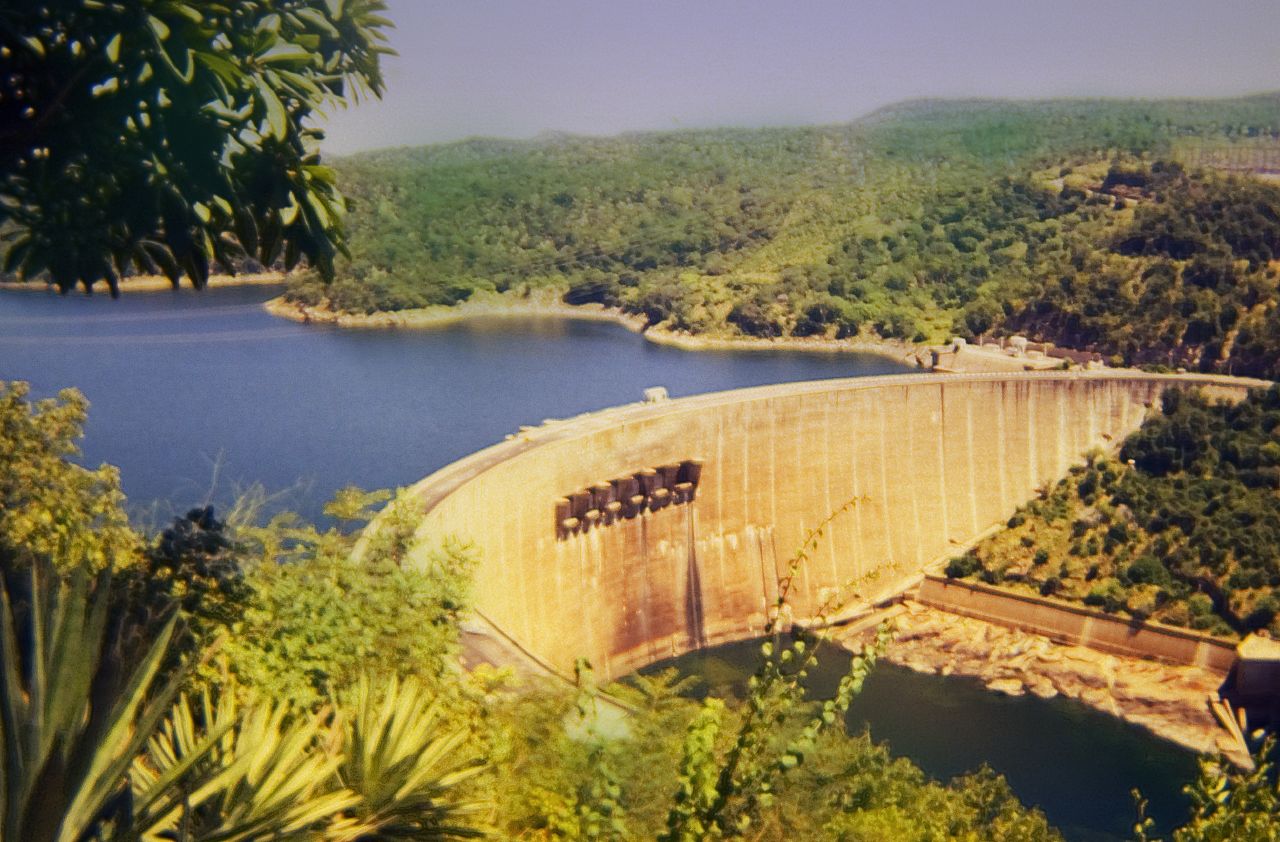
During its construction the local Tonga people believed that the River God of the Zambezi could not be harnessed. With the death of up to one hundred construction workers their belief had a strong case.

However after two massive floods the dam was complete, displacing over 55,000 people, causing thousand of animals to drown it brought cheap electricity to the first of the resettled Tonganees twenty-five years later.   They the Tonga had no say in the building of the dam or where they were resettled.

On a more positive side it is now provided cheap energy, a tourist attraction in the town of Kiriba. Excellent fishing for Tiger fish, Giant Vundu, Cheese, Nkupi to named but a few of the less known.   The creation of the Matusadona National park for the animals saved by Operation Noah our road hogging elephant > an inexhaustible source of water for bird life.   Not forgetting a home for Amp’s Free State. That night we venture out on to the waters to watch the sun set.

Morning we depart for Mana Pools a UNESCO world heritage Park with an assurance from Amp’s that all white Zim welcomes are indeed a Céad Mile Fáilte.

Arriving at the Park’s entrance without a visiting permit we resort to the typical unified homage and the splee that we thought you could get a permit at the gate.   Eventually after a radio call we are waved through the lifted barrier. “On reaching the river please report to the main office.” Seventy-three kilometres of bush penetrating dirt track we eventually emerge on to the Zambezi riverbank without seeing one animal.Afficher l'image d'origine

Twenty minutes later we emerge from the main park offices armed with our permit, which allows us to, caught one fist a day. Allocated camping site no six > with number three written on the permit we Pitch No 93 on site number five. Williwaw deposits the last of her radiator water in the dust as if to say this far and no further.   Our campsite situated on top of a high ridge is in the midst of large trees of Mahogany and Apple Ring Acacia.   Our view out over the ridge looks out on long grass stretching down to the banks of a slow-moving Zambezi meandering around small islands in and out of large pools and channels.

On the opposite bank of the river steep embankments covered in dense jungle defend the boundaries of Zambia. Prior to the Kariba dam the whole area would have being such swampier with lush river terraces reaching inland for several miles.

We settle in to the sounds of Hippos, Elephants and Hyena not forgetting the ever presents Baboons and our favourite blue asses Vervet monkeys the tugs of the bush.Afficher l'image d'origine

Our first Manna Pool morning breaks early with a breathtaking view of water buffalo munching, Hippo wallowing, with an Elephant parked outside the gents.   We have at long last found a park where the animals came to you rather than driving around on rumours looking for them. (Top TIP: Invest in good Binoculars 8X3or 9X40.)

The 2190km² of the park has one of the topmost intensities of wildlife on the whole continent.   .

We visit the park ranges lodge to pick up a map of the park and hire two Canoes.   I arrange to use their workshop to have a look at Williwaw.   The rest of the day is spent soaking up our idyllic surroundings.   An early evening drive down to a small lake called the Long Pool involves risking giving Williwaw a dose of Bilharzias > Her radiator requiring topping up from every stagnant pool there and back.

Dawn brakes with a baboon barking announcing the arrival of a Ranger to tell us that our canoes are down on the riverbank.   Equipped with hats, bottles of drinking water, a picnic and a thick coating of sun tan cream we set forth.   On the way over to the riverbank Florence is very distrusting of a large Buffalo that is grazing in the long grass.   She has every reason to be so we give it a wide berth. It turns out that we are not the only ones going cannoning. Standing beside the canoes are a young German couple and two South Africans.Afficher l'image d'origine

Life jackets on we set off up river. Hippos at a distance look harmless however close up at water level you feel more than defenceless, especially if they yawn. Our first pod of hippos has a young fledging.   Definitely stay clear.   We take a long detour behind a small island down a narrow channel emerging into another pool.   Out of the undisturbed waters up pop a pair of ears and snorting nostrils and up goes the girl’s apprehension.   Hippos can stay submerged for anything up to twenty-five minutes. The thought of one surfacing under our canoe keep us all on the alert.   Twenty minutes late Fanny spots a HMS Hippo on a broadside collision course. “Look its tail is flapping a sure sign it’s getting twitchy.” The girls paddle with renewed vigour. We learn later that tail flapping is not a sign of aggression to be more precise that it is having a dump.   For the moment nothing would convince the girls that we were not under the beady eyes of the approaching head with intent of immediate attack. We shoot across the river to the opposite bank to be confronted by a sleeping Buffalo.   About turn out we go to one of the many small islands already occupied by the Germans.Afficher l'image d'origineAfficher l'image d'origine

While the Germans make a reconnaissance of our small island we lunch. Our island krauts are gifted with the on canning gift of seeing herds of buffalo, elephants, and wildebeest when no one else sees a thing.   You name it and they have seen it.   Mind you they are somewhat fortuitously that they did not spot the croc near the canoes when we departed as we are sure they would have freaked.

Who cares what ever makes them happy. For us we had reached the limits of up river paddling. We turn for home. Except for hippo dogging the soothing waters embrace us. The hypnotic silences of our surroundings slice open every now and then by the piercing cry of a Fish Eagle give us cherish moments to remember. Submersed in the setting sun we float back down the mighty Zambezi without much effort to home.Afficher l'image d'origine

Back at camp with binoculars we watch the early evening parade of thirsty mammals.   Darkness as always arrives unexpectedly.   Out of the night the first set of Hyena eyes reflecting in the moonlight appear and disappear like large glow flies. Followed by a few others they create like the Hippos did a state of land fretfulness in the girls. All the assurances in the world, that the critters are harmless have little effect. That they will stay their distance does not change my ladies they being both being adamant. “Move the tent on to the roof.” “In the morning it’s far too dark now to start messing about.” “Don’t worry I stand guard.” The day’s sun and exercise wins the argument.

Awaking to the sound of crunching metal last night bone-crunching visitors are busy destroying some South Africans campsite. The brainless bastards have gone on an early morning walk (Mana Pools is one of the few parks where it is possible to go on walking Safaris escorted by a professional licensed guide.) without storing away their Cool box, tin food and the like. Right in front of our eyes their campsite is being reduced to ruins. Not a morsel of food is left. The cold box is crushed to smithereens followed by every available tin can.   Even our widow’s memory catapult is a waste of time. Four direct hits have no effect in deterring the raids. The whole affair is spell bounding.

While the casualties pack up what left of their campsite and leave we breakfast.   I wander over to the workshop leaving the girls to their own devices for the day.   With the help of one of the parks workers I remove Williwaw radiator. It is in need of radical repair way beyond Radweld.   Norman Monks the assistant park warden drops in and suggests some putty that they use. He also informs me that in the morning one of his rangers is going to Karoi to get married.   If I have no joy with the putty I could hitch a ride in the back with the bride and a few of his mates. They are leaving a four in the morning.   Just outside the town there is a place that does radiators. The putty is a miserable fiasco. Drop it the new name I have given my assistant is more of a hindrance than a help. He has the happy fondness of dropping all he touches. In the end there is nothing for it but an early rise and a long day with my radiator.

Three thirty in the morning. No sign of the groom or bride to be. I return to my sleeping bag. Five thirty up rolls the wedding party > Better late than never. I climb into the front seat. We call on one of the workers houses behind the Park lodge. Out marches the best man and the bride dressed to the teeth. I am given the short shift to the back of the Toyota. Scrambling aboard with my radiator I am greeted by two black faces in black woolly hats. The morning is cold. I have not notices the cold till I see them. The doors slam and we off.

Ten minutes down the road we come to a sudden halt.   Before I realize what is happening my two accompanying back passengers are up on their feet banging the cab roof.   The horn is blowing at full blast.   Caught like a rabbit in the headlights and spots. Frozen to the ground in the middle of the track is an Elephant.   Taking fright it starts running. For the next two kilometres it trundled along like a locomotive at thirty to thirty-five km per hour. Finally veering off it crash’s into the bush to be swollen by the snapping foliage. With all the excitements over we once more settle down out of the bitter wind to arrive four hours later in Karoi.

There is no offer of a lift back but a loose arrangement to meet outside the bank at 6pm. The first job on hand is to get some cash.   Standing shivering with teeth rattling I await my turn in the bank to change a few hundred dollars. African bank visits have a habit of trying ones staying power. Emerging two hours later I wander over to the garage. “No we don’t handle radiators but leave it with us and we send it up to Chinhoyi to Brake and Clutch”. With no other option I am now looking at hanging about Karoi till 6 pm. I resort to one of my favourite pass times.   Armed with a beer I install myself at a roadside café for a few hours of people watching.Afficher l'image d'origine
The day drags through the heat. Around midday I am spotted by some Mana Pools acquaintances how invite me for a spot of lunch. Borrowing a jacket I return to my perch outside the bank.   Six pm passing with no sign of my newly married ranger or his friends. Darkness begins to slides across the sky. Just as I am thinking I am stuck for the night out of the gloom Mrs Neville my guardian angel appears at the curb. She has spotted my sitting amongst my plastic bags of provisions. I explain that I am not a new phenomenon in Karoi i.e. the first ruff sleeping white. My predicament is that a newly married ranger has gone on the piss, no way back, radiator god knows where, stranger in town.

Zimbabwe hospitality immodestly clicks in. My angel guardian opens the door of her car excepting no good reason other than I stay the night in her home a tobacco plantation just outside town. A phone call to the girl’s followed by dinner and a late into the night discussion covering all of the Neville’s Zim woes or trips to date and a large bed raps the day up in the land of nod.

I awake to hear Mrs Neville on the phone. “Is there no way you can fly down and bring a young Irish man back to Mana Pools” “No but a group of friends are going for the weekend.” “I can get them to call over.” Mrs Neville assures me over breakfast that I will be back with my love ones by lunchtime.

After a breast-crushing hug her husband John drives me down to the entrance gates of the house. Here we are met by a young man on a shortwave radio.

“Yes I have the beers.” “Yes I’ am at Neville’s place – Be with you in a few minutes.” I am squeeze in to the car. Arriving at a cross roads we meet up with the rest of the group. Each vehicle is stuffed with kids, tents, cool boxes, wives, and friends.   A quick round of handshakes we on our way.

Arriving at the start of the long trail into Mana Pools one of the Toyota develops a knocking in the engine. Nothing dampens the holiday sprite. It’s abandoned with all the gear chucked on top of one the other car trailer’s.

My driver explains that he and another hunter offered the Zimbabwean Government in the region of ten million Z$ for two hunting concessions a year ago. It was turned down in favour of two local blokes, black of course who were given the hunting rights for 60,000Z$. The Reserve on which the hunting would have being done could have done with the extra money but as my driver put it Zimbabweans are no longer looks on as cherished citizens if born white.

The days of white supremacy 1930 -1934 when a land act debarred Africans from ownership of the best farming land, and a labor law which banned them from entering skilled trades of professions are long gone.   They were now however returning on the other foot to haunt us. “Another ten to twelve years and all that we have worked for will be down the swann’y.”

Finding the girls in good fettle I recount all. My provisions go down a treat.

Sticking to our close at hand surroundings I suggest that we venture forth in the morning on foot. It gets a puny response from Fanny and Flo. Perhaps their response is due more to the sign in the Wardens office “Stay out of long grass, look behind you now and again, don’t put water between yourself and a Hippo – Tourists must pay twice the fee as black Zimbabweans.” Or on the other hand I suspect that they are enjoying the company of some new arrivals.

So early afternoon armed with a camera, drinking water, and a few nibbles I set off on my own.   With the setting sun on my back my first surprise is a large Monitor.Afficher l'image d'origine

Not a computer monitor better known to inhabit European canals and rivers. This one is a fucking enormous Lizard that gives me quite a start. As one is not inclined to look at the ground when walking I had not noticed it till I had almost put my foot on it. (Monitors are related to Mosasaurs that lived 97 to 65 million years ago. One of the largest living lizards they have a long forked tongue with powerful jaws that unhinged in order to swallow large prey.)

With my pulse returning to normal I take a mental note to watch by step. Cutting in land from the river the plan is to go two kilometres straight in take a right turn and walk the parallel distance that I had walked up the riverbank.   Then take another right and end up back at camp.

The way in through the long tall grass makes me feel more and more at risk. My mind sees prying eyes where there are none. I am dinner passing bye on wheels. Emerging soaked in sweat I arrive at a dry riverbed.   Whether I had gone in two or more kilometres was any one guess. It did not matter, as I could not shake the feeling of being watched. I take a breather on a fallen log.

Consulting my compass I am just about to set off on a reciprocal course to the one I had walked up the Riverbank when I spot an Elephant in the bush.   He appeared to be gliding effortless soundless in my direction. Perhaps he is the Elephant we chased down the track or one of his brothers. Elephants never forget. To be on the safe side I move higher up the log. He grows in statue with every unforced step. All indicators say that he has not noticed me or that he is purposely showing little interest so as to put me off my guarded.

On he comes stopping less than fifty meters away from me.   It’s not possible to tell what an Elephant is thinking so I slip off the log taking protecting behind it. This fellow shows all the signs of “You are on my log.” It is written all over his face.   The charge comes with no advance ears flapping.   There is a soiled thud that sends a tremor up my timbers. Abandoning all rationalize thinking I high tail it straight into the setting sun. You can see me for dust.   Any awaiting crouching lion in the long tall grass has only to open its jaws to take delivery of an early Irish morning breakfast. My short burst of Olympic one hundred meters speed Peters out well before the winning tape. Much to my relief there is no following trumping.   In the world of might biggest is always right. I arrive back at camp alive and exulted and exhausted.

Visiting the Wardens lodge in the morning I add a note to the warnings given to one who goes on foot safari. “If you have to run don’t run blind into the sun.” I make a radiophone call to Toyota, which confirms that my radiator has gone on walk about. They have no clue as to it whereabouts. “It’s on its way to Chinhoyi, no wait a minute its in Harare, it’s not here.” The line goes dead. Norman the head warden is not of much use. Like most academicians he is as dozy as hell when it comes to practical advice. There is nothing for it but to go on a radiator hunt to morrow.

Passing some of the canoe tour operator’s camps I enquire without success after the possibilities of bumming a lift into Karoi in the morning. Fanny comes up trumps later in the day. She succeeds in commandeered a long-legged red-haired good-looking chap into giving me a lift in the morning.

We leave early completing the eighty-kilometre dirt track that leads in and out of Mana Pools before sun up. Five hours later after a stop in Kario I arrive at Brakes and Clutches in Chinhoyi. Parting company with my driver an enraged Irish voice is mollify by a cup of tea with an offer of a bed for the night and a phone call by Alan to Harare. “We make a plan in the morning if the radiator is ready I run you up the road to collect it.”   Once more I am experiencing Zimbabwean hospitality regrettably Alan hungry for a sympatric ear to his countries woes, we talks late into the night.

True to his word in the morning we set off meeting another radiator & Clutch man just outside Harare. My revamped radiator, with a new core is transferred into Alan’s booth. By the time we get back it is far too late to continue on down to Mana Pools. I stay another night.

In the morning the bus turns up packet to the gunnels. I climb over one bag after another planking myself down beside a lady wrapped in three blankets, wearing two woolly hats with an ass that only allows one cheek to rest on the seat.

Belching the compulsory cough of exhaust we jolt forward followed by the grating gearbox change into second where it remains for the rest of the journey. Every cross roads renews the battle of getting stuff off and on. With two unscheduled pee stops and six hours of gasping for air I eventually arrive on top of the hill that descends down to Mana Pools. Thump the odd passenger with the radiator I haul and squeeze myself to the front of the bus just in time to indicate I wanted off.

I also make it to the barrier in the nick of time to bum a lift. One hour later I get a warm welcome. “What kept you?” “Nothing much.” Later that evening I have fitted the radiator much to my relief without Drop its help.   We are all set to leave. (Top TIP: To avoid Radiator nightmares fit a fine mesh screen and make sure you reinforce its stabilizing fittings.)

Handshakes all around we once more set off down the dusty trail. The long drive to Harare is done in a hypnotic state of mind.   After a week camping in Mana Pools it’s time to spoil the girls with a night of comfort. Long before arriving in the capital we are booking into a decent hotel. Driving into the city centre the trimmings of a modern city once again enforces my belief that time is being hijacked by the western illusion of speed.Afficher l'image d'origine

Harare is one of those surprise African cities. Modern with wide boulevards it has all the trimmings and facilities of a European city > Working traffic lights, pedestrian crossings, parking meters, uniformed cops, brass doorplates and all the rest that makes up a pulsating city. We are to get to know it well over the next week but first over lunch I learn that we have accepted an invited to stay with one of our next store Mana Pools Campers. We head out north of the city to visit the Lamin family.

They live in a place called the Headlands and according to the girls they own a Zoo, a Craft Centre, Butchers, a Restaurant, a Bar, Souvenirs Shop, a petrol station, you name and they got it. The whole shebang is called the Half Way House.

After many enquiry stops we eventually drive into what can only be described as an ostentatious estate. A neatly trimmer avenue peppered with peacocks and duck meanders its way through spectacular gardens to the main house. I am beginning to believe the girls. With beaming Zimbabwean hospitality we are met by Margie and Tim. “Park over there.” I park Williwaw along side a mount of tea chests.   “Welcome, welcome”.

“Oula four gin and tonic.” Armed with long cold G&T we are given the tour.

Florence is the first to see the two baby cub lions playing with a large Rockviler. She is in heaven when she hears that all three are house inhabitant.   That night over dinner served by one of the many black servants we learn that the Lamin family is bailing out of Zimbabwe in the next few months for the USA.

We are also promised that we will see at first hand the white anxieties and disillusion about the future of Zimbabwe. Tim our host is a Yorkshire man >   A Long John Silver type – driven by the rattle of silver. His newfound wife Margie although small in statue has a dynamometry nature. As always on these occasions the chat goes on well into the early hours.

We awake late but who cares it the good life for us for a few days. Breakfast introduces the house cook Peter who takes any thing up to two hours or two days to produce the morning meal. We are also introduces to the morning view out the kitchen window > A large black baboon pleasuring itself in its cage. “We rescued him for a Lab in Harare.” Florence is fascinated as she-wolf down her second bowel of Corn flakes. She can’t wait for her sex education to finish so she can make the acquaintance of the two six month lion cubs.

At high noon we set off for Harare in search of a visa to Mozambique. The plan is to take the Tete corridor once knows as the Gun Run to Malawi.   Surprisingly we have little difficulty in finding the Embassy and a transit visa is issued without much bother. On Tim’s advice I call on Mr Hardcover in the Standard Chartered Bank. My namesake Bob Dylan works wonders. Mr Hardcover arranges a priority bank service account and through it a transfer of US dollars from Ireland. “It will be paid out on arrival without any charges or commission.” For once my namesake pulls some weight in Africa. To celebrate our good fortune we lunch in the Bombay duck followed by few pleasant hours of window shopping the day is complete. Avoiding rush hour we slip out of the city making it back just in the nick of time. Williwaws main fuel tank has developed a leak. What next?

The Lamin Commercial Centre situation at the back of the Fuel station houses a Butcher shop with a working garage. Leaving Williwaw parked outside the Garage we walking over to the entrance. We emerge into a paved courtyard overlooked on all sides by two storeys buildings. “What did we tell you? “ A gift shop, a Restaurant, a Pub, a Vegetable Shop, and Bar.   We are introduced to the gathering crowed. With no escape each introduction brings a fresh drink so by the time I am invited to visit the local farmers Country Club I have no hesitation in accepting. Fanny and Flo give the Club a miss preferring an evening swim. I have little recollection of the Club other than meeting Tim father big Jim.

A large hangover hampers my appetite for breakfast and the early morning antics of a frustrated laboratory Baboons. I leave the girls to their own devices and take a ride up to the garage.   Williwaw fuel tank leak turns out to be a glass reinforced fibre job. (Top TIP: Carry a kit. Plus kits for all your cylinders, Wheels, Master Brake Cylinder, Master Clutch Cylinder, and Slave Cylinder.)   It takes me most of the day to remove the tank to effect repairs. It always the same knuckles one cut’s when doing repairs. So by the time I have once more cut the refitting radiator knuckle I am not in any mood to indulge Jim over a well-earned beer.

Jim enshrines all that is white wrong with the country. Arriving from Yorkshire in the fifties he is still a steadfast supporter of Ian Smith and his then regime. He comes across as a conceited bellowing buffoon. One can see straight away why there are aspirations on the black side to rid themselves of such repugnant racist white trash. Two hours are spent telling me about a silver keel and rudder that had fallen off a yacht somewhere in the Indian Ocean. “They are not lost I know exactly where they are on the bottom.” Apparently he had attempted to launder some hard-earned cash out of the country during the sanctions applied by the UN in 1968. “The sanctions were by the way ignored by most western countries.”

“How about a lift home Paddy?” “Sorry I don’t have the time take the short cut around the back of the plantation.”

One hour later I wander into the backyard of the house to hear his booming voice. “That’s your man.” A black worker is being arrested. According to Bwana, Boss, Master, Jim the worthless wanker is on the fiddle. “He steals 60,000z$ of my money pays the fine and then will have the neck to tomorrow when he realised to ask for his job back.” “In the mean time like all blacks he will develop the Craft syndrome of.”   “Can’t Remember A Fucking Thing.”   “It’s no wonder my son is leaving.”

“You are seeing a country under the cosh of the Zanu-pp party.” “Black Zimbabweans are hell-bent on self-destruction with thousands of whites leaving for greener pastures.”   “The economy is two-thirds of the size it was in 1999.” “You are seeing right in front of your eyes a brain bleed dry policy that can only result in a dust bowel.” Jim is far for the best example of devotee white Zimbabwean patriotism he vents however an irrefutable fact that the mass exits is both the symptom and cause of the countries woes.

The whole uproar is a time capsule of African anguish. It acts like a large magnet for all with in hearing distance. The ensuing arrest is heart-rending.   The poor sod is bundled with excessive violence into the waiting police car. The event leaves behind a strong undercurrent for revenge. I can’t help feeling that we as humans have lost sight of earth as a planet where every one and all living things should be given the dignity of life.   With mass exploitation of people and nature, unbridled consumerism, post-modern intellectual nihilism, and new world order one is bound to ask oneself is it possible to have a science for the earth and its people. There is no answer.

Everything is a Science these days.

With most scientists being products of the western culture they reinforce their western world values. Models are used to create reality, to make visual in applied science and technology; both are so linked together that nature takes a backseat. Natural balance has all but gone out the door for the sake of development, the economy, and progress. In Livingston day’s science was about Gods creations.   Modern day science and technology is about manipulation, intervention, prediction and control. Using nature for mans needs has always existed since time began but you would think these days that nature does not exist, only as a product in the endeavours to ignore and change it.

Africa colonialism like most of the rest of the world on decolonisation was left with governments trying and to this day still trying to promote western-style science as the road to economic freedom and political autonomy. Modern science holds nature laws to be space and time invariants, with most scientists considering that the results of their work stand above morality and politics. As far as they are concerned it is up to Society to do as they please with their discoveries i.e. not their responsibility but the responsibility of others.

On the one hand it is not possible to stand outside scientific knowledge. Only natural philosophy can stand above science it not having that human value. Science will have to someday come out of the Laboratory, which is state or industrial supported becoming more transparent.

With Africa turning into the dumping ground of the world’s conscience and the difference between the Islamic and western civilizations and value systems growing it is time for man to pay respect to the diversity of nature and to those who he live within this shrinking world.   It is not possible to measure progress in a world of might. My hope is that over the next millennium of time scientific people will have demands placed on them to cut the cords of industrial and state support.

Let the west have its technology and Asia its mysticism. Africa gift to the world will be in the realm of human relations.

Entering the house my thoughts are shattered by another racket.   Florence has fallen foul of the two cubs. Lounge room stalking has been in play, one unsheathe claw has giving her a deep scratch. Apparently one of the cubs sprang on her back from the sofa, while the other gave her a swipe for good measure. All is repaired with a band-aid with a promise to visit Rosie in the morning.

Rosie turns out to be another Mana pools acquaintance. A friend of Florence with an Irish mother living in the Southern suburbs of Harare.   We set off early arriving to yet another wonderful welcome with an invitation to stay for dinner. Unlike the Lamin this family has neither the means nor desire to escape from Zimbabwe. Unfortunately it is a school day for Rosie but a quick phone call and a spare school uniform save the day – off they go hand in hand.

Our day starts with a visit to a local sculptor. His works in soapstone are thank God beyond our pocket nevertheless soapstone turned into one of those moments that caused me to all but disown Fanny. Not far from the Sculptor gallery she comes across a street vender selling carvings and down market souvenirs. What does she spot? Yes a small statue in green soapstone. Nothing would convince her not to buy it. The whole situation turns into a battle of wills. It weighs a ton, no room in the Jeep have no effect. I have no intention of carrying it half across Africa. Still no effect. Twenty minutes later it is rapped up in a box. Two minutes more and I am standing in a queue in the post office across the road. “The limit in weight Madame for posting is 20 kilos.” The queue gets longer as Fanny unpacks the statue for the third time. On the removal of some string to a round of applause the forth weigh in it scrapes under the wire. We emerge for the post office 19k 999grams lighter. Fanny with, I told you so, I with a large desire for a Mosi, a Rhino, a Bohlinger’s or a Zambezi. (Beers Label)   All is forgiven by the time I get to the Bohlinger’s.

The very word Zimbabwe has it origins in stone. Directly translated from the African Shona language it means Stone house and it Bantu it translates to Sacred House or Ritual seat of a king. While the rest of Africa was using cow dung, reeds and straw to build, Zimbabwe was well on its way to becoming the masons of the continent. It has massive stone ruins in the southeast of the country. Built on 1800 acres in AD1250- 1450 they were first discovered in 1898. They were declared a world heritage site in 1986. Nineteen years later it now looks like the whole country under Mugabe is hell-bent on becoming a ruin. (Our bit of rock arrived back home safe and sound.)

After collecting our Visas for the Gun Run to Malawi we visit one the world’s finest silversmiths Michael Mavros.   His silver miniatures animals are mounted on Zimbabwean ebony and are cast in a painstaking technique called “lost wax” once used in Egypt in the times of the Pharaohs and well-known throughout the ancient civilisations. His uniqueness is in the fact that he carves the original model in ivory. We arrive at his studios set in wonderful rolling hill country. There is no way one can visit this studio without coming out with a purchase. Mavros talent is that he captures in silver every little detail of the living animal. His pieces are made with such immeasurable skill that the animal are portrayed as if caught in a split moment of their living lives. It takes us less than ten minutes to fall in love with a male warthog with two young. The credit card takes a beating. (Top TIP: If you ever get the chance to own one you have a true piece of art.)  

Dinner that night is dominated by the young ladies school day turns into an overnight stay with us arriving back at the Lamins late in the following afternoon. The crates are being packed with guess way?   Soap stone sculptures. It turn out that they hope to set up a shop in San Francisco. For us it time to push on in the morning.

(To be continued)

Donation News: I am beginning to understand why many authors live on fresh air.

Robert Dillon: Account no 62259189. Ulster Bank 33 College Green Dublin 2

Sorting Code: 98-50-10       


Share this:

  • Click to share on WhatsApp (Opens in new window) WhatsApp
  • More
  • Click to share on Pocket (Opens in new window) Pocket
  • Click to share on Mastodon (Opens in new window) Mastodon

THE BEADY EYE’S UNPUBLISHED BOOK. CHAPTER FOURTEEN. SECTION TWO.

27 Wednesday Apr 2016

Posted by bobdillon33@gmail.com in Literature.

≈ Comments Off on THE BEADY EYE’S UNPUBLISHED BOOK. CHAPTER FOURTEEN. SECTION TWO.

Tags

Best Travel unpublished book., Top readable travel book, Travel book that will inspire you to travel., Travel.


Afficher l'image d'origineAfficher l'image d'origine


ZAMBIA.
What we know:

FORMER NORTHERN RHODESIA. VICTORIA FALLS. CECIL RHODES.

British need a visa 50$, car insurance 36$ and an hour of form filling we are on our way.
Stopping in Livingstone (renamed Maramba) we visit its small museum dedicated to a Scottish born doctor –missionary and explorer extraordinaire David Livingstone and his wife Mary nee Moffat. David, as you might remember, was one of my fantasy ferry acquaintances on our crossing to Africa from Europe. A forerunner of European Imperialism eventually converted to African Nationalism he had come a long way from Shuttle row in Blantyre eight miles outside Glasgow to be the first white man to see and name the falls on the 16 November 1855: Victoria (Known to the Kololo people who lived up-stream as smoke and thunder)

The museum does little to prepare us for what lie’s ahead the world’s widest expanse of falling water. It does, however, leave us with some appreciation of the determination of Livingstone. To put Livingston time in context the light bulb had just been invented one year before he was born. When he first laid eyes on the falls the bicycle still had iron wheels. Sparrows had arrived in the USA and it would be another thirty-nine years before moving pictures were invented. It’s only a year since the charge of the Light Brigade. There can be no doubt that he must have being gobsmacked as his canoe floated towards the lip. It’s no wonder he could not resist the temptation of some twenty-century graffiti carving his initials and date on a tree.
Indian smoke signals of white clouds are like him our only warning that the Zambezi waters are going to nose-dive headlong into a gigantic void. Will we be as gobsmacked? Not yet.

Our first view from the riverbank is restricted. White clouds of spray and dazzling rainbows block any clear view. The awesome power and majesty that captured Livingstone will have to wait till tomorrow. For us, it’s shower time at the Rainbow Lodge. Approaching the Zimbabwean border Victoria is coughing up a cloud every few minutes. Most are crossing in our direction. That is from Zambia to Zimbabwe. Over 95% of tourists arrive at Victoria on the Zimbabwe side. Formalities to cross over with Williwaw are a bit of a nightmare. As always calm, some good humour and the might of the dollar work’s wonders with the car papers causing most of the problems. Stamp, Stamp we over. Our one-day stay in Zambia is over.

See original imageAfficher l'image d'origine


ZIMBABWE.
What we know:

FORMER SOUTHERN RHODESIA. IAN SMITH. UN SANCTIONS. MUGABE. WHITE FARMERS. VICTORIA FALLS.  

We disappear one after the other into the tumbling hot water. Heaven in Africa is not difficult to find it’s a hot shower. How give a fuck about one millions of litres of tranquil Zambezi water that plunge over Victoria > Up to 650 million every minute in the rainy season. At this very moment in time for all, we care it might as well be a dribble. Situated right on the river edge just above the falls edge Rainbow Lodge is well named. Reborn we venture down to have another look.
David clean-shaven, sporting a moustache with long sideburns and a receding hairline found the falls while he navigated down the Zambezi in the hope of finding Gods Highway into central Africa. He first saw them some distance further down the river from where we are now standing. In another ten thousand years Rainbow lodge will have to move one and a half kilometres up river if it wants to stay from falling over the edge.

Disturbing two youths who are having an evening wash we emerge onto the very lip of the falls. The view across the leading edge is mesmerizing. Sheets of water reflect a canvas of the setting sun posing for a split second before, spilling over in long vaporizing blocks of water. One can follow individual chunks of water till they break into white drops right in front of your eyes. Further out the falls, the water disappears into large cracks where it gathers energy to make the jump into the unknown void below.

Twice the height of Niagara and one and a half times wider it impossible to get an overall view across the 1.6km width of the falls. Victoria is in fact made up of four falls: Devil’s Cataract, Main Falls, Rainbow Falls and Eastern Cataract. From its highest point at 108m water sprays up to 500m into the air creating a factory of perpetual white clouds that glide up into the sky. The only unquestionably unchanged caricature of the falls since David time is that the Zambezi River now dammed has changed its spirit utterly. On arriving at the edge as a smooth slow flowing river it changes in a wink into the rage of nature that David must have seen.

Afficher l'image d'origine

Returning to the Lodge under a full moon we are treated to a lunar rainbow, dinner and a deep sleep with water on the brain.

By the time we emerge next morning after yet another long shower session the sun is already poaching the land. Armed with some local knowledge the best way to get truly saturated is to head for the Chain Walk a pathway that descends down into a gorge called Devil’s Cataract on the Zimbabwean side of the falls. To fully understand the falls one has to realize that it is forever on the retreat. The present falls is the eight to appear on the river over the last million years. Each falls forming where the river finds a fault in the lava bed of the river. Devil’s crack is the latest and it is already 300m below the main fall line. Eventually, over the next few thousand years, the whole lot will pour down this crack to form the ninth site for Victoria.

Donning some wet weather gear we set off. The unremitting spray of Victoria gives the place its own microclimate. Just as in David’s time the falls are surrounded by lavish rainforest remaining both dramatic and dignified. Not so the hinterland, which has turned into a gold mine bastardized by the ever-increasing tourist commercialization. Now a major world tourist attraction with a population of 72000 living in and around its sides I am sure his Victorian constitution would take a turn for the worst.

Feeling somewhat strange dressed up in rain proofs we pay our entry fees. (Top TIP: Bring a waterproof bag for your cameras.) A trail through deep vegetation leads down to a jutting rock outcrop with many vantage points. Each stop taking ones breath away as the falls make’s public its claim to one of the world’s natural wonders. After the Sahara, the Kalahari and Namibian deserts we find it tricky to get our heads around so much water. God knows the way we are polluting the world drinking water it could be the source of many a forthcoming coming African war.

Around here you eventually realize that all paths lead to craft centres or craft villages and only a promise made at Danger Point overlooking Boiling Pot of lunch in the Victoria Falls Hotel saves the credit card from taking a pounding. The Victoria Falls Hotel is one of the few remaining old colonial old world hotels. Built in Edwardian style 1904 when the Cape to Cairo railway reached the falls it now caters to the well-heeled tourist.Afficher l'image d'origine

For the second time in our voyage, we feel inappropriately clad in shorts and tees shirts. In the splendid Livingstone Room, they don’t go with linen tablecloths, fine glassware, and an array of forks and knives to tax one’s dining table etiquette. This is made more than obvious by the standing waiter with a tray that is dressed in whites, gloves and red fez. “Madam” “Noilly Prat gin Martine please,” says Fanny “Would you like it served here or on the Stanley’s Terrace.” “Sir” “On the terrace; s’il vous paît; with a large Gin and tonic if you please. Perhaps the craft shop /village might have turned out more lenient on the plastic. To hell with it, this marks the starting point to the second half of our journey. With drinks in hand we watch a bungi jumper launch himself from Afficher l'image d'origine Over lunch I sign up for a one-day rafting trip in the morning down what called the Botaka Rapids.
7am the next morning “ Please sign the handed out forms.” Indemnities against all accidents and loss of life. Next the safety talk. Long swimmers. Hold on to the ropes on the side of the raft. Do as your raft leader requires and everything will be honkey dorey. Pay now drown later. My group consists of Dutch couple, an Aussie, a brother and sister, two employees of the rafting company and a black skipper. “OK, mount up.” I am sitting beside David our accompanying long swimmer canoeists. He hands out maps of the day’s river decent > Twenty-three rapids in total.

Looking at the map all the rapids are all suitably named to put the fear of God in those who have never done white water rafting before or who will never again. Rapid no 6 Devil’s Toilet Bowl. Rapid no 8 Midnight Diner > consisting of a choice of three runs. On the left “Star Trek” with a hole of 5m reserved for the brave, or down the middle called “Muncher Run”, or the right “ “Chicken Run.” rapid no 9 “Commercial Suicide”, “The Mother” rapid no 13, “Terminators One and Two” rapids no 16 and last but not least “ Oblivion “to name just a few.

Our converted Dutch army truck takes an hour to arrive at our launching pad so I have plenty of time to speak to David. Long swimmers turn out to be a bloke who has been swept some distance from the raft. It’s David’s job to go and fetch the drowning dude in his canoe i.e. long swimmers that are about to stop swimming. Short swimmers are those that pop up beside the raft. They are usually deal with by those who have not fallen out. If there is no left in the raft they should grab hold of the rope and climb aboard whether the raft is upside down or not.
The truck comes to a halt. Our first surprise is not long in coming. To get down to the river there is a long descent down the side of the gorge. Not by a track but step by step on a rickety ladder made from tree branches. With no handrails, it’s a true test of balance. The Dutch couples in front of me are making heavy weather of the decent. Our black captain raising his hand’s skywards in acknowledge of their difficulties. It looks like he has resigned himself to spending more time in the water than out of it. I can’t help sympathies with his premonitions. The Aussie brother and sister are attempting the descent by stepping in-between the ladder rungs. The inevitable happens. Crash! Down goes the long-legged sister chick ripping the ass out of her flimsy shorts exposing two juicy cheeks separated by a pink G-string. The panoramic view of which is not lost on our captain.

One hour later. Issued with life jackets and paddles we are assembled on the Rocky River shore. Raft places are allocated with two moons the sister getting the place of honour in the bow. Our rubber raft tethering on its painter in a backwater pool is then fitted with its steering oar. Twenty meters out from the shore the river boils. Pressure bubbles float into the backwater in long columns to explode like flashbulbs. “All aboard.” “Weil going to go twice around there for some practice.” Tayto > the captain announces indicating the circle with his hand.Afficher l'image d'origine
OK! “When I shout full steam ahead you are all paddle to getter.” “Good.” “When: I shout on the right.” “Those on the left are to paddle backwards and those on the right are to paddle forwards. “ On the left” those on the right paddle backwards and those on the left paddle forwards.” Good! Good! “High five all the paddles in the air like this.” He holds a paddle in the air over his head with his two hands. “Got It” “All aboard.” Around we go twice. ON THE RIGHT producing a clatter of paddles and ON THE LEFT producing a new command from Tayto, “All together please.” Round two. Not much better. The view, however, has improved with our bow lady throwing herself enthusiastically on Tayto command face down over the bow.

Hitting the main flow with paddles thrashing, Tayto’s legs muscle tense as the current takes the raft. Our first sight is David surfing upriver on a never advancing backwater wave. High five shouts Tayto we have just navigated our first rapid of twenty-three. The high-five apparently is also a team signal of our achievement. Neither of the Dutch Edams got wet. On we go. The next rapid presents no problem or the following three. Smiles with Orange Juice, all around.

The walls of the cannon tower on either side of us. Zambia on one side and Zimbabwe on the other. Next up is Morning Glory our first major rapid. On the bow, cheeks tighten. Toto’s voice disappears as we hit a hole and are swept towards the canyon wall to be dumped into another big hole. While those in the stern of the raft end up in the bow cheeks is catapulted head first into the drink. Toto’s black hand pulls her aboard revealing to all that she has lost the remaining tatters of her shorts. Stairway to Heaven is upon us before there is time for a short change even if she had a pair.
The Stairway is a class five rapid very steep and powerful with heaps of massive waves and holes. From where we are sitting it is an amazing spectacle. Its size and volume distract all eyes from the bow. Over we go in more ways than one. I surface beside the raft, which is upside down. A trusty Black Hand heave’s me out of the water. With some effort we right the raft. All are salvage except the Aussie our first long swimmer. Predictable being an Aussie he arrives aboard thanks to David with stories of never surfacing; see his life in a flash, escaping the jaws of a croc. The Devil’s hole shuts him up.
I am now well into the ride (Top TIP: Don’t miss it). With Toto working hard we enter Gulliver’s Travels the longest rapid. This is the most technically demanding rapid of our decent. Cheeks are in and out over the bow like a Yo-Yo. Accelerating the raft is like a bucking bronco. How we got through without turning turtle is all down to Toto skills. High five’s all around.
“All out here please.” “With this amount of water the next section is too dangerous.”
“You can stay Bob if you want.” Man what a buzz. The Zambezi’s most infamous rapid. This one is a river wide pour-over with a narrow slot less than a meter wide. Well named it is indeed not for the non-tutor. Commercial Suicide. Toto lines the raft to be spat out like a cork out of a bottle. The words, Awe-inspiring and humbling go a long way to describe the next few seconds, from beginning to end. A surge of acceleration a boom of exhilaration it’s no wonder mighty rivers of the world are the blood vessels of nature.
Safely through we pull in to pick up the waiting crew. Toto smile he can’t wait to put Cheeks back in the bow. The raft is given a few extra pumps of air. We pass Gnashing Jaws of death and Overland Truck Eater with on mishaps, other than Cheeks, whose cheeks begin to glow. Now over halfway the whirlies and squirts don’t seem so intimidating. We watch David spinning like a top in a whirlpool popping out to ride some more surf as we go at a speed through the Three Sisters and on to The Mother a massive wave train. Super. The Washing Machine then another wave train leads into Terminator one and two which are also wave trains but on the bigger size.
Toto reminds us all if we should turtle to look around when we surface. “There is always air under the raft if you need a gulp.” “ The Terminators are gigantic. I tell myself if anything is going to happen this is where it is most likely. Toto warns Cheeks to go to watertight. She grabs the lifeline with both her hands and feet.
He was right. The raft goes skywards depositing all in the lap of the River Gods. Toto like the waiting wave has already anticipated two hours previously that his luck would run out. With the agility of a Velvet monkey he somehow or other puts in a backwards somersault like as if he was taking the high jump. He lands on the upturned raft.
I have also seen it coming. There is no way I am going to be sucked into one of those boiling pressure points and burst an eardrum. I had also taken a firm grip on the rafts lifeline.
While two are manhandled aboard a black hand once more heaves me on to the raft. The Aussi surfaces right in front of me. Panic has set in. Looking in the wrong direction he is trashing the water like a hippo tail taking a dump. Luckily I still have hold of my paddle. There is nothing for it but to give him a smack of the paddle in the kisser. Now facing the right way he grips it. David gives the thumbs up sigh. I roar High Fives! No one seems to enthusiast as we plunge out of control in a crescendo of noise and foaming water towards Terminator number two. We whistle through the nearest to whistling down a warp hole in ao Flash Gordon book. Intensely > Spine-tingling > Call it what you want. It’s a hell of a buzz.
The raft flashes over Double Trouble with no trouble to coin a phrase. Oblivion makes it self-heard the last rapid of the day but not the least. This rapid is made up of three waves the last of which is responsible for more raft flips than any other in the world. Only about one in four attempts succeed. Not to worry Toto has it all worked out? We get fucked in the raft flips over we go head first to be flushed out into tranquil waters of a large backwater pool. “Never mind the crocs” “Right the raft.” Toto last instruct.

Righted the raft is now towed ashore where it is deflated by three waiting employees. It is then hoisted shoulder-high and carried at running speed up a similar ladder to the one we descended a few hours ago.

Before our long haul out of the gorge, a small waterfalls flowing over a smooth rock face into the pool catch the attention of a brave few. It inflicts a few extra sore bums to join Cheeks she preferring to stand in the cooling water rather than in the sun. (Top TIP: If you do it > make sure you plaster yourself with waterproof sun lotion and smear your lips with lip-gloss.)
Emerging from the long climb out we now treated to a cold buffet and a few tubes of Mosi a Zambia beer named after the local name for Victoria Falls. The beers go straight to our Aussie friend head he slurring to all in sundry who he was saved by his sister from Davy Jones locker. I did not have the heart to tell him that his sister had balls and it was I who gave him a whack of the paddle in the gob.
Several whiskeys later it is I who has verbal diarrhoea describing to the girls who I had spent the day in the fury of a giant tumble washer.

That evening we move I rather stiffly from Rainbow Lodge to Maramba River Lodge in the Mosi –oa- Tunya National Park and spend the next few lazy days swanning around somewhat reluctant to recommence our travels The Question is do we go around Lake Kariba on Zambia side or the Zambezi. A ferry up the lake from Saba to the Kariba Dam costs over 400$ one-way for two adults and a child with Williwaw. The trip takes over twenty-two hours to cover the 250 odd kilometres that are if the Ferry is running. On enquiring it’s no surprise that the invisible Ferry has not being seen for some time and that it is full. On consulting or maps and Oracle books, we opt for the Zambezi side.
First, we visit a small village outside Victoria. While I was in the Batoka Rapids cycle the girls had got wind off a village where there are excellent woodcarvings. Mad dogs and English men go out in the noonday sun. That is just what we do. Not for the first time or the last time. After several dead ends, wrong villages and near divorce proceedings we arrive. What we find is not wood carvings but an English Educated village Chief.
Parking Williwaw in some shade we are ushered into a large compound housing a large traditional African thatch house. On the clap of hands from inside, we bend on one knee and enter the Royal Chamber. Here we are greeted in perfect public boy school vernacular by his lordship. I have often heard of many a tribal Chief –tee working as a porter in Waterloo station. Here we have one for real, smirks and all. I take an on the spot dislike to his Highness. What follows is surreal. Here is a well-educated bloke exploiting his situation. Out the back of his time-honoured house are parked two top of the range 4×4 and a modern bungalow. You remember our village Chief back in Senegal who ripped off any willing tourist with a tour of this village and his four wives’. He at least had taught himself and providing for his village. This fat bastard was pocketing the lot. Tea and a Royal chat for a small fee if you please.
“What will happen if China invades Africa?” “Why did you not turn down your royal duties and stay in the UK?” “Is there a fee to walk around the village?” I can’t wait to escape this specimen of hip critical African. I leave the girls and take a wander. They emerge shortly after me with two wood carvings a Rhino and a Hippo, which I have to admit, are of exceptional quality but tainted by all he symbolizes.

(To be Continued)

Donation News: Like Victoria Falls they are flowing in. Zero. Be the First.

R Dillon Account no 62259189. Ulster Bank 33 College Green Dublin 2

Sorting Code 98-50-10


Share this:

  • Click to share on WhatsApp (Opens in new window) WhatsApp
  • More
  • Click to share on Pocket (Opens in new window) Pocket
  • Click to share on Mastodon (Opens in new window) Mastodon

THE BEADY EYE’S UNPUBLISHED BOOK: CHAPTER FOURTEEN: SECTION ONE.

26 Tuesday Apr 2016

Posted by bobdillon33@gmail.com in Literature.

≈ Comments Off on THE BEADY EYE’S UNPUBLISHED BOOK: CHAPTER FOURTEEN: SECTION ONE.

Tags

Best Travel unpublished book., Top readable travel book, Travel book that will inspire you to travel., Travel.


(Continuation)


The village awakes to the trundling of our convoy crossing the wooden bridge. We stop at the gate where our entry tickets are scrutinized to see if any more Pular can be squeezed out of us by the Gate warden.

He is unable to give us much information on the route up to Chobe other than no one has come down it this year since the rains. However, he warns us that there is no camping allowed between here and Chobe.   According to Warthog, we will have no option but to camp, as it will take more than a day to get across.

At first, the going is painless.

Slowly the track narrows into a deep v rutted narrow corridor.   The Ford driven by Warthog has one wheel in the rut and the other up in the edge of the bush.

The Germans with high ground clearance crawl along from one bump to the next bump fighting the steering wheel. While Williwaw in low range second gear wonders what all the fuss is about.

The ruts grow deeper. The Ford takes to the bush till she hits a root and puts his steering out of kilter. A halt is called. Straddling the ruts is not possible for the Ford so it’s back to one wheel in one wheel out.   I suggest that the Unimog should open his driver window and keep an eye on his front wheels. He would find it easier if his wheels were straight rather than battling the steering all the time. I am very much appreciative of our protection plate (A heavy metal shield attached to the underside of Williwaw to protect her engine sump.) (Top TIP: Don’t go to Africa driving without having one fitted.)

The track eventually flattens out onto a dry sandy ridge called the Magwikhew Sandridge. The going gets easier and we all arrive after a few elephants and pee stops at the southern gate to Chobe called Mababe. Afficher l'image d'origine

A stone-faced park warden welcomes us with the words that the camping site is fully booked out.   This appears to be a normal Botswana park tactics in order to squeeze a few extra dollars out of the visitor. “We are not stopping.” “All we want is a transit permit.” A few minutes pass while our man takes a radio call. He returns demanding our exit tickets from Moremi. Warthog has pulled a fast one back at Moremi when we were leaving. He had told the gate warden that he and his Aussie friend were on our Park permit. The Chobe gate is now demanding that I should pay. I blew a fuse and gave Warthog a verbal rollicking.

I can tell from his eye contact that he has not the balls to strike back if I were to lay one on him. They both cough up and all is settled African style. Some shouting, some foreign exchange a transit permit and smiles all around have us once more on our way into Savuti (Chobe National Park) a remote landscape embracing sandvelds, rocky outcrops, and acacia savanna, mopane forest that are highly vulnerable to fire and dry marshlands.   It used to be famous for its high intensity of wildlife. The current long dry spell has more or less put pay to that we seeing little sign of anything on four legs.

Twenty kilometres into the park we stop for the night.   With a transit permit we are not supposed to stop so we pull well off the track into the bush so as any passing wardens will not spot us easily.Afficher l'image d'origine

Pitch no 86, shows the tell-tale signs of Elephant Activity. Everything is dry as tinder. The slights spark would be whoosh for sure. Unexpected Warthog volunteers to make dinner and more amazingly show off some bush knowledge.   The construct a safe campfire avoiding a bushfire. .

First digging a deep hole he then digs a trench away from the hole at about half the holes depth.   He then inserts the grill of a barbecue into the hole above the trench depth.   Borrowing my machete he cuts some grass and kindling. When lit a large branch is then placed in the trench and pushed along it till the end of the branch is over the fire. More branches are fed down the trench till a good hot amber base is built. It is then covered to form an oven.

(Top TIP: Bush knowledge weights nothing. How to tie slip knots and a bowline is useful. Webbing strap knots > Double sheet bend knot > Splicing > How to read a compass. Buy one of those little SAS Survival Books. An off-road vehicle needs a high jack. You need to know all its applications. Winching and lifting > How to construct different ground anchors > the use of snatch pulley block.)

After an excellent dinner we all sleep soundly, but not before Florence and Fanny’s minds are put at rest about the possibility of any Jungle Trumpeting Patrol crashing out of the surrounding bush.

Chobe is divided into four distinctly different ecosystems. Where we are the Mabane Depression is Elephant land during the dry season. So we were lucky not to encounter some of Botswana’s population of over 120,000 some of which are the largest in body size in the whole of the African.

With the fire hole filled in so there is no chance of creating a bush, we bounce back out onto the track. Late afternoon after a hard drive we arrive at Chobe main port of entrance Sedudu gate.   On the requesting a visiting permit we are informed once more that the park is full.   “Full of what.” “We’ve just driven across the whole god dame park without seeing another human being, never mind an Elephant or for that matter any of its original inhabitants the San people otherwise known in Botswana as the Basarwa.”   It is obviously time to ring the bell and close the park, as the two park wardens are not willing to enter into discussions on the absurdity of their statements. We are marshal to the other side of the lowered barrier pole and told to come back in the morning.Afficher l'image d'origine

A few miles outside the gate we arrive in Kasane a small town that is situated not more than an hour from Victoria Falls in Zimbabwe. Pitch No 89 is in a private house garden. Warthog run foul of me, getting this second bollixing for helping himself to my gin and other items without asking if it’s ok. Not another word is heard till morning when last night’s reprimand is still smouldering. It’s time to go our separate ways before it comes to blows.   Warthog and Rickey roar off in the direction of Livingston while the Germans none the wiser shake hands as we depart our ways.

Returning to the Gate we decide to give Chobe a chance. Once more welcomed with the words, “the Park is full. “ Transit Permit please.” “ Please sign here.” We drive in and when out of sight we duck down a track onto the Chobe River. If there are any animals in this park they got to be near water. Not even a croc stirred. Perhaps they right the Park is full of sweet fuck all. We drive to Serondela campsite, which is supposed to be fully booked. There not a campsite occupied so we choose the best sit overlooking the river. Afficher l'image d'origine

Pitch No 90 is under some large trees with the tell-tale bark of Baboons.

Out of the twilight arrive two uniform park wardens on foot. Permit. “This is a transit permit,” I reply pointing to both sides of us. “I know back at the Gate there are no Visiting Permits to be had as the Park is full as you can see.” “You fellows look thirsty it’s a long way back to the Gate.” A drink is accepted and a half an hour later we have two friends for life. It’s agreed that I must return to the gate in the morning and get a permit. A bottle of whisky later our cards are marked as to where all the animals are hiding. With no sign of another bottle appearing they eventually get the message that we wished to retire for the night. Off they swagger into the darkness disturbing the resident baboon and monkey rookery that continues to bark its head off for hour after their departure.

We awake to a cold morning. Florence and I warm up with some monkey/baboon zapping. (Top TIP: A Widows Memory Catapult is an effective weapon against Hyena/Baboons and unwanted camp guests.) I eventually set off back to the Gate by the main track. Not far from where we are camped I pass a ramshackle of a building. It is from where our two friends of last night arrived.   No sign of either of them. I am not surprised. Once more my request for a visiting permit is met with the park is full. With what, I inquire? Fresh air. “You will have to move from site 5.” “OK, anything not to upset the other vacant sites.” On the way back, Williwaw develops a stiff gear change and seems to be overheating.

By the time I get back I am fit to leave Chobe to the maddening crowds. Florence has gone on a rooftop game drive with safari groups who have moved into site four. Fanny is feeding a real Warthog until I remind her that just because it is in a park does not mean it is not wild.

Warthog tusks can rip a lion belly open. They live in small family groups called Sounders; have no sweat glands so they wallow in mud to cover their bodies to keep cool. They have poor eyesight but an excellent sense of smell and hearing.   Run with erect tails up to 50km/h.   When under danger they scarper one following the other into their dens. The youngest ones go in headfirst while the male stands guard. When all are safe and sound he shuffles in backwards so his tusks are always facing any potential predators.  

We stay put on site 5 for the day. I brood over the cost of a new clutch while watching the medley of invisible campers going about their business. Fanny attending to some badly overdue house chores repacks our various boxes > Florence’s, books and education material box > our book box, medical box, herbs and flour, condensed milk and other goodies box. (Top TIP: Make sure that whatever boxes you take are waterproof.)

Manfred and his wife Julian take site 3 out of the thirty odd remaining sites. He turns out to be a German dentist and a keen motor mechanic. A few pushes of Williwaw clutch pedal reveals that it is clutch fluid or the lack of that is the problem.   (Top TIP: Make sure you carry spare transmission/brake/clutch fluid.)   With my gloom lifted we board Manfred Nissan for a short game drive. Three hours and five visits to locations supplied by my two whiskey-swilling wardens, we throw in the towel for a cold beer back at base.

 Before the final splash of the evening, color glistens on the river below us the heat of the days begins to vanish from the land without a trace. The silence is broken by two of Africa’s most recurring sounds, the early evening cricket chorus with the odd forlorn twit to woo of a distant plover. Both are a sure warning that darkness is not far off. Florence arrives back reporting not much more success than us. It seemed incomprehensible with the park so full of visitors that is has lost all of its animals.

A large full moon promises a chilly night. Long shadows in contrast to the ultraviolet rays of the sun that consume one all day long now turn every bush, every tree into ambush hides. In this sort of light, one gets a weird feeling that every sound announces the heartbreaking end to some animal’s life. You cannot help the edgy gut reaction to the slightness Crunch   Even when one take’s a pee you see eyes or movement where there are none.

By the time the girls hit the sack the bush TV is almost out.   We’ve all come to the conclusion that we are all still novices when it comes to spotting large herds of Chobe animals or people.   It’s time to pick up the bagpipes and follow in the footsteps of Doctor Livingstone 1831-1873 to one of the main attractions in the area Musi-oa-Tunya, the Smoke that Thunders, Victoria Falls.

In the bush when there is nothing much going on, one is prone to retire early with a book. I am just going to quench the last of the fire when out of the corner of my eye my two ranger friends are approaching down a long shadow. One looks as pale as the moonbeams, the other gibberish holding a plastic bag full of beers. I am silhouetted both by the moon and flickering bush TV. There is no escape.

It’s not long before eerie stories of Ghosts, Banshees, and Men turning into snakes and off your rocker beasts attacking gullible tourists is in full flow. The piece de resistance comes when I was asked if I believe in Magic. “Of course I do.” Well tell him encourages the gibberish one. Pale face announced that the other night when he had staggered back he had laid an egg. It is hard to keep a straight face as I enquire if it was hard-boiled.   By his looks of summoned up pain on his pale face, there is every chance he had indeed passed a gallstone. I feel somewhat sorry for taking the mic.

Before I surface Mr. and Mrs. Warthog have paid an early morning visit. Fanny takes one look at me calling off our departure. Chobe gets one more day to make public why it is so overcrowded. Due to my fragile state we hold fire until late afternoon to venture forth > Florence opting out.   Another fruitless excursion with Williwaw overheating does nothing to endear me to my loved ones. We arrive back at camp to find Florence has being holding the monkey population at bay. They had already done a job on the tent breaking one of the poles and ripping the foot of the tent. There is one male baboon that has been bearing his teeth at her, the clever little darling taking refuge in the jeep.   I give the bastard a ball bearing in the ass that sends it scarping.   Investigating Williwaw’s radiator for a leak I notice that the Universal joint on Williwaws back shaft needs replacing.   Down come the ammunition boxes off the roof rack. Tools and spares.

(Top TIP: Ammunition box are great for storing spares and tools. Make sure they have strong handles, and padlocks. I passed a chain through the handles padlocking them to the roof rack for security against theft. Buy padlocks that can be opened by one key (bring a spare). There is nothing more irritating than having a different key for each and every lock. Each vehicle needs its own spares/tools. What to bring and not what to bring is the question. The answer lies in many excellent publications on the market or talking to someone who has done a similar trip. The aim is to be self-sufficient as possible. One thing for sure you need your head in gear before tackling problems.)

The leak turns out to be controllable with a dart of Radweld but the Universal joint with a hangover is Another matter: (Top TIP: Like some bush crafts some tricks of the trade can make the difference between you arriving or not. The odd raw egg or curry powder in the radiator to seal a minor leak works.   If the leak is bigger remove the radiator cap to release the pressure. This requires regular topping up so not recommended where there is no water. There are hundreds of others tricks here are a few that are well worth noting. FUEL: Always take more than you think you will need. Use a filter when topping up from jerry cans. Sunlight soap can seal a hole in the fuel tank. If you can’t stop the leak put a Jerry Can on the roof connect with a pipe.   Know how to bleed you systems. ) 

An hour later I have uncoupled the shaft. A rummage in the spares discloses that my head is far from in gear. There is no spare. It’s a case of look before you leap. Nothing for it > Refit the old one and drive into Kasane.   The Four ways garage can’t help; there is a spare parts shop down the road. Eureka!   > Back to Four ways. Two cut knuckles, a throbbing head and the certainty that Murphy’s Law is waiting in the long tall grass blurs my recall of African mechanics. “Can you fit it for me?”   It takes all of three hours with a bill of 600 Pula. (Top TIP: Never leave your vehicle unattended. Mechanics are inclined to use excessive force. Never retighten bolts of nuts properly. Replace your new spares with old. Fry everything when electric welding (Forget to disconnect battery/alternator.)   I’m in no humor to suffer another Botswana rip off. A heated argument followed. “You’re not dealing with a raw prawn.” “I didn’t arrive in the last shower.” “I’ll call the police” have little effect.

Down the road to the spare parts shop > Back with the owner.   There is another half an hour of verbal diarrhoea before my headlights pierce the darkness for home 100 Pula lighter. The gate is closed and locked to keep the hoards in. I make short work of the Chinese lock. With every intention not to wake the girls or more importantly last nights storytellers, I drive the last few kilometres by moonlight.   Straining eyes are examining every bush in expectation of startling some critter. Not a soul moves. With no lights, there are no luminous eyes to be seen.

OK let’s hit the road Central Africa is calling. Zambia, Zimbabwe, Tanzania, Kenya, Uganda, not to mention the Democratic Republic of the Congo.   No one is very enthusiast. Some of Africa’s best-known names apart from Lion, Zulu, Famine, Aids, Coup d’état, and Tribe and the like receive a lukewarm reaction. OK! OK! How about? a decent hotel with a hot shower overlooking Victoria falls.

Chobe 11,000 sq kilometres of reserve waits until the final curtain call to show some of its huge elephant and buffalo population.   They have evidently learned that the outer limits of the park are the place stay. Well away from human meddling.   Not expecting to see anything, we drive into the middle of a buffalo herd. The Chobe bouncers. A mute silence surrounds them as they gawk at us as if savouring the moment. Not even the yellow-billed oxpeckers on their back move. It’s a stand-off.Afficher l'image d'origine

There is no question as to who has the right of way. Standing 1.7m at the shoulder, with massive horns ‘Syncerus Caffer’ to give them their scientific classification can weigh up to 800kg.   Close up these fellows are not to be messed with. Williwaws bull bars don’t look like much of a match against the fifty or so enormous horns all now turned towards us.   After what seems a never-ending period of time we slowly begin to back up only to become conscious that we are now surrounded.   Out of the bush to our rescue has come the Jungle Patrol.

A large bull elephant accompanied by aunties and young are now also disputing the right of way.   Ear flapping, making no distinction between us and the offending buffalos it not long before we receive a mock charge that tests our bodily functions.   Such charges make dramatic footage on TV wildlife programs here for real, it freaks the girls and exposes a definite yellow streak in my upbringing.   This is not the time to be hanging out the window offering bread buns.   Raw nature makes your hair stand on end in more ways than one. Panic!   All advice say’s “Hold your ground it’s only a mock charge.” The ground trembles. The spook buffaloes add an extra shuddering to terra firma. We turned a whiter shade of pale in a bat an eyelid the moment vanishes into the bush. We are left with a sense of sexual pleasure little shudders running up our bodies.   The exit gate to Chobe arrives and goes without us noticing.   For the first time in months, we are back on tarmac.Afficher l'image d'origine

An hour later at Kazangula still charged with excitement, we wait our turn to cross the Zambezi –  the forth-longest river of the Continent. (3,540 km) it drains an area of 1,300,000 sq km. Rising in northwestern Zambia it flows through eastern Angola crosses western Zambia, along the northeastern border of Botswana, forming the border between Zambia and Zimbabwe. Creating on its way the world’s famous Victoria Falls and man’s largest made lake – Kariba.   Giving its name to Zambia it crosses central Mozambique to become the only major African river to flow into the Indian Ocean.

Kazangula is one of those places on a map that exudes the idiosyncrasy of colonialism boundary making. Namibia, the Caprivi Strip, Botwswana, Zambia, Zimbabwe, all having shares in the dot.   As with all ferry crossings, it is a hive of activity, a gaudy mire of passing news, buying and selling, eating or drinking opportunities. A pickpocket’s favourite hunting grounds.   For us, it is where we leave Botswana, although the frontier crossing is another seven kilometres down the riverbank on the Zambia side of a mile wide rock rim that forms world’s widest expanse of falling water. Afficher l'image d'origine(To be continued)

Donation News: No change: Be the First. R Dillon Account No 62259189. Ulster Bank 33 College Green Dublin 2 Sorting Code: 98-50-10

Share this:

  • Click to share on WhatsApp (Opens in new window) WhatsApp
  • More
  • Click to share on Pocket (Opens in new window) Pocket
  • Click to share on Mastodon (Opens in new window) Mastodon

THE BEADY EYE’S UNPUBLISHED BOOK: CHAPTER FOURTEEN.

24 Sunday Apr 2016

Posted by bobdillon33@gmail.com in Literature., Uncategorized

≈ Comments Off on THE BEADY EYE’S UNPUBLISHED BOOK: CHAPTER FOURTEEN.

Tags

Best Travel unpublished book., Top readable travel book, Travel book that will inspire you to travel., Travel.


Afficher l'image d'origineAfficher l'image d'origine

BOTSWANA.

What we know:

Once known as Bechuanaland, we know zilch about Botswana other than it has a wonderful sounding name.

With four fifths of it covered by the Kalahari it is no wonder that its currency is called “Pula” the Setswana word for rain.Afficher l'image d'origine
Crossing the frontier near Sehengos we follow the Okavango on its journey to the world’s largest inland delta > (16,835sq km of lagoons, channels and islands before disappearing into the sands of the Kalahari.) Our day is spent avoiding donkeys and potholes, which we were, warned about at the border, not the potholes rather the donkeys. . By the time we arrive at the Island Safari Lodge we are shattered.

On checking in I enquire from less than a friendly moron named Nigel as to where the river is. He seems to think that all campers are only one step above the donkey shit that fertilizes the Botswana roads. I get a grunted answer that it has not rain enough for the water to reach the Island in years. In our tired state Pitch no 84 takes some arguing as to decide under which tree to camp. After a restless night I wake to my fiftieth birthday. An excursion by mokoro better known as a dugout canoe is the ideal present.Afficher l'image d'origineAfficher l'image d'origine

First we got to find our departure spot. Passing through the notorious buffalo fence that killed thousand upon tens of thousands Wildebeest and other wildlife. Set up in 1954 in an attempt to separate Botswana’s massive domestic bovine herd from their wilder cousins to stop foot and mouth it is over three thousand km long and 1.5 meters high. It blocked ancient wild migration pathways to sources of water.   A few corridors in the fencing would have saved and spared many an animal an encrusting death from thirst.   Somewhat sore of arsed after two-hour of bumping up and down in the back of our driver’s jeep we arrive out a sandy tongue.

As usual the competition for our business is in your face. Mokoro owners jostle for position each promising an experience of a life time > a trip better and cheaper than the other. All is eventually sorted. Fanny and Flo board their dugout with I in another. Two Canadian fellow excursions follow us out the narrow channel that appears too narrow for the dugouts to penetrate.

Sitting inches from the water this is one of Africa classical experiences. You glide along silently parting the Papyrus that cast their gleaming gold flowering color on clear waters. The feeling of being part of nature is overwhelming. The vast silence is punctuated only by the drip from the long pole as it pushes us out into our first lagoon. The papyrus acts as an immense filtering plant filtering millions of tons of silt and sand. Regrettably because of the buffalo fencing from our entry point, one has to travel a very long way to see wild life. Apparently for days if you want not to see reeds, reeds and more reeds.

Time waits for no man; my Birthday is celebrated on a small island to the cry of a fish eagle and a few egrets the pop of a Champagne bottle and a slice of birthday cake compliments of Fanny. A rendering of happy birthday with a ting of Canadian lumberjack beat breaks the Okavango slow rejuvenation.

With all returning to its relaxed pace I leave the girls to stretch their backs and legs for an hour while I try my luck at catching a tiger fish. Returning empty-handed we glide back to the awaiting bumpy trip back to camp which tests what remains of our best-padded backsides.

(Top TIP:   A dugout canoe has no backrests, shade, or seats. Bring a golf umbrella, some thing soft to sit on. If you have Bad back syndrome? – Steer clear. Golf umbrellas don’t take up much room. They are invaluable in the blazing sun when watching animals, fishing, or in those downpours in the wet season. )

On the dusty road home we decide that the only way to get an overview of the region is by light aircraft. When we enquire as to the possibilities of arranging a flight grunt face at the camping site is as helpful as a crocodile. With my ass having developed a rash from the ride back he gets a bit of my mind.Afficher l'image d'origine

Next morning at Maun, a young New Zealand pilot welcomes us. From the take off it is obvious that he fancied himself as a bit of a macho kamikaze merchant. Florence turns a whiter shade of pale and sees her breakfast for a second time as we bank steeply after take off.   The hour flight is disappointing animal wise.   We traverse mile after mile of reflecting waters. However it is obvious from the air that the waters of the Okavango are retreating.   “It takes anything up to six months for the water to arrive here from the Angola,” says our pilot, > “The Okavango heartbeat.”

“ It used to be the size of Wales “ Over ten billion tons of water that starts as the Cubango river in the Angolan highlands changes into the Okavango on entering Botswana to be channeled into the panhandle by two ridges fifteen kilometers apart at Seronga.” “ Here under the searing power of the sun it evaporates in a labyrinth of channels, and what left vanishes into the sands of Kalahari or the Kgalagadi as it is known to the Bushmen.”   “ You know that the Kalahari sands cover almost all of Botswana so it’s no wonder that there is a large temptation to siphon off some of the liquid jewels of the Delta. “Look two elephants.”   We bank so steep we all nearly see them in Technicolor.

Back on terra firma armed with the banks manager name I visit the bank, which seems to have the same crowd still waiting for service that were in the Rundu Bank.   Spotting the lesser-spotted manager I give him a shout. There is nothing like inside knowledge. My swollen sense of justice in skipping the queue is obvious for all to see as I leave unable to hold eye contact.

Returning to camp we learn of a pool not far away full of hippo and large crocs. A late afternoon sortie to the deep pool full of stinking green water we encounter our first hippopotami, > Far from the best introduction to the river horse of Africa.

Fossils of hippo have being found in Yorkshire in England. The live wild animal is now found nowhere in the world except in Africa. Weighting up to 1000-4500kg they can stay under water for up to 25 minutes at a time. Close their slit nostrils when they are submerged they can swim up to thirty-five kilometers a day in search of food. Eat 159kg of grass at on evening sitting.

Living in groups that can vary from ten up to one hundred and fifty their tusk-like canine teeth in the lower jaw ( weighting up to 3kg) settle many and argument and terminate many a foolish tourist that get between them and water. Their 5cm thick skin suffers from sun burn the reason they spend the day with only their ears and nostrils above water. Their meat is edible and a soup is made from their hides as well as whips known as an sjamboke. One of the best spreaders of fertilizer they get their name via Latin from Greek, Hippos – Horse+ Potamas – River.   They are the Okavango guardians in as much as they keeping the watercourses open by following clearly distinct pathways.

We slip out of Island Safari camp before sun up after a god nights rest. Moremi Wildlife Reserve located in the northeastern part of the delta and described by Mark Nolting as one of the most diversified and beautiful is our next port of call. Situated north of Maun in the Haila Plateau the hundred odd kilometers on atrocious dirt road is only negotiable by four –wheel drive.Afficher l'image d'origine

We arrive at the south gate “Have you booked?” No! “We are full” A group of South Africans are also at the gate. “We have paid by bank draft but the bastard has no record of receiving the payment and is now looking for Pula.” “Who the hell is Pula?” Standing in shorts with legs up to her armpits says a blond bombshell while she flutters her eyelashes at all and sundry.

“What’s your name I enquire of the gate warden?” “Moses” “Well Moses you’re my man.” How about 3rd bridge campsite is that full also? “You should have booked in Maun.”   “They told me that you Moses were the man, so how about it?” Ten to fifteen minutes later with 4/500 Pula lighter we camp just inside the gate pitch No 85 on the roof.

Morning breaks cold enough for Fanny to request our major kit bag.   Luckily the sun saves the struggle to find her thermal long johns. They never see the light of day.Afficher l'image d'origine

3rd bridge camp site is forty km up the middle of the 3000 km² reserve of swamp, dryland, floodplains, riverbank forest. On a narrow sandy track under trees that are taking on their autumn colors the drive is stunning.   We emerge onto a small airfield, which we are to see once more and once more. Around and around we go lost. Track after track bring us back to the airstrip. Not one bridge did we find never mind the 3rd bridge > A light aircraft lands. Fanny takes a prisoner of one of the awaiting driver, who thunders off down at full throttle one of the many tracks I now know as well as he does.   Pointing out the window “Ah that’s where we went wrong.”Afficher l'image d'origine

Arriving at the wooden bridge the reception – a small group of campers fully understand our need to drive right into the creek. What bliss swimming in the crystal clear water before setting up camp Pitch No 86. The first visitor is a hornbill unfortunately without the bottle of Guinness.

Later that night we awake to our first deep throat lion roar the sound of nobility of absolute authority.   Vibrating in the silence of the night it sends shivers of excitement and fear down one’s backs. It creates a unique atmosphere of menace and expectation. “How near it is dad?” “Are we safe?”   “What if it comes into the camp?” With all the assurance that we are not on its dinner list I am sure that Florence and Fanny listened for a long period like I did before shuteye arrives.

I am up early, keen to get started. Unlike Etosha this is a hand on reserve. Over breakfast our South African south gate friends arrive. A quick look in our bird book confirms that the blond is not such a rare poser or endemic.

Nothing is Africa quite prepares one for your first lion kill.   All the wild life documentaries, photos, you name fall short of the real life event. They like here in these written words are incapable of capturing the smells, the raw senses of survival, the power, the pecking order, the flies, the heat, and the knowledge that you could be dessert.

Rounding a small lake we noticed some commotion in the bush. Lions!   Rolling up the windows we drive off the track closing to within three car lengths of the kill.   Nine furry ones are dining on a buffalo. They are aware of us but take little interest.   We watch for hours. Snarls, snaps, squabbles, yawns, blood stained whiskers, stink, skin and bone. A hundred shots later we leave them in peace determined to come back in the morning to claim the buffalo horns.  Afficher l'image d'origine

Arriving back at camp those yellow staring eyes remain with us late into the night.   A large campfire with fresh bush baked bread and some monkey theft finishes a day of days.

After a long good look around I open Williwaws door back at yesterdays kill site.   Not a scrap it left horns and all have disappeared. Returning for a spot of breakfast I spot the pride lounging on the other side of a pool.   With ballooned bellies they begrudgingly move when I drive up to them. I could have pushed the stuffed gathering into the pool with the bull bars for all they cared.

Back at camp two new arrivals have parked up > A bran new Unimog with a young German couple and an odd pair in a converted ford. The Unimog is decked out for serious business. Solar panels, winches, 700-liter fuel tanks, fridge, the works. The battered ford in contrast regurgitates a South African and an Aussie the odd couple both with a fondness for the grog.

Before we get trapped in conversation we mount up for our second wander of the day. Unlike Etosha one gets a real feeling of being out in the bush here. There are no speed limits, no times to be back inside walled campsite, no tourist shops, and no swimming pools or man-made water holes.   Moremi wildlife and scenery is much more relaxed without the constant fear of spotting something and attracting a herd of clicking tourist. Moremi offers wildlife on a more personal one to one base.   We have not ventured far when Florence spots a small group of antelope. They turn out to be Greater Kudu. Reddish brown to pale gray in color > white strips running down their sides and along their backs. Standing dead still they watch us with their spiraling horns. Elegant and graceful they go about their business slowly for ever watchful. Not a stone throw away content to allow the Kudu stand sentry a small herd of Impala the long and high jumpers of Africa are also grazing.

The rest of the afternoon spotting taxes our Ornithologist’s appreciate. Fish Eagles; parrots, egrets, kingfishers, herons, to mention just a few we could id. The day is rounded off with a few Hippopotamus with the ever-present crocodiles, and a fleeting glimpse of our first Cheetah to wet our appetites for to-morrow. What a privilege we have undergone. It is difficult to put into words that would justify our sense of living.

Back at camp darkness has not fallen more than a few minutes when over strolls our two Ford friends an Aussie named Rick with Bushy his South African friend.   Bushy helps himself to a beer without asking. He is one of these excellent merchants that the word covet describes him to a tee. Whatever he lays his eyes on is his. I could see that he was going to get up my nose sooner than later. Fanny and I take an instant dislike to him and I agree that he has all the attributes of a warthog.   Later that night around the Bush TV (the camp fire) he endears himself to one and all. We discover that during our absence two Norwegians fresh out of the fiords have joined the campsite. The Unimog couple is quiet and somewhat shy.

The campfire conversation is when, where, and what did one see.   The Norse men saying they saw a leopard up a tree not a mile away when they we driving over here.   A night drive is suggested so one Norwegian, one Aussie, one Paddy and one warthog set out in the ford. With us all looking up into the trees including the driver it not long before we come unstuck or I should say stuck in soft sand.   Warthog informing us that the ford is only two-wheel drive and proceeds to digs in even further.   So much so that we have to take the sand tracks down off the roof.   After a good deal of digging, grunting, and nervous looking around we are eventually back on the track.

On we go until we arrive at a bend to be confronted by the lion pride, which is on the move – yellow eyes dare us to go any further so we turn tail and return to the bush TV.   Over a few beers we learn that our young Germans have just started their dream trip a lifetime. They have driven down the side of lake Kariba at five miles an hour from Harare and at the moment have no real plans of where next. They are both disheartened, the causes of their problems being the choice of transport – the Unimog and the young man’s lack of off-road driving know-how.   Apparently he could not handle the ruts the Unimog acting like a trampoline. I promised to give him a driving lesson before we leave.

Our last day in Moremi confirms that beauty is eternal and wherever one finds it protection is needed.   We visit one of the Reserves Safari Lodges that caters for the richer tourist. Our visit over an expensive beer is accepted with less than a ‘You are welcome’ attitude.

We realize that our camp under stars you could pluck, surrounded by inexplicable stillness of the air, with a sense of being watched by some many eyes of passing animals or abandoned spirits, beats hands down the manicured lawns, waiters with silver trays, buffets, gin and tonics, safari rosters, the smell of anti mosquito aerosol.

We return to camp convinced that we are the spoiled ones.

That night while preparing for an early departure in the morning the young Germans approach us. They inquire where we were setting off too. Our plan is to go north into the Chobe National Park, which according to our map is just a short hop from Moremi north gate. They ask can they join us. “No problem” we’ll see you in the morning.   Somehow Warthog has got a sniff of our plans. The plot thickens. Over he saunters “I’ve been up that way before and I can tell you that from here to Chobe is a mother fucker of a track > Nothing but soft, soft sand.   Later on the bush TV it emerges that Warthog knows what he talking about.

Although Chobe is not more than sixty kilometers away there is no marked dirt road. The option of following the only map-marked road up to Livingston offers over three hundred hot kilometers of corrugations. By cutting cross-country and traversing Chobe we will save over a hundred kilometers. The plan is to enter the park through the Mababe Depression cut through the Savuti an arid region in the southern section of the park named after a dry river that has not flowed since 1981.   The fear of the unknown wins over the Germans. The prospect of some off-road driving combined with some excellent game viewing opportunities wins our agreement. Mark W. Nolting book (Africa’s Top Wildlife Countries) describes the Savuti area of Chobe as excellent for Elephants with large populations of Zebra, Eland, Kudu, Antelope Waterbuck, Impala, Wildebeest, and of course with that lot good lion country.

(Top TIP: BUY A COPY. It is packed with current up to date information, with no bullshit and has good attention to detail.)

Over breakfast the problems begin to surface. The easy part was last night, when we all agreed to team up.   Two bums with a clapped out Ford, two young German lovers with a Unimog decked out to the nines and one Irish man, wife and child with a seasoned Land Rover.   Fuel is the first problem. Where we are going there is no fuel to be had until we reach Kasane over two hundred kilometers away as the crow flies on the other side of Chobe. > The second largest of Botswana national parks covering over 11,000sq km. The nearest possibility is back in Maun. It is decided that the Unimog, which has a large spare tank, will go into Maun and fill up.   We still have over 150 liters but we have learned the hard way that any off-road driving especially in sand burns up more fuel than one assumes.   The last thing one wants it to have to lug a jerry can on foot through bush where there is every prospect you might run into hungry lion. Never mind the distances, the sun, and the impossibility of carrying a full jerry can which would all end in a spectacular failure.

Looking at the two Ford reprobates warthog has a face like a smacked bum as red as a beetroot when I insist that it’s money up front for the fuel. They have just discovered that Rickey’s credit card is missing > “Must have left it in the supermarket in Maud.” “He will have to go back with them and see if he can find it.”

A decision is taken to meet up at the North Gate later that evening. We leave in the late afternoon. Meandering along now with an inner knowledge of Moremi’s tracks we get one surprise an up to the bonnet fording of a large pothole.   Arriving at the North gate there is no sign of the others.   Pitch No 87 is on the roof looking out on a long narrow wooden bridge that crosses over a dried out river to a small village and North Gate.   Florence and I take a wander across the bridge while Fanny prepares dinner. We return with a few cold beers. There is still no sign of the others. Whether we see them tonight is now in doubt. Darkness is approaching fast.   An hour later the alarms of the local monkey population announces the fords arrival to be followed some thirty minutes later by the bouncing lights of the unimog.   The card has being recovered and everything is oxo for the morning.   Both Germans look a little worse for wear. Fanny serves dinner to all.

TO BE CONTINUED.

DONATION NEWS; The good news is that they might break Zilch any moment. The bad news is it look very unlikely to happen, but hope is eternal.

Robert Dillon. Account no 62259189. Ulster Bank, 33 College Green Dublin 2. Sorting code 98-50-10


Share this:

  • Click to share on WhatsApp (Opens in new window) WhatsApp
  • More
  • Click to share on Pocket (Opens in new window) Pocket
  • Click to share on Mastodon (Opens in new window) Mastodon
← Older posts
Newer posts →

All comments and contributions much appreciated

  • THE BEADY EYE SAYS TRUST IS DISAPPEARING THANKS TO OUR INABILITY TO RELATE TO EACH OTHER. December 19, 2025
  • THE BEADY EYE SAYS. THE WORLD NEEDS PEOPLE GOVERNMENT NOT MONEY GOVERNMENTS. December 18, 2025
  • THE BEADY EYE ASKS WHAT ARE WE THE SAME GOING TO DO TO STOP THE WORLD BEING FUCK UP FOR PROFIT BY RIPOFF MERCHANT. December 17, 2025
  • THE BEADY EYE CHRISTMAS GREETING. December 16, 2025
  • THE BEADY EYE SAYS. TO THE NEXT GENERATION TO LIVE A LIFE WORTH WHILE YOU MUST CREATE MEMORIES. December 16, 2025

Archives

  • December 2025
  • November 2025
  • October 2025
  • September 2025
  • August 2025
  • July 2025
  • June 2025
  • May 2025
  • February 2025
  • January 2025
  • December 2024
  • November 2024
  • October 2024
  • September 2024
  • August 2024
  • July 2024
  • June 2024
  • May 2024
  • April 2024
  • March 2024
  • February 2024
  • January 2024
  • December 2023
  • October 2023
  • September 2023
  • August 2023
  • July 2023
  • June 2023
  • May 2023
  • April 2023
  • March 2023
  • February 2023
  • January 2023
  • December 2022
  • November 2022
  • October 2022
  • September 2022
  • August 2022
  • July 2022
  • June 2022
  • May 2022
  • April 2022
  • March 2022
  • February 2022
  • January 2022
  • December 2021
  • November 2021
  • October 2021
  • September 2021
  • August 2021
  • July 2021
  • June 2021
  • May 2021
  • April 2021
  • March 2021
  • February 2021
  • January 2021
  • December 2020
  • November 2020
  • October 2020
  • September 2020
  • August 2020
  • July 2020
  • June 2020
  • May 2020
  • April 2020
  • March 2020
  • February 2020
  • January 2020
  • December 2019
  • November 2019
  • October 2019
  • September 2019
  • August 2019
  • July 2019
  • June 2019
  • May 2019
  • April 2019
  • March 2019
  • February 2019
  • January 2019
  • December 2018
  • November 2018
  • October 2018
  • September 2018
  • August 2018
  • July 2018
  • June 2018
  • May 2018
  • April 2018
  • March 2018
  • February 2018
  • January 2018
  • December 2017
  • November 2017
  • October 2017
  • September 2017
  • August 2017
  • July 2017
  • June 2017
  • May 2017
  • April 2017
  • March 2017
  • February 2017
  • January 2017
  • December 2016
  • November 2016
  • October 2016
  • September 2016
  • August 2016
  • July 2016
  • June 2016
  • May 2016
  • April 2016
  • March 2016
  • February 2016
  • January 2016
  • December 2015
  • November 2015
  • October 2015
  • September 2015
  • August 2015
  • July 2015
  • June 2015
  • May 2015
  • April 2015
  • March 2015
  • February 2015
  • January 2015
  • December 2014
  • November 2014
  • October 2014
  • September 2014
  • August 2014
  • July 2014
  • June 2014
  • May 2014
  • April 2014
  • March 2014
  • February 2014
  • January 2014
  • December 2013
  • November 2013
  • October 2013

Talk to me.

Jason Lawrence's avatarJason Lawrence on THE BEADY EYE ASK’S: WIT…
benmadigan's avatarbenmadigan on THE BEADY EYE ASK’S: WHA…
bobdillon33@gmail.com's avatarbobdillon33@gmail.co… on THE BEADY EYE SAYS: WELCOME TO…
Ernest Harben's avatarOG on THE BEADY EYE SAYS: WELCOME TO…
benmadigan's avatarbenmadigan on THE BEADY EYE SAY’S. ONC…

7/7

Moulin de Labarde 46300
Gourdon Lot France
0565416842
Before 6pm.

My Blog; THE BEADY EYE.

My Blog; THE BEADY EYE.
bobdillon33@gmail.com

bobdillon33@gmail.com

Free Thinker.

View Full Profile →

Follow bobdillon33blog on WordPress.com

Blog Stats

  • 94,154 hits

Blogs I Follow

  • unnecessary news from earth
  • The Invictus Soul
  • WordPress.com News
  • WestDeltaGirl's Blog
  • The PPJ Gazette
Follow bobdillon33blog on WordPress.com

The Beady Eye.

The Beady Eye.
Follow bobdillon33blog on WordPress.com

Create a free website or blog at WordPress.com.

unnecessary news from earth

WITH MIGO

The Invictus Soul

The only thing worse than being 'blind' is having a Sight but no Vision

WordPress.com News

The latest news on WordPress.com and the WordPress community.

WestDeltaGirl's Blog

Sharing vegetarian and vegan recipes and food ideas

The PPJ Gazette

PPJ Gazette copyright ©

Privacy & Cookies: This site uses cookies. By continuing to use this website, you agree to their use.
To find out more, including how to control cookies, see here: Cookie Policy
  • Subscribe Subscribed
    • bobdillon33blog
    • Join 223 other subscribers
    • Already have a WordPress.com account? Log in now.
    • bobdillon33blog
    • Subscribe Subscribed
    • Sign up
    • Log in
    • Report this content
    • View site in Reader
    • Manage subscriptions
    • Collapse this bar