
( Seven minute read)
The RUBGY world cup is well on its way.
At the sports theatre we interpret and stage social life in ways that can help set the public agenda and that can change the life course of communities and individuals. Sports are not mere bread and circuses, but is also transformative.
Various sports in different cultures shape delicate and radically diverse life worlds.
It takes a special set of lenses, and interests, too, perhaps, to clarify the polyvalent capacities of sports.
This is structured around several questions.
First, how do we learn to cope with and learn from failure?
Losing is an essential part of sports. No one likes to lose and, yet, we all do.
Clearly, sports is a substantial aspect of the world we live in.
The business of sports is a $500-billion industry worldwide, and growing.
It could and should do more, far more, than just winning cups /medals.
———————
For anyone concerned with the symbolic dimension of social life, sports offer a laboratory par excellence, but also as the ludic modalities that beat the pulse of our civilizations.
Despite its universality, the world of sport is magnificently, yet often subtly, playful, and diverse. At the same time, sports’ ubiquitous presence in many of our lives is thoroughly mundane and a spectacle of ritual-like proportions. Again and again, sports, with their familiar seasonal patterns, are created and recreated as cultural systems gravitationally bound by our play to familiar symbols, myth, codes, and narratives.
I argue that we should flesh out the cultural structures of sports—their codes, myths, and narratives, as well as their modalities of play, games, fun, and sports themselves—with empirical data.
This will then allow us to show how empirically verifiable symbolic processes within and about sports shape social life.
It is always phatic to see any sport been used for political purposes but sport and politics are intricately intertwined. Like any other facet of life, Sport is inherently political.
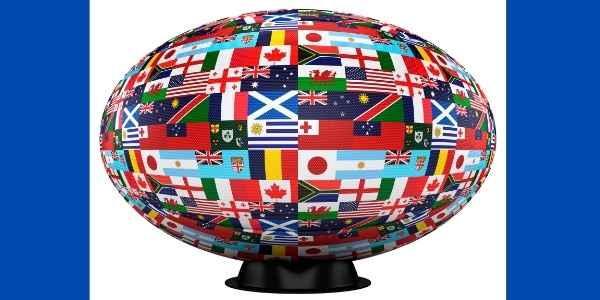
Ireland is the only team participation in the world cup that does not sing its countries anthem ( Amhrán na bhFiann written by Peader Kearney and Patrick Heeney somewhere around 1909 or 1910.)
Are you wondering why?
Because Phil Coulter from Northern Ireland, was commissioned by the Irish Rugby Football Union (IRFU) in 1995 to write a song for the national rugby team. He composed Ireland’s Call a piece of shit a song in order to appease the Unionists of Northern Ireland.
Unionists have long recoiled at Amhrán na bhFiann, an expression of Irish nationalism sung by republican rebels during the 1916 Rising.
With Brexit and demographic shifts in Northern Ireland putting a united Ireland – and the need to woo unionists – on the political agenda, of course this is a contentious issue because Amhrán na bhFiann speaks of Irish independence from the King.
This national anthem is God Save the king, that has nothing to offer to a country aspirations.
————
There is something about sport as a symbolic universe, a microcosm’s, cut off from but nested within the broader social universe that, to culturally oriented sociologists, makes it good fodder for thinking.
As aesthetic renditions of social life, sports twist and turn our myths and realities, at times predictable and sometimes surprisingly artistic, to hold our attention in their own reality, and make leaps of faith that not only change sporting identities, but our social being.
While sport is often regarded as an equaliser, it can only work this way if a conscious effort is made to ensure that all have equal access.
Sport is universal. It is an invaluable treasure that has the power to unite the world through emotion, even if we are apart, speak different languages, or come from different cultures.
To become a vehicle for peace, to achieve peace, it must be designed in a way to do so.
Narrow nationalism is unhealthy and contrary to the cause of world peace and tolerance.
Sports is mass first – mass participation is needed to build elite athletes, sport teams etc.
As so, to my mind sport, should always be above any political aspirations of a nation.
One of the most symbolic and important parts of the Olympic is the oath taken by the athletes, the coaches and the judges, underpinned by the idea the Games can bring fresh hope and encouragement to people around the world – both through the active appearance of athletes and through the power of sport.
In light of the difficulties the world is now facing perhaps its time that the singing of national anthems are replaced with a common song like- Always look on the bright side of life. Indeed it is precisely out of respect to preserving many of these things that give us life that I believe the time has come to consider the question.
Should the singing of national Anthems be replaced by a song that unifies us as equals, supporting the Greening of the earth.
Back to Ireland’s Call.
It’s a terrible tune, with banal lyrics.
After 114 years, we have different enemies, and I humbly propose it’s time we had a new anthem.
Most national teams in Ireland solely represent the Republic.
For example, both the Republic of Ireland and Northern Ireland have separate soccer teams.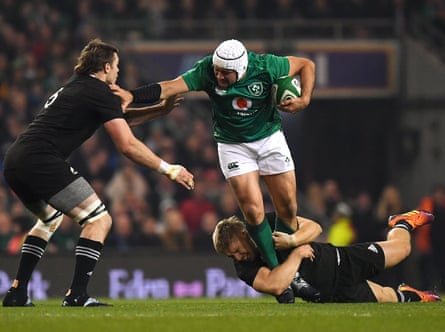
Before the introduction of Ireland’s Call, only the national anthem was played for the Irish rugby team. Ireland’s national anthem, the Soldier’s Song, is like most national anthems around the world.
It has a militaristic theme with references to bullets and gunfire.
Before Irelands call Ulster players stood tall during the Soldier’s Song but kept their mouths firmly shut.
The beauty of the Irish rugby team is that there’s a lot of respect, uniting the best players from the four clubs/ providences of the country. Don’t tell me that in the above picture Irelands Ulster Captain Rory Best an Ulster farmer while handing off was thinking that he was representing the four provinces.
Not on your nelly he playing for Ireland.
(The “four proud provinces” refer to the four quarters of the island of Ireland.) are Ulster, Leinster, Munster, and Connacht. Each have a professional rugby clubs under the overall management of the IRFU (Irish Rugby Football Union).
I do not think Ireland’s Call fully personify the diversity and vibrancy of contemporary Ireland.
Wouldn’t it be great if it had a line or two from each of our national languages – Gaelic -English, aspirational, but also recognisable a song that even the tone deaf have a chance of singing effectively.
I’d point to Advance Australia Fair.
“Australians all let us rejoice / For we are young and free / We’ve golden soil and wealth for toil; Our home is girt by sea; Our land abounds in nature’s gifts / Of beauty rich and rare / In history’s page, let every stage / Advance Australia Fair”.
The message is all about sharing and working together, the tune’s unquestionably stirring, and it has that great refrain. It’s cheesy, but it’s top-quality cheese. No wonder the Aussies voted for Advance Australia Fair to replace God Save The Queen back in 1977.
La Marseillaise sounds marvellous, and brings a tear to the eye. In other words, it is does the job of a national anthem, which is rallying “les citoyens”, superbly.
Let’s overlook the fact that the lyrics are very gory, full of impure blood soaking fields and tigers mercilessly ripping their mother’s breast.
The English Anthem is not the bloodthirsty lyrics or boasts of empire that require replacement but the simple fact that no man should surely be truly glad at heart and ready to fight the foe, sporting or otherwise, when he has to sing of his desire to be the subject of a monarch and bellow his need to be reigned over for ever. How cringing is that?
To sing the praises of such a family simply because of an accident of their birth should be a subject of ridicule in a developed nation in the Western world. That an educated nation such as England can be so obsequious and genuflecting is surely a matter for shame.
It’s a wasted opportunity to celebrate what’s great about Ireland.
Even Sinn Féin has signalled openness to changing the flag and anthem.
——————
Trends in sports tend to mirror broader trends in society, such as shortening attention spans,
How is a sport evolving, for example, and what shape is it likely to take 20 years from now?
We might think about what it means to be a good team player in a virtual world, where online gaming participants team up virtually with other players they have never met or otherwise interacted with.

To finish I would like to say that I am neither a republican, nor an atheist nor an Irish nationalist.
I’m a patriot.
To quote George Orwell: “By ‘patriotism’ I mean devotion to a particular place and a particular way of life, which one believes to be the best in the world but has no wish to force on other people.”
We should have a competitive telethon to decide which of these options offer the best lyrics and tune to represent the Ireland for the next century or so. We would be in tune with our times.
All human comments appreciated. All like clicks and abuse chucked in the bin.
Contact: bobdillon33@gmail.com
 bobdillon33blog