
( Fifteen minute read)
This is a country lurching from one crisis to another, a country is crying out for hope. A country that no longer works.
We tend to think of the world’s most powerful nations as unshakable actors on the world stage, but of course they are not.
The grim reality for Britain as it faces up to 2024 is that no other major power on earth stands quite as close to its own dissolution.
Given its recent record, perhaps this should not be a surprise.
By leaving the European Union, achieving the rare feat of erecting an economic border with its largest trading partner and with a part of itself, Northern Ireland, while adding fuel to the fire of Scottish independence for good measure. And if this wasn’t enough, it then spectacularly failed in its response to the coronavirus pandemic, combining one of the worst death rates in the developed world with one of the worst economic recessions.
Reaping the rewards of the Maggie Thatcher years, the United Kingdom is being confronted with huge problems it can no longer wish away.
A victim of modern privatised capitalism’s, increasing fondness for stripping out, squeezing down, and chasing dividends, it has ignored the needs of its people for the sake of GDP.
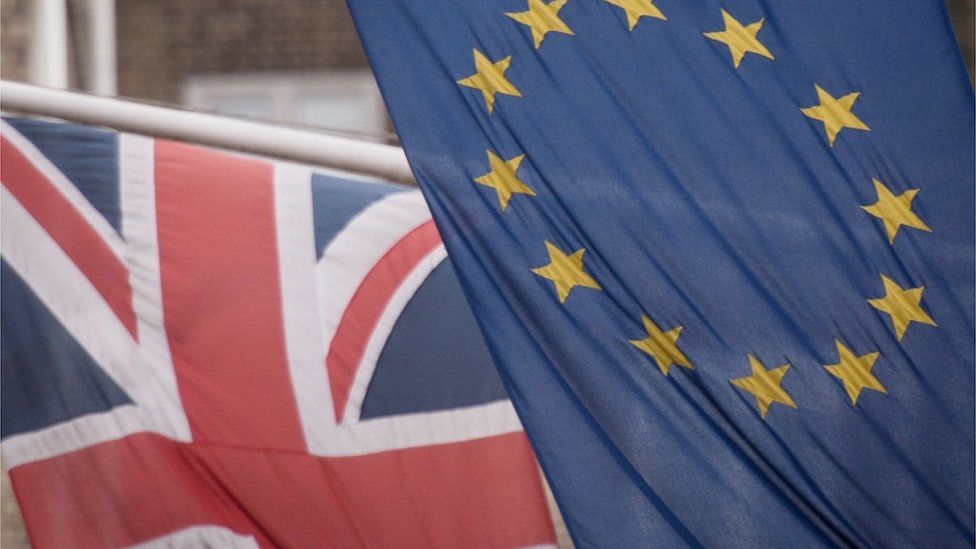
From the divisive 2016 Brexit referendum and the years long turmoil of leaving the E.U. (the world’s largest trading bloc – one that is seven times larger than the UK by population), England is now losing its wealth through a stupid gamble based on a pack of lies.
To the COVID-19 pandemic in which the U.K. suffered the worst per capita death toll in Western Europe it was then hit by multiple blows in the span of just a few months.
The downfall of Boris Johnson following a series of scandals that engulfed his government, on July 7; the death of the country’s longest-reigning monarch, Queen Elizabeth II, on Sept. 8; the crashing of the British pound two weeks later, after then Prime Minister Liz Truss unveiled a package of unfunded tax cuts for the superrich; and, finally, the collapse of yet another Conservative government on Oct. 20.
One only has to look, to see more and more appeals for help. From charitable organisation, from the NHS, to RSPCA to the RNI, to Schools, to foodbanks, to see that it is plunging deeper into crisis by the day, with a government missing in action.
It is against this bleak backdrop that virtually everyone—from political analysts to pollsters and even most voters—expects that Starmer will become the U.K.’s 58th Prime Minister when the country holds its next general election by January 2025.
In the mean time Sunak (whose reported $837 million net worth makes him the richest-ever occupant of Downing Street) is Prime Minister without a peoples mandate.
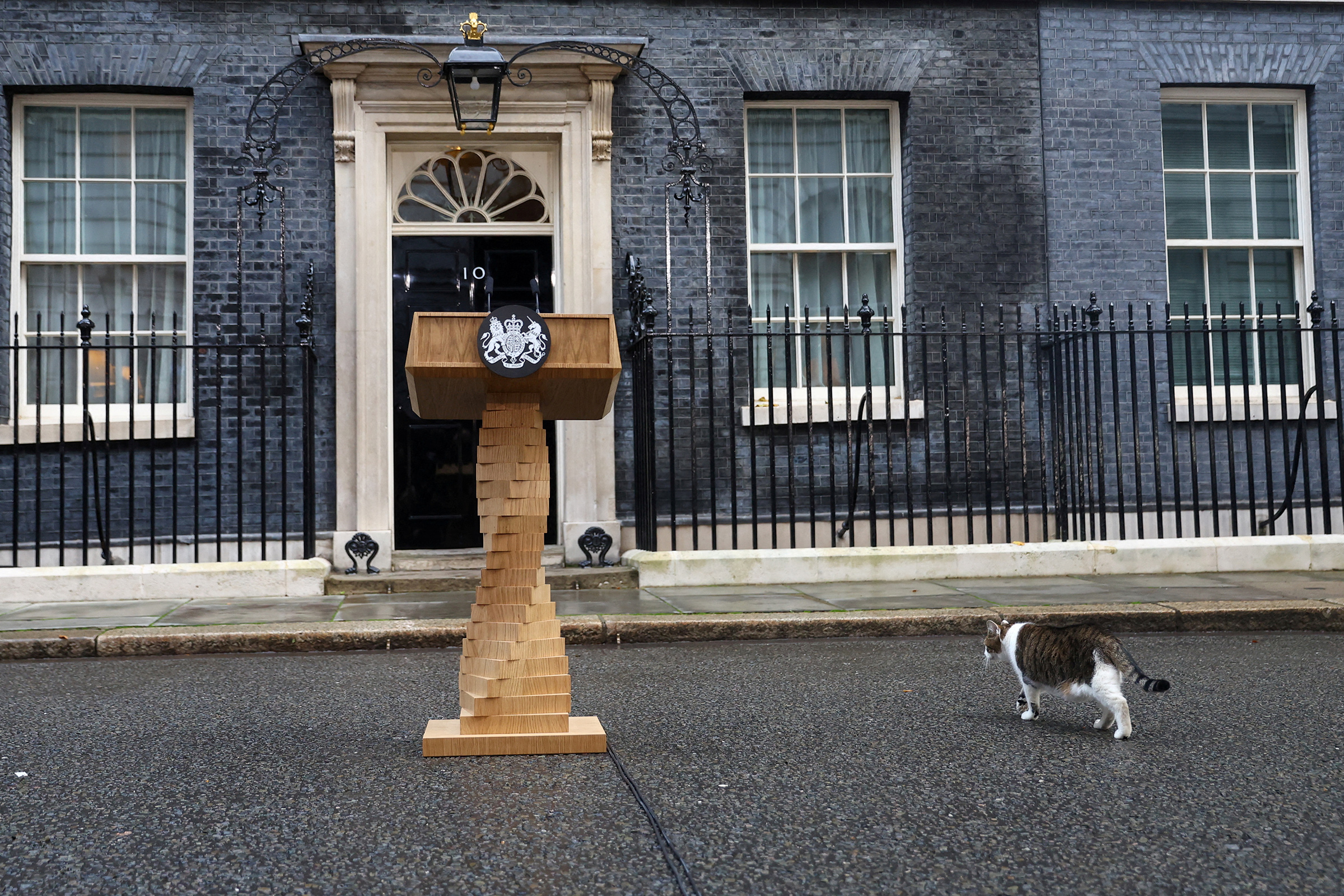
As the U.K.’s latest leader, Rishi Sunak, emerged unelected by the people to replacement to Truss.
The fifth Prime Minister in just over six years.
A prime minister who has done more than any other person in Britain to enable division and stupidity, while life in the U.K. is becoming less hopeful, more expensive, and, increasingly, shorter.
Rishi Sunak was asked what “levelling up” actually means, he simply laughed. 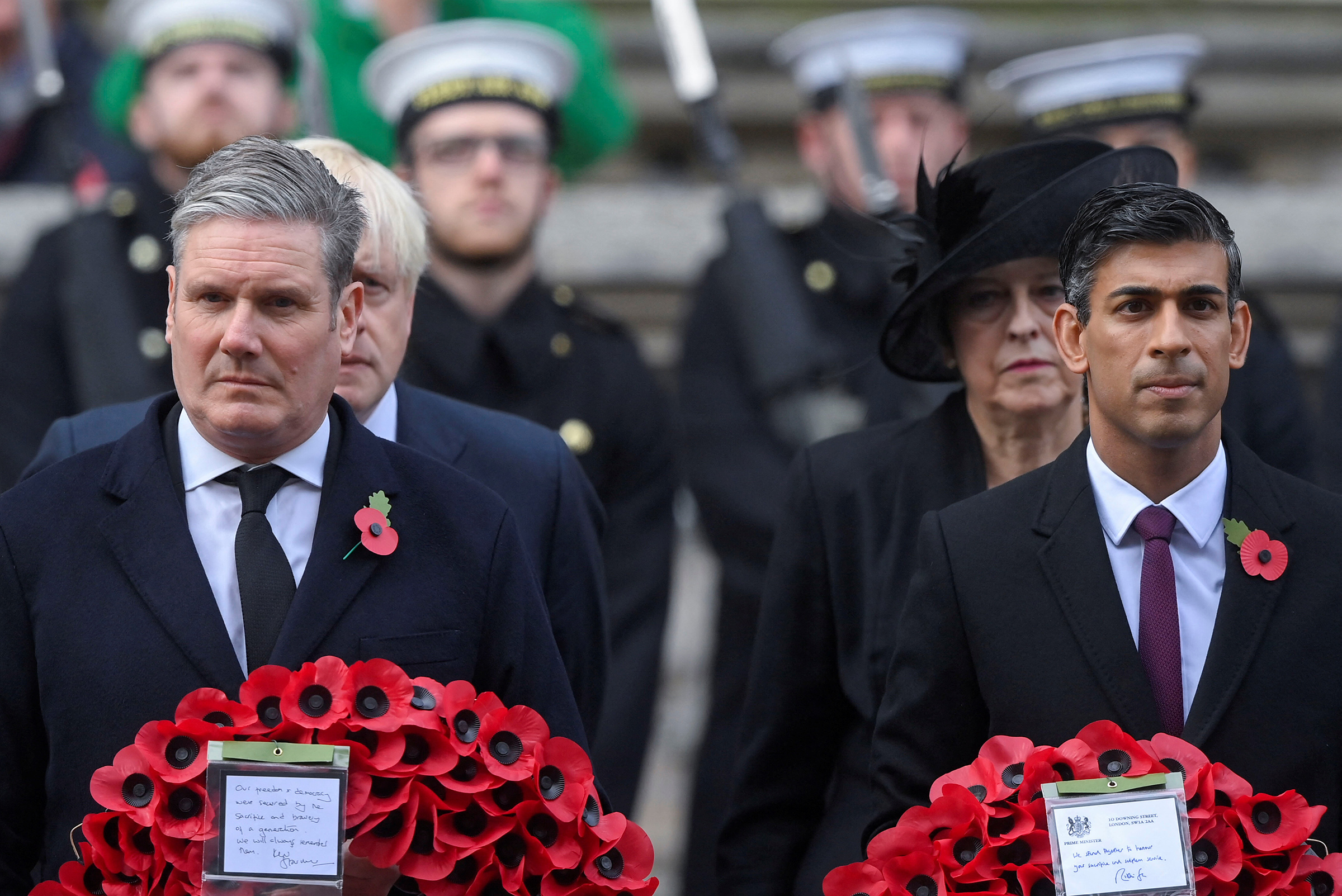
There is an obvious conclusion to be drawn.
There is something much deeper wrong.
It is the country itself that is now creeping out shamefacedly from its empire/ industrialist days into the light, wondering what, exactly, is wrong with it.
At the heart of Britain’s crisis is a crisis of identity. Put simply, no other major power is quite as conflicted about whether it is even a nation to begin with, let alone what it takes to act like one.
With the passing of the Soviet Union and Yugoslavia, it is now one of the rare states in the Western world whose name is not simply the nation it represents: The United Kingdom is more than Britain and the British. Some of its citizens believe themselves to be British, while others say they are not British at all.
For many, the root of Britain’s existential crisis today is Brexit—an apparent spasm of English nationalism that has broken the social contract holding Britain’s union of nations together, revealing the country’s true nature as an unequal union, of the English, by the English, for the English.
Although Brexit was carried by a majority of the U.K. as a whole, it was opposed by two of its constituent parts, Scotland and Northern Ireland. It was the votes of England, its dominant nation, that carried the day.
Yet the truth is that the Englishness of Brexit only matters if people see themselves as something other than British.
The great British bake off, run badly, staffed by people who don’t care enough.
It has grown lazy and complacent, unable to act with speed and purpose.
The state had stopped paying attention to the basics of government, whether that was the development of its economy, the protection of its borders, or the defence of the realm.
Instead, it had become guilty of a failed elite groupthink that had allowed separatism to flourish, wealth to concentrate in London and its surrounding areas, and the political elite to ignore the public mood.
In its scramble to survive, it forgot who it was, now destine to break up into its old component parts.
The U.K., is currently projected to be the G-7’s worst economic performer this year, is on track to become poorer than post-Communist Poland by the end of the decade.
Inflation, which reached a 41-year high in October, has barely eased. The worst cost-of-living crisis in a generation has led to crippling labour strikes, prompting hundreds of thousands of workers—among them doctors, nurses, train drivers, and teachers—to walk out in demand of better pay in the past year.
The cost of living crisis didn’t suddenly materialise in 2022. The living crisis is nothing new for millions of people who have lived in fear of hunger and homelessness for 12 years.
From 2010, a decade of austerity saw £37bn slashed from the welfare system. Food banks became a shameful fact of life. Wages have continued to stagnate and access to stable, even halfway affordable housing has become increasingly chimerical.
The most up-to-date figures show that 13 million people were living in relative poverty in 2020-21, with another seven million living in a state of perpetual “financial fear” At least 320,000 people are currently homeless in the UK.
As everyday costs continue to detach from reality, pressure has ratcheted up to new extremes.
Even the proposed solutions have their own built-in traps and inadequacies. It might mean being forced into predatory loans to make increasingly frayed ends meet, or living in a home with a more costly pre-payment energy meter. It might mean a lack of access to stable credit, or even a bank account.
If budgeting was torturous before, then it is becoming borderline impossible in the current climate. This is doubly true for those with existing debts with hidden tax costing some of the poorest people an estimated additional £430 a year.
How are you supposed to plan against the future when ends never quite seem to meet?
What is happing?
For example. Under Starmer, Labour’s policies for nationalizing public utilities have been side-lined by pledges to deliver the highest sustained economic growth in the G-7.
Decades of underinvestment have taken their toll on the UK. Major infrastructure projects, from broadband to sewers, were put on hold, leading to massive issues nationwide.
————-
The UK has endured a “lost decade” of productivity.
The UK is home to an ageing population. According to the latest statistics from Age UK, there are now nearly 12 million people aged over 65 in Britain.
What is certain is that it need to channel the surplus of money more effectively towards sustainable asset classes that deliver both economic and social returns, and to correct decades of underinvestment.
Its politicians, its business and banking leaders need to collaboratively join the dots.
Against this background what we see are two worthless new aircraft carriers, a highspeed railway costing trillions, as the government prepares to finalise a £24.5bn deal to build Hinkley C, the country’s first new nuclear plant for a generation. (A fifth more expensive than in France, a third more than the US and more than twice the projected costs in China or Korea.) Despite this, nuclear power continues to form a key plank of the UK government’s “portfolio” approach to decarbonisation.
It’s hardly news that life in the UK is becoming untenable.
As the days grow darker, so too does the mood in the UK as it head’s into yet another punishing winter.
Most people in the UK will see their quality of life deteriorate in the short term.
———
Benefit spending is constantly in the news but how much do we really know about where the benefits money goes in the UK?
£159bn was spent on benefits – an increase of 1.1% on the previous year. That is 23% of all public spending. With 20.3 million families receiving some kind of benefit (64% of all families), about 8.7 million of them pensioners. For 9.6 million families, benefits make up more than half of their income (30% of all families), around 5.3 million of them pensioners.
The UK is home to an ageing population. According to the latest statistics from Age UK, there are now nearly 12 million people aged over 65 in Britain[
The NHS started in 1948 and now employs over 1.5 million people. This makes it the biggest employer in the UK, in Europe, and 5th biggest in the World.
The wage bill for the NHS makes up a substantial proportion of its budget. In 2021/22, the total cost of NHS staff was £66.2 billion which amounted to 45.2 per cent of the NHS budget.
-
Day-to-day spending on the NHS will rise by 3.8% between 2021/22 and 2024/25, reaching a total of £166bn (in today’s prices) by 2024/25. The capital budget to cover NHS infrastructure costs will reach £10.5bn in 2024/25 (in today’s prices), in line with the REAL Centre’s projection of what is needed over this period. With a population of 67 million, that is about £2700 each.
-
So here is a few radical suggestion.
-
England the country – not the football team – it needs to take a look at itself.
-
Scrap first past to post voting. Replace it Proportional Representation to reflect its multi cultural population. In doing so place the Monarchy on a historical footing paying for its self from its own wealth. This requires a written constitution.
-
The central problem is this:
-
With a separate Scottish Parliament, Scottish voters can elect lawmakers to the British Parliament in Westminster, whose votes decide policies that only apply in England. English voters, meanwhile, have no say over policies decided by the Scottish Parliament in Edinburgh, even though the money used to pay for these policies is raised by the British government. This structural problem has no solution, either, because to create an English parliament on a similar footing to the Scottish one would mean that the most important person in the country would no longer be the British prime minister, but whoever ran the new English assembly.
-
Scrap the Benefit Society and charge a fees for hospital attendance while Introducing a Universal basic income for £1,600 a month for all those with citizenship earning less than living wage.With such an income they are no longer entitled to benefits, must look after their own health and education. A UBI would directly alleviate poverty and boost millions of people’s wellbeing: the potential benefits are just too large to ignore.No one should ever be facing poverty, having to choose between heating and eating.Some serious consideration of reform is vital to how millions of National Lottery and public money is spent on sport which should be funded by income of Football worth trillions.This is the time to be talking about constitutional change in order to use money and investment as a force for good not profit. Integrate the action of individual agents, such as businesses, industries, banks and hedge funds, from the ground up because with technology these systems are suddenly become wildly unpredictable, exhibiting extreme fluctuations.It all points to governments worldwide and how they have bought into the idea that economic growth can be perpetuated for ever. But that isn’t strictly realistic without action.For instance:The green energy transition will affect every aspect of life. Armed Forces often have a strong influence on governments across the world and therefore if they act, governments are more likely to act. British military activity are responsible for approximately 50% of all UK government emissions, it plays a fundamental role in helping the country reach net zero by 2050 at the latest. Climate change is important, but the time scales being talked about (2050, or even 2030) are seen as distant – important, but not urgent when urgent is something faced today, tomorrow. The solution is to make the important urgent, and this is beginning to happen.————
England is so deep in places that its secrets remain hidden.
Does the future of the United Kingdom—a political entity only 100 years old—really matter?
After all, the state that exists today is the product of Irish secession in 1921.
One of the problems in Britain is that the loss of faith in the country is now so pervasive that it is hard to know whether it can be rebuilt.
The union is not only being questioned by Welsh, Irish, and Scottish nationalists, but also, now, by the once-unionist middle classes in England for whom Brexit has broken a bit of the faith they had in Britain. Some simply no longer believe it’s worth saving.
The Republic of Ireland in recent years must also acknowledge the uncomfortable challenge it presents to British unionism.
And this is not just because it too is wealthy and settled, but because, in the imaginative sense, it knows who it is. Its national myths and stories might be just as bogus as any other country’s, but it believes them and promotes them through symbols and ceremonies. It is, in effect, a deeply conservative state that promotes a cohesive nationalism in a way the British state simply does not.
For Ireland, this success carries its own challenge as it seeks to subsume Northern Ireland and its million-strong British Protestant population, who do not share these national stories.
Look after the people first and GDP growth will follow.
It seems to me that if Britain is to survive, it has to believe that there is such a thing as Britain and act as though that is the case.
At root, Brexit was an assertion of nation—the British nation—but one mostly made by the English.
Here in lies its essential paradox. It is a revolution that has the potential to accelerate the breakup of the nation by revealing its Englishness, but also one that carries within it the potential to slowly rebuild a sense of Britishness by creating a new national distinctiveness from the other: Europe.
Outside the European Union, Britain’s collective experience becomes more national by definition.
It is for this reason that Brexit makes Scottish independence more likely in the short term, but more complicated in the long term, because it would mean imposing a hard border across the island of Britain that would not have been necessary had the U.K. remained in the EU.
In time, Brexit might prove to be the thing that finally breaks the union, or a shock that started the long, painful rebuilding process.
The United Kingdom of Great Britain and Northern Ireland remains an unusual country, but its vital memories are dying.
To survive, it must be more than empty pomp.
All human comments appreciated. All like clicks and abuse chucked in the bin.
Contact: bobdillon33@gmail.com
 bobdillon33blog