
( Five minute read)
We have very limited ability at this stage to imagine the applications of quantum computing, but down the road in the near term they could solve countless problems – and create a lot of new ones.
In order to prepare for what is coming.
Educate ourselves on the reality of Quantum Computers, and the impacts they could have around the world is now paramount if we wish to keep the values we place on life.
Soon will come a time when trusting a quantum computer will require a leap of faith.
Every year, new computers are being developed that are faster and smarter than ever before. But if you really want to take things to the next level, you’ve got to go quantum.
This new frontier of humanity could open hitherto unfathomable frontiers in mathematics and science.
Quantum’s industrial uses are boundless.
In the future, we will rely on everywhere in the world having access to quantum technology, but with risks, to national-security migraine. Its problem-solving capacity will soon render all existing cryptography obsolete, jeopardizing communications, financial transactions, and even military defences.
Modern warfare and national–security mechanisms are grounded in the speed and precision of decision making. If your computer is faster than theirs, you win.
The digital devices in our everyday lives – from laptop computers to smartphones – are all based on 0s and 1s: so-called ‘bits’. But quantum computers are based on ‘qubits’ – the quantum 0s and 1s that are altogether stranger, but also more powerful. (So-called quantum particles can be in two places at the same time and also strangely connected even though they are millions of miles apart.)
They will pave the way for systems that can solve complex real world problems that the best computers we have today are incapable of.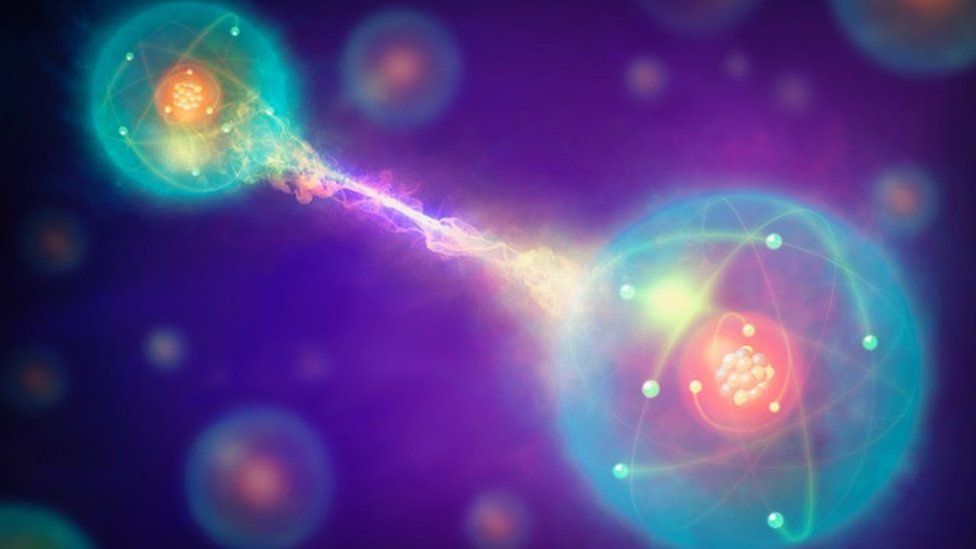
Currently, computers solve problems in a simple linear way, one calculation at a time.
A quantum computers could do multiple calculations all at the same time, millions of miles apart, mirroring each other’s actions instantaneously, transporting information from one chip to another with a reliability of 99.999993% at record speeds.
——-
Now that we understand what AI is capable of we also need to know its limits.
Before long, much of the material on the internet will have been written, or at least co-written, by AIs.
What will happen when AIs are being trained on texts they have written themselves?
The amount of data consumed in this way keeps going up and up.
What happens when data runs out?
——-
Generative AI is in a Cambrian explosion of capability.
Generative Ai, is now creating art, make music, generate synthetic humans, birth artificial influencers and celebrities, literally generate video from text, and threaten to upend our notions of creativity, art, public domain, copyright, and the nature of reality itself.
This is just the beginning, the ultimate thing for AI to create is more of itself.
When maybe AI is also at the point where it can start writing the code that will make its own AI even better. And that’s like where the true singularity is … when it can kind of set itself to improve itself, when it can start to improve itself better than what a human can.
It’s impossible to speculate what society could truly look like in such a situation.
But I think in most of our lifetimes we’re going to experience that. Exciting is one word for that.
Another is terrifying. Machines that can outthink humans. Your brain is the most intelligent learning algorithm in the universe that we know so far. The truth is that for now, AGI remains a fantasy.
Even if AGI is never achieved, the self-teaching approach may still change what sorts of AI are created.
The rapid development of AI that can train itself also raises questions about how well we can control its growth. If AI starts to generate intelligence by itself, there’s no guarantee that it will be human-like.
Whether this will happen, and how it will progress if it does is impossible to know, but there’s no guarantee that humanity as we know it would survive such a time, or that the vast AI entities potentially created by such an explosion would be benevolent to life as we know it.
I think that really where AI can be empowering is in that long tail when there’s like non-consumption with the alternative, where you could not afford to create that content in the first place.
And you can imagine that with like these very obscure topics.
You could even imagine that for news where maybe there’s something that happened in your local neighbourhood where only 20 people want to read that article and then it doesn’t make sense for a human to write it.
Generating artificial intelligence is all ready producing images like a photographer, creating music like an artist, selling like a sales rep, diagnosing disease like a doctor, and (gulp!) writing text like a human.
The technology could potentially also be used to design drugs more quickly by accurately simulating their chemical reactions, a calculation too difficult for current supercomputers. They could also provide even more accurate systems to forecast weather and project the impact of climate change.
Rather than humans teaching machines to think like humans, machines might teach humans new ways of thinking.
All human comments appreciated. All like clicks and abuse chucked in the bin.
Contact: bobdillon33@gmail.com
 bobdillon33blog